One Sure Thing About Globalization – The American Motion Pictures Industry World Hegemony Part 5

[Editor’s note: this lecture was delivered to the Leavey Institute of Santa Clara University in 2003. You can find it reproduced in whole here]

The Virtuous Global Effects of American Motion Pictures Hegemony

If one concedes the possibility that screen products generate or encourage violence, one must also accepts the possibility that they may affect behavior in socially desirable ways. (One can’t have it both ways: Television and, by extension, the cinema are either impotent or they may exercise a virtuous influence, as well as a pernicious one.) Thus, Curtin (1999) argues that satellite television circulates globally beneficently subversive (i.e. non-traditional), images of femininity, and therefore, alternative ways of being a woman. A moving testimony comes from the Albanian novelist Ismail Kadaré (1999): During the long night of Albanian communism (Albania was the most isolated country on Earth for forty years. Its paranoiac regime ended up cutting off relations with all countries except North Korea), Kadaré comments at length on how frequent exposure to garden–variety Western television courtroom drama ultimately induced among Albanians a distaste for personal blood feuds as old- fashioned or un-modern.

So, I pose the question: What virtuous influence may the ubiquitous American movies have on the rest of the world and, in particular, on the poor and on the downtrodden everywhere?

Even if one subscribes to the idea that movies don’t do much directly to alter either the values or the behavior of viewers, they inadvertently carry factual information, in their settings, as well as in the mundane aspects of their plots. I don’t see how some of that information cannot cumulatively have a liberating effect on those who live under less fortunate circumstances. American movies are shot mostly in the US (sometimes in Canada).They are directed mostly by American directors (or by Americanized Brits). Although Hollywood is one of the world centers of political correctness and of left-wing piousness, Hollywood films cannot help but convey to global audiences important realities of American life (and generic features of life in Western, secular, democratic, capitalist societies, in general). Among these: Continue reading

What Good Are Mathematical Models for the Science of Economics?

This question comes from co-blogger Warren Gibson’s piece in Econ Journal Watch titled “The Mathematical Romance: An Engineer’s View of  Mathematical Economics”:

Mathematics can be very alluring. Professional mathematicians speak frequently of “beauty” and “elegance” in their work. Some say that the central mystery of our universe is its governance by universal mathematical laws. Practitioners of applied math likewise feel special satisfaction when a well-crafted simulation successfully predicts real-world physical behavior.

But while the mathematicians, some of them at least, are explicit about doing math for its own sake, engineers are hired to produce results and economists should be, too. It’s fine if a few specialists labor at the outer mathematical edge of these fields, but the real needs and real satisfactions are to be found in applications.

Western civilization has brought us an explosion of human welfare: prosperity, longevity, education, the arts, and so on. We very much need the wisdom that economists can offer us to help understand and sustain this remarkable record. What good are engineers’ accomplishments in crash simulations if the benefits are denied to the world by trade barriers, stifling regulation, congested highways, or bogus global warming restrictions? What can mathematical economics contribute to such vital issues?

You can read the whole thing here (it’s also in the newly-renovated ‘recommendations’ section). Highly, uh, recommended! Mathematics is an important aspect of economics, I think, but Dr. Gibson and other Austrian critiques are more focused on the models that economists create rather than all of the wonderful data that can be quantified for calculation purposes.

I may be wrong, and I hope that my co-bloggers or others will correct me if I am, but either way Dr. Gibson’s critique of the mathematical models employed in the economics profession needs another good look.

One Sure Thing About Globalization – The American Motion Pictures Industry World Hegemony Part 4

[Editor’s note: this lecture was delivered to the Leavey Institute of Santa Clara University in 2003. You can find it reproduced in whole here]

Just another National Specialization

The massive asymmetry in films exports between the US and the rest of the world may be the result of any number of factors. The fact that foreign movies occasionally do well in the US market ( in recent years, “Life is Beautiful”, from Italy, “Amélie”, from France. The first, 1999, Pokemon cartoon from Japan grossed US$85.7 , million, according to WSJ 7/19/02:w11, and, as forecasted by same – “Read my Lips”, also from France, will do well) suggests that public preference, and possibly language barriers, are more likely to be issues than American distribution superiority, for example. Yet, language barriers may be less significant than one would guess. Luc Besson’s “Jeanne d’Arc” (“The Messenger”) released in 1999, purportedly produced in English to make it accessible to the polyglot EU markets and to the US market, registered 3.07 million admissions in the European Union in that year, against, 40 million for American-made “ Star Wars Episode 1”, 23 million for “Tarzan”, almost 21 million for “The Matrix” , and 7.4 million for “American Pie”. Even the obscure, American-made “Patch Adams” did better ( EAO 2001: 100). “The Messenger” flopped so badly in the American market that admissions and revenue figures are hard to find. For 1999 also, only one British production and two UK-US co-productions, all in English of course, figure among the top worldwide 50 admission getters. In Belgium where practically the whole population understands French , French-made movies obtain usually less than 10% market share, against an 80% share for American-made movies. (EAO 2001: 96). Finally, the foreign successes of Indian movies, almost all in languages understood hardly anywhere outside India and not everywhere in India, suggest again that language may be a small constraint. Continue reading

One Sure Thing About Globalization – The American Motion Pictures Industry World Hegemony Part 3

[Editor’s note: this lecture was delivered to the Leavey Institute of Santa Clara University in 2003. You can find it reproduced in whole here]

Broken Promises

Harm to the poor on a considerable scale occurs when rich countries suddenly violate the principles of free trade they publicly support, on the main. The US government and those of other post-industrial countries will periodically make a show of vaunting the merits of free trade on stages (such as the World Trade Organization) that guarantee worldwide publicity. These actions must encourage at least some of the most enterprising poor in poor countries to produce for distant markets they are not in a position to understand.

When the governments of rich and large entities, such as the US, Japan and the European Union, suddenly inhibit the free movement of products, those enterprising poor people in poor countries suffer, and suffer disproportionately. Thus, the recent passing of new American farm subsidies legislation (in 2002) makes it difficult or impossible for small farmers in the Sahel area of Africa to compete on the world ‘s cotton markets with American growers (Thurow and Kilman, 2002)(6). The steel tariffs erected by the Bush administration – with the full complicity of Congress – must have similar effect on steelworkers in some of the Third World and Eastern European steel-producing countries.

Neither of these policies nor the broken promises they imply, can be easily defended on moral or rational grounds. Directly, it can probably be shown that the economic actors of poor countries who embraced free trade end up worse off than they would be if they had toed to a more parochial (“autarkic”) line. Indirectly, such breaches of faith by powerful rich countries contribute to the stagnation of the Third World by seeming to prove wrong those who adopted a stance leading most surely to economic development: embracers of production for worldwide markets. (In my experience, well-educated defenders of national economic ”self-sufficiency” rarely care to argue against free trade in principle; instead, they rely on evidence that there is no real free trade but a poisonous international game where the dice are loaded against the poor in poor countries. Sometimes, they have a point.)

The American Motion Pictures Industry’s Hegemony Continue reading

From the Comments: the Unemployment Rate

Dr. Gibson has won the much-cherished gold star I had offered in a previous comment. My question had to do with the green dot in this graph, and Dr. Gibson explained it to perfection. He writes:

The widely followed U3 unemployment rate, as shown in the figure, is the number of unemployed divided by the labor force. The labor force excludes discouraged workers. The labor force participation rate is the labor force size (employed & unemployed) divided by the population. The green dot shows what the U3 rate would be if that ratio had stayed the same since Jan. 2009.

The U6 statistic counts discouraged workers as unemployed. That rate is currently around 15%.

See also: Unemployment: What It Is

From the article Dr. Gibson directs us towards comes some other important information:

Government policies contribute to unemployment above and beyond natural unemployment. The most notorious of these policies are minimum wage laws. These laws make it illegal, effectively, for low-skilled workers to accept employment. Anyone who cannot generate $8 worth of production per hour cannot expect to be paid more than $8. Such unfortunate people might be productive at $6 per hour but are forbidden to accept employment at this rate and are instead condemned to joblessness and all its attendant miseries. This burden falls most heavily on black teenagers, whose unemployment rate (based on those seeking work and excluding those who are in school) is well over 40 percent. The benefits accrue mainly to slightly higher-skilled workers, who have climbed onto the metaphorical ladder leading to better jobs and who are shielded from competition from those excluded by minimum-wage laws […]

Labor unions, as voluntary associations bargaining freely with employers, are unobjectionable. They did a lot of good in the past when working conditions in many places were pretty bad. But now they are granted special privileges by law—basically the privilege to engage in violent or coercive activities. The result is often wage agreements that are above market-clearing levels. Those left out are of course unemployed.

While labor unions can boost their members’ compensation at the expense of non-union workers, higher wages generally and higher living standards are due mainly to increased productivity, which in turn depends on high levels of capital investment. People are more willing to save and invest when they have confidence in the future, and that confidence comes from respect for property rights.

For more on minimum wage laws, see Bad Idea of the Year.

From the Comments: Keynesian Economics and the Stimulus Bill

A recent brouhaha has erupted in the comments thread of Dr. Delacroix’s post on Obama’s bad economic policies. Now, to be sure, the bad economy cannot be put on Obama’s shoulders alone. All he did was sign the stimulus act into law, after all, and I doubt John McCain would have vetoed it.

Let us also not forget about the two foreign wars that George W. Bush charged to the republic’s credit card, either. With that being said, I thought another economic chart would do readers of this blog a favor. From AEI’s blog comes this:

Ta-dah! Utter economic failure.

(h/t Steve Horwitz)

One Sure Thing About Globalization – The American Motion Pictures Industry World Hegemony Part 2

[Editor’s note: this lecture was delivered to the Leavey Institute of Santa Clara University in 2003. You can find it reproduced in whole here]

Poverty, some International Trends

Now, let’s look for objectionable new facts in the worldwide distribution of income. (It’s too difficult to get international data on wealth.) In the nineteen-fifties, the total of the national incomes of all other countries in the world barely equaled the national income of the US alone (Delacroix, 1974). Today, the US GNP constitutes less than one third of the sum of all countries’ GNPs (World Bank, 2002:4.2), although the US has experienced healthy economic growth since the fifties. It’s true that a number of countries are mired in deep poverty and that some are even regressing. (See below.) It seems to me those are all countries with exceptionally corrupt or tyrannical governments, such as Haiti on the one hand and North Korea, on the other, or stand-alone plutocratically-run former colonies such as the so-called “Democratic Republic of the Congo” (formerly Zaire), or Sierra Leone (where, incidentally, the bulk of the population was almost certainly better off under European colonialism), or that they have especially poor access to current information (because of high illiteracy and other reasons, including government censorship or even deeply entrenched cultural facts [4]), such as Afghanistan (but no hard data are available). By far the worst economic performers in the past ten years are the European countries that have been trying to recover from their cruel experiment in state socialism (“communism”), not the Third World countries.

In spite of loose talk of “globalization” somehow deepening the poverty of the Third World (5), the following countries experienced higher average Gross Domestic Product rates of annual growth than the US (and higher than any Western European country, except one; see below) between 1990 and 2000: Continue reading

Economic Growth in Europe: the Longer View

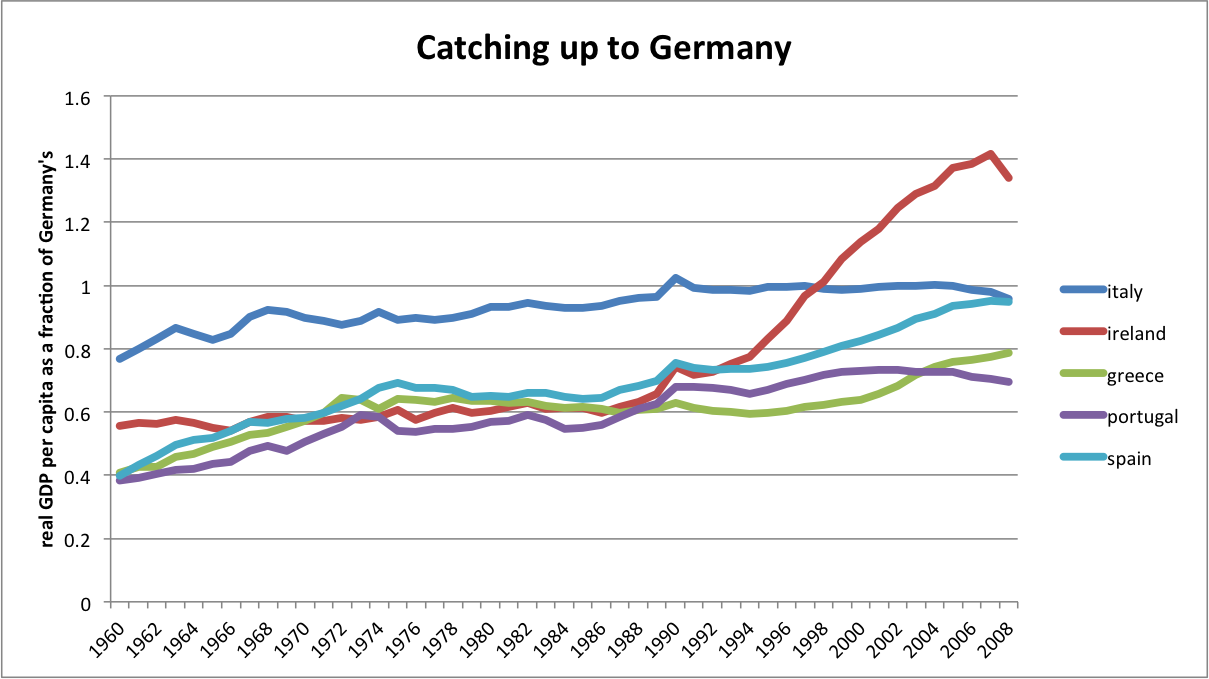
Economist Tyler Cowen has a post up on who has gained most from the Euro (as measured by state), but the economist Angus puts things into perspective:

Ireland, Spain, Portugal and Greece were all growing fast relative to Germany (and France which is not on the graph) well before the introduction of the Euro. Ireland and Spain take off somewhere around 1990 and the intro of the Euro in 2000 does not speed up their trajectory. Portugal actually falls further behind Germany in the Euro era. Greece is the only country of these 5 whose catch-up to Germany accelerates with the intro of the Euro.

Two quick thoughts:

  1. Woah! Look at Ireland!
  2. I’ll bet the acceleration of growth in the 1960’s had to do with the end of World War 2 and its rebuilding efforts.

Taking a broader historical view really puts things into perspective. If the Euro was not the catalyst for the economic growth of the 1990’s, what was? My guess is that the elimination of tariffs and labor restrictions between European states led to the growth. If the Eurozone had not implemented a central bank I think we wouldn’t be looking at all of the political problems now associated with the region.

Angus (who works at Oklahoma University) got his statistics from here. I highly recommend using it in your own studies as well.

One Sure Thing About Globalization – The American Motion Pictures Industry World Hegemony Part 1

[Editor’s note: this lecture was delivered to the Leavey Institute of Santa Clara University in 2003. You can find it reproduced in whole here.]

The word “globalization” is often used as shorthand to suggest that the world as recently shrunk for many purposes (Friedman, 1999). At first blush, this would seem to be good news, facilitating the spread of literacy, the diffusion of useful technologies, and socioeconomic progress, in general. However, a large segment of public opinion, in this country and, apparently, a larger segment in Europe and certain other countries (such as India), takes a jaundiced view of this shrinkage. This view is propagated by numerous websites as well as by professional intellectuals such as Noam Chomsky (who is often heard on National Public Radio). It contains a large anti-American component (Menand, 2002). It is widespread – at various levels of sophistication – in American universities. (1) In recent years, it has been dramatically acted out by rioters in Seattle, Quebec and Genoa, among other places. For left-wing opinion, “globalization” seems to imply that there is something radically new under the sun that is also economically nefarious for the poor and for the weak. For the same left-wing opinion, the word often suggests a sinister plot implicating in turn, “big corporations”, the World Trade Organization, the International Monetary Fund, and other organizations little understood by the general public. (For a broad, business-oriented and mildly liberal classification of the many sins the word “globalization” covers, see Eden and Lenway, 2001.) That new something entails a clandestine hegemony, or hegemonies, of some sort, dedicated to the further “exploitation” of the already poor and weak by the already rich and powerful. In this presentation, I develop the idea that there is little that is both radically new and nefarious,
and that what is new is likely to have largely beneficial effects. I rest my argumentation on readily available, public evidence.

Note: If you don’t think such a perspective on globalization exists, or you believe it’s inconsequential, you may want to stop reading. It is very difficult to find anywhere assertions about globalization displaying at once the following features: Continue reading

Obama’s Economic Policies: What’s Wrong, in a Nutshell

People are overwhelmed by the avalanche of bad news, and of news in general. It’s difficult to stop long enough to summarize objections to the new economic policies fostered by Presidents Obama and Pelosi.  Besides, if you tried, you might just strangle with horror and indignation. I made the effort. Here it is:

Pres Obama wants to re-distribute wealth when the amount of wealth available to re-distribute  is dwindling. It’s never happened, I think, in any democratic, market-oriented country before. Normally, you wait for a period when wealth is growing.

Pres Obama insists on an expensive stimulus package that will do, and has done little to stimulate the economy. Keynesian economics is largely wrong. This is Keynesian economics at its worst. It’s not even defensible by Keynesian standards.

Pres Obama choses a severe economic downturn to force us as a nation to try and do things we don’t know how to do. This includes switching from proven energy technologies such as coal and petroleum-based technologies to unproven ones such as air and wind technologies. It includes also constructing a satisfactory national health system, something no country has done. Normally, whenever you try something new, you make mistakes. You need a margin of error. You need to be reasonably rich. You don’t want to do it on a tight budget or when you are close to poverty.

Pres Obama is not evil. He has something I have seen hundreds of times in academia: He knows what he thinks he knows and he does not know anything else. He is narrow-minded and dogmatic. The more intelligent the person, the more stubborn in his narrow-mindedness and in his dogmatism. A less intelligent person would have the virtue of self-doubt, “Wait a minute, am I doing the right thing?”

Perplexing: There is an international media consensus  to the effect that the current global economic crisis was made in America. Yet, I detect no rise in anti–Americanism abroad. This would be a good time to be pissed off at us but, I don’t see it anywhere.

I wrote on this blog about “European Anti-Americanism.”  I suggested it was mainly based on envy. Perhaps, I was right: Others like us better when we are down and hurting. What do you think?

Recently, I mentioned the sentencing of a 75-year old woman to a whipping, in Saudi Arabia. I promised that I would check for indignant reactions on the part of Muslims. I have seen nothing on the website of the American Muslim Council and nothing of the website of the Islamic Society of North America.  I haven’t found anything either on French Muslim sites.

Of course, it’s disturbing. I would like it if someone told me that I am wrong and that I searched in the wrong places. I know I have Muslim readers. Get on your feet and do what’s right.

[Editor’s note: this essay first appeared on Dr. Delacroix’s blog, Bay Watch, on March 26th 2009]

North Dakota or Bust!

An excerpt from co-editor Fred Foldvary’s Progress Report:

In theory, productive public goods increase land rent because the supply of land is fixed. There can also be a rise in wages from more public goods, but that would be temporary. If labor becomes more productive in a location, that attracts labor from areas where wages are lower for the same skills. The increase in the labor supply will drive wages back down to normal. But the total supply of land in some region cannot expand, so the increase in rent sticks.

Just as territorial benefits raise land values, costs to landowners reduce the rent they keep, and so capitalize land value down. If the public goods are paid for by public revenue from land rent or site values, then the rise in land values would be limited. If governmental public goods are paid by labor and enterprise, then the rentalization and capitalization are implicit subsidies to landowners, at the expense of taxed labor and enterprise.

Economists have found evidence of the generation of higher land values from greater public goods. We now have an excellent case study: North Dakota.

Read the whole thing here. I’ve never been to North Dakota, but if it’s anything like South Dakota I might be tempted to settle there someday. Just kidding! California is the best state to live in, even with our terrible, fascistic-like government.

I am still having trouble wrapping my head around the concept of land value taxing, though. Someday I’m going to have to spend a couple of days with a copy of Henry George’s Progress and Poverty and see what I can figure out.

McCloskey Review = Leftist Rhetoric in Tatters

Deirdre McCloskey has an excellent review of a new book focusing on the immorality of capitalism. An excerpt:

The poor have benefited the most from capitalism. The sheer, first-act, unanalyzed equality that Sandel advocates would have killed the modern world and kept us in the appalling poverty of the human condition down to 1800. In fact in some countries it did, such as India after 1947, under Gandhi-plus-London-School-of-Economics egalitarianism, the “License Raj” and “the Hindu rate of growth,” as the Indians themselves bitterly described their communitarian economy. When I talk to friends who think like Sandel I worry that their dispositions will kill, quite unintentionally, the only chance for the world’s poor to achieve the scope for a full human life.

[…]

Sandel worries properly that the market can crowd out the sacred. A corporate market in, say, instruction in elementary classrooms can crowd out unbiased teaching about capitalism. Yet Sandel does not tell his own classroom that state schools can crowd out unbiased teaching about, say, the environment.

Do read the whole thing. McCloskey is an expert writer and a prestigious scholar, so be sure to grab a cup of coffee before you settle in. (h/t Jason Brennan)

From the Comments: Manufacturing Jobs and American De-Industrialization

I hate to admit it, but Dr. Delacroix has been on fire lately (with the exception of his foreign policy quackery, of course). I pulled this reply out of the ‘comments’ section of his post on the de-industrialization of the United States. You can find the condescending comment to Dr. Delacroix’s post here, but I’m going to reproduce Dr. Delacroix’s whole reply beneath the fold: Continue reading

Celebrating Chevron’s Profits

Recently there was a bad fire at the Chevron refinery in Richmond, CA, as you probably know.  The refinery will be offline for an unknown period, probably months.  Upon reading this, and knowing that the CA government prohibits “imports” of gasoline from other states, I knew the retail price would jump.  I made a mental note to fill up my Thunderbird next morning.  Too late – regular had jumped from $3.85 to $4.01.  This morning it was $4.06, and $4.13 by afternoon.

My reaction?  I’m delighted that the market is doing its job of balancing supply, which has suddenly dropped, with demand.  But predictably, ignorant fools have jumped on this situation, as in this letter in this morning’s San Francisco Chronicle:

Please ask Chevron to explain why the cost of gasoline will go up because of an accident at their plant.

Don’t they have insurance to cover the loss of their equipment? Is Chevron going to recoup the lost income (deducted from the billions of dollars in profit that they make every year) from us?

If the accident was determined to be due to Chevron’s negligence, are they going to compensate all of their neighbors “inconvenienced” by this?

But most of all, please ask all the other oil companies why their costs are going up because of a fire at a Chevron refinery.

If the other companies are not suffering a financial loss from this devastating environmental disaster in the Bay Area, why are prices expected to rise at Exxon-Mobil, Royal Shell Dutch, BP (Arco, lest anyone forget) and any other company I might be too angry to remember at this moment?

I might have to hold my breath until you find out the answers to these questions or until the air clears, whichever comes first. I’ll let you guess which one that will be.

Chevron probably doesn’t carry insurance because they are big enough to be self-insured, and the risks may be too large and uncertain for an insurance company to estimate.  But insurance is irrelevant to retail pricing.  The basic problem is the all too common myth on which this letter is based: that cost determines price.  The myth is that suppliers add up their costs and then tack on as much profit as they think they can get away with.  As anyone who has studied economics should know, supply and demand jointly determine price in a competitive market such as gasoline.  Set your price too high and you lose customers and your profit declines.  Set it too low and your margin declines, and you may sell out your supplies.  The sweet spot varies constantly with shifting supply and, to a lesser extent, shifting demand.

Of course, profits benefit Chevron’s shareholders.  But they are vastly more valuable to Chevron’s customers because they are the driving force (putting aside government interference) that tells Chevron what kind of products we want, where they are offered, how they are delivered, etc.

Of course, government interference is substantial and shouldn’t be set aside.  Politicians worried about rising gas prices could help out by lifting the prohibition on imports.

Hurray for profits!

Italy and National Debt and Everyone Else

I have been inactive. Some catching up to do. I will go straight to the Italian situation because I don’t see it addressed in the media with anything resembling insight based on good information. I am it by default.

It’s human nature I suppose to want simple solutions to complex problems and easy solutions to hard problems. Italy is out of the swamp and therefore, the Euro is saved and therefore, the sterco is not going to hit the fan on this side of the Atlantic. Reason: Old bad boy Silvio Berlusconi resigned. Not much analysis, not much going below the surface by the American press. I have to do their elementary work for them.

First, I suspect there is a monstrous confusion in the minds of many in the media between the accounts of Italy, the state, the Italian republic on the one hand, and the figures pertaining to the Italian economy, on the other hand. The Italian economy comprises a few highly visible major corporations such as Fiat and myriads of small businesses.

The Italian Republic is in debt. The Italian economy is doing well. It’s on the healthy side of economies of developed countries. It’s a lot better than Japan’s for instance. It’s also true that, as elsewhere in Europe, the budget of the state is large relative to the national economy. My bet is that it is smaller than say, in France, or in Sweden, or even in Germany, because the black economy in Italy is so large. The Italian government is just not able to get its grubby little hands on much of what’s generated within Italy. Nevertheless, it’s true that the government budget and the private sector economy influence each other in Italy, as they do elsewhere. That’s not excuse to confuse the one with the other. My wife and I influence each other. It does no mean that we are one and the same. (For one thing, she is both attractive and intelligent.)

Berlusconi did not accumulate the large sovereign debt of the Italian Republic. The debt goes back a long way, some say to the aftermath of WWII. Successive governments just left it alone or they contributed to it. Continue reading