On the (big) conditions for a BIG

This week, EconTalk featured a podcast between Russ Roberts and Michael Munger (he of the famous Munger-proviso which I live by) discussed the Basic Income Guarantee (BIG). In the discussion, there is little I ended up disagreeing with (I would have probably said some things differently though). However, I was disappointed about a point (which I made here in the past) which economists often ignore when discussing a BIG: labor demand.

In all discussions of the BIG, the debates always revolve around the issue of labor supply assuming that it will induce some leftward shift of the supply curve. While this is true, it is irrelevant in my opinion because there is a more important effect: the rightward shift of the labor demand curve.

To make this argument, I must underline the conditions of a BIG for this to happen. The first thing to say is that a) the social welfare net must be inefficient relative to the alternative of simply giving money to people (shifting to a BIG must be Pareto-efficient); b) the shift mean that – for a fixed level of utility we wish to insure – the government needs to spend less and; c) the lower level of expenditures allows for a reduction in taxation.  With these three conditions, the labor demand curve could shift rightward. As I said when I initially made this point back in January 2016:

Yet, the case is relatively straightforward: current transfers are inefficient, basic income is more efficient at obtaining each unit of poverty reduction, basic income requires lower taxes, basic income means lower marginal tax rates, lower marginal tax rates mean more demand for investment and labor and thus more long-term growth and a counter-balance to any supply-side effect.

As I pointed out back then, the Canadian experiment (in Manitoba) with a minimum income led to substantial improvements in health outcomes which meant lower expenditures for healthcare. As a result, b) is satisfied and (by definition) so is a). If, during a shift to a BIG, condition c) is met, the entire discussion regarding the supply effects becomes a mere empirical issue.

I mean, equilibrium effects are best analyzed when we consider both demand and supply…

P.S. I am not necessarily a fan, in practice, of BIG. Theoretically, the case is sound. However, I can easily foresee policy drifts where politicians expand the BIG beyond a sound level for electoral reasons (or even tweak the details in order to add features that go against the spirit of the proposal). The debate between Kevin Vallier (arguing that this public choice reasoning is not relevant) and Phil Magness (who argues the reverse) on this issue is pretty favorable to Magness (in my opinion). UPDATE: Jason Clemens over at the Fraser Institute pointed to a study they made regarding the implementation of a BIG in Canada. The practical challenges the study points too build upon the Magness argument as applied in a Canadian perspective. 

The Pox of Liberty – dixit the Political Economy of Public Health

9780226922171

A few weeks ago, I finished reading the Pox of Liberty authored by Werner Troesken. Although I know some of his co-authors personally (notably the always helpful Nicola Tynan whose work on water economics needs to be read by everyone serious in the field of economic history – see her work on London here), I never met Troesken. Nonetheless, I am what you could call a “big fan” in the sense that I get a tingling feeling in my brain when I start reading his stuff. This is because Troesken’s work is always original. For example, his work on the economic history of public utilities (gas and electricity) in the United States is probably one of the most straightforward application of industrial organization to historical questions and, in the process, it kills many historical myths regarding public utilitiesThe Pox of Liberty is no exception and it should be read (at the risk of become a fan of Troesken like I am) as a treatise on the political economy of public health.

Very often, it will be pointed out that public health measures are public goods that government should provide lest it be “underprovided” if left to private actors. After all, it is rare to hear of individuals who voluntarily quarantined themselves upon learning they were sick. As a result, the “public economics” argument is that the government should mandate certain measures (mandatory vaccination and quarantine) that will reduce infectious diseases. Normally, the story would end there. And to be sure, there is a lot of evidence that mild coercive measures do reduce some forms of mortality (mandatory vaccination and quarantine). The more intense the policies, the larger the positive effects on health outcomes. For example, taxes on cigarettes do reduce consumption of cigarettes and thus, secondhand smoke. In fact, even extreme coercive measures like smoking bans seem to yield improvements in terms of public health (another example is that of Cuba which I discussed on this blog).

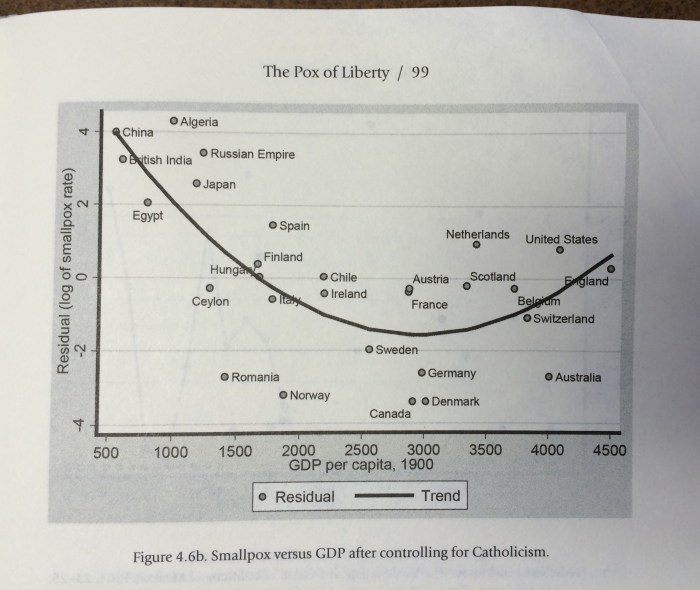
However, Troesken’s contribution is to tell us that the story does not end there. In a way, the “public economics” story is incomplete. The institutions that are best able to deploy such levels of coercion are generally also the institutions that are unable to restrain political meddling in economic affairs. Governments that are able to easily deploy coercive measures are governments that tend to be less constrained and they can fall prey to rent-seeking and regulatory capture. They will also tend to disregard property rights and economic freedom. This implies slower rates of economic growth. As a result, there is a trade-off that exists: either you get fast economic growth with higher rates of certain infectious diseases or you get slow economic growth with lower rates of certain infectious diseases (Troesken concentrates mostly on smallpox and yellow fever). The graphic below illustrates this point of Troesken. Countries like Germany – with its strong centralizing Prussian tradition – were able to generate very low levels of deaths from infectious diseases. But, they were poorer than the United States. The latter country had a constitutional framework that limited the ability of local and state governments to adopt even mild measures like mandatory vaccination. Thus, that meant higher mortality levels but the same constitutional constraints permitted economic growth and thus the higher level of living standards enjoyed by Americans relative to the Germans.

fullsizerender

But Troesken’s story does not end there.  Economic growth has some palliative health effects (in part the McKeown hypothesis*) whereby we have a better food supply and access to better housing or less demanding jobs. However, in the long-run economic growth means that new sectors of activity can emerge. For example, as we grow richer, we can probably expend more resources on drugs research to extend life expectancy. We can also have access to more medical care in general.  These fruits take some time to materialize as they grow more slowly. Nonetheless, they do form a palliative effect that contributes to health improvements.

However, there is an analogy that allows us to see why these palliative effects are important in any political economy of public health provision. This analogy relates to forestry. The health outcomes fruits from a “coercive institutional tree” can only be picked once. Once they are picked, the tree will yield no more fruits.  However, the yield from that single harvest is considerable. In comparison, the “economic growth tree” yields fewer and smaller fruits, but it keeps yielding fruits. It never stops yielding fruits. In the long-run, that tree outperforms the other tree. The problem is that you cannot have both trees. If you chose one, you can’t have the other.

In this light, public health issues become incredibly harder to decipher and understand. However, we can see a much richer wealth of information under this light. In writing the Pox of Liberty, Troesken is enlightening and anyone doing health economics should read (and absorb his work) as it is the first comprehensive treatise of the political economy of public health.


* I should note that I think that the McKeown hypothesis is often unfairly lambasted and although I have some reservations myself, it can be adapted to fit within a wider theoretical approach regarding institutions – like Troesken does. 

How Well Has Cuba Managed To Improve Health Outcomes? (part 3)

As part of my series of blog post reconsidering health outcomes in Cuba, I argued that other countries were able to generate substantial improvements in life expectancy even if Cuba is at the top. Then I pointed out that non-health related measures made Cubans so poor as to create a paradoxical outcome of depressing mortality (Cubans don’t have cars, they don’t get in car accidents, life expectancy is higher which is not an indicator of health care performance). Today, I move to the hardest topic to obtain information on: refugees.

I have spent the last few weeks trying to understand how the Cuban refugees are counted in the life tables. After scouring the website of the World Health Organization and the archives of Statistics Canada during my winter break, I could not find the answer.  And it matters. A lot.

To be clear, a life table shows the probability that an individual of age will die by age X+1 (known as Qx). With a life table, you will obtain age-specific death rates(known as Mx), life expectancy at different points and life expectancy at birth (Lx)(Where x is age). Basically, this is the most important tool a demographer can possess. Without something like that, its hard to say anything meaningful in terms of demographic comparison (although not impossible).The most common method of building such a table is known as a “static” method where we either compare the population structure by age at a single point in time or where we evaluate the age of deaths (which we can compare with the number of persons of each group alive – Ax). The problem with such methods is that static life tables need to be frequently updated because we are assuming stable age structure.

When there is important migration, Qx becomes is not “mortality” but merely the chance of exiting the population either by death of migration. When there are important waves of migration (in or out), one must account for age of the entering/departing population to arrive at a proper estimates of “exits” from the population at each age point that separate exits by deaths or exits (entries) by migration.

As a result, migration – especially if large – creates two problems in life tables. It changes the age structure of the population and so, the table must be frequently updated in order to get Ax right. It also changes the structure of mortality (exits). (However, this is only a problem if the age structure of migrants is different from the age structure of the overall population).

Since 2005, the annual number of migrants from Cuba to the United States has fluctuated between 10,000 and 60,000. This means that, on an annual basis, 0.1% to 0.5% of Cuba’s population is leaving the country. This is not a negligible flow (in the past, the flow was much larger – sometimes reaching north of 1% of the population). Thus, the issue would matter to the estimation of life tables. The problem is we do not know how Cuba has accounted for migration on both mortality and the reference populations! More importantly, we do not know how those who die during migration are measured.

Eventually, Ax will be adjusted through census-based updates (so there will only be a drift between censuses). However, if the Cuban government counts all the migrants as alive as they arrive in a foreign country as if none died along the way, it is underestimating the number of deaths. Basically, when the deaths of refugees and emigrants are not adequately factored into survival schedules, mortality schedules are be biased downward (especially between censuses as a result of poor denominator) and life expectancy would be accordingly biased upward.

Now, I am willing to reconsider my opinion on this particular point if someone indicates some study that has escaped my gaze (my Spanish is very, to put it euphemistically, poor). However, when I am able to find such information for other Latin American countries like Chile or Costa Rica and not for Cuba, I am skeptical of the value of the health statistics that people cite.

The other parts of How Well Has Cuba Managed To Improve Health Outcomes?

  1. Life Expectancy Changes, 1960 to 2014
  2. Car ownership trends playing in favor of Cuba, but not a praiseworthy outcome

What is Wrong with Income Inequality? Five Reasons to be Concerned

I sometimes part ways with many of my libertarian and classical liberal friends in that I do have some amount of tentative concern for income/wealth inequality (for the purposes of this article, the otherwise important economic distinction between the two is not particularly relevant since the two are strongly correlated with each other). Many libertarians argue that inequality ultimately doesn’t matter. There is good reason to think this drawing from the classic arguments of Nozick and Hayek about how free exchange in a market economy can often interrupt preferred distributions.

The argument goes like this: take whatever your preferred distribution of income is, be it purely egalitarian or some sort of Rawlsian distribution such that the distribution benefits only the worst off in society. Assume there is one individual in the economy who has some product or service everyone wants to buy (in Nozick’s example it was Wilt Chamberlain playing basketball), and let everyone pay a relatively small amount of income to that one individual. For example, assume you have a society with 10,000 people all who start off with an equal endowment of $5 and all of them decide to pay Wilt Chamberlain $1 to watch him play basketball. Very few people would object to those individual exchanges, yet at the end Wilt Chamberlain ends up with $10,005 dollars and everyone else has $4, and our preferred distribution of income has been grossly upset even though the individual actions that led to that distribution are not objectionable. In other words, allowing for free exchange precludes trying to construct an optimal result of that free exchange (a basic consequence of recognizing spontaneous order).

Further, these libertarians argue, it is more important to ensure that the poor are better off in absolute terms than to ensure they are better off relative to their wealthier peers. Therefore, if a given policy will increase the wealth of the wealthiest by 10% and the poorest by 5%, there is no reason to oppose this policy on the grounds that it increases inequality because the poor are still made richer. Therefore, it is claimed, we should focus on policies that improve economic growth and the incomes of the poor and be indifferent as to its impact on relative inequality, since those policies are strongly correlated with bettering the economic conditions of the poor. In fact, as Mises Argued in Liberalism and the Classical Tradition, a certain amount of inequality is necessary for markets to function: they create a market for luxury goods that can be experimented and developed into future mass-consumption goods everyone can consume. Not everyone could afford, for an example, an IPod when it first came out, however today MP3 players are cheap and plentiful because the very wealthy were able to demand it when it was very expensive.

I agree with my libertarians in thinking that this argument is largely correct, however I do not think it proves, as Hayek argued, that social justice (understood in this context as distributive justice) is a “mirage” or that we should be altogether unconcerned with wealth or income distributions. All this argument does is mean that there is no overall deontological theory for an ideal income distribution, but there still might be good consequentialist reasons to think that excessively unequal distributions can impact many of the things that classical liberals tell us to worry about, such as the earnings of the poor, more free political economic outcomes, or overall economic growth. Further, even on Nozick’s entitlement theory of justice, we might oppose income inequality if it arises through unjust means. Here are five reasons why libertarians and classical liberals should be concerned about income inequality (note that they are mostly empirical reasons, not claims about the nature of justice):

1) Income Inequality as a Result of Rent Seeking

Certain government policies result in uneven income distribution. For an example, a paper by Patrick MacLaughlin and Lauren Stanley at the Mercatus Center empirically analyze the regressive effects of regulatory policy. Specifically, Stanley and MacLaughlin find that high barriers to entry create barriers to entry which worsens income mobility. Poorer would-be entrepreneurs cannot enter the market if they must, for an example, pay thousands of dollars for a license, or spend a large amount of time getting costly education and certifications to please some regulatory bureaucracy. This was admitted even by the Obama Administration in a recent report advising reform of occupational licensing laws. As basic public choice theory teaches, regulators are subject to regulatory capture, in which established business interests lobby regulators to erect barriers to entry to harm would-be competitors. Insofar as inequality is a result of such rent-seeking, libertarians have an obvious reason to oppose it.

Many other policies can worsen inequality. When wealthy corporations receive artificial monopolies from policies such as excessive intellectual property laws, insulating them from competition or when they gain wealth at the expense of poorer taxpayers through improper subsidies. When the government uses violent policing tactics to unequally enforce drug laws against poorer communities, or when it uses civil asset forfeiture to take the property of the worst off. When the government uses eminent domain to take the property of disadvantaged individuals and communities in the name of public works projects, or when they implement minimum wage laws that displace low-skilled workers. Or, if the structure of welfare benefits discourages income mobility, which also worsens inequality. There are a myriad of bad government policies which benefit the rich and exploit the poor, some of which are a direct result of rent-seeking on behalf of the wealthy.

If the rich are getting richer, or if the poor are stopped from becoming wealthier, as a result of government coercion, even Nozick’s entitlement theory of justice calls for us to be skeptical of the resulting income distribution. As Matt Zwolinski argues, income distributions are not only a result of, pace Nozick, a result of the free exchanges of individuals, but they are also a result of the institutions in which those individuals exchange. Insofar as inequality is a result of unjust institutions, we have good reason to call that inequality unjust.

Of course, that principle is still very hard to empirically apply. It is hard to tell how much of an unequal distribution is a function of bad institutions and how much is a function of free exchange. However, this means we can provide very limited theories of distributive justice not as constructivist attempts to mold market outcomes to our moral desires, but as rough rules of thumb. If it is true that unequal distributions are a function of bad institutions, then unequal distributions should cause us to re-evaluate those institutions.

2) Income Inequality and Government Exploitation
Of course, many with more Marxist inclinations will argue that any amount of economic inequality will inherently result in class-based exploitation. There are very good, stand-by classical liberal (and neoclassical economic) reasons to reject this as Marxian class analysis as it depends on a highly flawed labor theory of value. However, that does not mean there is not some correlation between some notion of macro-level exploitation of the worst-off and high levels of inequality which libertarians have good reason to be concerned about, for reasons closely related to rent-seeking. Those with a high amount of economic power, particularly in western democracies, are very likely to also have a strong influence over the policies set by the government. There is reason to fear that this will create a class of wealthy people who, through political rent-seeking channels discuss earlier, will control state policies and institutions to protect their interests and wealth at the expense of the worst-off in society. Using state coercion to protect oneself at the expense of others is, under any understanding of the term, coercion. In this way, income inequality can beget rent-seeking and regressive policies which lead to more income inequality which leads to more rent-seeking, leading to a vicious political-economic cycle of exploitation and increasing inequality. In fact, even early radical classical liberal economists applied theories of class analysis to this type of problem.

3) Inequality’s Impacts on Economic Growth

There is a robust amount of empirical literature suggesting that excessive income inequality can harm economic growth. How? The Economist explains:

Inequality could impair growth if those with low incomes suffer poor health and low productivity as a result, or if, as evidence suggests, the poor struggle to finance investments in education. Inequality could also threaten public confidence in growth-boosting policies like free trade, says Dani Rodrik of the Institute for Advanced Study in Princeton.

Of course, this is of special concern to consequentialist classical liberals who claim we should worry mostly about the betterment of the poor in absolute terms, since economic growth is strongly correlated with bettering living standards. There is even some reason for these classical liberals, given their stated normative reasons, to (at least in the short-term given that we have unjust institutions) support some limited redistributive policies, but only those that are implemented well and don’t worsen inequality or growth (such as a Negative Income Tax), insofar as it boosts growth and helps limited the growth of rent-seeking culture described with reasons one and two.

4) Inequality and Political Stability

There is further some evidence that income inequality increases political instability. If the poor perceive that current distributions are unjust (however wrong they may or may not be), they might have social discontent. In moderate scenarios, (as the Alsenia paper I linked to argue) this can lead to reduced investment, which aggravates third problem discussed earlier. In some scenarios, this can lead to support for populist demagogues (such as Trump or Bernie Sanders) who will implement bad policies that not only might harm the poor but also limit individual liberty in other important ways. In the most extreme scenarios (however unlikely, but still plausible), it can lead to all-out violent revolutions and warfare. At any rate, libertarians and classical liberals concerned with ensuring tranquility and freedom should be concerned if inequality increases.

5) Inequality and Social Mobility

More meritocratic-leaning libertarians might say we should be concerned about equal opportunities rather than equal outcomes. There is some evidence that the two are greatly linked. In particular, the so-called “Great Gatsby Curve,” which shows a negative relationship between economic mobility and income inequality. In other words, unequal outcomes can undermine unequal opportunities. This can be because higher inequality means unequal access to certain services, eg. Education, that can enable social mobility, or that the poorer may have fewer connections to better-paying opportunities because of their socio-economic status. Of course, there is likely some reverse causality here; institutions that limit social mobility (such as those discussed in problem one and two) can be said to worsen income mobility intergenerationally, leading to higher inequality in the future. Though teasing out the direction of causality empirically can be challenging, there is reason for concern here if one is concerned about social mobility.

The main point I’m getting at is nothing new: one need not be a radical leftist social egalitarian who thinks equal economic outcomes are necessarily the only moral outcomes to be concerned on some level with inequality. How one responds to inequality is empirically dependent on the causes of the problems, and we have some good reasons to think that more limited government is a good solution to unequal outcomes.

This is not to say inequality poses no problem for libertarians’ ideal political order: if it is the case that markets inherently beget problematic levels of inequality, as for example Thomas Piketty claims, then we might need to re-evaluate how we integrate markets. However, there is good reason to be skeptical of such claims (Thomas Piketty’s in particular are suspect). Even if we grant that markets by themselves do lead to levels of inequality that cause problems 3-5, we must not commit the Nirvana fallacy. We need to compare government’s aptitude at managing income distribution, which for well-worn public choice reasons outlined in problems one and two as well as a mammoth epistemic problem inherent in figuring out how much inequality is likely to lead to those problems, and compare it to the extent to which markets do generate those problems. It is possible (very likely, even) that even if markets are not perfect in the sense of ensuring distribution that does not have problematic political economic outcomes, the state attempting to correct these outcomes would only make things worse.

But that is a complex empirical research project which obviously can’t be solved in this short blog post, suffice it to say now that though libertarians are right to be skeptical of overarching moralistic outrage about rising levels of inequality, there are other very good empirical reasons to be concerned.

Ten best papers/books in economic history of the last decades (part 2)

Yesterday, I published part 1 of what I deemed were the best papers and books in the field of economic history of the last few decades. I posted only the first five and I am now posting the next five.

  • Carlos, Ann M., and Frank D. Lewis. Commerce by a frozen sea: Native Americans and the European fur trade. University of Pennsylvania Press, 2011.

This book is not frequently cited (only 30 cites according to Google Scholar), but it has numerous gems for scholars to include in their future work. The reason for this is that Carlos and Lewis have pushed the frontier of economic history into the history of Natives in the New World. This issue of Natives in North America is one of those topics that irritates me to no end as an economic historian. A large share of the debates on economic growth in the New World have been centered on the idea that there was either some modest growth (less than 0.5% per year in per capita income) or no growth at all (which is still a strong testimonial given that the population exploded). But all that attention centres on comparing “whites” (and slaves) in the New World with everyone in the Old World. In the first decades of the colonies of Canada and the United States, aboriginals clearly outnumbered the new settlers (in Canada, the native population around 1736 was estimated at roughly 20,000 which was slightly less than the population of Quebec – the largest colony). Excluding aboriginals, who comprised such a large share of the population, at the starting point will indubitably affect the path of growth measured thereafter. My “gut feeling” is that anyone who includes natives in GDP accounting will lower the starting point dramatically. That will increase the rate of long-term growth. Additionally, the output that aboriginals provided was non-negligible and probably grew more rapidly than their population (the rising volume of furs exported was much greater than their population growth). This is why Carlos and Lewis’s work is so interesting: because it is essentially the first to assemble economic continuous time series regarding trade between trappers and traders, the beaver population, property rights and living standards of natives. From their work, all that is needed is a few key defensible assumptions in order to include natives inside estimates of living standards. From there, I would not be surprised that most estimates of growth in the North American colonies would be significantly altered and the income levels relative to Europe would also be altered.

  • Floud, Roderick, Robert W. Fogel, Bernard Harris, and Sok Chul Hong. The changing body: Health, nutrition, and human development in the western world since 1700. Cambridge University Press, 2011.

This book is in the list because it is a broad overview of the anthropometric history that has arisen since the 1980s as a result of the work of Robert Fogel. I put this book in the list because the use of anthropometric data allows us to study the multiple facets of living standards. For long, I have been annoyed at the idea of this unidimensional concept of “living standards” often portrayed in the general public (which I am willing to forgive) and the economics profession (which is unforgivable). In life, everything is a trade-off.  A peasant who left the countryside in the 19th century to get higher wages in a city manufacture estimated that the disamenities of the cities were not sufficient to offset wage gains (see notably Jeffrey Williamson’s Coping with City Growth during the British Industrial Revolution on this). For example, cities tended to have higher food prices than rural areas (the advantage of cities was that there were services no one in the countryside could obtain).  Cities were also more prone to epidemics and pollution implied health costs. Taken together, these factors could show up in the biological standard of living, notably on heights. This is known as the “Antebellum puzzle” where the mean heights of individuals in America (and other countries like Canada) fell while there was real income and wage growth. The “Antebellum puzzle” that was unveiled by the work of Fogel and those who followed in his wake represents the image that living standards are not unidimensional. Human development is about more than incomes. Human development is about agency and the ability to choose a path for a better and more satisfying life. However, with agency comes opportunity costs. A choice implies that another path was renounced. In the measurement of living standards, we should never forget the path that was abandoned. Peasants abandoned lower rates of infant mortality, lower overall rates of mortality, the lower levels of crowding and pollution, the lower food prices and the lower crime rates of the countryside in favor of the greater diversity of goods and services, the higher wages, the thicker job market, the less physically demanding jobs and the more secure source of income (although precarious, this was better than the volatile outcomes in farming). This was their trade-off and this is what the anthropometric literature has allowed us to glean. For this alone, this is probably the greatest contribution in the field of economic history of the last decades.

  • De Vries, Jan. The industrious revolution: consumer behavior and the household economy, 1650 to the present. Cambridge University Press, 2008.

Was there an industrious revolution before the industrial revolution? More precisely, did people increase their labour supply during the 17th and 18th centuries which lead to output growth? In proposing this question, de Vries provided a theoretical bridge of major significance between the observations of wage behavior and incomes in Europe during the modern era. For example, while wages seemed to be stagnating, incomes seemed to be increasing (in the case of England as Broadberry et al. indicated). The only explanation is that workers increased their labor supply? Why would they do that? What happened that caused them to increase the amount of labor they were willing to supply? The arrival of new goods (sugar, tobacco etc.) caused them to change their willingness to work. This is a strong illustration of how preferences can change more or less rapidly (when new opportunities are unveiled). In fact, Mark Koyama (who blogs here) managed to insert this narrative inside a very simple restatement of Gary Becker’s model of time use. Either you have leisure that is cheap but time-consuming (think of leisure in the late middle ages) or leisure that is more expensive but does not consume too much time (think the consumption of tea, sugar and tobacco). Imagine you only have the time-expensive leisure which you value at level X. Now, imagine that the sugar and tea arrive and, although you pay a higher price, it provides more utility than the level and it takes less time. In such a context, you will likely change your preferences between leisure and work. I am grossly oversimplifying Mark’s point here, but the idea is that the industrious revolution argument advanced by de Vries can easily fit inside a simple neoclassical outlook. On top of solving many puzzles, it also shows that one does not need to engage in some fanciful flight of Marxian theory (I prefer Marxian to Marxist because it is one typo away from being Martian which would adequately summarize my view of Marxism as a social theory). If it fits inside the simpler model, then you don’t need the rest.  De Vries does just that.

  • Anderson, Terry Lee, and Peter Jensen Hill. The not so wild, wild west: Property rights on the frontier. Stanford University Press, 2004.

Governance is not the same as government (in fact, they can be mutually exclusive). In recent years, I have been heavily influenced by Elinor Ostrom’s work on how communities govern the commons in very subtle (but elaborate) ways without the use of coercion. These institutional arrangements are hard to simplify into one variable for a regression, but they are theoretically simple to explain: people respond to incentives. Ostrom’s entire work shows that people on the front line of problems generally have the best incentives to get the right solution because they have skin in the game. What her work shows is that individuals govern themselves (see also Mike Munger’s Choosing in Groups) by generating micro-institutions that allow exchanges to continue. Terry Anderson and Peter Hill provide the best illustration in economic history in that regard by studying the frontier of the American west. Settlers moved to the American West faster than the reach of government and the frontier was thus an area more or less void of government action. So, how did people police themselves? Was it the wild west? No, it was not. Private security firms provided most of the policing, mining clubs established property rights without the need for government, farmers established constitutions in voluntary associations that they formed and many “public goods” were provided privately. The point of Anderson and Hill is that governance did exist on the frontier in a way that demonstrates the ability of voluntary actions (as opposed to coercive government actions) to generate sustainable and efficient solutions. The book has a rich theoretical framework on top of a substantial body of evidence regarding the emergence of institutions. Any good economic historian should own and read this book.

  • Vedder, Richard K., and Lowell E. Gallaway. Out of work: unemployment and government in twentieth-century America. NYU Press and Independent Institute, 1997.

The last book on the list is an underground classic for me. Richard Vedder and Lowell Gallaway are very good economic historians. It was produced like many other underappreciated classics (like Higgs’s Crisis and Leviathan) by the Independent Institute (see their great book list here). Most of their output was produced from the 1960s to the 1980s. However, as the 1990s came, they moved towards the Austrian school of Economics. With them, they brought a strong econometric knowledge – a rarity among Austrian scholars. They attempted one of the first (well-regarded) econometric studies that relied on Austrian theory of the labor-market (a mixture of New Classical Theory with Austrian Theory). Their goal was to explain variations in unemployment in the United States by variations in “adjusted real wages” (i.e. unit labor costs) all else being equal. At the time of the publication, they used very advanced econometric techniques. The book was well received and even caught the attention of Brad DeLong who disagreed with it and debated Vedder and Gallaway in the pages of Critical Review. Although there are pieces that I disagree with, the book has mostly withstood the test of time. The core insights of Out of Work regarding the Great Depression (and many of its horrible policies like the National Industrial Recovery Act) have been conserved by many like Scott Sumner in his Midas Paradox and they feature prominently in the works of scholars like Lee Ohanian, Harold Cole, Jason Taylor, Price Fishback, Albrecht Ristchl and others. In the foreword to the book, they mention that D.N. McCloskey (then the editor of the Journal of Economic History) had pushed hard for them to publish their work regarding the 1920s and 1930s. McCloskey was right to do so as many of their contentions are now accepted as a legitimate (if still debated) viewpoint. The insights regarding the “Great Depression of 1946” (a pun to ridicule the idea that the postwar reduction in government expenditures led to a massive reduction in incomes) have been generally conserved by Robert Higgs in his Journal of Economic History article I mentioned yesterday (and in this article as well) and even by Alexander Field in his Great Leap Forward However, Out of Work remains an underground classic that is filled with substantial pieces of information and data that remains unused. There are numerous unexploited insights (some of which Vedder and Gallaway have followed on) as well. The book should be mandatory reading for any economic historian.

Ten best papers/books in economic history of the last decades (part 1)

In my post on French economic history last week,  I claimed that Robert Allen’s 2001 paper in Explorations in Economic History was one of the ten most important papers of the last twenty-five years. In reaction, economic historian Benjamin Guilbert asked me “what are the other nine”?

As I started thinking about the best articles, I realized that such a list is highly subjective to my field of research (historical demography, industrial revolution, great divergence debate, colonial institutions, pre-industrial Canada, living standards measurement) or some of my personal interests (slavery and the great depression). So, I will propose a list of ten papers/works that need to be read (in my opinion) by anyone interested in economic history. I will divide this post in two parts, one will be published today, the other will come out tomorrow.

  • Higgs, Robert. “Wartime Prosperity? A Reassessment of the US Economy in the 1940s.” Journal of Economic History 52, no. 01 (1992): 41-60.

Higgs’s article (since republished and expanded in a book and in follow-ups like this Independent Review article) is not only an important reconsideration of the issue of World War II as a causal factor in ending the Great Depression, it is also an efficient primer into national accounting. In essence, Higgs argues that the war never boosted the economy. Like Vedder and Gallaway, he argues that deflators are unreliable as a result of price controls. However, he extends that argument to the issue of measuring GDP. In wartime, ressources are directed, not allocated by exchange. Since GDP is a measure of value added in exchanges, the wartime direction of resources does not tell us anything about real production. It tells us only something about the government values. As a result, Higgs follows the propositions of Simon Kuznets to measure the “peacetime concept” of GDP and finds that the prosperity is overblown. There have been a few scholars who expanded on Higgs (notably here), but the issues underlined by Higgs could very well apply to many other topics.  Every year, I read this paper at least once. Each time, I discover a pearl that allows me to expand my research on other topics.

  • Allen, Robert C. The British industrial revolution in global perspective. Cambridge: Cambridge University Press, 2009.

I know I said that Allen’s article in Explorations was one of the best, but Allen produces a lot of fascinating stuff. All of it is generally a different component of a “macro” history. That’s why I recommend going to the book (and then go to the article depending on what you need). The three things that influenced me considerably in my own work were a) the use of welfare ratios, b) the measurement of agricultural productivity and c) the HWE argument. I have spent some time on items A and C (here and here). However, B) is an important topic. Allen measured agricultural productivity in England using population levels, prices and wages to proxy consumption in a demand model and extract output from there (see his 2000 EREH paper here). As a result, Allen managed to compare agricultural productivity over time and space. This was a great innovation and it is a tool that I am looking to important for other countries – notably Canada and the US. His model gives us the long-term evolution of productivity with some frequency. In combination with a conjonctural estimate of growth and incomes or an output-based model, this would allow the reconstruction (if the series match) of a more-or-less high frequency dataset of GDP (from the perspective of an economic historian, annual GDP going back into the 17th century is high-frequency). Anyone interested in doing the “dirty work” of collecting data, this is the way to go.

  • Broadberry, Stephen, Bruce MS Campbell, Alexander Klein, Mark Overton, and Bas Van Leeuwen. British economic growth, 1270–1870. Cambridge University Press, 2015.

On this one, I am pretty biased. This is because Broadberry (one of the authors) was my dissertation supervisor (and a pretty great one to boot). Nonetheless, Broadberry et al. work greatly influenced my Cornucopian outlook on the world. Early in my intellectual development, I was introduced to Julian Simon’s work (see the best of his work here and here and Ester Boserup whose argument is similar but more complex) on environmental trends. While Simon has generally been depicted as arguing against declining environmental indicators, his viewpoint was much broader. In essence, his argument was the counter-argument to the Malthusian worldview. Basically, Malthusian pressures caused by large populations which push us further down the curve of marginally declining returns have their countereffects. Indeed, more people means more ideas and ideas are non-rival inputs (i.e. teaching you to fish won’t make me unlearn how to fish). In essence, rising populations are no problems (under given conditions) since they can generate a Schumpeterian countereffect (more ideas) and a Smithian countereffect (size of market offsets). In their work, Broadberry et al. basically confirm a view cemented over the last few decades that England had escaped the Malthusian trap before the Industrial Revolution (see Crafts and Mills here and Nicolinni here). They did that by recreating the GDP of Britain from 1270 to 1870. They found that GDP per capita increased while population increased steadily which is a strong piece of evidence. In their book, Broadberry et al. actually discuss this implication and they formulate the Smithian countereffect as a strong force that did offset the Malthusian pressures. Broadberry and al. should stand in everyone’s library as the best guidebook in recreating long-term historical series in order to answer the “big questions” (they also contribute to the Industrious Revolution argument among many other things).

  • Chilosi, David, Tommy E. Murphy, Roman Studer, and A. Coşkun Tunçer. “Europe’s many integrations: Geography and grain markets, 1620–1913.” Explorations in Economic History 50, no. 1 (2013): 46-68.

Although it isn’t tremendously cited yet, this is one of the best article I have read (and which is also recounted in Roman Studer’s Great Divergence Reconsidered). This is because the paper is one of the first to care about market integration on a “local” scale. Most studies of market integration consider long-distance trade for grains and they generally start with the late 19th century which is known as the first wave of globalisation. However, from an economic historian perspective, this is basically studying things once the ball had already started rolling.  Market integration is particularly interesting because it is related to demographic outcomes. Isolated markets are vulnerable to supply shocks. However, with trade it is possible to minimize shocks by “pooling” resources. If village A has a crop failure, prices will rise inciting village B where there was an abundant crop to sell wheat to village A. In the end, prices in village A will drop (causing fewer deaths from starvation) and increase in village B. This means that prices move in a smoother fashion because there are no localized shocks (see the work of my friend Pierre Desrochers who argues that small local markets were associated for most of history with high mortality risks). In their work, Chilosi et al. decide to consider the integration of markets between villages A and B rather than between country A and B. Basically, what they wonder is when geographically close areas became more integrated (i.e. when did Paris and Bordeaux become part of the same national market?). They found that most of Europe tended to be a series of small regions that were more or less disconnected from one another. However, over time, these regions started to expand and integrate so that prices started moving more harmoniously. This is an important development that took place well before the late 19th century. In a way, the ball of market integration started rolling in the 17th century. Put differently, before globalization, there was regionalization. The next step to expand on that paper would be to find demographic data for one of the areas documented by Chilosi et al. and see if increased integration caused declines in mortality as markets started operating more harmoniously.

  • Olmstead, Alan L., and Paul W. Rhode. Creating Abundance. Cambridge Books (2008).

This book has influenced me tremendously. Olmstead and Rhode contribute to many literatures simultaneously. First of all, they show that most of the increased in cotton productivity in the United States during the antebellum era came from crop improvements. Secondly, they show that these improvements occured with very lax patents systems. Thirdly, they show how crucial biological innovations were in determining agricultural productivity in the United States (see their paper on wheat here and their paper on induced innovation). On top of being simply a fascinating way of doing agricultural history (by the way, most economic history before 1900 will generally tend to be closely related to agricultural history), it forces many other scholars to reflect on their own work. For example, the rising cotton productivity explains the rising output of slavery in the antebellum south. Thus, there is no need to rely on some on the fanciful claims that slaveowners became more efficient at whipping cotton out of slaves (*cough* Ed Baptist *cough*). They also show that Boldrine and Levine are broadly correct in stating that most types of technological innovations do not require extreme patents like those we know today (and which are designed to restrict competition rather than promote competition). In fact, their work on biological innovations have pretty much started a small revolution in that regard (see one interesting example here in French). Finally, they also invalidated (convincingly in my opinion) the induced innovation model that generally argued that technologies are developped merely to ease scarcities of factors. While theoretically plausible, this simplified model did not fit many features of American economic history. Their story of biological innovations is an efficient remplacement.

Free lunch: college edition

Andrew Cuomo recently proposed making college free taxpayer funded for middle class New Yorkers. He argues that college is a “mandatory step if you really want to be a success.” For the sake of argument, let’s assume that he’s making adequate adjustments for vocational training.

As a SUNY employee, I’m not sure how to feel about this. On the one hand, it means an increased demand for my services. On the other hand, it means increased pressure to keep costs down, which could mean a fall in my future earnings potential. Increased admissions pressure means I might have easier to teach students, but also probably means less chances for the low-income students coming from the worst public schools.

At best, we’re looking at a middle-class to middle-class transfer that will trade off the benefits of market pressure against the benefits (to families paying for school) of not having to think too hard about how to manage a large expense.

I won’t go into the issue of signaling (see Bryan Caplan), or the sheer wastefulness of having people get bachelor’s degrees for jobs that don’t need them (see Dick Vedder… esp. table 1). These are important points, because they get at the root problem Cuomo is misdiagnosing. College is mandatory because of subsidies and subsidies will only make it worse. But we don’t even need to be that sophisticated to understand why this plan is a problem.

Here’s my basic problem with “free” college tuition: it’s too good to be true. I get the desire to help out poor people, but the average household in NY makes just under $60K/year and this plan is for all households making less than $125K. That’s “free” tuition to a lot of households that would be sending their kids to school anyways. That money has to come from somewhere. The people paying for this program will largely overlap with the people benefiting from it.

If everyone thinks their kids should go to school, then what’s the point in taking away their money to send their kids to school?! We all like burritos, so give me your money and I’ll buy us all the burritos we want. Doesn’t make sense! Giving up control of your spending can only make you worse off, so this will ultimately be a bad thing for the middle class. And that lack of control from middle class helicopter parents will likely be a bad thing for the working poor people who could have been net beneficiaries (hopefully… I’m not certain this won’t back fire on net). Even if subsidizing higher-ed were a good idea, this is almost certainly a terrible way to go about it.

Minimum wage and length of poverty spells

I had a pre-programmed blog post on the issue of the minimum wage and poverty which was preempted by Mark Koyama (a blogger here at Notes on Liberty). The tweet is below and it has forced me to adjust the post.

Mark is absolutely right! Let me explain why with my own spin on it.

First of all, the demand curve slopes downwards – always. However, the method of adjusting to price changes (wages are a price and the minimum wage is a price control) is not an empirical constant.  I am unlikely to fire workers for a 1% in the inflation-adjusted minimum wage. Firing workers implies transaction costs that are dependent of context (for example, if I am friend with my employee, this is a transaction cost in the form of a lost friendship), firm size (I won’t fire my only employee which represents 50% of my output for a 1% hike in MW) laws (firing and hiring regulations), institutions (social institutions, reputation, norms), my clientele (how elastic is their demand) and technological alternatives. For a 1% increase, I am likely to reduce work hours or cut marginal benefits (no free soup for you). For a 10% increase, I am more likely to consider the option of firing a worker or I may shift to a new technological set that reduces my demand for labor.  It may happen rapidly or take some time, but there will eventually be an adjustment.

In any case, the minimum wage will imply some losses with a deadweight loss. Only the method by which it materializes is debatable.  By definition, some people will be hurt and generally and even if supply is super-elastic (doubtful), some suppliers (workers)  will be ejected from the market (or the quantity of labor they can supply will be ulitmately reduced). Since the minimum wage generally tends to fall on unskilled workers, this must be correlated with workers close to the poverty line.

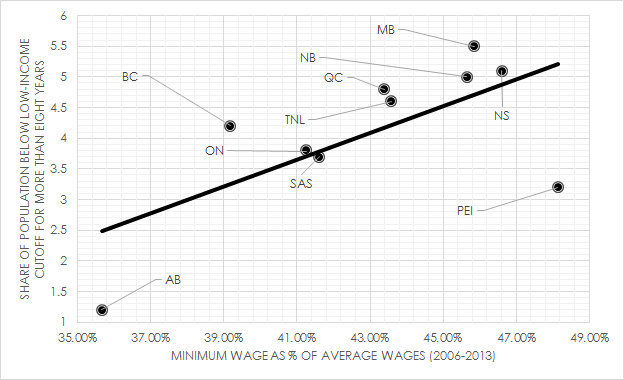
Ideally, we’d need a measure of the minimum wage to be compared with the “at-risk” population over a long period of time in order to encapsulate all the effects of the minimum wage. The perfect measure is the “length of poverty spell” variable which has been emerging progressively from the BLS. The problem is that it is not broken down by state. Fortunately, Canada has that variable (well, a low-income variable which is a relatie poverty measure) for provinces. Inside the Survey of Labor and Income Dynamics (affectionally known as the SLID), this longitudinal variable has a span of eight years. Basically, we can know if a person has been below the low-income threshold for up to eight years. Let’s take that extreme measure and plot it against the minimum wage divided by the average wage.

As one can see from the scatter plot below, there is a more or less clear relationship between the minimum wage as a share of the average wage and the length of poverty spells. What is more impressive is that this graph is not a regression. More precisely, the provinces with the highest minimum wages (like my own province of Quebec and the province of Nova Scotia) also have the most extensive social welfare nets. Alberta,  a province with the lowest minimum wage ratio and one of the least “generous” social welfare net in Canada, is at the very bottom of the pack in terms of the persistence of poverty.

minimumwagepoverty

I think this graph acts in very modest (but clear) support to Mark’s point (which is also the point of Burkhauser, Sabia, MaCurdy and many others)

Stock markets and economic growth: from Smoot-Hawley to Donald Trump

In a recent article for the Freeman, Steve Horwitz (who has the great misfortune of being my co-author) argued that stock markets tell us very little about trends in economic growth. Stock markets tell us a lot about profits, but profits of firms on the stock market may be higher because of cronyism. Basically, that is Steve’s argument. He applies this argument in order to respond to those who say that a soaring stock market is the proof that Donald Trump is “good” for the economy.

I know Steve’s article was published roughly a month ago, so I am a little late. But I tend to believe it is never too late to talk about economic history. And basically, its worth pointing out that there are economic history examples to show Steve’s point. In fact, its the best example: Smoot-Hawley.

Bernard Beaudreau from Laval University has advanced, for some years, an underconsumptionist view of the Great Depression (I consider it a “dead theory”). While I am highly unconvinced by this theory (in both its original and current “post-keynesian” reformulation), Beaudreau tries hard to resurrect the theory (see here and here) and merits to be discussed. In the process, Beaudreau attempted to reestimated the effects of of Smoot-Hawley on the stock market with an events study. Unconvinced about the rest of his research, this is a clear instance of sorting the wheat from the chaff. In this case, the wheat is his work (see here for his article in Essays in Economic and Business History) on Smoot-Hawley.

Basically, Beaudreau found that good news regarding the probability of the adoption of the tariff bill actually pushed the stock market to appreciate. Thus, Smoot-Hawley -which had so many negative macroeconomic ramifications* – actually boosted the stock market. Firms that gained from the rising tariffs actually saw greater profits for themselves and thus the firms on the stock market would have been excited at the prospect of restricting their competitors. If that is true, could it be that Donald Trump is the modern equivalent (for the stock market) of Smoot-Hawley.

*NDLR: I believe that Allan Meltzer was right in saying that the Smoot-Hawley might have had monetary ramifications that contributed to the money supply collapse. It was a real shock that precipitated the collapse of weak banks which then caused a nominal shock and then the sh*t hit the proverbial fan.

The Asian Age

I love Asia. Ever since my student days I have had a keen interest in South East Asia and China, with my course on the Politics of the Asia Pacific at the London School of Economics in the run up to the handover of Hong Kong as a high point. This was followed almost a decade later with four years of living in Manila, with time spend as a freelance journalist covering Philippine politics and society, as well as teaching for three years at the European Studies Program at the elitist Ateneo de Manila University. I also had the opportunity to travel to almost all countries in the region (with the notable exceptions of Laos, Taiwan and the Koreas, but one should keep something to be desired). I admire the resilience of the Asians, their humour, great work ethics, the beauty of their countries, and of course their sumptuous food.

As a classical liberal I always have a keen interest in the economic developments of the region, which to me serve as the prime evidence for the great and positive impacts freeing up economies have. The rise of Asia in essence is the empirical proof that classical liberal ideas work, that capitalism has the capacity to improve the life of millions of people, in a very short term. This despite the imperfect implementation of capitalism throughout the region, so there is much room for further improvement. In this light it is also interesting to see how long economic freedom and political lack of freedom can co-exist. Classical liberal ideas predict, most clearly expressed by Milton Friedman in Capitalism and Freedom, that one follows the other. Economic and political freedom cannot be separated forever (nor forever suppressed together, as the experiences in the former Soviet bloc continue to make clear, even despite Putin’s increasing autocratic rule).

For an international relations observer from Europe, the developments in the Asia Pacific are of particular interest, because the rise of Asia seems to go together with the fall of Europe as a geopolitical player. Or more precisely: the fall of the middle rank European powers, as the European Union itself is a significant player in trade politics only, the only field where it represents all member states and policy is determined at the European level, with a leading role for the European Commission.

The recent book Easternisation: War and Peace in the Asian Century, by Financial Times journalist Gideon Rachman, deals precisely with this issue.

blog-easternisation

It is a great book, bringing together Rachman’s extensive experience in the US, Asia, and Brussels. Often, books written by journalists lack sound analysis for the mid to long term, and historical perspective. While Easternisation is not an academic tome either, it does provide sufficient deep analysis, especially by tackling developments in all important countries which play a role in the process. It is not just another volume of simply USA or EU bashing, as we have seen before with the huge literature on the alleged Japanese take-over of the US economy.

Rachman’s main argument is that the influence of the West, Europe in particular, has crumbled. This may lead to a major conflict in the Asia Pacific, most notably between China and the US, which also endangers the global economic order. Yet many other conflicts are also building up, in a region which heavily invests in armaments. In short, in the 21st century, ‘rivalries between the nations in the Asia Pacific will shape global politics, just as the struggles between European nations shaped world affairs for over 500 years from 1500 onwards’. I think this is an important message, which should be taken seriously by everybody. Certainly by the Europeans, who are in danger of just inhabiting the world’s largest open air museum within a few decades.  One thing is certain: the Asians will not wait for them to come to terms with the current shift of power.

On 19th Century Tariffs & Growth

A few days ago, Pseudoerasmus published a blog piece on Bairoch’s argument that in the 19th century, the countries that had high tariffs also had fast growth.  It is a good piece that summarizes the litterature very well. However, there are some points that Pseudoerasmus eschews that are crucial to assessing the proper role of tariffs on growth. Most of these issues are related to data quality, but one may be the result of poor specification bias. For most of my comments, I will concentrate on Canada. This is because I know Canada best and that it features prominently in the literature for the 19th century as a case where protection did lead to growth. I am unconvinced for many reasons which will be seen below.

Data Quality

Here I will refrain my comments to the Canadian data which I know best. Of all the countries with available income data for the late 19th century, Canada is one of those with the richest data (alongside the UK, US and Australia). This is largely thanks to the work of M.C. Urquhart who recreated the Canadian GNP series fom 1870 to 1926 in collaborative effort with scholars like Marvin McInnis, Frank Lewis, Marion Steele and others.

However, even that data has flaws. For example, me and Michael Hinton have recomputed the GDP deflator to account for the fact that its consumption prices component did not include clothing. Since clothing prices behaved differently than the other prices from 1870 to 1885, this changes the level and trend of Canadian incomes per capita (this paper will be completed this winter, Michael is putting the finishing touch and its his baby).  However, like Morris Altman, our corrections indicate a faster rate of growth for Canada from 1870 to 1913, but in a different manner. For example, there is more growth than believed in the 1870-1879 period (before the introduction of the National Policy which increased protection) and more growth in the 1890-1913 period (the period of the wheat boom and of easing of trade restrictions).

Moreover, the work of Marrilyn Gerriets, Alex Chernoff, Kris Inwood and Jim Irwin (here, here, here, here) that we have a poor image of output in the Atlantic region – the region that would have been adversely affected by protectionism. Basically, the belief is a proper accounting of incomes in the Atlantic provinces would show lower levels and trends that would – at the national aggregated level – alter the pattern of growth.

I also believe that, for Quebec, there are metrological issues in the reporting of agricultural output. The French-Canadians tended to report volume units in manners poorly understood by enumerators but that these units were larger than the Non-French units. However, as time passed, census enumerators caught on and got the measures and corrections right. However, that means that agricultural output from French-Canadians was higher than reported in the earlier census but that it was more accurate in the later censuses. This error will lead to estimating more growth than what actually took place. (I have a paper on this issue that was given a revise and resubmit from Agricultural History). 

Take all of these measurements issue and you have enough doubt in the data underlying the methods that one should feel the need to be careful. In fact, if the sum of these (overall) minor flaws is sufficient to warrant caution, what does it say about Italian, Spanish, Portugese, French, Belgian, Irish or German GDP ( I am not saying they are bad, I am saying that I find Canada’s series to be better in relative terms).

How to measure protection?

The second issue is how to measure protection. Clemens and Williamson offered a measure of import duties revenue over imports volume. That is a shortcut that can be used when it is hard to measure effective protection. But, it may be a dangerous shortcut depending on the structure of protection.

Imagine that I set an import duty so high as to eliminate all entry of the good taxed (like Canada’s 300% import tax on butter today). At that level, there is zero revenue from butter import and zero imports of butter. Thus, the ratio of protection is … zero. But in reality, its a very restrictive regime that is not being measured.

More recent estimates for Canada produced by Ian Keay and Eugene Beaulieu (in separate papers, but Keay’s paper was a conference paper) attempted to measure more accurate indicators of protection and the burden imposed on Canadians. Beaulieu and his co-author found that using a better measure, Canada’s trade policy was 11% more restrictive than believed. Moreover, they found that the welfare loss kept increasing from 1870 to 1890 – reaching a figure equal to roughly 1.5% of GDP (a non-negligible social cost).

It ought to be noted though that alongside Lewis and Harris, Keay has found that the infant industry argument seems to apply to Canada (I am not convinced, notably for the reasons above regarding GDP measurements). However, that was in the case of Canada only and it could have been a simple outlier. Would the argument hold if better trade restriction measures were gathered for all other countries, thus making Canada into a weird exception?

James Buchanan to the rescue

My last argument is about political economy. Was the institutional arrangement of protection a way to curtail government growth? Protection is both a method for helping national industries and for raising revenues. However, the government cannot overprotect at the risk of loosing revenues. It must protect just enough to allow goods to continue entering to earn revenues from imports.  This tension is crucial especially since most 19th century countries did not have uniform general tariffs (like a flat 5% import duty) which would have very wide bases. The duties tended to concern a few goods very heavily relative to other goods. This means very narrow tax bases.

Standard public finance theory mandates wide tax bases with a focus on inelastic sources. However, someone with a public choice perspective (like James Buchanan) will argue that this offers the possibility for the government to grow. Basically, a public choice theorist will argue that the standard public finance viewpoint is that the sheep is tame. Self-interested politicians will exploit this tameness to be elected and this might imply growing government. However, with a narrow and elastic tax base, politicians are heavily constrained. In such a case, governments cannot grow as much.

The protection of the 19th century – identified by many as a source of growth – may thus simply be the symptom of an institutionnal arrangement that was meant to keep governments small. This may have stimulated growth by keeping other sectors of the economy more or less free of government meddling. So, maybe protection was the offspring of the least flawed institutional arrangement that could be adopted given the political economy of the time.

This last argument is the one that I find the most convincing in rebuttal to the Bairoch argument. It means that we are suffering from a poor specification bias: we have identified a symptom of something else as the cause of growth.

Spanish GDP since 1850

Among the great economic historians is Leandro Prados de la Escosura. Why? Because, before venturing in massively complex explanations to explain academic puzzles, he tries to make sure the data is actually geared towards actually testing the theory. That attracts my respect (probably because it’s what I do as well which implies a confirmation bias on my part). Its also why I feel that I must share his most recent work which is basically a recalculation of the GDP of Spain.

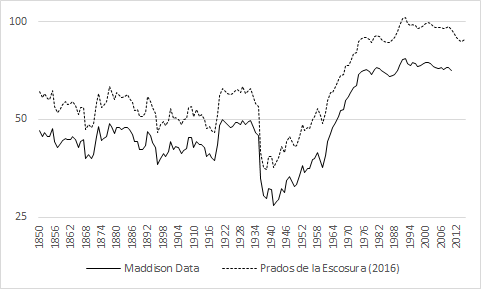
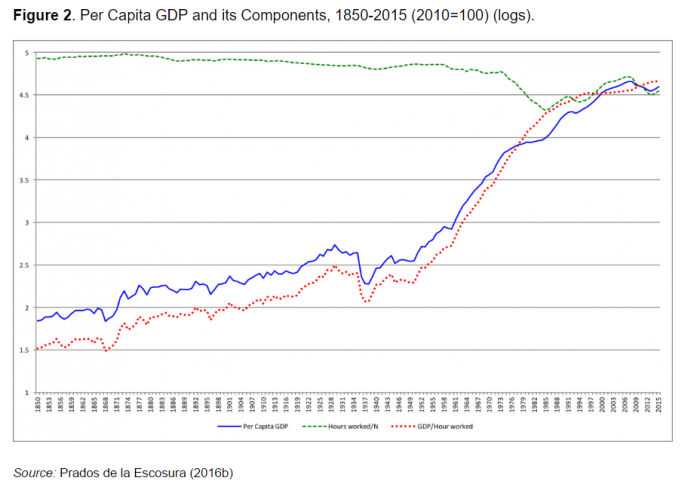
The most important I see from his work is that the recomputation portrays Spain as a less poor place than we have been led to believe – throughout the era. To show how much, I recomputed the Maddison data for Spain and compared it with incomes for the United Kingdom and compared it Leandro’s estimates for Spain relative to those for Britain (the two methods are very similar thus they seem like mirrors at different levels). The figure below emerges (on a log scale for the ratio in percentage points). As one can see, Spain is much closer to Britain than we are led to believe throughout the 19th century and the early 20th century. Moreover, with Leandro’s corrections, Spain convergence towards Britain from the end of the Civil War to today is very impressive.

spanishgdp

The only depressing thing I see from Leandro’s work is that Spain’s productivity (GDP / hours worked) seems to have stagnated since the mid-1980s.

spanishproductivity

On getting the data right : price disparities before 1914

I am a weird bird. I get excited at weird things. I get excited at reading economics and history papers (and books). I get particularly excited when I read papers and books that “get the data right”. This is because I believe that most theoretical debates in economics stem from poor data forcing us to develop grandiose theories or very advanced models to explain simple things. One example of that is the work of Joshua Hendrickson who argued that monetary aggregates (M1, M2 etc.) are not necessarily perfect indicators of money. However, these aggregates were used in statistical tests and generated strange results inconsistent with theory. This issue has been the cause of many debates. Josh stepped in and said that we just had a variable that was not created to measure what the theory said. Using broader measures of money, he found the results consistent with theory. The debates were driven by poor data (as I think is the case in issues over fiscal multipliers, crowding-out and business cycles).

Thus, I am always excited to see data work that “get things right”. One recent example that adds to cases like that of Hendrickson is Peter Lindert’s working paper at the National Bureau of Economic Researcher. Now, before I proceed, I must state that I am very partial to Lindert as he has been a big supporter of my own research and has volunteered important quantities of his time to helping me move forward. Thus, I have a favorable bias towards Lindert (and his partner in crime, Jeffrey Williamson).  Nonetheless, his working paper requires a discussion because it “gets prices right”.

The essence of his new working paper is that our GDP per capita estimates prior to 1914 may overestimate divergence between countries over time.

Generally, when we measure GDP, we try to derive “volume indexes” that measure quantities produced at a fixed vector of prices. For example, when I measured Canadian economic growth from 1688 to 1790 (I am submitting it in a few weeks), I took the quantities of grain reported in censuses and weighed them by prices for a fixed year. This is a good approach for measuring productivity (changes in quantities). Nonetheless, there are issues when you try to move this method over a very long period in time. The prices may become unrepresentative.  So you get time-related distortions. Add to this that all the time-related distortions may be different over space. After all, should we believe the relative price of wheat to oats in 1910 was the same in Canada as it was in Russia?  Variations in relative prices over space will affect this issue. Basically, you juxtapose these two types of distortions when trying to measure GDP per capita over centuries and you may end up so far in the left field that you’re in fact in the right field.

In his working paper, Lindert tried to adjust for those problems by moving to prices that were more representative. The approach he used is basically the one used by Robert Allen in his work on the Great Divergence. You create a bundle of goods that capture the cost of living in different regions – a basic bundle of goods. This generates purchasing power parities. From there, he recomputed incomes per capita with these measures prior to 1914. The results are striking: there is much more divergence between Europe and Asia that commonly proposed and the United States are much richer than otherwise believed (and were more richer very early on – as far back as the colonial era).

Now, why does this matter?

Well, consider the debate on convergence. Many scholars have been unimpressed by the level of income convergence across countries (at least until the 1980s). However, Lindert’s estimates suggest that the starting point was well below what we think it was. In a way, what this is telling us is that many puzzles regarding the “catching-up” of poor countries may be simply related to poor data. Imagine, for a second, that we could redo what Lindert did with many more countries at a higher time frequency. What would this tell us? Imagine also that this new data would confirm Lindert’s point, what would that entail for those entangled in debates over development?

Basically, what I am saying is this: most of our debates often stem from poor data. If a simple (and theoretically sound) correction can eliminate the puzzles, maybe our task as economists should be to stop bickering over advanced theory and make sure the data is actually geared towards testing our theories!

We can’t engineer our way out of this

Folks on the left have been getting more interested in science lately (though history tells us that might be something to worry about). They’re right to celebrate the incredible results of scientific progress–but scientific victory isn’t uniform across disciplines.

In some areas (including just about all areas on the cutting edge), scientists disagree with one another.It’s a big, complex world we live in, and we don’t understand it fully. That disagreement doesn’t mean we should discount science entirely, but it does mean we should be careful with it.

Imagine a world where engineers disagreed about the capabilities of their techniques and the strength of the materials they use. Some might be beholden to special interests (which gives me an idea for a public choice version of the Three Little Pigs), others might be dogmatic/superstitious. But even without concerns of systemic issues, we should be hesitant to try to get to the moon. That disagreement should tell us that we aren’t certain enough in our knowledge to make anyone but volunteers put their lives in the hands of those engineers.

Social scientist in particular frequently disagree with each other. Most are trying earnestly to apply the scientific way of thinking to understanding the social world, and it’s worth considering their view points. But applying that knowledge should only be done in a decentralized way. Applying the incredible insights of behavioral economics from the top down is appealing, but it’s probably best to do it piecemeal.

Social engineering and social science are harder than physical engineering and the physical sciences. Part of the problem Western governments face is that they’re trying to engage in social engineering. And politicians are promising them greater degrees of social engineering to improve the well-being of their constituents.

The trouble is two-fold: 1) those social engineering techniques aren’t good enough, even if they’re sometimes appealing. 2) The cost to decision makers of buying snake oil is too low in voting booths.

To my friends who are looking to the government to make things better: whether your hope is for government to help people be better versions of themselves, or to stop bad guys, we should push as much of that policy to the local level as possible. It might be nice if the whole country were more like Berkeley or Salt Lake City, but trying to make it happen at the national level is a recipe for conflict, disorder, and doing more harm than good. Keep policy local.

How Well Has Cuba Managed To Improve Health Outcomes? (part 2)

In a recent post, I pointed out that life expectancy in Cuba was high largely as a result of really low rates of car ownerships.  Fewer cars, fewer road accidents, higher life expectancy. As I pointed out using a paper published in Demography, road fatalities reduced life expectancy by somewhere between 0.2 and 0.8 years in Brazil (a country with a car ownership rate of roughly 400 per 1,000 persons). Obviously, road fatalities have very little to do with health care. Praising high life expectancy in Cuba as the outcome Castrist healthcare is incorrect, since the culprit seems to be the fact that Cubans just don’t own cars (only 55 per 1,000). But that was a level argument – i.e. the level is off.

It was not a trend argument. The rapid increase in life expectancy is undeniable, so my argument about level won’t affect the claim that Cubans saw their life expectancy increase under Castro.

I say “wait just a second”.

Cuba is quite unique with regards to car ownership. In 1958, it had the second highest rate of car ownership of all Latin America. However, while the rate went up in all of Latin America between 1958 and 1988, it went down in Cuba. During that period, life expectancy went up in all countries while there were substantial increases in car ownership (which would, all things being equal, slow down life expectancy growth). Take Chile and Brazil as example. In these countries, the rate went up by 6.9% and 8.1% every year – these are fantastic rates of growth. During the same period, life expectancy increased 25% in Chile and 19% in Brazil compared with Cuba where the increase stood at 17%. In Cuba, the moderate decline in car ownership (-0.1% per annum) would have (very) modestly contributed to the increase of life expectancy. In the other countries, car ownership hindered the increase. (The data is also from the WHO section on Road Safety while the life expectancy data is from the World Bank Database)

This does not alter the trend of life expectancy in Cuba dramatically, but it does alter it in a manner that forces us, once more, to substract from Castro’s accomplishments. This increase would not have been the offspring of the master plan of the dictator, but rather an accidental side-effect springing from policies that depressed living standards so much that Cubans drove less and were less subjected to the risk of dying while driving. However, I am unsure as to whether or not Cubans would regard this as an “improvement”.

Below are the comparisons between Cuba, Chile and Brazil.

cars

The other parts of How Well Has Cuba Managed To Improve Health Outcomes?

  1. Life Expectancy Changes, 1960 to 2014
  2. Car ownership trends playing in favor of Cuba, but not a praiseworthy outcome
  3. Of Refugeees and Life Expectancy
  4. Changes in infant mortality
  5. Life expectancy at age 60-64
  6. Effect of recomputations of life expectancy
  7. Changes in net nutrition
  8. The evolution of stature
  9. Qualitative evidence on water access, sanitation, electricity and underground healthcare
  10. Human development as positive liberty (or why HDI is not a basic needs measure)