Eye Candy: The HDI of BRICS

Phew, that’s a lot of acronyms. But this is a great map:

NOL map BRICS subunits
Click here to zoom

Orange and yellow is bad, green and blue is good. HDI stands for “Human Development Index,” which is a measurement that’s not nearly as good, in my opinion, for understanding how wealthy and happy a population is. Nevertheless, HDI is still one of the better measurements (Top 5, again in my opinion) out there. Here’s the wiki on HDI.

The maps are colored according to “subunits,” or provinces (which are like American states, such as Nebraska).

Brazil, India, and South Africa are multi-party democracies, while the other two are not. So what do all five have in common?

Rent isn’t a four-letter word

download (3)

Inspired by the publication this week of NYU scholar Alain Bertaud‘s critical new book Order without Design: How Markets Shape Cities (MIT press), Sandy Ikeda‘s pre-book development series Culture of Congestion over at Market Urbanism, and London YIMBY, here is a note on housing reform.

Classical liberals see the economic solution to housing as relatively simple: increase supply to better meet demand. By contrast, the political economy of housing is almost intractably complex. The reason for this is that there are endless externalities associated with new housing: access to light, picturesque landscape, open space and uncongested roads just for starters. These gripes and grievances are the bread and butter of local politics. Unlike consumer product markets, housing cannot be disentangled from these social, political and legal controversies. A successful market-based housing policy must establish institutions that not only encourage housing supply growth but navigate around these problems while doing so.

Policy reform proposals that deliberately favour increasing owner-occupied single-family homes, as tends to be the focus among market liberals in the UK (and to some extent in the US), are currently self-defeating. As justified as they were in the past to achieve a more market-friendly political settlement, they are now a barrier to achieving plentiful, affordable housing. This is because every new homeowner becomes an entrenched interest, a potential opponent to subsequent housing development in their area. They impose more political externalities than renters. I propose we cut the link between support for home ownership and housing supply policies. This would free up policymaking to focus on expanding provision by all available market-compatible means.

This should include greater encouragement of institutional landlords, especially commercial enterprises. Commercial landlords have more incentive and capability to expand supply on estates that they own, while long-term renters (unlike homeowners) have an interest in keeping rental costs low. The lack of private firms dedicated to supplying housing in England compared to much of the rest of the world is startling and yet often overlooked even by friends of free enterprise.

Continue reading

Innovation and the Failure of the Great Man Theory

We tend to think about innovation as inventions and particularly about the inventors associated with them: Newton, Edison, Jobs, Archimedes, Watt, Arkwright.  This Great Man Theory of incredible technical innovation is mostly implicitly held by quite a few of us, celebrating these great men and their deeds.

Matt Ridley, the author of The Rational Optimist and The Evolution of Everything among other credentials, has spent a lot of time and effort in recent years arguing against this theory. In his recent Hayek Lecture to the British Institute of Economic Affairs he convincingly outlines his case: so many independent innovations take place roughly at the same time by different people. The Great Man Theory leads us to believe that  hadn’t it been for Edison, we’ll all be in the dark and humanity deprived ofall the benefits that came with the innovation.

Not so. There were a great number of contemporary inventors who came upon versions of the lightbulb (Ridley cites 21 or 23 or them, depending on whom you include) around the same time as Edison. The story can be repeated for most other great inventions we know of: laws of thermodynamics, calculus, most metals, typewriting machines, jet engines, the ATM, Oxygen. Indeed, the phenomenon is so common that it has its own term: simultaneous invention.

It seems, in complete contrast to the Great Man Theory, that history provided a certain problem, a sufficient number of people working on solving it at a certain time, and eventually similar inventions taking place around the same time. The process is, Ridley concludes, “gradual, incremental, collective yet inescapable inevitable […] it was bound to happen when it did”.

Interestingly enough for those of us schooled and fascinated by spontaneous orders and bottom-up social and economic phenomena, the Great Man Theory is remarkably similar to other beliefs about the world. It is a symptom of the same reasoned short-comings that makes us humans susceptible to believing in zero-sum thinking, top-down organizing and “design-implies-a-designer”. Instead of grasping the deep insights of gains from trade, spontaneous order or evolution, we are tempted by the militaristically directed organizations that we believe we understand rather than the emergent order of many independently acting individuals’ trials and errors.

Precisely this bias makes us susceptible to the mistake Mariana Mazzucato has become famous for wholeheartedly embracing: the idea that, whatever the innovation, government probably did it. That government innovation is productive – or at least more productive than is commonly presumed – and indeed societies can greatly benefit from ramping up government R&D spending. Nevermind incentives, track records or statistical robustness.

Indeed, what Ridley points to is precisely that valuable and life-changing innovation cannot be directed. Admittedly, some innovation does occur in labs, but only a vanishingly small part. Mazzucato and other top-downers could have benefited greatly from listening to Ridley (or reading his book The Rational Optimist; or reading Demsetz’ devastating 1969 article ‘Information and Efficiency’).

Coming full circle and espousing the Hayekian insights, Ridley notes that the price is everything. Specifically the reduction in prices is what matters for innovations to be spread and adopted rather than the ideas themselves. Very little happens in terms of adoption and transmission until prices start to fall dramatically (hint, hint, Bitcoin… or nuclear energy, or renewable energy…). Like the printing press and the steam engine, interesting things start to happen when prices fall – not because an innovation is particularly cool in some subsection of society.

Innovation is a deeply decentralized yet deeply collective process. We face similar challenges that occassionally come to similar conclusions – and history would in all likelihood have progress exactly the same had we not had a Newton or Edison or Jobs.

Do You have Silver?

In an episode of the Netflix medieval series The Last Kingdom, the protagonist Uthred, trying to purchase a sword from a blacksmith in a town he is just passing by, is instantly asked “Do you have silver?”.

In one scene, insignificant to the plot, the series creators neatly raised some fundamental questions in monetary economics, illustrating the relative use of credit and cash and the importance of finality.

For many centuries, the very payment system between people set severe constraints on what kinds of transactions they could – or dared – engage in. There are two main ways of providing payments (with quite a few variations within these categories): cash or credit.

Cash (sometimes referred to as ‘money transactions’) refers to payments with direct finality; the economic chain is instantly settled, and gives rise to no other economic relation. Examples here would be pure barter (where one object is traded for another) or commodity money (where an object is traded for a common media of exchange, with history providing countless fascinating examples: cattle, skin, olive oil, feathers, pearls etc).

The other category, credit, involves trading someone else’s liability or incurring a new one. Modern credit cards easily comes to mind: swiping that card settles the trade between the vendor and the customer who used the card only by creating two new (future) economic relations – a promise by the credit card company to transfer funds to the vendor, and a promise by the customer to pay the credit card company at the end of the month. The same features can be – and were – applied in many early societies; I give you some of my items, and you owe me; later I may transfer this “claim” to somebody else is the community in exchange for something I wanted, and instead of owing me, you owe them.

Some of the difficulties of monetary economics are here quickly revealed. In order for credit to work, a sufficient level of trust, repeated dealings or enforcement mechanisms must exist. If one or more parties do not trust each other, the two are unlikely to trade again or cannot socially or legally force the other into upholding his or her contract, they may refuse the deal up-front and lose the benefits of trade (the “backward induct,” in Game Theory-speak). Nevertheless going through with this transaction requires a different payment system: instant finality, such as provided with cash. Here’s the conundrum that troubles monetary economists:

The frictions that are needed to make money essential typically make credit infeasible and environments where credit is feasible are ones where money is typically not essential (Ugolini, The Evolution of Central Banking, p. 169)

If we trust each other enough (or have enough repeat dealings and a system of keeping track of everyone’s debts), there is no need for cash. If there is need for cash, that means we do not trust each other (or can’t keep track/enforce debts), indicating the presence of “frictions” that make us reluctant to use credit at all.

Let’s go back to our Last Kingdom protagonist. It is clear that the two characters are strangers (no previous dealings, no trust) and from simply passing through a village, no reason for the blacksmith to believe that there may be repeat dealings. A credit transaction is thus clearly out of question. Instead he directly asks for silver (cash), which initially seems to solve the problem. However, two further issues emerge:

  1. if all transactions were like this, the amount of cash everyone must carry around in the economy would be enormous. A common problem in medieval and even early modern societies were the lack of coins. If enough cash was simply not there and recourse to credit system unfeasible, we quickly realise how difficult transacting would be.
  2. even if the customer had enough cash, the very reason they were reluctant to use credit in the first place (no trust, no repeat dealings, no credible enforcement) harms their ability to transact in cash. Howso? Because both parties can opportunistically defect from the agreement. If the sword is paid for up front, the blacksmith can take the money and run – since they are strangers and unlikely to meet again, the cost of cheating is comparatively low. If the sword is paid for at delivery, the customer can easily renege on payment once delivery is obtained.

Is there no way out?

Uthred and the blacksmith use a method most of us are familiar with – indeed, probably even used as kids – pay half up-front, and half on delivery, with the possibility of a bonus payment (tip) at the end. Risk-minimising, yet offering payoff through the gains from trade.

Good monetary economics does precisely that: illustrating how monetary systems, including payment systems, can facilitate transactions and expand rather than limit the available gains from trade. It concerns itself with one of those spheres of (economic) life that we don’t notice until they breaks down. Try completing everyday transactions in countries with small-change shortage for a neat flashback to eighteenth century Britain or U.S., or in countries impaired by hyperinflation or sanctions. Monetary economics, in essence, is fascinating in its complexity of otherwise quite mundane things. Thanks to The Last Kingdom team for illustrating that.

Economic Liberalism and (Re)Building Europe after WWII.

It is important to understand that economic recovery and growth in Europe after World War II is not as tied to Keynesianism, unfunded welfarism, and corporatism as is sometimes assumed.

The Glorious Thirty Years of European recovery from world war and subsequent growth were not due to ‘Keynesianism’ etc. The Thirty Years ended because the influence of liberal policies had weakened and the costs of other policies had accumulated to create an obviously dysfunctional system. Left-wingers (and communitarian-corporatist conservatives) who think ‘market fundamentalists’ overthrew a well functioning social and economic settlement which was behind all the economic growth and associated institution building (post-war national recovery and European Union construction) are in error. It is a major error to ignore the influence of Austrian School liberals (see the discussion by a leading current practitioner of Austrian economics, Peter Boettke) and the related Ordoliberalismus of the Freiburg School.

My remarks on what the major terms and schools in this paragraph refer to have become uncontrollably long, so they are relegated to the bottom of the post. I hope readers will have the patience to reach them.

The key points are that the German post-war Economic Miracle came from Ordo-liberal policies, while economic growth in France after Charles de Gaulle came to power for the second time in 1958 comes from the policies of Jacques Rueff, a civil servant, judge, and economist who participated in the 1938 Walter Lippmann Colloquium in Paris, a decisive event in the revival of liberal economic thinking attended by Hayek and many other notable liberal thinkers.

Such ideas have had a lot more influence in France than lazy propagators of clichés about statist France and liberal America understand. Of course, if we look at the French and American economies we can see notable ways in which the US economy is more liberal, but that should not obscure the reality that France has had good economic times and that these have come about because liberal economic policies were applied, even where, as under de Gaulle, the political narrative of the government was not liberal. The France of 1958 and after was able to stabilise institutionally after a real danger of the collapse of constitutional democracy and have a good economic period because of neoliberal economic ideas.

Some on the left think the relative revival of market liberalism in the 1970s can be rooted in the Chilean Coup of September 1973, after which economic policy was to some degree influenced by Chilean economists with doctorates from the University of Chicago. This revival of market liberalism is known as neoliberalism, a potentially useful term which came out of the Lippmann Colloquium (see below) that has unfortunately collapsed into an empty term of abuse for any kind of market thinking in government policy, wherein even the most modest accommodation of economic rationality is labelled ‘neoliberal’ and therefore extreme, authoritarian, and based on the narrow greed of the rich. It is sometimes accompanied by attempts to read enlightenment liberals as somehow ‘really’ left-liberal, social democratic, or even socialist.

The reality is that neoliberal ideas were first obviously influential on Continue reading

The Incomplete Counterfactual Fallacy

Mariana Mazzucato has some interesting ideas, but her basic thesis (which I’m guessing based only on her recent Freakonomics interview) forgets a simple fact: had the government not made GPS, not only would we not have GPS, resources would have been allocated somewhere else.

In other words, she’s right that without government involvement we’d miss all sorts of valuable things like the basic research it turns out government has financed, physical infrastructure (no matter how neglected), GPS, the specific form the Internet we got, etc., etc.

But that’s only half the story. What happens if DARPA closes shop just before starting on GPS? Those engineers end up somewhere else, the money for the project goes somewhere else, the steel and titanium for the satellites they would have built end up in some other shop.

If we could know that nothing else would have happened at that point, then GPS is a free lunch–some bold committee scooped up a handful of clay, handed it to brilliant engineers, and created something from nothing.

More likely some of those engineers would have made dozens of other projects a little bit better, and one or two of them might even have, through some series of unpredictable events, ended up creating some totally different innovation that would have put us on to an entirely different path.

Which is the better path? There’s no way to know. The people on that other path exist in a completely different paradigm from our own. It’s comparing meta-apples with meta-oranges. We are where we are and we ought to appreciate all the costs and benefits of the system we’ve inherited. I think Mazzucato is right that many of us have underrated the government. (Certainly 23-year-old-Rick was guilty of the over-complete counterfactual fallacy.)

She makes a compelling argument that Solyndra doesn’t look like such a boondoggle when you take the wider view we would expect of the smallest venture capital investor. But if it’s true that pointing at government failures is invalid, then so is pointing at government success.

What’s important is improving the future performance of our current institutional mess. To do that, I think we’re better off backing away from her broad claims and focusing on her more sensible (and jarring) arguments about how the current system encourages destructive rent seeking through intellectual property protection of basic research that might be better left in the public domain.

We have seen the algorithm and it is us.

The core assumption of economics is that people tend to do the thing that makes sense from their own perspective. Whatever utility function people are maximizing, it’s reasonable to assume (absent compelling arguments to the contrary) that a) they’re trying to get what they want, and b) they’re trying their best given what they know.

Which is to say: what people do is a function of their preferences and priors.

Politicians (and other marketers) know this; the political battle for hearts and minds is older than history. Where it gets timely is the role algorithms play in the Facebookification of politics.

The engineering decisions made by Facebook, Google, et al. shape the digital bubbles we form for ourselves. We’ve got access to infinite content online and it has to be sorted somehow. What we’ve been learning is that these decisions aren’t neutral because they implicitly decide how our priors will be updated.

This is a problem, but it’s not the root problem. Even worse, there’s no solution.

Consider one option: put you and me in charge of regulating social media algorithms. What will be the result? First we’ll have to find a way to avoid being corrupted by this power. Then we’ll have to figure out just what it is we’re doing. Then we’ll have to stay on top of all the people trying to game the system.

If we could perfectly regulate these algorithms we might do some genuine good. But we still won’t have eliminated the fundamental issue: free will.

Let’s think of this through an evolutionary lens. The algorithms that survive are those that are most consistent with users’ preferences (out of acceptable alternatives). Clickbait will (by definition) always have an edge. Confirmation bias isn’t going away any time soon. Thinking is hard and people don’t like it.

People will continue to chose news options they find compelling and trustworthy. Their preferences and priors are not the same as ours and they never will be. Highly educated people have been trying to make everyone else highly educated for generations and they haven’t succeeded yet.

A better approach is to quit this “Rock the Vote” nonsense and encourage more people to opt for benign neglect. Our problem isn’t that the algorithms make people into political hooligans, it’s that we keep trying to get them involved under the faulty assumption that people are unnaturally Vulcan-like. Yes, regular people ought to be sensible and civically engaged, but ought does not imply can.

A Millennial’s New Perspective on Home Ownership

The last few years I’ve loudly protested that home ownership is overrated; it’s a bad investment plus lots of responsibility. And yet, this summer my fiance and I bought a 100 year old house on the south shore of Long Island.

Yes, I have lost my mind.

I basically stand by my earlier position, but with greater nuance. Owning a home is a complicated undertaking. But it’s given me a greater appreciation for the nuance involved in managing real estate.

Home ownership is a great big Gordian knot of inter-dependencies. It’s massive set of knowledge problems wrapped in externality problems.There’s a massive role for local knowledge which means policy makers’ attention should be less focused on things like home ownership rates, and more on guiding the right people into the right places to take advantage of that local knowledge.

With local knowledge comes local politics. I don’t know anything about local politics, but expect more posts about what’s going on in my town hall over the next few decades.

So what have I learned in this first month of home ownership?

  • There’s something to be said about pride in ownership

It’s still a real trip to turn on my lights in my kitchen so I can do my laundry in my laundry machines. I didn’t think I’d enjoy it this much. The endowment effect is real. One effect has been to increase my interest in contributing to local public goods via civic engagement and other routes.

I haven’t been to a town hall meeting yet, but I plan on going to one tomorrow. I suspect it will be awful. But I’m walking distance, so I’ll be a little bit drunk.

  • The real estate market has some serious frictions

This might be obvious, but it’s interesting. There are artificial and natural obstacles to the efficient use of real estate. Transaction costs are significant and property rights issues are hairy.

Buying a house is a complicated transaction and going through the process has really made clear to me how difficult it is to commodify land. Each piece of land has a unique location and history. Information asymmetries are substantial. The neighborhood you’re buying into is utterly out of your control. Put simply: Amazon won’t be selling real estate any time soon.

Part of the reason I’m happy with buying a house is that our rent had been increasing about $100/month/year. Land lords absolutely take advantage of real estate frictions to charge as much as they can. The alternative (which I chose) is to lock-in to a specific property.

  • The required knowledge to operate a home is significant and difficult to evaluate.

It takes a lot of knowledge to manage a house. If I were to take a wild guess (at this non-quantifiable variable), I’d say that between 5% and 50% of a homeowner’s brain is necessary to operate a house. Even if you bring in experts to do everything, evaluating those experts is a lot of work.

There are repairs and upgrades to make, and my formal education prepared me for exactly none of those projects. On the other hand, I’ve got the Internet. Without YouTube and Reddit I’d be a half dozen unlucky mistakes away from homelessness.

On the other other hand, I’ve learned a ton of stuff I’ve got no use for. Like how to grow asparagus (which it turns out it isn’t worth doing except out of boredom).

You can’t evaluate knowledge until it’s too late. And there’s more to learn than you ever will, so you have to make mistakes. It’s true of home ownership and it’s true of life more generally.

  • Gardening is a real trip.

In History of Economic Thought professor Gonzalez shared a story about two economists meeting in Switzerland during WWII. On showing his vegetable garden to the visiting economist, the visitor said “that’s not a very efficient way to grow food,” to which the gardener said, “yes, but it’s a very efficient way to grow utility.”

I’ve wanted to garden for some time, but the market for gardens is thin. So now I’m starting with almost no useful experience. My public stance has been that lawns are boring and dumb. But figuring out how to manage a little ecosystem ain’t easy. I now get why someone would just put in a lawn and be done with it.

At my old apartment complex the entire ecosystem was made of: humans, trees, lawns, cockroaches. I suspect the cockroaches did so well because all their competition was poisoned away. As an emergent order guy, I’m not really into that. But I get it now. In the same way the king wants everyone living in neat little taxable rows my life would be easier if I could just slash and burn all the complexity out of my yard.

Tl;dr: My biggest surprise as a new home owner is just how big a cognitive load owning a house is. You hear homeowners talk about how much work it can be, but I think it’s rare to hear someone talk about how much know-how is required.

Given the capacity to generate externalities, I’m a bit surprised that there isn’t more public policy devoted to issues of home ownership* (beyond subsidizing finance and increasing barriers to entry). I supposed I’ll learn a lot more about these issues as I learn about local politics.

*That isn’t to say I think it’s a good idea to get the government involved in trying to tell people how to go about the business of daily life. I think homeowners are (basically) doing fine left to their own devices.

Evidence-based policy needs theory

This imaginary scenario is based on an example from my paper with Baljinder Virk, Stella Mascarenhas-Keyes and Nancy Cartwright: ‘Randomized Controlled Trials: How Can We Know “What Works”?’ 

A research group of practically-minded military engineers are trying to work out how to effectively destroy enemy fortifications with a cannon. They are going to be operating in the field in varied circumstances so they want an approach that has as much general validity as possible. They understand the basic premise of pointing and firing the cannon in the direction of the fortifications. But they find that the cannon ball often fails to hit their targets. They have some idea that varying the vertical angle of the cannon seems to make a difference. So they decide to test fire the cannon in many different cases.

As rigorous empiricists, the research group runs many trial shots with the cannon raised, and also many control shots with the cannon in its ‘treatment as usual’ lower position. They find that raising the cannon often matters. In several of these trials, they find that raising the cannon produces a statistically significant increase in the number of balls that destroy the fortifications. Occasionally, they find the opposite: the control balls perform better than the treatment balls. Sometimes they find that both groups work, or don’t work, about the same. The results are inconsistent, but on average they find that raised cannons hit fortifications a little more often.

A physicist approaches the research group and explains that rather than just trying to vary the height the cannon is pointed in various contexts, she can estimate much more precisely where the cannon should be aimed using the principle of compound motion with some adjustment for wind and air resistance. All the research group need to do is specify the distance to the target and she can produce a trajectory that will hit it. The problem with the physicist’s explanation is that it includes reference to abstract concepts like parabolas, and trigonometric functions like sine and cosine. The research group want to know what works. Her theory does not say whether you should raise or lower the angle of the cannon as a matter of policy. The actual decision depends on the context. They want an answer about what to do, and they would prefer not to get caught up testing physics theories about ultimately unobservable entities while discovering the answer.

Eventually the research group write up their findings, concluding that firing the cannon pointed with a higher angle can be an effective ‘intervention’ but that whether it does or not depends a great deal on particular contexts. So they suggest that artillery officers will have to bear that in mind when trying to knock down fortifications in the field; but that they should definitely consider raising the cannon if they aren’t hitting the target. In the appendix, they mention the controversial theory of compound motion as a possible explanation for the wide variation in the effectiveness of the treatment effect that should, perhaps, be explored in future studies.

This is an uncharitable caricature of contemporary evidence-based policy (for a more aggressive one see ‘Parachute use to prevent death and major trauma related to gravitational challenge: systematic review of randomised controlled trials’). Metallurgy has well-understood, repeatedly confirmed theories that command consensus among scientists and engineers. The military have no problem learning and applying this theory. Social policy, by contrast, has no theories that come close to that level of consistency. Given the lack of theoretical consensus, it might seem more reasonable to test out practical interventions instead and try to generalize from empirical discoveries. The point of this example is that without theory empirical researchers struggle to make any serious progress even with comparatively simple problems. The fact that theorizing is difficult or controversial in a particular domain does not make it any less essential a part of the research enterprise.

***

Also relevant: Dylan Wiliam’s quip from this video (around 9:25): ‘a statistician knows that someone with one foot in a bucket of freezing water and the other foot in a bucket of boiling water is not, on average, comfortable.’

Pete Boettke’s discussion of economic theory as an essential lens through which one looks to make the world clearer.

On Robert Allen’s defense of the High-Wage Economy hypothesis

The high-wage economy thesis is a topic I have blogged about many times before as I think it is an important debate among economists and economic historians (see notably here and here, see also this contribution of mine to the Journal of Interdisciplinary History). For those unfamiliar with this thesis, here is a simple summary of the idea advanced by Robert Allen: high wages relative to capital units was a key force in the industrialization of Britain and thus it explains why the Industrial Revolution was British before if was anything else.

As I have explained in the aforementioned blog posts, I am unsure of where I stand regarding this idea. I tend to be skeptical, but I have stated the evidence needed to convince me of the opposite. In the past year or so, there has been an avalanche of articles on the topic including this article by Humphries and Weisdorf, a follow-up working paper by the same authors, another paper by Judy Stephenson and a working paper by Stephenson (bis). Today, Robert Allen replies to his critics in this working paper.

I find that some of the points are convincing, however I must take issue with a particular point that falls into my ballpark as Allen mentions my work on wages in France (the aforementioned article in Journal of Interdisciplinary History). In my research, I pointed out that Allen’s computations underestimated wages outside Paris. With the correct computations, the rest of France does not appear as poor relative to England as Allen suggests. Allen concedes this point but then goes to state the following:

Geloso (2018) has pointed out that the Strasbourg unskilled wage series for 1702-64 is low in comparison to that of comparable towns, and workers may have received food, which has not been taken into account.  This is a perceptive point, but its implications are limited. The most important use I make of the Strasbourg evidence is in calculating the ratio of the wage to the user cost of capital. If the Strasbourg wage in this calculation is raised to that of neighbouring towns, the wage-capital cost ratio does rise but only by a small degree. The reason for this somewhat surprising result is that the wage is also an argument in the formula for the user cost of capital–building workers have to build the machines and the mills that house them–so the denominator of the ratio increases as well as the numerator, although to a lesser extend.

This is a incorrect characterization of my argument. First, I did not state that wages in Strasbourg did not account for in-kind payment. I stated that in-kind payment was evidence that the wages did not pertain to Strasbourg! The wages from the primary sources were for a city some 70 km away from Strasbourg, they did not concern unskilled workers and they included large in-kind compensation. To correct for this problem, I compared agricultural wages in England with those around Strasbourg that had been collected by Auguste Hanauer. What I found was the the lowest wages in farming were equal to 74% of farm wages in Southern England (as opposed to 64% with Allen’s stated wages). While I did not report this in the article because I had doubts, it is worth pointing out that the high bound of farm wages in Strasbourg is above the level reported for Southern England (which acts a proxy for England – see table 2 in my paper). As Strasbourg is a proxy for living standards outside Paris, my finding suggests a much smaller gap in living standards. It also entails a much more important change in the cost of capital to labor (wages are in the range of 50% above those suggested by Allen and sometimes they are higher by more than 100% which would mean a halving of the relative cost of capital! These are not peanuts to be thrown on the sidewalk!

Second, I ought to point out the nature of my argument. I was not trying to prove/disprove the high-wage hypothesis. My point was much more modest. The mirror of the question as to why the industrial revolution was British is why it was not French. France had a large population offering large returns to scale (in both economic and political organizations) and an array of navigable rivers that facilitated internal trade. It also key pockets of Lancashire-like industrialization such as Normandy (for textile) and Mulhouse (the French Manchester). As such, it is an entirely reasonable endeavor to try to situate living standards in France relative to Britain. If France was massively poorer than England, then Allen has a greater likelihood of being correct. If it was closer to an equal footing (I do not believe that anyone places France above England in circa 1750), then Allen’s critics have a greater likelihood of being correct.* However, regardless of the answer, the data does not infirm/confirm the high-wage hypothesis. It merely situates relative likelihood. As I point out that wages were quite above those postulated by Allen, I am merely stating the extent of the reasonableness of being skeptical of the high-wage hypothesis.

Finally, it is worth pointing out that the work of Leonardo Ridolfi is absent from Allen’s reply. The latter’s work is very important as it echoes (in a much richer manner) my point that wages outside Paris were not as low as cited by Allen.**

*As I assume a greater equality of capital returns across both countries, the smaller the wage gap, the smaller the relative differences in capital/labor costs ratios.
** Ridolfi shows France had incomes equal to 64% of English incomes circa 1700. However, I am skeptical of this figure. This is because, while I trust the index produced by Ridolfi, I am unconvinced about the benchmark year to convert the index into international dollars.

Animation Review #1: Burn the Witch

I am a big fan of animation, but I often have to ‘turn my brain off’ to enjoy a comic trying to make political commentary. With rare exceptions, like the Incredibles series, the industry has a strong statist bent. The industry is so statist that Superman: Red Son, a story line with the premise that Superman landed in the Soviet Union instead of the United States, ends with the message that communism would work if only it were a bit more democratic. Note that I say statist bent, as opposed to leftist bent. They are smaller in number, but there are several conservative comics (e.g. the Kingsman) that leave a statist aftertaste.

I can’t do much on the supply side of liberty-friendly comics, but I can at least highlight those comics that I think fellow libertarians might enjoy via blog posts.

First off is Burn the Witch, a new comic series published by Shonen Jump. I was pleasantly surprised when I read through Tite Kubo’s Burn the Witch. Tite Kubo is best known for authoring Bleach, a comic about Japanese school children fighting demons in fantasy Mexico.

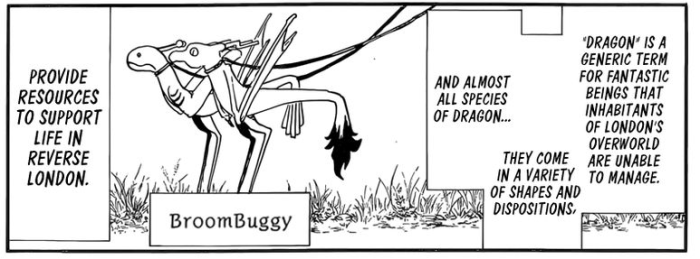
Dragons.png

Burn the Witch is about Anglo-Japanese school children fighting demons in fantasy Britain. The twist? Unlike their counterparts in fantasy Mexico, the British demons (referred to as ‘Dragons’ in-series) aren’t killed outright. Instead they are raised for the resources they provide. Only ‘bad’ demons who are killing humans or otherwise causing destruction are killed. It is noteworthy that the protagonists refer to themselves as ‘conservationists’. They kill the occasional demon, providing the story with action scenes when doing so, but their primary purpose is to conserve them. In an off hand comment the protagonists note that their fantasy Mexican counterparts are barbaric and indiscriminately kill their demons.

Contrary to the protagonist’s comments, it isn’t that individual fantasy Mexicans are barbaric so much that fantasy Mexico doesn’t recognize property rights in demons. Since no one has a property right in demons, no one has an incentive to conserve, much less domesticate, them in fantasy Mexico. Fantasy Britain enjoys strong property rights and consequently has minimal problems associated with its demons. One of the protagonists is ethnically from fantasy Mexico, but seems to be thriving under fantasy Britain’s rules. The story’s lesson? Property rights matter.

Only one chapter of Burn the Witch has been published thus far, and it’s unclear if it’ll become a recurring series, but I like what I’ve seen so far.

Thoughts? Comments? As always, write in the comments below. If you’re a fan of animation and a fellow libertarian, consider joining the anime libertarian alliance facebook group.

Battling Time and Ignorance: Mario Rizzo at 70

Last week my friend and colleague Mario Rizzo, a scholar central to the revival of  contemporary Austrian economics, turned 70. This occasion prompted a spontaneous outpouring of praise for his work, as well as messages of gratitude for his support of students and fellow academics over his decades as an intrepid professor with his home firmly at NYU. They are collected over at ThinkMarkets. Jeffrey Tucker has written an excellent summary of Mario’s intellectual contributions at the American Institute for Economic Research. Below is a segment of my birthday message:

In my home, the United Kingdom, classical liberal thought has until recently been virtually unheard within much of academia. As a student and think-tank researcher ravenous for liberal approaches to public policy, I gorged on Mario’s blog posts from ThinkMarkets. Together with Marginal Revolution and Cafe Hayek, ThinkMarkets was a critical lifeline for me facing an intellectual world dominated by various visions of authoritarianism and only slightly more benign variants of paternalism.

Thanks to Mario’s selfless contributions to the revival of Austrian economics, that intellectual world is changing, even in the UK. His co-founding of the Society for the Development of Austrian Economics and hosting the Program on the Foundations of the Market Economy at NYU has provided support and inspiration for countless young scholars.

I am very fortunate to be among that multitude.

IMG_5104


Brexit Breakdown

Ir has been obvious for at least a month now that soft Brexit has won out in the UK, though the Prime Minister Theresa May would never admit such a thing directly. Government discussion of access to the EU internal market at its existing level, or very close, and keeping the border open between the Republic of Ireland and Northern Ireland (a fundamental of the peace settlement in the north) would at the very least require continuing regulatory alignment in goods (that is, following the rules made by the European Union).

It seems very likely that negotiations of the terms of exit with the EU itself would make even this partial alignment with the internal market inadequate in order to get the desired level of access. At the very least EU negotiators would demand some inclusion of services (financial services are the big issue here) and something at least resembling free movement of labour.

That inclusion would be full UK access to the internal market after exiting and would require at least a Swiss style relationship with the EU, in which there is full market access in exchange for accepting EU rules and something close to free movement of labour. Such a relationship would mean accepting judgments of the European Court of Justice even if they are not incorporated into UK law. The UK might not follow Switzerland into EFTA (European Free Trade Association, see paragraph below).

It has even been suggested that the UK might find it necessary to adopt a ‘Norway’ solution, in which the UK is directly a member of the European Economic Area. Norway has free movement but opts out of common agricultural and fisheries agreements. It is not part of the EU customs agreement. Like Iceland, Lichtenstein, and Switzerland, it is a member of the European Free Trade Area, which essentially harmonises regulations between these countries and the EU; that is, EU regulations are enforced by EFTA institutions.

It is clear that most Conservative MPs and businesses (though more large business than small business) regard something like the arrangements above, soft Brexit, as preferable to hard Brexit (trade agreement with the EU as a completely external country, possibility of no deal). These MPs and business people, along with most Treasury economists and economists in general, believe that keeping complete access to EU markets is more valuable than vague claims of a trade boom through deals with non-EU states across the world.

Hard Brexiteers believe that economic growth of other parts of the world requires breaking free of EU shackles on global free trade. The soft Brexit, as well as Remain, argument is that membership of the EU does not prevent trade with the rest of the world and that some EU countries are already doing that very well compared with the UK. On this argument, geographical proximity will always make EU trade disproportionately important so that limiting access to EU markets in the hope that non-EU countries will want free trade agreements is unnecessary and probably very damaging.

May’s drift towards soft Brexit after presenting herself as the guardian of hard Brexit has the support of most of the Cabinet, and Conservative MPs, but has been disappointing hard Brexiteers for some time. An agreement of the full cabinet at the Prime Minister’s country residence for soft Brexit has led to the resignation of the two most hard Brexit-oriented ministers.

It seems unlikely this this will deter May from a soft Brexit policy, which everyone agrees can only become more soft in negotiations with the EU to achieve an agreed exit. It also seems unlikely that most Conservative MPs will resist this policy. The biggest problem for May could be that the opposition parties want to vote against the government in call circumstances, so could vote with hard Brexit Conservative MPs to bring down any Brexit agreement.

At this point Brexit might completely break down, with the UK becoming a full member of EFTA, so in practice a member of the EU which exchanges some opt-outs for absence from the decision making processes and institutions. It might even lead to a suspension of Brexit, or a second referendum in which the electorate chooses between the exit package and staying in the EU.

At present, the most likely options in descending order are: 1. soft Brexit, outside formal association with the EU, but like that in practice, 2. formal association with the EU, maybe meaning membership of EFTA, 3. the complete breakdown of Brexit. This could change and so far change has been to move further and further away from hard Brexit.

Personally I support continuing membership of the EU. It is inevitable that large parts of the UK economy will ‘align’ with EU regulations, so it is best to be part of the institutions and processes which decide on these regulations. That is the most pragmatic version of my argument.

I am also a strong European integrationist, even a federalist romantic. The qualification of this idealism is that integration should not go further than public opinion or institutional capacity can accept at any one moment and that economic realities should guide the relationship with Europe for and against the kind of integration I favour at heart.

My own ideal is a kind of revival of the medieval dreams of ‘universal’ (i.e. European) Empire. The poet Dante was a great exponent of such a vision in his classic of political thought On Monarchy, which does not exclude city republics, even favours them under a high European sovereign. We can join it with Marsiglio of Padua’s slightly later call for an empire with elections to have something like democratic federation for Europe.

Leaving my European romanticism aside for the moment, the current realities are that the UK’s exit from the EU has become more and more complicated by the disadvantages of disentangling complex and far reaching institutional and economic links, particularly when most people involved want to keep an open border with the Republic of Ireland and keep 100% of the current level of access to the internal market.

Turkey at the start of one-man rule

1. Yesterday (Monday) Recep Tayyıp Erdoğan took office under the system of executive presidency, which gives him arbitrary personalised powers, based on the claim that a system of such extreme powers for one person is the most democratic system if that person is elected. The changes came about as the result of a referendum last year, which gave a narrow victory for the constitutional changes. It seems to me, and many others, that rigging allowed victory in the election. For the first time in Turkey, all ballot papers unstamped by an electoral officer were counted, allowing unlimited fraud. There are other issues about intimidation and irregularities, but this is not the moment to go into further detail, but I will just point out that radical changes to the constitution were ‘legitimised’ by pseudo-democratic fraud.

2. The constitutional changes enable the President to: legislate by decree, appoint most Constitutional court judges, appoint the army chiefs, appoint police chiefs, appoint all higher level members of the bureaucracy, appoint government ministers and vice-presidents without reference to the National Assembly. There is no Prime Minister. The President, Vice-Presidents, and Ministers are not obliged to answer questions in the National Assembly. In principle the National Assembly can reverse decrees as laws, but to allow the President to legislate in such an unaccountable way in the first place undermines all understanding of what a national assembly is for and what the limits on the head of government or head of state (now the same person) should be in a state which is constitutional and democratic.

3. Ministerial appointments have most notably included the elevation of Erdoğan’s son-in-law, Berat Albayrak, to the Ministry of Treasury and Finance. Albayrak is a major businessman whose rise in business and then politics have taken place since Erdoğan became the most powerful man in Turkey in 2002.

4. Other appointments have given business people ministerial posts for areas of the economy in which they have a dominant market position. Erdoğan’s own family doctor who owns a medical business is health minister. The education minister owns a private college.

5. The appointments of business people and a son-in-law show carelessness about propriety in the separation of the administration of public affairs from private and family interests, to put it in the mildest way possible. It also suggests that Erdoğan thinks he is too big for the party which brought him to power, AKP. It has been clear for some time that the most powerful people in the AKP are this son-in-law and one of the sons. That is, the AKP exists as a vehicle of one family, and its businesses associates. In this case, it is hardly a properly functioning democratic party.

6. The appointments were preceded by a presidential decree on the appointment of the governor and vice-governors of the central bank, which reduces its autonomy and makes it more vulnerable to Presidential pressure. Erdoğan has clearly been struggling to live with central bank decisions to raise interest rates in response to inflation and the falling value of the Turkish Lira. Anyway, the currency lost 20% of its value and inflation is at nearly 16% though the central bank’s target is 5%.

7. Market confidence in Turkey, even of a very minimal kind, was resting on one man, Mehmet Şimşek, who has western training in economics and is the last remnant of the days when the AKP appeared to many to be a centre-right reformist party, and did manage to behave in part like such a party. Şimşek appears to have been increasingly unhappy with his situation, putting a rational face on polices he knows are going in the wrong direction, occasionally winning battles to raise interest rates. One of Erdoğan’s main obsessions is that interest creates inflation. He has found it necessary to curtail that belief on occasions. Şimşek apparently wanted to resign from government recently, but no one ‘betrays’ Erdoğan in that way. Şimşek was bullied into staying and has now been sacked. His replacement is Erdoğan’s son-in- law. The markets have been spooked and the lira fell very sharply yesterday evening.

8. The Erdoğanists do have a solution to lack of international market confidence in Turkey. It is to create a Turkish ratings authority which will rate Turkish government credit as the government wishes! This absurd proposal, which will only reduce the credibility of the lira and government debt, shows the depths to which economic policy run on political paranoia has sunk in Turkey. Political paranoia because low credit ratings are due to foreign conspiracies!

9. Going back to last month’s election, about 2% of ballots cast have been declared invalid by the Supreme Electoral Council. HDP (Kurdish rights and leftist party) has pointed out that most ‘invalid’ ballots are from polling stations where it did not have observers. The HDP is defined as ‘terrorist’ by the followers of Erdoğan and its presidential candidate is in prison on ‘terrorism’ charges. This is all based not on credible evidence of co-operation with the PKK, which does have common roots with HDP, but on absurdly broad definitions of terrorism which take in people who do not oppose the PKK enough or which offer any criticism of state policy towards the PKK.

10. Based on point 9, it looks very much like 2% of votes cast were spoiled to take votes from the HDP. It hardly seems likely that would be the limit of fraud. As mentioned in point 1, all ballots were counted which did not have the basic security guarantee of a stamp from an electoral official on the ballot itself or the envelope containing the ballot. It is inherently difficult to arrive at accurate figures in this matter, but it looks very much like at least 4% of the ballot was fixed (that would merely double the most obvious form of rigging, which I do not think is an extravagant assumption, after all most rigging will take place in very hidden ways). If I am correct then the pro-Erdoğan electoral list for the National Assembly did not get a majority of votes and Erdoğan did not get a majority of votes in the presidential election.

11. The government-state machine extends claims that the HDP is terrorist to the main opposition party, CHP, on the grounds that the CHP has offered some criticisms of the detention of the HDP presidential candidate, and that some CHP supporters voted HDP to help it overcome fraud and reach the 10% of votes necessary to enter the National Assembly. CHP provincial leaders have been banned from attending the funerals of soldiers killed by the PKK, soldiers who in some cases will be CHP supporters, showing the kind of spite, vengefulness, and abuse of state power driving the AKP.

12. The Istanbul municipal government has announced that public transport will be ‘only’ half price during next month’s Kurban Bayram (Sacrifice Festival; religious festival and public holiday) instead of free as has been normal for a long time. This shows the strains that public finances are under in Turkey. The AKP are specialists in providing ‘free’ benefits to electors, along with favours for individuals and families, building up a base in local government in this way before they came to power nationally. The Istanbul news is a small thing in itself, but is suggestive of a decline in the capacity of the AKP to use public money to buy votes.

13. Given increasing personal indebtedness, rising inflation, the falling value of the currency, the decline of foreign investment and the credibility of government debt instruments, we could see some very difficult economic times in Turkey. It is clear that this process was important in holding the recent election 18 months early. The loyalty of the AKP and Erdoğanist base is intense, but was formed at a time of economic growth and expanding public services. We see going to see what happens to loyalty in less happy circumstances.

Eye Candy: Each (American) state’s biggest export trading partner

NOL map US state trading partners
Click here to zoom

Those tariffs will work wonders for the economy, I’m sure…