My Pick-Up Truck and the Quality of Global Warming Reports

The struggle against climate change is making fast policy progress in the civilized world. It’s got to the point where I can foresee the authorities confiscating my good Toyota pick-up truck that has given me good service for eight years and continues to act just right. In California, they make no mystery of their intent to force me to replace it with a small electric sedan I won’t be able to afford. In the meantime, the same California is not able to guarantee enough electric power to keep my light bulbs lit 24/7; another story, obviously, a good one.

My problem is that I have not changed my stance on the credibility of the climate change narrative since I bought the truck. So, I feel tyrannized.

Recently, there was a long lasting, intense heat wave in the western United States where several people died of heat stroke. As I write, severe flooding seems to be ending in Germany, in Belgium, and in France. In the first country, at least one hundred people drowned.

Being a retired old guy, I listen to the media, or watch it, or read from it a good portion of the day. I do this daily, in at least two languages, English and French. There isn’t a day in my life when I don’t hear heat waves, or floods, or this and that blamed on “climate change.” The media personalities and journalists who assert those links all have one thing in common: None possesses the credentials to judge whether such a link exists at all. Climate change ideology has spread so successfully that every Dick, Tom, and Harry with a B.A. in Communications (or less) feels free to pronounce on such causal relationships as if they were simply mentioning that the sun rises in the east. Well, it’s not like this at all, not by a long shot.

Before I go on, we need a reminder: I mean by “climate change”: the narrative that includes all three statements below:

1 the climate is changing significantly in ways that affect people adversely;

2 this change is due to human activity and specifically the release of so-called “greenhouse gases,” (Human activity includes such things as manufacturing, reliance internal combustion engines, including in cars, cattle raising);

3 the adverse effects are such that we, collectively, need to address them right now.

Baselines Climate Change Advocates endlessly publicize: hottest year in 37 years, or most hurricanes in a period of two years since 1920, or highest tide since 1882. All such announcements are worthless and therefore misleading. There is no evidence of change without a baseline and the baseline has to make sense. It cannot be picked opportunistically, of course (as was done on the occasion of the “hockey stick” scandal; look it up). It cannot be selected mindlessly. Let me give you areal example. It may well be that the Greenland glaciers are melting unusually fast. And, of course, it could be a result of human caused global warming (oops, climate change). But, we know – because a noted environmentalist told us (Jared Diamond) – that the Norse inhabitants of Greenland were raising cattle there around 1100. You can’t do this today in Greenland because it’s too cold. So, if it was warmer there a thousand years ago, what’s left of the inference that it’s what happened in only the past 150 years of Industrial Revolution, etc (make it 160, 200, no matter) that produces the heat that melts glaciers? My point here is that what you infer from change observed from a bad baseline is not only a little off; it’s simply wrong. Climate Change enthusiasts and passive believers alike do this all the time. They also don’t accept corrections based on a more reasonable baseline.

Measurements The Climate Change narrative is chronically plagued with measurement issues and downright falsehoods. If you want to tell me anything about the condition of my house and you begin with a statement to the effect that one wall has sunk by 240 inches without my noticing, you are done; I have no reason to listen to anything else you have to say. Be gone!

I don’t normally read scholarly research supporting the climate change narrative. I shouldn’t have to. I am just a citizen. If you want me to alter my life drastically, it’s up to you to give me good reasons in a language I can grasp without two or three doctorates (additional doctorates, in my case). I do read the reports made of it by non-scholarly sources that I think intellectually respectable. The Wall Street Journal is one. (More on this below.)

Here, there are two nested problems with ways to assess climate events commonly found in the media. People have a tendency to confirm what they hear by saying, Yes, it’s never been so hot, ever. The first problem is that when this is said, the reference is almost always to the person’s personal experience. That can seldom exceed 90 years, a period insufficient to cover anything blamed on the 150-plus years since the beginning of the Industrial Revolution. The second problem is that, obviously, almost everyone has bad memory and forgets events at random. Here is an example: When I was a small child, I remember distinctly newspaper photographs of the sea frozen in the English channel, together with one radio comment to the same effect. My siblings living at the same time in the same place, remember no such thing. They have forgotten or I have produced a fabricated memory. Either way….

This past weekend’s Wall Street Journal takes apart a more sophisticated kind of measurement fallacy, one committed by a fairly respected federal agency. (Roger Pielke Jr, WSJ; 7/17-18/21; p. C4.) The National Oceanic and Atmospheric Administration announced that natural disasters causing one billion dollars of damage or more were seven times more numerous in 2020 than they were in 1980. The NOAA adjusted for inflation, of course. It did not compare 1980 dollars with 2020 dollar. Good enough, right? Not so. How much damage a given disaster causes depends on its severity but it also depends on how much is available to be damaged. There is incomparably more value to be obliterated today in America than there was in 1980. The same tornado occurring on the same day in the middle of the Sonora desert will cause much less damage than it would in Time Square, perhaps a million times less. That’s not a small error. The NOAA mistake is monumentally misleading. If you corrected for the amount available to be damaged, you might find that there was actually seven times more destruction in 1980 than in 2020. (I am not accusing anyone, except of gross incompetence. It’s not all bad faith.)

To aggravate again the severity of my judgment is the fact that real scientists with real credentials almost never step out of the ivory tower to condemn publicly the thousands of false statements made in their name every day.

Things have not changed much in eight years with respect to credibility. I don’t have any reason to change my mind and to consider the narrative favorably because it has not improved in rigor or in accuracy. They may be able to tear me off the seat of my pick-up truck but that will not alter my judgment that the repression is based on snake oil merchandising and on primitive superstitions. Yes, you can quote me.

Some Monday Links – Of bloody summer stains, busted hopes and laundries

Also lingo. And beards.

Why Cuba is having an economic crisis (Noahpinion)

The Language of Totalitarian Dehumanization (Quillette)

On the Cuba events. Governments and protests, now that’s a strained relationship. Talking about the so-called “Second World” countries, Nikita Khrushchev did not even know what booing is, until he encountered it in his visit to London in 1956.

Few years later, during a massive strike in the Russian city of Novocherkassk, a crowd stormed the central police station. Whether it was a genuine assault, or a naive display of defiance from a people inexperienced in protesting, the government’s fearful puzzlement turned to cold, brutal aggression. Unarmed protesters at the center of the city, mistakenly thinking that those days were over, remained steadfast at the face of warnings to disperse. That is, until security forces opened direct fire against them. The ensuing massacre was covered-up for three decades. Since this was an à la Orwell un-event, no high-ranking officials’ records were stained.

Khrushchev’s aloof ignorance strikes a nerve, contrasted with the people’s heartbreaking one. Both glimpses are captured in the brilliant (though somewhat uneven) Red Plenty, by Francis Spufford.

All things said, Karl Marx Loved Freedom (Jacobin). More beards.

The Greek government, like its French counterpart, is escalating the push for vaccinations. As constitutional scholars argue the limits of state power regarding personal freedom and the public good, historical precedents are brought forth (for the US, c. early 1900s), involving mandatory vaccinations, quarantines and discrimination. The discussion draws from equal protection of the laws jurisprudence and smoothly led me to Yick Wo v. Hopkins (1886):

Yick Wo v. Hopkins established fair implementation of statutes (History Net)

The decision set a milestone and has been cited some 150 times.

The backdrop of the case is rich. As it turns out,

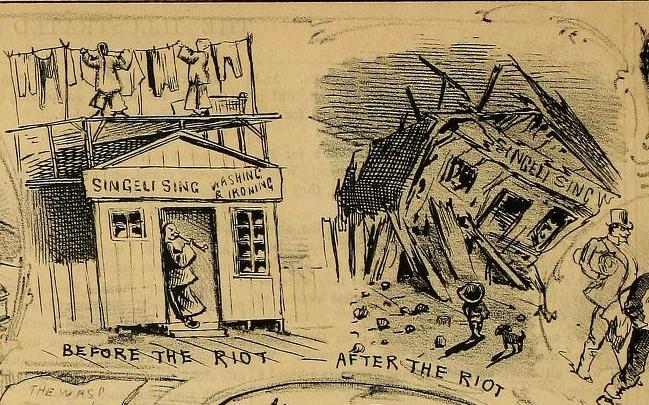
An 1880 ordinance of the city of San Francisco required all laundries in wooden buildings to hold a permit issued by the city’s Board of Supervisors. The board had total discretion over who would be issued a permit. Although workers of Chinese descent operated 89 percent of the city’s laundry businesses, not a single Chinese owner was granted a permit.

Oyez

The regulation was one in a series of many that reflected the anti-immigrant (especially anti-Chinese) sentiment, following the influx due to the Gold Rush (1849).

An illustration of the time, echoing the 3-day pogrom vs Chinese immigrants, San Francisco Jul. 1877 – Source

Yick Wo: How A Racist Laundry Law In Early San Francisco Helped Civil Rights (Hoodline)

A particularly badass line, from the unanimous opinion authored by Justice Stanley Matthews, shows that the Court did not hold back:

Though the law itself be fair on its face and impartial in appearance, yet, if it is applied and administered by public authority with an evil eye and an unequal hand, so as practically to make unjust and illegal discriminations between persons in similar circumstances, material to their rights, the denial of equal justice is still within the prohibition of the Constitution.

Will the US and Iran find common ground in Afghanistan?

Introduction

On July 7, 2021 Iran hosted talks between the Afghan Government and the Taliban (the Taliban delegation was led by Sher Mohammad Abbas Stanikzai). The same day, the Taliban attacked the Badghis provincial capital Qalat-i-Naw (Badghis is one of thirty-four provinces in Afghanistan). Iranian Foreign Minister Javad Zarif emphatically stated that the Afghan people should decide their own future, while also stating that there was a major threat to security. As of Friday, the Taliban claimed to have captured 85% of Afghanistan’s territory (it is tough to verify such claims however).

Zarif also underscored the point that dialogue was the only option for finding a way out of the current imbroglio in Afghanistan:

…commitment to political solutions the best choice for Afghanistan’s leaders and political movements

Tehran, which shares a 945 kilometre border with Afghanistan, also hosts 3 million Afghan refugees and migrant workers, and has expressed its concern with regard to the growing turmoil in the country as a result of US withdrawal of troops.

Important symbolism

If one were to look beyond the Afghan-Iran bilateral relationship, as well as the fact that Tehran is likely to be impacted by events in Afghanistan, the meeting is an attempt by Iran to send out a message to Saudi Arabia (which for long has positioned itself as the key geopolitical player in the Middle East) and the US with regard to its geopolitical relevance.

Tehran’s ties with Riyadh have witnessed an upswing in recent months, with Saudi Arabia expressing its keenness to resolve bilateral issues. Senior officials from both countries met in Iraq in May. Saudi Crown Prince Mohammed bin Salman, in a media interview in April 2021, clearly batted in favour of better Saudi-Iran ties, while not denying that differences did exist between both sides. Talks were held between Saudi and Iranian officials in April and May in Baghdad and are likely to shift to Oman.

Iran-US ties

Iran’s ties with the US under the President-elect Ebrahim Raisi, a hardliner in comparison to outgoing president Hassan Rouhani, are likely to face more challenges (at least in the short run). The Biden administration had made attempts to rejoin the Iran Nuclear deal/Joint Comprehensive Plan of Action (JCPOA), but it had limited time. (The US had signed in 2015, but the Trump Administration withdrew from the JCPOA in 2018.)

While the Iranian Presidential election was held in June, the Vienna negotiations (in which US participated indirectly) began only in April 2021. Some ice has been broken between Iran and the US, but no real outcome should be expected till August, when Raisi takes over. Iran’s announcement that it would begin producing enriched uranium metal has also drawn severe criticism from the E3 countries (France, Germany, and the UK) and could act as an impediment to the renewal of the JCPOA. It would also be pertinent to point out that, due to domestic pressures, it was very tough for both sides to move away from stated positions (while the US had said it would remove sanctions once Iran fully complies with the terms and conditions of the 2015 deal, Iran stated that it could only do so after US removed economic sanctions).

Need for US-Iran engagement on Afghanistan

Biden has shown pragmatism on a number of foreign policy issues. A strong example of this is how, in spite of his criticism of Russia, he has not refrained from engagement and finding common ground with Moscow. Similarly, realising Turkey’s importance in Afghanistan (Turkey had offered to safeguard Kabul Airport after the withdrawal of US troops), he has sought to improve ties with Istanbul. During a meeting between Biden and Turkish President Reccep Tayyip Erdogan, on the sidelines of the NATO Summit, a number of issues were discussed and both sides agreed that the meeting was positive. During the Summit, Turkey — a NATO member — made a commitment that it would keep its troops in the country, to safeguard Kabul Airport.

It is important that the US engages with Iran in a more pro-active manner (albeit indirectly), and not just on JCPOA but also Afghanistan; so far Biden has publicly spoken about the role of Russia but given the tensions with Tehran he has not really made a mention – though there has been a growing chorus by US allies for a back channel with Iran on Afghanistan. Given the fact that the US is engaging with Iran indirectly on JCPOA and other changes taking place, some engagement would already be going on but this needs to be substantial and more effective. On the other hand, Beijing, Moscow, and Tehran have been working to find a common strategy to counter the likely security challenges in Afghanistan.

Neither Tehran nor Washington can engage publicly, but it is important for Biden to open an effective back channel to Iran via US allies in the GCC, such as Oman, Saudi Arabia, and the UAE. Iran, in spite of moving closer to Beijing and Moscow in recent years as a result of Trump’s flawed Iran policy, would not like to send out a signal that it is blindly kowtowing to any external force, including China (the Iran-China 25 year agreement was viewed with suspicion in Iran by many including Former Iranian President Mahmoud Ahmadinejad who called it a suspicious deal), and a working relationship with Washington on the Afghanistan quagmire would only produce benefits.

In conclusion, the Biden Administration should give priority to the relationship with Iran seeing the changing political landscape. While due to domestic pressures and lobbies within the US, progress with regard to Washington getting back on board the JCPOA has been impeded, it is important that the US does not miss out on pro-active back channel diplomacy and engagement with Iran on Afghanistan.

Somaliland’s elections

Somaliland just held elections recently. Political scientist Scott Pegg was there as an international observer. I reprint his report with his permission:

I was in Somaliland as an international election observer for their parliamentary and local council elections on May 31st. The blog I did with Michael Walls has lots of cool photos in it if you want to see low-tech democracy in action in an extremely poor country in the Horn of Africa: https://defactostates.ut.ee/blog/observing-somaliland%E2%80%99s-2021-parliamentary-and-local-council-elections.

So, the biggest problem by far with Somaliland elections is that there is almost no policy or ideological differences between the candidates (everyone wants them to be recognized, everyone wants to promote livestock exports, etc.). Candidates will loudly proclaim how they fundamentally differ from their opponents but then when you ask them something like “give me three key issues you disagree about,” they start mumbling and deflecting. Unfortunately, much of their politics is clan-based (and often sub-clan based). When I was there for the 2017 presidential elections, a seasoned political observer who is a friend of mine gave me this incredible breakdown of “we’ve got this clan, that sub-clan and the other sub-clan, they’ve got this clan, that sub-clan and the other sub-clan and the only unknown variables are this clan and that sub-clan.” It was exactly like John King pulling up different electoral maps on CNN, just without the maps and the technology. Based on his analysis, I asked if I could get posted to either Burco (where I was sent in both 2017 and 2021) or Boroma because they were what he correctly predicted were the equivalents of “swing states” in their election. So that’s the depressing part.

The inspiring part is that there are several minor issues or problems, but the elections themselves are incredibly peaceful, festive, free, fair and orderly. The single biggest problem I saw this time was an unsealed ballot box. The polling station staff knew it was a serious problem and had already called the regional electoral headquarters to ask for additional seals to be brought out. Yet, the box is sitting in the middle of the room in full view of all voters and all observers and no one is tampering with it in any way. I initially thought the polling station I saw close was closing early and leaving a few dozen voters in line locked out of the process. Then, I soon discover that it is a 20 minute break for evening prayer time, after which they resume voting and stay open 90 minutes late to accommodate everyone who was in line before the polls close. They weren’t supposed to do that, it was technically wrong, but it wasn’t anything that was done with any kind of fraud or malicious intent and all the voters were totally cool with it. The one area where they totally violate international norms is on the secrecy of the ballot. Voters can vote in secret but large numbers of them just don’t care if people know who they are voting for and walk into the polling station loudly proclaiming I want to vote for X or Y candidate. The election staff either shows them how to do this or does it for them and then shows the ballot to all observers so they can see the voter’s intent was carried out. Alternatively, some voters vote in secret but then go up to the political party observers and say something like can you verify that I actually voted for X and Y candidates, which they then do honestly and scrupulously. They have assorted small problems or mistakes, but absolutely zero fraud, systemic irregularities or malevolent intent. Watching the process on election day is truly inspiring and I wish more Americans who are so jaded and cynical about our democracy could see it.

For more on Somaliland at NOL, start here. You can check out Scott Pegg’s excellent scholarship here.

Iran, the US, nuclear deals, and South Asia

In the coming months, US-Iran relations will be watched closely in South Asia (the region’s geopolitical landscape will be significantly impacted as it is by the withdrawal of US and NATO troops from Afghanistan).

India’s ties with Iran are economic and strategic. It has, for example, invested in the Chabahar Port project (during PM Modi’s Iran visit in 2016, India had committed $500 million for development of the port), and in December 2018, India had taken over a part of Phase 1 of the Chabahar Port (Shahid Beheshti). New Delhi has, however, stopped oil imports in 2019 after the US ended the waiver which it had provided to India and other countries for import of oil from Iran.

After India’s decision to stop importing oil from Iran, ties deteriorated and the Chabahar Project also suffered. Iran expressed its displeasure with New Delhi for stopping oil imports and also complained that development of the Chabahar Port had slowed down. This in spite of the fact that the Trump Administration had stated that Chabahar Project would be free from US sanctions on Iran. A State Department spokesperson, while commenting on Chabahar Port, said:

The exception for reconstruction assistance and economic development for Afghanistan, which includes the development and operation of Chabahar Port, is a separate exception, and is not affected by yesterday’s announcement

New Delhi and Tehran have been working towards improving ties ever since the end of 2019.  With the change of guard in Washington DC, however, India sensed a reduction in Iran-US tensions and also a US return to the JCPOA. As a result, it has been paying greater attention to the Chabahar Project, which has been dubbed as its gateway to Afghanistan and Central Asia (India has already used the port on more than one occasion for sending consignments to Afghanistan and relief materials during the Covid19 pandemic). Soon after the victory of Joe Biden in the US presidential election, India began to pay greater attention to the Chabahar Port and work on it has accelerated since the beginning of 2021.

It would be pertinent to point out that Indian PM Narendra Modi also sent a congratulatory tweet to Raisi stating that he looked forward to ‘working with him to further strengthen the warm ties between India and Iran.’

While the Tehran-New Delhi relationship seems to have improved in recent months, Tehran kept India out of the development of the Farzad B gas field (this field had been discovered by ONGC Videsh, the overseas arm of Oil PSU, Oil and Natural Gas Corporation). The Iranian oil ministry, in a statement, said:

The National Iranian Oil Company (NIOC) has signed a contract worth $1.78 billion with Petropars Group for the development of Farzad B Gas Field in the Persian Gulf

New Delhi responded by saying that Iran would involve India at a later stage in the development of Farzad B.

Iran-Pakistan ties and CPEC

It is also important to bear in mind the fact that Pakistan-Iran ties have witnessed a significant improvement in recent years.

First, there has been a downward slope in Pakistan’s relations with Saudi Arabia and the UAE (though in recent months Islamabad’s ties with the UAE and Saudi Arabia have improved).

Second, the Iran-China 25-year strategic agreement signed earlier this year is also likely to result in the expansion of the China Pakistan Economic Corridor (CPEC) Project towards Iran. (Tehran has expressed its willingness to be part of CPEC project). In recent months, China has already been focusing on Afghanistan as an important component of the CPEC. Chinese Foreign Ministry Spokesman Zhao Lijian, in May 2021, said, ‘China, Pakistan, and Afghanistan are discussing issues related to extending roads and expressways in Pakistan to Afghanistan.’

Conclusion

In conclusion, revival of the Iran Nuclear Deal is likely to take time. The US-Iran relationship is important not just in the context of the bilateral relationship, but is likely to have an impact on the geopolitics of the Middle East and South Asia, as well as important connectivity initiatives of both India and China.

Fred Foldvary, RIP

I have been offline for awhile now. Michelangelo shot me an email the other day alerting me to the fact that Fred Foldvary passed away earlier this month.

Fred was one of the original Notewriters here at NOL. He supported this project from the beginning. Here’s his first ever post for NOL, and here is his last one.

I first met Fred in person at an undergraduate summer seminar hosted by the Independent Institute in Oakland, and I had no idea what he was talking about (he was lecturing on interest rates). His writing over the years has convinced me of the soundness of a land tax, so much so that I call myself a geolibertarian if push comes to shove, and his selflessness with his time will never be forgotten.

Fred was an important voice for liberty once the Ron Paul moment got libertarianism out of its doldrums. The brutalists, led by Jeffrey Tucker, were pushing liberty in a decidedly non-liberal direction and many Ron Paul fans got discouraged by what they found. Fred was one of the people laboring hard to stress liberty’s humane-ness.

Without his encouragement, NOL would have never gotten off the ground.

Fred’s death coincides with the death of another prominent libertarian: Steve Horwitz, who was also instrumental in making libertarianism humane at a time when liberty was being pimped as a creed for conservatives with no hearts.

May they rest in peace.

What the rise of Raisi means for regional security and nuclear bargains

Introduction 

The triumph of hardliner Ebrahim Raisi in the recently-held Iranian Presidential election is likely to pose a challenge with regard to the renewal of the Joint Comprehensive Plan of Action JCPOA/Iran Nuclear Agreement (in 2019, US had imposed sanctions on him for human rights violations). Raisi, who has been serving as Iran’s Chief Justice since March 2019, will take over as President in August 2021 and will be replacing Hassan Rouhani, a moderate.

While he has not opposed the JCPOA in principle, Raisi is likely to be a tougher negotiator than his predecessor. This was evident from his first news conference, where he said that Iran will not kowtow to the West by limiting its missile capabilities or addressing concerns with regard to Iran’s role in the region’s security. In the news conference, he also stated that he will not be meeting US President Joe Biden.

The US has been guarded in its response to the election result. Commenting on the verdict and its likely impact on the Iran nuclear deal, US National Security Advisor Jake Sullivan stated: 

The ultimate decision for whether or not to go back into the deal lies with Iran’s supreme leader, and he was the same person before this election as he is after the election

Iran-China relations in recent years  

Chinese President Xi Jinping congratulated Raisi on his triumph, describing Iran and China as ‘comprehensive strategic partners.’ The Chinese President said that he was willing to work with Iran on a host of issues. Only last year, Iran and China had signed a 25-year strategic comprehensive agreement which sought to give a strong boost not just to economic ties between Tehran and Beijing, but security ties as well. One of the reasons cited for Tehran moving closer to Beijing has been the Trump administration’s withdrawal from the Iran-P5+1 agreement/JCPOA in 2018 and its lack of flexibility. From Beijing’s point of view, the deal was important not just for fulfilling its oil needs (according to the agreement, China would receive Iranian oil at a cheaper price). 

While there is no doubt that the Biden administration has made attempts to revive the Iran nuclear deal in recent months and the Vienna negotiations in which US has been indirectly involved, a solution does not seem in sight in the short run given that Raisi will replace Rouhani only in August. Also, if both sides stick to their stated position things are likely to get tougher. Interestingly, a senior Iranian official, presidential chief of staff Mahmoud Vaezi, indicated that the US had agreed to move over one thousand Trump-era sanctions, including those on insurance, oil, and shipping. 

The JCPOA has taken a break at the Vienna talks for some days and, commenting on this, Mikhail Ulyanov, permanent representative to Russia, said:

The task is to make full use of this break to ensure that all participants get final political instructions on the remaining controversial issues

Obstacles  

While many Democrats and strategic analysts had been arguing that the Biden administration needed to show greater urgency and move away from stated positions with regard to a return to the JCPOA, opposition from not just Republicans but hawks within his party made any such agreement impossible.  

Apart from domestic opposition, Biden will also need to deal with pressure from Israel. While it is true that GCC countries, like Saudi Arabia and the UAE, earlier opposed to the deal have been seeking to improve ties with Iran and have also softened their opposition to the deal, Israel has been opposed to JCPOA. The recently-elected Israeli Prime Minister Naftali Bennett’s stand vis-à-vis JCPOA is the same as Benjamin Netanyahu’s. After the Iranian election, the Israeli PM said: 

Raisi’s election is, I would say, the last chance for world powers to wake up before returning to the nuclear agreement, and understand who they are doing business with

Role of China and Russia  

It would be pertinent to point out that, days before the election, the Chinese Foreign Minister Wang Yi had stated that the US should remove sanctions vis-à-vis Iran. Given the fact that Raisi is anti-West, it is likely that China and Russia could play an important role in the revival of JCPOA.  

While there is merit in the Biden administration’s approach of removing sanctions against Iran in a stage-wise manner, since this may be politically more feasible, Washington needs to think innovatively and bear in mind that a rigid approach vis-à-vis Tehran will only make anti-Western sentiment in Iran more pronounced, and leave it with no choice but to move closer to China. GCC countries like the UAE and Saudi Arabia, which have been working towards resolving tensions with Iran, could also play an important role in talks between the Biden administration and a dispensation headed by Raisi.

In conclusion, the Biden Administration clearly has its task cut out. While negotiating with Raisi may not be easy, the fact that he has support of the supreme leader could be favourable, and the US could also use some of its allies to engage with the new administration.

“Building Back A Better World”: Can it challenge the BRI?

Introduction

Ever since taking over as President, Joe Biden has reiterated the need for the US and its allies to work together to check China’s economic rise by providing alternatives to China’s ambitious Belt and Road Initiative (BRI) project as well as its burgeoning technology scene. During his State of the Union address in April 2021, the US President had said:

China and other countries are closing in fast. We have to develop and dominate the products and technologies of the future

It would be pertinent to point out that 138 nations on five continents have signed various BRI cooperation agreements with China as of the end of 2020. (EU member states including Greece and Italy are also on board the BRI.) China has so far invested a whopping $690 billion in BRI-related projects in 100 countries.

G7 and the B3W

On June 12, 2021 the G7 unveiled the Building Back a Better World (BBBW/B3W), a brain child of the Biden Administration. The G7 leaders said that the B3W would be “values-driven, high-standard, and transparent.” During a conversation with Boris Johnson in March, the US President had discussed the need for an alternative to the BRI. A number of BRI related projects in developing countries in Asia and Africa have drawn criticism for lacking in transparency and not being economically sustainable, leading to debts which make countries dependent upon them or leads to a “Debt Trap (pdf).”

Debt trap has been defined as “a predatory system designed to ensnare countries into a straightjacket of debt servitude.” A prominent example of this is Sri Lanka, where when the South Asian nation’s debt burden vis-à-vis China became untenable, it was compelled to sign a 99-year lease with China through which Beijing got 70% stake in the strategic port of Hambantota. Many projects falling under the China Pakistan Economic Corridor (CPEC), too, have been under the cloud for lacking transparency and not being feasible. In certain cases, such as the Kyaukpyu port in Myanmar, Beijing has had to renegotiate the cost of projects (it was brought down from $7.3 billion to $1.3 billion) as a result of strong local opposition.

Alternatives to BRI

The Trump Administration received bi-partisan support for the BUILD (Better Utilisation of Investment Leading to Development ) Act, which created a new agency (the United States International Development and Financial Corporation, or USIDFC) with a corpus of $60 billion to facilitate private sector involvement in the Indo-Pacific, especially African countries. In 2018, the US Secretary of State Mike Pompeo had also made a commitment of $113 million to projects in the Indo-Pacific focused on technology, infrastructure, and energy. In November 2019, the US, Japan, and Australia had also launched the Blue Dot Network on the sidelines of the ASEAN Summit.

Then-US National Security Advisor Robert O Brien had compared the Blue Dot Network to Michelin Guide, which meant that just like a Michelin star is the sign of approval for a restaurant, a blue dot would be a seal of approval for infrastructural projects. Days before the G7 meeting, the inaugural meeting of the consultation group of the Blue Dot Network was held in Paris, apart from representatives from Western governments and Japan, other stakeholders such as members of civil society, academics, and 150 global executives participated in this meeting.

The US State Department, while commenting on the Blue Dot Network, had said:

The Blue Dot Network will be a globally recognized symbol of market-driven, transparent and sustainable infrastructure projects

Under the umbrella of Quad countries (US, Japan, Australia, and India), too, there has been discussion on enhancing economic cooperation as well as connectivity.

Opportunities for the B3W

There is an opportunity for the B3W, since in the aftermath of Covid, certain BRI projects have slowed down. Second, the geographical scope of BBBW is much wider than that of the projects under the Indo-Pacific (B3W will also include Latin America and Caribbean). BBBW can also hardsell its strengths such as transparency and sustainability – both economic and environmental. It also can dovetail with some of Biden’s ambitious economic schemes related to the economy and infrastructure. The fact that Biden is willing to take the lead, unlike Trump, is reassuring for allies and sends out a positive message to developing countries looking for alternatives to the BRI. While addressing a press conference after G7, the US President made this point:

The lack of participation in the past and in full engagement was noticed significantly not only by the leaders of those countries, but by the people in the G-7 countries, and America’s back in the business of leading the world alongside nations who share our most deeply held values

The US had also categorically clarified that the B3W seeks to provide an alternative to BRI, but it is not merely about targeting China.

Possible limitations of B3W

Yet, there are limitations. First, the B3W still does not have a clear blue print. Second, it would be tough to match the BRI in terms of resources. Third, a number of G7 members who themselves share good relations with China may be reluctant to get on board the initiative (even though it has been made clear that the B3W initiative is not just about targeting China).

Conclusion

In conclusion, a lot will depend upon how much not just the US government and big businesses are willing to invest in the B3W (since the model will be different from the BRI, which is one of ‘state capitalism’) but whether other members of the G7 are willing to play a proactive role in such a project. An alternative is needed to the BRI and the announcement of B3W is welcome. Taking it forward and competing with BRI may not be impossible but is certainly a tough task.

American Classical Liberals Suck

This week Kevin Vallier published a new entry on neoliberalism in the Stanford Encyclopedia of Philosophy: Neoliberalism (Stanford Encyclopedia of Philosophy). It is a well-written, well-researched piece. However, it is also symbolic for the greatest deficiency of American classical liberals: they are unable or unwilling to defend the name, or label if you like, of the ideas they are associated with. Given the influence of American academia and thinks tanks on the rest of the world this is especially important. It has happened before, and it is happening now. It sucks.

This is how Vallier starts his entry:

“Though not all scholars agree on the meaning of the term, “neoliberalism” is now generally thought to label the philosophical view that a society’s political and economic institutions should be robustly liberal and capitalist, but supplemented by a constitutionally limited democracy and a modest welfare state. Recent work on neoliberalism, thus understood, shows this to be a coherent and distinctive political philosophy. This entry explicates neoliberalism by examining the political concepts, principles, and policies shared by F. A. Hayek, Milton Friedman, and James Buchanan, all of whom play leading roles in the new historical research on neoliberalism, and all of whom wrote in political philosophy as well as political economy. Identifying common themes in their work provides an illuminating picture of neoliberalism as a coherent political doctrine.”

The problem is in the words: ‘“neoliberalism” is now generally thought…’’.  Neoliberalism is a hotly debated term, there is certainly no consensus on its meaning. As Oliver Hartwich has emphasized in Neoliberalism, the genesis of a political swearword, it is still most often used as a swearword by the left for all that they think is wrong with capitalism, (classical) liberalism, (more or less) liberal policies by IMF, WTO and World Bank, et cetera. These left wingers are also found in academia, policy and in media circles, which has led to its routine use. However, it is not true that the work of Hayek, Friedman and Buchanan is generally thought to be covered by a neoliberal label. Only those who disagree with it call them neoliberals. It is painful to see that the ideas of these three Nobel Prize winners are now used to explain neoliberalism in a leading online source. They self-identified as classical liberals and just because opponents of their views use a different label is no reason to comply with that malicious practice.  

The worse thing is, it has happened before, also commencing in the US. Fairly recently, classical liberals began to use the label libertarian, as the Cato Institute has been promoting, for example on their (very useful) website  Libertarianism.org, or in David Boaz’ The Libertarian Mind.  Jason Brennan’s Libertarianism, what everyone needs to know is another example. The issue here is that the three aforementioned classical liberals, and others, are now thrown onto the same heap as Rothbard and Rand, to name a few rather different thinkers.

Decades earlier, Hayek and others noted with regret that the Americans were unable to defend the original meaning of the word liberal, with the result that a liberal in the American sense is now what people in other parts of the world call a social-democrat. It is also the reason Hayek and other started to use the name classical liberal.  

The result of all this changing of names is confusion and vulnerability. Nobody knows what label belongs to which ideas, which gives rise to a petty industry on liberal labels, yet without any clarity in the end. It also provides ample opportunity for opponents to negatively attack ideas loosely associated with the (classical) liberal movement, which results in a negative image, which also make liberal ideas less attractive for outsiders. The lack of clarity also makes vulnerable for any kind of criticism. Actually, embracing the swearword other use for you, by offering the ideas of your greatest and brightest thinkers, is a shameful act at least.

American classical liberals should stay firm and defend their ideas under the proper labels. There is no reason for change (see my Degrees of Freedom: Liberal Political Philosophy and Ideology), there is only a need for explanation and defense. Giving up clear and proper labels plainly sucks.         

The Great American Racial Awakening (Part Three): “It Wasn’t Me!” and Something to be Done.

American society, American whites, non-black minorities, and even some African Americans, have not fully absorbed the fact that American slavery was a long story of atrocities. It was also an endeavor of mass rape, as the light skin color of many African Americans demonstrates. (It was rape by definition; human “property” does not have the ability to give consent.) Soon after the abolition of slavery, incapacitating legally defined inferior treatment of black Americans descended on much of the country. In the South – the historical home of slavery – extra-judicial murder was frequent enough to keep many blacks timid and in partial subjection; sometimes, the resort to intimidation rose to mass murder. Incidentally, this forgetfulness is why I am glad that National Geographic, first, and Pres. Biden second, recently chose to showcase the 1921 Tulsa race massacre. Whatever the latter’s real motivation, that may be the first good thing he did.

Of course, the question should arise, must arise, of responsibility regarding both slavery and segregation. This for two reasons. First, long lasting acts of inhumanity should not go un-described lest ignorance do harm in the next generations. Second, the treatment of African Americans was, for centuries so spectacularly at variance with long standing Anglo-American tradition that some sort of explanation is required. But there can be no explanation, of course without a recognition of who the actors were, of their identification. In fact, there are voices among the pushers of Wokeness claiming that all whites are guilty by definition. (I choose my words with here care.) “It wasn’t me; I wasn’t even here,” reply many white conservatives. Below is an examination of the white case I know best, mine,

I am immigrant. I landed in the US as an adult for good in 1963. It was too late to contribute much to racial segregation. If one of my approximately 30 family antecedents since 1865 had made it to American shores before me, I think the news would have reached me through family lore. So, I am almost certainly innocent on the account of aiding segregation, including trans-generationally innocent. Slavery is another issue.

Assessing my antecedents’ possible contributions to slavery is more dicey because of the greater remoteness in time but, especially, because of the multiplicity of family lines one would have to follow. (I think that to arrive even at 1800, one would have to research up to 64 linkages.) It seems that both sides of my family going back to my great-great-grandparents at least come from eastern and northern France, hundreds of mile from the western coast slaving ports. This does not exclude the possibility that one young man or other among those who sired me found his way there and signed up for a slaving voyage or two without leaving a record worthy of notice. There is also no obvious record of anyone with my last name, or my mother’s maiden name being a slave owner in America. This leaves open the possibility that some of the other branches with different surnames reached here and held slaves. As they say, “Absence of evidence is not evidence of absence.”

Still, on the whole, my antecedents are less likely to have profited from slavery than many, many people of coastal African descent, for example. Late into the 19th century, for example, the economy of the west African kingdom of Benin was centered on slave trading, including feeding the remaining cross-Atlantic trade. It would be surprising if some descendants of American slaves or some recent Nigerian immigrants were not also descendants of Benin slavers. Also, take the Kenyan Obamas, for example, with their Arabized first names… (“Barack” means “blessed,” in Arabic, a pious way to say “luck,” or “lucky;” and the aunt the president would not acknowledge was named “Zeituna,” Arabic for “Olive.” No olives grow in Kenya, I am sure. So, why “Olive”?) How did these names happen given that they are not Muslims? Could it be that the older Obamas were involved with the Arab slave traders of Africa’s east coast (who plied their trade much longer than anyone based in America)?

This mindless genealogical excursion is coming to an end, finally. There was a point to it though. It is this: It’s easy enough for many, possibly for most white Americans to argue that they should not be held to account either for slavery or for racial segregation because they were not here, in America, when those happened. What’s more, it’s likely that none of their ancestors were. The immigrant (legal, I hope) who landed yesterday from Russia certainly can make that claim, same as I do. It seems to me that the claim is largely irrelevant. In fact, and thinking realistically and cynically, if we looked for culpability through blood lines, we shouldn’t be surprised to find that the average African American of today is more related to slave owners of the past than is the average white American. (This speculation is based on the pretty good assumption that most of today’s white Americans trace all their American ancestry to post-1863 immigration.)

Thus my point here is not that American conservatives should wallow forever in useless guilt (like a liberal wimpette) because of some supposed culpability based on race. Neither do I think that they should help feed – by supporting this claim – a sense of impunity among black criminals preying mostly on innocent African Americans. Nor do I suggest that my fellow conservatives should yield to any of the endless, diffuse race-based blackmails filling our media today (in 2021). My point rather is that we, Americans, including, and especially American conservatives, should fix what we can. I explain the ethical reason why we must do so below.

Yesterday’s immigrant, and I, and most Americans probably, live, exist, some thrive, in part thanks to the existence of a federal state that guarantees our safety from exterior threats. It’s the same federal state that makes possible a certain peacefulness, a degree of predictability of daily life without which we couldn’t even contemplate the pursuit of happiness. The fact that it does so with a heavy hand and at a high cost that I often deplore, does not change the basic fact that it does. If your libertarian beliefs make it difficult to think of this, look at Nigeria for the past ten years and at Mexico during its current elections (June 2021). However, the same federal state, in a straight historical line again, the very same federal state, engaged without discontinuity, in slave catching for fifty or one hundred years. It went on until the very eve of the Civil War. I don’t mean that the Federal Government went hunting for slaves in Africa but that it cooperated in returning runaway slaves to their owners. The practice was thunderously re-affirmed as late as 1857 in the Supreme Court’s Dred Scott Decision. For all, we know, slavery as a regional economic system might have collapsed early if the long boundary between free and slave states had been one great big open door devoid of federal interference.

It seems to me that there is no way to affirm honestly: Yes, I am appreciative for the benefits I derive from the Federal Government but I am in no way responsible for any of its past actions. Rather, I think, the following conservative principle must prevail:

The Federal Government is my servant; I am responsible to repair what my servant damaged.

I hasten to say that I don’t know how to compensate anyone for the great physical and emotional damage slavery and then, segregation inflicted on their ancestors. I confess this while noting that financial compensation for pain and suffering stands right in the middle of the mainstream of Anglo-American legal tradition. I want to focus instead on something more tangible: income.

Money often comes down through the generations. It also often fails to so come down, it’s true. This is a complicated matter. What is sure is that if the ancestor has not money, the descendant will not inherit his money. If the ancestor has no money to transmit because he is lazy, a drunkard, a whore-monger, or even simply handicapped, it’s not really any of my business as a citizen of this federal state. If, on the other hand, the descendant inherits nothing because of something my servant did to his ancestor, it’s clearly my responsibility to try and do something about it.

An unresolved concrete matter from both slavery and segregation is one of unpaid wages, and of income that could not be realized in part because of the actions of the Federal Government. I mean, my Federal Government, yesterday’s immigrant’s Federal Government, and also my Hispanic neighbors’ Federal Government. I think we all owe some compensation to our fellow citizens who have slave ancestors. (I am also ignoring here the possibility that segregation adversely affected black immigrants, people with no US slave background, because, I think, there were hardly any until recently. In general, I am skeptical of immigrants’ claims, as I indicated earlier.)

Forty-five years ago, economists Fogel and Engerman showed in Time on the Cross: The Economics of American Negro Slavery that slavery could fairly rigorously be subjected to conventional quantitative economic analysis, including if memory is correct, that of wage equivalencies. (The fact that the book soon became controversial only means to me that many readers don’t know how to read figures, or don’t care to.) It shouldn’t be beyond the power of modern economists to give us a rough estimate of the wages slaves would have been paid if they had not been slaves. The figure might seem surprisingly low, incidentally, because slaves were housed and fed, after a fashion, and housing and food constituted the two main recurring expenses of unskilled free workers.

Whatever the case may be, Americans in general, or just conservatives, could announce an overall amount of wages owed to slaves and, separately, of potential income black citizens lost to segregation, both augmented by accumulated interest. Proposals for discharging this collective debt should be submitted to broad public discussion. Ideally, personally, I would prefer a single payment or partial payments spread over how long it would take all made to those contemporary citizens who can show slave ancestry in the US. Since I have no illusion that any method of direct payment to individuals would have any chance of being accepted because of ambient puritanism, my fallback position would be educational/ training grants awarded to any descendant of slaves upon reaching legal maturity. I like this solution because there is good evidence that education is a reliable income and wealth multiplier. Enhanced education/training thus creates -however slight – the possibility that American society might leave that particular portion of a more general problem behind forever. Help with down payment on real estate would also probably be favored by many and for the same reason. (It seems that owning a house is the main mean of saving for most Americans.) There are many other possibilities.

Ideally, the funds for this historical compensation would come from a voluntary levy, from a subscription (a method for financing public goods not tried often enough in my view). African Americans with slave ancestors and ancestors hurt by segregation number no more than 45 million. My back-of-the envelop suggests that if everyone else reserved 1 % of his income for slavery and segregation reparation that particular debt might be extinguished in less than a lifetime. (Just a general idea; my calculations are not to be trusted literally, of course) Failing a voluntary levy, a new dedicated federal tax could accomplish the same end, of course.

Do I hope that this kind of limited compensation to the descendants of slaves could be managed in a fair, organized, decent way? Not really. I think though that it could put a damper on the present liberal temptation to replay the whole long, disastrous War on Poverty of Pres. Johnson. It would point to another way to deal with a festering wound. In any case, the inability to describe how a mission ought to be conducted should never stop us from admitting openly, even announcing, that the mission is necessary. The main virtue of this proposal would be to free to some extent those who contribute from the moral servitude resulting form our having servitude imposed on others with the help of our servant, the federal state. Acting in good faith toward other individuals is its own reward. It may even inspire others.

Beyond this, I think the Woke culture is going to collapse soon under the weight of its own ridiculousness. In the meantime, it will have ruined the careers of a few important people, including highly visible liberals who did not have sufficient alertness to duck in good time and to offer proof of their virtuousness without being asked. Even academia will regain its senses eventually though it will take some time because it’s so well protected from reality. I am betting that what will be left of this (2020-2021) societal frisson of righteousness will be the empty and therefore poisonous word “equity.” It will no doubt be used and used again until it ends exhibited in the pantheon where the Left keeps the equally empty and equally poisonous terms: the “rich,” and “fair share.” We may not prevent this but we, conservatives can keep the voice of sanity alive.

I conclude by affirming to my possibly scandalized conservative friends that nothing in this three-part essay alters my view of the broader American political context of today (2021). Pres. Biden’s administration is the worst in my long lifetime. Like everything that dampens economic growth, its policies will turn out to be especially noxious for African Americans. And liberals and progressives will blame our “selfishness,” of course.

The Great American Racial Awakening (Part Two): “Get over it!”

For most of my fifty-plus years living in this country, I have thought that white Americans have not digested the facts of slavery beyond the most basic level. I think they have avoided emoting about them and also about the much nearer-in-time ninety years of segregation in some of the country, at least. (Reading the memoirs of traveling black Jazz musicians led me to believe that segregation was not just in the South. They tell how on arriving in a new town anywhere in the country, the first thing they did was inquire about lodging accepting blacks if arrangements had done been made in advance.)

It’s hard to tell what liberals know and feel about the country’s racial history broadly defined. First, since most of them vote Democrat, they have an internal conflict of interest that must stand in the way of both clarity of mind and of sincerity of expression. Historically, their party is the party of unfailing support for slavery and then, it morphed into the party of racial segregation. I don’t know how you deal with this on an individual level. Second, I find it personally hard to tell what really moves liberals because many are the kind of people who tear up at the violent spectacle of three puppies wrestling in their containment basket.

I am pretty familiar however with my fellow conservatives’ expressed views of the whole matter. (Of course, I don’t know what they feel their hearts of hearts.) Three responses keep coming up. The first is a reference to the hundreds of thousand dead of the Civil War, implying it was payment enough for the evils of slavery. No, I am sorry, the Civil War only stopped the evil of slavery. It did not make up for it. It did not stop the transmission of its perverse effects through the generations. I does not help that some conservatives include the Confederate dead who gave their lives in defense of slavery even if it was not always clear to them.

The second common response is a nonchalant: “Get over it; it was long time ago.” That’s not a reasonable response, I believe, as a conservative, specifically. I think many good things, and many bad things, come down through families, even from ancestors way back. My own narrow experience tells me that it’s so. My paternal grandfather was killed in WWI, in 1916, exactly, twenty-six years before I was born. That’s more than one hundred years ago. My mother was thus brought up in an all-female family. Had that not been the case, she would have raised her own children differently, I think. Note that I don’t say, “better” because, I don’t know. It’s just that she would have been a different person herself, a different woman. Again, I am only trying to make the point that family experiences reach far forward in time.

I knew my maternal grandmother well. Though there were merrier aspects to her personality (as I recount in my book, I Used to be French…..) she was a mostly silent presence for all the time I knew her. I don’t know that she may have a had a wealth of experience, or simply stories, she would otherwise have shared with me. I was brought up without a grandfather. (There was an other one but alcoholism had made him dysfunctional.) Had I had a grandpa, I am certain I would have been a different man, a nicer one. Incidentally, I only came to realize this clearly when I became a grandfather myself, a very distinctive and nurturing role. If the repercussions of the simple and common fact of not having a grandfather can be carried across a hundred-plus years, I tell myself, imagine the cumulative, tenacious effect of having had all slave predecessors for hundreds years. In my book, it’s not that consequences of slavery might live on today among African Americans, it’s that they surely do. It seems to me that this is hardly open for discussion. (Though w you should feel free to argue with me on this point.)

Another detour is in order here. I am only discussing the burden of the majority of black Americans who do have slave ancestors. The implied moral calculus is not relevant to the large and growing minority of black Americans who are immigrants and children of immigrants. (The fact that their numbers are increasing fast, in itself, speaks volumes.) Don’t like it here for whatever reason? Go back to Jamaica; go back to Nigeria; go back to Haiti. This calculus also does not concern the invented category “Hispanics.” Except for the special case of Puerto Ricans, they are also practically all immigrants and descendants of immigrants. They have no right to complain just because heir parents or other ancestors had the good sense to cross the border, often at great cost and at great risk, so they could enjoy a standard of living and a freedom vastly superior to those they left behind. In most cases, such American Hispanics are entitled to citizenship in their ancestral land or, they can regain it easily. Even Puerto Ricans, whose country the US annexed without consultation, have the latitude to go home where they are unlikely to be exposed to racism. All those so-called minorities can thus easily avoid current alleged white American racism and, to the extent that they carry a special burden, it’s because of choices their own antecedents made. It seems to me none has any right to blame America nor to expect favored treatment on this account.

Expecting the descendants of slaves to “get over it,” is not reasonable, as I said. The likelihood is quite high that the adverse consequences of slavery have followed their ancestors, their parents through the years like a pig moving through a python. There is not particular ground to believe that these negative effects must automatically become diluted over time. This assessment is possible (and, I think, only fair) irrespective of whether we know what to to about it. Recognizing that a problem exists does not require that one know its solution.

In the next and last installments of this three-part essay, I will look at resolutions after introducing the third common attitude of conservatives: “It wasn’t me.”

The Great American Racial Awakening: A Conservative Approach (Part One)

When the so-called progressive forces opened America wide to everything black after the police murder of George Floyd, I feared the worst. I thought I would be daily embarrassed by an endless parade of black affirmative action wonders. I was thinking of mediocre or frankly bad African American actors, would-be pundits, pseudo-intellectuals, and demagogues promoted solely because of their race in an act of mendacious collective contrition. (And it’s true that the Democratic Party, the current home of “progressives,” has a lot to be contrite about, going back to its foundation.) I had learned that fear from thirty years in academia, of course, as well as from the continuing demonstration of lack of acumen of the media in staging again and again Al (“Honest”) Sharpton and the seemingly immortal Reverend Jackson.

Here, a detour is in order. What I saw in academia was not the admission, or hiring or promotion of wholly incompetent individuals because of their race (except one time). What I witnessed instead was the fact that people who were qualified overall, were given a solid bump up because of their race. In the last academic hiring in which I was involved, for example, the favored job candidate was more than qualified, rather overqualified for my department, in fact. At 28, she was hired at the same salary I had achieved after twenty years. She was black, of course. Not good for race relations! End of detour.

To my great and pleasant surprise, this obvious orgy of promotion of the embarrassingly incompetent but racially endowed is not most of what happened in the past year. Instead, I began seeing more black faces and hearing more black voices in the English language media I normally follow. This happened without any loss of average quality. In the inside “culture and lifestyle” pages of my daily Wall Street Journal, for example, plays and movies by black authors and directors were reviewed instead of the usual whites’. I found nothing shameful there; in fact, it was a little bit refreshing. Whether this speaks to the quality of black culture producers or to the ordinary mediocrity of the WSJ inside pages, I am not sure. My point is that the descent into the intolerable I had feared and expected did not happen.

On the other hand, and as might be expected, National Public Radio crawled forward and backward to be ahead of the game and to do more for black authors, and black everything, and black everywhere, than anyone else. But in doing so, NPR fulfills all my usual expectation rather than my specific post-Floyd killing expectations. NPR is often unbearable because of its piousness, both sincere and contrived. And, I am well informed about this because I listen to NPR every weekend, have for years. First, it’s good for my moral character, like a cold shower upon getting up in the morning. Second, I want to be well informed about my enemies’ thinking and NPR gives me this in the most concentrated, efficient form possible. In addition, I frankly like a few of its weekly narrative offerings, such as “How I Built It” and the “Moth Radio Hour.”

To my mind, the Great American Racial Awakening is all pretty superficial. I think (I intuit) that few deep transformations will afflict it. My mind says, “Don’t panic!”

My optimism is rooted in the belief that the more grotesques forms of the new consciousness are going to be sloughed off naturally. For example, I am betting what within a short time, a combination of state actions, school board reactions, and quiet teachers’ rejections is going to push into oblivion the delirious statement that mathematics is “racist.” “Critical Race Theory,” that the schools are supposedly forced to teach, does not worry me much because no one knows what it is, not even those who are cramming it down our throats. (Perhaps two dozens academics really know what it is. They don’t matter.) I think it’s only a fancy word standing for a certain brand of historical revisionism. It seems to me it’s an attempt to make Americans re-focus and look at their history from a different angle. I will address this re-focusing in my next installment. I will do it explicitly as a conservative.

From the Comments: India and misunderstanding socialism

This is from Jacques, who is responding to Tridivesh’s recent piece on vaccine apartheid:

I don’t like your title. US firms and other firms based in the West have managed to produce enough vaccines to vaccinate all of the citizens of their respective countries. Governments (democratically elected governments) have decided that the vaccines should be reserved for their own citizens first. That decision might be attacked because it’s a form of govt seizure but it’s not apartheid. India has one of the largest pharmaceutical industries in the world. That its government has not been able to provide vaccines even minimally for the Indian people is the Indian government’s fault and more broadly, traceable to the fact that Indian society is a mess. As anyone a little observant who lives in the US can tell, there is no shortage of intelligent and energetic Indians ( I live near Silicone Valley myself). India is a mess largely because of a systemic issues of its own making. My former Silicone Valley Indian colleagues are mostly complicit. The central problem is Indians’ addiction to what they think is socialism, in reality, mostly crony capitalism and a stupefying government bureaucracy. I would like that, I am hoping that, this dreadful crisis will prompt many Indians to reconsider. I am not optimistic though. No, I didn’t read your essay because of its offensive and mendacious title. PS I am married to an Indian woman. I spent more time in India than the average casual visitor. I like India.

Libertarian foreign policy for the 21st century

American libertarians are behind the times when it comes to foreign policy (also known as “international relations”). We’re still, to a large extent, stuck in a Cold War mentality. The non-interventionism of Murray Rothbard and Robert Higgs is still prevalent in our circles, but this non-interventionism is rooted in the bipolar power struggle between the United States and the Soviet Union; it’s concerned with imperial overreach rather than liberty and republican security, which is understandable given the America’s role in the Cold War (the reactionary opposite to the Soviet penchant for exporting revolution).

European classical liberals are ahead of us, as they are in a more multipolar environment than us Americans, but they’re missing something too. They think the Westphalian status quo is just fine. They point to the European Union and they say, it’s better than nothing. But the world has changed since Westphalian confederations were en vogue. How does Westphalian nation-statism answer puzzles like Somaliland or Biafra or Balochistan?

It doesn’t.

American libertarians and European classical liberals have built their exit-centric approach to international relations upon Westphalian assumptions.

I think that an entrance-centric approach to the world would be a much better, more libertarian option.

Howdy, from Waco

I’m still here. I’ve been so busy lately. Trying to buy a home, trying to get the oldest child (who just turned four) into a good school, trying to advance my career, and trying to write some memorable shit.

There is a NOL podcast in the works. It’s really going to happen. I’m going to chat with Andrei about his new book, and Tridivesh wants in on the action, and Kevin is going to host an IP debate, and I’d like to get Nick and Edwin on about their new books, too.

I think Chris Dillow gives waaaaaay too much credit to “bourgeois politics” in this short piece on class. I don’t think there’s a concerted effort on the Right to keep everybody divided so that owners of property may live in peace and accumulate ever more wealth. This is a conspiratorial take, not a measured one.

Speaking of podcasts, I enjoyed this EconTalk episode with Katy Milkman. a behavioral scientist (psychology, I think). I usually find myself reading the transcript rather than listening to the actually podcast, and this case was no different. In fact, one of the reasons I have been so reluctant to launch a podcast here at NOL is because I’m just not a very good back-and-forth conversationalist. I’m much better at letters and emails and comments threads.