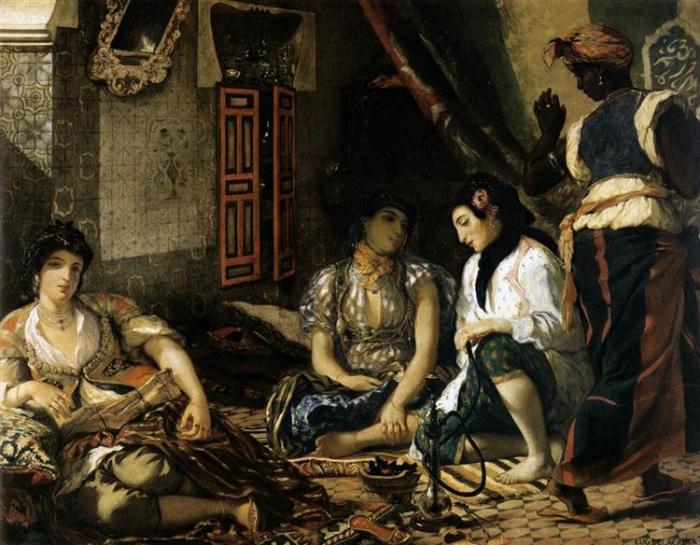
Afternoon Tea: The Women of Algiers in their Apartment (1834)

From Eugene Delacroix, as requested by Jacques Delacroix (no relation):

nol art delacroix the women of algiers 1834
Click here to zoom

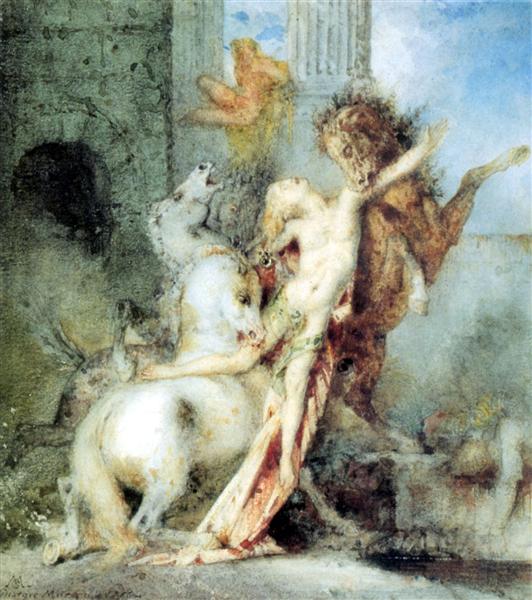
Afternoon Tea: Diomedes Devoured by his Horses (1866)

NOL art Moreau diomedes devoured by his horses 1866
Click here to zoom

This one is just plain crazy, and it’s by the French painter Gustave Moreau. Here is a wiki on the story of Diomedes, by the way. And here is Barry Stocker on ancient Greek thought.


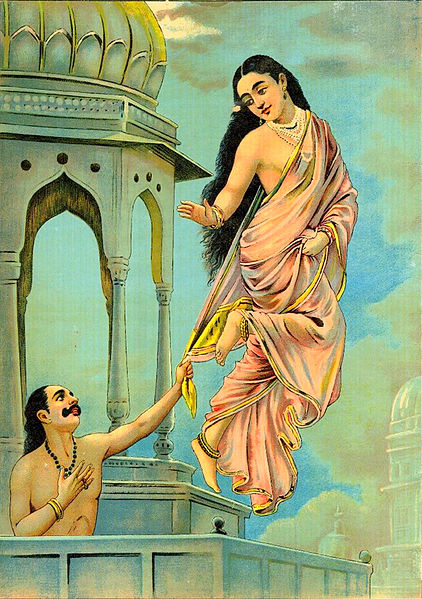
Afternoon Tea: Urvashi and Pururavas (unknown)

From the great Malayi (India) painter Raja Rami Varma:

NOL art Varma urvashi and pururavas
Click here to zoom

Varma was one of the first artists in colonial India to blend Western art with Indian traditions. Urvashi and Pururavas is an old Hindu love legend (wiki). And here is a wiki on Varma.

Here is yet another wiki, on the Malayali.

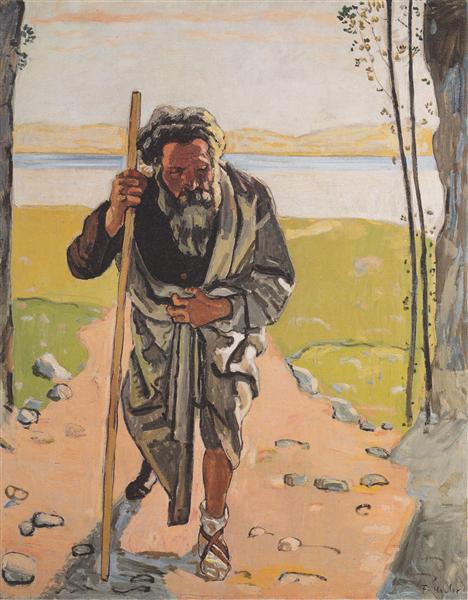
Afternoon Tea: Ahasver (1910)

NOL art Hodler ahasver 1910
Click here to zoom

This beauty is by Ferdinand Hodler, a Swiss painter. Rest assured, there’ll be more from him.

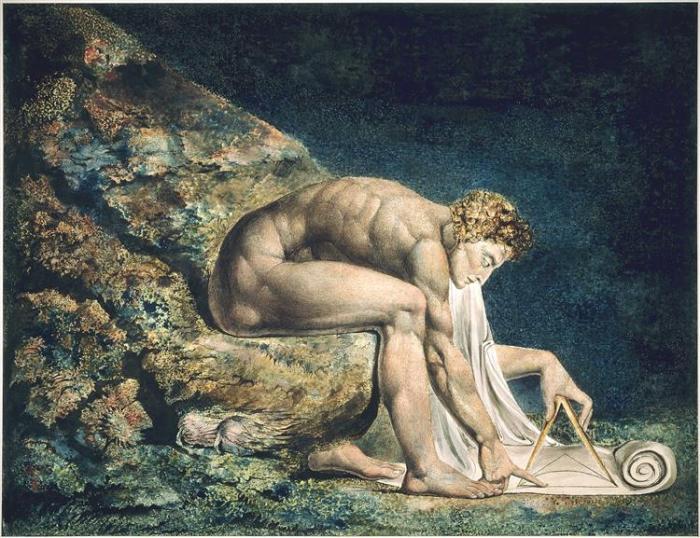
Afternoon Tea: Isaac Newton (1795)

From the British artist and poet William Blake:

NOL art Blake newton 1795
Click here to zoom

I’ve never been a huge fan of English art, but Blake is an obvious exception to the rule when it comes to art out of England. If you expand British art to include its imperial domains, then British art is spectacular, but as for England itself, meh. (William Blake excepted, of course.)

The Paradox of Prediction

In one of famous investor Howard Marks’ memos to clients of Oaktree Capital, the eccentric and successful fund manager hits on an interesting aspect of prediction markets and probability alike. In 1993 Marks wrote:

Being ‘right’ doesn’t lead to superior performance if the consensus forecast is also right. […] Extreme predictions are rarely right, but they’re the ones that make you big money.

Let’s unpack this.

In economics, the recent past is often a good indicator for the present: if GDP growth was 3% last quarter, it is likely around 3% the next quarter as well. Similarly, since CPI growth was 2.4% last year and 2.1% the year before, a reasonable forecast for CPI growth for 2019 is north of 2%.

If you forecast extrapolation like this, you’d be right most of the time – but you won’t make any money, neither in betting markets nor financial markets. That is, Marks explains, because the consensus among forecasters are also hoovering around extrapolations from the recent past (give or take some), and so buyers and sellers in these markets price the assets accordingly. We don’t have to go as far as the semi-strong versions of the Efficient Market Hypothesis which claim that the best guesses of all publicly available information is already incorporated into the prices of securities, but the tendency is the same.

  • if you forecasted 5% GDP growth when most everyone else forecasted 3%, and the S&P500 increased by say 50% when everyone estimated +5%, you presumably made a lot more money than most through, say, higher S&P500 exposure or insane bullish leverage.
  • If you forecasted -5% GDP growth when most everyone else forecasted 3%, and the S&P500 fell 40% when everyone estimated +5%, you presumably made a lot more money than most through staying out out S&P500 entirely (holding cash, bonds or gold etc).

But if you look at all the forecasts over time by people who predicted radically divergent outcomes, you’ll find that they quite frequently predict radically divergent outcomes – and so they would be spectacularly wrong most of the time since extrapolation is usually correct. But occasionally they do get it right. In hammering the point home, Marks says:

the fact that he was right once doesn’t tell you anything. The views of that forecaster would not be of any value to you unless he was right consistently. And nobody is right consistently in making deviant forecasts.

The forecasts that do make you serious money are those that radically deviate from the extrapolated past and/or current consensus. Once in a while – call it shocks, bubble mania or creative destruction – something large happens, and the real world outcomes land pretty far from the consensus predictions. If your forecast led you to act accordingly, and you happened to be right, you stand the make a lot of money:

Predicting future development of markets thus put us in an interesting position: the high-probability forecasts of extrapolated recent past are fairly useless, since they cannot make an investor any money; the low-probability forecasts of radically deviant change can make you money, but there is no way to identify them among the quacks, charlatans, and permabears. Indeed, the kind of people who accurately call radically deviant outcomes are the ones who frequently make such radically deviant projections and whose track record of accurately forecasting the future are therefore close to zero.

Provocatively enough, Marks concludes that forecasting is not valuable, but I think the bigger lesson applies in a wider intellectual sense to everyone claiming to have predicted certain events (market collapses, financial crises etc).

No, you didn’t. You’re a consistently bullish over-optimist, a consistent doomsday sayer, or you got lucky; correctly calling 1 outcome out of 647 attempts is not indicative of your forecasting skills; correctly calling 1 outcome on 1 attempt is called ‘luck’, even if it seems like an impressive feat. Indeed, once we realize that there are literally thousands of people doing that all the time, ex post there will invariably be somebody who *predicted* it.

Stay skeptical.

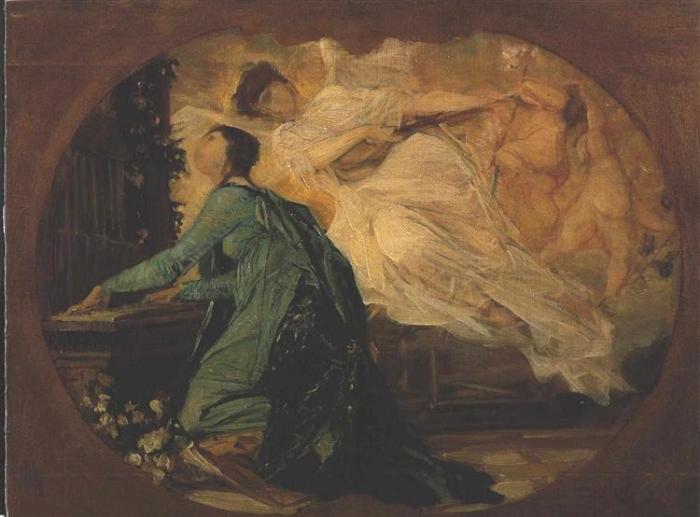
Afternoon Tea: Female Organ Player (1885)

NOL art Klimt female organ player 1885
Click here to zoom

From Gustav Klimt, still my favorite artist of all time…

The Gandalf Test

The two dominant American political parties have one defining trait in common, and it’s the trait that makes them both undeserving to hold the power they seek to wield. Both parties fail the Gandalf test.

I derive the Gandalf test from one of my favorite conversations in the Lord of the Rings. Gandalf pays a visit to Frodo Baggins after concluding that Bilbo’s old ring is in fact the One Ring–the single most dangerous and powerful object in Middle-earth. Once the full enormity of the ring dawns on Frodo, he tries to thrust it upon Gandalf. Gandalf flatly refuses. “With that power I should have power too great and terrible.” He recognized that he cannot embrace so much power even though he would want to do good with it. “Yet the way of the Ring to my heart is by pity, pity for weakness and the desire of strength to do good. Do not tempt me!”

The Gandalf test is simple: a righteous cause and a genuine desire to save the world do not qualify anyone for the exercise of extensive unilateral power. The Republican and Democratic Parties both have recently failed this test, and not for the first time. On one side, President Trump has turned to emergency powers to barge through constitutional barriers, so convinced he is that his cause is just. On the other side, the Green New Deal proposes to remake the United States economy. We tend to too often squabble over the merits of these policies instead of stepping back to apply the Gandalf test. Even if the policies themselves are good ones, even urgent ones, we must ask whether any person or cadre should wield the extraordinary power to put them into action. The “desire of strength to do good” is not enough.

A clear message of Gandalf’s and the Lord of the Rings generally is that progress toward the good and worthy comes through the everyday courage and goodness of ordinary people, not a few great souls on gilded thrones. Elsewhere, Gandalf points out: “Saruman believes it is only great power that can hold evil in check, but that is not what I have found. It is the small everyday deeds of ordinary folk that keeps the darkness at bay.” And in the Return of the King: “It is not our part to master all the tides of the world, but to do what is in us for the succour of those years wherein we are set, uprooting the evil in the fields that we know, so that those who live after may have clean earth to till. What weather they shall have is not ours to rule.” What a wonderfully apt response to the Green New Deal’s attempt to rule with an iron fist today in order to literally rule the weather that others might have tomorrow. That kind of hubris is poison to a republic.

We need to subject our leaders to the Gandalf test. We need to know if they are the type to vainly “master all the tides of the world,” or whether they will lead in humility by quietly empowering the everyday deeds of everyday people. If they can’t pass the test, I couldn’t care less whether they’re proposing a wall, a tax hike, or a clean energy revolution.

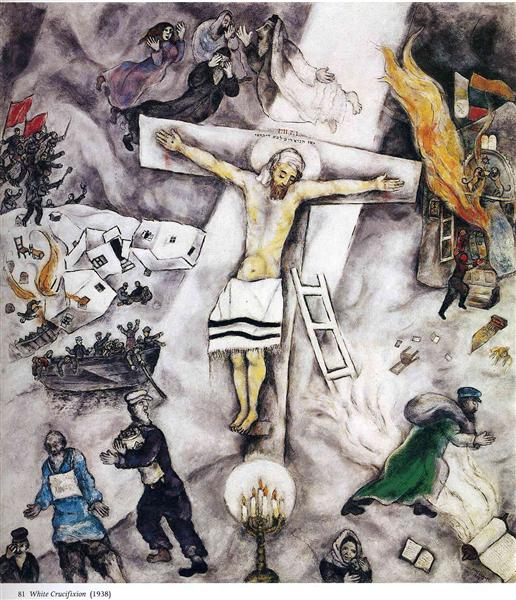
Afternoon Tea: White Crucifixion (1938)

From the esteemed Jewish French-Belarusian artist (and one of my personal favorites), Marc Chagall:

nol art chagall white crucifixion 1938
Click here to zoom

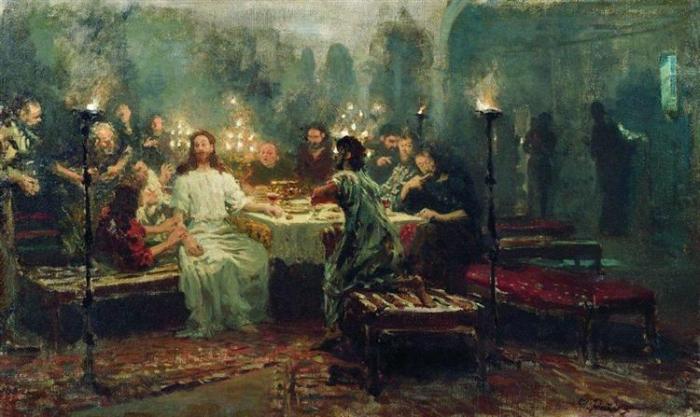
Afternoon Tea: Last Supper (1903)

From the Russian painter Ilya Repin:

nol art repin last supper 1903
Click here to zoom

This is a bit different than the traditional “last supper” paintings we are used to, at least here in the States.

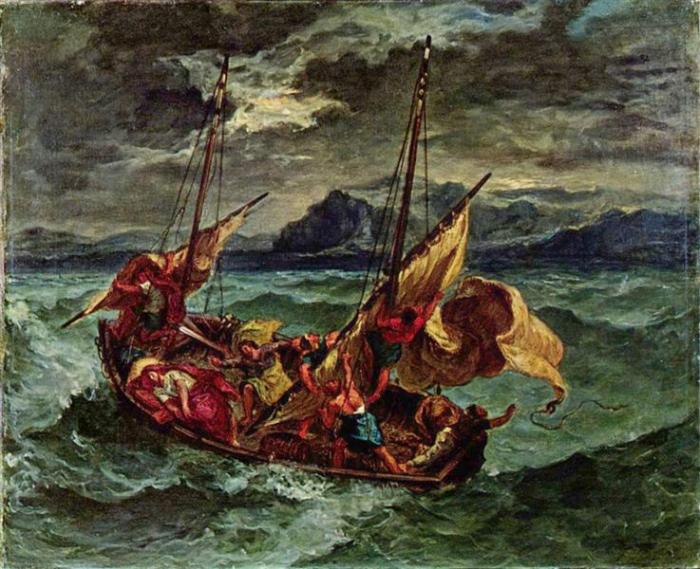
Afternoon Tea: Christ on the Sea of Galilee (1854)

From Eugene Delacroix, as requested by Jacques Delacroix:

nol art delacroix christ on the sea of galilee 1854
Click here to zoom

I could stare at this for hours…

From the Comments: Mexican communist art at San Francisco’s public colleges

My college (City College of San Francisco) has a “Diego Rivera Theater” featuring a mural by the artist that spans the width of the building. It is the cultural asset of which the college is most proud. It is very nice to look at. Here’s a picture.

That’s from David Potts, who teaches philosophy at City College of San Francisco and blogs at Policy of Truth.

I’ve seen the real thing. It’s absolutely beautiful. If you’re doing the tourist thing in San Francisco, or if you live there and are looking for something to do, make sure you hit up CCSF.

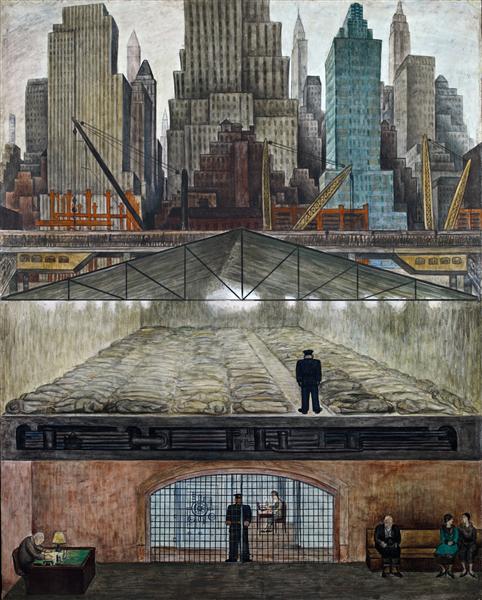
Afternoon Tea: Frozen Assets (1931)

This is from the communist Mexican artist Diego Rivera:

nol art rivera frozen assets 1931
Click here to zoom

Created during the Great Depression, this one is almost too predictable. It’s beauty alone, though, makes it worthy of an afternoon with tea.

Here is more from NOL on the Great Depression.

Liberty and pro-choice arguments

Abortion never struck me as a liberty issue. Fundamental ideas that inform libertarian thinking don’t pick a “side” for or against abortion, late-term or otherwise. Abortion is a random issue. But my pro-choice credentials face greater and greater scrutiny as I pal around right-libertarians and conservatives, and I’ve had to re-investigate my own decision-making process here.

I find each political side — abortion jurisprudence — wholly unconvincing. When a sperm and egg becomes “life” is so outside thousands of colloquial years of the word, there’s nothing analytic in the definition to illuminate policy choices; I don’t think medical science is going to answer the philosophical question of the concept of “life” either (“clinical death” violates what should be commonsense notions of death); etcetera. And then, of course, the pro-choice camp (which emphasizes parental choice) rarely cares about parental choice afterward, like in education, and the pro-life camp is an absurdly broad name for their legitimate concerns. The philosophy of abortion is probably interesting — the politics is a waste of time.

Here is what, I think, enforces my libertarian advocacy of choice. I am probably more radically pro-choice than most people I know, but this provides a basic defense.

If the question of whether or not life is “worth it” is a sensible question in the first place, then it is not one that can be answered a priori. Life is an inherently qualitative experience. This is clear enough by the fact that some people would rather choose to have died at age 60 after having lived to age 80, if we take their judgment as the best authority on their own life’s worth (and I do, and I think we should). Therefore, in advance, its not knowable if a person’s life will be worth it. People generally do enjoy living (more than they would otherwise?); this might not be the case if, for instance, the Nazis won and we all were born in camps. This is an accidental property of the current world. We live in a generally worthwhile time period, suggesting life is generally going to be determined to be worth it by each individual.

Since the worth of life is not a priori, the best guess in advance is that from local knowledge. Parents have the most local knowledge about the future of their child’s immediate life, before it gets unpredictable and the knowledge gets divided by millions of individuals who will impact their life and also understand ongoing trends. Therefore, parents are the best option to make a judgment call about whether or not their child’s life will be worth it — if they can care for it, if they will have a genetic problem, etc. Not politicians. Not voters. Not interest groups concerned with in utero life in the abstract.

Thus, parental choice.

It’s been said this is an “anti-human” argument. Lots of us came from lower income or impoverished households, myself included. Our lives are still found worthwhile. Why strawman, as if we’re in countries with terrible childhood obesity, malnutrition, drug addiction, gang violence?

It’s true that in general life is found to be worthwhile. But there’s no Leibniz-like principle that it must be. Nor does the aggregate data that people do, often, qualify life as worth living, mean that random individuals overcome parental ownership of the best localized knowledge.

This, I think, is a libertarian argument for choice. It depends on the point that abortion is a unique sort of event — we’re not talking about an old man’s caretaker, who must have the best local knowledge about whether or not we should pull the plug. The question need not arise about who makes important choices once someone is cognizant and autonomous. The argument rides on the point that there’s a vacuum in decision-making autonomy for fetuses by their very intrinsic nature, and we have to make proxy choices in advance.

We give parents plenty of other choices by law. When we are debating potential- or possible-beings still in the womb, before our language game definitively identifies them as “alive,” choice should default to the parents, and I should have no right to the woman’s body to make choices for her about a possible-being I will never see, feed, care for or otherwise worry about except to force the woman to take care of it for nearly two decades.
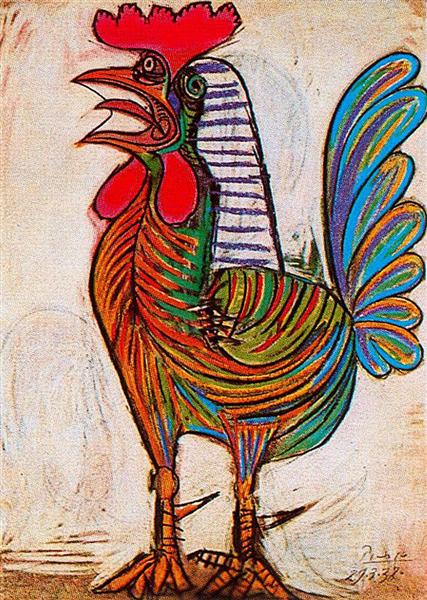
Afternoon Tea: Le Coq (1938)

A Picasso:

nol art picasso le coq 1938
Click here to zoom

This one is in a private collection somewhere…