Dear Mr. Pirie, refrain from using the “neoliberal” label

A few days ago, Madsen Pirie of the Adam Smith Institute announced the publication of the Neoliberal Mind.  Basically, Pirie accepts the grab-everything-we-don’t-like tag that many would-be thinkers have tried for decades to stick upon what we can refer to as the “liberal right” (I prefer the French expression of droite libérale). All he does is take the same message that classical liberals have been using for centuries and puts a new label on it.

It is a PR stunt. To be fair, I have often made the joke that there should be a New Liberal Party of Canada so that its members may be called the “neoliberals” so as to ridicule those who use the word. As such, I am poorly placed to frown upon Pirie’s book. Nonetheless, I wish that Pirie (and the folks at the Adam Smith Institute) would refrain from using the label.

Why? Because for years, the word “neoliberal” has been the most efficient sorting tool to separate the wheat from the chaff.

There is no generally agreed upon definition of “neoliberalism”. Everyone has its own spin on it. Sometimes, academics who use that word sometimes to mean what classical liberalism entails. In other instances, they speak about subsidies to certain companies as “neoliberalism”. Once, and I am not joking, I debated a policy analyst from a left-wing think tank who told me that rising levels of public spending to GDP could be qualified as  part of a “neoliberal” agenda.

A concept without a concise definition which is meant to collect into a bag everything that is not liked is not a relevant one.

Generally, those who use the word have this épouvantail (the word strawman has a scarier sound in French) of the beast they claim to slay. But it is generally a caricature that does not hold basic scrutiny. They argue that “neoliberals” value profit and are “cold utility maximizers” who draw everything they believe from the cold hands of the economic sciences. They are generally unaware that economists (which are often lumped in the same bag as the main promoters of “neoliberalism”) adhere to no such simplicity. One merely needs to read James Buchanan, Vernon Smith, Elinor Ostrom, Deirdre McCloskey, Max Hartwell, William Easterly to be cleansed of this simplistic (and simpleton) view of the human mind. Using a concept that is ill-defined and does not even survive the most basic of ideological Turing tests has no value.

In the end, the sole value of those who spew the word “neoliberalism” is that they signal to readers and scholars that their work might be worth avoiding. To be fair, some of those who use the word produce interesting research and comments. Generally, they tend to use the word parsimoniously and they make it a point of honor to define it in clear and unambiguous terms. They are an exception and, generally, good research tends to be absorbed in the mainline if the point is valid. As such, the word “neoliberalism” is useful because it sorts out the wheat from the chaff.

I understand the PR value of accepting the cloak – which is what Pirie is doing. However, are we not forsaking the best weapon to identify bad social science in so doing?

Did Inequality Fall During the Great Depression ?

Inequality

The graph above is taken from Piketty and Saez in their seminal 2003 article in the Quarterly Journal of Economics. It shows that inequality fell during the Great Depression. This is a contention that I have always been very skeptical of for many reasons and which has been – since 2012 – the reason why I view the IRS-data derived measure of inequality through a very skeptical lens (disclaimer: I think that it gives us an idea of inequality but I am not sure how accurate it is).

Here is why.

During the Great Depression, unemployment was never below 15% (see Romer here for a comparison prior to 1930 and this image derived from Timothy Hatton’s work). In some years, it was close to 25%. When such a large share of the population is earning near zero in terms of income, it is hard to imagine that inequality did not increase. Secondly, real wages were up during the Depression. Workers who still had a job were not worse off, they were better off. This means that you had a large share of the population who saw income reductions close to 100% and the remaining share saw actual increases in real wages. This would push up inequality no questions asked. This could be offset by a fall in the incomes from profits of the top income shares, but you would need a pretty big drop (which is what Piketty and Saez argue for).

There is some research that have tried to focus only on the Great Depression. The first was one rarely cited NBER paper by Horst Mendershausen from 1946 who found modest increases in inequality from 1929 to 1933. The data was largely centered on urban data, but this flaw works in favor of my skepticism as farm incomes (i.e. rural incomes) fell more during the depression than average incomes. There is also evidence, more recent, regarding other countries during the Great Depression. For example, Hungary saw an increase in inequality during the era from 1928 to 1941 with most of the increase in the early 1930s. A similar development was observed in Canada as well (slight increase based on the Veall dataset).

Had Piketty and Saez showed an increase in inequality during the Depression, I would have been more willing to accept their series with fewer questions and doubts. However, they do not discuss these points in great details and as such, we should be skeptical.

The Antebellum Puzzle, Anthropometric History and Quebec

I recently gave an interview on Economics Detective Radio with Garrett Petersen to talk about my forthcoming article in Economics & Human Biology (with Vadim Kufenko and Alex Arsenault Morin). In the interview, I explain why anthropometric history is important to our understanding of living standards, their evolution and short-term trade-offs in economic history. The interview is below, but you should subscribe to Garrett’s podcast as he is well on his way to becoming a serious competitor to EconTalk with the bonus that he does lots of economic history.

Podcast link (download).

Aggregate measures of well-being, England 1781-1850

I went in the field of economic history after I discovered how much it was to properly measure living standards. The issue that always interested me was how to “capture” the multidimensional nature of living standards. After all, what weight should we give to an extra year of life relative to the quality of that extra year (see all my stuff on Cuba)?

However, I never tried to create “a composite” measure of living standards. I thought that it was necessary, first, to get the measurements right. However, I had been aware of the work of Leandro Prados de la Escosura who has been doing considerable work on this in order to create composite measures (Leandro also influenced me on my Cuba reasoning – see this article).

A year ago, I discovered the work of Daniel Gallardo Albarrán from the University of Groningen at the meeting of the Economic History Society (EHS). Daniel’s work is particularly interesting because he is trying to generate a composite measure of well-being at one of the most important moment in history: the start of the British industrial revolution.

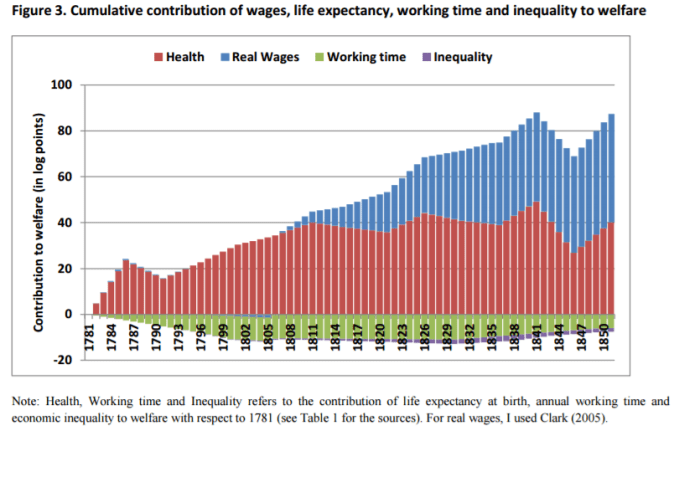
Because of its importance and some pieces of contradicting evidence (inequality, stature, amplitude of real wage increases, amplitude of income increases, urban pollution leading to increased mortality risks etc), the period has been begging for some form of composite measure to come along (at least a serious attempt at generating it). Drawing on some pretty straightforward microeconomic theory (the Beckerian in me likes this), Daniel generates this rich graph (see the paper here).

Daniel

The idea is very neat and I hope it will inspire some economic historians to attempt an expansion upon Daniel’s work. I have already drawn outlines for my own stuff on Canada since I study an era when (from the early 1800s to the mid-1850s) real wages and incomes seem to be going up but stature and mortality are either deteriorating or remaining stable while inequality is clearly increasing.

Star Trek Did More For the Cultural Advancement of Women Than Government Policies

The fondest memories of my childhood center on the time I spent with my father watching Star Trek. At the time, I simply enjoyed science fiction. However, as an adult I have often revisited Star Trek (on multiple occasions) and I realized that I had incorporated subconsciously many elements of the show into my own political reasoning.

Not to give too much away about my age, my passion with Star Trek started largely with the Voyager installments. As a result, I ended up seeing Kate Mulgrew as Captain Janeway. And that’s what she was: the captain. I never saw the relevance that she was a woman. A few years ago, I saw her speak at the Montreal Comic-Con (yes, I am that kind of Trekkie) and she mentioned how crucial she thought her role to be for the advancement of women. By that time, I had already started to consider Star Trek as one of the most libertarian-friendly shows ever to have existed. While its economics were strange, its emphasis on tolerance, non-intervention and equality of rights make it hard to argue that it is not favorable to broadly-defined liberal mindset. However, I had not realized how much so until I heard Mulgrew speak about her vision of the role. After all, I had somehow forgotten that Mulgrew was a woman and how novel her role was.

One person who understands how important was this point is Shannon Mizzi who wrote a piece for Wilson Quarterly which I ended up reading while I was still a PhD student. Her core point was that in Star Trek, women were simply professionals. They were rarely seen doing other things than their work. While she argues that this meant that Star Trek played an underappreciated role in the history of women’s advancement, I am willing to go a step further. That step is to assert that the cause of the cultural advancement of women has been better served by Star Trek than by governments. (Please note that I am only considering cultural advancement)

The pre-1900 economic and social history of women would be sufficient in itself to make this point of mine. After all, women were given a lesser legal status by governments. This is both a necessary and sufficient element to assert that, overall, governments have been noxious to women’s advancement over many centuries. One century of legal emancipation would still leave Star Trek as a net positive force. But that would be a lazy argument on my part and I should simply focus on the present day. In fact, thanks to a wealth of data on wage gaps, gender norms and measures of legal institutions, I can more easily back up the claim.

My friend Rosemarie Fike of Texas Christian University is the first person that comes to mind in that regard. Her own doctoral dissertation, Economic Freedom and the Lives of Womenintroduced me to a wide literature on the role of economic freedom in the advancement of women. To be sure, Rosemarie was not the first to try to measure the role of economic freedom (which we should understand as how small and non-interventionist a government is). There had already been some research showing that higher levels of economic freedom were associated with smaller hourly wage gaps between genders and how liberalizing reforms were associated with wage convergence between genders. However, some economists have been arguing that there are other “soft sides” to economic freedom – like in the promotion of cultural equality and norms that promote certain types of attitudes. This is where Rosemarie’s work is most crucial. In a section of her dissertation, she essentially builds up on the work of (my favorite Nobel laureate) Gary Becker regarding preferences and discrimination. Basically, the idea is that free markets will penalize people who willingly discriminate. After all, if an employer refuses to hire redheads for some strange reason, I can compete by hiring the shunned redheads at a lower wage rate and out-compete him. In order to stay in business, the ginger-hating fool has to change his behavior and hire redheads which will push wages up. Its hard to be a racist or misogynist when it costs you a lot of money.

However, if you prevent this mechanism from operating (by intervening in markets), you are making it easier to be bigoted-chauvinistic-male-pigs. As a result, laws that prevent market operations (like the Jim Crow laws did for blacks) enshrine discriminatory practices. Individuals growing up in such environment may accept this as normal and acceptable behavior and strange beliefs about gender equality may cement themselves in the popular imagination. When markets are allowed to operate, beliefs will morph to reflect the actions taken by individuals (see Jennifer Roback’s great story of tramways in the US South as an example of how strong markets can be in changing behavior and see her article on how racism is basically rent-seeking). As a result, Rosemarie’s point is that societies with high levels of economic freedom will be associated with beliefs favorable to gender equality.

But the mirror of that argument is that government policies, even if their spirits have no relation to gender issues, may protect illiberal beliefs. Case in point, women are more responsive to tax rates than men – much more. In short, if you reduce taxes, women will adjust their labor supply more importantly at the extensive and intensive margin than men will. This little, commonly accepted, fact in labor economics is pregnant with implications. Basically, it means that women will work less in high tax environments and will acquire less experience than men will. Since it is also known that differences in the unmeasured effects of experience weigh heavily in explaining the remaining portion of the gender pay gap, this means that high tax rates contribute indirectly to maintaining the small gender pay gap that remains. Now, imagine what would be the beliefs of employers towards women if they did not believe that women are more likely to work fewer hours or drop out of the workforce for some time? Would you honestly believe that they would be the same? When Claudia Goldin argues that changes in labor market structures could help close the gap, can you honestly say that the uneven effect of high tax rates on the labor supply decisions of the different genders are not having an effect in delaying experimentation with new structures? This only one example meant to show that governments may, even when it is not their intent, delay changes that would be favorable to gender equality. There are mountains of other examples going the larger effects of the minimum wage on female employment to the effects of occupational licencing falling heavily on professions where women are predominant.

With such a viewpoint in mind, it is hard to say how much governments helped the cultural advancement of women (on net) over the 20th and 21st centuries . However, Star Trek clearly had a positive net effect on that cultural advancement.  That is why I am willing to say it here: Star Trek did more for the cultural advancement of women than governments did.

Famine and Finance: Credit and the Great Famine of Ireland

41YjUSWp3JL._SX351_BO1,204,203,200_I have recently finished reading Famine and Finance by Tyler Beck Goodspeed. While short, it should have a prominent place on the shelves of economic historians interested (obviously) in Irish history and (less obviously) in Malthusian theory.
Famine and Finance is a study of the response of Irish farmers to the potato blight. As it is known to many, many individuals simply left Ireland. However, where micro-credit was available, Goodspeed finds that farmers adapted by shifting to different types of activities – notably livestock. These areas experienced a smaller decline in population. Basically, where the institution of micro-credit was present, the demographic shock was much less severe. If only for this nuance, the book makes a sizeable contribution to the historiography of Ireland. The methods used are also elegantly simple and provide an interesting road map for anyone interested in studying the responses of local population to environmental shocks.

However, the deeper point comes from it tells us about institutions. In Goodspeed’s story, the amplitude of the collapse of the Irish population in the 19th century depends on the presence of the institution of micro-credit. Basically, the institution determined the amplitude of the shock. Since Ireland’s potato blight is often presented as the textbook case of Malthusian pressures, Goodspeed’s results are particularly interesting. In his chatper titled”Was Malthus Right?”, he shows that when controls for the institution of micro-credit is present, the typical Malthusian variables fail to explain population changes. In other words (i.e.  my words) , Malthusian pressures (the change in population) are in fact institutional failures.

This is a point I have often made elsewhere (see here, here and here and a blog post here). And because Goodspeed backs this point of mine, he has earned himself a place on my shelf of “go-to” books.

The Heights of French-Canadian Convicts, 1780 to 1830

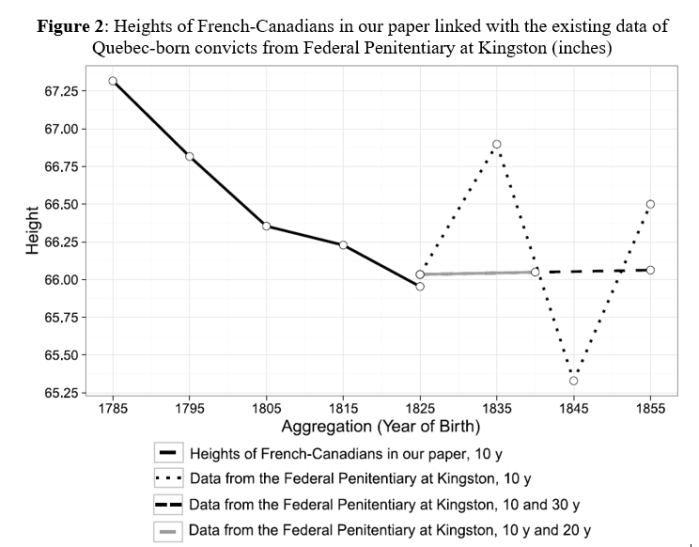
A few days ago, it was confirmed that my article with Vadim Kufenko and Alex Arsenault Morin on the heights of French-Canadians between 1780 and 1830 was accepted for publication in Economics and Human Biology. In that paper, we try to introduce French-Canadians before 1850 to the anthropometric history literature by using the records of the prison of Quebec City. Stature is an important measure of living standards. As it is heavily related to other aspects of health outcomes, it is a strong measure of biological living standards. More importantly, there are moments in history when material living standards and biological living standards move in opposite directions (in the long-run, this is not the case).

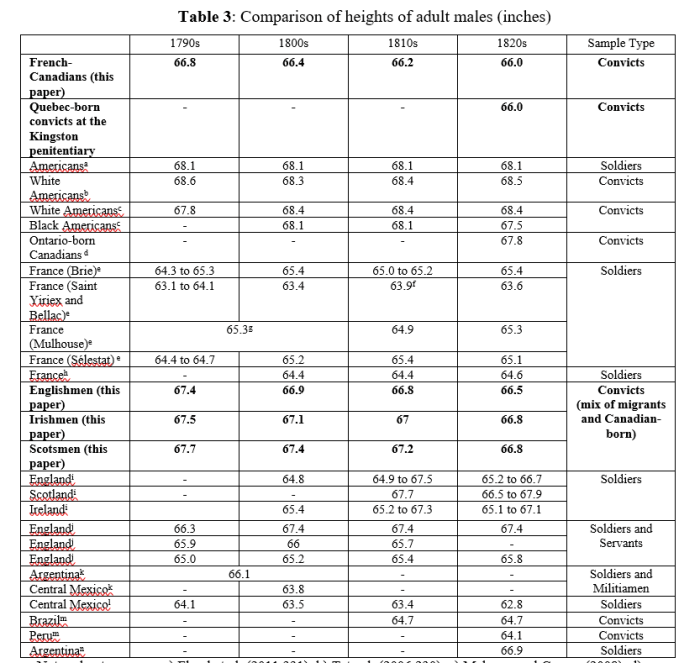
We find three key results. The first is that the French-Canadians grew shorter throughout the era when living standards did not increase importantly (and were very volatile). This puts them at odds from other places in North America where increases in stature were experienced up until the 1820s. Furthermore, stature stops falling around 1820 when economic growth picked up. This places the French-Canadians in a unique category in North America since it seems unlikely that they experienced a strong version of the antebellum puzzle (decline in stature with increases in material living standards which is what the US experienced). The second key result is that the French-Canadians are the shortest in North America, shorter even than Black Americans in slavery. However, they are considerably taller than most (save Argentinians) Latin Americans. More importantly, they are considerably taller than their counterparts in France. The third key result is related to the second key result. Today, French-Canadians are noticeably shorter than other Canadians. However, the gap was more important in the late 19th century and early 20th century. Pegged as a “striking exception” within Canada, we do not know when it actually started. Thanks to our work, we know that this was true as far back at the early 19th century.

The working paper (dramatically different than the accepted version) is here and I am posting key results in tables and figures below.  Moreover, I will be talking about anthropometric history and economic history with Garrett Petersen of Economics Detective Radio this Tuesday (I do not know when the podcast will be made available, but you should subscribe to that show anyways).

Heights.png

Table3.png

On power-display bias and the historians

This is an excerpt from my upcoming book at Palgrave McMillan which discusses Canadian economic history. This excerpt relates to a point that I have made numerous times on this blog regarding the bias for power held by historians and how it often leads them to inaccurate conclusions (here and here):

When the great historian Lord Acton warned that, “absolute power corrupts absolutely,” he was not only referring to imbuing certain fallible humans with excessive powers, but also as a caution to historians for their assessment of politicians. Too often, politicians become known for “greatness” because of their actions, regardless of how much they impoverished society or put in place measures that would ultimately erode their citizens’ quality of life. By the same token, some eminent figures remain unknown, relegated to a footnote in the history books, even though they have contributed in a more significant way to economic enrichment, cultural development, and social cohesion. Grand gestures and large-scale social projects inspired by good intentions do not always yield great results – or desirable ones.

If we truly want to assess the Quiet Revolution and the “Great Darkness” with any clarity, we must consider politicians’ actions in a more realistic scope, and sift through the quantitative and qualitative data that show how people thought and acted in the everyday. Through the use of rigorous tools, statistical methods and economic theories, we ought to consider how things might reasonably have developed otherwise without the Quiet Revolution. This is what I have tried to do in this book. (…)

The discourse on Quebec modernity that emerged along with the Quiet Revolution coincided with the emergence of a strong interventionist State. When we compare Quebec to other Western countries, however, our analysis reveals that the State did not play a major role in modernization here. After all, it was in a period when Quebec’s State apparatus was less active compared to the rest of Canada that it was able to progress in leaps and bounds. Of course, the State must have had some effect in certain areas, but the Quiet Revolution was not responsible for the bulk of positive outcomes that came to term during this period. Analyzing trends, causes, explanations and secondary forces at play in Quebec society’s metamorphosis definitely requires a degree of patience and effort. It would be much less onerous to take the easier path of only looking at the State’s activities as worthy of attention in this regard. If we fail to make these efforts, we risk succumbing to the “Nirvana Fallacy.” In order words, we tend to put the State on a pedestal: it becomes a kind of disembodied entity in a virtual reality where it plays the VIP or starring role. Comparing reality with a utopia necessary leads us to conclude that utopia is better, but this approach is utterly fruitless.


A hidden cost of the war on drugs

AI just completed another paper (this time with my longtime partner in crime Vadim Kufenko) where we question an hypothesis advanced by Samuel Bowles regarding the cost of inequality. In the process, we proposed an alternative explanation which has implications for the evaluation of the war on drugs.

In recent years, Samuel Bowles (2012) has advanced a theory (well-embedded within neoclassical theoretical elements while remaining elegantly simple) whereby inequality increases distrust which in turn magnifies agency problems. This forces firms to expend more resources on supervision and protection which means an expansion of the “guard labor force” (or supervisory labor force). Basically, he argues there is an over-provision of security and supervision. That is the cost of inequality which Bowles presents as a coordination failure. We propose an alternative explanation for the size of the guard and supervisory labor forces.

Our alternative is that there can be over-provision of security and supervision, but this could also be the result of a government failure. We argue that the war on drugs leads to institutional decay and lower levels of trust which, in turn, force private actors to deploy resources to supervise workers and protect themselves. Basically, efforts at prohibiting illicit substances require that limited policing resources be spread more thinly which may force private actors to expend more resources on security for themselves (thus creating an overprovision of security). This represents a form of state failure, especially if the attempts at policing these illicit substances increase the level of crime to which populations are vulnerable. To counteract this, private actors invest more in protection and supervision.

Using some of the work of Jeffrey Miron and Katherine Waldock, we show that increases in the intensity of prohibition enforcement efforts (measured in dollars per capita) have significant effects on the demand for guard labor. Given that guards represent roughly 1 million individuals in the US labor market, that is not a negligible outcome. We find that a one standard deviation increase in the level of drug enforcement efforts increases the ratio of guards to the population by somewhere between 12.92% and 13.91% (which is the equivalent of roughly 100,000 workers).

While our paper concentrated on proposing an alternative to the argument advanced by Bowles regarding the cost of inequality, we (more or less accidentally) measured a hidden cost from the war on drugs. The insecurity (increased crime rates and spillovers from illegal markets into formal markets) brought forth by drug prohibition  forces an over-provision of security and supervision (our supervision measure which includes workers that supervise other workers were smaller than with the security guard measure).

Basically, a hidden (private cost) of the war on drugs is that we must reallocate resources that we could have used otherwise. Its a little like when I say that it is meaningless to compare healthcare expenditures to GDP in Canada and the United States because Canadians assume costs in a hidden manner through rationing. Waiting lists in Canada are longer than in the US. The cost is lost wages and enduring pain and that cost will not appear in measures of expenditures to GDP. The war on drugs works the same way. There is a fiscal cost (expenditures dedicated to it and the taxes that we must impose), there is a crime cost (destruction of lives and property) and there is a reallocation cost of privately providing security which is hard to measure.

*The paper is available here. 

Inequality and Regional Prices in the US, 2012

I have just completed a short piece on the impact of regional prices on the measurement and geographic distribution of low income individuals. Basically, Youcef Msaid and myself* used the March 2012-CPS data combined the BEA’s regional purchasing power parities database to correct incomes.

We found is that the level of inequality is very modestly overestimated (0.5%). Now this is a conservative estimate since we used state-level corrections for price differences. This means that we took price corrections for New York state as a whole even if there are wide differences within New York state. Obviously, with more fine-grained price-level adjustments we would find a bigger correction but it is hard to imagine that it could surpass 1-3%.

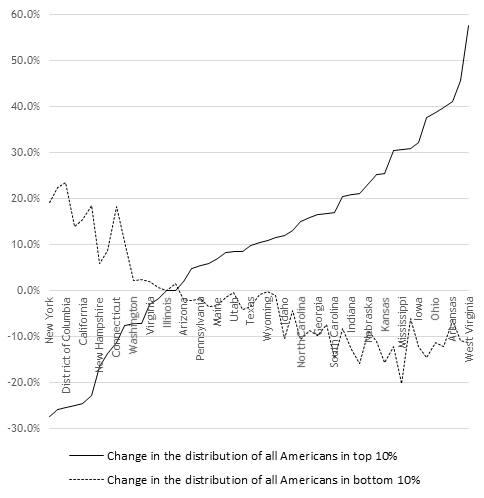
That was not our most important result. Our most important result relates to where the bottom decile of the income distribution is geographically located. We find that instead of being found disproportionately (relative to their share of the total US population) in poorer states, the bottom decile is disproportionately found in rich states. The dotted black line in the figure below illustrates the change in the number of individuals who are, nationally, in the bottom 10%. New York and California have significant increases while West Virginia has a large decrease. The dark black line shows the same for the top 10%.

fig2

Another way to grasp the magnitude of this change is to relate the change to the population shares of each decile by state. For example, New York had 6.29% of the US population in 2012 and 6.61% of all Americans in the bottom 10% of the income distribution before adjusting for regional purchasing parities. After adjusting however, New York’s share of the bottom 10% surges to 7.88%.

Why does it matter? Because most of the cost difference adjustments come from differences in housing costs. The first obvious point is that housing is a crucial aspect of any discussion of inequality. The second, but less obvious point,  is that these differences are massive barriers to migration within the United States and the poorest are those for whom these barriers are the heaviest. Unfortunately, the high-cost areas are also high-productivity areas (New York, San Francisco for example) whose high costs are largely the result of restrictions on the supply of housing. This means that high-productivity areas – which would raise the wages of low-skilled and low -income workers are inaccessible to them. It also means that those who were present before the increase in productivity of these areas capitalized the gains in more valuable real estates (even if this means lower real incomes).

In this light, the geographic reallocation of the bottom 10% is consistent with an emerging literature that argues that inequality is in great a result of housing policy (see notably Rognlie’s reply to Piketty in the Brookings Papers).  This small modification (I consider it small) that me and Youcef made has important logical ramifications.

* Thank you to my friends Rick Weber (who blogs here at NOL and whose research can be seen here) and Ryan Murphy (whose research can be found here) who provided good comments to bring the paper to the stage where we are ready to submit.

Wedding date and superstitions

There is a neat new paper in the most recent edition of the Journal of Population Research by Gabriele Ruiu and Marco Breschi on wedding dates and superstitutions in Italy. Here is the abstract:

In Italy, it is believed that Tuesdays and Fridays are particularly unlucky days for weddings as well as the 17th day of each month. Previous studies realized in the aftermath of the Second World War have shown the strong influence that these superstitions had in determining the wedding dates in the entire country. We have used exhaustive data collection of all marriages celebrated in Italy in the years 2007–2009 to investigate whether superstitions are still able to influence the choices of spouses. We find that this influence is still present after the great economic, social and demographic transformation of Italian society. We also show that a wife’s education reduces the influence of superstition on the choice of the date of marriage while those who opt for a religious rite are also those who are more careful in avoiding inauspicious days.

How Canada Tracked the US during the Great Depression

Over the last few years, while I continued my research on other fronts, I started spending small amounts of time on a daily basis to read about the Great Depression and more precisely, how Canada lived through the depression.

Since the old adage is that Canada gets pneumonia when the US gets the flu, I thought that it was a worthy endeavor (although Pedro Amaral and James McGee have been working on that front) to try to see what insights we can derive from looking at Canada’s experience during the Great Depression (especially since it had a very different banking system).

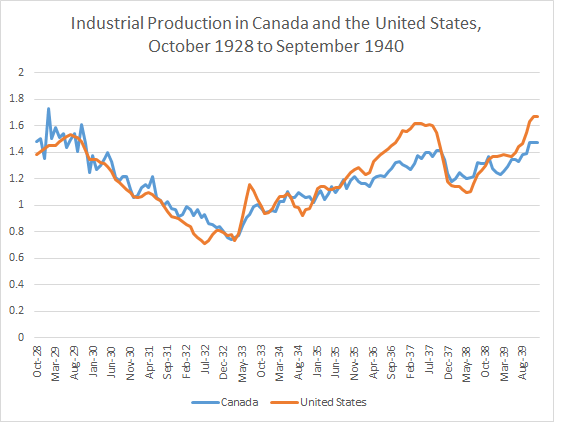
In the process, I managed to collect in a datasheet, the Industrial Production Index of Canada (consisting largely of heavy industry with some light industries and utilities, making it a relatively well-rounded index). This is what it looks like.

industrialproduction

Other than seeing Canada’s experienced mirrored in the US experience (except for the 1935-1937 window), I am not sure what to make of it. However, I thought it worthwhile to share that information publicly.

Once, Cubans were (maybe) richer than Americans

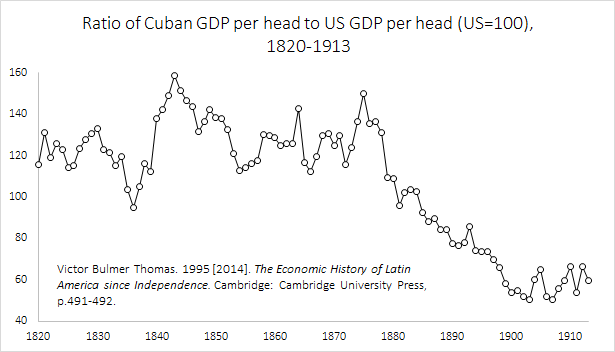
In light of what we see today, this is hard to believe. However, as a result of Castro’s death, I accidentally became interested in the history of this fascinating island and the more I discover, the more shocked I am at “the path” that Cuba has taken. One of these reasons is provided below by Victor Bulmer Thomas in his Economic History of Latin America since Independence. Now, Thomas uses a different approach than the commonly used Maddison data (he believes the assumptions are too heroic). He uses indicators correlated with GDP per capita to fill in the gaps and he finds that Cuba was generally richer than the United States for most of the 19th century (see below):

cubaus

Now, I am not convinced by the figure Thomas presents. However, I am also skeptical of the levels presented by Maddison (where Cuba is roughly 60% as rich as the US in 1820). In between are some more reasonable estimate (see this great discussion in this book as well as this discussion by Coatsworth).  Moreover, there is the  issue of slavery which distorts the value of using GDP per capita because of high levels of inequality (however, it distorts both ways since the US was also a slave economy up to the Civil War).

Nonetheless, this tells you about the “path not taken” by Cuba.

Household size and growth since 1870 (albeit in Canada)

Two days ago, I posted something on how much we were estimating growth since the 1950s. While organizing another research paper that I am trying to finish, I realized that I could make a follow-up to this based on previous research of mine.

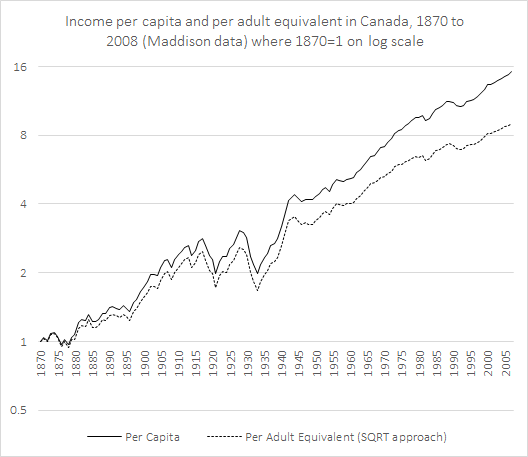
A few months ago, I published (alongside Vadim Kufenko and Klaus Prettner) a short note in Economics Bulletin where we showed that the large differences in household size in Canada that existed up to 1975 led many to overestimate the level of differences between provinces. Moreover, we pointed out that because household size were converging at the same time as incomes, we argued that the rate of convergence from 1945 onwards was slightly overestimated. That paper convinced us to do the same between all the OECD countries (we are assembling the data right now).  But this was an argument about variance, what if we simply plot the “per capita” income of Canada with the “per adult equivalent” income of Canada since 1870.

By using the Maddison dataset combined with the data from my article, it took me a few seconds to get the graph below. What is important to notice in this graph is that, incomes per adult equivalent (measured in 1990 Geary-Kheamis dollars) have increased 40% less than incomes per person. Since adult equivalents are a better measure of living standards (because you capture the economies of scale associated with household size), we can easily say that we have been underestimating the level of improvement in Canada (it is still substantial however).

growthfactors

On 7 million deaths from air pollution

ATTN published a video of An-huld (the really cool guy who made my childhood by being in all my favorite action movies like Predator* and who ended up being the governor of California). In that short clip, Schwarznegger starts by saying that 7 million individuals die from pollution-related illnesses.

That number is correct. But it is misleading.

People see pollution as “all and the same”. But some forms of pollution increase with development (sulfur emissions and some would argue that too much CO2 emissions is pollution as it causes climate change). However, others drop dramatically – especially heavy particules (Pm10) which are a great cause of smog. Julian Simon (the late cornucopian economist who is one my greatest intellectual influence) pointed out this issue and noted that the deadliest forms of pollution are those that relate to underdevelopment.

Back in 2003, Jack Hollander published the Real Environmental Crisis: Why Poverty, Not Affluence is the Environment’s Number One Enemy. Hollander pointed out that simply from the combustion of organic matter (read: firewood and animal manure – literally burning fecal matter) indoors for the purposes of heating, cooking and lighting was responsible for close to 2 millions deaths.

Since then, the WHO came out with a study pointing out that around 3 billion people cook and heat their homes with open fires and stoves that rely on biomass or anthracite-coal. They put the number of premature deaths directly resulting from this at over 4 million people. This is close to 60% of the figure cited by the former President of California (yes, I know he was governor – see here). In other words, 60% of the people who die prematurely as a result of strokes, ischaemic heart diseases, chronic obstructive pulmonary diseases and lung cancers can be attributed to indoor air pollution. That means pollution resulting from the fact that you are so poor that you have to burn anything at hand at the cost of your health.

True, richer countries pollute and there are policy solutions (I have often argued that governments are better at polluting than at reducing pollution, but that is another debate) that should be adopted. But, these forms of pollution do not harm human life as much as those that come with poverty.

* By the way, when you watch Predator, do you realize that there are two future American governors in that movie? I mean, imagine that when Predator came out, some dude from the future told you that two of the main actors would end governing American states. Pretty freaky!