Nightcap

  1. To the extent that states figure into national histories, they often appear as one-dimensional foils for national state-builders or vehicles for parochialism and bigotry.” (pdf)
  2. How black America fell out of love with Africa Alden Young, Noema
  3. The contradictions of classical liberalism Gene Callahan, Modern Age
  4. Revisiting the collapse of the Soviet Union Christopher Caldwell, American Affairs

Nightcap

  1. Is anything going to change? Emily Sellars, Broadstreet
  2. Why I am not a liberal The Last Positivist, Sooty Empiric
  3. Hayek’s trap and the European utopia we need (pdf) Philippe Van Parijs
  4. Soviet children’s literature Evgeny Shvarts, Economist

Hayek the globalist

“Since it has been argued so far that an essentially liberal economic regime is a necessary condition for the success of any interstate federation, it may be added, in conclusion, that the converse is no less true: the abrogation of national sovereignties and the creation of an effective international order of law is a necessary complement and the logical consummation of the liberal program.”

The case for Taiwan’s statehood

When Russia invaded Ukraine a few short weeks ago, some people began to worry that China might try to do the same thing with Taiwan. I didn’t worry about this myself, as China is mostly a paper tiger, but also because the US has close military ties with Taiwan. Taiwan has close economic relationships with several wealthy democratic states in East Asia, too. Contrast this geopolitical context with Ukraine, and the parallels, while tempting, do not add up.

The whole debate and worry over Taiwan got me thinking again about federation as a libertarian foreign policy. Why shouldn’t Taiwan just join the United States? Here are the most common objections to such a federation:

Geography. This is probably one of the strongest cases against Taiwan joining the US, since it’s so far away from not only the mainland but Hawaii, too. Aaaand it’s just off the coast of China, which would likely cause friction with the regional power were Beijing to suddenly find itself neighboring a transoceanic republic.

(Source)

This is all much ado about nothing. A plane ride from Dallas to Taipei is 14 hours if you take out the layovers. Somebody living in Kaohsiung could send me an email after reading this essay and I could access it within minutes. Geography still matters, but its not an insurmountable barrier to a freer, more open world via the federative principles of the United States constitution.

Culture. A big complaint I see about adding “states” to the American republic is “culture.” Fellow Notewriter Edwin does this all the time, and it can make sense, on the surface, in some cases, but not in Taiwan’s, and not in the Indo-Pacific more generally.

Look at Taiwan’s 2020 presidential election results:

(Source)

Look familiar? There’s only two colors. It’s a contest between a left-wing and right-wing, and both wings are committed to, and bound by, liberty and democracy. There are no “ethnic” parties, no “religious” parties, and no radical parties, mostly because Taiwan has the same electoral system as the US does: a “first-past-the post” one. So the cultural angle is even weaker than first imagined. Taiwan started out as a nationalist holdout against the Communist Party, but today nationalism doesn’t carry a whole lot of weight. Adding Taiwan to the republic would be like adding another California or Hawaii, albeit with more conservative votes. It’s plausible that adding Taiwan would give Democrats two more reliable seats in the senate, but this is merely cause to invite a polity that would reliably vote Republican to also join the United States.

Self-determination / cultural autonomy. There’s an argument in some circles that joining the US would be akin to losing self-determination and even cultural autonomy. I don’t see how any of this could be true. Even today, people in American states retain a “state-centric” identity when it comes to thinking about their place in the US. That Taiwanese would be able to add “American” to a plethora of other identities already at their disposal could only be a good thing.

China. Would China fight a war against the US over Taiwan statehood? Maybe, but given Russia’s poor showing in Ukraine, the war would end quickly, at least from a Taiwanese statehood perspective. The CCP’s military has no fighting experience, unproven tech, unproven hardware, and…no fighting experience. The worst that would happen, I think, is that the CCP threatens war, maybe sends some warships to the strait, maybe fires some rockets over the island and flies some fighter jets over the island, but that’s about it. The CCP just doesn’t have the muster to fight a war against the United States over Taiwan.


These four objections are so common that I can’t help but be exasperated by their banality, especially given the rich tradition of republican security theory and federalist thought over the past three or four thousand years. There are two reasons for Americans, and especially libertarians, to support Taiwan’s federation with the US:

The free riding problem. The first thing that all libertarians complain about when it comes to “foreign policy” is the free riding problem. This is a problem in political economy where agents will enjoy the benefits of a policy at the expense of other agents who are required to bear the costs. Libertarians aren’t wrong to complain about the free riding problem. It’s a big problem. Think of a Russian attack on NATO ally Lithuania.

Taiwan has a fairly hard guarantee of US military support were the Communist Party of China to attack it. This, the argument goes, allows Taiwan to be a bit more reckless than it otherwise would be when dealing with Beijing. Therefore, according to non-interventionists, the US should simply stop guaranteeing Taiwan’s military security and just trade with the people of the island instead. It would be an awful scenario to face were Taiwan to goad China into attacking it and thus draw the US into a war with China.

Federating would end the free riding problem once and for all. Taiwan’s citizens would be American citizens. They would benefit, and pay the costs, associated with such citizenship.

Sovereignty. Taiwan is not a sovereign nation-state, as China has blocked all of the island’s attempts to become so, and it never will be so long as nation-state status depends upon recognition by large states such as Russia and China (as well as the US). This actually makes it easier for Taiwan to join the republic. The American senate is a tool of international diplomacy that was utilized to bind independent states together in a federal union by trading their sovereignty for seats in a powerful upper house of Congress. Taiwan wouldn’t have to go through the arduous process of debating whether or not its sovereignty is worth the price of admission into a North American federal order, because its status as a Westphalian sovereign nation-state is non-existent.

By incorporating Taiwan into its federal order, the US could revamp the liberal world order, and it could do so by adhering to the principles which made it a beacon for liberty in the first place.

Meanwhile, in India

Hundreds of workers marched with the red flags of the labor unions and chanted anti-government slogans in India’s capital on Tuesday as part of a two-day nationwide strike that began Monday.

And this:

Elsewhere in the country, protests were held in eastern West Bengal state where demonstrators stopped trains at several locations. In southern Kerala, where the state government led by the opposition Communist Party of India backed the protest, streets were empty and shops shuttered.

India’s economy has bounced back after experiencing a major blow during the first two years of the pandemic. But many jobs have disappeared, with unemployment rising to 8% in December.

It’s hard to tell which parties are reactionary in India. Modi’s Hindu-centric party certainly seems to fit the bill, but it looks to me like the Communists want to turn back the clock, too. Where are India’s liberals (classical or otherwise)? Here’s the rest.

New Book! Markets with Limits: How the commodification of academia derails debate

James Stacey Taylor writes:

In brief, I argue that the increasing pressure on academics to publish has led to a decrease in the accuracy of academic work, and suggest ways to rectify this. 

I begin Markets with Limits by outlining how Jason Brennan and Peter Jaworski (both of Georgetown University) have inadvertently misrepresented the views of the “anti-commodification theorists” they criticize in their influential book Markets Without Limits

I then expand my discussion to identify “woozles” (claims that are widely repeated but false) in other disciplines–such as the claim that Eskimos have many different words for snow, that Victorian physicians “cured” their female patients of hysteria by using vibrators, and that Popeye ate spinach because it had high levels of Vitamin D. (This part of the book was a lot of fun to write!)

Along the way I also provide a taxonomy of different types of expressivist arguments, of which semiotic arguments are only one, and a taxonomy of the different ways in which one might understand the debate over the moral limits of markets. And I insert Easter Eggs–hidden academic jokes–throughout the text, Index, and Bibliography!

The link to his new book is here. Check it out! And check out his excellent essays on colonialism here.

The Federation of Free States: Growing pains

We’re continuing our thought experiment on adding more states to the American republic.

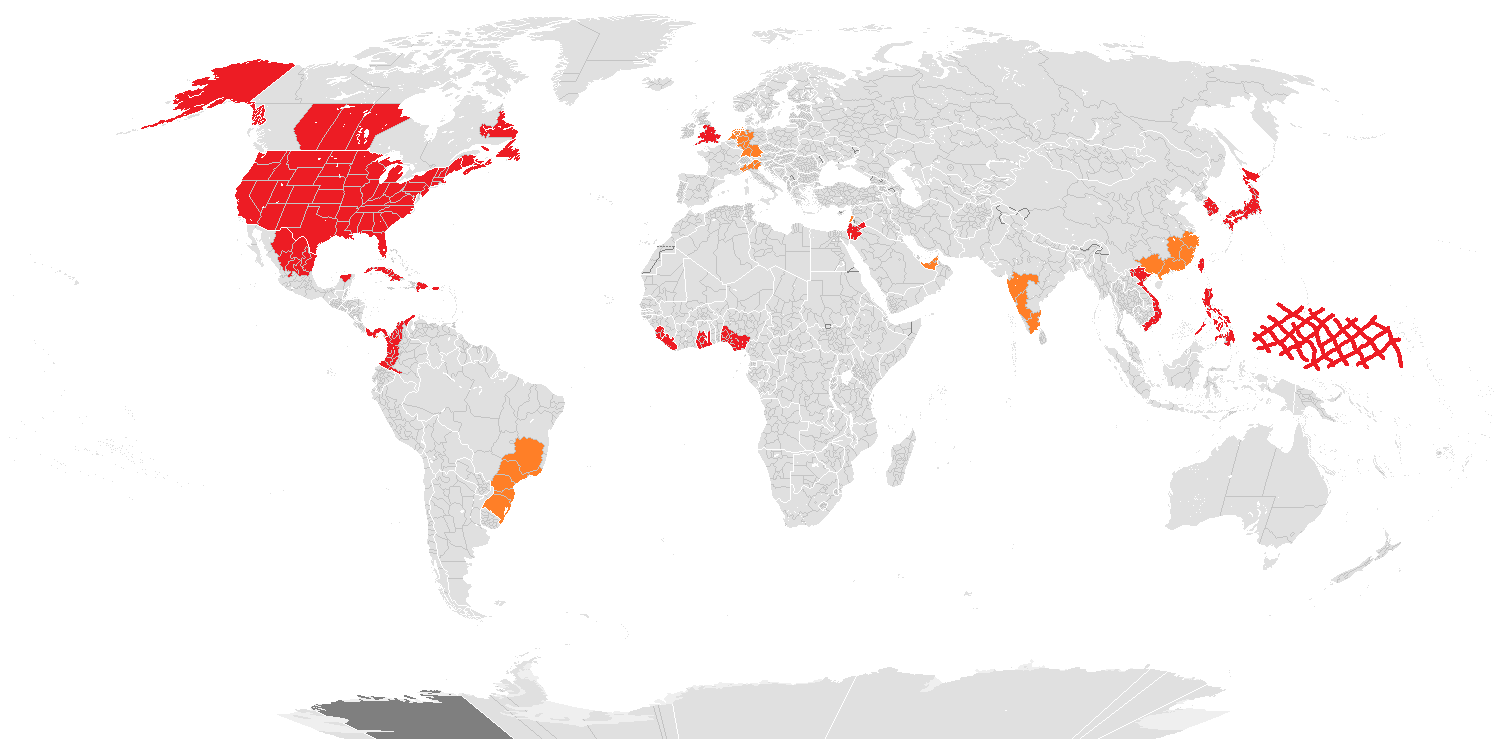
Our initial experiment added 29 states to the union in 2025. After a few decades of relative success (the entire world grew economically from 2025 to 2045), the bicameral Congress of free states was willing to accept several new members, who in turn were willing to trade their sovereignty for two seats in the Senate. The polities that joined the federation of free states in the second peaceful geographic expansion of the Philadelphian federal order were varied, but only somewhat predictable. The Madisionian compound republic rearranged the map once again. Here is what it looks like in 2045:

The red places were “states” in 2025, the orange places are new “states” in 2045.

As you can see, most of the expansion came in North America, East Asia, and West Africa. The experience of Canaan, England, and Wales hasn’t been bad, but enough nationalist-secessionist sentiments remain in these three “states” that none of their neighbors thought that giving up their sovereignty for Senate seats was worth it. All three economies grew, and peace finally came to Canaan, but if peace, wealth, and security from predation were the only things that people wanted then we wouldn’t be people. We’d be something else entirely. People want freedom, and the compound republic – the federation of free states – did not yet show in 2045 it was capable of extirpating the menace of nationalism from human existence.

The success of the ranching states of Mexico – Coahuila, Tamaulipas, and Nuevo León – within the United States prompted several more Mexican states to apply for statehood, but the pushback against too many states joining the union was stern. Yucatán and Chihuahua were added as is, giving the Senate four more seats, but the states of Zacatecas, Durango, and San Luis Potosí had to combine into one state (they called it San Luis Potosí, and it’s about the size of Nevada) in order to join the Philadelphian world order.

The prairie provinces of Canada also did well for themselves since 2025. So well, in fact, that five more provinces applied to join. However, Congress did not want to add five more states with such sparse populations, so the Atlantic provinces of Nova Scotia, Prince Edward Island, New Brunswick, Newfoundland, and Labrador merged to become a state that they called Nova Scotia, a massive landmass with enough people for only one or maybe two representatives. By the way, from 2025 to 2045, several old American states — Washington, Oregon, and Vermont – all held referendums on whether to leave the Madisonian republic and join Canada (or go it alone), but the referendums have proved to be unsuccessful.

Liberia’s success in the American federation is perhaps the most encouraging progress of all. Crime rates skyrocketed once Liberia joined the union, but this only shows how the American legal system does such a wonderful job of protecting property rights. Violent crime dropped, but crimes involving property rights reached an all-time high, which means that property rights in Liberia are finally being protected by a state strong enough to do so. The GDP (PPP) per capita of Liberia quadrupled from 2025 to 2045. Several neighboring states took notice, but only one, Sierra Leone, joined the federation outright.

Several Nigerian and Ghanaian polities joined the republic. All of the polities started out as administrative units within Ghana and Nigeria, and there were too many that wanted to join. So, they borrowed from San Luis Potosí’s playbook and merged with each other before applying for statehood as larger polities. From Nigeria, the states of Oyo (made up of five Nigerian states), Biafra (made up of eight states), Benin (made up of four states), and Bayelsa (three states) all joined. The states are all from the south of Nigeria.

Ghana sent three states to the republic: Ashanti (made up of five Ghanaian provinces), Volta (made up of three provinces), and Cape Coast (three provinces). The 11 provinces that made up the three new states were all from Ghana’s south. It should be noted the the Ashanti region had a relatively strong sense of nationalism when it applied for membership to the federation, and that the extirpation of this nationalism in exchange for self-government in a compound republic was not a problem for its inhabitants.

Colombia and Panama. The Caribbean experience has had less of a “wow factor” than Liberia or Mexico. Economic growth in Antilles was a little bit better than the regional average, but not by much. The big change was demographics, as many seniors from the original 50 states moved to Antilles, and many young people from Antilles moved to the original 50 states. The crime rate was similar to that of Liberia, too, with violent crimes dropping but property crimes increasing a little bit. Most of the countries in Central America (sans Costa Rica) and all of the Pacific countries in South America applied for membership in one form or another. However, only four states were added in 2045: three from Colombia and the whole of Panama. The four states got together and pulled out a map of 19th century Gran Colombia to put together a plan for federation. Isthmo (Panama), Cundinamarca (made up of eight Colombian states), Magdalena (made up of six states), and Cauca (five states) all joined the federation of free states.

Things went so well in East Asia and the Pacific that the entire country of Vietnam applied lock, stock, and barrel. Like Japan, South Korea, and the Philippines in 2025, Vietnam had too many states for the federation so six regions joined instead: Bắc Trung Bộ, Bắc Bộ, Tây Nguyên, Đông Nam Bộ, Tây Nam Bộ, and Đồng Bằng Sông Hồng. The Vietnamese now enjoy the military and economic benefits that come with being federated with the compound republic of the United States.

Further thoughts

The Canadian and West African states are the only ones with English-language speakers. Nevertheless, English continues to be employed as the lingua franca of the federated polity. This has produced a class division between those who can speak English and those who cannot, and eventually English will be spoken by nearly everybody in the polity (now numbering just over one billion souls), but the native languages are unlikely to disappear. They’ll continue to evolve on their own lines, and most people in the federation will simply be able to speak more than one language. The English of the Constitution and Bill of Rights will no doubt become antiquated as English evolves, but it’s already pretty antiquated today (2022) and there’s been no real challenge in 250 years to English’s status as the lingua franca of the republic.

Reactions to the compound republic from other states

Perhaps the most interesting aspect of the United States’ decision to apply federation to its foreign policy is the reaction of other states. The Russians, who it could be argued had an alternative to the Westphalian order in the 19th century (and this is why it pursued its own foreign policy agenda throughout the Cold War, rather than for the exportation of the Revolution), are still doing what they’ve been doing since 2000: recognizing small states along their vast border and slowly chipping away at the losses of their empire. States such as Donetsk, South Ossetia, and Crimea are recognized as states by Russia, Belarus, and, say Kazakhstan, but in 2045 the compound republic decided to build upon its foreign policy of federation by recognizing these claims to independence. This means that post-Soviet states like Ukraine and Georgia lose territory, but it doesn’t necessarily make Russia stronger and it doesn’t mean freedom is in decline. Out of two states (in this example), five now exist, and there’s nothing to suggest that they won’t lean on the compound republic rather than the Russian Federation.

The CCP turned inward, especially once the compound republic called its bluff on Taiwan. Like Russia, it has been argued that an alternative state system to Westphalia existed prior to 19th century European imperialism. The Belt and Road Initiative was supposedly part of the Tianxia state system, but regardless of whether or not you buy this argument (I don’t), China’s expansion ceased once Japan, South Korea, and Taiwan joined the Philadelphian union. The CCP became even more repressive and paranoid. The non-Han grew more despondent, and the non-Mandarin speaking Chinese, especially those living along the wealthy seaboard of the South China Sea, grew angry.

The Europeans and their interstate system continued to try to keep the Westphalian European Union alive, but without the abrogation of state sovereignty, the EU continued to be ineffectual. The French, taking a page from the American playbook, revived an old effort to federate with its former colonies. The French continued to adhere to a Westphalian logic in this effort, and the French Union floundered as badly as the European Union. The key to Madisonian compound republic’s success has been its abrogation of state sovereignty (which is “traded” for seats in the Senate). Portugal reached out to Brazil and Angola to discuss a Lusophone federation, and ties became closer, but Westphalian sovereignty trumped all discussions of cooperation and the Portuguese found themselves in the same situation as the French: members of two ineffectual confederations that are built upon Westphalian nation-state sovereignty.

The remnants of the British and Spanish Empires (Peru, Argentina, Australia, India, Pakistan, Sri Lanka, New Zealand, Iraq, Egypt, Saudi Arabia, the British Caribbean, etc.) continued along the same path as the Europeans. Economic growth continued at its slow pace, but compared to the societies living within the compound republic, it was becoming clear that the Westphalian remnants were losing ground, especially in regards to liberty, equality under the law, and democratic governance.

In 2045, the American republic added 22 more states, making the federation a conglomerate of 101 “states” and the District of Columbia. Liberty is on the rise, and despotism is getting cornered.

Nightcap: Development with Dignity

There’s a new book coming out that y’all should read: Development with Dignity: Self-determination, Localization, and the End to Poverty. Here’s the link. Here’s the description:

At a time when the global development industry is under more pressure than ever before, this book argues that an end to poverty can only be achieved by prioritizing human dignity.

Unable to adequately account for the roles of culture, context, and local institutions, today’s outsider-led development interventions continue to leave a trail of unintended consequences, ranging from wasteful to even harmful. This book shows that increased prosperity can only be achieved when people are valued as self-governing agents. Social orders that recognize autonomy and human dignity unleash enormous productive energy. This in turn leads to the mobilization of knowledge-sharing that is critical to innovation and localized problem-solving. Offering a wide range of interdisciplinary perspectives and specific examples from the field showing these ideas in action, this book provides NGOs, multilateral institutions, and donor countries with practical guidelines for implementing “dignity-first” development.

Compelling and engaging, with a wide range of recommendations for reforming development practice and supporting liberal democracy, this book will be an essential read for students and practitioners of international development.

It’s by Tom Palmer (one of my favorite scholars) and Matt Warner. Again the link is here.

New issue of The Independent Review is out

Two of the Notewriters are featured in this issue: myself and Nick. The Independent Review, by the way, is the leading libertarian academic journal in the world today. If you want to find good, intellectually stimulating arguments about liberty, then TIR is the place to go. Many of the Notewriters have been featured in TIR. Indeed, most of my recruitment of Notewriters has been based off of stuff they’ve written that’s been featured in the journal. Edwin (“Hayekian Spontaneous Order and the International Balance of Power“), Jacques (“If Mexicans and Americans Could Cross the Border Freely“), Vincent (“Social Justice, Public Goods, and Rent Seeking in Narratives“), and Andrei (“From ‘National Socialists’ to ‘Nazi’“) all have beautiful pieces of work in the journal.

Nick’s article is part of an elite mini-symposium on Rawls and his Theory of Justice, while mine slipped in near the end of the journal as a piece on libertarian foreign policy. Both pieces are paywalled, but here is an earlier draft of Nick’s piece (titled “Rescuing Rawls from Rawls”) that you can read, and here is an earlier, readable draft of my piece.

You can buy the entire issue here, and I recommend that you do!

No nightcap tonight

I’m buried in a special issue for Cosmos + Taxis. It’s gonna be awesome. It’s on libertarian foreign policy. The list of authors contributing is astounding, but the list of peer reviewers might be the crowning achievement of the issue. I’m dealing with academic rock stars.

Some of the subjects being tackled in the issue:

  • human rights and the liberal world order
  • indigenous sovereignties
  • the populist world order
  • Somaliland
  • hawkish libertarian world orders
  • F.A. Hayek
  • the polycentric orders of pre-colonial Nigeria

Nightcap

  1. Remembering Christopher Hitchens John Rodden, Commonweal
  2. Is Vladimir Putin preparing for war? Bruno Maçães, New Statesman
  3. Russia does not want war in Ukraine Mary Dejevsky, spiked!
  4. What won the Cold War Daniel McCarthy, Modern Age

Nightcap

  1. The global recession of classical liberalism John McGinnis, Law & Liberty
  2. Where are we making progress? Scott Sumner, EconLog
  3. Anthropology has turned its back on its legacy Peter Wood, Spectator
  4. The spiritual space of Rus Vs. NATO Nathan Gardels, Noema

Nightcap

  1. One of history’s great transportation infrastructure projects (pdf) Dave Donaldson, AER
  2. Thomas Mann’s defense of the nonpolitical Adam Kirsch, City Journal
  3. Habsburg state-building in the Long Nineteenth Century (pdf) Robert Mevissen
  4. World order re-founded: The idea of a concert of democracies (pdf) Emiliano Alessandri, TIS

Nightcap

  1. State anarchy as order (pdf) Hendrick Spruyt, International Organization
  2. Classical liberalism, world peace, and international order (pdf) Richard Ebeling, IJWP
  3. Sovereignty in Mesoamerica (pdf) Davenport & Golden, PSP-CM
  4. The distributive state in the world system (pdf) Jacques Delacroix, SCID

Nightcap

  1. The colonization cost theory of anarchic emergence (pdf) Vladimir Maltsev, QJAE
  2. How Africa made the modern world Dele Olojede, Financial Times
  3. Gorbachev’s Christmas farewell to the Soviet Union Joseph Loconte, National Review
  4. How I did not celebrate Christmas (in Yugoslavia) Branko Milanovic, globalinequality