Iran, the US, nuclear deals, and South Asia

In the coming months, US-Iran relations will be watched closely in South Asia (the region’s geopolitical landscape will be significantly impacted as it is by the withdrawal of US and NATO troops from Afghanistan).

India’s ties with Iran are economic and strategic. It has, for example, invested in the Chabahar Port project (during PM Modi’s Iran visit in 2016, India had committed $500 million for development of the port), and in December 2018, India had taken over a part of Phase 1 of the Chabahar Port (Shahid Beheshti). New Delhi has, however, stopped oil imports in 2019 after the US ended the waiver which it had provided to India and other countries for import of oil from Iran.

After India’s decision to stop importing oil from Iran, ties deteriorated and the Chabahar Project also suffered. Iran expressed its displeasure with New Delhi for stopping oil imports and also complained that development of the Chabahar Port had slowed down. This in spite of the fact that the Trump Administration had stated that Chabahar Project would be free from US sanctions on Iran. A State Department spokesperson, while commenting on Chabahar Port, said:

The exception for reconstruction assistance and economic development for Afghanistan, which includes the development and operation of Chabahar Port, is a separate exception, and is not affected by yesterday’s announcement

New Delhi and Tehran have been working towards improving ties ever since the end of 2019.  With the change of guard in Washington DC, however, India sensed a reduction in Iran-US tensions and also a US return to the JCPOA. As a result, it has been paying greater attention to the Chabahar Project, which has been dubbed as its gateway to Afghanistan and Central Asia (India has already used the port on more than one occasion for sending consignments to Afghanistan and relief materials during the Covid19 pandemic). Soon after the victory of Joe Biden in the US presidential election, India began to pay greater attention to the Chabahar Port and work on it has accelerated since the beginning of 2021.

It would be pertinent to point out that Indian PM Narendra Modi also sent a congratulatory tweet to Raisi stating that he looked forward to ‘working with him to further strengthen the warm ties between India and Iran.’

While the Tehran-New Delhi relationship seems to have improved in recent months, Tehran kept India out of the development of the Farzad B gas field (this field had been discovered by ONGC Videsh, the overseas arm of Oil PSU, Oil and Natural Gas Corporation). The Iranian oil ministry, in a statement, said:

The National Iranian Oil Company (NIOC) has signed a contract worth $1.78 billion with Petropars Group for the development of Farzad B Gas Field in the Persian Gulf

New Delhi responded by saying that Iran would involve India at a later stage in the development of Farzad B.

Iran-Pakistan ties and CPEC

It is also important to bear in mind the fact that Pakistan-Iran ties have witnessed a significant improvement in recent years.

First, there has been a downward slope in Pakistan’s relations with Saudi Arabia and the UAE (though in recent months Islamabad’s ties with the UAE and Saudi Arabia have improved).

Second, the Iran-China 25-year strategic agreement signed earlier this year is also likely to result in the expansion of the China Pakistan Economic Corridor (CPEC) Project towards Iran. (Tehran has expressed its willingness to be part of CPEC project). In recent months, China has already been focusing on Afghanistan as an important component of the CPEC. Chinese Foreign Ministry Spokesman Zhao Lijian, in May 2021, said, ‘China, Pakistan, and Afghanistan are discussing issues related to extending roads and expressways in Pakistan to Afghanistan.’

Conclusion

In conclusion, revival of the Iran Nuclear Deal is likely to take time. The US-Iran relationship is important not just in the context of the bilateral relationship, but is likely to have an impact on the geopolitics of the Middle East and South Asia, as well as important connectivity initiatives of both India and China.
Some Monday Links

(US) inflation?

YES — Is the Fed Getting Burned Again? (Project Syndicate)

NO — In the Fed We Trust (Foreign Affairs)

TENTATIVE — Is the Phillips Curve Back? When Should We Start to Worry About Inflation? (Niskanen Center)

The dimming of the light (Aeon). Adds some color to this brief-but-thick (and somewhat pessimistic) exchange with Jacques Delacroix.

Fast Cars, Wide Roads, Blue Skies: Vintage Postcards From Across America (Flashbak)

A Lot Better than Others

The 1776 Declaration of Independence and the Constitution of 1787 were all flawed. The first ten Amendments that followed quickly (around 1789) hardly began to fix them.

It’s idle to pretend that the group of highly educated, very cultured men who composed and promulgated them only allowed slavery because it sounded like the right idea at the time. In fact, there was never any moment in pre-American history when abolitionism was not a doctrine vigorously and clearly enunciated – by the Quakers among others.

The writers of the Declaration and the writers of the Constitution (two much overlapping groups) were all, if not Christian themselves, close descendants of Christians living in a Christian society. Of course, they knew that slavery was wrong. Of course, they spent a lot of intellectual energy minimizing in their own minds how dreadful it was in practice.

So, yes, slavery on a large scale tarnished the founding of the American Republic. The Founding Fathers were not saints in any way, shape of form. Few men are saints, by the way (or women, for that matter!) That’s why they need constitutions. The Founding Fathers were just way ahead of everyone else. The institutions they devised lasted us largely for nearly 250 years. They were copied more or less everywhere. They still are.

The Harem Pants

It was market day. If you are a serious traveler, you never miss open air markets. They are invariably pleasurable as well as educational. All the female merchants there in that Turkish market, all from the interior of the country, were wearing broad, long, flowing, so-called “harem pants.” An older lady with gray hair showing crossed our path wearing such pants, silky ones, with a black on gray subtle motif my wife immediately liked. You know what to do, I told my wife. (A long time earlier, I had demonstrated to her that it was possible to buy a woman’ clothes off of her ten minutes after meeting her. That story is told elsewhere.) At first, she demurred.

I saluted the gray-haired lady and I expressed to her with gestures that my wife admired her pants. She took us to a stall that sold an inferior version of the same item. No, I insisted with a smile, she wants yours. To tell all, I was a little concerned that she might misunderstand me to be proposing to her that the three of us perform exotic acts together. But what we wanted soon seemed to dawn on her. I guessed she was a bit shocked but also intrigued. Soon, several other market women joined us, plus a little girl who had a bit of school English. When the female passel disappeared behind a truck, I discreetly walked away.

I walked around the market; I bought a brass pepper grinder to waste time. Then, I guessed to myself that my wife understood men well enough to find me, eventually. I made my way to the tea stall in the middle of the market. Soon, several wide-eyed boys surrounded me. Then, one at a time, older men joined me on the benches set out in the open. Each one of them offered me a cigarette and each tried to buy me a glass of tea. Seeing no toilet anywhere, I declined the tea each time with a big smile and a hand on my heart.

Are you married? One asked. How many children? Do you have pictures? Here are mine. And, finally: How old are you? I told the truth, as usual. One by one, they felt my biceps, then my thighs. I asked each politely one by one how old he was. As it happens, older Turkish men are all terrific liars, no exception. Men obviously in their early sixties would announce on their fingers: I am 83. I am 86. One said, I will be 95 next year. Then, they took turns blustering, I thought, I guessed, I imagined, about how good they looked for their age. It took all my willpower to refrain from challenging each and every one of the old bastards to an arm-wrestling match to teach them a little humility.

Subsequently, for the remainder of my stay, every mature Turkish man I met who was not trying to sell me a rug displayed precisely the same kind of loud vanity. I am suppose it keeps them young. It certainly beats the despicable Western custom of old geezers casually competing with each other about who has the worse health problems. Give me a braggart every time over a whiner!

Anyway, at some point, we got into the meat of things: American, yes? Yes, I confirmed. Bush? The oldest man asked with a raised eyebrow. I lifted my conservative thumb up. He replied immediately: Bush, good! Saddam… He drew his hand across his throat. Exactly! I confirmed eagerly. The American intervention in Iraq was about three months old then. Saddam Hussein was hiding in a dirt hole at the time. There were smiles all around.

The market was in a pretty seaside town. There were no American tourists in sight in the Near-East that summer. One old guy said to me, Tell the Americans to come back, please; these fucking European come here with three hundred Euros and they think they are kings. No, I don’t know any Turkish but I certainly caught the words “Americans,” “Europeans,” “Euros,” and,”sultan.” How do I know he used the expletive? Well, I can read faces.

An hour had passed pleasantly but I was vaguely, and only very slightly, worried about my wife. I did not think there was any danger, but was not like her to stay away because she is the kind of woman who gets periodically lost between our house, where we have lived for ten years, and the grocery store where she shops every week. I called over a couple of twelve year-olds (who may have been really twenty-five, according to Turkish males’ general apprehension of temporal reality).

I borrowed a gold-plated fountain pen from one of the old men. On a paper bag, I drew a chesty female silhouette and pounded my own (flat) chest. Wife of mine, I said. My wife is from India. Hindi! I added. Everyone murmured favorably about my artistic talent.

One of many wonders of globalization is that all around the less-developed world many people know and love Bollywood movies. “Hindi” struck a chord. I gave the boys one million liras each and sent them searching, paper bag drawing in hand. (What with inflation, a million liras does not buy nearly as much as it used to!) I wished them well in my heart, hoping they would not get into trouble inspecting too closely the bosoms of all and every woman at the market.

I located my wife, eventually. She had traded the old lady’s used but beautiful harem pants against two new ones, plus one for each of three other women present at the negotiation, plus a whole outfit for the little girl who had acted as an interpreter. But the pants she had acquired were truly magnificent! (My wife has many wonderful qualities and enormous artistic talent but a wily bargainer, she is not.)

The transaction completed at last, she had failed to find me, she said. This, although I was right in the middle of the market, surrounded by a small but loud crowd. Instead, guided by some obscure female atavism, something probably hard-wired, against all precedents in her life, she had decided to walk back to the hotel by herself. She was in her fifties at the time. She has luxuriant gray hair but she was tall and thin, yet curvy. With the gray and black, silky harem pants streaming around her long legs and her narrow hips, she must have cut a striking figure in the eyes of dozens of appreciative Turkish male spectators on the way. If this was her last huzzah, she could not have chosen a better venue; bless her occasionally exhibitionist little heart!

This is just a story; there is no deep meaning to it (as far as I now).

Fred Foldvary, RIP

I have been offline for awhile now. Michelangelo shot me an email the other day alerting me to the fact that Fred Foldvary passed away earlier this month.

Fred was one of the original Notewriters here at NOL. He supported this project from the beginning. Here’s his first ever post for NOL, and here is his last one.

I first met Fred in person at an undergraduate summer seminar hosted by the Independent Institute in Oakland, and I had no idea what he was talking about (he was lecturing on interest rates). His writing over the years has convinced me of the soundness of a land tax, so much so that I call myself a geolibertarian if push comes to shove, and his selflessness with his time will never be forgotten.

Fred was an important voice for liberty once the Ron Paul moment got libertarianism out of its doldrums. The brutalists, led by Jeffrey Tucker, were pushing liberty in a decidedly non-liberal direction and many Ron Paul fans got discouraged by what they found. Fred was one of the people laboring hard to stress liberty’s humane-ness.

Without his encouragement, NOL would have never gotten off the ground.

Fred’s death coincides with the death of another prominent libertarian: Steve Horwitz, who was also instrumental in making libertarianism humane at a time when liberty was being pimped as a creed for conservatives with no hearts.

May they rest in peace.

Three Astonishing Women

I leave my newspaper on the table outside as I dart inside the coffee shop to get more sugar. When I return, four or five seconds later, a middle-aged woman is walking briskly across the street holding my newspaper in her hand.

Hey, I shout fairly amicably, I was not finished with my paper!

She turns around and throws the paper on the table near me. I don’t want your stupid paper, she says. What would I do with it? I am legally blind.

Fact is that she is wearing unusually thick glasses. Point well taken. What do I know?


I drive into an unevenly paved parking lot behind a woman in a big van. As she makes a right-hand turn, I spot a blue handicapped placard hanging from her rear-view mirror. Just as she is about to position her van in the reserved handicapped space, its engine stops. After several useless attempts to re-start it, she steps out of the vehicle and begins pushing.

I am a real sweetheart and also an old-fashioned guy so, my first reflex is to get out and give her a hand. I abstain because I soon judge her efforts to be useless. She is pushing that heavy van up a significant bump. I think there is no way the two of us can vanquish gravity and place the van in its right spot.

Then, the woman braces herself; the back of her dress rises and her big calves become like hard river stones; she harrumphs once and the van ends up perfectly parked in the handicapped space. I learned another lesson: Don’t judge a book by its cover.


Speaking of parking makes me think of the last time I went to the California Department of Motor Vehicles (DMV). I just wanted a copy of a trailer permit. I had duly paid for the original when I had obtained it. As is normal, I was in a foul mood much before I reached there. Less logically, my irritation grew as I advanced up the line, as I got nearer the end of my ordeal.

The employee to whose window I am directed is a plump young Latina with thick eyelashes and a pleasant yet officious face. I explain my request. She goes tick, tick, tick on her computer and, quickly enough, she hands me the copy I want.

It’s $16.75, she says.

That’s ridiculous, I explode. That fee for a simple copy is an abuse of power. I changed my mind; I don’t want it anymore. Keep it!

Well, I will just have to give it to you, says the DMV employee with a big smile.

I practically fall on my butt in the midst of dozens of still pissed-off but unbelieving customers. I guess I don’t know everything about women, as I often think, just many things.

This is just a story; it has no deeper meaning, as far as I know.

Some Monday Links

Never-Before-Published Hannah Arendt on What Freedom and Revolution Really Mean (Literary Hub)

Boom and Gloom (Claremont Review of Books)

The Bitcoin Law: Counterfeit Free Choice in Currency (Alt-M)

Huge Diego Rivera mural about to go up at SFMOMA (The Mercury News)

NOL has revisited works of Diego Rivera here (this particular mural, aka Pan American Unity) and here (another mural, Frozen Assets – Fondos Congelados – from 1931).

What the rise of Raisi means for regional security and nuclear bargains

Introduction 

The triumph of hardliner Ebrahim Raisi in the recently-held Iranian Presidential election is likely to pose a challenge with regard to the renewal of the Joint Comprehensive Plan of Action JCPOA/Iran Nuclear Agreement (in 2019, US had imposed sanctions on him for human rights violations). Raisi, who has been serving as Iran’s Chief Justice since March 2019, will take over as President in August 2021 and will be replacing Hassan Rouhani, a moderate.

While he has not opposed the JCPOA in principle, Raisi is likely to be a tougher negotiator than his predecessor. This was evident from his first news conference, where he said that Iran will not kowtow to the West by limiting its missile capabilities or addressing concerns with regard to Iran’s role in the region’s security. In the news conference, he also stated that he will not be meeting US President Joe Biden.

The US has been guarded in its response to the election result. Commenting on the verdict and its likely impact on the Iran nuclear deal, US National Security Advisor Jake Sullivan stated: 

The ultimate decision for whether or not to go back into the deal lies with Iran’s supreme leader, and he was the same person before this election as he is after the election

Iran-China relations in recent years  

Chinese President Xi Jinping congratulated Raisi on his triumph, describing Iran and China as ‘comprehensive strategic partners.’ The Chinese President said that he was willing to work with Iran on a host of issues. Only last year, Iran and China had signed a 25-year strategic comprehensive agreement which sought to give a strong boost not just to economic ties between Tehran and Beijing, but security ties as well. One of the reasons cited for Tehran moving closer to Beijing has been the Trump administration’s withdrawal from the Iran-P5+1 agreement/JCPOA in 2018 and its lack of flexibility. From Beijing’s point of view, the deal was important not just for fulfilling its oil needs (according to the agreement, China would receive Iranian oil at a cheaper price). 

While there is no doubt that the Biden administration has made attempts to revive the Iran nuclear deal in recent months and the Vienna negotiations in which US has been indirectly involved, a solution does not seem in sight in the short run given that Raisi will replace Rouhani only in August. Also, if both sides stick to their stated position things are likely to get tougher. Interestingly, a senior Iranian official, presidential chief of staff Mahmoud Vaezi, indicated that the US had agreed to move over one thousand Trump-era sanctions, including those on insurance, oil, and shipping. 

The JCPOA has taken a break at the Vienna talks for some days and, commenting on this, Mikhail Ulyanov, permanent representative to Russia, said:

The task is to make full use of this break to ensure that all participants get final political instructions on the remaining controversial issues

Obstacles  

While many Democrats and strategic analysts had been arguing that the Biden administration needed to show greater urgency and move away from stated positions with regard to a return to the JCPOA, opposition from not just Republicans but hawks within his party made any such agreement impossible.  

Apart from domestic opposition, Biden will also need to deal with pressure from Israel. While it is true that GCC countries, like Saudi Arabia and the UAE, earlier opposed to the deal have been seeking to improve ties with Iran and have also softened their opposition to the deal, Israel has been opposed to JCPOA. The recently-elected Israeli Prime Minister Naftali Bennett’s stand vis-à-vis JCPOA is the same as Benjamin Netanyahu’s. After the Iranian election, the Israeli PM said: 

Raisi’s election is, I would say, the last chance for world powers to wake up before returning to the nuclear agreement, and understand who they are doing business with

Role of China and Russia  

It would be pertinent to point out that, days before the election, the Chinese Foreign Minister Wang Yi had stated that the US should remove sanctions vis-à-vis Iran. Given the fact that Raisi is anti-West, it is likely that China and Russia could play an important role in the revival of JCPOA.  

While there is merit in the Biden administration’s approach of removing sanctions against Iran in a stage-wise manner, since this may be politically more feasible, Washington needs to think innovatively and bear in mind that a rigid approach vis-à-vis Tehran will only make anti-Western sentiment in Iran more pronounced, and leave it with no choice but to move closer to China. GCC countries like the UAE and Saudi Arabia, which have been working towards resolving tensions with Iran, could also play an important role in talks between the Biden administration and a dispensation headed by Raisi.

In conclusion, the Biden Administration clearly has its task cut out. While negotiating with Raisi may not be easy, the fact that he has support of the supreme leader could be favourable, and the US could also use some of its allies to engage with the new administration.

Caging the leaders of the future

My journey back to school has made me realize the skill school forbade me from learning is the single most important one I use in my job: delegation.

I have been running a research company I founded for 5 years now, and no single skill I have learned matters to my leadership abilities more than delegation. The only reason our company thrives is that other people do things I could never do myself, and it would be self-destructive and short-sighted to even try to hog the work on any task.

However, I returned to law school to finish my degree, and felt the limitations of my student life fall again squarely on my shoulders. Every assignment, every class felt uncomfortably heavy almost immediately, not because they were meaningless or useless, but because I could not treat them like a problem seeking a solution. Like an obstacle for me to overcome with my greatest asset–my team.

This simple rule, that I must turn in only my own work, makes sense only in the sterile world of the bean counting metric junkies, who worry not about whether I build great things but whether I built them alone. No client has ever peered suspiciously over my work, suggesting that perhaps I may have gotten outside, illicit assistance. Or worse, Googled and found someone else’s solution.

I’m not saying that all schools must immediately revise their grading systems to teach leadership or fit my needs. Far from it–I am telling anyone else struggling under the burdens of leadership, your school simply cannot help you. Recognize that there is no way to prepare for real challenges by getting high grades on fake ones. And learn to value the skills of others, lest you drown in your own inbox and incompetence.

US and China: Knowledge Deficit or Trade Deficit?

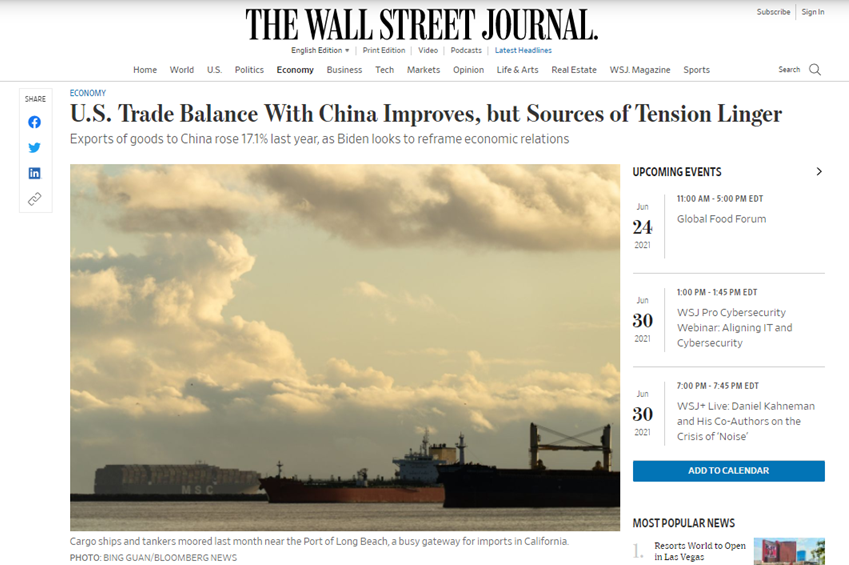
The problems with headlines such as this: “US Trade Balance With China Improves, but Sources of Tension Linger” are twofold. 

https://www.wsj.com/articles/u-s-trade-deficit-narrowed-in-december-as-exports-outpaced-imports-11612532757

A: It furnishes support to the notion that trade surpluses are FOREVER safe and trade deficits are INVARIABLY grave. That is not accurate because foreign countries will always wish to invest capital in countries like the US, which employ it relatively well. One clear case of a nation that borrowed massively from abroad, invested wisely and did excellently well is the United States itself. Although the US ran a trade deficit from 1831 to 1875, the borrowed financial capital went into projects like railroads that brought a substantial economic payoff. Likewise, South Korea had large trade deficits during the 1970s. However, it invested heavily in industry, and its economy multiplied. As a result, from 1985 to 1995, South Korea had enough trade surpluses to repay its past borrowing by exporting capital abroad. Furthermore, Norway’s current account deficit had reached 14 percent of GDP in the late 1970s, but the capital it imported enabled it to create one of the largest oil industries.

B: The headline makes a normative claim while equating bilateral trade deficit with the overarching narrative of bilateral tensions. Such normative claims follow from the author’s value-based reasoning, not from econometric investigation. China and the US may have ideological friction on many levels, but the surplus or deficit has much to do with demographics and population changes within a country at a given time. Nonetheless, a legacy of political rhetoric relishes on inflating and conflating matters. We hear a lot about the prediction that China is forecasted to become the largest economy by 2035, provoking many in the US to bat for protectionist policies. But we ignore the second part of this prediction. Based on population growth, migration (aided by liberal immigration policies) and total fertility rate, the US is forecasted to become the largest economy once again in 2098. 

Therefore, it is strange that a lot of the “trade deficit imbalance” headlines neglect to question if the borrower is investing the capital productively or not. A trade deficit is not always harmful, and no guarantee that running a trade surplus will bring substantial economic health. In fact, enormous trade asymmetries can be essential for creating economic development.

Lastly, isn’t it equally odd that this legacy of political rhetoric between the US and China makes it natural to frame trade deficits with China under the ‘China’s abuses and coercive power’ banner but intimidates the US establishment from honestly and openly confronting the knowledge deficit in SARS-CoV-2’s origin? How and when does a country decide to bring sociology to epistemology? Shouldn’t we all be concerned more about significant knowledge deficits?

Some Monday Links

Redefining Death (National Review)

Some medical devices don’t mean to be racist, but they are (Psyche)

Monetary Meld (IMF)

And, inspired by this NOL discussion here,

A History of My Economic Opinions (Deirdre McCloskey)

This is a long, but enrapturing piece (I am not familiar with McCloskey’s work, which was also referenced en passant in another fresh NOL post). An excerpt:

I happened in 1958 to devour in the Andrew-Carnegie financed public library of Wakefield, Massachusetts the Russian prince Pyotr Kropotkin’s Mutual Aid: A Factor of Evolution (1902) and the gullible American journalist John Reed’s Ten Days That Shook the World (1919). If I had instead come across Rose Wilder Lane’s The Discovery of Freedom (1943) or Ayn Rand’s Atlas Shrugged (1957) I suppose I would have gotten a better grasp of market pricing, earlier. Many market-loving classical liberals came to liberalism by that free-market path, and were never socialists. Yet the socialism-to-liberalism route is very common in 20th century political biographies, such as Leszek Kołakowski’s or Robert Nozick’s or, to descend a couple of notches, D. N. McCloskey’s. (The contrary route from market liberal to state socialist is vanishingly rare.)

The muddle-class: A continuation

In the 1999 remake of the film The Thomas Crowne Affair, there is an interesting snippet of dialogue:

Woman: The thing that impressed me most… was getting from Glasgow to Oxford on a boxing scholarship.

Crowne: Not bad for a wee lad from “Glasgee.” It was easy. Rich kids can’t box.

As readers of NOL would know, Oxford doesn’t offer sports scholarships, meaning that this origin story is not only implausible, it’s impossible. What this speaks to, aside from the inattention of the screenwriter, is a phenomenon of performance for a certain demographic: That is to say the telling of stories with information tailored to the understanding and assumptions of a particular group, or groups, of people. In the case of The Thomas Crowne Affair, that group is Americans for whom collegiate sports and higher education are synonymous, or those whose understanding of higher education is framed by their local institution, which offers sports scholarships. By extension, such people are not in the Oxbridge or even the Ivy League’s orbit as they would then be aware that the former don’t offer sports scholarships and that at the latter, even though some sports-related scholarships are offered, sports are held in open contempt by the student body. No one works hard to attend these places to then be jocks. The problem with demographically targeted performance is that it creates division, one which is based on fiction but whose consequences can be all too real. If a person doesn’t know how things work in another part of society, if his or her knowledge is based on stories-with-an-agenda, then he or she will see discrimination or rejection where there is none.

I have written before about meeting a childhood acquaintance for the first time in over twenty years and discovering that she was angry and bitter toward society for not recognizing her imagined precocity. She had moved to a town which is known as a resort frequented by the CEOs of Fortune 500 companies, visiting dignitaries, etc. Telling me of her experiences, she became distraught – distraught! – that these people were polite to her. She comes from a family which might be described as Gucci socialists, so I inferred that she had a worldview which presumed that rich people, successful people be rude or arrogant toward the “working man.” Realizing that she was not elite and that her perceptions of the elite were wrong was a massive blow to her constructs.

As the case of Anna Sorokin, alias Delvey – the young woman who swindled her way around New York City for a year before being caught and charged with fraud – revealed, what tripped Sorokin was her lack of knowledge of the way elites truly behaved. One of the girls whom Sorokin attempted to involve in her subterfuges stated that she could be exceptionally rude to service people, which was one of the red flags to the hotel management who eventually unmasked her. The exact words were: “she could be oddly ill-mannered for a rich person. Please and thank you were not in her vocabulary.” She was hoisted on the petard of her own fantasies. I, myself, am waiting to see if this little detail makes its way into the two upcoming television dramas about the Sorokin swindle.

There’s a film from 2004, In Good Company, which stars a young Scarlett Johansson, among others. The film is a fairly good representation of how a placid, self-satisfied middle-class man was dragged, kicking and screaming, into the digital age. But, interestingly, the first clue for the parents in the film that the world doesn’t work the way they thought it did is when their eldest daughter, played by Johansson, is injured, costing her her tennis scholarship to an unnamed college in upstate New York. She comes home and informs her parents that without the scholarship, there’s no point in returning to that college because its reputation isn’t good enough for her to be able to progress professionally and socially coming out of it. She’s already arranged to transfer to NYU but needs her parents to cover her fees as she’s transferring mid-year, when all scholarships or financial aid have already been awarded. The daughter’s announcement is the beginning of her parents’ world collapsing in an avalanche of new information: “Not all colleges are created equal! The tennis scholarship wasn’t worth it – now she has a damaged arm and is behind academically! Well at this rate, she’s never going to win a merit scholarship. No problem, we’ll take out a mortgage on the house. Oh, damn! Dad’s lost his job because the magazine where he works is moving from print to digital and he can’t figure out how to use a computer!” The film is an interesting study of what happens when a couple, that fancies themselves as worldly wise and upwardly mobile, discover how little they actually know. The world doesn’t work the way they thought it did and everything that they believe themselves entitled to is stripped away.

Arthur Schopenhauer wrote in his essay “Psychological observations,” published in English as part of a collection of his essays titled Studies in Pessimism, “Every man takes the limits of his own field of vision for the limits of the world.” This quote, taken out of context, is much beloved by self-help authors. The full quote is:

Every man takes the limits of his own field of vision for the limits of the world. This is an error of the intellect as inevitable as that error of the eye which lets us fancy that on the horizon heaven and earth meet. This explains many things, and among them the fact that everyone measures us with his own standard—generally about as long as a tailor’s tape, and we have to put up with it: as also that no one will allow us to be taller than himself—a supposition which is once [and] for all taken for granted.

Schopenhauer was commenting on Shakespeare’s Hamlet in this paragraph. However, it is a succinct description of the intellectual heresy of the pseudo-middle class. They take their own limited experience as how the world works, e.g. sports scholarships, and measure society according to their tailors’ tapes, e.g. world views requiring rich people to be rude.

According to legend, American wit Dorothy Parker was asked at a party to create an epigram using the word “whore;” without hesitating, she said “you can lead a whore to culture but you can’t make her think.” Mental or knowledge poverty, be it social or cultural, cannot be alleviated by mere exposure. Such poverty has nothing to do with lack of material means. It exists solely in the four or so inches between a person’s ears. In the same way, mental or knowledge wealth cannot be redistributed. As the Bolsheviks found, the only way to redistribute this type of wealth is to blow a person’s brains out.

The pseudo-middle class (or the muddle-class), with its limitations and tailors’ tapes, isn’t the backbone of society. At best, it’s a parasitic entity; at worst, a cancer. The bourgeois, of the type studied by Deidre McClosky, with their high-quality educations, discipline, courtly manners, and work ethic, are the backbone. Not everyone who falls into the general category “middle class” is bourgeois. In fact, I go so far as to say based on my own experience that the majority of middle class people are not bourgeois because we are at a point in history where true bourgeois values and lifestyle are demonized as “elitist.”

From the comments: “liberty, evolution, and morals”

I’m reminded of an MR entry by Tyler Cowen a couple of months ago in which he remarks that the “energetic young talent” in libertarianism now often seems more intent on “projects for building entire new political worlds” — charter cities, blockchain — than on theory, political, economic, etc. (https://marginalrevolution.com/marginalrevolution/2021/04/where-is-non-state-capacity-libertarianism-evolving.html)

I think there’s truth in that. But theory is still needed. It’s what gives us our organizing principles and inspiration.

That’s just the trouble with the bloggers mentioned, and I don’t mean the blog format. It’s the smallish scope of thinking: books on voting behavior, the university education system, immigration and open borders. This sort of thing is fine, but it’s not fundamental theory.

The purist libertarianism (rights absolutism, the “non-aggression axiom”) exemplified by Rand, Nozick, and Rothbard has been a dead end, I think. It is readily grasped, and it has the capacity to inspire, but it isn’t true. And the gradual realization of this has led to its collapse.

This collapse has left us somewhat rudderless. That’s how I feel, anyway. We need a new paradigm. The way to think about society is evolutionarily, or so it seems to me. That points to Hayek. But he had little to say about morals, and libertarianism should provide a moral vision. What is needed is a way to put these two together.

(The best evolutionary theorist of society—that I know of—is Joe Henrich. Both his books, The Secret of Our Success, and The WEIRDest People in the World, are terrific. But of course he’s neither a libertarian nor a moralist.)

This is from David Potts, responding to yours truly in the comments.

I have to think about this a bit more.

“Building Back A Better World”: Can it challenge the BRI?

Introduction

Ever since taking over as President, Joe Biden has reiterated the need for the US and its allies to work together to check China’s economic rise by providing alternatives to China’s ambitious Belt and Road Initiative (BRI) project as well as its burgeoning technology scene. During his State of the Union address in April 2021, the US President had said:

China and other countries are closing in fast. We have to develop and dominate the products and technologies of the future

It would be pertinent to point out that 138 nations on five continents have signed various BRI cooperation agreements with China as of the end of 2020. (EU member states including Greece and Italy are also on board the BRI.) China has so far invested a whopping $690 billion in BRI-related projects in 100 countries.

G7 and the B3W

On June 12, 2021 the G7 unveiled the Building Back a Better World (BBBW/B3W), a brain child of the Biden Administration. The G7 leaders said that the B3W would be “values-driven, high-standard, and transparent.” During a conversation with Boris Johnson in March, the US President had discussed the need for an alternative to the BRI. A number of BRI related projects in developing countries in Asia and Africa have drawn criticism for lacking in transparency and not being economically sustainable, leading to debts which make countries dependent upon them or leads to a “Debt Trap (pdf).”

Debt trap has been defined as “a predatory system designed to ensnare countries into a straightjacket of debt servitude.” A prominent example of this is Sri Lanka, where when the South Asian nation’s debt burden vis-à-vis China became untenable, it was compelled to sign a 99-year lease with China through which Beijing got 70% stake in the strategic port of Hambantota. Many projects falling under the China Pakistan Economic Corridor (CPEC), too, have been under the cloud for lacking transparency and not being feasible. In certain cases, such as the Kyaukpyu port in Myanmar, Beijing has had to renegotiate the cost of projects (it was brought down from $7.3 billion to $1.3 billion) as a result of strong local opposition.

Alternatives to BRI

The Trump Administration received bi-partisan support for the BUILD (Better Utilisation of Investment Leading to Development ) Act, which created a new agency (the United States International Development and Financial Corporation, or USIDFC) with a corpus of $60 billion to facilitate private sector involvement in the Indo-Pacific, especially African countries. In 2018, the US Secretary of State Mike Pompeo had also made a commitment of $113 million to projects in the Indo-Pacific focused on technology, infrastructure, and energy. In November 2019, the US, Japan, and Australia had also launched the Blue Dot Network on the sidelines of the ASEAN Summit.

Then-US National Security Advisor Robert O Brien had compared the Blue Dot Network to Michelin Guide, which meant that just like a Michelin star is the sign of approval for a restaurant, a blue dot would be a seal of approval for infrastructural projects. Days before the G7 meeting, the inaugural meeting of the consultation group of the Blue Dot Network was held in Paris, apart from representatives from Western governments and Japan, other stakeholders such as members of civil society, academics, and 150 global executives participated in this meeting.

The US State Department, while commenting on the Blue Dot Network, had said:

The Blue Dot Network will be a globally recognized symbol of market-driven, transparent and sustainable infrastructure projects

Under the umbrella of Quad countries (US, Japan, Australia, and India), too, there has been discussion on enhancing economic cooperation as well as connectivity.

Opportunities for the B3W

There is an opportunity for the B3W, since in the aftermath of Covid, certain BRI projects have slowed down. Second, the geographical scope of BBBW is much wider than that of the projects under the Indo-Pacific (B3W will also include Latin America and Caribbean). BBBW can also hardsell its strengths such as transparency and sustainability – both economic and environmental. It also can dovetail with some of Biden’s ambitious economic schemes related to the economy and infrastructure. The fact that Biden is willing to take the lead, unlike Trump, is reassuring for allies and sends out a positive message to developing countries looking for alternatives to the BRI. While addressing a press conference after G7, the US President made this point:

The lack of participation in the past and in full engagement was noticed significantly not only by the leaders of those countries, but by the people in the G-7 countries, and America’s back in the business of leading the world alongside nations who share our most deeply held values

The US had also categorically clarified that the B3W seeks to provide an alternative to BRI, but it is not merely about targeting China.

Possible limitations of B3W

Yet, there are limitations. First, the B3W still does not have a clear blue print. Second, it would be tough to match the BRI in terms of resources. Third, a number of G7 members who themselves share good relations with China may be reluctant to get on board the initiative (even though it has been made clear that the B3W initiative is not just about targeting China).

Conclusion

In conclusion, a lot will depend upon how much not just the US government and big businesses are willing to invest in the B3W (since the model will be different from the BRI, which is one of ‘state capitalism’) but whether other members of the G7 are willing to play a proactive role in such a project. An alternative is needed to the BRI and the announcement of B3W is welcome. Taking it forward and competing with BRI may not be impossible but is certainly a tough task.

Shanghai over the years

Cool photo essay.