Trade: Is Obama Right This Time?

I was hoping to sit this one out. I mean the multiple discords about the new Pacific trade treaty proposed by President Obama. I feel I need to lend a hand because there are good reasons to be confused. Plus, I taught international business for twenty-five years. My voice just might be useful this time. Here is my brief but adequate road map to the problem. I am deliberately staying away from nouns and initials because they do more harm than good.

Pres. Obama has an early draft of an international trade agreement with a large number of Pacific countries. Such agreements eliminate or lower trade barriers. So, first, they make it easier for economic actors from one country to buy a and sell things to economic actors from another country. That’s because all trade barriers are hidden taxes on consumers. They all raise prices above where they should be. Get rid of them, have more real income.

Second, the lowering or the elimination of trade barriers ultimately result in something almost magical: Economic actors stop doing what they are doing badly and start focusing on what they do well. Most items become less expensive and of better quality. Everyone benefits from this. I mean everyone in the world.*

International trade agreements do cause some to lose their jobs. They create many more jobs than they cause to disappear, however. But the loss is certain: After all, as soon as central American bananas are allowed into Canada, Canadian banana growers must lose their jobs, by and large. Incidentally, there have not been Canadian banana growers, as far as I know but you see what I mean: Canadians ought to concentrate on producing lumber, or refrigerators, or iron ore, almost anything but bananas.

The current trade project presented by Obama contains a $500 million clause to retrain at public expense those Americans who might lose their job as a result of the new agreement. This is nothing new. Previous trade agreements contained similar arrangements.

President Obama wants what is known as “fast track authority.” That’s the privilege to have the Senate vote a simple “Yes” or “No” on the final draft of the agreement with those many other countries. This is pretty necessary because if each government of each signing country has to go home and gather amendments and often, amendments to amendments, in the end, no agreement sees the light of day. It’s a practical thing, not a sinister ploy.

On the one hand, practically all previous presidents who signed international trade agreements had fast track authority. On the other hand there is a sturdy reason to deny Mr Obama fast track authority: He is a proven, extremely bad negotiator. On the third hand, the negotiations of such agreements are almost completely done by technical personnel who know their business. And, how likely is Mr Obama actually to get involved?

As I write, elected Democrats are all against everything involved because the unions think that every international trade agreement makes them lose ground. I think their perception is correct. Republicans are torn between their understanding of the world (which is more or less like mine) and their wish to give the president a black eye.

This is a small digest of a complex and interesting issue. I deal with it at leisure and extensively in nine installments on this blog. Each had the words “protectionism” or “protectionist” in the title. Again, those are installments; you may want to look at them in order. No test!

* Paradoxically, one of the best, clearest scholarly explanations of this magic – called comparative advantage – is by Paul Krugman. It’s from the days when he was not yet crazy. Bret Stephens in the WSJ 6/16/15 jogged my memory on this strange fact. It’s worth looking up Krugman, for once.

From the Comments: Libertarians and Love

Rick responds to my question about heartless libertarians:

You’re spot on. There’s a mental image I’ve read (and I’m going to butcher this because I don’t remember it clearly) of a moral gradient (I’m 60% sure that’s what it’s called). The way I fit this concept in my head is that we each have a sort of a topographical map of something hill-shaped. This map represents the moral weight we put on others and ourselves. We’re at the center, and the points furthest away are those strangers from far away that we will never meet in our lives. Different areas may represent different groups of people. Even better, instead of a topographic map, you’re forming it with a finite amount of playdough. Some people might have more or less playdough than others, but they’re usually pretty similar.

Say one person’s hill is shaped like Grinch mountain (incredibly steep) he holds himself in far higher esteem than anyone else, even those very close to him. Someone whose map is a flat plain (or plateau, but it’s hard to tell, isn’t it?) is messiah-like in her even-handedness with humanity; every person is as valuable to her as her mother. Both of these are very different from normal, and we like to see other people be normal. Sometimes quirkiness is acceptable, and I suppose we might admire someone whose map looks like a ridge representing her strong devotion to the children of an African village she visits every year as well as animals of all sorts.

When I compare my moral gradient to the people around me, I notice some important differences. I put a much higher weight on strangers and foreigners. I still probably put a lower weight on the poor than a typical democrat. But that effect is swamped when you account for how much more I care about strangers and foreigners. So if I care more about the world’s poor, then who’s missing out on love? From whence came this playdough? I’m pretty sure it’s my girlfriend’s coworkers. I honestly can’t keep them straight and I can’t piece together the stories I hear about them into anything but the most abstract people.

I think my moral gradient might be pretty typical for a libertarian. Like you, I don’t want to put people out and that can appear stand-offish. But that’s really just me saying, “I don’t know you, but I believe you aren’t simply a solipsist delusion left here for my abuse or neglect.” But other-oriented sentiments come at a cost. I consider people in the abstract, where non-libertarians consider people on a case-by-case basis. Each one is special, but only a few of them actually count. Most people incorporate Dunbar’s number as both the limit of their social network and a limit to the number of people they actually care about. For me, I basically recognize “family”, “friend”, “human being”. I don’t have “second cousin, twice removed” or “friend’s ex-boyfriend’s cool cousin that I still hang out with some times.”

That’s all a very long winded way of saying “egh, their measure for love might have been focusing on love for those in-between strangers whose names I just can’t remember for the life of me.”

Here is the wiki for Dunbar’s numbers (Robin Dunbar is a British anthropologist). Here is more from Rick on the topic. The ‘moral gradient’ Rick speaks of probably has to do with the research of the economists Sandra Peart and David Levy (I’d start here, if you’re interested), but I’m just wagering a guess.

The Tyranny of Majoritarianism

Where did the concept of “majority rule” come from? Why should any majority rule over any minority?

Of course the idea of protecting minority rights also exists. It is accepted in the civilized world that minority religions, ethnicities, and cultures should be respected. So evidently the global belief in majoritarianism is not absolute. But overall, the prevailing global political culture in democratic societies is majoritarian. The party which has some majority in an election gets its leaders in the government, and it is able to impose its policies on everybody.

In a voluntary club, it seems natural that the leader be elected by the majority. Everyone in the club agrees about the mission of the club. Suppose it is a hiking club. It does not matter too much who the leader is, so a majority vote seems like the best option. Also, in deciding which location to hike in, majority rules seems sensible. Majority rule provides greater utility than minority rule, and there is general agreement that making more people happy is better than if fewer are happy.

But when it comes to government, majority rule is problematic. First of all, majority rule is based on the persons who may vote, not the whole population. Young children do not vote, and foreign residents do not vote. The adult citizens own the country, so they vote.

People believe in majority rule because they think of the alternative as either dictatorship or a rule by an elite minority. Why should one man or an aristocracy rule over the others? The global political culture now rejects monarchial rule as violating equality. What is not understood is that imposed majority rule also violates equality.

If we accept human equality, that all human beings have an equal moral worth, then the logical conclusion is equal self-governance. No person has a natural right to impose his will on another, because is it morally evil to coercively harm another person. Harm means an invasion into the domain of others, including the harm of restricting the other’s peaceful and honest actions.

When a person becomes employed, or enrolls in an institution such as a university, one does not usually expect democratic governance. The company is a non-democratic hierarchy, in which there is a top boss, lower bosses, and the ordinary workers who are directed. The workers has to comply with rules he may not favor, but the arrangement is voluntary because the worker chose to enter into employment or enrollment, and he may quit.

The equality of the employment situation is the ability of the worker to enter and exit, and the ability of the employer to equally contract with the employee and to terminate the employment. Free association is the basis of equal liberty.

The governance of territory is in accord with human equality when there is freedom of association among the members. Whether a territory is ruled by one man or by a majority does not matter so long as the individuals consent to be governed, so long as they can exit at will. After all, a traveler does not expect a voice in the rules of the places he visits. Whether the location is run by one person or the local majority does not matter to the traveler, so long as he may come and go, and so long as any unusual rules are presented in advance.

We need governing structures, but these can be contractual agreements among equals. We have today voluntary contractual communities such as homeowner associations, road associations, condominiums, cooperatives, and proprietary communities. All neighborhoods could be governed this way, and then the local organizations can form greater associations for public goods with a broader scope. An occasional hermit would not disturb the governing continuum.

Just as local communities would be able to associate, they would have the freedom to disassociate. The problem with imposed majoritarianism is that individuals and communities may not secede, and so they are forced to be dominated by the majority. Minorities are subjected to the law enforcement, schooling, drug laws, civic services, and taxes favored by the majority.

The reform that would establish deep equality would be a constitutional rule that would prohibit only coercive harm to others. Government would not impose costs and restrictions on peaceful and honest action. Contractual communities would be free to have restrictive rules among their own members. Contractual governance is best implemented bottom up, with secession where feasible.

The avoidance of imposed costs implies the absence of taxes on transactions and produced goods. There would be charges for trespass and invasions, such as pollution. In the absence of taxes on labor, capital, and trade, those who hold title to land would have to pay for civic services from the yield of their land, the rent. Ideally, people would understand the logic of equal benefits from the rent generated by nature and community. The deepest equality would consist of both equal self-governance and, as Henry George put it, standing “on equal terms with reference to the bounty of nature.”

Milton on Free Political Institutions: ‘The Tenure of Kings and Magistrates’ (1649), ‘A Treatise of Civil Power in Ecclesiastical Courts’ (1659), ‘The Ready and Easy way to Establish a Free commonwealth’ (1660)

“He was, as every truly great poet has ever been, a good man; but finding it impossible to realize his own aspirations, either in religion or politics, or society, he gave up his heart to the living spirit and light within him, and avenged himself on the world by enriching it with this record of his own transcendental ideal.” (Comment on John Milton by the English poet Samuel Taylor Coleridge, 1772-1834)

For my introduction to Milton see here, for my post on freedom of the press in Milton see here.

Milton made important arguments for the kind of political institutions which would serve liberty, as well as discussing to goal of freedom in discussion of opinion. Though there are two basic Milton texts identified here, I will not attempt to distinguish them here, let alone take into consideration every possibly relevant text by Milton. This is a period of rapid change in political institutions in England (also applying but unevenly and differently in Ireland and Scotland; at this time Wales has to be considered part of England), of experimentation including the execution of King Charles I just before the publication of the first essay identified was published and the institution of a Commonwealth and Free State, in that year, and of reaction in the sense of royal Restoration in the year that the last essay identified was published. Context matters and so does change, but I think for the purposes of this post as opposed to a blog about the details of Milton’s life as a man of letters and politics, this will be mostly an overview rather than a tracking of Milton’s evolution.

As with his views on free speech, Milton’s views on political institutions mix religious commitments with knowledge of English history and great scholarship of ancient texts. The knowledge of ancient texts to some degree overlaps with the knowledge of religious texts, which is one reason why intensified study of the Bible in the sixteenth and seventeenth century tended to serve general cultural development and liberty.

Milton’s objections to monarchy are partly established through his reading of the Old Testament/Hebrew Bible where he argues that God warned the ancient Jews against adopting the institution of monarchy. Anyone interested in following up which parts of Hebrew scripture Milton is using here should start with the First Book of Samuel, Chapter 8. Disasters that befall the Biblical Jews are in some measure the consequence of ignoring God’s counsel in this matter. Of course, many have seen the Bible as justifying not just monarchy, but absolute monarchy so Milton goes to some effort to argue that monarchy was a second best institution for the Jews from God’s point of view and that the Jews never gave their monarchs absolute power.

The view that Milton has then, of the rights and powers of kings, is that they are established by covenant with the community and not a divine authority which the community must obey. The idea of covenant is important in Christianity, with regard to the view that the ancient Jews had a covenant with God as his chosen people and that Christ offered a new covenant for all humans willing to follow him as the son of God. These covenants were very much emphasised in the Protestant culture of the sixteenth and seventeenth centuries, which thought it was returning to a relation with God obscured by centuries of Catholic interposition of church hierarchy between believer and divine word.

The idea of covenant moved quite quickly from theology to political and legal thought in Hugo Grotius (1583-1645), a Dutch theologian and legal-political thinker who was one of the major shapers of modern thought in these matters. Milton does not emphasise him in these essays, but he was certainly an influence. For Grotius, the covenant is at the centre of theology, and influences his view of the obligation to obey law and government, though he does not use the language of covenant greatly in that context. The point being in political terms that in some way laws and political institutions rest on some choice of the community to obey them. In Grotius’s thinking, this is more about the reason for obedience than an incitement to rebellion where laws and institutions lack popular backing, but the latter aspect is necessary outcome. This ambiguity carries on into the Leviathan of Thomas Hobbes (1551) which takes a foundational social covenant (defined more in legalistic than theological terms) as the basis of absolute obedience to the sovereign, but certainly influences the view of John Locke’s Essay Concerning Civil Government (1690) according to which ‘the people’ (in practice Locke meant the upper classes reğresented in Parliament) the right to overthrow government.

So Milton precedes Locke’s view that rebellion against unjust government is lawful, even admirable, and that laws are uniquely made by ‘the people’ in Parliament and never by a monarch. Milton himself draws on earlier historical precedent for this view of government as based on contract and the right of rebellion against government which ignores that contract. Particularly important is the Dutch Revolt of the late Sixteenth Century, in which merchant towns rebelled for political, commercial, and religious reasons against the absolutist Catholic monarchy of Spain which had acquired them for rather accidental dynastic reasons in recent history. Final agreement with Spain took a long time, but the new Dutch Republic quickly established the possibility of a mercantile republic in modern Protestant Europe and offered support to those who considered republics to be more Protestant than monarchies. Milton draws further on recent Scottish history, pointing out that a Protestant Scottish parliament had deposed Mary, Queen of Scots, in the preceding century. In general, Milton argues that the idea of monarch contradicts the idea of an ordinary human with an ordinary body, with legal accountability like anyone else, and so can never be incorporated properly into a state of free citizens.

Though monarchy which obeys such agreements is allowable from Milton’s point, it is not ideal and is very likely to decay into outright tyranny. Nevertheless he offers examples of how great monarchs of European history, including Roman Emperors, accepted that their power was only justified by serving law and the good of the community. As Milton emphases the last great Roman Emperor Justinian (ruling from Constantinople towards the end of the period during which any Roman Emperor controlled much territory beyond Anatolia and the Balkans) produced the greatest codification of Roman law, making himself the servant of law, not god on Earth. In any case is monarchy might be just about tolerable in many societies for Milton, the proper practice of Protestant Christianity certainly required a freedom from the religious and institutional church authority demanded by kings. Protestant ideas of free discussion of religious ideas and self-governing groups of believers could not thrive under a king (which was a reasonable estimate since Protestant Dissenters were not really equal citizens until the nineteenth century when the monarchy had become largely ceremonial, and indeed the last monarch who really struggled for a more than figurehead role, George III, was en enemy of religious emancipation).

Milton developed a view of how a republic, or commonwealth, might survive over the long term, certainly a longer term than the period it lasted in England, in its purest form only from 1649-52, and then the Lord Protectorship of Oliver Cromwell until 1658 and his heir Richard Cromwell until 1660. He thought that while the country might need a new parliament in 1660, once elected it should serve permanently, replacing dead or absent members through its own method. What Milton seems to advocate here though is not a permanent republican law, but something necessary to institute a permanent republic. Milton thinks of the beginnings of  a republic as embattled and as needing to act more like an army than a fully stabilised and secure civil republic should. Both the chance for election and eligibility to vote can be restricted while the republic secures itself against selfish internal a faction and external danger. Here Milton runs into the problem Niccoló Machiavelli, an ardent republican despite frequent misrepresentations, encountered in The Prince, how to get a people that is not very republican and maybe not very ready for a republic to the point where civic virtue and understanding of public good are strong enough for a workable republic.

Milton’s life and public service under the take over of the English republic by the quasi-monarch Oliver Cromwell, followed by his life and exile from public life under the restored monarchy, is the context for the quotation from Coleridge at the head of this post. For Milton, republicanism and associated ideals, became more and more associated with some better and other world. After the Restoration Milton certainly became the author of poetry rather than political essays, producing in particular Paradise Lost, a religious epic which places him just below Shakespeare in general evaluation of English literature. We could look there for a more ‘transcendental’ exploration of republicanism and liberty, and I had hoped to do so. However, this task will be deferred as I think a responsible investigation of republicanism in Milton’s poetry, though a recognised area of discussion, is just too big and different to incorporate into this sequence of posts. Later I hope.

Gay Parade: a Conservative Take

So, last Sunday was Gay Pride Parade downtown Santa Cruz. I am all for parades in general. It feels good for people to march, no matter the cause. In this case, I am a little perplexed at first. I don’t know what the marchers are addressing. This is Santa Cruz, after all, where no one is ever judgmental, except against those who are judgmental. Where is the potential gain in tolerance, I wonder?

The parade does not even succeed in browbeating me by making me feel “what it’s like to be a minority.” After all, most of the women in the parade are a lot like me. They like what I like. We may have been rivals once but I was not even aware of it until my wife brought home – in all innocence – an obviously lesbian admirer. My wife is from India. She was young then. There were many things she did not understand. Also, she was striking. Of course, I threatened the woman with beating her up with my big fists. No, I was not acting intolerant. I treated her the way I would have treated any sexual rival. I treated her equally, you might say. (Yes, she quickly vanished.)

The Santa Cruz parade is puzzling in other ways. One small tight group carries two signs. The first shows a Star of David in several colors. The second sign shows a small number of abstractly rendered fish in the same colors. I can’t bring myself to believe that this is a plea for support of Jewish homosexual fish. Yet, I have no other interpretation. The Santa Cruz parade also leaves me a little frustrated because it’s frankly scruffy, overall. I feel parade envy vis-à-vis the flamboyant and perfectly groomed San Francisco Gay Pride Parade. I am not sure but I think the difference is due to the fact that the Santa Cruz event is dominated by lesbians. Many (not all) lesbians make it a point of pride to wear sloppy t-shirts, like guys. Some aspire to be male rednecks and are fast getting there.

Toward the end, I enter into a conversation with two older woman, one costumed. It turns out they are leaders of the local Medical Marijuana Alliance. One is a retired nurse. They both like guys, one of the biddies reassures me unhelpfully. They are there because there is an alliance between the Alliance and lesbian and gay organizations. They support one another politically. This is good American politics at work. Mutual support is set up peacefully, without acrimony, to gain influence over rules and over how public funds are spent. I often complain about the policy results of such coalitions but I can’t think of a better way, in the short term, that is.

I still dislike taxation and I dislike even more large segments of law and order. I detest above all the so-called War on Drugs, a true catastrophe for this whole society. In the short term, though, I don’t see the path forward to doing away with these gross limitations on individual freedom. So, I rejoice in every item of evidence that we could do worse.

A question on adverse selection for the economists

I can’t think of an example of adverse selection occurring without asymmetric information. Does anyone else know of one?


But as long as I’m here waiting for answers, let me think through an aspect of this…

The classic example of adverse selection in my mind is the Death Spiral. (My dad sells group benefits, so growing up I would hear about some of the weird outcomes of different states’ insurance regulations on things like pre-existing conditions.) Trying to pull apart adverse selection (AS) and asymmetric information (AI) has led me to an interesting thought: The adverse selection problem created by preventing insurance companies from using the (very sensible) policy of not covering pre-existing conditions (i.e. of only insuring insurable things) may unravel some epistemic aspect of this situation.

The private costs of sharing information about pre-existing conditions falls and this might have modest benefits to offset the significant costs of AS. I’m sure health economists would be happy to have this sort of information, and maybe it would give insurance companies’ actuarial division some new insights that could apply to other markets.

The Lowest Levels of Love (with apologies to Dr Amburgey)

Different Types of Love scale

The Different Types of Love scale is a 40-item measure of loving feelings toward four different groups. Participants indicate agreement with statements concerning friends […], family […], generic others […], and their romantic partner […]

Results.

Table 4 shows that libertarians showed the lowest levels of loving feelings toward others, across all four categories (although the difference with conservatives on love for friends was not significant).

Interpretation.

Consistent with the results on the Identification with All of Humanity scale, the libertarian independence from others is associated with weaker loving feelings toward friends, family, romantic partners, and generic others. It is noteworthy that differences between liberals and conservatives were generally small (except toward generic others). Libertarians were the outliers.

You’ll always be my bro, though. These results come from a paper by a bunch of moral psychologists, including Jonathan Haidt. I’ve blogged about the paper before, in regards to intelligence. (Libertarians are smarter than conservatives and liberals, remember? It turns out that we are bigger jerks, too.)

My intuition tells me that this is an incomplete analysis, though (the paper’s authors say as much, up front, in the paper itself). It’s not that libertarians are less loving than conservatives and liberals, it’s simply that we show our love in a different way, most likely in a way that isn’t represented in the sampling process. Libertarians could not, for example, be the ardent internationalists that we are without some measure of “love” for humanity.

Here is an example of what I mean. Suppose I am walking down the street and I see a bum with a cardboard sign and a tip jar (a paper cup from Carl’s Jr). The bum is drunk, and a little stoned. I say to myself, “Damn, that guy is in a crappy situation.” I reach into my pockets to see if I’ve got some change or, better yet, a couple of cigarettes. I am comfortable in claiming that most libertarians – sans those raised on the Atlantic coast of the US – go through the same thought process. If I put myself in that guy’s shoes, anything more than what I spare for him becomes a nuisance to me. Does this make sense? So if I’m panhandling, and somebody tries to do more than give me their change or spare me a couple of smokes, they become a pain in my ass. Why would I want to be a pain in our hypothetical bum’s ass?

This same thought process can be attributed to family, friends, and romantic partners. We’re not being jerks, we’re respecting your autonomy. I know for a fact that this can be a shallow admission of truth for some to hear, but it’s the truth nonetheless.

The libertarian’s outlier-ness in regards to conceptions about love may explain why we have such a tough time politically. (Our superior cognitive skills, which prompts us to be more open to getting at the truth of some matter, also goes some way toward explaining why we fail politically, as politics is emphatically about avoiding the truth.)

Morality (“love”) is simply one of a number of different spheres of conception about how the world works (including, say, economics, history, or sociology). However, morality is often the only sphere that people can afford to use to make judgments about this or that policy or social puzzle. This is because the training that is required to understand more complex topics like economics or sociology is expensive (“time”) and hard to come by. So, for example, there are a number of explanations for why foreign aid to Somalia is bad. You can use historical explanations or sociological ones or economic arguments, but the first – and often only – line of reasoning used by most people is moral in nature. Thus:

Giving money to poor countries is morally wrong.

Not exactly a game-winner, right? Look at what a jerk you are. Should we, as libertarians, be spending more time explaining to others why we think the way we do?

David Friedman on Judging Outside Your Expertise

David Friedman writes:

Accepting the views of experts on a question you are not competent to answer for yourself, assuming that you can figure out who they are and what they believe, is often a sensible policy, but one can sometimes do better. Sometimes one can look at arguments and evaluate them not on the basis of the science but of internal evidence, what they themselves say.

He goes on to give examples of inconsistent claims made by global warming alarmists. His (short) post is worth the read. Here are my 2 cents:

First, (in response to the block quote) deferring to experts is sensible but requires a certain degree of expertise in picking out who they are which is a difficult task. We’re all human, and it’s hard to hold something in your head without thinking it’s true. That makes it hard to not be arrogant. We need to emphasize strongly that interpreting information is hard, and the outcomes are not at all obvious. Those concerned with anthropogenic climate change (myself included) are better served by stressing the uncertainty involved and making arguments centered on appropriate risk management.*

Second, The issue of climate change boils down to a series of sub-issues that need to be considered carefully:

We need to think about costs and benefits. A warmer world would be a boon for many people. If we could set the average world temperature, we would want it to be higher than 0 Kelvin. We might even want it to be warmer than it is today.

We need to think about the uncertainty surrounding what’s happening, as well as what we can do about it. We should be particularly skeptical about cost estimates for any effort to try to control the environment.

(This one’s a bit of a non sequitur.) We should use this as an excuse to do things that would help reduce the costs of climate change that we should be doing anyways. Specifically, we need to liberalize immigration policy in wealthy nations. Let’s say there’s a 0.00001% chance that climate change has a bad outcome, and that specifically that outcome is that the entire country of Bangladesh will catch fire and kill everyone. That’s a good excuse to let Bangladeshi’s come to America, but we should be doing that anyways. It’s a low cost (actually a negative net-cost) solution to a potential problem of climate change.

Here’s one that I think the smarter alarmists/deniers already recognize: this is a political discussion. Politics and the truth don’t mix. But recognizing this point and making it widely known may allow people to tone down and argue something closer to the truth.

skepticalscience
Global warming will lead to catastrophic… life?

Both sides like to think of themselves as skeptical (as demonstrated by that masthead which warns that we might have to suffer through the addition of a habitable continent (?)), and good for them. We should value skepticism in this. But that skepticism shouldn’t lead us to make bold claims on one side or the other. It should lead us to ask a lot of “what if?” questions. This is a risk management issue, not a social engineering one.

* I like Taleb but I’m not as worried by GMO’s as he apparently is, but I haven’t read that paper either.

Fourteen-Year Old Girl in Bikini Threatens Armed Cop

For those of you, my conservative friends, who believe police brutality is just a collection of deliberate made up tales, there is a video on the major cable networks today I hope you see.

It shows a normal size adult in a blue or black uniform putting his knee in the back of a fourteen-year old girl in a bikini to force her down. The girl is crying out for her Mamma. The same cop then draws his gun on a couple of teenage boys in swim shorts who are trying to help the girl. There are other teenagers around, all in swimming attire where one couldn’t hide a weapon. Does the cop think they are going to gang up on him and beat him to death? It’s difficult to see how his life is threatened. In fact, it’s impossible.

A private person gave a pool party on a hot day. Although I understand it took place in a semi-public pool, it was by invitation only. Predictably, some teenagers tried to crash the party. Someone called the police. At that point no blows had been struck; there may have been no violence. I say “may” because, according to some reports but not all, some girls had been pulling one another’s hair. The horror! Cat fights used to be considered free entertainment. The cops who first arrived felt out of their depth and apparently lost their cool and quickly became the worst threat to citizens‘ safety anywhere around.

This is the point where the media and everyone should ask the obvious question:

Suppose the cop had retreated and done nothing? What would be the worst case scenario. Answer 1: Uninvited teenagers swimming in a public pool that had been reserved. Answer 2: Possibly some hair pulled off. (When was the last time a teenage girl did serious damage to another with her bare hands? The stereotype is right: Girls don’t know how to fight.)

Is there an alternative universe where avoiding these calamities is worth brutalizing a young girl and pulling a gun on boys in bathing suits?

Is it even likely that the use of pepper spray was justified? Yes, I am double-guessing the cops on the scene. It’s becoming easier thanks to amateur video. If the cop who pulled his gun is unable to restrain himself or if he does not have the good judgment to do it, he shouldn’t be in charge of protecting us. Yes, that simple!

Was what I saw on the video a racial incident? I don’t think so although the main cop was white and the teenagers black. Likewise, when I see a white man sell a used tool to a black man at the flea market, I don’t think of it as a “racial transaction.” The assertion that white cops kill black men because white cops (and society in general) are racist is a simplistic idea invented and sustained by the scum sliver fringe of the dying civil rights movement to prolong its unearned privileges (including not paying millions of dollars in owed taxes).

I won’t believe that racial animus presides over the shooting of black men or any other kind of brutalization of black people by police until I see appropriate comparative figures: How many whites shot by white cops, how many blacks killed by black cops, etc. This would have to take into account the superior propensity of black to commit crimes. The number exists; the study is not difficult to do; any sociologist, any statistician could do it. The fact that it has either not been done or not publicized speaks to me of massive censorship, or self-censorship, of paralyzing political correctness.

The cop who put his knee in the middle of the back of a fourteen-year old girl may not be a racist; as I said; I think he is probably not. He just should not be a police officer. Given that he is a veteran, it’s not his training that’s defective, it’s him. Perhaps he should not have ever been on any force to begin with. Perhaps he has been on the job too long. If it’s the latter, I am guessing union rules prevent his superiors from doing anything about it or even from noticing that something is awry with that guy. Whatever is the case, the man is not a protector, he is a public danger.

He does not belong on the street with a gun but working in a church basement at something innocuous. His working buddies could be, for example, young women who think a smile is sexual harassment and a tap on the shoulder, rape. They deserve one another.

And, I can already hear it from my conservative friends: Peace officers have a tough job, blah, blah! You have to understand, blah, blah! Not so; the market tells the truth. There is is no shortage of police recruits nationwide. People are flocking to the job. The California Highway Patrol is currently recruiting young interns. Candidates must have no drug conviction (which does not make much sense if you think about it). They must have at least a 2.00 GPA in high school. Let me think, with grade inflation that would be a D- or an F+?

In the meantime, the Santa Cruz Sheriff is offering $5,200 a month for trainees with an immediate raise following graduation from the police academy. High school diploma required, or an associate degree. (There are also tests but…) Good time to weed out the inept and the used up. Or, the selection standards could be changed: You might go easier on the brawn and become more demanding on self-control and on ordinary common sense.

And, by the way, I hate affirmative action but…. (I hate it because it gave us among other things, the current Fascist-leaning administration that is also inept.) Yet, I don’t have trouble imagining that female cops may possess a superior ability to defuse potentially explosive situations. I believe that, in daily police practice, there are many cases where small physical size and low testosterone are assets.

There is no – I repeat – no reason to tolerate police brutality. Conservatives are morally bound to distrust the government there too. It’s our constitutional tradition.

PS I have no animus against police officers. My father was one, a good one. In my whole life, I have only had two moving violations; one was for driving too slowly.

Creeping illiteracy in the media: I heard with my own auditory ears and saw with my own visualizing eyes an MSNBC commentator refer to a “canine dog.” It makes me hunker for a “feline dog,” or even for an “avian dog.” That would be cool. Fortunately, it was on MSNBC, not on Fox.

The Fog of Foreign Policy

The Fog of Foreign Policy: Why only ‘least bad’ options are available in Syria, Iraq and other global hotspots

rr4

Sound libertarian analysis, highly recommended!

Here’s why you should default on your student loans. And here’s why you shouldn’t.

This article popped up on my newsfeed the other day and I (as always) read the headline (“Why I defaulted on my student loans”), looked to see if it was posted by one of my sane or insane Facebook friends (no idea…), then promptly forgot about. Then I saw this response: “The New York Times Should Apologize for the Awful Op-Ed It Just Ran on Student Loans” (posted by a sane friend). Okay, let’s give this some thought.

Lee Siegel (of the first article) writes that he made some bad decisions and faced the prospect of either living a life he didn’t want, or defaulting on his obligation. The question then is “should more people follow his example?”

Choosing a major is essentially an entrepreneurial decision. You are investing in a set of human capital goods that you hope will provide a return in the future sufficient to justify the cost of the investment. One thing we know about entrepreneurship is that it usually fails. We also know that this failure is often not socially wasteful but simply a cost of experimentation. America was lucky to end up with a system of bankruptcy that is uniquely easy on defaulters… why lucky? Because it turns out that this system meant to merely shift resources towards farmers also allows entrepreneurs to quickly dust themselves off and get back to work on their next experiment. Some turn out to be brilliant and ultimately outweigh the costs of past failures.

But this wasn’t what Siegel was advocating. His decision was to not pay his debt but to stay in the line of work he trained for. His thinking was “sunk cost, and now it’s someone else’s problem.” Yes, the higher-ed industry is screwy on all sorts of margins, and yes, he probably didn’t have great information beforehand. But rather than learn from his mistake, he simply ignored it.

Using bankruptcy to subsidize risky experimentation turns out to make sense in some cases (it’s hard to believe, but there it is). And this might be justified in some cases in schooling… it might be worth it to subsidize 100 post-secondary schools that try all sorts of crazy methods on the chance that we learn something useful from the experience. And I think we can justify defaulting on student loans that were made in fraudulent circumstances (“Hey Buddy, wanna get a degree?”). It might be sensible to allow loan forgiveness for students who get a degree in a field that turns out to be obsolete by the time they graduate… as long as it’s paired with a policy requiring student loan applicants to watch a 12 hour long video course on employment projections and labor economics.

We might even justify subsidies by partial loan forgiveness for students studying art or some other field that might generate positive spill overs–but if we do, the decision shouldn’t be left to those who already owe a lot of money for attending an expensive school. It’s not up to Siegel to determine that he should get a subsidy. He wasn’t suggesting walking away from his mistake and starting fresh, he was suggesting letting someone else pay for the cost of his mistake while he reaped the rewards.

If there’s anything to learn from Siegel’s decision, it’s that understanding costs isn’t a requirement for writing in high profile news papers and so we should be leery of policy advice given by journalists. I think the second article I linked to makes a compelling case that Siegel is a bum.

New issue of Econ Journal Watch is out

For those of you just tuning in to NOL, Fred is an editor for the journal, and Warren is its math reader.

Evolution, moral sentiments, and the welfare state: Many now maintain that multilevel selection created a sympathetic species with yearnings for social solidarity. Several evolutionary authors on the political left suggest that collectivist politics is an appropriate way to meet that yearning. Harrison Searles agrees on evolution and human nature, but faults them for neglecting Hayek’s charge of atavism: The modern polity and the ancestral band are worlds apart, rendering collectivist politics inappropriate and misguided. David Sloan Wilson, Robert Kadar, and Steve Roth respond, suggesting that new evolutionary paradigms promise to transcend old ideological categories.

Evidence of no problem, or a problem of no evidence? In 2009, Laura Langbein and Mark Yost published an empirical study of the relationship between same-sex marriage and social outcomes. Here Douglas Allen and Joseph Price replicate their investigation, insisting that conceptual problems and a lack of empirical power undermine any claim of evidence on outcomes. Langbein and Yost reply.

The progress of replication in economics: Maren Duvendack, Richard W. Palmer-Jones, and W. Robert Reed investigate all Web of Science-indexed economics journals with regard to matters concerning replication of research, including provision of the data and code necessary to make articles replicable and editorial openness to publishing replication studies. They explain the value of replication as well as the challenges, describe its history in economics, and report the results of their investigation, which included corresponding with journal editors.

A Beginner’s Guide to Esoteric Reading: Arthur Melzer describes techniques and devices used in esoteric writing.

Symposium:
Classical Liberalism in Econ, by Country (Part I): Authors from around the world tell us about their country’s culture of political economy, in particular the vitality of liberalism in the original political sense, historically and currently, with special attention to professional economics as practiced in academia, think tanks, and intellectual networks.

Chris Berg: Classical Liberalism in Australian Economics

Fernando Hernández Fradejas: Liberal Economics in Spain

Mateusz Machaj: Liberal Economics in Poland

Patrick Mardini: The Endangered Classical Liberal Tradition in Lebanon: A General Description and Survey Results

Miroslav Prokopijević and Slaviša Tasić: Classical Liberal Economics in the Ex-Yugoslav Nations

Josef Šíma and Tomáš Nikodým: Classical Liberalism in the Czech Republic

All the links are pdfs. The website is here.

Contra Argumentation Ethics

The proposition in argumentation ethics is that “arguing for any political position other than libertarian anarchism is logically inconsistent” (wiki).  This proposition was set forth in 1988 by Professor Hans-Hermann Hoppe of the University of Nevada at Las Vegas. The basic idea is that the non-aggression principle is a premise implied in every argument, and so it cannot be logically denied in any doctrine. The concept of argumentation or discourse ethics had been developed by several German philosophers, such as Jürgen Habermas.

The non-aggression principle is that aggression – the initiation of force or fraud against a person –  is morally evil. The argumentation proposition is that non-aggression is a presupposition of every argument, and so the concept cannot be logically denied within an argument. If a person argues that slavery is justified, the contradiction is that by engaging in argument with another person, he is implying that they are both seeking to arrive at truth by persuasion as equal independent non-slave parties. Since the person who argues for slavery is not using force to make the other person a slave, that implies that he is thereby rejecting slavery. It is then logically and performatively inconsistent for him to argue that enslaving any other person would be justified.

The prevailing argument for a libertarian ethic, based on natural moral law, is based on human nature applied to human action, rather than argumentation. The two premises set forth by John Locke in his Second Treatise of Government are human independence and equality.

Independence is the biological statement that persons think and feel as independent beings. Equality means that human beings have an equal moral worth, which is the basis of Jefferson’s statement that we are created equal, and is the basis of equality before the law. The equality premise is based on the observation that there is no inherent master-slave relation among human beings, and so equality is more consistent with human biology than any inherent moral superiority of any race, sex, or culture.

Hoppe states that concept of human nature is too diffuse to provide a determinate set of premises for natural law. Locke’s premises of independence and equality indeed have fuzzy edges, such as for beings not yet born, but they seem to be clear enough for practical purposes. Libertarians have no consensus on issues such as abortion, capital punishment, land value subsidies, the use of the military, and the justification of imposed government, but argumentation does not resolve such issues either. One needs additional premises to solve issues such as personhood, e.g. under which conditions is a human organism a person with rights. After all, one cannot have discourse with a newly born baby.

The concept of argumentation ethics has been rejected by several libertarian scholars, for example the article in The Journal of Libertarian Studies (Spring 2006) by Robert Murphy and Gene Callahan. They point out that at most, argumention establishes self-ownership only to one’s mind and mouth, and only during the argument. A slave owner can argue with a slave while the slave is in chains, and then murder the slave. The superiority of the slave owner is not refuted by the owner’s asking the slave whether he prefers to be strangled or shot with a bullet.

As pointed out by Murphy and Callahan, a statist may believe that under particular conditions, the initiation of force is justified, even though when this is discussed, the parties are equally in their ability to argue.

Another refutation was made by Jason Brennan in “Hoppe’s Argumentation Ethics Argument Refuted in Under 60 Seconds.” Brennan first presents two definitions. “A liberty right is something that grants me permission to do something. A claim right is something that entails others have obligations, responsibilities, or duties toward me.”

He then writes:

“all I need to avoid a performative contradiction here is for me to have a liberty right to say, ‘I propose such and such.’ I need not presuppose I have a claim right to say ‘I propose such and such.’ Instead, at most, I presuppose that it’s permissible for me to say, ‘I propose such and such’. I also at most presuppose that you have a liberty right to believe what I say. I do not need to presuppose that you have a claim right to believe what I say. However, libertarian self-ownership theory consists of claim rights… Hoppe’s argument illicitly conflates a liberty right with a claim right, and so fails.”

Yet another refutation of argumentation is made in “Justopia” by Justin:

“That flaw is revealed by showing that intent matters. This flaw eliminates the performative contradiction aspect because one cannot, without further information, determine whether many of the statements that Hoppe would claim are performative contradictions actually are performative contradictions.”

The Lockean foundation for natural moral law does not suffer from such flaws. Based on its premises from human nature, the universal ethic has three basic rules:

  1. Acts which are welcomed benefits are good.
  2. All acts, and only those acts, which coercively harm others are evil.
  3. All other acts are neutral.

It is curious why some natural-law libertarians have not accepted Locke’s libertarian ethic and have instead turned to German discourse philosophy. Perhaps the answer involves psychology and sociology rather than pure philosophy. At any rate, argumentation ethics is not the answer.

(This article also appears in http://www.progress.org )

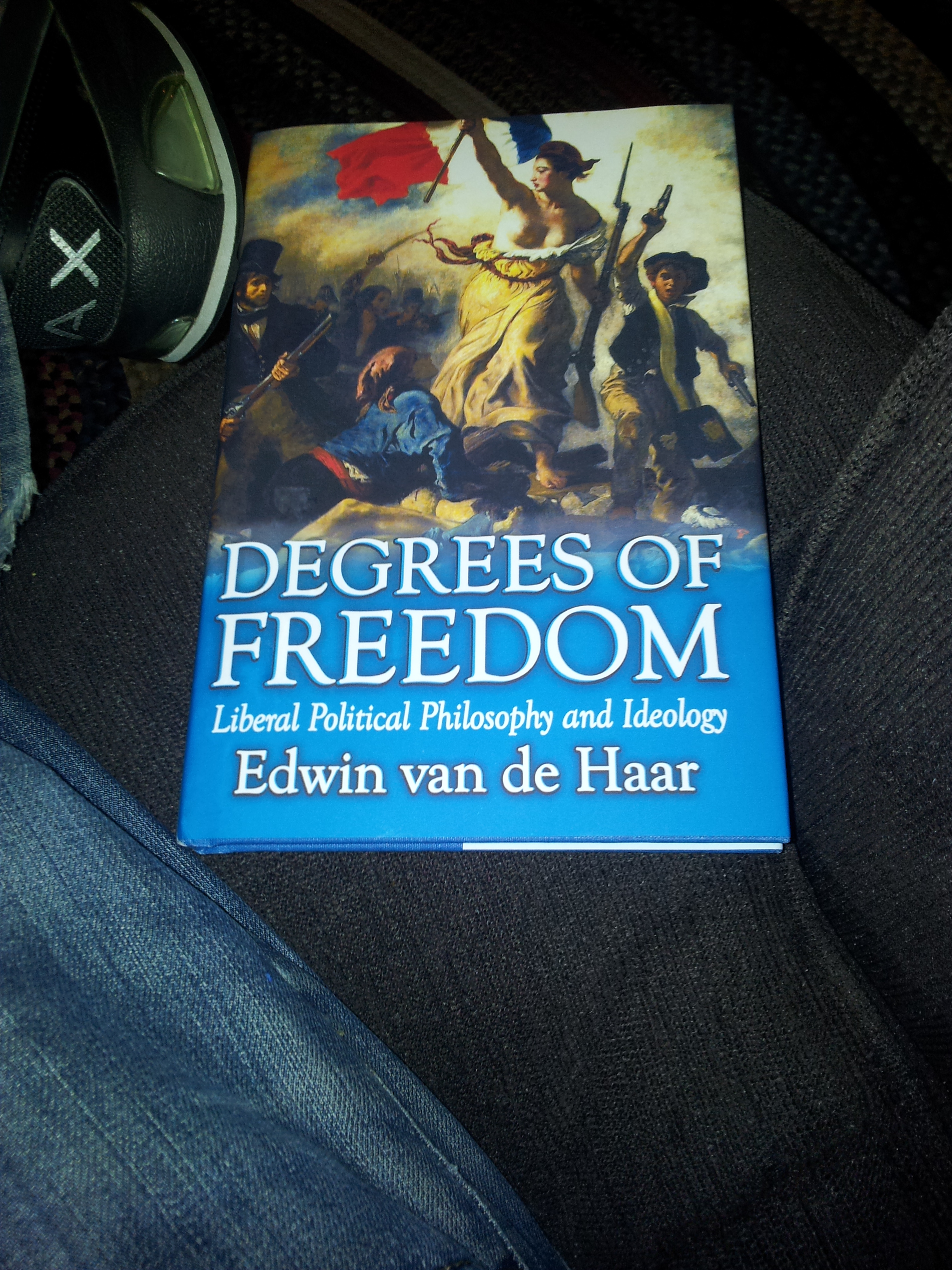
Look at what just arrived in my hands

Van de Haar's "Degrees of Freedom: Liberal Political Philosophy and Ideology"
Van de Haar’s “Degrees of Freedom: Liberal Political Philosophy and Ideology”

It’s Dr van de Haar’s newest book, straight from the Netherlands. You can pick up your own copy here (mine was a gift from Dr V, one of the many perks of being an annoying blog editor!). He’s got more books that you can find either on his ‘About…’ page here at NOL or on the sidebar. Thanks Dr van de Haar!

I know Dr Khawaja (of Policy of Truth infamy) was thinking of getting this book reviewed for Reason Papers, too. I don’t have the training in political philosophy to do the job, but I can say, just by reading through the first couple of pages in his introduction, that I could have benefited immensely from this book if I had been introduced to it in Political Science 101.

Aside from the introduction, I also briefly read through Edwin’s section near the back of the book (pgs. 120-126) titled ‘The Neoliberal Phantom’, and believe that it would be very useful for liberals of all stripes when confronted with poorly constructed anti-liberal arguments (the geographer – NOT anthropologist – David Harvey, for example, gets the full Dutch treatment from Dr van de Haar). It should be noted that this section is probably (again, I don’t have any training in this area) a little less useful for academics confronting more sophisticated attacks against liberalism, but it’s a very good primer for intense undergraduates and graduate students who have to deal with the relentless, poorly reasoned attacks on liberalism in their studies and at seminars.

When I read the whole thing I’ll be sure to post a review here at the blog. If I get word of somebody who wants to review Dr van de Haar’s book for Reason Papers (check out what’s on tap right now, by the way), I’ll try to post the good news here, too.

Secession in Europe (but not the EU)

NOL‘s roster has blogged about secession within the EU before, but what about dissatisfied regions joining Switzerland’s cantons instead of the EU? Read more, from the WSJ, to find out…