- Gaza is bad. We are about to make it worse Michael Koplow, Ottomans and Zionists
- Jews, Human Rights, and the Last of the Tzaddiks David Shulman, NY Review of Books
- The Liberal Conception of Freedom Nick Nielsen, The View from Oregon
- The 19th-century painter with a warning for America Julian Beecroft, 1843
liberalism
The Impossible Trinity of Liberal Democracy
In the first part of my series on democracy published a few years ago, I made a distinction between four senses in which the term “democracy” is used. To briefly recap, I made they were: a) a term of empty political praise for policies which partisans like b) an institutional decision-making process emphasizing the primacy of majoritarian opinion c) a generic term for the type of procedures which have been prevalent in the west, and d) an overarching term for the ethical commitments of liberals. In that series, I focused on the tension b) and d), mostly ignoring a) and c). (For Present purposes, my highly speculative musings on anarchism are irrelevant.
In a recent podcast of the Ezra Klein show (which I highly recommend) discussing his book The People vs. Democracy: Why Our Freedom Is in Danger and How To Save It, Harvard political theorist Yascha Mounk and Ezra Klein were debating how pessimistic we should be about the prospects for the future of American Democracy. I don’t really wish to comment on whether we should be pessimistic or not, but I want to make a further distinction that clarifies some of the disagreements and points towards a deeper issue in the workings of democratic institutions. I will argue that democracy consists of a liberal, majoritarian, and procedural dimension and these dimensions are not reconcilable for very long.
Mounk makes a similar distinction to the one I made between democratic majoritarianism and liberalism as a reason to be pessimistic. Klein tended to push back, focusing on the ways in which modern American political culture is far more ethically liberal than it has ever been, as seen through the decline in racism since the middle of the twentieth century and decline in homophobia since the 1990s. Mounk, however, emphasized how respect for procedure in the American political process has declined during the Trump Era, as evidenced by Trump’s disrespect for the political independence of courts and agencies like the Department of Justice.
However, throughout Klein’s and Mounk’s debate, it became clear that there was another distinction which needed to be made explicitly, and one which I have tended to heavily under-emphasize in my own thinking on the feasibility of democracy. It seems to me there are at least three dimensions by which to judge the functioning of democracies which are important to distinguish:
- Majoritarianism—the extent to which a democracy is sensitive to majority public opinion. Democracy, in this dimension, is simply the tendency to translate majority opinion to public policy, as Mounk puts it.
- Liberalism—this refers to the ethical content towards which democracies in the west try to strive. This is the extent to which citizens are justly treated as moral equals in society; whether minority religious freedoms are respected, racial and ethnic minorities are allowed equal participation in society (economically and politically), and the extent to which general principles of liberal justice (however they may be interpreted) are enacted.
- Legal proceduralism—the extent to which political leaders and citizens respect the political independence of certain procedures. This dimension heavily emphasizes the liberal belief in the rule of law and the primacy of process. This can include law enforcement agencies such as the Department of Justice or the FBI, courts, and respect for the outcomes of elections even when partisan opponents are victorious.
It seems that there are reasons why one would want a democracy to retain all three features. Majoritarianism could be desirable to ensure stability, avoiding populist revolutions and uprising, and perhaps because one thinks it is just for government to be accountable to citizens. Liberalism, clearly, is desirable to ensure the society is just. Proceduralism is desirable to maintain the stability of the society given that people have deep political and philosophical disagreements.
Klein and Mounk’s debate, considering this explicit triadic distinction, can be (crudely) seen as Mounk initially emphasizing the tension between majoritarianism and liberalism in modern democracies. Klein pushes back saying that we are more liberal today than we’ve ever been, and perhaps the current majoritarian populist turn towards Trump should be put in context of other far more illiberal majoritarian populist impulses in the past. Mounk’s response seems to be that there’s also been a decline in respect for legal procedure in modern American politics, opening a danger for the instability of American democracy and a possible rise of authoritarianism.
First, it seems to me that both Mounk and Klein overemphasize respect for procedure in the past. As Robert Hasnas has argued, it has never been the case that anyone treats the law as independent simply because “the law is not a body of determinate rules that can be objectively and impersonally applied by judges” and therefore “what the law prescribes is necessarily determined by the normative predispositions of the one who is interpreting it.” There is always an ethical, and even a partisan political dimension, to how one applies procedure. In American history, this can be seen in ways that courts have very clearly interpreted law in motivated ways to justify a partisan, often illiberal, political view, such as Bowers v. Hardwick. There has always been a tendency for procedures to be applied in partisan ways, from the McCarthyite House Unamerican Committee, to the FBI’s persecution of civil rights leaders. Indeed, has Hasnas argues, the idea that procedures and laws can be entirely normatively and politically independent is a myth.
It is true, however, that Mounk does present reason to believe that populism makes disrespect for these procedures explicit. Perhaps one can say that while procedural independence is, in a pure sense, a myth, it is a constructive myth to maintain stability. People believing that elections are not independent, Trump’s disrespect for the independence of courts and justice, allows for a disintegration of those institutions into nothing but a Carl Schmitt-style, zero-sum war for power that can undermine stability of political institutions.
On the other hand, it seems worth emphasizing that there is often a tension between respect for procedure and the ethics of liberalism. Klein points out how there was large respect for legal procedure throughout American history that heavily undermined ethical liberalism, such as southerners who filibustered anti-lynching laws. Indeed, the justification for things such as the fugitive slave law was respect for the political independence of the legal right to property in slaves. All the examples of procedure being applied in politically biased and illiberal ways given moments ago support this point There is nothing in the notion that legal and electoral procedures are respected that guarantees those procedures in place will respect liberal principles of justice.
I remain agnostic as to whether we should be more pessimistic about the prospects for democracy in America today than at any other point in American history. However, at the very least, this debate reveals an impossible trinity, akin to the impossible trinity in monetary policy, between these three dimensions of democracy. If you hold majority opinion as primary, that includes populist urges to undermine the rule of law. Further, enough ink has been spilled on the tensions between majoritarianism and liberalism or effective policy. If you hold respect for procedure as primary, that includes the continuation procedures which are discriminatory and unjust, as well as procedures which restrict and undermine majority opinion. If you hold the justice of liberalism as primary, that will generate a tendency for morally virtuous liberals to want to undermine inequitable, unjust procedures and electoral outcomes and to want to restrict the ability of majorities to undermine minority rights.
The best a conventional democrat can do, it seems to me, is to pick two. A heavily majoritarian democracy where procedures are respected, which seems to be the dominant practice in American political history, is unlikely to be very ethically liberal. An ethically liberal and highly procedural government, something like a theoretically possible but practically unfeasible liberal dictator or perhaps a technocratic epistocracy (for which Jason Brennan argues), is a possible option but might be unstable if majorities see it as illegitimate or ethically unpalatable to procedural democrats. An ethically liberal but majoritarian democracy seems unworkable, given the dangers of populism to undermine minority rights and the rational ignorance and irrationality of voters. This option also seems to be what most western democracies are currently trending towards, which rightly worries Mounk since it is also likely to be extremely unstable. But if there’s a lesson to be learned from the injustice of American history and the rise of populism in the west it’s that choosing all three is not likely to be feasible over the long term.
Towards a genuinely Inclusive, Liberal, and Open Global Agenda
The recent past has been witness to the increasing rise of ‘economic-nationalism’, anti-immigration policies, and increasing xenophobia. Countries which in the past have welcomed immigrants, and have been protagonists of Free Trade and open borders, while immensely benefiting from the same, are becoming more and more insular. While this point got strongly reiterated by the election of Donald Trump. Apart from the US and UK, many of the EU member states and Australia are also becoming more and more inward looking.
Germany and Canada have tried to develop an alternative narrative while being open to immigrants, and opening their doors to refugees. Justin Trudeau in Canada, like Angela Merkel, deserves immense credit for exhibiting courage and conviction and not capitulating before populist and ultra nationalist sentiments.
Both Trudeau and Merkel have opened their doors to refugees, with Trudeau opening his country’s doors to nearly 40,000 Syrian refugees. After the US imposed a ban on immigrants from certain Muslim countries, he tweeted:
“To those fleeing persecution, terror & war, Canadians will welcome you, regardless of your faith. Diversity is our strength #WelcomeToCanada.”
Angela Merkel, Chancellor of Germany, in spite of scathing criticism for her decision to admit over 1 Million refugees, since 2015, from Syria, Iran, and Afghanistan, has stuck to her guns. In an interview, the German Chancellor stated:
“It was an extraordinary situation and I made my decision based on what I thought was right from a political and humanitarian standpoint.”
The rise of the extreme right AfD, which emerged as the third largest political outfit, and which Merkel managed to beat by a lesser margin than usual, has been attributed to Merkel’s open door policy.
Along with Macron and Trudeau, one more leader who is trying to offer an alternative narrative is the Mayor of London, Sadiq Khan, who has started a campaign, ‘London is Open’. Said Khan in his message:
…Many people from all over the globe live and work here, contributing to every aspect of life in our city. We now need to make sure that people across London, and the globe, hear that #LondonIsOpen…
Not restricted to any ideology or country
It would be pertinent to point out that while the rise of right-wing leaders like Trump and AFD in Germany is cited as one of the reasons for this growing insularity, even left leaning leaders have been equally inward looking, when it comes to economic and trade policies. One thing which was common between Trump and Bernie Sanders was their economic policies, which found resonance with the working class.
Not just Trump
While Trump has emerged as the mascot of ‘insularity’ and economic nationalism, it must be pointed out that not just the US, but other countries which have benefited from immigration, to have tended to look inwards on important issues.
Australia, which has opposed Trump’s withdrawal from the Trans Pacific Partnership TPP and has repeatedly spoken in favour of an ‘open’ Indo-Pacific, has brought in some tough laws to oppose immigration. This includes the abolition of the 457 Visa (for skilled migrants), replacing it with a new visa program which is far more stringent, and will make it tougher for workers from other countries.
Commenting on the abolition of the Visa, Australian Prime Minister Malcolm Turnbull stated:
“The migration program should only operate in our national interest. This is all about Australia’s interest.”
The second point to bear in mind is that some countries have spoken vociferously in favour of trade agreements, and open borders, but have played it safe on important human rights issues and immigration. This includes not just Syrian refugees, but more recently the Rohingya Issue. If one were to take the case of ASEAN for instance, a number of member states including the Chair for 2018, Singapore, have argued in favour of economic openness, and were critical of the US approach towards TPP. Yet, they have been cautious on the Rohingya Issue, not wanting to rub Aung San Suu Kyi the wrong way.
Conclusion
In conclusion, there can not be a selective approach, countries which seek to benefit from globalization, need to be open to immigrants and at times shoulder onerous responsibilities. After all, it is not just immigrants who benefit economically, but countries which they have migrated too also benefit from their skills and productivity.
Secondly, an enlightened, liberal agenda cannot just be restricted to economic issues, important human rights issues, can not be obliterated and must get the attention they deserve.
Third, it is pointless, to blame any one country or ideology for insularity, everyone shares collective responsibility for the same.
Party politics and foreign policy in Brazil’s early history
Early Brazilian foreign policy was criticized for being too Europe-centered. Brazil declared its independence from Portugal in 1822 in a process unique in the Americas: Dom Pedro I, the country’s first head of state and government, was the son of Dom João VI, king of Portugal. This gave Brazil a sense of continuity with the former metropolis – unique in the Americas. Although Dom Pedro I renounced his rights in the Portuguese succession line to become Brazil’s first Emperor, early Brazilian foreign policy was very much a continuation of late Portuguese policy.
Early in the 19th century Portugal became involved in the Napoleonic Wars on the English side. Portugal and England enjoyed then an already long friendship. When Napoleon invaded the Iberian Peninsula, Dom João, then Prince Regent, decided to move the Portuguese imperial capital to Rio de Janeiro, instead of fighting a war he believed he could not win. This move consolidated the Anglo-Portuguese alliance of that time, as Dom João’s policy was backed up by England.
In South America, Dom João first decision was to finish the colonial exclusivism Portugal enjoyed with its colony, opening Brazil’s ports to friendly nations. With most of Europe at war and occupied by French armies, England was basically the only friend Brazil and Portugal had at the time. But his policies meant that Brazil had a move towards liberalism unknown until that moment. The country’s trade with the outside world rose as English products entered the Brazilian market.
When Dom João returned to Europe, Brazilian elites were unwilling to give up the freedom conquered in the previous years; in that case, something not that different from what happened in Spanish America. With Dom Pedro I as Prince Regent in Brazil, the independence movement grew strong until complete secession in 1822.
With that in mind, it’s possible to understand how early Brazilian foreign policy was mostly a continuation of Dom João’s policy: Dom Pedro I’s first task was to get recognition of Brazil’s independence from Portugal. That happened with English support. The United States was the first country to recognize Brazil’s independence, but this was welcomed coldly in Rio de Janeiro.
In response to English help, Dom Pedro I kept and improved the trade benefits England already enjoyed with Brazil. He also occupied Uruguay, a region disputed between Spain and Portugal, leading to a war with Argentina and, despite renouncing his rights to the Portuguese throne, kept close relations with his family in Portugal.
Dom Pedro I’s foreign policy was a reason for growing opposition. He could not win a war against Argentina and his connection to Portugal was a constant reason for accusations of recolonization plans. Topping that was the perception of Brazilian elites that the trade agreements with England were bad for Brazil. For these and other reasons, Dom Pedro I resigned in 1831 and returned to Portugal, leaving the Brazilian throne to his son, Dom Pedro II.
Dom Pedro II was only five years old when he ascended to the throne, and so despite being the head of state, he could not govern the country. The 1830’s were a period of regencies when few important decisions were made in Brazil’s foreign policy. But in another topic, that was a crucial decade in Brazilian history: the political tendencies present in Dom Pedro I’s reign became more formal political parties in the late 1830’s: the Conservative Party, that defended progress inside of order, and the Liberal Party, that defended more radical changes.
Dom Pedro II’s adulthood was anticipated in 1840, and besides a short period of Liberal rule, the conservatives dominated Brazilian politics for most of the 1840’s to the 1870’s. In domestic politics, conservatives wanted to centralize politics and bureaucracy in Rio de Janeiro and leave little autonomy to the provinces. They claimed to be afraid of the extremes of mob rule, despotism, and oligarchy, and therefore defended progress inside of order. This meant conserving much of the Portuguese heritage. It was up to the state to build the nation and to lead a modernization process. Ironically, many important conservative leaders were former adversaries to Dom Pedro I and accused him of despotism. However, once in power, they said the country needed to be saved from excesses of liberty.
The conservatives talked about the 1830’s as a period of dangerous upheaval in Brazil. Indeed, the country faced several regional revolts that could have fragmented the Empire. Anyway, the conservative answer was to secure the integrity through a stronger government. In their understanding, Brazil was simply not ready for a certain level of liberty.
Libertarianism, Classical Liberalism, Right Wing Populism, and Democracy
An interesting exchange has occurred between Will Wilkinson of the Niskanen Center and Ilya Somin writing for the Washington Post on the issue of the influence of libertarianism over the modern Republican Party’s erosion of liberal democratic norms. In his initial piece, Wilkinson seemed to argue that the Libertarian view of absolutism in regards to property rights which was a way to offer an emotionally gratifying alternative to socialist redistribution was responsible for the Right’s adoption of a populist outlook which eroded democratic norms, for example, policies like Voter ID and Gerrymandering. Ilya Somin responded by pointing out that the libertarian “absolutist” conception of property rights had next to nothing to do with why many libertarians Wilkinson cites are skeptical of democracy. Wilkinson responded by saying his initial argument was confusingly stated, not that absolutist property rights is driving democratic erosion on the part of the right, by trying to clarify his distinction between “libertarian” and “classical liberal.” Somin pointed out that this response undermines the force of Wilkinson’s initial argument and took issue with some of his other points.
I wish to contribute to this debate because, even though Somin is largely right that Wilkinson’s argument is weakened by his clarification, I think both have missed that Wilkinson has fundamentally misunderstood what right-wing populism is and why it is a threat to democracy. Modern right-wing populism does not try to erode majoritarian democracy, even if it erodes some of the institutional norms which make it possible for modern liberal democracy to function. Rather, populism, in its many forms, weaponizes democratic rhetoric which is premised on the very notions which libertarians and classical liberals critical of democracy seek to challenge. Attempts to tie such criticisms to the modern right is absurd and distracts us from confronting those aspects which are actually threatening about the right’s pathologies. Afterwards, I will comment on some of the other minor confusions into which I believe Wilkinson falls.
Populism and Folk Democratic Intuitions
In Wilkinson’s genealogy, the root of modern libertarianism is an attempt to weaponize classical liberalism’s defense of property against the desire for socialist redistribution. As he tells it, classical liberals like Hayek and Buchanan sought to put trigger locks on democracy in the form of constitutional constraints on majority rule whereas radical libertarians like Rand, Nozick, and Rothbard sought to disarm democracy altogether from violating property rights. This conception leaves no room for any analysis of or support for democratic decision-making. Since the end of the Cold War, the right has continued to believe this absolutist property rights argument was extremely important even after the Red Menace had been slain and so is willing to do anything, including throwing democracy under the bus, to defend property rights. As Wilkinson puts it:
And that’s why ideological free-market conservatives tend to be so accommodating to, if not exactly comfortable with, populist white identity politics. In their minds, mundane left-right differences about tax rates and the generosity of the welfare state are recast as a Manichean clash between the light of free enterprise and the darkness of socialist expropriation. This, in turn, has made it seem morally okay, maybe even urgently necessary, to do whatever it takes—bunking down with racists, aggressively redistricting, inventing paper-thin pretexts for voting rules that disproportionately hurt Democrats, whatever—to prevent majorities from voting themselves a bigger slice of the pie.
In his follow up, after Somin pointed out that irrational factors like partisanship are more likely to influence a voter’s decision than complicated moral theories such as property rights, Wilkinson attempted to make this argument more plausible by giving the hypothetical example of a white working-class republican voter who, while not fully libertarian, uses his thin knowledge of libertarian property rights absolutism as a form of motivated reasoning justifying his erosion of democratic norms:
Burt is a moderately politically engaged mechanical engineer with ordinary civics-class ideas about democracy, as well as a strong distaste for paying his taxes. (He wants to buy a boat.) One day Burt picks up Atlas Shrugged on the recommendation of a friend, likes it a lot, and spends a few weeks poking around libertarian precincts of the Internet, where he encounters a number of libertarian arguments, like Rand’s, that say that taxation violates a basic, morally inviolable right. Burt happens to find these arguments extremely convincing, especially if he’s been idly shopping for boats online. Moreover, these arguments strongly suggest to Burt that democracy is a dangerous institution by which parasitic slackers steal things from hyper-competent hard workers, like Burt.
Now, none of this leads Burt to think of himself as a “libertarian.” He thinks of himself as a Lutheran, a moderate Republican, and a very serious Whovian. He’s suspicious of “free trade.” He’s “tough on crime.” Burt would never disrespect “our troops” by opposing a war, and he thinks legalizing drugs is bananas. Make no mistake: Burt is not a libertarian. But selective, motivated exposure to a small handful of libertarian arguments has left Burt even more indignant about taxes, and a bit sour on democracy—an altogether new attitude that makes him feel naughtily iconoclastic and a wee bit brave. Over time, the details of these arguments have faded for Burt, but the sentiments around taxation, redistribution, and democracy have stuck.
Ayn Rand and the other libertarian thinkers Burt encountered in his brief flush of post-Atlas Shrugged enthusiasm wanted him to be indignant about redistribution and wanted him to be sour on democracy. He drew the inferences their arguments were designed to elicit. The fact that he’s positively hostile to other elements of the libertarian package can’t mean he hasn’t been influenced by libertarian ideas.
Let’s suppose that, a few years later, a voter-ID ballot initiative comes up in Burt’s state. The local news tells Burt that this will likely make it harder for Democrats to win by keeping poorer people without IDs away from the polls. Burt rightly surmises that these folks are likely to vote, if they can, to take even more of his money in taxes. A policy that would make it less likely for those people to cast a ballot sounds great to Burt. Then it occurs to him, with a mild pang of Christian guilt, that this is a pretty selfish attitude. But then Burt remembers those very convincing arguments about the wickedness of democratic redistribution, and it makes him feel better about supporting the voter-ID requirement. Besides, he gives at church. So he votes for the initiative come election day.
That’s influence. And it’s not trifling, if there are a lot of Burts. I think there are a lot of Burts. Even if the partisan desire to stick it to Democrats is doing most of the work in driving Burt’s policy preference, the bit of lightly-held libertarian property rights absolutism that got into Burt’s system can still be decisive. If it gives him moral permission to act on partisan or racial or pecuniary motives that he might otherwise suppress, the influence might not be so small.
The problem here is not just, as Somin says, that this dances around the issue that people like Burt have become less libertarian over time and so it seems silly to blame libertarianism for his actions. It sounds as if Wilkinson has never actually talked to a populist-leaning voter like Burt. If you do, you will not find that Burt is skeptical of democracy or sees himself as defending some important ideal of laissez-faire capitalism against irrational socialist voters who are using democracy to destroy it. It is more likely that you will find that Burt sees himself as defending the “silent majority” who democracy should rightly represent from evil liberal, socialist and “cultural Marxist” elites who are undermining democracy, and how Trump will stop all the elitist liberals in the courts and media from alienating the common man with common sense by “draining the swamp.”
Read, for example, Rothbard’s original call for libertarians to ally with nationalist right-wing populists. In it, you’ll find no mention of how small “d” democracy attacks property rights because voters are rationally ignorant, and you won’t find, to quote Wilkinson, skepticism towards “a perspective that bestows dignity upon democracy and the common citizen’s democratic role.” Instead, you’ll find that the “grassroots” of the right-wing common man like the secessionists and neo-confederates who are defending property rights against the “socialist tyranny” of the “beltway elites,” Clintons, and the Federal Reserve. Modern adherents to this Rothbardian populist strategy define populism as “a political strategy that aims to mobilize a largely alienated base of the populace against out-of-control elites.” It sounds more like a radically majoritarian, Jacksonian screed about how the voice of the people needs to be truly represented.
Importantly, what the libertarian populists are trying to do is take the folk democratic intuitions which populist right-wingers have, intuitions upon which most peoples’ beliefs in the legitimacy of democracy rely, and channel those intuitions in a more thinly “libertarian” direction. Unfortunately, this is why many modern right-libertarians in the style of Ron Paul are impotent against white supremacists and often try to cozy up to them: because an important part of their strategy is to regurgitate the vulgar democratic rhetoric in which populists believe.
By contrast, modern skeptics of democracy in libertarian circles (or “classical liberal” or “cultural libertarian,” whichever semantic game Wilkinson wants to play to make his argument coherent), such as Ilya Somin, Bryan Caplan, and Jason Brennan, fundamentally undermine those folk democratic intuitions. While right-wing populists believe that the “common man” with his “common sense” knows better how the world works than the evil conniving academic elite does, the libertarian skeptic of democracy points out that the majority of voters know next to nothing and fail to be competent voters due to their rational ignorance. While populist voters believe that the voice of the majority should rule our governing structure, public choice tells us that “majority will” is mostly an illusionary concept. While populist voters believe that the “trigger locks” like courts are evil impediments to the people’s will and regularly attack them, libertarian skeptics of democracy view such institutions as the last line of defense against the irrational and ignorant mob of hooligan voters.
In fact, if people listened to folks like Somin and Brennan, populism of the sort that we’ve seen on the right would be an impossible position to maintain. This is partially why Rothbard largely rejected the public-choice analysis on which scholarship like Somin’s depends.
To try to link modern public choice-inspired skepticism of democracy with populism of any form, even in its most pseudo-libertarian form of the late Rothbard, is to grossly misunderstand populism, classical liberalism, and libertarianism. It seems rather odd to blame Somin and company for the rise of a political ideology which their arguments render incoherent. A Nancy MacLean-like conspiracy to undermine majority rule doesn’t have much of anything to do with the modern right when they think they are the majority who’s being oppressed by elites.
Neither is this some trivial matter of simply assigning blame incorrectly. The problem with populism on the right which has eroded American democracy is not that it thinks democracy is wrong, most populists naively have a lot of folk intuitions which imply some sort of vague proceduralist justification of strongly majority rule. Rather, they’ve taken the majoritarian, quasi-Jacksonian rhetoric (rhetoric to which libertarians other than Rothbard and classical liberals alike have mostly been opposed) which democrats often use and weaponized it in a manner that undermines the non-majoritarian norms on which liberal democracy is dependent for functioning. For someone like Wilkinson, who defends liberal democracy vigorously, misunderstanding the very nature of the threat seems like a particularly grave error as it renders his arguments impotent against it.
Democratic Majoritarianism versus Democratic Norms
In part, I think Wilkinson falls for this trap because he makes a conceptual confusion between the non-majoritarian liberal ideals on which democracy depends—towards which most libertarians are sympathetic—and democracy’s institutional form as majority rule. I’ve described this as a distinction between “institutional democracy” and “philosophical democracy” in the past, and have argued that one can uphold philosophical democratic norms while being skeptical of the current institutions in which they are embedded. Wilkinson argues, citing an article by Samuel Freeman, that libertarian absolutist conception of property is inherently illiberal as it implies a sort of propertarian, feudalist order. Of course, Wilkinson neglects to mention a response to Freeman by Peter Boettke and Rosolino Candela claiming that Freeman misunderstands the role property rights play in libertarian theory.
I am not an absolutist natural property rights-oriented libertarian at all, however in their defense, it is wrong for Wilkinson to think that belief in absolutist property rights—even to the point that one becomes an anarchist like Rothbard—means one is necessarily willing to do anything to undermine democracy to defend property rights. As Somin mentions, not all libertarian absolutists in property completely disbelieved in government like Nozick, but more importantly one can be an anarchist who is strongly skeptical of democracy for largely propertarian reasons but still believes, given that we have democracy, certain norms need to be upheld.
Norms such as equality before the law, equal footing in public elections (which Gerrymandering violates), and equal access to political power (which Voter ID laws violate). Just because one believes neo-Lockean arguments about property rights are valid does not mean one cannot coherently also endorse broadly Hayekian accounts of non-majoritarian liberal norms which make it possible for democracies to function (what Wilkinson calls “trigger locks”), even if in particular instances it might result in some property rights violations.
In other words, one can be skeptical that institutional democracy is moral for libertarian reasons while still embracing a broadly philosophically democratic outlook, or simply believe it is preferable to keep some democratic norms intact given that we have a democracy as an nth best possible solution.
What Wilkinson takes issue with is how the modern right attacks the sort of norms which make democracy work, norms with which no libertarian ought to take issue with given that we have a democracy as they are precisely the “trigger locks” which Hayek called for (even if libertarians want much stronger trigger locks to the point of effectively disarming governments). To think these norms are identical with how many libertarians think the specific voting mechanisms which democracy features are flawed is a conceptual confusion.
An Alternative Account of the Relationship between Libertarianism and the Right’s Pathologies
To me, it seems that Wilkinson’s attempt to shoehorn the somewhat nuanced (by the standards of electoral politics, if not by the standards of academic philosophical argumentation) philosophical arguments of Nozick and Rothbard into an account of the rise of Trumpian politics seems fundamentally inconsistent with the way we know voters act. Even if voters sometimes use indirect intellectual influences as a way to reason about their voting preferences in a motivated manner likes Wilkinson imagines, it’s not really explaining why they need to use such motivated reasoning in the first place. Here’s an alternative account:
During the Cold War, as Wilkinson notes, libertarians and conservatives had a common enemy in communism and socialism. As a result, fusionism happened and libertarians and conservatives started cheering for the same political team. After the end of the cold war, fusionism continued and libertarians found it hard to stop cheering for the “red” team for the same tribalist reasons we know non-libertarian irrational voters remain fiercely loyal to their political parties. Today, even though the GOP is becoming extremely less libertarian, some libertarians find it hard to stop cheering for the GOP for the same reasons New England Patriots fans still cheer for Tom Brady after the deflation scandal: old tribalist affiliations are hard to break.
The only real link between libertarians and modern right-wing pathologies are that some voters who have vaguely libertarian ideas still cheer for populist right-wingers in the GOP because they’re irrational hooligans who hate the left for tribalist reasons. This accords better with the fact voters aren’t all that ideological, that they (unlike Burt who’s interested in just lowering his own taxes selfishly) vote based off of perceived national interest more than self-interest, and how we know generally voters behave in partisan tribalist patterns. But this doesn’t make libertarianism any more culpable for the rise of the modern right’s erosion of democratic norms any more than (and probably less than given its limited influence) any other ideological current which has swayed the right to any degree.
How does this make sense of Wilkinson’s only real, non-hypothetical evidence of libertarian influence on the modern GOP, that some right wing politicians like Paul Ryan and Rand Paul sometimes cite Ayn Rand and Rothbard? Politicians sometimes use intellectual influences haphazardly to engage in certain sorts of motivated-reasoning to cater to subsets of voters, even though they overwhelmingly disagree with those thinkers. This why Paul Ryan first praised Ayn Rand, to get some voters who like Rand, and then later emphasized how much he rejected Rand. This is why Rand Paul cites libertarians simply to virtue-signal to some subset of libertarianish voters while constantly supporting extremely un-libertarian policies. Ted Cruz has said that conservatives “should talk about policy with a Rawlsian lens,” but nobody thinks that Rawls has been particularly influential over Cruz’s policy decisions. All politicians do when they cite an intellectual influence is try to play to cater to the tribalist, pseudo-intellectual inklings of some nerdy voters (“I read the same guys as you do, therefore I’m on your team”), it usually doesn’t mean they really were deeply influenced by or even understand the thinker they cite.
Libertarians and Classical Liberals
Let me conclude this article by addressing a side-issue of how to parse out the distinction between classical liberals and libertarians. One of Wilkinson’s ways of clarifying his disagreement with Somin was by claiming that there is something fundamentally different between “libertarianism” and “classical liberalism.” As Wilkinson puts it:
Absolutist rights-based libertarianism isn’t really part of this conversation at all. It’s effectively an argument against liberalism and the legitimacy of liberal political institutions, which is why it’s so confusing that the folk taxonomy lumps libertarianism and classical liberalism together, and sets them against standard left-liberalism. The dispute between liberalism and hardcore libertarianism concerns whether it’s possible to justify democratic political authority at all. The dispute within liberalism, about the status of economic rights and the legitimate scope of democratic decision-making, is much smaller than that.
Thus, Wilkinson seems to think that libertarians think political authority can’t be justified given that property rights are absolute and that classical liberals just think economic liberties should be included as liberal liberties. However, in my view this taxonomy of ideologies is still confused. Many who typically count as “libertarians” do not fit neatly into such a schema and need to be ignored.
You need to ignore significant portions of libertarians who still endorse property rights but think they are insufficient to a full conception of liberty and endorse other liberal freedoms, like the aforementioned Peter Boettke paper. You need to ignore intuitionist libertarians who do not endorse an absolutist conception of property rights but still dispute that political authority is justified at all, like Mike Huemer. You need to ignore consequentialists who do not embrace absolutist property rights as a philosophical position but think some sort of absolutist property-based anarchist society is desirable against liberal democracy, like David Friedman and Don Lavoie’s students. You need to ignore “thick” left libertarians like Charles Johnson and Gary Chartier who endorse libertarian views of rights yet think they imply far more egalitarian leftist positions. Further, you’d need to claim that most people the public readily identifies as some of the most influential libertarians of all time, like Hayek and Milton Friedman, are not actually libertarian which obscures rather than clarifies communication. Basically, the distinction is only useful if you’re trying to narrowly clarify disagreements between someone like JS Mill and someone like Rothbard.
I agree that there are distinctions between “libertarians” and “classical liberals” that can be drawn and the folk taxonomy that treats them creates a lot of confusion. However, it seems obvious if one talks to most libertarians, there is more going on in their ideology than just “property rights are absolute” and that there is a strong intermingled influence between even the most radical of anarchist libertarians and classical liberals. It is also true that there are a small minority of libertarians who are thoroughly illiberal (like Hoppe), but it seems better to just call such odd illiberal aberrations “propertarian” and still treat most libertarians as a particularly radical subset of classical liberals.
Ultimately, however, I think this taxonomical dispute, while interesting, isn’t particularly closely related to the problem at hand: the relationship between right-wing populism and libertarianism.
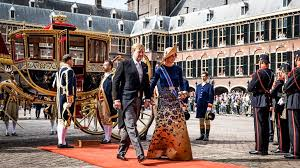
North Korea at the North Sea?
Yesterday, both Houses of Dutch Parliament jointly opened the parliamentary year, which is always held on the third Tuesday in September, and is known as “Budget Day.” Normally, there is not much pomp and glory in the Low Lands, but on “Little Princes Day” (as the day is literally called), we go all-out: the King and Queen are driven in a horse-pulled carriage to the Hall of Knights, the oldest part of the parliamentary buildings (built around 1250), surrounded by military troops in full ceremonial dress. The King reads his speech (actually written by and under full political responsibility of the Prime Minister and cabinet) from a huge throne, announcing the government’s plans for the next year. Male ministers in morning coats, ladies in dresses and hats, with the powerful elites also assembled.

After the reading, the Royal couple make their way back to one of their palaces in the centre of The Hague, returning once to greet the masses from the balcony.
Meanwhile, the Minister of Finance officially presents the 2018 budget to the Lower House. The separate budgets of all departments are laws, which will have to pass both Houses before 31 December. This process is normally preceded by a two day debate on “the general state of the country,” but this year it is skipped because there is only a caretaker government in office. It awaits the finalization of negotiations for a new government, which started right after the elections on 15 March. Still no government is formed, although it is widely expected that a four-party coalition will be presented within a few weeks, consisting of small Christian left wingers, centre Christian Democrats, and two social liberal parties, D66, and Prime Minister Mark Rutte’s VVD.
Although much improved since the low point of the Great Recession, around 2011-2012, the public finances are still shocking from a classical liberal perspective. The income of the national government is 285 billion Euro (around 338.5 billion USD), which is 43% of GDP.
It consists mainly of several mandatory insurance premiums for collective arrangements (112.2 billion Euro), income tax (55.4 billion; the highest bracket of 51.5% tax applies to all personal income over 68.507 Euro), and VAT (52.8 billion). The rest are mainly specific taxes, related to companies, the environment, excises, dividends, et cetera. In 2011, the public share of GDP was still 47%, while in the 1980s it reached peaks of around 60%. Not exactly anywhere near an ideal liberal situation, no matter what liberal persuasion you are. Personally, I would argue that 25% should be the max for a decent set of state tasks, but I am sure that makes me some weird Northern European commie in some American libertarian eyes!
The situation is even more dire if we see where that money is spent. Health care (80.4 billion euro) and social security (79 billion) are always in competition as the largest spending departments. So that is 56% of the budget already and both increase annually, no matter the economic circumstances. The third post is public education (35.4 billion), followed by funds for provinces and municipalities (24.4 billion), foreign affairs and foreign aid (12), police and judiciary (10.3), defense (8.4), and infrastructure and environment (also 8.4), with the other departments taking parts of the rest. Despite a very rare expected budgetary surplus of 7.8 billion in 2018, the national debt is still 53.7% of GDP. Perhaps not bad in international comparison, still not good for any liberal.
These numbers are only part of the story, because there are also numerous local taxes, and the number of liberty-inhibiting regulations, from European, national, provincial and local origin are staggering. There is not one really free market, and there are hardly parts of individual life not regulated or influenced by the state. A comparison with North Korea is of course still far-fetched, yet socialism is alive and kicking on the North Sea shores.
In my view it is evidence of the remarkable power of capitalism that The Netherlands is still one of the richest countries on earth, a global top 15 economy (GDP per capita), with only 17 million inhabitants. No matter how hard you curb it, the capitalist system still delivers amazing results. Of course, the opportunity costs of the Dutch regulatory state are very high. In terms of personal liberty there are not many better places on the planet. Yet in other fields it is a different story. Economic freedom is a mess, which means that the material aspects of personal freedom are seriously restricted. Yet the worst is the mentality. Sadly, most Dutch have traveled the whole Hayekian Road to Serfdom, making a shift to classical liberalism highly unlikely.
A short note on ideological neutrality
William‘s excellent post on dishonesty reminded me of an equally excellent post by John McGinnis over at Liberty Law Blog on the ACLU and free speech. The post ended, though, with the following sentence:
It would be a tragedy for our nation if the ACLU’s decision begins to dissolve the strong social fabric supporting the ideologically neutral First Amendment.
Ach. There is nothing neutral about the First Amendment. It’s a law based on liberal ideology. The idea of free speech is based on liberal ideology. The other ideologies out there pay great lip service to free speech, but there’s no First Amendment in the post-colonial states of Africa and Asia. Free speech is trumped by an ambiguous form of censorship called “hate speech” in other OECD countries (Western Europe, Australia-New Zealand, Japan). There is no First Amendment in Russia or China or Venezuela.
Liberalism is the only ideology out there that actually encourages rival ideologies to attack it, not with provocative laws but with one specific law that allows all factions the same space for their platform. The First Amendment is not neutral at all; it is instead an aggressive flaunting of liberalism’s staying power and ability to deliver freedom.
When libertarians start thinking of their preferred values as “neutral” or “centrist” they begin to echo the Left, which has been dishonest with itself for the past 45-50 years. That’s a road I’d hate to the movement plod through.
Is Socialism Really Revolutionary?
A central feature of Karl Marx’s thought is its teleological character: the world walks inexorably towards communism. It is not a question of choices. It is not a question of individual decisions. Communism is simply the direction in which the world walks. Capitalism will collapse not because of some external force, but because of its own internal contradictions (centrally the exploitation of the workers).
I don’t know exactly what History classes are like in other countries, but in basically all my academic trajectory I was bombarded with some version of Marxism. Particularly as far as my country was concerned, the question was not whether a socialist revolution would happen, but why it was taking so long! Looking at events in the past, the reading was as follows: the bourgeoisie overthrew the Old Regime in the French Revolution. At that time the bourgeoisie were revolutionaries (and therefore left-wing). However, overthrowing the monarchy and establishing a constitutional government, the bourgeois became advocates of the new order (and therefore, reactionary, or right-wing). Socialists have become the new revolutionaries, the new left, the new radicals.
This way of seeing history has a Hegelian background: there are no absolutes. History moves through a process of thesis, antithesis, and synthesis. History’s god is learning to be a god. I’ve written earlier here about how this kind of relativistic view does not stand on its own terms. Now I would like to say that this way of looking at history can be intellectually dishonest.
According to the historical view I have learned, there is no absolute of what is left or right. One political group is always to the left or to the right of another, depending on how much this group is revolutionary or reactionary. Thus, the bourgeois were revolutionaries at one time, but today they are no longer. But what happens when the Socialists come to power? Do not they themselves become reactionary, defenders of the status quo? According to everything they taught me, no. The revolution is permanent. My assessment is that at this point they are partly right: the revolution must be permanent.
Socialists can not take the risk of becoming exactly what they fought at the first place. In practice, however, this is not the case: the Socialists occupy the posts of the state and begin to defend their position and these positions more than anything else. That’s what I see in my country today. In practice, it is impossible to be revolutionary all the time, just as it is impossible to be relativistic in a consistent way. I have not yet met a person who, looking at the red light, said “but to me it’s green and all these other cars are just a narrative of patriarchal society.”
Politics is unfortunately, for the most part, simply a search for power. Even the most idealistic groups need the power to put their agendas into practice. And experience shows that once installed in power, many idealistic groups become pragmatic.
Socialism is not revolutionary. It is only a reaction against the real revolution that is capitalism defended by classical liberalism. Classical liberalism says: men are all equal, private property is inviolable, exchanges can only occur voluntarily and no one can be forced to work against their will. Marxism responds: men are not all the same (they are divided into classes), private property is relative (if it is in the interest of the collective I can take what was once yours) and you will work for our cause, whether or not you want to. In short, Marxism is a return to the Old Regime.
On Liberalism & Race
Race has occupied my thoughts for the past few months. I have traditionally been against giving too much thought to race. Progressives, I think, abuse claims of racism to shut down discussions and pass questionable public policies; e.g. “We need state provided health care because the current system is racist against people of color.”. Conservatives likewise use racism (nativism really) to justify restrictive migration policies. My default position has been that liberals should seek to reduce the role of race of society. I am no longer convinced that this is a viable goal.
My earlier position was based on my childhood experience growing up in 1990s Los Angeles. I grew up in the city’s Koreatown district. The corner grocery store was owned by an Indian. We had a mosque in the block that catered to the neighborhood’s Bengali population. This being Los Angeles there was of course a mixture of Hispanics from Mexico, El Salvador, Argentina, and other nations. With so many groups clustered together in a small place you would expect frequent violence – but there wasn’t. Property crimes (petty theft mostly) were common given the general poverty in the area, but inter-group violence wasn’t common. The reason for peace was because the United States’ market oriented institutions discouraged such violence. All the groups were too busy trying to make money to have time to escalate inter-group conflict beyond making fun of one another in private. I grew up hearing plenty of jokes at the expense of Salvadoreans and Asians, but I never saw any actual violence against them. I figured that this was evidence that a liberal society would in the long run be able to make race irrelevant by making it too costly to be racist.
The events of the past few months have made me skeptical of this. Liberal society certainly makes racism costly and reduces inter-group conflict. However liberal society does not eliminate all inter-group conflict or remove the underlying differences across races.
Given that liberalism cannot eliminate racism, what should the liberal position on race be? I have no solid answer. Thoughts?
A very short response to Bruno Gonçalves Rosi’s reflection on Latin American Conservatism
With his “The Problem with Conservatism in Latin America,“ Bruno Gonçalves Rosi brings to NOL a very interesting debate on politics and history. In the case of Hispanic America the controversy is quite severe: during the 17th-century Spain and its colonies were undergoing an incremental process of liberalization and modernization known as “Bourbon Reforms.” These reforms implied a language unification (adopting Castilian – later named “Spanish” – as the national language), an increasing centralization of political administration, and free trade between Spain and its colonies, among other aspects.
In the case of the Spanish colonies in America, the Bourbon Reforms implied that Spanish-born subjects were preferred over American-born ones to take up public duties, and also that American products could not compete with Spanish ones. Up until then, commerce among Spain and its American colonies was restrained to gold and a narrow scope of goods. Free commerce had been allowed only in cases of extreme scarcity (for example, between Buenos Aires and South Africa) and for a very short lapse of time. The Bourbon Reforms put a severe strain on the incipient local production of the Hispanic American colonies that had flourished as consequence of closed markets. Sometimes inefficient local processes of production were outperformed by more competitive Spanish goods. But in other cases, efficient local industries were banned because they were regarded as a menace to Spanish ones.
Thus, the reactions to the Bourbon Reforms were of two opposite kinds: the Liberals rejected them because they limited the free trade only to Spain and its colonies and the modernization process was too slow. Liberals demanded free trade with all countries. On the other side, the Conservatives sought to go back to the Habsburg era: they rejected Modernity and free trade and demanded protectionism. The Emancipatory process of Spanish America was carried out by the conjunction of the Liberal and the Conservative reaction against the Bourbon Reforms. Once independence was fulfilled, the two parties became acutely antagonist to each other…perhaps up until today.
The history of Latin American Conservatism and Liberalism is worth our attention not only because of political history itself, but because it gives us a model to ponder the processes of departure from political and economic commonwealths that have been seen in the recent years -and perhaps are not closed yet.
What the Bible really says about how to treat refugees
Recently a text written by Jesse Carey, in Relevant Magazine, supposedly about what the Bible says about immigrants, refugees and displaced people, has come to me. The text is a bit old (from November 17, 2015), but is being reheated because of President Trump’s recent decisions in this area. Given these things, here are some comments on “What the Bible Says About How to Treat Refugees.”
Carey presents what he calls “12 verses about loving immigrants, refugees and displaced people”. The first thing to note is that none of the texts presented by Carey mentions the word refugees. The texts speak about foreigners, the poor and needy, travelers, strangers, and neighbors, but never about refugees. A refugee is a foreigner, but not every foreigner is a refugee. The same goes for stranger. Amazingly, refugee is also not synonymous with traveler. Every refugee is traveling (against his will, it is assumed), but not everyone who is traveling is a refugee. Finally, a refugee can be poor and needy, but poor and needy and refugee are also not synonymous. It seems that Carey has difficulty reading: when he sees words like foreigner or traveler or poor and needy or stranger his brain reads refugee. Either that or he’s being flagrantly dishonest.
The second observation is that, in the language used by Jesus, for the Christian every refugee is a neighbor. Not every refugee is poor and needy, not every foreigner is a refugee, nor does every stranger is a refugee and not every traveler is a refugee. But for the Christian, every human being is a neighbor, and so deserves his mercy. The problem is that Carey wants to apply this to immigration policies, and immigration policies are not made by Christian individuals, but by governments.
The history of the relationship between churches and governments is long, complex and tumultuous. To make a quick summary, suffice it to say that during the Middle Ages church leaders and political leaders fought and argued among themselves about who would dominate the people of Europe. The Bishop of Rome wanted to be above the Emperor of the Holy Roman Empire. At the local level, bishops and priests fought with nobles of all kinds. The result was a general confusion. One of the great victories of the Modern Era, beginning with the Protestant Reformation (which celebrates 500 years this year) was the separation of churches and state. Especially since the Peace of Westphalia in 1648, the tendency has been for states not to use their arms to impose a religion on the population. Carey wants to go the other way. He even cites 1 Corinthians 12:12-14 as if it applied to every human being, and not only to Christians.
The Bible teaches that individual Christians must care for needy people, and certainly refugees fall into this category. But the Bible does not teach that the state should do this. The role of the state, according to the Bible, is to carry the sword to punish wrongdoers and to benefit those who follow the law (the classic text regarding this is Romans 13). In other words, biblically the function of the state is restricted to security. Receiving immigrants is certainly a policy with which Christians can agree, but fully open borders, without any vigilance, are a delusion and nothing more. Wrongdoers can disguise themselves as immigrants to enter a country, and it is up to the state to do some kind of security check.
I am not discussing here the details of Trump’s current policy for immigrants and refugees. It is quite possible that there are aspects within it that Christians can or should disagree with. But by wanting to impose Christian behavior on the state, Carey goes against one of the greatest victories of the Modern Age, the separation of churches and state, something amazing for a liberal and progressive author. Does he approve of compulsory prayer in schools, the end of teaching Darwinism and punishment for those who do not attend Sunday worship? Hope not.
Roger Williams has already presented this discussion very clearly more than 300 years ago: Christians cannot impose their religion using the state for this. What can be expected Biblically from the state is in the second table of the law: you shall not murder, you shall not steal, you shall not give false testimony … Basically, do not hurt others, do not lie to them and do not take their stuff without permission, things that any kindergarten child knows are wrong. I do not think we need the Bible to teach us that.
I hope that the state is open to immigration as much as possible, being restricted only by security concerns. I hope Christians will welcome the refugees. I hope the wall of separation between church and state is never overthrown. And I hope that the rulers of the United States will leave the Islamic world for the Islamists to take care of. They already have enough work taking care of the safety of Americans in North America.
Foreign Policy in the Liberal Tradition: The Real Story
Over at the Niskanen Center, Matthew Fay wrote a blog entitled “Thinking about Libertarian Foreign Policy.” Brandon was so nice to point this out to me.
Fay’s main point is that, apparently contrary to what some libertarians think (Fay leaves them unnamed, no references either), there is big divide between the foreign policy pronouncements of Donald Trump and libertarian views on foreign policy. So far, so good. I have no dispute with that.
Yet Fay’s blog post is seriously lacking at other points. The main one, and the focus of this post, is that he mixes up different views on international relations within the liberal tradition at large, which is in some way not so surprising because he appears to be ignorant of those differences to begin with (at least in this piece). That is not very comforting for those concerned with this issue, as the Niskanen Center is about to start a larger project on foreign policy. Should it indeed be born in neglect and oversight, it won’t add much to our knowledge, I am afraid.
Conceptual mess
Fay’s essay gets off to a false start as he fails to properly introduce “libertarian.” He then continues to use this label for all kinds of theoretical ideas, originating from both liberal political thought, and international relations theory. To make things worse, Fay routinely claims that there is one unified libertarian position on foreign policy.
This is erroneous, as classical liberalism, libertarianism, and social liberalism all have partly different views on the matter. The various thinkers associated with those different liberalisms have different views on domestic and international politics. Any meaningful analysis on foreign policy from a libertarian or other liberal position should acknowledge that, and use it to the reader’s advantage. It is impossible and perhaps even deceiving to enter into a topical debate when your own position is a conceptual mess. This applies to all debates, academic and otherwise.
Proper conceptual approach
So what should Fay have done instead? Simply acknowledge there is more to liberal thought on international relations, and work from there.
To keep this blog to a readable length, I will just present these differences very briefly. My presentation is based on the writings of the British political theorist Michael Freeden. He argues that every political ideology (and liberalism is one of them) should be seen as a framework (which he calls morphology) composed of a number of political concepts. These concepts vary in importance while their meaning is contested within the ideology. It is possible to distinguish core, adjacent, and peripheral concepts, which together make a unique set of political ideas. While some of the individual concepts overlap, there is significant variation between the frameworks. This enables the distinction between different liberal variants, which are still part of the larger liberal family.
For example, the concept of liberty is key to all liberal variants, but liberty has different meanings. Isaiah Berlin’s famous divide between positive and negative liberty is relevant here. The latter can be defined as ‘the freedom from interference by others’, the first ‘the freedom to fully enjoy one’s rights and liberties’, which often demands some support of the state. Classical liberalism is associated with the negative conception and social liberalism with the positive meaning. Yet the meaning of negative liberty may be further contested. The protection from interference by others may be taken as absolute, which is far more stringent than the classical liberal interpretation, which does allow for compulsory taxation of individuals to pay for public services. Now we are entering the libertarian domain, which is in itself divided into those who hold an absolute idea of negative liberty (the anarcho-capitalists), and those who permit a minimal infringement of property rights to pay for police, external defense, and the judiciary (the minarchists). This is also why conservatism is not as closely related to the liberal family as is sometimes thought. For conservatives, individual liberty is not a core concept at all.
Applied to liberalism and conservatism is comes to this:
Table 1: The Morphology of Liberalism and Conservatism
| Classical Liberalism | Social Liberalism | Libertarianism | Conservatism | |
| Core concepts | Negative freedom, realistic view of human nature, spontaneous order, limited state | Positive freedom, positive view of human nature, social justice as self-development, extended state | Negative freedom, realistic view of human nature, spontaneous order, natural law including strict defense of property rights | Realistic view of human nature, organic change, human order with ‘extra-human’ origins, counter movement |
| Adjacent concepts | Natural law, rule of law/constitutionalism | Modern human rights, rule of law and neutral state, social contract (Mill: utilitarianism) | Minarchism: minimal state, rule of law | Groups/family, hierarchy, active state, sometimes: spontaneous order |
| Peripheral concepts | Social justice, strict defense of property rights, democracy, utilitarianism | Property rights, spontaneous order | Social justice | Individual (property) rights, freedom |
Source: Edwin van de Haar, Degrees of Freedom. Liberal Political Philosophy and Ideology (Transaction Publishers, 2015).
Liberalism and international relations
Interestingly, yet of course completely logical, these differences also translate to views on foreign policy and international relations:
Table 2: Liberalism, Conservatism, and International Relations
| Classical liberalism | Social liberalism | Libertarianism | Conservatism | |
| Nation as limit of individual sympathy | Yes | No | No | Yes |
| State as prime actor in world politics | Yes | No | No | Yes |
| International governmental
institutions/regimes |
No | Yes | No | No |
| Can war be eliminated | No | Yes | Yes | No |
| Does trade foster peace? | No | Yes | Yes | No |
Source: Edwin van de Haar, Degrees of Freedom. Liberal Political Philosophy and Ideology (Transaction Publishers, 2015).
So, in contrast to Fay’s approach, it is not so simple to claim all kinds of concepts and ideas for just one liberal label. There is far more to it. I shall leave it at this for the moment, but for those wanting to read more about this, see my longer essay at libertarianism.org, or my books Degrees of Freedom and Classical Liberalism and International Relations Theory.
On the trade off between the rule of law and lower taxes
The recent Carrier deal has caused some controversies in liberty-oriented circles. For example, The Mises Institute published a defense of the deal, arguing (along other lines, please read the article yourself):
there is nothing inherently wrong with an administration focused on keeping jobs in America — especially if this is accomplished by relieving tax and regulatory burdens.
The point I wish to make here is a general point, so I won’t go into the specifics of the Carrier deal. Among other reasons: I don’t know the specifics of the deal (I don’t know the content and I don’t know how the deal came to pass.) What I wish to do here is to argue the general case on how to view these kinds of tax exceptions.
The point we ought to remember, I think, is that there are a trade offs between two important liberal values, although they are important in different ways. On the one hand, we have the idea of rule of law, the idea that the law is general, not specific, applies to everyone rather than some, and that it’s not designed to favor some because it should serve an open-ended order. Things that contribute to such a legal order are ipso facto prima facie good, things that take away from such a legal order are ipso facto prima facie bad.
On the other hand we have the idea that taxes are bad. Things that lower taxes are prima facie good, things that increase taxes are prima facie bad.
But neither of these things trump all other considerations. Let me give you two examples.
- Suppose there was a law that said that the taxes on, for example, business started by family members of politicians are automatically exempted from taxes. Would this be a good law?
- Suppose there was a law that said that everyone has to be drafted and has to serve mandatory military service overseas, except the family members of politicians. Again: would this be a good law?
In both of these questions, the answer depends on the liberty-inspired framework you use to answer the question. If you think the value of the rule of law outweighs the value of individual liberty of those family members (who are, after all, not responsible for the actions of their political family members) than you think these are bad laws. If you think the increase in individual liberty for those family members is more important than the violation of a rule of law principle, than you think these are good laws. My point is not to say how one should determine this, my point is that there are two liberty-inspired frameworks that can justify an outcome, and both of these frameworks are relevant in determining what kind of laws we ought to support.
To make the issue slightly more applicable: is the increased damage on the rule of law (created by allowing a specific exception on the general laws on taxes) larger or smaller than the benefits that allow a company to have less taxes?
Some people have tried to argue by analogy – for example, comparing it to the draft. The problem is that analogies quickly run into the problem of changing the relative values of the two important concepts. For example: is it a good thing that women are exempted from the draft? Yes, this seems like obviously a good thing. Would it be a good thing that male children of politicians would be automatically exempted from the draft? This seems like less obviously a good thing.
Would it be a good thing if white people were automatically exempted from the draconian drug laws? Maybe it would, but maybe that also lowers the chance of getting rid of the drug laws altogether. Different margins matter in these kinds of evaluations.
The wrong thing to think is that all policies are pro tanto good just because they increase liberty on some margin for some people, especially if this allows for the prolonging of bad policies by the current ruling class. Some policies can be bad on some margins and good on others and reasonable people can disagree whether the complete net effect of this is good for all.
Maybe it’s a good thing that some people are exempted from evil laws (such as taxes), but it’s not good that the political class gets to choose who does so. Because those who will be exempted will be those who are connected to the political class. So one can absolutely like lower taxes, oppose politicians’ power to choose who is exempted and oppose that, and still be happy for a company that they got a tax cut. (Unless, of course, the company itself is evil. This is certainly possible if they are partners in, for example, the wars that the USA commits.)
So tl;dr. As I posted somewhere on facebook:
Rule of law and lower taxes are two good things. A president (or important person connected to the ruling class such as the president elect) getting to pick and choose winners isn’t desirable, but a tax break is. A higher tax isn’t desirable, but a rule of law is.
Trying to argue the case based on principle seems wrong. It depends on the margins. In the case of the draft, the margin *against* rule of law seems important enough to say it’s a clear victory for liberty to not have women included.
In the case of tax breaks, this is less obvious and reasonable people can come out on different sides of this, I think.
O que é socialismo?
Alguns posts atrás fiz uma exposição sobre o que é capitalismo, e também procurei expor e desmistificar alguns equívocos a respeito dele. Nos próximos posts pretendo fazer algo semelhante com o socialismo: explicar o que é e desfazer alguns mitos e equívocos. Falando a respeito de capitalismo, expliquei que esta palavra é utilizada de forma bastante livre, e assim há muitas variedades de capitalismo. Optei por expor um tipo de capitalismo associado ao pensamento de Adam Smith e à tradição liberal, algo que pode ser chamado de liberdade econômica, liberdade de mercado ou liberdade de escolha. O socialismo também aparece em variadas formas. O que exponho aqui é a variedade associada a Karl Marx. Marx foi um historiador, filósofo e sociólogo, mas o que me interessa aqui é principalmente sua teoria econômica.
A teoria econômica de Marx começa com a teoria do valor trabalho. De acordo com esta pressuposição, o que dá valor a um produto é a quantidade de trabalho envolvida na produção. Em outras palavras, o trabalho (trabalho braçal, entenda-se) é a fonte de todo valor. Esta percepção de valor trabalho pressupõe uma ligação entre mais valia e acumulação de capital. Marx argumentou que toda a riqueza é fruto do esforço dos trabalhadores. No entanto, os trabalhadores não recebem um salário correspondente ao valor pelo qual sua produção é vendida. Na percepção liberal, a diferença entre custo de produção e valor de venda é chamada de lucro. Na percepção de Marx, isto é mais valia: os donos das fábricas (ou donos dos meios de produção) enriquecem a custa do esforço dos trabalhadores. Mas esta é uma relação insustentável: para lucrar os empresários precisam pagar aos trabalhadores o mínimo possível, somente o suficiente para garantir a sobrevivência e reprodução dos trabalhadores. Com o tempo, os lucros iriam cair, o capital (ou os recursos de produção) iriam se concentrar em poucas e imensas fábricas (fabricas menores seriam levadas à falência pela competição), haveria dificuldade de transferência de capital (os investimentos seriam cada vez menos rentáveis), o número de desempregados se elevaria, a capacidade de venda cairia, crises cada vez mais profundas e frequentas ocorreriam, todo o sistema iria inevitavelmente chegar ao fim. Uma sociedade socialista, onde os trabalhadores seriam donos dos meios de produção, surgiria.
No coração da teoria econômica de Marx está o conceito de mais valia: os trabalhadores não recebem o que merecem pelo seu trabalho. Ao invés disso, eles são explorados pelos patrões. Acredito que esta noção de exploração comove muitas pessoas, mas ela não faz o menor sentido. Marx não está dizendo que alguns patrões exploram os trabalhadores. Ele está dizendo que, por definição, todos os patrões exploram os trabalhadores, pois retém na mais valia uma riqueza que não lhes pertence.
A pedra fundamental da teoria econômica de Marx é a teoria do valor trabalho: o que confere valor a um produto é o trabalho que se tem para produzi-lo. Daí que necessariamente haja exploração. Mas a teoria do valor trabalho está certa? Ela corresponde à realidade? Acredito que está bem claro que não: posso ter muito trabalho para produzir uma escultura de palitos de fósforo no meu quintal, e nunca conseguir vende-la, pois ela não tem valor para mais ninguém. Todo o meu trabalho, todo o meu esforço, é inútil e sem valor se eu não estiver produzindo algo que seja do interesse de outra pessoa. Além disso, a revolução marginalista do final do século 19, e particularmente a Escola Austríaca, veio demonstrar que valor é algo subjetivo e sujeito a condições de tempo e espaço.
A questão clássica a respeito de valor é: “porque diamantes, que não alimentam, são tão caros, enquanto que água, que é essencial à vida é tão barata?”. A resposta do valor trabalho é que dá muito trabalho conseguir diamantes, enquanto que água literalmente cai do céu. Mas esta resposta é incompleta: em alguns lugares água não cai do céu. No deserto do Saara, morrendo de sede, uma pessoa pode trocar muitos diamantes por copo de água. Em outras palavras, se a teoria do valor trabalho está correta, então há um valor objetivo: é possível calcular com precisão o valor de alguma coisa considerando o trabalho empregado em sua produção. Mas é manifesto que isto não é verdade: produtos tem seu valor afetado por muitas circunstâncias, e o esforço empregado na produção pode não ter qualquer relevância no valor final.
A conclusão é simples: se a teoria do valor trabalho está errada, toda a teoria econômica de Marx está errada. Isto quer dizer que patrões nunca exploram seus empregados? Claro que não! Isto quer dizer apenas que esta exploração não ocorre segundo a explicação de Marx.
As previsões de Marx (salários menores, maior desemprego, crises econômicas recorrentes e profundas) foram desmentidas uma a uma: a Europa do final do século 19, progressivamente marcada pelo liberalismo econômico, experimentou uma prosperidade impar em sua história. Num quadro mais amplo, nações que optam pelo liberalismo econômico prosperam, e principalmente prosperam os trabalhadores. Basta comparar Coreia do Norte e Coreia do Sul, China e Hong Kong, Alemanha Ocidental e Alemanha Oriental, EUA e URSS e assim por diante. Entendo que muitas pessoas se encantam com o marxismo (e como o socialismo) por se apiedarem das condições muitas vezes precárias dos trabalhadores. Porém, não basta ter o coração no lugar certo. É fundamental ter uma compreensão correta da realidade. Caso a exploração dos trabalhadores seja uma preocupação para você, sugiro considerar o capitalismo e esquecer qualquer forma de socialismo.
Final thoughts on Rio Olympics
Rio Olympics are over, and it seems to me, they are leaving a great impression. Despite all the problems the city and the country faced in recent years, not to mention the fact that Brazil is still a developing country, all ends well for Summer Olympics 2016.
One final comment I would like to make about the events once again relates to Brazilian athletes: Brazil scored an unprecedented 19 in the medal table (7 golds, 6 silvers and 6 bronzes), establishing a new record for itself. Among Brazilian medalists were people like Martine Grael, who won gold in Sailing, 49er FX Women. Martine is the daughter of twice Olympic gold medalist in sailing Torben Grael. Her brother Marco and uncle Lars also sailed in the Olympics. We also had people like Isaquias Queiroz dos Santos, who won Silver in Canoe Sprint, Men’s Canoe Single 1000m, Bronze in Canoe Sprint, Men’s Canoe Single 200m, and again Silver in Canoe Sprint, Men’s Canoe Double 1000m, becoming the first Brazilian athlete to ever win three medals in a single edition of the Olympic Games.
Isaquias was born in a very poor region of Brazil, and has been through great adversity before becoming an Olympic medalist: as a child he poured boiling water on himself and spent a month in hospital recovering; at the age of 5 he was kidnapped and offered up for adoption before being rescued by his mother; at the age of 10 he fell out of a tree and lost a kidney. In his teenage years he severed the top third off his left ring finger. He started training in a social project supported by Brazilian Federal government.
I am pretty sure that this picture happens with athletes and medalists from other countries: on one hand we have medalists like Martine, coming from a well-to-do environment and with a family of athletes who introduced her to the sport. On the other hand we have medalists like Isaquias, who had to face great hardships but was helped by social programs to become an Olympic athlete. Considering that, should the government create more programs to develop more people like Isaquias? Should the government prevent the privileges of people like Martine? Questions like these may sound preposterous to many, but they actually reflect much of the political discussion we have today: should the government help kids from poor families with education, healthcare and other things in order to create a head start? Should the government overtax the rich (and their heritage) in order to create more equality? In other words, what we have here is a discussion of equality versus freedom. In order to talk about that we have to understand what is equality and what is freedom.
There are many senses in which Isaquias and Martine will never be equals: they were born in different places, to different families. They had different life stories. There is a sense in which no two individuals are equal: each one of us is in each one way unique. And that makes us all special in each one way. Of course, when talking about equality most people are thinking about equality of outcome. But they forget (or ignore) that in order to have this kind of equality you need to ignore all the differences between individuals – the very same thing that makes us all unique and special – or to use government force to take from one and give to another. So, unless you are willing to ignore all the differences that make us all unique or to use force against non aggressors, you have to accept at least some income inequality as part of life. The classical liberal answer to that is that we need to be equal before the law: a great part of the liberal project in previous centuries was basically to abolish privileges (private laws) and to make all equally responsible before government. That is an equality we can all have. And we should.
The second point is freedom. Freedom from what? Or to do what? There are at least two kinds of freedom discussed in the context of the liberal revolutions in the 18th and 19th centuries. One is related to John Locke and the Founding Fathers, the other to Jean-Jacques Rousseau. In the Declaration of Independence Thomas Jefferson wrote that “all men are created equal, that they are endowed by their Creator with certain unalienable Rights, that among these are Life, Liberty and the pursuit of Happiness.” The discussion about this phrase can go really long, but I want to emphasize simply that in Jefferson’s view you have the freedom to pursue your own understanding of happiness. I may completely disagree with what you are choosing for your life, but at the same time I am not to force you in any way to change your choices. I am not to force upon you my brand of happiness, not matter how much I am sure I have the correct one.
Rousseau’s version of freedom is very different: as he famously stated, “whoever refuses to obey the general will shall be compelled to do so by the whole of society, which means nothing more or less than that he will be forced to be free.” In other words, if you are a minority (and especially if you are an individual, the smallest minority possible) people can force upon you their brand of happiness. That is one reason why Rousseau is called “the philosopher of vanity”: he refuses to accept that people see life in a different way from his own. Rousseau’s vision of freedom is connected to his troubled relation with Christianity – where indeed you need to have a relationship with God through Jesus to become free. But the catch is that in Christianity God never forces you. Rousseau’s god is very different, and as such, Rousseaunism is just a Christian heresy.
To conclude, in order to create more income equality you have to destroy the classical liberal version of freedom – or to change to another version that inevitably leads to totalitarianism. As Milton Friedman said, “A society that puts equality — in the sense of equality of outcome — ahead of freedom will end up with neither equality nor freedom. The use of force to achieve equality will destroy freedom, and the force, introduced for good purposes, will end up in the hands of people who use it to promote their own interests.” I just hope we can have more people like Isaquias and Martine, who achieve great goals, sometimes with the help of friends and family, sometimes in completely unpredictable ways.