Rational Ignorance, Fairy Dust and Pissing Away the Future: Libertarians are Selfish and Stupid

I’ve been workin’ on a farm out in Utah for the past couple of weeks, so blogging has been slow. I’m trying to save up some cash so I can head back west again. In the mean time, here is an old post I wrote that critiques some of the more juvenile foreign policy arguments of Republicans and Democrats.

Brandon Christensen's avatarFACTS MATTER

Hello all,

I thought I’d take up Dr J’s invitation to write something for his blog. This post is largely inspired by the comments thread from his recent post on bombing Syria (for Syrians’ sake, of course) and his latest post on the supposed differences between conservatives and liberals. Ultimately, my goal is to show you how full of shit everybody that participates on this blog really is.

That won’t be hard to do.

Dr J makes the following, factually correct, observation about Leftists (“liberals”):

Conservatives are well informed about liberal programs because they cannot help but be. Few liberals however avoid being pathetically dependent on gross stereotypes of conservatism as a political doctrine. Few even know that it’s a political doctrine based on a well-defined moral stance.

If there is one thing that Leftists are known for, it is being rationally ignorant: the less you know about your opponent…

View original post 1,255 more words

Demos sin cracia

democracia2

Las democracias modernas instituidas como “el gobierno de la mayoría” comenzaron a aparecer ya entrado el siglo XIX y se popularizaron velozmente.  Al lado de ella, la promoción de los ideales del sufragio universal, la igualdad de derechos y obligaciones entre hombre y mujer, la abolición de la esclavitud y del trabajo forzoso de curso legal, entre otros principios empezaron a dispersarse como un veloz germen en las sociedades occidentales y sus ex-colonias.  Han pasado ya 200 años desde que el germen democrático se dispersó por el mundo.  Sin embargo, los más recientes acontecimientos que han perturbado el flujo de las democracias de mayorías se ha visto afectado en Ucrania, Venezuela y desde hace dos días en El Salvador.

¿Por qué será que el ideal de la democracia ha “fallado” en estos países? 

Los argumentos a favor y en contra son muchos y muy complejos. Deben ser comprendidos desde distintas perspectivas y entender las posiciones tomadas por todos los actores que se han visto afectados de manera directa e indirecta por estos eventos.  Nosotros, el resto del mundo observador, podemos participar con ideas para ojalá descubrir más preguntas en nuestro camino. Hoy quiero compartirles una idea que cruzó por mi mente.

¿Acaso nuestro problema no ha sido que hemos tenído más “demos” que “cracia” en nuestro gobierno y en el desarrollo de nuestro rol ciudadano?

¿A qué me refiero con esto?

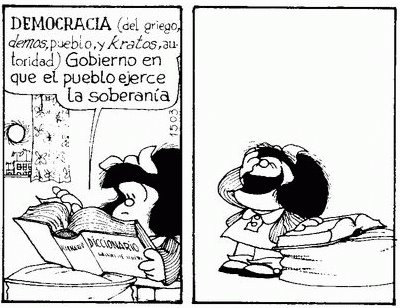
El término democracia es antiguo y complejo y se forma a partir de los vocablos “demos” traducido al castellano como -pueblo y/o poder- y “cracia” que indica un -gobierno o sistema-.  Así y actualizando el término desde la antigua Grecia a nuestros días, la democracia se refiere al gobierno del pueblo.

¿Pero acaso no ha sido el pueblo el que se ha volcado a la rebelión en Ucrania, Venezuela y El Salvador? Entonces, ¿la democracia reaccionó en estos países contra la democracia?

Quizás lo que ocurre en estos tres países (que son producto de la colonización y de la subyugación a los imperios durante la Guerra Fría) es que quizás no han pasado el suficiente tiempo en independencia institucional y maduración de sus gobiernos como para lanzarse desbocados a procesos democráticos que deben ir de la mano de una reforma educativa y cultural de la ciudadanía.  Pero, ¡alto! Que conste, que no me refiero a que estos países post-coloniales y post-guerra fría deban regresar bajo el control de un dictador o de una metrópoli.  Sino que, la participación del pueblo (demos) no debería avanzar cuando se ha descuidado o se ha impedido continuar el proceso de institucionalización de la democracia en la vida ciudadana.

Ucrania, Venezuela y El Salvador tienen como un común denominador la inmensa pobreza y la enorme desigualdad educativa y cultural entre la elite gobernante que heredó el poder de sus antiguos amos colonizadores y el grueso de la población. La mayoría de la población en estos países ha sido condicionada a servir como un “agente legitimador” al momento de ejercer su voto pero no se le ha permitido adquirir conciencia absoluta de su rol como “ciudadano legitimador empoderado”. Porque es su voto el que le permite exigir responsabilidad, honestidad y resultados en el equipo de gobierno que eligió en las urnas.

Titulo: 7 killed in post-election protests
Via: FoxNews

En Venezuela ha sido la población cansada y agotada de la corrupción la que ha tomado conciencia del poder de su voto al exigir la renuncia del gobierno revolucionario (aún a pesar de que recientemente había sido electo por el voto de las mayorías).  Es acá que el pueblo ha empezado a ilustrarse en su poder como votante y garante.

Titulo: Days of Protest in Ukraine
Via: The Atlantic

En Ucrania ha sido el pueblo el que también ha tomado conciencia del poder de su voto y de su derecho de autodeterminación pidiendo la anexión de Crimea y su mayoría étnica rusa a Rusia debido a sus distintos intereses económicos, políticos y culturales con el resto del país.

Titulo: El TSE pidió a los contendientes que respeten los resultados que el pueblo decida.
Via: http://www.lapagina.com.sv

Y en El Salvador desde el día lunes debido a que las elecciones presidenciales concluyeron con una cercana diferencia de votos entre los partidos ARENA y FMLN. ARENA rechazó el conteo de las elecciones luego del anuncio de su derrota. 6,000 votos marcaron la diferencia y el partido ARENA rechazó la legalidad del proceso democrático.

Espero que no sea aún tarde para extender una invitación a reflexionar a los ciudadanos salvadoreños sobre el funcionamiento del gobierno democrático y de la necesidad de estudiarlo a más profundidad y, quizás, comprender que el voto de la mayoría (aún si efectivamente ganará por 6mil votos de diferencia) no es garante suficiente de legitimidad.  Y que, es urgente que ambos partidos realicen un pacto serio, democrático y honesto antes de queso se derramé una sola gota de sangre.

En Venezuela, Ucrania y El Salvador es aún posible alcanzar acuerdo y pactos de concertación que partan del respeto al gobierno democrático y que busquen una inclusión de ideas, actores y modificaciones a los actuales procesos en los que el Pueblo (demos) colabore en la construcción y progreso del del Sistema de gobierno (cracia).

Esto evitará muertes y violaciones a los derechos individuales.  Pero más importante aún, permitirá la evolución y maduración de sistemas democráticos de gobierno en estos países que aún ahora se vieron afectados por la injerencia de los poderes imperiales en sus asuntos. Que envidia que en estos países quizás estén a las puertas de un desarrollo democrático del cual nuestros países vecinos podrían aprender mucho.

Imperialisms, Old and New: Sykes-Picot and the United Nations

Foreign policy expert (and Reason contributor) Michael Young had an op-ed out last week on nationalism and imperialism in the Middle East. Writing in The National, Young argues that Western imperialism should not be blamed for the problems of the Middle East today. Young argues that the power vacuum left by the collapse of the Ottoman Empire guaranteed that violence would play a prominent role in the region, regardless of where the lines of borders had been drawn, or who had drawn them.

Violence would play an important role, Young argues, because aspirant hegemons and various types of nationalisms (Arab, Iraqi, Lebanese, etc.) would be eager to expand their influence and power throughout the Middle East. This is an interesting hypothesis, but it strikes me as disingenuous largely because there is no way to prove such an assertion wrong. The fact that violence could have happened in the absence of European imperialism does not excuse the cartographic crimes of European states. The carving up of the post-Ottoman Arab world happened (interesting counterfactuals notwithstanding).

Young’s argument fails on another account as well. He writes, for example, that:

None of the protagonists in Syria’s conflict has cast doubt on its borders, or has called for a Sunni or Alawite state. Their rhetoric has almost entirely been couched in nationalistic terms, with their aim being the control over all of Syria. Even Mr Al Assad has never expressed interest in falling back on an Alawite mini-state, and if he does so that would only be because he can no longer hold Damascus.

There are two arguments worth scrutinizing here. One, there have been calls for a Sunni state. Two, the nationalist rhetoric is itself a product of Western imperialism. For example, these power struggles for the center occur because secessionist or federalist options are not available to factions in the region. The lack of options stems from the inherent inability of these post-imperial states to govern without a strong man. Strong men are required in the post-imperial Middle East because the states that were drawn up by European diplomats were arbitrary and ahistorical, and therefore lack legitimacy in the eyes of the people.

Post-imperial states are not considered legitimate by their citizens because they never had a say in how to go about structuring such a state (not even through the traditional channel of war). They had no say in where the borders should be, or who they could trade with, or how to best accommodate foreigners. Because post-colonial states are not legitimate, violent centripetal forces are constant. This pattern continues unabated because those who eventually end up controlling the center receive legitimacy from the international legal order, as exemplified by the United Nations and financial lending institutions such as the IMF.

By recognizing the legitimacy of Sykes-Picot’s arbitrary states and the sanctity of its borders, the UN and other Western institutions contribute directly to the bloodshed and impoverishment of the region. Because these states have been legitimized by the UN, violent factions can simply seize control of the center and they will automatically gain legitimacy from the very international order that has sustained this chaos. Why bother trying to gain the legitimacy of an impoverished populace when you can simply capture the rent associated with running a post-imperial state?

The West would do well to start working on a foreign policy that looks at recognizing devolutionist tendencies in the post-imperial world as a legitimate option. Recognizing the mistakes of Western imperialism would be a good start. Western recognition would also give these breakaway movements a sense of legitimacy when it comes to working with international organizations such as the IMF or WTO. Official recognition could open up diplomatic options that are currently unavailable to stateless societies in the post-imperial world.

By continuing to not view devolution as a legitimate option for Middle Eastern (and other) societies, the West is doubling down on its moral failure of a hundred years ago. Recognizing centrifugal forces as a legitimate political process would also bring the post-imperial world and the West to a more level standing with each other, as the West would welcome new states into their international orders rather than picking winners and losers through cartographic exercises. In an era where inequalities are shaping up to play prominent roles in policy debates, this last tweak in diplomacy could very well contribute (politically at least) to a more equitable world.

The Power of Propaganda and the Japanese Empire

Economist Kurt Schuler has a fascinating post on the various currencies that were used in mainland East Asia during World War II over at the Free Banking group blog.

Unfortunately, there are three paragraphs in the post that attempt to take libertarians to task for daring to challenge both the narrative of the state and the narrative of the nation regarding that horrific reminder of humanity’s shortcomings. He is writing of the certainty of the US’s moral clarity when it came to fighting Japan (the post was published around Pearl Harbor remembrance day):

The 1940 U.S embargo of certain materials frequently used for military purposes was intended to pressure Japan to stop its campaign of invasion and murder in China. The embargo was a peaceful response to violent actions. Japan could have stopped; it would have been the libertarian thing to do. For libertarians to claim that the embargo was a provocation is like saying that it is a provocation to refuse to sell bullets to a killer.

Then, in December 1941, came not just the Japanese bombing of Pearl Harbor, but an attack on the whole of Southeast Asia: Hong Kong, Singapore, what is now Malaysia (British colonies), Indonesia (a Dutch colony), the Philippines (scheduled under American law to become independent in 1945), Thailand (independent). In 1942 there followed the invasion of Burma, a bit of India, and a few of the Aleutian Islands, plus the bombing of Darwin, Australia.

With that history in mind, how can anybody think that the United States could have made a durable peace with Japan? It would have lasted as long as would have been to Japan’s military advantage, no longer. Japan was hell-bent on conquest. Nothing since its emergence as a major international power suggested a limit to its ambitions. It only ceded in the face of superior force. Even as Allied forces retook territory, Japanese fanaticism was such that the government did not surrender until after the U.S. military dropped two atomic bombs. To ignore the long pattern of Japanese aggression as quite a few libertarians are wont to do is not just historically ignorant but dangerous, because it closes its eyes to the hard truth that some enemies are so implacable that the only choice is between fighting them and being subjugated by them. It took a prolonged U.S. military occupation to turn Japan from the aggressor it was to the peaceful country it has become. (source)

This is an unfortunate mischaracterization of what went on in World War 2, but it also does a fairly good job of demolishing some of the arguments that libertarians have come up with in regards to this debate. You see, the issue of World War 2 is one that is usually foisted upon libertarians as an example of the benevolence of the State: Washington crushed two powerful, evil war machines in one fell swoop and then stood up to a third evil empire for forty years.

Libertarians often get confronted with this interpretation of history and they get bothered by it. This argument gets under their skin. They often make up excuses for Japan’s actions, or they avoid dealing with what actually happened in the time period. This response is also unfortunate because the general principles of libertarianism – individual freedom, strong property rights, internationalism – explain the events of World War 2 well, but only once the facts are looked at clearly and thoroughly. The power of propaganda is immense. The fact that so many people believe that the United States was the good guy in the war against Japan is astounding, and I think the heavy weight that is placed upon the shoulders of those who dare to defy the standard account of the US’s war with Japan flusters the seeker of truth.

Even though libertarians get hot-headed on this issue and stumble, thus making Schuler right in a sense, his argument is absolutely wrong. What follows is an attempt to calm things down, and to explain why Schuler is wrong and what libertarians need to get right.

Tokyo did not want to expand beyond a certain point, due to the ideological consensus of the governing party at the time. The narrative of the governing party was that great civilizations had natural territories over which they naturally lorded. For the Japanese, this natural territory (which was, of course, entirely arbitrary and ahistorical) was called, amongst other things, the East Asia Co-Prosperity Sphere. It included the Korean peninsula, Manchuria, Southeast Asia, Indonesia, the Philippines, coastal China, Mongolia, Malaysia (including Singapore and Brunei), and a separatist region in India known as Azad Hind. Any territory beyond these lands were inhabited by – again according to the ideology of the dominant political party at the time – peoples who did not conform to the standards set by the Japanese people (and those ranked directly beneath them; the ones I just mentioned). These foreign peoples were treated accordingly, especially in Melanesia.

What this suggests is that, contra Schuler, the Japanese were not “hell-bent on conquest.” Rather they simply wanted to carve out a territorial space that has obvious parallels with the German conception of Lebensraum. This is not a coincidence, by the way, for the ideologies of the dominant parties in Germany and Japan were cut from the same racist cloth.

Hawaii might have been a target for the Japanese military eventually, due to the large number of people living there with Japanese ancestry, but even this is stretching the limits of generosity. Hawaiians of Japanese ancestry considered themselves to be Hawaiians, or Americans, before Japanese (this probably due to the fact that the Japanese government sent some of its citizens over to Hawaii by force, but that is another story for another day; hopefully you can see why loyalty to Hawaii and the US was a given to people of Japanese ancestry on the islands). A Japanese invasion of the US mainland is simply an incredibly silly notion, which is why I think Dr Schuler relies upon the irrefutable fact of Japanese lust for conquest. Can you not see where propaganda is at work here?

Now, obviously the Japanese were warmongering at the time. There is no doubt about this. However, it hardly follows that the Japanese were a threat to the American republic.

For instance, look at what the Japanese military ended up attacking:

  • European and American colonies (which were burdens rather than boons for both the colonized and the colonizing)
  • Thailand, a kingdom with a long history of playing foreign powers off on each other
  • and parts of China (which could hardly lay claim to much of its territory anyway)

If I’m not mistaken, Europe and the United States are thousands of miles away from Japan, and yet they had militaries occupying foreign lands in East Asia. Again, Japan was certainly an aggressive state in the early 20th century, but it seems extremely unfair to ignore the military occupation – by Western states – of Asian lands and the Jim Crow-esque political regimes that they enacted and enforced. Notice, too, that the military incursions of the Japanese Empire do not stray too far from the official ideology of the governing political party. This is also true of Nazi Germany and Fascist Italy. It was also true of Soviet Russia, but for different reasons. The Soviets engaged in worldwide imperial ambitions (“spreading the revolution”) after solidifying their rule at home, and this imperialism was part and parcel of the dominant ideology of Leninism. I am digressing.

Japan did declare war on the US, so I think Washington’s war was just, but it hardly follows that Japan was “hell-bent on conquest,” or that its military would have invaded the United States, or that Tokyo’s decision not to curl up in the fetus position and simply accept US economic warfare was “unlibertarian.” Suppose Japan had conquered the US. What would its armies have uncovered?

Think of it this way: What incentive would Japan have to conquer the United States? Where were the plans to do so? Doesn’t it make more sense to look at Japan’s war on the US as part of its broader effort at creating and maintaining its hold over the territory it deemed to be the natural lord over? Why waste so many resources invading and occupying a territory dominated by people who were part of another race (as per the prevailing ideology of Tokyo at the time)? Oh, that’s right: Because Japan was “hell-bent on conquest.”

Propaganda is very powerful, but it’s also important not to label everything you disagree with as propaganda. That makes you sound like a crackpot. For instance, I don’t think anything Dr Schuler argues is driven by pure propaganda. Such an insinuation on my part would simply be garbage, and (rightly) treated as such in the public sphere. However, the notion that the US military stopped a war machine “hell-bent on conquest” is a product of propaganda. This notion is strengthened by personal and cultural narratives, and in time it takes on a life form of its own.

One last thing: Dr Schuler argues that the embargo Washington placed on Tokyo “was a peaceful response to violent actions,” but surely you can see how that policy was actually a violent response to violent actions. Whether that violence to counter other violence was a good thing or not is a question that cannot be answered in this already-too-long post.

(One more last thing: Here is an excellent essay on ideology in developing states that might be worth checking out; it doesn’t deal directly with the Japanese Empire but does deal with some of the concepts [especially nationalisms] that confront us when thinking about the rise of the Japanese Empire.)

Creative Destruction in the Levant

Creative destruction ain’t just a place for the marketplace, baby! The National Interest has an article out by Mark Donig on “The Twilight of Sykes-Picot.” It’s a great piece that basically acknowledges the end of an era (European imperialism and cartographic arrogance), and what this will mean for the United States.

Sykes-Picot is an agreement between France and Great Britain that divided the Ottoman Empire up between the two after World War I (the article goes into a bit more detail if you’re interested). Russia was also a part of the negotiations for carving up Europe’s sick man, but after the Bolsheviks seized power all imperial pretenses associated with the West were abandoned in Moscow. European cartographers abandoned the Ottoman approach (learned over centuries of trial and error) to governing territories in the Levant and instead carved up the region as they saw fit. The end result was, of course, a number of states that could only be held together by a strong man. Today, these post-colonial states are collapsing and in their place are a greater number of pseudo-states.

In many of these pseudo-states, Islamists run the show. Donig, an international law student, is worried that if states like Syria and Iraq collapse, the chemical and biological weapons stockpiled in secret locations will fall into the wrong hands. Donig’s suggestion is that the US pay very close attention to what is happening in the Levant, but I think he is much too pessimistic.

The US should embrace political disintegration in Levant wholeheartedly. Doing so would mean recognizing sovereignty of nasty-looking regimes. Yet is would also end the power struggles for the “center” in Sykes-Picot states, which would in turn end the reign of strong men in the region for good (for a concise explanation on why strong men emerge in post-colonial states, see “Imperialism: The Illogical Nature of Humanitarian Wars“).

Were the US to embrace decentralization in the Levant, it would be wise for Washington to play an active role implementing trade agreements both between the new states  as well as with Washington. The separatist movements in Scotland and Catalonia illustrate my garbled point well. Scots and Catalonians don’t want independence without membership into the international trading confederation known as the EU, and membership in an international confederation requires relinquishing some sovereignty (Daniel Larison inadvertently makes this point here; people on both the Left and Right who point to evils of EU rarely acknowledge that many states and regions would love to be a part of this confederation, warts and all, and that they stake their very separatist claims on such a membership).

Trade agreements would play an integral role in making or breaking these new states within their newly decentralized region (see Becker or yours truly on the importance of trade in politically fragmented regions). Once recognizing sovereignty of new states, the US would gain some much-needed trust from the peoples of these new states, and then Washington could use that influence to push for more economic integration (between the new states and with the new states) while at the same time recognizing the reality of political fragmentation in the region.

At any rate, full-on American diplomacy in this area is a must, especially given the TNI report’s account of possible chemical weapons stockpiles. This is something the US could work with Russia on, thus building a measure of trust which could, in turn, be used to work with Moscow elsewhere (especially in Europe). It still surprises me that dovish policymakers in Washington and Moscow have not yet used their respective government’s mutual enemy (Islamism) to build much-needed bridges between the two countries.

Weekend Question: What to do about the violence in South Sudan?

As many of you may know, the recently-minted country of South Sudan has descended into civil war. I’m going to show you how this violence was actually predictable, but first I want to point out a couple of things.

  1. Why did South Sudan get international recognition and not Somaliland, which has been a functioning democracy for about twenty years now? I’ve got two theories: One of them has to do with Islam. The peoples in what is now South Sudan are Christians and animists and the Arabs they were fighting in Khartoum were Muslims. Theory 2 has to do with Western pseudo-guilt associated with its past, state-sponsored racism. The peoples of South Sudan are black and the people running Khartoum are not.  Neither of these theories makes sense, mind you, but I think this actually bolsters my thoughts on ‘why?‘.
  2. Where did the violence between South Sudan and Sudan go? These guys were duking it out over an oil-rich region just a few months ago and now I can’t find much about the conflict. I’ll bet Khartoum’s disappearance has to do with both Western threats and the realization that it could accomplish more behind the scenes, so to speak, by playing its former enemies (various black ethnic groups) off on each other.
  3. The violence between former allies in war against Khartoum is also worth musing about, if only for a moment. A bunch of different ethnic groups were former allies in the war against Arab Khartoum and now they are at each other’s throats. I don’t think ideology, specifically ethno-nationalism, is an issue here…yet. It won’t be for a long time. Ethno-nationalism seems to be something that shows up within a society after years and years of botched efforts by elites to mold a nation out of a post-colonial state.

Ok, back to the issue at hand. I’ve blogged a little bit about secession before, and one thing I like to remind readers of is that there is an underlying concept that is much more important than case studies. For instance, you can probably get a much better understanding of what is going on in South Sudan by reading this old piece by yours truly:

In fact, the West could help to turn this disaster into something quite worthwhile: Build an international consensus and recognize the independence of the fiefdoms.  If the West does this now, there is a good chance that local players will be more agreeable in their claims on territory.  To secure independence from a Leviathan like Libya would guarantee a period of time for the local fiefdoms to regroup and rebuild what Ghaddafi had destroyed.

A parallel can be drawn to the velvet divorce of the Czech Republic and Slovakia just after the collapse of the USSR.  What made the divorce “velvet” was international cooperation.  When the international community doesn’t play the game smart, however, divorces look more like Algeria, Indonesia, the Congo basin, the Balkans, and, of course, Somalia.

If the West is to “do something”, and I think it should in most cases, then pursuing diplomatic relations that focus on decentralized governance and international trade are a good way to start.

Can you see how this works? Just replace ‘Libya’ with ‘South Sudan’ and ‘Ghaddafi’ with ‘Khartoum’ and you have the right parameters in place for what needs to be done in regards to making secession in failed states work (I blogged a little bit more about these parameters in South Sudan here as well).

Here is the relevant map for our weekend question:

This is a map of South Sudan’s ethnic groups. It looks like Switzerland, to be honest, but unlike Switzerland South Sudan does not have the same institutional structures in place. Nor does this new country have the full support of the international community. There are plenty of condescending Leftists “monitoring” the country inside and out, but that’s about it.

If the West wants to play a role in helping to avert a violent downward spiral, then it would do well to quickly recognize the futility of South Sudan’s existence and start acknowledging the legitimacy of the fiefdoms. You know where the ‘comments’ section is!

The Tyranny of Ambiguity: “Hate Speech” laws in Japan and subtle Western imperialism

Economist Tyler Cowen linked to the following report in the Washington Post about a supposed increase in enmity between Japanese citizens and Korean expats in Tokyo’s Koreatown. Setting aside all of the hyperbole on the part of the Post concerning rising tensions, and setting aside the interesting fact that there is a Koreatown in Tokyo, and setting aside the fact that there seems to be an increase in nationalism throughout the developed world, I’d like to focus on the Post‘s advocacy of “hate speech” laws. The Post reports:

“Japan is right now at a crisis point,” said Yoshifu Arita, a [Left-wing] lawmaker who is campaigning for new laws to regulate hate speech. “A situation like this — people getting so publicly hostile — never happened in the seven decades after the war until now.” […] In 1995, Japan did accede to the United Nations’ convention to eliminate racial discrimination, including hate speech, but its parliament has not passed legislation to enforce that treaty commitment. Its reluctance, experts and politicians say, stems from a separate war-era legacy — the wholesale suppression of anti-government dissent. Japan created free-speech laws to prevent a repetition of that censorship, and many still oppose the idea of regulating speech, said Kenta Yamada, a media law professor at Senshu University. The Japanese government’s hope, Yamada said, is to reduce hate speech with education and enlightenment, not with new laws.

Now I think we can all agree that ethno-nationalism is a bad thing, and there has been a rise in ethno-nationalism throughout the world since the 2007-2008 economic crisis began. However, I hope we can all equally agree that squelching free speech in the name of an imposed tolerance would be a much, much worse outcome.

“Hate speech,” of course, is ambiguous and invites arbitrary censorship. The fact that the Leftist politician pushing for the assault on free speech is employing the language of crisis does nothing to relieve my suspicions of her intentions.

This piece brought up three more quick thoughts in my mind:

  1. The report states, in the above quoted passage, that Japan created free speech laws after the war. This is all well and good for the most part, but I’ll never tire of reminding people that the right to free speech cannot be created by government. Free speech is a natural human right, and as such it is impossible for governments to create free speech. For example, what would happen if Japan had not created free speech laws after the war? Would free speech not exist? It’s possible, but this could only be true if governments had laws in place prohibiting free speech.
  2. Is it just me, or did the reporter – a Western Leftist – come off as sounding a bit imperialistic in his subtext?
  3. Imagine what a federal incorporation with the US would do for ethnic relations between Koreans and Japanese.

American Foreign Policy: Predictions, Assumptions and Falsehoods

On November 1st 2011 I got into an argument with Dr Delacroix about US foreign policy. During that time, if you’ll recall, a debate on the merits and demerits of bombing Libya was raging across the blogosphere and in the halls of power. Here is what I wrote in the heat of the moment two years ago today:

Time will tell, of course, which one of our predictions comes true. In two years time, Tunisia, which did not get any help from the West, will be a functioning democracy with a ruling coalition of moderate Islamists in power.

The Egyptian military will be promising the public that elections are just around the corner, and Libya will be in worse shape than it is today. Two years from today, Dr. J, you will be issuing an apology to me and making a donation to the charity of my choice.

Since you are very good at avoiding the facts on the ground in the name of democratic progress, I think we should establish a measurement rubric by which to measure the progress of Libya. How about GDP (PPP) per capita as measured by the IMF?

Not too shabby, eh? In case you haven’t been staying up to date on current events in the Middle East, Tunisia is a functioning democracy with a ruling coalition of moderate Islamists in power. It is not Switzerland or Iceland, but it is doing much better than the two states who were on the receiving end of US “help” during the Arab Spring.

Egypt, for example, is currently being run by the (US-funded) military, and the military is promising Egyptians that elections are just around the corner.

In Libya, GDP (PPP) per capita for 2013 started off the year at $11,936 (in international dollars). In 2011, prior to the uprisings and subsequent US bombing campaign, Libya’s GDP (PPP) per capita clocked in at $14,913 (you’d have to look at 2010 to see where Libya started off). That’s a nearly $3,000 drop in purchasing power parity. Here is the relevant IMF data (it starts off in 2010 and you can go from there).

Perfectly predicting the current mess in the Middle East has less to do with my genius than it does with applying a general libertarian framework to the situation. For example, I know that government is very bad at doing nearly everything. Government is a name we have given to an organization that has a monopoly on force. This monopoly on force is usually consented to because it is expected that it will provide an honest court system and a way to interact with other polities (“diplomacy”). When this monopoly on force is applied to anything other than these two functions, peace and prosperity give way to war and impoverishment. The trajectory that war and impoverishment take in a society depends on any number of variables, but the general libertarian framework I just outlined never fails to impress.

Now, my perfect prediction was made in the heat of the moment during an argument. If my argument was right, what did the other side of the debate have to say? Is it at all possible that Dr Delacroix had an argument that somewhat conformed to reality as well? Decide for yourself, and remember, this was written near the end of 2011:

There are several benefits to the Libyan/NATO victory for this country […] First, rogues and political murderers everywhere are given a chance to suppose that if you kill Americans, we will get you afterwards, even if it takes twenty years […] Two, Arabs and oppressed people everywhere are figuring that we mean it when we say we like democracy for everyone […] Three, this Obama international victory will cost him dearly in the next election. A fraction – I don’t know how large – of the people who voted for him the first time around oppose all American military interventions.

I don’t know about you, but it looks as if Dr Delacroix got Libya, the rest of the Arab world and American domestic politics horribly wrong, and on every level possible. If I am being disingenuous or unfair to Dr Delacroix’s argument, please point out to me where I go wrong in the ‘comments’ section.

Let’s take a second to reflect on something here. I was factually correct in my assessment of what would happen in the Middle East if the US intervened militarily. Dr Delacroix was factually incorrect. I think the drastic difference in outcomes occurred because our assumptions about how the Middle East works are informed by different history books. This is odd because we agree on nearly everything else.

Were I proved to be wrong, and shown how devastating the effects of my assumptions on societies could be,  I know I would do some deep questioning about my prior assumptions of how the world works.

There are four assumptions Dr Delacroix makes, in recent blog posts, that I believe are unfounded. When these unfounded assumptions have gained traction policy-wise, the consequences have been devastating. When these unfounded assumptions have been defeated in open debate, the consequences have been minute. By pointing out these assumptions, and ruthlessly criticizing them, I hope to provide a framework for those who read this blog to use when thinking about foreign affairs.

  • False Assumption #1: “Bullies will try to pull off worse and worse brutalities until they become intimidated. The unopposed brutalities of one bully encourage others to go further. Some who had the potential but never acted on it will be encouraged by the impunity of others to become bullies themselves.”

Comparing leaders of authoritarian states to schoolyard bullies is a bad way to go about understanding international relations. I think this is done on purpose, of course, in order to obfuscate the reality of a given situation. Dictators in authoritarian states often enjoy broad coalitions of support from the populaces over which they rule. In Iraq, for example, Saddam Hussein enjoyed support from Sunni Muslims, Christians, secularists, socialists, trade unions, domestic corporations, women’s rights groups and the poor. Dictators often enjoy broad support from their populaces because of the fact that they bully, to use Dr Delacroix’s term, the bullies (see False Assumption #2 for more on this).

Here is another example: Bashar al-Assad has broad support in Syria because he protects religious and ethnic minorities from the passions of the vulgar mob. Dictators rarely care about the actions of dictators in other countries, unless it serves their own domestic purposes, and slaughtering people randomly is something I have never heard of a dictatorship doing. A dictator’s attacks are calculated, quite coldly I admit, so as to bolster support from the factions they are allied with. Dr Delacroix would like nothing more than to have the Middle East actually be a place where dictators take comfort in the actions of other dictators. Were this to be true, his argument would be right. His predictions would come to pass. Alas.

  • False Assumption #2: “By the way, as little as four years ago and even less, Western liberals and misguided libertarians were still blaming the American military for Iraqi on Iraqi violence. The US military is gone; the violence is rather worse.”

Attempting to sweep the violence and high death count associated with the US invasion of Iraq under the rug does nothing to inspire confidence in Dr Delacroix’s framework. The Iraqi-on-Iraqi violence occurred after the US military illegally removed the bully’s bully from his position of power. Prior to the US military’s illegal invasion, the Iraqi-on-Iraqi violence Dr Delacroix points to was kept in check by Saddam Hussein’s heavy-handed tactics. When Hussein gassed Kurds, for example, he did not do so simply because the Kurds “revolted” against his rule. He did so because the Kurds had been murdering Arabs and engaging in terrorist activities that targeted Iraqi infrastructure. The intrastate warfare in Iraq was quite negligible until the United States decided to break its own laws and illegally invade and occupy Iraq.

Of course, you can always choose to believe Dr Delacroix’s theory of events, but I think the results of our predictive power speak for themselves (on the inevitability of intrastate warfare in post-colonial states, see the discussions about “post-colonialism,” “secession” and “decentralization” here at NOL).

  • False Assumption #3: “In World War Two, we could have stopped the genocide of the Jews or slowed it to a crawl. We did not because there was a strong but vague reluctance to ‘get involved.’”

In 1939 France and the United Kingdom had worldwide empires. The Soviet Union was 25 years old. So were the small, independent states of Turkey, Hungary and Austria. Germany, despite its defeat in World War 1, was an industrial power. The was no such thing as cruise missiles. There was no such thing as jet airplanes. There was no such thing as satellites. Or the internet. The Jews that were slaughtered in Europe lived in places that could not be reached by the American military of 1939. Indeed, they lived in places in Europe that could not be reached by the American military of 1945. The Eastern Front in World War 2 was many things, but certainly I think you can see why it wasn’t a “reluctance to get involved” on the part of the American people that is partly responsible for the Holocaust. To assume that the American military could have marched into Eastern Europe during World War 2 and stopped, or even slowed, the Holocaust is delusional.

  • False Assumption #4: “Today, I am ashamed to be an American because of our passivity with respect to the slaughter of Syrian seekers for freedom.”

Since the end of World War 2, when the US assumed its place as the world’s most prominent polity, Washington has continually opted to support the socialists (Ba’athists, Nasserists, Ghaddafi, etc.) over the Islamists in the Arab world (liberal Arabs simply, and unfortunately, emigrate to the West). The most obvious reason for this support is that the socialists do not send their agents to fly planes filled with people into commercial buildings filled with people. Pretending that the US is putting its head in the sand is disingenuous. Washington is well-aware of the consequences of letting Assad fight it out with the Islamists. We have made our decision after weighing the costs and benefits of every option available. We did this through open debate. Socialists make better enemies (and allies) than Islamists.

Now, these are just some small examples of jingoism and delusions of grandeur I have picked out. There are many more examples, especially in the national press, but Dr Delacroix’s are much, much better reasoned than any of those. If you are reading the op-eds in the national press rather than Dr Delacroix you are going to be woefully misinformed about the nature of the world. Your brain will be slightly more malnourished than it otherwise would be (this is one of the reasons why I like blogging with him). His arguments are informed by a lifetime of prestigious scholarship; they are informed by somebody who has the benefit of understanding two distinct cultures in an intimate way.

And look how incredibly wrong he has been proven to be. Assumptions matter. So, too, does truth and falsehood.

Imperialism or Federalism: The Occupation of South Korea

A recent op-ed in Foreign Policy highlights South Korea’s very successful rent-seeking campaign in regard to US military services:

When it comes to taking charge of coalition forces here on the Korean Peninsula, South Korea has been a little gun shy. South Korea and the United States this week are celebrating the 60-year anniversary of an alliance forged after the Korean War; there were two parades, a big dinner, video retrospectives, and a lot of talk of katchi kapshida (“we stand together”). But after decades of confidence-building joint exercises and billions of dollars in military assistance, it’s time for the South Koreans to step up and assume what’s called “operational control” of all forces stationed here if war should break out. The problem is, the South Koreans aren’t quite ready.

This brings out two interrelated but distinct trains of thought in my mind. First, it destroys the arguments, found on the hard Left, about a brutal US imperialism in the region. Seoul has made a US military presence on its soil a top priority for sixty years now. This has been the case during the autocratic period and it is now the case for the democratic one as well. A state cannot have a brutal presence in another state’s territory if the latter state continues to make the former’s presence a top priority.

Second, this is not to say that the US is not imperialistic. Here is how Merriam-Webster online defines imperialism: “the policy, practice, or advocacy of extending the power and dominion of a nation especially by direct territorial acquisitions or by gaining indirect control over the political or economic life of other areas.” With this useful definition in mind, South Korea’s rent-seeking necessarily brings up anti-imperial arguments from the center and the Right; namely, that South Korea is taking US taxpayers for a ride (the Cato Institute has done some especially good work on this topic).

So here are the relevant circumstances: the US military is currently on the Korean peninsula, and it is fairly entrenched, and the South Koreans overwhelmingly want it there, and US citizens don’t seem to mind all that much the presence of their military along the 38th parallel. So what exactly is the problem? Why is Foreign Policy, a traditionally interventionist publication, highlighting South Korea’s rent-seeking now? The answer, I think you all know, is government gridlock. Notice first how gridlock is not necessarily a bad thing. It forces Americans to reassess their priorities and to make tough compromises.

Libertarians have long called for Washington to withdraw its troops from South Korea (and correctly so). Among their grievances are the aforementioned rent-seeking tactics of the South Koreans, the unnecessary expenses that accompany such arrangements, and the fact that a US military presence causes unnecessary problems with China and North Korea.

Given the costs and the unnecessary dangers associated with occupation, I am in full agreement with libertarians. However, given the four circumstances mentioned above, I think there is a better way to go about pursuing a more just situation: federate with each other. By federate I do not mean that Seoul should send two senators and X number of representatives. That would be extraordinarily unfair. However, if the 17 provinces in South Korea each sent two senators and X number of representatives, justice would be achieved.

The objections to such an idea are numerous. They include political, cultural and economic angles, and none of them ever hold up to scrutiny. But what exactly is wrong with the status quo? What’s wrong with a complete military withdrawal? My answer to the first question is simply that the status quo is unfair. The South Koreans are ripping the Americans off. My answer to the second question is a bit more complicated.

A complete withdrawal implies that South Korea is not paying its fair share. Indeed, that it is not paying its share at all. A complete withdrawal also implies that foreign occupation creates unnecessary dangers, and it is indeed difficult to imagine a nuclear-armed North Korea without the presence of the US military along the 38th parallel (would Beijing or Tokyo stand for that? Would there be two Koreas? Korea today, without the war, would look like Vietnam).

A withdrawal also implies that the US no longer cares about the South Korean people. Only the hard, fringe Korean Left wants the US out. It’s not the threat of China or North Korea I’m concerned about (only demagogues are concerned about that), but rather the lost opportunity to enhance liberty and equality under the law in both the US and South Korea.

A federation would go a long way toward tackling these problems. South Korean provinces would suddenly find themselves paying their fair share. Two armies would become one (that means soldiers from the province of Jeollanam would be fighting in Afghanistan and not just patrolling the 38th parallel). The propaganda about American imperialism coming from the socialist paradise of North Korea would be rendered obsolete. A new peace – based on consent and equality – would begin to arise. My inspiration for these thoughts comes from a segment of Adam Smith’s Wealth of Nations (pgs 681-682; bottom of 779-794 in the Bantam paperback edition), musings from Hayek’s The Road to Serfdom (223-236 in the definitive, paperback edition) and Mises’s fascinating argument in Liberalism (105-154 of the paperback edition from FEE; here is a pdf of the book from mises.org). I’d even go so far as to claim that it is a more libertarian position than the calls to withdraw from the region. At any rate, it would certainly address the problem of rent-seeking that the US now finds itself facing (which in turn proves that the libertarians were correct all along).

A Glimpse into Ottoman Syria

One must not lose sight of the fact that, historically speaking, and contrary to prevalent belief, the Alawites wanted no part of the “Unitary Syria” that emerged out of Franco-British bickering in the Levant of the interwar period. Indeed, when the French inherited the Ottoman Vilayets (governorates) of Beirut, Damascus, Aleppo, and Alexandretta in 1918, they opted to turn them into six autonomous entities reflecting previous Ottoman administrative realities. Ergo, in 1920, those entities became the State of Greater Lebanon (which in 1926 gave birth to the Republic of Lebanon), the State of Damascus, the State of Aleppo, the State of the Druze Mountain, the State of the Alawite Mountain (corresponding roughly to what the Alawites are reconstituting today), and the Sanjak of Alexandretta (ceded to Turkey in 1938 to become the Province of Hatay.)

But when Arab nationalists began pressuring the British on the question of “Arab unity,” urging them to make good on pledges made to the Sharif of Mecca during the Great War, the Alawites demured. In fact, Bashar al-Assad’s own grandfather, Ali Sulayman al-Assad, was among leading Alawite notables who, until 1944, continued to lobby French Mandatory authorities to resist British and Arab designs aimed at stitching together the States of Aleppo, Damascus, Druze, and Alawite Mountains into a new republic to be christened Syria.

From this long-winded (but useful) article by Franck Salameh in the National Interest. What would be interesting to research is how long it took the Ottomans to figure out how to best govern such a diverse set of peoples. God forbid anybody let them govern themselves. Also interesting to note is the “Arab unity” canard that ultimately created the state of Syria. From what I recall, Arab nationalism was largely pushed by a hodgepodge of urban liberals with connections to British and French businesses and rural aristocrats hailing from the Gulf and promised land and power by the British for turning on the Turks.

What a mess. The liberals, by the way, are long gone. They were swept away by the military dictatorships of the 1960s and 1970s. The Islamists are largely a reaction to the military dictatorships. Islamism as we know it today only came into being in the late 1950s, when the leaders of the Middle East were all puppets that had been installed by the last vestiges of European colonialism. Arab nationalism was still strong in the late 1950s, so the Islamists lost out in popularity to the military dictatorships (which operated under the guise of “Arab socialism”). Twenty years of Arab socialism – guided by Generals and Colonels – paved the way for the Islamists and their internationalist rhetoric to become the voice of the Arab street.

I, for one, wouldn’t mind seeing Syria dissolve back into six independent states. If the international community could get them to bind their economies together in a free trade zone of sorts, the region would heal quickly and set an important precedent: political decentralization and economic integration work well no matter where they’re applied.

Update: the Economist has more on the ethnic angle in Syria’s civil war.

The Arab Crack-Up: Are New States on the Way?

Let us hope so, but I won’t hold my breath. Sharmine Narwani thinks otherwise. She argues that both Western states and “the locals” are now looking at more decentralization in the Middle East as a viable option:

The Mideast will one day need to make region-wide border corrections, but to be successful, it must do so entirely within an indigenously determined process. The battles heating up in Syria, Iraq, Lebanon, Yemen, Bahrain and elsewhere are a manifestation of a larger fight between two “blocs” that seek entirely different regional outcomes – one of these being the borders of a new Middle East.

The rest of the article is fairly atrocious, but it goes without saying that she should read (ha ha) my musings on how to go about decentralizing in a cool, calm and collected manner. Here is the shorter version of my argument: the West should emphatically not go around breaking up the states of the Middle East into smaller ones, but it should recognize breakaway regions as soon as they, uh, break away. This’ll give these states a little bit of breathing room on the international scene and deter older states from trying to reclaim their old territory.

From the Comments: How, Exactly, Does One Define Terrorism?

From longtime reader –Rick, who starts off by quoting Dr Delacroix:

“Thanks to your influence, I have become more conscious of what I mean by terrorism. It includes intentionality and blindness toward the (civilian) victims. Thus, I have revised my concept of terrorism. I will be more precise in the future.”

One immediate problem I have with this is the use of force by the Allies in retaliation to the evil and unjustified use of force and murderous policies of the Axis powers in World War II. With “an intentional and blind lack of consideration of civilian casualties”, retaliatory force such as the bombing of Dresden and the dropping of atomic bombs on Japan would not have occurred and as a result, our enemies may have, instead, developed and used such strategies and weapons on us. Without efforts to annihilate the enemy and obtain an unconditional surrender, WWI, WWII, or perhaps even the American Civil war may have ended up with a decades long cease fire form of a truce as we have between North and South Korea that commits America to spending billions to keep troops and support systems in Korea as we shrink our military forces on a global scale.

Your inclusion of intentionality and blindness makes the actions taken by the allied forces in response to similar or worse actions by the enemy nations of Japan and particularly Germany make the Allies no more than terrorists for their defensive actions taken to suppress hostile nations and restore some semblance of peace to the planet.

So, depending on your view of history and warfare necessities, you may need to revise your definition even further – or not.

Dr Amburgey also adds his thoughts on Dr Delacroix’s statistical reasoning. One thing I have noticed, reading through this dialogue again, is that Dr Delacroix and other imperialists are much more interested in wielding arbitrary rules, norms and even definitions to advance their aims. Once the imperialist is called out on his arbitrariness (amongst other things), however, he begins to accuse his debate partners of dogmatism (amongst other things).

Libertarian Foreign Policy: A Dialogue on Imperialism

I am flattered, Brandon and I am sure I don’t deserve all this attention. I did not merit these detailed rebuttals and your rebuttals don’t deserve that much either. Sorry if this sounds dismissive b, it’s not my attention but your arguments seem to proceed from some debating class that I have not taken. He are your words:

It is not enough for you to have an adequate defense force that protects the territory and integrity of the Republic.

I think that’s not the Libertarian position. The party’s position instead is to wait until we are attacked, as in Pearl Harbor, to engage in active defense on the basis of a military establishment much smaller than the current one. Please, correct me on these specific points if my perception is wrong. Please, don’t run all around the chicken corral!

You charge me with saying that “we must bomb, maim, and bully other peoples in the name of peace as well.” Of course, it’s a caricature but it hides an important truth. We have different perceptions of recent events. Here it is in a capsule: The Iraqi liberation war did not do as well as it should have; it went much worse, in fact. Yet, knowing what I know now, if I had to make the decision I would do it again. The Libyan operation went as well as one could expect. As I wrote on my blog, it’s an Obama success.

You refer mysteriously to the constitutional limits of military actions. I think both the Iraq war and the Afghanistan wars are constitutional. I think, the help to Libyan is borderline.

I can’t take your otherwise thoughtful critique seriously because of all that you leave out of my clearly expressed position. I want to try one last time to elicit your response one something that is important to my military posture. I assume that you and I could easily agree that the US had no vital interest in Rwanda at the time of the genocide.

Was it fine to let thousands of Rwandan massacre hundreds of thousands of their fellow-citizens with machetes and bricks?

It seems to me that the first answer has to be a “yes” or a “no.”

One more thing, Brandon: I don’t know where in my writing you see anything resembling anti-Muslim statements. What I have done repeatedly is:

  1. denounced the hypocrisy of American Muslim organizations;
  2. deplored the blindness, the confusion of ordinary Muslims;
  3. attacked the mendacity of political correctness in this country, all with respect to the following simple fact: 95% of all terrorist acts in the world in the past twenty years have been committed by people who call themselves Muslims and most often, in the name of Islam.

I mean by “terrorism” violent acts directed deliberately against civilians.

Just to be superfluously declarative: I don’t think Muslims are evil; I think they are in massive denial. There are Muslim commentators who say exactly the same. There are too few and they are not heard much.

Libertarian Foreign Policy: A Dialogue on Imperialism

This is starting to feel a lot like shooting fish in a barrel Dr Delacroix. Since we both know exactly how Leftists argue, I think it would be pertinent to over your rebuttals point-by-point.

I am glad we agree on the US intervention in Afghanistan based on the fact that the Taliban hosted and refused to deliver the terrorist Al Qaida.

And it would have been nice if we had focused our resources and our energy on staying there and hunting down al-Qaeda. There is also something amiss here: Osama bin Laden was shot dead in a shootout involving our special forces underneath the nose of Pakistan’s version of West Point. As we both know very well, the Taliban and Islamabad have never been on friendly terms, yet both sides gave refuge to bin Laden.

My suspicion is that both factions harbored bin Laden because of his immense wealth, not because of ideological solidarity. Also, I am not sure that the Taliban would have even been able to retrieve bin Laden if they wanted to. Rule by the Taliban was no doubt cruel, but for the most part they relied heavily on regional strongmen and political alliances to maintain control of the state.

With all this being said, I don’t think we ever declared war on Afghanistan. I may be wrong, but I think we focused our efforts on toppling the Taliban regime and hunting bin laden rather than fighting the Afghan state. This is actually a logical outcome, if you think about it, because al-Qaeda was not sponsored by Kabul, and it most certainly was not sponsored by the impoverished warlords of the Afghan regions, either. I’m willing to bet that the Taliban were simply in the wrong place at the wrong time.

Remember, al-Qaeda, or whatever is left of it after President Obama gets finished with them, is not the same thing as the Taliban. I would even say, with some confidence, that the Taliban knew nothing of the attacks being planned against the United States.

Either way, both factions are finished, and it’s time to bring our troops home after a job well done (thanks to President Obama’s strategy).

The “some press reports” statement regarding the Taliban blinding of little girls with acid shows what might be deliberate ignorance. The assertion was made by several responsible neutral sources, including National Geographic, not exactly a hawkish extremist publication. I suspect the Libertarian pacifist stance cannot be maintained without a broad practice of tactical ignorance such as you just demonstrated: Iran’s nuclear weapons? No problem.

My point wasn’t to discredit the press reports, it was to suggest that going to war with a state because a regime sometimes sponsors the throwing of acid into little schoolgirls’ eyes is a little bit silly. And where did the statement on Iran’s nuclear weapons come from?

Pulling stuff out of thin air to legitimate a point that was used to purposefully misconstrue the argument of your opponent is something only Leftists do, usually.  When are you going to come out of the closet, Dr Delacroix?  We’re all dying to know!

Your disquisition on the French Revolution simply ignores my question: Is the American revolution any the less valid because ti was helped by the intervention of a foreign power, France? When you seem to relate the Terror to this intervention, you are going out on a very thin limb. There is a conventional belief that the French intervention hastened the revolution in France by aggravating the public debt.

Ah. Here I think there is a miscommunication between us. If a revolution happens, it is valid regardless of who is involved and who it affects. Pretending otherwise is a waste of time. I brought in the French angle because today the United States IS France playing the role of interventionist in the Middle East.

How is relating the social, political, and economic upheaval of the Terror – which was aggravated by French intervention in the Anglo-American war – going out on a very thin limb? I did not suggest that we are on a crash course for violent revolution. I only drew some (quite pertinent) parallels between the two situations: supporting revolutions that have nothing to do with national security has never bode well for the states that do the intervening.

If you negative feelings, your apprehensions about the Arab Spring were all well-founded (were) should we then, as a country, continue to favor tyranny in those countries as we did for thirty years?

Ah. I have never said that I do not support the revolutions going on in the Middle East. Ever. What I have done is raise a flag of caution in the face of bellicose calls for more bombing, more involvement, and more intrigue on the part of Washington in the revolutions going on in the Middle East. Given that we have been supporting brutal regimes in that part of the world for the last half century, I don’t think our involvement will be looked upon with graciousness by the peoples we are inevitably trying to help.

Of course I support the revolutions going on in the Middle East, I just don’t support our government getting involved with them. When the dust clears, I think we should be the first state to stick out our hand and offer our friendship to the new governments.  I think the people of the Middle East would be inclined to agree with me.

Libertarian Foreign Policy: A Dialogue on Imperialism

[Editor’s Note: I had an extremely enlightening dialogue with Dr Delacroix in October of 2011 over the various merits and pitfalls of American imperialism. The dialogue was so interesting that I thought I’d break it up into installments – but still keep it in the exact order that it appeared – over the next little while. I hope you find it as informative as I have, and don’t hesitate to throw your own two cents into the ring, either]

Well Done Mr Obama!

I don’t argue with success. President Obama initiated and led a successful operation to get rid of another tyrant who also had American blood on his hands. He did it without losing a single American life. Whatever the cost in treasury was small in the broader scheme of things. It was a good investment. I think it’s fine to borrow a little money to deal with a rabid dog, however small the dog. Incidentally, my guess would be that the cost was less than 1/1000 of 1% of GDP. Want to bet?

I wonder what Libertarian pacifists have to say about the whole thing. I am going to ask them. One of the things they will probably argue (just guessing) is that there are many rabid dogs in the world, too many for us to deal with. Yes, I don’t mind borrowing money to deter all of them if need be. Tranquility is priceless.

There are several benefits to the Libyan/NATO victory for this country. (That’s Libyan blood and courage and NATO arms, including our own.)

First, rogues and political murderers everywhere are given a chance to suppose that if you kill Americans, we will get you afterwards, even if it takes twenty years.

Two, Arabs and oppressed people everywhere are figuring that we mean it when we say we like democracy for everyone. We did not always mean it. We do now that communism look like an antique instead of a superpower with the largest army and the most tanks in the world.

Three, this Obama international victory will cost him dearly in the next election. A fraction – I don’t know how large – of the people who voted for him the first time around oppose all American military interventions. For years, they have explicitly preferred a native butcher to an American liberator. Given how tight the election is likely to be, his victory in Libya might be the cause of President Obama’s fall.

If I were he, I would consider resigning this morning, like leaving the ocean after a really good wave.