From the Comments: More trade, more states?

Nguyen Ha left this thoughtful comment about my post on protectionism in Africa that I am embarrassed I missed:

Would you care to explain how “stronger economic ties will hasten the demise of current African states’ superficial institutions”?

What a tough question! First, though, I stated that it was my hope that deeper trading ties would lead to more states, not my prediction. My hope is based on current trends around the world: stronger economic ties have led to more states (and more aspirations for statehood within existing states).

The best academic treatment on this topic comes from Giacomo Ponzetto, an economist currently at CREI in Barcelona (he’s been mentioned at NOL on more than one occasion, too), and especially the Introduction and Section 5 of his working paper titled “Globalization and Political Structure.” Here:

As globalization proceeds, localities remove borders by increasing the size of countries. The number of countries declines and the mismatch between each locality is ideal and actual provision of public services grows. Eventually, this mismatch is large enough to justify a move to a two-level governance structure. The world political structure shifts from a few large countries to many small countries within a world economic union. The two-level structure is more expensive, but it is nonetheless desirable because it facilitates trade and improves preference-matching in the provision of public services.

By “two-level governance structure” Ponzetto means one level, a locality, that’s focused on delivering public goods to that specific locality, and another level, a world economic union, that’s focused on protecting property rights and eliminating border costs.

You can see this concept play out in a few different federative structures, especially the EU, the US, India, and China. In the European Union, multiple localities have tried to separate from countries (Catalonia from Spain, Scotland from UK) while still remaining part of the international economic union in place. Deeper trade ties, more states.

Three new states were created in India in 2000, and China is currently grappling with federalism as a way to keep up with its predictable economic success. The US hasn’t seen any new states added since 1959, but that’s because its system does a good enough job overall to keep all its member states content (happy, even).

The free trade zone in Africa will be interesting to watch because there are so many different variables at play than in China, the EU, India, or the US. India was governed by one overseas empire; the EU has been able to maintain stability because of American military power and the security umbrella it provides; China has been unified on and off again for centuries; and the US is, for all intents and purposes, a polity underscored by British cultural, economic, and political mores. Africa has none of these traits, yet its various leaders recognize that free trade leads to prosperity and often (not always) to better diplomatic ties.

If all goes well, and current trends elsewhere are any indication, Africa would see more states come into being to go along with its deeper economic ties. (This might be a major factor why Nigeria refused to join; Abuja fought a vicious civil war in the 1970s against separatists in Biafra and its leaders are probably tacitly aware of current global trends.) If all doesn’t go well, then violence and poverty will be just around the corner.

Who are the protectionists in Africa?

Rwanda, a country that thankfully avoided “humanitarian” military intervention by Western powers during a nasty killing spree in the 90s, is leading the charge on free trade in Africa. Of the 54 countries on the African continent, 44 have signed the agreement, but the traditional economic giants of the continent – Nigeria and South Africa – have not. Surprisingly, Botswana, an example often cited by economists as an African success story, has not signed it either.

CNBC reports on why Nigeria has so far refused to join the agreement, citing a consultant who specializes in global trade:

There is a general sentiment among (labor unions and industry bodies) that Nigeria’s export capacity in non-oil sectors isn’t sufficiently robust yet to expose itself to external competition.

Unions and “buy local” capitalists: The scourge of prosperity and progress worldwide, but also not much of a surprise.

What will be interesting to see is where this bold experiment leads. How can 44 countries with poor institutions come together to form a free trade pact? I am hoping this will lead to more states in Africa. My logic goes something like this: stronger economic ties will hasten the demise of current African states’ superficial institutions, while allowing informal institutions to flourish. Because these informal institutions are better at solving coordination problems, they’ll eventually be recognized as states. Here’s how I put it back in 2012:

A better way of looking at it, and one that I have pointed out before, is to look at Europe realize that it shares roughly the same amount  of polities as does Africa (50-ish) despite being four times smaller. I bring up the comparison with Europe because in the Old World things like ethnicity still have a strong hold on how individuals identify themselves with their various social spheres. Rather than the 50-ish number of  polities in Africa that we have today, a better way of solving Africa’s problems would be to let the polities currently in place dissolve into 400 polities. Or 500. Then, I think, Africans would know peace and prosperity.

I’d add, today, that this would only be possible if the links built by this free trade pact endure. Economic integration is vital to the dissolution of Africa’s despotic states. (h/t Barry)

Nightcap

  1. Enlightenment and the Capitalist Crisis Chris Dillow, Stumbling & Mumbling
  2. The Wall is the Wall: Why Fortresses Fail Jack Anderson, War on the Rocks
  3. Topiary in the land of al-Qaeda Nicolas Pelham, 1843
  4. Why Ketchup in Mexico Tastes So Good Jeffrey Tucker, Daily Economy

Nightcap

  1. The Persistence of Tyranny Ken White, Popehat
  2. The father of consumer sovereignty Henry Farrell, Crooked Timber
  3. UK’s Labor (Left-wing) Party and the Custom’s Union Chris Dillow, Stumbling and Mumbling
  4. Kosher Salt Stefan Kanfer, City Journal

Ayn Rand and International Politics

In a previous post I promised to write about Ayn Rand and her views on international politics, based on a recently published article.

I find Ayn Rand a fascinating figure in libertarian history, for a number of reasons. Her life style and ways she went about it in her life are so far distanced from me, that made me curious. Some of her philosophical ideas are great, others do not appeal to me at all. I plainly admire her for making the moral case for capitalism and individualism, which stands out in the economist-dominated libertarian tradition.

I am on the one hand annoyed by the way she fostered such cult-like circle of followers, in her own day and after her death in 1982, that led to dogmatism and intellectual isolationism, which goes against all basic academic standards I think are crucial.

On the other hand, I think the people at the Ayn Rand Institute do a great job preserving her legacy and attempting to widen her appeal. Overall, I am convinced that no matter what your take on this fascinating figure or her work is, Rand deserves to be studied in academia, because she remains influential to this day, especially in the US, and left a serious collection of writings that warrant intellectual analysis, even by people who do not consider themselves Randian.

Against this background I made a comparison between mainstream liberal theories of International Relations (IR) and the ideas on world affairs of Ayn Rand. The brief summary of the first is as follows:

  • World peace is attainable, in the belief that humans are rational enough to overcome war and conflict.
  • The nation is seen as a problematic actor in world affairs. Its room for maneuvering needs to be curtailed, including the importance of the balance of power between states, and the alleged influence of ‘war mongering’ diplomats and the so-called military-industrial complex.
  • Peace oriented foreign policies can be fostered by domestic institutional arrangements, most notably democracy (democratic peace theory).
  • In the international realm, there is an important role for intergovernmental and non-governmental organizations, regimes and international law (liberal institutionalism), which aim to overcome or neutralize the effects of the logic of power politics.
  • International trade is also expected to foster peace, often in combination with the alleged pacifying influence of interest groups and public opinion of foreign policy decision-making.
  • A recent addition is the broad support for humanitarian intervention.

To keep this blog at readable length I will not go into the details of Rand’s writings, but limit myself to her main views on these ideas, which should be seen in the context of her fierce opposition to the Soviet Union and its allies in the Cold War, and her concern for America losing its super power position through internal causes, not least the loss of the individual liberty-enhancing spirit among the American people.

  • In contrast to classical liberals from Smith to Hayek, Rand did indeed think that world peace would be attainable, but only in an Objectivist world. Among rational men living according the Objectivist principles there would be a harmony of rational interests. Yet in the current world there was also abundant irrational behaviour, bad morality, and other grounds for dispute.
  • The main causes of war were not material issues, domestic interests, institutional arrangements, or the structure of the international system. Rather, war was rooted in human nature. It went back to the tribal era, when brute force was the prime rule of conduct. The (socialist) dictatorships were contemporary examples in her mind, with their lack of respect for the rights of their own citizens, and those of foreigners alike. ‘Statism needs war, a free country does not’.
  • Rand was inconsistent in her valuation of the power of public opinion. She noted that most people often do not want war. Yet the origins of war still lay with those civilians, also in non-democratic regimes, because they failed to reject the doctrine that it was right and justified to achieve goals by physical force. If people put up with a dictatorship like the Soviet Union, or decided not to flee, they were co-responsible for the deeds, and deserved the same fate as their government.
  • Rand recognized that individuals live in groups or communities, but she regarded respect for tribal roots, ethnicity, and regional languages as uncivil and, above all, irrational and a limit on individual liberty. Ethnicity was also an important cause of war. Nationalism was perhaps less abstract than Marxism, but it was at least as vicious in stirring emotions such as hatred, fear, and suspicion. Therefore rational people would altogether disregard their roots as guides in (political) life.
  • Rand had two positions on the issues of sovereignty and intervention, depending on the moral character of the nation in question. Sovereignty was a right that had to be earned, but could also be forfeited. If a nation fully respected the principle of individual rights, it’s right to sovereignty was morally secured and should be respected by other nations. However, if a state violated the rights of its citizens it would lose its sovereign rights. ‘A nation ruled by brute force is not a nation, but a horde, whether led by Atilla, Genghis Khan, Hitler, Khrushchev, or Castro.’
  • Dictatorships were outlaws and could therefore be invaded as a matter of choice for the free nations, although there was no duty to do so. The right to self-determination and sovereignty only existed for free nations, and for societies seeking to establish freedom.
  • Yet this way, anarchy loomed. Rand divided the world into three groups of countries. First, countries complying to the Objectivist principles, with full sovereign rights. Second, countries on their way to freedom, often referred to as ‘mixed economies’, or half-way houses between freedom and dictatorship. Third, countries not worth existing, such as dictatorships and tyrannies. Unfortunately, the world lacked fully free countries. The mixed economies did not have unlimited right of intervention, they could only interfere when another country seriously breached Objectivist principles, for example by establishing one party rule, enacting censorship laws, executing people for political offences without trial, or nationalizing or expropriating private property.
  • Rand acknowledged the perpetual influence of power in world politics. The character of international politics was, and always had been among states, a balance of power game.
  • The US army was under domestic, non-patriotic attack for its virtues, for being a competent and strong force. It was unwise to cut the defence budget, while -in another contrast to liberal IR thought- ‘the military-industrial complex’ was ‘a myth or worse’.
  • Statism at the international level, in the form of ‘a planetary community’ and other cosmopolitan ideas had to be rejected. The collaboration of semi-free countries with communist dictatorships in the UN was evil and stood in contrast to reason, ethics, and civilization. The UN provided the Russian camp with prestige and moral sanction, suggesting that ‘the difference between human rights and mass slaughter is just a matter of opinion’.
  • Another point of contention with the social liberals was development cooperation. Foreign aid was nothing but ‘altruism extended to the international realm’.
  • While, in contrast to social liberals, she lacked faith in international law as such, Rand did regard international treaties as firm obligations.
  • Also, Rand saw peaceful effects of laissez-faire capitalism, because it was based on the recognition of self-interest by free individuals and the non-initiation of force. Capitalism fostered a society of traders. Therefore the essence of Objectivist foreign policy had to be free trade.

To briefly sum up: Rand’s writing show that not all liberals are peace-seeking cosmopolitans, attempting to minimise the role of the nation, the balance of power, the military, and warfare in international relations. She rejected most forms of international governmental organization and other expressions of liberal institutionalism. Often her ideas lack sufficient (legal) detail, while they are also centred on America, and hence limited to the perspective of an influential super power with large military capacity. Yet her writings show that fostering liberty in international relations can be done in several ways, and that different liberals have different ideas about the route towards that goal.

Ricardo and Ringo for a free-trade Brexit

maxresdefault

My colleague, Shruti Rajagopalan, points out that today is the 200th Anniversary of the publication of David Ricardo’s  On the Principles of Political Economy and Taxation. It was here that the notion of comparative advantage began confounding protectionists and nativists. Shruti offers this famous example of it in practice:

Apparently, when asked if Ringo Starr is the best drummer in the world, John Lennon quipped, “Ringo isn’t the best drummer in the world. He isn’t even the best drummer in the Beatles.” And while Lennon may have fancied himself a better singer, guitarist, songwriter, and drummer, than Ringo, the Beatles are still better off with Ringo at the drums.

The essence of comparative advantage is that you don’t need to possess a great talent to benefit from trade within a group, whether we are talking about individual people or nations. So long as there exists some variation in relative talents, people will be able to benefit from specialization and trade.

This message is as relevant as ever. The British Parliament has just voted to hold fresh elections. This is supposedly to strengthen the Prime Minister’s hand when negotiating new terms of trade when Britain leaves the European Union. Politicians act as if trade is dangerous, always a threat to the national interest unless carefully constrained. They negotiate complex deals and regulation on market access, essentially holding their own consumers hostage, preventing them from buying foreign goods unless other countries agree to open their own markets. They fear that their domestic producers will be out-competed by superior, or cut-priced, businesses from abroad.

What comparative advantage shows is that even if that happened to be true for every single industry, domestic businesses could still specialize so as to be competitive on the world market, and improve domestic living standards at the same time. Britain could open its ports and wallets to foreign goods and services with no tariffs, even without any reciprocal deal from the EU, and yet still benefit from trade.

Why? Because it doesn’t matter if you have to be the drummer, just so long as you are in the band.

A very short response to Bruno Gonçalves Rosi’s reflection on Latin American Conservatism

With his “The Problem with Conservatism in Latin America, Bruno Gonçalves Rosi brings to NOL a very interesting debate on politics and history. In the case of Hispanic America the controversy is quite severe: during the 17th-century Spain and its colonies were undergoing an incremental process of liberalization and modernization known as “Bourbon Reforms.” These reforms implied a language unification (adopting Castilian – later named “Spanish” – as the national language), an increasing centralization of political administration, and free trade between Spain and its colonies, among other aspects.

In the case of the Spanish colonies in America, the Bourbon Reforms implied that Spanish-born subjects were preferred over American-born ones to take up public duties, and also that American products could not compete with Spanish ones. Up until then, commerce among Spain and its American colonies was restrained to gold and a narrow scope of goods. Free commerce had been allowed only in cases of extreme scarcity (for example, between Buenos Aires and South Africa) and for a very short lapse of time. The Bourbon Reforms put a severe strain on the incipient local production of the Hispanic American colonies that had flourished as consequence of closed markets. Sometimes inefficient local processes of production were outperformed by more competitive Spanish goods. But in other cases, efficient local industries were banned because they were regarded as a menace to Spanish ones.

Thus, the reactions to the Bourbon Reforms were of two opposite kinds: the Liberals rejected them because they limited the free trade only to Spain and its colonies and the modernization process was too slow. Liberals demanded free trade with all countries. On the other side, the Conservatives sought to go back to the Habsburg era: they rejected Modernity and free trade and demanded protectionism. The Emancipatory process of Spanish America was carried out by the conjunction of the Liberal and the Conservative reaction against the Bourbon Reforms. Once independence was fulfilled, the two parties became acutely antagonist to each other…perhaps up until today.

The history of Latin American Conservatism and Liberalism is worth our attention not only because of political history itself, but because it gives us a model to ponder the processes of departure from political and economic commonwealths that have been seen in the recent years -and perhaps are not closed yet.

On immigration, trade, and inequality: why nobody should care (that much)

Recently, I read snippets from George Borjas’s book, We Wanted Workers (I got distracted and reverted to reading Leah Platt Boustan’s Competition in the Promised Land).On its heels came this article by Dani Rodrik in Foreign Policy. Both work make the same case, that free movement of goods and people may imply some negative effects on inequality. Borjas argues that immigration increases inequality while Rodrik argues that low-skilled workers are displaced.

Both arguments are not convincing.

First of all, immigration will always increase inequality in one area. This is by definition. Unless the migrants follow the same distributional pattern as the host population, inequality will increase. If somebody from Cuba enters the United States at the tenth percentile, he increases inequality by swelling the ranks of low earners. If somebody from China enters the United States at the 90th percentile, he increases inequality by swelling the ranks of the high earners. However, from a global perspective (world population), inequality has actually dropped since the migrant has a greater income than in the past. After all, bringing a Haitian to the US may increase US inequality measures but the ten-fold increase in his income (this number comes from my colleague Ben Powell) means that worldwide inequality drops.

To be honest, I know that Borjas is probably aware of this point, but many of those who spin his work don’t get it. Borjas’s argument is little more sophisticated. His claim is that low-skilled workers (high school dropouts) see their wages go down while everybody else (high school graduates and university graduates) gains from immigration. This increases inequality because they are left behind economically. But this is where his argument is alike that of Rodrik and where it misses the target dramatically.

While I could be lazy and simply say that many other scholars place Borjas at the extreme of the spectrum of academics with regards to the effects of immigration on labor markets. Indeed, there are more scholars who find that low-skilled workers also gain from immigration all things being equal. But, I won’t be lazy. Let me assume, for the sake of argument, that the empirical result is valid. If unskilled workers are displaced, why can’t they find new employment elsewhere. If the effects of immigration are so positive for everybody else, it means that everybody else is substantially richer and they can demand more goods. Are there barriers preventing the unskilled from acquiring jobs? The answer is emphatically yes.

The ability to find a new form of employment following changes in the labor market depends on the frictions that exist on the labor market. Some of them are natural. We have to assume search costs (time, energy, some money) to look for a job and get the training for that job. But there are also barriers that create unnecessary frictions. The rise of occupational licencing is one of those (growing) frictions (see here, here and here). We could also point out that product regulations tend to affect the prices of goods that weigh more heavily in the consumption baskets of lower-income workers (here and here) thus pulling the poorest down. We could also point to the fact that states with right to work laws seem to have enjoyed more limited increases in inequality than the states without such laws (here). We could also underline the fact that housing regulations are making it harder for unskilled workers to move to dynamic areas, thus locking them in low-productivity areas (here). And the list could go on for a few more pages, but I think the point is made: there are tons of factors that make displacement a problem. However, those who worry about it when it comes from changes resulting from trade or immigration are concerned with a minor (and positive in the long-run) variable. In a way, Borjas and Rodrik are (rightfully) concerned about the poorest but they fail to identify the problem like if a doctor was concerned with his patient’s loss of sight rather than concentrating on the brain tumor that caused the loss.

Free trade and open borders generate massive benefits. But there are short-term costs as production methods and resources are being reallocated. Many government policies amplify exponentially these costs and delay reallocation. This creates the inequality they bemoan.

Stock markets and economic growth: from Smoot-Hawley to Donald Trump

In a recent article for the Freeman, Steve Horwitz (who has the great misfortune of being my co-author) argued that stock markets tell us very little about trends in economic growth. Stock markets tell us a lot about profits, but profits of firms on the stock market may be higher because of cronyism. Basically, that is Steve’s argument. He applies this argument in order to respond to those who say that a soaring stock market is the proof that Donald Trump is “good” for the economy.

I know Steve’s article was published roughly a month ago, so I am a little late. But I tend to believe it is never too late to talk about economic history. And basically, its worth pointing out that there are economic history examples to show Steve’s point. In fact, its the best example: Smoot-Hawley.

Bernard Beaudreau from Laval University has advanced, for some years, an underconsumptionist view of the Great Depression (I consider it a “dead theory”). While I am highly unconvinced by this theory (in both its original and current “post-keynesian” reformulation), Beaudreau tries hard to resurrect the theory (see here and here) and merits to be discussed. In the process, Beaudreau attempted to reestimated the effects of of Smoot-Hawley on the stock market with an events study. Unconvinced about the rest of his research, this is a clear instance of sorting the wheat from the chaff. In this case, the wheat is his work (see here for his article in Essays in Economic and Business History) on Smoot-Hawley.

Basically, Beaudreau found that good news regarding the probability of the adoption of the tariff bill actually pushed the stock market to appreciate. Thus, Smoot-Hawley -which had so many negative macroeconomic ramifications* – actually boosted the stock market. Firms that gained from the rising tariffs actually saw greater profits for themselves and thus the firms on the stock market would have been excited at the prospect of restricting their competitors. If that is true, could it be that Donald Trump is the modern equivalent (for the stock market) of Smoot-Hawley.

*NDLR: I believe that Allan Meltzer was right in saying that the Smoot-Hawley might have had monetary ramifications that contributed to the money supply collapse. It was a real shock that precipitated the collapse of weak banks which then caused a nominal shock and then the sh*t hit the proverbial fan.

Inflation in Canada and the US since 1774

It is often said that Canada and the United States are very much alike, except for the fact that Canada has tons of French people (myself included) and free (TANSTAFL) healthcare. It is also often said that when the US economy catches a cold, Canada gets pneumonia.

From an economic historian’s perspective, this is a hard claim to swallow without making tons of nuances. Yes, economic conditions in Canada are heavily affected by those in the US. But, the evidence for that generally concerns the twentieth century. There is very little before that. The first pieces of evidence we have for Canada start only in the 1870s. In fact, that evidence is also subject to many caveats (my work with Michael Hinton suggests that the GDP deflator for Canada from 1870 to 1900 causes a considerable underestimation of Canadian economic growth during the period and that Canada).

Thus, we do not know if that was always true. To some extent, I am tempted to believe that this is true, but that it is has grown “truer” over time. Canada used to be geared towards Britain and Europe for a long time, but, progressively, it became more connected with the United States. Now, the Maddison project data shows that Canada in terms of GDP per capita converged towards that of the United States from the 1870s to the present day. Morris Altman produced revised estimates of Canadian GDP growth (here) that show a moderately steeper convergence between 1870 and 1929. Given the amount of capital movements between both countries, this is not really surprising (in fact, excluding Quebec from Canada brings the two countries closer together).  But again, we don’t go back further than 1870.

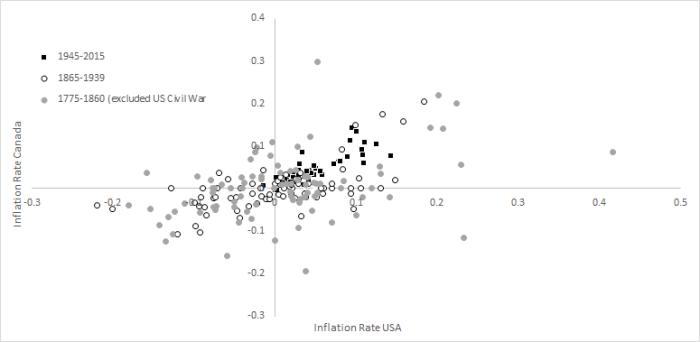
So, to see if this is the case, I decided to take my paper (online since yesterday) on creating a price index for Canada since 1688. Measuring Worth offers an American Price Index that starts in 1774. If the two economies began to become more interlinked, then a price index that goes back to the founding of the United States should do the trick. The result is below.

pricescorrelation

I organized the data by time period and it seems that the rates are generally correlated (which you would expect since global monetary conditions do suggest some long-terms similarities in terms of price trends – I have many reservations about the book I am citing here, but it gets the empirical point across). However, the dispersion seems to collapse over time. As we move from the colonial era to the modern era, inflation rates get more tightly grouped together. Free trade, lower transport costs, central bank policy, capital mobility and labor mobility would have factored in to mean that things become more tightly knit.

It does seem like Canada and the US became more interdependent over time.

I have more to come on this!

What if fake news was merely an attempt at political entrepreneurship?

Fake news! The new plague that besets mankind! That is largely the new name given to what 19th century folks would have called “yellow journalism“.

Yellow journalism was sensationalist to the point of distorting the news in order to carry a very emotional message. Generally embedded in that message was a political narrative supporting progressive reforms (not all yellow journalists were progressive but it seems that most were).

The aim of many progressives was to design a new society, to reform the old society by getting rid of old institutions. In many cases, economic historians have documented that these reforms (like with prohibition, workers compensation, antitrust) ended up serving very narrow interest groups who either allied themselves with reforming zealots (as in bootleggers helping baptists pass Sunday sales bans), gained through the restriction of competition or gained at the expense of future workers and minorities. But it is not as if the “previous” order was paradise. The postbellum era prior to the progressive era was highly protectionist, used public funds to bailout poorly performing railways and solicited the federal army to deal with natives rather than peacefully deal with them.  Basically, both eras had their political entrepreneurs who found their way in the political process to obtain favors.

Progressives who indulged in yellow journalism merely wanted to replace one set of political entrepreneurs with another. Just like the Alt-Right, from which emanates most of the fake news. In a way, both are exactly the same. Many members of the Alt-Right are not interested in restraining government abuses, they’re in favor of redirecting government indulgences towards them (Trump did promise less immigration with paid maternity leaves and no reduction in social transfers). Some are well-meaning like the baptists of lore. But there are still bootleggers (example: Steven Mnuchin from Goldman Sachs) who co-opt the process in order to continue indulging in rent-seeking just as they did before.

Are we about to swap one bad set of institutions for another? Given that all I see is the same type of political entrepreneurs (after all, Bannon from the flagship of the fake news alt-right outlet Breitbart is now a member of the government) as those we saw during the progressive era, I am inclined to respond “yes”.

Trump’s rejection of TPP: a political economy comment

Trump’s rejection of the Trans-Pacific Partnership (TPP) seems virtually certain. Without the United States and with a weak Canadian prime minister on the issue (who got elected without a clear position on it), the agreement will die a swift death. By dying that rapidly, it confirms a point I have been making for years: agreements like the TPP are managed trade that generate as much (if not more) opposition than genuine free trade agreements (those that could fit on a few pages, not 10,000).

Protectionism are basically income-redistributing schemes. Shifting from protectionism to free trade means altering these schemes. Thus, the political opposition and the agreements we have seen over the last decades where special dispensations are placed inside the agreements. In some instances, like the Canada-US Free Trade Agreement of 1988 (CUFTA), this leads to genuinely freer (not free) trade. In other cases, like CAFTA in the early 2000s, the agreement is nothing less than rent-seeking by different means.

In the case of TPP, it seems that popular discontent is large enough to kill this very complex (and flawed) agreement. I am not sure whether or not, in net terms, the TPP was an improvement over the current state of affairs. What I am sure is that the opposition was similar to what the opposition would have been with unilateral trade liberalization.

At this point, small countries with no influence on world demand (like Canada) should simply go “at it alone”. What I mean is that unilateral trade liberalization is the way to go. There is a strong case for unilateral trade liberalization (see notably the work of Edwards and Lederman) for small economies. A large part of the cost of protectionism is not the level of tariffs and quotas, but the distortions generated in relative prices that lead to inefficient allocations of resources.The low hanging fruits are to be found in the tree of leveling the field. Small countries could convert quotas into tariffs and set a uniform (across the board) low tariff (see Chile’s case).Although far from ideal free trade (no barriers), this would represent a considerable improvement over the distorted relative entry barriers.

In such a situation, the political costs would be the same as those with agreements like the TPP, but the benefits would be infinitely larger making it easier for governments to proceed. The narrative would also be easy to sell to electorates: no special treatment for anyone. In the long-term, this may even “spillover” into multilateral trade agreements by reducing frictions during negotiations.

A libertarian case for Hillary Clinton

I have abstained from commenting on the American presidential race between Donald Trump and Hillary Clinton (sorry Rick) for so long because I just wasn’t very interested in it. I’m still not that interested in it, but the topic has come up quite a bit lately here at NOL so I thought I’d throw in my two cents.

First, though, I thought I’d use up a couple of paragraphs to explain why I don’t really follow American presidential elections, even though most intelligent people, in most parts of the world, do. American presidents simply don’t have a lot of power in domestic American politics. Congress controls the purse strings, makes the laws, and, in the case of the House of Representatives at least, is closer to the People than is the President. The Supreme Court is in charge of deciding which laws are good and which are not, and in some cases even has the power to create laws where Congress or the People simply aren’t getting the job done (Proposition 8 in California comes to mind). To me, that makes the executive branch the most boring branch of government.

The one area in American politics where the head of the executive branch does have a lot of leeway, foreign policy, is one area where I’m not particularly worried about either candidate. I’m not worried because both, despite holding views of the world I strongly disagree with, are not advocating anything radical or unpredictable. I’d rather have a presidential candidate advocate the same old garbage of getting in Russia’s face and keeping troops in South Korea because that way I know they’re ignorant and, more importantly, I know they know they’re ignorant on such matters because they defer to the Washington Consensus.

Libertarians don’t like statists and we don’t like statist policies. Some of us don’t even think voting is worth the effort (or even a good idea). I think there is a case to be made, though, for Libertarians and libertarians to get out and vote this fall for Hillary Clinton over Donald Trump. My case rests on 3 hugely important facts (at least to libertarians and Libertarians).

Fact #1: Thanks to the recent wikileaks revelations, we know for sure that Hillary Clinton is in favor of free trade. This is THE most important reason to vote for Hillary Clinton in the fall. Imagine if the United States, led by Trump’s isolationism, were to begin breaking its trade agreements with the rest of the world. Yikes. Free trade has lifted hundreds of millions of people out of poverty over the last 30 years, but because the majority of beneficiaries to trade liberalization have happened to not be American citizens, demagoguery ensues. I understand that Clinton has expressed skepticism in US free trade agreements on the campaign trail, but when you’re in a party that is vying for potential voters who feel they have been hurt by free trade, you’ve gotta do what you’ve gotta do.

Regardless of what Clinton says to the masses, her record on free trade while holding political offices is impressive (a ‘No’ vote on CAFTA notwithstanding). Free trade, or trade liberalization, is one of the fundamental tenets of libertarianism. Individual liberty cannot be realized or even partly realized without markets that are free from the constraints of governments and the factions that manipulate them. Donald Trump, like Bernie Sanders, wants to reverse decades of trade liberalization and the benefits that such a policy has bestowed upon humanity.

(Digression: Libertarians and libertarians are so adamant about free trade not only because it loosens the grip of the state over peoples’ lives, but also because it makes everybody – not just fellow countrymen – better off. When libertarians and Libertarians hear protectionist sentiments from the political class, you will often see or hear us point out that the Great Depression of the 1930s was hastened not only because of central banking policies but also because of the isolationist tariffs that Congress threw up as a response to the economic downturn caused by the new central bank’s policies. Free trade is a BFD.)

Fact #2: Hillary Clinton is much more individualist than Donald Trump. Women’s rights is an individualist issue, and always has been, even though Clinton has made a mockery of the historical movement by playing the “gender card” and defending (and pledging to expand) subsidies in the name of women’s rights. Trump wants to “make America great again,” but Hillary just wants your vote, any way she can get it. If that ain’t individualist, I don’t know what is.

Hillary Clinton is not a racist, either. She marched against The State’s oppression of black Americans in the South and against The State’s discrimination against black Americans in the rest of the country throughout the 1960s. (For what it’s worth, I don’t think The Donald is a racist. Businessmen rarely are, for reasons that should be obvious to any fair-minded person, but his rhetoric on race is absolutely toxic, and he knows it. His deplorable actions bring to mind a certain F-word I won’t mention here.)

Trump may or not be a racist – I’ll give him the benefit of the doubt – but I don’t know for sure. Clinton is definitely not a racist.

Fact #3: Hillary Clinton is a lawyer and she knows how our government is supposed to work (even if she doesn’t like it). One could make the case that Trump knows how our federal system of government works, too, given his braggadocio about buying off politicians, but his is a vulgar understanding of what is, after all, a magnificent example of compromise and diplomacy over our more primal urges. Lawyers make better politicians than businessmen. As Alexis de Tocqueville remarked way back in his 1831 ethnography of the United States:

“the authority [Americans] have entrusted to members of the legal profession, and the influence which these individuals exercise in the Government, is the most powerful existing security against the excesses of democracy […] When the American people is intoxicated by passion, or carried away by the impetuosity of its ideas, it is checked and stopped by the almost invisible influence of its legal counsellors, who secretly oppose their aristocratic propensities to its democratic instincts, their superstitious attachment to what is antique to its love of novelty, their narrow views to its immense designs, and their habitual procrastination to its ardent impatience.”

Lawyers, Tocqueville observed, make up a sort of informal aristocracy in America because their training in the field of law requires them to have a deep respect for precedent and “a taste and a reverence for what is old.” Businessmen are not used to the clumsy, inefficient coalition-building necessary for good governance. That’s why businessman George W Bush was such a failure and attorney Bill Clinton was such a success. Any good libertarian needs to acknowledge the benefits that come from specialization and the division of labor. Any really good libertarian, the kind that has actually read a little bit of FA Hayek’s work, knows that change in the political and institutional arena needs to be done slowly, and preferably through the legal system (no matter how imperfect it may be).

I know all about the bad stuff that Hillary has supported and voted for in the past (especially on foreign policy, and even more especially on foreign policy in Africa). I get it. I really do. But Donald Trump represents a very nasty strain of thought that has swept into power of the country’s Right-leaning political party. His nationalism is antithetical to libertarianism in a way that Clinton’s typical corruption and condescension is not: libertarianism has a long history in this country of dealing with Clinton-esque figures. The American polity was forged by consensus and thus has recourse, perhaps more so than any other presidential system, to constrain exactly this type of persona. This persona is egotistical and out for personal glory and prestige, but libertarians, progressives, conservatives, and others here in the United States have institutions and networks that were created specifically for presidencies run by people like Clinton.

We’re small in number, too small to have a significant impact if we all voted for Clinton, but we have an outsized impact in the realm of ideas and policy. Get behind Clinton in any way that you can, because more of the same ain’t all that bad.

Theory versus Common Sense? The case of Free Trade

[…] the [World Baseball Classic] allows Organized Baseball to sustain the structures that constitute its inner purity, maintaining the boundaries of its regular and post seasons above all against all challenge by foreign teams, all the while increasing its global reach in recruiting talent and vending its commodity […A]ll the champions and perennial powers of the world’s other leading leagues need not apply.

[…] To call [Organized Baseball] an empire, or even a monopoly, is to seriously underestimate it. It is to fail to see the form of power it wields in shaping the separateness of its own commodious world, controlling access, avoiding and deflecting competition, limiting liability, sustaining and elaborating fictions of separate but equal, and mostly separate.

[…] For all of our ease in understanding objections to racism, for all that we can see the flaws in separate but equal when it generated the Major Leagues and the Negro Leagues, most of us now, not only but especially Americans, have no inkling how strange and immoral will someday seem our sanguine acceptance of the legal fortresses of limited liability and nation-state self-determination. (170-172)

These passages are from the last few pages of American anthropologist John D Kelly’s short book The American Game: Capitalism, Decolonization, World Domination, and Baseball. You can read it for yourself, but my short summary of the book is that it pleads for free trade. Not the theoretical free trade of economists, mind you, but of a practical free trade that opens up borders to labor (Kelly points out that it is really hard to play in the Majors if you are not an American, but shortsightedly blames US policy when other nation-states harbor just as much of the blame; if anything, the US has one of the more open immigration policies in the world today) and to marketplace competition (i.e. capital) in the realm of goods and services. I don’t know if this is a conclusion that Kelly would be comfortable being associated with, given that he is a man of the Left, but what would you call a world where baseball teams from Cuba, the US, the Netherlands, Japan, etc. compete with each other on an even playing field for labor, fans, and prestige?

The stubbornness of the Left is sometimes astounding. Kelly is right to lament the fact that the American baseball league (“Organized Baseball”) wields so much power in international baseball, but he doesn’t spell out an explicit remedy for solving this issue. Instead, it seems as if he is mystified as to how this could possibly happen. He understands and acknowledges that Organized Baseball derives much of its power from being located in the world’s most powerful nation-state, but he also understands that free trade (of labor and capital) is the answer to this issue without explicitly acknowledging this fact.

It seems to me that this is an issue where libertarians and internationalist Leftists can work together, provided we clarify a few concepts. Free trade is the answer for a lot of problems in the world today. Internationalists on both the Left and the Right realize this (see also Delacroix). The New Left intelligentsia, though, wants a practical free trade, and it often accuses economists of arguing for a theoretical free trade. But this critique is made in bad faith: Because economists are more familiar with the theoretical version of free trade, they are, as a whole, more willing to make compromises in the form of small steps towards more free trade. The New Left intelligentsia, instead of taking into account all the various options that can be done to move toward a freer world, including political limitations on what can be done to open societies up more to each other, has decided instead to poo-poo the small steps advocated by economists, and all in the name of practicality!

I agree with Kelly and others about the nation-state being a tool of segregation in today’s world. Unlike the New Left, though, I wholeheartedly embrace the pragmatic steps being taken to erode this segregation through the peaceful medium of free trade, even if it is not True Free Trade.

Classical Liberalism, Cosmopolitanism and Nationalism

In another thought-provoking post on Facebook (does the guy ever write mediocre stuff, I wonder?) Barry raised the question of the relation between classical liberalism, nationalism and cosmopolitanism. He wrote the following:

“On the capture of classical liberal/libertarianism by anti-cosmopolitans. This is very influential at the heart of the ‘leave’ ‘elite’ in the UK, and can only be destructive of classical liberalism/libertarianism. The immediate political consequence of Leave is the elevation of Theresa May to Tory leadership/Prime Minister’s office on a much more ‘Red Tory’, communitarian, corporatist foundation than existed under Cameron. ’To the extent to which the current wave of populism maps into a conflict over national versus transnational identity (Dan Drezner is unconvinced), the problem is not an excess of cosmopolitanism but rather its absence, especially on the conservative, free-market right.”

He seems to take a positive relation between classical liberalism and cosmopolitanism as the default position. Of course Barry did not provide definitions in a FB post, but here I take cosmopolitanism to mean “the idea that all human beings, regardless of their political affiliations, belong to a common moral community. Cosmopolitans often believe that all individuals have the same basic moral status, and tend to downplay the importance or desirability of national political institutions. [They are] opposed to nationalism” (source: Matt Zwolinski (editor), Arguing About Political Philosophy, Routledge, 2009).

I argue that Barry overlooks that classical liberalism combines a cosmopolitan side, with a strong defense of national political institutions (e.g. the state). The cosmopolitan side is perhaps easiest to see, if one takes the idea of free trade as the guiding principle. Free trade is by nature morally neutral for the individuals involved, and has numerous positive economic effects; it fosters cultural exchange as well as innovation and knowledge sharing. In that sense classical liberalism is indeed related to cosmopolitanism.

Yet this stops where the national state comes into play. Classical liberals never predicted any positive political effects of trade (see my earlier notes on this topic) and, just as importantly, they actually favor a strong state, with a limited number of tasks. At the same time, from Hume and Smith onwards to Mises and Hayek, they strongly dislike the idea of transnational political institutions, because these lack any substantial emotional basis which nations do posses. Also, these large political institutions easily become a threat to individual liberty, even more so than national states with too many tasks. So, there is no really no relations between political cosmopolitanism and classical liberalism at all.

There is also no relation between nationalism and classical liberalism. A preference for the national state does not lead to nationalism, which is the vicious and poisonous belief in the superiority of one’s country, often accompanied with a dislike of allegedly inferior neighboring countries or peoples or groups. This is collectivism turned even worse, which is a double ‘no’ from a classical liberal perspective. This said, if patriotism is defined as national pride, then classical liberalism and patriotism can and will go together. There is a fine line between the two sometimes, but patriotism is not violent and dividing, but a binding force between individuals sharing a national state.

The last point is on the European Union. Hayek and Mises have been on record with strong support for a European Federation, primarily as a remedy to war-torn and nationalism-infected Europe. In these circumstances the default position of an international order as a society of states no longer functioned, so there was a need to seek an alternative. Needless to say their federation had little resemblance with the current super state we know as the European Union, which has become a classical liberal nightmare in terms of liberty and property rights violations it commits on a daily basis.

The current EU has some classical liberal traits (the imperfect common market is the single most important one), which is of tremendous use to all European individuals. It is, however, way too cosmopolitan in the bad political way. A likely consequence of Brexit is that this will become even worse, now that the French and their allies will get more room for their collectivist fallacies.