In the Spirit of Socialist Realism: Sampling American Multikulti Cinema

On the new year day, searching on Youtube for something to watch, by chance, I stumbled upon a low budget and poorly made Western Yellow Rock (2012). By now, I watched enough of Hollywood products that were tailored to current “diversity” ideology and PC tastes. At least, some of them (e.g. Django Unchained, Black Panther, Dances with Wolves) were well crafted . But this Yellow Rock really “rocks.” It totally “overwhelmed” me. 

An official plot description is rather innocent:

“A man searching for his missing son hires a group of rugged cowboys to take him into territory controlled by the Black Paw Indians. When they come upon an ancient burial ground, their own greed tears them apart, as the posse turns on itself.”

Yet, in reality, from the first scenes, you are literally plunged into the “diversity pulp fiction”: caricature whisky-drinking and swearing white male rednecks (the posse) approach a camp of no less caricature noble American Indians who are taken care of by an all-female team of noble physicians and nurses. The head of the posse claims that he is looking for his missing son. Yet, in reality, they need to secure a permission from the tribe to cross Indian lands to reach an abandoned gold mine to get hold of some sacks with gold dust. Through their wooden characters, from the very beginning, producers defined clearly ideological sides: noble victims (Native Americans), allies (white women), and oppressors (white males). Not a single shade of grey. The only exception is a white male alcoholic scout who takes the posse into the wild. As a victim of his addiction, he is also somewhat qualified to be noble, and, in fact, he acts as an ally too.
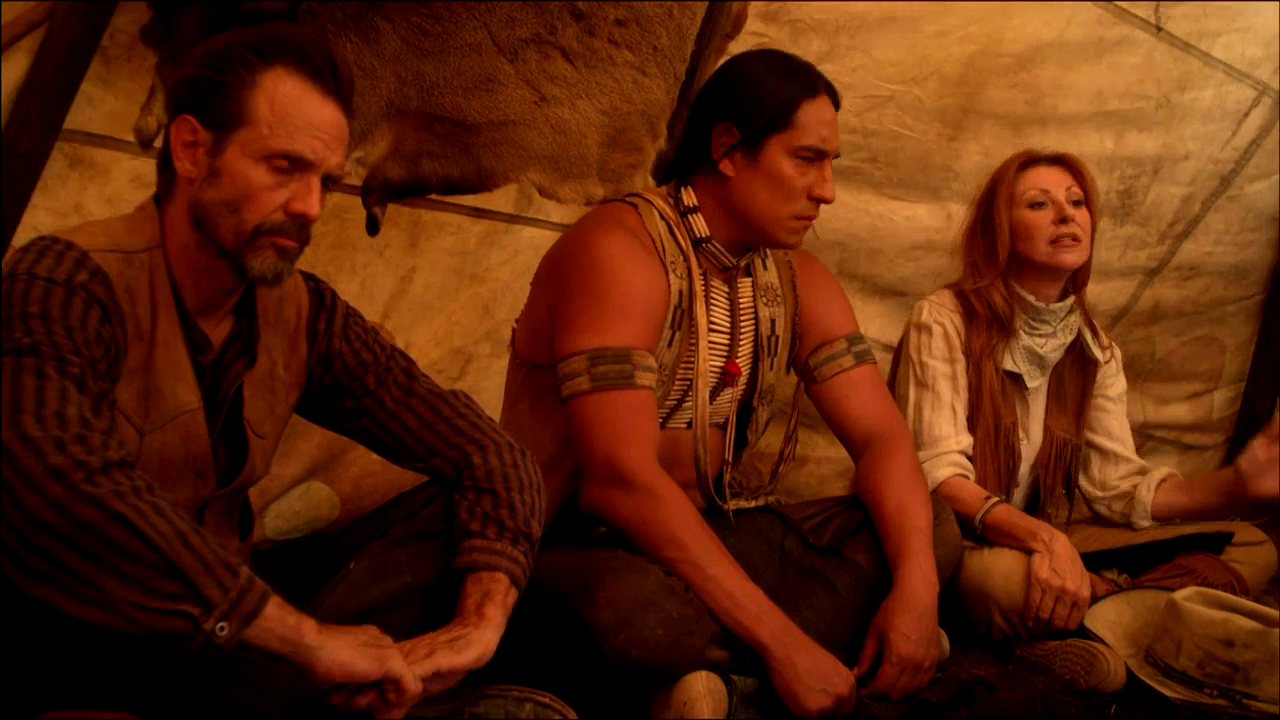
nol_4The cliche plot is painfully predictable: the posse of the “whitey” wants to cross straight across Indian burial grounds, although the “Injuns” warn them not to do it. Of course, by violating the sacred land, the “whitey” offend local spirits, who send against the rednecks a pack of wolves who appear as grotesque caricature shiny silver wolves resembling their brethren from New Age postcards and posters. Finally, the evil posse, which en route harasses an accompanying female physician and a male Indian, finds the gold. Yet, driven by an expected greed, the members of the posse take on each other. The rest of them are finished by the physician who is able to snatch a gun and by Black Paw Indians who arrive just in time to commit the act of justice. The movie ends with a scene of a slow motion collective execution of the last greedy redneck by a group of the Black Paws who repeatedly shoot the guy holding tightly a sack of gold. When the justice warriors lean over the dead corpse, they find out that gold dust somehow miraculously turned into regular dust; elements of paranormal and New Age mystique are rather common in latter day Westerns.

nol_2

I would not have ventured into the description of this “movie” unless it had not provoked me to jump to an obvious conclusion: at times a trashy cultural product might serve as a good learning tool. Trashy stuff highlights dominant ideological cliches and sentiments more than any other more or less well crafted movie. Like an imbecile who mimics the behavior of surrounding people, such “masterpieces” clone the mainstream ideology that is superimposed on people in public schools and colleges. To me, Yellow Rocks demonstrated how deeply the educational system (film studies along with the rest of humanities) and print media has ingrained in the minds of movie makes the pillars of what people on the right label Cultural Marxism and that people on the left call Critical Theory. In its turn, this elusive theoretical “beast” served as a major fountainhead of the Multiculturalism ideology.

nol_34

Watching that particular movie, I suddenly felt catapulted to the “good old” Soviet Union. Replace noble Indians+female do-gooders with noble workers (proletarians) and greedy white evil males with greedy capitalists and you will get a solid Soviet movie tailored according to the cliches of Socialist Realism. For those who do not know what Socialist Realism is, I want to note that it was a Stalinist doctrine that required from movie makers, poets, writers, and the rest of the intellectual gang to depict the surrounding life not as it was but as should be in the ideal future. I have also realized that comparing old Soviet and communist Chinese movies with current multikulti products in European and American realms might have a pedagogical value. It will allow us to trace the genetic links between the Marxism of old that had been obsessed with political economy and class warfare and the current Cultural Marxism that is obsessed with racial and gender identity wars. In the 1920s and the 1930s, both in the Soviet Union and Western progressive subculture the ultimate noble savage was a metaphysical muscular male proletarian.

Since the 1960s, “noble savages” of old Marxism became replaced by the new cultural left with new “noble savages”: third world, people of “color,” females, gays….The list of victims who are simultaneously to act as redeemers from the evil Western civilization is not yet complete.

In a typical Soviet heroic movie a people-friendly misfit character without a stable class-based moral compass chaotically fought against oppression. He or she needed a solid back up form a wise muscular industrial proletarian who, with his working class salt of the earth wisdom, was to take this character to the highest level of consciousness. In Yellow Rock, the alcoholic scout similarly was upgraded by female and Indian wisdom. Incidentally, the same trope one can observe in the third part of the famous (and well made) Hunger Games trilogy that I watched again last night. The major character, Katniss Everdeen, a noble female warrior, was not complete without receiving an endorsement (in the final scene of that trilogy) from the victim/redeemer of a “higher caliber.” After Everdeen defeats dictator Snow, an aged cunning white male, a black female elder approaches Everdeen and gently leads her to the center of the new power, where masters of the multikulti paradise gathered to usher the new world.


nol_9

Nightcap

  1. The original meaning of the 14th Amendment Damon Root, Reason
  2. Understanding politics today Stephen Davies, Cato Unbound
  3. It sometimes begins with Emerson Irfan Khawaja, Policy of Truth
  4. RealClearHistory‘s 10 best history films of 2018

Nightcap

  1. African soldiers (excellent film review) Jeremy Harding, London Review of Books
  2. Not born in the USA Irfan Khawaja, Policy of Truth
  3. Iraq’s Kurds versus Turkey’s Kurds Mahmut Bozarslan, Al-Monitor
  4. Branko Milanovic’s confusion on inequality David Henderson, EconLog

Nightcap

  1. Is Heaven’s Gate really a bad movie? Rick Brownell
  2. You can’t go home again, America Emma Ashford, War on the Rocks
  3. Nostalgia and democracy Seth Cotlar, Age of Revolutions
  4. Aleppo after the fall Robert Worth, New York Times Magazine

Animation Review #1: Burn the Witch

I am a big fan of animation, but I often have to ‘turn my brain off’ to enjoy a comic trying to make political commentary. With rare exceptions, like the Incredibles series, the industry has a strong statist bent. The industry is so statist that Superman: Red Son, a story line with the premise that Superman landed in the Soviet Union instead of the United States, ends with the message that communism would work if only it were a bit more democratic. Note that I say statist bent, as opposed to leftist bent. They are smaller in number, but there are several conservative comics (e.g. the Kingsman) that leave a statist aftertaste.

I can’t do much on the supply side of liberty-friendly comics, but I can at least highlight those comics that I think fellow libertarians might enjoy via blog posts.

First off is Burn the Witch, a new comic series published by Shonen Jump. I was pleasantly surprised when I read through Tite Kubo’s Burn the Witch. Tite Kubo is best known for authoring Bleach, a comic about Japanese school children fighting demons in fantasy Mexico.

Dragons.png

Burn the Witch is about Anglo-Japanese school children fighting demons in fantasy Britain. The twist? Unlike their counterparts in fantasy Mexico, the British demons (referred to as ‘Dragons’ in-series) aren’t killed outright. Instead they are raised for the resources they provide. Only ‘bad’ demons who are killing humans or otherwise causing destruction are killed. It is noteworthy that the protagonists refer to themselves as ‘conservationists’. They kill the occasional demon, providing the story with action scenes when doing so, but their primary purpose is to conserve them. In an off hand comment the protagonists note that their fantasy Mexican counterparts are barbaric and indiscriminately kill their demons.

Contrary to the protagonist’s comments, it isn’t that individual fantasy Mexicans are barbaric so much that fantasy Mexico doesn’t recognize property rights in demons. Since no one has a property right in demons, no one has an incentive to conserve, much less domesticate, them in fantasy Mexico. Fantasy Britain enjoys strong property rights and consequently has minimal problems associated with its demons. One of the protagonists is ethnically from fantasy Mexico, but seems to be thriving under fantasy Britain’s rules. The story’s lesson? Property rights matter.

Only one chapter of Burn the Witch has been published thus far, and it’s unclear if it’ll become a recurring series, but I like what I’ve seen so far.

Thoughts? Comments? As always, write in the comments below. If you’re a fan of animation and a fellow libertarian, consider joining the anime libertarian alliance facebook group.

The Politics of the Incredibles (minimal spoilers)

I saw an early release of the Incredibles 2 last night. I wasn’t expecting too much given Pixar’s history with sequel. Finding Dorothy, Monsters University and the Cars sequels were okay, but below average for Pixar. I am happy to report that the Incredibles 2 was a pleasant exception. Not only did the film re-capture the magic of the original, it made a point that many readers and fellow Notewriters should appreciate: legality doesn’t equal right.

The film starts off directly after the events of the first film. The titular Incredibles family fights off the Underminer, a mining themed super villain. Instead of getting praised for their actions though, they get arrested. Superheroes are still illegal. The events of the past film haven’t changed that. One of the characters wisely remarks, “Politicians don’t understand why someone would do the right thing for its own sake. They’re scared of the idea.”

The family is let go, but they’re at a low point. Their home has been destroyed. They’re unemployed and broke. They’re gifted with super powers, but they live in a world where they can’t legally use them. That’s when a businessman approaches them and asks – why not use their super powers? The businessman proposes that the family continue to use their powers illegally, and convince the government to change the law after the public has been shown how useful superheroes are. This leads to a funny exchange where the characters argue about how they’re being asked to be illegal in order to become legal.

I won’t spoil the remainder of the film, but I love the businessman character’s early scenes. It’s refreshing to see a corporate character, and his disregard for legislated morality, portrayed in a positive light. Tony Stark/Iron Man starts off this way in the early MCU films, but makes a u-turn by Captain America: Civil War. This new character, for better or worse, stands by his beliefs.

The tension between legislation and morality isn’t a new theme for Pixar. The idea of breaking the rules to do what’s right was a central feature of Monsters University as well. It’s a lesson I think many children, and their parents, could benefit to learn. Legislation isn’t morality.

I give the film a solid 9/10. It’s around Wall-E or Up levels of quality. It’s easily one of the funniest Pixar films in a while. The animated short before the film is, as standard for Pixar, a tear jerker. Bring some tissues.

Thoughts? Opinions? Post in the comments.

“The staying power of ‘Citizen Kane'”

That’s the title of my Tuesday column over at RealClearHistory. An excerpt:

The relevant socio political commentary is more interesting, in part because people today still use the film to attack media moguls they don’t like (such as Fox News’ Rupert Murdoch). One narrative about the film’s sociopolitical impact even likens the film to a subtle anti-fascist, and pro-war, production because of the attention it draws to the immense power media moguls wield, and the incentive structures they face (and produce). This argument has at least some bite to it, as one of America’s most powerful media moguls in the 1940s, William Randolph Hearst, refused to give the film any sort of advertisement in any of his many publications. This blackballing on the part of the powerful led, of course, to the Citizen Kane’s relative flop at the box office.

Read the rest, baby!

Lunchtime Links

  1. 25 years after Waco Freedom of Conscience and the Rule of Law
  2. The US-Japan Alliance and Soviet competition | Some thoughts on “Thinking About Libertarian Foreign Policy”
  3. Japan’s rent-a-family industry | In Search of Firmer Cosmopolitan Solidarity
  4. The story of the skull of a victim of the Indian Uprising of 1857 | Myths of Sovereignty and British Isolation, III
  5. Reviving India’s classical liberal party | Classical Liberalism and the Nation State
  6. The decline of regional American art | A History of Regional Governments
  7. Michelle Pfeiffer keeps getting better and better | On the paradox of poverty and good health in Cuba
  8. “It was the most devastating loss in the history of the Library.” | No, natural disasters are not good for the economy

Nightcap

  1. The cursed wonders of India Rishika Yadav, Spontaneous Order
  2. Robot of Jihad? A Guide to Tipu’s Tiger Blake Smith, the Appendix
  3. Black pictures (film) Darryl Pinckney, New York Review of Books
  4. A Male Feminist’s Crisis Michael Friedrich, New Republic

Nightcap

  1. A libertarian review of Chappaquiddick Stephen Cox, Liberty Unbound
  2. The 19th century war on dogs Livia Gershon, JSTOR Daily
  3. The NBA is thriving because it has embraced individualism Douglas French, National Review
  4. After reading this, I can’t imagine why… Anar Parikh, Anthro{dendum}

Nightcap

  1. Blood on the land in Brazil Gregory Duff Morton, New York Review of Books
  2. “Blackness” in France and in America Sarah Claire Dunstan, JHIBlog
  3. What if prejudice isn’t the cause of racism? Blake Smith, Aeon
  4. Mexico is whooping the film world’s butt Ioan Grillo, New York Times

Nightcap

  1. Iran’s Afghan fighters, in Syria Ahmad Shuja Jamal, War on the Rocks
  2. The Africans of 16th Century Britain David Dabydeen, New Statesman
  3. What Books Did American Blacks Read Before the 1960s? Jonathan Rose, History News Network
  4. Padmaavat loathed by fundamentalists of all stripes Barkha Dutt, Washington Post

Nightcap

  1. Centuries-old German toy shop conquers internet Katrin Terpitz, Handelsblatt
  2. Interviews with Nazi Filmmakers [pdf] Gary Jason, Reason Papers
  3. Comparing Mao to Hitler and Stalin Ian Johnson, NY Review of Books
  4. 10 Weapons That Forged British Empire (my latest at RealClearHistory)

Atlas Shrugged Part II

I got around to seeing the movie this morning along with about ten other folk. I was reminded of why I don’t go to movie theaters: they’re run by sadists who like to torment people with a quarter hour of promos following the advertised starting time, meat-locker temperatures and ear-splitting sound. I didn’t bring my wife knowing she couldn’t have endured the torment but I’ll get the DVD later.

So, what of the movie? Quite good, mostly. The screenplay is faithful to the novel, thanks, no doubt, to David Kelley. The special effects, notably the tunnel disaster and the airplane chase and crash, are powerful. I wasn’t bothered by the change to an all-new cast. Rearden’s trial was done well. The acting, however, is mixed. Rearden is good and the bad guys are good but Dagny, who is really the central character, was a disappointment. She looked almost bored as she piloted her plane toward what increasingly looked like death. Only later did she crank up the intensity.

Just a couple of nits: two men can’t lift a concrete railroad tie. Galt tells Dagny not to move because she’s hurt and then extends a hand to drag her out of the wrecked plane. A few others but nothing substantial, really.

I give it 3.5 stars out of 4, but I’m sure the critics won’t agree. It looks like the movie will follow Part I into oblivion, sad to say. One only hopes that DVD sales will pick up and that it will enjoy the same sort of underground success that the novel enjoyed following its scathing reviews.

Rainy Day

Here is a quick list of links around the web from our bloggers at the consortium:

Fred Foldvary weighs in on the 2011 Nobel Prize winners in Economics

Some Possible Consequences of a U.S. Government Default by Jeffrey Rogers Hummel

One of Jacques Delacroix’s famous short stories (and this co-editor’s personal favorite)

Brian Gothberg introduced me to Colossus: The Forbin Project at a summer seminar in 2009

I hope everybody stays dry out there!