More on Chinese Culture

The plight of migrant workers (and hints of Chinese nationalism):

If there’s one takeaway lesson from all the migrant worker stories in the news, it’s that they are quite often treated like crap. Nothing has hitherto expressed this more bluntly than one Wuhan toilet.

“Migrant workers prohibited from entering. Offenders fined 200 yuan,” reads the toilet’s bare concrete slab façade in bright red letters.

[…] Snoot city dwellers may love to hate on those lowly migrant workers who clean their streets, prepare their foods, and build their city, but unfortunately institutional discrimination in China does not end there. Foreigners (and dogs) are now at risk of being barred from certain establishments.

Read the rest of the blurb (from Shanghaiist). Readers may recall my most recent musing on culture and nationalism in China. There is more from our blog, on China, here.

Government Programs, Coffee and Bread

I have been vexed for years by a simple problem: How to explain to young people who were not taught anything of substance at school why free markets are desirable. You would expect this to not be much of a problem is this overall still capitalist country. When, I try, most of the time, I end up making their eyes glaze over although I am captivating speaker overflowing with charisma.

The difficulty is that the concept of market is counter-intuitive. In everybody’s personal experience, good things generally happen because someone makes them happen: Mom, Dad, the boss, God. The “invisible hand” of the free market is just that, invisible. To understand our economy takes an effort of imagination.

Lack of understanding of markets opens up people, especially young people, to the direct, unsophisticated emotional appeal of government intervention. In many minds again, especially in the young’s, government solves problems and when it does not, problems go unsolved. There is a good reason for this misapprehension of reality: The many good things that the market does, it does undramatically, almost imperceptibly. Its achievement tend to be taken for granted. By contrast, government interventions are nearly always thunderous, even and especially, if they turn out to be completely ineffective.

Below is a micro-essay question that illustrates this phenomenon. (No grade and no reward except the pleasure of discovery.) Continue reading

One Sure Thing About Globalization – The American Motion Pictures Industry World Hegemony Part 2

[Editor’s note: this lecture was delivered to the Leavey Institute of Santa Clara University in 2003. You can find it reproduced in whole here]

Poverty, some International Trends

Now, let’s look for objectionable new facts in the worldwide distribution of income. (It’s too difficult to get international data on wealth.) In the nineteen-fifties, the total of the national incomes of all other countries in the world barely equaled the national income of the US alone (Delacroix, 1974). Today, the US GNP constitutes less than one third of the sum of all countries’ GNPs (World Bank, 2002:4.2), although the US has experienced healthy economic growth since the fifties. It’s true that a number of countries are mired in deep poverty and that some are even regressing. (See below.) It seems to me those are all countries with exceptionally corrupt or tyrannical governments, such as Haiti on the one hand and North Korea, on the other, or stand-alone plutocratically-run former colonies such as the so-called “Democratic Republic of the Congo” (formerly Zaire), or Sierra Leone (where, incidentally, the bulk of the population was almost certainly better off under European colonialism), or that they have especially poor access to current information (because of high illiteracy and other reasons, including government censorship or even deeply entrenched cultural facts [4]), such as Afghanistan (but no hard data are available). By far the worst economic performers in the past ten years are the European countries that have been trying to recover from their cruel experiment in state socialism (“communism”), not the Third World countries.

In spite of loose talk of “globalization” somehow deepening the poverty of the Third World (5), the following countries experienced higher average Gross Domestic Product rates of annual growth than the US (and higher than any Western European country, except one; see below) between 1990 and 2000: Continue reading

Economic Growth in Europe: the Longer View

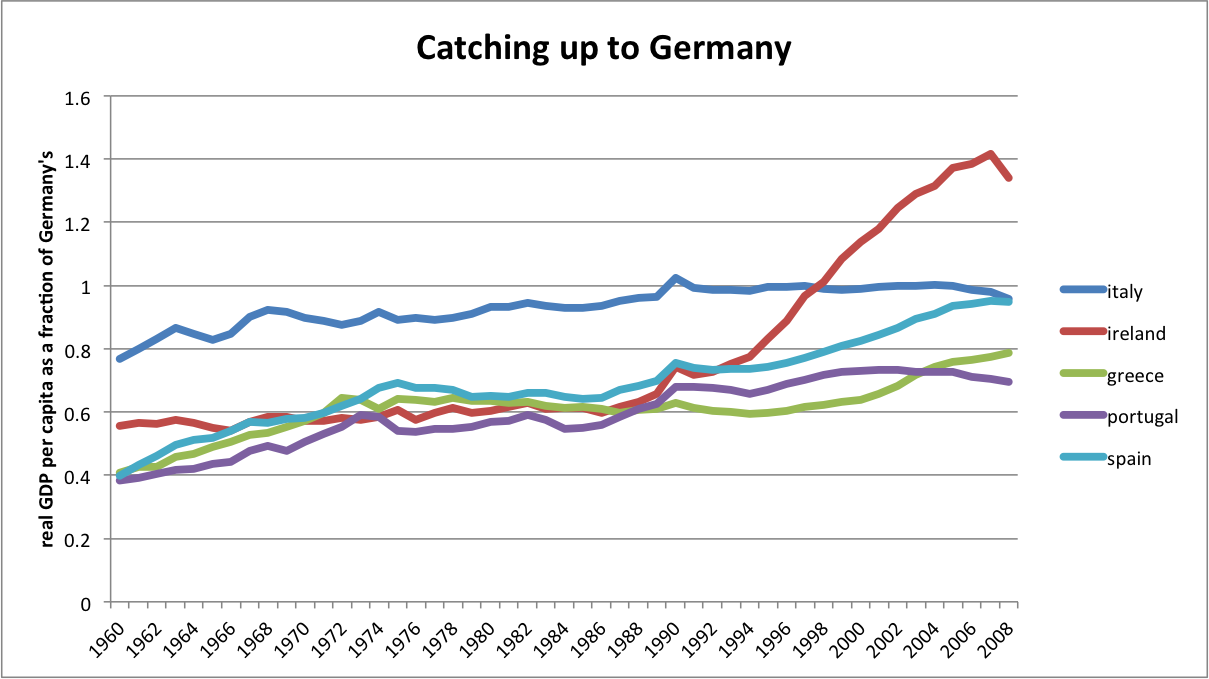
Economist Tyler Cowen has a post up on who has gained most from the Euro (as measured by state), but the economist Angus puts things into perspective:

Ireland, Spain, Portugal and Greece were all growing fast relative to Germany (and France which is not on the graph) well before the introduction of the Euro. Ireland and Spain take off somewhere around 1990 and the intro of the Euro in 2000 does not speed up their trajectory. Portugal actually falls further behind Germany in the Euro era. Greece is the only country of these 5 whose catch-up to Germany accelerates with the intro of the Euro.

Two quick thoughts:

  1. Woah! Look at Ireland!
  2. I’ll bet the acceleration of growth in the 1960’s had to do with the end of World War 2 and its rebuilding efforts.

Taking a broader historical view really puts things into perspective. If the Euro was not the catalyst for the economic growth of the 1990’s, what was? My guess is that the elimination of tariffs and labor restrictions between European states led to the growth. If the Eurozone had not implemented a central bank I think we wouldn’t be looking at all of the political problems now associated with the region.

Angus (who works at Oklahoma University) got his statistics from here. I highly recommend using it in your own studies as well.

The Good Old Days

Here is a story that’s more than a story.

All our food was organic and no one was overweight. We wore only natural fibers, from sheep and from the cotton fields of Africa.

Children did not get fat spending their days and nights in front of a stupid screen of one kind or another. We read instead.

No one was over-caffeinated or on pills. We rarely went to the doctor.

Kids with Attention Deficit Disorder did not disrupt any school.

We used water sparingly and washed our hair and bodies in simple, non-polluting soaps. We did not waste water or energy with long showers.

My own personal carbon footprint was close to zero, I am sure.

There were few car accidents, unlike now.  Continue reading

A View from Inside China

Below is what I think is an interesting document. It’s an email from a former MBA student. He is a Singapore Chinese who spends a lot of time doing business inside China, in Mandarin. He is an intelligent and well-educated man. I know him to have a conservative temperament overall but he is also a keen observer and an independent thinker. Some of his statements are disturbing to me. I post this document on my blog for its intrinsic interest, not as an endorsement. I note with interest that he has not asked me to delete his name in spite of his denunciations of Singapore’s treatment of its dissidents. I withhold it nevertheless. He can add it subsequently if he wishes.

I have been hearing lots about evil China and their evil products (mostly from Taiwan opposition party folks, Chen Sui Bian and his gang).

There have been lots of negative press about manufacturers in China and how bad they are. Thing is the blame needs to be shared. I sourced in China as well and I what I have seen appalled me. Not that the manufacturers are out to get the buyers, but more so, the buyers are working so hard to get the manufacturers. The incident about Mattel, for example, I feel it was an error on Mattel’s part not to confirm that lead-free paint was going to be used. They probably assumed it.

And they probably pushed the price down so hard that the manufacturers had to cut corners to make any sort of financial sense. And when excrement hits the fan, they sad the manufacturers were to blame. And what about Walmart? Most manufacturers I know, many of whom are my friends, are refusing to sell to Walmart. Walmart are so harsh on pricing that they would specifically ask for the lower (if not lowest) quality goods. They would put such a large order, so huge that they would take over the entire manufacturing capability of a factory. If the factory is dumb enough to let them be the biggest and majority customer, they will be in for a fix. Walmart to hit prices down low and threaten to move elsewhere. The factory would have no choice but to budge because, if Walmart left, they would go out of business. So corners are cut, and Walmart knows about these cuts. All they care about is price and in the end, the customer suffers. It is not just the savings are “rolling back” to the customers, but the poor quality of the products are going back to the customer as well. By the way, Walmart usually price their goods anywhere from five to twenty times that of the cost they procured it at.

My view on communism is very different from the average person in the “free world”. This is the “new” communism in China. My opinion is that things actually get done here and quick too. In the time that Oakland took to rebuild the Cypress Highway that connects 880 to the Bay Bridge after the earthquake, Shanghai has constructed more than 10 times of that distance in highways, most of them elevated, a complete subway system, 3 large bridges and 3 underwater tunnels, a full industrial park (cao he jing) a full financial center in Pudong, A new airport, and a new half of the city in Pudong literally done up. This is just within the limits of Shanghai city, excluding all the work done for the interstates. What can I say?

Comparing it to Singapore with a “democratically” elected government, China enjoys more freedom. Now, I say this as a person living in China, not as a politician. I see demonstrations from time to time in Shanghai and recently, the Shanghai government has been listening.

Talks happen, and situations get changed. It is true that China has seen more restricted times in the past but Hu and his current government is set to change that. The situation in Singapore is much more different where the law is often used to suppress opposition and dissidents.

See http://singaporedissident.blogspot.com/.

People in Singapore mostly just take it in and forget about it, choosing to think about car payments, house payments and if their favorite British soccer team is going to win.

Anyway, these are just some of my thoughts. Of course, there are things that gets to me in China and Singapore as well, and also many things I like about the USA. These are some ramblings I have. Feel free to put them on your blog if you want to. I really miss talks with you outside Kenna Hall while you are bumming cigarettes off me. ;)

P.S. I haven’t seen the Palin article on your blog. I will look it up. Every time I see her picture or video anywhere, I always get the impression of a deer in the headlights.

P.S.S. I have been out of touch with a lot of things. I really disapprove of Obama in 1) his work on 90% tax on the AIG bonuses (which I think is stupid and unconstitutional) and 2) him sending more troops into middle east.

A. L.

Normal Poverty

Here is a short excerpt from my memoirs: “I Used to Be French….”:

Young and youngish Americans of the early 21st century have personally only known prosperity. That is, historically unheard off prosperity. They are also fairly familiar with extreme poverty, with misery, because of the good job television often does documenting it in other parts of the world. More rarely, foreign travel gives them glimpses of appalling living conditions. And, of course, the many who have served in the Peace Corps are well informed on this topic. It seems to me that our contemporaries know little, by contrast, about the kind of poverty that prevailed in developed countries until recently. I call it “normal poverty.” I grew up in normal poverty, in Paris, in the forties and fifties. Here is what it was like.

My family of seven lived entirely off my father’s small public servant’s salary and off what he scrounged from after-hours bookkeeping for small merchants. We lived on the edge of Paris, in a charmless but well-maintained area of apartment blocks built by the city twenty years earlier. Municipal rents were probably kept artificially low. The seven of us shared an apartment that was smaller than the house I now occupy with my wife in California, a state where living spaces tend to be smaller than in most other parts of the country. Yet, we had central heating and hot water in the single bathroom. Other blocks nearby had indoor plumbing but no hot water, incredibly. Telephone service was the pay-phone at the café downstairs. When my family got its own phone, after the expected ten year wait, my mother immediately clamped a padlock on it. Continue reading

“Stocks Slammed as Dow Erases 2012 Gains”

That’s the title to a headline piece over at CNN.

The Dow Jones industrial average (INDU) plunged 275 points, or 2.2%, the biggest one-day drop since November. The blue-chip index gave up all its gains for the year, and is now 99 points below where it finished 2011. The S&P 500 (SPX) lost 32 points, or 2.5%, and the Nasdaq (COMP) dropped 80 points, or 2.8%.

Ouch. The cause of the plunge?

“The U.S. employment report was simply terrible,” said Marc Chandler, global head of currency strategy at Brown Brothers Harriman.

The May jobs report showed only 69,000 jobs were added to payrolls, less than half the 150,000 jobs forecast by economists surveyed by CNNMoney. The unemployment rate ticked higher for the first time in a year, rising to 8.2%.

I take three things away from this: Continue reading

Some Mistakes Have Been Made

I just finished up the readings for a class on the history of the modern Middle East. The main book issued is one conveniently written by the professor of the course (James Gelvin) and is aptly titled The Modern Middle East: A History. Below is an excerpt that I think sums up the problems facing the Middle East today:

American policy towards the Middle East [after World War 2] was instrumental in promoting both development and the civic order development was to sustain […] To promote development, the United States adopted a multifaceted approach derived, in good measure, from its own Depression-era wartime experiences.

Ooops.

Here is Murray Rothbard’s America’s Great Depression. Now, I know libertarians are infamous for condescending suggestions to “go read a book”, but I don’t think we can really help it sometimes. Hoover’s interventionist policies and Roosevelt’s New Deal were disastrous for the American economy. Most, if not all, of the Middle East’s problems today can be traced to the institutions currently in place, and these institutions in their turn were created and codified based upon models that had entirely failed the West.

For the record, the developmentalist approach led directly to, you guessed it, economic nationalism and political despotism. You can find a convenient ranking of the world’s states based off of GDP (PPP) per capita here. According to the IMF, the US ($48,387) is ranked 6th in the world (the US also repealed or rebuked many of the Depression-era policies of the Hoover and Roosevelt administrations; the few that remain are among the most pressing problems American society faces today). The world average is $11,489. Egypt is ranked 104th, Iraq is 128th, Iran is 69th (coming in slightly above the world average at $13,053), and Syria is 118th.

Karl Marx Was Right (Pretty Much)

Karl Marx spent a lifetime arguing that the motor of history, what caused social change, was the “class struggle.” (Marx said other, more complicated things in relation to the class struggle. I don’t care to talk about them right now because they are obscure and there is little agreement among Marxists about what they mean.) Marx also did not assign enough importance to technological progress, it’s true. That would happen largely as a result of ever greater densities of population, irrespective of any political system. Many people in close contact in cities are more likely to come up with better ways to get things done than few people who barely ever meet anyone outside their small group. Literacy also helped of course by helping preserve accumulated knowledge. With these major lacunas, I think Marx was mostly right.

Marx had an elaborated conceptualization of social class that he never really completed. First, what “class” is not, according to Marx (also according to Delacroix). Class explicitly does not refer to “the rich and the poor” as many think. That would have been of limited usefulness when Marx was writing and it would be utterly useless now. The fact is that the distribution of wealth in modern, capitalist societies (the ones Marx had in mind) is continuous, that is, there is not break-up point. Next to the person, or family who owns $1,000, 000 there is one that owns $999,000, and next to that one, there is another that owns $998,999. Likewise, next to the person or family who owns $50, there is one that has $51 in wealth. And so forth. Moreover, who owns what is not fixed except at the lowest end. I was poor when I was thirty, I am not anymore. People who own vast wealth are liable to lose large portions of it in a day or two, thanks to the normal operation of the stock market, for example. Thus, there is frequent re-shuffling and rich and poor are pseudo-categories and therefore, useless.

Marx explained at length that what social class one belongs to is determined by one’s “relation to the means of production.” This is a bad translation of the bad German that prevailed at the time Marx was writing. Generations of Marxists everywhere have striven to conserve this opaque language because it made them sound profound, not least in their own eyes, and because it made them look like possessors of higher, “scientific” knowledge. Let me dispose of the scientific claim right away. It’s pure propaganda, deliberate bullshit, one of Marx’s public relations achievements. He made his claims seem more serious than they otherwise would have seemed by calling them “scientific” at a time when the word conveyed much intellectual prestige. Again, it’s bullshit. What makes anything scientific is that it can be refuted by comparison with reality. Another way to say nearly the same thing is to say that scientific claims can be tested. (Don’t worry about the “nearly” in the previous sentence; the statement is good enough for our purpose.) Marx’s claims cannot be tested in a rigorous, logical manner. All Marxists can do is to cry, “See, Marx said so,” after the fact, whenever something develops more or less according to one of Marx’s many unclear predictions. One issue about which Marx was clear was the class struggle. More on this below.

The world in which Marx lived was different from ours in important respects two of which are crucial for understanding the idea of social class in the 21st century.

1 When Marx was observing and writing, in the second half of the 19th century, land was losing much of its age-old importance as a source of income, in comparison with manufacturing and mining, and later, railroads. While agricultural productivity was making steady gains in the richest countries, manufacturing and, in its wake, mining, were growing explosively thanks to the Industrial Revolution. (Note what I am not saying: Income from agriculture was not shrinking in absolute terms, it was expanding.) It was clear to most observers then that the quick way to riches was to capture the fast rising income generated by those industries. The best spigot was thus the material industries of manufacturing, mining and later, railroads.

The claimants to this income were uncommonly well-defined. On the one side were a small number of mostly family-based companies like the Krupp in Germany, the Schneider in France, the Rockefeller in America, and so on. These highly visible companies owned the manufacturing plants, the mines, and later the railroads. Here is a useful digression: Marx seemed not to have understood the importance of publicly owned companies in which small people and other groups could invest their small savings. He probably thought big corporations would remain in a tiny number of hands forever. Correspondingly, he did not understand well the role of stock exchanges either. He was wrong on this, wrong by large omission.

The other claimants to manufacturing, mining and railroad income were also highly visible. They were the masses of workers flocking to the cities and mining centers from the countryside. Those people were visible because of where they lived, near the centers of cities. Originally, they were also poorly paid and overworked. Marx observed that they were in a favorable situation to organize along labor union lines and also politically to an extend unimaginable by their peasant forebears. This, because of their geographic concentration and because of their ability to realize that they shared a certain type of misery.

From these accurate observations, it was fairly natural to predict that there would eventually be a clash between the super-rich owners of the means of production, manufacturing plants, mines and railroads, and those who toiled for them. It looked like there was at any time, a zero-plus sum game being played: Whatever the owner took, the workers did not get, and vice-versa: capitalists (owners) vs proletariat (industrial workers, broadly defined).

But everyone who was not a worker was not a capitalist in that sense, and everyone who was not a capitalist was not necessarily an industrial worker. The lawyers who serviced the capitalists could be expected to join with them. The tavern owners whose own income came from workers’ drinking would side with the workers, and so forth. This scheme makes it clear that a starving lawyer could be in the capitalist camp and a prosperous pub owner in that of the workers. Hence the idea that people would line up politically according to their “relationship to the mean of production.” This is a more sophisticated idea and also one much more applicable than the “rich vs poor” of the popular imagery of social class.

2. The second big difference between Marx’s time and ours is the size of government. Throughout the 19th century, governments everywhere were small and poor. There was no income tax; they derived revenue largely from customs (border taxes) and from excise taxes. Governments then were a fiscal burden on everyone if not equally, then commonly, but a fairly light burden most of the time.

Today, governments in the developed world are large to huge. They consume anywhere between 40% approximately and 70% of Gross Domestic Product. They are also everywhere by far the largest accessible source of income.

Superficially, the amorphous, ill-defined “service sector” seems even larger since it accounts regularly for more than 70% of GDP (in rich countries including the US). However, it’s fragmented, heterogeneous, controlled (to the extent that is is controlled) by a myriad of owners. Much of it is not very profitable, as opposed to 19th century manufacturing, for example. The services workforce is also extremely fragmented and it tends to be transient. It would be difficult for that workforce, or for anyone else to get together to capture anything of value. There is not much to take from the service sector and it would be hard to get.

By contrast, the large to very large chunk of money that is in governments’ hands at any one time is easy to capture. It does not take much more than a well-engineered vote to get one’s own hands on it. Furthermore, unlike the private sector’s funds that depend on the vagaries of the market and on management’s competence, government grants in various forms tend to have a long shelf life. The WWII subsidy to chinchilla farmers was only repealed about ten years ago, fifty years late! Civil service pension funds are another case in point. Obtaining money from government entities is well worth the effort. The government is both a big spigot and an easy one to turn on.

I know I promised to tell you that Marx was almost right. Well, what we see in America today is a classical Marxian class struggle. The classes in conflict are not those Marx described because he was writing almost 150 years ago and he had not foreseen the monstrous growth of government. (No one else had.) The Obamanian/Obamist faction of the Democratic Party has engineered and is engineering an alliance between the main social class of today, government workers, on the one hand and a few other, opportunistically selected groups, on the other hand.

First among the government workers class allies are the small minority of workers in labor unions (maybe 7 or 8% of all employed and unemployed people). Labor unions have always used government to grab what their own muscle failed to achieve. Second, are the majorities of racial minorities. Many – but not most – are poor for reasons that ceased a long time ago to be related to racism. The largest racial minority, so-called “Latinos,” is heterogeneous and many of its members are immigrants or one generation removed from immigration. The Obamists are trying to grab them before they meld into the traditional American dream.

The second largest minority is “blacks.” Only about half of so-called “African-Americans” are descendants of slaves with a historical grievance that is supposed to be addressed by affirmative action. Many in that half, of southern church background, are addicted to resounding speeches about injustice and to the idea that the remedy to their ills can only come from government. They will vote for the best “injustice speech” giver irrespective of what they gain afterwards. (Usually nothing. The Democratic Party had been using and abusing blacks for thirty years.) The other half of Americans with African blood are immigrants and their children. Like Obama himself, in my book, they have no historical claim on the nation. That second half of the second minority might surprise us soon, politically. They are experiencing normal American social mobility, like general Colin Powell for example, the son of Jamaican immigrants. They are at best temporary members of the Obamian recruits, I think. He, and his Left-Democrat conspirators cannot count on them for the long haul.

A flat and slow-growing economy is always especially hard on immigrants. That’s the main reason western Europe has always – until now – had worse immigrant problems than we have. Immigrants in America open a small business and their kids go to college and they become the doctors and lawyers and engineers our normally expanding economy requires. Immigrants in France, for example, go to college and then remain underemployed forever because the French escalator is hardly moving at all.

There are no other racial minorities in America today that want to be considered minorities. They are all doing well without recourse to government favor. Many may have voted for Obama without understanding what they were doing. If I were an American communist trying to take over by legal means, I would not count on them further. In the same breath, I would refer to the scarce but disproportionately influential American Jews. I think more than 75% voted for Obama. That was a downright perverse and obstinate vote. I don’t think many are communists. I suspect many more are coming to their senses right now. (I may be placing too much confidence in an unsystematic sample here. All the Jews I know are conservatives. Ten years ago, I did not even know of Jewish conservatives.)

Finally, the Obamists exercise control over a large under-class that they are trying to enlarge yet: All those who are not working but who exist temporarily or permanently thanks to government payments. Marx had described something like this when he spoke of the politically unstable lumpenproletariat, the sub-working class “dressed in rags.”

So, here we are: On the one side, the large and growing class of government employees and the small allied class of union members. Both classes earn considerably more in wages and benefits than the employed in the private sector, nearly twice as much on the average. One bus driver in my small town belongs to both classes, as a government employee and as a union member. Last year, he earned $160,000 (that’s with overtime, let’s be frank). The job requires a high-school education. (I hope he is the one bus driver in this town who is not habitually gruff.) This is the same town where coffee shop baristas with a college degree earn $9/ hour if they are lucky, with no benefits. (I am speaking of Liberal Arts and Environmental Studies majors. Again, let’s be frank!)

To summarize: Government employees and union members owe their superior earnings to their relationship to the means of re-distributing income forcibly, government. They seek to extend and consolidate their hold on government with the help of precariously allied ethnic minorities and of unstable recipients of welfare under various names. On the other side is everyone else, everyone who does not work for government and who pays the taxes that feed the others. They too are defined by their relationship not to the “mode of production,” (see above) but to the spigot of government.

Here is a key figure: Almost 50% of Americans paid no federal income tax last year. That’s a lot of people who are not against the government confiscating legitimate income though legal means.

Once you start looking at the events and policies of the past 18 months as elements of a normal class-struggle, you gain much clarity. And, incidentally, this thesis does not contradict my repeated statements that the Obama administration and the President himself, are not very bright. They are relying on an old play-book that tells them pretty much what to do and that does not require much inventiveness.

I am astounded – if I say so myself – by the predictive power of my historical explanation. We even have the third highest elected official in the land ( third in order of succession to the President) engaging overtly in fascist intimidation: Speaker Pelosi threatened around August 16th “to investigate” those who oppose a mosque near Ground Zero! (See my column on this: “The ‘Ground Zero’ Mosque Issue Clarified”)

And, by the way, for those of you who got Cs in public school, or Bs in private school because the school needed the tuition, no, I am not confused. The Obamians are a species of communists and, communism is just one brand of fascism. See my two essays on the topic on this blog:“Fascism Explained,” and “How About Communism?

The De-Industrialization of the US: A String of Enlightening Fallacies. Essay on International Economics, in Plain English

About ten days ago, I began I lively exchange with a stranger, G., on the Facebook wall of the President of the Independent Institute, of all places. The I.I. is my favorite think-tank. It’s located in Oakland, California. It’s my favorite because it regularly performs, intelligently and usefully, the function of bringing libertarian thought (broadly defined) to all who are interested. It has been doing this for years and on a shoe-string budget. (Full disclosure: I have had two co-authored articles [here and here; both pdfs – BC] in The Independent Review, one of the journals associated with the Independent Institute.)

You can easily Google the Independent Institute’s website.

My interchange with G. begun when I noticed one of the most common fallacies on one of his Facebook messages: He expressed himself in a way that led me to believe that he thought the US had been de-industrializing for years, chiefly to the benefit of China. We were both referring only to manufacturing industries.

G.’s impression is correct only in the most trivial way. It’s wrong on the whole, very wrong.

What is true is that American manufacturing employment has declined steadily for the past forty years. That’s true in an absolute sense. Fewer Americans work in manufacturing than used to.

This would have happened if there had not been any China, Red or otherwise. I gave G. the following historical precedent to which he did not respond:

Around 1860, about 60% of the American workforce was in agriculture. Today, it’s around 3%. (Note: Don’t go on a television game show with those figures. They are close enough for my purpose; that’s all.)

Nevertheless, American agriculture produces more than it ever has, in every sense of the word, whatever measure you want to use.

American agriculture used so much of the country’s labor power because it had low productivity then. (That’s value of production per worker.) As productivity improves, farmers can produce as much with fewer workers. What happened in the American case (and in Canada, and in Australia, and in Western Europe) is that farmers produced more with fewer workers. This virtuous trend has not stopped. It’s going on as I write. Some reforms may slow it or even reverse it; so-called “organic agriculture” may be one.

What happened early in agriculture happened later in manufacturing. Here are the simple, hard to believe, but nevertheless real facts:

Productivity in American manufacturing had never stopped growing, except for lags of a year or two. So has total American manufacturing production.

The simplest, most general rule-of-thumb is:

The year in which American manufacturing output was the largest in value, was last year, or the year before.

This is true although American manufacturing employment is declining and declining fast. Remember the 1860, 60% precedent.

I suspect G. did not get this point, in part because I did not explain it so well on Facebook. In part it’s because he appears transfixed by his own experience. G. is an experienced executive with manufacturing responsibilities. He says he is in China often. G. argued with me that the evidence of his own eyes was that a lot of manufacturing that used to take place in the US is now done in China.

I have no doubt that he is right, well, sort of right. Thirty years ago, when I bought an ordinary gardening tool, it was invariably made in the US. Nowadays, it’s invariably made in China, or at least, not in America.

My garden tool is also cheaper, much cheaper than it used to be. I mean in constant dollars, I mean relative to everything, including the minimum wage and including the median wage. It’s true practically in any measure you want to use. My money goes a longer way. That’s what it means to be richer: Whatever money you have buys more. As a consumer, I have only gained by the fact that the production of garden tools is now very largely done in China.

That’s speaking as a consumer. If I had been employed in the American garden tool manufacturing industry say, twenty years ago, I might easily have lost my job. That would in fact have been a consequence of outsourcing.

This is not the whole story. The reality is more complicated. In brief, for every job lost to outsourcing, one or more are created by the after-effects of outsourcing. This is a factual but counter-intuitive observation I don’t want to discuss in this essay. Here is a brief way to deal with it: If you lost your job to outsourcing, nothing I will say will console you. I can only hope that the American economy is growing and flexible enough to provide another job soon. I hope it will be as a good as the one your lost. Looking at the past thirty years, there is a very good chance it will be a better job.

If the American economy does not offer an abundance of good new jobs, ask yourself why.

If you did not lose your job to outsourcing: see above; you are now richer than you were twenty or even ten years ago, the current crisis (circa 2009) notwithstanding. If you want to know the net effect on American employment, a crude but legitimate approach is simply to look at evolving unemployment figures: In spite of massive outsourcing, American employment was very high except from 2009-2014. (Note: Net effect = jobs added-jobs subtracted.) As long as unemployment is low or going down, it’s not likely that limiting outsourcing would do you any good.

Training exercise: The 60% of the work force who were in agriculture and who lost their jobs since 1860 evidently found something to do. The many manufacturing workers who lost their jobs in the past forty or fifty years ______ (Complete the sentence in your mind.)

G. seems to refuse to consider any of this because he thinks his own experience an appropriate substitute for the kind of stuff I am writing now.

His experience is called “anecdotal evidence.” It’s usually worse than no evidence at all to demonstrate anything. (It’s often useful to formulate hypotheses though.) Here is why it’s worse:

My wife beats me frequently. I deduce from this personal experience that wives originate much of or most conjugal violence. Furthermore, I know for a fact that my wife does not drink alcohol. So, I am pretty sure drunkenness does not play much of a role in domestic violence. (Ok. I am messing with your minds; my wife does not beat me, ever. She would like too though, and often.)

What happened with the transfer to China of American garden tool production is complex and factually well-supported, both. Fortunately, if you are busy, or impatient, or simply if you have a life, there are valid short-cuts to help you get a grip.

China, now India, and many other countries that could barely keep alive in the fifties are now producing. They are now finally contributing. This is good for me, for two reasons: One, the more goods there are worldwide, the cheaper they are, in real terms. Second, rich neighbors may sometimes be rivals politically, and even militarily, economically, they are all potential customers. The richer they are, the more I can sell them and, the richer I become.

As compared to 1955 today, the world produces all the garden tools it used to produce, many garden tools it did not produce then, more food than it did, more of everything than ever plus, it produces things that no one had ever heard of in 1955. That would include the low-end but amazingly sophisticated computer I am using to type and to disseminate this essay. Incidentally, there were television sets in 1955. Everything about them was awful and they were more expensive than the sets we have now. (That’s by any measure you want to use.)

There remains the genuinely important question of what industries are going to be in what countries. That’s an important issue because acts of production are not born equal: Making concrete, or steel, generates less in earnings, including wages, than producing software.

The short-cuts to this important issue are these:

  1. Government seldom does anything right economically;
  2. The issue of production allocation among countries is well explained by the Doctrine of Comparative advantage. It’s almost 150 years old. It’s well tested. It’s not unfashionable just because it’s old. Old explanations should only be buried when they have been demonstrated dead.

My correspondent, G., is obviously worried about America’s place in the world and he seems impressed by solar technology. In support, I suppose, of what he would like our government to do, he sends me an article about China’s policies in this respect. It’s at:

(http://cleantechnica.com/2009/07/24/what-we-can-learn-from-chinas-heavy-investment-in-solar-energy/)

A sentence in the article caught my eye both because of its bad grammar and because it’s such a shining example of bad policy:

“China is telling their [sic] banks to support [solar energy industries] with strong loans…”

Two comments: 1) What reason is there to expect any national government, Chinese Communist or otherwise, to make good choices regarding what industries should be developed? The Communist Chinese are the same gang responsible for keeping China an underdeveloped country for forty years. We now know it did not have to be that way. Yes, they are reformed but we don’t know how thoroughly nor for how long. Thoroughly democratic Western European governments have a long record of failures in deciding national industrial priorities.

“How about the Airbus?” Two responses: To this day, the invoice for this multinational government venture has never been presented in a transparent fashion. Airbus looks like an economically viable venture but we don’t know for sure. If you invest $10,000 to earn ten dollars ten times and you have to spend eleven dollars each time, your venture may sell a lot but it’s not successful.

Second: The Airbus project benefited by the Concord experience, an extraordinarily costly apprenticeship and a rank economic failure from its first to its last day.

To my knowledge, the only large instance of a commercially successful government-prompted industrial venture is the Internet. It was done strictly on a cost-plus basis, as a defense project (another story), with hands-off by the federal government. (I would appreciate being corrected if there are other instances. Details and verifiable sources required.)

Examples in the negative abound. I will refer to what I know best. French governments have been sticking their noses into nearly all sectors of French industry since 1945. They had wide latitude to do so, because there were no intellectual defense of real, free-market capitalism in France until about ten years ago. French governments even intervene vigorously in the motion picture industry. French governments however never reached much into several industries, because they were too fragmented, or because industrial actors opposed a spirited defense against government intervention. Notable among those are the food transformation industry and the wine and spirits industry. Guess which French industries are more than holding their own, on the national market and internationally? (To begin, think Danon and think Gray Goose Vodka.)

G. also calls Chinese solar industry policies in a Facebook message developing “comparative advantage.”

It’s not comparative advantage. Like most college graduates and most MBAs (and deplorably, most university professors, I suspect), G. misunderstands the concept. His mistake is not small, it’s huge. I think you don’t understand the logic of international trade and investment if you don’t get comparative advantage. Let me try because my readers are, by definition, an elite group.

My comparative advantage is what I do best. Period. It’s not what I do better then the other guy. If I suck at everything I do, I still have a comparative advantage because I don’t do everything equally badly. That’s always true in the real world.

The doctrine of Comparative Advantage is the single most important rational underpinning of international trade, and indirectly of international investment.

It says clearly and absolutely that if every actor focuses his effort in what he does least badly, all the actors jointly produce more than would otherwise be the case. Period!

Logic test: Is there a difference between: “What I do least badly, “ and, “What I do best”?

Instant reminder: Once you know what I do least badly, in itself does this tell you anything about what I do better, or worse, than my neighbor Tom? This is a “yes” or “no” question. Don’t wimp out!

Below is a different approach to the same concept of Comparative Advantage. Select the approach that suits best your particular genius and stick with it.

My buddy John is an excellent, Mercedes-trained car mechanic. He is also an indifferent floor sweeper. Every time I catch him broom in hands, sweeping his shop floor, I bitch at him, “Stop, man; every time you sweep, you are impoverishing me.”

I am right? I insist you already have all the information you need to answer this question. Again, don’t wimp out on me.

Facts matter but thinking things through slowly is also important.

There is a Muslim saying attributed to the Prophet Muhammad:

“Ignorance is a sin.”