What is going on in Brazil

I’ve been thinking about writing a short essay about some of the things going on in Brazil right now, especially concerning politics and economics, for my English speaking friends. I guess one can get really lost in the middle of so much news, and to the best of my knowledge, some left-leaning journalists are saying quite some nonsense already. So here we go!

President Dilma Rousseff was impeached over a year ago. Her party, the Workers Party (Partido dos Trabalhadores, or PT in Portuguese) is officially a social democrat party, close to the European social democracy tradition, i.e., socialists who want to attain power through a non violent, non revolutionary path. In the end, as it happens with so many big parties, PT has many internal tendencies and in-fighting, but I believe the party can be summarized especially in two tendencies.

On one hand you have cultural Marxists, in the Frankfurt School but even more in the Antonio Gramsci tradition. Many people in PT and other Brazilian socialist parties understood long ago that they had to win a cultural war before they won the political war. And so, these factions are much more interested in feminism, gay rights, and minority rights in general than in anything else. To the best of my knowledge, this is a strategy that backfires somewhat: cultural Leftism is a self defeating philosophy, and so, cultural Marxists are more and more into a witch hunt that damages even themselves. They make a lot of noise, to be sure, but they can’t run a country.

On the other hand, many Brazilian socialists are almost entirely pragmatic. It seems that they forgot about Marxism long ago, and are somehow even convinced of the Washington Consensus. They know basic economics, such as money doesn’t grow on trees and there’s no such thing as free lunch. But they also don’t want to lose face, and most importantly, don’t want to lose position. So, they surely won’t take measures that really shrink the size of the state to a healthy degree.

Dilma’s supporters still say she was the victim of a coup. Of course, she wasn’t. She was impeached with overwhelming evidence of her wrongdoings according to Brazilian law. Other than that, it is hard to believe in a coup where all branches of government agree and the military are not involved in any way. Eventually her supporters sophisticated the argument by saying she was the victim of a “parliamentary coup.” It is nonsense, but if we take it with a grain of salt we can be reminded of something important in Brazilian politics – or politics in general. Dilma was not impeached because of her wrongdoings. Many politicians in Brazil have done similar or worse things than her. She was impeached because she lost support, mostly in the legislative branch. For the wrong reasons (opposition to Dilma), the representatives did the right thing.

One of the problems that Brazil faces today is that the same congress that impeached Dilma for the wrong reasons expects from her successor, Michel Temer, the political favors they used to get from Dilma’s predecessor, Luis Inacio Lula da Silva. But these favors are not cheap. Other than that, even if he is a crook, Temer seems to realize that Brazil can’t suffer any more socialism. In the end Brazil is facing some (sort of) free market reforms, but without really shaking the basis of a state too big to function properly.

James Cooley Fletcher

At the beginning of the 19th century there was almost no vestige of Protestantism in Brazil. From the 16th century the country was colonized basically only by Portuguese, who resisted the advance of Protestantism during the same period. Huguenots and Dutch Reformers tried to colonize parts of Brazil in the 16th and 17th centuries, but with little or no lasting effects. Only after the arrival of the Portuguese royal family in 1808 did this picture begin to change.

First came the English Anglicans. England rendered a great help to Portugal in the context of the Napoleonic Wars, and thus the subjects of the English crown gained religious freedom on Brazilian soil. This freedom soon extended to German Lutheran immigrants who settled mainly in the south of the country from the 1820s. However, it was only with the American missionary work, from the 1840s and 1850s, that Protestantism really began to settle in Brazil.

James Cooley Fletcher was one of the people who contributed most to the establishment of Protestantism in Brazil. Quoted frequently by historians, he is, however, little understood by most of them and little known by the general public. Born April 15, 1823 in Indianapolis, Indiana, he studied at the Princeton, Paris, and Geneva Seminary between 1847 and 1850 and first came to Brazil in 1852. In 1857 he published the first edition of The Brazil and the Brazilians, a book which for many decades would be the main reference regarding Brazil in the English language.

Fletcher first came to Brazil as chaplain of the American Seamen’s Friend Society and a missionary of the American and Foreign Christian Union. However, shortly after his arrival in the country, he made it his mission to bring Protestantism to the Brazilians. His performance, however, would be indirect: instead of preaching himself to the Brazilians, Fletcher chose to prepare the ground for other missionaries. For this he became friends with several members of the Brazilian elite, including Emperor Dom Pedro II. Through these friendships, he managed to influence legislation favorable to the acceptance of Protestantism in Brazil.

Although Fletcher anticipated and aided missionaries who would work directly with the conversion of Brazilians to Protestantism, his relationship with these same missionaries was not always peaceful. Some of the missionaries who succeeded Fletcher were suspicious of him because of his contacts with Brazilian politicians. It is true, Fletcher had an agenda not always identical with that of other missionaries: while others wished to focus only on the conversion of Brazilians, he understood that Protestantism and liberalism were closely linked, and that the implementation of the first in Brazil would lead to the progress propelled by the second. For this very reason, Fletcher had no problem engaging in activities that at first glance would seem oblivious to purely evangelistic work. He promoted, for example, the immigration of Americans to Brazil, the establishment of ship lines linking the two countries, the end of slavery in Brazil and commercial freedom.

James Cooley Fletcher is generally little remembered by Brazilian Protestants, although he has contributed decisively to the end of the Roman Catholic monopoly in the country. He is also little remembered by historians, but this should not be so. Fletcher was one of the people who contributed most to the strengthening of religious freedom in Brazil, and also to a combination of religious, political, and economic beliefs. It was precisely because of his religious beliefs that he believed in the political and economic strength of liberalism to transform any country, including Brazil.

A short note on Brazil’s present political predicament

This Wednesday, O Globo, one of the newspapers of greater audience in Brazil, leaked information obtained by the Federal Policy implicating president Michel Temer and Senator Aécio Neves in a corruption scandal. Temer was recorded supporting a bribe for former congressman Eduardo Cunha, now under arrest, so that Cunha would not give further information for the police. Aécio, president of PSDB (one of the main political parties in Brazil), was recorded asking for a bribe from a businessman from JBS, a company in the food industry. The recordings were authorized by the judiciary and are part of the Operation Lava Jato.

In the last few years Oparation Lava Jato, commanded by Judge Sérgio Moro and inspired by the Italian Oparation Clean Hands, brought to justice some of the most important politicians in Brazil, including formed president Luis Inácio Lula da Silva. However, supporters of president Lula, president Dilma and their political party (PT) complained that Moro and his team were politically biased, going after politicians from the left, especially PT, and never form the right – especially PSDB. PSDB is not actually a right-wing party, if we consider right wing only conservatives and libertarians. PSDB, as it name implies, is a social democratic party, i.e., a left wing one. However, since the late 1980s and especially mid-1990s, PSDB is the main political adversary for PT, creating a complicated scenario that PT usually explores politically in its own benefit. In any way, it is clear now (although hardcore Lula supporters will not see this) that Operation Lava Jato is simply going after corrupt politicians, regardless if their political parties or ideologies.

With president Michel Temer directly implicated in trying to stop Operation Lava Jato, his government, that already lacked general public support, is held by a string. Maybe Temer will resign. Other possibility is that the Congress will start an impeachment process, such as happened with Dilma Rousseff just a year ago. In one way or another, the Congress will have to call for a new presidential election, albeit an indirect one: the Congress itself will elect a new president and virtually anyone with political rights in Brazil can be candidate. This new president would govern only until next year, completing the term started by Dilma Rousseff in 2014. There is also another possibility in the horizon: the presidential ticket that brought both Dilma Rousseff and Michel Temer to Brasília is under investigation and it is possible that next June Temer will be declared out of office by the electoral justice.

Politicians from the left, especially REDE and PSOL, want a new presidential election with popular vote. In case Temer simply resigns or is impeached, this would require an amendment to the already tremendously amended Brazilian constitution. This new election might benefit Marina Silva, virtual candidate for REDE and forerunner in the 2010 and 2014 presidential elections. Without a solid candidate, it is possible that PSOL will support Marina, or at least try a ticket with her. A new presidential election with popular vote could also benefit Lula, still free, but under investigation by Moro and his team. Few people doubt that Lula will be in jail very soon, unless he escapes to the presidential palace where he would have special forum.

Temer already came to public saying that he will not resign. Although a corrupt, as it is clear now, Temer was supporting somewhat pro-market reforms in Brazil. In his current political predicament it is unlikely that he will be able to conduct any reform. The best for Brazil is that Temer resigns as soon as possible and that the Congress elects equally fast a new president, someone with little political connections but able to run the government smoothly until next year. Unfortunately, any free market reform would have to wait, but it would also give time for libertarian, classical liberal and conservative groups to grow support for free market ideas among the voters until the election. A new presidential election with popular vote would harm everyone: it would be the burial of democratic institutions in Brazil. Brazil needs to show the World that it has institutions that are respected, and to which people can hold in times of trouble, when the politicians behave as politicians do.

Who is Jair Bolsonaro and why you should care

Since 1994, Brazilian presidential elections follow a pattern: PSDB and PT candidates are the main competitors, with a third candidate falling between the main leaders and countless dwarf candidates. Although this third candidate does not reach the presidency and does not even dispute the second round of the elections, its political influence tends to increase and its support happens to be disputed by the candidates of the PSDB and the PT. So it was mainly with Marina Silva in 2010 and 2014, and possibly will be so with Jair Bolsonaro in 2018.

After being defeated in 1989, 1994 and 1998, Luis Inacio Lula da Silva finally won the presidential election in 2002 and was re-elected in 2006. In 2002 Lula was benefited by the low popularity of President Fernando Henrique Cardoso (FHC), hurt by the circumstantial economic difficulties that the country was going through. FHC was practically absent from the campaign of his successor candidate, José Serra, apparently by common agreement of the incumbent and the possible successor. In addition, Lula and the PT had a radical change of stance that year, expressed mainly by the “Letter to the Brazilian People”. In this document Lula promised to abandon his historic struggle against free markets and to maintain the basic guidelines of FHC’s economic policy, which in the middle of the previous decade had taken the country from one of the worst economic crises in its history. The Brazilian economy left the circumstantial difficulty of 2002 and with this Lula secured his reelection in 2006. However, looking back, the arrival of Lula to the power was not accidental. Created in the late 1970s, the PT always faithfully (and not secretly) followed Antonio Gramsci’s guidelines of cultural Marxism: to come to power not by violence and also not by elections per se, but by cultural influence. This guideline guaranteed to Lula, even in the elections he lost, about 30% of the valid votes. The other 21% were electors dissatisfied (in the case of 2002) or excited (in the case of 2006) with the economic conditions of the moment. However, it is this same strategy of cultural Marxism that is now opening room for Jair Bolsonaro.

Bolsonaro is already an old congressman in Brazil, but has only really become famous in recent years. Elected for the first time in 1990, he fiercely criticized FHC’s free-market economic policy during the 1990s. In his view the then-president was a entreguista (something like a surrenderer) and the Brazilian economy needed to be protected against foreigners. Bolsonaro has also many times attenuated or even denied the fact that Brazil underwent a military dictatorship between 1964 and 1985. But what his followers (who call him Mito) really admire him for is the way he stands against political correctness, in a way reminiscent of Donald Trump. Bolsonaro became famous mainly for opposing the introduction of gender ideology as content in the country’s public schools. For this reason he is often accused of machismo and homophobia by his opponents. In recent statements Bolsonaro expresses greater support for the free market, but maintains his admiration for the military that governed Brazil in the past and a hard line against the politically correct.

Not only in Brazil, but in other parts of the world, the spell of cultural Marxism is turning against the sorcerer. When the facts refuted Marx’s economic theory (already brilliantly refuted by Mises) some Marxists, such as Oskar Lange, and more recently Thomas Piketty, sought a soft version of economic Marxism. Many others, however, took refuge in the cultural Marxism of Gramsci, Foucault, Herbert Marcuse, and others. The option was simple: instead of admitting that Marxism is not true, many Marxists decided that truth is relative. The main result of this is the identity politics that spread throughout the world. Everyone wants to identify themselves as members of minorities who are not represented by traditional politicians. It was only a matter of time before white middle-aged men began to complain that they were not represented. And so white middle-aged men have taken Britain out of the European Union, elected Trump US president and will shortly elect leaders in other countries or at least greatly annoy the globalist establishment.

Throughout the world there is a weakening of the semi-Marxist welfare state, and the same can be observed in Brazil. Important right-wing leaders have emerged in recent years, ranging from conservatism to libertarianism. In the case of Brazil, however, where the population is still largely socially conservative, there is a strong tendency towards a conservatism with which libertarians do not identify, and this trend is stopping the advance of communism in the country. Brazilians can accept Marxism in politics and economics, but they do not accept it in their bedrooms as easily. It is possible that Bolsonaro is accepting the basic premises of a free-market economy, but his main appeal is to be the most anti-Lula, anti-PT, anti-establishment and politically incorrect presidential candidate. Even if he is not elected president in 2018, or even reaches the second round of elections, Bolsonaro is already a political leader impossible to ignore.

Military Dictatorship in Brazil: Was it worth it?

The title of this text can already cause controversy since many understand that there was no dictatorship in Brazil, but a series of military governments that could not be classified as dictatorial. But the fact is that, in 1964, Castelo Branco became president in place of João Goulart, being succeeded by Costa e Silva, Medici, Geisel and João Figueiredo. Calling this dictatorship or not, the fact is that João Goulart was deposed and Castelo Branco occupied the presidency to avoid that the country was taken by groups sympathetic to the communism, making Brazil a “Big Cuba”. And it is against this fact that I ask if it was worth it: was it worth having 21 years of military governments to prevent a socialist government from being implanted in Brazil?

A socialist government was implemented in Brazil in 2003 by popular vote. Although political propaganda in 2002 had proclaimed an inclination towards the center of the political spectrum, the fact is that the PT never completely abandoned its socialist inclinations. It could even be said that FHC is worthy of the same comment: although less inclined to the left, the PSDB does not carry “democratic socialism” in the name for nothing. In light of this, I ask if it was worth having 21 years of military governments in Brazil. In 1988, just three years after João Figueiredo left the presidency of the country, a Constitution was promulgated with a strong Progressive character. In 1994, less than 10 years after the last military president stepped down, Brazil elected a “Third Way” president. In 2002 a president with a past of explicit connections with socialism came to power, and in 2011 the country happened to be governed by a former guerrilla warrior. If the objective of placing the military in power has been to avoid the implantation of socialist governments in Brazil, it can be said that this goal was not achieved. It was only postponed for just over 21 years.

What is socialism? Why is it so bad? Even without any empirical research, I am quite sure that most of the Brazilian population would not know how to answer these questions. In a similar vein, I am quite convinced that most of the country’s “literate class” (artists, academics, and intellectuals of all kinds) is sympathetic to socialism. Many of the political parties in Brazil carry “socialism” or “communism” in the name.

What did the military governments offer in exchange for socialism? Although they had varied characteristics, most of the governments between 1964 and 1985 tended to be a modernized version of Positivism. Positivism states that all knowledge (tradition, common sense, religion) will be superseded by positive scientific knowledge. Another way of defining it is to say that only what is empirically proven is true. Positivism, however, presents some problems. First, it is self-defeating, that is, it does not stand up to its own validation criteria: “Only what is empirically proven is true.” Is this empirically proven? Is it empirically proven that “only that which is empirically proven is true”? No. And it could not even be. Another difficulty is to carry out the empirical tests. It is possible, even with constraints, to conduct empirical tests in a controlled environment (in laboratories) to test theories and hypotheses. But it is not possible to declare the universality of the results, even if the tests are performed a very large number of times.

This “problem of induction” (to draw universal conclusions from particular, albeit many, observations) was famously answered by Karl Popper: in Popper’s definition, the aim of science is not to prove universal truths, but to affirm with confidence a set of information. In other words, nothing is “scientifically proven,” but many things are scientifically falsified by the lack of favorable evidence. Ludwig von Mises answered the problem of induction in another way: not everything has to be empirically tested to be considered true. There are truths that are self-evident, even without any empirical test. Despite the differences, both Popper and Mises offered possibilities of non-positivistic sciences (in the sense of systematic knowledge), especially valid for the study of human beings living in society.

Positivism and Marxism are sister doctrines. Both emerged in the 19th century in response to liberalism. The origin of liberalism lies in Christianity, if not in the affirmation of the existence of the Christian God in all the details presented by the Bible, at least in elements such as Natural Law and an anthropology similar to that of Christian teaching. Positivism and Marxism have moved away from Christianity by adopting a materialist view of reality (it only exists, or at least it only matters what we can experience empirically) and by denying the natural limitations of the human being.

Following von Mises, the Austrian School rejects the positivist methodology, and therefore is classified as heterodox. Although we should avoid anachronisms, the tendency of classical economists was the same: from introspection and axioms, rather than from empirical tests. It is not a matter of despising the scientific method altogether, quite the opposite! The scientific method is excellent for taking the man to the moon and discovering the cure of diseases. It just is not fit for a human “science.” To believe so is to fall into a “fatal conceit”. The military that governed Brazil between 1964 and 1985 can be accused of this fatal conceit. They generally believed that they could rule the country as if it were a barracks.

In conclusion: was it worth it? Certainly avoiding Socialism is a great and necessary goal. But combating it with Positivism is not the right path. Two mistakes do not make a hit. Was there the possibility of combating socialism with liberalism? I think not. Brazil didn’t have the liberal tradition necessary to confront socialism and other forms of authoritarianism or totalitarianism (and maybe it still hasn’t). Looking back, we can only regret that the options were so bad. Looking forward, we can try to improve our options by building a true liberalism in Brazil.

Brazil six months after Dilma Rousseff

Six months after President Dilma Rousseff’s impeachment, Brazil remains plunged into one of the biggest crises in its history. Economically the outlook is worrisome, with little chance that the country will grow again anytime soon. Politically the government of President Michel Temer has little credibility. Although brought to power by a process whose legitimacy cannot be questioned (even if groups linked to the former president still insist on the narrative of the coup – although without the same energy as before), Temer has no expressive popular support and is attached to oligarchic interests difficult to circumvent. In other areas, the crisis is also present: urban violence is increasing, unemployment, especially among the young, remains high, and education is among the worst in the world, among other examples. It is surprising that Brazil, considering its GDP, is one of the largest economies on the planet.

As I predicted in a previous article, Dilma Rousseff’s departure from power, however just and necessary, would not be the solution to all Brazil’s problems. Rousseff, although president of the country, was far from having a leading role in the Brazilian reality. As local press often put it, she was just a pole put in place by former President Luis Inacio Lula da Silva hoping to one day return to power (which he never completely left). Today, however, Lula is the target of several corruption investigations and is expected to go to jail before he can contest new elections. Meanwhile, the government of Michel Temer offers little news compared to the previous.

Michel Temer is a lifelong member of PMDB. PMDB was formed during the Military Government that lasted from the early 1960s to the early 1980s. It was the consented opposition to the military, and eventually added a wide variety of political leadership. Leaving the military leadership period, some tried to keep the PMDB united as a great democratic front, but this was neither doable nor desirable. Keeping the PMDB together was not feasible because what united its main leaders was only opposition to the military government. In addition, the party added an irreconcilable variety of political ideas and projects, and it was not desirable to keep them together because it would be important for Brazilian political leaders to show their true colors at a moment when internationally the decline of socialism was being discussed. After a stampede of many of its most active leadership to other parties (mainly to the PSDB), the PMDB became a pragmatic, often oligarchic, legend and without clear ideological orientation, very similar to the Mexican PRI.

Being a party of national expression, the PMDB had oscillating relations with all Brazilian governments since the 1980s, but with one certainty: the PMDB is a party that does not play to lose. Eventually a part of the party leadership understood that the arrival of the PT to the presidency of the country was inevitable and proposed an alliance. This explains the presence of Temer as Rousseff’s vice president. But it would be wrong to say that the PMDB simply joined the winning team: the PT was immeasurably benefited by the alliance, and probably would not have reached or remained in power without the new ally. The alliance with the PT also showed that, despite the ideological discourse, the PT had little novelty to offer to Brazilian politics.

Although he has waved with reforms in favor of economic freedom, Temer has done little that can considered new so far. The freezing of government spending, well received by many right-wing groups, does not really touch the foundations of Brazilian statism: the government remains almost omnipresent, only without the same money to play its part. The proposed pension reform, similarly, does not alter the fundamentals of the state’s relationship with society. Finally, Temer put the economic policy in the hands of Henrique Meirelles, who had already been President of the Central Bank of Lula. Meirelles is one of the main responsible for the crisis that the country faces today, and its revenue to get around the problems remains the same: stimulus spending. In other words, do more of what brought us to the current situation in the first place.

A positive aspect of the current Brazilian crisis is the emergence or strengthening of right-wing political groups. Although the Brazilian right still is quite authoritarian, there are inclinations in favor of the free market being strengthened. Of course, strengthening a pro-market right annoys the left, and this is perhaps the best sign that this is a political trend gaining real space. While it is still difficult to see a light at the end of the tunnel, the 2018 presidential election may be the most relevant to the country since 1989.

Joaquim Nabuco, a Brazilian visionary in Washington

During most of the 19th century Brazil and the United States showed little mutual interest. Brazilian foreign policy was initially directed to Europe (mainly England) and then to border problems in South America (particularly with Argentina and Paraguay). Meanwhile, the US was concerned about its expansion to the west and its internal tensions between north and south. With little convergence in these priorities, the two countries basically ignored each other.

However, this picture began to change at the end of the century, especially because Brazilian coffee found in the USA an excellent consumer market. The definitive change occurred in the first decade of the 20th century, when Barão do Rio Branco, Brazil’s foreign minister for 10 years (1902-1912) decided that the country should privilege relations with the US in its foreign policy. The Baron understood that after Africa and Asia, South America (especially the unprotected Amazon) would be the target of European imperialism. Without an army and a navy that could deal with Europeans, Brazil needed US protection.

Fortuitously, this was also the period in which Theodore Roosevelt gave his corollary to the Monroe Doctrine. Roosevelt had already made clear his intention to keep Europeans away from the American continent, particularly in his intervention to build the Panama Canal. An unwritten alliance was formed between the two countries: the convergence of interests caused Brazil and the United States to experience an unprecedented approach in history. To consolidate the new paradigm of foreign policy the Baron elevated the Brazilian diplomatic representation in Washington to the level of embassy. In the diplomatic gesture of the time this was a clear indication of the preference that the country gave to the USA. The Baron chose Joaquim Nabuco to be Brazil’s first ambassador to Washington.

Nabuco is a well-known personage to the scholars of Brazilian history. When he became ambassador to Washington he was already famous for his struggle against slavery in Brazil and for his work as a historian. Like the Baron, Nabuco believed that Brazil would be the target of European imperialism, and that it needed US help to protect itself. Unlike the Baron, however, Nabuco saw an opportunity at the time to do something more: to turn America into a zone of peace, a continent with international relations essentially different from those of Europe.

The Baron saw international relations only as a zero-sum game. He also did diplomacy thinking in terms of a balance of power. Nabuco was not unaware of these aspects, but he believed that through regular international conferences and open trade, America could avoid the wars that were so characteristic of Europe. But for that the US leadership was essential, and should be supported by all. The Baron sought the US punctually: he wanted the protection of a stronger country while Brazil was not able to protect itself. Nabuco wanted a permanent alliance. In his foreign policy the Baron was a kind of conservative: changes do not occur easily. The story simply repeats itself. The 20th century would simply repeat the 19th. Nabuco believed that change is possible. He believed in universal principles linked to classical liberalism.

Nabuco passed away in 1910, only five years after assuming the position of ambassador. Perhaps if he had been more successful in his foreign policy we would have had a very different twentieth century. The United States would not have become involved in Europe, as it did in World War I. America would be a continent of peace, contrasting with the Old World. America would lead by example, not intervention. And many problems we face today, the fruits of American interventionism, would be avoided.

My favorite posts at NOL this year

Last week I promised y’all a post on my favorite reads at NOL this year. I almost always keep my promises, so below is a long-ish list of essays I really enjoyed reading and learning from this year.


My absolute favorite essay of 2016 at NOL was Barry Stocker’s analysis of the attempted coup in Turkey. Dr Stocker has spent a quarter of a century in the Turkish-speaking world and all of his acquired wisdom of the region is on display in the piece. Barry didn’t post much here this year, but I am hoping that, given the geopolitical situation in his neck of the woods (Dr Stocker teaches political philosophy at Istanbul Tech), he’ll be able to provide much more insight into the challenges the region will face in 2017.

Jacques, who has become sidetracked ever since Donald Trump became the GOP nominee, had an excellent post titled “A Muslim Woman and the Sea” that everyone should read. I don’t agree with it, but the quality of his writing almost demands that you read through the entire piece. In it is the peaceful nostalgia for both youth and French Algeria, the almost careless way he describes his surroundings, and the slow, deliberate manner in how he attacks his enemies. It is all on display for you, his audience, to devour at your leisure. Dr Delacroix is a world-class storyteller.

Mark Koyama’s piece on Jewish communities in premodern Europe garnered a lot of praise, but I found his post on medieval China to be much more fascinating. In the post, Dr Koyama summed up his recent paper (co-authored with UCLA Anderson’s Melanie Meng Xue) on literary inquisitions during the Qing era (1644-1912). What they did was tally up the number of times the state dragged scholars and artists to court in order to accuse them of delegitimizing the Qing government. This had the unfortunate (but predictable) effect of discouraging discussion and debate about society in the public sphere, which stifled dissent and emboldened autocratic impulses.

Chhay Lin had a number of great posts here, some of which were picked up by major outlets like RealClearWorld and 3 Quarks Daily, and Notes On Liberty is lucky to have such a cool cat blogging here. My favorite post of his was the one he did on his childhood in a Cambodian refugee camp along the Khmer-Thai border. What an inspiring story! I hope there are more to come in 2017. (Chhay Lin, by the way, splits his time at NOL with SteemIt, so be sure to check him out there).

Zak Woodman had lots of good posts in his debut year (including NOL‘s most-read article), but the two I enjoyed most were his thoughts on empathy in cultural discourse and his Hayekian take on safe spaces. Both pieces took a libertarian line on the freedom of speech, but Mr Woodman’s careful articles, which are as much about being true to the original meaning of some of the 20th century’s best thinkers as they are about libertarianism, suggests that he has a bright future ahead of him as one of the movement’s deeper thinkers (he’s an undergraduate at UM-Ann Arbor). I look forward to his thoughts in 2017.

Bruno Gonçalves Rosi burst on to NOL‘s scene this year with a number of posts (in both English and Brazilian Portuguese). His blistering critiques of socialism were fundamental and – to me, at least – reminiscent of the debates between libertarians and statists here in the United States in the 1970s and 1980s. My favorite of Dr Rosi’s 2016 posts, however, was his reflection of the 2016 Rio Paralympics that took place in the late summer (at least it was late summer here in Texas). Bruno brilliantly applied the Games to the famous argument about inequality between 20th century American philosophers Robert Nozick and John Rawls. I hope the piece was but a glimpse of what’s to come from Dr Rosi, who also has a keen interest in history and international relations.

Lode Cossaer is probably busy with his very intriguing dissertation (“the institutional implications of the tension between universal individual rights and group self governance”), but he did manage to find some time to dip his feet into the blogging pool with a few insightful posts. My favorite was his explanation of Donald Trump’s Carrier move, which was blasted from all sides of the political spectrum (including libertarians) for being a prime example of “crony capitalism.” Cossaer, in his own delightfully contrarian manner, pointed out that there is a trade-off between the rule of law and lower taxes. This trade-off might not be pretty, but it exists regardless of how you feel about it. Lode, in my opinion, is one of very few thinkers out there who can walk the tight-rope between Rothbardian libertarianism and plain ole’ classical liberalism, and he does so ruthlessly and efficiently. I hope we can get more contrarianism, and more insight into Cossaer’s dissertation, in 2017.

Vincent has been on a roll this month, and I simply cannot choose any single one of his 2016 posts for recognition. His pêle-mêle comments on the debate between historians and economists over slavery is well-worth reading, especially his insights into how French Canadians are portrayed by economic historians in graduate school, as are his thoughts on the exclusion of Native Americans from data concerning living standards in the past. These posts highlight – better than his more famous posts – the fact that economists, along with political philosophers and anthropologists, are doing way better historical work than are traditional historians. Dr Geloso’s post on fake news as political entrepreneurship did a wonderful job, in my eyes, of highlighting his sheer passion for history and his remarkable ability to turn seemingly boring topics (like “political entrepreneurship”) into hard talking points for today’s relevant policy debates.

Federico is still practicing corporate law in Argentina, so every article he writes at NOL is done so in his free time. For that I am deeply grateful. His early August question, “What sort of meritocracy would a libertarian endorse, if he had to?” was intricately stitched together and exemplifies Federico’s prowess as one of the world’s most novel scholars of Hayekian thought. I also enjoyed, immensely, a careful, probing account of human psychology and our ability to act in this short but rewarding post on homo economicus. I look forward to a 2017 filled with Hayekian insights and critical accounts of social, political, and economic life in Buenos Aires.

Rick spent the year at NOL blogging about whatever the hell he wanted, and we were all rewarded for it. Dr Weber is obviously emerging as important conduit for explaining how “politics” works in democratic societies, and perhaps more importantly how to be a better, happier person within the American system. I hope Rick continues to explore federalism though a public choice lens, but I also suspect, given Dr Weber’s topics of choice this year, that Elinor Ostrom would have been interested in what he has to say as well. 2017 awaits! Here is Rick breaking down Trump’s victory over Clinton. You won’t get a finer explanation for why it happened anywhere else. Oh, and how about a libertarian argument for an FDA?

Michelangelo, who is now a PhD candidate in political science at UC Riverside, won my admiration for his brave post on safe spaces and the election of Donald Trump. While 2017 may be composed of uncertainties, one thing that is known is that Trump will be president of the United States. We need to be wary and vocal (just as we were with Bush II and Obama).  Michelangelo was in top form in his piece “…Why I Don’t Trust the Police,” so much so that it stuck with me throughout the year. It is libertarianism at its finest.

William Rein, a sophomore (“second-year”) at Chico State, has been impressive throughout the year. His thoughts do very well traffic-wise (literally thousands of people read his posts), and it’s all well-deserved, but I thought one of his better pieces was one that was relatively slept on: “Gogol Bordello & Multiculturalism.” Mr Rein points out that Political Correctness is destroying fun, and the election of Donald Trump is merely the latest cultural challenge to PC’s subtle tyranny. William weighed in on the safe spaces concept as well and, together with Zak’s and Michelangelo’s thoughts, a coherent libertarian rationale has formed in response to this cultural phenomenon. If you want to know which clouds young libertarian heads are in, NOL is a great place to be.

Edwin initiated the best debate of the year here at NOL with his post on classical liberalism, cosmopolitanism, and nationalism. Barry replied (in my second-favorite post of his for 2016), and Dr van de Haar responded with a third volley: “Classical Liberalism and the Nation-State.” At the heart of their disagreement was (is?) the concept of sovereignty, and just how much the European Union should have relative to the countries comprising the confederation. Dr Stocker concluded the debate (for 2016, anyway) with a final post once again asserting that Brexit is bad for liberty. For Edwin and Barry, sovereignty and international cooperation are fundamental issues in Europe that are not going away anytime soon. NOL is lucky to have their voices and, like Dr Stocker, I hope Dr van de Haar will be able to provide us with many more fascinating and sometimes contrarian insights in 2017.

Lucas Freire wasn’t able to post much here this year (he is doing postdoc work in South Africa), but his post on economics in the ancient world is well worth reading if you are at all interested in methodology and the social sciences. Dr Freire has continually expressed interest in blogging at NOL, and I am almost certain that 2017 will be his breakout year.

Those are my picks and I’m sticking to ’em (with apologies to Rick). Notewriters are free to publish their own lists, of course, and if readers would like to add their own in the ‘comments’ I’d be honored (you can always email me, too). The post I most enjoyed writing this year, by the way (thanks for asking…), was a snarky one questioning the difference between Saudi Arabia and Islamic State. Thanks for everything.
How Well Has Cuba Managed To Improve Health Outcomes? (part 2)

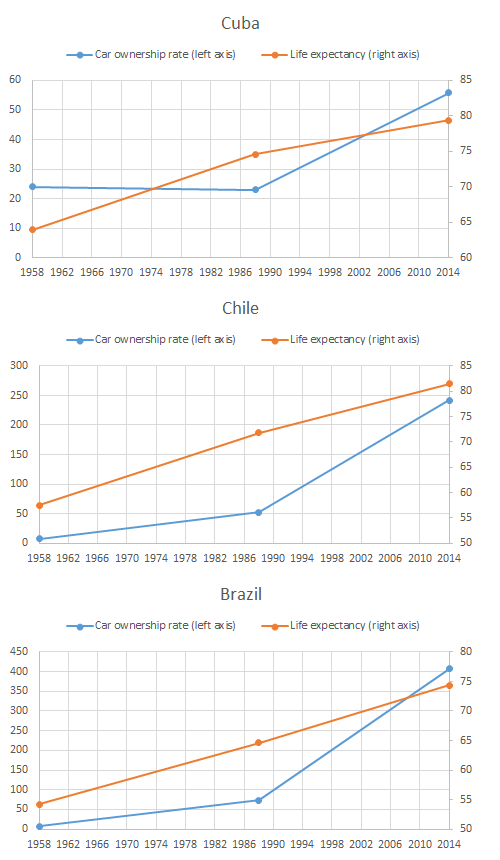
In a recent post, I pointed out that life expectancy in Cuba was high largely as a result of really low rates of car ownerships.  Fewer cars, fewer road accidents, higher life expectancy. As I pointed out using a paper published in Demography, road fatalities reduced life expectancy by somewhere between 0.2 and 0.8 years in Brazil (a country with a car ownership rate of roughly 400 per 1,000 persons). Obviously, road fatalities have very little to do with health care. Praising high life expectancy in Cuba as the outcome Castrist healthcare is incorrect, since the culprit seems to be the fact that Cubans just don’t own cars (only 55 per 1,000). But that was a level argument – i.e. the level is off.

It was not a trend argument. The rapid increase in life expectancy is undeniable, so my argument about level won’t affect the claim that Cubans saw their life expectancy increase under Castro.

I say “wait just a second”.

Cuba is quite unique with regards to car ownership. In 1958, it had the second highest rate of car ownership of all Latin America. However, while the rate went up in all of Latin America between 1958 and 1988, it went down in Cuba. During that period, life expectancy went up in all countries while there were substantial increases in car ownership (which would, all things being equal, slow down life expectancy growth). Take Chile and Brazil as example. In these countries, the rate went up by 6.9% and 8.1% every year – these are fantastic rates of growth. During the same period, life expectancy increased 25% in Chile and 19% in Brazil compared with Cuba where the increase stood at 17%. In Cuba, the moderate decline in car ownership (-0.1% per annum) would have (very) modestly contributed to the increase of life expectancy. In the other countries, car ownership hindered the increase. (The data is also from the WHO section on Road Safety while the life expectancy data is from the World Bank Database)

This does not alter the trend of life expectancy in Cuba dramatically, but it does alter it in a manner that forces us, once more, to substract from Castro’s accomplishments. This increase would not have been the offspring of the master plan of the dictator, but rather an accidental side-effect springing from policies that depressed living standards so much that Cubans drove less and were less subjected to the risk of dying while driving. However, I am unsure as to whether or not Cubans would regard this as an “improvement”.

Below are the comparisons between Cuba, Chile and Brazil.

cars

The other parts of How Well Has Cuba Managed To Improve Health Outcomes?

  1. Life Expectancy Changes, 1960 to 2014
  2. Car ownership trends playing in favor of Cuba, but not a praiseworthy outcome
  3. Of Refugeees and Life Expectancy
  4. Changes in infant mortality
  5. Life expectancy at age 60-64
  6. Effect of recomputations of life expectancy
  7. Changes in net nutrition
  8. The evolution of stature
  9. Qualitative evidence on water access, sanitation, electricity and underground healthcare
  10. Human development as positive liberty (or why HDI is not a basic needs measure)

Does socialism need to be corrupt?

Brazil is going through a deep crisis right now. It is tempting to say that this is the greatest crisis in the country’s history, but I am quite afraid to make this comment. Unlike England and the United States, which have experienced significant institutional stability in the past 200 or 300 years, Brazil has gone through several political breakdowns in its history, and the current economic crisis is far from the hyperinflation of the 1980s. But there is a characteristic that links the present crisis to the previous ones: the presence of a tendentially authoritarian state.

Although Brazil was governed by an openly socialist party only between 2003 and 2016, this does not mean that socialist characteristics were not present in the country much earlier. One of the central theses of F.A. Hayek in the Road to Serfdom is that the democratic socialist parties of Western Europe (notably the Labor Party in England) had more features in common with the Nazis and fascists than they would have liked to admit. In other words, the differences between left (even a moderate left) and extreme right were illusory: they both had the fundamental characteristic of trying to plan society centrally.

The opposition between spontaneous order and central planning was one of the central theses in Hayek’s career. In Fatal Conceit he develops this theme a lot, showing how the opposition between central planning and lack of planning is a fallacy: society will forcibly be planned. The question is by whom: for a small group of people on behalf of all the others, or for a large group of individuals, each with limited responsibilities? According to Hayek, this distinction between central planning and individual planning is one of the central separations between an authoritarian society (left or right) and a truly free society.

It is difficult to say if the PT (“worker’s party”) government between 2003 and 2016 was the most corrupt in Brazilian history. Homesick people can always claim that corruption was also present in previous governments (it was just not investigated), and possibly they would be right. Before becoming a country ruled by a socialist party, Brazil has always been a patrimonialist country. And this is a fundamental point that adherents of socialism cannot understand: Brazil has never been a capitalist country, at least not in the sense that the liberal tradition employs.

Starting from Hayek, we conclude that central planning is impossible. Planners do not have the information they need to make their plans. As Mises taught, without private property there is no price formation, and without price formation the economic calculation is impossible. This opens space for what Hayek calls a fatal conceit: the assumption that it is possible to run a country from a central body, a presupposition that not only fails to achieve its goals, but also leaves piles of corpses on the way.

The PT government was probably the most corrupt in Brazilian history because it was what most rejected capitalism. The opposite of the free market is the attempt to centrally plan the economy. To centrally plan the economy, an army of administrators is needed. To watch over these administrators, a host of supervisors is needed, and so on. Corruption is inevitable.

Socialist governments are always among the most corrupt, and the reason is simple: the more government, the more corruption. A simpler, more decentralized government is not perfect. But it’s the best we can wish for. It would certainly be a government with less control over money, and thus less likely to steal.

Brazil: the country of slavery yesterday is the country of socialism today

Although President Dilma Rousseff was impeached, and the PT (the Worker’s Party) suffered great losses in the municipal elections some weeks ago, it is still clear that PT in particular and socialism at large still has strong support among the population, especially in intellectual, cultural, and political circles. The Brazilian political spectrum often intrigues observers both from inside and outside the country: among the 35 registered political parties, almost none presents itself consistently as liberal or conservative. The only one to do so is the newly created Partido Novo (literally New Party). Other parties present themselves as socialist, social democrats, or don’t talk about this at all. To use the infamous left-to-right political spectrum, all political parties present themselves either as left or center. To present itself as right is still taboo for Brazilian political parties. Things surely seem to be changing as the already mentioned Partido Novo enters the scene and some individual politicians, such as Jair Bolsonaro, present themselves openly as right-wing. Also, social movements such as Movimento Brasil Livre and think tanks such as and Instituto Von Mises Brasil help create momentum for a new right in the country. It is possible that in future elections conservative and liberal candidates will gain seats, especially in the legislative chamber, but as parties are concerned, the right is still mostly a wasteland in Brazil. But why is that so?

Many analysts blame two factors for the lack of party representation for the Brazilian right. First, there’s the military government, from 1964 to 1985. Although statist both in political and economical terms (as it would be expected in a military government), this period was consistently identified as “right.” Therefore, to identify someone as right is still usually understood as to identify as a supporter of the military regime. Second, there is the successful work of the left, especially in the propaganda arena. The main reason for the 1964 coup was the threat of a communist revolution, such as in Cuba. The military was successful in fighting the communist guerrilla insurgency in the countryside, but were mostly unaware of the intellectual struggle in schools, universities, and other places (despite much talk of censorship to this day). Related to that or not, the fact is that the right is still underrepresented in intellectual and cultural spheres.

I’m not saying that either of the above explanations is wrong, but I’d like to suggest an alternative that goes much further in the past: Brazil is the country of socialism today because it was the country of slavery yesterday. When slavery was abolished in 1888, Brazil was the last country in the Western world to do so. An estimated four million slaves had been imported from Africa to Brazil, 40% of the total number of slaves brought to the Americas. This is ten times as many as were trafficked to North America and far more than the total number of Africans who were transported to all of the Caribbean and North America combined. According to the only national census accomplished during the monarchy, in 1872, Brazil had a population of about 10 million people. 15.24% were slaves, and 84.8% were free. It is most likely that this census doesn’t reflect the reality of the whole monarchical period, as successive laws against slavery, immigration, and other factors moved these percentages over time.

José Bonifácio de Andrada e Silva, a major figure in Brazilian politics of the time, praised freedom in his writings, but kept slavery in place, even with British pressure to abolish it and subsequent promises to help. He did that because he needed the slave owners’ money and thought that abolition wasn’t politically wise. Bernardo Pereira de Vasconcelos, founder of the Conservative Party, was a slave owner and even rented his slaves for public works. Many subsequent leaders of the Conservative Party, such as Paulino José Soares de Sousa, were part of the Fluminense slave-owning aristocracy either by birth or by marriage. Anyway, the Conservative Party wasn’t in a hurry to abolish slavery. The lack of revenue and the political implications were matters of much greater concern than the humanitarian cause. When they finally passed the gradual laws for abolition (and ironically they passed them all) it was to appease the liberal opposition, not for the sake of the cause. Conservatives were also unwilling to employ the Africans as free workers or to treat immigrants as free individuals: their plan was to gradually abolish slavery and to substitute it with a cheap immigrant labor force in large estates through laws restricting access to land. To their surprise, this plan never succeeded. Their last effort, to bring supposedly naïve Chinese in to substitute slaves, was barred by the liberals.

The legacy is that the country of slavery yesterday is the country of socialism today. As Herbert Spencer once said, “All socialism involves slavery.” Even better, Alexis de Tocqueville said that “Socialism is a new form of slavery.” Both share the same thought: slavery is forced labor of one individual to another. Socialism is forced labor of everyone to everyone else. When “rights” abound, it’s worth asking how they will be paid. Brazil is a country of rights, but not of duties or responsibilities. Just as it was the right of the elites of the past to have the slaves working for them, it’s the right of people today to receive social benefits from everyone else. People can (maybe naïvely) defend socialism as much as people in the past defended slavery, but to treat adults as infants is neither moral nor wise. Sure, Brazil still has a population that suffers from the mistakes of the past. But two wrongs don’t make a right.

BC’s weekend reads

  1. Smuggling Nikita Khrushchev’s memoirs out of the USSR
  2. Are memes disrupting American politics? So asks a Leftist
  3. The 4th Amendment, policing, and pedagogy
  4. At least the end of the War on Drugs is nigh
  5. A new (old) strategy for a polycentric world (but why not federation?)
  6. A simple map of Brazil and its states

BC’s weekend reads

  1. Racism in Brazil, and American academic imperialism
  2. A quick lesson on race and class in Brazil
  3. Unlike Their Parents, Black Millennials Aren’t A Lock For Clinton
  4. The Rise of the Libertarian Technocrats
  5. Property versus Democracy
  6. Our Friendly Visitors

Alguns mitos, equívocos e objeções comuns ao capitalismo

No meu último post ofereci uma definição de capitalismo baseada nos conceitos de escolha pessoal, trocas voluntárias, liberdade de competição e direitos de propriedade privada. Em resumo, um capitalismo liberal ou uma sociedade de livre mercado. Neste post eu gostaria de começar a desfazer alguns mitos, equívocos e objeções comuns ao capitalismo (se entendido nos termos que defini anteriormente). A lista não é exaustiva, mas acredito que cobre bastante terreno da discussão. Aí vai:

  1. Ser pró-capitalismo é ser pró-grandes corporações.

Adam Smith observou que empresários dificilmente se encontram para eventos sociais, mas que quando se encontram não conseguem evitar combinar meios de evitar a mútua concorrência. Empresários (especialmente donos de grandes corporações) tendem a não gostar de concorrência. É compreensível. A maioria de nós também preferira não ter colegas de trabalho com quem competir, assim como vários corredores hoje gostariam que Usain Bolt não existisse. O capitalismo liberal, no entanto, é um sistema de perdas e ganhos. Numa economia verdadeiramente livre de intervenção do estado é improvável que corporações se tornem desproporcionalmente grandes. A tendência é ao nivelamento.

  1. O capitalismo gera uma distribuição de renda injusta

Uma das grandes objeções ao livre mercado é a desigualdade de renda. No entanto, nenhum sistema econômico na história foi tão eficiente em retirar pessoas da pobreza quanto o capitalismo. Numa economia verdadeiramente livre a desigualdade existe e é basicamente inevitável, mas não é nada quando comparada a sociedades que optam pelo controle estatal da economia. China, URSS e Cuba são os países mais desiguais da Terra.

  1. O capitalismo é responsável por crises econômicas, incluindo a mais recente

A crise de 2008 foi causada por intervenção do governo norte-americano nos setores bancário e imobiliário. Sem intervenção do governo, instituições financeiras teriam um comportamento mais cuidadoso e a crise seria evitada. A mesma observação vale para basicamente qualquer crise econômica dos últimos 200 anos.

  1. Capitalismo explora os pobres

A livre concorrência, por definição, não é um sistema de exploração. Quando eu pago cem reais por um par de sapatos, isso significa que eu valorizo mais o par de sapatos do que os cem reais. O sapateiro, por sua vez, valoriza mais os cem reais do que o par de sapatos. Isso não quer dizer que não existam vendedores inescrupulosos, ou que não existam compradores injustos. Mas numa sistema de livre concorrência as possibilidades de fraude são mitigadas justamente pela concorrência: se o produto ou serviço não agrada ao consumidor, há sempre a possibilidade de procurar a concorrência. Em resumo, no capitalismo o consumidor é rei. Para concluir este ponto, apenas uma observação: o salário é nada mais do que o preço que se paga pelo trabalho de uma pessoa. E as mesmas observações se aplicam.

  1. Capitalismo é injusto

Algumas pessoas nascem com deficiências. Algumas pessoas nascem em famílias pobres ou desestruturadas. Isso é injusto? Por quê? Uma definição clássica de justiça é “dar a cada um o que lhe é devido”. O que nós é devido? O que nós merecemos? Eu merecia ter nascido com boa saúde? O que eu fiz para merecer isso? Estas perguntas facilmente nos levam a grandes indagações filosóficas e teológicas, e logo demonstram o quanto a acusação de injustiça numa economia livre é superficial. Ainda assim, nenhum sistema político ou econômico permite a ajuda aos desfavorecidos como o capitalismo. Se você considera injusto que existam pessoas sem dinheiro, sem saúde ou sem famílias estruturadas, sugiro que seja coerente e use mais do seu tempo e dinheiro para ajudar estas pessoas. 

  1. Capitalismo não traz felicidade

Pensando num sentido aristotélico, felicidade possui significados diferentes para cada um. Para um cristão significa ter um relacionamento pessoal com Deus através de Jesus Cristo. Provavelmente um não cristão não irá concordar com este conceito de felicidade. Dito isto, a liberdade econômica não tem como objetivo trazer felicidade para qualquer pessoa, e assim é injusto culpá-la por algo que não propõe fazer. Porém, dentro de um sistema de liberdade econômica a tendência é que a liberdade para a busca da felicidade também esteja presente. Além disso, com liberdade econômica é mais provável que consigamos buscar nossa felicidade através da criação de uma família, do envolvimento com instituições religiosas, ou mesmo ficando ricos simplesmente.

  1. Capitalismo não é estético e é poluidor

Os países mais poluidores do século 20 foram URSS e China. Proporcionalmente ao tamanho da sua população, EUA está longe do topo desta lista. Quanto ao fator estético, sugiro pesquisar por imagens da Alemanha Ocidental e da Alemanha Oriental, ou da Coreia do Sul e da Coreia do Norte. Dizem que a beleza está nos olhos de quem vê, mas me parece bastante óbvio que esta acusação estética é simplesmente falsa.

  1. Corporações são cheias de escândalos e extorsão

Com certeza elas são. Mas possuem o mesmo nível de corrupção de governos? A matemática é bastante simples: quanto mais governo, mais corrupção. Além disso, com uma corporação é possível simplesmente levar o dinheiro embora dali. Governos não são tão permissivos com evasão de impostos. A proposta de criação de mais sistemas de vigilância governamental apenas aumenta o tamanho do governo e as possibilidades de corrupção. A ideia de transparência e de consulta popular também é simplesmente falsa: a não ser que possamos passar 24 horas de nossos dias vigiando os governantes, estes sistemas simplesmente não terão possibilidade de funcionar. A solução mais simples continua sendo menos governo.

Há mais alguns tópicos que podem ser acrescentados e que deixarei para um futuro post. Por enquanto basta dizer que capitalismo (definido como livre mercado) pode ser bastante diferente daquilo que popularmente se entende.

Para saber mais:

https://www.youtube.com/watch?v=KGPa5Ob-5Ps

https://www.youtube.com/watch?v=ZgiLF48w7uQ

O que é capitalismo?

O Brasil é capitalista? O capitalismo é culpado por vários problemas que observamos no Brasil? E outros países? A China é hoje um país de economia capitalista, ainda que com política socialista (ou comunista)? O capitalismo prejudica os mais pobres enquanto beneficia os mais ricos? Estas são algumas questões com as quais me esbarro regularmente. Algumas pessoas mais sofisticadas observam que não há apenas um capitalismo, mas vários: o capitalismo brasileiro é diferente do sueco, que é diferente do japonês, que é diferente do norte-americano, e assim por diante. Vejo alguma pertinência nesta observação, mas penso que ela ainda deixa de lado a questão mais básica e fundamental: o que é capitalismo?

Suponho que sem recorrer a qualquer fonte podemos concluir que capitalismo é algo relacionado a capital. Segundo o Palgrave Macmillan Dictionary of Political Thought, de Roger Scruton, “o capitalismo é um arranjo econômico, definido pela existência predominante de capital e trabalho assalariado”. De acordo com esta definição, no capitalismo alguns ganham salários e outros ganham lucros. Capital por sua vez é definido como “os meios de produção produzidos, ou seja, commodities que foram produzidas e que por sua vez podem ser empregadas na produção de outras commodities”. Em outras palavras: capital são recursos que são empregados na produção de mais recursos. Capitalismo é um sistema econômico (e não predominantemente político ou social ou cultural) que gira em torna da alocação destes recursos.

Partindo de uma forma de pensar semelhante, Milton Friedman observou que todos os países são capitalistas. Os EUA são capitalistas. A China é capitalista. A URSS é capitalista (Friedman estava fazendo esta observação ainda no período da Guerra Fria). Não há país (ou sociedade) onde não haja capital e onde não ocorram decisões sobre como alocar o capital. Há bastante tempo Max Weber fez uma observação semelhante, afirmando que alguma forma de capitalismo esteve presente em todas as civilizações, com a diferença que mais recentemente o Ocidente produziu um capitalismo moderno, com características peculiares. Mas voltando para Friedman: todos os países são capitalistas. A questão é: quem controla o capital?

A pergunta de Friedman lembra uma observação de Friedrich Hayek: durante o período da Guerra Fria era comum afirmar que a economia da URSS era planejada, enquanto que a economia dos EUA não era. Mas esta afirmação está errada: ambas economias eram planejadas. A da URSS por um pequeno grupo de pessoas em Moscou; a dos EUA por milhões de indivíduos espalhados pelo país. O ponto de Hayek é que uma economia necessariamente envolverá decisões sobre como alocar capital (ou recursos). A questão é: quem tomará estas decisões? Um grupo de governantes num comitê centralizado, em nome de toda a população? Ou a própria população, numa esfera mais modesta, dentro de suas próprias vidas?

Adam Smith é popularmente considerado o pai do capitalismo (e também da Economia como disciplina acadêmica, além do liberalismo econômico. Adam Smith teve muitos filhos). Curiosamente, Smith não usou o nome capitalismo em seus escritos (este nome seria cunhado mais tarde por marxistas – o próprio Marx também não usou este nome, ao menos não regularmente), mas falava sobre sociedade de mercado. A observação de Smith era que em tempos recentes mais pessoas estavam se tornando mercadores. Em tempos antigos (sobretudo na Antiguidade Clássica de Grécia e Roma) as relações econômicas eram dominadas por donos de terras e escravos. Havia mercadores (ou comerciantes), mas estes ocupavam um espaço menor na sociedade (e também eram vistos com desconfiança por não produzirem nada – apenas trocarem o que outros produziram). Na Inglaterra do final do século 18 mais pessoas eram comerciantes, isto é, trocavam alguma coisa, ainda que “alguma coisa” fosse sua força de trabalho em troca de salários. Neste sentido, Smith não inventou o capitalismo moderno: apenas observou e descreveu seu nascimento – além de suas vantagens diante de outros arranjos econômicos.

Partindo de Adam Smith e chegando a Friedman e Hayek, podemos observar quatro elementos fundamentais do capitalismo moderno (ou do liberalismo econômico, ou as sociedade de mercado, ou do livre mercado): escolha pessoal; trocas voluntárias; liberdade para competir em mercados; direito de propriedade privada. A escolha pessoal se refere às decisões individuais que se toma a respeito dos recursos individuais (devo sair para trabalhar hoje? Ou devo ficar em casa?). Trocas voluntárias se refere ao fato de que posso livremente trocar meus recursos com outra pessoa que queira fazer o mesmo (havendo uma coincidência de vontades). Liberdade para competir significa que posso oferecer meus serviços (ou produtos, ou talentos) e aguardar que haja interessados. Propriedade privada se opõe a propriedade coletiva ou comunal, geralmente sob controle do estado.

Uma forma mais direta de sistematizar a teoria de Smith (e neste ponto de Friedman e Hayek) é dizer que no livre mercado a propriedade é privada (e não coletiva ou comunal) e o trabalho e assalariado (e não escravo). Mais simples ainda, o livre mercado opera pela máxima de “não faça aos outros o que você não gostaria que fizessem com você”, ou “não mexa com quem está quieto”. No livre mercado os indivíduos são livres para fazer trocas voluntariamente com outros indivíduos – que queiram voluntariamente fazer estas trocas, havendo coincidência de vontades.

Há muitos economistas que consideram que a sociedade de mercado é mais um tipo ideal do que uma realidade. Alguns países estão mais próximos desta ideal do que outros, e neste sentido é válida a observação de que há variedades de capitalismo. O capitalismo praticado no Brasil (ou na China) não é (nunca foi e nunca chegou perto de ser) o capitalismo liberal descrito ou almejado por Smith, Friedman e Hayek. O capitalismo praticado nos EUA está mais próximo disso, embora esteja num franco afastamento deste ideal há várias décadas.

Saber o que é capitalismo é um primeiro passo para sabermos se este é um modelo que desejamos ou não. Pretendo nos próximos posts continuar este assunto. Por ora, digo apenas que quando falo a respeito de capitalismo estou pensando na sociedade de mercado descrita ou almejada pela tradição liberal. Caso o que temos no Brasil seja capitalismo, certamente não é este capitalismo que defendo.