Why Don’t Tribes Transition to Market Defense?

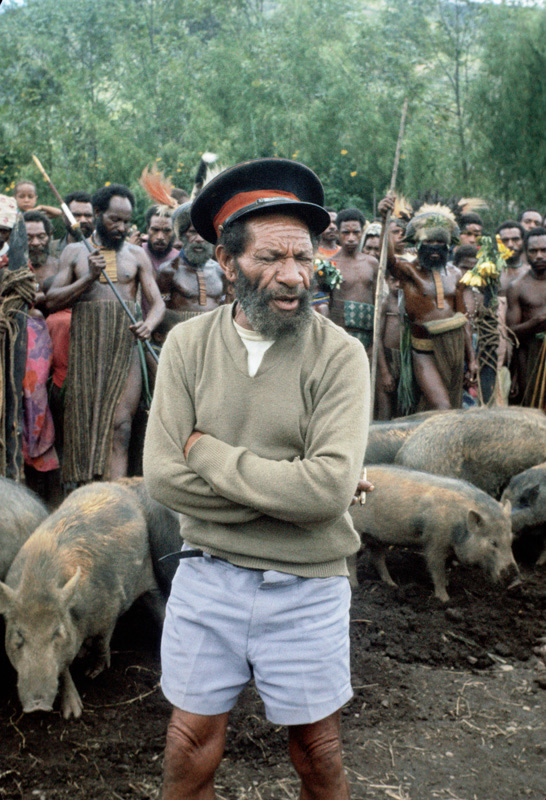
Ongka
Ongka, a “big man” of the Kawelka tribe. Image from http://www.stewartstrathern.pitt.edu/

Watch almost any anthropological film about a newly discovered “isolated tribe,” and you’re likely to see at least one “tribesman” wearing a t-shirt.

People in bands and tribes and chiefdoms — who have since time immemorial handled most of their economic transactions for food, clothing, and shelter through traditional economies of gift exchange and family sharing — eagerly become buyers and sellers for products on the global market as soon as they get the chance.

They grow coffee beans or trap furs, and they use the money to buy firearms, machetes, cell phones, and jean shorts. In other words, they jump right in to the market. And usually, the tendrils of global trade have arrived way before the anthropologists and their film crews.

But people in the same bands, tribes, or chiefdoms seem to hang on to their family and gift-based economies for political, military, and legal services.

They do not jump to create or hire market solutions (mercenaries, defense corporations), and they instead eventually transform — by hook or by crook — into a state or into a people subjugated by a state.

Why does this happen? Why do we get states for defense and markets for everything else?

Let me back up and explain my terms:

In the examples I’m familiar with, humans use one of four main methods to organize law enforcement and military protection:

1. Kin-based. Your extended family (a “band,” “clan,” or a “lineage”) and maybe an alliance of intermarried and neighbouring extended families (a “tribe” or a “village”), protects you. You are technically free to leave the family or the village, but that could leave you without protection unless you are marrying into a new one.

Examples: Cree, Tahltan, Ju/‘hoansi

2. Prestige-based. A famous leader (a “big man” or “chief”) and his warriors protect you in return for material gifts and social deference. You can pull your support from the leader — more easily if he’s just an informal “big man” and less easily if he’s a formal “chief.” And there are usually other nearby leaders or aspiring leaders who would happily accept your patronage.

Examples: Yanomamo, Kawelka, Trobriander

Systems #1 and #2 are often blended together, as in the Trobriander case, where each man’s connections to the chief are determined partly by family relatedness and partly by gift exchange.

3. State-based. A compulsory ruler (a “king” or “president”) and his warriors protect you in return for taxes and/or labor. You are never free to pull your support, although you are sometimes free to leave through emigration.

Examples: Aztec Empire, Canada, People’s Republic of China

4. Market-based. A private enterprise (a “defense contractor”) protects you in return for money. You are free to pull your support and choose another contractor, or go without.

Example: Detroit’s Threat Management Center

Now, we could also sketch out the same 4 methods for the basic kinds of economic exchange people do for food, shelter, and all the other goods and services in life besides defense. People can give and receive the things they want and need through #1 family networks, #2 prestige-oriented gift exchange, #3 state redistribution, and #4 markets.

What I see throughout the world in the last 500 years is that as globalisation advances, people in all or almost all cultures eagerly take their systems of food, shelter, etc. out of systems #1 and #2 and go into system #4. In other words, people in bands, tribes, and chiefdoms all over the world desperately want the metal tools, firearms, t-shirts, cell-phones, and everything else that the market offers, and so they find ways to sell goods or services and thus money that lets them buy that stuff.

For instance, hunter-gatherers who once collected food to share with their family now collect furs to sell internationally, or instead serve as bush guides to wealthy tourists from foreign cultures.

But people almost never eagerly or rapidly take their law and defense systems out of kin and prestige and into markets.

Instead, they tend to hang on to kin or prestige-based methods of law enforcement and warfare until they (a) get conquered by a state or (b) organize themselves as a state (whether to fend off would-be conquerors or to become conquerors themselves).

So in highland Papua New Guinea for instance, the Dani and the Kawelka were happy to grow coffee beans and other crops to put on the market by the 1970s. But they didn’t start hiring mercenaries for defense. Instead, they stuck to their big men and their tribes until their military organizations were absorbed into state militaries or turned into paramilitary movements aiming to create or seize control of a state.

Markets became the center of food production. States became the center of defense production.

Later on, after states have arrived as military organizations, sometimes they start expanding and controlling parts of the economics of food, shelter, education, etc., through compulsory redistribution.

Conversely, shifts to market-based defense seem to occur after a society has already had state-based defense — like in Moresnet or Kowloon (PDF). And the market organizations arise when, for some reason, the state-based defense system relaxes or collapses.

Why does this bifurcated trend keep happening?

Why do people in these societies transition into markets for most goods and services but states for law and war?

Do state-based militaries and police forces simply outcompete (or outfight) market ones?

Am I missing major counterexamples, or even misunderstanding my own examples?

“We’re all nothing but bags of stories”: Carlos Castaneda as a Countercultural Icon and Budding Post-Modernist

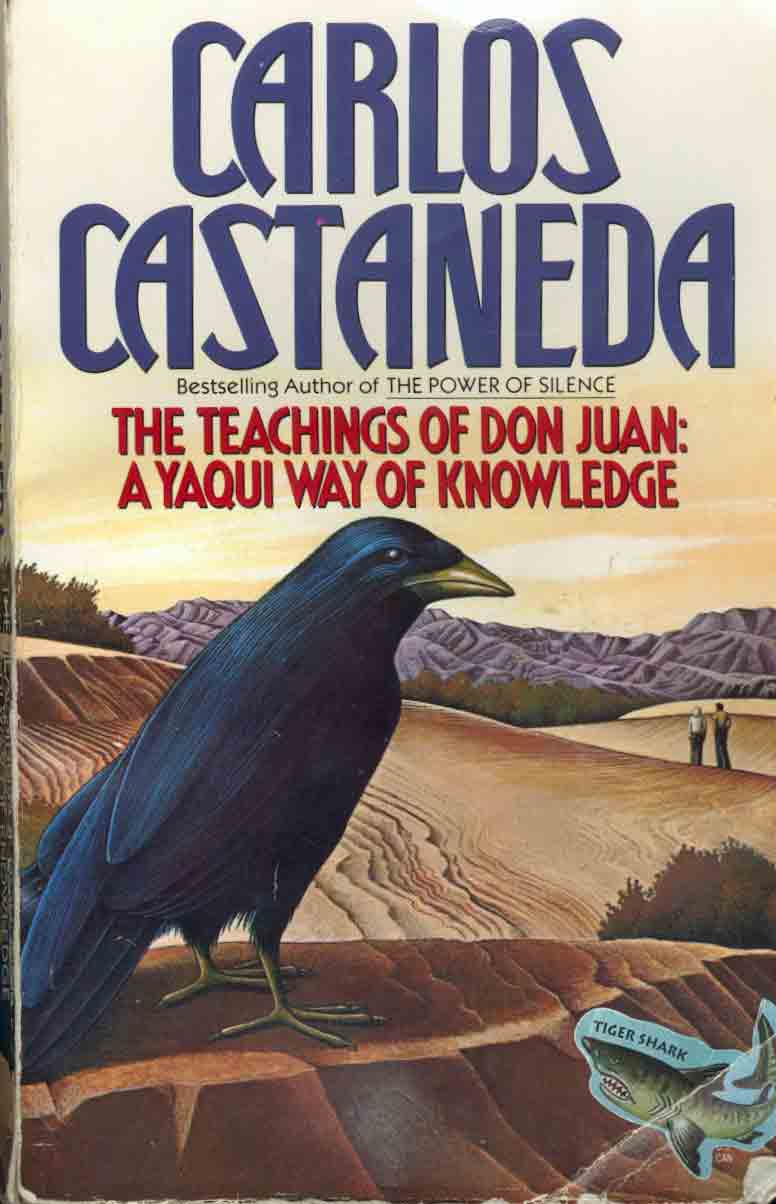
Exploring the countercultural 1960s and the origin of Western New Age, one cannot bypass Carlos Castaneda. He became a celebrity writer because of his bestselling book The Teachings of Don Juan: A Yaqui Way of Knowledge that was published by the University of California Press in 1968. The book was written in a genre of free-style dialogues between a Native American shaman named Don Juan Matus and Castaneda himself, who claimed that he worked with Don Juan for many years. The Teachings describes how Castaneda learned to use three hallucinogenic plants: peyote, jimson weed, and psychedelic mushrooms. After ingesting these substances, Castaneda went through mind transformations and learned that there were other realities besides the ordinary one. Later, it was revealed that he made up the whole experience, but this never affected his popularity.

Carlos-Castaneda-The-Teachings-of-Don-Juan

Of course, a book like this was well-tuned to the then-popular hallucinogenic subculture, and the link between Castaneda’s text and the psychedelic ‘60s is the most common explanation of his popularity. Yet I want to argue that this is a very narrow view, which does not explain why Castaneda’s follow up books, which had nothing to do with psychedelics, continued to enjoy popularity well into the 1990s. In fact, by the early 1980s, Castaneda became so paranoid about hallucinogens that he forced his girlfriend to undergo drug tests before allowing her to sleep with him. I also argue that viewing Castaneda exclusively as one of the spearheads of the New Age does not explain much either. The appeal of his texts went far beyond the New Age. In the 1970s and the 1980s, for example, his books were frequently assigned as conventional course readings in anthropology, philosophy, sociology, religious studies, and humanities classes.

Let me start with some biographical details. Castaneda was born Carlos Arana in Peru to a middle class family and moved to the United States in 1951. He tried to enter the world of art but failed. Then, for a while, he worked as a salesman while simultaneously taking classes in creative writing before eventually enrolling in the anthropology graduate program at UCLA.

Originally Castaneda did not care about hallucinogens and the emerging hippie culture, but eventually UCLA (and the broader California environment), which was saturated at that time with various counterculture and unchurched spirituality projects, made him choose a sexy topic: the use of psychedelics in a tribal setting. The book which made him famous, The Teachings of Don Juan, originated from a course paper on “power plants” and from his follow-up Master’s thesis. I want to stress that both papers were essentially attempts to find a short-cut to satisfy the requirements of his professors. His first professor, an anthropologist, invited those students who wanted to get an automatic “A” to find and interview an authentic Indian. Despite a few random contacts, Castaneda could not produce any consistent narrative, and had to invent his interview. This was the origin of his Don Juan character. Then he followed requirements of his advisor, Harold Garfinkel, a big name in sociology at that time and one of the forerunners of postmodernism. Garfinkel made it explicitly clear to Castaneda that he did not want him to classify and analyze his experiences with Don Juan scientifically.

What Garfinkel wanted was a free-style and detailed description of his work with the indigenous shaman as it was and without any interpretation. Thus it was through collective efforts that Castaneda produced a text that by chance caught the attention of the university press as a potential bestseller. Essentially, Castaneda took to the extreme incentives provided to him by his professors and by the surrounding subculture. He internalized these incentives by composing a fictional text, which he peddled as authentic anthropological research. It is interesting to note that in 1998, just before he died, Castaneda made the following mischievous remark in his introduction to the last anniversary edition of The Teachings of Don Juan: “I dove into my field work so deeply that I am sure that in the end, I disappointed the very people who were sponsoring me.”

The popularity of the first book gave rise to the whole Don Juan sequel, which made Castaneda an anthropology and counterculture star. The combined print run of his books translated in 17 languages reached 28 million copies. And, as I mentioned above, despite the revelations that his Don Juan was a completely fabricated character, the popularity of his books was increasing throughout the 1970s. In fact, to this present day, libraries frequently catalogue his books as non-fiction.

It seems that Castaneda’s appeal had something to do with overall trends in Western culture, which made his text resonate so well with millions of his readers. For this reason, I want to highlight the general ideological relevance of Castaneda’s books for the Western zeitgeist (spirit of the time) at its critical juncture in the 1960s and the 1970s. Various authors who wrote about Castaneda never mentioned this obvious fact, including his most complete biography by French writer Christophe Bourseiller, Carlos Castaneda: La vérité du mensonge (2005). So exploring the ideological relevance of the Don Juan books will be my small contribution to Castanediana.

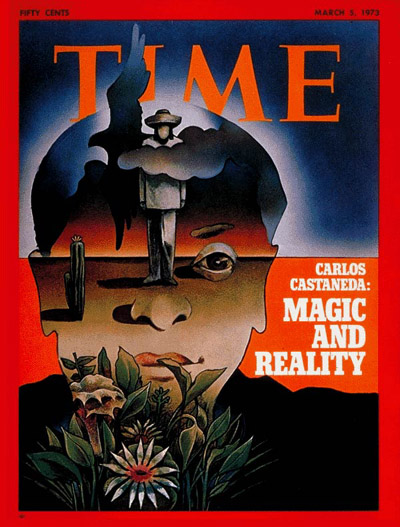
To be specific, I want to point to two themes that go through all his books. First, he hammered in the minds of his readers the message of radical subjectivism, which in our day it is considered by some a conventional wisdom: What we call truth is always socially constructed. Don Juan, who in later books began speaking as a philosophy professor, repeatedly instructed Carlos that so-called reality was a fiction and a projection of our own cultural and individual experiences, and instead of so-called objective reality, we need to talk about multiple realities. In an interview for Time magazine, Castaneda stressed that the key lesson Don Juan taught him was “to understand that the world of common-sense reality is a product of social consensus.” Castaneda also stressed the role of an observer in shaping his or her reality and the significance of text in Western culture. In other words, he was promoting what later became the hallmark of so-called postmodern mindset.

Second, fictional dialogues between the “indigenous man” Don Juan, whom Castaneda portrayed as the vessel of wisdom, and Castaneda, a “stupid Western man,” contained another message: remove your Western blinders and learn from the non-Western ones. Such privileging of non-Western “wisdom” resonated very well with Western intellectuals who felt justified frustration about the hegemony of positivism and Western knowledge in general and who looked for an intellectual antidote to that dominance. By the 1990s, this attitude mutated into what Slavoj Zizek neatly labelled the “multiculturalist’s basic ideological operation,” which now represents one of the ideological pillars of Western welfare-warfare capitalism.

At the end of the 1970s, several critics tried to debunk Castaneda. They were able to prove that his books were the product of creative imagination and intensive readings of anthropological and travel literature. These critics correctly pointed out that Castaneda misrepresented particular indigenous cultures and landscapes. Besides, they stressed that his books were not written in a scientific manner. Ironically, this latter criticism did not find any responsive audiences precisely because social scholarship was moving away from positivism. Moreover, one of these critics, anthropologist Jay Fikes, who wrote a special book exposing Castaneda’s hoax, became a persona non grata in the anthropology field within the United States. Nobody wanted to write a reference for him, and he had to move to Turkey to find an academic position.

What critics like Fikes could not grasp was the fact that the Castaneda texts perfectly fit the emerging post-modernist thinking that was winning over the minds of many Western intellectuals who sought to break away from dominant positivism, rationalism, and grand all-explaining paradigms. To them, an antidote to this was a shift toward the subjective, individual, and spontaneous. The idealization and celebration of non-Western knowledge and non-Western cultures in general, which currently represents a powerful ideological trend in Western Europe and North America, became an important part of this intellectual revolt against the modern world. I am sure all of you know that anthropology authorities such as Clifford Geertz (until recently one of the major gurus of Western humanities), Victor Turner, and Claude Lévi-Strauss were inviting others to view any cultural knowledge as valid and eventually erased the border between literature and science. They also showed that scholarship can be constructed as art. Castaneda critics could not see that his texts only reflected what was already in the air.

Castaneda_Time magazine

The person who heavily affected the “production” of the first Don Juan book, which was Castaneda’s revised Master’s thesis, was the above-mentioned sociologist Garfinkel. As early as the 1950s, Garfinkel came up with ideas that contributed to the formation of the post-modern mind. I am talking here about his ethnomethodology. This school of thought did not see the social world as an objective reality but as something that individuals build and rebuild in their thoughts and actions. Garfinkel argued that what we call truth was individually constructed. Sometimes, he also called this approach “people’s sociology.” He stressed that a scholar should set aside traditional scientific tools and should simply narrate human experiences as they were in all details and spontaneity. Again, today, for many, this line of thinking is conventional wisdom, but in the 1950s and the 1960s it was revolutionary. Incidentally, for Castaneda it took time to figure out what Garfinkel needed from him before he rid his text of the vestiges of “positive science.” To be exact, Castaneda could not completely get rid of this “science” in his first bestselling book. In addition to the free-flowing and easy-to-read spontaneous dialogues with Don Juan, Castaneda attached to the text an appendix; a boring meaningless read that he titled “Structural Analysis.” In his later books, such rudiments of positivism totally disappeared.

When Castaneda was writing his Master’s thesis, Garfinkel made him revise the text three times. The advisor wanted to make sure that Castaneda would relate his spiritual experiences instead of explaining them. Originally, when Castaneda presented to Garfinkel his paper about a peyote session with Don Juan, the text was formatted as a scientific analysis of his own visions. The professor, as Castaneda remembered, rebuked him, “Don’t explain to me. You are nobody. Just give it to me straight and in detail, the way it happened. The richness of detail is the whole story of membership.” Castaneda spent several years revising his thesis and then had to revise it again because Garfinkel did not like that the student slipped into explaining Don Juan psychologically. Trying to be a good student, Castaneda embraced the advice of his senior colleague. So the final product was a beautiful text that was full of dialogues, rich in detail, and, most importantly, came straight from the “field.”

I interviewed some of Castaneda’s classmates and other scholars who became fascinated with his books at the turn of the 1970s. Many of them had no illusions about the authenticity of Don Juan. Still, they argued that the whole message was very much needed at that time. A quote from Douglas Sharon, one of Castaneda’s acquaintance, is illustrative in this regard. In his conversation with me, Sharon stressed:

“In spite of the fact that his work might be a fiction, the approach he was taking—validating the native point of view—was badly needed in anthropology, and, as a matter of fact, I felt it was a helping corrective for the so-called scientific objectivity that we were taking into the field with us.”

I want to mention in conclusion that Castaneda not only promoted the postmodern approach in his novels but also tried to live it. Before the age of Facebook and online forums, Castaneda, with a group of his followers, became involved in an exciting game of identity change. They came to enjoy confusing those around them by blurring and constantly changing their names and life stories. For example, people in his circle shredded their birth certificates and made new ones. They also performed mock wedding ceremonies to make fun of conventional reality. To those who might have had questions about this “post-modernist” game, Castaneda reminded: “We’re all nothing but bags of stories.”

Around the Web

  1. Why Women Hunt: Risk and Contemporary Foraging in a Western Desert Aboriginal Community (pdf)
  2. Competing to Be Leaderless: Food Sharing and Magnanimity Among Martu Aborigines (pdf)
  3. In Pursuit of Mobile Prey: Martu Hunting Strategies and Archaeofaunal Interpretation (pdf)
  4. Signaling Theory, Strategic Interaction, and Symbolic Capital (pdf)
  5. Rethinking Rights (and Freedom): A Series (be sure to scroll through the ‘comments’)
  6. Deconstructing Colonial Historiography: A Case Study of Afanasy Nikitin

Around the Web

  1. “It is a Strict Law That Bids Us Dance”: Cosmologies, Colonialism, Death, and Ritual Authority in the Kwakwaka’wakw Potlatch, 1849 to 1922 (pdf)
  2. Prime Factors
  3. Competitive Displays: Negotiating Genealogical Rights to the Potlatch at the American Museum of Natural History (pdf)
  4. Bad Weather: On Planetary Crisis (pdf)
  5. Do Muslims Belong in the West?

Calls for harsh criticism: my first (of four) graduate school statement of purpose

Note: this is my statement of purpose (SOP) for a graduate program in anthropology at Emory University. I am also going to apply to Stanford, New Mexico, and Chicago. This is only a rough draft. I have given myself plenty of time to make these perfect, so I am posting this here in order to get harsh feedback and also in case anybody ever finds himself in my position (looking online for examples). The application process consists of five parts: grades, GRE score, Letters of Recommendation, SOP, and resume. My big weaknesses are the SOP and Letters of Recommendation. Any help I could get on my SOP would be great! UPDATE (4/14): Dr Khawaja has kindly provided a forum for my other weakness, the Letters of Recommendation, over at Policy of Truth and I have been learning a lot.

I am interested in land contestations, property rights in stateless regimes, and state formation. There are two main reasons for this. First, I spent three months in the Ghanaian village of Wiamoase, a remote outpost in the Ashanti region, with a medical anthropologist who was then doing graduate work on placebo effects and shamanism at Boston University. Ghana was on the threshold of a third consecutive, coup-free presidential and parliamentary election cycle and I was able to observe how these elections were interpreted by rural Ghanaians. Two major factions figured prominently in the electoral calculations of Ghanaians: the aid-lending Global North and rival, ethnic-based domestic factions. These calculations reminded of the work done by the historian Charles Tilly on the slow rise of democracy in France and the role played in this contestation by the landowning aristocracy. I then decided to conduct an informal survey where I asked villagers whether they had more trust in the politicians of Accra or in the land-holding chiefs who leased out farmland. The unanimous response to my unscientific survey was that the trust of the villagers was in the land-holding chiefs.

Second, at Cabrillo College – a community college in central California – I did Honors research on Javanese political strategies and the Dutch colonial practices that those strategies induced. I was particularly intrigued by the narrative of condescension that dominated Western scholarship up until the 1960s, when the Javanese finally began to be depicted by (some) historians as active, willing participants in the new relationships that were formed by the arrival of European settlers. I presented the results of this research at Stanford University in 2011 as part of a Bay Area Honors consortium, where challenging feedback from professors and participants allowed me to show how this research is relevant to understanding today’s examples of both large-scale organized violence and economic development (or lack thereof).

This research was also featured, in modified form, at RealClearHistory in February of 2014. RealClearHistory is part of the RealClear online series that features work from academics, policymakers, and journalists from around the world on issues ranging from science to history to international relations. RCH also featured my articles on the limits of Japanese imperial ambitions during the Shōwa era and on the European Union’s potential for avoiding the nationalisms of the 20th century by providing inclusive outlets for separatist aspirations. The research done for these features, coupled with my electoral experience in Ghana, produced two notions of democracy in my mind: democracy as a colonial project, and democracy as a power-sharing institution; both of these notions feature prominently in Somalia, my main area of interest, today.

Building upon the work of Peter Little, states are generally taken to be a necessity because of the benefits they provide in regards to public goods. In the postcolonial context, however, states are often wielded as a bludgeon and used as an ATM machine by those who attain its levers of power. When a faction – usually ethnic- or geography-based – wins out in a postcolonial state, the other factions lose power (this is in contrast to long-established, more-or-less democratic states, where “losers” still have institutional representation in a number of ways).

Given this situation, I am interested in both the process of state formation in the postcolonial context, and in the idea of taking seriously notions of informal sovereignty – as exemplified by non-state (indigenous) cooperation at the regional and local levels of borderlands – within current internationally-sanctioned boundaries. In the course of writing my article on nationalisms and the EU, for example, I discovered that three distinct cultural cores of the world – South Asia (India, Pakistan, Bangladesh, Nepal, Bhutan, and Sri Lanka), the Horn of Africa (Somalia, Eritrea, Ethiopia, Yemen, Sudan, Djibouti), and the European Union – have similar geographic spaces, ranging in size from 4.31 million km² to 4.482 million km². Yet within these similar geographies, the comparative number of states is stark: both the Horn of Africa and South Asia are comprised of six states each, while the European Union has nearly five times as many (twenty-eight since 2013). The GDP (PPP) per capita – a leading measurement tool used to gauge the economic health of a country – of these regions (based on 2012 IMF estimates) provides another stark insight: the EU’s GDP (PPP) per capita stands at $31,018, whereas South Asia’s stands at $3,805 and the Horn of Africa’s is $1,679. These are simple but profound economic and geographic quantitative rifts that have yet to be fully explained, especially in the context of the contestation over defining democracy. Can these macro-level data, in turn, be complemented by looking at informal, cross-border market cooperation, comparative interethnic & intraethnic trading strategies, and power-sharing political institutions? More theoretically: Do these informal economies form the basis of viable states?

The pastoralists in southern Somalia offer an avenue of exploration into these questions, especially the cross-border trade between pastoralists and cattle traders in Somalia and Kenya. I am unaware of research being done on how property rights are agreed upon by the parties involved in this sector of the economy, but the quasi-corporate organizational structure of the actors in the cattle supply chain identified by Dr. Little have ample potential. While much work has been done on the destination of Somali cattle products, and on the traders who act as intermediaries between herders, sellers, and producers, the perspective of Somali herders on the regional informal economy has not been studied in depth. How does both land – as an economic factor of production – and conceptions of property rights affect pastoralists’ economic decisions and political acumen? Ethnographic accounts of herder perspectives on informal economies in general and on the supply chain of their cattle in particular can also build upon the foundations necessary for understanding larger-scale social phenomena such as state formation and neocolonial institutions.

I spent most of my time at UCLA living in an outdoor track-and-field stadium and hauling around a cardboard box with all of my belongings in it, which taught me to be determined and I only mention this because it’s good evidence that I have the perseverance necessary to pursue a doctoral degree from your program. My experience in homelessness is not limited to my time at UCLA. I was born in the cultural center of the Mormon world and, when I left that world at a relatively young age, was exposed to the sometimes harsh realities of poverty in the United States. I mention this experience because it has taught me who to pay attention to depending on what I need and what I want. The work of Peter Little on the formal and informal economies of pastoralists in the Horn of Africa has, in particular, attracted my attention, and I hope to be able to learn directly from him. David Nugent’s work on comparative state formation methods is also an area of research I would learn much from, as is the work of Michael Peletz on Islamic law and its relationship with state formation in Southeast Asia.

More on Liberty and Homer: Tacitus, Montesquieu, and Humboldt

As I have discussed before here, there is a way of writing about liberty in a conscious focus on political thought, which finds liberty to be emulated in some respect, going back at least to the first century Roman historian Tacitus. He was referring to the condition of the ancient Britons, within the Roman Empire, but rebelling against it, and the ancient Germans who could not be incorporated into the Empire.

The latter situation may have been at least as much for economic reasons as for the German fighting spirit, but they were certainly difficult to overcome and inflicted one of the great defeats on the Roman legions, at the height of Roman power in the Battle of the Teutoburg Forest in 25CE.

The image of barbarian liberty in Tacitus was certainly in some part shaped by Homer given the deep impact of Greek culture on the Romans, and most relevantly in this instance through the continuation of Homer in the greatest latin epic, Aeneid, which links Rome with the Trojan prince Aeneas. As I pointed out before here, Tacitus’ idea of barbarian liberty strongly influenced Montesquieu’s The Spirit of the Laws (1748, a work I will be posting on in future), whose view of liberty in modern Europe, in brutal but meaningful summary, was of a combination of Roman law and Germanic individualism.

Montesquieu was of course a great part of Classical Liberalism and we can follow up his interest in barbaric liberty with reference to other classical liberals. David Hume and Adam Smith, who were writing after Montesquieu, tended to write on ‘barbarism’ and a related idea of ‘savagery’ with some anxiety regarding the possibility that such societies, or societies closer to that stage than those European nations where civil society had advanced the most, might overwhelm commercial legalistic nations with their unrestrained force.

However, some element of respect for liberty in the most simple societies does manifest itself at times, but mostly through an interest in the earliest stages of the Roman and Greek republics of antiquity, which in Montesquieu’s thinking come between the Germanic individualism and the late Roman legalism. Tacitus was thinking of the ‘virtue’ (in the sense of patriotic courage and love of law) of the early Romans when addressing the courage, rough individuality, and fierce independence of the Britons and Germans.

The most interesting way of linking back from Enlightenment liberalism of the Eighteenth century, for me at least, is via Wilhelm von Humboldt, a thinker I will address in at least one dedicated post in future. Humboldt’s major contribution to political thought, The Limits of State Action, was written in the 1790s, so another generation on from Montesquieu, just after Smith and Hume.

At this point, we might think of a movement from Enlightenment to Romanticism in European thought. While we should be very careful about such general distinctions, and amongst other things not engage in simplistic oppositions, it is appropriate to think of Humboldt as belonging to a phase of interest in the history and current meaning of aesthetics, literature, culture, and language as part of the study of political ideas.

He was in fact a major thinker about language and the infinite capacities inherent in the combinatory nature of language, which was part of his thinking about individual human capacity and the power of voluntary co-operation.

It is the interest in aesthetics, language, culture, historical existence, and the capacity of the inner human which makes him ‘Romantic’ rather than ‘Enlightened’, though again we should avoid stereotype and simple opposition here. Humboldt was very much not against Enlightenment respect for reasons, and some of these ‘Romantic’ themes are in ‘Enlightenment’ texts.

One of the earlier big classics of Enlightenment, The New Science (1725, 1744) by Giambattista Vico, is a good example and that is a book giving great importance to Homer. Vico is someone else who merits at least one dedicated post, so there will be more about him at some point. I am not aware of any evidence that Humboldt read Vico, but he certainly made an impression on German thinkers of the time.

Anyway, Humboldt was a learned classicist from a philological and literary way, which has an impact on his idea of how liberty was strengthened in antiquity, which compensated for the tendency of the ancient state to interfere in the soul, as Humboldt thinks of antique laws and institutions to promote moral and religious traditions.

What compensates for this pressure on liberty is the struggle in the lives of ancient humans, which has two main aspects. First the struggle with nature to have enough food and shelter to preserve life. Second the military struggle with rival states and communities, which was a very frequent experience in antiquity, and was an aspect of the history of the early Greek and Roman republics.

The best place to look for that in antique sources is Homer, because of the breadth of the Homeric world, as well as its poetic qualities, as well as its enormous influence on Greek and Roman culture. I had meant to address how the kind of struggle which can promote some kinds of liberty does appear in Homer, but this post is already long enough, and the best thing is to address Homer directly in the next post.

In the meantime, careful reading of any of the translations in books and post on websites, of The Iliad and The Odyssey (or indeed the original Greek for those fortunate enough to have that linguistic capacity), should I hope provide material to confirm what I’m suggesting.

Strange Historical Facts

Not long thereafter, they erected the first sawmill in what was to become the state of Washington on a site by the lower falls of the Deschutes River. Much of the capital for erecting the mill apparently came from George W. Bush, Washington’s first black resident. The cut of this mill, it has been claimed, was marketed through the Hudson’s Bay Company at Fort Nisqually and found its way to Victoria and the Hawaiian Islands. The first shipment was supposedly made on the Hudson’s Bay Company steamer Beaver in 1848.

Um, wow. I don’t know where to begin. This excerpt comes from page 25 of a 1977 book by historian Thomas R Cox titled Mills and Markets: A History of the Pacific Coast Lumber Industry to 1900. Aside from the interesting anecdote quoted above, it’s not very good. I picked it up because of the possibilities associated with such a subject, but instead of a theoretical narrative on globalization, identity, state-building, and property rights, it is a book that reads a lot like the excerpt I quoted above (the local history aspect I have enjoyed, though; local history is one of my secret pleasures, the kind of stuff that never makes it into grand theoretical treatises but always lights up my brain because of the fact that places I know and places I have lived are the focus of the narrative).

I blame it on the year it was published, of course. 1977 was at the height of the Cold War, which means that scholarly inquiry was inevitably going to be policed by ideologues, and also that works appraising global or regional scales and scopes just weren’t doable. For instance, there was virtually no mention of Natives in the book. (See archaeologist Kent Lightfoot’s excellent, highly-recommended work – start here and here – for more on how this is changing.)

The Best Book I Have Read Recently

I make some notes about almost all the books I read. I am thinking my notes may be useful to others. Here is an instance; it’s about a good book I read recently:

Jared Diamond’s 2012 The World Until Yesterday: What Can We Learn from Traditional Societies?

A confession first: When I die, I want to come back as Jared Diamond. He had the exemplary academic career; he wasted no time; he took advantage of academia’s largess and low standards to change himself several times into a different kind of scholar. He addresses ordinary literate people with much success. He is a great teacher.

What Diamond means by “traditional societies”  (in the title) is an imaginary aggregate of what social scientists call “hunters-gatherers” and “horticulturalists.” The latter are largely hoe cultivators, people who don’t use the plow but who grow food. Horticulturalists live entirely in tropical and equatorial climates.

Diamond’s book makes very good reading and, in addition, he tries to make it practical, useful at every step. His guiding theme is that by observing traditional people more closely, we may be able to improve many of our civilized practices. He visits in turn how his traditional societies define strangers and how they deal with war, child rearing, the treatment of the aged, attitudes toward danger, religion, language and health.

Traditionals, in general (also called “primitives”) live in fairly small units because their technologies (plural) cannot support large concentrations of people. They have no cities; they are not “civilized.” Diamond makes the implicit assumption (implicit, I think) that small scale and the preservation of “traditional beliefs” go hand in hand. He makes the further assumption – a fairly common one – that today’s traditional societies are similar to the societies in our own past. Thus, the part of the title that says, “Until Yesterday.” According to this assumption, the observation of such societies has much to teach us about how we – civilized people – grew up, so to speak, and about what we lost while growing up.

I am skeptical about both assumptions, not rejecting, skeptical. First, I don’t really believe that tradition does not change. I think that traditional people live in environments that change to some extent, sometimes rapidly. They change, in particular, because the powerful civilized societies in which they are embedded tend to grow, thus threatening or reducing the traditionals’ physical space and their resources. The tragedy of the Plains Indians reduction to near nothing must have happened many times before. Thus the thing that defines traditional people, “tradition” itself must change to some extent to accommodate change in their environments. The mere fact that traditional societies are around to be observed at all tells us that they must have adjusted to some extent. Thus, when considering them we don’t know if we are looking at our own past, or at pathetic survivors next to extinction, or on the contrary, at extraordinarily skillful ones. That’ s a problem for the generalizing Diamond invites us to engage in. That’s my second main objection to Diamond’s overall approach.

In point of fact, the traditional societies to which Diamond alludes include none situated in the temperate zone. It’s not his fault, of course, Lapps in Northern Scandinavia and Finland may be the only ones left more or less intact. But this fact aggravates my skepticism about the exemplarity of the primitive groups Diamond describes. I cannot eliminate from my mind the fact that civilization arose only in temperate zones, in the Middle East, in Europe, and in China. And independently, in the temperate elevations of meso-America and of South America. Perhaps, possibly, probably this is not a coincidence. Diamond’s tropical, desert, and far north groups may be in no way similar to our ancestors.

Beyond these general remarks, I have two specific quarrels with Diamond. The first is about health and the second about language acquisition. Diamond contends that the maladies of old age that affect civilized people today, including arthritis, cardiac illness, and diabetes, are practically non-existent among primitive people. He also says that primitive people have low life expectancy, I think he means at all ages. So, I am wondering if the first statement is not simply the result of a major sampling error, of a major optical illusion: If people seldom live beyond age fifty-five there will be few of the illnesses associated with old age in their society. It would seem like a gross error for a man of Diamond’s intellectual distinction to make. He may have in fact taken care of this objection and I missed it. Or, he did not do it loudly enough and then, why?

My second specific objection concerns one of the many statement he makes on language acquisition. At one point, he declares himself in favor of “crib bilingualism.” That’s the practice of speaking to babies in more than one language from birth. Personally, I think it’s a dangerous gamble. I don’t have any systematic data. My judgment relies on anecdotal evidence spread over fifty years. So does his. I believe he has not done enough due diligence of tracking possible downsides of the practice. (I don’t need to track its upsides because they are obvious: Get two languages for the same price, same as heads of cabbage at the flea market.)

I may write Prof. Diamond soon at UCLA where he teaches to ask him to discuss these points. Don’t wait on me to act to read this wonderful book though. Do it, do it critically if you can.

Also, read my book : I Used to Be French: an Immature Autobiography

Federalizing the Social Sciences

A few days ago I asked whether the social sciences could benefit from being unified. The post was not meant to make an argument in favor or against unification, although I myself favor a form of unification. The post was merely me thinking out loud and asking for feedback from others. In this follow up post I argue that the social sciences are already in the process of unification and a better question is what type of unification type this will be.


What is a social science?

First though allow me to define my terms as commentator Irfan Khawaja suggested. By social sciences I mean those fields whose subjects are acting individuals. For the time being the social sciences deal with human beings, but I see no particular reason why artificial intelligence (e.g. robots in the mold of Isaac Asimov’s fiction) or other sentient beings (e.g. extraterrestrials) could not be studied under the social sciences.

The chief social sciences are:

Economics: The study of acting individuals in the marketplace.

Sociology: The study of acting individuals and the wider society they make up.

Anthropology: The study of the human race in particular.

Political Science: The study of acting individuals in political organizations.

There are of course other social sciences (e.g. Demography, Geography, Criminology) but I believe the above four are those with the strongest traditions and distinctive methodologies. Commentators are more than encouraged to propose their own listings.

In review the social sciences study acting individuals.  A social science (in the singular) is an intellectual tradition that has a differentiating methodology. Arguably the different social sciences are not sciences as much as they are different intellectual schools.


Why do I believe the social sciences will be unified? 

On paper the social sciences have boundaries among themselves.

In practice though the boundaries between the social sciences blurs quickly. Economists in particular are infamous for crossing the line that the term ‘economics imperialism‘ has been coined to refer to the application of economic theory to non-market subjects. This imperialism has arguably been successful with Economists winning the Nobel prize for applying their theory to sociology (Gary Becker), history (Douglass North, Robert Fogel), law (Ronald_Coase) and political science (James M. Buchanan). The social sciences are in the process of being unified via economic imperialism.

Imperialism is a surprisingly proper term to describe the phenomenon taking place. Economists are applying their tools to subjects outside the marketplace, but little exchange is occurring on the other end. As the “Superiority of Economists” discusses, the other social sciences are reading and citing economics journals but the economics profession itself is very insular. The other social sciences are being treated as imperial subjects who must be taught by Economists how to conduct research in their own domains.

To an extent this reflects the fact that the economics profession managed to build a rigorous methodology that can be exported abroad and, with minimal changes, be used in new applications. I think the world is richer in so far that public choice theory has been exported to political science or price theory introduced to sociology. The problem lays in that this exchange has been so unequal that the other social sciences are not taken seriously by Economists.

Sociologists, Political Scientists, and Anthropologists might have good ideas that economics could benefit from, but it is only through great difficulty that these ideas are even heard. It is harder still for these ideas to be adopted.


Towards Federalizing the Social Sciences

My answer to economic imperialism is to propose ‘federalizing’ the social sciences, that is to say to give the social sciences a common set of methodologies so that they can better communicate with one another as equals but still specialize in their respective domains.

In practice this would mean reforming undergraduate education so that social science students take at minimum principle courses in each other’s fields before taking upper division courses in their specializations. These classes would serve the dual purpose of providing a common language for communication and encouraging social interaction between the students. Hopefully social interaction with one another will cause students to respect the work of their peers and discourage any one field from creating a barrier around itself. A common language (in the sense of methodology) meanwhile should better allow students to read each other’s work without the barriers that jargon terminology and other technical tools create. It is awful when a debate devolves into a semantics fight.

Supplementary methodologies will no doubt be introduced in upper division and graduate study, reflecting the different needs that occur from specialization, but the common methodology learned early on should still form the basis.

The unification of the social science need not mean the elimination of specialization. I do however fear that unless some attempt is made in ‘federalizing’ the social sciences we will see economics swallow up its sister sciences through imperialism.

As always I more than encourage thoughts from others and am all too happy to defer to better constructed opinions.

Could the social sciences benefit from being synthesized?

This past month a paper Marion Fourcade, Etienne Ollion, and Yann Algan by on the ‘Superiority of Economists‘ has made the rounds around the webs. Our own Brandon has made note of it before. I have given the paper some thought and cannot help but wonder if the social sciences could not benefit from being synthesized into a unified discipline.

Some background: I have been studying economics for a little under half a decade now. By all means I’m a new-born chicken, but I have been around long enough to have grown a distaste for certain elements of the dismal science. In particular I am disturbed by the insular nature of economists; relatively few seem interested in dropping by the History or Political Science departments next door to see what they’re working on. I cannot help but feel this insular nature will be economic’s undoing.

It should be no surprise that I hope to enter CalTech’s Social Science program for my PhD studies. The university is famed for its interdisciplinary nature and its social science program is no different. Its students are steeped in a core composed of microeconomics, statistics, and the other social sciences. For a while the New School in New York City offered a similar program.

I am sure there would be those who would object to synthesizing the social sciences into a unified discipline. Sociology and Economics might be more easily combined (as they were by folks such as Gary Becker) than Economics and Anthropology.

I am eager to hear other’s thoughts on this. Is the gap between the social sciences too large for them to be unified? Is unification even desirable? Should we content ourselves with an annual holiday dinner where we make fun of our common enemy?

Privilege in the Classroom

https://i0.wp.com/d268xzw51cyeyg.cloudfront.net/wp-content/uploads/sites/1375/2014/12/636_110711_fx_scolding_finger.jpg

I just finished teaching my intro anthropology course on Thursday afternoon. At the end, the students heartily applauded me.

Every year, between 30% and 100% of my students are indigenous women (I’m never totally sure, because I don’t take a survey, and random chromosomal sorting and centuries-long interbreeding mean that you can be half Ojibwa and look like Cameron Diaz): Cree, Ojibwa, Dakota, Metis — you name it.

My indigenous students are extremely diverse intellectually and culturally. Some of them grew up telling their friends they were Italian in the hopes of avoiding getting called a dirty Indian. Some of them grew up declaring, loud and proud, who they are. Some of them grew up thinking they were of pure French stock, and only later found out the dirty family secret that they were Metis.

220px-Cameron_Diaz_by_David_Shankbone

Some of them are energetically engaged in shamanic rituals. Some of them are fiercely Christian. Some are quiet atheists.

What my students were applauding was that I’d kept a strict classroom environment (so the douchey cellphone-wielding students don’t interrupt us), provided a welcoming discussion environment (so the dedicated students can engage verbally in the class), provided clear evaluation criteria that incentivize learning, entertained them with jokes and anecdotes, and helped them understand interesting phenomena in human nature and their lives.

What I find is that my indigenous students (and everyone else) are fascinated and empowered by my course if I drop hints along the way explaining how their own experience and their family’s history of anarchic indigenous traditions, recent domination by the state, discrimination by everyday racists (and very often, internal cultural breakdown and internalized, self-hating racism) connects to broader phenomena of human nature and cultural diversity.

Throughout the course, I make sure to cover a few cultures that have similar experiences of anarchic tradition and colonial oppression. There are some striking similarities with the once-nomadic Ju/’hoan of southern Africa, for instance.

And when my students eventually start raising their hands to say “Hey, that’s just like on the Indian reserve I grew up on!” Or “Is that like what happened in Canada to the Aboriginal people?” I encourage them enthusiastically: “Yes, that’s exactly right!” By the end of the class, when we actually do talk a bit about North American indigenous cultures, these students are confident and curious enough to engage fully and bring their personal knowledge to bear.

I developed this technique based on the good things I learned from the privilege-oriented leftists I went to grad school with. Actual aggression (especially by states and state-backed corporations) against the indigenous people is one layer of the problem. Hostile racism and other douchey attitudes (especially by state officials and rightists) are another layer. But there’s a subtle, third layer, which is patronizing racism (especially by academics and leftists: “Oh your people are so in tune with nature! So egalitarian!”) and the assumption that only experts have the ability to explain “exotic” cultures. Layers 2 and 3 can be stupefying and degrading even when they aren’t violent.

So if the professor goes into the classroom and (as some of my colleagues do) starts talking right away about how evil Western cultures are and how dignified and beautiful indigenous cultures are, the students can fall prey to that third layer. They never develop their own voice and vision.

If you go in and lay down a bunch of conclusions and facts to memorize for the test, the students never get the incentive do their own intellectual work of asking how their own individual lives connect to the broader themes of academic study. Maybe they adopt the prevalent academic interpretation (capitalism BAD!). Maybe they just shut up and don’t share their vision with the class because they know it’s not “what the teacher wants to hear.” Or maybe they simply decide that they must not really know what their own life means.

So instead, I like to drop some breadcrumbs and let the students do the detective work.

Yes, yes, yes, “privilege” is all around us. And yes, yes, yes, I’m a white dude privileged to teach in this environment. But what makes my classes work, for me and my students, is not some guilt-ridden confession session about privilege, nor some moralizing lessons from me, lecturing them on how valid their life experience is, and lecturing the white students on how privileged they are. Instead, what works is to set up the incentives for my students to study hard and talk lots, and then to set up the clues so they can do the work of connecting the dots on their own.

Furthermore, “privilege” guilt sessions and “antiracist” moralizing have a very high rate of turning off the white folk in class, because they feel (somewhat rightly) that they’re being attacked. So, 9 times out of 10, they lash out or dumb down their own voices and visions. But when I drop the breadcrumbs, the white students can connect the dots too. And because I use fun, discussion-based classes, they can discuss the evidence and discover the truth step by step along with their indigenous peers. Fun is a better motivator of learning than guilt.

I do hope that my teaching leads in the long run to some liberation in the NAP sense. But I am certain it leads to some liberation in the psychological sense of shaking off the subtle, sneaky, racist, collectivist assumptions that tend to sneak into classrooms.

***

Originally published at Liberty.me.

From the Comments: What *are* the institutions that promote rational ignorance?

Rick answers my question:

Let’s go a step further than institutions: Instincts.*

Our ancestors survived a dangerous natural environment by taking on genetic strategies that allow us to use our big-old-dolphin-brains in clever ways, but that falls short of perfect Spock-ness. We are easily excited by certain things and will often answer easier questions than the ones posed to us without realizing it.

So besides the fact that it’s genuinely rational to be ignorant, our psychological makeup creates a situation that exacerbates the problem. Voters ask the question “will I be better off in four years with that asshole in charge or this one?” but answer the question “which of these schmucks would drive me to suicide slowest if I were trapped on a desert island with one of them?”

Let’s get back to the institutional question… Rational ignorance is a thing because we are facing a collective action problem. Through repeated play the problem of rational ignorance has created an electoral institution that rewards showmanship (playing on the psychology of voters). There are two questions: 1) Why did things unfold so that this is the case? 2) How might we change them for the better?

I suspect the answer to 1) is that people genuinely thought voting was going to be about information. Perhaps it even was at some point. And if it was successful it’s only natural that its scope would be expanded. But as its scope expands the informational issues become larger and it becomes more rational to be ignorant. (That’s one possible story but not the only one.)

The status quo isn’t going to change without a major shift in the way people think. One way to get that shift would be to fix high school civics classes (Okay, where do I sign up for sea-steading?!). I think one of the higher marginal benefit things is satire (tangent: my introduction to satire was This Hour has 22 Minutes which I watched before I was a full-blown libertarian). One reason I like Jon Stewart so much is that he fights back against the non-role of information in the political-media nexus. If “the people” acknowledge that politics isn’t about making “the right choice” in some objective sense they will be admitting the problem.

*Now, if I remember my last anthropology class correctly instincts aren’t as real as we think they are… but what from what I’ve gleaned about evolutionary psychology and neurology there is hard-wiring, or something like it, that kinda-sorta stands between instinct and culture. So I’ll (perhaps incorrectly) use the word instinct as short-hand for psychological features of humans that arose from our evolution as a social animal.

Expanding the Liberty Canon: Icelandic Sagas of the Middle Ages

A first in this series, a discussion of literary texts rather than a text covering political ideas through philosophical, historical, legal, or social science writing. One good reason for the new departure is simply that the sagas of Iceland have become a focus of debate about the possibility of a society with effective laws and courts, but no state.

It has become a celebrated case in some pro-liberty circles largely because of an article by the anarchy-capitalist/individualist anarchist libertarian thinker David Friedman (son of Milton) in ‘Private Creation and Enforcement of Law: A Historical Case’, though it has also been widely studied and sometimes at full book length by scholars not known for pro-liberty leanings. I somewhat doubt that Iceland of that era could be said to have purely private law, but I will let the reader judge from the descriptions that follow.

Other important things also come up in discussing the sagas. There is the issue of how much political ideas, political theory, or political philosophy just reside in written texts devoted to theories, institutions, and history, and how much they may reside in everyday culture, collective memory, and the literature of oral tradition. This becomes a particularly important issue when considering cultures lacking in written texts, but nevertheless has ethics, law, and juridical practice of some kind. The modern discipline of anthropology has provided ways of thinking about this, but rooted in older commentaries on non-literate societies, as in the Histories of Herodotus (484-425 BCE) and indeed the texts by Tacitus, considered here last week, on ancient Britons and Germans.

The Icelandic sagas present the ‘barbarians’ in their own words, though with the qualification that the sagas were largely from Pagan-era Iceland and then were written down in Christian-era Iceland. You would expect some alterations of a kind in the sagas as they are transferred from memory and speech to writing, and the religious transformation may have led to some element of condemnation of the old Pagan world colouring the transcription.

Nevertheless we have tales of Pagan warrior heroes in a society with very little in the way of a state, written down only a few centuries later (maybe three centuries), which is a lot closer in time than the absolute minimum of seven centuries between whatever events inspired the Homeric epics, the Iliad and the Odyssey, and the writing down of the oral tradition in the eighth century BCE.

The comparison with Homer is worth making, because the Sagas present warrior-heroes whose extreme commitment to the use of individual violence to maintain and increase status echoes that of the heroes in Homer. The all-round enthusiasm for inflicting death and injury as a way of life, and a basis of status, may of course lead us to regard these as more action heroes than moral heroes. In the Homeric context, and discussions of other pre-urban societies dominated by a warrior aristocracy, the word ‘hero’ often has a descriptive political and social aspect, which is more relevant than any sense of moral approbation in the term hero.

The classic discussions of warrior ‘hero’ societies since Homer and Tacitus are Giambattista Vico’s New Science (1744) and Friedrich Nietzsche’s On the Genealogy of Morality (1887), and these should be seen in the context of Enlightenment writing on ‘savage’ and ‘barbarian’ stages of history. Nietzsche’s contribution comes from the time in which anthropology is beginning to emerge as a distinct academic discipline, tending at that time anyway to concentrate on ‘primitive’ peoples.

The Sagas give a literary impression of a society in which the state has not developed as an institution, which could be regarded as evidence of ‘primitiveness’. However, the Icelanders had originally left the monarchical state of Norway, which features heavily in the Sagas, and they were in touch with the monarchical state of England, in a sense which could include Viking raids, as well as warrior service to Anglo-Saxon kings. So it would not be correct to say that the Icelanders were at some early, simple stage where they did not know anything different, as they had chosen to reject monarchical institutions, or at least had never found it worth the trouble to go about creating a monarchy with a palace, an army, great lords, taxes, and law courts appointed from above.

What the Icelander had was a dispersed set of rural communities, in which there were no towns. The centre of the ‘nation’ was not a capital city, but an assembly known as ‘althing’, which combined representative, law making, and judicial functions, with the judicial function predominating. There was not much in the way of political decision-making since there was no state, and the laws were those that existed by custom, not through deliberate law-making.

The judicial function was exercised through judgements, which were essentially mediations on disputes that could also be brought before lower level assemblies-courts. The right to participate in the assembly with a vote was restricted to a class of local notables, though not a hereditary aristocratic class.

Judging by the Sagas, the judgments of the Althing may have been influenced by the numbers present on either side, particularly if they were armed. Only one person was employed by the Althing, a ‘law speaker’, whose compensation was taken from a marriage fee. At least in the earlier years of the Icelandic community, from 870 to 1000, there seems to have been nothing else in the way of a state. Conversion to Christianity in about 1000 led to tithes (church taxes) and a good deal more institutional interest in what religion Icelanders might be practising. In the thirteenth century the tendency towards more, if still very little, state was completed by incorporation into the domains of the King of Norway.

The Sagas do not give a complete institutional description, but are a large part of the evidence for what is known about pre-Christian Iceland. The stories of warrior-heroes and families often takes us into the judicial life of the community, as violent disputes arise. There is no police force of any kind, so disputes initially dealt with by force, including killing.

Sagas which concentrate on warrior heroes suggest that considerable property and local influence could be built up through individual combats in which the winner kept the property of the loser, that is the person who died in the combat. The more family based sagas suggest that at least some of the time, combat might lead to the loser ceding some land rather than having to fight to the death.

Presumably, in some cases, the warrior honour culture led to anyone challenged to combat being forced by custom to agree to do so, which gave particularly effective warriors a chance to become major land owners through willingness to issue challenges. The warrior-oriented sagas really suggest a society in which some part of the population were constantly using deadly violence to protect and advance their status, or simply in reaction to minor slights on honour, and the use of such violence could lead to the killing of a defenceless child.

The use of murderous violence against those unwilling, or unable, to fight back was deterred and punished to some degree by a system of justice which was in large part voluntary. There was no compulsion to attend the Althing, or lower assemblies, and no means to enforce attendance except the violence of those wishing to make a legal complaint, should they wish the accused to be present. The punishments, even for the most extreme violence, were never those of physical punishment, prison, or execution.

Judgments required economic compensation, or at the most extreme outlawed the guilty party, who appears to have been largely given the time and opportunity to leave Iceland unmolested before the most severe consequences out outlaw status could be applied. Outlawing of course removes legal protection from the person punished who can therefore be murdered, or s subject to some other harm, without a right to legal complaint. Outlawing often seems to have been the result of non-payment of compensation demanded by the court.

The judicial system was essentially voluntary, and judging from the sagas a lot of disputes were settled by private violence, which could include murder of supposed witches and torture of prisoners. Victims of violence, or other harms, were only protected by law as far as they or their friends, neighbours, or families, were willing and able to go to court, demand an official judgement authorising punishment, and enforce it.

Slavery was normal, but there was some legal protection of slaves, in so far as anyone in their community was interested in ensuring enforcement. Jealousy and competition between neighbouring families may have helped produce legal protectors for the socially weak, but this is maybe not the most reassuring form of protection.

For liberty community fans of the example of Iceland from 870-1000, it is a example of how anarchism can work; that is, it is an example of how there can be law and a judicial system without a state beyond judicial assemblies and the one employee of the most important assembly.

Medieval Iceland was a functioning society, which was perhaps not as sophisticated as England, France, the German Empire (Holy Roman Empire), the Byzantine Empire (which appears in the Sagas as the Greek Empire), or caliphate of Cordoba, just to name the most powerful European states of the time, but did leave a significant literary legacy in the Sagas, as even the most violent warrior-heroes wrote poetry some times. It was a rural seagoing trading community, in which violence was no more prevalent than other parts of Medieval Europe, and a tolerable existence was maintained in the face of a very harsh nature.

The arguments for a less enthused attitude toward Iceland as a liberty-loving model include the very simple nature of the society with no towns, the existence of slavery, and the lack of comprehensive enforcement of law. In general there is the oddity of taking as model of anything a situation in which there was no protection from violence, and no other harms, unless someone or some group with some capacity to exert force, brought a case to the attention of the court and was able to enforce any decision.

Medieval Iceland was a society in which violence was not always punished and where those inclined to use violence for self-enrichment could live without consequences, either through ignoring laws, or making use of laws and customs, which created opportunities to take property on an issue of ‘honour’. The courts and laws of Medieval Iceland were maybe adequate for creating some restraint on a community containing a significant proportion of Viking raiders regarding murderous violence on a systematic scale as legitimate and even as an honourable way to increase wealth.

On the whole I lean more in the second direction, I certainly see no reason to see near-anarchist Iceland as better for liberty in its time than the self-governing merchant towns of the Baltic, the Low Countries, and northern Italy. There is no evidence that Medieval Europeans were ever inspired to take Iceland as a great example of anything. The intermittently contained violence of slave owning landholders is not a great justification for the semi voluntary legal system, and near non-state.

Having said that, the emphasis on justice as mediation, and on punishments limited to exile and compensatory payments, does have something to say to those who prefer to limit the power of the state over individuals, who wish to prevent the punishment of crime become the reason for an incarcerating state, trying to extend that model of power into every aspect of social life.

The system of law without state compulsion did not succeed in sustaining itself beyond a few centuries, but that is enough to suggest that there are some possibilities of viable modern national communities existing with less of a centralised state and coercive judicial-penal-police apparatus than is now normal. The limitations of Saga Icelandic liberty apply to the antique slaveholding republics, and in some part to European states and the USA when some forms of liberty were increasing while plantation slavery was expanding. The Icelandic Medieval example is at the very least worth contemplation with regard to the possibilities of limiting the coercive state.

Note on texts. As with other classics, many editions are available and I usually leave readers of these posts to find one in the way that is most convenient for them. In this case though, I would like to point out the following extensive and scholarly edition, which includes some useful historical background as well as literary discussion.

The Sagas of the Icelanders: A Selection,  Viking [hah Viking!]-Penguin, New York NY, 2000.
Expanding the Liberty Canon: Tacitus on Barbarian Liberty

Cornelius Tacitus was a Roman senator and historian from the early Roman Empire. Some details of his life are oddly evasive given his high status in the Roman system and his fame as a writer. It is not known what his first name was (Romans had three names), but Gaius and Publius are the most widely accepted hypotheses. It is not clear where he was born except that it was some distance from the city of Rome. Southern France (or Gaul) or northern Italy are the most widely accepted hypotheses. His exact dates of birth and death are not known, but he lived from about 56 to 117CE.

Tacitus was one of the great antique historians and prose stylists. He deserves to be read by liberty enthusiasts for the record he provides of ideas of liberty in Rome, as well as for reasons of literary appreciation and general historical knowledge. His historical work includes the Annals and the Histories, which are a major source of information about the history of the early Roman empire, as well as of the political attitudes of the traditional Roman ruling class at that time.

There is some overlap between the Histories and the Annals, and the texts under discussion in the present post, which are On Agricola and On Germany, but the first two texts will be covered in a later post. I have already had a lot to say about the republicanism of the Athenians and the Romans, so it is time to consider how the ancients conceived of liberty in the ‘barbarian’ nations, those nations lacking the cities, literary, and unified legal-political systems known to Greek and Roman writers.

Another topic to be considered later is how the ancient republicans understood good rule in a monarchy (the Cyropaedia of Xenophon from ancient Athens is the most obvious example), and deals with the education of the Persian king Cyrus. There is some overlap between the topics of wise monarchy and barbarian liberty, particularly if we look at how these ideas evolve over time, something that will be explained at the end of this post.

Tacitus’ general position on Roman politics was that of an aristocrat and enthusiast for the Republic, who despised many of the early emperors, but was at least willing to give credit to those emperors he believed were behaving with respect regarding the aristocracy and old republican values. In particular, Tacitus gives a negative view of the personality and means of rule used by the second emperor Tiberius, a far more scathing impression of the following emperor Caligula, and a generally horrified impression of Roman leaders and the culture of Rome until the time of Nerva and Nerva’s successor Trajan. Nerva and Trajan are the first two of the Five Good Emperors, also including Hadrian, Antoninus Pius, and Marcus Aurelius.

That sequence is conventionally regarded as the highpoint of the Roman Empire before a decline which ends in the fifth century fall of the West and the formation of Hellenic despotism in the East. That is not exactly a view universally accepted by historians now, and I do not refer to it to endorse it, but to refer to a very powerful story influencing the understanding of history and the fate of states over the centuries.

Anyway, Tactitus did much to form the earlier part of that time-honoured if now much criticised historical understanding. It seems to me that it is as least correct to see some substantial, if very variable, respect for republican forms and manners until the death of Marcus Aurelius, though supreme power had been premised on control of the military since Julius Caesar’s time. After Marcus Aurelius, maybe some republican legacy remains in that the Senate in Rome always has some influence, but that influence looks weak compared with that of the power of the military, which decided the name of the emperor in times of uncertainty or became the source of coups by would be emperors.

Tacitus’s republican-inspired criticisms of emperors who humiliated or ignored the Senate were not a wish for popular government; this was a distinctly aristocratic wish for liberty for those who deserved to exercise liberty, combined with nostalgia for a stern public morality of self-restraint and courage associated with the memory of the early Republic. Tacitus’ objections to unrestrained emperor rule were partly of mild behaviour towards slaves and the promotion of freedmen over free men.

The freedman had a particular legal status in Rome: as a slave emancipated from slavery, but still bound to render services to the master who freed him (I’m excluding women here as they do not enter into the politics of the time) and who could be taken back into slavery if he failed to recognise his obligations. So only the children of a freedman were truly free and they were still of socially low status, at least according to the old aristocratic families in the Senate.

Emperors were happy to give important jobs to freedmen who owed them particular loyalty, rather than aristocrats who might believe in their own rights independent of the emperor. So Tacitus, along with other senators, was very much in favour of a state, a kind of republic under an emperor, ruled by free men, on the understanding that only a very limited class of men deserved freedom, understood as the right to exercise political power as well as non-political legal rights.

One way in which Tacitus examines an alternative to the apparent decadence of Rome was with reference to the barbarian subjects or enemies of Rome. He was particularly concerned with two groups of barbarians, Britons and Germans. He discusses the Britons as part of his tribute to his father-in-law Agricola, the Roman governor of ‘Britannia’ (England, Wales and a very variable part of Scotland) who consolidated the conquest undertaken by the Emperor Claudius.

As Tacitus notes, Julius Caesar failed to conquer Britannia, so noting the limitation of the effective founder of the Emperor system, though its formal start is associated with the consolidation of powers and titles, new and old, by Caesar’s successor Augustus. Tacitus is also referring to the difficulties of conquering the Britons, who had a fierceness lacking in the Roman legions (disciplined and brave in battle as they were).

Tacitus’ praise for his father-in-law is enhanced by and feeds into recognition of the difficulties of subduing the fiercely independent people of this terribly cold, rainy, and foggy land at the edge of the Roman world. As Tacitus notes, resistance to Rome first came from a queen, Boudicca, occupying a role of political and military leadership closed to Roman women. Tacitus has little else to say about this situation, but at least has acknowledged a form of struggle for liberty under a woman beyond any episode of Roman history.

The biggest voice for British love of liberty is given to Calgacus leading opposition to Rome in the highlands of Britannia. Tacitus attributes a speech to him, which is likely to have much more to do with Tacitus’ own imagination and political sensibility than anything the historical Calgacus ever said. We will never be sure about this, but in any case Tacitus gives an important example of some deep ambiguities in Roman thinking about liberty and their own civilisation.

Calgacus condemns the greed for wealth of the Romans and portrays them as only exercising power through enslaved peoples rather than their own courage and merit. The reference to “enslaved peoples” is to people politically and militarily subdued by the Romans, with most remaining above slave status, rather than the enslavement in the strongest sense of every individual within a people.

The liberty the Britons are depending on comes from a simple moral struggle to defend family and immediate community from foreign domination, not from a wish to enslave others. Calgacus recognises the remoteness of Brittania from Rome and from Roman civilisation, making their struggle a struggle of wilderness, mountains, and places by the sea against a gigantic continental force, fighting with nothing to lose except the liberty of simple peoples with simple lives.

Tacitus is giving voice to a mentality he admires though coming from a people who deserved to be slaves because they failed to throw off Roman mastery. That is partly a matter of war, which Tacitus implies through Calgacus, the Britons lacked talent for over time as opposed to a capacity for isolated surprise victories. Tacitus both admires the courage of the barbarians and despises their lack of discipline. The real source of their slavery though is the luxury that Roman rule brings to Britannia (in practice this can only apply to a minority of urban dwellers and larger to a minority Romanised upper class within that category), so that the Britons forget liberty as they enjoy the fine living of Roman civilisations.

Tacitus himself enjoyed that fine living while continuing an idealisation of Britons as simple, hardy, brave people, which in early history even applied to aristocrats who were small property owners, farming their own land. Tacitus both wished to keep his privileged life and use the ideal of simple republican virtue against the emperors and those corrupted by emperors.

Tacitus wrote on the difficult to conquer but finally conquered Britons and also on the impossible to conquer Germans. The Germans again resisted Caesar, but unlike the Britons resisted a succession of Roman Emperors. Like the Britons, the Germans are portrayed as living at the edge of the liveable world, in this case surrounded by forests and swamps with no gold or metal and little in the way of farming. The lack of gold and silver marks the Germans as mere barbarians, but also makes them free of the corruption the Romans had suffered.

Tacitus discusses the political situation of the Germans as variable as they are divided between many tribes, but generally they have a strong monarchy or a monarch who appears to largely exist to lead in war rather than dominate the society. The latter kind of monarch tends to rule through freedmen according to Tacitus, so duplicating the tendency of Roman emperors to keep political power way from those who fit to exercise liberty and leave it to the slavish in nature.

The Germans are portrayed as brave but with reference to family and immediate community, who are all present in battle (including the women) rather than to the state, or ‘public thing’ (‘res publica’), which is how Romans understood their own state at any time, republican strictly speaking, or imperial in forms. Again Tacitus shows a mixture of contempt for the backwardness of it, and admiration for the so far uncorrupted bravery on behalf of the little world of everyday life. The emotional passion of the Germans is also admired, but regarded as inferior overall to the discipline and self-control of a proper Roman aristocrat like Agricola.

Significantly, Tacitus thinks the kind of Stoic self-control and extreme rationality, discussed from the political point of view in an earlier post on Seneca, is going too far. Despite the influence of Stoic thinking on the Roman upper class and Seneca’s association with resistance to evil emperors, Tacitus wants some passion leftover from the barbarian mentality, as part of the makeup of the Roman ruling class. Their liberty requires passion as well as self-restraint.

As indicated at the beginning of this piece, over time there is some convergence between Tacitus’ respect for barbarian liberty and Xenophon’s interest in good kingship in a ‘barbarian’ (as in non-Greek, though not as in backward) state, that is the Persian Empire.

This is the outcome of the Medieval dominance of monarchy as a political form in western and central Europe, combined with increasing knowledge of ancient republican ideals as knowledge of Latin increases in the Middle Ages, followed by increasing knowledge of Greek in the Renaissance.

The social and political structure of Medieval states, in which there are still some city republics, where monarchies allow self-government to city merchants, and find it necessary to consult estates, or assemblies, of nobles, clergy, and merchants, the cult of aristocratic-knightly prowess in war, and independence of barons from kings, all suggest ways in which European monarchs, aristocrats, and intellectuals pick up on republican ideas and apply them to a monarchy.

Enlightenment ideas of liberty themselves dealt with the tension and combination of Roman order and barbarian spirit. The most sustained attempt to turn this into a philosophy of history, state, and law, can be found in Montesquieu’s Spirit of the Laws, which emphasises that the Roman Empire in the west was overwhelmed by Germanic tribes and succeeded by Germanic kings, with particular emphasis on France.

Early Frankish-German kings and aristocrats brought Germanic laws and customs to Roman Gaul, but some elements of Roman law survived particularly in the church. The Roman law was fully revived in the thirteenth century in a process strongly established with the growing power of the French monarchy and the emergence of a French nation. So for Montesquieu, the French monarchy of his time rested on a mix of Germanic liberty, which was primitive republican in origin, given the limited role of early German kings, under a monarchy and aristocracy that was Germanic and origin, and in which Roman law provided an ordered structure for liberty.

The Roman component, like the Germanic component, was republican in origin. Montesquieu himself is taken in both republican and monarchist ways, and he was looking at how the two come together in complex interactions in European history to create liberty with increasing commerce and moral sensitivity, under law, as he knew it. Adam Smith was also very sensitive to this historical complexity of law and liberty, looking back to both the Graeco-Roman and barbarian republics with various mixtures of admiration and concern. He was certainly aware of the Tacitus style of neo-republican contempt for those supposed unworthy of liberty and feared that modern republics might engage in the same polarisation between full citizens and the excluded.

From the Comments: The medieval Dark Ages were indeed dark

Dr Stocker answers my question about non-European canons of liberty:

Hello Brandon, sorry I didn’t have time to check the comments on this earlier. I don’t really want to say there was a 1000 year dark age for thought about liberty, but in terms of big recognised classics, it does look like a ‘Dark Age’.

Sadly I’m not equipped to discuss what was going on outside ‘Christendom’, the Medieval Christian world which largely corresponded with Europe particularly after the Arab (and in the west Berber) Muslim conquests in north Africa and south west Asia, so in what had been the Byzantine Empire outside its Balkan and Anatolian heartland.

I’m very slightly better qualified to discuss the Muslim world of this time than the cultures further east, and as far as I can see despite the riches of Muslim intellectual achievement, and the building of legal traditions, there is no major figure who could be described as pro-liberty though as with Aquinas, William of Ockam and other major political writers in Christendom of the time, there is an interest in law and respect for law from the sovereign power. I personally feel it’s a bit of a stretch to include that in any kind of liberty tradition, though the rule of law ideas to feed into it and to some degree pick up on antique republican thought, but largely in its empire of laws aspect rather than other aspects of political and social liberty.

There is a lot of really important and interesting stuff going on further east, particularly in China and India, going back to at least the time of Aristotle in Greece, in terms of philosophical, ethical, and political thought, and institutional innovation. On the institutional side though, I can’t see anything that looks very ‘republican’ or holding power accountable, or valuing challenges to excessive power. I’m sure there are texts that are important for liberty minded people to read, and some things some absolute rulers did like Buddhists who tried to abolish slavery, worth knowing about, but I’m just not competent right now to deal with this stuff properly. It is becoming better known in the west and that is going to produce results in the liberty community. I’ll see if I’m ever ready to engage, I’ve got some iras about how to get there from particular interests of mine, but it needs time.

In discussing Asian political traditions, one issue which is being discussed a lot is state hill communities in southern Asia, though from a collectivist anarchist position rather than an individualist anarchist position, the discussion has been picked up to some degree from an individualist point of view (Peter Leeson, the George Mason economist for example) and I think we’ll see more of that over time. That issue of hill peoples brings me onto something else.

Knowledge of the political structures of hill peoples comes from anthropologists (particularly the Yale anthropologist and agrarian studies specialist James C. Scott, a collectivist anarchist in inclination) rather than from texts in political theory by those stateless peoples. They were illiterate and maybe deliberately so to protect themselves from the low land state observations. Any political philosophy (or indeed philosophy of any kind) of such people comes from looking at the assumptions and everyday ‘ideologies’ of their lives. A big thing on that issue which has been getting increasing interest is that until the late 18th century European histories of philosophy included that kind of implicit philosophy of illiterate peoples observed in an ‘anthropological’ way by ancient historians like Tacitus and Herodotus. There has been a modern equivalent, roughly speaking, to that Herodotus/Tacitus observation of the supposed beliefs of peoples who seem very foreign, which is African philosophy, as studied by African scholars and outside Africa, largely by African-American scholars in US universities. This has engaged with an anthropological-philosophical study of the belief systems of colonised and pre-colonial African peoples.

There is a scholar known to me by personal acquaintance as well as academic reputation working on that sort of approach to non-literarate or not very literate non-urban societies round the world. That is Justin E.H. Smith a (white) American based at the University of Paris, who has a book due out on this in a few years, I’m certainly looking forward to it. That leads me to your point about ideology.

I agree that there is a valid area of study of philosophy, political throughout etc as it exists outside ‘ideology’ as written texts on those theme. It may have some relation to ‘ideology’ as everyday assumptions, though with less of the control/conformity associations of ‘ideology’. I am not on the whole the right person to say much about this, but over time I might be able to post a few things. I’m thinking of taking a step in that direction for next week’s post, which I’m thinking could be on the Medieval Iceland Eddas (heroic poetry) as it relates to a society, which apparently had very little in the way of a central state. That will mean breaking the timeline I’m working through, but that’s OK as I now realise I meant to cover the Roman historian Tacitus, but forgot, so next couple of posts will probably go back in history. Just working on a post on a 14th century English legal thinker, John Fortescue, for this weekend.

You can all read Dr Stocker’s promised Fortescue post here if you haven’t already (it’s excellent, of course). I have been interested in liberty from a non-European point of view ever since I first became interested in liberty (2008, thanks to Ron Paul’s presidential run, and I have always been interested in non-European cultures). A part of me wants to believe that there is an unwritten code of liberty to be found within all societies, and I think that there is a case to be made for this, if you look closely enough.

However, I was doing a search for liberal political parties throughout the world (liberal means libertarian!) and I was genuinely shocked at how few liberal parties there are outside of continental Europe and the Anglo-Saxon world. Even Latin America, long the West’s red-headed stepchild, has a dearth of liberal political parties.

Most parties in the non-European world are based around ethnicity, nationality, or socialism. The fact that socialism is ambiguous enough that it can allow for a narrative that incorporates ethnicity or nationality into its premise probably accounts for the popularity of these political parties. (So, for example, a political party that serves the interests of an ethnic group in a post-colonial state will often name itself the “National Party of Post-Colony,” or the “People’s Party of Post-Colony.”) This is still a disheartening trend, though. In the US, both major political parties are essentially liberal, and in continental Europe most of the political parties are liberal in fact if not in name.

I note here that factions and not parties are ultimately what drives drives politics, but the lack of liberal political parties can still us something about a society’s cultural mores.

For some reason this superficial political observation, coupled with Barry’s astute thoughts, reminds of this old post by Jacques on knowledge, language, and information.