Asking the Wrong Question

How do the United States and others achieve victory against Islamic State without empowering sectarian actors who will seek to poison the reconciliation that Iraq needs to hang together?

That’s the question posed by Craig Whiteside, an associate Professor of Theater Security Decision Making for the Naval War College at the Naval Postgraduate School, over at War on the Rocks. Dr Whiteside’s recommendations (“avoid all cooperation with sectarian militias, continue to target Islamic State with minimal collateral damage, patiently train and equip the security forces, ensure it’s done by Iraqis with subtle, behind the scenes help”) are just what you’d expect from a military strategist with a PhD, but his question highlights well what’s wrong with current thinking on non-state actors in Washington and also explains why central planning fails in areas other than managing an economy.

Whiteside’s line of thought is pretty standard, and it goes something like this: Islamic State is bad and Iraq is good. Islamic State is bad not because it lawlessly slaughters more people than Iraq (obviously not true, especially when you account for the Hussein regime), but because it is a non-state actor with political, economic, cultural, and military capabilities that threaten the existence of state actors. Hence his worry over how to defeat Islamic State while still keeping Iraq in one piece.

This is a terrible way to think about international relations and strategy, and it governs the logic of the republic’s finest thinkers.

Why not think about the situation in the Levant in the following way instead:

There is a “world order” of sorts that is composed of states. The states themselves have been patched together over the course of centuries. The world order itself has been patched together over the course of centuries.

Iraq is a state that was patched together by the UK and France, in accordance with the logic of the world order at the time. Thus, Iraq was able to become a legitimate member of organizations like the UN, FIFA, OPEC, etc. However, because Iraq was patched together by the world order rather than by the people of Iraq (acting through contentious factions), it can only, ever “hang together” under a regime governed by a strong man.

The appearance of Islamic State in what is now Iraq is just an attempt by Iraqis to govern themselves. Islamic State is an attempt, made possible by the power vacuum left by the invasion and occupation of the US and its allies, to join the world order (hence the “state” in Islamic State). It’s a horrible attempt, which is just what you’d expect from a people who have likely never had a chance to experiment in self-governance. Nevertheless, people in what is now Iraq are trying to patch together their own states.

The world order should recognize these attempts instead of trying to maintain the status quo. Change can be a good thing. As an example, just compare the brutality of the Hussein regime, a legitimate state actor, with that of Islamic State. It’s not even a contest, especially in terms of people murdered.

Wouldn’t recognizing Whitehead’s “sectarian actors,” instead of seeking to isolate or destroy them, be a much better avenue to peace and prosperity in the region? Recognition by the world order, haphazardly and pragmatically patched together itself, would bestow responsibility onto non-state actors. It would signal a trust in the ability of Iraqis to govern themselves. It would help to rationalize diplomacy and trade in the region. And it would put an end to the vicious cycle of strong men in the Middle East.

Instead of asking what the US and its allies can do to eliminate violent non-state actors from the region, isn’t it time to start asking what the West can do, as equal partners, to facilitate more self-governance in the Levant?

That central planning suffers from a knowledge problem is a given in many elite economics circles today (even economists at the Federal Reserve recognize it), but I don’t think this argument has extended into other fields of thought or other bureaucracies yet. A fatal conceit indeed.
The European Union is Pathetic

So here we are. Prime Minister Cameron got his ‘special deal’ from the rest of the EU leaders. It is pathetic, from both sides. I like the Brits, and admire their great tradition in political thought. Because of their constant doubts about the EU, they are (potentially) the most informed about it, if the enormous flow of publications pro and con is a sign, which have seen the light since the eighties. Therefore, one questions the sincerity of Cameron, who has repeatedly said he will campaign against Brexit. His pathetic result seems a sure vote winner for the No side though. I find it hard to belief that anyone can be seriously convinced to stay in, if his four main results should do the trick.

These four are: a minor semantic thingy (Britain is exempt from striving to a closer union); a complicated procedure for a majority of national parliaments to reject or change intended European regulation (a comparable procedure has been a failure); the possibility to decrease the amount of children allowance for children who do not live in Britain to the purchase power parity level of the country concerned (especially aimed at Eastern Europeans); and finally an emergency break on social security benefits. Great results to build a campaign on…

These results are mostly symbolic, and while symbols are important in politics, it still amounts to little. So the other European leaders were not willing to change much in the way the EU is now run and its enormous amount of laws, rules and legislation. This is by far the saddest of it all. The leaders  let the moment pass to really change the EU, to not only address the British fear and frustration, but also those of the people of many other member states.

This is especially relevant for The Netherlands. On April 6 there is national referendum on the association treaty with Ukraine. The No-camp is leading the polls. If rejected (and the government acts accordingly, which it is not obliged legally), the whole treaty has to be discarded by the EU. We have been in this situation before. In 2005 the French and Dutch populations rejected the EU constitution by large margins. Only to have force fed on their throats a marginally different constitutional treaty a year later. So strange support for the EU had been decreasing for years.

The EU cannot make a fist in foreign politics, not in defense and security affairs, not in the current refugee crisis. It fails to ensure free competition in services, it still wastes billion of euros in subsidies on agriculture, regional support, industrial policies, et cetera. In short: it is a mess, the EU fosters the development of turning itself into an open air museum: admired for its culture, laughed at for its dismal politics and economics. Thanks a lot for the leadership, European Council.

Jews in the West and Jews in the Middle East

Has there ever been a Holocaust in the Middle East?

Pogroms were an annual affair in Russia, and we all know how much Christian Spain loved its Jews. The Holocaust was horrific.

I also realize that anti-Semitism is rampant in the Middle East. Some of this is because of Israel, and some may be because some imams interpret the Koran to be anti-Semitic, but there’s never been any kind of mass murder committed by Muslims against Jews in the Middle East on the scale that has occurred in the West.

Is this because the West was industrialized and therefore had better access to technology with which to kill large amounts of people? Is it because the structure of states in the West made it easier to run roughshod over the liberties of minorities? These are the only two explanations that I can think of that make any sense. The second of the two possibilities seems like an especially weak option, given the amount of carnage post-colonial states have managed to produce (though, in a paradox, it is often minorities that do the killing and oppressing in these post-colonial states, rather than majorities; maybe this helps to explain why there has never been a Holocaust in the Middle East…).

The first possibility is reasonable enough, but since most of the states in the Middle East that are rich enough to “test” this hypothesis have expelled the Jews from their territories, it’s virtually impossible to know.

I am simplifying things here, I realize. I want to give this much more thought (and I have been), but I think that, given the toxic climate in the public sphere concerning Islam, it’s important to point out the obvious.

Myths about the “owners of capital”

Yesterday, Steve Horwitz of Saint-Lawrence University made a small post on facebook. Basically, it was a complaint against enduring myths regarding capital owners. He pointed that “historically, the owners of capital have very often rejected free markets and asked for political privileges” and that free markets should be (solely) judged on their ability to increase the standard of living for consumers.

In essence, I share his complaint. History is a good guide on the issue. In both Canada and the United States (historically), protectionism was advanced by capital-owners who wanted to shield their capital from competition. Since both economies had abundant capital in the form of land relative to labor compared with European economies, European economies should have been the producers of labor-intensive goods such as manufactured goods. However, the “owners of capital” basically did lobby against free trade such as to protect their interests in the production of manufactured.  Indeed, these industries did expand in Canada and the US and it was good for profits (my co-author on a project regarding measuring Canadian GDP from 1870 to 1900, Michael Hinton, is coming out with a book showing Canadian productivity to be equal to American productivity in protected sectors like textiles). However, the American industries (at least in textiles) were much less productive than those found in England which had the competitive advantage in that area. Although it is a small example, it shows that the “owners” of capital are rarely about free markets and their benefits may not imply greater living standards.

However, I want to point out something important regarding capital that Horwitz fails to mention. In fact, it is the fact that his argument can be summarized in one simple sentence: the value of this capital is determined by the value of what it produces to consumers. Capital must be transformed into capital goods that are helpful in the production of consumer goods. If capital is not used to increase the production of the goods that consumers value the most, it is wasted. By definition, capital should serve consumers. If it does not, there is an incentive to reallocate capital to other areas of production to maximize profits by maximizing welfare for consumers. For example, capital-owners are very happy to lend money to individuals who invent new technologies to take more pie from an even larger pie. The main way through capital can be kept to uses that are not the most valued by consumers is through legislative coercion.

Take the case of Canada in the 19th century which we mentioned above. Capital-owners in Canada wanted to protect their investments in textiles. To do so, they had to prevent Canadian consumers from buying textiles from countries were capital was being used more efficiently to produce clothing.

Had there been free trade, Canadians would have bought more foreign cloth. Owners of capital in Canada would have had to compete with capital owners from abroad (since an increase in imports of goods means an increase in the exports of Canadian assets to foreigners which means more foreign investment in Canada) or would have had to reallocate their capital to other industries like shipping or agriculture. Canadians would have had more money in their pockets to save more money and thus increase the stock of capital to make everyone richer in the future.

I think that this was  the best way to illustrate the point made by Horwitz.

“On Working Shi**y Jobs”

That’s the title of this short piece by yours truly. Please take a look and leave me some feedback. I am turning it into a longer essay that I hope to shop around once it’s complete.

From the Comments: Ayn Rand on extremism

I’m glad you highlighted the Ilya Somin/Will Wilkinson debate [here – bc], but I just found the whole thing so damn confused. I’m not a libertarian (or an Objectivist) but I ended up leaning more toward Somin than toward Wilkinson. But the real problem is that the terms “moderation” and “extremism” are left undefined throughout. Extremism in the pursuit of clarity is no vice, and moderation in the pursuit of muddle is no virtue.

In that respect, at least, I think Ayn Rand’s analysis of “extremism” makes more sense than anything that either Somin or Wilkinson are saying. As she puts it, “‘extremism’ is a term which, standing by itself, has no meaning. The concept of ‘extreme’ denotes a relation, a measurement, a degree….It is obvious that the first question one has to ask, before using that term, is: a degree–of what?…Measurements, as such, have no value-significance–and acquire it only from the nature of that which is being measured” (Rand, Capitalism, pp. 196-97). The nature of what’s being measured is the one thing that neither Somin nor Wilkinson discuss (though Somin certainly comes closer). Which is why the debate they’ve having is relatively pointless.

Wilkinson treats his youthful encounter with Ayn Rand as nothing more than that. If he took a closer look at what she said, I think he’d find that there’s more there than he remembers.

That’s from the infamous Dr Khawaja, who does his blogging at the always excellent Policy of Truth group blog. You can find a link to Rand’s Capitalism here. I think Dr Khawaja is wrong to suggest that this debate is relatively pointless, though, at least to libertarians who care about electoral politics. I do agree with him that Wilkinson should revisit his familiarity with Rand’s work, though.

Is there an Implied Consent to be Governed?

Implied consent means that what one may or may not do is understood without having to ask or say explicitly. In personal relationships, having established some interactions, it is implied that one may continue doing these. If a store is open for business, it is implied that customers may enter, and also that the customers will pay for what they take.

Implied consent has also been applied to the relationship between a resident and the government. The idea is that a person may not agree with some policies, but benefits from others, so it all evens out, and therefore there is an implied consent by all regarding government policies. Some say that if one does not move out, one implicitly agrees with the laws.

Being under the jurisdiction of a government is a major “state” of affairs. We might consider what Lysander Spooner, a 19th-century American philosopher, had to say in his book No Treason: The Constitution of No Authority.

“Neither law nor reason requires or expects a man to agree to an instrument, until it is written; for until it is written, he cannot know its precise legal meaning. And when it is written, and he has had the opportunity to satisfy himself of its precise legal meaning, he is then expected to decide, and not before, whether he will agree to it or not. And if he do not then sign it, his reason is supposed to be, that he does not choose to enter into such a contract.”

In the laws of the United States and many other countries, important relationships are required to be in writing and signed. When one buys real estate, the new buyer must sign a contract. When one gets married, there is a signed agreement. Being under the jurisdiction of a government is just as important.

When one buys a unit of a condominium or homeowners association, one is presented with the community documents, the master deed and bylaws, and the buyer signs an agreement. But this is not done when one moves into a governmental jurisdiction. Why not? Spooner says:

“The most they can say, in answer to this question, is, that some half, two-thirds, or three-fourths of the … adults of the country have a tacit understanding that they will maintain a government under the Constitution; that they will select, by ballot, the persons to administer it; and that those persons who may receive a majority, or a plurality, of their ballots, shall act as their representatives, and administer the Constitution in their name, and by their authority.”

But, says Spooner:

“No body of men can be said to authorize a man to act as their agent, to the injury of a third person, unless they do it in so open and authentic a manner as to make themselves personally responsible for his acts. None of the voters in this country appoint their political agents in any open, authentic manner, or in any manner to make themselves responsible for their acts. Therefore these pretended agents cannot legitimately claim to be really agents. Somebody must be responsible for the acts of these pretended agents; and if they cannot show any open and authentic credentials from their principals, they cannot, in law or reason, be said to have any principals. The maxim applies here, that what does not appear, does not exist. If they can show no principals, they have none.”

Although Spooner thought that his arguments against a governmental implied consent supported anarchism or voluntary governance under explicit contracts, there is another possibility. Coercion is the opposite of consent, and no consent is needed to defend against invasions. Therefore if there is a government whose sole function is to protect people from coercive harm, and that government does not itself commit coercive harm both in its laws and its public finances, then no consent is needed.

The function of natural moral law is the proper governance of humanity, to prohibit coercive harm. Therefore, as I wrote in Soul of Liberty, “There is no moral authority for government other than to enforce the Universal Ethic.” If government only enforces natural moral law, as expressed by the Universal Ethic, then no consent is needed, regardless of how the governors are selected, even if the governor is a dictator, as there is only protection from coercive harm.

However, in human reality, there is no perfect governance, and people disagree on the details of law, and so, as a practical matter, if we take human equality to its logical conclusion, no person should be above any other. That implies a voluntary governance among peaceful persons, enacted with the explicit consent of signed contracts. As to those who choose to not be peaceful, since they do not honor consent, they implicitly agree to be punished. That is the real implied consent in governance – those who coercively harm others imply that they may be resisted, put on trial, and punished.

——————————–

This article also appears in progress.org under “Implied Consent.”

BC’s weekend reads

  1. Libya Epitomizes Hillary Clinton’s Not-So-Smart Power
  2. Paradoxes of the Gray Zone
  3. The Kurdish Conundrum
  4. The Future of the Arab
  5. Just Following Orders: Leadership Lessons from Argentina’s “Dirty War”

Forget income, the greatest outcome of capitalism is healthier lives!

Yesterday, James Pethokoukis of the American Enterprise Institute posted, in response to Bernie Sanders’ skepticism towards free market, that capitalism has made human “fantastically better”.

I do not disagree – quite the contrary. However, Pethokoukis makes his case by citing the fact that material quality of life has increased for everyone on earth since the early 19th century. I believe that this is not the strongest case for capitalism.  The strongest case relies on health. This is because it addresses an element that skeptics are more concerned about.

Indeed, skeptics of capitalism tend to underline that “there is more to life than material consumption”. And they are right! They merely misunderstand that the “material standard of living” is strongly related to the “stuff of life”. For them, income is of little value as an indicator. Thus, we need to look at the “quality of human life”. And what could be better than our “health”?

The substantial improvement in the material living standard of mankind has been accompanied by substantial improvements in health-related outcomes! Life expectancy, infant mortality, pregnancy-related deaths, malnutrition, risks of dying from contagious diseases, occupational fatalities, heights, the types of diseases we die from, quality of life during old age, the physical requirements of work and the risks related to famines have all gone in directions indicating substantial improvements!

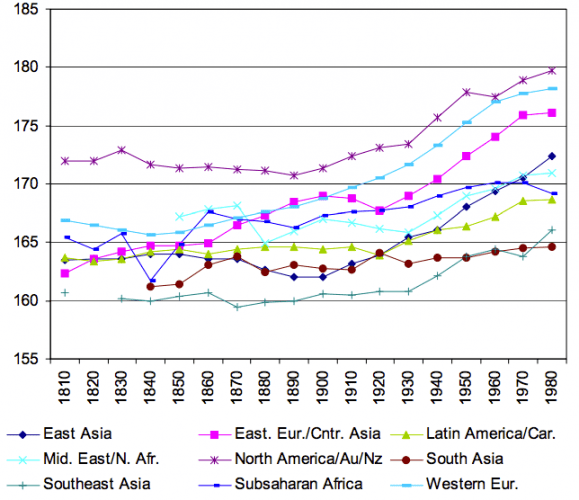
My favorite is the case of height. Human stature is strongly correlated with income and other health outcomes (net nutrition, risks of disease, life expectancy, pregnancy-related variables). Thus it is an incredible indicator of the improvement in the “stuff of life”. And throughout the globe since the industrial revolution, heights have increased (not equally though).  Over at OurWorldInData.org, Max Roser shows this increase since the 1800s (in centimeters)

height-development-by-world-regions-interpolation-baten-blum-2012-0-579x500

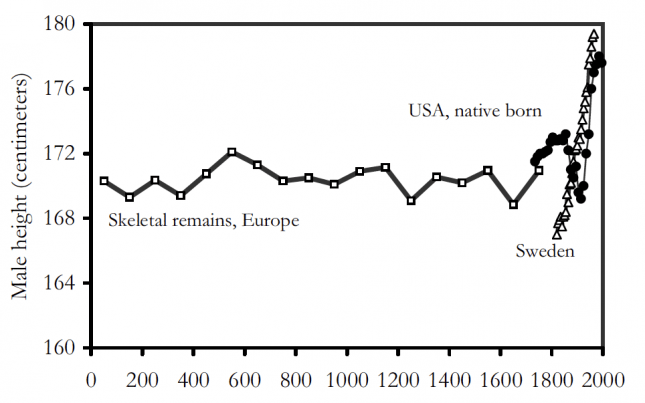
However, the true magnitude of the increase in human heights is best seen in the data from Gregory Clark who used skeletal remains found in archaeological sites for ancient societies. The magnitude of the improvement is even clearer through this graph.

male-heights-from-skeletons-in-europe-1-2000-clark-645x403.png

The ability of “capitalism” to generate improvement in material living standards did leak into broader measures of human well-being. By far, this is the greatest outcome from capitalism.

Free Trade and Labor Market Displacement

A few days ago, I saw Noah Smith’s piece on free trade and why opening up with China may have yielded some undesirable results. In essence, his argument is that labor market adjustments have been slow. It created a small storm in the economics blogosphere. I wanted to reply earlier. I did not and I regret that. However, better late than never. So here are my three key reactions to the piece written by Smith (see his blog here).

  1. Slow labor market adjustments are not a cause of free trade: If anything, they are the results of a series of government intervention. Countries like Denmark, which may have large governments combined with fewer regulations on businesses, are very well able to adapt to free trade. The ability to start businesses is basically the ability to properly channel inputs towards more valued output. If you prevent an entrepreneur from doing just that while you open your borders to more efficient producers, it is quite obvious that free trade could be “less” beneficial. This point can be well seen in the role of states with “right to work (RTW) laws”. Although there is a debate as to whether or not RTW laws increase wages (James Sherk at Heritage says yes, the good people at the Employment Policy Institute say no and I say that both don’t get it, we should care about regionally adjusted real wage growth), it does seem that it helps industrial activity while boosting employment levels (see here too).  Unions would hinder adjustments to changes in trade patterns. In fact, its worth pointing out that of the 11 states that had RTW laws before 1948 – in only three of those states did the income share of the top 10% exceed that on the whole United States (see the data here) in 2013. While the entire country has seen an increase in income inequality, the RTW states have seen the share of all income of the top 10% increase by only 26% (1947 to 2013) compared to 42% nationwide. This suggests that RTW laws are probably helping workers adjusts to changes caused by free trade (otherwise, there would be a state-level increase in inequality). This finding seems to conform to large section of the literature on the links between RTW and inequality (here and here).  I am sure that if the Autor, Dorn and Hanson study (on which Noah Smith relies) was to be redone with attempts to control for right to work laws, the effect would be concentrated in non-RTW states. Thus, if the problem is labor laws, don’t blame free trade for the poor adjustments!
  2. Nobody said that free trade was “costless” to adapt to. I do economic history. I see cases of industries being protected for decades. Protectionism not only raise prices, but it changes relative prices between different inputs. It incites the adoption of an artificially profitable production method. It is profitable to do so, but it is by no means the most efficient approach. It was made profitable only by the artifice of regulation and duties. Once you eliminate that artifice by removing the barriers, you still have “time to build” problem and a need to change production methods. That takes time. However, governments are very good at making sure this takes more time than needed (see point 1)
  3. Trade agreements with China are not free trade agreements: this is the point I keep repeating (and the point that actually make Paul Krugman interesting), free trade agreements should normally fit on a napkin. If it takes 10,000 pages, it is free trade with 10,000 exceptions. Noah Smith should realize that he may be looking at a case of such “managed trade”.

That’s all folks!

BC’s weekend reads

  1. Dank Federalism
  2. What About Capitalism? Jürgen Habermas’s Project of a European Democracy
  3. The IDF gets leaner as its enemies evolve (the US should do the same, by the way)
  4. A moderate defense of extremism in defense of liberty
  5. Why I lean libertarian
  6. Backlash grows to Schengen backlash

Go Broncos

I wish I could just list every idea I’ve encountered then never cite anything…

Steve Horwitz has a great piece in the Freeman that I wish I’d written. The tl;dr: Voting isn’t all there is to political participation. This is an idea that’s been bouncing around in my head as I’m constantly remound that I’m now an American citizen (sorry everyone else in the world…) and that this November I’ll be eligible to vote for who I think should foster anti-American sentiments internationally (Republicans) or  domestically (Democrats).

The other day I said I’d consider voting but I couldn’t recall whose name I’d write in (turns out it’s Willie Nelson*). But my usual response to any question about whether I’ll vote is “No, it just encourages the bastards.” When that’s countered with “blah blah blah civic engagement blah blah” I retort with,essentially, Horwitz’s point: My vote is not going to change the outcome**, but I can contribute value by trying to convince my students that economics matters and that a vote for third party candidate (even a Green Party vote) does more good than a vote for the big two.

I don’t know where I picked up that idea, but if I’d remembered, I would have posted his piece here before he did. Even better would be if I could just list a repository of everything I’ve ever read (or heard) in some public place and just write and write without worrying about citing anything.

Continue reading

New issues of Econ Journal Watch, Reason Papers out

Many of you already know that two of NOL‘s Senior Editors are associated with Econ Journal Watch, thus making its publication a family affair. Fred is on the editorial board and Warren is its math reader. Here are some of the highlights I found worth noting in the latest issue:

Eli Heckscher’s Ideological Migration Toward Market Liberalism: Benny Carlson explores the intellectual evolution of a great Swedish economist.

Symposium:
Classical Liberalism in Econ, by Country: Authors from around the world tell us about their country’s culture of political economy, in particular the vitality of liberalism in the original political sense, historically and currently, with special attention to professional economics as practiced in academia, think tanks, and intellectual networks.

New contributions:

Young Back Choi and Yong Yoon: Liberalism in Korea

Pavel Kuchař: Liberalism in Mexican Economic Thought, Past and Present

(All of the papers from this symposium, which has carried across multiple issues of EJW, are collected at this page.)

You can download the whole issue here (pdf).

Dr Khawaja, an Editor-at-Large for Reason Papersreports (2/2/16) on the latest issue over at Policy of Truth:

The latest issue of Reason Papers, vol. 37, number 2 is now out; officially, it’s the Fall 2015 issue, but we only just managed to put it up on the website last night. This link will take you to a monster-size PDF to the whole issue (almost 250 pages). This link will take you to the journal’s Archive page, where you can access individual articles for this or any past issue (you have to scroll down a bit). Finally, this link will take you to three (time sensitive) Calls for Papers issued by the journal’s editors: one on “the philosophy of play” (March 1, 2016); one a fifteen-year retrospective on 9/11 (July 1, 2016); and one an Authors-Meet-Critics symposium on Douglas Den Uyl and Douglas Rasmussen’s forthcoming book The Perfectionist Turn: From Meta-Norms to Meta-Ethics (February 1, 2017).

My own small contribution to Reason Papers can be found here (pdf).

The High Wage Economy: the Stephenson critic

A recent trend has emerged in economics. The claim is that high wages can have a dynamic positive effect on market economies.  The intuition is that high wages increase productivity because they incite management to find new techniques of production. In essence, its an argument about efficiency wages: efficiency wages increase incentives to innovate on the part of managers, they can also incite workers to acquire more human capital and work harder and more diligently.

In economic history, this claim has been taken up by scholars like Robert Allen (see his work here for the general public) who argues that the Industrial Revolution took place in England because of high wages. The high-wages of England in the 17th and 18th centuries (relative to all other areas in Europe), together with cheap energy, created an incentive for capital-intensive methods of production (i.e. the industrial revolution). In fact, a great share of the literature on the desirability of high wages for economic development has emanated from the field of economic history.

I have always been skeptical of this argument for two reasons. The first is that efficiency wages is a strange theory that relies on debatable assumptions about labor (strangely, I have been convinced of this point by Austrian scholars like Don Bellante and Pavel Ryksa). The second is that numerous scholars have advanced large criticisms of the underlying data. Robert Allen – the figurehead proponent of the high wage argument – has been constantly criticized by historians like Jane Humphries (see here) for the quality of the data and assumptions used. Allen defends himself on numerous occasions and many of his replies (mainly those on the role of family size in living standards) show that his initial case might have been too conservative (i.e. he is more “correct” than he claims).

Until a year or two ago, I was agnostic on the issue even though I was skeptical. That was until I met Judy Stephenson – a colleague at the London School of Economics. Judy did what I really like to do – dig for data (yes, I am weird like that). She went to the original sources of data used by Allen and others and she looked at what any Law-and-Economics buffs like me like to look at – transaction costs and contracting models.

She recently published her work as a working paper at the LSE and what she found is crucial! Labor was not hired directly, it was hired through contractors who charged costs on the basis of days worked. But this did not translate into wages actually paid to workers. The costs included risks and overheads for contractors. Somewhere between 20% and 30% of the daily costs were not given to workers as wages. Thus, the wage series used to claim that England (Stephenson concentrates on London though) had high wages are actually 20% to 30% below the level often reported. They are also substantially close to those in western Europe.

Thus, the high wage story for England seems weaker. This little piece of historical evidence brought about by Judy is something to think about carefully when one makes the argument that high wages are conducive to growth. Since most of the argument brought to the public was informed largely by this argument in economic history, it makes sense to be cautious when thinking about it in the future.

From the Comments: Sovereignty, the Commons, and International Relations

There have been a number of excellent discussions in the ‘comments’ threads these days. Dr Khawaja adds more depth to the discussion on Iran and foreign policy. Me and Chhay Lin are in the midst of a debate on democracy and libertarianism. Michelangelo’s post on splitting up California generated a good discussion. You can see what’s hot in the threads by looking to your right, of course. I wanted to highlight this ‘comment’ by Rick in the threads of Edwin’s recent post on liberalism and sovereignty:

“[S]overeignty is a constitutional idea of the rights and duties of the governments and citizens or subjects of particular states.”

To me, a constitution is like a contract. It’s close to set in stone and it lays out these rights and duties. But the idea of sovereignty Jackson is pointing toward in that quote would be better understood as laying out a sort of meta-prize; it’s a delineation of the commons that potential groups within that area may compete over or cooperate in. To be fair, a constitution is a similar sort of commons (especially when that constitution includes the right to collect tax and lead armies). The question of how to govern the commons is *the* question on the domestic side.

On the international end of things, anarcho-capitalism calls for muddying the borders of these commons. This has obvious costs and benefits: it makes the emergence of a productive polycentric order easier, but it also opens access to what would have been relatively closed commons. I think the missing piece in the world governance question, whether from a classical liberal, minarchist, or anarchist perspective is the question of how a polycentric order would emerge and function (e.g. standards associations, norms of arbitration/dispute resolution, etc.).

More discussion is needed on this point…