Philosophy of science and free speech

Here’s a link to an article I wrote just published in FEE.

I consider this part of an ongoing, gradual effort to incorporate Paul Feyerabend into the liberty canon. It’s probably a mistake, but I’m doing it anyway.

I also want to give a shoutout to the person that commented I’m “pretending that Ayn Rand didn’t exist.” Of course I know what Ayn Rand is, that’s the island next to Great Britain.

Nightcap

  1. What do we mean by “meaning”? Scott Sumner, Money Illusion
  2. The Sōseki of Prague Duncan Stuart, 3:AM Magazine
  3. The Civic Sacred Cow Wayland Hunter, Liberty Unbound
  4. The (American) Civil War’s Most Infamous Atrocity Rick Brownell, Historiat

The Catholic Church, Pedophilia, and Gay Rights

Note: I wrote this eight (8) years ago, in April, on my personal blog, Facts Matter.


The Catholic Church is, first of all, a criminal organization. It conspired for several generations to shield criminals from justice, just like the Mafia. Reading the press, I experience a sense of growing disbelief. Many commentators sound as if it the Catholic Church should be given a pass, somehow. The reverse is true. I am not religious but I know enough about the traditional Jesus to remember that he held hypocrites in special contempt. (Within the context of his day, he called them “Pharisees,” a sect known for showing off instead of acting righteously.) The Catholic Church’s own historical, philosophical, and moral claims demand that its crimes be treated with special severity. The Catholic Church deserves enhanced penal sentences and seizure of property.

If you are a grief-stricken Catholic and you hesitate to leave the Church, you should wonder whether even your simple passivity does not make you complicit in the large-scale, systemic, criminal cover-up becoming apparent right now. If you believe that the Catholic Church has the ability to cleanse itself somehow, you have not been listening to the shameful lies and self-deceptions expressed by prelates, during Holy Week of all times.

As always, I pay attention to what one should reasonably expect to happen and that is not happening. It’s striking how nearly none of the accusations of pedophilia against the Catholic church concerns girls. Catholic sexual crimes against children are almost exclusively homosexual. It looks like we are speaking about thousands of homosexual crimes. It makes me wonder why I don’t hear a word from so-called “gay” organizations. I mean militant gay organizations. I do not (not) refer here to the many homosexuals who lead irreproachable and constructive lives. They have no more to do with priestly pedophilia than I am responsible for heterosexuals who cut up their wives into little pieces. Nevertheless, anyone who thinks that mass molestation of children by homosexuals within the church has no bearing on the discussion of homosexuals’ right to marry is dreaming. The numbers are just too large and the criminals are homosexuals, anyway you look at it.

Nightcap

  1. The science war Peter Boettke, Coordination Problem
  2. On wider access to culture Chris Dillow, Stumbling & Mumbling
  3. Spaceship Earth explores Culture Space Robin Hanson, Overcoming Bias
  4. The liberal dream is freedom plus groceries (and that’s okay) Brad DeLong, Grasping Reality

A Millennial’s New Perspective on Home Ownership

The last few years I’ve loudly protested that home ownership is overrated; it’s a bad investment plus lots of responsibility. And yet, this summer my fiance and I bought a 100 year old house on the south shore of Long Island.

Yes, I have lost my mind.

I basically stand by my earlier position, but with greater nuance. Owning a home is a complicated undertaking. But it’s given me a greater appreciation for the nuance involved in managing real estate.

Home ownership is a great big Gordian knot of inter-dependencies. It’s massive set of knowledge problems wrapped in externality problems.There’s a massive role for local knowledge which means policy makers’ attention should be less focused on things like home ownership rates, and more on guiding the right people into the right places to take advantage of that local knowledge.

With local knowledge comes local politics. I don’t know anything about local politics, but expect more posts about what’s going on in my town hall over the next few decades.

So what have I learned in this first month of home ownership?

  • There’s something to be said about pride in ownership

It’s still a real trip to turn on my lights in my kitchen so I can do my laundry in my laundry machines. I didn’t think I’d enjoy it this much. The endowment effect is real. One effect has been to increase my interest in contributing to local public goods via civic engagement and other routes.

I haven’t been to a town hall meeting yet, but I plan on going to one tomorrow. I suspect it will be awful. But I’m walking distance, so I’ll be a little bit drunk.

  • The real estate market has some serious frictions

This might be obvious, but it’s interesting. There are artificial and natural obstacles to the efficient use of real estate. Transaction costs are significant and property rights issues are hairy.

Buying a house is a complicated transaction and going through the process has really made clear to me how difficult it is to commodify land. Each piece of land has a unique location and history. Information asymmetries are substantial. The neighborhood you’re buying into is utterly out of your control. Put simply: Amazon won’t be selling real estate any time soon.

Part of the reason I’m happy with buying a house is that our rent had been increasing about $100/month/year. Land lords absolutely take advantage of real estate frictions to charge as much as they can. The alternative (which I chose) is to lock-in to a specific property.

  • The required knowledge to operate a home is significant and difficult to evaluate.

It takes a lot of knowledge to manage a house. If I were to take a wild guess (at this non-quantifiable variable), I’d say that between 5% and 50% of a homeowner’s brain is necessary to operate a house. Even if you bring in experts to do everything, evaluating those experts is a lot of work.

There are repairs and upgrades to make, and my formal education prepared me for exactly none of those projects. On the other hand, I’ve got the Internet. Without YouTube and Reddit I’d be a half dozen unlucky mistakes away from homelessness.

On the other other hand, I’ve learned a ton of stuff I’ve got no use for. Like how to grow asparagus (which it turns out it isn’t worth doing except out of boredom).

You can’t evaluate knowledge until it’s too late. And there’s more to learn than you ever will, so you have to make mistakes. It’s true of home ownership and it’s true of life more generally.

  • Gardening is a real trip.

In History of Economic Thought professor Gonzalez shared a story about two economists meeting in Switzerland during WWII. On showing his vegetable garden to the visiting economist, the visitor said “that’s not a very efficient way to grow food,” to which the gardener said, “yes, but it’s a very efficient way to grow utility.”

I’ve wanted to garden for some time, but the market for gardens is thin. So now I’m starting with almost no useful experience. My public stance has been that lawns are boring and dumb. But figuring out how to manage a little ecosystem ain’t easy. I now get why someone would just put in a lawn and be done with it.

At my old apartment complex the entire ecosystem was made of: humans, trees, lawns, cockroaches. I suspect the cockroaches did so well because all their competition was poisoned away. As an emergent order guy, I’m not really into that. But I get it now. In the same way the king wants everyone living in neat little taxable rows my life would be easier if I could just slash and burn all the complexity out of my yard.

Tl;dr: My biggest surprise as a new home owner is just how big a cognitive load owning a house is. You hear homeowners talk about how much work it can be, but I think it’s rare to hear someone talk about how much know-how is required.

Given the capacity to generate externalities, I’m a bit surprised that there isn’t more public policy devoted to issues of home ownership* (beyond subsidizing finance and increasing barriers to entry). I supposed I’ll learn a lot more about these issues as I learn about local politics.

*That isn’t to say I think it’s a good idea to get the government involved in trying to tell people how to go about the business of daily life. I think homeowners are (basically) doing fine left to their own devices.

The State and education – Part IV: Conclusion

On August 17, 2018, the BBC published an article titled “Behind the exodus from US state schools.” After taking the usual swipes at religion and political conservatism, the real reason for the haemorrhage became evident in the personal testimony collected from an example mother who withdrew her children from the public school in favour of a charter school:

I once asked our public school music teacher, “Why introduce Britney Spears when you could introduce Beethoven,” says Ms. Helmi, who vouches for the benefits to her daughters of a more classical education.

“One of my favourite scenes at the school is seeing a high-schooler playing with a younger sibling and then discussing whether a quote was from Aristotle or Socrates.”

The academic and intellectual problems with the state school system and curriculum are perfectly encapsulated in the quote. The hierarchy of values is lost, not only lost but banished. This is very important to understand in the process of trying to safeguard liberty: the progenitors of liberty are not allowed into the places that claim to incubate the supposed future guardians of that liberty.

In addition to any issues concerning academic curricula, there is the problem of investment. One of the primary problems I see today, especially as someone who is frequently asked to give advice on application components, such as résumés and cover letters/statements of purpose, is a sense of entitlement vis-à-vis institutional education and the individual; it is a sense of having a right to acceptance/admission to institutions and career fields of choice. In my view, the entitlement stems from either a lack of a sense of investment or perhaps a sense of failed investment.

On the one hand as E.S. Savas effectively argued in his book Privatization and Public-Private Partnerships, if the state insists on being involved in education and funding institutions with tax dollars, then the taxpayers have a right to expect to profit from, i.e. have a reasonable expectation that their children may be admitted to and attend, public institutions – it’s the parents’ money after all. On the other hand, the state schools are a centralized system and as such in ill-adapted to adjustment, flexibility, or personal goals. And if all taxpayers have a right to attend a state-funded institution, such places can be neither fully competitive nor meritocratic. Additionally, Savas’ argument serves as a reminder that state schooling is a manifestation of welfarism via democratic socialism and monetary redistribution through taxation.

That wise investing grants dividends is a truth most people freely recognize when discussing money; when applied to humans, people start to seek caveats. Every year, the BBC runs a series on 100- “fill-in-the-blank” people – it is very similar to Forbes’ lists of 30 under 30, top 100 self-made millionaires, richest people, etc. Featured on the BBC list for 2017 was a young woman named Camille Eddy, who at age 23 was already a robotics specialist in Silicon Valley and was working to move to NASA. Miss Eddy’s article begins with a quote: “Home-schooling helped me break the glass ceiling.” Here is what Eddy had to say about the difference between home and institutional schooling based on her own experience:

I was home-schooled from 1stgrade to high school graduation by my mum. My sister was about to start kindergarten, and she wanted to invest time in us and be around. She’s a really smart lady and felt she could do it.

Regarding curriculum choices, progress, and goals:

My mum would look at how we did that year and if we didn’t completely understand a subject she would just repeat the year. She focused on mastery rather than achievement. I was able to make that journey on my own time.

And the focus on mastery rather than achievement meant that the latter came naturally; Eddy tested into Calculus I her first year at university. Concerning socialization and community – two things the public schools pretend to offer when confronted with the fact that their intellectual product is inferior, and their graduates do not achieve as much:

Another advantage was social learning. Because we were with mum wherever she went we met a lot of people. From young to old, I was able to converse well with anyone. We had many friends in church, our home-school community groups, and even had international pen pals.

When I got to college I felt I was more apt to jump into leadership and talk in front of people because I was socially savvy.

On why she was able to “find her passion” and be an interesting, high-achieving person:

And I had a lot of time to dream of all the things I could be. I would often finish school work and be out designing or engineering gadgets and inventions. I did a lot of discovery during those home-school years, through documentaries, books, or trying new things.

In the final twist to the plot, Camille Eddy, an African-American, was raised by a single mother in what she unironically describes as a “smaller town in the US” where the “cost of living was not so high.” What Eddy’s story can be distilled to is a parent who recognized that the public institutions were not enough and directly addressed the problem. All of her success, as she freely acknowledges, came from her mother’s decision and efforts. In the interest of full honesty, I should state that I and my siblings were home-schooled from 1stgrade through high school by parents who wanted a full classical education that allowed for personal growth and investment in the individual, so I am a strong advocate for independent schooling.

There is a divide, illustrated by Eddy’s story, created by the concept of investment. When Camille Eddy described her mother as wanting “to invest time in us and be around,” she was simply reporting her mother’s attitude and motivation. However, for those who aspire to have, or for their children to attain, Eddy’s achievements and success, her words are a reproach. What these people hear instead is, “my mother cared more about me than yours cared about you,” or “my mother did more for her children than you have done for yours.” With statements like Eddy’s, the onus of responsibility for a successful outcome shifts from state institutions to the individual. The responsibility always lay with the individual, especially vis-à-vis public education since it was designed at the outset to only accommodate the lowest common denominator, but, as philosopher Allan Bloom, author of The Closing of the American Mind,witnessed, ignoring this truth became an overarching American trait.

There are other solutions that don’t involve cutting the public school out completely. For example: Dr. Ben Carson’s a single-, working-mother, who needed the public school, if only as a babysitter, threw out the TV and mandated that he and his brother go to the library and read. As a musician, I know many people who attended public school simply to obtain the requisite diploma for conservatory enrollment but maintain that their real educations occurred in their private preparation – music training, especially for the conservatory level, is inherently an individualistic, private pursuit. But all the solutions start with recognizing that the public schools are inadequate, and that most who have gone out and made a success of life in the bigger world normally had parents who broke them out of the state school mould. In the case of Dr. Carson’s mother, she did not confuse the babysitter (public school) with the educator (herself as the parent).

The casual expectation that the babysitter can also educate is part of the entitlement mentality toward education that is pervasive in American society. The mentality is rather new. Allan Bloom described watching it take hold, and he fingered the Silent Generation – those born after 1920 who fought in World War II; their primary historical distinction was their comparative lack of education due to growing up during the Great Depression and their lack of political and cultural involvement, hence the moniker “silent”[1]– as having raised their children (the Baby Boomers) to believe that high school graduation conferred knowledge and rights. As a boy Bloom had had to fight with his parents in order to be allowed to attend a preparatory school and then University of Chicago, so he later understandably found the entitlement mentality of his Boomer and Generation X students infuriating and offensive. The mental “closing” alluded to in Bloom’s title was the resolute refusal of the post-War generations either to recognize or to address the fact that their state-provided educations had left them woefully unprepared and uninformed.

To close, I have chosen a paraphrase of social historian Neil Howe regarding the Silent Generation, stagnation, and mid-life crises:

Their [Gen X’s] parents – the “Silent Generation” – originated the stereotypical midlife breakdown, and they came of age, and fell apart, in a very different world. Generally stable and solvent, they headed confidently into adult lives about the time they were handed high school diplomas, and married not long after that. You see it in Updike’s Rabbit books – they gave up their freedom early, for what they expected to be decades of stability.

Implicit to the description of the Silent Generation is the idea, expressed with the word “handed,” that they did not earn the laurels on which they built their futures. They took an entitlement, one which failed them. There is little intrinsic difference between stability and security; it is the same for freedom and liberty. History demonstrates that humans tend to sacrifice liberty for security. Branching out from education, while continuing to use it as a marker, we will look next at the erosive social effect entitlements have upon liberty and its pursuit.


[1]Apparently to be part of the “Greatest Generation,” a person had to have been born before or during World War I because, according to Howe, the Greatest Generation were the heroes – hero is one of the mental archetypes Howe developed in his Strauss-Howe generational theory – who engineered the Allied victory; the Silent Generation were just cogs in the machine and lacked the knowledge, maturity, and experience to achieve victory.

Nightcap

  1. What would it take to build a tower as high as outer space? Sun & Popescu, Aeon
  2. Progressive/libertarian: the alliance that isn’t Bryan Caplan, EconLog
  3. An atlas of diplomacy Francis Sempa, Asian Review of Books
  4. How to save the Catholic Church Rachel Lu, the Week

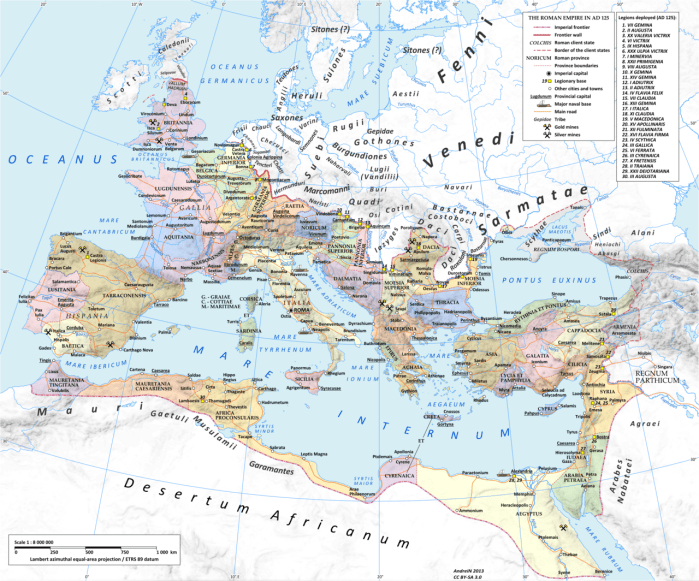
Eye Candy: the provinces of ancient Rome

NOL ancient Rome's adminstrative units.png
Click here to zoom

This is a beautiful map of Rome’s administrative units. There’s not much more to say, really.

Here is Barry on Roman law. Here is Mark on the Roman economy. Have a good week!

Nightcap

  1. The transformation of the liberal political tradition in the nineteenth century Pamela Nogales, Age of Revolutions
  2. Kurds have conditions for an alliance with Shiites in Iraq Omar Sattar, Al-Monitor
  3. Mau-Mauing Myself Harry Stein, City Journal
  4. Is the sharing economy exploitative? Per Bylund, Power & Market

RCH: 10 libertarian thoughts on the (American) Civil War

I went there. I did it. I dropped a doo-doo right in the middle of August, for all the world to see. An excerpt:

5. Shout-outs to Alexis de Tocqueville and Joseph Smith. Alexis de Tocqueville wrote the best book on America, ever. Joseph Smith founded the “American religion” (to quote Leo Tolstoy). Both men also saw that the north-south divide in the United States was bound to lead to future calamity. It wouldn’t be accurate to call their thoughts on the American divide “predictions,” but both men were outsiders in one form or another, and both men have etched their names into history. The French, who had lost Tocqueville just two years prior to the beginning of the Civil War, approach to the American bloodbath was to remain neutral (after consulting with the United Kingdom), and instead invade Mexico. Napoleon III invaded Mexico, in the name of free trade, late in 1861 and established a puppet monarchy, which angered the United States as it violated the Monroe Doctrine. However, there was not much the U.S. could do and Napoleon III did not abandon his puppet until early 1866, when it became apparent which side was victorious in the American Civil War. The French preferred normalized relations with the American republic to a puppet monarch in the Mexican one. The Mormons, for their part, largely sat out the Civil War. Volunteers from Utah helped guard the mail routes from Indian attacks, but other than that, the Mormons, who had not yet been assimilated into American society (indeed, they had only fled from violence in Missouri to Utah a few decades prior to the Civil War), were content to let both sides bleed.

Please, read the rest.

Nightcap

  1. The other side of broken windows Eric Klinenberg, New Yorker
  2. “Peace through strength” is weakening Putin at home Krishnadev Calamur, the Atlantic
  3. How to cleanse the Catholic Church Andrew Sullivan, Daily Intelligencer
  4. The garment of terrorism Azadeh Moaveni, London Review of Books

Nightcap

  1. Why Czechs don’t speak German Jacklyn Janeksela, BBC
  2. The Kurds, Sykes-Picot and the quest for redrawing borders Nick Danforth, BPC
  3. The language of the economy: prices Rick Weber, NOL
  4. A Balkan border change the West should welcome Marko Prelec, Politico EU

Nightcap

  1. Yoram Hazony and the New Nationalism Samuel Goldman, Modern Age
  2. The archive of comics sponsored by South Africa’s Apartheid government William Worger (interview), Africa is a Country
  3. Photo essay on the Soviet squelching of the Prague Spring Alan Taylor, the Atlantic
  4. Failed states and failed civilizations Nick Nielsen, The View from Oregon

Nightcap

  1. Confucianism and meritocracy James Hankins, American Affairs
  2. Lots of ideological axes to grind Scott Sumner, EconLog
  3. Did the notorious Zinoviev Letter ever exist? Alan Judd, Spectator
  4. That time when Chile conquered Peru and Bolivia Stefan Aguirre Quiroga, History Today

Between anarchy and minarchism

While sometimes we think of ideologies in strict terms of left and right, more and more frequently we look at political schemas that incorporate a dimension for statism. Big government is possible for both conservatives and progressives; so, maybe, is minarchy. If minarchy is possible, and achievable, it must attain popular support less it be thwarted by revolution or contrarian voting. From this, maybe it makes sense that a minarchism utilize fundamental values from each side, in order to be pragmatic and achieve democratic (and thereby maybe stable) ends. Here there may even be room for an ultraminarchy.

In Anarchy, State and Utopia, Robert Nozick defended a minimal state slightly more restrained than traditional classical liberalism. This minimal state arises through natural market forces from statelessness, and serves to enforce contracts and produce monopolistic law. Nozick, although countering his fellow Harvard academic Rawls, was also responding to the natural law anarchists, who criticized coercive states for violating human rights — which, in the American tradition, often boil down to rights of property and self-ownership.

However, before arriving at the minimal, night-watchman state, Nozick articulates an ultraminimal state, i.e. a private protection agency that claims exclusionary right over the use of force for a given geographical area. It has its voluntary clients; the extension of coverage to others makes the agency a “state” as it introduces taxation.

In ASU the state is an entity formed from an invisible hand to produce heavily right-libertarian functions of government like protecting negative rights. Because of this, the minarchist state was a refuge for archist libertarians to claim as their own, relatively consistent with centuries of Western liberal thought. Accordingly, in response, the anarchists question the viability of a lasting minimal state — cue David Friedman in Machinery of Freedom:

“It took about 150 years, starting with a Bill of Rights that reserved to the states and the people all powers not explicitly delegated to the federal government, to produce a Supreme Court willing to rule that growing corn to feed to your own hogs is instate commerce and can therefore be regulated by Congress.”

Government grows; modern government grows really, really fast. Minimalism hasn’t seemed to last. So the question is, what sorts of minimal governance could last?

The traditional ultraminimal and minimal state are concerned with, as stated, traditionally libertarian public functions such as police, the judiciary, and possibly roads and maybe even national defense. The problem with these utilities is that they feel wildly inadequate to the modern American used to entitlements, welfare, or, e.g., a president. The privatization of nearly all federal departments — even when their failures are widely acknowledged — is seen as wild enough for John Oliver to entertain millions of viewers, at the blight of Gary Johnson, and make hardcore eliminativism a losing electoral program. The contemporary world is too complicated, or our enemies are too powerful, or the market is too corrupt for the reinstitution of laissez-faire in the 21st century.

Nevertheless we want a smaller government, or no government, and losing to the tide isn’t a good death; we’d rather fight, and we’d rather win. A lasting minarchism satisfies the broad purposes of limited governance — basic liberty, protection, and preserving the benefits of the market — while sufficiently completing modern democratic demands, lest it erode into statism or collapse internally. (Keep in mind that statelessness, at least this week, is not a winning platform.)

Here’s what I think lies between anarchism and minarchism: the redistributive state. We can make a couple assumptions which I think are likely true: (1) every public service, including public goods, currently monopolized by the state could be provided (and, maybe, could be provided better) by the market and non-coercive communities instead, and (2) the entitlement theory of distributive justice offered by Nozick is correct, i.e. holdings are just if acquired by peaceful initial acquisition, voluntary exchange or gifting, or rectification of a previous unjust acquisition. Taking these assumptions, and leveraging the fact that the American populace will not currently settle for brutalist governance, the redistributive state (RS) seeks only to collect tax revenues and redistribute money progressively.

Instead of offering vouchers, EBT, or public options like housing, schools, security and roads, a RS would only tax its citizens and reallocate revenue based on some progressive variables like income, net worth or consumption. (These details are less important, for now.) The only administration is something like an Internal Revenue Service, Census Bureau, and investigation unit suffused together, with over ninety-five percent of the current staff eliminated, with tax escapees adjudicated through non-state means.

An RS violates rights based on a Lockean or Kantian conception; it also does something which sounds pretty socialist to right-wing circles. For this reason, though minarchist, it may not be libertarian. However, the pragmatic element is also very utilitarian and liberal, which may interest bleeding-hearts; and, being essentially one big welfare program, it may intrigue American leftists currently eyeing a state takeover of health care and socialized education. We would do well to keep in mind that Friedrich Hayek and Milton Friedman were not averse to basic income either — a redistributive state operates a universal basic allowance and abandons the productive functions of the state. I think it is generally clear that, in a situation where we are already giving a person $X in the illiquid form of schools, transfer payments, utilities, roads, defense, firefighters, social planning, arts, retirement investing, mail service, etc., instead we should just give that person $X to spend however they see fit, to reap more competitive pressure from consumer exposure to prices and to align their dollars with their own individual values. If anyone disagrees, they might be too top-down to consider minarchism in any scenario.

The RS has many benefits over our current, vague understanding of contemporary government. In the first case, the reductionist perspective of right-wing anarchists, such as the stationary bandits theory, is validated, and a lot of the mysterious machinery and ivory-tower political philosophy is dissolved. Some of the bright spots of recent cameral formalist thought are validated, too, without the unpleasant baggage. (And armchair philosophizing about the Rousseauian general will is finally put to rest.) And, for the Marxists, their critique of the state as a tool of the capitalist class, which is true enough, is answered, since the state now greatly serves labor more than capital: some of the income of the upper classes is directly confiscated from them and allocated to the lower classes. Also, the state ceases to be paternalistic — it no longer chooses what food is available through SNAP, or issues health and safety warnings; it just straight-up hands out the money without assuming value for consumers. It doesn’t determine what is taught in schools, or what color the roads are, or which country gets bombed on Tuesday.

Perhaps most popularly, the RS has the potential to all but eliminate bureaucracy. With one small administrative branch which functions like a hyper-specialized agency, there is little room or need for massive proliferation and government by permanent staffers, where we find ourselves now. Likely, all seats will be elected positions along with some underlings, with the marginal tax brackets pre-established constitutionally and open to a similar amendment process. But, that can all be figured out later.

Now, there are some obvious flaws for an RS. First of all, the very wealthy, prima facie, have little incentive to stay in a redistributive state. Their money is seized and without tangible benefit for themselves, like roads or security. They have to buy those things on their own dime. The redistributive state is the antithesis of Galt’s Gulch. The primary answer to this I can think of is that, in a society with less state omnipotence (in contrast to today, where everyone’s first answer to a problem starts with a “g”) community ties will be closer — the rich will want to pay their “fair share.” This is the Hoppean trust in private charity, except that it’s now “forced private” charity. Also, taxes would be much, much lower than the current situation and hopefully tolerable. The taxes are also going directly to other citizens instead of politician’s wallets, oil tycoons, and potassium chloride. Furthermore, they’re paying to live in — the government still has a coercive and unjustified monopoly on land — the freest nation in the world. An RS is significantly freer than the other statist regimes, and less stressful. Government plays no role at all in everyday life.

One other flaw — maybe an inherent flaw of government brightly illuminated by a raw redistributive state — is what Murray Rothbard saw as an eternal tension between net tax-payers and net tax-consumers. To the extent that the RS administration is elected, and to the extent that politicians have platforms, a lot rests on whether or not taxes will be raised (read: redistribution will increase) or not. The left will continually be concerned with income inequality, regardless of whether or not everyone is well-off. The goalposts might keep climbing, to where taxation is no longer about fairness or the difference principle, but about punishment. At the same time, dialectically, the very wealthy will want to keep the maximum amount of their money and protect profit, regardless of my arguments above. Raw societal tensions like these probably require a dynamic form of governance, with fluctuations in party dominance, but the RS is too brutalist to feature such parties or other contrivances. The only hope here, I guess, is that the tension will be less than in the current system we have, where people openly talk about murdering the other party. And very likely it will be. (Also, the market will correct much of the gratuitous wealth disparity presently built upon rent-seeking — so it becomes an empirical question about what levels of inequality create what levels of tension, as there will be large inequality in any non-patterned system of holdings.)

In conclusion, a redistributive state would be baldly organized around theft (in a libertarian interpretation) and using people as means rather than ends. To that extent it is hardly libertarian. It achieves Nozick’s end of minimal government but distorts the typical functions we correlate with small government. Still, it’s ultraminarchical, preserves innovation, balances right-wing virtues like liberty and industry and left-wing virtues like equality and positive freedom, and, for a radical populace not quite keen on revolution, has the potential to be politically attractive. It serves welfarist functions demanded by 21st century citizens without the corporatist empire of the present. Also, no one starves. For all of this, even if a redistributive state is not perfection incarnate, it seems far better than the current system, and provides a culturally-celibate political framework to possibly achieve success in totally disparate societies from the United States. I think it’s a useful, radical place to look for bipartisan solutions to a complicated and overwhelmingly statist world.

I’m pretty sure I’m the first one to suggest a state organized baldly and singularly around redistribution of private income, either because it’s too stupid or it’s too grossly unattractive, so I welcome all feedback. But, if voluntarist alternatives are possible at all, this implies all the state is is a redistributor anyway. The idea of an RS just accepts this conclusion and makes it efficient. Keep in mind I haven’t elaborated on the many complications of UBI, which is an entire field to articulate more extensively, and which has its own numerous difficulties. For now the only question is would this form of government be possible.