Criminalizing Innovation

By Fred Foldvary

The U.S. government has attacked an entrepreneur and his new product, as another episode of the federal government’s war on enterprise. In this case, the entrepreneur CEO is Craig Zucker, the company was Maxfield & Oberton, and the product was Buckyballs.

Buckyballs were small magnetic spheres made of neodymium, a rare-earth element that is a powerful magnet. As they stick together, the balls can be assembled into shapes such as pyramids. They were named “Buckyballs” after Buckminster Fuller, an American architect, inventor of the geodesic dome, and futurist visionary. His friends called him “Bucky,” and the neodymium spheres were somewhat like Bucky’s domes.

The company imported the balls from China and started selling them in 2009. They became a popular office toy. But the Buckyballs were banned in July 2012 by the federal Consumer Product Safety Commission, which is now seeking to prosecute Zucker for having sold the balls.

In 2012 the Commission also sent letter to retailers warning of the risks to consumers of using Buckyballs and asking them to stop selling them. That was effective in stopping the sales. The Commission stated that the balls were a hazard for young children who swallowed them.

The company had developed the Buckyballs in collaboration with the Consumer Product Safety Commission, and after the action by the Commission, the firm provided it with a corrective-action plan. Buckyballs were sold with a warning against access by children, and they were not sold in toy stores. But the Commission pursued a lawsuit against the firm even before examining the corrective plan. As pointed out by the Wall Street Journal article (cited below) on that case, there are many potentially dangerous products being sold, such as cleaning chemicals, knives, and balloons. Buckyballs were intended and marketed for adults, and, according to the WSJ article, no deaths have been associated with the Buckyballs.

The Commission declared, as a justification for the ban, that Buckyballs have “low utility” and are unnecessary, despite purchases by 2.5 million adults who spent $30 each. The principle established by the Commission is that government determines which products are desirable, not consumers. Any product could be banned by the standards of the Commission.

The company then engaged in a publicity campaign regarding the actions by the Commission. In the end, the government was too powerful to resist, and the company was terminated in December 2012. However, in February 2013, the Commission charged Zucker as being personally liable for the costs of a recall costing $57 million if the Buckyballs are judged to be defective.

The federal government has by this action abolished limited personal liability under U.S. law for corporations as well as partnerships. From now on, the executives of a firm will be vulnerable for the liabilities of the firms. Any entrepreneur will now risk losing all that he owns if he engages in the production or distribution of any product. The effect of this government action is to strangle American entrepreneurship.

In the case of United States v. Park in 1975, the Supreme Court ruled that the CEO of a food company was criminally liable for a rodent infestation. This ruling was based on the federal Food and Drug Act. But another case, Meyer v. Holley in 2003 ruled that ordinary liability applies unless there is a clear Congressional intent to hold corporate officers personally liable. The relevant law in the Buckyballs case is Section 15 of the Consumer Product Safety Act, which regulates corporate persons, not individual persons.

The WSJ article says that since Zucker did not commit any criminal violation, the Commission’s continuing prosecution of Zucker “raises the question of retaliation for his public campaign against the commission.” If the Commission achieves its goal, personal-injury lawyers will take advantage of personal liability to go after CEOs and other company personae.

This action by Congress, the Courts, and the Commission has to be seen in the perspective of a broad war by government on private enterprise and consumer choice, using taxes, restrictions, mandates, and prosecutions, ultimately resulting in an economy that is nominally private but substantially controlled by governmental chiefs. The name for that system is “fascism.”

————————————-
Reference: Sohrab Ahmari, “What Happens When a Man Takes on the Feds,” Wall Street Journal, August 31-September 1, 2013, p. A11.

Why is India so poor? A macro approach

India’s total area, in square kilometers, is 1,222,559 3,166,414.

The total area of France, Germany, the UK, Ireland, the Netherlands, Belgium, Luxembourg, Denmark, Sweden, Iceland, Norway, Finland, Switzerland, Austria, Italy, the Czech Republic and Slovakia (or “the West”), in square kilometers, is 1,223,543 3,106,585.

Think of this comparison in terms of regions: one region is India, the other is the West. Both regions are densely populated. Both regions have a number of languages and an even greater number of regional dialects. Yet one region is wealthy, and the other is poor.

One way to look at this phenomenon would be to glance at the macro institutional structures in place in these two regions. India is one country. The West is composed of 6 17 countries. That’s six seventeen centers of power, as opposed to one, within territorial spaces that are roughly equivalent in size.

If we think about these macro institutions and incorporate them into other institutional arguments that focus on the micro institutions, then India actually has a lot of hope. The West saw numerous wars before it finally came to the arrangements it now has (six seventeen independent centers of power and a free trade zone binding them together), so India has a great blueprint for improving its macro institutions.

On the downside, of course, is the fact that many factions won’t really care if India becomes freer and more prosperous, so long as they get theirs. Along with the standard public choice explanation, the path dependency argument also suggests that India has a tough road ahead.

Sometimes being a libertarian sucks.

Update: Dr Gibson was kind enough to point out that I had initially calculated India’s size in square miles rather than square kilometers. I have taken that into account and updated it accordingly. Conceptually, my argument actually grows in strength with the corrected size. 

Does the New York Times read NOL?

Parag Khanna definitely reads Notes On Liberty. From his latest op-ed in the New York Times:

Devolution is even happening in China. Cities have been given a long leash to develop innovative economic models, and Beijing depends on their growth. One of the most popular adages among China watchers today is: “The hills are high, and the emperor is far away.” Our maps show a world of about 200 countries, but the number of effective authorities is hundreds more. [check out “Federalism, Chinese Style” by Gabriella Montinola, Yingyi Qian, and Barry R. Weingast for a fascinating look at the ongoing devolutionary trends in China – BC]

The broader consequence of these phenomena is that we should think beyond clearly defined nations and “nation building” toward integrating a rapidly urbanizing world population directly into regional and international markets. That, rather than going through the mediating level of central governments, is the surest path to improving access to basic goods and services, reducing poverty, stimulating growth and raising the overall quality of life.

Connected societies are better off than isolated ones. As the incidence of international conflict diminishes, ever more countries are building roads, railways, pipelines, bridges and Internet cables across borders, forging networks of urban centers that depend on one another for trade, investment and job creation.

I’ve been making this same argument here at NOL for quite some time now, but Dan Drezner disagrees. He has three bones to pick with my argument (as augmented by Dr Khanna in the NYT):

  1. People were writing about devolution all the way back in 1995, so Khanna’s insights aren’t particularly new or exciting. This is true; if you’ll remember my recent post on federalism as an alternative to imperialism you’ll recall that Adam Smith was making the same argument as Khanna in 1776.
  2. Contra Khanna, states have always been in competition with other forms of governance (not government). Khanna needs hard empirical evidence to prove that the devolution he writes about is as prominent and fast-moving as he claims it is.
  3. Other academics, mostly economists, have been claiming precisely the opposite of what Khanna is arguing; namely that states have been increasing in size and scope over the past few decades. Drezner hesitantly errs on the side of the economists, who at least bring data to the table, but claims that there is probably a middle ground between Khanna and the economists.

As far as throwing out ideas to back up the devolutionist argument, it might be a good idea to look at the nation-state’s loss of monetary sovereignty to supranational (or quasi-national) organizations in the West. Or the separatist tendencies of regions within supranational organizations like the EU that threaten to break up nation-states. Or the fragility of African and Islamic states, as evidenced by the dictatorships and wars often found in these regions. Or the multilateral trade agreements that are becoming more and more inclusive, and more and more complicated. There are probably many more, and if you can think of any feel free to leave them in the ‘comments’ section.

With all of this said, Drezner has a point. The state has found a number of ways to counteract the various effects of globalization, and proving that the state is in decline is, for the moment, extremely hard to do. Yet Drezner’s point says nothing about Khanna’s overall argument, which is merely that devolution is a good thing and ought to be embraced by more progressively-inclined people.

The interesting question here is not the current situation of the state itself, but rather if a consensus can be forged, among thinking people, around the idea that political decentralization and economic integration leads to freer societies. Until a consensus built around this idea can be reached among intellectuals, I fear despotism will reign in most parts of the world at most times.

What the Hell is a “RINO” Anyway???

I have serious problems understanding the definition of the term ‘RINO’. The term is supposed to mean a Moderate Republican, i.e. a Republican that shares views with a Democrat. However, the term is used by so many contradictory parties that it lacks real meaning. Many people hold up President Reagan as the hard definition of a true conservative, with his quote of “the soul of conservatism is libertarianism”.

In the 2012 election, the four Republican candidates each represented a key demographic of the current Republican base. There was Mitt Romney, a Mormon westerner who had become merged with the moderate eastern Money Trust Rockefeller establishment. There was Rick Santorum, a right-wing Catholic obsessed with social issues and ready to wage a Christian jihad. There was Newt Gingrich, a Baptist-turned-Catholic career politicians who’d passed centrist legislation throughout the Clinton administration. And of course, Ron Paul, a libertarian carrying the youth vote, ironically carrying views of a politician born in the 1890s, who would have been a member of the bipartisan anti-Roosevelt Old Right coalition.

The idea of a RINO came into existence around the campaign of Barry Goldwater, an Arizona Senator, who won the 1964 nomination instead of Nelson A. Rockefeller, the grandchild shared by John D. Rockefeller of Standard Oil and Senator Nelson Aldrich, who pitched the original idea for the Federal Reserve. Even though he won the nomination, Goldwater was written off as an “extremist” by many, and Rockefeller was considered a “moderate”. But what does this really mean?

As America was still very homogenous in 1964, most regions had a strong local culture. At the time, the Republican base was comprised of Midwestern Lutherans, Western Mormons, wealthy New England Episcopalians, and transient career military families. At the time, most Southern Baptists and Catholics were still largely Democrats. Goldwater winning Southern states in 1964 did not permanently secure the Solid South as red states, despite the widely toted myth. (Third party Wallace of 1968 and Democrat Carter of 1976 prove this.) As a general phenomenon, the lower-middle-class flyover demographics were known as the extremists, while the upper-middle-class city and suburban folk were known as the moderates.

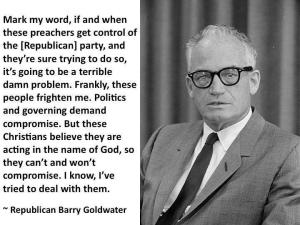
Despite being categorized as a “right-wing extremist” in 1964, Goldwater still had little in common with the heartland evangelicals of today. Goldwater had no connection to fundamentalist Christianity like Governors Perry or Palin. One side of his family was Jewish, and the other side was Yankee Episcopalians, and Goldwater was an Episcopalian his whole life. Goldwater supported no legislation in regards to gay marriage, drugs, or abortion. Goldwater is directly quoted as saying, “Mark my words, if and when these preachers get control of the Republican party, and sure they’re trying to do so, there’s going to be a terrible damn problem. Frankly these people frighten me”.

Everything Barry Goldwater predicted about the Christian fundamentalist hijack eventually came true. Now the term RINO has a whole new meaning than when two socially liberal Episcopalians were vying for the nomination in 1964. Many Republicans referred to John McCain (a career military man with no regional ties) and Mitt Romney (a flip-flopper from the far left state of Massachusetts) as RINOs or moderates. But when Obama ran against them in 2008 and 2012, his campaign spent countless efforts painting the two candidates as right-wing extremists

Since 2008, the mainstream liberal media outlets have generally painted all Republican candidates in the same stereotype: old, uncool, racist, sexist, cranky, corny, money-hoarding, miserly Mr. Scrooges, obstructing Obama’s hip-and-groovy “CHANGE”. It mattered little how moderate McCain’s and Romney’s records were, the media rhetoric implied that anyone running against Obama had a closeted agenda with the same motivations as the Thurmond, Wallace, or Duke campaigns. Vice President Biden shouted out to an audience during a debate with Paul Ryan, “Romney is gonna put you all back in chains”. The MSM saw no problem with this.

So what are the concrete issues that make or break the difference between the RINOs and a non RINO? Is it the military, war, and foreign policy? Is it economics? Is it Christian social issues? (a dead horse, as far as I’m concerned) Are the rants espoused by Limbaugh, Hannity, and other Fox News anchors the policies that anyone who runs as a Republican are “supposed” to have? Fox anchor Ann Coulter referred to libertarians as “pussies”, and implied that supporting drug legalization was RINO/moderate, by mashing  different ideologies from left and right. Everyone has different definitions of RINO.

So this brings up the question: Was Ron Paul a “RINO”? Fox News certainly said so in the 2012 election. Were Ronald Reagan and Barry Goldwater “RINOs”? Many Democrats who hate the Tea Party would say so today. Although one must acknowledge Ron Paul’s ultraconservative personal views, one should realize he would give power back to the fifty state governments, with the intention that each American demographic can carve out a haven. There is no point pretending that Ron Paul is a hip guy with young libertarian social ideas: his views have changed little since he was a medical student in the 1950s.

Despite this, Ron Paul had the potential to represent a purge of many issues that the left hates about the Republicans; policies relating to drugs, gays, abortion, corporate bailouts, but most importantly, the wars in the Middle East. This was only exacerbated by Rick Santorum’s extremist Christian authoritarian rants, and his comment that he wanted to “fight against libertarian influence in the Republican party”. Despite the Obama administration’s continued drone warfare allover the Middle East, the Obama 2012 campaign repeated the same 2008 rhetoric that this was Bush’s personal, Republican, corporate, Islamophobic war. Simultaneously, the other three Republicans called Ron Paul an isolationist coward for his foreign policy. Ron Paul could have been the perfect moderate with ideas compromising from both sides, and yet they trashed and defamed him every possible chance.

Unfortunately, it is the Tea Party, and not moderate Republicans or Democrats, who have been blamed for the government shutdown. Personally, I think the Republicans handling the shutdown is a poorly planned reactionary idea. This kind of political activism only works if the libertarian-leaning Republicans were to shut down the government about the wars in the Middle-East, or the incarcerations of non-violent drug offenders. Otherwise, the MSM will just paint them as quintessential obstructionist right-wing cranks, as they have done so far.

McCain’s machine of moderate Republicans have marched in lockstep behind Obamacare, in an attempt to make Ted Cruz and other libertarian-leaning Republicans look like the “extremists”, Obama-haters, and Confederate secessionists. Despite the fact that libertarians are supposed to share a good bit ground with progressives, Democrats and moderates are together pointing to libertarianism “the far right fringe”. Moderate Republicans need to keep in mind that when is all over, the liberal media outlets will put all Republicans, moderate and conservative, in the same category as tongue-speaking, back-alley-abortion-causing, end-of-times, Limbaugh-hypnotized, warmongering, theocratic neo-confederates no matter what.

If liberal Democrats prefer moderate ‘Rockefeller Republicans’, or big government Republicans, let them have each other. If they think the enemy is small town, small business people, let them feel that way. Democrats can have Republicans like the Bushes, an old New England Money Trust family, long term ally of the Rockefellers, with CIA connections and investments in the baby Standard Oil corporations. After all, when corporate exploitation, global imperialism, and war profiteering makes millions, they can cash in and use the money to look humanitarian later in life. Just don’t dress him up like a Texas good ol’ boy, and then blame flyover folk for him.

Not Reagan, Goldwater, Taft, Coolidge, Eisenhower, or possibly even Bush, Sr. would ever have done what George W. Bush did in Iraq and Afghanistan, or what Nixon did in Vietnam. (both cited for the claim: “Republicans are warmongers”) Meanwhile, Democrats Wilson, Truman, and Johnson started long wars based on the idealistic grounds of “spreading democracy”. It is the imperialist Republican war machine and CIA added to the liberal Democrat dream of international government that make a poisonous combination together.

Maybe a RINO is what we want. If RINO means secular Republican; with no evangelical Christian dogma influencing government policy, then RINO is good. If RINO means Republican who embraces science and new technology, then RINO is good. If RINO means anti-war Republican, who wants to cut military spending, then RINO is good. If RINO means socially liberal Republican, then RINO is good. If RINO does not recite unoriginal reactionary propaganda from Fox News, then RINO is good. If RINO is opposed to neo-conservative foreign policy, then RINO is good. Maybe RINO is what we need after all.
barry-goldwater-on-preachers

Balanced Budget Amendment Slated to be Rejected by Tomorrow

So Tomorrow’s the big day. The U.S. government is slated to hit the debt ceiling, and with it will be faced with the prospect of actually having a balanced budget. I think the situation is nicely summed up in the opening sentence to an article from Cato: “America faces two very serious budget problems: Democrats, and Republicans.” Of course behind those problems are voters who vote for their congressman to steal and object to others’ doing the same.

This root problem is interesting and I’d like to take a minute to speculate about it. It looks like long term economic growth in the U.S. will slow down. The pace of government expansion can only continue so long before growth slows to a crawl and we hit some equilibrium. What happens then? I think there will be two changes in patterns of entrepreneurship.

The first change is a general decline in growth-oriented entrepreneurship. As the returns to private investment fall, young innovative entrepreneurs will focus on improving their (non-taxable) lifestyle rather than getting rich. Better to run a cool boutique shop and spend lots of time loafing around than work your ass off to pay taxes. Even more likely, students trained in navigating public schools and subsidized colleges will find themselves more at home in bureaucracy than industry. C students will get productive jobs and A students will shuffle papers.

The second change is an exodus of entrepreneurs. The U.S. isn’t the only game in town. The ambitious few who decide they want to make it big (and whose entrepreneurial spirit hasn’t been ground down by life in a culture that isn’t any longer interested in such ambition) will go elsewhere. And places like the Cayman Islands will get freer and flourish as they attract these entrepreneurs.

The U.S. as a country will gradually fade from prominence, the world will be less free overall, but some places will do well and will perhaps foster long run shifts.

Obamacare: Working As Planned?

There has been a lot of talk about the problems of Obamacare as its rollout begins. “Obamacare may be imploding,” says Reason Magazine.  “Obamacare’s Website Is Crashing Because It Doesn’t Want You To Know How Costly Its Plans Are” says Forbes.

But what if these “problems” were fully expected and even desired by the more sophisticated perpetrators of Obamacare? What if they wanted it to fail? Why would they? Because they want its failure to lead to a total government takeover.

Ayn Rand’s villain Dr. Floyd Ferris in Atlas Shrugged comes to mind.  At one point he lays all his cards on the table:

We’re after power and we mean it. You fellows were pikers, but we know the real trick, and you’d better get wise to it. There’s no way to rule innocent men. The only power any government has is the power to crack down on criminals. Well, when there aren’t enough criminals, one makes them…you create a nation of lawbreakers – and then you cash in on guilt.

Translation to 2013: if you don’t want to purchase health “insurance” we’ll make you a criminal. We’ll break your spirit and make you a helpless dependent.  (Incidentally, I put “insurance” in quotes because, as Dr. Beth Haynes so ably demonstrated in a recent Huffington Post piece, health insurance has been almost entirely abolished and replaced by prepaid medical expenses).

Of course the millions of boobs who believed Obama’s lies about the “Affordable Care Act” won’t be told any of this. They will continue to get the party line spoon-fed to them.

And the Obamacare perpetrators will never acknowledge that it was doomed from the start. They’ll acknowledge glitches, delays and screwups. They’ll blame them on software designers, Republican sabotage, anything and anybody but themselves. They will echo Wesley Mouch, Rand’s bureaucrat-dictator: “I need wider powers.” When they feel the timing is just right, and just enough problems have become evident, they’ll spring the trap: “single payer;” translation: total government takeover.

Ah, but this is a fine line they’re walking. Obamacare’s failure could be more catastrophic than they figured. There just might be enough of the spirit of liberty left in the American electorate to generate a backlash. The Republicans might take the Senate next year (not that they deserve it). Ludwig von Mises taught that a mixed economy is unstable but whether a particular mixed institution (Obamacare being perhaps 90% statist and 10% market) will move toward freedom or away from it.   Already the defenders of Obamacare are getting a little shrill, along the lines of, “it’s the law, get over it.”  And speaking of law, Obamacare is not law at all. It’s a statute. It utterly fails the test of genuine law, grounded in the natural rights of man. No one has any moral obligation whatever to obey this statute.

So stay tuned. While Single Payer may seem inevitable, to be followed by assaults on the remaining semi-free areas of the economy, one never knows. We live in interesting times.

Inequality Unexplained

There is a new economics documentary film that stars Robert Reich, former Secretary of Labor under President Clinton and now a professor at the Goldman School of Public Policy at the University of California at Berkeley. The film, Inequality for All,  directed by Jacob Kornbluth, won a U.S. Documentary Special Jury Award and has been shown nation-wide.

Unfortunately, Robert Reich has not explained why the US has had an increasing inequality of income. Neither in the film nor in his writings and interviews does he examine the cause. Without the elimination of the cause, there can be no remedy. As usual in documentaries of social problems, most of the film just describes and tells stories about the inequality.

Inequality for All is typical of welfare-state presentations in jumping to governmental responses that only treat the symptoms and effects. Reich advocates a higher minimum wage without any analysis what determines wages in a market economy.

Most basically, in a free market, ordinary workers are paid what economists call the “marginal product,” or what an extra worker contributes to output. If a worker adds $10 each hour to total output, then that is what he is paid, and that is what he is worth to the company. If the company pays him any less, say $8, that provides an opportunity for a similar company to offer $9 and get the $10 worth of output, so competition will drive the wage up to the worker’s contribution, his marginal product.

A minimum wage forces the firm to pay more than the worker’s marginal product. The firm will not hire a worker who costs more than he is worth. The reason that workers are not all dismissed is the law of diminishing returns. In a farm or factory, if there are only a few workers, each worker’s marginal product is high, because there is a lot of land and machines, and few workers. As workers are added, each extra worker contributes less extra output. Workers are hired up to the quantity for which the wage equals the marginal product.

The minimum wage acts like a tax on labor that forces the firm to reduce the number of workers employed to that level where the higher marginal product equals the required wage. In some cases, the firm will also respond by reducing benefits such as medical insurance such as by hiring part-time instead of full-time labor.

Many firms in competitive industries respond to the higher minimum wage as they would to a higher tax. They pass on some of the costs to the customers. The higher price reduces sales, production, employment, and income.

The minimum wage is lethal to the economy as it acts as an extra tax on employment on top of payroll taxes, unemployment taxes, workers insurance taxes, and the income tax on the profits of the firm. All these taxes reduce employment and reduce the take-home pay of the worker.

Henry George stated in his 1883 book Social Problems that “There is in nature no reason for poverty.” Poverty is caused not by any lack of natural resources but by human institutions that deprive workers of the ability to buy what they produce. The institution with the power to impose this intervention is government. The totality of restrictions, mandates, taxes, and subsidies reduces enterprise and takes away much of the product of labor. Then impoverished workers need the welfare state to provide the necessities of life.

The ideology of welfare statists makes them only think of governmental aid and reject the idea that governmental intervention is the source of the problem. They sneer at “free market fundamentalism.” They don’t understand the fact that taxes on labor redistribute wealth from workers to landowners as government taxes wages to pay for public goods that generate higher rent and land value. They don’t understand that the worker-tenant pays twice for the public goods of government, once by having half his wage taxed away, and a second time in the higher housing rental he pays because greater governmental services increase locational rents.

The effective remedy for poverty is to remove all punitive taxes and land-value subsidies. We can remove subsidies to the landed interests by having them pay back the rent generated by useful public goods such as roads, schools, and security. Without taxes on labor and enterprise, the cost of labor is lower to employers, while the worker’s take-home pay is higher. The replacement of wage taxes with land value taxes would reduce economic inequality while also increasing the productivity of the economy.

Of course the elimination of poverty also has to include better education, and that can be accomplished with vouchers, payments not to schools but to parents. A voucher is a ticket that a parent could use to send his children to the best schools. It provides an incentive for educators to produce better schools. It is not a panacea, because the home and neighborhood environment are also important, but it would shift the incentives towards better schooling.

It is not only unfortunate but astonishing that a leading professor of public policy who cares about the poor would not make the prosperity tax shift, replacing wage taxes with land value taxes, the core of his policy proposal. I suspect his response would be that while this is a good idea, it is politically unfeasible, while raising the minimum wage has political support. But the reason it is politically unfeasible today is precisely that leading reformers such as Robert Reich refuse to bring the effective remedy to public attention in the ultimately futile effort to advocate policies with the least current political resistance.

Much of the gains from economic growth and welfare get captured by higher rent and land value. Raising the minimum wage is futile because if all workers get a substantially higher minimum wage, their landlords will be able to raise their housing rentals by the amount of their greater ability to pay, and the landed interests will end up with the gains. Why do you think that housing costs have been escalating while wages stagnate?

Extremist Republicans Did the Right Thing

There is a poll suggesting that the Republican Party is taking a public opinion thrashing for provoking a government so-called “shutdown.” I don’t think there is much of a shutdown. And I don’t think a single poll means anything. If there were four convergent polls showing the Republicans being blamed, I would still support Republican e “extremists”, including Ted Cruz.

We will not get Obamacare defunded. That was hardly ever in the cards. It was just a good time to draw the American’s people attention to the abnormality that it the federal government. It’s a good time because its own actions right now illustrate both its pettiness and its gross incompetence. Keep veterans out of veterans’ monuments and fail just about 100% on the implementation of a vast ambitious program legislated on a completely partisan basis.

In addition, thanks to the crisis, many young people will be astonished to discover that, like them with their credit cards, the Federal Government cannot pay its bills to Peter without borrowing from Paul. Nothing new here; its’ just that many citizens don’t know this simple fact.

I don’t buy the argument that, of course, there was going to be technical glitches with Obamacare. Implementation of Obamacare is a big big project, of course, but it does not involve any novel technical challenge. And they had four years. And they could have asked Facebook, for example, to take charge. The federal government rarely does a small trivial thing well. There was no reason to believe it could do a big important thing well.

The main things Pres. Obama said four years ago about reforming health care turn out to be wrong, false. I don’t think he was lying then. I believe he and his advisers never had any idea of what they were talking about. They still don’t.

I am glad there were members of the Republican Party in Congress who manned up enough to point to the obvious.

If the Republican Party suffers as a result of the present crisis, I think it will have been worth it. Personally, I am not much invested in a Party that’s a little of everything and of anything. It’s conservatism that matters, the conservative perspective on the world. It’s the perspective that says that the best government is that which governs least. It used not to be a radical thought.

Yesterday, we buried my friend Filip. I had only known him for a few years but his departure leaves a hole in my mind and in my heart. At first, he was just a needed financial adviser. Then, we became friends around conservative politics and braised sweetbreads. We had both in common because we were both immigrants. We both detested authoritarianism and we both liked earthy foods. I was reared in France. My earthy food talents are good. Filip was reared in Communist Romania. His authoritarianism detector was superb. We were complementary.

Misunderstanding freedom of the press

Katherine Rushton of The Daily Telegraph wrote a column trying to embarrass those in America, like Republican lawmaker Kieran Michael Lalor, who oppose bringing in Al Jazeera television on to the American television news market. Ms. Rushton feels such opposition is a kind of ethnic prejudice, not sound journalism. Dubbing Al Jazeera “Al Jihad,” such efforts may well be over the top but not necessarily.

Suppose Americans had opposed making room for Pravda and Izvestia in America or some Nazi or fascist broadcasters in the past. Would this prove them to be prejudiced, unfair, biased? I personally object to NPR (National Public Radio) and PBS (Public Broadcasting Service), not at all because I am prejudiced but precisely because I consider it dangerous to treat government funded and supported “journalism” and “entertainment” as if it were just like some private outfit such as HBO, The New York Times or Time magazine.

When governments fund news outfits, they go astray in several ways. They take money by force from citizens to support what those citizens may well not want supported! They enjoy a competitive advantage as against those who do not use taxpayers’ resources. And when it comes to Al Jazeera, there is no other government-owned – it is owned by the Qatari government(!) – service pretending to be journalists instead of propagandists. (Not everything on Al Jazeera has to be tainted by government bias for one to be justified in being suspicious of the content of its broadcasts.)

Frankly, even the venerable BBC is a misguided institution and its reputation rests mainly on its traditional commitment to straight newscasting, not on its official restraint. Ms. Rushton complained that “Meritocracy is all well and good for certain ethnic minorities.” But evidently not for those with Middle Eastern or Islamic ties.

Maybe not so. Maybe what bothered Kieran Michael Lalor has nothing to do with ethnic ties but with evident enough efforts by Al Jazeera to cast jihadists in a favorable light. I don’t know this for sure but if so, that would certainly justify skepticism about Al Jazeera’s credentials and a bona fide news-broadcasting organization. Whenever I check out Al Jazeera, I sense that jihad is treated with kid gloves.

Genuine freedom of the press has no government involvement of any kind. Competition among newspapers, broadcasters, magazines, etc. arises from the initiative of entrepreneurs! Otherwise we are back to Pravda and the like, which should not be treated as agents of a free market of newscasting.

An Exemplar of Governance: The United States and Chinese Citizens

I’ve briefly pointed out the penchant of Chinese citizens to look to the US as a role model for governance before. As Dr Foldvary has argued, it’s about governance, not government. Foreign Policy‘s Passport blog takes a look at how the recent government shutdown in Washington is viewed by citizens of the Chinese state:

[…] both China’s state-run and private-but-state-supervised mainstream media outlets have thus far reacted with restraint. Meanwhile, users of the country’s bustling, often candid, often profane social web have found a silver lining in the political paralysis that would surprise many Americans […] In Chinese social media, meanwhile, the government shutdown became an opportunity to criticize the Chinese government […]

Some veiled their critiques. Xu Jilin, a professor of history at East China Normal University in Shanghaiwrote, “The government has shut down, but the country is not in disorder — now that’s what you call a good country where people can live without worry.”

The gridlock itself, decried by most commentators in the U.S., struck many Chinese as a sign of lawfulness. As one user remarked, “A government that can shut down, no matter how big the impact on everyone’s lives, is a good thing. It shows that power can be checked, and the government can’t spend money however it wants.” […] Others took more direct aim at their own government. As one user noted, “Comrades, no need to worry that the same thing will happen in our country!  In any event, delegates in our National People’s Congress [China’s […] legislature] cannot cast dissenting votes, haha.” Another wrote, “I wish China’s government would shut down and let corrupt officials have a taste of it.”

I think these admittedly anecdotal reactions are simply a testament of the age-old, distinctly human problem of confusing society with state. The Chinese people themselves don’t have beef with the US or its people. The American people themselves don’t have beef with Beijing or its people. However, both governments are engaged in a power struggle, and as a result, people suffer. Perhaps the most heartening development can be found in this statement:

The growing connections between China and the United States mean that no issue is strictly domestic for either country.

While some no doubt view the growing interdependence of the two societies with unease, I cannot help but see a future of peace, prosperity and harmony. This does not mean I see an absence of conflict, but only that such conflict will be handled according to rules and procedures that have been laid down in the past and that can be altered so long as it is done so in a manner conducive to yet another round of rule-following and procedures.

Statists applaud death of unarmed mother amidst faked Gov’t shutdown

Bedlam in Goliath.

Commentary by:  L.A. Repucci

Shots were fired in the Capitol today after a lone female fled a checkpoint in her car.  A child was in the woman’s vehicle, now presumably orphaned by law enforcement fatally shooting her dead outside of the black sedan, used to ram a newly-erected ‘Barrycade’ in Washington, DC.

House Majority Leader John Boehner praised the courage of the Fed’s security for gunning down the unarmed woman with an infant on the threshold of the halls of congress.  Shoot-to-kill seems to be increasingly the only tactical response for law enforcement, from the unarmed Tsarnaev brothers now to a weaponless, unstable mother, clearly outside of the vehicle she was driving.

Could ‘shoot-to-kill’ be a federal-level directive aimed at preventing the voice of dissent from surfacing in the media?

Police have yet to confirm rumors that the suspect is Miriam Carey a 34-year-old Stamford (CT) Dental Hygienist with ‘mental health’ issues.  It would seem the political landscape is saturated with partisan rhetoric to the point that the proverbial chickens are coming home to roost in the Capitol faster than ever before.

Ultimate Party Hacker.

The partisan theater that is the current government shutdown has apparently struck a chord with a public increasingly suspicious of government, rather than one party or the other.  The abuse of power and authoritarian statism may have finally hit a pitch pushing the electorate from the customary partisan vitriol to a new, holistic hatred and mistrust of not just a particular government, but of governance in general.

This blog isn’t intended to assign blame to the ham-fisted-yet-impotent GOP or to the openly manipulative Democrat party — there are the usual pundits and party hacks more than willing to play the left-right game on this (and every other issue), and point the finger across the aisle.  In fact, it’s probable that the usual partisan coverage of one national crisis after another likely whipped the woman into the frenzy that resulted in her behavior and subsequent public death-by-firing squad.  Looking at the current national political climate of deepening partisan divides, it would seem this sort of thing is indeed inevitable.

From a libertarian perspective, it is evident that whether the woman is a dyed-in-the-wool leftist or a red-blooded conservative, the simple truth is that it is the false dichotomy of the two party system within the larger construct of a Goliath Government* that is fueling the schism among the current American political zeitgeist.  Libertarian ideals have found more support within the GOP than the Democrat party, but with the political landscape quickly evolving with left-leaning progressives increasingly autocratic and hawkish, and the right continuing to be the party of ‘smaller’ behemothic, socially-oppressive government, libertarian-influenced politicians may need to re-evaluate their alignment with the GOP and assert their own space on the political spectrum.

*The Mars Volta do not endorse this blog, the US Government, or governments anywhere, so far as I know.

By distancing themselves from the GOP, this current crisis could be the moment at which the principles of limited government and personal liberty fix in the minds of the electorate as the sole territory of the libertarian philosophy.  Ted Cruz, Marco Rubio, and Rand Paul…the nation awaits your voices.  Use this opportunity to point out the stark failure of the current junta to fix problems with the force of statism.  Point out the fact that a ‘government shutdown’ seems to consist of closing parks and monuments that require little if any state management to simply exist as they do, and furloughing non-essential personnel easily replaceable with simple automation and elimination of redundancy.  Draw attention to the fact that of the 700,000-or-so suspended government functionaries are eligible and filing for unemployment benefits, drawing income from the same stolen tax revenues which are used to ‘pay’ them usually — and paying them not to work may be preferable than paying them to do their jobs, if the goal is shrinking the size of the state.  Be sure to reference the 1.2-or-so million bureaucrats that continue to serve the public by stealing their wealth and threatening their lives and safety with the full force of a statist totalitarian regime and a monopoly on violent oppression.

Government employees carrying firearms aren’t furloughed, nor are the three-letter agencies that spy on the public unconstitutionally and ‘appropriate’ our money as taxes.  The IRS isn’t really furloughed, despite reports to the contrary — they are needed (including their 16,000 gun-toting new recruits — yes, IRS agents carry firearms) to run Obamacare as ‘navigators’, who are paid on commission per signup to the new compulsory, unconstitutional insurance law.

In conclusion, if the Authoritarian government continues to fan the partisan flames with more political theater, they can expect a multitude of Miriam Careys to continue to go postal and throw themselves against the bulwark of the evil machine that has wrested liberty away from a free people.  You called down the thunder, politicians — now you will reap what you’ve sown for decades.  US foreign policy has been breeding terrorists for decades, and now it’s domestic policy will begin to do the same.  Maybe it’s time to rethink the ‘shoot-to-kill’ mentality…

Pax Humana,

–L.A. Repucci

The Government Shutdown of 2013

Due to the lack of compromise over the budget plan for fiscal year 2014, involving the Affordable Care Act aka Obamacare, there has allegedly been a “government shutdown”. One would imagine that the traffic lights are out, there’s people throwing bricks through windows to steal loaves of bread, cars are abandoned all over the roads; etc… etc…

Nah.

Wikipedia has compiled a list of the services of the government that have been shut down. Around 800,000 “unessential” federal workers from have been furloughed. Wikipedia’s official statement is: “The Federal Reserve is not affected by the Government shutdown as it is not dependent on Congressional appropriations for its funding.”

However, one should pay very careful attention to the agencies that have remained virtually untouched. Notice that none of these particular services have been shut down: police forces, military, and all the three letter agencies. What do all of these have in common? They all carry a loaded weapon at work.

The fact that all the Federal government’s armed personnel are still alive and well should wake people up to the reality of government’s purpose. “The government is not your friend”. This is not a silly anarchist slogan, nor is it statement that the government is your enemy. But it is not your friend, and is not there to be your friend, and was never intended to be your friend.

This is not an endorsement of an immature, egocentric Ayn Rand worldview. Or an implication of “Are there no prisons? Are there no workhouses? Bah humbug!” But Americans need to take a good hard look at how they’ve allowed themselves to become so dependent on a system that has proved to be unsustainable. In Matthew 7:24, it states clearly: “Do not build a house on a sandy foundation”.

This is not some cruel desire to see people in abject poverty, sick and dying in the streets. Those who talk of drastic government slashes overnight are as foolish as those who believes in the centralized government subsidizing everything.

Sustainability should always be the goal. It should not be considered unfair to ask why there are close to a million “unessential” people paid with Federal tax dollars. If such a catastrophe as this can happen, it is clear as day that the model is not sustainable. There’s no use blaming Obama or the Republicans because we as a nation have let things get out of hand.

The US is still in serious debt to China. The US government is using Chinese gold to pay for its projects. And he who foots the bill calls the shots. If the US government proves itself to be incapable of balancing their budget, then maybe the Chinese will do it for them. They are already starting to buy US companies. Maybe they will demand to manage and supervise government programs themselves.

This is not a tea partier rant. This is not an Ayn Rand pipe-dream. This is not an unoriginal Obama bashing. There is clearly a problem that has to be tackled.

The Roots of Liberty Online

Feed your brain with Liberty-minded places ’round the web to visit between candy-crush jags and emailing your broker.

Young Americans for Liberty

Educating young people about the constitution, and being chased out of public spaces by petty tyrants for doing so.

Adam Vs The Man

Adam Kokesh has forfeited his liberty to defend yours.  Visit his website for the latest on the last patriot.

Rational Responders

Skeptics apply the logic that culminates in libertarian ideals to organized religion with similar results.  Come listen to a classic podcast and play ‘crazy, ignorant or lying’ with Brian Sapient and the gang!

Snopes.com

Despite what that ‘documentary’ you watched on YouTube says, the pyramids weren’t built by alien technologies, and magic isn’t real.  Find out how we know this, and other self-evident truths with Snopes.com!

DRUDGEREPORT.COM

Matt Drudge scoops the major media outlets by posting links to their own stories in a bad font.  Brilliant!

Free Keene

You don’t live in New Hampshire?  Philistine.  You can read up on local customs and agorist markets while you pack.

Alternative Media Television

Grassroots liberty video-activism.  Go learn about the proud state of Jefferson, USA.

Free Domain Radio

The World’s largest philosophical discussion, and home of Stephan Molyneaux — Our generation’s Lysander Spooner.

WeAreChange.org

Luke Rudowski fearlessly documents tyranny with a camera. Political action defined.

NORML

Working to end the monopoly on drugs. Prohibition creates crime and is bad fiscal policy when it targets the single largest agricultural export of our time.

Reason Magazine Online

Media, advocacy and content for Free Minds and Free Markets

Cato Institute

Policy research group that actively pursues a shrinking state…and advocates individual liberty as an underlying solution to most state-created problems.

You know what really grinds my gears?

Let’s say you’re going to buy a T-shirt. You’ve narrowed it down to two identical shirts, one of which costs $12 and was made by a surgeon and another which cost $10 and was made by a poor high school dropout. You can spare a couple extra bucks so you’ve decided to make your decision based purely on ethics. I think most of us would agree that you should buy the $10 shirt. First off, whoever made it probably needs the money more than the surgeon. Perhaps more importantly, you shouldn’t be encouraging the surgeon to waste her capacity to create value by saving lives.

Okay, what if the poor dropout is really really poor? Same decision. Shirt costs $5? Same decision.

Alright, what if the more expensive shirt isn’t made by a surgeon, but by someone who is ten times as wealthy as the person who made the $5 shirt? Same decision. Five times as wealthy? Twice as wealthy? Same decision, same decision.

This is why that marketing gem “Made in the USA!” really grinds my gears. American workers are lucky enough to work in a place with good institutions and a capital structure that allows them to be incredibly productive while working in comfort. Using this productivity to deny opportunities to the poor is morally reprehensible. Using this productivity to do something a poor person wants to do is morally reprehensible (okay, none of us want to go to work, but we’d all prefer some jobs to others or to no job at all).

Caveat: If something is made in the USA and is higher quality I’m fine with that if the selling point is the quality and not that it was made by rich (in relative and historical terms) Americans.

Brookline Selectmen decided to upset their Econ 101 professors

Brookline Selectmen decided to upset their Econ 101 professors

Cab medallions is one of the most popular textbook examples of destructive government policies. Despite this, Brookline’s government has decided to implement a medallion policy. In 2013 I can only assume this was done specifically to anger economics professors in the Boston area.