Não é fácil saber se há correlação entre…

…caridade e liberdade econômica. Talvez esta seja uma relação que os liberais devam começar a estudar melhor. Ou não?

Another example of double-speak: This is what happens when Time Warner Cable is forced to compete

This is what happens when Time Warner Cable is forced to compete

Such a laughable headline when government regulations are what caused the cable/telecom monopolies in the first place.

“This report admits that in the days when cable was challenging airwave broadcasters, regulators “did not hesitate to grant exclusive franchises to cable operators”4. It speaks specifically of a long history of successful regulatory lobbying by the cable industry. This report claims that lobbying of regulators resulted in a variety of tactics to deter competition (p. 35). It claims that regulators protected and favored cable incumbents for years. Licensing policies have directly or effectively barred competition in many local markets (p. 44). Such practices are no longer official, but cable companies still succeed in enlisting the help of regulators to bar direct competition (p. 44). Incumbent cable companies have also gotten regulators to use “level playing field laws” to increase the costs of entering the cable market (p. 45). Cable companies have also saddled new competitors with disproportionate shares of subsidies for public education and government programming (p. 45). The cable industry has also succeeded in getting the FCC to quash new competitors with prices for leased access no competitor “could pay and remain commercially viable” (p. 47).”

Much like the drug law argument I talked about last week this is another example of people lauding governments for solving problems that the government itself is responsible for.  We need to look beyond the double-speak and identify the underlying issues at hand.  In this case government privilege granted to favored corporations.

Some interesting links on post secondary schooling

A Conservative Defense of Tenure

This article raises the important point that tenure is a form of compensation, and one that can reduce budget pressure. It also raises the point that tenure allows a more open-ended approach to schooling which, in my mind, frees teachers and students to engage in genuinely educational but non-measurable activities. At the end the author writes, “we conservatives are especially alive to what is lost when we transform all of our institutions according to the logic of the market.” I agree that conservatives (properly understood) are not pro-market, but as a pro-market libertarian, I also agree with him on the value of tenure. Really what it boils down to is that education (the result we hope students will attain in schools) really is unmeasurable and so can’t be neatly provided in a market or a bureaucracy; schools can be provided on a market, but there is an important civil-society element to them.

From Tennessee, a Solution for Mission Creep

One of the core insights of economics, simple though it appears, is apparently not understood by schools (or even economics departments): everyone doing the same thing is unproductive. Diversity (no, not diversity of melanin content) is the basis of gains from trade, and product differentiation is the way to advance oneself. But what schools tend to do is try to imitate “better” schools by doing a worse version of the same thing. Imagine if restaurants did this; McDonald’s would sell budget foie gras, Applebee’s would sell slightly better foie gras in a kitschy atmosphere, and the only places you’d actually want to eat foie gras would (still) be the same restaurants that sell it in the world we actually live in.

The state of Tennessee has set up an incentive structure that ties funding to measurable outcomes, but makes that funding contingent on a school’s Carnegie rating. The effect is that trying to move up the prestige ladder will result in reduced funding unless a school is actually able to deliver results. “Take one of the state’s regional colleges, Austin Peay State University. If it tried to become more like Middle Tennessee State University by awarding doctorates, Austin Peay would very likely lose 4 percent of its state funds.”

Competency-Based Degrees: Coming Soon to a Campus Near You

If more institutions gravitate toward competency-based models, more and more students will earn degrees from institutions at which they take few courses and perhaps interact minimally with professors. Then what will a college degree mean?

It may no longer mean that a student has taken predetermined required and elective courses taught by approved faculty members. Rather, it would mean that a student has demonstrated a defined set of proficiencies and mastery of knowledge and content.

Sounds good to me! Although, as the author points out, we’re still left with the problem of how to evaluate students. It makes sense to allow someone to test out of an accounting class, but certification of competency isn’t the whole story for a liberal arts program.

If you want to learn skills, then a technical college with a competency-based degree makes a lot of sense. If you’re looking for an immersive environment  that expands your appreciation for philosophy, art, and deep thought then you’re dealing with something unmeasurable. A BA from Wesleyan should communicate that you’ve experienced something like that, but that’s a different product than what most students are looking for (a piece of paper to help them get a good job). This goes back to the conflation of education and schooling. I’m not sure that credentials for liberal arts even makes sense; a better measure of a student’s success in lib arts would be the books and essays they write.

Betting on Vetting

The author is concerned with the current state of affairs in social sciences where hiring and tenure decisions are based on a cumbersome publication process resulting in new research being kept unavailable until it has finally survived the publication process. But there’s an unexploited opportunity: have outside experts evaluate unpublished manuscripts and assign grades. These grades can be used for faculty evaluation, but they can also reduce transaction costs on the publishing end. Instead of a round robin, manuscripts (or articles) are evaluated once, and publishers compete for publishing rights. “The new slogan for upward academic mobility would be ‘produce or perish.’… Publishing was yesterday’s problem, vetting is tomorrow’s.”

A taste of local flavor: Remington Outdoor Company to announce major expansion to Huntsville

Remington Outdoor Company to announce major expansion to Huntsville

“The site will rank with ROC’s largest facilities. Ilion, N.Y., is home to the largest facility at more than 1 million square feet, followed by other sites such as its ammunition plant in Lonoke, Ark., and its factory in Mayfield, Ky.

Sources say manufacturing operations in Ilion will not be affected by the expansion and there are no plans to move manufacturing from that site, where Remington has been building firearms for nearly 200 years.”

I have to wonder how much Governor Cuomo’s anti-gun policies contributed to this decision.  We will see if Remington holds true to their word but this author is predicting the Ilion factory to be gone in the next five years.

I would also like to suggest that any New Yorkers check out this page for information on anti-gun restriction protests happening this spring.  While they are not a libertarian organization there is some semblance of solidarity.

Mais guerras, mais crescimento econômico? Não!

É importante que instituições liberais sejam construídas sobre sólidos fundamentos teóricos. Imagino que uma deles seja o de que não devemos sobreestimar o suposto impacto positivo de guerras sobre a prosperidade.

Thousands of Connecticut Gun Owners ‘Flout’ New Registration Law

THOUSANDS OF CONNECTICUT GUN OWNERS ‘FLOUT’ NEW REGISTRATION LAW

The most prescient point from State Senator Tony Guglielmo is “I honestly thought from my own standpoint that the vast majority would register.” He then added, “If you pass laws that people have no respect for and they don’t follow them, then you have a real problem.”

It seems that in many cases the average person is more libertarian than they realize.  Or to use the phrase provided by pseudo-libertarian author Robert Heinlein:

“I am free, no matter what rules surround me. If I find them tolerable, I tolerate them; if I find them too obnoxious, I break them. I am free because I know that I alone am morally responsible for everything I do.”

Italy overturns ‘absurd’ drug law equating marijuana and hard drugs

Italy overturns ‘absurd’ drug law equating marijuana and hard drugs

The title really gives all of the details. Libertarians are usually quick to celebrate these kinds of liberalizations of government authority but I always take these times to reiterate and oft forgotten fact.  Italy has not “given more rights to drug users”.  I hear this so often and strangely enough almost universally from more “left” policies such as gay marriage “Massachusetts has given the right to marry to homosexuals.”  This is a blatant misrepresentation of the truth.  The right of self-ownership is universal and each and every person already has the right to consume any drugs they please or to marry whomever they choose.  Government action has taken away those rights and them removing that restriction is not the same as giving away rights.  Rights cannot be granted, they are innate and inalienable.  Rights can only be removed by force.  Two forces in this world deny rights to others.  Criminals and the Government.  Most libertarians do not make a distinction between the two.

Obama: “I can do what I want”

Obama: “I can do what I want”

Let us contrast this to the president that the founding fathers of America intended.   As Alexis de Tocqueville put it in the early 19th century, the president “has but little power, little wealth, and little glory to share among his friends; and his influence in the state is too small for the success or ruin of a faction to depend upon his elevation to power.”

How far we have come…

From the Comments: Regulations, Market Failures, and the Fait Accompli

Dr Amburgey raises an excellent point in Adam’s equally excellent, most recent post. Responding to a link by economist Peter Boettke on the effects that institutions have on political economy, Dr Amburgey writes:

Very nice post; it crystalizes many of my objections to what I sometimes see here, a neglect of the literature on market failure in general and opportunism specifically.

[Dr Amburgey quoting Boettke:] “In my book, Why Perestroika Failed I argue that in assessing the workability of utopian schemes we must first subject them to a coherence test, and then a test of their vulnerability to opportunism. Schemes that are incoherent are deemed impossible; schemes that are coherent but vulnerable are impractical; and only schemes that are both coherent and invulnerable should be considered in the feasible set of workable utopias.”

An anarchist regulatory regime *is* a utopia, but raising taxes on corporations as an alternative is not? Then why propose such a policy in the first pace? I think it’s because Dr A doesn’t realize that his utopia is incoherent. Workable, absolutely, but not coherent.

Do you see how his argument is proposing a utopia, though? There are a number of theoretical responses to the market failure argument. Economist Peter Boettke lists four general responses to the market failure argument: Definitional, institutional, entrepreneurial, and comparative analysis. Adam’s post is an example of a defintional rejection of the market failure argument. I make institutional arguments all the time. Rick’s post on entrepreneurship is a good example of the third. Perhaps we need to do a better job of explaining that our arguments are rebuttals of market failure arguments, but I also think that such rebuttals are implicit in most of our writings.

Dr Amburgey also takes Adam to task for ostensibly failing to see the current regulatory apparatus in place (even though Adam’s initial post was all about current regulations and what to do about them). Dr Amburgey thinks Adam’s argument is all about unicorns and pixie dust:

Unicorns: We’ll completely deregulate one of the most oligopolistic industries in the history of the universe and then the invisible hand of market competition will make everything ok.

Okay, but market competition would include a market for buying and selling regulatory apparatuses. That is to say, regulations themselves would not disappear were they to be withdrawn from the purvey of the State, but rather they would be subject to market competition.

There is also the fact that the oligopolies Dr Amburgey identifies are a result of the state-sponsored regulations.

Pixie dust: “The oil companies should be liable for the full cost of any damages done by their rigs.” Yup. We’ll just add that on to the long list of tort reforms barrelling through the American legislative and judicial systems.

Just because the political system is currently preventing the reforms necessary for full liability does not mean that Adam’s argument is “pixie dust.” Is it not logically sound? If the logic is there (and I see no reason why it is not) then the reforms necessary can take place. Whether or not they will take place is an entirely different topic. I think they could, but only if we can get enough smart people like Dr A to see how they are not thinking their arguments through.

Sure. But they weren’t doing anything they didn’t want to do anyway [see the point just above] they were just externalizing the downside risks. As Adam points out “If the site is not economically viable then there is no reason to drill there.” Classic corporate capitalism in the contemporary US. If it works we get the profit, if it doesn’t you bear the cost.

I don’t think we are disagreeing here. Here is where our misunderstanding begins: Adam’s argument (as I understand it) is that Big Oil is able to externalize these costs through the regulatory apparatus. I think you would have to agree provided you think through the logic of your statement. We all agree that Big Oil was able to externalize the risks involved in drilling off the Gulf, but how, for example, do firms go about “socializing the costs”? If they don’t go through the existing regulatory apparatus, how do these firms achieve the externalization of costs?

“It looks to me like Adam is proposing an alternative for regulating how oil is drilled for by corporations.”

It looks to me like Adam’s alternative for regulating oil [NOT just drilling] is to not regulate it at all. Did I miss some regulations that he would keep?

Again, I don’t know how I can be more clear: Just because government regulations would not exist does not mean that no regulation would exist.

Liberdade, homofobia, heterofobia…

Neste pequeno texto em meu blog, mostro uma correlação que, geralmente, é esquecida por alguns. Confira aqui.

Risks Of Regulation

A bit dated but still very relevant.

Regulation; the four letter word of the business world.  Many people see regulation as a protective shield from the ‘dangers’ of the businessman; a way to protect people, property and the environment.  The oil industry is one of the most heavily regulated enterprises in the United States.  Despite being intended to protect us; these regulations failed catastrophically on April 20th, 2010 when the Deep Water Horizon oil rig suffered a mechanical failure resulting in an explosion which sank the rig two days later(1).  Yet, when the disaster happened, we were met with pleas for more government oversight and more red tape.  The regulations on that industry, both in the Gulf Mexico and throughout the country, helped cause the Deepwater Horizon disaster and removing them would help prevent similar disasters in the future.

Regulations in the Gulf of Mexico begin with the Minerals Management Service (MMS).  Created in 1982 due to the Federal Oil and Gas Royalty Management Act the MMS “both regulates the [gulf oil drilling] industry and collects billions[of dollars] in royalties from it”(2, 3).  The MMS’s responsibility to regulate includes monthly inspections, issuing safety documentation, and issuing safety citations(3).  Royalty collection is based on number of barrels of oil removed and varies from well to well.  The MMA also provides  “royalty relief“ to a number of rigs based on previous legislation. Until November of 2000 the royalty relief was issued based on the Outer Continental Shelf Deep Water Royalty Relief Act of 1995, better known as DWRRA.  This act “relieves eligible leases from paying royalties on defined amount of deep-water production”.  At depths over 2,526 feet oil companies did not have to pay the United States royalties on 87.5 million barrels of oil, between 1,312 and 2,625 feet the relief was 52.5 million barrels and between 656 and 1,312 feet the relief was only 17.5 million barrels.  While this act expired in the year 2000 it was replaced by an incentive program that allowed royalty relief to be “specified at the discretion of the MMS”(4).  This incentive program provides more relief if a drilling site is “more expensive to access” even if it is at the same water depth as another rig receiving less relief (2).  The royalty relief system provides incentives for Oil Rigs to operate in deep waters, especially those classified as “Ultra-Deepwater” by reducing the royalties paid on those sites(5).

While not specific to the gulf, there are a variety of moratoria on drilling throughout the country.  These moratoria take two forms.  The first set, known as “leasing moratoria” are general bans on drilling in select areas , the second set are temporary bans due to specific incidents.  Since   the fiscal year 1982 congress has denied funds to the MMS to “conduct leasing for the specified Outer Continental Shelf areas”.  Currently there is a “blanket moritorium” on leasing in effect “through 2012” that covers a large portion of both the East and West coasts( 2).  One of the largest bans on drilling however exists in the Arctic National Wildlife Refuge(ANWR).  Located in the “northeast corner” of Alaska over ten million acres of land are off limits to drilling.  In this wildnerness it is estimated that there exists “between ten billion and sixteen trillion barrels of oil” that could supply twenty percent of U.S. demand for nearly thirty years(6).  The most recent temporary bans have been a result of the Deepwater Horizon disaster.  A “30-day pause in offshore drilling” followed the sinking of the Horizon rig(11).  This did not only cover BP’s rigs but all offshore drilling “based on water depth”(7).  That ban was removed by a federal court, but was replaced with a revised ban that will be in effect until November, 2010(7).

Beyond physical limitations on drilling there are also economic regulations.  There are a number of federal subsidies and tax breaks for the drilling industry.  David Kocieniewski says that “examination of the American tax code indicates that oil production is among the most heavily subsidized businesses”.  These tax breaks occur for a number of reasons.  Many are simply to lure oil companies to American shores, others were “born of international politics” or “date back nearly a century”(8).  Beyond that the United States government has put “Liability Limits” on drilling operations.  The Oil Pollution Act of 1990 limits an oil companies liability for damages to only $75 million dollars.  Any remaining damages, up to $1 billion, are payed through the Oil Spill Liability Trust Fund.  This fund is “financed primarily through a fee on imported oil”(1).  Senator Robert Menendez from New Jersey recently introduced bill, S. 3305 which would raise that cap to $10 billion(9).

All of these laws and regulations have one thing in common.  They increased the probability of a catastrophic oil spill in the Gulf of Mexico.  Each regulation increased the risk of such a spill in some way and when combined they resulted in the disaster that is causing massive destruction in the Gulf today.  The Minerals Management service was organized to be the overarching regulatory body for the Oil Industry.  Why did it fail in its duty?  Why did “spills from offshore oil rigs…in U.S. waters more than quadrupled this decade” despite the MMS’s oversight(10)?  This question was answered by economist Walter Block in his book The Privatization of Roads & Highways (12).  Quoting Cecil Mackey, former Assistant secretary of transportation, he says:

“As the more obvious regulatory actions are taken; as the process becomes more institutionalized; as new leaders on both sides  replace ones who were so personally involved as adversaries in  the initial phases, those who regulate will gradually come to reflect,     in large measure, points of view similar to those whom they regulate.”

Quite simply, the MMS adopted the views of the Oil Industry completely negating their ability to regulate it.  Congressman Nick J. Rahall confirms this saying “MMS has been asleep at the switch in terms of policing offshore rigs”.  Using numbers supplied by the MMS in the prior 64 months before the incident “25 percent of monthly inspections were not performed”(3).  Are we to believe another agency would be any more efficient?  Bureaucracy and corruption are not the only things to blame however; legislation played a vital role in this disaster as well.  DWRRA, for example, incentivized the risk to drill in deep waters.  Under DWRRA the greater the depth being drilled the greater the royalty relief amount.  These waters are inherently less safe to drill in.   It is easy to compare the difficulties in dealing with a site 5000 feet below the ocean against one 500 feet below the surface.  These incentives were made worse when DWRRA expired.  Under the new program “the most economically risky projects would receive the most relief”, safer projects on the other hand would receive “little or no relief”(4).

While acts like DWRRA incentivize the risk of deepwater drilling the greater incentive to drill in the Gulf of Mexico is simply that there are so few places to drill in the continental United States.  The United States Exclusive Economic Zone extends “200 nautical miles” from all of it’s shores(2).  Yet, much of this area is off limits to drilling.  The “blanket moratorium” issued by former President George H.W. Bush in 1990  restricts drilling in “all unleased areas offshore Northern and Central California, Southern California except for 87 tracts, Washington, Oregon, the North Atlantic coast, and the Eastern Gulf of Mexico coast”.  The Gulf of Mexico is the only economically viable offshore area left for them to drill.  This of course pales in comparison to the Arctic National Wildlife Refuge.  Most of the 10-million-acre area is not even adjacent to the ocean, surely drilling on land or in shallow water is much safer than drilling 5000 feet under the ocean(6).  Beyond helping to cause the spill in the first place the government is increasing the risk of future disasters.  The temporary ban issued in response to the Horizon spill “neither improves safety nor mitigates risk”(11).  By forcing drilling to stop you immediately cause a number of problems.  Reentering a location is as dangerous, if not more so, than the original drilling operation.  Experienced workers have been fired, laid off, or relocated and will need to be replaced with less experienced ones.  Equipment in worse quality will be all that remains when the moratorium ends(11).

The economic regulations were the proverbial straw that broke the camel’s back.  A single tax break for the Deepwater Horizon oil rig covered “70 percent of the rent” or “$225,000 a day”.  Or, as policy analyst Sima J Gandhi describes it “We’re giving tax breaks to highly profitable companies to do what they would be doing anyway”(8).  These breaks are not only an unfair advantage, they incite these companies to make riskier choices.  If the potential cost of the Deepwater Horizon rig wasn’t offset by these breaks it may not have been economically viable to drill in such a dangerous location.  On top of the lower cost of the initial operation; the Liability Caps ensured that any potential risk was marginalized by the government.  The $75 million limit that has been in effect since 1990 was a message to the industry to attempt increasingly risky drills(1).

The oil companies should be liable for the full cost of any damages done by their rigs.  The worry that “operators and nonoperators in the U.S. Gulf of Mexico will be unable to obtain adequate protection from insurance” is totally unjustified (1).  If the site is not economically viable then there is no reason to drill there.  If BP and Transocean knew they would have been liable for all damages they would not have received a citation for “not conducting well control drills as required and not performing ‘all operations in a safe and workmanlike manner'”(3).  There would have been an incentive to spend money on safety, training and equipment instead of the incentive to take risks knowing they would be protected.  Or as one lawyer explained the situation “arbitrary liability caps are just not reasonable.  You cannot decide the expense of a disaster before it happens.  Liability caps allow companies like BP to avoid bearing the responsibility for the full cost of the damage they inflict”(9).

The oil has stopped flowing from the bottom of the Gulf; for now.  The question remains: How can we prevent this from happening again?  There, of course, is no easy answer.  Accidents, mistakes, and disasters can never be guarded against completely.  We can however mitigate the risk involved in those dangerous operations that are needed for the sake of humanity.  The best way to increase the safety of the oil industry is to remove the regulations that incentivize the risks involved in their industry.  Preventing drilling in safer areas, tax breaks, royalty reductions, liability limits; all these things make an already dangerous prospect that much more perilous.  We need to neither help nor hinder these companies, they must succeed or fail on their own merits.

Sources available upon request.

Fractional Reserves in Free Banking

by Fred Foldvary

A bank is a firm that accepts funds as deposits. The generic term “bank” includes various institutional types, such as credit unions. The bank is an intermediary between savers and borrowers. The interest paid by borrowers pays the expenses of the bank, and what remains is paid to the depositors.

There are two ways to organize a banking system. The first is with central banks, such as the Federal Reserve (the “Fed”) in the USA. The central bank issues the currency and regulates the private banks. In the USA, the Fed includes regional Federal Reserve Banks, which are the bankers’ banks. The private banks hold accounts with a Federal Reserve Bank; the funds are called “reserves.” The Fed creates money by buying bonds: it pays the seller a check, the seller deposits the check into a bank, the bank presents the check to the Federal Reserve Bank, and the Federal Reserve Bank covers the check by increasing the reserves of that bank, thus creating money out of nothing. The interest income from bonds pays the expenses of the Fed, and the remaining interest is paid back to the US Treasury.

The other method of banking is with free-market banking, or “free banking,” whereby there is no central bank; the private banks issue their own currencies and are not restricted other than by laws that prohibit fraud. The banks would usually use the same unit of account, such as the dollar or euro.

There are two ways to do banking. The first is called “one hundred percent reserves” or “full reserve” banking. In that method, the bank may not loan out the funds that are deposited. One of the challenges of banking is that with checking accounts, also called “demand deposits,” the account holders may withdraw their money at any time. In contrast, loans are typically long term, such as for mortgages or business loans or car loans. So if depositors suddenly want to withdraw much of their funds, the money will not be there. With full-reserve banking, the money is always there, but the bank get no interest payments. The depositors pay a fee to have their money stored at the bank.

The workings of a banking system also depend on the money system. The three basic types of money are 1) commodity money, where a commodity such as gold or silver is used as a general medium of exchange, 2) a fiat money system, in which the currency has no fixed convertibility to any natural commodity, and 3) an artificial-commodity system, where the unit of account is constructed in a way that limits the supply.

With commodity money, banks create money substitutes convertible to the real money at a fixed rate. For example, if gold is the real money, banks issue paper currency convertible into gold, so that, for example, a $20 paper note can be exchanged for a $20 gold coin with $20 worth of gold. All government-created money today is fiat. With fiat money, the real money is paper currency and coins, and bank deposits are money substitutes. The prime example of artificial-commodity money today is the bitcoin, an electronic currency created by computer programs.

The other method of banking is called “fractional reserve banking.” With that method, a bank holds only a small fraction of deposit funds in its reserves. Governments typically impose some minimum of required reserves. The remainder are “excess reserves,” which may be loaned out.

For example, suppose Samantha deposits $100 of currency into her account, and the required reserves are ten percent. The bank keeps $10 in reserve, and loans out the other $90 to Ralph. The loan consists of an account created by the bank. The loan therefore creates $90 in new money, since Samantha still has her $100 in the bank. With the $90 account, the bank again keeps 10%, or $9, and loans out $81. This money creation can continue until all the excess reserves are fully loaned out, in which case the original $100 deposit is multiplied into the creation of $1000.

With all reserves loaned out, if the depositors seek to withdraw their money, the bank will not have sufficient currency. A bank can deal with this liquidity problem in several ways. One is to have most of the funds in time deposits, funds that are held for a fixed period of time, unless the account holder pays a large penalty. Another method is for a bank to be able to borrow funds from other banks or from a central bank. A third way is for the bank to have contracts that state that the bank may not be able to provide withdrawals at times when it has insufficient funds.

Critics of fractional reserve banking claim that the private banks are a private monopoly cartel that inflates the money supply by making loans and obtains interest that robs the economy of money and goes to privileged bank owners.

With fiat money and central banking, there is indeed a potential for inflation, as there is no limit to money creation. The main problem with central banking is that there is no scientific way to know in advance the optimal money supply, and historically, the Fed created destructive deflation in the 1930s, high inflation in the 1970s, and the cheap credit that generated the real estate bubble and the Crash of 2008.

Some critics of central banks want the government to directly issue money. But if the Treasury or Finance department can issue money at will, political influences can induce inflation, and even hyperinflation as happened in Zimbabwe.

However, with free banking and commodity money, these problems do not arise. Banking would not be a monopoly cartel, since new banks, including credit unions can be created. The convertibility of money substitutes into real money prevents inflation, as the quantity of money substitutes is limited by the demand by the public to hold them. Competition among banks limits their profit to normal returns, as the rest of the debt service paid by borrowers goes to interest payments to depositors. Fractional-reserve free banking generates a flexible yet stable money supply. Free banking does not generate inflation, because new deposits into the banking system come from additional real money, such as from gold mining, which is costly to produce.

The failures of central planning in the economy include the failure of central banks to successfully manage the money supply and optimally manipulate interest rates. Free banking worked well where tried, such as in Scotland until 1844, when the Bank of England took over its money system. A pure free market would let the market determine both the money supply and the natural rate of interest. In Scotland, the banks formed an association to lend funds to banks that needed more liquidity. With free banking, the market’s natural rate would avoid the distortions that arise from either cheap credit or a shortage of credit.

The boom-bust cycle will only be eliminated by the prevention of the fiscal and monetary subsidies to real estate. Sustainable economic progress requires both the public collection of land rent and a free market in money and banking.

Note: this article appeared as “Fractional Reserve Banking” in the Progress Report.

SOTU: a Masterwork of Co-option.

Sheila Broflovski ‘solves’ the ‘problem’ of ‘obscenity’.

A professor of Political Science at my school described the modern left-right paradigm for the class today — to paraphrase, he summed up the political landscape of the US with the all-too familiar perspective: ‘conservatives want less government, and liberals want more government’.

I opined, silently, in my seat.  Sensing my disapproval, the professor asked if anyone had a differing perspective on the country’s political spectrum.  I raised my hand and pointed out the perspective of this oft-regurgitated axiom of political theory.  rephrased the point: Conservatives want liberty, and Liberals want safety.  When it was suggested by a classmate that I was coloring the axiom to suit my political bent, I defended my choice of language.  This phrasing, I argued, is the happy middle ground between the original, popular formulation that the professor used, and a statement that more closely aligns with my actual opinion: Conservatives want freedom, and Liberals want slavery.

When placed together, these three phrasings of the same observation illustrate the powerful effect nomenclature can have on a statement — and sheds a pinhole of light onto the vastness of the power of language analysis with respect to ideology:

Conservatives want less government, and Liberals want more government.

Conservatives want liberty, and Liberals want safety.

Conservatives want you to be free, and Liberals want you to be a slave. 

The words we chose to use when we frame our thoughts betray our underlying perspective.  Language is the seat of understanding, and can be deconstructed to suggest motivation and perspective.  Analyzing the language used by self-styled ‘progressive liberals’  (forgive the quotes — the term itself is completely removed from cogency as a representation of meaning, as is ‘conservative’.  These two terms as used in modern US politics do not come anywhere near connoting accurate definitions) yields a lexicon that I dub the language of Co-option.  This liberal dictionary is used by a vast majority of the public out of rote; most people do not consider deeply the meaning of the language they use.  Those that speak this dialect knowingly craft the language, and therefore, the thinking, of the larger public who adopts the dialect and spreads the meme and built-in collectivist programming therein.

This Language of Co-option is the language of our classrooms.  It is the language of our politicians.  It is Hegel.  It is Sociology.

Let’s vivisect the following liberal sociological speech pattern:

is bad for society.  We should do so that happens instead.”

To make the point that much clearer, let’s translate the above formulation into political rhetoric:

“For American families, x is a real problem, so our administration is committed to policy so that z will result.”

To define our terms:  the value in this construction represents a ‘problem’ — to be specific, some suggested verifiable disadvantageous phenomena, that would be mitigated by taking action.  These instances exist; we can plug in some terms for our variables to create cogent statements:  Suffocating is problematic for humans, therefore humans should breathe.  This construction is cogent because human beings need to breathe in order to avoid suffocation, which is indeed, harmful to humans.  However, such statements rarely provide people with new insights, because cause and effect tend to be plainly apparent; most everyone knows that they need to breathe to live.  It seems tedious to think such obvious statements would warrant comment, let alone, say, a State of the Union address.

The power of this statement only manifests when coupled with action — the y variable.  The point of x, of stating an obvious ‘problem’, is merely to gain the agreement of the audience to the that will follow.  In fact, in political speech, and need not have any real connection at all.  This effect has been pointed out by others, including the research of behaviorist Ellen Langer, who’s research suggests merely by adding any explanation to a request one can improve the chance of a ‘yes’ in response.

For example, take this phrase from the State of the Union Address last night:

“There are other steps we can take to help families make ends meet, and few are more effective at reducing inequality and helping families pull themselves up through hard work than the Earned Income Tax Credit.”

to simplify:  “Poverty (x) is a problem for people, and we can fix inequality (z) with the EITC (y).”

Let’s break it down critically.  Poverty is always a problem for a family, as it is averse to survival.  If you don’t eat, you starve — as obvious as the sun shining in the sky.  This statement alone is almost as bereft of importance as ‘nice day, huh?’ or ‘how about those (insert local sports team name)!’ The President must have had a reason to make the comment.  The statement made in this way implies poverty is a fixable problem in society, rather than a product of the human condition or the laws of our natural world.  The first law of the human condition is scarcity; there is never enough of any resource to satisfy demand in any economy.  When coupled with the Second Law of Thermodynamics, any natural system in the universe behaves the same way.  POTUS makes the statement about poverty implying a collective problem that can be solved by some action.

The showstopper for libertarians is usually y.  The solution to the problem offered by the state is ALWAYS aggressive force.  In the above example, that aggression is in the form of extortion — specifically, theft of property through threat of violent action via taxation.  This is stated in a positive light as phrased; the Earned Income Tax Credit is sold to the public as a tax break for some people, but comes at the expense of everyone else.  The fact that your government is extorting less money from some than from others is aptly defined as ‘inequality’, but this obvious truth is distorted and reversed completely with Co-optive language to masquerade as benevolence, yielding the aberration cited.

This construct is the essence of the Hegelian ‘crisis, reaction, solution’, and is a hallmark of Co-optive speech and thought, and permeates our zeitgeist.  Freedom-minded individuals hear this language and know just how ubiquitous it is in society — keep it in mind the next time you hear someone spray about what ‘We’ must ‘do’.  Co-option is built in to the culture and mindset of authoritarianism, and in fact, the democratic process itself as naked tyranny of the supposed majority.

Please, feel free to post your co-optive, authoritarian quotes in response below!

Narrating the Decline from a Classroom Desk,

L.A.Repucci

The State of the Union and the State of our Liberties

Nevertheless it is important not to fall into the delusion that President Obama presents the greatest danger to the culture of liberty. A historian looking back a hundred years from now is likely to group the Reagan, Bush I, and Clinton presidencies together as an era when the state receded or at least did not grow, as measured by regulatory and fiscal burdens on our lives. But Bush II relentlessly increased domestic spending and created more government involvement in health care with the Medicare D program for prescription drugs. It was President Bush who initiated many of the NSA programs.

In short, there are more similarities between Bush II and Obama than their supporters or detractors care to acknowledge. And almost all of the similarities suggest that the risks to our liberty today transcend the actions of any particular politician.

From John McGinnis. Read the rest.

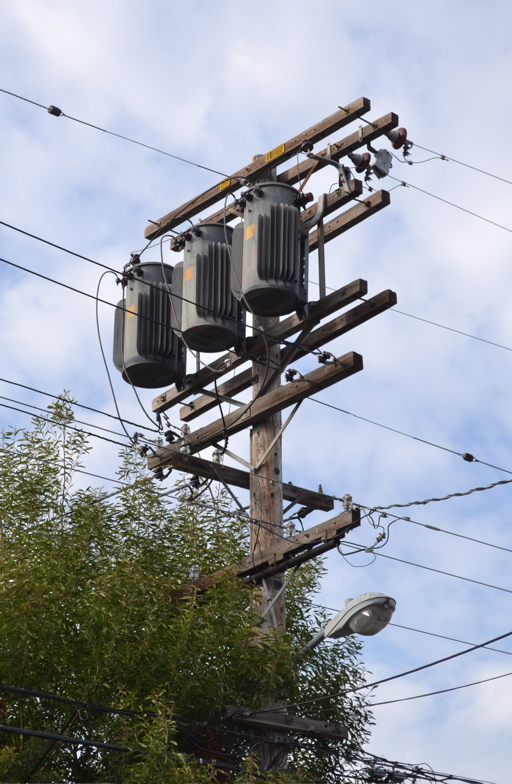
Gratitude to a Power Pole

Image

Whilst ambling around San Carlos recently, I came upon the power pole shown here. Ugly, isn’t it? Or maybe not. In fact, my reaction was one of gratitude, prompted in part by the “Gratitude” chapter in Joel Wade’s excellent book, Mastering Happiness (available at drjoelwade.com). I had listened to the chapter the previous evening.

What is there about this power pole that warrants gratitude, and to whom? The answer lies in really looking at the pole and pondering the devices, wires and cables attached to it.

The top crossbar holds wires that provide the electrical supply, probably three-phase 440 volts. I know the supply comes from a substation a mile away which in turn is fed from very high voltage transmission lines east of the freeway. Three transformers on the pole step the 440 down to 220 and feed it to surrounding buildings.

Ugly grey boxes? Not to me. Some anonymous engineers put their heart and soul into designing those transformers. The basic idea of a transformer has been known for years: use a pair of coils with different winding densities to convert electrical energy into magnetic energy and then back to electrical at a desired voltage. But to design a really good transformer requires careful attention to fabrication costs, reliability, safety, and operating efficiency. No transformer is perfect; some energy gets lost as waste heat, and heat must be dissipated even in the hottest weather lest temperatures exceed safe operating levels. (Notice the cooling fins on each transformer.) The fluid bath which enhances efficiency must never leak – or more precisely, the probability of leakage must be kept extremely low. Nice job, guys (maybe gals, too). Thanks!

I see telephone wires. Of course, wireline telephone service is declining but still there is a lot to ponder. Four blocks away is a big windowless AT&T building which I believe houses switching equipment that was a marvel in its day.

I see coaxial cables that transmit television and internet signals. Just think of the torrent of information coursing through those cables. These days we all take megabit download speeds as a God-given right. Try to picture millions, perhaps hundreds of millions of bits traversing one of those cables every second. In addition, the cables entering those poles from Comcast’s central office, wherever that may be, carry a mix of packets destined for different recipients. They must be sorted and delivered on time and in the proper sequence to the various recipients served by our pole. I see three small boxes on the pole that may perform that function. The Post Office is a block away. Imagine the sorters there sorting a million letters per second!

I see a small device which may be an antenna for the new wireless electric and gas meters. Predictably, there have been complaints about health effects from these devices, likely from people who have no clue about the difference between ionizing radiation and RF radiation. Others have complained about privacy. I personally feel no need to hide the details of my electrical usage. I look forward to the advent of time-of-day pricing that these meters will enable. The resulting incentives should save money for many people including me. In addition, PG&E will be able to forestall increases in peak power capacity.

The pole itself is a tree trunk treated with creosote. Aluminum is used in substation structures and transmission towers but is evidently uneconomical for street poles. Wooden poles eventually rot and require replacement. But replacing a pole requires far less time and labor than in past times because of the improved equipment and procedures that have been developed.

Now I grant you that such poles will remain ugly in the eyes of many beholders no matter how much they may learn about their function. So why not put all the wires underground? Just dig a trench and move them, right? Not so fast, it’s nowhere near that easy. Of course it can be done and has been done but there are many complex and expensive details. For one thing, most of the buildings served by the relocated lines would require interior modifications to accept cables from underground rather than overhead. It wouldn’t do, as part of a beautification project, just to run cables down the outside of a building from the old rooftop connection point to the new underground point. Underground transformers are costlier and harder to access. The old service must be kept running until the new service is ready, and the switchover must be done quickly and near-perfectly. The costs and benefits of an undergrounding project should be carefully weighed before it is undertaken.

Gratitude to a power pole? No, in the spirit of Leonard Read’s I, Pencil I owe my gratitude to the countless individuals who made it possible. I think of Faraday and Maxwell who gave us the keys to understand electromagnetism. Edison and Tesla who pioneered power generation. Anonymous engineers and linemen who make it happen. Bold thinkers of the Enlightenment who paved the way for what McCloskey calls bourgeois dignity and the consequent explosion of Western living standards in the last three centuries.

Some people are moved to gratitude by religious iconography. Good for them. For me, a power pole does the trick.