Is Free-Riding for Union Negotiations a Myth?

As the US Supreme Court is considering the case of Janus v. AFSCME on mandatory deductions for the purposes of union negotiations, I think it is time to truly question the argument underlying mandatory deductions: free-riding. Normally, the argument is that union members fight hard to get advantageous conditions. After taking the risks associated with striking and expending resources to this end, non-members could simply get the job and the benefits associated with prior negotiations and not contribute to the “public good” of negotiation. This is an often-used argument.  I come from Quebec in Canada where closed shop unionism (i.e. you are forced to join the union to get the job) still exists and mandatory dues are more stringently enforced than in the United States. There, one of the most repeated defense of the closed shop system and of the mandatory dues is the free-riding argument. As such, the free-riding argument is an often-used communication line.

That is, in essence, the free-riding argument. While it appears axiomatically true, I do not believe that it is actually a relevant problem. However, before I proceed, let me state that I have a prior in favor of consent and I only sign off on “forcing” people when the case is clear and clean-cut (I am what you could call a radical “contractarian”).

So, is free-riding a problem? The answer is in the negative (in my opinion) as the free-riding argument entails that unionism provides a public good. One of the main feature of a public good is an inability to exclude non-payers.  Think about the often-used example of lighthouses in public economics: the lighthouse provides a light that everyone can see and yet the owner of the lighthouse would have a very hard time to collect dues (although Ronald Coase in 1974 and Rosolino Candela and myself more recently have emitted doubts about the example).  However, why would a union be unable to exclude? After all, it is very easy to contractually “pre-exclude” non-payers. A non-member could obtain only 50% or 75% or 80% of the benefits negotiated of the union. Only upon joining would he be able to acquire the full benefits of the union.

As such, “excludability” is feasible. In fact, there are precedents that could serve as a framework for using this exclusion mechanism. Consider the example of “orphan clauses” which were very popular in my neck of the wood in the 1990s and early 2000s. Basically, these clauses “create differences in treatment, based solely on the hiring date, in some of the employment conditions of workers who perform the same tasks“. These existed for police forces, firefighters and other public sector workers.  Now, this was a political tool for placating older union members while controlling public spending. As such, it is not an example of exclusion for negotiation purposes. Nevertheless, such contracts could switch the “date of employment” for the “union status” in determining differences in treatment.

Another mechanism for exclusion is social ostracism. This may seem callous, but social ostracism is actually well rooted in evolutionary psychology. It also works really well in contexts of continuous dealings (see also this example by Avner Greif which has been the object of debates with Sheilagh Ogilvie and Jessica Goldberg)  Workplace relations between workers are continuous relations and shirkers can be ostracized easily.  The best example is the “water dispenser gossip” where co-workers will spread rumors about other workers and their behavior. All that is needed is an individual marginally inclined towards the union (who could even get special treatment from the union for being the ostracism-producer) who will generate the ostracism. As such, the free-riding argument has a solution in that second channel.

In fact, ostracism and contractual exclusion can be combined as they are in no way mutually exclusive. These two channels are the reason why I do not adhere to the “free-riding” argument as valid justification of compulsory payment for financing unions.
SMP: Lessons From Inflation-targeting Regimes

Inflation targeting is probably the most widely-known policy adopted by central banks around the world. Under an inflation-targeting regime, the government (usually the central bank or treasury) announces an inflation target (usually with lower and upper limits). It is then up to the central bank to decide how to achieve the target. Seen in this light, inflation targeting is more of a constrained discretionary policy than a strict monetary rule.

Continue reading at SMP.

The Gradual, Eventual Triumph of Liberty

Today I’d like to write a few words of hope and encouragement to those who already understand liberty’s value. I read a speech from 1853 that stood out to me. It’s easy to be caught up in the daily news cycle and feel that liberty is constantly under attack and threatened at every hand, that every gain is clawed back as liberties are eroded one at a time. At times like that, it is good to step back and took a better look at the broader history of the world.

The speech I read was by a gentleman named Parley P. Pratt, an apostle of the Church of Jesus Christ of Latter-day Saints in the Utah territory. This was just a few years after the Mormons, including Pratt and his family, had been driven from their homes by mobs and by indifferent and sometimes hostile state and federal governments in the United States proper to find freedom and refuge in the Rocky Mountains. There they still held 4th of July celebrations, honoring the sacrifices for liberty their fathers had made. Pratt, by this point in his life, had traveled through England and parts of Europe, much of the US, Canada, and along the Pacific into Mexico, and met with many people from Asia as well – a remarkably well-traveled man.

Despite the very real failures of the government to protect their individual rights or redress their grievances, he spoke in praise of the Constitution. The main thrust of his address was that the cause of liberty would expand and someday fill the world:

The longer I live, and the more acquainted I am with men and things, the more I realize that … the Constitution of American Liberty was certainly dictated by the spirit of wisdom, by a spirit of unparalleled liberality, and by a spirit of political utility. And if that Constitution be carried out by a just and wise administration, it is calculated to benefit not only all the people that are born under its particular jurisdiction, but all the people of the earth … . It seems broad enough, and large enough, to receive and protect all that may be in any way deprived of the common rights of man. …. [The principles of the Constitution] embrace eternal truths, principles of eternal liberty, not the principles of one peculiar country, or the sectional interest of any particular people, but the great, fundamental, eternal principles of liberty to rational beings – liberty of conscience, liberty to do business, liberty to increase in intelligence and in improvement […]

There is a day coming when all mankind upon this earth will be free. When they will no longer be shackled, either by ignorance, by religious or political bondage, by tyranny, [or] by oppression (Journal of Discourses, Vol. 1, p. 137-143)

Pratt claimed this would not happen predominantly by revolution and violence, but by America being a beacon light to the world. He spoke of throngs of people who would sit in his day enjoying to hear of our freedoms, our institutions, and our scientific and cultural progress. He spoke of the immigrants coming to this country from all parts of the world specifically to find that freedom, and that once enlightened by being allowed to think and reason and act for themselves without the bondage of kings, state religions, or other powers they would blossom and rise up in greatness. Whether they eventually returned to their native lands or not, this would act as an “indirect influence … on those despotic nations” of Europe and Asia.

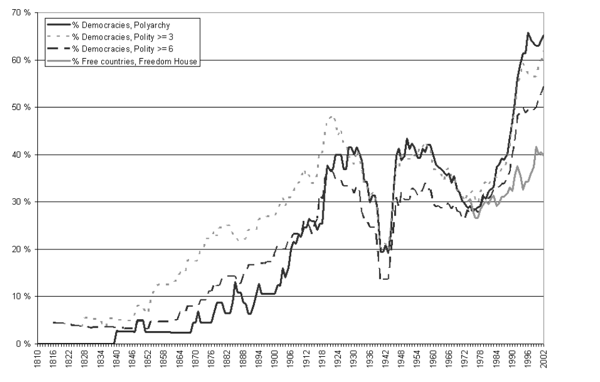
Recognizing that our liberty is remarkably multi-faceted, I will focus on the same categories Pratt mentioned. At the time he spoke, there were exactly 3 nations that were in some measure democracies, where at least some large percentage of the populace had the liberty of choosing their leaders. You can see for yourself how this has grown in the intervening 160+ years:

NOL Watson 1
source: Our World in Data

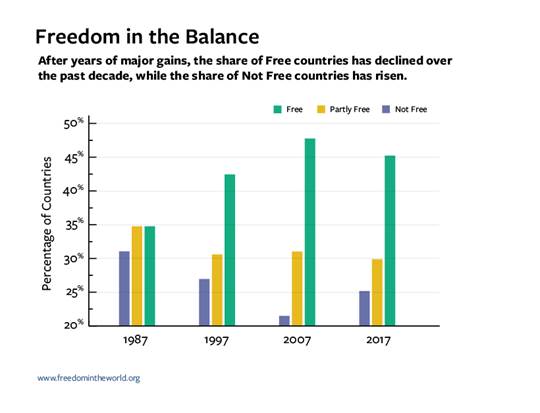
Billias’ 2009 work on how the principles of American constitutionalism were “heard round the world” shows that waves of influence gradually spread the principles of self-determination, liberty, separation of powers, and checks and balances into the freedom movements and constitutions of most of the world. Even while warning that the last ten years have seen declines in liberty overall worldwide, Heritage shows us that the last thirty years still show remarkable improvement:

NOL Watson 2

From a time when the US was one of very few countries to legally protect religious liberty, today nearly three-fourths of all the countries in the world have a constitution that specifically protects freedom of belief, and two-thirds permit some religious proselytism – which preserves freedom of expression (Pew Global Restrictions on Religion). There is still much to do to improve and preserve religious liberty around the world, both in legally acknowledged protections and in fostering an actual peaceful society where religious groups are not subject to violence and persecution.

Despite the distance left to go, the cause of liberty has clearly moved forward in great ways in the last 160 years. Much as Pratt predicted, much of this was accomplished without great revolutions and civil wars, but through the power of example as free nations and free people proved themselves a beacon to the world. There is still good cause to believe in that fundamental converting power from setting the right example and allowing free people to govern themselves.

A quote

The most profound technologies are those that disappear. They weave themselves into the fabric of everyday life until they are indistinguishable from it.

Mark Weiser

Hayek would have liked this quote about computers. On his behalf, I’m going to co-opt it as a description of the miracle of markets.

Tech’s Ethical Dark Side

An article at the NY Times opens:

The medical profession has an ethic: First, do no harm.

Silicon Valley has an ethos: Build it first and ask for forgiveness later.

Now, in the wake of fake news and other troubles at tech companies, universities that helped produce some of Silicon Valley’s top technologists are hustling to bring a more medicine-like morality to computer science.

Far be it from me to tell people to avoid spending time considering ethics. But something seems a bit silly to me about all this. The “experts” are trying to teach students the consequences of the complex interactions between the services they haven’t yet created and the world as it doesn’t yet exist.

My inner cynic sees this “ethics of tech” movement as a push to have software engineers become nanny-state-like social engineers. “First do no harm” is not the right standard for tech (which isn’t to say “do harm” is). Before 2016 Facebook and Twitter were praised for their positive contribution to the Arab Spring. After our dumb election the educated western elite threw up our hands and said, “it’s an ethical breach to reduce our power!” Freedom is messy, and “do no harm” privileges the status quo.

The root problem is that computer services interact with the public in complex ways. Recognizing this is important and an ethics class ought to grapple with that complexity and the resulting uncertainty in how our decisions (including design decisions) can affect the well being of others. My worry is that a sensible call to think about these issues will be co-opted by power-hungry bureaucrats. (There really ought to be ethics classes on the “Dark Side of Ethical Judgments of Others and Education Policy”.)

I don’t doubt that the motivations of the people involved are basically good, but I’m deeply skeptical of their ability to do much more than offer retrospective analysis as particular events become less relevant. History is important, but let’s not trick ourselves into thinking the lessons of 2016 Facebook will apply neatly to whatever network we’re on in 2026.

It hardly seems reasonable to insist that Facebook be put in charge of what we get to see. Some argue that’s already the world we live in, and they aren’t completely wrong. But that authority is still determined by the voluntary individual decision of users with access to plenty of alternatives. People aren’t always as thoughtful and deliberate as I’d like, but that doesn’t mean I should step in and be a thoughtful and deliberate Orwellian figure on their behalf.

RIP John Perry Barlow – On the right to free information

Sadly, John Perry Barlow, the founder of the Electronic Frontier Foundation has died today. He was – to me – a huge inspiration for the internet anarchy and the cyberlibertarian movement I support.

His vision of the internet was to create “a world that all may enter without privilege or prejudice accorded by race, economic power, military force, or station of birth.”

As a tribute to Barlow, I would like to provide a summary of his speech on The Right To Know at TEDx Marin.

  1. The first time Barlow got online, he thought the internet would create the collective organism of mind.
  2. He believed that one day everyone on the planet would be endowed with the right to say whatever they want to say within their hearts, and nobody would be in the position to shut them up. In addition, everybody would have the right to not listen to what was said or written on the internet.
  3. The internet was going to be the great challenger of dogmatism.
  4. Having founded the Electronic Frontier Foundation in July 1990, he spent many years thinking about the intersection between Cyberspace and the physical world.
  5. All the existing power relations in the physical are being renegotiated in Cyberspace.
  6. We are now at the point where the physical world is starting to become terrified of Cyberspace. This is obviously shown by how governments deal with Wikileaks and the Arab awakening.
  7. Cyberspace has provided the bloggers, and journalists of Wikileaks and the Arab awakening with the opportunity to question the political structure. They knew that their real power was the ability to speak, and to be heard.
  8. They also understood that they had the right to know.
  9. If we play our cards right, the internet will make it possible for everybody on the internet to satisfy his curiosity to the fullest extent that is presently known by our species. Everyone interested, can know what is presently known.
  10. Nothing like this has had ever happened before.
  11. To achieve that, we have to realize that we cannot own free speech.
  12. Copyright is the wrong model for monetizing the expression of the mind. Thought is not a thing, … it is an action. The more a thought is heard and understood, the more powerful it becomes. It’s not like physical goods.
  13. Because of the old model of thinking of expression as a thing that must be regulated towards scarcity, there are many things going on right now that are militating against Freedom of expression.
  14. Comcast, yesterday, stopped all of our access to PirateBay. PirateBay is a notorious copyright infringement site, but is also an important cause with different members from European parliaments.
  15. The other thing is that the Freedom of expression necessarily includes tolerance to the other person’s right to speak up his mind. No matter how abominable his ideas may be.
  16. The answer to hate speech is love speech, and the answer of the speech you can’t stand is the speech of your own heart. Go out there and stop those who will try to own Freedom of expression.
  17. Take a look at the Electronic Frontier Foundation.

2018 Hayek Essay Contest

The 2018 General Meeting of the Mont Pelerin Society will take place from September 30 – October 6, 2018 at ExpoMeloneras and Lopesan Hotels in Meloneras, Gran Canaria, Canary Islands. As with past general meetings, the Mont Pelerin Society is currently soliciting submissions for Friedrich A. Hayek Fellowships. The fellowships will be awarded through the Hayek Essay Contest.

The Hayek Essay Contest is open to all individuals 36 years old or younger. Entrants should write a 5,000 word (maximum) essay that addresses the quotation(s) and question(s) detailed on the contest announcement (available at the above link). The deadline for submissions is May 31, 2018. The winners will be announced on July 31, 2018. Essays must be submitted in English only. Electronic submissions should be sent in PDF format to this email address (mps.youngscholars@ttu.edu). Authors of winning essays must present their papers at the General Meeting to receive their award. The essays will be judged by an international panel of three members of the Society.

Please feel free to share this announcement with any individuals who may have an interest in submitting an essay for consideration of a fellowship award. All questions may be directed to the MPS Young Scholars Program Committee by email at mps.youngscholars@ttu.edu or phone at +1.806.742.7138.

MPS Young Scholars Program Committee

What should universities do?

The new semester is here so it’s time for me to figure out what the hell I’m supposed to be doing in the weird world of modern American university life. Roughly speaking, the answer is going to be “do the stuff that professors do to help universities do what universities do.” So what do universities do? What are they supposed to do?

Universities occupy a few different niches in society. I’m usually tempted to think of universities like a business. And in that framework, I justify my salary by providing something of value to those students. At my school, something like 90% of the operating budget comes out of students’ pockets.

But that’s an overly narrow view. Students pay to go to school because they expect they’ll get value from it, but they also go to school because them’s the rules–if you want to enter adult society, university is the front gate. In this framework, I justify my salary by serving as a gatekeeper. Even though it’s students paying, the (nebulous) principal I’m obliged to is the collection of people already inside the walls.

But wait! There’s more! Universities are (in no particular order):

  • A repository of knowledge,
  • A generator of new knowledge,
  • A place people go to learn,
  • A place people go to prove themselves,
  • A place people make friends and have fun (in a way that may be hard to replicate),
  • A business (engaging in mutually beneficial exchange),
  • A special interest group,
  • An institution that holds a particular (privileged) position in a wider cultural landscape.

Any one of these functions is a can of worms in its own right. When we start to consider tradeoffs between each function (and the many less visible functions I’ve surely missed), it gets downright intractable. I’m going to focus on the student-focused aspects of university life.

The mainstream view:

University is a place students get educated. This education helps them get jobs because employers value it. Students might also learn things that help them be better citizens.

The mainstream view doesn’t seem far off from what I’ve got in mind until you get your hands dirty and start disentangling what that view says. Here are three big problems inherent in that mainstream view:

  1. The education-for-job myth.
  2. The definition problem.
  3. The one-size-fits-all problem.

The Job-training myth

We’re told that students go to school to learn valuable skills. I think that’s true, but not in the usual way. Any specific skills students learn in school are a) incredibly general, or b) out of date. My students might learn some interesting ways of looking at the world (general knowledge), but a lot of what I teach is completely useless in the workforce (“Johnson, draw me a demand curve, stat!”). But students do learn valuable skills incidentally. They learn to manage their time (ideally), how to be conscientious, and in general they’re socialized so that they can fit in with adult society.

Lately I’ve been thinking of college as a form of upfront consulting. Instead of going to school when you’ve got a specific problem to solve, go when you’re young and have nothing better to do. Since you’re getting the consulting before you know what sort of problems you’ll face in the future, we couldn’t possibly give you exactly the right bundle of knowledge.

College exposes students to lots of different ideas that might combine in unexpected ways. Your class in underwater basket weaving might seem like a waste of time until some day 30 years later you are trying to solve some problem that turns out to make a lot more sense if you think of it like wet wicker (I’m looking at you civil engineers!).

Some of what I (and my colleagues) do helps prepare students for their careers, but mostly I’m trying to help them be better–better thinkers, better able to understand and appreciate, better able to enjoy life.

The definition problem

The word “Education” means a lot of things to a lot of people. More often than not, people use the word without being clear about what they mean. Often it means “job training.” Sometimes it means “enlightening.” Other times it means “making you agree with me.” In practice, it means surviving enough classes that you get a piece of paper indicating as much.

It should be recognized as a vague and nebulous word instead of being pigeonholed. It isn’t a binary state (I was ignorant, now I’m educated). It’s helpful to think of people as being more or less educated, but the state of your education isn’t something we can really objectively compare to my state of education.

There are lots of important but nebulous things in our lives: health, happiness, moral worth. Their vagueness makes them difficult, but it isn’t going away.

It isn’t hard to convince people that education is nebulous, but it is hard to get people to behave as though they really understand that.

Homogenization and commodification

Once people start thinking of education as some objective thing we can pull off a shelf and give to someone, we run into the real problems. This unexamined view leads to bureaucracies that attempt to standardize and commodify education.

Don’t get me wrong, I get why people would try to do this. We want everyone to get education (and moral training, and good health, and…). And as long as we’re worried about that, we’re going to worry about making sure everyone gets the best education possible. But “the best” gives the false impression that there’s one right answer.

A top-down approach isn’t the right way to achieve the goal of widespread education. Attempting to systematically scale up education provision kills the goose that lays the golden eggs. We should fight against attempts to commodify university (which currently happens via accreditation-as-gateway-to-subsidy and the general expansion of bureaucracy through administration).

So what should universities do?

There are different margins on which we can justify our existence, but it’s not obvious how to balance our tasks: teaching, researching, advocating, etc.. Given the high degree of uncertainty, I’d argue for pluralism… different schools (and professors) should be trying different things. As universities adapt to the future, it’s important that they don’t all try to adapt in the same way at the same time.

I think a big part of the problem is that we’ve been too successful at rent seeking. All money/privilege/goodies comes with strings attached, and more money comes with more strings. We’re always going to get a little tangled up in those strings, but in the last couple generations we’ve hamstrung ourselves. Accreditation and assessment have become the most important things a modern university does, which distracts from our more fundamental goals.

A bottom up approach doesn’t mean less education, just different education. A more modest education system would change the mix of costs and benefits faced by stakeholders. Employers might rely less on degree signalling, which means hiring managers and potential employees exercising more judgement in sending and evaluating quality signals. I don’t know exactly what would happen, but flexibility is valuable for the nebulous goals universities are supposed to be pursuing.

But at the moment we seem to be in an equilibrium. Students are expected to go to school, schools are expected to deliver on promises they can’t really fulfill, and we go through the motions of keeping schools accountable in a way that basically misses the point.

So what will I do this semester? I’m going to keep talking about interesting stuff to students. I’m going to keep working towards getting tenure. But I’m also going to quietly subvert attempts to commodify university.


In memory of Christie Davies: defender of the right to joke

ChristieDavies

As we approach the end of 2017, I remember this year’s sad passing of Christie Davies. Davies was a rare academic beast: a classical liberal sociologist. Despite representing a minority perspective in his discipline, he was able to thrive and leave a mark that will continue to influence scholars for generations.

Continue reading

Ayn Rand and International Politics

In a previous post I promised to write about Ayn Rand and her views on international politics, based on a recently published article.

I find Ayn Rand a fascinating figure in libertarian history, for a number of reasons. Her life style and ways she went about it in her life are so far distanced from me, that made me curious. Some of her philosophical ideas are great, others do not appeal to me at all. I plainly admire her for making the moral case for capitalism and individualism, which stands out in the economist-dominated libertarian tradition.

I am on the one hand annoyed by the way she fostered such cult-like circle of followers, in her own day and after her death in 1982, that led to dogmatism and intellectual isolationism, which goes against all basic academic standards I think are crucial.

On the other hand, I think the people at the Ayn Rand Institute do a great job preserving her legacy and attempting to widen her appeal. Overall, I am convinced that no matter what your take on this fascinating figure or her work is, Rand deserves to be studied in academia, because she remains influential to this day, especially in the US, and left a serious collection of writings that warrant intellectual analysis, even by people who do not consider themselves Randian.

Against this background I made a comparison between mainstream liberal theories of International Relations (IR) and the ideas on world affairs of Ayn Rand. The brief summary of the first is as follows:

  • World peace is attainable, in the belief that humans are rational enough to overcome war and conflict.
  • The nation is seen as a problematic actor in world affairs. Its room for maneuvering needs to be curtailed, including the importance of the balance of power between states, and the alleged influence of ‘war mongering’ diplomats and the so-called military-industrial complex.
  • Peace oriented foreign policies can be fostered by domestic institutional arrangements, most notably democracy (democratic peace theory).
  • In the international realm, there is an important role for intergovernmental and non-governmental organizations, regimes and international law (liberal institutionalism), which aim to overcome or neutralize the effects of the logic of power politics.
  • International trade is also expected to foster peace, often in combination with the alleged pacifying influence of interest groups and public opinion of foreign policy decision-making.
  • A recent addition is the broad support for humanitarian intervention.

To keep this blog at readable length I will not go into the details of Rand’s writings, but limit myself to her main views on these ideas, which should be seen in the context of her fierce opposition to the Soviet Union and its allies in the Cold War, and her concern for America losing its super power position through internal causes, not least the loss of the individual liberty-enhancing spirit among the American people.

  • In contrast to classical liberals from Smith to Hayek, Rand did indeed think that world peace would be attainable, but only in an Objectivist world. Among rational men living according the Objectivist principles there would be a harmony of rational interests. Yet in the current world there was also abundant irrational behaviour, bad morality, and other grounds for dispute.
  • The main causes of war were not material issues, domestic interests, institutional arrangements, or the structure of the international system. Rather, war was rooted in human nature. It went back to the tribal era, when brute force was the prime rule of conduct. The (socialist) dictatorships were contemporary examples in her mind, with their lack of respect for the rights of their own citizens, and those of foreigners alike. ‘Statism needs war, a free country does not’.
  • Rand was inconsistent in her valuation of the power of public opinion. She noted that most people often do not want war. Yet the origins of war still lay with those civilians, also in non-democratic regimes, because they failed to reject the doctrine that it was right and justified to achieve goals by physical force. If people put up with a dictatorship like the Soviet Union, or decided not to flee, they were co-responsible for the deeds, and deserved the same fate as their government.
  • Rand recognized that individuals live in groups or communities, but she regarded respect for tribal roots, ethnicity, and regional languages as uncivil and, above all, irrational and a limit on individual liberty. Ethnicity was also an important cause of war. Nationalism was perhaps less abstract than Marxism, but it was at least as vicious in stirring emotions such as hatred, fear, and suspicion. Therefore rational people would altogether disregard their roots as guides in (political) life.
  • Rand had two positions on the issues of sovereignty and intervention, depending on the moral character of the nation in question. Sovereignty was a right that had to be earned, but could also be forfeited. If a nation fully respected the principle of individual rights, it’s right to sovereignty was morally secured and should be respected by other nations. However, if a state violated the rights of its citizens it would lose its sovereign rights. ‘A nation ruled by brute force is not a nation, but a horde, whether led by Atilla, Genghis Khan, Hitler, Khrushchev, or Castro.’
  • Dictatorships were outlaws and could therefore be invaded as a matter of choice for the free nations, although there was no duty to do so. The right to self-determination and sovereignty only existed for free nations, and for societies seeking to establish freedom.
  • Yet this way, anarchy loomed. Rand divided the world into three groups of countries. First, countries complying to the Objectivist principles, with full sovereign rights. Second, countries on their way to freedom, often referred to as ‘mixed economies’, or half-way houses between freedom and dictatorship. Third, countries not worth existing, such as dictatorships and tyrannies. Unfortunately, the world lacked fully free countries. The mixed economies did not have unlimited right of intervention, they could only interfere when another country seriously breached Objectivist principles, for example by establishing one party rule, enacting censorship laws, executing people for political offences without trial, or nationalizing or expropriating private property.
  • Rand acknowledged the perpetual influence of power in world politics. The character of international politics was, and always had been among states, a balance of power game.
  • The US army was under domestic, non-patriotic attack for its virtues, for being a competent and strong force. It was unwise to cut the defence budget, while -in another contrast to liberal IR thought- ‘the military-industrial complex’ was ‘a myth or worse’.
  • Statism at the international level, in the form of ‘a planetary community’ and other cosmopolitan ideas had to be rejected. The collaboration of semi-free countries with communist dictatorships in the UN was evil and stood in contrast to reason, ethics, and civilization. The UN provided the Russian camp with prestige and moral sanction, suggesting that ‘the difference between human rights and mass slaughter is just a matter of opinion’.
  • Another point of contention with the social liberals was development cooperation. Foreign aid was nothing but ‘altruism extended to the international realm’.
  • While, in contrast to social liberals, she lacked faith in international law as such, Rand did regard international treaties as firm obligations.
  • Also, Rand saw peaceful effects of laissez-faire capitalism, because it was based on the recognition of self-interest by free individuals and the non-initiation of force. Capitalism fostered a society of traders. Therefore the essence of Objectivist foreign policy had to be free trade.

To briefly sum up: Rand’s writing show that not all liberals are peace-seeking cosmopolitans, attempting to minimise the role of the nation, the balance of power, the military, and warfare in international relations. She rejected most forms of international governmental organization and other expressions of liberal institutionalism. Often her ideas lack sufficient (legal) detail, while they are also centred on America, and hence limited to the perspective of an influential super power with large military capacity. Yet her writings show that fostering liberty in international relations can be done in several ways, and that different liberals have different ideas about the route towards that goal.

SMP: On the Delusions of Price Level Stability

One of the lessons that should have been learned after the 2008 crisis is that price level stability does not guarantee economic and financial stability. Rather, central bankers and policy makers understand that the lesson is there should be even more regulation.

In a recent column, William White explains how “major central banks’ vigilant pursuit of positive but low inflation has become a dangerous delusion.” The idea that price level stability is both, necessary and sufficient to achieve macroeconomic stability and growth should have been put to rest by the 2008 financial crisis. But conflicting narratives have enabled it to live on.

Since the crisis, the focus of many central bankers has turned to macroprudential policy. The objective is to manage financial risk. Regulatory efforts have increased as a result. On the monetary policy front, price level stability still reigns supreme. New tools have been developed to execute monetary policy, to be sure. But the overall objective has been more-or-less left intact.

Keep reading at Sound Money Project.

(Unofficial) IHS Graduate Student Facebook Group

I’ve created an (unofficial) facebook group for graduate students who are part of the IHS crowd so that we can organize appropriate conference meet ups, look for potential hotel sharing buddies, and other hijinks. Several NoL writers and readers have gone through IHS so I figured I’d share the link.

I may or may not be using the group as a way to find future NoL writers.

https://www.facebook.com/groups/1958211444500599/

#mini-microblog

Can you manage what you can’t measure?

Disclaimer: I’m not a macroeconomist, but I play one in Principles classes. Feel free to point out my errors in the comments.

Economics is filled with imperfect measures of important concepts. GDP, unemployment rates, and price indices all have significant flaws. Measures of entrepreneurship are even worse.

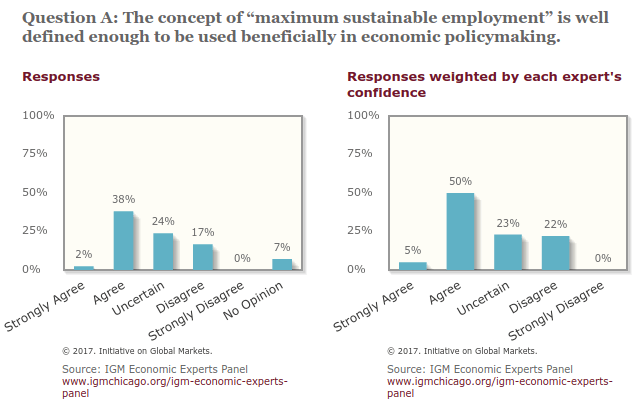
The Chicago Booth IGM Experts’ Panel recently posted an interesting result about the problems with unemployment:

IGMChicago_EmploymentandtheUSEconomy

The question is: “The concept of “maximum sustainable employment” is well defined enough to be used beneficially in economic policymaking.”

That’s 42 economists asked, 34 with an opinion (including “uncertain”), and about half of the sentiment is positive. And that sounds about right to me. I read this question as “can we engage in macroeconomic policy that doesn’t do long-run harm?” And if I were to describe my opinion probabilistic, it would look like these results. We could probably do “good policy” with a low degree of precision (i.e. useful enough for severe situations) if 1) we magically didn’t have to deal with political squabbling and 2) explicitly limited our goals to the short run.

Respondents agreeing emphasize that it’s “good enough.” But what does that mean? What level of precision and control are we looking at here?

Here’s the basic situation: given the underlying economic reality (everyone’s individual preferences, capabilities, knowledge, etc.) it makes sense to have some limited number of unemployed people at any given time. Unemployment rate is a measure of “how far are we from 0,” not, “how far are we from the ideal level?” That raises the following questions:

  • How accurately can we know what’s going on in the world?
  • How accurately can we know what’s supposed to be going on in the world?
  • How precisely can we affect the world?

The aggregate macroeconomic theory and empirics of the 1960’s were seriously imprecise. Trying to target macroeconomic policy would be like doing eye surgery with a hand grenade. In that sort of world, your best medicine is probably chicken soup and bed rest.

Here in the present we have much better data and computation. And it’s going to get better. Facebook already has data precise enough to track the exact effects of policy down to the individual level.

But think about a precise outcome and imagine what sort of policy would be required to get there. Let’s say our outcome is “get Rick to buy a new car.” Some mix of low interest rates, the right set of subsidies, and ideal circumstances might move things in that direction. But that sort of surgical outcome is just never going to be possible through legitimate macroeconomic policy (and definitely not monetary policy*). The size of the problem just means that Butterfly Effect problems will prevent macroeconomic policy from having household-level precision, even if the data could (in principle) measure the effect.

Less precise outcomes seem plausible (e.g. “get middle class households in the north east to buy 30-60,000 new cars”), but not without making a lot of second order problems. It’s not so much a “middle of the road leads to socialism” situation as a multiplier effect from a convergent series. Push a billion over there, create big distortions, follow those up with medium distortions, and finally let small remaining problems fizzle out on their own. Throw in public choice issues and it seems obvious that the efficiency cost of precise interventions won’t scale up nicely.

We’re now in a world where our theoretical and empirical tools are more precise than our implementation tools. We’re no longer trying to do surgery with a hand grenade. But that doesn’t mean we’ve got a laser scalpel either. It’s more like we’ve got we’ve got laser-like measuring tools but our implementation tools are blunt objects. If we aren’t careful, we’ll spend our time swatting flies with sledge hammers.

All told, it seems possible that we could engage in fairly targeted macroeconomic policy. But as the scale increases, the marginal cost will rise rapidly (maybe less so with the right institutions). Better timing might increase the effectiveness of each dollar spent*, but overall, it seems like things have to be really bad before the government should consider anything too ambitious.

Manage an economy’s economic health using imperfect measures like unemployment rate is about like trying to manage your physical health using heart rate and body mass index figures. Can we do “good enough”? Only to a limited extent. We could stop eating garbage and get some exercise. But there isn’t some magic combination of vitamins and crystals that will stop cancer. Anyone who tells you otherwise is a) trying to sell you something and b) trying to convince themselves they’re in control of the uncontrollable.

In terms of macroeconomic policy, we should start by caring about fundamentals (i.e. long run economic development) and be skeptical of people promising to control the business cycle.


*And let’s face it, we aren’t likely to get decent macroeconomic policy (in terms of efficiency, timing, and appropriateness of policy to circumstances) out of Congress until there’s a serious cultural shift.

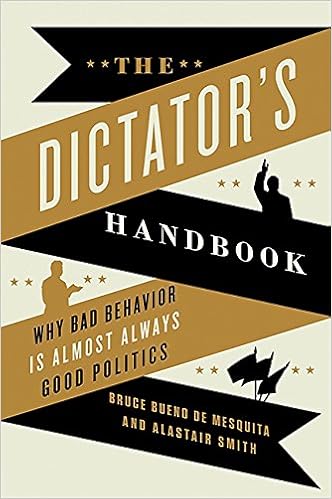
The Dictator’s Handbook

I recently pointed you towards a book that has turned out to be a compelling and interesting read.

At the end of the day, it’s a straightforward application of public choice theory and evolutionary thinking to questions of power. Easy to understand theory is bundled with data and anecdotes* to elucidate the incentives facing dictators, democrats, executives, and public administrators. The differences between them are not discrete: they all face the same basic problem of compelling others’ behavior while facing some threat of replacement.

Nobody rules alone, so staying in power means keeping the right people happy and/or afraid. All leaders are constrained by their underlings. These underlings are necessary to get anything done, but they’re also potential rivals. For Bueno de Mesquita and Smith the crucial facts of a political order are a) how big a coalition (how many underlings) the ruler is beholden too and b) how replaceable the members of that coalition are.

The difference between liberal and illiberal orders boil down to differences in those two parameters. In democracies with a larger coalition and less replaceable coalition members, rulers behave better.


I got a Calculus of Consent flavor from Dictator’s Handbook. At the end of the day, collective decision making will reflect some version of “the will of the people… who matter.” But when we ask about the number of people who matter, we run into C of C thinking. Calling for bigger coalitions is another way of calling for an approach to an effective unanimity rule (at least at the constitutional stage).

In C of C the question of the optimal voting rule (majority vs. super majority vs. unanimity) boils down to a tradeoff between the costs of organizing and the costs of externalities imposed by the ruling coalition. On the graph below (from C of C) we’re comparing organization costs (J) against externality costs (I) (the net costs of the winning coalition’s inefficient policies). The idea is that a unanimity rule would prevent tyranny of the majority (i.e. I is downward sloping), but that doesn’t mean unanimity is the optimal voting rule.

Figure 18.  Click to open in new window.

But instead of asking “what’s efficient” let’s think think about what we can afford out of society’s production, then ask who makes what decisions. In a loose sense, we can think of a horizontal line on the graph above representing our level of wealth. If we** aren’t wealthy enough to organize, then the elites rule and maximize rent extraction. We can’t get far up J, so whichever coalition is able to rule imposes external costs at a high level on I.

But I‘s height is a function of rent extraction. Rulers face the classic conundrum of whether to take a smaller piece of a larger pie.

The book confirms what we already know: when one group can make decisions about what other groups can or must do, expect a negative sum game. But by throwing in evolutionary thinking it shed light on why we see neither an inexorable march of progress nor universal tyranny and misery.

As you travel back in time, people (on average) tend to look more ignorant, cruel, and superstitious. The “default state” of humanity is poverty and ignorance. The key to understanding economics is realizing that we’ve bootstrapped ourselves out of that position and we aren’t done yet.

The Dictator’s Handbook helped me realize that I’d been forgetting that the “default state” of political power is rule by force. The liberalization we’ve seen over the last 500 years has been just the first part of a bootstrapping process.

Understanding the starting point makes it clear that more inclusive systems use ideas, institutions, capital, and technology to abstract upward to more complex levels. Something like martial honor scales up the exercise of power from the tribe (who can The Chief beat up) to the fiefdom (now the Chief has sub-chiefs). Ideology and identity can tie fiefdoms into nation-states (now we’ve got a king and nobility). Wealth plus new ideologies create more inclusive and democratic political orders (now we’ve got a president and political parties). But each stage is built on the foundation set before. We stand on the shoulders of giants, but those giants were propped up by the non-giants around them.

Our world was built by backwards savages. The good news is that we can use the flimsier parts of the social structure we inherited as scaffolding for something better (while maintaining the really good stuff). What exactly this means is the tricky question. Which rules, traditions, organizations, and processes are worth keeping? How do we maintain those? How/when do we replace the rest? And what does “we” even mean?

Changing the world involves uncertainty. There are complex interrelations between every part of reality. And the knowledge society needs is scattered through many different minds. To make society better, we need buy-in from our neighbors (nobody rules alone). And we need to realize that the force we exert will be countered by an equal and opposite force some plural, imperfectly identifiable, maybe-but-probably-not equal, and only-mostly-opposite forces. There are complex and constantly shifting balances between different coalitions vying for power and the non-coalitions that might suddenly spring into action if conditions are right. Understanding the forces at play helps us see the constraints to political change.

And there’s good news: it is possible to create a ruling coalition that is more inclusive. The conditions have to be right. But at least some of those conditions are malleable. If we can sell people on the right ideas, we can push the world in the right direction. But we have to work at it, because there are plenty of people pitching ideas that will concentrate power and create illiberal outcomes.


*I read the audiobook, so I’m basically unable to vouch for the data analysis. Everything they said matched the arguments they were making, but without seeing it laid out on the page I couldn’t tell you whether what they left out was reasonable.

**Whatever that means…

What classes are worth subsidizing?

A friend of mine has a great phrase that captures what’s wrong with about 1/3 of the population. They’re “people who would make good Nazis.” These are the obedient people who are ready to follow orders without thinking without having sufficiently high standards for whose orders they’ll follow.

My question is “what can I do to help my students not fall into this category?” The trouble is that these folks aren’t drawn to intellectual arguments. I need to get them in a more visceral way. I think the answer is art. These kids need to be watching TV shows and movies/shows like Donnie Darko and The Handmaid’s Tale (tell me your favorites in the comments!). They need something that will grab them by the lapels, shake them, and shout “question authority!”

Pragmatic folks (the sort of people who are normally excited to hear what a libertarian economist has to say) would usually think that schools should focus on pragmatic things. It’s certainly a good idea for kids to leave school with some ideas about how to manage their personal finances and research important issues. But the economic justification for subsidies rarely favors such pragmatic topics. Petroleum engineers don’t need their schooling subsidized because they’ll end up getting paid enough to pay off their student loans.

I like to think of myself as a pragmatic person*, but I’m increasingly coming around to the idea that art is worth subsidizing. Even (perhaps) if that means giving money to ridiculous people who argue incoherently against freedom.

Bildergebnis für ned flanders parents

As subsidies go, art is cheap. You don’t need to build anything as complicated as a particle accelerator. You just need to grab some kid out of the nearest Starbucks and give them a few bucks to make something.

You’ll end up paying for a lot of garbage, but life is full of waste (I’d bet good money that any good project involves a good amount of unrealized potential savings that are only obvious after the fact). For that matter, you’ll almost certainly do some degree of harm. If we threw money at art departments (the way we did with STEM departments during the cold war) the money spent on Che shirts could easily fuel the western hemisphere by attaching a generator to Guevara’s spinning corpse.

And the benefits will be vague and arguable. I’m not in the business of selling bonafide snake oil; this idea isn’t a magical cure-all.

In fact, the more you try to measure the benefits, the less benefit you might get. If we could measure important but intangible things like decency and thoughtfulness, we’d already have those things. But when we try to come up with proxies for important things, those proxies quickly become bad proxies. All the more so if we try to reward people for measurable achieving our goals. Funding should be unconditional (and focused on production rather than selection) if we want to avoid funding propaganda. We almost certainly will be funding propaganda, but if humanity is really worth saving, it’s a baby/bathwater tradeoff.

I’ve just spent three paragraphs convincing you that this might be a terrible idea. But I still think the net benefits could justify the cost. Imagine some imperfect estimate of the impact and an even more imperfect measure of the value created. What will we get out of this (on average)? In a word: more. More novels, web comics, paintings, podcasts, and films.

And with more art, there’s more cream to rise to the top. The best art typically encourages thoughtfulness and empathy. This is a “let a thousand flowers bloom” approach that would (at relatively low cost) saturate the public sphere with enough semi-thoughtful stuff to force usually-thoughtless people to think more clearly about the world around them.

If** we can subsidize free thought, this is how we’ll do it. And if it’s possible, it’s worth doing in a world where we clearly have too many people who would make good Nazis.


*If that was really true I’d work in a bank.

**Do I really think this would work? I’m not remotely sure. But I think it’s an idea worth discussing. I teach economics because I hope the marginal return (in terms of improving the “civic quality” of my students) is high. But it feels Sisyphusian at times, and some students are clearly not ready to get it. I worry that they’ll go out into the world ready to follow any maniac’s orders. In terms of the stability of a free and peaceful society, doing something about those people seems important.