- What it’s like to be black in Europe Christopher Kissane, Financial Times
- America’s other rebellious border Maxime Dagenais, Age of Revolutions
- Capitalism in America: Up, up, and away Deirdre McCloskey, Claremont Review of Books
- How Italy made me think about America Addison Del Mastro, American Conservative
Liberty
The long-run risks of Trump’s racism

This week, the United States and much of the world has been reeling from Trump’s xenophobic statements aimed at four of his Democratic opponents in Congress. But the U.S. economy continues to perform remarkably well for the time being and despite his protectionist spasms, Trump is widely considered a pro-growth, pro-business President.
This has led some classical liberals to consider Trump’s populist rhetoric and flirtations with the far right to be a price worth paying for what they see as the safest path to keeping the administrative state at bay. Many classical liberals believe the greater risk to liberty in the U.S. is inevitably on the left with its commitment to expanding welfare-state entitlements in ways that will shrink the economy and politicize commercial businesses.
In ‘Hayek vs Trump: The Radical Right’s Road to Serfdom’, Aris Trantidis and I dispute this complacency about authoritarianism on the right. In the article, now forthcoming in Polity, we re-interpret Hayek’s famous The Road to Serfdom in light of his later work on coercion in The Constitution of Liberty.
We find that only certain forms of state intervention, those that diminish the rule of law and allow for arbitrary and discriminatory administrative oversight and sanction, pose a credible risk of turning a democratic polity authoritarian. A bigger state, without more discretionary power, does not threaten political liberty. Although leftwing radicals have in the past shown disdain for the rule of law, today in the U.S. and Europe it is the ideology of economic nationalism (not socialism) that presently ignores democratic norms. While growth continues, this ideology may appear to be compatible with support for business. But whenever the music stops, the logic of the rhetoric will lead to a search for scapegoats with individual businesses in the firing line.
Several countries in Europe are much further down the 21st road to serfdom than the U.S., and America still has an expansive civil society and federal structures that we expect to resist the authoritarian trend. Nevertheless, as it stands, the greatest threat to the free society right now does not carry a red flag but wears a red cap.
Here is an extract from the penultimate section:
The economic agenda of the Radical Right is an extension of political nationalism in the sphere of economic policy. While most Radical Right parties rhetorically acknowledge what can be broadly described as a “neoliberal” ethos – supporting fiscal stability, currency stability, and a reduction of government regulation – they put forward a prominent agenda for economic protectionism. This is again justified as a question of serving the “national interest” which takes precedence over any other set of values and considerations that may equally drive economic policy in other political parties, such as individual freedom, social justice, gender equality, class solidarity, or environmental protection. Rather than a principled stance on government intervention along the traditional left-right spectrum, the Radical Right’s economic agenda can be described as mixing nativist, populist and authoritarian features. It seemingly respects property and professes a commitment to economic liberty, but it subordinates economic policy to the ideal of national sovereignty.
In the United States, President Trump has emerged to lead a radical faction from inside the traditional right-wing Republican Party on a strident platform opposing immigration, global institutions, and current international trade arrangements that he portrayed as antagonistic to American economic interests. Is economic nationalism likely to include the type of command-and-control economic policies that we fear as coercive? Economic nationalism can be applied through a series of policies such as tariffs and import quotas, as well as immigration quotas with an appeal to the “national interest.”
This approach to economic management allows authorities to treat property as an object of administration in a way similar to the directions of private activity which Hayek feared can take place in the pursuit of “social justice.” It can take the form of discriminatory decisions and commands with a coercive capacity even though their authorization may come from generally worded rules. Protectionism can be effectuated by expedient decisions and flexible discretion in the selection of beneficiaries and the exclusion of others (and thereby entails strong potential for discrimination). The government will enjoy wide discretion in identifying the sectors of the economy or even particular companies that enjoy such a protection, often national champions that need to be strengthened and weaker industries that need to be protected. The Radical Right can exploit protectionism’s highest capacity for partial discriminatory applications.
The Radical Right has employed tactics of attacking, scapegoating, and ostracizing opponents as unpatriotic. This attitude suggests that its policy preference for economic nationalism and protectionism can have a higher propensity to be arbitrary, ad hoc and applied to manipulate economic and political behavior. This is perhaps most tragically demonstrated in the case of immigration restrictions and deportation practices. These may appear to coerce exclusively foreign residents but ultimately harm citizens who are unable to prove their status, and citizens who choose to associate with foreign nationals.
Against Ideology
Since first dipping my feet (brain?) into philosophical waters I’ve realized that the world has more dimensions than my mind. Many more. Which means insisting on a consistent philosophy is, in all likelihood, a recipe for disaster.
This isn’t to say I’ve got an inconsistent philosophy, or that I’m ready to throw up my hands and say “anything goes!“. But like a good bridge, my philosophy is full of tensions.
I can’t derive everything back to the Harm Principle (a principle I like), recognition of subjective values (which I’m on board with), or some notion of a social utility function (which I do like as a rhetorical crutch or skyhook, but am unwilling to take with me more than arm’s length from the whiteboard).
Instead, I’ve got a smorgasbord of mental tools–ethical notions (“don’t kill people!”), social science models (prisoners’ dilemma, comparative advantage)–that I try to match appropriately to the situation.
This puts me in the unfortunate position of requiring a great deal of humility. But as it will say on my tombstone: worse things have happened to better people…
I approach the world with libertarian priors. At the end of the day, I’m a left-libertarian anarchist. But Jonathan Haidt’s work has convinced me that my priors say more about me than the world. To be sure, libertarianism brings something important to the table, but so do other views.
Recognizing the importance of ideological pluralism lets me use my ideology like a lever instead of a bat–a tool instead of a weapon. And hey, what’s more libertarian than pluralism?!
As a centuries-long-run prospect for a meta-utopia I’m still staunchly libertarian. Go back in time 500 years and you’ll be told democracy is a pipe dream. I think we’re in a similar moment for the ideas of radical freedom, self-determination, and decentralization of power I’d really like to see put into practice. But imagine going back in 500 years, convincing everyone you’re a powerful wizard, then implementing democracy all at once. I don’t think it’d work out very well. Hell, I’m not even sure about going back in time 3 years to run that experiment! Similarly, flipping the An-Cap switch tomorrow would probably be 100 steps forward, 1000 steps back. Without the appropriate culture in place, good ideas are likely to backfire.
Still, I’m a libertarian anarchist by default and want to see the world move in that direction. But in the short-medium run I refuse to be dogmatic.
I get a lot out of my ideological priors, but I get more by refusing to slavishly follow them at all costs. Yes, the greatest good will be served in an anarcho-capitalist world (I think). But it’s a long trip from here to there. Sustaining that equilibrium will require a cultural shift that hasn’t happened yet–and ignoring those informal institutions is likely to lead to something more like feudalism than utopia. In the mean time, I say move towards greater freedom and avoid getting bogged down in partisanship.
So I’ve got a long-run goal: radical federalism and maximal freedom. But how do we get there? What are the short- and medium-run goals?
Simply to make things better while encouraging people to engage in voluntary interactions that create value, especially by building up social capital networks.
My Austrian-subjectivist priors are in tension with my rationalist-utilitarian instinct. But I think we find a way out by considering policy effects on future generations. Tyler Cowen suggests pursuing policy that promotes long run economic growth.
The big caveat is that although GDP is the best available metric to pursue, GDP is an imperfect measure. Figuring out “GDP, properly understood” adds a layer of complexity that makes policy evaluation all the more difficult. Which is part of the controversy with my recent posts on pollution taxes.
For example, after the end of slavery, total leisure time increased which would decrease measured GDP. But clearly a proper accounting of productivity would discount the initially higher GDP by the cost of forced labor. Similarly, we have to refine our notion of measured* economic well-being to account for things left out of the old methods–like household consumption, leisure, black markets (side note: the war on drugs is a waste!), human capital**, and ecological assets that fall outside the private property system.
Addendum for the left: what’s best for the world’s poorest people is a worthy addition to Cowen’s policy. And it’s an addition that also tends to push us towards libertarian arguments (like liberalization of immigration policy).
Unfortunately, I’m a rationalist by default which means I have to work at my epistemic humility. I’m constantly tempted to see the world as more legible than it really is. I have to keep reminding myself that I don’t know could fill a library. But the world is much more complex than any functional team of smart people could handle, let alone a lone economist–even if he happens to be one of few who really do get it.
One of my favorite arguments is the Austrian-libertarian point that “if we knew what people would do with their freedom, we wouldn’t need it.” For example, the reason to allow someone to start new businesses isn’t because we know that it’s going to make things better. Instead, it’s because market innovation depends on decentralized, crowd-sourced experimentation. We don’t say “oh, this Steve Jobs guy is about to improve our lives,” because if we could do that (we can’t) then we could instead find a less costly way to get the same outcome (we can’t do that either).
This line of reasoning also applies to policy. There are some easy cases–there’s plenty of low-hanging fruit in occupational licensing. But society is a complex system, so you can’t do just one thing. Any one policy change ripples through the system and creates unintended consequences.
Don’t get me wrong, I’m not saying we should do nothing. But my conservative friends are right that we shouldn’t go too fast. In any case, we’ve got more tensions that require me to listen to a wider range of ideological voices due to my cognitive limits.
A particularly interesting policy question is to what extent we should (not) take account of the impacts of American (Canadian, European, Chinese, etc., etc.) policy on non-Americans.
Here we find another tension. On the one hand, surely being accidentally born into a particular geography doesn’t give you greater moral weight than others. On the other, even if we want American policy to help Haitians, there’s a knowledge problem exacerbated by distance.
I think the appropriate response is a friendly and open federalism. Local issues should be handled locally. We should be neighborly. We should resist the temptation to centralize power.
But we should also take advantage of large-scale governance structures (private or public) to deal with large-scale issues. Match the scale of governance to the scale of the relevant externalities.
The downside of this approach is that some locales will do terrible things. “States’ rights” is a bad argument for slavery (or for anything else). But stepping in to make things better isn’t an unambiguous improvement. If there’s one thing to learn from America’s adventures in statecraft*** it’s that you can’t just force a country to be free.
Given that, we should be more open to accept the world’s huddled masses yearning to breathe free. Historically, our record is far from spotless. But there have also been humanitarian successes in moving people away from tyranny.
We have a moral obligation to at least consider the well-being of everyone around the globe. And the lowest hanging fruit for actually making a positive difference is opening up our borders. Not to say there’s a simple answer, but the answer lies in the direction of freedom of movement.
How should we (according to me) go about deciding questions of public policy? We should opt to encourage the creation of value and reduction of costs (i.e. economic growth). But we should do so carefully and with open minds.
GDP growth is a worthy goal, but not for it’s own sake. John Stuart Mill wrote:
“How many of the so-called luxuries, conveniences, refinements, and ornaments of life, are worth the labour which must be undergone as the condition of producing them?… In opposition to the ‘gospel of work,’ I would assert the gospel of leisure, and maintain that human beings cannot rise to the finer attributes of their nature compatibly with a life filled with labour.”
Mindless insistence on measurable output overlooks important things like going to your kid’s little league game, grabbing a beer with friends, or quiet contemplation. And even if the people arguing for protecting the environment seem a bit silly, we’re wrong to ignore the importance of environmental externalities in affecting our standard of living. All of which is to say, Cowen is right that we need to carefully consider the shortfalls of how we measure economic growth, all while encouraging it.
Perhaps most importantly, we should relish a tension between consequentialism and principles. There are plenty of low-hanging fruits for libertarianism, but if we want to get the most out of this metaphorical tree we need to let a fear of bad outcomes encourage us to invest in civil society, informal institutions, and rich social networks so that freedom can expand without costing us inhumanity. I want to see the welfare state ended, but I’m willing to wait while we start by reducing barriers to entrepreneurship. I want to see taxes go away, but I’m willing to see a less-bad tax replace an egregious one.
We should reject the dogmatism that too often leads us to over-prioritize ideological purity. First, such purity can trap us in local optima (metaphor: a self-driving car programmed to never go east sounds like a good way to get from NYC to LA… till it gets stuck in a cul de sac somewhere). Second, that purity is an illusion. God’s true ethical system simply isn’t available to us–it’s more complex than our brains are–so why worry?
Post script: don’t take this to be an argument against libertarianism. Or a call to prioritize “pragmatism” over ideology or any other political values. I’m not trying to make a definitive argument abolishing ideology, I’m just gently pushing back. The key word here is tension. We can’t have tension between A and B if we get rid of A.
*Here’s another tension: I don’t believe we can actually measure economic well-being. I think we can make educated guesses based on well-thought out studies of observable proxy variables, but I believe in the impossibility of interpersonal utility comparison.
**A major pet peeve of mine is the conflation of education and schooling. Education, properly understood, is simply not measurable. We might find some clever proxy variables (for example, the Economic Complexity Index is my current favorite metric for productive capability–which overlaps capital and human capital accumulation).
***That’d be a good title for a comic book! If you know the right historian and/or international relations scholar, put them in touch with Zach Weinersmith!
FURTHER CRACKS IN THE GLOBAL WARMING PROPHECY
Although global warming zealots continue their religious crusade, more research reveals skepticism toward the doomsday prophecies. Recently Finnish scientists published research that further debunks claims about the role of humans in generating global warming. Their thesis is that global temperatures are controlled primarily by cloud cover, which is a natural occurance that is beyond human control:
https://www.ecology.news/2019-07-12-climate-change-hoax-collapses-new-science-cloud-cover.html
The opponents immediately denounced this as a junk science:
It is OK and normal to have debates within scientific community. We, regular lay tax paying people are understandably not shrewd in all intricacies of scientific debates around so-called climate change. Yet, I am sure many of us want to make sure that no financially ruinous global or nationwide social engineering scheme would be enforced on all of us by social activists who decided to side with a group of aggressive academic zealots claiming scientific consensus and squashing dissenting views.

In his Counterrevolution of Science (1955), F. A. Hayek wrote about the dangerous hubris of “science worshippers” who wanted to extend their theories, which at best had narrow application and limited experimental database, to reshape the life of entire humankind. The first aggressive spearheads of this hubris were “generation X” socialists, acolytes of Henri St. Simone, who congregated in and around Paris Ecole Politechnique from the 1810s to 1860s. They dreamed about New Christianity – a creed based on the religion of science. With its “Council of Newton,” it was to regulate entire life of society. In the past century, we already lived through projects designated to reshape the life of humanity through “scientific” societal laws peddled by Marxism. We also lived through national socialist attempts to breed the better race of human beings based on “scientific” laws. More recently, in the 1970s, driven by the same scientific hubris backed by moral considerations, we resorted to global ban of “evil” DDT. This led to the outbursts of yellow fever and mass deaths in the Third World.
During a brief period of soul searching and self-scrutinizing among the left in the wake of communism collapse in the 1990s, in his Seeing Like a State (1998), James Scott, a leftist academic, gave a severe critique of that hubris that he called high modernism arrogance. Not naming socialism directly and sparing the ideological feelings of his fellow comrades, who have been dominating humanities and social sciences, he subtitled his book as follows How Certain Schemes to Improve the Human Condition Have Failed. Still, it was a devastating accusation of the “science”-based social engineering, from German attempts to breed perfect healthy forests in the 18th century to the “scientific socialism” of the Soviets who methodically ruined Russian agriculture by their aggreesive collectivization. The current left are not as modest as Scott’s generation. They quickly moved on, sweeping their own history under the rug. Being emboldened by the crisis of 2008 (a new “sign” of capitalism end of times), the left are now ecstatic about the Green New Deal and its Stalinist global warming regulations that are peddled by the big-eyed “democratic” socialist of “color” from Congress. It seems we are invited again to step on the same rake in order to smash our forehead once again by adopting another scientific Utopia.
Tone deaf Leftists: A Chilean tale
Check out this beautiful block of text from the Poetry Foundation, an educational website ostensibly dedicated to the subject it has named itself after:
[Pablo] Neruda had gone into hiding in his native Chile more than a year before. After he helped elect Gabriel González Videla as president on a radical left platform, González Videla launched a campaign of repression that included roundups of leftists and labor leaders, and violent repression of workers’ strikes. As copper prices plummeted after World War II, the Truman administration convinced González Videla that he would need the United States’ economic help and that war between the US and Russia was looming. This convinced González Videla to ban communism in Chile.
There are two things to think about here. One is the fact that the poetry website is only superficially about poetry, even though it proudly claims the mantle of all things belonging to the realm of the poet. In reality, the Poetry Foundation is one of the many well-funded arms of the political left.
Here’s the thing, though. The folks at the Poetry Foundation don’t think they’re engaged in leftist political activism. They think they’re doing the work of a poetry foundation. To them, there is no distinction between poetry and left-wing politics. It’s like the partisan who claims to be a political moderate while calling for the wholesale nationalization of medical and financial markets. We’re not dealing with a vicious, concerted effort to uproot the liberal order. We’re dealing with obstinate people in cliques who believe they have more knowledge than everybody else. (By the way, the excerpt above was what the well-respected leftist website 3 Quarks Daily, which shows NOL some love from time to time, used to promote the article.)
The second thing I’d like to focus on is the narrative itself. A radical left-wing government was elected and, once in power, immediately began repressing other rivals factions. (Do you think labor groups and other leftist organizations were the only ones repressed by González Videla?) This is not a new phenomenon. This is what radicals, on both the left and the right, do. Just ask the Russians. Or the Venezuelans.
Yet look at how this well-documented repression – by a left-wing, democratically-elected Chilean government – is portrayed by the Poetry Foundation. Instead of owning up to the fact that radical governments, even democratically-elected ones, tend to resort to violence when their unfeasible ideas are finally put into place and inevitably, predictably fail, Harry Truman gets blamed.
So a radical leftist government gets elected and starts repressing its former allies (and, it is assumed, its enemies) because Harry Truman told this radical, democratically-elected leftist that the Soviet Union and the United States were going to fight in a war and the Americans were the side Chile should ally with? Obstinate ignorance!
Before I sign off, it’s worth noting that González Videla was elected in 1946. Allende was elected in 1973. In the nearly 40 years between them lots of people on both sides of the aisle died for political reasons. People didn’t stop dying until well into the 1980s. Yet, somehow, Milton Friedman and F.A. Hayek (and Harry Truman) are to blame for all of Chile’s Cold War woes.
Introducing: the Federation of Free States, an ongoing thought experiment
The most popular article I have ever written, in terms of views, has been, by far, “10 Places that Should Join the U.S.,” a short piece at RealClearHistory pining for an enlarged geographic area under the American constitution.
This is not a strange concept for longtime NOL readers. I’ve been pleading for stronger political ties between the U.S. and its allies for quite some time. There has been lots of push back to this argument, from everywhere. So I’m going to spend some more time explaining why I think it’d be a great idea for the American constitutional regime to expand geographically and incorporate more political units into its realm. Here is what an initial “federation of free states” would look like in, say, 2025:
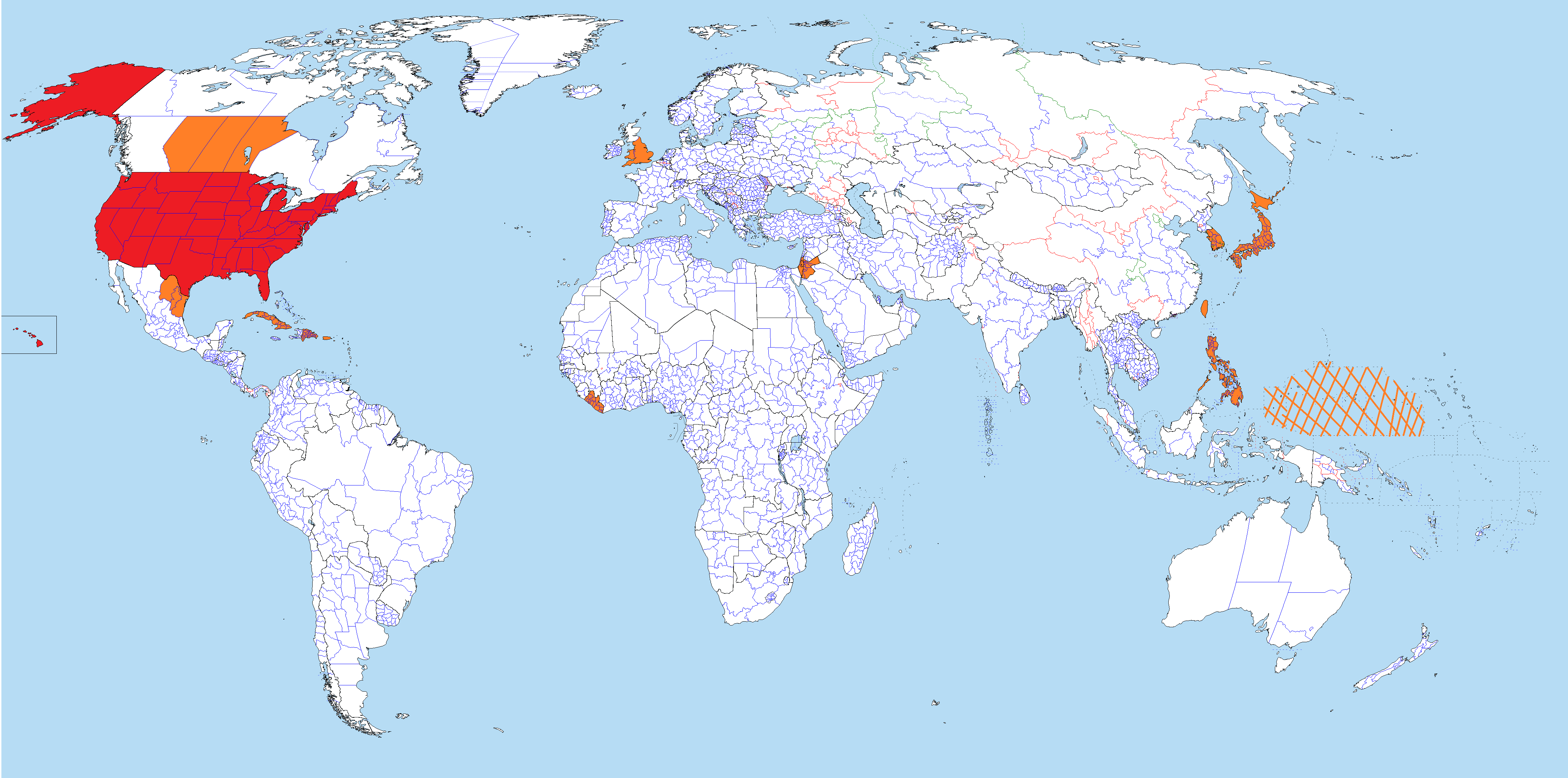
I’ve incorporated two of the strongest voices against such a federation, NOL‘s very own Michelangelo and Edwin. Michelangelo’s Pacific and Caribbean bias is somewhat acknowledged, and Edwin’s pessimistic socio-linguistic argument against adding continental European states to the federation has also been incorporated.
I’ve also tweaked the “10 places” that I originally saw fit to join the US.
In the map above I’ve got parts of Canada (the 3 “prairie provinces”) and Mexico (3 “ranching states”) joining the American federation. The prairie provinces of Canada – Alberta, Saskatchewan, and Manitoba – would be admitted as separate “states,” and would thus get to send 2 senators each to Washington. According to my napkin calculations, Alberta would only be sending 3 representatives to DC while Saskatchewan and Manitoba would only get 1 representative each in the House. The ranching states of Mexico – Coahuila, Tamaulipas, and Nuevo León – wold likewise be admitted as separate “states,” and would also get to send 2 senators each to Washington. These three states, which have plenty of experience with federalism already, are a bit more populated than the prairie provinces, but not by much. Nuevo León would send 4 representatives to DC, while Tamaulipas would send 3 and Coahuila, 2. Why be so generous to these polities? Why not lump them together into one unit each – a Mexican one and a Canadian one? Mostly because these new states would be giving up a lot to leave their respective polities. Military protection and the rule of law wouldn’t be enough, on their own, to persuade these states into joining the Federation of Free States. They’d need disproportionate representation in Washington, via their Senate seats, in order to leave Canada and Mexico and join the republic.
Antilles (Cuba, Dominican Republic, US Virgin islands, and Puerto Rico). This is a random collection of polities, I admit, and lumping them together into one “state” is even more random. But lump them together I would. On their own I don’t think these polities would do well in a federated system, even with their own Senate seats. There’s just not enough historical parliamentary experience in these Caribbean states. If they were lumped together, though, they’d be a formidable presence in Washington. While Antilles would only get 2 Senators, its combined population would be enough to send 19 representatives to the House, more than Florida, New York, and a gang of other influential states in the current union. At the heart of Antilles joining the US as a “state” in its union is a great trade off: sovereignty in exchange for the rule of law and democratic self-governance.
IsPaJo. Israel, Palestine, and Jordan would also be incorporated into 1 voting state, though I don’t have a good name for this state yet. This isn’t nearly as crazy as it sounds. The populations of these 3 polities would benefit immensely from living under the US constitution. Questions of property would be handled fairly and vigorously by the US court system, which is still widely recognized as one of the best in the world when it comes to property rights. Concerns about ethnic cleansing or another genocide would be wiped away by the fact that this new state is now part of the most powerful military in world history. Sure, this state would only get to send 2 Senators to Washington, but its representation in the House would be sizable: 18 representatives.
England and Wales (but not Scotland or Northern Ireland). England would be the crown jewel of the federation free states. The United Kingdom is dying. Scotland wants out. Northern Ireland wants to rejoin Ireland. In England, London is thriving but the rest of the country is suffering from the effects of de-industrialization. The kingdom’s once-vaunted military depends on the United States for nearly everything. Adam Smith put forth a proposal in his 1776 treatise on the wealth of nations that’s worth re-discussing here. Smith argued that the best way to avoid a costly war with the 13 American colonies was to give them representation to go along with taxation. He proposed that the U.K.’s parliament should add some seats and give them to North American representatives. This way both sides could avoid the whole “no taxation without representation” dispute. Smith further opined that, were this federation to happen, the center of the British empire would inexorably move in the direction of the North American colonies. England and Wales would both get to send 2 Senators to Washington, giving the Isle of Liberty 4 Senators in the upper house. Wales wouldn’t get much in the way of the lower house (only 2 representatives according to my napkin calculations), but England, in exchange for its sovereignty, would become the republic’s most populated “state” and would therefore get to dictate the terms of discourse within the republic in much the same way that California and Texas have been doing for the past 3 or 4 decades. That’s not a bad trade-off, especially if you consider how awful life has become in once-proud England.
Liberia. In 1821-22, the American Colonization Society founded a colony on the Pepper Coast of West Africa and called it Liberia. The aim of the colony was to provide freed slaves in the Americas a place to enjoy their freedom, since racism was still rampant in the Americas. The freedman quickly came into conflict with the locals (a clash of cultures that has continued into the present day). Liberia, governed by its New World migrants, declared its independence in 1847 but it wasn’t until 1862, in the early stages of the American Civil War, that the US recognized Liberia’s declaration. The African continent’s first and oldest republic, predating Ghana by over one hundred years, survived, as an independent entity, the Scramble for Africa in the late 19th century and has been at the forefront of regional coalition-building in Africa since the end of World War II (when the British and French empires collapsed). Liberia, like almost all republics, has decayed politically and socially, especially over the last few decades. Federating with the United States would do wonders for Liberians, and give the federation of free states a legitimate stamp on the African continent (and breath new life into America’s own republican decay). The West Africans would send 2 Senators to Washington, and about as many representatives as Louisiana or Kentucky.
Japan (8 “states”). With nearly 127 million people, Japan’s presence in the American federation would alter the latter’s composition fundamentally. Federating the United States with Japan also presents some logistical problems. As it stands today, Japan has 47+ prefectures, which are roughly the equivalent of US states. If we added them all as they are, the Japanese would get over 100 senate seats, which is far too many for a country with so few people. So, instead, I would bring Japan on board via its cultural regions, of which there are 8: Kantō, Kansai, Chūbu, Kyushu, Tōhoku, Chūgoku, Hokkaidō, and Shikoku. The country formerly known as Japan would get 16 Senate seats (which would be roughly divided between left and right) and the new “states” would be able to send a plethora of representatives, ranging from 32 for Kantō to 3 for Shikoku. In exchange for its sovereignty Japan would get the military protection from China it wants. The US would no longer have to worry about a free-rider problem with Japan, as its inhabitants would be citizens under the Madisonian constitution. It is true that a federation would lead to more non-Japanese people being able to migrate and take root in Japan, but this is a feature of federation, not a bug. (A federation of free states would devastate ethno-conservatism in several societies around the world.)
“Micronesia.” Made up of 8 current countries and territories in the Pacific Ocean, Micronesia is also a cultural territory that encompasses a huge swath of the Pacific. While it doesn’t have a whole lot of people, Micronesia has been important to US military efforts in the Pacific for centuries. Federating with the area is the least we could do for the inhabitants of the Northern Marianas, Guam, the Federated States of Micronesia, the Marshall Islands, Palau, Nauru, Kiribati, and Wake Island. Micronesia would only get 1 seat in the lower house, but with 2 sitting Senators in DC the area would finally get a say in how the United States conducts its business in the region.
Visayas, Mindinao, and Luzon. These 3 regions in the Philippines would do much to enrich the federation of free states. Like Japan above (and South Korea below), the Philippines has a complicated representative system that would need to be simplified in order to better fit the Madisionian constitutional system. Through this cultural-geographic compromise, the Philippines would be able to send 6 senators to Washington, but these three “states” would also get to send more representatives to Washington than New York, Pennsylvania, and a bunch of other current heavyweights. There is already a long history between Filipinos and Americans, and while the first half century was a rough one for both peoples, today Filipinos hold some of the most pro-American views in the world. Of course, Americans who live near Filipino communities in the United States know just how awesome Filipinos are.
Taiwan. Even though Washington doesn’t officially recognize Taiwan as a country (a deal Washington made with post-Mao reformers on the Chinese mainland, in exchange for peace and trade), the two polities are deeply intertwined. Taiwan spends billions of dollars on American military equipment, and the U.S. spends significant political capital protecting Taiwan from China’s bellicosity. Taiwanese statehood would not only bring two close societies even closer together, it would force China to either fight the United States or reveal itself to be a paper tiger. That’s a gamble I’m willing to take, since China is a paper tiger.
South Korea (5 “states”). Another wealthy free-riding ally of the United States, South Korea has 5 cultural regions that could easily become “states” in a trans-oceanic federation: Gangwon, Jeolla, Chungcheong, Gyeongsang, and Gyeonggi. This would give South Korea 10 senators and 50 representatives (spread out according to population size, just like all the other states in the union).
Altogether we’re looking at adding 29 states to the union. That’s a lot, but I think you’ll find that not only would we be expanding liberty but also limiting the size and scope of the federal government, and forcing it to do more of what it is supposed to do: provide a standardized legal system with plenty of checks & balances and maintain a deadly, defensive military.
Ending Empire
Check out this map of known American military bases in the world today:

Expanding liberty and the division of labor are not the only positive side-effects of an enlarged federation under the Madisonian constitutional system. Ending empire – which is expensive and coercive, and gives the United States a bad name abroad – would also be a key benefit of expanding the republic’s territory.
Most American libertarians are isolationists/non-interventionists. Most European libertarians are wishy-washy hawks. Neither position is all that libertarian, which is why I keep keep arguing that “a libertarian position in foreign affairs should emphasize cooperation, choice, and trade-offs above all else.” Non-interventionism is uncooperative, to say the least, but you could argue that it’s at least a position; the Europeans seem to take things on a case-by-case basis, which is what you’d expect from a people who haven’t had to make hard foreign policy decisions since 1945. Open borders is a cool slogan, but that’s just a hip way of arguing for labor market liberalization.
It’s time to open up our doors and start talking to polities about going all the way.
Nike’s speech rights?
Nike’s decision to scuttle the Betsy Ross flag shoe design says so much about how touchy we’ve become as a society. Maybe Nike’s being too politically correct, maybe Nike’s critics are being too outraged. Probably both. What interests me, though, is Arizona’s threat to withdraw financial incentives dangled in front of Nike as an incentive to build a plant in the state. Does this implicate Nike’s free speech rights? I think it might.
The interesting aspect of this scenario is that it features the flip sides of two coins. Rather than being punished for speaking, Nike is being punished for refraining to speak. And rather than punishing my Nike by, say, imposing an additional tax, Arizona is threatening to withdraw an incentive that the state isn’t obligated to provide in the first place.
As to the first point, it has long been clear that expression itself is not the only thing protected by the free speech guarantee. Rather, the First Amendment protects decisions about expression, including the decision not to engage in speech. The unusual aspect of this situation is that the government is not trying to compel Nike to speak a message created by or sponsored by the government. Rather, Arizona is penalizing the company for creating its own expression and then changing its mind. Still, I think this would likely be considered to be part of one’s right not to speak.
As to the withdrawal of incentives, the free speech guarantee forbids the government from placing an unconstitutional condition on a government benefit–i.e., you better sell that shoe with the Betsy Ross flag on it, or you don’t get those tax breaks. Government can’t force someone to waive a constitutional right in exchange for a government benefit.
The other interesting question here is whether Nike’s speech–or lack thereof–would be considered commercial speech, which is less protected than other forms of speech. In a way, the Betsy Ross flag shoe nicely demonstrates why this is a silly distinction–the flag has deep political meaning. Why does it matter that it’s printed on a retail shoe rather than stuck on a sign in someone’s yard?
In any case, it seems like there’s a plausible free speech problem behind Arizona’s overreaction, here. I’m curious to see if anything comes of it.
On Facebook’s new cryptocurrency, the Libra. What will its consequences be for Bitcoin, blockchain and the financial world?
After many years on the sidelines, a consortium of large corporations and social impact organizations led by Facebook will soon enter the blockchain space. In the past week, Facebook has given more details regarding their future cryptocurrency, the Libra. It is supposed to be released by the consortium in the first half of 2020.
This article is my first reaction to the Libra White Paper, which describes Libra as a cryptocurrency with low volatility that will make use of its native Libra blockchain. What follows is a description of Libra as described in the White Paper, and 11 predictions about its consequences for the blockchain and financial world.
Goal of Libra
The goal of the Libra Association is to create a stable currency that makes use of a secure and stable open-source blockchain. Open-source means that the source code is public for anyone to see. In order to keep the currency stable, it will be backed by Libra Reserves – a basket of low-volatility assets, such as bank deposits and short term government securities in currencies from stable and reputable central banks such as the USD, EUR, CNY, and GBP. These assets will be managed by a global network of custodians. The Libra will thus enjoy the benefits of stable traditional government money and the benefits of blockchain-based cryptocurrencies. Users of Libra should theoretically be able to make transactions with Libra coins with low costs, and within immediate speeds to anyone anywhere in the world.
The Libra Association is hopeful that it will give a boost to better and cheaper financial services, therefore, making financial services accessible for everyone.
Considerations for building the Libra blockchain
The Libra blockchain has been developed, while taking the following three requirements into consideration:
- It must be scalable to accommodate billions of accounts, meaning that it can process a high transaction throughput with low latency.
- Funds and financial data must be secure.
- It must be flexible enough to power the ecosystem’s governance and future implementations of innovative financial services and upgrades to the network are possible.
In order to make the above possible, the association has chosen to:
- Develop a new programming language, called Move. The goal of Move is to make the development of “smart contracts” and transaction logic more secure. Hence, with fewer risks that a software developer writes mistakes into his code that lead to unforeseen bugs and unpredictable behavior of the software.
- In addition, a Byzantine Fault Tolerance consensus protocol suitable for processing a great number of transactions will be used. This protocol will also be more energy efficient, than for example Bitcoin’s “Proof of Work” consensus protocol, and have less network latency. The protocol is a set of rules determining how consensus about the correct state of the blockchain within a blockchain network can be reached and what the requirements are for approving transactions.
- Finally, according to the White Paper, the blockchain will be pseudonymous and will offer users the option to create multiple addresses that cannot be linked to their real-world identities.
The Libra Association
The Libra Association will consist of a consortium of around 100 founding members. It has approximately 30 members so far. Among these members are PayPal, Mastercard, Visa, Spotify, Über and Ebay. In order to become a founding member, they had to put in $10 million for the Libra Rerserve. In addition to commercial corporations, there are also social impact organizations such as Women’s World Banking and Kiva. The members of the consortium will receive Libra Investment Token (LIT) with which they can participate in the governance of the Libra Association. It is also possible that they will be rewarded with LIT for maintaining the blockchain and approving the transactions.

The Libra Association will manage the Libra Reserve for the stability and growth of the Libra economy. The interest earned from the reserves will be used to cover their costs. The Libra Association will be the only party that can issue and burn (destroy) Libra tokens. When authorized resellers have bought Libra from the Association with fiat money, new Libra will be issued. Libra will only be burned when authorized resellers sell their Libra to the Libra Association in exchange for their underlying assets. The Libra Reserve thus acts as the “buyer of last resort”. The policy of the Libra Association can only be changed through majority consensus of the members. It’s still unclear how much consensus is needed to change the Association’s policies. It’s also unclear how much consensus is needed to approve a transaction. It’s expected that this will be similar to other Byzantine Fault Tolerance protocols and that 67% consensus is needed.
Another goal of the Libra Association is to develop a standard for open digital identities. Such identities are, according to the Association, a prerequisite for financial inclusion.
Permissioned blockchain
According to the White Paper, the blockchain is permissioned. This means that not everyone is able to run the blockchain on their own computer – only the members of the Association are allowed to do so. They are nonetheless planning to make the transition towards a permissionless environment in which everyone can run his or her blockchain node within 5 years.
Is the Libra blockchain really a blockchain?
Although the Libra Association asserts that Libra is blockchain-based, one could argue that it’s actually not. Blockchains normally make use of data blocks that are chained to each other. Libra, on the other hand, is a single database and does not make use of such blocks. It acts more like a payment scheme.
For more details regarding this topic, see the following article of Simon Lelieveldt.
If Libra does not make use of a blockchain, is it a cryptocurrency?
Some may believe that Libra is not a real cryptocurrency if it does not make use of blockchain. However, in order to be consistent, they should then also maintain that B-money – a precursor to Bitcoin with many similar properties as Bitcoin, but without the use of blockchain – is not a cryptocurrency.
I will not get deeper into the discussion whether Libra is a blockchain or a cryptocurrency.
Calibra wallet
Libra will be implemented into the ecosystem of Facebook and will also be available in other applications owned by Facebook, such as Messenger, Whatsapp, and Instagram. The wallet in which Libra will be stored is called the Calibra wallet.
What will be Libra’s consequences for the blockchain and financial world?
It’s difficult to make correct predictions about Libra, especially since many details about Libra are still missing. Nonetheless, there some predictions I already dare to make.
- The Libra blockchain will not be entirely neutral and borderless. The Libra Association will conform to governmental rules and regulations. It will hence be unlikely that transactions to sanctioned countries, such as Iran, will be approved.
- The Libra blockchain will compete with banks and fintech companies. It will introduce innovative financial products that will directly compete with financial products offered by banks and fintech companies. Also, Libra transactions will not require payment service providers and intermediary banks and schemes to facilitate the transactions. People could, for example, be able to send money abroad with low transaction costs, and pay with Libra for Über rides and Spotify without traditional payment facilitating intermediaries.
- Libra will compete with central banks. Libra could undermine the demand for national currencies – something that central banks and national governments will not accept. Shortly after the announcement of Libra, French and Russian politicians have already expressed their worries that Libra will undermine their national financial system. In addition, it will also be more difficult for central banks to prevent capital flight. Recently, voices have been raised in the United States to (temporarily) stop the development of Libra in order to make sure it will not compete with the USD. Thus, it’s still unsure whether the Association will be able to release Libra in the first half of 2020.
- Libra will lead to tension with rules and regulations, and show that current financial rules and regulations are outdated. The call for clearer regulations with respect to cryptocurrencies will grow.
- Libra will show that those who say “cryptocurrencies are not interesting, it’s all about blockchain” are dead wrong. Cryptocurrencies will be a tremendous force for mainstream adoption of blockchain, just like e-mail was for the internet.
- Libra will compete with stablecoins. Stablecoins are cryptocurrencies that are pegged to assets with stable value. Think for example about the USD, the EUR and precious metals. Stablecoins that already exist are Tether (USDT), Gemini Dollar (GUSD), bit.USD, and Coinbase Dollar (USDC).
- It’s unclear how the Libra Association will handle their users’ privacy. I expect that users will be required to provide private information if they would like to make use of the Calibra wallet. The White Paper mentions that having a digital identity is a prerequisite to make use of Libra. However, it also mentions that users will be able to create wallets that cannot be linked to their real-world identities. In addition, it’s also unclear how the Association will deal with users’ transaction data. The Association members will be able to view all transaction data as they are allowed to run a Libra node on the network.
- The people that will benefit most from Libra are those who are still facing big barriers to participate in the financial world. If Libra is able to lower the barriers of entree, it will greatly improve the financial opportunities of the unbanked.
- Libra will lead to more intensified discussions about what money is. People will become more skeptical about national currencies, and more will become convinced of the benefits of privately issued currencies like cryptocurrencies.
- Libra will make people more familiar with cryptocurrencies and better educated about the benefits of blockchain.
- In the long run, people will look for alternative currencies that cannot be controlled by governments and central banks. They will hence make more use of cryptocurrencies that are open, public, borderless, neutral and censorship resistant like Bitcoin. These currencies will eventually benefit from Libra.
Conclusion
Libra is an interesting development that will benefit the blockchain space, as well as the financial world. The members of the Libra Association already have a combined reach of more than 2.5 billion people, so they can accelerate mainstream adoption of blockchain. Users will be able to perform transactions against lower costs and with immediate speed. Those that will benefit most from Libra will be mainly people from developing countries.
Eventually, though, Libra will lead to greater adoption of cryptocurrencies that are truly open, public, borderless, neutral and censorship resistant like Bitcoin.
The Philosophy and Ethics behind Blockchain (smart talk)
I have recently given a 7-minute smart talk on “the Philosophy and Ethics behind Blockchain” at the Saxion Smart Solutions Festival. The talk is intended for laymen who are interested in the intersection of Philosophy and Blockchain.
What follows is a video and transcript of the talk.
Purpose of my Smart Talk
The purpose of this smart talk is four-fold:
- Firstly, I contend that philosophy matters if we would like to understand the practical and social implications of Blockchain;
- I then give a brief description of Crypto-Anarchism, a philosophy that together with the Cypherpunk movement have deeply influenced the Blockchain space from its early beginnings;
- This is then followed by a description of the essence of the Bitcoin Blockchain. I also make a comparative analysis between the Bitcoin Blockchain and Crypto-Anarchism;
- Finally, I will conclude that the Blockchain space is moving towards the development of products that are very well in line with its initial philosophy. These products are Distributed Autonomous Organizations or DAOs in short.
Why Philosophy Matters
I believe that in order to understand something, and to understand where it’s going to we have to understand where it’s coming from. In other words, if we want to understand the practical and social implications of Blockchain, we cannot dismiss the philosophy that has given birth to it.
What is the Crypto-Anarchist and Cypherpunk philosophy?
The invention of Blockchain has a long and very intriguing history. Blockchain was invented in 2008 by Satoshi Nakamoto, a mysterious person or group of people whose real identity until this day has always been concealed. Although Blockchain was invented in 2008, we also know that Satoshi was heavily influenced by crypto-anarchists and cypherpunks.
In 1992, a crypto-anarchist called Timothy May invited a group of cryptographers, mathematicians, engineers, and others concerned with our liberties for a meeting. Their goal was to think of ways to protect
- their privacy,
- their political freedom,
- and their economic freedom through the use of cryptography.
Cryptography is the science or practice of making information unintelligible. It is a means to protect your communication. For example, if you make a purchase on a webshop you actually don’t send a message to the payment service provider that includes your name, your product Y, the amount X and the time Z. What you send is a message that is scrambled into something unintelligible so that whenever a person intercepts the message – for example a malicious hacker – will not be able to understand it.
Crypto-anarchists and cypherpunks are practical idealists so they developed real-life applications that supported their ideals. They developed such things as untraceable e-mail, untraceable payments. They discussed ideas of anonymous markets, self-enforcing smart contracts, secure messaging etc. Most of the technical elements that form the foundation of Bitcoin and the Bitcoin Blockchain were already developed by this group of people.
This group of people that came together in 1992 are known as Cypherpunks. I am sure that most people know at least one person from that group. The Dutchman Robert Gonggrijp (founder of XS4ALL) was part of this group as well as Julian Assange (founder of Wikileaks).
An important question we have to raise here is:
“What are Crypto-anarchists and Cypherpunks and what do they want?”
In the words of Timothy May (1994),
“Crypto-anarchy is the cyberspatial realization of anarcho-capitalism (libertarian anarchism)… Digital cash, untraceable and anonymous (like real cash), is also coming, though various technical and practical hurdles remain… For libertarians, strong crypto provides the means by which government will be avoided.”
Working in the same philosophical tradition as John Locke. The crypto-anarchists are also strict contractarians. They believe that two parties should be allowed to engage in any social and economic activity as long as both parties agree on the said activity. In other words, they believe that every social interaction should be legitimate as long as it happens voluntarily and without coercion. They are very skeptical of centralized institutions, such as governments as – according to them – governments are monopolistic coercive institutions. They want governments to be limited, and preferably non-existent. Crypto-anarchists don’t equate anarchism with disorder. They believe that within an anarchist society – thus one without a government – rules and regulations will emerge naturally from the ground up.
“And what are cypherpunks?”
Cypherpunks are activists who are also very skeptical of centralized institutions like governments. They use cryptography as the means to preserve the freedoms they deem important.
Let’s sum up what they want.
| Crypto-anarchists/Cypherpunks |
| Transparency: Transparency of governments |
| Voluntaryism: Voluntaryist social and economic interactions |
| Privacy: Privacy for everyone |
| Propertarian: Strict property rights |
| Free markets: No institutional monopoly of money production |
| Decentralization: Decentralization of power. Social order happens from the bottom-up |
Overview of the workings of the Bitcoin Blockchain
Now, let’s take a look at what a Blockchain is and see how it’s related to Crypto-anarchism and Cypherpunk. The most basic explanation of Blockchain is that it is a database, distributed among a network of computers so that every computer has an exact copy of this database. Every computer on the network – also called a node – verifies every mutation of the database. When someone tries to insert malicious data into the Blockchain, the network will easily discover it. In order to hijack the database, you need to be able to hijack a majority of the nodes on the network.
This is in stark contrast with traditional, centralized networks that contain a central server. The relationship between the central server and the connected devices is called a client-server relationship. However, one could also refer to it as a master-slave relationship. The central server has an administrator. This administrator can determine who Is adding what content to the database, he stores your password, your username etc. In such a network, you have to trust the administrator that he acts properly. These type of networks are very prone for corruption, censorship and attacks. In order to attack this centralized network, all you have to do is attack this central server. Therefore, we also say that it has a single point of failure (SPOF).
This is the most basic explanation of what Blockchain is and how its contrasts with centralized networks – but it’s also a boring explanation. A question I’d like us to explore is:
“What is the essence of Blockchain?”
The essence of Blockchain, I beleive, is that it creates trust in a network of unknown participants. It is an elegant solution to the possible corruption of digital networks. In its essence, it is a technology against censorship and corruption of digital networks. There is no need to appeal to authority, because rules are set by consensus, reached through active discussions and persuasion instead of coercion.
In this sense, the Bitcoin Blockchain perfectly matches the philosophy of Crypto-anarchism and Cypherpunk.
Comparison between Crypto-Anarchism and the Bitcoin Blockchain
| Crypto-anarchists/Cypherpunks | Bitcoin Blockchain |
| Transparency: Transparency of governments | Transparency: Blockchain is open source and transparent. Everyone can look into the source code and follow every transaction. |
| Voluntaryism: Voluntaryist social and economic interactions | Voluntaryism: Everyone is free to join and leave the network. Everyone is allowed to use Bitcoin, and not coerced into using it. |
| Privacy: Privacy for everyone | Privacy: Anyone, anywhere can create a Bitcoin wallet without having to provide private information. Bitcoin addresses are pseudonymous and its encouraged to use a different Bitcoin address for every transaction. |
| Propertarian: Strict property rights | Propertarian: When you own your private key of your wallet, no one can take it away from you. |
| Free markets: No institutional monopoly of money production | Free markets: Introduces competition in money production. |
| Decentralization: Decentralization of power. Social order happens from the bottom-up | Decentralization: Blockchain is copied and distributed over a large network of computers. There’s no need to appeal to authority to participate or to make transactions. In that sense, it is radically neutral. Everyone on the network, no matter whether you are a king or humble civil servant, is treated the same and according to pre-specified consensus rules. |
What types of applications can we look forward to
Knowing where Blockchain came from. What can we say about the types of applications they would like to build? What types of applications can we look forward to in the future that hold true to this anti-censorship/anti-corruption philosophy of the Crypto-anarchists and Cypherpunks?
The ultimate types of application for them are Distributed Autonomous Organizations or DAOs for short. These are organizations, that don’t have a single point of decision-making. They have no board of directors, no select group of owners that have exclusive ownership rights, no one executive that directs the organization. These organizations, instead, are open and inclusive for anyone. They are ruled by machine consensus and not by the whims of a small group of people.
There are already DAOs. Bitcoin was the first DAO. There is no Bitcoin company, no Bitcoin executive. If you think about DAOs, imagine a Facebook without a Facebook CEO, a YouTube without a YouTube company, and an investment fund without a fund manager.
Call for papers – 2020 Politics of Fantasy/Sci-Fi Panel
When I attended my first political science conference in 2017 I was sad to realize that people didn’t cosplay. When I walked through APSA I saw no one dressed up as their favorite president or congressperson. Instead I saw an army of suits.
For context, I regularly attend anime and comic conventions where attendees dress up as their favorite characters. I’ve even attended a few political party conferences where activists dressed up as the candidates. I vividly recall seeing several Bernies back in the 2016 election cycle.
After speaking to others, it is clear that I am not the only one sad at the state of the discipline. I intend to do my part in fixing this by organizing a panel of the politics at fantasy and science fiction next year.
The goal is to get together a series of papers that use popular media to discuss political science. I myself plan to use Frank Herbert’s God Emperor of Dune to discuss the importance of exit in democratization. If you are interested in participating, please fill out the following form. The tentative plan is to have the panel at either WPSA or MPSA 2020.
The case for Constructivism in IR
Part one: The fourth debate and the origins of Constructivism
Recently there has been a surge in blogpost dealing with International Relation (IR) theory on this blog. Dr. Rosi stated that he thinks the paradigm of Realism best explains world politics. On the other side, Dr. van de Haar has proven to be an expert in the liberal tradition of IR, putting forward nuanced explanations of different subcategories of liberalism and even making a distinction between liberal and libertarian IR theory (As an IR undergrad I can say, this is not a very common thing to do). Although it seems like kind of a mismatch in the first place, that an undergrad tries to argue against two scholars who have spend a significant time of their life doing research in this particular subject, I at least want to try making a convincing case for Constructivism in world politics. However, I do not want to boil down such a diverse and heterogeneous tradition of thought into a few hundred words, which why I try to do this as a series. After describing the historical circumstances of its emergence, I’d like to summarize the key point of constructivist philosophy and then conclude how this school of thought has developed since.
Constructivism – The origins
While the origins of Liberalism and Realism can be traced back to the beginnings of the 20th century, Constructivism is a quite new school of thought emerging after the end of the cold war in 1990. Looking back, this was one of the most interesting and turbulent times for IR scholars. The peaceful collapse of the soviet union left structural realists and neorealist puzzled: How could the security dilemma be solved peacefully? The end of the cold war caused the theoretical hegemony of neorealism to wane. Contrary, Liberalism as IR theory regained interest culminating in the liberal manifesto of Francis Fukuyama, who proclaimed a bloomy future for liberal democracy by conflating Hegel’s historical dialectics with democratic peace theory.
Simultaneously, the inter-paradigm debate (or arguably the 3rd big debate in IR) had gained momentum and showed that IR scholars saw a significant barrier in the neorealist – neoliberal distinction inhibiting actual research progress. Instead, it became clear, that scholars looked for a via media approach which would focus on predictions and results instead of a sharp theoretical distinction, leading to the so-called Neo-Neosynthesis. Keeping the end of the third big debate of International Relations in mind, it becomes more clear how the fourth big debate unfolded.
Since the 1980’s scholars began to question the positive research agenda as well as their limited methods to explain world politics. Yosef Lapid, Friedrich Krachtowil and Richard K. Ashely published excellent works which directly attacked the determinism of traditional IR Theory. During the next ten years, the criticism got harsher and harsher. Scholars feared a fallback into another sharp distinction of radical constructivist and traditional IR schools – the issue that once sparked the inter-paradigm debate.
In 1992 Alexander Wendt published his well-known paper “Anarchy Is What The States Make Of It”, which eventually became a (or maybe: the first?) catch-phrase in IR. If I would have to choose one essay in order to understand IR after 1990, It certainly would be this one. With this essay, Wendt effectively tries to build a bridge between the newly emerging tradition (radical constructivism) and the traditional schools of thought (namely: liberal institutionalist).
In Order to differentiate Constructivism from other IR schools of thought, it is useful to recall how they conceptualize anarchy. Although we firstly might associate anarchy with total chaos, it basically just describes the absence of a centralized authority, which basically all main schools agree on as state of the art in world politics. However, the conceptualization of anarchy is the key to the distinction of these schools of thought.
Power and the construction of anarchy
Contrary to the deterministic construction of anarchy in Realism, Liberalism and Marxism, Constructivism introduced anarchy as a dynamic variable in the international system. As stated in the title, “Anarchy is what the states make of it” refutes anarchy as an axiom from which we can derive theories. Instead, Alexander Wendt pronounces the vital moment of the “first contact” between states from which in a process of ego-alter construction an anarchic international system is constituted. The key is that the intersubjective perception of the “other” determines whether we are friendly, hostile or neutral towards another state. Hence, anarchy operates not every time in the same way. Wendt instead distinguishes at least three kinds of anarchy:
- Hobbesian anarchy – States perceive each other as predator, no international cooperation
- Lockesian anarchy – States perceive each other as neutral, constant adjustment of the balance of power operates as a regulatory principle
- Kantian anarchy – States perceive each other as beneficial allies, international cooperation becomes possible and international organizations emerge.
In the real world, we can observe (at least in Europe) how the international system went through all of these stages: The pre-1648 Europe basically was a Hobbesian playground until the peace of Westphalia manifested a respected international system of sovereign nation-states from which we got into Lockesian anarchy. In the early 20th century the globalization began to gain momentum and suddenly international organizations and institutions began to flourish, hence heralding Kantian anarchy. this development, of course, does not prevent states from states self-interested behaviour, but it puts effective constraints on such acts by complex interdependent relation. Although I do not share the optimism (?!) of scholars to whom this development indicates a future transcendence into a Kantian-like world state, it is nonetheless remarkable how humankind has “tamed” (or at least constrained) anarchy in the international system.
This development goes hand in hand with the conceptualization of power. In the eyes of realists, power is determined by brute factors revolving mostly around military force. It was not until Joseph Nye and Robert Keohane introduced the complex interdependence theory that soft factors such as culture, ideology and identity of states were considered to be influential to international politics. The wide concept of power was subject to constant changes due to a process of “complex learning”. State identities are not stable but rather fluently dependent on institutional changes. Thus, states are able to learn and adapt to their political environment. Early constructivist (or moderate constructivist) thought sought to build a bridge between liberals, who were convinced that state identities were not stable but could change due to institutional changes, and early radical constructivist thoughts, who clearly despised the positivist research agenda of traditional IR schools.
When we analyze power in the real world today, it becomes clear that a narrow focus on military force fails to capture real power politics. What is more dangerous for the US, 50 nuclear missiles in North Korea or 50 nuclear missiles in Canada? What is perceived to undermine western values in a more significant way: 50 Buddhist preachers or 50 imams? Power cannot only be measured in quantitative ways but one rather has to take soft factors into consideration and put the brute facts into a cultural context.
To conclude my first takes:
Traditional schools of thought in IR fail to recognize anarchy and power as heterogeneous and dynamic variables. Constructivism points out this blind spot and seeks to connect new concepts with a post-positivist ontology, epistemology and methodology.
In the next part of the series, I want to differentiate moderate Constructivism from Radical Constructivism, Postmodernism and Poststructuralism and demonstrate what new fields of research have opened up in the course of a constructivist approach.
Jair Bolsonaro: the Devil?
Scott Sumner wrote recently on The Library of Economics and Liberty a piece in which he apparently buys into Reason’s understanding that Brazil’s president Jair Bolsonaro is “the most extreme and repellent face of a resurgent, evangelical-driven right-wing attempt to drag the country backwards by decades”. Reason, on its turn, is buying into The Intercept’s understanding of Bolsonaro.
There is little new on the piece: Bolsonaro is a racist, a misogynist, a homophobic, a fascist… All the accusations that mainstream media is used to throw at him, mentioning no clear examples or just inventing ones. And once again, it is my job to defend not Bolsonaro himself, but the truth.
Bolsonaro was born in 1955. He is in many ways a typical aging Brazilian man. Coming from a lower middle-class family, as a young man, he joined the army. He was very young but lived the years in which the military took over power to defend Brazil from the communists. Many people today might think that the communist threat didn’t call for that. Nevertheless, this is not what common people in the 1960s understood. They were afraid and begged the Army to defend the country. Most people were happy to give up democracy in the name of security. Bolsonaro was among them. Maybe they were very wrong, but one should try to empathize with them.
Because of the environment in which he grew, statism and protectionism are in Bolsonaro’s blood. Actually, that’s how we all grew up in Brazil. We expect that the government will solve the problems, and we are not used to asking where the money will come from. We also believe that the government has to protect the Brazilian workers and businesspeople against foreign competition. To become economically conservative in Brazil is crazily hard. You have to fight against a deeply established culture. Bolsonaro seems to be fighting against his best instincts that tell him that he should protect the Brazilian market and promote development.
I seriously doubt that Bolsonaro is corrupt. In any functional democracy, this should be a given, but sadly in Brazil, especially after the PT years, to have an honest president is a great relief. I’m certainly not saying that he is incorruptible. Also, Bolsonaro was not virtuous enough to give up many of the privileges he had over the years as a politician. Nevertheless, compared to much of the Brazilian political class, he stands as an honest guy.
In a sense, all this talk is pointless. Bolsonaro was elected. He is the president. He is profoundly against all that the PT government did. The PT government brought Brazil into its deepest economical, political and moral crisis. Bolsonaro and the people around him are trying to revert this. I’m certainly not saying that he shouldn’t be criticized. But he needs help. And Brazilians need help as well. Our real enemy is certainly not Bolsonaro.
Back in Brazil: bureaucracy
After two years away, I’m trying to put my life back on tracks in Brazil, and one of the main obstacles for doing so is the country’s crazy bureaucracy. Maybe this will come as no surprise for many, but Brazil is known for its big fat bureaucratic system, and basically, any rational analyst I’ve ever heard or read believes that this is one of the main obstacles for the country’s economic growth.
One of the problems I’m facing is getting the money from my FGTS. FGTS stands for “Fundo de Garantia do Tempo de Serviço”, a compulsory savings account that all Brazilian workers are forced to have. The moment you get a job, your employer is responsible for putting a percentage of your salary in the account. In case you are fired (or retire, or get cancer – seriously), you can get the money.
FGTS was created in 1966, at the beginning of the military regime that lasted from 1964 to 1985. Funny enough, people on the left, who demonize the Military governments, are today the main defensors of FGTS. Reality is, as you can probably tell, that this does little to help workers. FGTS has a very low interest rate, lower than the country’s inflation. That means that you actually lose money with it. Any other private investement would be better. Besides, it is clear that its reason to be is not to help workers. FGTS was created because bureaucrats realized that Brazilians had no culture of savings, therefore the government had to create one in order to have some money reserve to use. And using it government did. FGTS accounts have frequently been used by the government to try to boom the economy Keynesian style. Trying to get your FGTS money is crazily hard. Bureaucracy turns into a maze and can win you by fatigue. Perhaps I should just leave my money with the government.
The Bolsonaro government is trying to modernize the economy, and part of the process might involve putting an end to FGTS and other peculiarities created by Brazilian bureaucrats in the past. The left, however, complains that workers are losing rights. I can tell by personal experience that I would be losing my right to have a very poor savings account that I didn’t choose and that I have a very hard time to get access to. But try to explain this to millions of workers that are still hostages for labor unions and left-wing political parties.
For and/or Against Method, initial miscellany
The past couple weeks I’ve been accumulating material related to our fledgling summer reading group. First I got For and Against Method, realized it was more for than against so I ordered the third edition of Against Method and also found the (apparently much shorter) first edition online.
I’m currently dipping my toes into For and Against, reading Lakatos’s lectures at LSE on the scientific method. I was expecting to be more interested in Feyerabend’s perspective, but so far I’m pleasantly surprised. Lakatos is an interesting guy, and the conversational tone of the (transcribed) lectures is delightful.
I’m not sure how we plan to do this reading group, so, anarchist that I am, I’m going to randomly lash out until something sticks! Here are some initial thoughts from Lakatos’s first two lectures:
- Around pp. 24-25 he lays out the demarcation problem: we want a (set of) method(s) to separate good and bad science. Presumably, our method should stand up to its own scrutiny. If our method is L(t), taking theory t and returning “good” or “bad”, then L(L) should return “good”. To me, this looks Gödelian.
- p. 26: “I remember when back in my Popperian days I used to put this question to Marxists and Freudians: ‘Tell me, what specific historical or social events would have to occur tin order for you to give up your Marxism?’ I remember that this was usually accompanied by either stunned silence or confusion. But I was very pleased with the effect.
“Much later I put the same question to a prominent scientist, who could not give any answer because, he said, ‘of course anomalies always spring up, but somehow sooner or later we always solve them.’ This is why, according to Feyerabend, who follows in Popper’s footsteps, all these criteria for intellectual honesty have one and the same function: they are empty rhetoric to frighten school children.” [emphasis my own]- Anyone here know something about rhetoric and the Greeks? Personally, I’m drawn to the notion that it’s all basically rhetoric. The term I prefer, though, is bullshit. Don’t get me wrong, by BS I don’t mean “wrong” or “bad” (per se). And for that matter, I don’t quite mean rhetoric either. It’s something like the sort of communication that goes on during a poker game.
- You might be able to see that I’m going to be naturally sympathetic to Feyerabend who, apparently, preferred to think of himself as an entertainer than an academic philosopher. That’s part of the reason I’m reading Lakatos first. But I’m happy to see that a) Lakatos has a sense of humor, and b) He’s got a character endorsement from Feyerabend.
- There’s good BS and bad BS. Bad BS leads to things like advertising campaigns and college accreditation schemes. Good BS leads to open minded learning. Good BS is what happens between grad students in a good program after midnight.
- Good BS isn’t arbitrary, but it isn’t too tightly bound to reality either. You can’t send an astronaut to space on good BS, but you probably need good BS to come up with the idea in the first place.
- I’m a materialist at the end of the day, and I believe in an objective external universe (though I can’t reject a Cartesian evil genius). But my map of that universe is highly impressionistic. I think anyone who’s map is more precise is either fooling themselves, or highly specific (i.e. they’re missing out on something).
- Currently, I’m thinking rhetoric is for strangers and BS is for friends.
- Anyone here know something about rhetoric and the Greeks? Personally, I’m drawn to the notion that it’s all basically rhetoric. The term I prefer, though, is bullshit. Don’t get me wrong, by BS I don’t mean “wrong” or “bad” (per se). And for that matter, I don’t quite mean rhetoric either. It’s something like the sort of communication that goes on during a poker game.
- Lakatos talks about three basic groups: Militant positivists, anarchists, and elitist authoritarianism.
- The positivists would be right if they were omniscient. In principle we could come up with theories that perfectly aligned with reality. And we could come up with a theory of theories that neatly separated the good from the bad. But the universe is more complex than our finite minds can handle.
- Did you hear the one about the economist who was told about the latest brilliant new business? His response: “sure it works in practice, but does it work in theory?”
- Lakatos’s view of the anarchists is that different theories are essentially all at the same level, but some get more support and others get less.
- According to the elitists “there is a demarcation, but there are no demarcation criteria.”
- I’m basically an elitist-anarchist with a heavy dose (I hope) of humility. There are better and worse theories (it’s not quite “anything goes”), and often (but not always) the elite are in the right position to pass (fallible) judgement. If a professional economist (ahem) says “Theory X is stupid”, then odds are good they’re correct. But it’s not guaranteed. Not even if all economists agree.
- The positivists would be right if they were omniscient. In principle we could come up with theories that perfectly aligned with reality. And we could come up with a theory of theories that neatly separated the good from the bad. But the universe is more complex than our finite minds can handle.
- There’s no easy way out. Some science is good and some is bad, and there’s no algorithmic way to distinguish them.
- It’s like the historians’ joke: “What was the outcome of WWII? Too soon to say.” We can extend the metaphor all the way back. It’s too soon to declare any specific outcome to the Big Bang. It’s surely the case that there will be some outcome (according to my materialist, even LaPlacian, priors), but predicting that outcome would require a computer bigger and more powerful than the universe.
- Fundamentally, distinguishing good and bad science requires going out on a limb, taking a risk, making a judgment. All theories will ultimately be tested against objective reality, but nature isn’t always great about sharing her data and our methods (especially our language, which places the ultimate constraints on our ability to share and accumulate knowledge) prevent us from getting to 100%.
My understanding is that Lakatos will be building up to some notion of a more-or-less objective way to demarcate good and bad science. I believe there is good and bad science, but I’m skeptical of humanity’s ability to draw any sort of hard line separating the two. I think the evaluation of science is more like the evaluation of art than the evaluation of competing answers to a well defined mathematical question.
Tying this in to my wheelhouse: science (as LaVoie has repeatedly told us) is in a similar position to market enterpreneurship (and also ants, which are amazing) and the Austrian insights apply: this is the sort of stuff that fundamentally only works in a decentralized, anarchic fashion. The ant queen is not actually a central planner. Entrepreneurship is decentralized social learning that central planning is no substitute for. And science is not so comprehensible that we’ll ever find some way to automate approval of grant proposals.
Learning is hard because we’re finite beings staring into an infinite abyss.
Dunbar’s Number
One of my favorite ideas in social science is Dunbar’s number: the cognitive limit to the number of relationships our brains can handle. It’s something like 150. That’s about the number of people our ancestors might have shared their tribe with 20,000 years ago.
Our sense of social propriety is tuned to dealing with people within our circle. Economics often seems counter-intuitive because it’s largely about how to interact with people outside that circle.
Here’s the example I use in class:
You’ve got a date tonight. You stop at a florist to pick out a bouquet and start wondering if maybe chocolate would be a better gift. Dark chocolate or milk? Or maybe something else. You think back to your economics classes and realize that if your date had $20 cash, they could buy this bouquet if it’s what they really wanted, or chocolates if that’s preferred. So when you knock on the door, instead of offering a bouquet, you hold out a crisp $20 bill.
What happens next?
If you aren’t dating an economist, you get the door slammed in your face.
So you run back to the florist, buy the flowers, run back, and nobody answers the door. Your date probably went to the bar with friends. You call a cab. When it pulls up to your door, the fare is $20. You just spent $20 on these flowers. You try to pay for your fare with the flowers.
What happens next?
The driver refuses and insists on cash.
So what’s better, flowers or cash? Is your date irrational, or the cab driver? Neither. Both are rational within the context they’re acting in. The driver is a stranger and market rules are appropriate. In this context, $20 is worth more than $20 worth of flowers. Maybe the cab driver wants flowers, but cash gives them the option to buy whatever best meets their needs.
You and your date were trying to cease being strangers. The cab driver is outside of Dunbar’s number, but your date would have (could have) been inside that inner circle. At that point, the signaling value of the flowers would trump the economic value of the cash.
Economics has a lot to tell us about how to behave with those inside and outside of our Dunbar’s number. But that dividing line calls for different rules on either side: the rules of family and neighbors on one side, and the rules of the market on the other.
I’m thinking about Dunbar’s number because I just finished a recent episode of EconTalk where they talked about a classic example from behavioral economics: An Israeli daycare, tired of late pickups started charging fines to late parents. Ironically, this resulted in an increase in late pickups that persisted even when the policy was reversed.
The daycare example is often trotted out to say “see! Sometimes adding an incentive backfires! Raising the price from $0 to $x increased the quantity of lateness demanded. People are irrational!” Of course it only takes about 5 seconds of thinking to realize that we aren’t holding all else equal here. As usual, there’s a lot of interesting stuff hidden in the ceteris paribus assumption.
The more sophisticated interpretation of this example is that attaching a price shifted parent’s interpretations of the norms. In my language: the inclusion of money in that interaction shifted the rules of behavior from those of neighbors to those of strangers.
(Roberts brought up an important point I hadn’t considered with this example: the price was too low. Prices communicate information about how onerous it is to produce a product, and that price told parents “it’s not a big deal if you’re late…”)
More generally, when we’re looking at some social scientific question, Dunbar’s number demarcates a point separating the assumptions we can make about sharing and monitoring–whether it’s about the practicability of communism (the real kind, not the kind with mass murder), corporate bureaucracy and firm size, or the tenability of informal institutions.
 Notes On Liberty