Financial History to the Rescue: On Bitcoiners’ Many Troubles

This article is part of a series on bitcoin (and bitcoiners’) arguments about money and particularly financial history. See also:

(2): ‘Rothbard’s First Impressions on Free Banking in Scotland Were Correct’, Joakim Book, AIER (2019-08-18)
(3): ‘The Harder Money Wins Out’, Joakim Book, NotesOnLiberty (2019-08-19)
(4): ‘Bitcoin’s Fixed Money Supply Is a Weakness’, Joakim Book, AIER (2019-08-28)

It is unfair to expect technologically savvy bitcoiners to also be apt and well-read monetary economists. By no means do the skills and experiences of either have to overlap. Through the rise of Bitcoin with its explicit central banking challenge and attempt to become a worldwide currency, the subject matter of the two groups has unexpectedly clashed. All arguments that support or attack bitcoin is a head-first dive into monetary economics – sometimes exhuming centuries-long disputes among monetary economists and often blatantly distorts and overlooks money and banking arrangements of the past.

We can’t have that, can we.

One of the most delightful events in the libertarian world is the monthly Soho Forum debate run by Gene Epstein. Yesterday’s splendid showdown between Profs. George Selgin and Saifedean Ammous on the suitability of Bitcoin as a Medium of Exchange is bound to get some serious traction once the recording is on available only – look out for that!

A great debate for anyone interesting in monetary system and monetary economics more generally, this was probably the best and most entertaining of many Soho Forum debates I’ve watched. It’s a good format that forces speakers to engage and respond to one another’s arguments, which makes a two-hour conversation on something as technical and intricate as Bitcoin’s monetary role an absolute delight; even those of us deep into this nerdy rabbit hole can learn a lot and walk away with a trove of inspiration.

Channeling that inspiration into long-form, multi-part reviews of the relevant financial and monetary history is exactly what I’m going to do!

One question I often get regarding my research interests (banks, money and financial markets in the past) is the mildly offensive but absolutely correct question to ask: who the f— cares?! Bitcoin and the question of monetary regimes are perfect examples that make financial history relevant: the rise of crypto questions the fundamentals of monetary systems, systems that very rarely change. Naturally, the financial historian has an edge here, having a lot more nuanced knowledge about past monetary and financial arrangements and their operations. History becomes our (only) laboratory, to which the financial historian typically has a lot to contribute.

Moreso than other topics, fundamental questions of monetary regimes are explicitly pitted against other possible regimes – by their nature comparative and always informed by historical experience. It takes about two-and-a-half sentences before debates over money invoke some reference to financial and monetary history – as they should, since they illustrate how some (aspect of) a different monetary regime worked. Frustratingly enough, there’s a good chance that the speaker has mindboggingly little idea of what s/he’s talking about!

That’s where I like to come in. To a roomful of aspiring monetary economists at Cato’s Alternative Money University in July this year, Randall Wright‘s response to why he does monetary economics at all (“to debunk all this B-S!”) generalizes pretty well.

I’m gonna use this post to review some of the mistakes Saifedean made yesterday – and use it going forward as an updated collection of future posts on the topic, especially as I go through Saif’s promising book, The Bitcoin Standard: The Decentralized Alternative to Central Banking. The aim here is to respectfully clarify the parts of the Bitcoin arguments where I’d like to think that I have a comparative advantage – financial and monetary history – and to better develop my understanding of the monetary theory involved.

Here are some points that came up yesterday:

  • The Monetary Progression of ‘Harder Money’: the brilliance of the past is that almost any account, no matter how persuasive and compelling, is bound to run into inconvenient historical facts. The world is more nuanced than can be reasonably captured by pithy generalization (yes, I realize the irony here). In a piece attacking this bitcoiner’s creation myth earlier this year, I wrote:

This progressively upward story is pretty compelling: better money overtake worse money until one major player unfairly took over gold – the then-best money – replacing it with something inferior that the Davids of the crypto world now intents to reverse. […] Too bad that it’s not true. Virtually every step of this monetary account is mistaken.

  • The Lender-of-Last-Resort role privately provided: Many Austrians and opponents to fractional reserve banking routinely believe that banks holding less-than-100% reserve against their deposits must have a government backing them, providing emergency liquidity when such banks are inevitably run upon. This is completely false. I can point to many different historical instances that privately accounted for such risks, from private clearinghouses to insurance, to the option-clause debate in Scottish Free Banking and contingent/unlimited liability institutions.
  • …which leads us to Scottish Free Banking. There’s a famous quip by Rothbard (“Rothbard’s Law“) that describes the tendency for economists to specialize in the fields they’re worst at: Henry George specialized in land, where his writing is appalling; Milton Friedman on Money, where he’s awful etc. I usually say that the same thing applies for Rothbard whenever he writes on Financial History. Very bad. And yes, I will go through his article ‘Myth of Free Banking in Scotland’
  • Saif made a distinction yesterday between the “Medium of Exchange” and the “Payment Mechanism” involved that struck me as misleading, and I didn’t get a chance to finish my reasoning with him in person – so I’ll flush it out in a piece later on. Happily for all you Free Banking fans, it involves note-issuing Scottish banks and the bigger questions of redeemability and outside/inside money.

Some additional housekeeping from yesterday:

  • Saif: “There was no real estate bubble on the Gold Standard”.
    • Yes, Selgin said, the Florida 1920s housing bubble leading up to the Great Depression. No, Saif correctly objected, that wasn’t a real gold standard, but a central bank-planned Gold Exchange Standard.
      Ok, fine – I’d agree with Saif here. How about the 1893 Australian banking crisis? Classical Gold Standard, no central bank, but a property boom and bubble-like collapse nonetheless.
    • A response might be “but fractional reserve banking!” but a) that’s a topic I’ll delve into much more, and b) this is started to sound like a No True Scotsman fallacy…
  • Saif: “Central banks hold gold – they don’t trust each other enough to hold currency”
    • Saif probably misspoke here, since he couldn’t possibly believe this; looking at any central bank’s balance sheet would instantly dispell such beliefs. Central banks generally hold no more than 5-8% of their assets in gold, and often a lot more than that in foreign currency-denominated asset. The ECB holds about equal parts (7-8% of assets) in gold and foreign currency. I routinely follow the weekly changes in the Riksbank’s balance sheet and even after a more extreme QE programe than the Fed’s (as % of GDP), it holds more FX than it does SEK-denominated assets (and no more than 5% in gold). The Bank of England technically doesn’t actually have any gold at all on its balance sheet, but holds gold in storage at its vaults (on behalf of other countries and the UK Treasury).

Bear with me over the next few months, as I make my way through Saif’s book and engage with these thrilling debates. Feel free to interrupt/comment on Twitter at any point if you think I’ve made a factual/empirical error, error in reasoning or in relevance to Bitcoin.

And yes, keep in mind that this is a respectful inquiry into fascinating topics with people who agree on like 92% of everything. Feel free to call me out for unnecessarily snarky and offensive thing as we go along – and welcome to the party!

Is Dominic Cummings a hypocrite, or does the EU’s Common Agricultural Policy just suck?

Tedandralph

On Saturday, The Observer revealed that Prime Minister Boris Johnson’s recently appointed chief of staff received around £235,000 of EU farm subsidies over the course of two decades in relation that his family owns. Dominic Cummings is often portrayed as the mastermind behind the successful referendum campaign to Leave the European Union. So he is currently enemy no.1 among remain-supporters.

I am unconvinced this latest line of attack plays in Remainers’ favor (I was a marginal Remain voter in the referendum and still hold out some hope for an eventual EEA/EFTA arrangement). Instead, this story serves as a reminder of probably the worst feature of the current EU: the Common Agricultural Policy.

The CAP spends more than a third of the total EU budget (for a population of half a billion people) on agricultural policies that support around 22 million people, most of them neither poor nor disadvantaged as Cummings himself illustrates. Food is chiefly a private good and both the interests of consumers, producers and the environment (at least in the long-term, as suggested by the example of New Zealand) are best served through an unsubsidized market. But the CAP, developed on faulty dirigiste economic doctrines, has artificially raised food prices throughout the European Union, led to massive over-production of some food commodities, and denied farmers in the developing world access to European markets (the US, of course, has its equivalent system of agricultural protectionism).

These economic distortions make an appearance in my new paper with Charles Delmotte, ‘Cost and Choice in the Commons: Ostrom and the Case of British Flood Management’. In the final section, we discuss the role that farming subsidies have historically played in encouraging inappropriately aggressive floodplain drainage strategies and uneconomic use of marginal farming land that might well be better left to nature:

British farmers currently receive substantial subsidies through the European Union’s Common Agricultural Policy. This means that both land-use decisions and farm incomes are de-coupled from underlying farm productivity. Without the ordinarily presumed interest in maintaining intrinsic profitability, farmers may fail to contribute effectively to flood prevention or other environmental goals that impacts their output unless specifically incentivized by subsidy rules. If the farms were operating unsubsidized, the costs of flooding would figure more plainly in economic calculations when deciding where it is efficient to farm in a floodplain and what contributions to make to common flood defense. Indeed, European governments are currently in the perverse position of subsidizing relatively unproductive agriculture with one policy, while attempting to curb the resulting harm to the natural environment with another. These various schemes of regulation and subsidy plausibly combine to attenuate the capacity of the market process to furnish both private individuals and local communities with the appropriate knowledge and incentives to engage in common flood prevention without state support.

Our overall argument is that it is not just the direct costs of subsidies we should worry about, but the dynamics of intervention. In this case, they have led not only farmers but homeowners and entire towns to become reliant on public flood defenses with significant costs to the natural environment. There is limited scope for the government to withdraw provision (at least in a politically palatable way).

Turning back to The Observer’s gotcha story, it isn’t clear to me that Cummings is a hypocrite. I think the best theoretical work on hypocrisy in one’s personal politics comes from Adam Swift’s How Not To be Hypocrite: School Choice for the Morally Perplexed. In it Swift argues that the scope to complain about supposed hypocritical behavior, especially taking advantage of policies that you personally disagree with, can be narrower than intuitively imagined, mainly because of the nature of collective action problems. Swift’s conclusion is that, in some circumstances, leftwing critics of private schools are entitled to send their own children to private schools so long as others continue to do so and burden of doing otherwise is too strong. Presumably, this also means that strident libertarians are not hypocritical to use public roads so long as a reasonable private alternative is unavailable.

In an environment where every farmer receives an EU subsidy, it might be asking too much of EU-skeptic farmers to deny it to themselves. Instead, it seems legitimate and plausible to take the subsidy while campaigning sincerely to abolish it.

Do we want criminals to ‘feel terror at the thought of committing crimes’?

Last week, Priti Patel, the new British Home Secretary, provoked a media stir when she announced that she thought the criminal justice system should aim to strike fear into the heart of criminals. Critics combined her new interview with her previous support for the death penalty, banned in the mainline UK since 1965, to suggest that Patel represents a draconian and reactionary turn in British law enforcement.

Then a couple of days ago, a YouGov survey showed, that 72 per cent of the British public agreed with her. Media commentators can forget quite how high support is for law and order among ordinary citizens. Support for the death penalty itself still attracts almost half of the population.

Are the public right? The meat of the Government’s new policy is an increase in the number of police officers; this at a time of increasing violent crime and concerns about rising knife crime in London. On that front, the evidence points in Patel’s favour. More police often reduce crime and do so through a variety of mechanisms, including situational deterrence (for example, patrolling in high-crime areas) as well as increasing detection rates. There is general agreement that increasing the certainty of apprehension contributes to deterrence.

What about punishment severity? There the evidence is decidedly more mixed. There is remarkably little evidence, for example, that the death penalty deters crimes like murder more than an appropriate prison sentence.  Using a new data set of sentencing practice in all police force areas in England and Wales, myself and some great colleagues at the Centre for Crime, Justice and Policing at the University of Birmingham produced a study just printed last month: ‘Alternatives to Custody’. We compared the way a previous year’s sentencing influenced the subsequent year’s recorded crime.

What we found was that for property crime, our largest category, and robbery, community sentences generally reduced crime more than prison. In fact, one of our models suggested increased use of prison caused subsequent crime to go up. On the other hand, prison seemed to work (and was the only thing that worked) to reduce violent crime and sexual offences. (We summarised our results for the LSE British Politics and Policy blog.)

The lesson that we draw is that deterrence isn’t an overwhelming explanation of the impact of sentencing. Harsher sentencing probably works to deter some offenders. But at the same time carrying out punishments can have criminogenic effects. Experience of prison often makes convicts less employable and can effectively socialise them into having an enduring criminal identity. Of course, many offenders in the real-world are not particularly well informed about the criminal justice system. They may also have less self-control than a typical member of the public. So information about an increased penalty for a crime may never effectively filter into the deliberation and reflection of some offenders until they are sentenced, at which point you get the high financial and social costs of prison kicking in.

Getting caught by the police, perhaps on a few occasions,  is a more immediate sign to an offender that their behaviour is unlikely to pay off in the long-term. What does this mean for Patel? It suggests that fear of the consequences can play a role, but what we really need is graduated sanctions, avoiding prison when possible. This gives offenders plenty of options to exit a criminal career path. Relying on terror, by contrast, can lead to a large prison population producing a lot of stigmatized and harmed individuals who quite possibly will re-offend when they are released.

On Translating Earnings From The Past

A few days ago, John Avery Jones published a great piece on the Bank of England blog (“Bank Underground”), investigating how much Jane Austen earned from her novels in the early 1800s. By using the Bank’s own archives and tracking down Austen’s purchases of “Navy Fives” (Bank of England annuities, earning 5%), Avery Jones backed out that Austen’s lifetime earnings as a writer was probably something like £631 – assuming, of course, that the funds for this investment came straight from the profits of her novels.

Being a great fan of using literature to illustrate and investigate financial markets of the past, I obviously jumped on this. I also recently looked at the American novelist Edith Wharton’s financial affairs and got very frustrated with the way commentators, museums, and scholars try to express incomes of the past in “today’s terms”, ostensibly vivifying their meaning.

For the Austen case, both Avery Jones and the Financial Times article that followed it, felt the need to “translate” those earnings via a price index, describing them as “equivalent to just over £45,000 at today’s prices”.

Hang on a minute. Only “£45,000”? For the lifetime earnings of one of the most cherished writers in the English language? That sounds bizarrely small. That figure wouldn’t even pay for the bathroom in most London apartments – and barely get you a town-house in Newcastle. The FT specifically makes a comparison with contemporary fiction writers:

“[Austen’s] finances compare badly even with those of impoverished novelists today: research last year by the Authors’ Licensing and Collecting Society found that writers whose main earnings came from adult fiction earned around £37,000 a year on average”

Running £631 through MeasuringWorth’s calculator yields real-price estimates of £45,910 (using 1815 as a starting year) – pretty close. But what I think Avery Jones did was adjusting £631 with the Bank’s CPI index in Millenium of Macroeconomic Data dataset (A.47:D), which returns a modern-day price of £45,047 – but that series ends in 2016 and so should ideally be another 7% or so from 2016 until May 2019.

 “This may not be the best answer”

Where did Avery Jones go wrong in his translation? After all, updating prices through standard price indices (CPI/RPI/PCE etc) is standard practice in economics. Here’s where:

untitled-1

The third line on MeasuringWorth’s result page literally tells researchers that the pure price number may not reflect the question one is asking. The preface to the main site includes a nuanced discussion about prices in the past:

“There is no single ‘correct’ measure, and economic historians use one or more different indices depending on the context of the question.”

When I first estimated Mr. Darcy’s income, this was precisely the problem I grappled with; simply translating wealth or incomes from the past to the present using a price index severely understates the meaning we’re trying to convey – i.e., how unfathomably rich this guy was. There is no doubt that Mr. Darcy was among the richest people in England at the time (his annual income some 400 times a normal worker’s salary), a well-respected and wealthy man of elevated rank. However, translating his wealth using a price index doesn’t even put him on the Times’ Rich List over the thousand wealthiest Britons today. Clearly, that won’t do.

Because we are much richer today in real terms, price indices alone do not capture the meaning we’re trying to communicate here. Higher real income – by definition – is a growth in incomes above the rise in prices. We therefore ought to use a more tangible comparison, for instance with contemporary prices of food or mansions or trips abroad; or else, using real income adjustments, such as GDP/capita or average earnings.

MeasuringWorth provides us with three other metrics over and above the misleading price-index adjustment:

Labour Earnings = £487,000
using growth in wages for the average worker, it reports how large your wage would have to be today to afford what Austen could afford on £631 in 1815. Obviously, quality adjustments and technological improvements make these comparisons somewhat silly (how many smartphones, air fares and microwaves could Austen buy?), but the figure at least takes real earnings into account.

Relative Income = £591,300
Like ‘Labour Earnings’, this adjustment builds on the insight above, but uses growth in real GDP/capita rather than wages. It more closely captures the “relative ‘prestige value’” that we’re getting at.

Both these attempt are what I tried to do for Mr. Darcy (Attempt #2 and #3) a few years ago.

Relative Output = £2,767,000
This one is more exciting because it captures the relationship to the overall economy. If I understand MeasuringWorth’s explanation correctly, this is the number that equates the share of British GDP today with what Austen’s wealth – £631 – would have represented in 1815.

Another metric I have been experimenting with is reporting the wealth number that would put somebody in the same position in the wealth distribution of our time. For example, it takes about £2,5m to qualify for the top-1% of British wealth (~$10m in the United States) distribution today. What amount of wealth did somebody need to join the top 1% in, say, 1815? If we could find out where Austen’s wealth of £631 (provided her annuities were her only assets) rank in the distribution of 1815, we can back out a modern-day equivalent. This measure avoids many of the technical problems above for how to properly adjust for a growing economy, and how to capture inventions in a price index – and it gets to what we’re really trying to convey: how wealthy was Austen in her time?

Alas, we really don’t have those numbers. We have to dive deep into the wealth inequality rabbit hole to even get estimates (through imputed earnings, capital stocks or probate records) – and even then the assumptions we need to make are as tricky and inexact as the ones we employ for wage series or prices above.

The bottom line is pretty boring: we don’t have a panacea. There is no “single correct measure”, and the right figure depends on the question you’re asking. A reasonable approach is to provide ranges, such as MeasuringWorth does.

But it’s hard to imagine the Financial Times writing “equivalent of between £45,000 and £2,767,000 at today’s prices”…

One weird old tax could slash wealth inequality (NIMBYs, don’t click!)

yesnoimputedrent

What dominates the millennial economic experience? Impossibly high house prices in areas where jobs are available. I agree with the Yes In My Back Yard (YIMBY) movement that locally popular, long-term harmful restrictions on new buildings are the key cause of this crisis. So I enjoyed learning some nuances of the issue from a new Governance Podcast with Samuel DeCanio interviewing John Myers of London YIMBY and YIMBY Alliance.

Myers highlights the close link between housing shortages and income and wealth inequality. He describes the way that constraints on building in places like London and the South East of England have an immediate effect of driving rents and house prices up beyond what people relying on ordinary wages can afford. In addition, this has various knock-on effects in the labour market. Scarcity of housing in London drives up wages in areas of high worker demand in order to tempt people to travel in despite long commutes, while causing an excess of workers to bid wages down in deprived areas.

One of the aims of planning restrictions in the UK is to ‘rebalance’ the economy in favour of cities outside of London but the perverse result is to make the economic paths of different regions and generations diverge much more than they would do otherwise. Myers cites a compelling study by Matt Rognlie that argues that most increased wealth famously identified by Thomas Piketty is likely due to planning restrictions and not a more abstract law of capitalism.

Rognlie also inspires my friendly critique of Thomas Piketty and some philosophers agitating in his wake just published online in Critical Review of International Social and Political Philosophy: ‘The mirage of mark-to-market: distributive justice and alternatives to capital taxation’.

My co-author Charles Delmotte and I argue that for both practical and conceptual reasons, radical attempts to uproot capitalism by having governments take an annual bite out of everyone’s capital holdings are apt to fail because, among other reasons, the rich tend to be much better than everyone else at contesting tax assessments. Importantly, such an approach is not effectively targeting underlying causes of wealth inequality, as well as the lived inequalities of capability that housing restrictions generate. The more common metric of realized income is a fairer and more feasible measure of tax liabilities.

Instead, we propose that authorities should focus on taxing income based on generally applicable rules. Borrowing an idea from Philip Booth, we propose authorities start including imputed rent in their calculations of income tax liabilities. We explain as follows:

A better understanding of the realization approach can also facilitate the broadening of the tax base. One frequently overlooked form of realization is the imputed rent that homeowners derive from living in their own house. While no exchange takes place here, the homeowner realizes a stream of benefits that renters would have to pay for. Such rent differs from mark-to-market conceptions by conceptualizing only the service that a durable good yields to an individual who is both the owner of the asset and its consumer or user in a given year. It is backward-looking: it measures the value that someone derives from the choice to use a property for themselves rather than rent or lease it over a specific time-horizon. It applies only to the final consumer of the asset who happens also to be the owner.

Although calculating imputed rent is not without some difficulties, it has the advantage of not pretending to estimate the whole value of the asset indefinitely into the future. While not identical and fungible, as with bonds and shares, there are often enough real comparable contracts to rent or lease similar property in a given area so as to credibly estimate what the cost would have been to the homeowner if required to rent it on the open market. The key advantage of treating imputed rent as part of annual income is that, unlike other property taxes, it can be more easily included as income tax liabilities. This means that the usual progressivity of income taxes can be applied to the realized benefit that people generally draw from their single largest capital asset. For example, owners of a single-family home but on an otherwise low income will pay a small sum at a small marginal rate (or in some cases may be exempted entirely under ordinary tax allowances). By contrast, high earners, living in large or luxury properties that they also own, will pay a proportionately higher sum at a higher marginal rate on their imputed rent as it is added to their labor income. Compared to other taxes on real estate, imputed rent is more systematically progressive and has significant support among economists especially in the United Kingdom (where imputed rent used to be part of the income tax framework).

This approach to tax reform is particularly apt because a range of international evidence suggests that the majority of contemporary observed increases in wealth inequality in developed economies, at least between the upper middle class and the new precariat, can be explained by changes in real estate asset values. Under this proposal, homeowners will feel the cost of rent rises in a way that to some extent parallels actual renters.

For social democrats, what I hope will be immediately attractive about this proposal is that it directly takes aim at a major source of the new wealth inequality in a way that is more feasible than chasing mirages of capital around the world’s financial system. For me, however, the broader hope is the dynamic effects. It will align homeowners’ natural desire to reduce their tax liability with YIMBY policies that lower local rents (as that it is what part of their income tax will be assessed against). If a tax on imputed rent were combined with more effective fiscal federalism, then homeowners could become keener to bring newcomers into their communities because they will share in financing public services.

The long-run risks of Trump’s racism

hayekvstrump

This week, the United States and much of the world has been reeling from Trump’s xenophobic statements aimed at four of his Democratic opponents in Congress. But the U.S. economy continues to perform remarkably well for the time being and despite his protectionist spasms, Trump is widely considered a pro-growth, pro-business President.

This has led some classical liberals to consider Trump’s populist rhetoric and flirtations with the far right to be a price worth paying for what they see as the safest path to keeping the administrative state at bay. Many classical liberals believe the greater risk to liberty in the U.S. is inevitably on the left with its commitment to expanding welfare-state entitlements in ways that will shrink the economy and politicize commercial businesses.

In ‘Hayek vs Trump: The Radical Right’s Road to Serfdom’, Aris Trantidis and I dispute this complacency about authoritarianism on the right. In the article, now forthcoming in Polity, we re-interpret Hayek’s famous The Road to Serfdom in light of his later work on coercion in The Constitution of Liberty.

We find that only certain forms of state intervention, those that diminish the rule of law and allow for arbitrary and discriminatory administrative oversight and sanction, pose a credible risk of turning a democratic polity authoritarian. A bigger state, without more discretionary power, does not threaten political liberty. Although leftwing radicals have in the past shown disdain for the rule of law, today in the U.S. and Europe it is the ideology of economic nationalism (not socialism) that presently ignores democratic norms. While growth continues, this ideology may appear to be compatible with support for business. But whenever the music stops, the logic of the rhetoric will lead to a search for scapegoats with individual businesses in the firing line.

Several countries in Europe are much further down the 21st road to serfdom than the U.S., and America still has an expansive civil society and federal structures that we expect to resist the authoritarian trend. Nevertheless, as it stands, the greatest threat to the free society right now does not carry a red flag but wears a red cap.

Here is an extract from the penultimate section:

The economic agenda of the Radical Right is an extension of political nationalism in the sphere of economic policy. While most Radical Right parties rhetorically acknowledge what can be broadly described as a “neoliberal” ethos – supporting fiscal stability, currency stability, and a reduction of government regulation – they put forward a prominent agenda for economic protectionism. This is again justified as a question of serving the “national interest” which takes precedence over any other set of values and considerations that may equally drive economic policy in other political parties, such as individual freedom, social justice, gender equality, class solidarity, or environmental protection. Rather than a principled stance on government intervention along the traditional left-right spectrum, the Radical Right’s economic agenda can be described as mixing nativist, populist and authoritarian features. It seemingly respects property and professes a commitment to economic liberty, but it subordinates economic policy to the ideal of national sovereignty.

In the United States, President Trump has emerged to lead a radical faction from inside the traditional right-wing Republican Party on a strident platform opposing immigration, global institutions, and current international trade arrangements that he portrayed as antagonistic to American economic interests. Is economic nationalism likely to include the type of command-and-control economic policies that we fear as coercive? Economic nationalism can be applied through a series of policies such as tariffs and import quotas, as well as immigration quotas with an appeal to the “national interest.”

This approach to economic management allows authorities to treat property as an object of administration in a way similar to the directions of private activity which Hayek feared can take place in the pursuit of “social justice.” It can take the form of discriminatory decisions and commands with a coercive capacity even though their authorization may come from generally worded rules. Protectionism can be effectuated by expedient decisions and flexible discretion in the selection of beneficiaries and the exclusion of others (and thereby entails strong potential for discrimination). The government will enjoy wide discretion in identifying the sectors of the economy or even particular companies that enjoy such a protection, often national champions that need to be strengthened and weaker industries that need to be protected. The Radical Right can exploit protectionism’s highest capacity for partial discriminatory applications.

The Radical Right has employed tactics of attacking, scapegoating, and ostracizing opponents as unpatriotic. This attitude suggests that its policy preference for economic nationalism and protectionism can have a higher propensity to be arbitrary, ad hoc and applied to manipulate economic and political behavior. This is perhaps most tragically demonstrated in the case of immigration restrictions and deportation practices. These may appear to coerce exclusively foreign residents but ultimately harm citizens who are unable to prove their status, and citizens who choose to associate with foreign nationals.

Bourgeois IV: The Economics of difference

Economists Abhijit Banerjee and Esther Duflo studied the root causes of flawed decision making in their book Poor Economics. While much of the book is an applied economics redux of Ludwig von Mises’ more cerebral Human Action: A Treatise on Economics, there were several points that are particularly applicable in an examination on the difference between the bourgeois and the middle-class as defined only by income. The most important point is Banerjee and Duflo’s concept of the S-curve. According to this model, social mobility is not a sequence of steps or a diagonal line; it is shaped like the letter S, and each of the curves represents a significant hurdle on the path from the bottom left edge to the right top one. The first curve (obstacle) is a love of pointless material display, and the second is a desire for security and stability.

In Poor Economics, a crucial part is understanding the extent to which family plays in the equation. Banerjee and Duflo discovered that on the S-curve only the very top and the very bottom had more children than was the national average. The parents on both ends were more solicitous of their children’s educations and futures than those in the middle. In fact, having fewer children in the case of the middle which was recently elevated from the lower portion had an adverse effect on parental spending on education and opportunity, with the result that the middle became a place of stagnation. The economists explained that to some extent in cultures where having children is the retirement plan, middle parents felt as though they had less to spend because they had fewer children. But this did not explain similar gaps in cultures where reliance on grown children was not normative. 

Across the board, though, the top and bottom segments expressed the sentiment that they couldn’t afford to not invest in the very best for their children. For the top, the feeling was related to understanding that maintaining their position was contingent upon vast investment in the next generation; for the bottom, the only way having an above average number of children was worth the time and effort was for all of them to become highly successful. In other words, on both ends, the prevailing attitude was “can’t afford to fail.” Conversely, those in the middle of the S-curve aspired to security, rather than success, and the parents were only willing to spend as much as necessary to obtain that – it varied among the different countries studied, but no more than high school and a local college were quite common – even if the parents could afford much more and the children were capable of pursuing more. The correlation between more children and advanced, better quality education regardless of official social class was a shock to the researchers because it defied popular wisdom, which mandates that fewer children equals more opportunity and better education for them. Based on Banerjee and Duflo’s findings, parental indifference is more or less the root cause of modern “stagnation” and “inequality.”   

Given that today there is quite a bit of complaining in the developed world, particularly the US, about the “shrinking middle-class” and the ills, mostly portrayed as economic, associated with it. It is worth considering based on the data from Poor Economics that the middle-class is shrinking in a literal demographic sense, as well as a social one. The researchers found that it is common for families on the bottom half of the S to have, on average, four to five children (with as many as nine or twelve being usual in cultures with strong intergenerational dependency dynamics) and those at the top to have between three and four; middle families never had more than two. The image is that of an hourglass, with the “middle-class” being perceived as squeezed by virtue of the larger groups on the top and bottom. 

In July 2018, Brookings published a study on the subject of the “decline in social mobility,” with the surprise twist being that it was a downward drop from the American professional classes, rather than from an income-based general category:

As Aparna Mathur and Cody Kallen of AEI wrote in “Poor rich kids?”; “[P]erhaps the most puzzling – and least commented upon – finding is the large positive correlation between the parent’s income and the decline in absolute mobility over the years. Put more simply, the richer the parents, the larger has been the decline in mobility for their kids.”

While the “poor rich kids” phenomenon might be upsetting from the American mythos perspective, from the data collected by Banerjee and Duflo, it is completely to be expected. The researchers established that middle-S families experience diminishing returns over the course of multiple generations as a direct result of their priorities. For example, in India, one of the main countries studied, government bureaucratic jobs have been the favored, hereditary domain of middle-S families because of their security but over the course of the last-third of the 20thcentury and into the 21st these jobs have experienced wage stagnation, saturated markets, and, with the first two, declining social capital; in other words, they lose social mobility. However, middle-S families continue to persist in their established behavioral routines. Hence, Banerjee and Duflo diagnosed love of security as the second ill, the (almost) insurmountable “hump” in the quest for social mobility. 

According to the Brookings study, the fallen American middle-class has experienced all of these symptoms as well, and certainly the demagogues have happily adopted rhetoric relating to claiming a disappearance of the “middle-class.” Although, as the AEI study cited by Brookings cautioned, income is not a particularly good indicator of mobility, there is no doubt that there is a sharp decrease in perceived well-being among the children of the American “middle-class:”

The reason this is interesting is that it matches Banjeree and Duflo’s findings regarding the middle-S groups of all the countries they studied, which indicates that their research is applicable to developed and underdeveloped countries alike. 

But the loss of manufacturing jobs cannot explain what happened to the near-rich and the top 1%. Naturally, it may be difficult to surpass highly successful parents, but that does not explain why mobility rates have declined so sharply at the top income levels, especially if wealth and incomes are becoming more concentrated. Moreover, average incomes for the top 1% have remained at about 4 times the median income over these years. Yet, for the 95th percentile, absolute mobility fell from 84 percent for those born in 1940 to 20 percent for those born in 1984. And for those born in 1984, coming from a top 1% family essentially guarantees earning less than one’s parents, with a mobility rate of 1.2 percent.  

While there are some cultural differences that serve to obscure similarities, if one looks at American educational expenditure, for example, one sees that the average middle-American family spends more on semi-educational activities than other families in comparable situations in other cultures. However, viewed critically, very little of that expenditure is on efforts that advance career prospects, or even on pursuits that hold genuine cultural and intellectual value. This was the issue with the Abigail Fisher vs. University of Texas case. For those who might not be aware of the case, Fisher sued UT-Austin, claiming that the institution had racially discriminated against her using affirmative action; UT-Austin said that race hadn’t factored into its decision in regard to her because she simply wasn’t candidate material. After two hearings by the Supreme Court, the judges ruled in favor of the university. Ultimately, though, the case had little to do with affirmative action and everything to do with that all the extracurricular activities she cited as proof of extenuating circumstances for mediocre academic performance, e.g. involvement with Habitat for Humanity, were ultimately worthless. Cutting through the legalese, the lawyers for UT-Austin essentially explained that her “achievements” were not remarkable literally because every applicant put down something similar on his/her CV. It was a simple case of supply and demand.

From a Poor Economics perspective, the case fell within the bounds of middle-S behavior, the pursuit of security represented by conforming to “everyone else;” from a historical bourgeois view, it is proof that activities, or busyness, are not a replacement for true achievement and accomplishment. It is a classic example of value not always equaling cost with the twist that the cost of the cited extracurricular activities was not equal to their value. To map this firmly to the S-curve and the “squeezing” of the middle-class, it doesn’t matter if the refusal to invest is direct, as in middle-S parents interviewed by Banerjee and Duflo in developing countries, or insistence that average activities are equivalent to achievement, as in the Fisher case, the effect is the same: the ersatz middle-class with its aspirations to and mimicry of the bourgeois is revealed as simply inadequate, and it is so as a result of its choices.   

If there is one thing economist Tyler Cowen has been warning the country of for the last two decades, it is that many of the declines and discontents we face today stem squarely from a mania for stability that afflicted American post-War society. In the same vein, there was Kevin D. Williamson’s infamous, although completely justified, U-Haul article from right before the 2016 presidential election, which elicited anger because his prescription supposedly required people to “abandon their roots,” to reject something integral to themselves. 

One of the greatest pieces of wisdom from classical antiquity is that mimesis will ultimately fail; conversely, metamorphoses will ultimately succeed. Rising along the S-curve requires rejection, demolition of perceptions and of, possibly, mental values. It demands metamorphoses, not merely imitation. In The Anti-capitalistic Mentality, von Mises remarked that the resentment directed at multi-generational, hereditary prosperity and privilege overlooked that everyone involved went out and recaptured “every day” the ingredients for their own success. Their nice cars, big houses, fine clothes, etc. were simply the reward for their constant, invisible toil, one which Mises pointed out very specifically embraced the concept of sic transit gloria mundi. It is not an accident that the two hurdles of the S-curve are points of mimesis: the material and the perceived, which does not even exist. The question that people must ask is: Are we content to pretend, to wrap ourselves in the apparel of success and achievement, or do we wish to become?

Elite Anxiety: Paul Collier’s “Future of Capitalism”

Paul Collier, the controversial Oxford professor famous for his development work and his acclaimed books Exodus and The Bottom Billion, is back. But the author of Exodus and The Bottom Billion is long gone. The compelling writing and carefully reasoned world that made Bottom Billion impossible to put down has somehow disappeared. In The Future of Capitalism, Collier is tired. He is bitter. And he is sometimes quite mad – so mad that his disdain for this or that group of thinkers or actors in society consumes his otherwise brilliant analytical mind.

Instead of having his editors moderate those of his worst impulses, he doubles down on his polemic conviction. Indeed, he takes pride in offending people in all political camps, believing that it supports the book’s main intellectual point: ideologues of every persuasion are dangerous, one-size-fits-all too constricted for a modern society and we should rather turn to a communitarian social democratic version of pragmatism – by which he means some confused mixture of ideas that seem to advocate “what works” on a case-by-case basis.

Yes, it’s about as nutty as it sounds. And he is all over the place, dabbling in all kinds of topics for which he is uniquely unqualified to offer advice: ethics, finance, education, family, social policy and on and on and on.

One reason The Future of Capitalism went awry might have been the remarkable scope: capturing all the West’s so-called ‘Anxieties’ – and their solutions – in little over 200 pages of non-academic prose. Given the topic, a very unfitting sort of hubris.

Apart from the feeble attempt at portraying a modern society that has “come apart at the seams,” there’s no visible story, no connection between the contents of one paragraph and the next and hardly any connection between one chapter and another. Rather, it’s a bedlam of foregone conclusions, appeals to pragmatism, dire stings to ideological ‘extremists’ on either side and a hubris unfitting for someone like Collier. I guess this is a risk that established academics run at the end of their careers, desperately trying to assemble all their work into One Grand Theory.

The most charitable thing I can say about Collier’s attempt is that it offers a lot of policy prescriptions – tax unearned land rents, tax-and-redistribute productivity increases, expand housing supply through local governments, have governments direct the Silicon Valley-clusters of tomorrow, cap mortgage finance, benefits for families, expand ethical responsibilities of firms, encourage marriage, create a new G6 (EU, US, Russia, India, Japan, China) that could overcome the global collective action problem (good luck with that!), expand Germanic vocational training and workers’ representation on company boards, embrace patriotism but never nationalism, detach ownership from control and place control with stakeholders (workers, suppliers, local homeowners).

The common denominator seems to be an imperative to do all these things that seem to have worked well in some time or place or utopia, conveniently ignore institutional or cultural reasons, while espousing all ideological positioning and political capture.

Just voicing the suggestions ought to spark at least some fruitful conversations.

Chapter 8, ostensibly concerned with the Class Divide, is an illuminating case study. It takes Collier about 36 pages (out of 37) to mention ‘class’ (not that I blame him: the concept is way too nebulous and politically infected to be meaningfully dealt with in such short space). Instead, Collier discusses all kinds of topics whose relevance to class is quite unclear: public policy for single mothers, German vocational training, lawyers and the rule of law, a Yorkshire project to encourage reading in school kids – not to mention a ten-page digression into the institution of marriage for stable families.

When his polemics, dry writing, unsupported analysis or incomprehensive treatment of a topic hasn’t put me off (I gave up on the book at least four times during the last couple of months), some of the picture Collier paints does resonate with me. There is a social and geographical divide in Britain: the economically flourishing South-East, dominated by the well-educated English and the cosmopolitan accents of almost every language on the planet, is posited against the collapsing towns of the backward Midlands or the North. If this divide is real – in support of which Collier offers next-to-no evidence – it is not clear to me that it wasn’t already captured in, say, David Goodhart’s The Road to Somewhere or Branko Milanovic’s Global Inequality, or for that matter the countless of magazine articles trying to outline the fractures that Brexit unearthed about British society. Considering the effort those authors put into mapping their divides, Collier’s attempt seems frivolous.

He can do better. Much better.
___
My fellow Notewriter Rick is organising a summer reading group around Feyerabend’s Against Method. The equivalent Collier reading group could be aptly named Against Ideology.

Back in Brazil: bureaucracy

After two years away, I’m trying to put my life back on tracks in Brazil, and one of the main obstacles for doing so is the country’s crazy bureaucracy. Maybe this will come as no surprise for many, but Brazil is known for its big fat bureaucratic system, and basically, any rational analyst I’ve ever heard or read believes that this is one of the main obstacles for the country’s economic growth.

One of the problems I’m facing is getting the money from my FGTS. FGTS stands for “Fundo de Garantia do Tempo de Serviço”, a compulsory savings account that all Brazilian workers are forced to have. The moment you get a job, your employer is responsible for putting a percentage of your salary in the account. In case you are fired (or retire, or get cancer – seriously), you can get the money.

FGTS was created in 1966, at the beginning of the military regime that lasted from 1964 to 1985. Funny enough, people on the left, who demonize the Military governments, are today the main defensors of FGTS. Reality is, as you can probably tell, that this does little to help workers. FGTS has a very low interest rate, lower than the country’s inflation. That means that you actually lose money with it. Any other private investement would be better. Besides, it is clear that its reason to be is not to help workers. FGTS was created because bureaucrats realized that Brazilians had no culture of savings, therefore the government had to create one in order to have some money reserve to use. And using it government did. FGTS accounts have frequently been used by the government to try to boom the economy Keynesian style. Trying to get your FGTS money is crazily hard. Bureaucracy turns into a maze and can win you by fatigue. Perhaps I should just leave my money with the government.

The Bolsonaro government is trying to modernize the economy, and part of the process might involve putting an end to FGTS and other peculiarities created by Brazilian bureaucrats in the past. The left, however, complains that workers are losing rights. I can tell by personal experience that I would be losing my right to have a very poor savings account that I didn’t choose and that I have a very hard time to get access to. But try to explain this to millions of workers that are still hostages for labor unions and left-wing political parties.

Dunbar’s Number

One of my favorite ideas in social science is Dunbar’s number: the cognitive limit to the number of relationships our brains can handle. It’s something like 150. That’s about the number of people our ancestors might have shared their tribe with 20,000 years ago.

Our sense of social propriety is tuned to dealing with people within our circle. Economics often seems counter-intuitive because it’s largely about how to interact with people outside that circle.

Here’s the example I use in class:

You’ve got a date tonight. You stop at a florist to pick out a bouquet and start wondering if maybe chocolate would be a better gift. Dark chocolate or milk? Or maybe something else. You think back to your economics classes and realize that if your date had $20 cash, they could buy this bouquet if it’s what they really wanted, or chocolates if that’s preferred. So when you knock on the door, instead of offering a bouquet, you hold out a crisp $20 bill.

What happens next?

If you aren’t dating an economist, you get the door slammed in your face.

So you run back to the florist, buy the flowers, run back, and nobody answers the door. Your date probably went to the bar with friends. You call a cab. When it pulls up to your door, the fare is $20. You just spent $20 on these flowers. You try to pay for your fare with the flowers.

What happens next?

The driver refuses and insists on cash.

So what’s better, flowers or cash? Is your date irrational, or the cab driver? Neither. Both are rational within the context they’re acting in. The driver is a stranger and market rules are appropriate. In this context, $20 is worth more than $20 worth of flowers. Maybe the cab driver wants flowers, but cash gives them the option to buy whatever best meets their needs.

You and your date were trying to cease being strangers. The cab driver is outside of Dunbar’s number, but your date would have (could have) been inside that inner circle. At that point, the signaling value of the flowers would trump the economic value of the cash.

Economics has a lot to tell us about how to behave with those inside and outside of our Dunbar’s number. But that dividing line calls for different rules on either side: the rules of family and neighbors on one side, and the rules of the market on the other.

I’m thinking about Dunbar’s number because I just finished a recent episode of EconTalk where they talked about a classic example from behavioral economics: An Israeli daycare, tired of late pickups started charging fines to late parents. Ironically, this resulted in an increase in late pickups that persisted even when the policy was reversed.

The daycare example is often trotted out to say “see! Sometimes adding an incentive backfires! Raising the price from $0 to $x increased the quantity of lateness demanded. People are irrational!” Of course it only takes about 5 seconds of thinking to realize that we aren’t holding all else equal here. As usual, there’s a lot of interesting stuff hidden in the ceteris paribus assumption.

The more sophisticated interpretation of this example is that attaching a price shifted parent’s interpretations of the norms. In my language: the inclusion of money in that interaction shifted the rules of behavior from those of neighbors to those of strangers.

(Roberts brought up an important point I hadn’t considered with this example: the price was too low. Prices communicate information about how onerous it is to produce a product, and that price told parents “it’s not a big deal if you’re late…”)

More generally, when we’re looking at some social scientific question, Dunbar’s number demarcates a point separating the assumptions we can make about sharing and monitoring–whether it’s about the practicability of communism (the real kind, not the kind with mass murder), corporate bureaucracy and firm size, or the tenability of informal institutions.

Back in Brazil: more impressions

Another thing that calls my attention in Brazil (or rather, in Rio de Janeiro) are the crazy traffic jams. All day long, traffic moves painfully slowly. Really. There is no rush hour. Every hour is rush. The reason is not hard to understand: there are way too many buildings for too few streets and poor options in mass transportation.

Thinking about this, I came across this excellent text. It is in Portuguese, so for those who can’t read it, I’ll summarize. Basically, zoning laws in Rio de Janeiro through the 20th century were completely crazy, following a very nasty relationship between politicians and real state companies. A company wanted to build taller buildings and profit, the city hall would not oppose, especially when a luxurious apartment was waiting for the mayor. The result is that old neighborhoods like Tijuca and Botafogo simply have no space on the streets for so many cars.

But what is the problem with many tall buildings? That’s what New York is all about, and I simply love the Big Apple! Well, that’s true, but NY has something that Rio doesn’t: a great mass transit system. Rio has four subway lines. Or three. Wait, maybe it’s just one. Here is the thing: on paper, Rio has four subway lines, which already makes no sense, since it only has lines 1, 2 and 4. Line 3 was planned but never built. Line 4 is just an extension of line 1, and line 2 trains enter line 1 (!). Although the system was privatized in the 1990s, it is very clear that it maintains a very suspicious connection with the state government. Sergio Cabral, Rio’s former governor, and presently in jail, was married to a lawyer who defended the Metro company. It is also clear that bus companies subsidize politicians who maintain their interests. In sum, Cariocas are hostages to a terrible public transport system that favors a criminous relationship between big companies and politicians.

Rio ends up representing very well a problem we see all over Brazil: people believe this is capitalism. Because of that, they vote for socialist parties. It should be painfully obvious from the examples of USSR, Cuba, Venezuela, Nicaragua, North Korea, China, Vietnam, Eastern Europe, and so many others that socialism simply doesn’t work. But here is the thing: people in Rio (and actually in Brazil and Latin America in general) suffered and suffer so much under crony capitalists that they can’t help but thinking that socialism might be the answer.

Hear, World! Socialism failed, just like Mises predicted. But as long as people suffer under crony capitalists, it will still be appealing, be it in a poor neighborhood or a college campus in the US, be it in a poor country in Latin America. The job is not done. Freedom isn’t free. We still have a long way to go freeing people from evil.

Back in Brazil: first impressions

After almost two years living in the US, I’m back in Brazil, more precisely in Rio de Janeiro, for a short visit. When I left Brazil two years ago, I was hoping that Bolsonaro would be elect president and that with that things would start to change for the better. I still have hope, but change is slower than I would wish.

Things in Brazil are crazily expensive. One liter of milk is almost 4 reais. One liter of gasoline is 5 reais. Considering that a poorly skilled worker makes less than 2 thousand reais, imagine how much it costs to live in Rio de Janeiro. If you live in the US, just remember how much you pay for a gallon of milk or gasoline. And also how much a poor, very simple worker makes in the US.

But thankfully Brazil has universal healthcare! Only that hospitals have always been terrible here. Seems to me that Brazilian TV has a video that they just play in a loop, showing how terrible it is. Sadly, mainstream media continues to ask the government for better health (and better education, and better services in general) instead of admitting that government-run services will simply never be good.

Brazilians (or at least people in Rio) are also very aggressive. I believe I understand why. Everyone here has been deeply hurt.  “It´s the law of the jungle”. Or “grab what you can and let the devil take the hindmost”. Injustice has hurt these people pretty deeply.

So, yeah. Keeping desiring Socialism! Keep supporting the likes of Bernie Sanders and Alexandria Ocasio-Cortez. Nothing has helped poor people over the years more than free markets. Few things have hurt them more than socialism. Coming back to Brazil, I can tell.

Economists, Economic History, and Theory

We can all come up with cringeworthy clichés for why history matters to society at large – as well as policy-makers and perhaps more infuriatingly, to hubris-prone economists:

And we could add the opposite position, where historical analysis is altogether irrelevant for our current ills, where This Time Is completely Different and where we naively disregard all that came before us.

My pushback to these positions is taken right out of Cameron & Neal’s A Concise Economic History of The World and is one of my most cherished intellectual guidelines. The warning appears early (p. 4) and mercilessly:

those who are ignorant of the past are not qualified to generalize about it.

We can also point to some more substantive reasons for why history matters to the present:

  • Discontinuities: by studying longer time period, in many different settings, we get more used to – and more comfortable with – the fact that institutions, routines, traditions and technologies that we take for granted may change. And do change. Sometimes slowly, sometimes frequently.
  • Selection: in combination with emphasizing history to understand the path dependence of development, delving down into economic history ought to strengthen our appreciation for chance and randomness. The history we observed was but one outcome of many that could have happened. The point is neatly captured in an obscure article of one of last year’s Nobel Prize laureates, Paul Romer: “the world as we know it is the result of a long string of chance outcomes.” Appropriately limiting this appreciation for randomness is Matt Ridley’s rejection of the Great Man Theory: a lot of historical innovations seems to have been inevitable (When Edison invented light bulbs, he had some two dozen rivals doing so independently).
  • Check On Hubris: history gives us ample examples of similar events to what we’re experiencing or contemplating in the present. As my Glasgow and Oxford professor Catherine Schenk once remarked in a conference I organized: “if this policy didn’t work in the past, what makes you think it’ll work this time?”

History isn’t only a check on policy-makers, but on ivory-tower economists as well. Browsing through Mattias Blum & Chris Colvin’s An Economist’s Guide to Economic Historypublished last year and has been making some waves since – I’m starting to see why this book is quickly becoming compulsory reading for economists. Describing the book, Colvin writes:

Economics is only as good as its ability to explain the economy. And the economy can only be understood by using economic theory to think about causal connections and underlying social processes. But theory that is untested is bunk. Economic history provides one way to test theory; it forms essential material to making good economic theory.

Fellow Notewriter Vincent Geloso, who has contributed a chapter to the book, described the task of the economic historian in similar terms:

Once the question is asked, the economic historian tries to answer which theory is relevant to the question asked; essentially, the economic historian is secular with respect to theory. The purpose of economic history is thus to find which theories matter the most to a question.

[and which theory] square[s] better with the observed facts.

Using history to debunk commonly held beliefs is a wonderful check on all kinds of hubris and one of my favorite pastimes. Its purpose is not merely to treat history as a laboratory for hypothesis testing, but to illustrate that multitudes of institutional settings may render moot certain relationships that we otherwise take for granted.

Delving down into the world of money and central banks, let me add two more observations supporting my Econ History case.

One chapter in Blum & Colvin’s book, ‘Money And Central Banking’ is written by Prof. John Turner at Queen’s in Belfast (whose writings – full disclosure – has had great influence on my own thinking). Focusing on past monetary disasters and the relationship between the sovereign and the banking system is crucial for economists, Turner writes:

We therefore have a responsibility to ensure that the next generation of economists has a “lest we forget” mentality towards the carnage that can be afflicted upon an economy as a result of monetary disorder.” (p. 69)

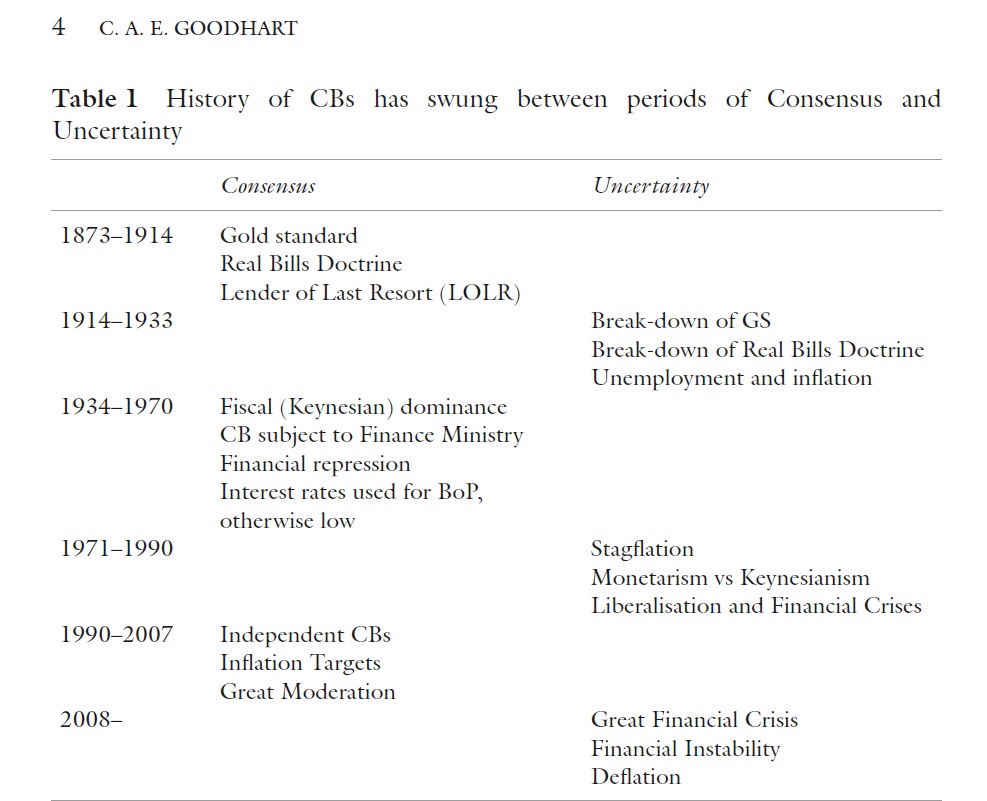
This squares off nicely with another brief article that I stumbled across today, by banking historian and LSE Emeritus Professor Charles Goodhart. Lamentably – or perhaps it ought to have been celebratory – Goodhart notes that no monetary regime lasts forever as central banks have for centuries, almost haphazardly, developed their various functions. The history of central banking, Goodhart notes,

can be divided into periods of consensus about the roles and functions of Central Banks, interspersed with periods of uncertainty, often following a crisis, during which Central Banks (CBs) are searching for a new consensus.”

He sketches the pendulum between consensus and uncertainty…goodhart monetary regime changes

…and suddenly the Great Monetary Experiment of today’s central banks seem much less novel!

Whatever happens to follow our current monetary regimes (and Inflation Targeting is due for an update), the student of economic history is superbly situated to make sense of it.

Those revenue-raising early central banks

In a piece on a rather different topic, George Selgin, director for the Center for Monetary and Financial Alternatives and editor-in-chief of the monetary blog Alt-M, gave a somewhat offhand comment about the origins of central banks:

For revenue-hungry governments to get central banks to fund their debts is itself nothing new, of course. The first central banks were set up with little else in mind. (emphasis added)

Writing about little else than (central) banks in history, you can imagine my surprise:

Reasoned response: Selgin ought to know better than buying into this simplified argument.

Less reasoned response, paraphrasing one of recent year’s most epic tweets: you come into MY house?! 

Alright, let’s make a quick run-through, then. Clearly, some simplification and lack of attention to nuances is permissible under the punchy poetic licenses of the economic blogosphere – especially so when the core of an argument lies elsewhere. But the conviction that early central banks

(a) were created as revenue-raising devices for their governments, or
(b) all central banks provided their governments with direct fiscal benefits,

is a gross simplification of a much broader and much more diverse history of early public banks. Additionally, the misconception entails what Italian banking scholar Curzio Giannini derisively referred to as overly-narrow “fiscal theor[ies] of central banks”. Since too many people believe some version of the argument, let’s showcase the plethora of early central banks and illustrate their diverse experiences.

Initially, the banks-as-fund-raisers argument may seem reasonable; a few proto-central banks definitely were set up with this purpose in mind, with the Bank of England’s series of monopoly charters beginning in 1694 as the prime example. David Kynaston, the great historian of the Bank, eloquently characterized the relation between the government and the Bank as a ‘ritualistic dance’ in light of the periodic renewals of its monopoly charter; the Bank provided the government with funds and in return received some new privilege in addition to lucrative interest payments.

Among the dozen or so other candidates reasonably fitting the description “first central banks”, we see a wide variety of purposes, not all of which were principally – or even at all – concerned with funding their governments.

Banco di San Giorgio (Genoa, 1407), was essentially a precursor of money market funds with investors holding the City state’s debt and receiving taxing rights. Here, as in many of the northern Italian city-state banks of the 14th and 15th century, the banks-as-fund-raisers argument seems applicable (we might mention others here too, like the Catalonian Taula de Canvi, 1401, that is often considered the first public bank). Whether or not these first generation banks may be counted as  “central banks” is much less doubtful, but a topic for another day.

Amsterdam Wisselbank (1609), a much-studied institution and a trailblazer in the history of central banking, was primarily set  up to facilitate payments, specifically to simplify the chaotic muddle of coins and payment methods that abounded in the Low Countries during the 1500s and 1600s. The Bank’s lending was circumscribed, and the lending that did take place often went to the Dutch East India Company – of course, we might argue that the Dutch East India Company, with its directors appointed by the Dutch provinces, actually constituted an arm of the government and so counting this lending as government financing. Besides, the City only began using the Wisselbank for financing purposes firstly through a loan in the 1650s and then more frequently towards the end of the 17th century. Regardless, those are (decades removed) outcomes – not initial purposes.

Hamburger Bank (1619) was similarly set up with monetary stabilization in mind and adopted many of the features of the Wisselbank. Contrary to the Wisselbank, it had a credit department that right away engaged in lending to private parties on collateral. However, it seems that most of its funds were lent to the Kämmerei (municipality treasury). In economists William Roberds and Francois Velde’s account, the

problems with circulating coinage in early seventeenth-century Hamburg were, if anything, worse than in Amsterdam.

A partial vindication, at best, for the banks-as-fund-raisers argument since the Hamburger Bank was clearly set up with monetary stabilization in mind rather than government financing. In practice, however, it did finance the city.

The Riksbank: (Stockholm, 1668). Picking up from its failed predecessor ‘Stockholms Banco’, what later became known as Sveriges Riksbank (frequently credited with being the first – surviving – central bank) was tasked with facilitating trade and upholding the value of the domestic currency. In practice, this meant influencing the foreign exchanges as they stood in Hamburg or Amsterdam. Initially, the bank was explicitly prohibited from extending funds to the crown (in early 2019 there has emerged a dispute over this point among some Swedish financial historians). What is clear is that for the first fifty years or so of the bank’s existence, the rule seems to have mostly held up; not until the Great Northern Wars in the early 1700s did the Riksbank to any meaningful extent advance funds to the government.

Bank of Scotland (1695) and the Royal Bank of Scotland (1727), were both – a bit like the Riksbank – chartered to advance and improve the functioning of the domestic economy, and they were prohibited from lending to the crown. Despite the well-known political conflicts leading to the chartering of the Royal Bank, the Scottish case of rivaling banks were clearly created to advance the North Sea trade, not to finance the government or manage its debt. The third chartered Scottish bank, the British Linen Company (1745) was formed in order “to carry on the linen manufactory”. As is often the case in banking history, the Scottish case might thus be the clearest counterpoint to an argument. Further, the Scottish banking historian Sydney Checkland pointed out that the Bank of Scotland was “solely dependent on private capital, and […] wholly unconnected with the state.”. Again, the No True Central Bank objection might be raised, but it would send us tumbling into a dark definitional hole that has to wait for another time.

Banco del Giro/Wiener Stadtbank (Vienna, 1703 and 1705) were both established as a result of “the poor state of Austrian public finance” Like in Venice and Genoa, the banks were meant to enhance the liquidity of the government’s debt, actively contributing to reducing the State’s and the City’s interest rates respectively – and then gradually pay back their debt. While both banks did accept private deposits, and like its Hamburg and Dutch predecessors facilitated payments through their ledgers, these operations were clearly not their prime purposes. Money-raising argument vindicated.

This brief overview of some early central banks illustrate the point: banking history contains much wider experiences than a simplified money-raising argument implies. Indeed, even the First Bank of the United States – clearly an aspiring candidate to the title of ‘first’ central banks’ – seems to primarily have had trade-enhancing and economic development purposes in mind. This I say much hesitantly, since early American banking is definitely not my forte and I fully expect Selgin (and others) to correct me here.

Regardless, to claim that early (central) banks were set up with government finance in mind, is clearly an overstatement.

___

The title is a play on my favorite of George Selgin’s many brilliant articles, ‘Those dishonest goldsmiths’.

For the record, George Selgin is well-versed in this literature, and I’m merely using his quote as a stand-in for a common conviction among the not-so-well informed academic crowd.

Watson my mind today: culture change

That, and spring time: that mystical time of year when a young student’s fancy turns to their neglected grades and wonders if there is anything they can do once the semester is over to raise them.

Culture is an emergent order. It cannot be owned, so you can’t have a “right” to a culture. It can’t be controlled, and while it can be influenced, it’s a complex system so beware lest your efforts backfire.

— Change doesn’t come, until it comes quickly. This serves as another reminder of the importance of keeping true ideals alive even when they are unpopular and they seem doomed to obscurity.

— It is also a warning about other changes, such as the growing anti-natalism of the left, brought in through environmentalism.

Caplan’s review of Moller’s Governing Least. “Instead of focusing on the rights of the victims of coercion, Moller emphasizes the effrontery of the advocates of coercion.” Even if “exceptions abound” to the “common-sense morality … that rights to person and property are not absolute … Moller sternly emphasizes … that these exceptions come with supplemental moral burdens attached.” Highly recommended.

— Responding to Ambassador Araud’s claim that the culture of neoliberalism and free trade are dead, Sumner says “Intellectuals focus too much on interesting rhetoric and too little on mundane reality.”

— On the importance of a culture that allows people to repent and change, that allows someone to apologize, make amends, and receive public forgiveness.