The minimum wage induced spur of technological innovation ought not be praised

In a recent article at Reason.comChristian Britschgi argues that “Government-mandated price hikes do a lot of things. Spurring technological innovation is not one of them”. This is in response to the self-serve kiosks in fast-food restaurants that seem to have appeared everywhere following increases in the minimum wage.

In essence, his argument is that minimum wages do not induce technological innovation. That is an empirical question. I am willing to consider that this is not the most significant of adjustment margins to large changes in the minimum wage. The work of Andrew Seltzer on the minimum wage during the Great Depression in the United States suggests that at the very least it ought not be discarded.  Britschgi does not provide such evidence, he merely cites anecdotal pieces of support. Not that anecdotes are bad, but those that are cited come from the kiosk industry – hardly a neutral source.

That being said, this is not what makes me contentious towards the article. It is the implicit presupposition contained within: that technological innovation is good.

No, technological innovation is not necessarily good. Firms can use two inputs (capital and labor) and, given prices and return rates, there is an optimal allocation of both. If you change the relative prices of each, you change the optimal allocation. However, absent the regulated price change, the production decisions are optimal. With the regulated price change, the production decisions are the best available under the constraint of working within a suboptimal framework. Thus, you are inducing a rate of technological innovation which is too fast relative to the optimal rate.

You may think that this is a little luddite of me to say, but it is not. It is a complement to the idea that there are “skill-biased” technological change (See notably this article of Daron Acemoglu and this one by Bekman et al.). If the regulated wage change affects a particular segment of the labor (say the unskilled portions – e.g. those working in fast food restaurants), it changes the optimal quantity of that labor to hire. Sure, it bumps up demand for certain types of workers (e.g. machine designers and repairmen) but it is still suboptimal. One should not presuppose that ipso facto, technological change is good. What matters is the “optimal” rate of change. In this case, one can argue that the minimum wage (if pushed up too high) induces a rate of technological change that is too fast and will act in disfavor of unskilled workers.

As such, yes, the artificial spurring of technological change should not be deemed desirable!

Is minimalism immoral?

I came across a simple but important question on Quora: Is it wrong to aspire to be a minimalist? Doesn’t this negatively affect the country’s GDP?

I see two big lessons here: 1) wise use of metrics requires wisdom… i.e. appropriate interpretation and critical thinking. 2) Maximization is just one version of one part of the whole story. (There are also important questions to ask about what we can expect from others, but I’ll leave that for the comments.)

Readers of NOL should be familiar with the notion that GDP is only an imperfect proxy for well being. But not everyone is so we have to repeat ourselves. There’s what we’re after, and there’s what we can measure, and the two are not the same. GDP is a really clever way to aggregate total production in an economy, but production is only valuable to the extent we’re producing the things that actually improve people’s lives. It’s easy for busy people to confuse a proxy measure for the latent variable we actually care about, so we need someone whispering in the emperor’s ear “the metric is not the mission.

Economics is easier to describe using the simplifying assumption that people want more stuff. It’s easy to forget that people also want more leisure (and so less work). This is a subtle reappearance of the seen and unseen. We can see when someone gets a cool new car and we can’t see when someone has a fun evening with friends and family. We have to check our bias towards trying to get more stuff and remember that reducing work is another feature of human flourishing.

On “strawmanning” some people and inequality

For some years now, I have been interested in the topic of inequality. One of the angles that I have pursued is a purely empirical one in which I attempt to improvement measurements. This angle has yielded two papers (one of which is still in progress while the other is still in want of a home) that reconsider the shape of the U-curve of income inequality in the United States since circa 1900.

The other angle that I have pursued is more theoretical and is a spawn of the work of Gordon Tullock on income redistribution. That line of research makes a simple point: there are some inequalities that are, in normative terms, worrisome while others are not. The income inequality stemming from the career choices of a benedictine monk and a hedge fund banker are not worrisome. The income inequality stemming from being a prisoner of one’s birth or from rent-seekers shaping rules in their favor is worrisome.  Moreover, some interventions meant to remedy inequalities might actually make things worse in the long-run (some articles even find that taxing income for the sake of redistribution may increase inequality if certain conditions are present – see here).  I have two articles on this (one forthcoming, the other already published) and a paper still in progress (with Rosolino Candela), but they are merely an extension of the aforementioned Gordon Tullock and some other economists like Randall Holcombe, William Watson and Vito Tanzi. After all, the point that a “first, do no harm” policy to inequality might be more productive is not novel (all that it needs is a deep exploration and a robust exposition).

Notice that there is an implicit assumption in this line of research: inequality is a topic worth studying. This is why I am annoyed by statements like those that Gabriel Zucman made to ProMarket. When asked if he was getting pushback for his research on inequality (which is novel and very important), Zucman answers the following:

Of course, yes. I get pushback, let’s say not as much on the substance oftentimes as on the approach. Some people in economics feel that economics should be only about efficiency, and that talking about distributional issues and inequality is not what economists should be doing, that it’s something that politicians should be doing.

This is “strawmanning“. There is no economist who thinks inequality is not a worthwhile topic. Literally none. True, economists may have waned in their interest towards the topic for some years but it never became a secondary topic. Major articles were published in major journals throughout the 1990s (which is often identified as a low point in the literature) – most of them groundbreaking enough to propel the topic forward a mere decade later. This should not be surprising given the heavy ideological and normative ramifications of studying inequality. The topic is so important to all social sciences that no one disregards it. As such, who are these “some people” that Zucman alludes too?

I assume that “some people” are strawmen substitutes for those who, while agreeing that inequality is an important topic, disagree with the policy prescriptions and the normative implications that Zucman draws from his work. The group most “hostile” to the arguments of Zucman (and others such as Piketty, Saez, Atkinson and Stiglitz) is the one that stems from the public choice tradition. Yet, economists in the public-choice tradition probably give distributional issues a more central role in their research than Zucman does. They care about institutional arrangements and the rules of the game in determining outcomes. The very concept of rent-seeking, so essential to public choice theory, relates to how distributional coalitions can emerge to shape the rules of the game in a way that redistribute wealth from X to Y in ways that are socially counterproductive. As such, rent-seeking is essentially a concept that relates to distributional issues in a way that is intimately related to efficiency.

The argument by Zucman to bolster his own claim is one of the reason why I am cynical towards the times we live in. It denotes a certain tribalism that demonizes the “other side” in order to avoid engaging in them. That tribalism, I believe (but I may be wrong), is more prevalent than in the not-so-distant past. Strawmanning only makes the problem worse.

Fogel on economics and ideology

Many, upon reading the conclusions of economists, believe that economics has an ideological bent. I often respond that this is not the case. True, the “window” of political opinions in economics is narrower but that is largely because the adhesion of economists to methodological individualism precludes certain ideological views that rest on holistic approaches or concepts. However, when you consider more complex situations than “party affiliation”, you will find economists all over the place. They will often cross ideological lines or even have a foot in two antagonistic camps.

Recently, I was reading Robert Fogel’s lectures on the “Slavery debates” which retells the intellectual history of American slavery from U.B. Phillips to … well … Fogel himself. One must remember that Fogel was, and remained from what I can tell, a quite strongly left-leaning economist for most of his life (see here). As such, it is hard to consider Fogel as an ideologue preaching for free market economics. Yet, in the lectures, Fogel (p.19) makes a point that supports the contention that I often make regarding economists and ideology that I believe must be shared:

The ability to view Phillips (NDLR: the dominant interpretation of slavery pre-1960) in a new light was facilitated by the sudden intrusion of a large corps of economists into the slavery debates during the 1960s. This intrusion was welcomed by neither the defenders of the Phillips tradition nor the neoabolitionist school led by Stampp (NDLR: Kenneth Stampp, author of The Peculiar Institution). The cliometricians, as they were called, refused to be bound by the established rules of engagement, and they blithely crossed ideological wires in a manner that perplexed and exasperated traditional historians on both sides of the ideological divide.

Given that the source of this quotation is Fogel, I admit that I am particularly fond of this passage. Maybe the distrust towards economists is because economists can be both friend and foes to established interlocutors in a given discussion.

ICE as Education Planners

Yale recently reclassified economics as a STEM (science, technology, engineering, and math), and other schools may follow suit. It’s a public-spirited regulatory arbitrage–by reclassifying to “Econometric and Quantitative Economics” they make it easier for international students to continue working in the U.S. after graduation. But by capitulating to regulatory nonsense, they’re sacrificing the long-run vitality of the field.

Here’s how this whole classification thing works: Immigration and Customs Enforcement (ICE) has a “STEM Designated Degree Program List” that specifies which programs on the Department of Education’s list of degree programs qualify as STEM. Students with degrees in these fields get special status as far as immigration. ICE’s list includes (among others) several psychology programs and three social science programs: Archaeology; Cyber/Computer Forensics and Counterterrorism; and Econometrics and Quantitative Economics.

What can we infer from this? That the feds are defining STEM narrowly, with a greater emphasis on engineering than science. STEM is about training people to do science-y work with practical applications. Basic research gets lip service, but only really matters so far as it’s likely to have clear applications in the future.

Economics has some parts that fit into such a view of STEM. Even I’ll admit (controversially for Austrians and Anarcho-Capitalists) that positive-sum social engineering a) is possible (in modest increments), and b) has something to learn from economics. But to include all of econ in STEM would require using a broader definition of STEM.

So what’s the upshot? High profile departments will focus more on a narrower part of economics pushing much of the field to the periphery. This is a retreat into more isolated academic silos. “Economics, general” leaves a vague space around a department, but taking a more specific designation means they can be held to more specific expectations. It might have little impact on the day-to-day life of a department, but in the long run they’re hamstringing themselves.

The problem these departments are trying to address is that ICE has too much power. But by playing this game they’re letting ICE play central planner in the education industry!

Divergence and Convergence within Italy

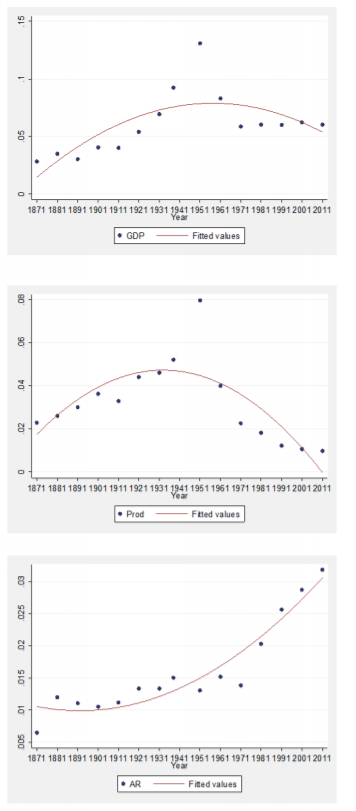
Two years, I wrote a post on this blog on the process of regional convergence in Italy. In that post, I made the observation that it seems that, economically, Italy was as fragmented at the time of the unification as it is today which made it an oddity in terms of regional convergence. To make that claim, I used this table of relatively sparsed out observations produced by Emanuele Felice: which was published in the Economic History Reviewitaliangdp


As one can see, there is a pronounced “lack” of integration for the Italy in terms of living standards. This is reinforced by a more “continuous” set of estimates produced, again, by Emanuele Felice (this time, its a working paper of the Bank of Italy) that now include the 1870s and go to 2011 (as opposed to 2001). This is the result, which I find fascinating. The first graph shows GDP per capita – for which there is divergence to 1951 and then a mild convergence thereafter but still well above the levels at the time of unification.  More fascinating is the fact that productivity is at its most integrated since unification (2nd figure) suggesting a divergence in levels of labor activity (3rd figure). In these three graphs, you have a neat summary of Italian labor markets since 1870.

Italian Convergence

The great global trend for the equality of well-being since 1900

Some years ago, I read The Improving State of the World: Why We’re Living Longer, Healthier, More Comfortable Lives on a Cleaner Planet by Indur Goklany. It was my first exposition to the claim that, globally, there has been a long-trend in the equality of well-being. The observation made by Goklany which had a dramatic effect on me was that many countries who were, at the time of his writing, as rich (incomes per capita) as Britain in 1850 had life expectancy and infant mortality levels well superior to 1850 Britain. Ever since, I accumulated the statistics on that regard and I often tell my students that when comes the time to “dispell” myths regarding the improvement in living standards since circa 1800 (note: people are generally unable to properly grasp the actual improvement in living standards).

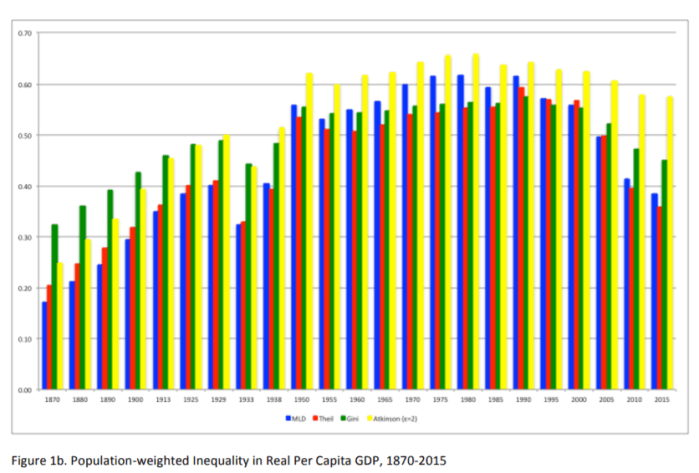
Some years after, I discovered the work of Leandro Prados de la Escosura who is a cliometrician who (I think I told him that when I met him) influenced me deeply in my work regarding the measurement of living standards and who wrote this paper which I will discuss here.  His paper, and his work in general, shows that globally the inequality in incomes has faltered since the 1970s.  That is largely the result of the economic rise of India and China (the world’s two largest antipoverty programs). Figure1Leandro

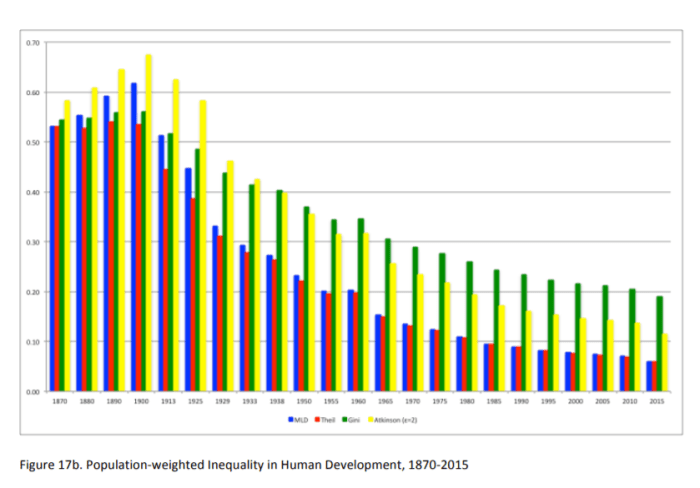
However, when extending his measurements to include life expectancy and schooling in order to capture “human development” (the idea that development is not only about incomes but the ability to exercise agency – i.e. the acquisition of positive liberty), the collapse in “human development” inequality (i.e. well-being) precedes by many decades the reduction in global income inequality. Indeed, the collapse started around 1900, not 1970!

Figure2LEandro.png

In reading Leandro’s paper, I remembered the work of Goklany which had sowed the seeds of this idea in my idea. Nearly a decade after reading Goklany’s work well after I fully accepted this fact as valid, I remain stunned by its implications. You should too.

Economists vs. The Public

Economics is the dismal science, as Thomas Carlyle infamously said, reprising John Stuart Mill for defending the abolishment of slavery in the British Empire. But if being a “dismal science” includes respecting individual rights and standing up for early ideas of subjective, revealed, preferences – sign me up! Indeed, British economist Diane Coyle wisely pointed out that we should probably wear the charge as a badge of honor.

Non-economists, quite wrongly, attack economics for considering itself the “Queen of the Social Science”, firing up slurs, insults and contours: Economism, economic imperialism, heartless money-grabbers. Instead, I posit, one of our great contributions to mankind lies in clarity and, quoting Joseph Persky “an acute sensitivity to budget constraints and opportunity costs.”

Now, clarity requires one to be specific. To clearly define the terms of use, and refrain from the vague generality of unmeasurable and undefinable concepts so common among the subjects over whom economics is the queen. When economists do their best to be specific, they sometimes use terms that also have a colloquial meaning, seriously confusing the layman while remaining perfectly clear for those of us who “speak the language”. I realize the irony here, and therefore attempt my best to straighten out some of these things, giving the examples of 1) money and 2) investments.

An age-old way to see this mismatch is measuring the beliefs held by the vast majority of economists and the general public (Browsing the Chicago IGM surveys gives some examples of this). Bryan Caplan illustrates this very well in his 2006 book The Myth of the Rational Voter:

Noneconomists and economists appear to systematically disagree on an array of topics. The SAEE [“Survey of Americans and Economists on the Economy”] shows that they do. Economists appear to base their beliefs on logic and evidence. The SAEE rules out the competing theories that economists primarily rationalize their self-interest or political ideology. Economists appear to know more about economics than the public. (p. 83)

Harvard Professor Greg Mankiw lists some well-known positions where the beliefs of economists and laymen diverge significantly (rent control, tariffs, agricultural subsidies and minimum wages). The case I, Mankiw, Caplan and pretty much any economist would make is one of appeal to authority: if people who spent their lives studying something overwelmingly agree on the consequences of a certain position within their area of expertise (tariffs, minimum wage, subsidies etc) and in stark opposition to people who at best read a few newspapers now and again, you may wanna go with the learned folk. Just sayin’.

Caplan even humorously compared the ‘appeal to authority’ of other professions to economists:

In principle, experts could be mistaken instead of the public. But if mathematicians, logicians, or statisticians say the public is wrong, who would dream of “blaming the experts”? Economists get a lot less respect. (p. 53)

Money, Wealth, Income

The average public confusingly uses all of these terms interchangeably. A rich person has ‘money’, and being rich is either a reference to income or to wealth, or sometimes both – sometimes even in the same sentence. Economists, being specialists, should naturally have a more precise and clear meaning attached to these words. For us Income refers to a flow of purchasing power over a certain period (=wage, interest payments), whereas Wealth is a stock of assets or “fixed” purchasing power; my monthly salary is income whereas the ownership of my house is wealth (the confusion here may be attributable to the fact that prices of wealth  shares, house prices etc  can and often do change over short periods of time, and that people who specialize in trading assets can thereby create income for themselves).

‘Money’, which to the average public means either wealth or income, is to the economist simply the metric we use, the medium of exchange, the physical/digital object we pass forth and back in order to clear transactions; representing the unit of account, the thing in which we calculate money (=dollars). That little green-ish piece of paper we instantly think of as ‘money’. To illustrate the difference: As a poor student, I may currently have very little income and even negative wealth, but I still possess money with which I pay my rent and groceries. In the same way, Bill Gates with massive amounts of wealth can lack ‘money’, simply meaning that he would need to stop by the ATM.

Investment

A lot like money, the practice of calling everything an ‘investment’ is annoying to most economists: the misuse drives us nuts! We’re commonly told that some durable consumption good was an investment, simply because I use it often; I’ve had major disagreements friends over the investment or consumption status of a) cars, b) houses, c) clothes, and d) every other object under the sun. Much like ‘money’, ‘investment’ to the general public seem to mean anything that gives you some form of benefit or pleasure. Or it may more narrowly mean buying financial assets (stocks, shares, derivatives…). For economists, it means something much more specific. Investopedia brilliantly explains it: The definition has two components; first, it generates an income (or is hoped to appreciate in value); secondly, it is not consumed today but used to create wealth:

An investment is an asset or item that is purchased with the hope that it will generate income or will appreciate in the future. In an economic sense, an investment is the purchase of goods that are not consumed today but are used in the future to create wealth.

This definition clearly shows why clothes, yoga mats and cars are not investments; they are clearly consumption goods that, although giving us lots of joy and benefits, generates zero income, won’t appreciate and is gradually worn out (i.e. consumed). Almost as clearly, houses (bought to live in) aren’t investments (newsflash a decade after the financial crisis); they generate no income for the occupants (but lots of costs!) and deteriorates over time as they are consumed. The only confusing element here is the appreciation in value, which is an abnormal feature of the last say four decades: the general trend in history has been that housing prices move with price inflation, i.e. don’t lose value other than through deterioration. In fact, Adam Smith said the very same thing about housing as an investment:

A dwelling-house, as such, contributed nothing to the revenue of its inhabitant; and though it is no doubt extremely useful to him, it is as his cloaths and household furniture are useful to him, which however make a part of his expence, and not his revenue. (AS, Wealth of Nations, II.1.12)

Cars are even worse, depreciating significantly the minute you leave the parking lot of the dealership. Where the Investopedia definition above comes up short is for business investments; when my local bakery purchases a new oven, it passes the first criteria (generates incomes, in terms of bread I can sell), but not the second, since it is generally consumed today. Some other tricky example are cases where political interests attempt to capture the persuasive language of economists for their own purposes: that we need to invest in our future, either meaning non-fossil fuel energy production, health care or some form of publicly-funded education. It is much less clear that these are investments, since they seldom generate an income and are more like extremely durable consumption goods (if they do classify on some kind of societal level, they seem like very bad ones).

In summary, economists think of investments as something yielding monetary returns in one way or another. Either directly like interest paid on bonds or deposits (or dividends on stocks) or like companies transforming inputs into revenue-generating output. It is, however, clear that most things the public refer to as investments (cars, clothes, houses) are very far from the economists’ understanding.

Economists and the general public often don’t see eye-to-eye. But improving the communication between the two should hopefully allow them to – indeed, the clarity with which we do so is our claim to fame in the first place.

Revised version of blog post originally published in Nov 2016 on Life of an Econ Student as a reflection on Establishment-General Public Divide.

George Halm against Common Wisdom on Currency Boards

Motivated by the recent decision of Argentina’s government to ask for an stand-by loan to the I.M.F., after a run on the peso, the last The Economist’s Bello section gives an account of the history of the relationship between them and makes a remark about the Argentine currency board experience between 1991-2002 that today is almost common wisdom: Since convertibility meant forgoing exchange-rate flexibility and an independent monetary policy, fiscal discipline was all-important for its success.”

But by the time the I.M.F. was being created, that was not an unanimous opinion. We have the example of George N. Halm who, in his book Economics of Money and Banking, stated that every Currency Board must implement a countercyclical policy on reserve requirements to be held by the commercial banks. Thus, the Currency Board could neutralize or mitigate an expansion or contraction of the base money by alternatively increasing or lowering the reserve requirements of the banks. For George Halm, a Currency Board could be almost in full command of monetary policy -and even more with respect to any other system, since it retains its political independence.

It is hard to imagine a Halm’s Currency Board that promotes a rapid economic growth which, in turn, could bring any popularity to its implementation. But it is as hard to imagine as the probability that a monetary system as such could end up in a bank run.

Cultural marxism and the Overton window

According to all accounts, Karl Marx was not an easy person. Basically, he had the habit of making the life of all around him miserable. However, as Joseph Schumpeter (himself far from being a Marxist) loved to point out, he was extremely well read. This allowed him to build a complex economic theory focused on factory workers, without ever (or almost ever, at least) stepping into a factory. Life for a factory worker in 19th century Britain was not easy, and Marx was very able in pointing that out. His economic theory, however, was a complete failure, as Ludwig von Mises aptly pointed out.

Marxism should have died in the mid-20th century when it became clear that all socialist countries are poor and oppressive. However, it survived as cultural Marxism. People like Antonio Gramsci, Michel Foucault, Jacques Derrida, and everybody in the Frankfurt School were not interested in economics. Instead, they wanted to study culture. The oppressed were not the factory workers anymore, but the social minorities. Libertarians and Conservatives should sympathize with that. It is true that women, non-whites, and homosexuals suffered a great deal in the masculine, white, heterosexual West. To point out that they suffer even more outside the West is not particularly helpful. We don’t have to throw the baby out with the bathwater. However, as with much of original Marxism, cultural Marxism is only good at pointing the problems, not at offering solutions. Modern civilization, as Sigmund Freud very well observed, is full of discontents. This is an old argument. Rousseau points out how modern civilization is cruel. Voltaire answers that, as cruel as it might be, it is still better than the alternative.

Our problem today is that cultural Marxism was successful in pushing the Overton window in their favor. That was precisely Gramsci’s objective: to fight “bourgeois” cultural hegemony with Marxist cultural hegemony. To a great degree, he succeeded. We need to fight the cultural war. As much as modern life can be bittersweet, I still haven’t heard a better alternative. Besides, as a Christian, I have to say with Saint Augustine that men have a “God-shaped hole” that no civilization – Modern, pre-modern or postmodern – can fill. But still, I enjoy the things that capitalism, capitalism that originated from the Protestant ethic, has to offer.

Low-Quality Publications and Academic Competition

In the last few days, the economics blogosphere (and twitterverse) has been discussing this paper in the Journal of Economic PsychologySimply put, the article argues that economists discount “bad journals” so that a researcher with ten articles in low-ranked and mid-ranked journals will be valued less than a researcher with two or three articles in highly-ranked journals.

Some economists, see notably Jared Rubin here, made insightful comments about this article. However, there is one comment by Trevon Logan that gives me a chance to make a point that I have been mulling over for some time. As I do not want to paraphrase Trevon, here is the part of his comment that interests me:

many of us (note: I assume he refers to economists) simply do not read and therefore outsource our scholarly opinions of others to editors and referees who are an extraordinarily homogeneous and biased bunch

There are two interrelated components to this comment. The first is that economists tend to avoid reading about minute details. The second is that economists tend to delegate this task to gatekeepers of knowledge. In this case, this would be the editors of top journals. Why do economists act as such? More precisely, what are the incentives to act as such? After, as Adam Smith once remarked, the professors at Edinburgh and Oxford were of equal skill but the former produced the best seminars in Europe because their incomes depended on registrations and tuition while the latter relied on long-established endowments. Same skills, different incentives, different outcomes.

My answer is as such: the competition that existed in the field of economics in the 1960s-1980s has disappeared.  In “those” days, the top universities such as Princeton, Harvard, MIT and Yale were a more or less homogeneous group in terms of their core economics. Lets call those the “incumbents”. They faced strong contests from the UCLA, Chicago, Virginia and Minnesota.  These challengers attacked the core principles of what was seen as the orthodoxy in antitrust (see the works of Harold Demsetz, Armen Alchian, Henry Manne), macroeconomics (Lucas Paradox, Islands model, New Classical Economics), political economy (see the works of James Buchanan, Gordon Tullock, Elinor Ostrom, Albert Breton, Charles Plott) and microeconomics (Ronald Coase). These challenges forced the discipline to incorporate many of the insights into the literature. The best example would be the New Keynesian synthesis formulated by Mankiw in response to the works of people like Ed Prescott and Robert Lucas. In those days, “top” economists had to respond to articles published in “lower-ranked” journals such as Economic Inquiry, Journal of Law and Economics and Public Choice (all of which have risen because they were bringing competition – consider that Ronald Coase published most of his great pieces in the JL&E).

In that game, economists were checking one another and imposing discipline upon each other. More importantly, to paraphrase Gordon Tullock in his Organization of Inquiry, their curiosity was subjected to social guidance generated from within the community:

He (the economist) is normally interested in the approval of his peers and and hence will usually consciously shape his research into a project which will pique other scientists’ curiosity as well as his own.

Is there such a game today? If in 1980 one could easily answer “Chicago” to the question of “which economics department challenges that Harvard in terms of research questions and answers”, things are not so clear today. As research needs to happen within a network where the marginal benefits may increase with size (up to a point), where are the competing networks in economics?

And there is my point, absent this competition (well, I should not say absent – it is more precise to speak of weaker competition) there is no incentive to read, to invest other fields for insights or to accept challenges. It is far more reasonable, in such a case, to divest oneself from the burden of academia and delegate the task to editors. This only reinforces the problem as the gatekeepers get to limit the chance of a viable network to emerge.

So, when Trevon bemoans (rightfully) the situation, I answer that maybe it is time that we consider how we are acting as such because the incentives have numbed our critical minds.

On the rift between economics and everything else

The line is often heard: economists are “scientific imperialists” (i.e. they seek to invade other fields of social science) jerks. All they try to do is “fit everything inside the model”. I have this derisive sneer at economists very often. I have also heard economists say “who cares, they’re a bunch of historians” (this is the one I hear most often given my particular field of research, but I have heard variations involving sociologists and anthropologists).

To be fair, I never noticed the size rift. For years now, I have been waltzing between economics and history (and tried my hand at journalism for some time) which meant that I was waltzing between economic theory and a lot of other fields. The department I was a part of at the London School of Economics was a rich set of quantitative and qualitative folks who mixed history of ideas, economics, economic history and social history. To top it all, I managed to find myself generally in the company of attorneys and legal scholars (don’t ask why, it still eludes me). It was hard to feel a big rift in that environment. I knew there was a rift. I just never realized how big it was until a year ago (more or less).

There is, however, something that annoys me: the contempt appears to be self-reinforcing.  Elsewhere on this blog (here and here) (and in a forthcoming book chapter in a textbook on how to do economic history), I have explained that economists have often ventured into certain topics with a lack of care for details. True, there must be some abstraction of details (not all details are useful), but there is an optimal quantity of details. And our knowledge grows, the quantity of details necessary to answering each question (because the scientific margin is increasingly specialized) should grow. And so should the number (and depth) of nuances we make to answer a question.  There is a tendency among economists to treat a question outside the usual realm of economics and ignore the existing literature (thus either rushing through an open door or stepping in a minefield without knowing it).  The universe is collapsed into the model and, even when it yields valuable insights, other (non-econs) contributors are ignored.  That’s when the non-econs counter that economists are arrogant and that they try to force everything into a mold rather than change the mold when it does not apply. However, the reply has often been to ignore the economists or criticize strawmen versions of their argument. Perceived as contemptuous, the economists feel that they can safely ignore all others.

The problem is that this is a reinforcing loop: a) the economists are arrogant; b) non-economists respond by dismissing the economists and ridiculing their assumptions; c) the economists get more arrogant. The cycle persists. I struggle to see how to break this cycle, but I see value in breaking it. Elsewhere, I have made such a case when I reviewed a book (towards which I was hostile) on Canadian economic history. Here is what I said for the sake of showcasing the value of breaking the vicious circle of ignoring both sides:

These scholars (those who have been ignored by non-economists) could have easily derived the same takeaways as Sweeny. Individuals can and do engage in rent-seeking, which economists define as the process through which unearned gains are obtained by manipulating the political and social environment. This could be observed in attempts to shape narratives in the public discourse. According primacy to the biases of sources is a recognition that there can be rent-seeking in the form of actors seeking to generate a narrative to reinforce a particular institutional arrangement and allow it to survive. This explanation is well in line with neoclassical economics.

This point is crucial. It shows a failing on both sides of the debate. Economists and historians favorable to “rational choice” have failed to engage scholars like Sweeny. Often, they have been openly contemptuous. The literature has evolved in separate circles where researchers only speak to their fellow circle members. This has resulted in an inability to identify the mutual gains of exchange. The insights and meticulous treatments of sources by scholars like Sweeny are informative for those economists who consider rational choice as if the choosers were humans, with all their flaws and limitations, rather than mechanistic utility-maximizing machines with perfect foresight (which is a strawman often employed to deride the use of economics in historical debates) . In reverse, the rich insights provided by rational choice theorists could guide historians in elucidating complex social interactions with a parsimony of assumptions. Without interaction, both groups loose and resolutions remain elusive.

See, as a guy who likes economics, I think that trade is pretty great. More importantly, I think that trade between heterogeneous groups (or different individuals) is even greater because it allows for specialization that increases the value (and quantity) of outputs.  I see the benefits of trade here, so why is this “circle of contempt” perpetuating so relentlessly?

Can’t we just all pick the 100$ bill on the sidewalk?

Life expectancy at birth is not a predictor of health care efficiency…

This is going to be a short post to argue that pundits (and some economists) need to stop quoting life expectancy figures to argue for/against a particular health care system. This belief is best exemplified in a recent paper in the Journal of the American Medical Association where Papanicolas et al. (2018)  point out that the United States “spent nearly twice as much as 10 high-income countries (…) and performed less well on many population health outcomes”. While the authors make good points about administrative costs, they point out that the US has a low level of life expectancy.

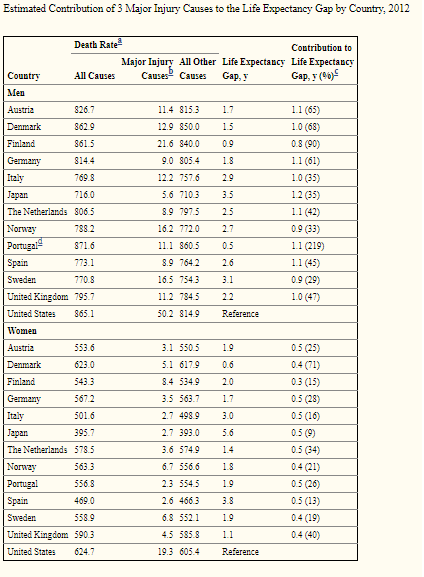
Sure, that is actually true – but Americans tend to die in greater proportions from homicides, drug overdoses and car accidents (Americans drive more than Europeans) than in other rich countries. While these factors of mortality are tragic (except car accidents since Americans seem to prefer the benefits of mobility to the safety of not driving), they are in no way related to the efficiency of health care provision. How much of a deal are these in explaining differences with other industrialized countries? A pretty big deal.  For example, these three factors alone account for 64% of the male life expectancy gap between Austria and the United States (see table reproduced below). For women, 26% of the gap between Austria and the United States is explained by these three factors.

The study I cite here only includes three factors. If you add in other factors like drownings among youths (Americans tend to have more drownings than several industrialized countries) which is a result of the fact that Americans are richer and can afford pools (while Europeans tend not to), then you keep explaining away the difference.  This is not to say that American health care is great. However, this says that American health care is not as bad as life expectancy outcomes suggest.

Mortality


A quick thought on UBI

I’m still not sure where I land on the issue of Universal Basic Income (UBI), but I just thought of a bit of clarifying language that lead to a thought. I’m sure this thought isn’t original, but I’m also sure it doesn’t come up as often as it ought to.

A UBI system’s appeal stems from the fact that it’s a minimal welfare state (kinda sorta). We all know the old debate between proponents of a minimal state–and the debates about what exactly that constitutes–and those of a welfare state–and again, there’s plenty of disagreement on what that actually means.

On a 0-10 spectrum of “how important should the government be? / how important is the government currently” a UBI is a lateral move with obvious efficiency gains. It strips out all the bureaucracy in our current welfare state, provides a wide safety net, and allows the poor to exercise their own agency using their local knowledge about their particular circumstances and opportunities. No cookie cutter solutions, no lines, just a modest check in the mail and an entire population looking for good ways to use it.

On the other hand, it lays bare some of the worst case scenarios of a maximal welfare state. Subsidizing sloth and dependency, enormous costs, reduction in savings, net negative cultural effects, and who knows what else!

But still, perhaps UBI with some minimal modifications is an improvement over what we’ve got now?

2×2 matrix (robust vs thin welfare state and broad vs targeted welfare state).

The maximal welfare state is robust, and broad. There’s a housing bureau, a food bureau, a work bureau, and nearly everyone is waiting in line at one of them at some point each week.

The minimal state would have no welfare, but the minimal welfare state would have a thin and targeted system. No social workers, no bureaucrats, just a check. And unlike a UBI, this would only apply to the poor. Which might cost it political support.

A UBI is thin but broad. That might require it to be less generous, but could (literally) buy it some votes. On the other hand, what do I know about what makes people vote?

The thinness and breadth of a UBI makes it startling next to the old dichotomy. It simultaneously opens up whole new realms of possibilities–it dramatically increases the opportunity cost of drudgery and bureaucracy and provides an easy enough safety net to allow widespread entrepreneurial activity. If we had the right culture we could do anything! But (!) we don’t get to choose the culture.

That breadth is pretty scary when we consider some of the negative behaviors it will surely breed. The lunatic fringe will be funded by the rest of us. A cult is easy to finance when all your members sign over a government check to you every month.

Here’s a possibility: Imagine a vastly simpler tax code. “What’s your income? Scan your tax/employment card that isn’t as stupid as a Social Security Number.” $X “Thank you, give us f(X). Insert cash or card into the machine.” You could file taxes every month (or more or less frequently if you prefer). In that world, we could just give a refundable tax credit to anyone who had a low enough income.

Mind you, I’m assuming away the issue of designing the right marginal tax rates and setting the level of the tax credit. But such a system could be simultaneously broad (it kicks in for anyone as soon as you need it) and narrow (you only get it if you’re poor… and you end up paying it back if you get rich). I think a simpler tax system would be necessary to make a minimal UBI workable

Revisiting Epstein’s Freedom and Growth


I was fortunate to be invited give the Epstein Lecture at LSE this March. The series is named after the great LSE economic historian Larry (Stephen) Epstein. Here I’ll summarize why it was such an honor to give the lectures. The content of the lecture will be another post.

Epstein was a historian whose origin field of expertise was medieval Italy. I encountered him through Freedom and Growth. Published in 2000, I first read it a couple of years later, perhaps in 2002 or 2003. At the time I was devoted to a story of economic growth shaped by Douglass North, particularly Structure and Change in Economic History (1981).

The focus of Structure and Change was on transaction costs. High transaction costs limited market exchange and kept societies poor for most of history. Sustained economic growth could only occur once transaction costs fell to a level that allowed markets to expand and the division of labor to develop. On this view, market expansion or Smithian growth was itself a stimulus to technological innovation. But what kept transaction costs high?

One answer North gave was the state. To paraphrase: the state had the ability to both keep a society mired in poverty through predatory behavior and to provide the preconditions for growth by securing property rights. The origins of sustained economic growth for North lay in institutional changes that occurred secured property rights and lowered transaction costs. The most important such institutional change was the Glorious Revolution of 1688.


North’s account received many challenges, but the issue that Epstein honed in on was the assumption that there was such a state, able to either revoke or secure property rights. It was assumed that “rulers rule”. Epstein contested this arguing that New Institutional Economists

“project backwards in time a form of centralised sovereignty and jurisdictional integration that was first achieved in Continental Europe during the nineteenth century; they therefore fundamentally misrepresent the character of pre-modern states.”

North, Wallis, and Weingast would address this in their 2009 Violence and Social Orders. But Epstein’s criticism was spot on in 2000. Epstein argued that alongside the problem of predatory states, a central problem was the lack of integrated markets. He attributed market disintegration to coordination and prisoners’ dilemma problems between political authorities. In so doing, Epstein set the agenda for the subsequent “state capacity” research agenda.

Epstein made several points which continued to be expanded upon by current research (see here). First, he documented that the lower interest rates that the British state paid after 1688 were characteristic of city republics from the middle ages onwards. He argued that the English monarchy in the 17th century was characterized by an anomalously backwards financial system. Lower interest rates after 1688 partly represent a convergence to the Republican norm achieved by Italian city-states centuries earlier.

Second, he challenged the argument that monarchies “overtaxed” cities. There was “no evidence that townspeople paid higher taxes under monarchies than republics”. Per capita taxes were likely higher in Republican city-states.

Third, he disputed that Republican city-states like Florence brought economic freedom noting that “republican subjects faced several limitations to their economic and political freedoms that monarchical subjects did not”. All of this challenged generalizations made by historical sociologists like Charles Tilly and economic historians like North.


Epstein’s historical evidence came from medieval Italy. Late medieval Italy was highly urbanized and prosperous by pre-industrial standards. According to Broadberry’s estimates, per capita GDP in Italy in 1450 was not matched by England until 1750. Like growth elsewhere in the premodern world, it was Smithian growth, driven by trade, market integration, and the division of labor. But unlike in England, this Smithian growth did not continue and blossom into modern growth. Epstein’s explanation for why this did not take place was that late medieval Italy suffered an “integration crisis”.

He saw the late medieval period as characterized by new opportunities for growth and innovation. Urbanization increased. Capital markets expanded and deepened. Interregional trade developed. Proto-industrialization took place. But Epstein contended these opportunities were only seized in areas where political authority was centralization.

In reference to proto-industrialization, he observed that

“Crucially, the success of regional crafts was inversely proportional to the concentration of economic and institutional power in the hands of a dominant city.”

With respect to the establishment of permanent fairs, he noted that

In fifteenth-century Lombardy, new fairs proliferated only after the balance of power shifted decisively from the former city-states to the territorial prince with Francesco Sforza’s victory in 1447.

Market integration was complemented and perhaps driven by political integration. Integrated urban hierarchies were themselves the product of political centralization.

“Centralisation underlies all the major institutional changes to market structures previously described. It lowered domestic transport costs, made it easier to enforce contracts and to match demand and supply, intensified economic competition between towns and strengthened urban hierarchies, weakened urban monopolies over the countryside, and stimulated labour mobility and technological diffusion.”

The more centralized parts of Italy — notably Lombardy — were better able to benefit from these trends than was Tuscany. But in general, political fragmentation and regional diversity were “distinctive features of pre-modern Italy” in general and an impediment to its long-run growth prospects.

Unlike in his analysis of interest rates, Epstein brought little data to bear on these claims and I am unaware of subsequent research on late medieval Italy. As such, the thesis of a late medieval integration crisis laid out in Freedom and Growth remains speculative. Epstein would no doubt have fill in the details had he lived longer. Subsequent research has mostly focused on early modern rather than medieval Europe (see here).  But the larger message: the importance of the state for premodern economic development has been central to subsequent research, including my own work (e.g. here).