From the comments: follow on effects of liability rules?

Far be it from me to to tell anyone how to think, or what a word belonging to everyone really means. But I’m going to quickly indulge in a No True Scotsman-ism. Libertarianism means being skeptical of power. (I recently saw a great line on libertarians that needs sharing: “…every libertarian agrees on two things: that there’s only one libertarian and it’s them.”)

So I’m optimistic to see reductions in the amount of power government agents can exercise. I’m particularly optimistic to see changes that don’t take the form of “we’re going to manage that bit of power over there with a new bit of power over here” (i.e. regulation). A very short term version of such a change happened when Buffalo’s police union announced they wouldn’t cover the legal fees of their riot squad.

My enthusiasm was followed by the right question in the comments: “If this obtains, what is the likely effect upon the lives and property of Buffalo dwellers?”

In principle, we could dig into this question empirically, but not until we’ve got decent data with variation in the liability rules governing police behaviors. In the mean time…

Let’s break the question down: What are the average effects and how will those effects differ between different parts of Buffalo? What will be the effects on violent crime? What will be the effects on property crime? And how will those effects affect property values?

The most obvious and immediate change will be a reduction in police use of force. As we’ve seen, at least some of that force is used criminally. This change in the rules means reducing the likelihood of another Gugino incident. Which means a reduced likelihood of pulling resources away from productive uses to cover all the various costs involved in such incidents–the medical care and suffering, the resources surrounding arresting the perpetrators and keeping them safe should they end up incarcerated, the legal fees, etc. All else equal (i.e. ignoring secondary effects), this is equivalent to raising the cost of breaking windows–bad for the glazier, but more than offset to window owners.

Of course, the real question is about the impact of reducing the non-criminal use of force by police. The Buffalo experiment looks to be short-term and restricted to the riot squad, so we won’t be able to draw any conclusions from this (except, of course, that it confirms my priors and you’re looking at things the wrong way if you disagree with me. </s>)

The more interesting question is how extending this liability issue–i.e. curtailing qualified immunity–would affect the long run equilibrium? That outcome would eventually be capitalized into the prices of real estate. Safer neighborhoods will have higher property values.

Here’s my prediction: property values will increase in poor and non-white neighborhoods relative to wealthier and whiter neighborhoods.

Some caveats are in order:

  • I suspect that in most American cities poor neighborhoods are under-served by the police, so reduced legitimate police force will have minimal impact.
  • I also suspect (hopefully someone will share some helpful resources in the comments) that illegitimate police force is mostly concentrated in poor neighborhoods.
  • Wealthy neighborhoods might see some increased crime from reduced legitimate police force, but I’m doubtful. I think more likely the impact will be more like the effects of price discrimination–why pay more if the alternative isn’t terrible? To the extent poor neighborhoods get less terrible, the relative draw of rich neighborhoods will decreases.
  • There are any number of other changes coming down the pipeline that will make it difficult to disentangle the effects of qualified immunity holding all else equal.
  • To the extent we see a general improvement in the quality of policing (more ‘serve & protect’ and less cracking skulls) we should see an increase in property values across the board.
  • White flight is likely to happen which will bias results towards my conclusions. I want my hypothesis to be interpreted holding white flight constant.
  • The effects will go beyond just real estate price. I would expect something like this: for every $1 price reduction in rich neighborhoods, there will be <$1 price increase in poor neighborhoods, but the gap will be made up in other quality-of-life changes such as reduced chance of incarceration for victimless crimes, fewer hours of work missed, fewer injuries at the hands of police, etc.
  • I hope that these quality of life changes will make empirical analysis even more difficult as other follow on effects extend the time horizon of people in poor neighborhoods–e.g. if fewer people are sent to jail, that could lead to fewer young men getting involved in crime leading to entrepreneurs being more willing to invest in their communities.

My predictions are absolutely shaded by my ideological biases. And there’s no getting around how complicated these changes are (hopefully) going to be. But I feel confident predicting an implicit shift of wealth from the paranoid wealthy to the disenfranchised.

Is there anyone here who disagrees enough to help me clarify my thinking by putting money on it?

Be Our Guest: “Providing healthcare isn’t practicing medicine”

Jack Curtis has a new Guest Post up. An excerpt:

It was expected that doctors would have some charity patients from those less well off. You also expected that he would do everything possible for your care because that reputation was the reason you wouldn’t call someone else next time. That was reinforced by the priceless value set on human life by the prevailing Judeo-Christian ethos. No, this is not fiction; such was medical practice in Los Angeles in my youth. A simplification certainly, but it conveys the essential: Human ills and injuries were serviced by medical doctors whose state licensing and professional organizations approximated medieval guilds.

Please, read the rest.

On a different note, Jack’s excellent thoughts will be the last installment of NOL‘s experimental “Be Our Guest” feature. I just couldn’t find the time to get a decent turnaround. If you still want to have your say, and nowhere to say it, jump on in the ‘comments’ threads.

Liability Rules!

“The union representing Buffalo police officers told its rank and file
members Friday that the union would no longer pay for legal fees to
defend police officers related to the protests…”

From Buffalo News.

This could be excellent news (at least in Buffalo). The threat of lawsuits means police will either be on their best behavior or won’t show up to work.

Hayek, International Organization and Covid-19

Just to inform all NOL-readers out there, if you like the subject, please register and join the IEA webinar I’ll give next wednesday, 13.00 hours, London time.

Institute of Economic Affairs > Events
Time:
10/06/2020
13:00 – 14:00

Although it was never the subject of a book, Friedrich Hayek wrote a lot about international relations during his long career and had rather firm views on international order and how it could be achieved. In this webinar, these Hayekian views are presented in the context of the current COVID-crisis. What was Hayek’s opinion about the existence and the role of international governmental organizations, such as the World Health Organization?

Dr. Edwin van de Haar (www.edwinvandehaar.com) is an independent scholar who specializes in the liberal tradition in international political theory. He has been a (visiting) lecturer at Brown University, Leiden University and Ateneo de Manila University. Van de Haar is the author of Classical Liberalism and International Relations Theory. Hume, Smith, Mises and Hayek (2009), Beloved Yet Unknown. The Political Philosophy of Liberalism (2011, in Dutch) and Degrees of Freedom. Liberal Political Philosophy and Ideology (2015). Among others, he contributed to The Oxford Handbook of Adam Smith (2013) and a forthcoming book on The Liberal International Theory Tradition in Europe, while his articles on liberal ideas and liberal thinkers appeared among others in Review of International Studies, International Relations, International Politics, Independent Review and Economic Affairs.

Van de Haar got his PhD in International Politcial Theory from Maastricht Universit in 2008, and holds master degrees in international relations (London School of Economics and Political Science) and in political science (Leiden University).

Please visit: https://iea.org.uk/events/hayek-international-organization-and-covid-19/

How much more progressive is the corporate world than academia?

Academia is a hotbed of leftism and has been for centuries. At the same time, it’s also one of the most conservative institutions in the Western world. I don’t think this is a coincidence. Leftists are conservative.

The recent writings of Lucas, Mary, and Rick have highlighted well not only academia’s shortcomings but also some great alternatives, but what about stuff like this? The link is an in-depth story on how senior professors use their seniority to procure sexual favors from their junior colleagues. There is, apparently, not much universities can do about it either.

If a manager within a corporation tried any of the stuff listed in the report, he or she would be fired immediately. Sexual harassment is still an issue in the corporate world, but it is much, much easier to confront than it is in academia. The same goes for government work. The President of the United States couldn’t even get away with a blow job from a teenage intern without dire consequences in the 1990s.

What makes academia so different from corporate and government work? Is it tenure? Is it incentives? In the corporate world profits matter most. In government, “the public” matters most. In academia, it’s publish or perish. I don’t think this has always been the case. I think the publish-or-perish model has only been around since the end of World War II. Something is horribly wrong in academia.

In the mean time: corporations, churches, governments (it pains me to say this, but it’s true, especially when compared with academia), and all sorts of other organizations continue to experiment with social arrangements that attempt to make life better and better.

What will a post-pandemic British foreign policy look like?

Introduction

The United Kingdom’s post-corona foreign policy is likely to be driven by some crucial economic factors. On the one hand, it will continue to work closely with countries like the United States, Japan, Australia, and India to reduce its dependence upon China. On the other hand, the UK cannot totally bank on the US for achieving its economic goals, given the unpredictability of US President Donald Trump.

The UK needs to look at new Free Trade Agreements (FTA’s) and also be part of multilateral arrangements, such as the Trans Pacific Partnership, which will enable it to diversify its supply chains.

Important upcoming economic decisions

Given the changing environment of the post-corona world, London now has an eye on enhancing self-sufficiency and reducing reliance on China.

The Boris Johnson government has set up a committee — ‘Project Defend’ — which seeks to study the UK’s economic dependence with hostile countries (with a specific thrust on China), especially for sensitive imports. Based on the findings of Project Defend’s report, for example, the UK will work towards the relocation of pharmaceutical companies. While changing supply chains overnight may not be an easy task, the Boris Johnson Administration has made an important decision.

The UK’s recent decision on Huawei

The Boris Johnson Administration has also recently decided to reduce Huawei’s participation in the 5G network to zero by 2023. In January 2020, Boris Johnson had given a go ahead to Huawei’s participation in the ‘non-core’ element of the 5G network, with important restrictions, as well as a 35% market share cap. This decision drew flak from a section of Conservative Party politicians, who for long have been arguing that the UK needs to be cautious with regard to close economic ties with China, since this has serious security implications. The Trump administration had also expressed its displeasure with the Boris Johnson administration. The US President and senior officials in his administration have publicly expressed their unhappiness, saying that this decision could have an impact on security cooperation between both countries.

In the aftermath of the coronavirus pandemic, ties between the UK and China have gone downhill (senior officials of the Johnson administration have criticized China for suppressing information with regard to the outbreak of the pandemic), and Johnson’s decision was driven by two factors: 1) increasing pressure from Conservative MP’s who had threatened to vote against the government’s decision, and 2) the fact, that the UK is keen to go ahead with an FTA with the US (there have been differences between the US and UK, however, on the issue of the FTA, with the US urging the UK to make a choice between China and the US).

Apart from this, the recent US sanctions imposed on Huawei have also played a role in Johnson’s decision of reducing Huawei’s participation by 2023 (the Trump administration has made it compulsory for foreign manufacturers using U.S. chipmaking equipment to obtain a license before being able to sell chips to Huawei).

D10 network

Interestingly, the UK has also proposed that a group of 10 countries, dubbed as D10, joins hands to provide an alternative to Huawei’s 5G network and other technologies with the aim of reducing dependence upon China. The proposed grouping would consist of the US, Italy, Japan, the UK, South Korea, India, Germany, France, Canada, and Australia.

The UK has thus taken the lead in providing an alternative to the now bipolar status quo. Significantly, Trump has also stated that he is keen to expand the G7 and include not only India and South Korea but Russia as well.

UK also keen to play an important role in the TPP

While on the one hand the UK is trying to reduce its dependence upon China by joining hands with the US and like-minded countries, on the other the UK is also seeking membership within the Comprehensive and Progressive Agreement for Trans Pacific Partnership (TPP), which consists of 11 members (Australia, Brunei, Canada, Chile, Japan, Malaysia, Mexico, New Zealand, Peru, Singapore, and Vietnam).

While the idea of the TPP was proposed by former US President Barack Obama, the first decision taken by Trump after his electoral triumph in 2016 was to withdraw from the agreement. Japan has been playing an important role in the TPP, and efforts are being made to expand its membership so that democratic dependence on China is still further reduced.

The UK faces numerous challenges and while it does need to reshape its economic relationship with China, London recognizes that this cannot be done overnight, so enhancing FTAs and joining the TPP are important steps in geopolitical context.

From a purely strategic perspective, the UK-US relationship has been important and with Johnson and Trump at the helm, and increasing convergence on attitudes vis-à-vis China, this is likely to get further strengthened (though of course there will be differences on both economic and geopolitical issues). The idea of the D10 grouping mooted by the UK has also sent a clear message that in spite of numerous economic challenges, the UK is keen to emerge as an important player, in its own right, in the post-corona world order.

Brazil’s economy after the pandemic

I wrote an article on the path to economic recovery in Brazil after the pandemic. The article was published by Instituto Monte Castelo, a Brasilia-based think tank, and it is in Portuguese. Here is a summary of the key points.

Brazil’s economy is overwhelmingly interventionist, as shown by its progress (or lack thereof) in data compiled by the World Bank in its Doing Business studies, or Heritage’s Foundation Index of Economic Freedom, or the World Economic Forum’s Global Competitiveness Report. As predicted by theories of economic interventionism (more recently, Robert Higgs and Sanford Ikeda; but, classically, Ludwig von Mises), a time of crisis invites more government intervention or, remarkably at certain historical junctures, disintervention.

From a free market perspective, what can be done?

Brazil’s situation is, to a certain extent, a reflection of the global scenario. A global crisis was bound to happen, given the unrealistic inflation of asset prices in global financial markets, reflecting the artificial propping up of the major economies around the world by injections of money and credit, as well as increased public spending after 2009. COVID-19 triggered it, but it was the tip of the iceberg. Brazil suffered from capital outflows and its currency devalued sharply against the US dollar.

In terms of how the external scenario reflects on Brazil, the only thing that can be done is decrease the level of risk in Brazil’s economy, or maintain interest rates on a level that reflects the amount of risk in the economy (given that Brazil’s Central Bank has been cutting rates throughout the year). The fact that the President is fighting with his cabinet and with the other branches of the government also reflects poorly in terms of political risk.

However, there is a lot that can be done in terms of the domestic scenario. The economic crisis resulting from the pandemic also reflects, in part, a change in consumer preferences and in how things will have to be done safely to avoid contamination. This means that some businesses will not thrive as much (restaurants, for example) and that other industries will incur in much higher costs to operate more safely. This disequilibrium would have happened regardless of government-mandated restrictions, and alert entrepreneurs will spot a chance to obtain gain by creating value for their consumers and clients.

However, it’s much harder to shut down inefficient companies, fire people, and open new ones, and hire people, in a heavily interventionist economy such as Brazil’s.

Shutdowns and other government imposed restrictions, especially on the local level, are making things worse. Brazil’s case is one of a milder shutdown. The government is offering a small compensation package for the trouble, but not much compared to the “stimulus” packages in Europe and the US. This probably reflects a more sober approach by Brazil’s Central Bank. However, on the one hand small businesses struggle to get access to credit due to the red tape, so this favors large companies and will concentrate the market in the long run. There’s also an idea of propping up airline companies and other inefficient businesses. This, in my view, would be a mistake. But lobbyists will line up to get their share of the cake.

The path to economic recovery in Brazil will necessarily have to involve local and federal deregulation, cutting lots of red tape, and major tax reforms. Labor laws have been made more flexible a few years ago, and the current administration managed to pass a massive pension reform that will reconfigure some of the public debt. However, this is not enough. Deeper reforms to cut public spending on a more permanent basis will have to be proposed, and the federal government will have to work harder to signal institutional and political stability and predictability.

The challenge is that the current administration can’t get reelected in 2022 with very little to show in terms of the economy, and the effects of the reforms proposed above will only become clearer in the long term. The temptation is to do just what the US seems to be doing – anti-trade nationalism to punish a foreign scapegoat, or the abstract scapegoat of ‘globalism’, appease some of the cronies with monetary and fiscal populism, red herrings making the population and the media focus on culture wars, etc. But this temptation is to be expected according to the economic theory of interventionism. Whether it will be overcome, only time can tell.

Cyclical History

An interesting result from behavioral/experimental economics is that bubbles can happen even with smart people who should know better. But once those people go through a bubble, they do a better job of avoiding bubbles in the future.

I think this result has major implications for society more broadly and I think we’re seeing it play out in the news. In the ’70s people learned a lot of hard lessons about things like stagflation (and racism–but ask a sociologist about that) that made the following decades easier. But those people gradually retired and were replaced with people who weren’t inoculated to certain ideas (like the idea of inflating your way out of a supply-side recession).

We’re now living in a world where the median voter and her elected representatives have unlearned those hard lessons. And so we’re going to live through the 1970’s again. Hopefully. If we’re not so lucky we might live through the 1930’s again.

Launching our COVID-19 visualization

I know everyone is buried in COVID-19 news, updates, and theories. To me, that makes it difficult to cut through the opinions and see the evidence that should actually guide physicians, policymakers, and the public.

To me, the most important thing is the ability to find the answer to my research question easily and to know that this answer is reasonably complete and evidence-driven. That means getting organized access to the scientific literature. Many sources (including a National Library of Medicine database) present thousands of articles, but the organization is the piece that is missing.

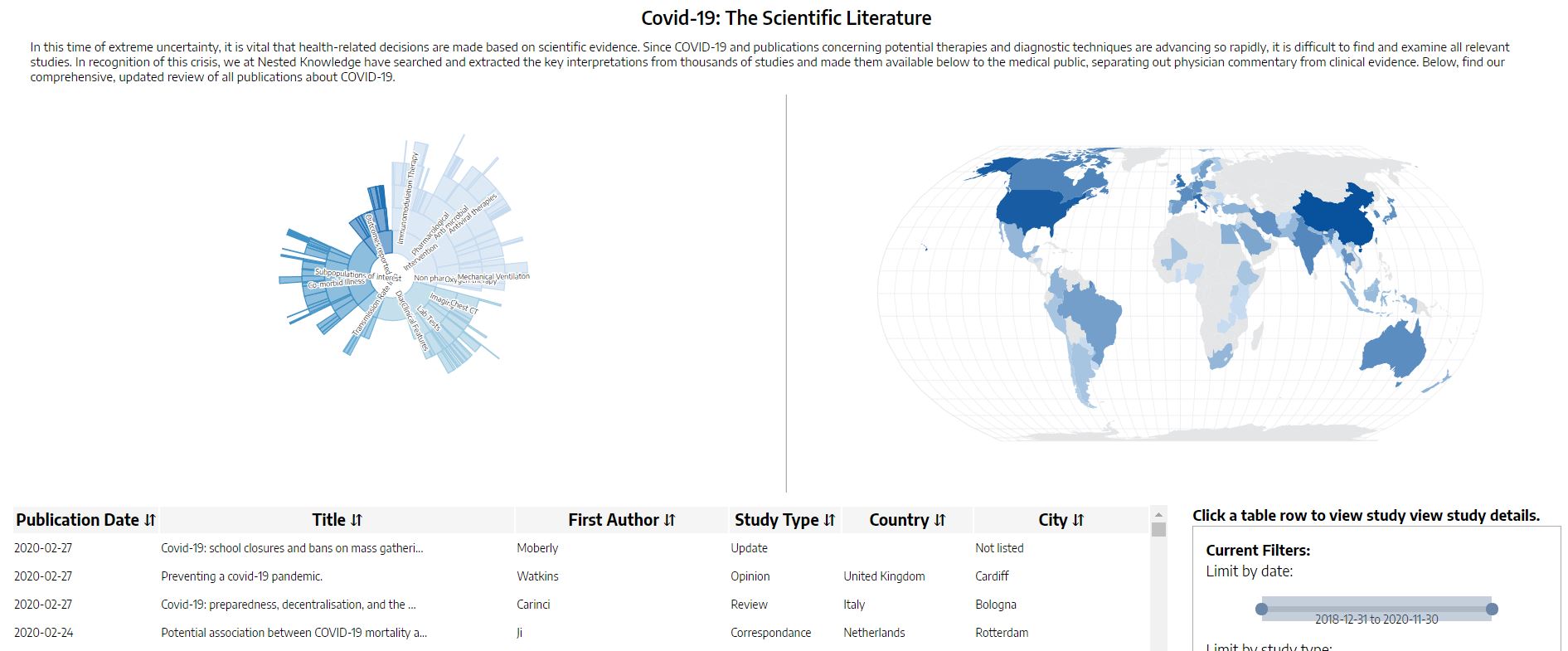
That is why I launched StudyViz, a new product that enables physicians to build an updatable visualization of all studies related to a topic of interest. Then, my physician collaborators built just such a visual for COVID-19 research, presenting a sunburst diagram that users can select to identify their research question of interest.

Studyviz sunburst

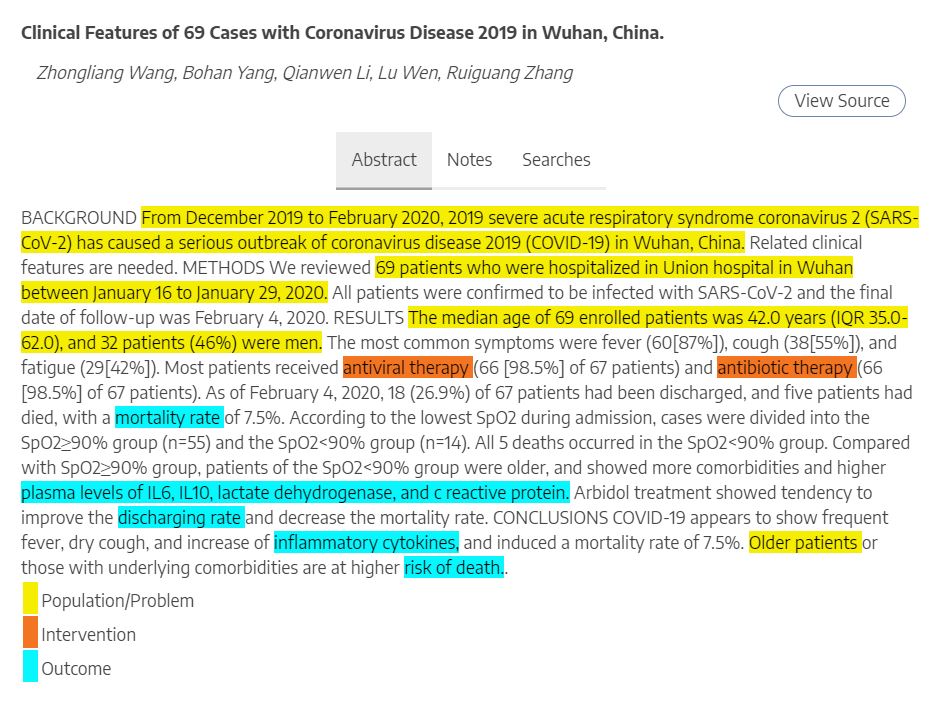
For instance, if you are interested in the impact of COVID-19 on pregnant patients, just go to “Subpopulations” and find “Pregnancy” (or neonates, if that is your concern). We nested the tags so that you can “drill down” on your question, and so that related concepts are close to each other. Then, to view the studies themselves, just click on them to see an abstract with the key info (patients, interventions, and outcomes) highlighted:

Abstract

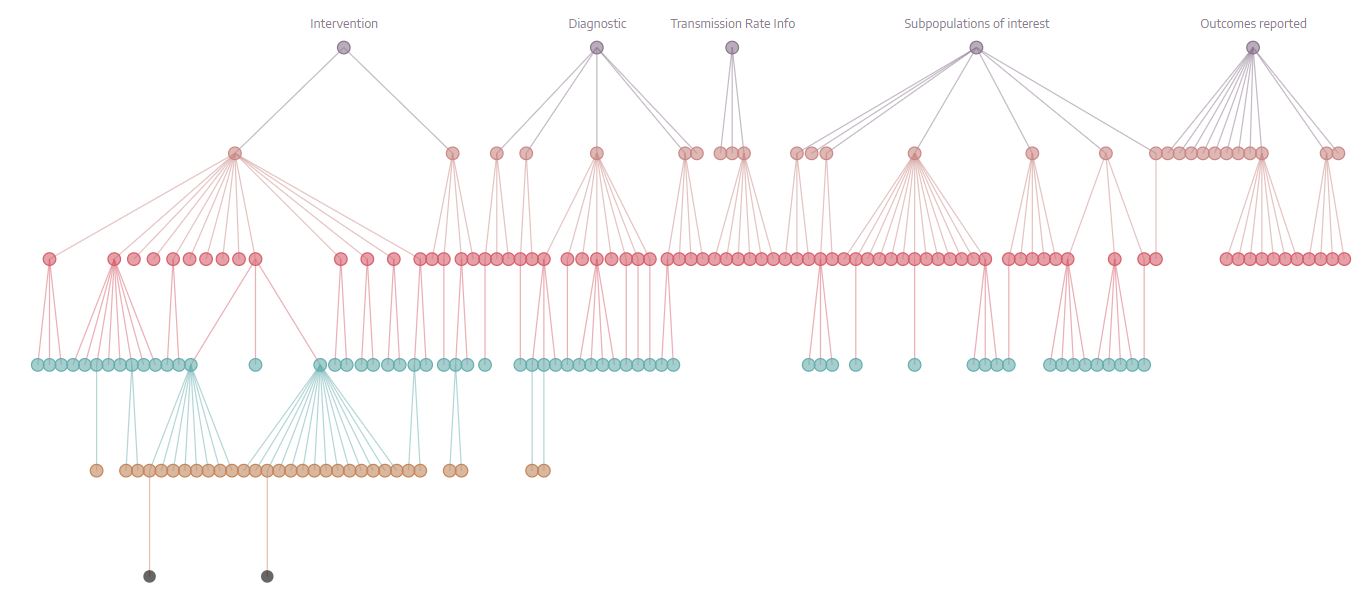
This is based on a complex concept hierarchy built by our collaborators and that is constantly evolving as the literature does:

Hierarchy

Even beyond that, we opened up our software to let any researchers who are interested build similar visuals on any disease state, as COVID-19 is not the only disease for which organizing and accessing the scientific literature is important!

We are seeking medical coinvestigators–any physician interested in working with us, simply email contact@nested-knowledge.com or contact us on our website!

Be Our Guest (Sunday Poetry): “Food & Drinks to Rats & Finks”

Our latest Be Our Guest post comes from poet N.D.Y. Romanfort, and it’s another poem. Once again I’m taking liberties in regards to Alex’sSunday Poetry” series and sharing Romanfort’s poem today. An excerpt:

Two-legg’d rodents have seized
the cherished eateries.
For these rats of great size
Mere food scraps aren’t the prize.

Please, read the rest. Enjoy. And if you’ve got something to say and no place to say it, Be Our Guest.

The Private Production of Defense

Lucas’ post reminded me of a piece that I wrote for his website ThinkIR, in 2013. Most of it I re-used in my book Degrees of Freedom (2015). Of course it is also a piece on its own, that readers of NoL may find of interest. Thanks Lucas!

+++++++++++++++++

It is fun to think about the almost unthinkable. Therefore this contribution is about the idea that no state is needed to provide military security against foreign attack. In modern times the idea goes back to at least the French-Belgian economist Gustave de Molinari and his 1849 pamphlet The Production of Security. The most prominent current defender of this idea is the German economist Hans-Herman Hoppe, a leading anarcho-capitalist thinker, in his essay The Private Production of Defense (also see The Myth of National Defense, which was edited by Hoppe).

Hoppe rightly notices (p.1) that the legitimacy of the modern state is strongly related to the belief in collective security. Following Rothbard in The Ethics of Liberty, he argues that states will always expand, due to the governmental monopoly to tax its inhabitants. This also applies to governments that only have the limited task of protection against aggression and administrating and justice. The only proper solution is therefore to abolish the state altogether, in order to ensure true liberty and individual justice. Consequently, this also means that the provision of security needs to be privatized, as Hoppe does not expect the world to turn into a peaceful utopia (pp. 1- 5).

So how would this work? Basically, to regard the production of security as an insurance, where the expenditures for defense are to be paid by premiums paid by individuals (pp.5-8). The insured people can choose from competing insurance firms, just like in other parts of the insurance market. This is not as improbable at it may seem at first sight. Importantly, insurance companies are already used to deal with risk and other real world dangers. There are already many private security companies in existence, also at the battlefield. The cost of defense in relation to other parts of the insurance market appears large, but do not discount the idea beforehand. For example: Dutch defense expenditure in 2013 is around 7 billion Euro, less than 1% of GDP, while annual turnover of the two largest insurers is around 20 billion. Of course Hoppe would point out that the 7 billion in current defense expenditures needs to be returned to the taxpayers, hence widening the premium base. Presumably, this would work the same in other countries with smaller economies and/or smaller financial sectors (but see the remarks below).

A world without states, but with private security insurance is less war prone, Hoppe argues (p.11-12). Insurers will have an interest in keeping costs down, and will therefore only make unprovoked attacks insurable. People who provoke, or have known to provoke violence in the past, will be excluded from the insurance. After a while, the number of uninsured people will be small. They will face big defense insurance companies if they violate somebody’s property, making this unlikely to happen often, in contrast to interstate war. Yet in my view here Hoppe relies too much on his stated view on human nature: man as rational animal.

A related main defect of the essay is its focus on the role of insurers and their (economic) incentives. This is fine, but the argument quickly loses any of the convincing power it has when Hoppe turns to an analysis of international war. Or more precise, a violent conflict between a free territory, defended by one or more insurance companies, and a state, financed by compulsory taxation. He simply asserts (p. 14) that the state would be in a disadvantage because it is less efficient and that its leaders would lose their legitimacy, because they necessarily fail to convince the population of the justification of an attack on the inherently peaceful free territory.

Yet if an attack would still happen, Hoppe continues, the state-led army of specialists would not only face the defense force of the insurance company (or several insurers and re-insurers cooperating), but also an armed population (p.15). Without much analysis he simply asserts the companies will always be more efficient and also capable to counter all attacks by any state, perform counter-operations in the state territory and be able to kill its leaders, while making sure to minimize any collateral damage. All because they have to justify their insurance fees.

That is as far as Hoppe goes in his argument. He offers no further analysis or other scenario’s, no additional arguments, does not provide any international political analysis, none whatsoever. Only the fact that the insurance companies are private suffices for Hoppe as they must be more efficient and thus able to overcome all possible attack. That is too simplistic, as just three examples illuminate.

Hoppe overlooks some important geopolitical aspects. Take size of territory and population for instance. How likely is it really that a small free territory, say the size of Luxembourg, or The Netherlands for that matter, would be able to raise enough insurance premiums to enable a good defense structure to counter attacks by much larger states? There is a difference between collecting enough money to match current defense expenditures and ensuring defense against all possible attacks, especially given the anarcho-capitalist dislike of international alliances such as NATO.

Apparently Hoppe thinks all necessary technology is either invented by the research and development people of the insurance company, or freely available at the market. This is improbable as far as the state-side of the argument concerns, given today’s relative secrecy in military procurement. Also, the cooperation between insurance companies may fail in this respect. If one company has a superior weapon system, it will be a ground for competition with the other insurer(s). The superiority of one company may quickly make it a monopolist. It may become a threat to its insured, just like states may be threats to their taxpayers. Once the armed forces of the private insurer are in full operation it only takes a powerful CEO with his or her own agenda to turn things sour. Just the fact of private financing does not make much difference.

Also, does economic efficiency always trump state inefficiency? The history of warfare is full of examples where the supposedly superior army loses unexpectedly. So if the state deals a decisive blow it effectively robs the remains of the insurance company, and it’s successors, of its premium paying clients.

To conclude, for liberty loving people the prospect of stateless private security may be tantalizing. However, the quality of the argument as presented by Hoppe thus far is poor and unconvincing. His theoretical arguments largely stem from economics and overlook other relevant facts and arguments, including those from IR. Hoppe’s private production of defense remains a fairy tale.


Links:
Molinari:
http://mises.org/document/2716/The-Production-of-Security

Hoppe:
http://mises.org/document/1221/The-Private-Production-of-Defense

http://mises.org/document/1092/Myth-of-National-Defense-The-Essays-on-the-Theory-and-History-of-Security-Production

Rothbard:
http://mises.org/document/1179/The-Ethics-of-Liberty

Skin in the Game or Senility?

This morning I learned that Trump has been taking Hydroxycloroquine for the last week.

Good for him for actually (apparently) taking on the risk he’s so enthusiastic to encourage others to take. I’m surprised Fox News hasn’t picked this up as a chance to build up some good press. Still, as a devoted never-Trumper, I hope this turns into evidence that Trump is not legally competent to hold office.

No word yet if he’s been huffing bleach fumes.

Multilateralism is alive and well in the Indo-Pacific

Introduction

The Comprehensive and Progressive Agreement for Trans Pacific Partnership (CPTPP) trade agreement, also known as CPTPP 11, consists of 11 member states (Australia, Brunei, Canada, Chile, Japan, Malaysia, Mexico, New Zealand, Peru, Singapore, and Vietnam).

The TPP agreement was a brain child of former US President Barack Obama. The main objective of the agreement was to bolster Obama’s ‘Pivot to Asia’ vision, and it was signed in February 2016.

Significantly, one of the first decisions taken by US President Donald Trump upon his election was to withdraw from the agreement. The main reason cited by Trump for this decision was that the TPP agreement was not favourable towards US workers. During the Presidential campaign of 2016, Trump had repeatedly said that apart from leading to job losses of US workers, the agreement would undermine US independence.

In April 2018, Trump had stated that the US was willing to join the TPP if it was offered a better deal, but by then other countries which were part of the original TPP had moved on, and the CPTPP 11 came into force in the end of 2018 (after a majority of signatories, Australia, Canada, Japan, Mexico, New Zealand, and Singapore ratified the agreement).

How the agreement has enhanced trade linkages between member states

CPTPP 11 has helped in bolstering economic cooperation between a number of member states such as Japan, Canada, and Vietnam. During Shinzo Abe’s visit to Canada in 2019, Canadian PM Justin Trudeau made a mention of how the deal had enabled Canada to increase its exports threefold to Japan. Trudeau also stated that the deal had been beneficial for strengthening economic ties between Canada and Japan.

According to estimates, the agreement has also helped in bolstering trade not just between Vietnam and Japan, but also between Vietnam and Canada.

Efforts to keep supply chains intact

In the midst of the corona virus pandemic, CPTPP 11 member states like Japan, Singapore, and New Zealand have been working assiduously towards keeping supply chains intact.

Singapore has been exporting meat and medical products from New Zealand and has also been seeking to strengthen its economic ties with Japan in the midst of the pandemic. In April, several CPTPP 11 members — Singapore, Australia, New Zealand, and Brunei — issued a joint statement along with Myanmar (a non-CPTPP 11 member) on the issue of opening trade lines, including air and sea freight.

Singapore, Australia, New Zealand, and Canada, along with non-CPTPP 11 member South Korea, have also been exploring the possibility of resuming essential travel.

What is also interesting is the success of some of the CPTPP 11 member states in dealing with the coronavirus pandemic, especially Vietnam and New Zealand. As of May 16, 2020, Vietnam recorded 318 coronavirus cases and did not register a single death. The ASEAN nation began to ease the lockdown in the end of April. As of May 16, 2020, the number of coronavirus cases in New Zealand was 1149, and number of deaths was 21 (New Zealand ended a 7 week lockdown on May 14, 2020).

Efforts to rope in new members into the partnership

After the coronavirus pandemic, more countries are likely to get on board with the CPTPP 11, including the United Kingdom. In Asia, Japan is also trying to get Malaysia and Thailand on board with the CPTPP 11. The main aim of Japan, which will chair the CPTPP 11 in 2021, in getting these countries on board is reducing its dependence upon China (Tokyo imports over 20% of its intermediate goods from China). Thailand could be an important addition to the CPTPP 11 because it has been relatively successful in dealing with the pandemic as of now, and apart from its economic relevance, Thailand has been working closely with several CPTPP 11 members in their endeavor to resume essential travel.

Conclusion

The CPTPP is thus important for a number of reasons. First, it is providing an alternative narrative to China’s Belt and Road Initiative — especially in the context of the Indo-Pacific (Japan’s desire to get new countries on board is a strong reiteration of the same).

Second, the CPTPP is a clear reiteration that globalization in a post-corona world is not likely to be driven by Washington and Beijing (many members of the partnership, such as Japan, New Zealand, and Vietnam, have an important role to play).

Third, it is an interesting instance of an arrangement where not all member states have similar political systems, but are bound by common economic interests.

In the post-corona world, the relevance of the CPTPP is likely to rise, and it remains to be seen how Beijing and Washington react to this.

Wats On My Mind: Polling NOL readers about COVID-19

538 has some interesting new polling data. While the vast majority of respondents in the US agreed that social distancing et al is the right thing to do right now, there is a large and rapidly growing split between Democrats and Republicans on the future, and whether the worst is over or not. Their story fits what’s going on on my Facebook feed certainly. But I was curious what Notes on Liberty readers think (wherever in the world you happen to be living). Which of the following best describes your outlook in your country? Please choose only one:

a) There will be a 2nd or even 3rd wave during 2020 that will be far worse than we have had so far. Total deaths in my country will more than triple from where they are today. The highest number of new deaths in a single day is in the future. (For the US, that’s more than 255k deaths total and more than 4000 dead in a single day; for the UK and Italy, that’s more than 100k dead; and so forth)

b) There will be a 2nd or even 3rd wave during 2020 that will be worse than we have had so far. Total deaths in my country will double from where they are today. (For the US, that’s more than 170k deaths total and a return to 2000-3000 dead per day in on average; for the UK and Italy, that’s more than 65k dead; and so forth)

c) Right now is the worst it will be. Total deaths will increase from where they are today, but at a decreasing rate.

d) We have already survived the worst of the infections and death (For the US, total deaths will be less than 170k and average dead per day will not increase above 2000 again; and so forth).

And let me ask you a second polling question about civil liberties that have been constrained during the quarantine in most countries. Which of the following describe(s) your outlook? Feel free to answer more than one:

e) The restriction of my civil liberties will be temporary (less than 6 months).

f) The restriction of my civil liberties will be long lasting, but eventually I’ll get them back (6 months – 3 years)

g) The restriction of my civil liberties will be nearly permanent (3+ years)

h) The restriction of my civil liberties was a deliberate power grab by the state

i) The restrictions on civil liberties successfully prevented many more deaths in the last few months and in the future

j) The restrictions on civil liberties successfully prevented many more deaths in the last few months, but not many in the long run

k) The restrictions on civil liberties may have prevented some deaths in the last few months, but not many in the long run

In Defence of Economics Imperialism

Under the guise of the end of “Neoliberalism”, economics is losing its grip. Troubles had begun with the 2008 financial crisis. As people had once lost their faith in the Gold Standard, by 2008 the consensus upon the self-regulation of the markets slept away. Even some of the most notorious free-marketeers -like Alan Greenspan- became renegade from their lifelong beliefs.

The COVID-19 crisis seems to complete that process. However, it is not a process of the end of Neoliberalism, but of the end of what Gary Becker called the “economic way of thinking” -and this is truly bad news. The end of the imperialism of economics is, in some way, the end of rationality and universalism in political thinking.

The demise of economics in politics, in fact, had begun just some months before the 2007-2008 Crisis: when Tony Blair stepped down from Downing Street. Or even before: when George W. Bush, trying to avoid losing his re-election as his father had done in 1992, crushed the superavit inherited from Bill Clinton’s administration and created twin deficits. But Bush’s misfortunes were at least generated by an ill-understanding of economics. We are in danger of the near future being ruled by a not-understanding of economics at all. That is why we should not renounce the use of the economic way of thinking.

The key is not to leave the task only to the economists. Philosophers, lawyers, sociologists, historians, and all sorts of social scientists should get involved. Milton Friedman was the scapegoat of the Left, but the 1980’s and 1990’s came after decades of works of thinkers of all nationalities and sorts, like Karl Popper, Robert Nozick, Friedrich Hayek, Bruno Leoni, Max Weber, Raymond Aron, T. S. Ashton, Gary Becker, Robert Mundell, James M. Buchanan, Gordon Tullock, Anthony Downs and many more.