Be Our Guest (Sunday Poetry): “Food & Drinks to Rats & Finks”

Our latest Be Our Guest post comes from poet N.D.Y. Romanfort, and it’s another poem. Once again I’m taking liberties in regards to Alex’sSunday Poetry” series and sharing Romanfort’s poem today. An excerpt:

Two-legg’d rodents have seized
the cherished eateries.
For these rats of great size
Mere food scraps aren’t the prize.

Please, read the rest. Enjoy. And if you’ve got something to say and no place to say it, Be Our Guest.

Foundering in academia

For the last couple of weeks, I have been reading and re-reading Gerard Klickstein’s book The Musician’s Way: A Guide to Practice, Performance, and Wellness. Klickstein is a musician and professor who has spent much of his teaching career helping other musicians recover from physical injury or overcome psychological issues, such as performance anxiety. Klickstein argues that the vast majority of musicians’ problems, physical and psychological, are a result of poor formation at critical stages of development. Reversing problems engendered by “unqualified,” i.e. incompetent, teachers is an overarching theme in the book. Reading Klickstein’s anecdotes in which many of his students are recent college graduates, one becomes alarmed at the sheer number of incompetent teachers present in “higher education.”    

Several summers ago, at a music festival, I sat with an opera singer friend and we assembled her audition book. An audition book is a selection of opera arias which a singer provides to producers during the audition process. My friend and I were deep into research and consideration, when another musician, also a singer, joined us. His contribution was to question us as to why we bothered with the book at all.

He went on to reveal that he wasn’t planning on attempting the opera house and festival audition cycle, nor was he considering trying for a choral ensemble. Instead, he was applying for faculty positions at small colleges. He was a recent doctoral graduate from a university which is overall relatively famous but not particularly well-regarded for its music school. At that time, the three of us were roughly at the same level. His experience and education were slightly above average for the types of small, regional institutions he was targeting.  

Behind his dismissive behavior lay a mentality of minimal effort. Why should he go to the trouble of researching roles, evaluating musical suitability, and learning parts when his résumé would satisfy the expectations of small, provincial colleges? He lacked the vocabulary to explain his vision, but what he described was a sinecure. Before the festival ended, he had secured a full-time position at an institution in a backwater of the American southwest.

One side of the proverbial coin says that the institution was lucky to have him – his background certainly was above anything the college could expect on the basis of its own reputation and musical standing; the other side of the coin says that it is concerning that someone like him could see academia as a safety net. 

Now American colleges have begun to furlough staff. As you can imagine, many of my Facebook friends are people who attended and are now staff at small liberal arts colleges and small state universities throughout the country. In the atmosphere of uncertainty, my own FB feed has filled up with people lashing out against a society, which, they insist, doesn’t value them. There is an underlying financial element; few can afford to be furloughed. But there is a deeper issue present: a professional inactivity that has pervaded American small liberal arts academia for the last few decades.  

In truth, financial concerns are more a symptom of professional inactivity than they are representative of some overarching truth about poor pay for teachers. I recall how one of my Columbia professors told my class never to rely on a single income stream. He would talk about how all breaks are opportunities to be productive. He told us about how when he was starting his career in the 1960s, he deliberately accepted a part-time position, rather than a full-time one, so that he could finish writing his first book. In terms of his career, the book was more important than his job at a small city college because the book paved the way for the big opportunities. To tell the truth, it didn’t matter that he taught at a small city college, outside of gaining some official teaching experience which he could have obtained through teaching just one class. There’s a difference between being professionally active and simply being busy or being employed.

There is a species of person who follows the same MO as the singer from the music festival. Academia is a safety net, and the goal is to rush into a full-time position and sit there for a lifetime. Their attitude is that of a career teacher, not a professor. They lecture and grade, however there is no professional contribution or creativity on their part. Such people tend to be barren of original thought and to react with hostility to new ideas or concepts. A quick search of academic databases shows that they don’t write articles, they haven’t written books (their theses don’t count), and they don’t write for think tanks or journals. An egregious example is a college professor who writes movie reviews for popular art enthusiast magazines; he’s been passing this activity off as “publishing” and “being published” for years. 

There is, I know, a perception of a double standard on some level. For example, Kingsley Amis taught English Literature at Oxford for the majority of his career. He published comparatively little on the academic side in contrast to some of his peers, and much of his lighter work took the form of reviews, essays, and opinion pieces for newspapers and magazines, such as the London Times or The New Yorker. But he averaged a novel a year. Recognized in his own lifetime as a giant of twentieth century English literature, no one questioned his publication record or his ability to teach the field.

The subtle stagnation at the liberal arts college level has contributed to a culture of belief in talent and luck, rather than good decision making and hard – by which I mean calculated and carefully weighed – work. There are many people today who would classify my Columbia professor’s story as one of privilege and make assumptions about a background of wealth that allowed part-time work. In actual fact, he did not come from a particularly “privileged” background: he simply settled on his priorities, thought ahead, and made his decisions accordingly.

One thing one learns very quickly in the arts is that one must create without expectation of immediate payment. Singers learn arias, instrumentalists study concerti, filmmakers shoot reels all so that when the moment is right, they can produce a piece that demonstrates ability and wins a commission. One tidbit my professor included was that he had to write several critically acclaimed books before he began to receive advances for his work. The principle is the same: create first then receive a reward. A person who works according to the parameters of payment is a drone, and it is unsurprising that such people do not create new works, make discoveries, or have groundbreaking insights. If one considers that American small colleges have populated themselves largely with professional drones, one must reevaluate their worth to education.    

A Queens’ Marxist in the Lions’ Court

When I first walked into the conference room, two other girls were already there. One of them caught my eye and with a friendly nod indicated I should take the seat next to her. I did and then observed the girl on the other side of the table.

She was quite striking, well-dressed in the trendiest fashion, and clearly intelligent, but she exuded an agitation and antagonism that clashed with the sleepy serenity of the room and our own quiet desire for friendship. As our other six classmates trickled in, the Girl across the Table never relaxed and though she responded correctly to any friendly overture, she did so with an attitude of suspicion. Puzzled but too preoccupied to give it much thought, I turned my attention to the department chair who was opening orientation.

For the first couple of weeks I was much too in awe of my new surroundings at this Ivy League university to concern myself with anything more than adjusting as quickly as possible. Only one of us had attended an Ivy for undergraduate and she was one of the nicest people in the class. Recognizing how intimidating the new environment could be, she went out of her way to demystify the place for us, and with her help we soon realized that the tranquil, yet demanding, atmosphere of the first day was genuine. We were meant to become our best selves, not to compete insanely with each other. About three weeks in, our entering cohort of nine had settled into a social and academic routine with everyone participating in a cordial, collegial manner, everyone except one: the Girl across the Table – hereafter called GatT. 

Her hostility from the first day was unabated, and now we were its direct target. During lunch, if someone suggested a book, she had a snarky putdown, even if seconds later she would be raving about another book by the same author. One evening a group of the classical music lovers took advantage of free tickets from the school to go to the opera. GatT came with us. Stretching our legs at intermission time devolved into standing in  a circle and listening uncomfortably as GatT made snide comments about how everyone in the lobby was dressed. As we turned to go back in, I heard her mutter something about “bourgeois” under her breath. A light went on in my heard: GatT was a Marxist – puzzle solved! The next morning, GatT publicly avowed her Marxist leanings during a seminar discussion. 

The mystery of her hostility solved, we moved on with our social lives and pretty much managed to maintain a state of cautious détente with GatT. She made her desire to lead a jacquerie against us fairly clear a couple of times a week. This became funny once a casual lunch conversation revealed that eight of the nine of us had some familiarity with firearms; I commented to the friendly girl from the first day that this particular jacquerie wouldn’t end the way GatT thought. Eventually we became accustomed to her outbursts, and it took one of extraordinary absurdity to elicit any reaction from us. The closest anyone came to snapping at her was the time she claimed that our completing assignments on time was an act of class oppression against her. 

One of the other students was the daughter of two economists who had became ardent free-marketeers after spending their youths as equally ardent Marxists; consequently her grasp of both arguments was comprehensive. After losing a verbal bout with her, GatT refrained from practical arguments and retreated to social commentary. One day during our daily class coffee gathering, she proclaimed that if she had known our school was an Ivy, in order to show support for the proletariat, she would not have applied. As the “discussion” continued, she branded us as privileged elitists. Meanwhile, we quietly drank our cheap coffee and pondered the fellowships that made this our most affordable option. 

The remainder of our graduate studies passed in the pattern of endless writing and studying, intense debates on all sorts of topics, excursions to museums and evenings at the theatre or concerts, and of course simply socializing with each other. We tuned out GatT’s insulting nattering and someone always ensured she received an invitation to whatever activity was scheduled. Despite her clear resentment, she usually came. 

In the final term, when the course load was intentionally light to leave room for writing the Masters thesis, GatT disappeared for a few weeks. We learned through her social media that she was participating in anti-austerity protests in Europe and was immediately sprayed with tear gas during a raucous demonstration. Soon after she returned to school, I ran into her. She told me that she hadn’t started writing her thesis yet: the submission deadline was three weeks away.

I haven’t seen GatT since that last meeting, but the rest of us stay in touch. During a dinner with some of the gang a few months ago we tallied where everyone is now. GatT was the only one we couldn’t account for; because of her propensity for agitating, we suspect she might be locked away in a third-world prison somewhere. We also wonder if she ever managed to complete her thesis.     

Be Our Guest (Sunday Poetry): “The Tyrant’s Burden”

Our latest Be Our Guest post comes from poet N.D.Y. Romanfort, and it’s great. So great, in fact, that I’m taking liberties in regards to Alex’s “Sunday Poetry” series and sharing Romanfort’s poem today. An excerpt:

Shoulder the Tyrant’s Burden-
Yield to “expert” decree-
3 Lettered Health Institutes
Control mind and body-
Free thinking doctors? They’re called
Medical Heretics-
Big Tech will silence their noise,
Thus, public thought is fixed.

Please, read the rest. And if you’ve got something to say and no place to say it, Be Our Guest.

From Class to Identity: The Cultural Turn in the Left Thought Collective (1950s-1980s)

Class to Culture


This is a draft of a book chapter that has been published as Andrei Znamenski, “From Class to Culture: Ideological Landscapes of the Left Thought Collective in the West, 1950s–1980s.” In Bolgov R. et al. (eds) Proceedings of Topical Issues in International Political Geography. Cham, Switzerland: Springer, 2021, pp. 337-354.


Ideologies never die, they metamorphose and are reborn in a new form just when they are thought buried forever.

– Pascal Bruckner, French philosopher and writer (2006)

In 2010, sociology professor Rick Fantasia, a member of the Democratic Socialists of America, struggled to explain the results of US Congress elections that were disastrous to democrats and that, at that time, brought a majority to the republicans.  Fantasia was part of a Social Forum, a 15,000-strong army of left activists who gathered in Detroit, Michigan.  Observing this convention, he noted that most people who arrived at this convention mostly represented various minority organizations that were either involved into identity politics or represented immigrant workers.  Fantasia also noted a heavy presence of countercultural and environmentalist elements, including New Age seekers.  At the same time, the activist scholar pointed out that one important element was missing: working-class people, especially white workers.  With frustration, Fantasia noted that there were only a few white working-class people: “The whites were mostly educated members of the middle class, organizers, activists, representatives of philanthropic organizations and academics.” The described gathering and the expressed concern were a microcosm that reflected the shift in the entire ideology and the social base of the current Western left for the past fifty years.

What worried Fantasia was not some aberration or a temporary flaw in the left strategy and tactics. In fact, this was the result of a natural evolution of the left mainstream.  Since the 1960s, it drifted away from concerns about an economic growth and class-based politics, which were associated with the old left.  Instead, the left began shifting toward culture, race, and identity issues as well as environmentalism.  This metamorphosis is sometimes labeled by a loose umbrella expression the “cultural turn.” On the level of ideas, this turn is usually associated with the emergence of the often-mentioned post-modernism and includes several intellectual trends and political practices that developed in the wake of traditional socialism that was heavily informed by Marxism.  The most important among these trends are post-colonial studies, critical theory, feminism, multiculturalism, and political correctness.   Some authors on the right refer to all this by an umbrella term “Cultural Marxism” – a pejorative expression that serves to point to genetic links between the current cultural left and the old Marxism-driven left.

This essay explores the sources of the cultural turn among the left and the development of their passion for identity matters, which resulted in the phenomenon pinpointed by Fantasia.  Although there have been tons of writings about the cultural left and the origin of their woke culture, our intellectual mainstream is still dominated by the following popular notions.  On the right, it is a widespread conviction that evil “Cultural Marxism,” primarily through the malicious activities of the Frankfurt School, set out to erode the Western civilization.  In the meantime, the easily triggered left have been ascribing any critique of PC thought collective and its “sacred cows” of race and gender to the evil forces of fascism and racism. If we “deconstruct” the history of the left’s gradual evolution toward culture and identity, we might problematize both approaches and tone down the heated debates around that issue.  Moreover, the understanding of the gradual evolution of the contemporary left from economic determinism and fixation on the proletariat to the privileging of culture, identity, and lifestyles will help us understand better how and why literally every aspect of human life became politicized in the eyes of the current left.  In other words, the history of the cultural turn will shed more light on the origin of the popular left meme that personal is political. 

The goal of this essay is to paint a bigger picture by showing that, besides the often-mentioned Frankfurt School, there were other essential sources that fomented the cultural or identitarian turn on the left.  Thus, to understand the formation of this turn, on needs to address the significance of the year 1956 and celebrity sociology W. Right Mills’ crusade against “Victorian Marxism.”  We also need to bring up the writings of C.L.R. James, William Dubois, France Fanon who were the first to refurbish popular Marxism’s memes (the proletariat, class domination and oppression, the new man, false consciousness, and center-periphery) and its Eurocentric nature along racial and non-Western lines.  Most important, one needs to examine the activities of British group of communist historians, Birmingham Institute of Cultural Studies, and New Left Review.  Without them, it will be hard to understand the historical role of the 1960s-1970s’ New Left, which acted as an intellectual bridge between old economic- and class-based Marxism and current cultural left that is heavily steeped in identity politics.

How Do We Call It? Critical Cultural Theory, Cultural Marxism, and the Identitarian Left

In existing debates about the cultural turn, the term “Cultural Marxism” has aroused most controversy.  Current identity-oriented progressive writers and scholars do not like this expression. Their favorite term of choice is Critical Theory and the host of expressions derived from it: Critical Cultural Theory, Critical Racial Theory, Critical Legal Studies and so forth.  However, earlier left authors did not see any problems with “Cultural Marxism.”  In fact, between the 1970s and the 1990s, they pointed that this very expression captured well the essence of the socialist ideology that was undergoing an adjustment to the new times. For example, in his “British Cultural Marxism”(1991) Ioan Davis and Dennis Dworkin in his Cultural Marxism in Postwar Britain: History, the New Left, and the Origins of Cultural Studies (1997) did not see any problems in using that expression.  Moreover, from about 2004 to as late as 2021, progressive social scholar Douglas Kellner did not find it problematic to generalize about “Cultural Marxism and Cultural Studies.”
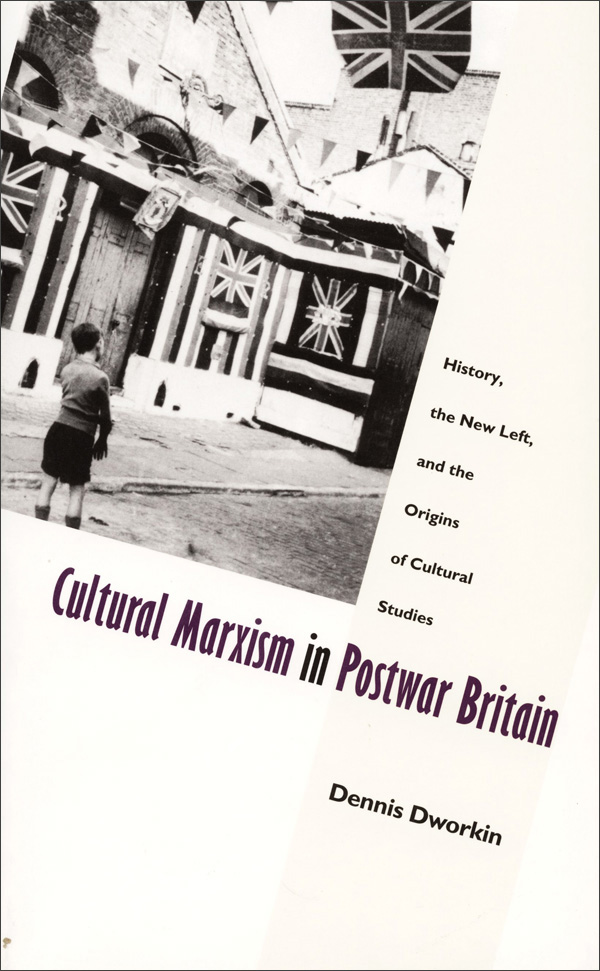
dworkin

The most aggressive among current cultural left, especially journalists who did not take time to explore the history of Marxism and neo-Marxism, have been quick to label Cultural Marxism as a hate taboo term that promotes fascist, Nazi, and anti-Semitic ideas.  Using such smear metaphors, they want to intellectually link all critics of the identitarian left on the right to Hitler’s propaganda workers who had talked about “Cultural Bolshevism.”  Moreover, downplaying the historical links between pre-1960s “scientific socialism” and the current cultural left, some identity-oriented left authors have claimed that they in fact moved beyond Marxism and that they are not Marxists anymore.
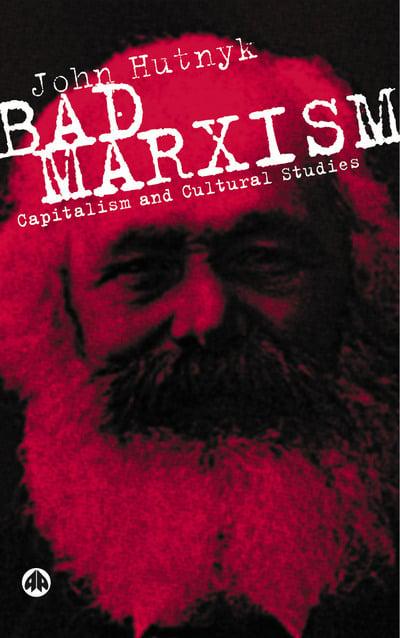
bad marxism

In their turn, many among traditional Marxist leftists, who still try to stick to the class-based approach, agree that the cultural left have nothing to do with Marxism.  These “traditionalists” label their wayward cultural comrades as traitors to the cause and dismiss them as “bad Marxists”. Several scholars (historian Paul Gottfried and philosopher Helen Pluckrose), who are critical of both traditional Marxism and the current identitarian left, too have argued against using the expression Cultural Marxism.  Correctly stressing that the post-Marxist left stopped prioritizing economic determinism and class and assimilated ideas from outside of Marxism, Gottfried and Pluckrose have stressed that the current cultural left hardly have any links to Marxism.

Several conservative authors (e. g. Kerry Bolton and Jeffrey D. Breshears), who generalized about Cultural Marxism, have come to view it as a grand conspiracy on the part of the left.  They have portrayed it to as a sinister plan masterminded by the so-called Frankfurt School that allegedly sought to uproot Western civilization and Christianity.  The most grotesque versions of the Cultural Marxism conspiracy theory link it exclusively to the activities of German-Jewish scholars (who had indeed dominated the Frankfurt School (see Benjamin Ivry, Deconstructing the Jewishness of the Frankfurt School (2015). That theory goes as follows. A group of mostly Jewish intellectuals, who were part of radical socialist and communist forces in the 1920s’ Germany, were upset about the failure of the 1917 Communist revolution in Europe and decided to modify the Marxist-Leninist project of world revolution by mixing Marx and Freud.

FrankfurtSchool

Their goal was to smash capitalism not through the cultivation of the working-class indignation but through undermining Western culture and civilization (traditional family, gender hierarchies, and sexual norms).  In the 1930s, being kicked out by national socialists from Germany, the Frankfurt School cabal moved to the United States, where it became the “Trojan horses” of the radical left, setting out to undermine the culture and values of the United States – the economic and political hub of the Western civilization. One of the major proponents of this view has been writer William Lind (“The Roots of Political Correctness,” 2009), who in fact was instrumental in popularizing the expression “Cultural Marxism.” It is mostly by drawing on his writings that the left journalists came up with the argument that this expression serves as an anti-Semitic dog whistle.

While authors like Lind singled out the Frankfurt School to be demonized as the major intellectual culprit, left authors, who have been peddling so-called neoliberalism, became similarly obsessed with searching for the shadow of the Mont Perelin society in any movement that advocated free market and individual liberty.  The irony of the situation is that both pejorative memes “Cultural Marxism” and “neoliberalism” do describe social trends that have been unfolding in society.  They are not the products of the grand conspiracies but reflect what has been going on in the intellectual culture and on the ground among various segments of society.  Incidentally, several scholars (Keith PrestonAlexander Zubatov, Allen Mendenhall, and Dominic Green) have recently explored the content of Cultural Marxism, trying to separate the conspiracy elements from actual intellectual links between Marxism of old and the current cultural left. Although I believe that this term can be useful especially when we need to stress the continuity between the old Marxian socialism and the present day cultural left, who operate with many ideological pillars inherited from the old creed (e.g. oppression/domination narrative, false consciousness and so forth), it indeed might be too narrow. So, I personally prefer to use such broad definitions as the “cultural left” and “identitarian left.”

Behind the rise of the cultural left, there stood a large thought collective that did reflect genuine concerns of various segments of the left and social movements.  The writings of the Frankfurt scholars, who both analyzed Western society and did issue utopian suggestions about how to transform it, were marginal until the 1960s.  Their scholarship, which helped to shift the left’s priorities from class to identity and culture, would have remained marginal had it not been for wide and vocal audiences that for various reasons picked up and consumed them. To summarize, the “Frankfurters” were not a sinister alien cabal that was preying on Judeo-Christian civilization with the sole purpose to destroy it.  One can describe their effect on society by an old saying: when a student is ready, a teacher comes.  In the 1960s and the 1970s, their ideas, which had earlier been marginal, suddenly began to resonate with thousands of progressives in the West and beyond.  Such “Frankfurters” as Herbert Marcuse (1898-1979), Theodore Adorno (1903-1969), and Erich Fromm (1900-1980) described the development of mass consumer society, patriarchic family, the effects of propaganda on masses, criticized industrial society, and Western mass culture, frequently issuing sweeping condemnation of the entire “soulless” Western civilization.

The reason these ideas came in vogue was simply because, by the 1960s, the West and the rest of the world experienced profound socio-economic changes: the decline of traditional working class and the rise of intellectual professions, the massive involvement of women into all spheres of life and the end of the male-oriented societal ethic, which until the 1960s had been considered normal, the emergence of new technologies, an industrial pollution, and concerns about how to better handle an economic growth.  Furthermore, the world saw the rise of Third World national liberation movements, the collapse of old colonial empires, and the emergence of minority movements in Western countries. Finally, the Soviet Union, which for a large portion of the left earlier had been the great new hope, lost its image as the ultimate socialist utopia.  Facing those changes, the old left began to crumble. There was a need to refurbish the left ideology and identity. In the 1960s and the 1970s, during student antiwar movements, the rise of Third World national liberation movements, civil rights protests among the people of “color,” the expansion of women and gays rights movements, the ideas disseminated by the above-mentioned intellectual “power centers” of the left resonated well with thousands of protesters. One cannot simply dismiss these collectives and their ideas as something imposed from above on the “innocent populace.” 

Toward “Socialist Humanism” and Away from Traditional Marxism (1956 and beyond)

1956 was a pivotal year for the socialist thought collective.  This was the year when the Soviet nomenklatura elite partially exposed Stalinism, trying to polish the tainted image of socialism.  The communist bureaucracy was tired of living in a constant fear, and, after the death of Stalin, it sought to secure its privileges and to somehow reform communism to make it more appealing.  During the same year, taking advantage of the limited destalinization, people of Hungary openly rose in an anti-communist revolt against the Soviets.  The suppression of the Budapest rebels by the Soviet tanks was a devastating blow at the moral of the millions of left idealists around the world who still believed that the Soviet Union was acting on the side of the forces of light.  There was a growing frustration with the Soviet model of socialism that was tied to a total nationalization and centralized planning. Moscow was rapidly losing its status as the utopian place.  It was natural that the year of 1956 signaled the emergence of the so-called New Left who sought to disentangle themselves from the Soviet experience.

In the meantime, the working-class people in the West dramatically improved their living conditions and did nor express any desire to go to barricades to battle capitalism.  Social democrats were shedding the last vestiges of Marxism, and communist parties were increasingly losing their membership.  For example, the French Communist Party, one of the largest pro-Soviet left movements in the West, which had 320,000 members in 1956, by 1962 shrank down to 225,000.  Similarly, pro-Soviet Communist Party USA, which had between 75,000 to 80,000 members in 1945, declined to fewer than 3,000 in 1958. It was not the expected immiseration of working-class masses but an increased prosperity, bourgeois culture, and boredom that became a great challenge.  The left, especially their radical wing, were poised to turn into rebels without a cause.  The major character from John Osborn play (1956) expressed it best when he uttered a phrase that became classic: “There aren’t any good, brave causes left.” In 1960, Raymond Williams (1921-1988), an influential UK socialist novelist and theoretician,  admitted that not only the Marxist prophecy about the immanent collapse of capitalism failed but also the entire hubris of traditional Marxism was under threat: “The Marxist claim to special insight into these matters of life and death of an economic system makes concessions of error less easy.”

There was not much to gain for the left by sticking to the economic playing field, where “rotten” capitalism was improving people’s living standards and securing an economic growth. Those who wanted to keep radical left agenda alive had to rekindle the traditional left subculture. The Trotskyites, cosmopolitan Marxist-Leninist heretics, who were the victims of vicious political assaults from their Stalinist rivals, did arouse a sympathy among dissident communists who were seeking a socialist alternative beyond the Soviet experience.  After all, the Trotskyites were the first to struggle to preserve the radical elan of the Marxist creed, while simultaneously attacking both capitalism and Stalinism.  Yet, with their old and worn out mantra about the primacy of an economic basis, vanguard party, and false claims about an increasing misery of the industrial working class, they were out of touch with reality.  The Trotskyites simply appeared as reenactors of the bygone era and could not generate any visible support among workers, quickly degenerating into an esoteric intellectual sect.

Cornelius Castoriadis, a prominent left theoretician, captured well the whole dilemma faced by the left who were frustrated about the proletariat that failed to fulfill its prophetic mission: “The proof of the truth of the Scriptures is Revelation; and the proof that there has been Revelation is that the Scriptures say so.  This is a self-confirming system. In fact, it is true that Marx’s work, in its spirit and its very intention, stands and falls along with the following assertion: The proletariat, as it manifests itself as the revolutionary class that is on the point of changing the world. If such is not the case – as it is not – Marx’s work becomes again what in reality it always was, a (difficult, obscure, and deeply ambiguous) attempt to think society and history from the perspective of their revolutionary transformation – and we have to resume everything starting from our own situation, which certainly includes both Marx himself and the history of the proletariat as a component.”  Issues that became more relevant by the 1960s were the US war in Vietnam, the rise of Third World anticolonial movements, civil rights struggle, and women liberation.  Traditional working-class issues became less irrelevant, whereas the issues of race, gender, and culture that earlier had occupied a marginal place on the left’s agenda, now were coming to the forefront.  The mainstream radical left had to rethink their creed and agenda and customize it to the changes.

In contrast, by the 1960s, Moscow, which had billed itself as Red Jerusalem and the vital center of left radicals appeared as conservative, oppressive and ideologically suffocating.  In the 1930s and the 1940s, the sympathetic left somehow could excuse Stalin’s socialism along with its police state, terror, and labor concentration camps as a temporary mobilization scheme that was needed to successfully fight fascism and railroad backward Russia into the radiant world of modernity.  Yet, after 1956, it became harder to justify the continuation of that politically correct line.  For example, in response to Soviet defector Victor Kravchenko’s revelations of Stalin’s crimes in 1946, European communists and their fellow travelers still felt no shame in dismissing the existence of  GULAG concentration camps as fake news, and large segments of public swallowed it. Yet, ten years later, when Stalin’s heir Nikita Khrushchev himself indirectly revealed the brutal reality of Soviet communism, the cannibalistic nature of the Bolshevik-made regime was impossible to deny.  Without wishing this, the Soviets, who themselves denounced Stalin, the “red pope” of communism, made a huge crack in the entire building of the socialist faith. 1956 produced thousands of apostates.  Several of them released a volume of their testimonies with a revealing title God That Failed.

The-God-That-Failed

Since 1956, to dissociate themselves from the Soviet brand of socialism, the Western left sought to humanize Marxism. Hence, a natural shift away from economic determinism and economic efficiency toward the issues of culture and identity. Later, this trend manifested itself in the emergence of such contemporary memes as “socialism with a human face,” “democratic socialism,” “socialist humanism,” and “Marxism-Humanism.”   A Jamaican-born UK Marxist sociologist Stuart Hall, one of the fountainheads of the cultural turn on the left, remembered that he and his comrades wanted to find a new political space through the rejection of both Western social democracy and Stalinism. The expression “Stalinism” became an important euphemism for those among the radical left, who wished to exorcise Stalin from communism and socialism, but who simultaneously wanted to preserve the reputation of these two sacred words untarnished.

“Sense of Classlessness” and British Cultural Studies, 1950s-1970s

One of the major trailblazers of the drift toward humanized Marxism and culture and away from economic determinism was a dissident group of British Marxist intellectuals who were later labelled as the New Left. Several of them came from so-called Communist Party Historians Group that was set up within the British Communist Party in 1946. Others were communist fellow travelers or independent Marxists.  At the end of the 1950s, when the Moscow commanding heights began to question Stalin’s infallibility, these historians, sociologists, and literary scholars either quit on the party or drifted away from traditional Marxism-Leninism, challenging its Stalinist theory and practice.  These dissident intellectuals included such prominent figures as E. P. Thompson (1924-1993), Herbert Hoggart (1918-2014), Christopher Hill (1912-1996), Raymond Williams (1921-1988), Christopher Hill (1912-2003) Stuart Hall (1932-2014), Raphael Samuel, (1934-1996), John Saville (1916-2009), Eric Hobsbawm (1917-2012), George Rudé (1910-1993) Rodney Hilton (1916-2002).  Several of them (Hall, Hobsbawm, Hoggart, Thompson, and Williams) had a profound impact on Western social scholarship, especially in English-speaking countries. For example, Hall and Williams literally laid the foundations of current cultural studies. In their turn, Thompson and Hobsbawm had a huge impact on history scholarship, helping to shift its mainstream direction toward writing about the past “from below.”

These New Left dissidents began to question the old Marxist notion that the end of capitalism was linked to the increasing immiseration and economic degradation of the proletariat.  Instead, they started arguing that the need for socialism was arising from the bourgeois affluence and consumerism. Furthermore, these ex-communists cracked the traditional Marxist conviction that economic class interests conditioned politics, social life, people mindsets, and culture.  Gradually shedding off economic determinism, these left scholars who had invested their whole careers into “scientific socialism,” found a new outlet to continue their intellectual pursuits – retrieval of the popular culture of working-class people.

Their intellectual quest eventually gave rise to New Left Review.  Launched in 1960, it became the major periodical of the Western New Left.  In fact, the very expression “the New Left” originated from a collective that congregated around this journal and that was hanging in and around the Partisan Coffee House in Soho, a bohemian area of London, and the Birmingham Institute of Cultural Studies. Searching for a new identity, the New Left changed the very concept of political, moving away from the traditional left “sacred sites” such a factory and a trade union to the realm of labor culture, folklore, lifestyles, and individual behavior.  Hall, who was part of this ideological collective, noted that he and his comrades were looking for a better place to ground their radical socialism. Incidentally, one of his speculative essays carried a characteristic title “A Sense of Classlessness.” Hall specified that the major way for him and his comrades to anchor themselves was politicizing various issues surrounding college life, high schools, movie theaters, art and other walks of life and institutions.  Jumping ahead, I want to stress that for the current cultural left politicizing the issues of lifestyle is one of the major ways of sustaining their identity.  Hall defined the New Left ideological search as “the proliferation of potential sites of social conflict and constituencies for change.” The famous slogan of radical feminism “the personal is political” captured well the essence of that quest.  Overall, as Hall stressed, all kinds of issues, including personal troubles and complaints could be amplified and opened to politicization.

Screenshot (3)

Trying to downplay the old mantra about how economy conditioned the minds of proletarians, these anti-Stalinist dissidents shifted attention to learning about the wisdom of working class by exploring its culture and folklore.  One of the first timid steps was made by Thompson, a professional historian and one of those communist dissidents.  Although Thompson continued to romanticize the labor as the ultimate savior of humankind from capitalism, the scholar nevertheless admitted that the cause of the intellectual bankruptcy of Marxism-Leninism was its economic determinism.  Drawing on Marx’s The Eighteenth Brumaire of Louis Napoleon (1852)one of a few foundational texts in classical Marxism that did recognize a relative autonomy of political culture, Thompson invited to pay more attention to the spontaneous agency of people over the working of invisible natural laws.  Simultaneously, he criticized contemporary Marxism for downplaying moral and ethical issues. Thompson is mostly known for multiple editions of his The Making of the English Working Class (1963) that became a staple reading in history and humanities courses throughout English-speaking world.  In this book, he drew attention to the radical culture of English labor.

Williams, political scientist and literary scholar who belonged to the same collective, moved far further toward embracing a cultural approach to the proletarian “chosen people.”  Formally remaining a member of the British Communist Party, in the 1950s, Williams gradually drifted away from it toward the Labour (social democratic) platform.  Unlike Thompson, who was still trapped within the old Marxist bubble, Williams went full ahead in fomenting the cultural shift in Western Marxism and one of the most influential thinkers for the entire Anglo-American left social scholarship community. Moreover, to dramatize his opposition to the economic materialism and determinism of traditional Marxism, Williams labelled his method as “cultural materialism”; because of Williams’ aggressive media presence, his ideas about the working-class culture and group identity trickled down into Western humanities, where later they were used as a methodological blueprint for feminist, racial, gay, and queer theories.

To legitimize the cultural shift, the dissidents had to appeal to the authority of foundational Marxist texts and use relevant quotes from its founders.   Just as their Soviet counterparts who, when partially cleansing the house of Stalinism, turned to Marx and Lenin, the Western New Left had their intellectual “Reformation” by invoking the early writings of Marx.  Besides such writings as The Eighteenth Brumaire of Louis Napoleon, they particularly became interested in so-called Economic and Philosophic Manuscripts (1844), vague and abstract notes made by young Marx about humanism and alienation.  Excavated and published by Bolshevik scholars in Moscow in the 1920s, those notes appeared to contemporary radical socialists as irrelevant: they did not yet contain the famous pillars of Marxist “science” such as surplus value, the primacy of economic basis, socio-economic formations, and the salvational role of working class.  In the wake of the 1917 revolution, being busy with class battles and ready to harness the “laws of history” in order to usher in the radiant communist future, Bolsheviks and their radical left allies in other countries did not pay much attention to those manuscripts, considering them raw speculations of the great mind in its infancy.  Yet, during the unfolding New Left revisionism, which aimed to mute economic determinism and the Stalinist totalitarianism, amplifying instead the significance of the human being, culture, and identity, those vague notes suddenly became relevant and “mature.” What especially resonated with the British dissident Marxists and the New Left in general was Marx’s generalizations about alienation of human beings in modern Western society.

The ultimate task was to revise the traditional Marxist canon, which preached that economic basis conditioned political and cultural “superstructure,” and to place instead an emphasis on the “superstructure.” In his Culture and Society (1960), Williams furnished relevant quotations from the writings of Marx and Engels to make a case that the cultural superstructure should not be reduced to the economic basis.  Instead of old speculations about the economic conditions of the working class in England, the historian was on the quest for the traditional working-class culture, which he romanticized as organic, wholesome, and authentic.  Moreover, Williams sought to separate it from “artificial” bourgeois mass culture.  A sympathetic contemporary aptly remarked that the intellectual quest of Williams and his New Left colleagues who sought to pinpoint an “authentic” proletarian culture was an attempt to merge “imaginative literature and socialist humanism.”

cuture and society

Marxist sociologist Hoggart, who founded the Birmingham Center for Contemporary Cultural Studies in 1964, too portrayed the idealized working-class culture as organic and natural, contrasting it to the “non-authentic” bourgeois culture.  According to Hoggart, mass bourgeois culture was undermining and phasing traditional and wholesome working-class ways.  It was natural that Williams and Hoggart, who celebrated the bygone traditional labor culture, became drawn to Romantic poets and writers who celebrated Merry Ole England.  In fact, their intellectual speculations surprisingly resembled dismissive rants of conservative critics regarding modern British culture.  Irving How, a walk away American Trotskyite and socialist sceptic who was observing these cultural speculations of his English  comrades, could not resist making a comment: “I suspect that in their stress upon the working-class neighborhood and its indigenous culture men like Williams and Hoggart are turning to something that is fast slipping away.”

Another prominent member the same group of dissident Marxists historian Hobsbawm, whose books became must read in many history and anthropology courses, gives us an example of a true-believer who was literally tormented by the idea of how and where to find a “class-savior” at that age of “classlessness.” Unlike his wayward comrades such as Thompson, Hobsbawm, chose to remain in the British Communist party.  Moreover, at the turn of the 1950s, still infested with the idealism about the proletariat as the ultimate victim-savior, the historian put his two cents in the famous debate about the effect of the Industrial Revolution on the living conditions of the working class in England.  In the spirit of classical Marxism, Hobsbawm was trying to argue that by 1800 the life of the factory laborer had become miserable if compared with the preindustrial Britain.  By the way, it was the very same debate that also produced collective volume Capitalism and Historians (1954), in which F. A. Hayek and his colleagues challenged arguments of Hobsbawm, Thompson and the like, arguing that the living condition of workers had significantly improved.  In the end of the 1950s, being unable to operate on the familiar economic playground of classical Marxism, Hobsbawm slowly began to drift toward new “pastures” in the Third World.  At the turn of the 1960s, he took several trips to Latin America, exploring revolutionary movements in that part of the world, falling for Cuba and engaging Peruvian peasants into talks about the level of their oppression.  At some point, Hobsbawm became so excited about the revolutionary potential of Latin America that he defined it as the engine of the future socialist revolution.

In 1959, he published Primitive Rebels.  This book that became a runaway bestseller in the English-speaking world was also translated in all major European and Asian languages.  In fact, the enthusiastic reception of the text demonstrated that he did tap in the popular longing among the left to find new “chosen ones” to letch on.  Although the current identitarian left will find that title too patronizing and Eurocentric, Primitive Rebels did clear the ground for the cultural turn in the general shift away from the proletariat.  The book represented a history account that romanticized people whom Hobsbawm defined as social and noble bandits, from English Robin Hood types and Sicilian mafia to peasant communism in Italy and Ukraine and Spanish anarchists of the 1910s-1930s.  The indirect message of the book was that all those segments fomented a spontaneous social justice by undermining oppressive systems.  In fact, the most recent American paperback edition of the book has been advertised as a timeless text that would be relevant to Black Lives Matter activists who sought to protect black ghettos from alleged police brutality.

Those independent New Left, who were not constrained by ties to the communist movement like Hobsbawm, went further and began to completely debunk the role of workers as the “chosen people” destined to save the world from capitalism. In 1960, American sociologist C. Wright Mills (1916-1962), an emerging intellectual guru of the New Left, openly challenged the “labor metaphysic” of the old comrades.  He scorned the romancing of the proletariat as “Victorian Marxism” and a survival of the past. Trying to fill the old Marxist clichés with a new content, the sociologist insisted that in the new “post-industrial” conditions, the true catalyst of revolutionary changes would be the intellectuals in the West, Soviet bloc countries, and the Third World.  People like Thompson, who continued to believe in the proletarian class struggle, were confused and upset about such flamboyant attack on the sacred pillar of Marxism.  On the one hand, they wanted to exorcise Stalinism and economic determinism from “scientific socialism.” Yet, on the other hand, they were too attached to the old ideological meme of proletarians as the “chosen people” to simply cast aside this foundational stone of the Marxist theology. Still, blended with “racialized Marxism” of Dubois, James, and Fanon, Mills’ heretical ideas, Thompson, Hoggart, and Williams and Hobsbawm scholarship opened doors to the emergence of the identitarian left.
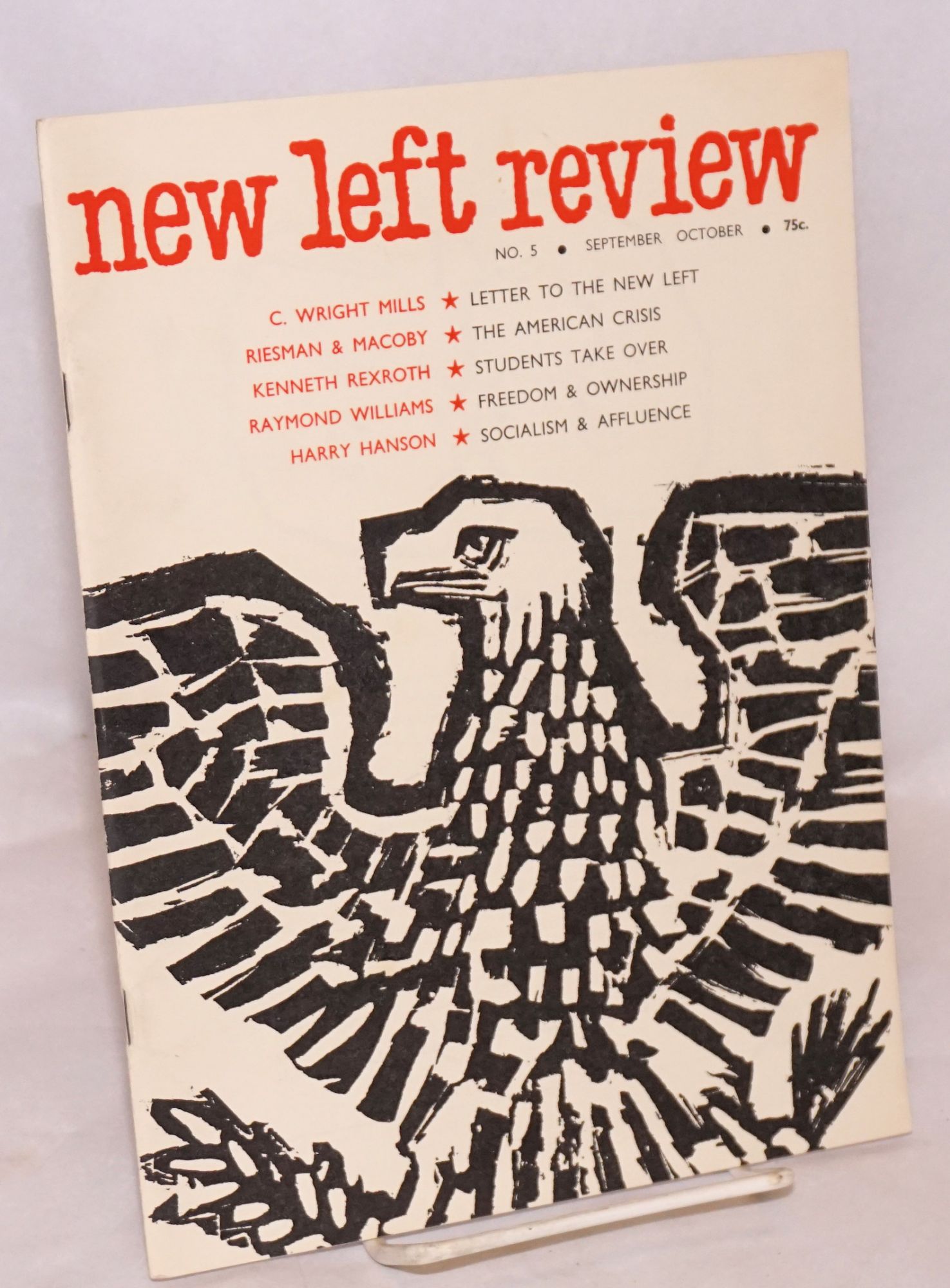
letter

C.L.R. James, William Dubois, Frantz Fanon, and the “Curse” of the Western Civilization

Moving further away from the sacred pillars and sites of traditional Marxism (a factory, economic growth, the working class, and the Soviet Union), such activist intellectuals as Hall became known as the New Left.  From the economic critique of capitalism, which did not make sense at the time when this very capitalism improved workers’ living standards, the New Left gradually began to take on the Western civilization in general, bourgeois life-styles and culture, embracing the Third World and non-Western cultures.  The slowdown of class battles and sluggish radical socialist activism in the West contrasted with the great awakening in the Third World, where emerging national liberation movements challenged European colonialism. Cast against the “dormant” and “corrupted” Western working-class, the Third World appeared to the New Left as the potential hub revolutionary activism.
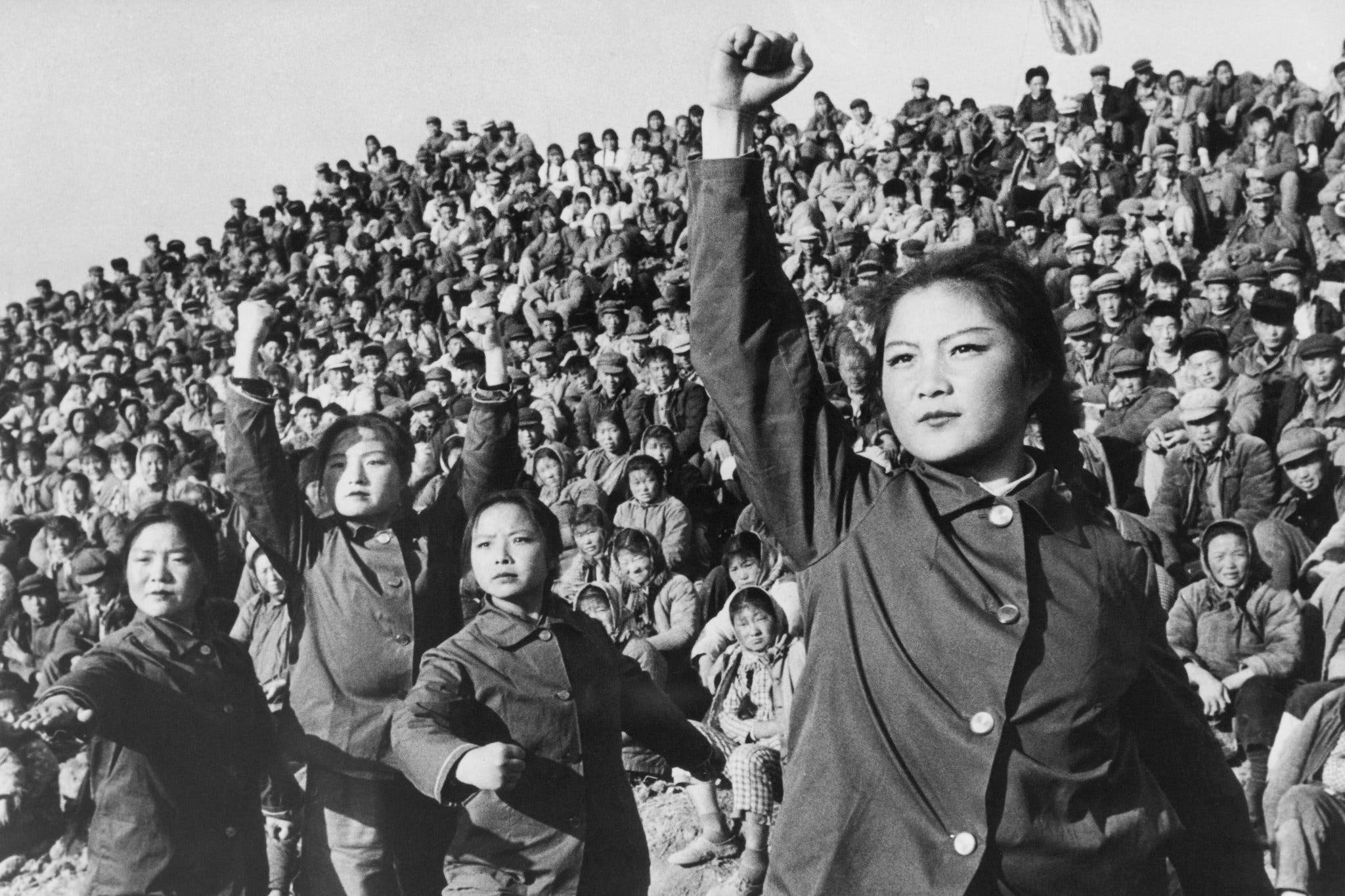
fanatic chnse youth

It was increasingly clear that the Europe-centered old left hardly had anything to offer in the new socio-political circumstances. Hall remembered, “I was troubled by the failure of Orthodox Marxism to deal adequately with either ‘Third World’ issues of race and ethnicity, and questions of racism, or with literature and culture.” Another Caribbean expat and his French counterpart Aime Cesaire, a budding New Left intellectual from Martinique, declared his resignation from the French Communist Party, rebuking Eurocentric paternalism of the communists.

To be exact, there were already several major writers on the left who had inaugurated this drift away from the West toward the Third World, culture, and identity matters.  In fact, Vladimir Lenin, one of the giants of the radical left, had opened a space for the cultural rereading of Marxism by endorsing the anti-colonial resistance as the European proletariat’s ally and pointing to the commonality of interests between the European “wretched of the earth” and the colonized people.  Moreover, feeling the need to placate various local nationalisms in the emerging Soviet Union and to win allies in the non-Western colonial periphery, Lenin drew a distinction between “bad” regressive nationalism of the bourgeois West and “good” progressive nationalism of the colonial periphery. Without wishing it, Lenin made a crack in classical Marxism that had taught that colonialism had been progressive because it had brought industry to the undeveloped parts of the world.  Earlier, it was assumed that boosting the expansion of capitalism sped up the formation of the proletariat – capitalism’s gravedigger – and the movement toward the radiant communist future.

Among the influential early voices that triggered the identitarian revision of Marxism was W. E. B. Dubois (1868-1963), an African American social scholar, nationalist, Soviet fellow-traveler, and a convert to communism at the end of his life.  The other one was C.L. R. James (1901-1989), an independent Marxist novelist and theoretician from a British Caribbean colony of Trinidad. The third was Frantz Fanon (1925-1961), yet another Caribbean-born black intellectual from the French-owned island of Martinique, who was instrumental in merging Marxism, Pan-Africanism, and Third World nationalism.  Since the 1960s, the New Left and their successors among the cultural left have been holding all three in a high esteem.  In fact, in academia there grew entire publication industry around those personalities.

Early in his career, along with socialism, Dubois absorbed then popular race and “folk soul” ideas when he was studying in Germany between 1892-1894, applying them to his budding Black nationalism.  In his 1897 “The Conservation of Races,” Dubois called for the cultural unity of the “Black race” to replicate the efforts of the Teutons, Slavs, Anglo-Saxons, Latins, Semites, Hindu, and Mongolians who were busy, as he explained, consolidating their own civilizations.  Dubois viewed the American blacks as the enlightened vanguard of the black race that was to perform that job of consolidation.  He envisioned such racial solidarity as a counterweight to the contemporary domination of the “whiteness of the Teutonic” and their soulless civilization that was fixated on individualism and economic enterprise. Very much like his racially-conscious Germanic contemporaries, who lamented the degradation of the Aryan soul by corrupt forces of modern industry and commerce, Dubois generalized about the bourgeois civilization of the West corrupting Africa – the primal and vital center of the black race.

In his Souls of Black Folk (1903) and Negro (1915), he spoke in favor of segregating “black culture” from “white civilization” and speculated about an abstract black soul, race, and culture devoid of any local and linguistic differences.  In fact, later in 1934, Dubois severed his connections with the National Association for the Advancement of Colored People that was working to eliminate racial segregation in the United States because the organization’s activities contradicted the racial utopia he contemplated. Interestingly, in his novel Dark Princess (1928), Dubois portrayed the Atlas Shrugged-type society of non-white expatriates who formed the Great Council of the Darker Peoples.  Represented by “dark” superheroes, that society was planning to take over and engineer a happy future on the planet after white institutions collapsed.

Dubois relied on European romantic memes of the noble savage (collectivist, generous, wholesome, happy, simple), which he applied to all blacks as a race.  Also, drawing on his parochial experience as a black American, the writer singled out race as the central factor in the world history, and slavery as the experience that defined not only the past history but also conditioned future behavior of his “tribe.”  Dubois assumed that the sheer presence of “black blood” in an American automatically made such a person a carrier of the “soul experience” of being a slave; incidentally, none of Dubois ancestors had been in bondage.  Dubois welcomed the 1917 Bolshevik Revolution that he considered as a scorching wind that was to cleanse the modern world, washing away bourgeois civilization.  Since the Soviet Union crusaded against the West, he automatically viewed that country as an ally: the enemy of my enemy is my friend.  By 1935, Dubois came to conclusion that the Soviets would destroy the “rotten” Western civilization and help to construct a new non-Western cultural order.  The writer praised Stalin as a great liberator, and the 1956 revelations of the Soviet crimes did not shatter this conviction.   Reflecting contemporary political preferences of Third World anti-colonial leaders and spokespeople, he called the Soviet Union and China the shining models of the future.  His conversion to communism and subsequent move to Ghana in 1961, where he became a senior advisor to Kwame Nkrumah, the head of the country who claimed building socialism, was symbolic. Here on the African soil, his black nationalism, which was saturated with romantic memes of European primitivism, met Marxian socialism. There is no need to stress that Dubois writings has been a must read in many humanities and social science courses across Western academia since at least the 1970s.

The evolution of C.L.R James, who became another must reference for Western social scholarship, moved in a reverse direction, although the result was essentially the same.  From early on, in the 1930s and the 1940s, he prophesized his loyalty to Marxism. Yet, gradually, James began to play down class exploitation, amplifying the significance of racial and colonial oppression.  It was natural because these issues were personally more relevant to him than far-away class battles in distant and alien Europe.  James at first embraced anti-Stalinist Trotskyite version of communism and its prophecy of the world revolution.  Yet, later, driven by anti-colonial concerns and by a desire to identify a new reliable revolutionary force to act as a surrogate proletariat, he shifted his attention to the Third World.

clrjames

Essentially, both Dubois and James were refurbishing the classic Eurocentric prophecy of Marxism along the Third World lines. Marx had welcomed colonialism as a progressive system that was sucking underdeveloped areas into the global commodity economy, pushing the world closer to capitalism and creating an economic basis for a leap into the radiant communist future.  For him, slavery was an archaic mode of production that, at the dawn of human history, had boosted economic development and then perished, giving rise to more progressive stages of human evolution such as feudalism and then capitalism. According to the founder, slavery survived in some backward areas of the globe (US South, Latin America, Africa) that did not catch up yet with the industrial West.  In contrast, James and Dubois argued that slavery was not a vestige of the bygone socio-economic formation, but, more than the exploitation of European proletariat, was an essential part of modern capitalism.

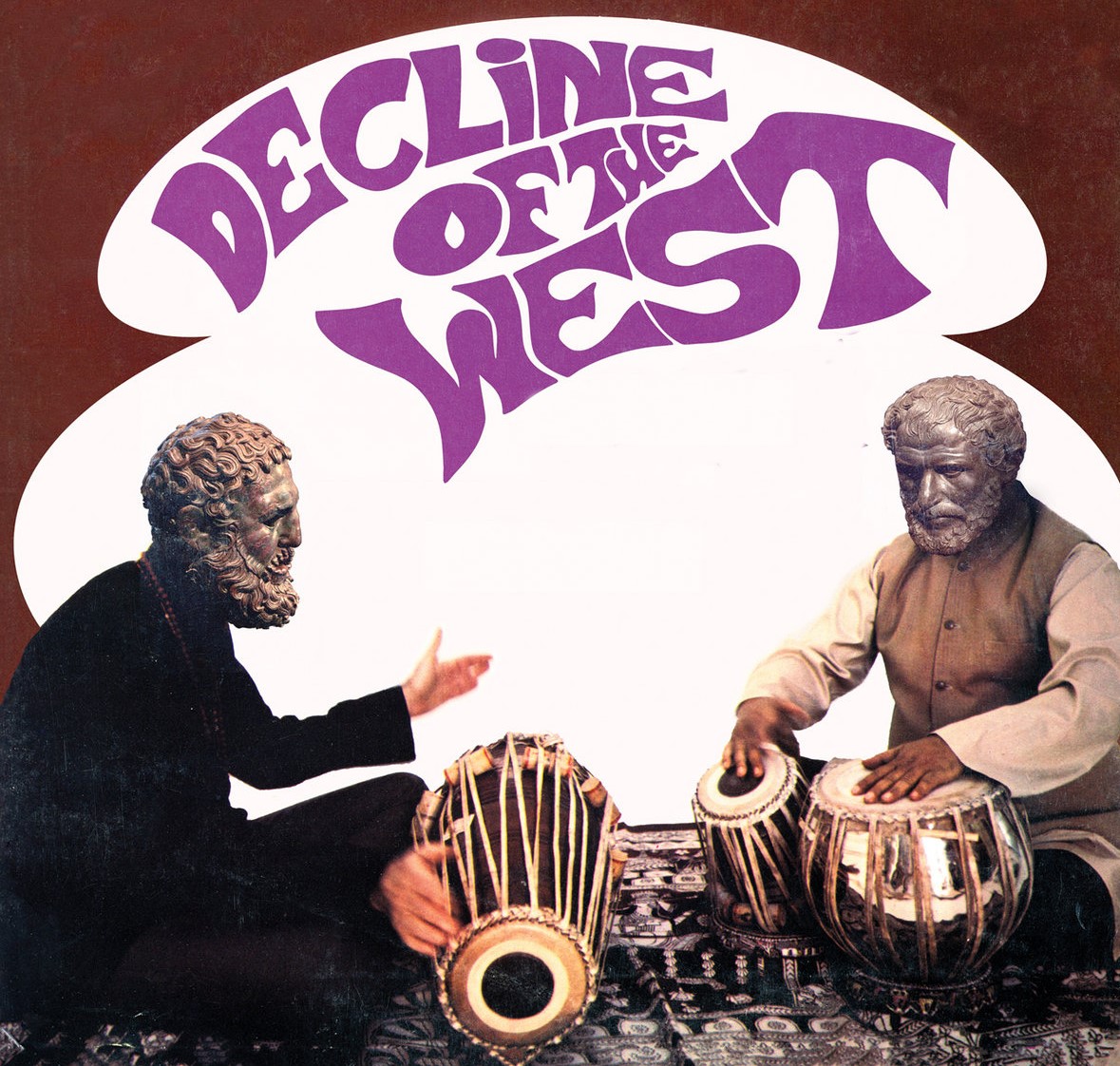
They insisted that slavery and exploitation of colonies were the vital resource that made possible the rise of capitalism.  Moreover, they became convinced that the entire Western prosperity was accomplished at the expense of non-Western people.  Again, in contrast to Marx who viewed capitalism as a progressive stage on the way to communism, James and Dubois began to argue that capitalism was not a progressive but a regressive system – a European cultural institution imposed on the rest of the world for the purposes of exploitation.  It is notable that, when singling out two pivotal books that had affected his worldview, besides Leon Trotsky’s History of the Russian Revolution (1932) James mentioned The Decline of the West (1918) by Oswald Spengler. The latter text, which was saturated with a deep pessimism, prophesized the decline of the Western civilization.  Incidentally, Spengler too greatly affected Dubois who began taking for granted that the West was in perpetual decline.  Both found in the German philosopher’s text what they were looking for: a radical criticism of the entire Western civilization.

The crucial role in shifting Marxism toward race and identity issues belonged to Fanon, a popular anticolonial writer whose landmark text The Wretched of the Earth (1961) became a book of choice for the whole generation of the Third World national liberation activists in the 1960s-1970s.  Fanon’s bashing of the West also won him numerous disciples in the countercultural circles and among the New Left in Europe and the United States.  As Kalter reminds to us, since the 1980s, assimilated by the academic left (post-colonial studies and critical race theory) into educational system and media, his writings later became an important intellectual fountainhead for identity studies and identity politics.

A psychotherapist by profession, Fanon was a French-speaking intellectual who took part in the Second World War and then in the Algerian War of independence (1954-1962).  In his writings, he focused not on economic liberation but on the cultural and psychological decolonization of the Third World.  Drawing on Marxist class clichés, Fanon revised them along racial lines: “You are rich because you are white, you are white because you are rich.” Fanon insisted that the colonial periphery became the mentally  imperiled by Western values, which natives needed to shed off because these were “white values”: “Come, comrades, the European game is finally over, we must look for something else. Let is not imitate Europe. Let us endeavor to invent a man in full, something which Europe has been incapable of achieving.” In his view, Europe was deadly sick and the keys to the  liberation of humanity were in the hands of the Third World that was destined to shape the New Man; incidentally, the latter meme also originated from Marxism.  Fanon’s friend Jean-Paul Sartre, a famous French philosopher and Soviet apologist, felt happy that “the most ardent poets of negritude are at the same time militant Marxists.” Yet, repeating the mantra of the old left, Sartre said that the mingling race with that class was “not a conclusion” but a transitional stop on the way to a greater color-blind commonwealth.  When Fanon read these Sartre’s words, he felt utterly offended as if he was robbed of his identity.  Contrary to what his philosopher friend believed, for Fanon, “racialized Marxism” was the conclusion.
declne of the west

Traumatized by the brutalities of the French he witnessed during the Algerian liberation war, Fanon insisted that nothing connected the colonizers and the colonized except racist violence. Ignoring the multitude of social, economic, and cultural relations in the contemporary colonial and post-colonial periphery, he argued that “the colonial world is a Manichean world.”  In his irreconcilable “black and white” world, oppressed victims held the ultimate truth because of their sheer status of being colonized people.  To Fanon, morality and truth were relative.  They depended on how well these two things served a liberation cause.  This included lying and committing violence, provided these vices served a good cause.  Stressing that truth was a matter of political expediency, he wrote, “Truth is that which hurries on the break-up of the colonialist regime; it is that which promotes the emergence of the nation; it is all that protects natives, and ruins foreigners.  In this colonialist context there is not truthful behavior: and the good is quite simply that which is evil to ‘them’.”

28976

To overcome their oppressive state, the colonized had to take the place of their masters by resorting to a redemptive violence.  The natives, who wasted their energy in mutual tribal conflicts and indulged into ecstatic tribal dances, were to channel their energy into the anti-colonial violence against whites. In fact, violence occupied an important place in the entire Fanon’s liberation philosophy.  In The Wretched of the Earth (1961), he romanticized violence and attributed to it pedagogical value: “Violence alone, violence committed by the people, violence organized and educated by its leaders, makes it possible for the masses to understand social truths and gives the key to them.””  Fanon viewed violence not only as a tool of liberation and education but also as a powerful vehicle of a nation-building and racial consolidation.  In the process of their struggle, oppressed natives were expected to nourish the sense of a unified collective: “Individualism is the first to disappear,” and “the community triumphs.”

Using Marxist class categories and simultaneously filling them with a new content, Fanon argued that in undeveloped colonial countries the only revolutionary class was peasants. These rural masses carried armed struggle from the countryside into cities.  This meant that the class that was to liberate the colonial periphery and the rest of humankind from capitalism was not industrial workers (proletarians) but the Third World peasantry.  With such a view, Fanon naturally came to idealize Third World peasant collectives as the cradle of the ideal human commonwealth.  Invoking the romantic meme of European primitivism, he contrasted “evil” Western individualism with the “noble” African culture of collectivism represented by village councils, people’s committees.  According to Fanon, the anti-colonial struggle was to rekindle and strengthen those collectives.  Moreover, a solidarity nourished during an anti-colonial war was to heal a corrupt indigenous bourgeoise – the creature of the West. Through its involvement into the common anti-colonial movement, this bourgeoise would reunite itself with its indigenous soil, merging with common into a united Gemeinschaft-type people’s community.

noble savage

Out of anti-colonial sentiments of such Third World intellectuals as Fanon and their colleagues from Western countries, there grew natural animosity to the West, which was responsible for colonialism, and the idealization of non-Western societies as the holders of a revolutionary potential and better forms of life. The fact that in the 1950s and the 1960s, the West was involved into two bloody colonial wars (France in Algeria, and the United States in Vietnam) amplified those sentiments.  As a result, since the 1960s, for the left, the major existential enemy was shifting from capitalism as an economic system to Western civilization that was associated with colonialism, consumerism, and moral decay.  In 1966, writer Susan Sontag conveyed well that negative attitude, which was becoming part of the intellectual mainstream, by saying that the white West was the “cancer of human history.”

cancer


There was now much talk on the left about humans being enslaved and alienated by the technology-driven individualistic civilization of the West and less talk about an economic growth, progress, and capitalism robbing workers of a surplus value.  In fact, economic progress became a curse phrase.  The idealization of the non-Western, tribal, and the primitive became a natural intellectual offshoot of such ideological pursuits.  Reflecting on the cultural turn that was launched in the 1960s, Marxist sociologist Harold Bershady stressed that this trend carried obvious reactionary notions: “It was a kind of left-wing conservatism.” Gradually ditching the failed argument of the old left, who had insisted that capitalism had been profoundly inefficient and could not provide material affluence, the New Left were switching to the moral and cultural critique of that very affluence that now was declared a major vice.  Sontag again spelled out this message in her flamboyant style: “America is a cancerous society with a runaway rate of productivity which inundates the country with increasingly unnecessary commodities”; in an ironic twist, such utterances turned out to be Freudian slips: the writer died from cancer.

Ayn Rand, a rising countercultural icon on the right who, in contrast to the Marxist ultimate proletarian “savior,” invented her own version of a “noble savage” in a form of heroic capitalist “savior” entrepreneur, responded to those sentiments with a loaded sarcasm: “The old-line Marxists used to claim that a single modern factory could produce enough shoes to provide for the whole population of the world and that nothing but capitalism prevented it. When they discovered the facts of reality involved, they declared that going barefoot is superior to wearing shoes.” Among others, unnecessary commodities included TV sets, comics magazines, soap operas, the variety of household items. Incidentally, in the 1970s and the 1980s, such romantic neo-primitivist attitudes helped the left to find a common ground with environmentalists who began to preach an apocalyptic vision of the global collapse of natural habitat if not arrested by massive government regulations.

Conclusions

The frustration with the economic growth and the incorporation of the non-Western ones and radical environmentalism into the socialist agenda was a natural offshoot of the “going primitive” trend that looked beyond Europe and North America for major revolutionary hubs.  Exorcising the proletarian messiah class from the popular Marxian socialism and moving toward identity and the idealization of non-Western “others” was not a straight-forward process. In the 1960s-1970s, among the New Left, communist dissidents, and Trotskyite fossils, there was still a desire lingering on to somehow continue the revolutionary elan of the proletariat.  At the same time, among those elements one could detect the growing trend toward romancing the working-class culture and its “organic” anti-bourgeois ways.   The Birmingham School of Cultural Studies and dissenting communist historians such as E. P. Thompson, who aspired to cleanse Marxist theory from economic determinism and who elevated the proletarian culture and consciousness, prepared a fertile intellectual ground for the later cultural turn in the left thought collective. 

Before the current left completely ditched the working class from the pedestal and developed a an “acute identity syndrome,” the New Left segment acted as an intellectual bridge between classical Marxian socialists and the current identitarian left.  In the 1960s and the 1970s, the New Left gradually transferred the metaphysical characteristics ascribed to the proletariat to the non-Western “others,” domestic people of “color,” chronically unemployed, social deviants, women, and gays. Communist bohemian historian Hobsbawm with his bookish “social bandits” and his attempts to probe Latin American peasants for their revolutionary potential is an excellent snapshot of how that process was unfolding.

Just like the proletariat of the old, the new victim groups were thought to become the oppressed redeemers – the new “noble savages” of the left.  On the one hand, such revision of traditional Marxism gave an opportunity to the New Left to disentangle themselves from the Old Left.  Yet, on the other hand, this very revisionism allowed them to continue the familiar Marxist tradition in the new intellectual garb. The new groups designated to the role of the oppressed ones were lumped together in an abstract category of the poor and disadvantaged.  In the same manner, old Marxism generalized about the proletariat as a homogenous impoverished class, downplaying ethnic, religious, and economic differences within this group.

In the 1960s, the most passionate New Left revisionists who became hooked on the Mills’ message of bashing the “Victorian Marxism” cast the newly found surrogates into authentic, uncorrupt and holistic people, the caretakers of the egalitarian ethics and natural goodness. Thus, in a religious-like manner, New Left activist Casey Hayden, the spouse of famous Tom Hayden, described her feelings about the new “chosen ones”: “We believed that the last should be the first, and not only should be the first, but in fact were first in our value system. They were first because they were redeemed already, purified by their suffering, and they could therefore take the lead in the redemption of us all.” Another New Left writer characteristically titled his book about “unspoiled” and “authentic” rural blacks in Mississippi A Prophetic Minority (1966).

Those conservative and libertarian authors who are fixated on the Frankfurt School have failed to pinpoint the variety of intellectual fountainheads that contributed to the cultural turn.  So have those in the current left mainstream who downplay their genetic links with Marxian socialism. Besides the Frankfurt School, there were other essential intellectual sources on which the left heavily drew when refurbishing their political religion in the 1960s and the 1970s.  This essay has highlighted the role of the British “cultural Marxists” as well as their intellectual predecessors and contemporaries who “racialized” Marxism.  Moreover, because of the worldwide hegemony of English language, the writings of C.L.R. James and William Dubois, popular translations of Frantz Fanon, and British Cultural Studies along with New Left Review played more important role in fomenting the cultural turn than the often-spoken Frankfurt School.  In fact, it was NLR that popularized “frankfurters’” writings that regular educated readers had a hard time to digest. 

The names and schools profiled in this essay do not exhaust other potent sources of the cultural left, which still await their comprehensive study.  For example, a future researcher cannot bypass secularized Protestantism of northern Europe and North America and its links with the current woke culture.  It is impossible to reduce the virulent and aggressive moralism of the current secular social justice warriors, the Unitarian Universalist movement, and several other progressive Protestant denominations in the United States to the intellectual evolution of Marxian socialism in the direction of identity matters.  Although many of the above-mentioned elements have been feeding on the New Left neo-Marxist writings, they obviously drew too on the secularized Puritan tradition that, according to famous H. L. Mencken, had been always haunted by the “fear that someone, somewhere, may be happy.”  In Multiculturalism and the Politics of Guilt: Towards a Secular Theocracy (1992), Paul Gottfried briefly outlined how via the social gospel tradition, radical Puritanism of some Protestant denominations gradually mutated into virulent cultural moralism and how in the current “theology” of the left, the old Christian concept of sin and salvation became replaced with sensitivity training and social therapy sessions. Most important, we need to keep in mind that British Cultural Studies, dissenting Marxist intellectuals who idealized working class anti-bourgeois culture, Mills and the American New Left, the Frankfurt School, and the latter-day social justice “evangelicals” cross-fertilized each other, spearheading what later produced the identitarian woke tradition, which currently represents the progressive mainstream.

Evolution in Everything: Handwriting

There’s a whole set of simple but profound lessons that, if I were being lazy, I might call “the economic way of thinking.” We move through a hand-me-down world, solving some problems and creating new problems, adjusting and adapting, and shaping the world that we pass on to the next generation.

I just stumbled on a lovely example in an article about ballpoint pens and the end of cursive. A technological change changed the nature of handwriting, but the structure of human capital lagged behind. Specifically, the widespread adoption of ballpoint pens meant the old way of writing–how to hold the pen, how to form the letters, etc.–was poorly suited to the tool being used. This should have been an opportunity to test unchecked assumptions (e.g. about what the “correct” way to write is) but instead an inefficient practice (cursive writing with a bic pen) persisted in the face of increasing obsolescence.

I particularly like the idea of trying something new (fountain pens) can lead to a realization that some old method has a lot more going for it than was obvious to the non-alert.

I wonder how many other mundane skills, shaped to accommodate outmoded objects, persist beyond their utility. It’s not news to anyone that students used to write with fountain pens, but knowing this isn’t the same as the tactile experience of writing with one. Without that experience, it’s easy to continue past practice without stopping to notice that the action no longer fits the tool. Perhaps “saving handwriting” is less a matter of invoking blind nostalgia and more a process of examining the historical use of ordinary technologies as a way to understand contemporary ones. Otherwise we may not realize which habits are worth passing on, and which are vestiges of circumstances long since past.

How the Ballpoint Pen Killed Cursive

Learning takes time. So in a dynamic society, it’s natural that there will always be some sort of practice outliving its utility. The only other way I see is stagnation: no new methods, no new problems, and we eventually setting into a “making the best of it” equilibrium.

The discovery of each of these inefficiencies creates some pocket of entrepreneurship. Sometimes it’s a massive, market oriented bit of entrepreneurship–like Bic industrializing the process of making cheap, reliable pens. Sometimes it’s a niche community of hobbyists (who might be incubating the next big thing). But that entrepreneurial reaction to inefficiency is pretty exciting. Realizing how my bad handwriting is the outcome of a technical problem makes me want to try fountain pens.

First Contact, libertarianism, and astropolitics

Permit me to speculate.

Earth is currently composed of 193 or 195 states, depending on who you ask. There are several more states that have an ambiguous status within the world order. Of these states, dozens have bureaucracies dedicated to scientific research in outer space.

Now suppose there is life on a planet close to ours, say on Proxima centauri b, and suppose further that the life there harbors an intelligence that mirrors our own.

How many countries would be on Proxima centauri b? Given how difficult it has been here on Earth to establish global dominance, I have to assume that the same difficulties face other extraterrestrial life in nearby star systems. I assume this because if they haven’t been able to contact us, or are unable to contact us, they are likely on the same playing field as us when it comes to intelligence.

What if the United States or its much more libertarian successor, the Federation of Free States, allies with a country on Proxima centauri b, while China allies itself with another country on proxima centauri b and Russia allies itself with a third Centaurian country?

I think this would be the most realistic scenario for First Contact. If there are species out there with higher intelligence and better technology, I don’t think they would even bother with us or with the Centaurians, not even if they needed our help. Would we, as humans, ask for the help of baboons if we were stranded in the desert with a broken arm? Have we ever thought it necessary to eliminate another species simply because it existed or even because it might pose a future threat? I think those of us who can achieve the same type of reasoning based on the same limited cognitive ability of our brains will be brought together in our section of the Milky Way.

Basically, I think when First Contact happens, it will be the same ol’ geopolitics playing out, but instead of being geopolitics it will be astropolitics. All the more reason for libertarians to eschew unilateralism in favor of federation.

Cixin Lui’s trilogy has been on my mind, as has Neill Blomkamp’s short film Rakka.

All News is Biased

I generally avoid the news because those things are outside my control. But then the pandemic happened and I picked up this bad habit.

I generally get my news from NPR because I trust that they’ll observe the rules of good journalism and it’s easy to adjust for the inevitable leftward bias. Just to be safe, I’ll occasionally check Fox News to mix up the sorts of spin I’m seeing. (Aside: a recent Wisecrack video on biased news has me feeling more optimistic about the existence of a wide range of biased news, even if I’m still pessimistic about most people’s ability to take advantage.)

At first I didn’t see a huge difference. When something happened, both sources report what happens. Both sources do the same basic task of reporting the news. The editorials are certainly different, but I’m not that interested in most opinions. When they’re reporting, the spin is fairly subtle because it’s hard to spin a mostly raw fact.

But after a few weeks, I’ve been finding that the news worsens my mood and offers me little useful information. My time is scarce and my old methods (getting news indirectly from friends, family, and the local paper) worked better. I’m updating my information diet. Besides cutting back on Fox News and NPR, I’m taking a cue from Trump and shifting to a new, prior-confirming, and basically made up news source: OPR. Their stories aren’t literally true, but the act of interpreting them is similar to de-biasing actual news. And for all the effort, I feel as informed as I did last week.

An update from Texas

I am still working from home. The weather has been spectacular here over the past few days. I immediately head outside with the kids at 5 o’clock. We just run around and play. The younger one likes throwing the football around in the grass. The older one likes to play with the ants in the cracks of the sidewalk.

I was looking forward to going to Oslo this fall, but I just received news that the event has been postponed. I’ve still got the inaugural family camping trip to Ouachita to plan, so that’s exciting.

The political landscape here is much different than it is on the west coast or in Austin. Authority is decentralized. There are more black and Mexican people here, and fewer other minorities (including Central Americans). I have more black friends now than I ever did in California. It’s odd. In some ways, the non-South is now more racist than the old South. I can’t put my finger on it but I swear it’s true. You can carry on a friendly conversation with anybody here, something that’s missing out west and up north.

My guess is that this has something to do with the fact that segregation was blatantly racist in the South during the Cold War, and Washington felt it had to do something about it in order to win friends (despots) abroad. The racism in the north and the west was less blatant, and as a result nothing has ever been done about it.

I mean, I didn’t grow up with any black people. Or Mexicans. There are tons of them in California, but they don’t live in white residential areas. Down south, at least in the parts of Texas I’ve lived in, this is not the case. There are still “sides” of town, but at least we all share the same town. There’s still racism here, but the racism is more honest than, say, the zoning found up north and out west. This familiarity between blacks, Mexicans, and whites is something you as an individual have to work hard on to achieve in the non-South.

The federal government forcibly dismantled Jim Crow. It did so only after it conveniently ignored the 14th Amendment for decades, but at least it finally did so. There’s a place for Washington down here in Texas. Decentralized tyrannies are still tyrannies. I just started watching Waco, the Netflix series. It’s good. Washington is responsible for the deaths of several innocent women and children. It’ll never pay the price. Those people were just too strange for the broad public to really give a shit.

It’s a never-ending balancing act: finding a comfortable equilibrium between federal, state, and local governance. The feds are better at protecting the descendants of slaves than the state and local governments. But the state and local governments are better at protecting non-conformists and religious extremists than the federal government.

Libertarianism hasn’t been able to shake its racist stigma yet. Sure, leftists call us racists all the time, but a kernal of truth is still a kernal of truth. I have witnessed several people I once respected sweep libertarianism’s ugly, recent past under the rug and then turn to grab their paycheck. Libertarian Inc. has its place in our society, but it won’t be effective so long as the racist label sticks with us. And the racist label won’t come off until we grapple with the brutal truth of what we’ve become comfortable with and what we will tolerate.

Paid Sick Leave and Schelling Focal Points

Paid sick leave is something I want more people to have. Of course it’s a good thing. Sick leave is valuable, but it’s not free so we have to ask it it’s worth it.

Right around the 11:30 mark is a tragic and hilarious line: “Dildos are not essential items. Books for kids, yes, but dildos? … No!” Good for John Oliver noting that deciding what is essential isn’t straight forward–apparently frivolous things might keep people inside and so serve the public health.

This is a classic Austrian point: prices (are supposed to) communicate information about how urgently people want a product. We run into trouble trying to prevent prices from reflecting the underlying economic crappiness of a crisis. Price gouging should be allowed for toilet paper and especially for grocery/Amazon workers. And the price of grocery workers should be passed on to consumers.

What we’ve got now requires each of us to not only ask “am I willing to pay this price?” but also engage in a moral calculus that is hard. I have to ask (as a person striving to be moral) if it’s really worth ordering X, Y, and Z from Amazon. But as a person who has to strive to be moral, it’s entirely too easy to fall for bad rationalizations.

So how do we help these essential-yet-replaceable* workers? Paid sick leave sure sounds good. And given the externalities involved in a pandemic, there’s a strong argument for mandating it.

But it’s worth remembering (particularly as a long run policy) that if we push on one part of a compensation bundle, something’s going to give. If we require employers to provide a company car (or simply encourage company cars through preferential tax laws), we shouldn’t be surprised to see monetary compensation fall. The same logic applies to paid sick leave.

But I’m my own devil’s advocate, so let me make a counter argument. I rarely use my sick days. I think I’ve taken 2 or 3 in the last 6 years. (I’m absolutely reevaluating that position now!) There’s this idea floating around in the back of my head that tells me to just tough it out and keep working. This isn’t because I carefully weighed pros and cons, it’s just received “wisdom” picked up by osmosis from the broader culture.

American culture values work over value. There’s no shortage of bullshit work because we’re in a work-too-hard equilibrium. This is not to say that hard work doesn’t have benefits. I’m happy when ambitious entrepreneurs work “too” hard to provide greater value. But there are a lot of cases where we create work for its own sake (especially in the higher ed racket, but apparently we’re not alone).

Essentially, we’re all playing a coordination game where we choose between “[appear to] work to make things better” and “stay home instead of passing your illness to other people.” Given American work culture, the Schelling focal point is <work, work>.

On the compensation end of things employers have to decide between offering more sick leave or some other compensation (like money). In this end, there is some benefit to zigging where other employers zag. If I’m running the only business to offer paid paternity leave, I get my pick of the best family-oriented workers while my competitors have to outbid each other to get the best of the other workers. But any mid-level HR manager is more likely to play the risk-averse strategy of following “best practices.”

So we’re in an equilibrium that underrates sick leave. We want to be in an equilibrium where it’s just good business sense to offer sick leave during a global pandemic. But coming from our current equilibrium, offering sick leave is a costly decision to privately provide a public good; it’s unlikely to happen unless the culture already promotes it.

I think we can get that equilibrium. I think we’re already moving towards it (ask yourself: would the board of the East India Company be more likely to offer sick leave than Amazon?). But we’re not there yet.

Paid sick leave should be good business sense right now**. But it depends on a culture where such behavior is widespread. I’m not convinced we could flip a switch and get that culture over night. Given that, I’m at least somewhat okay with contradicting my libertarian priors and calling for emergency mandates for paid sick leave. 2020 America isn’t likely to coordinate on the “right” short-term solution and coercion is probably the most efficient*** way to deal with this common pool problem. But outside of a public health emergency we shouldn’t allow top down mandates about the mix of compensation offered in markets (certainly not with the sort of people we elect to be on top).


(A couple rhetorical points: First, John Oliver isn’t speaking the language of those on the right. They won’t even be convinced that the issues he’s talking about are important. I think that’s a shame. Second, this is a tough time to try to argue against paid sick leave. In 2020 America, mandatory paid sick leave is probably required because we’re at the wrong Schelling point. Again, I don’t think conservatives or right-libertarians will find Oliver’s motivations convincing, but I believe that they could be persuaded. But that’s another blog post.)

(Two important counterpoints to the above: first, price increases hurt the poor. The way to solve that is to give charity money to the poor, not to try to make markets communicate information about relative scarcity and act as charity–that’s half-assing twice and it’s bound to be more inefficient than the charity would be costly. Second many people categorized as “essential” aren’t in a position to demand higher wages*. I don’t have an easy solution to this issue. Let’s talk about it in the comments.)

*Which is to say, workers who are in the same position as water in the diamond-water paradox.
**Not to say it would be cheap or easy.
***There you go. Now my friends on the left can accuse me of being a bloodless economist for opposing paid sick leave in general, and my friends on the right can accuse me of being a bloodless economist for supporting

Ron Paul’s Revolution: A libertarian education

The Mises Institute, lewrockwell.com, and FFF all had cool articles mixed in with some not so cool stuff, and I stuck with these sites for a while after opening the floodgates. The fact that these sites are more combative, more dogmatic than other libertarian organizations probably played a role in my reluctance to branch out too far into other spheres of influence. I was a product of the public school system and a relatively strict religious upbringing and, as a result, my mind was mush. The combativeness spoke to me. It seized me in its grasp and led me forcefully down a path I knew I needed to take. This personal intellectual journey was complemented by my foray into formal education. My professors, too, were combative but not in the same way as the paleo-libertarian websites I would frequent. They pushed me, hard. The cool thing about Cabrillo College was a combination of the weather, the girls (me and the Banana Slug broke up shortly after our arrival in Santa Cruz), the PhDs teaching there, and the fact that most of the classes shrunk in size to about 12 people (more or less) in a matter of weeks. I was getting a first-rate education from great teachers who happened to be married to the California Teachers’ Union. After one semester at Cabrillo College, I was reluctantly ushered into its fairly challenging Honors program, where a transfer to Cal or maybe even Stanford was all but guaranteed.

My go-to websites began to change. The Independent Institute, where Anthony Gregory was officially employed, and Liberty, which published occasional essays by a French-American scholar who happened to live in Santa Cruz, became more influential. FEE’s smorgasbord of scholars overwhelmed me with libertarianism. Cato’s devout, firebrand non-interventionism emboldened my heart. EconLog and Cafe Hayek were too wishy-washy for me at the time. They had no oopmf. Reason was cool but it was too bubbly, too pop-culture for me. Tyler Cowen’s name began to pop up in places. I also came across Peter Boettke and Steve Horwitz via a brutal intralibertarian squabble at the Mises Institute’s website. These were scholars I earmarked as possible sources of knowledge, but their blogs were too informal for me. They reminded me of my college classes, and I already had enough of those on my plate as it was. I wanted – needed – my libertarianism to be sure of itself, formal, and able to reinforce my thoughts about the world at large. Just like Ron Paul.

I decided to spend the summer of 2009 traveling not around Europe or Ghana, but around the United States in order to attend seminars that various libertarian foundations put on for undergraduate students.

I attended four seminars that summer. The first one was up the road from Santa Cruz in Oakland at the Independent Institute. It was a strange way to be introduced into the world of formal libertarianism. First, they had no idea I was coming. I had signed up for the seminar, and I remember paying for it because I had found out that the Independent Institute offered seminars during the summer long after I had already bought my plane tickets for the other three, so I bummed the money from my dad in order to squeeze in a week at my favorite libertarian think tank. Mary and David Theroux were nonetheless ecstatic to have me there and offered to waive the fee. I politely declined their offer and paid up on the spot. (I was a libertarian now and not some freeloading socialist.) My situation was probably helped by the fact that there were only 4 or 5 other students attending the seminar, and most of them were high school students forced to attend for an assortment of reasons.

I was especially excited about the lineup of scholars the institute had cobbled together. Robert Higgs could not be there (I would see him later, at different seminar), but Anthony Gregory and Fred Foldvary would both be there, as would three guys I had never heard of before: Brian Gothberg, James Ahiakpor, and José Maria J. Yulo.

The two things that brought me into libertarianism was its non-interventionist foreign policy and its internationalist worldview. I have always been attracted to other ways of life, and Ron Paul’s 2008-2009 campaign perfectly encapsulated these two attractive -isms. That James Ahiakpor, an economist from Ghana, and José Maria J. Yulo, a philosopher from the Philippines, were to be teaching me about libertarianism, in person, was perfect. Ahiakpor lectured on Adam Smith, and Yulo on Plato, two dead white guys whose thoughts I had never been introduced to before (though I knew both of their names). Ahiakpor’s lectures were actually a bit of a dud. He was not able to fathom, or entertain, the notion of an economy without a central bank. He appealed to Adam Smith on the matter, and that was that. Dr Yulo’s lectures were quite different. They were rich and socratic. They were peppered with personal anecdotes, both funny and serious. They were conservative, too. Dr. Yulo’s lectures eviscerated my aversion to conservatism. He made conservatives human and worthy of my time and attention. Anthony was Anthony and Fred was Fred. The star of the seminar was undoubtedly Brian Gothberg.

Gothberg’s passion for liberty oozed out into the makeshift classroom (this makeshift classroom was one of the many charms connected with attending the institute’s seminar). Gothberg had been a California liberal, a technocrat rather than a socialist like me, and his intellectual journey sounded, to me at the time, a lot like my own. He used basic economic reasoning to show how prices could help save the environment, and how the Robber Barons captured their rents. Most of all Gothberg used every opportunity he could to engage me personally. I am an introvert and I just showed up on the institute’s doorstep with apparently no heads up. Brian went out of his way to make me feel welcome, to help me voice my thoughts aloud, and to get to know me.

I spent my nights in San Francisco that week, sleeping on my best friend’s couch. I brought him all of the books I would receive from the seminar. My friend and I marched together in San Francisco. He was attending San Francisco State at the time. We had heated but mostly civil discussions about liberty and American politics. He and I went to the same schools in the same town. We both had the same worldview of civics up until Ron Paul crashed the party. Looking back, those discussions represented the flowering of our intellectual capacity to think for ourselves. We were teasing out ideas and confronting stark intellectual challenges to our conceptions of the world. The books I gave him ended up in his garbage can. When I was again sleeping on his couch, in Austin, in 2016, he had voted for Gary Johnson. (During those hot summer nights in Austin, we both revealed what turned out to be a shared disgust in our fellow anti-war protestors. Those people were not marching in San Francisco to protest the invasion and subsequent occupation of Iraq; they were marching against the Republican Party and, by extension, democratic politics.)

Next up were two of FEE’s venerated seminars, one in Midland, Michigan and the other in Irvington-on-Hudson, New York. The Midland seminar, located at Northwood University, was a breath of fresh air. The topic of the seminar was “History & Liberty,” and lecturers included Lawrence Reed, Robert Higgs, Brad Birzer, Burton Folsom Jr., and Stephen Davies. Unlike the seminar in Oakland, this one was well-organized and well-funded. I was put up in a dorm and all of my meals were comped. These were also well-attended seminars. I met people from all over the world, though Midwestern Americans formed a slight majority. My roommate was none other than Vincent Geloso, 2017’s hottest libertarian blogger. In 2009, though, Vincent was already something of a star. A Quebecer, Geloso spent his free time either trying to get into the pants of an outgoing Guatemalan student whose name escapes me or watching Star Trek reruns on his laptop. He organized a boycott of Robert Higgs’ remaining lectures for the week after Dr. Higgs haughtily suggested that World War II was not worth the effort. Vincent also praised Paul Krugman’s academic work while bemoaning his blog at the New York Times, something I was not yet accustomed to libertarians doing. At Mises and FFF (and at the lectures of these summer seminars), Krugman was nothing more than a punching bag, not somebody you could learn from.

Burton Folsom made everybody laugh, and Larry Reed made everybody feel good. Stephen Davies lectured on Paraguay, and its lessons have stuck with me over the years, but Brad Birzer’s intelligence and loquaciousness impressed me the most. Brad Birzer loves history. There are two events I remember most clearly about that first FEE seminar in humid Midland, Michigan. First: I remember seeing Sheldon Richman at a table by himself eating breakfast and reading at the same time. The man lived and breathed liberty. I remember thinking to myself (I dared not interrupt his breakfast) that he was probably reading some obscure work of Böhm-Bawerk or something. Second, I was dropped off at the airport a full day before my flight was scheduled. I tried to find a field to sleep in, but was instead picked up on the side of some god forsaken road by an airport employee on her way home, and she let me meet her family, dine with them, and crash on her couch for the night.

The Irvington-on-Hudson seminar was an introductory course on “Austrian economics.” I don’t remember much about the lectures. Lawrence Reed was there again. He told different stories than the ones he told in Midland, and they were equally good. Sheldon Richman lectured, too. An economist named Paul Cwik lectured. He was funny, but unremarkable. I don’t think I learned anything new at this seminar.

There was an Asian girl from Stanford, an economics major, who attended the seminar. She stood out because she was a she, she was Asian, and she attended an elite school. I remember her asking Sheldon Richman, after one of his forgettable lectures, a question about economics and him becoming flustered by the questions. The Asian girl actually put up her hands at one point and said “woah.” She backed away slowly and I never heard from her again. This seminar had less Midwestern Americans in it. There were more Europeans. I don’t remember who my roommate was at Irvington-on-Hudson but I do remember going to the city not once but twice. The first time I went with a Dane and a Swede, both of whom were business students. The Empire State Building blew them away. I went a second time to the city with two Italians, brothers Claudio and Adriano Gulisano. The brothers stayed out late and pretended to enjoy the nightlife. I could see in their eyes, though, that NY’s nightlife was a perfunctory for them; a duty to be performed as a European in the United States. The Brothers Gulisano were, and are, brooding individualists concerned only with the next move of their enemy (the state), and NY’s shallow nightlife rudely illuminated the chains of their social obligations.

The highlight of the Austrian Economics seminar was not the old FEE building or New York, but Lode Cossaer, a Belgian libertarian whose passion for liberty was unlike anything I had ever seen before. He freely gave the Americans history lessons about their own country. He told the Eastern Europeans to beware of clever authoritarian traps nestled in their Hoppeanism. He explained to the Guatemalans why their university, Francisco Marroquin, was such an important institution for global liberty. Cossaer did all of these things with the worst haircut in the world, too. (He had one of those little boy bowlcuts that just makes you want to puke when you see a grown man sporting it.)

The final seminar of that eventful summer brought me, full circle, back to northern California. The Institute for Humane Studies was an institute I hadn’t heard much about. There wasn’t a lot of writing on its website, but it was obviously libertarian and the seminar had some great topics (I think it was “liberty & economic development” or something along those lines). I had to write an essay and wait around to be rejected or accepted. The seminar was at Cal, a school I still didn’t think I could ever get in to. IHS set itself apart from FEE and the Independent Institute before the summer even started.

The students were different, too. Elite research universities and expensive liberal arts colleges adorned most of the nametags. The majority of the students were from the eastern seaboard or the upper South. There were more Californians; two attended Cal, one attended UCSD (and whose boyfriend was from my hometown), and Rick Weber, my favorite economist-blogger. The lecturers had no public presence that I was aware of, except for one of them, who was officially was part of the Coordination Problem group blog but hardly ever wrote anything there. The IHS seminar had more of a university feel to it, overall, while the other three had more of a Fellowship of the Rings vibe to them. There were more leftists and fewer foreigners. My roommate was an older undergraduate who was attending Georgetown. He had just gotten out of the Navy. The lecturers included an anthropologist, two economists – one from France and one from the United States – and a philosopher.

The economists were forgettable, except for the French one’s contempt for his home country, but the anthropologist and the philosopher were excellent. Susan Love Brown lectured on planned societies and their many failures, and Andrew I. Cohen actually brought leftists to tears with his rigorous logic. So defeated were these leftists that they had no recourse other than to do what their mommies and daddies had taught them to do: cry about it. This was a phenomenon that I had never witnessed before.

The lecturers and the students would party together after dinner. At one point the organizers, the 24 year-olds responsible for overseeing the day-to-day affairs of the seminar, asked us as a group to be aware of the fact that a big-time donor would be at one of the lectures for half of the day. Many of the non-Californian students, as well as the lecturing American economist, ignored me once they learned that Cabrillo College was a community college rather than an obscure liberal arts college in the redwoods. Dr. Cohen reached out to me, as did Dr. Brown, but the overall atmosphere kept the vibe bittersweet. IHS at Cal was nothing like FEE or the Independent Institute in Oakland.

Altogether, the IHS experience was more rewarding precisely because it was more alarming. Berkeley taught me that libertarian people as well as libertarian organizations are fallible, something that I think FEE and the Independent Institute tried to ignore or gloss over. There are careerists in the libertarian movement. There’s an entire cottage industry dedicated to professionalizing libertarian thought, strategy, and outreach. I tried to hitch a ride with one of the Cal students up to Sacramento, where I could take a bus to Placerville, but he didn’t have any room in his car. I took a train instead, from Berkeley to Sacramento, and a bus from Sacramento to Placerville. I spent the next two weeks on my mom’s couch, and then it was back to Santa Cruz for the fall.

Next: from Santa Cruz to Los Angeles

Ron Paul’s Revolution: Looking back

On January 20, 2009, Barack Obama was sworn in as President of the United States. It was a historic moment. The United States of America had elected its first black President. I remember listening to the president’s inaugural speech on the radio. (I was driving from the Lake Tahoe area to Santa Cruz, officially moving to the Monterey Bay along with my girlfriend at the time, who had been accepted into UC Santa Cruz while we were in Ghana.) I got chills that ran down my spine. My nipples got hard. The hair on my arm stood up, revealing goosebumps.

I had enough respect for the republic’s history to know that I was listening to one of its greatest triumphs. A member of an ethnic minority, and a group that had been viciously oppressed at that, had been elected to the republic’s highest-ranking democratic office. American society was evolving in a way that made me proud. It was cool, but my elation was tampered due to a different evolution that was going on in my own way of thinking. My thoughts about how societies worked had been radically altered thanks to the presidential candidacy of a little-known Republican Congressman from Texas: Ron Paul.

I came across Ron Paul via YouTube videos that had been shared on MySpace. I was a product of the California public school system. The public school system has two tiers: a good one for rich people and an awful one for the rest of us. I came from a single parent household. My mother had a college degree and was part of the California public school system, but we were still in the “poor” category. In California’s public schools, a binary way of thinking about civics is introduced and hammered home from the age of 5 to the age of 18. Democrats are liberals who prefer higher taxes, listen to scientists, and believe in change, while Republicans are conservatives who prefer lower taxes, listen to Protestant ministers, and believe in maintaining the status quo. This is not a caricature. I believe this is how most Americans viewed civics up until the moment Ron Paul arrived on the national scene via his back-and-forth with Rudy Guilliani.

In short, I was uneducated but enthusiastic about reading and especially history. I had no career at that point in time (I was an informal carpenter’s apprentice from March through November, and a sandwich maker during the rainy holiday season). I became obsessed with Ron Paul videos online. I watched them over and over. I had never heard arguments like his before. I had no idea that you could be a Republican and be against wars on terrorism and drugs. I had no idea Democrats could be so “pragmatic” when it came to these wars. I watched Ron Paul over and over again. Instead of trying to soundbyte his message, he spoke of responsibility and hard money and corporations taking advantage of regulations to enrich themselves at the expense of everybody else. Never had I heard such ideas before!

I was slow to follow up on his reading suggestions, though. I went almost immediately to the websites of Lew Rockwell and the Mises Institute but what I found there was too radical for me. It was too straightforward. They were speaking of things that I considered, due to my public schooling and religious background, to be taboo. There was a hint of racism in some of the articles I saw at these sights. Perhaps because of the cruddy schooling I got in California, I was at the time of Ron Paul’s revolution a left-wing conspiracist of sorts. I marched against the invasion of Iraq in San Francisco. I marched in 2003 and 2004, when opposition was its zenith. I shared Immortal Technique’s music videos on MySpace (you know the ones). I proudly spouted socialist views online and at parties. Republicans were conservatives, and therefore racists and religious bigots. The whole of the American Right was thus unfit for my company.

Yet, slowly and surely, I kept visiting these two sites. The site I visited most often, though, was Campaign for Liberty, run by Anthony Gregory. It served as Ron Paul’s official campaign website and continued to drum up support and solidarity months after Obama had already been sworn into office. The authors on this site kept imploring me to check out this ‘n’ that from the Mises Institute or lewrockwell.com or Jacob Hornberger’s Future of Freedom Foundation. It was a long, slow process. Some of the things said on these sites never sat well with me. Yet, there were also articles on Native American reservations, anti-war movements in the American past, how property rights could save the environment, and how to bring down big corporations.

I gave in. Once the intellectual floodgates were opened, I found FEE, the Independent Institute, Cato, Reason, Cafe Hayek, EconLog, and Liberty. I read libertarian thought every day. I checked Campaign for Liberty when I woke up. During this time I decided to enroll in college. I enrolled at Cabrillo College near Santa Cruz. Cabrillo is located on the beach. It attracts PhDs. My professors there had doctorates from schools like Columbia, Cal and UCLA, UC San Diego, Washington University in Saint Louis, and a plethora of other good second-tier public universities. Ron Paul inspired me to learn, to think for myself.

Next: A libertarian’s education

Eco’s ‘How to eat ice cream’

A friend recently gifted me a vintage copy of some of Umberto Eco’s essays translated to English. One of the essays, titled “How to eat ice cream,” opened with an anecdote Eco said was based on his childhood. In the story, there was an ice cream vendor who sold regular cones for two cents and ice cream pie cones for four cents. Eco said his parents and grandmother would buy him which ever type he requested, but there was a limit. Young Eco envied the neighbor children who would parade down the street carrying a regular cone in each hand. But whenever he asked for four cents to buy two cones, the adults would flatly refuse and tell him that he could have a pie cone instead. As an adult, he mused:

[…] I realize that those dear and now departed elders were right. Two two-cent cones instead of one at four cents did not signify squandering, economically speaking, but symbolically they surely did. It was for this precise reason that I yearned for them: because two ice creams suggested excess. And this was precisely why they were denied me: because they looked indecent, an insult to poverty, a display of fictitious privilege, a boast of wealth. […] And parents who encouraged this weakness, appropriate to little parvenus, were bringing up their children in the foolish theatre of “I’d like to but I can’t.” They were preparing them to turn up at tourist-class check-in with a fake Gucci bag bought from a street peddler on the beach at Rimini.

The parenting method must have worked because he became Umberto Eco. What Eco recognized was that his parents had inoculated him against false consumerist behavior. The preventative measures were not against the so-called consumerist society but ostentatious display, the process of “keeping up with the Joneses.”

Around January 2018, there was a meme floating around social media. It said something along the lines of “Entrepreneur: someone who lives a few years the way most people won’t so that they can spend the rest of their lives living the way most people can’t.” I very belatedly discovered Carl Schramm’s 2004 book The Entrepreneurial Imperative. Schramm identified the 1950s as the time when American society ceased valorizing business ownership and virtuous risk in favor of material security. As part of the “security first” mentality, children and young people were openly discouraged from seeking independence or from being different in a positive way. The world was one of ossification and stagnation, even as the federal government and media pushed a strong Keynesian message of “consume to grow.” On a side note, now that I think about it, Keynesian economics resemble the children’s video game Snake: one guides the snake to food so that it will grow but eventually it becomes so big that it bites itself – Game over.

Even given the massive propaganda effort put into promoting Keynesian theories, scapegoating “consumerism” or “consumerist society” is a form of escapist thought, a dodging of responsibility. Eco spotted the cause and effect nature of being a parvenu. The desire for “fictitious privilege” creates a set of priorities that cause one to spend his wherewithal thoughtlessly. In turn a “boast of wealth” strategy leads to “’I’d like to but I can’t’” through ensuring that there is no money when real opportunity arrives. The world becomes one of abundant middle as the effort to possess everything spirals.

Be Our Guest: “Government: The Great Post-Christian Swindle”

Jack Curtis is back as our guest, and with a thoughtful vengeance:

It is no coincidence that Reformed Judeo-Christian culture has led the explosion of human progress in recent centuries; it both set up the church as society’s and government’s visible conscience, and by reversing sovereignty from king to people, freed incalculable individual effort into the more productive directions celebrated by Adam Smith in his The Wealth of Nations. The first provided a foundation for the reduced corruption and enhanced public trust that advance economic progress; the second accelerated human achievement. Tales of extraordinary human accomplishment have always centered upon motivated individuals, ordered serfdom has never been considered very productive and slavery, least of all. This is a reality typically brushed off by those selling the idea that alterations of government structure can be used to alter innate human behavior. The idea however, remains an enduring political swindle enshrined among public educators naturally interested in producing complaisant citizens for their employer.

Read the rest, and don’t forget to add your own thoughts. As always, feel free to Be Our Guest

Brazil, the country of Carnival (?)

Maybe for most English speakers it isn’t even known, but we are in the Carnival week. Carnival is a festive season that occurs before the liturgical season of Lent. The main events typically occur during February or early March. It typically involves public celebrations, including events such as parades, public street parties and other entertainments. I’m unashamedly taking some elements from Wikipedia here to try to explain it. It is basically equivalent to Mardi Gras. Carnival (or Carnaval, as we say it in Portuguese) is a big thing in Brazil. Or maybe not. That’s what this post is about.

Carnival is a Christian feast, at least in its origin. It occurs right before lent. Lent is the forty days that antecede the Passover. The idea was that people would fast (at least to some degree) during the forty days of lent. Therefore, Carnival was the last opportunity for forty days to indulge in some pleasures of the flesh. Carnival literally means “remove meat”, from the Late Latin expression carne levare. “Farewell to meat” is another possible translation. However, carne is not solely meat in Latin; it also refers to the flesh, especially in the Christian association between sin and flesh. Carnaval, therefore, is the feast of the flesh – taken literally or not. At least in Brazil, to my knowledge, the relationship between Carnival, Lent and Passover is little known. I believe that most people just take it to be a major party that happens sometime between February and March.

Brazil is popularly known as the country of Carnival, Samba and Soccer. Of these three, I kind of like the last one. Not so much the first two. To my knowledge, Carnival has always been very popular in Rio de Janeiro, at least since the early 19th century. At that time, it was known as Entrudo, a celebration in which mostly people throw water on one another, like in a water balloon fight. However, there were some improvements: people started throwing some liquids other than water if you know what I mean and that even at strangers. The party was also an opportunity for slaves to poke on their masters. Carnaval eventually became associated with the slaves’ African culture, and I suppose that’s how the Christian origins were somewhat lost. Today, Carnaval in Rio is strongly associated with Samba music.

I haven’t done a very scientific research for this, but to my knowledge, most people in Rio actually don’t like Carnaval. Carnaval is a street party, with all that comes with it: people leave tons of trash behind; people get drunk, and often violent; the music can get really loud and sometimes going on for hours, even into the night. Given the specific nature of the festival, there are people having sex on the street and other things happening as well. It is hard to say this without sounding moralistic, but the thing is that Carnaval ends up being the most anti-libertarian thing one can imagine. If “don’t do onto others what you don’t want to be done onto you” is the golden rule we’re trying to put into practice, Carnaval is the undoing of this.

In the late 19th century, some authorities already realized that the festival was getting out of control and tried to organize it somehow, mostly to no avail. But things really got out of control in the early 20th century. Coming out of the monarchy, Brazilian intellectuals were dedicated to the task of identifying the Brazilian identity. Sérgio Buarque de Holanda made a huge contribution to this with is Roots of Brazil (Raízes do Brasil), in which he said that Brazilians had a hard time understanding and applying the impersonal relationships necessary for a modern capitalistic society. Another major contribution in this conversation was done in 1933 by anthropologist/sociologist Gilberto Freyre in his book Casa-Grande e Senzala (English: The Masters and the Slaves). In this book, Freyre argued that the Brazilian national identity was the result of miscegenation (both biological and cultural) between masters and slaves.

On the one hand, I want to say that Freyre’s argument was revolutionary because he was saying that Brazilians were not an “inferior race” because of race-mixing. Just the opposite: Brazilian culture was permeated by highly positive elements exactly because of miscegenation. Consider that Freyre was saying that in the 1930s, when race-mixing was still a major taboo in the US, not to mention Nazi Germany. But on the other hand, I believe that Freyre contributed to a movement that gave up trying to “civilize” Brazil.

The topic of civilization is always a polemic one because it implies that some cultures are superior to others. I don’t want to go that way. But I also don’t want to be a cultural relativistic. Some cultures are superior to others in some aspects. There is nothing culturally superior in leaving tons of trash in the streets after a street party. There is nothing culturally superior in imposing your music taste on others. There is nothing superior in imposing your take on sexuality on others.

In the late 19th century, some authorities were trying to organize Carnaval in Rio de Janeiro because things were getting out of control. In the early 20th century, most authorities gave up that enterprise because they decided that Rio de Janeiro (and Brazil) is that “mess”. Instead of trying to correct the bad aspects of Carnaval, they decided to celebrate it as the very essence of Brazilian culture. Eventually, into the 20th century, Carnaval became a great example of panem et circenses policy.

I understand that in the early 21st century more and more people in Brazil are getting sick and tired of Carnaval, and that has some connections with politics. Typically (though definitely not always) people on the left want to celebrate Carnaval. People on the right typically (though definitely not always) don’t want to. Some people on the left are already saying that Bolsonaro’s government represents the taking over of government by Christian fundamentalists. I doubt. They may be right at a very low degree. But for the most part, what is happening is that Brazil is too diverse for a single project of nation to work for everybody. Ironically Gilberto Freyre was right: we are the result of this mixture, and this is not a bad thing. People only need to learn to respect the opinions, tastes and preferences of the other elements in this mix.