Declining to Wed Gay Couples: Right or Wrong?

News item: the Georgia governor has just vetoed a bill that would, among other things, have allowed ministers to decline to wed gay couples.

What a tangle. Let’s see if we can sort things out.

First of all, many decent people, your humble servant included, find the concept of “gay marriage” troubling. I believe any two adults (or three or more) should be free to make any contract they like regarding sharing assets, pledging fidelity, and so forth. I just wish they wouldn’t call it “marriage.” That term is taken.

Second, hate is not a crime. Some people express repugnance or hatred for homosexuality. Ayn Rand called the practice immoral, an attitude that is hard to fathom in this day and age but perhaps understandable given the tenor of her times. Some go farther and express hatred for homosexuals per se. But as long as these people refrain from initiating force or fraud, they should not be molested. Boycotts, shunning, and criticism are legitimate responses to such people, but forcible restraint is not.

Third, rights are not granted by governments. Rights derive from our basic nature as humans, as thinkers such as Ayn Rand and Murray Rothbard have so eloquently demonstrated. Contractual “rights” should have a different name, perhaps “privileges.” These are actions that have been legitimized by a voluntary agreement. Thus for example, no one has free speech “rights” on a campus. Students may have free speech “privileges” on a campus if the owners of the campus have granted that privilege in a written or implied contract.

Fourth, freedom of association is a basic human right, and includes freedom of dissociation, whether in personal or business relations. Some years ago I posted a defense of the late Lester Maddox who famously attempted to exclude blacks from his chicken restaurant. My post generated considerable blowback, but I stand by it and note that in this day and age, anyone who tried to exclude blacks would not be elected governor of Georgia as Maddox was, but instead lose most of his customers and close his doors.

In summary, no minister needs permission from the state to deny wedding services to a gay couple. And religion has nothing to do with it. Anyone should free to decline business or personal relationships with anyone, for any reason whatever, or for no reason at all.

Were Confucians the first internationalists?

Sheng [Hong] uses the term in this broader sense, so that we can say that tianxia zhuyi is the idea of a global civilization that encompasses a diversity of cultures. In fact, this interpretation matches with the historical evolution of the Chinese empire, which was a multiethnic body politic based on certain universal civilizational principles and artifacts such as the Chinese script.

It is essential why Sheng makes that distinction. He claims that globalism, which he considers to be a Western term, is actually violating basic principles of economic liberalism in opting for trade liberalization but containing international migration.

That is from Carsten Herrmann-Pillath, a Professor of Business Economics at the Frankfurt School of Finance and Management, in a chapter titled “Smith, Confucius and the Rise of China.” The chapter is in Volume 8 of The Adam Smith Review, edited by Fonna Forman, which in turn was a gift from Edwin to me. There is no mention of Mises or Hayek (or NOL!) in the bibliography. Herrmann-Pillath continues:

So, globalism is a conceptual framework which still builds on the conception of the nation state and hence economic nationalism […] Ideas about the transition from the ‘nation state’ to a new political order based on culture and civilization continue to flourish among Chinese intellectuals until today. (88)

Unlike Chhay Lin and Matthew, I don’t know very much about ancient or medieval Chinese political thought,  but I can buy Sheng’s argument. In fact, I’m surprised it has taken this long for scholars anywhere in the world to realize that certain schools of thought in an empire would be internationalist. What is more curious to me, though, is this “new political order based on culture and civilization.” Why not base it on the individual? It seems to me that basing political orders on hard-to-define terms like “culture” and “civilization” will only lead to major problems, such as cultural chauvinism, down the road.

Prediction: Trump-Sanders 2016

You heard it here first. At some point soon the two populist campaigns will join forces and take the White House with Donald Trump as the president. The odd-couple reality show residuals will foist Bernie to the top of Forbes’ “Lamest Billionaires” list before he’s even sworn in.

idiocracy3

By 2018 the supreme will be hearing disputed disputes over MLB umpires’ decisions. By 2024 they will be the official referees of Wrestlemania. Incidentally, Wrestlemania 42 is where Bernie Sanders will peacefully shuffle of this mortal coil. Conspiracy theorists will insist that he was killed before the event by a Russian assassin and that his aides carried his dead corpse in so that they could attend the event. After that it will only be another 5 years before the last Facebook (by then a branch of the Social Security Administration) comment using the phrase “Feel the Bern” which by then will understood to be a reference yeast infections.

mv5bmjawmju1mta4n15bml5banbnxkftztcwnzaxntc3na-_v1_sx640_sy720_

In fact, lots of good, funny, and interesting things will happen in the future! CSPAN will final get watchable. Even better news: selling the broadcast rights to the State of the Union Address will finally put a dent in the debt. And as budgets shift away from bureaucracies towards more explosive, entertaining, and big-data-y ventures, red tape will whither away. With a good dose of good luck, the world going to hell in a hand basket might be the best thing that’s ever happened to us.

Asking the Wrong Question

How do the United States and others achieve victory against Islamic State without empowering sectarian actors who will seek to poison the reconciliation that Iraq needs to hang together?

That’s the question posed by Craig Whiteside, an associate Professor of Theater Security Decision Making for the Naval War College at the Naval Postgraduate School, over at War on the Rocks. Dr Whiteside’s recommendations (“avoid all cooperation with sectarian militias, continue to target Islamic State with minimal collateral damage, patiently train and equip the security forces, ensure it’s done by Iraqis with subtle, behind the scenes help”) are just what you’d expect from a military strategist with a PhD, but his question highlights well what’s wrong with current thinking on non-state actors in Washington and also explains why central planning fails in areas other than managing an economy.

Whiteside’s line of thought is pretty standard, and it goes something like this: Islamic State is bad and Iraq is good. Islamic State is bad not because it lawlessly slaughters more people than Iraq (obviously not true, especially when you account for the Hussein regime), but because it is a non-state actor with political, economic, cultural, and military capabilities that threaten the existence of state actors. Hence his worry over how to defeat Islamic State while still keeping Iraq in one piece.

This is a terrible way to think about international relations and strategy, and it governs the logic of the republic’s finest thinkers.

Why not think about the situation in the Levant in the following way instead:

There is a “world order” of sorts that is composed of states. The states themselves have been patched together over the course of centuries. The world order itself has been patched together over the course of centuries.

Iraq is a state that was patched together by the UK and France, in accordance with the logic of the world order at the time. Thus, Iraq was able to become a legitimate member of organizations like the UN, FIFA, OPEC, etc. However, because Iraq was patched together by the world order rather than by the people of Iraq (acting through contentious factions), it can only, ever “hang together” under a regime governed by a strong man.

The appearance of Islamic State in what is now Iraq is just an attempt by Iraqis to govern themselves. Islamic State is an attempt, made possible by the power vacuum left by the invasion and occupation of the US and its allies, to join the world order (hence the “state” in Islamic State). It’s a horrible attempt, which is just what you’d expect from a people who have likely never had a chance to experiment in self-governance. Nevertheless, people in what is now Iraq are trying to patch together their own states.

The world order should recognize these attempts instead of trying to maintain the status quo. Change can be a good thing. As an example, just compare the brutality of the Hussein regime, a legitimate state actor, with that of Islamic State. It’s not even a contest, especially in terms of people murdered.

Wouldn’t recognizing Whitehead’s “sectarian actors,” instead of seeking to isolate or destroy them, be a much better avenue to peace and prosperity in the region? Recognition by the world order, haphazardly and pragmatically patched together itself, would bestow responsibility onto non-state actors. It would signal a trust in the ability of Iraqis to govern themselves. It would help to rationalize diplomacy and trade in the region. And it would put an end to the vicious cycle of strong men in the Middle East.

Instead of asking what the US and its allies can do to eliminate violent non-state actors from the region, isn’t it time to start asking what the West can do, as equal partners, to facilitate more self-governance in the Levant?

That central planning suffers from a knowledge problem is a given in many elite economics circles today (even economists at the Federal Reserve recognize it), but I don’t think this argument has extended into other fields of thought or other bureaucracies yet. A fatal conceit indeed.

“We’re all nothing but bags of stories”: Carlos Castaneda as a Countercultural Icon and Budding Post-Modernist

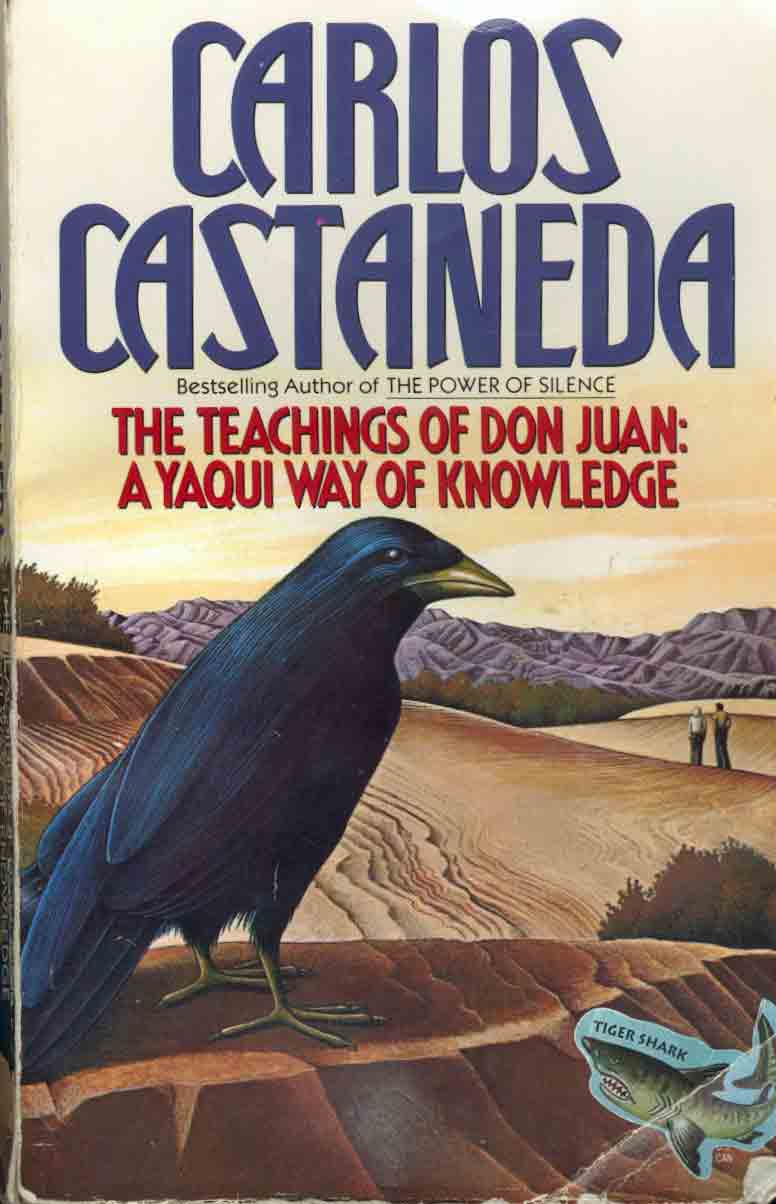
Exploring the countercultural 1960s and the origin of Western New Age, one cannot bypass Carlos Castaneda. He became a celebrity writer because of his bestselling book The Teachings of Don Juan: A Yaqui Way of Knowledge that was published by the University of California Press in 1968. The book was written in a genre of free-style dialogues between a Native American shaman named Don Juan Matus and Castaneda himself, who claimed that he worked with Don Juan for many years. The Teachings describes how Castaneda learned to use three hallucinogenic plants: peyote, jimson weed, and psychedelic mushrooms. After ingesting these substances, Castaneda went through mind transformations and learned that there were other realities besides the ordinary one. Later, it was revealed that he made up the whole experience, but this never affected his popularity.

Carlos-Castaneda-The-Teachings-of-Don-Juan

Of course, a book like this was well-tuned to the then-popular hallucinogenic subculture, and the link between Castaneda’s text and the psychedelic ‘60s is the most common explanation of his popularity. Yet I want to argue that this is a very narrow view, which does not explain why Castaneda’s follow up books, which had nothing to do with psychedelics, continued to enjoy popularity well into the 1990s. In fact, by the early 1980s, Castaneda became so paranoid about hallucinogens that he forced his girlfriend to undergo drug tests before allowing her to sleep with him. I also argue that viewing Castaneda exclusively as one of the spearheads of the New Age does not explain much either. The appeal of his texts went far beyond the New Age. In the 1970s and the 1980s, for example, his books were frequently assigned as conventional course readings in anthropology, philosophy, sociology, religious studies, and humanities classes.

Let me start with some biographical details. Castaneda was born Carlos Arana in Peru to a middle class family and moved to the United States in 1951. He tried to enter the world of art but failed. Then, for a while, he worked as a salesman while simultaneously taking classes in creative writing before eventually enrolling in the anthropology graduate program at UCLA.

Originally Castaneda did not care about hallucinogens and the emerging hippie culture, but eventually UCLA (and the broader California environment), which was saturated at that time with various counterculture and unchurched spirituality projects, made him choose a sexy topic: the use of psychedelics in a tribal setting. The book which made him famous, The Teachings of Don Juan, originated from a course paper on “power plants” and from his follow-up Master’s thesis. I want to stress that both papers were essentially attempts to find a short-cut to satisfy the requirements of his professors. His first professor, an anthropologist, invited those students who wanted to get an automatic “A” to find and interview an authentic Indian. Despite a few random contacts, Castaneda could not produce any consistent narrative, and had to invent his interview. This was the origin of his Don Juan character. Then he followed requirements of his advisor, Harold Garfinkel, a big name in sociology at that time and one of the forerunners of postmodernism. Garfinkel made it explicitly clear to Castaneda that he did not want him to classify and analyze his experiences with Don Juan scientifically.

What Garfinkel wanted was a free-style and detailed description of his work with the indigenous shaman as it was and without any interpretation. Thus it was through collective efforts that Castaneda produced a text that by chance caught the attention of the university press as a potential bestseller. Essentially, Castaneda took to the extreme incentives provided to him by his professors and by the surrounding subculture. He internalized these incentives by composing a fictional text, which he peddled as authentic anthropological research. It is interesting to note that in 1998, just before he died, Castaneda made the following mischievous remark in his introduction to the last anniversary edition of The Teachings of Don Juan: “I dove into my field work so deeply that I am sure that in the end, I disappointed the very people who were sponsoring me.”

The popularity of the first book gave rise to the whole Don Juan sequel, which made Castaneda an anthropology and counterculture star. The combined print run of his books translated in 17 languages reached 28 million copies. And, as I mentioned above, despite the revelations that his Don Juan was a completely fabricated character, the popularity of his books was increasing throughout the 1970s. In fact, to this present day, libraries frequently catalogue his books as non-fiction.

It seems that Castaneda’s appeal had something to do with overall trends in Western culture, which made his text resonate so well with millions of his readers. For this reason, I want to highlight the general ideological relevance of Castaneda’s books for the Western zeitgeist (spirit of the time) at its critical juncture in the 1960s and the 1970s. Various authors who wrote about Castaneda never mentioned this obvious fact, including his most complete biography by French writer Christophe Bourseiller, Carlos Castaneda: La vérité du mensonge (2005). So exploring the ideological relevance of the Don Juan books will be my small contribution to Castanediana.

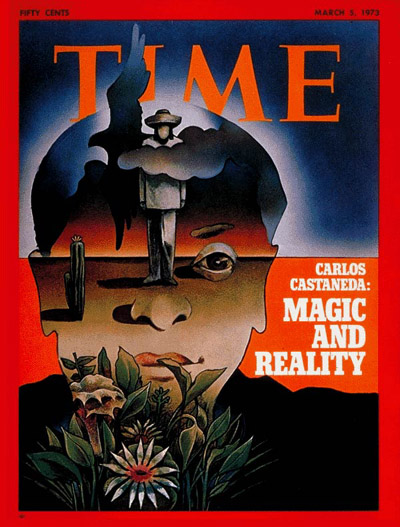
To be specific, I want to point to two themes that go through all his books. First, he hammered in the minds of his readers the message of radical subjectivism, which in our day it is considered by some a conventional wisdom: What we call truth is always socially constructed. Don Juan, who in later books began speaking as a philosophy professor, repeatedly instructed Carlos that so-called reality was a fiction and a projection of our own cultural and individual experiences, and instead of so-called objective reality, we need to talk about multiple realities. In an interview for Time magazine, Castaneda stressed that the key lesson Don Juan taught him was “to understand that the world of common-sense reality is a product of social consensus.” Castaneda also stressed the role of an observer in shaping his or her reality and the significance of text in Western culture. In other words, he was promoting what later became the hallmark of so-called postmodern mindset.

Second, fictional dialogues between the “indigenous man” Don Juan, whom Castaneda portrayed as the vessel of wisdom, and Castaneda, a “stupid Western man,” contained another message: remove your Western blinders and learn from the non-Western ones. Such privileging of non-Western “wisdom” resonated very well with Western intellectuals who felt justified frustration about the hegemony of positivism and Western knowledge in general and who looked for an intellectual antidote to that dominance. By the 1990s, this attitude mutated into what Slavoj Zizek neatly labelled the “multiculturalist’s basic ideological operation,” which now represents one of the ideological pillars of Western welfare-warfare capitalism.

At the end of the 1970s, several critics tried to debunk Castaneda. They were able to prove that his books were the product of creative imagination and intensive readings of anthropological and travel literature. These critics correctly pointed out that Castaneda misrepresented particular indigenous cultures and landscapes. Besides, they stressed that his books were not written in a scientific manner. Ironically, this latter criticism did not find any responsive audiences precisely because social scholarship was moving away from positivism. Moreover, one of these critics, anthropologist Jay Fikes, who wrote a special book exposing Castaneda’s hoax, became a persona non grata in the anthropology field within the United States. Nobody wanted to write a reference for him, and he had to move to Turkey to find an academic position.

What critics like Fikes could not grasp was the fact that the Castaneda texts perfectly fit the emerging post-modernist thinking that was winning over the minds of many Western intellectuals who sought to break away from dominant positivism, rationalism, and grand all-explaining paradigms. To them, an antidote to this was a shift toward the subjective, individual, and spontaneous. The idealization and celebration of non-Western knowledge and non-Western cultures in general, which currently represents a powerful ideological trend in Western Europe and North America, became an important part of this intellectual revolt against the modern world. I am sure all of you know that anthropology authorities such as Clifford Geertz (until recently one of the major gurus of Western humanities), Victor Turner, and Claude Lévi-Strauss were inviting others to view any cultural knowledge as valid and eventually erased the border between literature and science. They also showed that scholarship can be constructed as art. Castaneda critics could not see that his texts only reflected what was already in the air.

Castaneda_Time magazine

The person who heavily affected the “production” of the first Don Juan book, which was Castaneda’s revised Master’s thesis, was the above-mentioned sociologist Garfinkel. As early as the 1950s, Garfinkel came up with ideas that contributed to the formation of the post-modern mind. I am talking here about his ethnomethodology. This school of thought did not see the social world as an objective reality but as something that individuals build and rebuild in their thoughts and actions. Garfinkel argued that what we call truth was individually constructed. Sometimes, he also called this approach “people’s sociology.” He stressed that a scholar should set aside traditional scientific tools and should simply narrate human experiences as they were in all details and spontaneity. Again, today, for many, this line of thinking is conventional wisdom, but in the 1950s and the 1960s it was revolutionary. Incidentally, for Castaneda it took time to figure out what Garfinkel needed from him before he rid his text of the vestiges of “positive science.” To be exact, Castaneda could not completely get rid of this “science” in his first bestselling book. In addition to the free-flowing and easy-to-read spontaneous dialogues with Don Juan, Castaneda attached to the text an appendix; a boring meaningless read that he titled “Structural Analysis.” In his later books, such rudiments of positivism totally disappeared.

When Castaneda was writing his Master’s thesis, Garfinkel made him revise the text three times. The advisor wanted to make sure that Castaneda would relate his spiritual experiences instead of explaining them. Originally, when Castaneda presented to Garfinkel his paper about a peyote session with Don Juan, the text was formatted as a scientific analysis of his own visions. The professor, as Castaneda remembered, rebuked him, “Don’t explain to me. You are nobody. Just give it to me straight and in detail, the way it happened. The richness of detail is the whole story of membership.” Castaneda spent several years revising his thesis and then had to revise it again because Garfinkel did not like that the student slipped into explaining Don Juan psychologically. Trying to be a good student, Castaneda embraced the advice of his senior colleague. So the final product was a beautiful text that was full of dialogues, rich in detail, and, most importantly, came straight from the “field.”

I interviewed some of Castaneda’s classmates and other scholars who became fascinated with his books at the turn of the 1970s. Many of them had no illusions about the authenticity of Don Juan. Still, they argued that the whole message was very much needed at that time. A quote from Douglas Sharon, one of Castaneda’s acquaintance, is illustrative in this regard. In his conversation with me, Sharon stressed:

“In spite of the fact that his work might be a fiction, the approach he was taking—validating the native point of view—was badly needed in anthropology, and, as a matter of fact, I felt it was a helping corrective for the so-called scientific objectivity that we were taking into the field with us.”

I want to mention in conclusion that Castaneda not only promoted the postmodern approach in his novels but also tried to live it. Before the age of Facebook and online forums, Castaneda, with a group of his followers, became involved in an exciting game of identity change. They came to enjoy confusing those around them by blurring and constantly changing their names and life stories. For example, people in his circle shredded their birth certificates and made new ones. They also performed mock wedding ceremonies to make fun of conventional reality. To those who might have had questions about this “post-modernist” game, Castaneda reminded: “We’re all nothing but bags of stories.”

Urging Cambodians To Critique Their Culture

Brandon has recently referred to my comment that the Cambodian culture is ‘backward’ in this post. In response to that, I would like to share some more thoughts about the Cambodian culture and why I would urge all Cambodians (and all others) to critique their own culture.

I notice that some Cambodian people romantically adore their Khmer culture. Some people’s adoration stretches to the extent that they cannot accept any critiques about their culture as if critiquing the culture equals criticizing the person. Their adoration takes levels that are frightening me – examples are sentiments of supreme nationalism, the gullible belief in distorted histories that have pushed Cambodians into a victimized position that they gladly exploit in political and personal relations, and their willingness to fight and die for the country. To them, the excessive love of one’s culture or nation is noble, but to me it is ridiculous. It doesn’t require heart to love something, it requires more heart to critique the thing you love.

Several aspects of the Khmer culture that I find absolutely deplorable:

  • the hierarchical structure of its social life. Cambodian children are raised to respect and to be obedient toward their elders and toward Buddhist monks. Instilled with strict social rules, the Cambodians are unable to properly reflect on social values and social norms. Children are not encouraged to think for themselves, and to oppose their elders as the elders are always considered right. It should be no surprise that they grow up lacking self-reflective skills;
  • the people´s highly status oriented attitude and their low demeanor toward those who are more wealthy. Cambodian people are extremely status oriented and excessively adore those who enjoy a higher status. It is considered impolite to make eye contact with someone of higher status. In return, empowered by a feeling of superiority despite their plain stupidity, those of higher status look down on the lower classes;
  • their idleness and slowness, which seems to be common among most native South-East-Asians and which may be attributed to their tropical climate. Cambodian people are lazy and like to spend their time gazing around mind-numbingly;
  • its false and pretentious intelligentsia. The Cambodian intelligentsia are like dogs: they bark so much, but they know absolutely nothing! Equipped with beautiful words and eloquent expressions, their words are often empty of substance. They are good at doubtlessly regurgitating any knowledge or wisdom that they have read, but are incapable of critical thinking and of constructing their own ideas;
  • and worst of all its culture of self-pity. Cambodians like to pity their own existence and it is in this self-pity that their suffering is multiplied and their extreme egoism is revealed. This most self-destructive emotion which drowns them in a sea of depression is often used as a weapon to manipulate others, and is sometimes expressed through hysterical lamentations. See here and here for some examples of their miserable cries.

Although I know that my harsh critique of Cambodian culture does not please some Cambodians, they should know that in criticism there is often a desire to improve the people’s situation and to elevate them. It requires effort and energy to care enough about something to speak freely about it. I would urge all Cambodians who would like to improve their nation to gather the strength to stand above their culture so that they can look down on it, reflect on it, and critique it – even better, make fun of it and eventually transcend it.

Hence, Cambodian, go and indulge yourself in some self-mockery!

A quick update on NOL’s art project

Chhay Lin sent me this email detailing a rough timeline for the NOL art project he initiated:

I met my friend about the art project last weekend. He told me that he is experimenting with an Escher-esque logo/banner for NOL. He doesn’t know how long it will take, and is not working on it full-time. In the meantime he is busy moving out from the city of Breda to Rotterdam, opening his own workshop, and making portraits for a book that he and I are working on. 🙂 I’ll keep you up to date if I hear anything new about the NOL artsy project.

His friend, Cheerted Keo, has a website that you can check out here.

To Pledge or Not to Pledge

I attended a public meeting last night as I do from time to time. It’s a bad habit I can’t seem to shake. Like many of the more formal public meetings in this country, it started with the Pledge of Allegiance. (Foreign readers may not know that this is a 31-word quasi loyalty oath of allegiance to “the flag.”) When the time comes, everyone is supposed to stand, put their heart on their hand, face the flag, and recite the Pledge in unison, which is drummed into all schoolchildren.

My policy during the last several years has been to stand and remain silent with my hands at my side. I don’t make a spectacle of myself by staying seated, but I’m not willing to say the Pledge, for several reasons.

  • It’s too much like religion, and not just because of the “Under God” phrase
  • I don’t like feeling like a sheep following the herd
  • I don’t like the implication that we should bow and scrape to our rulers

Plenty of people would brand me a traitor for my attitude, an ingrate who doesn’t appreciate the benefits of living in the good ol’ U.S.A. In fact, I am quite grateful that I live in the U.S.A. because

  • I grew up in this culture and feel a part of it (omitting rock “music”)
  • The land is beautiful
  • Our politicians are less rapacious than in some other countries
  • We still have a reservoir of individualist sentiment that resists the “Progressives” and the neocons and their relentless push for a made-in-America brand of fascism
  • The libertarian movement has grown enormously in the years since 1971 when I signed on

I do indeed feel some kind of loyalty to the land and the people. But not to the government. And to swear allegiance to the Constitution, as the newly elected councilmen did last night, is a farce because the Constitution was shredded years ago, starting with Abraham Lincoln and perhaps earlier. At the federal level, they swear allegiance to the Constitution and then turn around and spit on it.

But wait, you might say, if you’re loyal to the people you have to be loyal to the government because we elect our leaders. But that’s a slender thread indeed. The government is controlled by unelected bureaucrats and powerful special interests. The government is not “the people.”

So, with only the mildest misgivings, I’ll go on boycotting the Pledge.

From the Comments: Why did Cambodians trade foreign terror for domestic horror?

John Cyberome pitches the question to Chhay Lin on his post about the terrorist attacks in Paris. Chhay Lin’s response (which I have broken up into smaller paragraphs) deserves a closer look:

I don’t understand why Cambodians traded foreign terror for native horror. It’s something I’ve always wanted to understand. I don’t remember a time when I did not have such questions as: how can people be so cruel to each other or would they (the friends I had) be able to commit such horrendous acts to me if they would live during the Khmer Rouge period? It seems like there is a terrible part of human nature that is called upon in certain circumstances. I think the Milgram Experiment and the Stanford Prison Experiment have been examples of how peaceful people can move to extremely horrifying acts. I also think that the Khmer Rouge had good intentions. In their eyes, they were saving the nation from corruption, from immorality, from foreign invaders and from domestic traitors.

Cambodia by the way, is a country that is quite paranoid. Until this day, they still fear that the Thai or the Vietnamese will one day take over the country. Some already believe that the country only exists by name, but that it’s actually under Vietnamese rule. According to them, after the Vietnamese occupation from 1979-1989, they have installed a pro-Vietnamese ‘puppet’. This paranoia feeds nationalism – a sentiment, I believe, that can be easily manipulated into hatred towards foreign Khmer like Sino-khmer or Vietnamese-khmer.

Besides that, I also think that the poorer people were envious of the wealthy class. When the Khmer Rouge came into power and turned the social hierarchy upside down by installing the poor people into higher social positions, they may have been especially cruel to those fellow Cambodians who they believed were better off.

I also think that we can partly blame it on the Cambodian culture. The culture is very hierarchical. People of status look down on poorer people and treat them like crap. The poor don’t even dare to look the better-off in their eyes. It’s a culture that breeds envy and discontents between classes. I think these are a few reasons why the Cambodians had traded foreign terror for native horror. In all honesty, I find the culture quite backward 😛.

This is a whole lotta insight packed into one short ‘comment’.

For starters, I would be comfortable in suggesting that land is the crucial factor of production in Cambodia, rather than capital. (I am not as confident as Rick in arguing that land, labor, and capital are basically obsolete tools, in large part because there are big swathes of the world that don’t share the institutions that have created the West.) Land-based societies that I have read about all share the same general cultural characteristics as those mentioned by Chhay Lin (though none would dare call these characteristics ‘backward’!).

Trade has, in my reading of history, been the traditional arbiter of destruction for land-based interests. Does anybody have any good information on international trade and Cambodia? I’ve looked in to a few sources (World Bank, OECD, Heritage) and it looks like the volume of trade has been increasing since at least 2010, but that there are institutional problems which have yet to be addressed.

‘Creative destruction’ is such a strange concept, especially to a libertarian like me.

Good Health Will End Civilization

Good health and decisive minds. With maybe about 5% probability. We’re far more likely to destroy ourselves with war or stupidity, but knowledge could do us in too.

The basic problem is that as our knowledge of health and aging increases, we’re going to end with a lot of old people around. We’re going to be those old people, which is great for us, but it could be deadly in the long run.

Institutions are made up of formal rules, and informal interpretations of those rules by members of society. We learn how to interpret our environment by observing how our predecessors did so, copying them, ideally refining their approach, occasionally rebelling against the old ways and finally pushing our ways on the next generation.

This sets up an evolutionary process where variation and generational turnover occur together. The basic problem is that few people change their minds once they’re about 25. You might be able to teach an old dog new tricks, but odds are good you can’t teach him a new way of looking at the world.

Yeah, some people can change with the times, but on the whole Bill Burr’s pretty much spot on: [as far as other people are concerned] you can live too long. The older the median voter, the further removed their view of the world is from the actual reality of the time.

Now, there’s certainly some optimal degree of conservatism. We don’t want to upend society every five years in the name of progress. But if generational turnover grinds down to a glacial pace, so may institutional adaptation.

But of course we don’t know what the future holds. Perhaps an older, wiser median voter is a good thing. Perhaps the key to longer lifespans includes therapy to stimulate neural plasticity.

In any case, I hope that coming generations will hear a message that mirrors advice given to my generation. We were told “don’t expect to have the same job forever.” Now we need to be told “don’t expect to have the same opinion forever.”

Notes On Liberty ART

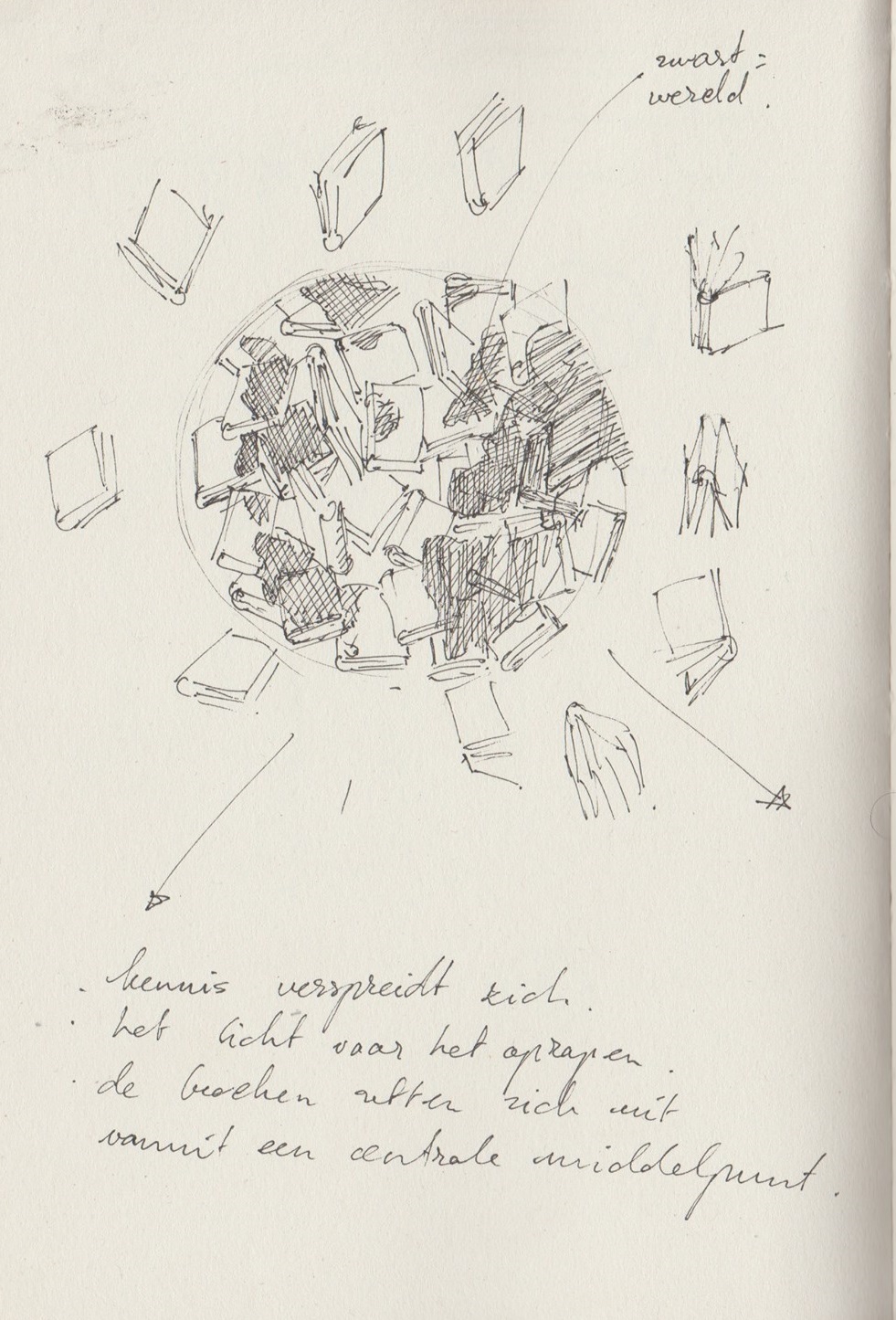
Cheerted Keo, who is a friend of mine and an aspiring Cambodian artist by way of Holland, is in the process of creating a banner or logo for our “Notes On Liberty” website. Inspired by the subtitle ‘Spontaneous thoughts on a humble creed’ and by Friedrich Hayek’s insights on ‘dispersed knowledge’, he has come up with an art work that represents our libertarian philosophy. His work symbolizes Hayek’s key observation that information is decentralized and that each individual knows just a small fraction of what is collectively known. The result of that, as Hayek has clearly stated in his seminal work The Use of Knowledge in Society (1945), is that it is best to let those with local knowledge make their own decisions in how to plan their own lives.

Although I know that the product is not finished yet, I would already like to share his work in progress with you – click on the images to enlarge them.

Cheerted Keo Notes on Liberty sketchCheerted Keo Notes On Liberty wipCheerted Keo Notes on Liberty wip 2

Please share your thoughts with us about the work. He is making the art work for free, but I thought it would be great to give him some exposure in return. Thus, if you appreciate his work, please spread word about this awesome up-and-coming artist.

If you would like to know more about Cheerted Keo’s works, you can visit his website here: www.ckeo.nl. He is quickly building up his portfolio, has had several exhibitions and is also selling some of his art works.

South Park’s ‘Safe Space’: A Parody On Stepford Students

Do you know what Stepford students are? This article by Brendan O’Neill explains:

They’re everywhere. On campuses across the land. Sitting stony-eyed in lecture halls or surreptitiously policing beer-fuelled banter in the uni bar. They look like students, dress like students, smell like students. But their student brains have been replaced by brains bereft of critical faculties and programmed to conform. To the untrained eye, they seem like your average book-devouring, ideas-discussing, H&M-adorned youth, but anyone who’s spent more than five minutes in their company will know that these students are far more interested in shutting debate down than opening it up.

Stepford students demand the ‘right to feel comfortable’. Their eyes “glazed with moral certainty”, they demand ‘safe spaces’ – spaces where no student would feel threatened or unwelcome. They seek safety from words, ideas, Zionists, ‘blurred lines’, Nietzsche etc. This new generation of students believe that self-esteem is more important than everyone else’s liberty to speak up their mind. At some universities, like Brown University, ‘safe spaces’ have been set up so that students can take refuge from ‘disturbing ideas’.

Now comes the greatest part: the concept of ‘safe spaces’ has been discussed in South Park’s latest episode. It is hilarious!

The selfish meme

There are two senses in which to consider the phrase.

  1. The sense in which memes enter or exit our minds.
  2. The sorts of behavior encouraged by our memes.

For those who don’t know what I’m talking about:

A meme (/ˈmm/ meem)[1] is “an idea, behavior, or style that spreads from person to person within a culture”.

Richard Dawkins introduced the idea in his famous book: The Selfish Gene. The bulk of his book discusses examining the gene as the basic unit of analysis in evolutionary studies. He introduces the idea of the meme as a different form of replicator. Both genes and memes will only be reflected in the outcome of biological and cultural evolution if they exhibit fitness–if they are able to survive.

So the cultural traditions that helped hunter-gatherer societies survive droughts or harsh winters tended to survive and spread. Over time a culture accumulates this sort of practical, tacit knowledge. (Side note: this week’s Econtalk has Cesar Hidalgo who does really interesting work trying to indirectly measure the presence of such tacit knowledge in market economies.) And if culture is made up of memes, the same way organisms are made up of genes.

Looking at genes as the unit of analysis (as opposed to the organism) explains some otherwise mysterious behavior. It provides a plausible explanation of altruism: we care for our children more than anyone because 50% of their genes are our genes. A nephew is still precious, but not as important to us because the expected ratio of shared genes between the two of you is 25%. A gene that prompts you to protect your children is likely to survive longer than a gene that doesn’t prompt you. (And genes that hang around with such kin-protects genes are also more fit than their competition.) A gene that prompted you to be kind to neighbors makes sense when you live in small groups. But a gene that prompted you to be kind to total strangers might be a liability in a world where strangers were dangerous.

Cultural evolution certainly makes sense as a gradual mutation of different cultural practices merging together to make what is called (and perceived) as a unique body of culture. It’s a complex of knowledge, ideas and basic assumptions, social interface protocols, and it’s deeply embedded in how we engage in the world. (Perhaps we can’t remember our infancy because we didn’t have a cultural lens through which to reference anything to anything else…) One thing that I’m sure we’ve all noticed is that it can be almost painful to have to reject a cherished belief. It’s even difficult to see one of these memes challenged.

Now genes don’t have to be small bits of genetic code. They can be something simple like “make this enzyme when you get a chance.” But as a unit of replication, you should consider the smallest discrete chunk of genetic coding that replicates itself. If a particular pattern isn’t fit, it will leave the gene pool, while the fit collections of genetic instruction spread. So you might end up with long complex strings of genetic material akin to a computer program. Initially simple scripts might gather as successful collections of genes that work well together. The “produce stomach acid” gene works well with the “produce a stomach” gene and soon the two are virtually inseparable. They’ve become a simple script: “Do this, then that, then maybe this other thing.” Scripts gather into multi-cellular organisms with different functions that can respond differently to different stimuli. Soon you’ve got a complex set of code as your replicating unit.

More complex genes are necessary to prompt more complex behavior. It’s worth noting that Dawkin’s theoretical framework sometimes looks like a hyper-rational economics model. Evolutionary Stable Strategies are a Nash Equilibria that are robust to invaders. They occupy a niche and survive. But this evolution is happening in the context of increasing complexity. The system is learning*. This isn’t an instantaneous process**, but it is gradually becoming more sophisticated.

A complex gene will get bugs due to random mutation, but as long as it’s still generally fit, it will survive. And over time, more subtle and sophisticated programs identify new niches. And we get plant genes surviving by filling the “eat sunlight” niche and animals in the “eat plants” niche, and bacteria co-evolving with animals’ digestive systems.

Slowly working through this long, blind, random process genes surviving this hostile environment develop behaviors that help them flourish (the “four F’s of evolution: Fighting, fleeing, feeding, and reproduction”). Gradually they stumble into opportunities, and an important one was social behavior.

More and more complexity, round and round, until we start to get our first little bits of sentience. I’ve been watching a chinchilla hop around my apartment for a couple weeks now and I’m astonished by how much effort she puts into genuinely exploring her world. She tests objects for structural integrity and learns what she can and can’t jump on. She tests boxes with her teeth, I don’t know what for. She’s distinctly learning and not merely existing or surviving. She’s comfortable and does not know fear (I’ve seen her scare one particularly wussy cat). That sort of behavior requires a great deal of complexity which requires a great deal of genetic material.

I’m noticing as I write this that the biggest gene (i.e. discrete, replicated set of genetic code) must be that very large collection of genetic patterns that must come together in order for a one’s offspring to simply be the same species.*** I’ve heard that humans and chimps share 94 percent of our genetic material. That overlap tells me that some larger percentage than that is what makes us actually a human. The difference between any two individuals, then, must be among a very small portion of their total genetic makeup. This small portion is where genetic competition occurs in the arena of sexual reproduction.

In any case, our first memes (behaviors) seem to be transmitted biologically. Later, with more complex genes, we are able to replicate more complex behaviors. Eventually, we get complex enough to build up a sense of consciousness****.

A complex enough gene might have a subroutine that sets off an error; something like the pain our consciousness experiences when things are going poorly*. And likewise for a meme. Though more likely is that the error is being returned by our psychology. (If our genes are assembly language, our psychology is the operating system, and culture is the mess of basic programs that makeup our desktop environment.)

When we think of memes as self-replicating units, interesting questions arise: what sort of patterns will be robust to competition? Which will occupy what niches? What happens when incompatible memes come together in one mind? What sort of eusocial behaviors are possible? How much do our memes govern our behavior? (This is where nature and nurture overlap.)

Obviously one possibility is a “selfishness meme,” or a culture that hits an equilibrium of distrust. But there are many others, and how they combine matters. At this level we’re essentially asking questions about psychology, culture, and institutions. The fodder of all the social sciences comes together here. Different memes will be transmitted in different ways (which is perhaps what defines the disciplines), but any of these memes may be complex enough to have a defense mechanism that involves activating various processes (including other memes, perhaps) and perhaps making people feel anger and related emotions when someone questions our beliefs and may even push people to fight with their life for their memes.


*We’re computers, markets are computers, societies are computers, the ecosystem is a computer, Earth is just a big giant computer. It processes data and creates new data.

** The next Hayek rap should include the phrase “it’s spontaneous order, not instantaneous…”

*** I could imagine it as made up of some set of smaller genes in some complex, rather than one monolithic gene but I don’t have the language to communicate that idea concisely.

**** And it must be noted that this consciousness is built out of parts designed for the poop-and-panic machines that were our evolutionary ancestors. It’s like building a super computer* out of a truck load of Pez dispensers and a warehouse full of chainsaws. And yet, how else could it be done.

La Bêtise et la langue française.

J’ai eu des ennuis de santé occasionant une absence de ce blog. J’aimerais bien pouvoir dire qu’il s’est agit seulement d’un accès de priapisme, mais ce serait exagérer.

En tous cas. il est temps que j’y repique. Ce sera pour maugréer, bien sur.

Je viens de regarder pour la seconde fois le beau, l’étonnant documentaire de l’émissions TV française Thalassa sur Saint-Malo, une ville et une région qui me sont chères.

A un moment, le narrateur mentionne que le grand corsaire malouin Surcouf s’était livré à la traite des Noirs, donc, au commerce des esclaves africains. Le sous-titre en Anglais rend cette simple affirmation par ces mots époustouflants:

“Surcouf respected the Black Treaty,” “Surcouf respectait le Traité Noir.” !

Comment peut-on être aussi ignare; et surtout, comment peut-on être aussi con?

En effet, ne pas connaitre un mot ou une expression specialisé n’est peut-être pas un crime (mais encore, pour un traducteur également spécialisé?) mais laisser en place un expression qui ne possède aucun sens, en aucune langue c’est contribuer à l’abêtissement des foules, téléspectateurs, autant que lecteurs.

Pourquoi cette carence de contrôle de la qualité dans un émission de télévision bien considerée depuis déjà trente ans? La réponse probable est une profonde indifference aux faits. La photo est splendide; le narratif captiv vant si on n’y fait pas trop attention. Pourquoi s’en faire?

J’ai remarqué ailleurs que cette indifférence me semble être liée à l’usage de la langue francaiss. (Voir mon recueil d’histoires: “Les Pumas de grande-banlieue: histoires d’émigration.” sur Amazon.) J’ai du mal à imaginer ce genre de bêtise en Anglais, sauf dans des journaux de très bas niveaux, genre l’ancienne “France Dimanche.” Le Francophones disent n’importe quoi; ils possèdent une grande tolérance vis-à-vis de la bêtise qui sonne bien, et meme envers la connerie tout court.

Moi, il me semble que lorsqu’il y a trop de poubelle débordantes dans l’espace intérieur intellectuel, on ne peut plus penser clairement. La fameuse rigueur francaise, “cartésienne” dont les Francais, en particulier, se targuent toujours a simplement disparu, je crois. Les autre francophones ont été éclaboussés simplement parceque la production culturelle française domine de beaucoup la francophonie de par son poids.

Dites-moi que j’ai tort!

“What every 21st century American should ‘know'”

Over at Policy of Truth, Dr Khawaja has an interesting post up on cultural literacy:

The journal Democracy is running an article revisiting E.D. Hirsch’s idea of cultural literacy, and looking for readers to help generate an updated list like the one at the end of Hirsch’s 1987 book, Cultural Literacy: What Every American Needs to Know

Here’s the list I came up with, completely off the top of my head (i.e., involving less than a minute of thought, since that’s all the time for thought I currently have).

  1. Wounded Knee 1890
  2. Wounded Knee 1973
  3. The Fort Laramie Treaty (1868)
  4. Russell Means and/or Dennis Banks
  5. AIM (American Indian Movement)
  6. Ayn Rand
  7. Atlas Shrugged
  8. The Fountainhead
  9. libertarianism
  10. BDS (Boycott, Divestment, Sanctions)

I added my own list in the ‘comments’ thread, but still haven’t had time to address critiques. My list:

My quick list:
1) black conservatism
2) the whole Pahlavi-Mossadegh affair
3) libertarianism (people still have trouble conceptualizing it’s right-left crossover appeal)
4) Latin America’s Western culture
5) Dutch history
6) South Asian-East African literature (lots of historical links between the two regions that could help conceptualize current US role in the world)

Lists are fun. They are an easy way to start a conversation and they are time friendly. Add your own and don’t forget to justify your positions! Here is how I justify #1: it’s a storied, intellectually-robust tradition that has suffered greatly in the public sphere due to vulgar demagogic practices associated with the black Left. #2: C’mon, why shouldn’t every American know that their government overthrew an elected government in Iran and paved the way for the current anti-American regime?#3: see what’s between the parenthesis. #4: knowing that Latin Americans are by and large Western (save for the Natives still living in the Andean highlands) would do wonders for better relations between North and South. #5: Dutch (and Swiss) history can teach us far more about our own institutions than anything the UK has to offer. #6: see parenthesis.

Lots of foreign policy implications on my list, as well as stuff that can help to better understand why the US works the way it works. (This is a charitable assumption on my part, of course.)