The Latin American tropism

Below is an excerpt from my book I Used to Be French: an Immature Autobiography. You can buy it on amazon here.


The Paris in which I grew up (outside of the long summer vacations), was a gray, dank and dark place. It was an easy locale from which to fantasize about the sun-drenched tropics. Palm-trees were our favorite trees because we never saw any except at the movies. Of all the tropics, the Latin American tropics took pride of place. Perhaps that was because France had negligible colonial entanglement there and therefore, no colonial retirees to mug our fantasy with their recollections of reality. Or perhaps, it was because, well after the emergence of rock-and-roll in France, close dancing was still taking place to the sound of Latin music: Rumba, Samba, Tango. One sensuous experience easily becomes grafted onto another; the clinging softness of girls’ flesh became associated in our minds with that particular kind of music and thence, with a whole unknown continent. This cocktail of sensations biased me until now in favor of that continent.

At one of the stops where several foreign student buses met, I became smitten with a Bolivian girl and she with me. We were to each other the most exotic thing ever touched. She had luscious brown skin, thick, black, lustrous Indian hair, swinging hips, and a lovely round chest. Our buses met again several times and the passion was renewed each time. Although those encounters involved little more than many sloppy deep kisses and some furious mutual groping, indirectly, they were to shape an important part of my mental life, a favorable disposition toward the otherness of others, “xenophilia,” if you will.

On power-display bias and the historians

This is an excerpt from my upcoming book at Palgrave McMillan which discusses Canadian economic history. This excerpt relates to a point that I have made numerous times on this blog regarding the bias for power held by historians and how it often leads them to inaccurate conclusions (here and here):

When the great historian Lord Acton warned that, “absolute power corrupts absolutely,” he was not only referring to imbuing certain fallible humans with excessive powers, but also as a caution to historians for their assessment of politicians. Too often, politicians become known for “greatness” because of their actions, regardless of how much they impoverished society or put in place measures that would ultimately erode their citizens’ quality of life. By the same token, some eminent figures remain unknown, relegated to a footnote in the history books, even though they have contributed in a more significant way to economic enrichment, cultural development, and social cohesion. Grand gestures and large-scale social projects inspired by good intentions do not always yield great results – or desirable ones.

If we truly want to assess the Quiet Revolution and the “Great Darkness” with any clarity, we must consider politicians’ actions in a more realistic scope, and sift through the quantitative and qualitative data that show how people thought and acted in the everyday. Through the use of rigorous tools, statistical methods and economic theories, we ought to consider how things might reasonably have developed otherwise without the Quiet Revolution. This is what I have tried to do in this book. (…)

The discourse on Quebec modernity that emerged along with the Quiet Revolution coincided with the emergence of a strong interventionist State. When we compare Quebec to other Western countries, however, our analysis reveals that the State did not play a major role in modernization here. After all, it was in a period when Quebec’s State apparatus was less active compared to the rest of Canada that it was able to progress in leaps and bounds. Of course, the State must have had some effect in certain areas, but the Quiet Revolution was not responsible for the bulk of positive outcomes that came to term during this period. Analyzing trends, causes, explanations and secondary forces at play in Quebec society’s metamorphosis definitely requires a degree of patience and effort. It would be much less onerous to take the easier path of only looking at the State’s activities as worthy of attention in this regard. If we fail to make these efforts, we risk succumbing to the “Nirvana Fallacy.” In order words, we tend to put the State on a pedestal: it becomes a kind of disembodied entity in a virtual reality where it plays the VIP or starring role. Comparing reality with a utopia necessary leads us to conclude that utopia is better, but this approach is utterly fruitless.


The Asian Age

I love Asia. Ever since my student days I have had a keen interest in South East Asia and China, with my course on the Politics of the Asia Pacific at the London School of Economics in the run up to the handover of Hong Kong as a high point. This was followed almost a decade later with four years of living in Manila, with time spend as a freelance journalist covering Philippine politics and society, as well as teaching for three years at the European Studies Program at the elitist Ateneo de Manila University. I also had the opportunity to travel to almost all countries in the region (with the notable exceptions of Laos, Taiwan and the Koreas, but one should keep something to be desired). I admire the resilience of the Asians, their humour, great work ethics, the beauty of their countries, and of course their sumptuous food.

As a classical liberal I always have a keen interest in the economic developments of the region, which to me serve as the prime evidence for the great and positive impacts freeing up economies have. The rise of Asia in essence is the empirical proof that classical liberal ideas work, that capitalism has the capacity to improve the life of millions of people, in a very short term. This despite the imperfect implementation of capitalism throughout the region, so there is much room for further improvement. In this light it is also interesting to see how long economic freedom and political lack of freedom can co-exist. Classical liberal ideas predict, most clearly expressed by Milton Friedman in Capitalism and Freedom, that one follows the other. Economic and political freedom cannot be separated forever (nor forever suppressed together, as the experiences in the former Soviet bloc continue to make clear, even despite Putin’s increasing autocratic rule).

For an international relations observer from Europe, the developments in the Asia Pacific are of particular interest, because the rise of Asia seems to go together with the fall of Europe as a geopolitical player. Or more precisely: the fall of the middle rank European powers, as the European Union itself is a significant player in trade politics only, the only field where it represents all member states and policy is determined at the European level, with a leading role for the European Commission.

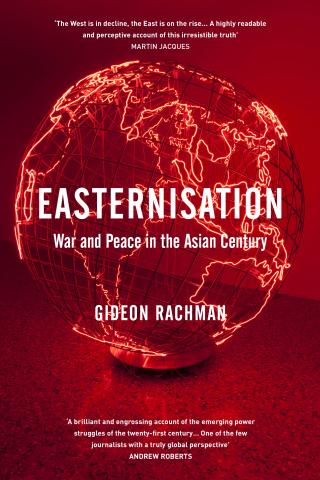
The recent book Easternisation: War and Peace in the Asian Century, by Financial Times journalist Gideon Rachman, deals precisely with this issue.

blog-easternisation

It is a great book, bringing together Rachman’s extensive experience in the US, Asia, and Brussels. Often, books written by journalists lack sound analysis for the mid to long term, and historical perspective. While Easternisation is not an academic tome either, it does provide sufficient deep analysis, especially by tackling developments in all important countries which play a role in the process. It is not just another volume of simply USA or EU bashing, as we have seen before with the huge literature on the alleged Japanese take-over of the US economy.

Rachman’s main argument is that the influence of the West, Europe in particular, has crumbled. This may lead to a major conflict in the Asia Pacific, most notably between China and the US, which also endangers the global economic order. Yet many other conflicts are also building up, in a region which heavily invests in armaments. In short, in the 21st century, ‘rivalries between the nations in the Asia Pacific will shape global politics, just as the struggles between European nations shaped world affairs for over 500 years from 1500 onwards’. I think this is an important message, which should be taken seriously by everybody. Certainly by the Europeans, who are in danger of just inhabiting the world’s largest open air museum within a few decades.  One thing is certain: the Asians will not wait for them to come to terms with the current shift of power.

The struggle for life

Below is an excerpt from my book I Used to Be French: an Immature Autobiography. You can buy it on amazon here.


In elementary school, grades were handed out in class in a terrifying monthly ceremony. The same deranged Principal would walk into each classroom in turn holding a thick pile of “livrets scolaires,” individual grade-booklets, rather than simple, one-shot report cards, under his arm. There was one livret per student per year with numerical scores and verbal comments for each subject matter, and a monthly overall ranking of students. The Principal would lay the grade-books upside down, in reverse order of students’ ranking for the month ending hence, lowest-ranking student first.

For several years, every month, without fail, the lowest-ranking pupil and the first on the mental scaffold was a runty, scrawny, rheumy-eyed boy who always sat in the last row, “Colinet.” The Principal would start ranting as he entered the room; his glasses would drop down his nose and he would deliver himself of the same furious tirade at the top of his voice against miserable, crouching Colinet. He was a large middle-aged man whose eyes became globulous when he was angry. He would foam at the mouth and spittle would dribble down his shirt as he promised Colinet the guillotine or worse. Colinet never got used to it. I sure did not. I almost crapped my pants several times although I was sitting near the front row and the Principal was staring over my head, straight at the back of the room, as he yelled and screamed. As he called out names from Colinet to the higher-ranking pupils, he would calm down, his voice would subside, and his comments became briefer. By the time he reached the livret of the tenth-ranker, his manner had become civilized as if there had been no raging storm minutes earlier.

In my family, there was a completely arbitrary rule that only the first six places were acceptable. I think my parents secretly thought only the first five were really acceptable but added the sixth because it made them feel magnanimous. Once the Principal had called out the ninth-ranked name, my body began to relax and I was breathing normally. If the Principal was down to the fifth livret and my name had not come up, the sweet song of victory began ringing in my heart. “Very good, my boy,” the Principal would say in a low, calm voice as he handed me my livret (to be signed by both parents).

Communism and reading

Below is an excerpt from my book I Used to Be French: an Immature Autobiography. You can buy it on amazon here.


My parents pro-Americanism must have been displayed often because faith in Communism was on the ascendancy during the miserable post-war years. That was when a significant fraction of French public opinion became mindlessly and reflexively anti-American, seemingly forever. Yet, rampant anti-Americanism hardly interfered with American cultural influence. The first movie I saw was a Charlie Chaplin, the first cartoon, Snow White. Every week, when I had been good, I had my copy of Mickey Mouse Magazine (“Mikay Mooze”), although there were excellent French and Belgian children’s periodicals. One of the best French-language children’s periodical had a Far-West serial, “Lucky Luke” that still amazes me for its historical and geographic accuracy. Somebody in the France of the fifties was an attentive student of Americana. Made-in-America action hero comics were forbidden fruits though. To this day, I don’t know why they were prohibited. Perhaps my mother thought them “vulgaires,” like many other things. Later, the first music I paid attention to was jazz.

Movies played a big role in shaping my world-view. I did not develop a sense for what was an American movie rather than a French movie until I was about fifteen. My real second language was thus the extremely bad, stilted French dubbing of American motion pictures. The dubbing is awful to this day. When the hero shoots the bad guy in the gut with a “Take this, you motherfucker!” it comes out in French like this: “This will teach you a lesson, mean man.” All dubbing is done in France by people who don’t know English well, I suspect. The same dozen voices are used over and over again. The dubbers are immortal, it seems. You might say that I was brought up in good part by a curiously distorted Hollywood.

How I Helped Win World War Two

Below is an excerpt from my book I Used to Be French: an Immature Autobiography. You can buy it on amazon here.


All of a sudden, that road was flooded by a long column of trucks overflowing with big, loud, laughing men in distinctive uniforms. People were shouting greetings and waving flags. It seems that an American soldier jumped off his vehicle, swept me up into his arms and kissed me on both cheeks. That may have been because my mother, who had wanted her second child to be a daughter, processed my long blond hair into Goldilock-style ringlets. That I am straight today is a testimony to the resiliency of genetic programming. My mother always insisted the kissing soldier was black. On the one hand, she may have made up this detail for colorful effect. On the other hand, there were so many trucks the soldiers may have belonged to a transport unit and hence, probably to a black unit in the segregated Army of the day.

It was August 1944. I was two and my family lived in a (nice) city project right on the periphery of Paris, near one of its main access roads. One thing that bothers me about this visual and auditory recollection is that we lived on the east side of Paris. American soldiers should have been arriving from Normandy, in the west. Yet, the memory is clear.

Before the American forces reached Paris, my mother had sewn a makeshift tricolor French flag. The blue came from my father’s old military service flannel sash (a forgotten and now incomprehensible item of clothing). The red came from a Nazi flag my father had stolen from a German general’s car he was supposed to guard. (The Germans were packing up at the time and very nervous. He might have been shot on the spot if he had been caught.) At a loss for white, my mother made the center piece out of one of my diapers. That’s why I have always felt I played a part, although a small one, in the liberation of Paris, a symbolically important phase of WWII.

I was born and conceived during the Nazi Occupation of France when life was tough and entertainment scarce. My father was a Paris cop. His life was not so tough, however, that he did not have the energy to make my mother pregnant one more time before the Liberation, this time with twins. There was little to eat and milk was rationed so, my mother breastfed me for the longest time. I was precocious. At one point, I think I was able to ask for the breast in grammatically perfect French. It must have been embarrassing for her. Or perhaps I made this up on the basis of bits and pieces I picked up while I was growing up, like some of the other early recollections in these truncated memoirs. They stop at age 21 when I moved to the US for good. I made that choice because I think the second part of my life would be less  interesting to an American readership than the first, the preparatory phase, so to speak.

I  described above my first, full, cinematographic memory. From the days before the Liberation, I remember bit and pieces, like still photographs with some sound, glimpses of German uniforms and the vast, beautiful fire of the Paris general mills, a mile away, set by the US Army Air Corps. It’s a little known fact that the Allies bombed the hell out of France right before and during the Normandy landing. The French never complained much; they were different then, and too sick of the German presence to bitch about collateral damage. When the air raid siren sounded, my mother would wrap me up in a blanket and take me down to the basement of our seven-story apartment house. Some tenants were so jaded by then that they did not bother to take shelter. The basement was a crowded but not especially tragic place.

In spite of this dramatic, first, fully formed memory, nothing really important ever happened to me. I have escaped the Chinese curse, of “living in interesting times,” although I did live in fact in quite interesting times. I waltzed through the murderous second half of the twentieth century with hardly a scratch to show for it. All my life, I have been mostly fortunate. The undeserved lucky breaks more than made up for the few unjustified blows fate has dealt me. The luckiest break was my first coming to the US at eighteen, a prelude to immigration three years later. In this country, no one ever oppressed me successfully though a few tried.  Many gave me a push at just the right moment. Mine is a happy story. This makes it worth telling to the largely glum denizens of the twenty-first century.

I live in the sunny, warm climate I longed for as a child, near the sea I always loved, in a small town rich with the small pleasures I have always appreciated: a variety of movies, a good café in an interesting, animated downtown, several bookstores within easy reach, and young people everywhere. My wife is a talented painter whose work I enjoy so much I don’t ever like her to sell it. She has few obligations, and she has not had many for  quite a while. That’s what keeps her beautiful, I think. She is also an immigrant, from the other side of the world from me, yet we see eye-to-eye on most matters. Nevertheless, we each have our own house, feet apart, each gracious in its own way. Although, it’s in the center of town, our tiny plot contains an apple tree, a plum tree, two lemon trees, and a big fig tree. All bear fruits, especially the fig tree, a sort of miracle I never fully grasp, for reasons that will become clear below.

I am a retired university professor and scholar, fairly proud of my scholarship, happy to have been a professor and equally happy to not be one anymore. Most mornings, weather permitting (it permits often, here in California), after the gym and after coffee at Lulu’s, I am forced to decide whether I want to go sailing, or fishing, or just putter about my boat, or start one of my sometimes fairly good postcard paintings, or again, write a micro-story. Sometimes, I just simply spend the whole day reading, for no particular reason and to no particular purpose. I read much history but also almost anything anyone hands me. That would include a fair amount of trash. You guessed it: I am a satisfied lazy man.

The pages below tell the tale of the unlikely beginnings of the journey that brought me to my current state of beatific smugness.
From the Comments: Foucault’s purported nationalism, and neoliberalism

Dr Stocker‘s response to my recent musings on Foucault’s Biopolitics is worth highlighting:

Good to see you’re studying Foucault Brandon.

I agree that nationalism is an issue in Foucault and that his work is very Gallocentric. However, it is Gallocentric in ways that tend to be critical of various forms of nationalist and pre-nationalist thought, for example he takes a very critical line of the origins of the French left in ethnic-racial-national thought. Foucault does suggest in his work on Neoliberalism that Neoliberalism is German and American in origin (which rather undermines claims that Thatcherism should be seen as the major wave). He also refers to the way that Giscard d’Estaing (a centre-right President) incorporated something like the version of neoliberalism pursued by the German Federal Chancellor, Helmut Schmidt, from the right of the social democratic party.

Thoughts about the relations between France and Germany going back to the early Middle Ages are often present in Foucault, if never put forward explicitly as a major theme. I don’t see this as a version of French nationalism, but as interest in the interplay and overlaps between the state system in two key European countries.

His work on the evolution of centralised state judicial-penal power in the Middle Ages and the early modern period, concentrates on France, but takes some elements back to Charlemagne, the Frankish king of the 8th century (that is chief of the German Franks who conquered Roman Gaul), whose state policies and institutional changes are at the origin of the French, German and broader European developments in this are, stemming from Charlemagne’s power in both France and Germany, as well as other areas, leading to the title of Emperor of the Romans.

Getting back to his attitude to neoliberalism, this is of course immensely contentious, but as far as I can see he takes the claims of German ordoliberals to be constructing an alternative to National Socialism very seriously and sympathetically and also regards the criticisms of state power and moralised forms of power with American neoliberalism in that spirit. I think he would prefer an approach more thoroughly committed to eroding state power and associated hierarchies, but I don’t think there is a total rejection at all and I don’t think the discussion of ordoliberalism is negative about the phenomenon of Germany’s role in putting that approach into practice in the formative years of the Federal Republic.

Here is more Foucault at NOL, including many new insights from Barry.

Foucault’s biopolitics seems like it’s just a subtle form of nationalism

I’ve been slowly making my way through Michel Foucault’s The Birth of Biopolitics, largely on the strength of Barry’s recommendation (see also this fiery debate between Barry and Jacques), and a couple of things have already stood out to me. 1) Foucault, lecturing in 1978-79, is about 20 years behind Hayek’s 1960 book The Constitution of Liberty in terms of formulating interesting, relevant political theory and roughly 35 years behind his The Road to Serfdom (1944) in terms of expressing doubts over the expanding role of the state into the lives of citizens.

2) The whole series of lectures seems like a clever plea for French nationalism. Foucault is very ardent about identifying “neo-liberalism” in two different models, a German one and an American one, and continually makes references about the importation or lack thereof of these models into other societies.

Maybe I’m just reading too deeply into his words.

Or maybe Foucault isn’t trying to make a clever case for French nationalism, and is instead trying to undercut the case for a more liberal world order but – because nothing else has worked as well as liberalism, or even come close – he cannot help but rely upon nationalist sentiments to make his anti-liberal case and he just doesn’t realize what he’s doing.

These two thoughts are just my raw reactions to what is an excellent book if you’re into political theory and Cold War scholarship. I’ll be blogging my thoughts on the book in the coming weeks, so stay tuned!

McCloskey, Western equality, and Europe’s Jews

Warren shot me the following email a few days ago:

Brandon, do you know the name Deirdre McCloskey?

She is a first-rate economist with extensive expertise in history, literature and anthropology.  She recently finished a trilogy, the third volume of which is “Bourgeois Equality.” It’s a fat book but you would be well rewarded for time invested.  You don’t have to read the first two volumes to benefit from the third.

The purpose of the trilogy is to explain why we’re 30 times richer than our forebears of 250 years ago, as best that can be estimated.  Conventional answers like the industrial revolution and rule of law don’t go far enough.  The answer lies in attitudes toward commerce.

I haven’t read McCloskey’s book yet, but it’s been on my amazon wishlist for awhile and thanks to Warren’s prodding it’ll be my next purchase. (Here is all of NOL‘s stuff on McCloskey so far, by the way.)

My first instinct on this topic is to think about Europe’s Jews. Bear with me as I lay out my thoughts.

McCloskey’s book, which as far as I can tell takes readers to the Netherlands and the United Kingdom from the 17th to 19th centuries, is about how Europeans began to reconceptualize equality in a way that was very different from notions of equality in the past.

A very basic summary is that notions of equality in Europe prior to the modern era largely aligned with notions of equality elsewhere in the world. Basically, an established hierarchy based on either inherited land ownership or clerical ranking was justified in all cultures by a religious appeal: “we’re all Christians or Buddhists or Muslims or fill-in-the-blank, so don’t even worry about what we have and you don’t have.” This way of thinking was irrevocably altered in 17th century northwestern Europe. Once I actually read McCloskey’s book, I can give you more details (or, of course, you can just read it yourself).

This argument, that northwestern Europe became free and prosperous because of a change in ideas about equality, is of course very broad and qualitative, but I buy it. The big “however” in this line of reasoning is Europe’s treatment of its Jews.

I forget where I heard the argument before, but somebody or some school of thought has argued that because Europe’s Jews were forced by legislation to go into “dirty trades” like commerce, they became more broadly open-minded than other ethnic groups in Europe and therefore more prosperous. Dutch and British bourgeois culture no doubt had a Jewish influence, and because bourgeois culture is internationalist in scope this Jewish influence must have penetrated other European societies, but anti-Semitism in these other bourgeois centers was more rampant than than it was in the UK and the Netherlands. Why was this?

My main guesses would be “Protestantism” (because Protestants at the time were more open-minded due to being at odds with the Catholic Church), or “the seafaring character of British and Dutch societies.” These are just guesses though. Help me out!

Art, Photography, and Homophobia

Sometimes the theater of the absurd, current events that is, just gets to be too much and I have to comment. This time the issue is whether photography is an art form, a case arising from a professional photographer’s refusal to cover a lesbian wedding. If photography is art, goes the argument, it’s a form of speech protected by the Constitution and that protection overrides any laws prohibiting discrimination on account of sexual orientation.

This nonsense arises from the notion that some forms of voluntary transactions should enjoy legal protection and others shouldn’t. Transactions that are deemed to be exercises of religion or freedom of speech are protected while it’s OK to suppress others even when they are mutually voluntary. The courts view artistic works forms of speech, and are protected. This protection covers not just engaging in protected activities but also refraining from engaging in them. Thus if photography is art, then refraining from photographing a lesbian wedding is an exercise of free speech, protected by the first amendment.

That’s all well and good as far as it goes, but it leaves courts with the job of drawing lines delimiting religious activity or free speech activity. Example: during Prohibition, Catholics were allowed to use wine as part of their Communion sacrament. But Native Americans who want to use peyote as part of their religious ceremonies have consistently run afoul of the law. What’s the difference? Obviously, Catholics are more numerous and politically powerful than Native Americans. Since there is no objective way of delimiting either religion or art (as presently understood), court decisions about these matters are necessarily political.

Delimiting artistic expression may be even more problematic than with religion. Given that any and all kinds of garbage can be found in “Modern Art” museums, it would seem that almost any activity, spraying graffiti for example, could be construed as artistic expression.

The solution is to recognize the right of free association and its concomitant freedom of dissociation, whether in personal or business affairs. (Though not a part of the First Amendment, these rights might be found in the Ninth Amendment.) There are two qualifications. First, any transaction that infringes on the rights of third parties is illegitimate. As Ayn Rand put it, “any alleged ‘right’ of one man, which necessitates the violation of the rights of another, is not and cannot be a right.” Second, politicians and bureaucrats must not be allowed to discriminate since they are supposed to represent the entire population. Those qualifications aside, any business person must be free to turn away gays, blacks, Jews, or anybody else, with or without explanation. But woe unto anyone who tries such exclusions in today’s world. They would pay a stiff price in lost business and boycotts. Unless they found a niche market among KKK bigots, such business people would very likely lose most of their customers, including, I hasten to add, this writer.

Some time ago I posted a piece on these pages defending the right of Lester Maddox, a truly obnoxious character, to exclude blacks from his chicken restaurant, which he did in the 1960s in defiance of the Civil Rights Act. Those were different times, and he garnered enough support to get elected Governor of Georgia. That would not happen these days.

Though I got a lot of pushback, I stand by the argument that obnoxious characters like Lester Maddox constitute a vanguard that helps defend the rights of us “normal” folks. If their outrageous but non-aggressive actions are protected, our moderate actions are safe. Nobody has made this case better than Walter Block in his book “Defending the Undefendable.” He trots out and defends one seedy character after another—pimps, prostitutes, you name it—whose actions, while distasteful to almost everyone, violate no one’s rights.

Returning to the photographer in question, it should make no difference whether her refusal is informed by religion or by hatred of gays.  She should be free to turn away customers for good reasons, bad reasons, or no reason.

Incidentally, my friend Michelle Kamhi recently convinced me that photography is not art. I highly recommend her book Who Says That’s Art?, devoted primarily to demolishing modern and post-modern “art” which she calls “anti-art.” I think she’s spot on, but whether you agree or not, you will have to admire the courage and tight reasoning in her book.

A short note on two types of political structures

I just came across an excellent review by Herman Belz of a book on American history recently published by Nicolas Barreyre, a French history professor. The main thrust of the book Belz is reviewing has to do with American Reconstruction, but the theoretical thrust of the book is all about state-building and political economy. The whole article is worth your time, but I wanted to hone in on a particular paragraph that caught my attention:

In the 20th century, Progressive “living-Constitutionalism” dedicated to constructing a centralized administrative state […] undermined the Founders’ establishment of a territorial federal republic as the constitutional ground of American liberty. Americans were the territorial people of the United States. Sovereignty resided in the people of the state in which they lived as well as in the states united as a national whole. In the 21st century, the aspirations of Progressive statism reach beyond national borders to the conceit of transnational global authority.

In this paragraph Dr Belz draws a distinction between two political structures:

  1. a centralized administrative state
  2. and a territorial federal republic

The centralized administrative state is a much worse option than a territorial federal republic in Belz’ view (and my own), mostly because in the federal republic sovereignty resides in both “the people” and in the various “states” that have federated to form a republic (Belz suggests this made the United states “a national whole,” but I don’t think that’s true, largely because of Belz’ own description of what Barreyre calls “sectional” politics at the time, but I digress; see Michelangelo for conceptions about “the nation”).

The territorial federal republic is thus a bottom-up approach to a more inclusive, more open society, whereas the centralized administrative state relies on experts, many of whom are unelected and unknown, to govern public affairs.

Belz is largely correct in his summaries of these two political structures, but I think his conclusion (“the aspirations of Progressive statism reach beyond national borders to the conceit of transnational global authority”) misses the mark. This is not because he is right to suspect the Left of wanting to create and sustain a centralized administrative state with a global reach (i.e. the UN), but because he leaves out the possibility that a territorial federal republic can also have a global reach while still avoiding the pitfalls of morphing into a centralized administrative state. Belz is probably more conservative than I am, and hence more pessimistic about the chances of a “transnational global authority” being republican in nature rather than administrative, but I still think my argument is better…

Unanimous direct democracy

I was recently introduced to a few positive arguments for this in R. P. Wolff’s In Defense of Anarchism. Lacking the book to cite, he was absorbed with the problems of democracy, namely, the triumphant majoritarian democracy, in the manner that the minority suffers exclusion from representative processes and alienation in their laws. Philosophically he thinks contemporary liberalism leads to an illegitimate government, and anarchism is the only legitimate form of governance.

He proposed a possible method in which unanimity might be lost (as is the case in any large enough governed society), but directness and egalitarianism sustained and an authentic “rule by the people” enacted: socially-funded television sets, installed at large community centers or subsidized for private homes, with featured debates at every election season. Specialists, e.g., in fields like economics, American history and foreign policy, could feature, from various recesses of the political spectrum, to explain the more complicated issues in a collaborative, unpedantic effort. Middle Eastern history, for example, could be briefly clarified before candidates discuss their stances. (Of course, biases would find an entry point through specialists. Further discussion is necessary for this.) At the end of the week of debates, once issues are clarified and nominees understood, the remote control could be used to cast a vote for each member of the household according to the census. This system would greatly increase voter participation, and make domestic politics worthwhile for the average citizen, returning policy-making to everyone affected.

This is an idea of working within the current society on a system for better voter say: it should be judged on these merits as such.

Is it feasible? Is it at all admirable? Discuss.

How Fascism Will Come To America

John T. Flynn’s As We Go Marching was written in 1944, but there isn’t a line in this excerpt that doesn’t fit today’s situation perfectly.  I read the book many years ago and will pull it out and read it again.

Fascism will come at the hands of perfectly authentic Americans who have been working to commit this country to the rule of the bureaucratic state; interfering in the affairs of the states and cities; taking part in the management of industry and finance and agriculture; assuming the role of great national banker and investor, borrowing billions every year and spending them on all sorts of projects through which such a government can paralyze opposition and command public support; marshaling great armies and navies at crushing costs to support the industry of war and preparation for war which will become our nation’s greatest industry; and adding to all this the most romantic adventures in global planning, regeneration, and domination, all to be done under the authority of a powerfully centralized government in which the executive will hold in effect all the powers, with Congress reduced to the role of a debating society.

HT: Jacob Hornberger, Future of Freedom Foundation

Fretting over Christmas gifts?

Fret no longer! Dr Amburgey smugly reports:

My daughter is a political science major at Queen’s University. She’s putting together her applications for grad school right now [she’s interested in political theory]. Last summer she went to a Libertarian student conference in Montreal [I enthusiastically funded her travel]. At any rate I was doing my annual struggle to come up with good Christmas presents when a visual cue from NOL made the proverbial light bulb light up. She will be tickled when she discovers that Santa Claus gave her a copy of Degrees of Freedom: Liberal Political Philosophy and Ideology by Edwin van de Haar. 😀

I hope I don’t spoil anything here! If political philosophy isn’t your target’s cup of tea, there are plenty of other books by the Notewriters to check out in the book pile to your right (Dr Gibson’s new book comes out in January, but that’s no excuse not to pre-order it now!).

I realize, too, that there’s a way to work with amazon so that when you buy a Notewriter’s book from an NOL account a portion of the money goes back to us (meaning me), or something like that, but I’m lazy and this is a labor of love. Lazy love is the best kind of love.

Happy Holidays.

My Publishing Adventure

As you see in the right-hand column, I am co-author of a new book, “The World’s Your Stage.” The intended audience is performing artists (musicians, dancers, etc.) and those who manage artistic groups. So it isn’t directly related to this blog, and in fact my co-authors are not libertarians. But readers who are thinking of publishing may be interested in what I learned from dealing with a commercial publisher, so I’ll write a little about those experiences here.

A great deal more is involved in getting a decent book out the door than writing and editing. Most would-be authors know (I hope) that a good editor is essential. Our first editor did a poor job and was fired, at which point the publisher, perhaps out of embarrassment, assigned their top editor to us. He was very helpful. Some editorial corrections can be very hard to swallow. One has to give a great deal of latitude to an experienced editor, while knowing when to stand firm on an essential point.

It had all started with a contract. They sent us a long document that we had to initial in about forty places. We were promised an advance, which showed up about a year after we signed the contract: $5,000 split three ways. I expect to see little or nothing beyond that, making this very much a labor of love. A learning experience, certainly.

They want you to conform to their specifications for writing the document in MS Word (font, spacing, figures, etc.). No problem there.

Publishers are scared silly about copyright infringement. For example, I had used a 52-word quote from a book, but they said I would either have to cut it to 49 words or get written permission from the author. I cut it to exactly 49. There were lots of other places where we did have to get permission. Fortunately one of my co-authors had the patience to get most of these.

They are also picky about citations. In several instances they wanted sources for facts that I thought were common knowledge.

Several times I thought we were through with revisions only to find out we weren’t. After the editor comes a copy editor whose job (I think) is to read it all for consistency and various other picky but necessary things. These good people don’t miss a thing.

A good cover is essential, and for that they have graphic designers who sent us proofs for our approval. A dramatic pictorial graphic would have been nice but beyond the budget, no doubt. They needed photos of us for the jacket along with the photographer’s name, for credit. Mine was a selfie, which had them scratching their heads at first.

Quite a few competent professionals seem to have spent time on our book, and they don’t come cheap, especially when the publisher is headquartered in Manhattan.

So the book is in print and we’re done, right? Not exactly. For a niche book like ours, marketing is pretty much up to us. So one co-author is working on a web page, and we’re all thinking of where and how we might pitch the book. The other co-author was head of public TV in New York for 20 years and there are lots of doors he can open. He got Rene Fleming, an opera star, to write a plug for the back cover. He can easily get speaking gigs and possibly TV appearances.

Now I’m thinking about my next book. Even with this first book in hand, getting a publisher for the second is a long shot so I’m looking at self-publishing. I think there’s a lot I could do on my own, using my experience from the first book, and a lot where I would need help. I would hire an editor, but how to find a good one? And a graphic designer—who? How to market it? Stay tuned.