Poverty Under Democratic Socialism — Part I: the French Case

I saw a televised investigation by the pretty good French TV show, “Envoyé spécial” about current French poverty. It brought the viewer into the lives of six people. They included a retired married couple. The four others were of various ages. They lived in different parts of mainland France. All sounded French born to me. (I have a good ear for accents; trust me.) All were well spoken. The participants had been chosen to illustrate a sort of middle-class poverty, maybe. Or, perhaps to illustrate the commonness of poverty in one of the first countries to industrialize.

All the interviewees looked good. They seemed healthy. None was emaciated; none was grossly obese, as the ill-fed everywhere often are. All were well dressed, by my admittedly low standards. (I live in the People’s Democratic Republic of Santa Cruz, CA where looking dapper is counter-revolutionary.) None of those featured was in rags or wearing clothes inappropriate for the season.

The reporter took the viewer into these people’s homes. There was no indoor tour but you could see that the outside of the houses was in good repair. Most of the interviewing took place in kitchens. Every kitchen seemed equipped like mine, more than adequately. There was a range and a refrigerator in each. Every house had at least one television set.(I couldn’t determine of what quality.) No one said he or she was cold in the winter though two complained about their heating bills.

The show was geared to sob stories and it got them. Each participant expressed his or her frustration about lacking “money,” precisely, specifically. It seems to me that all but two talked about money for “extras.” I am guessing, that “extras” mean all that is not absolutely necessary to live in fairly dignified comfort. One single woman in her forties mentioned that she had not had a cup of coffee in a café for a year or more. (Keep her in mind.)

Another woman talked about the difficulty of keeping her tank filled. She remarked that a car was indispensable where she lived, to go to her occasional work and to doctors’ appointments. Her small car looked fine in the video. The woman drove it easily, seemingly without anxiety or effort.

A woman of about forty, divorced, took care of her two teenage daughters at home two weeks out of each month. She explained how she went without meat for all of the two weeks that her daughters were away. She did this so she could afford to serve them meat every day that they were with her. I could not repress the spontaneous and cynical reaction that most doctors would probably approve of her diet.

Yet, another woman, single and in her thirties, displayed her monthly budget on her kitchen table. She demonstrated easily that once she had paid all her bills, she had a pathetically small amount of money left. (I think it was about $120 for one month.) She had a boyfriend, a sort of good-looking live-in help whose earnings, if any, were not mentioned.

The retired couple sticks to my mind. The man was a retired blue-collar worker. They were both alert and in good shape. Their living room was comfy. They also talked about their bills – including for heating – absorbing all of their income. The wife remarked that they had not taken a vacation in several years. She meant that she and her husband had not been able to get away on vacation, somewhere else, away from their house and from their town. They lived close to a part of France where some rich Americans dream of retiring some day, and where many Brits actually live.

I ended up a little perplexed. On the one hand, I could empathize with those people’s obvious distress. On the other hand, I got yanked back to reality toward the end when the retired lady blamed the government for the tightness of her household budget. Then I realized that others had tacitly done the same. The consensus – which the reporter did not try expressly to produce – would have been something like this: The government should do something for me (no matter who is responsible for the dire straights I am in now).

Notably, not one of the people in the report had a health care complaint, not even the senior retired couple.

So, of course, I have to ask: Why are all those people who live far from abject poverty, by conventional standards, why do all those people convey unhappiness?

The first answer is obvious to me only because I was reared in France, where I retain substantial ties: Many small French towns are dreadfully boring, always have been. That’s true, at least, if you don’t fish and hunt, or have a passion for gardening, and if you don’t attend church. (But the French are not going to church anymore; nothing has taken the social place of church.)

And then, there is the issue of what the French collectively can really afford. This question in turn is related to productivity and, separately, to taxation. I consider each in turn.

French productivity

According to the most conventional measure – value produced per hour worked – French productivity is very high, close to the German, and not far from American productivity: Something like 93% of American productivity for the French vs 95% for the Germans. (Switzerland’s is only 86%.) However, to discuss how much money is available for all French people together, we need another measure: the value of French production divided by the number of French people. Annual Gross Domestic Product per capita is close enough for my purpose. (The version I use is corrected to incorporate the fact that the buying power of a dollar is not the same in all countries: “GDP/capita, Purchasing Power Parity”).

For 2017, the French GDP/capita was $43,600, while the German was $50,200. (The American was $59,500.) Keep in mind the $6,600 difference between the French and the German GDP/capita (data).

If French workers are almost as productive as the Germans when they work, what can account for the low French GDP/capita? The answer is that the French don’t work much. Begin with the 35/hr legal work week. (1) (A study published recently in the daily Le Figaro asserts that 1/3 of the 1.1 million public servants work even less than 35 hours per week.) Consider also the universal maximum retirement age of 62 (vs 67 in Germany), a spring quarter pleasantly spiked with three-day weekends for all, a legal annual vacation of at least thirty days applied universally, a common additional (short) winter (snow) vacation. I have read (I can’t confirm the source) that the fully employed members of the French labor force work an average of 600 hours per year, one of the lowest counts in the world. Also log legal paid maternity leave. Finish with an official unemployment rate hovering around 9 to 10% for more than thirty years. All this, might account for the $6,600 per year that the Germans have and the French don’t.

There is more that is seldom mentioned. The fastest way for a country to raise the official, numerical productivity of its workers is to put out of work many of its low-productive workers. (That’s because the official figure is an arithmetic mean, an average.) This can be achieved entirely through regulations forbidding, for example, food trucks, informal seamstress services, and old-fashioned hair salons in private living rooms, and, in general, by making life less than easy for small businesses based on traditional techniques. This can be achieved entirely – and even inadvertently – from a well-meaning wish to regulate for the collective good. The more of this you do, the higher your productivity per capita appears to be and also, the higher your unemployment, and the less income is available to go around. I think the official high French productivity oddly distorts the image of real French income. I suspect it fools many French people, including public officials: They think they are wealthier than they are.

La vie est belle!

The French have nearly free health care – which works approximately as well as Medicare in the USA, well enough, anyway. (French life expectancy is higher than American expectancy.) Education is tuition-free at all levels. There are free school lunches for practically anyone who asks. University cafeterias are subsidized by the government (and pretty good by, say, English restaurant standards!) Many college students receive a stipend. Free drop-off daycare centers are common in big and in medium-size cities. Unemployment benefits can easily last for two years, three for older workers. They amount to something like 55% of the last wages earned, up to 75% for some.

That’s not all. The fact that France won the World Cup in soccer in 2018 suggests that the practice of that sport is widespread and well supported. It’s mostly government subsidized. Other sports are also well subsidized. French freeways are second to none. They are mostly turnpikes but the next network of roads down is excellent, and even the next below that. This is all kind of munificent, by American standards. The French are taken care of, almost no matter what. The central government handles nearly all of this distribution of services directly and some, indirectly through grants that local entities have to beg for.

Someone has to pay for all this generosity. After sixty or seventy years, many, perhaps most French people, still believe that the rich, the very rich, have enough money that can be pried from their clutching hands to pay for the good things they have, plus the better things they wish for. (No hard numbers here, but I would bet that ¾ of French adults believe this.) In fact, multi-fingered, ubiquitous, invasive taxation of the many who are not very rich pays for all of it.

French taxation

The French value added tax (VAT) is 20% on nearly all transactions. When a grower sells $100 of apples to a jelly producer, the bill comes to $120. When the jelly-maker in turn sells his product to a grocery wholesaler, his $200 bill goes up to $240, etc. Retail prices are correspondingly high. The French are not able to cheat all the time on the VAT although many try. (Penalties are costly on the one hand, but there exists a complicated, frustrating official scheme to get back part of the VAT you do pay, on the other hand.) I speculate that the VAT is so high because the French state does not have the political will nor the capacity to collect an effective, normal income tax, a progressive income tax. Overall, the French fiscal system is not progressive; it may be unintentionally regressive. To compensate, until the Macron administration, there was a significant tax on wealth. (That’s double taxation, of course.) It’s widely believed that rich French people are escaping to Belgium, Switzerland, and even to Russia (like the actor Gérard Dupardieu).

The excise taxes are especially high, including the tax on gasoline. In 2018, the mean price of gasoline in France was about 60% higher than the mean price in California, where gas is the most taxed in the Union. An increase to gasoline taxes, supposedly in the name of saving the environment, is what triggered the “yellow vests” rebellion in the fall of 2018. Gasoline taxes are particularly regressive in a country like France where many next-to-poor people need a car because they are relegated to small towns, far from both essential services and work. (2)

All in all, the French central government takes in about 55% of the GDP. This may be the highest percentage in the world; it’s very high by any standard. It dries up much money that would otherwise be available to free enterprise. Less obviously but perhaps more significantly, it curtails severely what people individually, especially, low income citizens, may spend freely, of their own initiative.

What’s wrong?

So, with their abundant and competent social services, with their free schooling, with their prodigal unemployment benefits, with their superb roads, with their government-supported prowess in soccer, what do the French people in the documentary really complain about? Two things, I think.

Remember the woman who couldn’t afford to take her coffee in a café? Well, the French have never been very good at clubs, associations, etc. They are also somewhat reserved about inviting others to their homes. The café is where you avail yourself of the small luxury of avoiding cooking chores with an inexpensive but tasty sandwich. It’s pretty much the only place where you can go on the spur of the moment. It’s where you may bump into friends and, into almost-friends who may eventually become friends. It’s the place where you may actually make new friends. It’s the best perch from which to glare at enemies. It’s where that woman may have a chance to overhear slightly ribald comments that will make her smile. (Not yet forbidden in France!) The café is also just about the only locale where different age groups bump into one another. The café is where you will absorb passively some of that human warmth that television has tried for fifty years but failed to dispense.

This is not a frivolous nor a trivial concern. In smaller French towns, a person who does not spend time in cafés is deprived of an implicit but yet significant part of her humanity. The cup of coffee the woman cannot afford in a café may well be the concrete, humble, quotidian expression of liberty for many in other developed countries as well. (After all, Starbucks did not succeed merely by selling overpriced beverages.) The woman in the video cannot go to cafés because the social services she enjoys and supports – on a mandatory basis – leave no financial room for free choice, even about tiny luxuries. She suffers from the consequences of a broad societal pick that no one forced on her. In general, not much was imposed on her from above that she might have readily resisted. It was all done by fairly small, cumulative democratic decisions. In the end, there is just not enough looseness in the socio-economic space she inhabits to induce happiness.

She is an existential victim of what can loosely be called “democratic socialism.” It’s “democratic” because France has all the attributes of a representative republic where the rule of law prevails. It’s “socialistic” in the vague sense in which the term is used in America today. Unfortunately, there is no French Bureau of Missing and Lost Little Joys to assess and remedy her discontent. Democratic socialism is taking care of the woman but it leaves her no elbow room, space for recreation, in the original meaning of the word: “re-creation.”

The second thing participants in the documentary complain about is a sense of abandonment by government. Few of them are old enough to remember the bad old days before the French welfare state was fully established. They have expected to be taken care of all their adult lives. If anything is not satisfactory in their lives, they wait for the government to deal with it, even it takes some street protests. Seldom are other solutions, solutions based on private initiative, even considered. But the fault for their helplessness lies with more than their own passive attitudes. An overwhelming sense of fairness and an exaggerated demand for safety combine with the government’s unceasing quest for revenue to make starting a small business, for example, difficult and expensive. France is a country where you first fill forms for permission to operate, and then pay business taxes before you have even earned any business income.

The French have democratically built for themselves a soft cradle that’s feeling more and more like a lead coffin. It’s not obvious enough of them understand this to reverse the trend, or that they could if they wished to. There is also some vague worry about their ability to maintain the cradle for their children and for their children’s children.


(1) I am aware of the fact that there exists a strong inverse correlation between length of week worked and GDP/capita: In general, the richer the country, the shorter the work week. Again, this is based on a kind of average. It allows for exceptions. It seems to me the French awarded themselves a short work week before they were rich enough to afford it.

(2) You may wonder why I don’t mention the French debt ratio (amount of public debt/GDP). All the amenities I describe must cost a lot of money and the temptation to finance them partly through debt must be great. In fact, the French debt ratio is lower than the American: 96% to 109% in 2018 according to the International Monetary Fund. This is a little surprising but all debtors are not equal. A country with near full employment and plenty of talent is better able to pay off its debts than one with high long term unemployment and a labor force decreasingly accustomed to laboring. The latter is, of course, a predictable result of inter-generational unemployment and underemployment. Nowadays, it’s common to cross paths in France with people over thirty who have never experienced paid work. International investors think like me about the inequality of debtors. Investors flock to the US but they are reserved about France.

[Editor’s note: You can find the entire, longform essay here if you don’t want to wait for Parts II and III.]
The French Have It Better?

As I keep saying, facts matter. Facts matter more than ideological consistency if you want to know. That’s why I keep comparing us with the other society I know well, France. I am up-to-date on it, a task facilitated by the fact that I read a major French newspaper online every day, by the fact that I watch the French-language Francophone television chain, TV5, nearly every day, and by occasional recourse to my brother who lives in France. My brother is especially useful as a source because he is well-informed by French standards, articulate, and an unreconstructed left-of-center statist. I suspect he has never in his life heard a clear exposition of how markets are supposed to work. He is a typical Frenchman in that respect.

I almost forgot: I must admit that I watch a French soap opera five days a week at lunchtime. And finally, I spy on my twenty-something French nieces and nephews through Facebook. I never say anything to them so they have forgotten I am their so-called “friend.” I almost forgot again: Until recently, I went to France often. Every time I was there, I made it my duty to read local newspapers and newsweeklies and to listen to the radio and to watch the news on television. I said “duty” because it was not always fun.

So, those are my credentials. I hope you find them as impressive as I do.

And, incidentally, for those who know me personally, mostly around Santa Cruz, the rumor that I am a guy from New Jersey who fakes a French accent to make himself interesting to the ladies, that rumor has no foundation. In fact, the accent is real. French is my first language; the accent never went away and it’s getting worse as my hearing deteriorate. I like to write in part because I don’t have much of an accent in writing. Got it?

I found out recently that the French national debt to GDP ratio is about 85. That is, French citizens, as citizens, owe 85 cents for every dollar they earn in a year. The debt is a cumulative total, of course, And “national debt” refers to what’s owed by the national government of a country. The private debt of the citizens of the same country is an unrelated matter. Another way to say the same thing is that, should you reduce the national debt of your country down to zero, it wouldn’t help you directly with your personal credit card balance. (It might help you indirectly to some extent because you wouldn’t be in a position anymore to compete with the federal government for credit. This competition raises interest rates.)

The national debt also does not include the debts of states and local governments. In this country, the aggregate of these non-federal government debts is also high because of our decentralized structure. Let me say it another way: The national debt, associated entirely with the federal government, is a relatively small fraction of the total debt US citizens owe by virtue of the cost of their overall system of government. It’s relatively small as compared to the same quantity for France, for example. The French national debt includes most sub-debts that would be counted as state debt and local debt in this country. Accordingly, the French national debt is overestimated as compared to ours. If French accounting were like ours the French national debt would be considerably less than 85% of GDP.

Well, you ask: What’s ours, our national debt as a percentage of GDP? Fair enough:

It’s about 100% of GDP, 15 points higher than the French percentage. We are closer to Greece than France is in that respect.

This pisses me off to no end. The divergence between the directions taken by French society and American society occurred during my adulthood. I witnessed that divergence in concrete terms through my French relatives and directly, through my visits to France, and the occasional longish sojourn there, and so forth. So, let me summarize what I saw in France during the past thirty years.

The French eat better than Americans. They always did but their food could have become worse under “socialism.” Even the children who stay at school over lunch eat good meals for a nominal sum. School lunches in the average French town taste better than the fare of a better-than-average American restaurant, in my book.

The French have longer vacations than Americans. That’s all of them, all Americans, including civil servants and bricklayers’ union members. Five weeks is the norm in France. You read that right: 5!

In many French municipalities – I am tempted to say “most” but I have not done the research – children go skiing at public expense one week each year or more. There are also many subsidized “initiation to the sea” summer camps.

It’s also true that Americans have bigger houses and bigger cars than do French people. Personally (and I am a kind of small expert on the topic) I think French universities are not nearly as good as their American counterparts. I mean that the best French universities don’t come close to the best American universities and that the worst American universities maintain standards absent in the worst French universities. Elementary and secondary French schools seem to me to be about equivalent to American schools. They also turn out large numbers of functional illiterates. But, there is more.

The French have universal health care that is mostly free. It hurts me a lot to say this but I saw it at work several times, including under trying circumstances, and the French national health care system performed fine every time. (There is an essay on this topic on this blog, I think.) I know this is only anecdotal evidence but the raw numbers don’t contradict my impression. In point of fact, French males live two years longer than American men. I realize this superior longevity could be due to any number of factors (except genetic factors, both populations are very mixed). However, it is not compatible with a truly horrendous “socialized medicine” system. And, yes, I too would like to credit Frenchmen’s longevity to regular drinking of red wine but it’s not reasonable. If it were, a health cult of red wine would have been launched by the wine industry in this country a long time ago.

The French collectively spend about half as much as we do on health care.

I can hear my virginal libertarian friends howling: The French can afford all those tax-based luxuries because they are less likely than Americans to become involved in military ventures. (And I would add, they cut out earlier, as they are now doing in Afghanistan.) But the numbers have to jibe: In the past thirty years, the US never spent more than 5% of GDP on the military. In most years, it was under 4% . Both figures include incompressibles such as veterans’ benefits that aren’t really spent to wage war, now or in the future. Those costs, about ¼ of the military budget in the average year, would be more or less made up elsewhere if they did not exist. So, it seems to me that higher military budgets cannot begin to account for the fifteen percentage points the French have over us in their national debt relative to GDP.

I am a small government conservative who would call himself a libertarian if I did not see the word as associated with pacifism. Yet, I cannot look away from these simple facts. I wish I had an answer to the quandary they pose but I don’t. Any ideas?

The Admissions Scandal Will Improve Universities

I would have been annoyed, I would have felt frustrated if my alma matter, Stanford, had been left out of the university admissions scandal. After all, what does it say about your school if it’s not worth bribing anyone to get your child admitted to it? Fortunately, it’s right in the mix.

I spent ten years in American universities as a student, and thirty as a professor. You might say that they are my milieu, that I am close to being an expert on them, or perhaps, just a native informant. Accordingly, reactions to the March 2019 admissions scandal seem a bit overwrought to me. That’s except for the delight of encountering the names among the line cutters of famous and successful people one usually associates with a good deal of sanctimoniousness. The main concern seems to be that the cheating is a violation of the meritocratic character of universities.

In fact, American universities have never been frankly or unambiguously meritocratic. They have always fulfilled simultaneously several social functions and served different and only partially overlapping constituencies. Sure enough, there is some transmission of knowledge taking place in almost all of them. I don’t mean to belittle this. I am even persuaded that there is a palpable difference between intelligent people who have attended college and those who have not. In addition, it should be obvious that some of the knowledge transmitted in higher education organizations is directly instrumental to obtaining a job (most engineering courses of study, accounting). That, although, in general, it was never expressly the primary role of undergraduate education in the US to procure employment.

The best of universities also contribute to the production of new knowledge to a considerable extent. University research is probably the bulk of the considerable body of American research in all fields. (Incidentally, I believe that the dual function of American faculty members as both researchers and teachers largely accounts for the superior international reputation of American higher education. More on this on demand.) The remainder of schools of higher education imitate the big guys and pretend to be engaged in research or in other scholarly pursuits. Many succeed some of the time. Some fail completely in that area. In fact most university professors are well aware of the degree to which each individual college or university offers conditions propitious to the conduct of research and such, and demands them. But teaching and research are not the whole story of American academia by a long shot. Those in the general public who think otherwise are deluded or, largely misinformed.

Most American universities are obviously superb sports venues; a few are world-grade in that area. In some schools, football financially supports learning rather than being an adjunct activity. Some, such as Indiana University where I taught, make do with basketball which can also be quite lucrative. It’s obvious too that residential universities- which include almost all the top names – are reasonably good adolescent-sitting services: Yes, they get drunk there but there is a fair chance they will do it on campus and not drive afterwards. If they do too much of anything else that’s objectionable – at least this was true until quite recently – there is a fair chance the story will get squashed on campus and remain there forever.

And, of course, of course, the big universities, especially the residential version but not only it, are incomparable devices to channel lust. They take young people at approximately mating age and maximize the chance that they will come out four, or more likely, five years later, either suitably matched, or appropriately unmatched. It’s a big relief for the parents that their darling daughter may become pregnant out of wedlock but it will be through the deeds of a young person from their own social class. For some parents, universities would be well worth the cost, if they limited themselves to staving off what the French call: “mésalliances.” (Go ahead, don’t be shy; you know more French than you think.)

Naturally, universities could not have been better designed to promote networking, offering at once numerous opportunities to meet new people (but not too new), and plenty of leisure time to take advantage of them, all in a conveniently limited space. As is well known the results of this networking often last a lifetime. For some, campus networking constitutes an investment that keeps paying dividends forever.

And, I kept the most important university function for last. I think that from the earliest times in America, universities served the purpose of certifying upper-class, then, middle-class status. This credentialing function is usually in two parts. The young person gets social points for being accepted in whatever college or university the parents consider prestigious enough, nationally, internationally, or even locally. The student gets more points for actually graduating from the same school or one equivalent to it.

This idea that higher education organizations publicly certify social status is so attractive that it has spread downward in my lifetime, from the best known schools, Ivy League and better (such as Stanford), down to all state universities, and then, to all lower admission-standards state colleges, and even down to two-year community colleges. In my neighborhood of California, possessors of a community college Associate of Arts degree are considered sort of upper lower-class. This small degree influences marriage choices, for example. I used to know a man of a sort of hillbilly extraction who was very intelligent and extremely eager to learn and who attended community college pretty much for twenty years. He kept faithful to his origins by never even earning an AA degree. (True story. Some other time, of course.)

Merit recruitment of faculty and students

I, and the academics I know are not very troubled by the cheating news, only by the crudeness involved, especially in the raw exchange of cash for illicit help. I suppose most of us realized, even if in a sort of subliminal way, that admission was never thoroughly or even mainly based on merit as measured, for example by high school achievement and by test results. My own undergraduate experience is limited but varied. I spent two years in a good community college where pretty much everyone who could read was accepted. Then, I transferred to Stanford with a full tuition scholarship. Academic merit did not loom very large in either school, and perhaps a bit more in the community college than it did at Stanford.

In order to preserve a reputation for intellectual excellence that contributes to their ability to credentialize without subsuming it at all, universities and colleges must actively recruit. They have first to attract faculty with a sufficient supply of their own (academic) credentials in relation to the status the universities seek to achieve, or to keep. Often, regularly for many, they also reach down to recruit as students promising young people outside of their regular socioeconomic catchment area. Their own motives are not always clear to those who make the corresponding decisions. One is do-gooding, of course completely in line with the great charitable American tradition (that this immigrant personally admires).

At the same time, colleges and universities don’t select scholarship recipients for their moral merit but for their grades, and for other desirable features. The latter include, of course, high athletic performance. Additionally, in my observation, many, or at least, some, also recruit poor undergraduates the way a good hostess composes a menu. When Stanford plucked me out of my young single immigrant poverty, it was not only for my good community college GPA, I was also an interesting case, an interesting story. (There were no French undergrads at all on campus at the time. Being French does not have cachet only for foolish young women.) Another transfer student they recruited at the same time, was a Turkish Jew whose mother tongue was 16th century Spanish (Ladino). How is this for being interesting? I am speaking about diversity, before this excellent word was kidnapped by an unlovable crowd.

Attendance, grades and merit

At Stanford, I realized after a couple of quarters that many undergraduates did not care to go to class and did not care much about grades either. I discovered a little later (I never claimed to be the sharpest knife in the drawer!) that few were preoccupied with receiving good grades. That was because it was quite difficult to get a really bad grade so long as you went through the motions.

I was puzzled that several professors took an instant liking to me. I realized later, when I was teaching myself, that it was largely because I was afraid of bad grades, greedy for good grades, and I displayed corresponding diligence. I thought later that many of the relaxed students were legacy admissions (I did not know the term then) who had good things coming to them pretty much irrespective of their GPA. Soon, I perceived my own poor boy conventional academic striving as possibly a tad vulgar in context. I did not resent my relaxed fellow students however. I kind of knew they paid the freight, including mine. Incidentally, I am reporting here, not complaining. I received a great education at Stanford, which changed my life. I was taught by professors – including a Nobel Prize winner – that I richly did not deserve. The experience transformed and improved my brain architecture.

About ten years after graduating, I became a university teacher myself, in several interesting places. One was a denominational university that was also pricey. I remember that there were always there well dressed young women around, smiley, with good manners, and vacant eyes. (I don’t recall any males of the same breed; I don’t know why.) They would do little of the modest work required. Come pop-quiz time, they would just write their name neatly on a piece of blank paper. I gave them the lowest grade locally possible, a C, of course. Same grade I gave without comment to a bright-faced, likable black athlete who turned in the best written essay I had ever seen in my life. There were no protests, from any party. We had a tacit understanding. I speculate the young women and the star athletes had the same understanding with all other faculty members. I don’t know this for fact but I don’t see how else they could have remained enrolled.

And then, there always were always cohorts of students bearing a big sticker on their forehead that said, “I am not here because of my grades but in spite of my grades.” OK, it was not on their forehead but on their skin. That was damned unfair to those minority students who had gained admission under their own power if you ask me. Nobody asked me. And then, especially in California, there has been for a long time the tiny issue of many students whose parents come from countries where they eat rice with chopsticks. Many of those couldn’t gain admission to the school of their choice if they had invented a universal cure for cancer before age eighteen. As I write, this issue is still being litigated. I doubt there is anyone in academia who believes the plaintiffs don’t have a case.

Meritocracy!

Virtue out of evil

The mid-March 2019 admissions scandal might paradoxically make universities better, from a meritocratic standpoint. By throwing a crude light on their admission process and turning part of the public cynical about it, the scandal may undermines seriously their credentialing function. It will be transformed, or at least, it may well be watered down. I mean that if you can’t trust anymore that the fact that Johnny was admitted to UnivX is proof of Johnny’s worth, then, you might develop a greater interest in what Johnny actually accomplished while he was attending UnivX. You might become curious about John’s course of study, his choice of classes, even his grades, for example. That wouldn’t be all bad.

Some schools, possibly many schools because universities are like sheep, may well respond by strengthening their transmission of knowledge function, advertising the fact loudly and, with luck, becoming trapped in their own virtuous snare. Some universities, possibly those that are now second-tiers rather than the famous ones (those could well prove immune to any scandal, indestructible) may actually become more of the learning centers they have long pretended to be.

I can envision a scenario where the US has a first kind of good universities, good for intellectual reasons, to an extent, but mostly good for continued social credentialing. And next to the first kind, would be higher education establishments mainly dedicated to studying and learning. The latter, if they were successful, would unavoidably and eventually grow a credentialing function of sorts. That would be fine. The two categories might compete for students. That would be fine too. It would be good for recruiters to have a clear choice of qualities. I think that university professors, or some of them, many of them, would easily move between the two categories of schools. There would be a single labor market but different vocations, perhaps serialized in time. Above all, students would have more choice and more sharply defined choices. Everyone could stop pretending. Actual intellectual merit and grit would find a bigger place in the higher education enterprise.

This is all wool-gathering of course. It depends on one of my big predictions being false. I mean none of the above matters if American universities are committing suicide before our eyes. I refer to unjustified and unjustifiable tuition raises over thirty years, to their collaborating in the moral horror that student loans have become; I am thinking of their capture by a monolithic tribe of ideologues clinging to an old, defeated utopianism. I refer even more to their current inability or unwillingness to protect free speech and the spirit of inquiry.

Shares of Income – Common Left Delusions

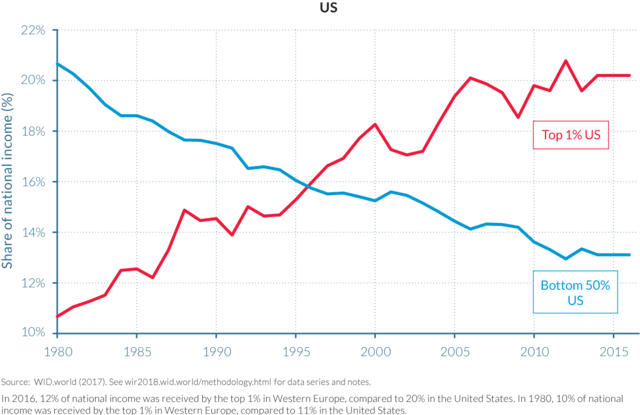
Two big conceptual mistakes are hidden in one small graph that help the leftist delusion.

1. I do not contest the data. I have not checked them. They may be correct. I don’t know; I have another purpose.

2. People who use this graph (though not the makers of the graph, maybe) implicitly assume that those who were in the top income 1% in 1980 are the same as those who are in the top 1% in 2016, or their parents.  The graph says nothing about this. One thing is clear: Steve Job or his parents would not have been in the top 1% in 1980; Steve Jobs would have been, for sure, in 2010, his estate in 2016. The graph does not show the perpetuation of privilege and of inequality, as users almost always imply. Suppose that 100% of those who were in the 1% in 2016 were not (or their parents, or their grandparents) in 1980. This would show a fast change of economic elites. It might pose a problem but not the problem the envious imply when they display the graph.

noldelacroixsharesofincome

The problem here is intellectual passivity.

3. The percentage of income that accrues to a given fraction of the population – including the top 1%  – tells you nothing about how well anyone has fared economically, whether anybody is richer or poorer than he was at the beginning. Here is an example: Suppose, you and I both earn $1,000 at the beginning of the period of observation. Thus, we each get 50% of our joint income (1000/2000). Suppose further that during the period observation, my income doubles while yours quadruples, I am now getting only 33% while you are getting 66% (2000/2000+4000 vs 4000/2000+4000). My share in percentage terms has declined while yours has ballooned. Question: Am I now poorer than I was at the beginning of the period? That’s a “Yes/No” question.; don’t equivocate. The problem is here is failure to understand elementary school math.

The chart is produced by the World Inequality Organization, a single purpose outfit not dedicated to the possibility that inequality may be decreasing. The data it offers have not been certified by the usual scholarly processes  This organization’s executive committee includes Thomas Piketty who could not get his data straight in his best-selling book. He had to refer critics to a website to get his story down. The earlier edition of the same book became famous for not including in US calculations: food stamps, rent support, free medical care, and more, in US welfare recipients’ incomes. I don’t know the others, which may or may not matter. Too many Europeans for my taste. I don’t like it, from 40 years of observation. That last remark is somewhat subjective, of course.

Together these simple comments add up to this critical judgment of the relevant chart: Either, those who use it normally don’t know what they are talking about or, they are not saying anything that matters.

Jacques the Moron

The verbal assaults against Pres. Trump, both oral and printed, have become almost mechanical. The concerted attempt to make his presidency seem illegitimate has largely become successful for much of the America population thanks to this systematic demeaning of the man. The above-board conspiracy has mostly won. I am not referring to criticism of Mr Trump’s policies based on facts and analysis. That’s fine and necessary, of course. (I have done some of this myself, right on my FB and on this blog.) I refer to personal attacks. Individuals with zero achievements, many demonstrable morons themselves, routinely call the president a moron. (I am not making this up; I could name names; perhaps I will, right here.)

When opponents are not content with opposing President Trump but insult him too, they also insult me. I voted for Mr Trump for the same reasons million others did. First, his name was not Clinton; second, I thought it was important to seize the chance to appoint a conservative Supreme Court Justice (or two). Since he has taken office, Mr Trump has surprised me pleasantly. There is no doubt in my mind that the current general American prosperity has a great deal to do with his policies, beginning with the general tax cut. Incidentally, I am well aware of the fact that the drop in unemployment began with the Obama administration. Another administration might have stopped it, or slowed it down. So, I have had two years to recant my vote. I have not. If you call the man I voted for a moron; you are calling me a moron.

I am not inclined to be indulgent with respect to the insult because I believe I know where it comes from thanks the many hours I spent at the faculty club. It’s a social class reaction; it’s the offended retort of those who think they are superior because they have read three books. It’s the cry of anguish of the semi-washed against the great unwashed (the “deplorables” in Mrs Clinton precise and unforgettable formula). Those who insult Pres. Trump, and therefore, me, are elitists with little reason to consider themselves an elite of any kind. Obviously, those who merely oppose his policies don’t need to call him names; they just have to describe that which they object to.

The daily name calling is wearying. It will leave a mark on my soul. I am far from sure that I will find it in me to forgive, or if I will ever forget. I think a ditch has been dug that will not be filled.

The Yellow Vests: Update

In the ninth weekend of demonstrations, the politics of envy seem to dominate. (Soak the rich again!) The Government must give us more money. Lower some taxes but impose or re-impose others especially the former tax on wealth.

Far behind: Introduce a degree of popular initiative in the political process: allow groups of citizens to initiate legislation, to implement it, and to abrogate it.

I can’t tell if those who want more money are the same as those who demand popular initiative in legislation. It’s a problem with grass root movements. They make attribution difficult.

Pres. Macron’s response is all over the place. It sounds like the work of an old man although the pres. is only 41. I think I know why this is: Nearly all the past thirty presidents and prime ministers are graduates from the one same school. Maybe they just crib the class notes of their predecessors.

Notably, Mr Macron’s response – contained in an open letter – to the nation includes more “save the Planet” proposals as if he had forgotten that an environmentalist tax set the barrels of powder on fire to begin with. Little chance he will be heard by the Yellow Vests although his open letter may serve to rally the main part of the population around him as the lesser of several evils.

Notably, the president, on his own, mentioned the possibility of limiting immigration although that’s not high in any of the Yellow Vests demands. Curious.

The president’s proposed themes are supposed to be debated widely and on a national scale. They are expected to give rise to suggestions on how to govern France. The suggestions will be collected at the municipal level (a good idea; the French like their mayors) in complaint books called “cahiers de doléances.” The latter sounds to me like a very bad idea. The last time those words were used on a large scale, was around 1788-89. The ruling circles lost their heads soon afterwards. (I mean literally.)

Keep things in perspective: If you add all the demonstrators nationally in every town any Saturday, you arrive at a very small number although it’s made up of persistent people . They are persistent because they represent a large minority facing serious, possibly unsolvable problems. Many ordinary French people have grown weary of the disruptions the Yellow Vests have caused. There is also huge revulsion against the acts of violence that accompany Yellow Vests demonstrations (not necessarily their own acts).

Cool heads counsel the president to dissolve the National Assembly and to call for new elections. Supposedly, this would bring up elected representatives more in tune with the people’s mood. My own guess is that new elections would result in the isolation of the Yellow Vests and bring an end to their movements. Just guessing.

Did I forget anything?

Immigration: Not Opinions, Facts

Immigration is in our newspapers and on our screens every day. Yet, between the factual confusion of most Republicans and the insult-laden cheery irresponsibility of Democrats, little of substance is being said. Here are two central facts that are routinely ignored:

1 In practice, there is no legal path to immigration for 95% + of illegal immigrants. Asylum is a possibility for a tiny number among them. Poverty is not currently grounds for asylum. (See reference below.)

2 A forty year-old single immigrant from India with an engineering degree is unlikely to take more out of the public trough than he puts in. He is also very unlikely to commit a serious crime, especially a serious crime of violence. Now, consider younger immigrants from Central America, who have have few or no skills, who don’t know English, who may be semi-literate, or even illiterate in their own language. If they are female, they will probably cause a draw on the public treasury, if nothing else by sending to school children with special (linguistic) requirements, while contributing little to the financial maintenance of the same schools. That’s the optimistic case, where the children are healthy and normal.

If they are male, they will add to American crime, especially to violent crime because that’s the way it works: Younger, poor men, of no or low literacy are responsible for almost all of the violent crime in America. Note that this pronouncement does not contradict the findings of the excellent article by Michael T. Light and Ty Miller “Does Undocumented Immigration Increase Violent Crime?” published in the Journal Criminology, March 18th 2018. The study on which they report finds that an influx of illegal immigrants does not correspond to a higher crime rate. (Note: It’s a good study by any criteria – I am credentialed to judge.)

The point – beyond the sterile debate about immigrants’ crime rates – is that immigrants of the “right” (wrong) characteristics do not replace the native born one-for-one, including in the commission of crimes. They contribute their own deeds. Take the young California police officer named Singh who was murdered by a crime recidivist illegal alien in early 2019. If Officer Singh had not encountered his particular illegal alien killer, does anyone think that a citizen, or a legal alien would have stepped in to murder him?

This is an abstracted summary from my longer, informational essay on immigration: “Legal Immigration Into the United States.”

Pres. Trump and Me After Two years

I voted for Donald Trump for two clear reasons. First, his name is not Clinton. Second, he promised to nominate Supreme Court Justices from a published list of conservative judges. I have been amply satisfied on both counts.

Accomplishments

Then, I watched pleasantly surprised as the Trump administration engineered a tax reform that could only improve economic growth. Then, it quickly dismantled hundreds of federal regulations, a strategy that could only benefit entrepreneurship and business activity. Sure enough, there was a sudden rise in Gross Domestic Product growth. I don’t have any proof of causality here but the temporal coincidence is gratifying! At the same time, the unemployment rate – which had been going down even in the waning days of the Obama presidency, it’s true – continued to nosedive. It reached an all-time low for African Americans and for Hispanics. That fact illustrated nicely the basic conservative idea that results count more than intentions. (Remember, that Adam Smith wrote the same in 1776 but who reads Adam Smith nowadays?)

Soon, there was the blessed withdrawal from the comedy of the Paris climate “accord.” Then, there was the abrogation of the weak-kneed, poisonous agreement (not a “treaty) with the totalitarian and aggressive Islamic Republic of Iran. I applauded both with both hands. I was pleasantly surprised later by the initiative toward North Korea although I reserve judgment because nothing much has actually been accomplished on that front, except, possibly (possibly) a better mood. I do think President Trump has gone farther on the road to disarming that kingdom of cruelty and madness than any previous president. Yet, Continue reading

Twelve Things Worth Knowing According to Jacques Delacroix, PhD, Plus a Very Few Brain Food Items.

Note: I wish you all a prosperous, healthy, and writerly year 2019. (No wishes for happiness, it will come from all the above.)

I have a French nephew who is super-smart. Not long after graduating from the best school in France, he moved to Morocco where he married a super-smart Moroccan woman. He is so smart that he asked me for my intellectual will before I depart for another planet. It’s below.

Here are my qualifications: I taught in universities for thirty years, including twenty-five years in a business school in Silicon Valley. My doctorate is in sociology. (Please, don’t judge me.) My fields of specialization are Organizational Theory and the Sociology of Economic Development. My degree is from a very good university although I am a French high school dropout. My vita is linked here (pdf). Its academic part is respectable from a scholarly standpoint, no more. There is much additional info in my book: I Used to Be French: an Immature Autobiography, available from me, and on Amazon Kindle, and in my electronic book of memoirs in French: “Les Pumas de grande-banlieue: histoires d’émigration”, also on Amazon Kindle.

1. When the facts don’t fit your perspective you should change …. ? (Complete sentence.)

2. One basic complex idea worth knowing that resists learning: natural selection.

Note: the effective mechanism involved is multi-generational differential reproduction. You don’t understand natural selection until you can put a meaning on all three words.

3. Another basic idea worth knowing, a counter-intuitive one, that also resists learning: the principle of Comparative Advantage: If you are not working at what you do the very best, you are impoverishing me. There is a ten-lesson quick course on my blog to explain this. Look for short essays with the word “protectionism” in the title. A longform version can also be found, here.

4. Taking from the poor is a stupid way to try to become rich when you can invent a new world – like Steve Jobs – and be immensely rewarded for it. Or open a decent restaurant and be well rewarded, or learn welding. There isn’t much you can take from the poor anyway because they are poor. Plus, the bastards often resist!

5. Culture is in the heads (plural). Everything else isn’t “culture.”

6. How a body of people act is not simply the addition of the thinking of its individual human members. (There is a sociology!)

7. Beware those pesky fractions. Quick test: Five years ago, my income was 40% of yours. Now, my income is only 20% of yours. Am I earning less than I did five years ago?

8. Correlation is not causation but there is no causation without some sort of correlation.

9. Statistical significance is significant even if you don’t quite know what it signifies. Find out. It’s not hard.

10. Use statistical estimation methods even if you don’t understand them well. It will improve your reasoning rigor by confronting you brutally with the wrongness of your guesses. And you can only become better at it with practice.

11. There is not text that’s not improved by extirpating from it half of all adjectives and adverbs.

12. Reading is still the most efficient way to improve your comprehension of the world.

It seems to me that if you understand these twelve points inside out, you are well above average in general culture; that’s even true on a global scale.

Below are some intellectual anchoring points of my life. They are subjectively chosen, of course. Don’t lend them too much credence.

My favorite singer-composers: Jacques Brel; the Argentinean Communist Atahualpa Yupanqui. (I can’t help it.)

My favorite instrumental musics: baroque music, the blues.

My favorite painters: Caravaggio (link); Delacroix (Eugene); Delacroix (Krishna).

I don’t have a favorite book because I read all the time without trying to rank books. These three books have made a lasting impression, changed my brain pathways forever, I suspect: Daniel Defoe, Robinson Crusoe; George R. Stewart, Earth Abides; Eric Hoffer, The True Believer: Thoughts on the Nature of Mass Movements.

The only two intelligent things I have said in my life:

“Once you know a woman well vertically, you know nothing about her horizontally.”

“There is not bad book.”

Legal Immigration Into the United States (Part 20): Transitional Measures and Conclusions

We must recognize than any orderly system used to select and admit immigrants involves a degree of bureaucratic slowness. Hence, the existing family preference-based program would have to be extended for several years, maybe as long as ten, while accepting no more new applications. It’s likely that the compromise solution would even have to be some sort of measure that guarantees that the last direct descendants and direct ascendants of existing immigrants have been accommodated.

To remedy the labor rigidity consequent on the abolition of family preference as the primary source of admission, the US might re-instate a new version of the 1942-1964 bracero program. I refer to a system of admission of temporary contractual workers guaranteed a minimum wage and decent living conditions by employers for a stated period. Temporary immigrants admitted in this manner would have no expectation of permanent admission to the US. The problem of “stay-overs” could be solved through a conventional bonding system. (I am puzzled about why bonding has not yet been tried in connection to immigration.) The work sojourns would have to be made renewable in law so that the US might preserve the option of keeping temp. workers who had acquired valuable and rare skills during, or even before their first, or following stay in-country. In exceptional cases, temp. workers in such a program could be channeled to the new F-1B program, perhaps with credit given for experiences working in the US and for cultural adjustment.

Conclusions

In summary: I deplore two features of current public discussions of legal immigration: They are ill-informed to an astonishing degree; and, they are often crude, lacking in both subtlety and imagination, like an argument between two people who keep cutting each other off. Unless one formulates a systematic alternative to the current system, one squarely separating immigration based on altruism from merit-based immigration, immigration based on the expected immigrants contributions to American society, the helter-skelter liberal project will continue to prevail. It is now prevailing by default in the minds of  most Americans. Those who have the energy to resist it too often limit their response to a blind “No!”In the end,  if no countervailing project emerges forcefully, we will witness the establishment of a statist one-party system in the US. Libertarians, among others, should hurry to confront their close friends and relatives who toy with the dangerous delusion of open borders.

[Editor’s note: in case you missed it, here is Part 19; you can also read the entire essay at the “LongForm Essays” section of the blog.]

Legal Immigration Into the United States (Part 19): How to Go About It

Admitting immigrants legally for the benefit of American society need not be bureaucratically demanding. The existing H-1B visa program could fairly easily be turned into a merit system. It would require only minor tweaking. The main tweak would be to forbid or, at least, to restrict severely employers’ reliance on labor contractors through which most of the abuses occur, I believe. (See, for example, the infamous Disney case, described below.) Let each employer applying for such visas be squarely on record as vouching for the individual beneficiaries’ quality.

Following the example of Canada, some degree of priority could be assigned to obvious contributions to successful adaptation to American society, beginning with knowledge of English. (This might actually require a new law making English the official language of the US.) I listed above other examples of immigrants features that might be scored positively. Note again that avoiding the drawbacks of a completely relative-based system does not necessarily imply the rejection of the simple idea that having relatives in the country often facilitates adjustment. Within the framework of a H-1B-type point system, some degree of preference could be assigned to the fact that the beneficiary has relatives in the US close to where he will first settle. This would not be family re-unification under a different guise because family relations would be subordinate to work capabilities and other features facilitating adaptation.

The next necessary tweak has to do with the fact that the H-1B program has a bad reputation among the unemployed and  the uncertainly employed. So, in 2016, the Walt Disney company was sued, famously for having American workers train their F-1B visa replacements before they were laid off. The suit was dismissed by reason of what I think was a big loophole in the protective measures in favor of American workers in connection with the H-1B program. No one denied that Disney had done what it was accused to have done. Many believe furiously that the program actively discriminates against American workers and keeps their wages low. To make it more acceptable, the existing H-1B safeguards against noxious practices undermining the employment of the American-born and of legal resident immigrants would have to be widely publicized and remedies against abuses would have to be made judicially more accessible than they are now.

The American public would also have to be ready for the predictable consequences of merit policies in terms of culture and in terms of politics. The merit-based program I envisage would result quickly in a large increase in Indian immigration. Although Indians have been very good immigrants by most counts, there might be objections because nearly all of them seem to suck some form of leftism or other with their mother’s milk. In addition, and although India is often celebrated as the “world largest democracy,” there is some question about educated Indians’ attachment to the constituent forms of historically Western democracy, specifically. (I am a small-time expert on this because I read items in and through the Indian press and because I have Indian relatives. They are a tiny biased sample, of course but also an informational gateway of sorts. See also India-born commentator Jayant Bhandari in the October 5 2017 issue of Acting Man: “Canada: Risks of a Parliamentary Democracy.”)

This problem and others like it could be mitigated by placing a numerical ceiling on the total number of immigrants from any one country. I predict informally that this particular problem would turn out to be limited because, once the gates of legal immigration opened for real, there would be a sharp increase in applications from European countries with democratic systems similar to ours. This too would have consequences: As I have pointed out, by and large Europeans are not shy about using any form of welfare, broadly defined, including unemployment benefits. I note shyly that placing a ceiling on the contribution of any one nation-state to US immigration would seem “fair” to liberal opinion, making the whole project more acceptable than would otherwise be the case.

Incidentally, a reasonable merit-based system, aimed as it would at foreigners of some competence, might produce additional revenue to help defray both the cost of better enforcement of immigration laws, and the cost of caring for people admitted on altruistic grounds.

[Editor’s note: in case you missed it, here is Part 18]

Legal Immigration Into the United States (Part 18): Reforms I Would Favor

Now, here is what I, personally, a US citizen and an appreciative immigrant, as well as a small government conservative, would like to see happen: As I pointed out before, most liberals and quite a few conservatives perceive allowing all immigration as a sort of altruistic gesture. That includes those who do not overtly call for open borders but whose concrete proposals (“Abolish ICE.”) would result in a soft state that would provide the equivalent of open borders. As far as I can tell – with the major exception of Tabarrok, discussed above – many pure libertarians whisper that they are all for open borders, but they only whisper it. I speculate that they are forced to take this principled but unreasonable position to avoid having to defend the nation-state as a necessary institutional arrangement to control immigration.  Frankly, I wish they would come out of the closet and I hope this essay will shame some into doing so.

The most urgent thing to my mind is to separate conceptually and bureaucratically with the utmost vigor, immigration intended to benefit us, American citizens and lawfully admitted immigrants, and beyond us, to promote a version of the American polity close to the Founders’ vision, on the one hand, from immigration intended to help someone else, or something else, on the other. The US can afford both but the amalgam of the two leads to bad policies. (See, for example the story “The Refugee Detectives: Inside Germany’s High-Stake Operation to Sort People Fleeing Death…” by Graeme Wood in The Atlantic, April 2018.)

Next, I think conservatives should favor, for now, an upper numerical limit to immigration, one pegged perhaps to the growth of our domestic population. Though my heart is not in it, it seems to me that this is a prudent recommendation in view of the threatening prospect of a Democratic one-party governance.

The first category of immigrants would be admitted on some sort of merit basis, as I said, perhaps a version of the system I discuss above. The second category would include all refugees and asylum seekers, and, to a limited extent, their relatives. Given a strictly altruistic intent in accepting such people, Congress and the President jointly would be in a better position than they are today to apply any strictures at all, including philosophical and even religious tests of compatibility with central features of American legal and philosophical tradition – if any. (Of course, in spite of the courts’ interventions in the matter, I have not found the part of the Constitution that forbids the Federal Government from barring anyone it wants, including on religious grounds. Rational arguments can be made against such decisions but they are not anchored in the Constitution, I believe. (See constitutional lawyers David B. Rivkin and Lee A. Casey’s analysis: “The Judicial ‘Resistance’ is Futile” in the Wall Street Journal of 2/7/18.)

I think thus both that we could admit many more people seeking shelter from war and other catastrophes than we do, and that we should vet them extensively and deeply. We could also rehabilitate the notion of provisional admission. Many of the large number of current Syrian refugees would not doubt like to go home if it were possible. Such refugees could be given, say, a five-year renewable visa. As I pointed out above, some beliefs system are but little compatible with peaceful assimilation into American society. This can be said aloud without proffering superfluous insults toward any group.  National hypocrisy does not make sense because it rarely fools anyone. In general, I think all American society has been too shy in this connection, too submissive to political correctness. So, think of this example: French constitutions, most of the fifteen of them anyway, proclaim the primacy of something called “the general interest,” a wide open door to authoritarian collectivism if there ever was one. There is no reason to not query French would-be immigrants on this account. I would gladly take points off for answers expressing a submissiveness to this viewpoint. (Yes, I am one of those who suspect that the French Revolution is one of the mothers of democracy but also, of Communism and of Fascism.)

Similarly Muslim religious authorities as well as would-be Muslim immigrants could be challenged like this: Just tell us publicly if Islamic dogma welcomes separation of religion and government. State, also in public, loudly and clearly that apostasy does not deserve death, that it deserves no punishment at all. Admission decisions would be a function of the answers given. Sure, people would be coached and many would cheat but, they would be on record. The most sincere would not accept going on record against their doctrine. Sorry to be so cynical but I don’t fear the least sincere!

The underlying reasoning for such policies of exclusion is this: First, I repeat that there is no ethical system that obligates American society to commit suicide, fast or slowly; second, probabilistic calculations of danger and of usefulness both are the only practicable ones in the matter of admitting different groups and categories. (I don’t avoid jumping from planes with a parachute because those who do die every time they try but because they die more often than those who don’t.) Based on recent experience (twenty years+), Muslims are more likely to commit terrorist acts than Lutherans. (It’s also true that there is a very low probability for both groups.) Based on common sense and the news, most Mexicans must have acquired a high tolerance for political corruption. Based on longer experience, many Western Europeans have extensive and expensive expectations regarding the availability of tax supported welfare benefits. Based – perhaps- on one thousand years of observation, the Chinese tend to favor collective discipline over individual rights more than Americans do. (See my: “Muslim Refugees in perspective.”)

Pronouncing aloud these probabilistic statements does not shut off the possibility of ignoring them because immigrants from the same groups bring with them many improvements to American society, of course. I could easily allow a handful of well chosen French chefs to come in despite of their deep belief in the existence of a common public interest. I even have a list ready. Admitting facts is not the same as making decisions. I can also imagine a permanent invitation to anyone to challenge publicly such generalizations. It would have at least the merit of clearing the air.

Last and very importantly: Invalidating the generalizations I make above, to an unknown extent, is the likelihood that immigrants are not a true sample of their population of origin: Chinese immigrants may tend to have an anarchist streak; that may be the very reason they want to live in the US. Mexicans may seek to move to the US precisely to flee corruption for which they have a low tolerance, etc. The French individuals wishing to come to the US may be trying to escape the shadow of authoritarianism they perceive in French political thought, etc.

[Editor’s note: in case you missed it, here is Part 17]

Legal Immigration Into the United States (Part 17): Merit-Based Immigration and Other Solutions

The long-established numerical prominence of immigration into the US via family relations makes it difficult to distinguish conceptually between legal immigration responding to matters of the heart and immigration that corresponds to hard economic, and possibly, demographic facts. The one motive has tainted the other and vice-versa. The current public discussions (2016-2018) suggest that many native-born Americans think of immigration as a matter of charity, or of solidarity with the poor of this world, as in the inscription at the foot of the Statue of Liberty: “Give me your tired, your poor, your huddled masses yearning to breathe free,….”  Many Americans accordingly perceive as hard-hearted those who wish to limit or reduce immigration. Inevitably, as whenever the subject of hard-heartedness emerges as a topic in politics, a Right/Left divide appears, always to the detriment of the former.

It seems to me that conservatives are not speaking clearly from the side of the divide where they are stuck. They have tacitly agreed to appear as a less generous version of liberals instead of  carriers of an altogether different social project. Whatever the case may be, the politically most urgent thing to do from a rational standpoint is to try and divide for good in public opinion, immigration for the heart and immigration for the head, immigration for the sake of generosity and immigration for the benefit of American society. Incidentally, and for the record, here is a digression: I repeat that I believe that American society has a big capacity to admit immigrants under the first guise without endangering itself. That can only happen once the vagueness about controlling our national boundaries has dissipated. Such a strategy requires that the Federal Government have the unambiguous power to select and vet refugees and to pace their admission to the country.

“Merit” Defined

In reaction to the reality and also, of to abuses associated with the current policy, a deliberate, and more realistic doctrine of immigration has emerged on the right of the political spectrum. It asks for admission based on merit, partly in imitation of Australia’s and Canada’s. Canada’s so-called “Express Entry System” is set to admit more than 300,000 immigrants on the basis of  formally scored merit in 2118. That’s for a population of only about 37 million. The central idea is to replace the current de facto policy favoring family relations as a ground for admission, resulting in seemingly endless “chain migration,” with something like a point system. The system would attempt scoring an immigrant’s potential usefulness to American society. In its simplest form, it would look something like this: high school graduate, 1 point; able to speak English, 1 point; literate in English, 1 more point; college graduate, 2 points (not cumulative with the single point for being a high school graduate); STEM major, 2 points; certified welder, 2 points; balalaika instructor, 2 points. Rocket scientist with positive record, 5 points.  Certified welder, 10 points.

The sum of points would determine the order of admission of candidates to immigration into the US for a set period, preferable a short period because America’s needs may change fast. With the instances I give, this would be a fair but harsh system: Most current immigrants would probably obtain a score near zero, relegating them to eternal wait for admission.

There are two major problems with this kind of policy. First, it would place the Federal Government perilously close to articulating a national industrial policy. Deciding to give several point to software designers and none to those with experience running neighborhood grocery stores, for example, is to make predictions about the American economy of tomorrow. From a conservative standpoint, it’s a slippery slope, from a libertarian standpoint, it’s a free fall. Of course, we know how well national industrial policies work in other countries, France for example. (For 25 years, as a French-speaking professor on the spot, visiting French delegations to my business school would take me aside; they would buy me an expensive lunch and demand that I give away the secret of Silicon Valley. First, create a first rate university, I would answer meanly…)

Second, the conceit that a merit-based system of admission, any merit-based system, is an automatic substitute for the family reunion-dominated current policy is on a loose footing. Suppose, a Chinese woman receives top points in the new system as a world-class nuclear scientist whose poetry was nominated for a Nobel in literature. She walks right to the head of the line, of course. But she is married and she and her husband have three children. Can we really expect her to move to the US and leave her family behind? Do we even want her to, if we expect her to remain? Does anyone? Then, the woman and her husband both turn out to be busy as bees and hard workers, major contributors to the US economy, and to American society in general. (They are both also engaged in lively volunteering.) So, they need help with child care. The husband’s old but still healthy mother is eager and willing to come to live with the couple. She is the best possible baby-sitter for the family. The problem is that the old lady will not leave her even older husband behind. (And, again, would we want her here if she were the kind to leave him?)

Here you go, making ordinary, humane, rational decisions, the merit-based admission of one turns into admission of seven! And, I forgot to tell you: Two of the kids become little hoodlums, as happens in the best families in the second generation. They require multiple interventions from social services. They will both cost society a great deal in the end. In this moderate scenario, the attempt to rationalize immigration into a more selfish policy benefiting Americans has resulted in a (limited) reconstitution of the despised chain immigration, with some of the usual pitfalls.

The arguments can nevertheless be made that in the scenario above, the new merit-based policy has resulted in the admission of upper-middle class individuals rather than in that of the rural, poorly educated immigrants that the old policy tended to select for. This can easily be counted as a benefit but the whole story is probably more complicated. In the exact case described above, the US did replace lower-class individuals with upper-middle class people but also with people possibly of more alien political culture, with consequences for their eventual assimilation. I mean that all Mexicans tend to be experts in Americana and that our political institutions are familiar to them because theirs are copy-cat copies of ours. I surmise further that Mexicans are unlikely from their experience to expect the government to be mostly benevolent. Moreover, it seems to me the children of semi-literate Mexicans whose native language is fairly well related to English and uses the same alphabet, are more likely to master English well than even accomplished Chinese. This is a guess but a well-educated teacher’s guess. (I don’t think this  holds true for the grand-children, incidentally.) Of course, if my argument is persuasive, there would be a temptation to down-score candidates just for being Chinese, pretty much the stuff for which Harvard University is on trial as I write (October 2018).

I described elsewhere how the fact of having relatives established in the country facilitates installation and economic integration, even as it may retard assimilation. Note that a point system does not have to forego the advantages associated with family relationships. Such a system can easily accommodate family and other relationships, like this: adult, self-sufficient offspring legally in the US: 3 points; any other relation in the US: 1 point; married to a US resident with a welder certification: 15 points, etc.

[Editor’s note: in case you missed it, here is Part 16]

Legal Immigration Into the United States (Part 16): Toward a One-Party System?

There exists a prospect that continued immigration of the same form as today’s immigration could provide the Democratic Party with an eternal national majority. The US could thus become a de facto one-party state from the simple interplay of demographic forces, including immigration. There are three potential solutions to this problem, the first of which is seldom publicly discussed, for some reason. As the European Union has been showing for thirty years or so, residence in a particular country should not necessarily imply citizenship, the exercise of political rights, in the same country. Ten of thousands of Germans live permanently in France and in Spain. They vote in Germany. (In July 2018, a German woman, thus a citizen of the European Union, who had lived and worked in France for 25 years, and with a French citizen son, was denied French citizenship!) This arrangement, separating residency from citizenship, seems to pose no obvious problem in Europe. (Nikiforov and I discussed this solution in our article in the Independent Review.)

Curiously, in the current narrative, there are no loud GOP voices proposing a compromise with respect to some categories of illegal aliens, I mean, legalization without a path to citizenship. This is puzzling because this is precisely what many illegal aliens says they aspire to. Latin Americans and especially Mexicans frequently say they want to work in the US but would prefer to raise their children back home. (See, for example the good descriptive narrative by Grant Wishard, “A Border Ballad” in the Weekly Standard, 3/9/18.) The simple proposition that easy admission could go with no path to citizenship has the potential to transform immigration to the US, to dry up its illegal branch, and to facilitate border control to a great extent. Yet, there is no apparent attempt to wean immigrants away in this fashion from their Democrat sponsors. The GOP does not seem to have enough initiative to try to reach agreement with immigrant organizations on this basis thus by-passing the Democratic Party. Again, the silence concerning this strategy is puzzling.

In early 2018, President Trump seems to be seeking an answer to the problem of a permanent Democratic takeover by combining the two next solutions. First, would come a reduction in the absolute number allowed to immigrate. Fewer immigrants, fewer Demo voters, obviously. Small government conservatives like me, and rational libertarians also, might simply want to favor reduced immigration as the only sure way to avoid a one-party system even as we believe in the economic and other virtues of immigration.

The second conceptual solution consists in the broad adoption of so-called “merit-based” immigration. There is an unspoken assumption that a merit-based system would produce more middle-class immigrants and, therefore more conservatively oriented immigrants. This assumption is shaky at best. The example of  much of the current high-tech Indian immigrants  is not encouraging in this respect. More generally, immigrants with college degrees, for example, might turn out more solidly on the left than the current rural, semi-literates from underdeveloped countries who are also avid for upward mobility. The latter also frequently are religious, a condition the Democratic Party is increasingly apt to persecute, at least implicitly. At any rate, reducing the absolute size of immigration carries costs described throughout this essay and merit-based immigration is no panacea, as explained below. I fear that some significant trade-offs between political and other concerns are going to be implemented without real discussion.

[Editor’s note: in case you missed it, here is Part 15]