- Four types of labor and the epidemic Branko Milanovic, globalinequality
- Republicans, Democrats, and coronavirus Ronald Brownstein, Atlantic
- War with Iran: Regrets only Irfan Khawaja, Policy of Truth
- Taiwan’s robust constitutionalism and coronavirus Wen-Chen Chang, Verfassungsblog
Year: 2020
Nightcap
- Keith Hart (economic anthropologist), RIP Cultural Anthropology
- Do you feel lucky, punk? Robin Hanson, Overcoming Bias
- From nation-states to interstellar civilization Nick Nielsen, Grand Strategy Annex
- “Under the Virus’s Cloak, Trump Pursues Long-Sought Policies” NYT
Nightcap
- The Use of Knowledge in Society F.A. Hayek, American Economic Review
- On conservative nationalism and foreign policy Emma Ashford, War on the Rocks
- Europe’s ‘solidarity’ crumbles in the face of a crisis Kai Weiss, CapX
- Bigger Brother: surveillance capitalism Tim Wu, New York Review of Books
Never reason from a fatality rate
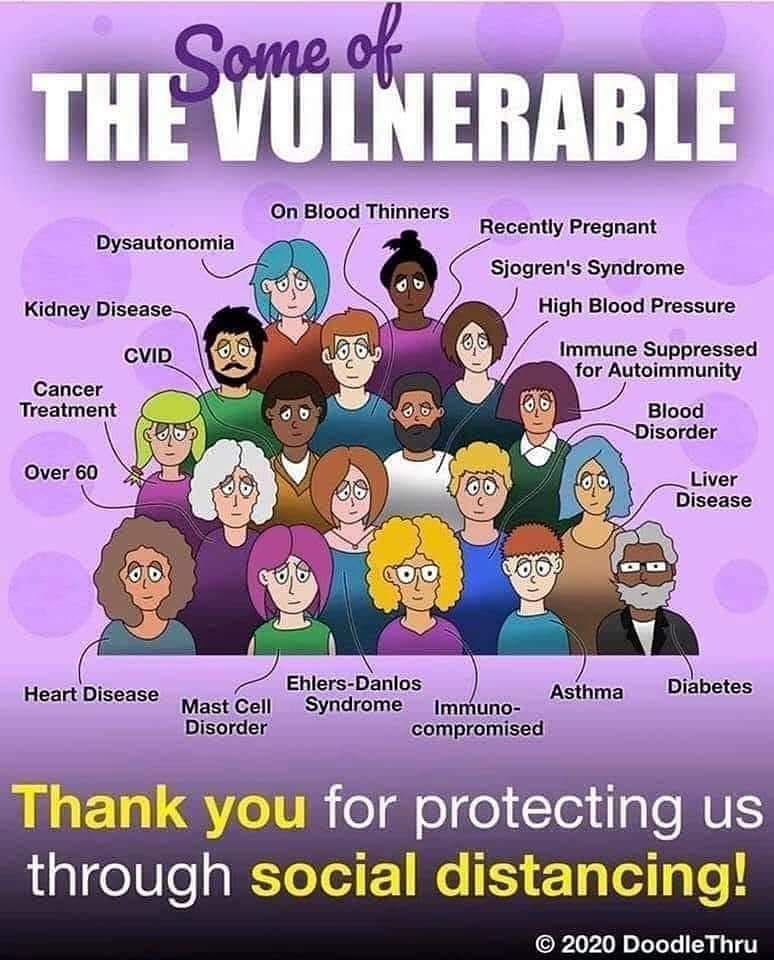
Richard Epstein has produced several posts and a video interview arguing that the mainstream media is overreacting to the Coronavirus pandemic. Richard understands the potential seriousness of this situation and the proper role of government. He recognises the value of the Roman maxim Salus populi suprema lex esto – let the health of the people be the highest law. In public health emergencies, many moral and legal claims resulting from individual rights and contracts are vitiated, and some civil liberties suspended.
Nevertheless, along with Cass Sunstein, Richard claims that this particular emergency is likely to be overblown. His justification for this is based on data for infection and fatality rates emerging from South Korea and Singapore that appear (currently) under control with only a relatively small proportion of their population infected. This was achieved without the country-wide lockdowns now being rolled out across Europe. Extrapolating from this experience, Richard suggests that the Coronavirus is not too contagious outside particular clusters of vulnerable individuals in situations like cruise ships and nursing homes.
The line of argument is vulnerable to the same criticism that one should never reason from a price change. The classic case of reasoning from a price change is reading oil prices as a measure of economic health. When oil prices drop, it could herald an economic boom or, paradoxically, a recession. If the price dropped because supply increased, when OPEC fails to enforce a price floor, then that lower price should stimulate the rest of the economy as transport and travel become cheaper. But if the price drops because economic activity is already dropping, and oil suppliers are struggling to sell at high prices, then the economy is heading towards a recession. The same measure can mean the opposite depending on the underlying mechanism.
The same logic applies to epidemics. The transmission rate is a combination of the (potentially changing) qualities of the virus and the social environment in which it spreads. The social environment is determined, among other things, by social distancing and tracking. Substantial changes in lifestyle can have initially marginal, but day after day very large, impacts on the infection rate. When combined with the medium-term fixed capacity of existing health systems, those rates translate into the difference between 50,000 and 500,000 deaths. You can’t look at relatively low fatality rates in some specific cases to project rates elsewhere without understanding what caused them to be the rate they are.
Right now, we don’t know for sure if the infection is controllable in the long run. However, we now know that South Korea and Singapore controlled the spread so far and also had systems in place to test, track and quarantine carriers of the virus. We also now know that Italy, without such a system, has been overrun with serious cases and a tragic increase in deaths. We know that China, having suppressed knowledge and interventions to contain the virus for several months, got the virus under control only through aggressive lockdowns.
So the case studies, for the moment, suggest social distancing and contact tracing can reduce cases if applied very early on. But more draconian measures are the only response if testing isn’t immediately available and contact tracing fails. Now is sadly not the time for half-measures or complacency.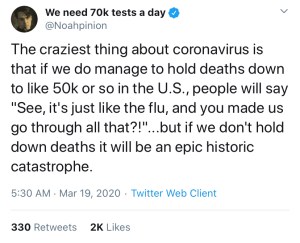
I believe that Richard’s estimated fatality rates (less than 50,000 fatalities in the US) are ultimately plausible, but optimistic at this stage. Perversely, they are only plausible at all insofar as people project a much higher future fatality rate now. People must act with counter-intuitively strong measures before there is clear and obvious evidence it is needed. Like steering a large ship, temporally distant sources of danger must prompt radical action now. We will be lucky if we feel like we did too much in a few months’ time. Richard believes people are more worried than warranted right now. I think that’s exactly how worried people need to be to adopt the kind of adaptive behaviors that Richard relies on to explain how the spread of infection will stabilise.
Nightcap
- Our cities, our selves Jason Jewell, Modern Age
- Waiting for the wave to break Chris Bertram, Crooked Timber
- Midcentury life in the Soviet Union Alex Halberstadt, Literary Hub
- Britain’s colonial crimes and trade Jamil Anderlini, Financial Times
Human Capital Diversification vs Pancake Mix
I went to the grocery store yesterday (late morning) expecting either business-as-usual or empty shelves. I was surprised to see both. I’m currently regretting not taking photos because it probably will be business-as-usual by the time I go back.
Some shelves were empty, and others were full. What I saw was a direct visualization of what my neighbors don’t know how to cook.
Going through my store I could see that my neighbors know how to put jarred sauce on pasta. But I saw the opportunity to blend some canned whole tomatoes and make my own sauce. “International” foods were largely untouched, but anything in the local culinary lexicon was sparse.
The whole Baking Needs aisle was basically fine, except for the pancake mix which was all gone. This is really the whole story. Who buys pancake mix? Culinary illiterates.
(Disclaimer: I’m a biased source when it comes to pancakes. I take pancakes as seriously as 75th percentile Bostonian takes the fact that the Yankees suck.)
It takes a modest amount of skill to make pancakes, but the ingredients are cheap and YouTube wants to help you. Now is a great time to up your pancake game. But even if you just follow the directions on any random pancake recipe you’re stirring together flour, salt, baking powder, sugar, eggs, oil, and milk.
The mix will either give you a crappy shelf-stable replacement for the eggs and/or milk (yuck!) or hold your hand as you stir together some powder with eggs, oil, and milk.
Thinking back to my career as an omnivore, I can recall a time when I’ve bought ingredients I really should have made. I’m not judging people who don’t know how to cook, because I’ve been there.
What I’m pointing out is that those people are always going to have the hardest time when it comes to food shortages. I’d be in the same boat if I was shopping at a store that didn’t sell the limited set of ingredients I know how to use.
There’s a tension in economics that we don’t pay enough attention to: gains from specialization vs. gains from diversification. At a system level (and in a Principles class) the two go together. But at the level of individual there is a lot to be said for diversification–you’re more robust to change, resilient in the face of problems, and perspectives gained in one domain may have lessons to apply to others.
I’m grateful I haven’t taken my own human capital specialization so far that I can’t make my own pancakes.
Seattle’s landlord regs at the Supreme Court
Landlords in Seattle must rent to the first person to walk in the door, so long as they check out on paper. This “first-in-time” rule has slogged through several years of litigation over whether the rule violates landlords’ constitutional rights (full disclosure–I represent the plaintiffs). That case, called Yim v. City of Seattle, has now crescendoed with a petition to the United States Supreme Court. The Court should seize the chance to decide two pressing questions about the Constitution’s role in protecting property rights: (1) if regulation destroys a fundamental attribute of property ownership–like the right to exclude, or the right to sell–does the regulation result in a taking that requires compensation? and (2) if a regulation is “unduly oppressive” of individual rights, does it violate due process?
The first-in-time rule is something of a novelty. The rationale behind the rule is to prevent implicit bias; a landlord can’t unconsciously discriminate if she doesn’t have any discretion to decide whom to rent to. Hence, the rule allows landlords to set pre-established criteria, though all criteria must have minimum thresholds (i.e., minimum credit score). The landlord cannot thereafter deviate from that criteria and must simply rent to the first person who qualifies, even if ten or fifteen applicants check all the boxes. After the landlord rents to the first comer, the lucky winner has 48 hours to sit on the offer, after which time the offer moves on to the next person in line.
The bottom line is that landlords can no longer make common-sense judgment calls about who will live on their property. The practical challenges that result are daunting, for small landlords in particular. A landlord cannot, for instance, deny an applicant because they feel threatened or unsafe when an applicant tours a unit. That’s a big deal for plaintiff Kelly Lyles, a single woman and sexual assault survivor. Or for MariLyn Yim, who owns a triplex and lives in one of the units with her husband and kids. They share a yard and common spaces with their tenants–compatibility and safety are key. And some of the Yims’ units have roommates, where the ability to select people that will get along and feel comfortable with each other is essential. But basic discretion is out the window with first-in-time. If Lois Lane advertises the fortress of solitude for rent and Lex Luthor shows up with his spotless credit score and seven-digit income, she’s out of luck.
And renting property often involves a give-and-take negotiation that’s no longer possible under the rule. Tom Riddle’s credit score is shabby, but he offers a two-year lease instead of one to make his application more appealing. Not under first-in-time. Pam Isley offers to do landscaping if the landlord drops rent by $50 a month. Nope. Nor can landlords offer leniency by deviating from their criteria because they want to give a second chance to someone down-and-out.
MariLyn Yim and Kelly Lyles sued on the theory that removing everyday discretion in this manner constitutes an unconstitutional taking and a violation of due process. They won at trial and lost before the Washington Supreme Court. Now, the questions they bring to the Supreme Court’s attention raise some fundamental questions about the Fifth Amendment’s takings clause and the Fourteenth Amendment due process guarantee.
The plaintiffs argue that a taking occurs when regulation destroys a fundamental attribute of property ownership. They invoke a well-known metaphor in property law: the “bundle of sticks.” Property is not really a single right–it’s a bundle of various rights that a person has with respect to a physical thing, such as the right to exclude others, the right to use the property, to occupy it, to sell it, and so on. Plaintiff’s theory is that each of these “sticks” in the bundle is entitled to independent constitutional protection; when one of those sticks is destroyed by regulation, that constitutes a taking of property as surely as a seizure of land. In this case, plaintiffs argue that denying them the right to decide who will occupy their property destroys their right to sell property to the person of their choosing and their right to exclude people not of their choosing.
This is an important and uncertain question under the Fifth Amendment. The Supreme Court has held in the past that a taking occurred where various attributes of property ownership were destroyed. For instance, when the United States required a marina to open a private lagoon to the public, the Supreme Court held a taking occurred because the government had destroyed the right to exclude, “one of the most essential sticks in the bundle of rights that are commonly characterized as property.” Likewise, the Supreme Court held that a taking occurred when Congress prohibited owners of tribal lands to pass on the property to their heirs, which was a “total abrogation” of a right that “has been part of the Anglo-American legal system since feudal times.”
The trouble is, though, that some other decisions of the Supreme Court can be read to refute this approach to takings. Hence, the city of Seattle argues that these takings precedents don’t represent the current state of takings law. This question thus presents an important opportunity for the Court to clarify the scope and meaning of the Fifth Amendment.
The second issue is no less compelling: does the oppressive impact of a law bear on whether it satisfies due process? The federal courts tend to answer yes, while a large number of state courts answer no. The Fourteenth Amendment’s due process clause imposes, at minimum, a floor of rationality–a law must be rationally related to a legitimate government interest. The question raised in the Yim petition asks the Court to address whether an unduly oppressive means (obliterating discretion) of achieving a legitimate government purpose (preventing discrimination) satisfies this threshold of rationality. The Supreme Court has repeatedly held that a law’s oppressive nature bears on whether the law is arbitrary or irrational. That is, a government has no legitimate interest in imposing oppressive laws on its people, and the use of oppression to achieve an otherwise legitimate government interest is arbitrary and irrational, in violation of due process.
The Washington Supreme Court, however, held that the U.S. Supreme Court had implicitly overruled this “unduly oppressive” analysis. It also overruled a whopping 61 of its own cases recognizing and applying this “unduly oppressive” test–so many that it provided a separate index of cases fed through the shredder. By joining a growing number of states that refuse to recognize that an unduly oppressive law violates the rational basis test required by due process, the Washington Supreme Court has teed up an important issue that warrants the U.S. Supreme Court’s attention.
These questions will grow in significance as government control of the rental market expands. Since enacting first-in-time, for instance, Seattle has imposed a ban on criminal background checks, a ban on winter evictions, a requirement that landlords rent to a tenant’s choice of roommate, and more. Other cities are enacting similar restrictions on landlord control over their own property. The U.S. Supreme Court should address the pressing constitutional questions that such regulations raise.
Nightcap
- Let’s have more audience-free debates Fred Kaplan, Slate
- Why the Natives usually sided with the British Jeffrey Ostler, Atlantic
- The case for shortening medical education Jain & Orr, Niskanen
- What’s buried in the coronavirus relief package? Billy Binion, Reason
Nightcap
- Why didn’t we see this coming? Scott Sumner, MoneyIllusion
- Against ageism Irfan Khawaja, Policy of Truth
- Expose the young Robin Hanson, Overcoming Bias
- Humility, not certainty Victor Davis Hanson, City Journal
Nightcap
- What holds China together? Ian Johnson, ChinaFiles
- Bernie Sanders was wrong about America Conor Friedersdorf, Atlantic
- Assessing the problems caused by the creation of America Mark Spencer, TLS
- Should we ration coronavirus testing by price? Tyler Cowen, MR
Coronavirus and the spirit of internationalism
Introduction
Iran has asked the International Monetary Fund (IMF) for emergency funding (it is for the first time since 1962 that Iran has sought IMF assistance) to fight the deadly Corona Virus outbreak (COVID19).
As of Saturday, March 14, 2020, Iran reported over 600 deaths (611) and over 12,000 cases arising out of the deadly virus. That makes Iran the third most affected country in the world after China and Italy. A number of prominent personalities, including the country’s Vice President (Eshaq Jahangari) and two other senior cabinet members, have contracted the virus.
On Wednesday, March 4, 2020, the IMF’s managing director, Kristilina Georgieva, stated that developing countries will be supported in their efforts to take on the Corona Virus through the Fund’s Rapid Financial Instrument. The IMF announced a $50 billion aid package with the aim of specifically assisting ‘low income’ and ‘emerging market’ economies. (On Monday, the World Bank had announced a $12 billion package to deal with the epidemic.)
Iran’s Central Bank chief, Abdolnaser Hemmati, said on Thursday that he had written to the IMF requesting $5 billion in emergency funding via the latter’s Rapid Financing Instrument. In a tweet on Thursday, the Iran’s Foreign Minister, Javad Zarif, urged the IMF to release this amount immediately. The Iranian Foreign Minister also said that Iran was facing a severe shortage of medicines and equipment. US sanctions on Iran, which have prevented it from selling oil or participating fully in the world’s financial ecosystem, have had a detrimental impact on the country’s economy. Iran, in a letter to the UN Secretary General Antonio Guerres, stated that US sanctions should be suspended keeping in mind the current crisis.
Iran’s apprehensions
Even if the IMF were to agree to releasing $5 billion for Iran, there are a number of obstacles that may result in Iran not being able to get the money from the IMF. First, the US is part of the IMF’s decision-making board (interestingly, in his tweet Zarif had stated that the IMF/IMF board should act responsibly) and even if the IMF agrees to disburse the amount, given the strains between Washington and Tehran it is quite possible that the US will veto such a move by the IMF. If Trump is willing to annoy US allies like the EU (on Wednesday, Trump took a decision to suspend flights from 26 Schengen countries to US, for a period of 30 days without consulting the EU), there is no reason why he will adopt a nuanced approach towards Iran.
Second, the Financial Action Task Force (FATF) has blacklisted Iran, which means that even if IMF agrees to provide the loan, banks and financial institutions can block such transactions.
Corona Virus is an opportunity for the US to exhibit statesmanship and maturity, and also lower tensions with Iran. While Trump has claimed to being open towards engaging with the Iranians, and seems to have changed his approach towards Tehran, he has not really exhibited much statesmanship in dealing with Tehran. Ever since the killing of Iranian General Qasem Soleiman (a major general in the Islamic Revolutionary Guard Corps) in a drone attack, in January 2020, ties went further downhill.
Opportunity for the US
This is an opportunity for the US to send a positive message to the international community, and to also distinguish between the Iranian public and its political class. China’s messaging with regard to helping the international community has been far better. On March 12, 2020, a team of Chinese doctors reached Italy (Italy, which is the most worst hit nation after China, had requested assistance from the latter). A number of Italian leaders have also criticised EU countries for being slow in reacting to Italy’s call for assistance.
Positive steps taken by China
What is also significant is that at a time when Washington and Beijing have been engaged in unnecessary mud-slinging with regard to the virus, with the US Secretary of State Mike Pompeo dubbing the Corona Virus as ‘Wuhan Virus’, and a senior Chinese diplomat responding by calling it a ‘conspiracy’ by the US army, on Friday March 13, 2020, Chinese billionaire Jack Ma stated in a tweet that he would donate one million face masks and 500,000 corona virus testing kits to the US. Earlier, Jack Ma’s charitable foundation, and his China-based company’s foundation, the Alibaba Foundation, had already donated supplies to a number of countries including Japan, Korea, Italy, Iran, and Spain.
Conclusion
In case, the US does not agree to provide immediate assistance to Iran, other countries should step in including US allies like the UK, EU member states, and Japan. It is also important for multilateral organizations to show their teeth and not allow petty politics to come in the way of the fight against COVID 19. The Corona Virus is a clear reiteration of the point that while there may be numerous problems with economic globalization, we live in a truly interconnected world however much we may try to obliterate this fact. Humanity should trump petty politics and bickering, and this is an opportunity to revive the true spirit of internationalism.
Nightcap
- Soviet science fiction magazines Winnie Lee, Atlas Obscura
- The truth about Area 51 Matt Blitz, Popular Mechanics
- If aliens contact us, we won’t understand William Herkewitz, Astronomy
- Adapted aliens Robin Hanson, Cato Unbound
I stopped French kissing. (Coronavirus alert!)
About 40 US deaths so far. The French have double that with 1/5 the population. My skeptical fiber is on full. Still I am washing my hands. When I run out of rubbing alcohol, I will use cheap brandy – of which I have plenty, of course. Oh, I almost forgot: I have decided to stop French kissing completely if the occasion arises! Extraordinary times require extraordinary measures! Count on me. I am wondering what the libertarian response should be to this public crises (plural).
My best to all.
Prediction: Online Adjuncting is About to Boom
SUNY has been pushing for more online for some time. It means an increased ability to sell credentials to a broader market with lower real estate costs.
As far as I can tell, the primary constraint has red tape. I don’t know who put it there (unions? accreditors? governments?), but getting a class certified to go online on my campus has meant going through a steep enough up front cost that few people bother. Combine that with the fact that an online class is simply less fun and you’ve got a recipe for a mercifully slow expansion of online teaching.
That changed this week. Now almost all of SUNY is online, like it or not. The red tape might be there when we get back to normal, but the up front cost to getting a class online will fall enough that many adjuncts will get in on the action next fall.
About 15% of summer 2020 classes are slated to be led by adjuncts. I predict that by summer 2021 that will increase to 25% and that will just be the start of a much larger trend of adjunctification of online classes.
Nightcap
- “Portugal is not a small country.” Afonso Ramos, History Workshop
- “Japan’s frank and uncomplicated relationship to pleasure offered them an attractive alternative.” David Chaffetz, Asian Review of Books
- Getting intimate with America’s only bachelor president Susan-Mary Grant, History Today
- “In short, give into death;” Micah Mattix, American Conservative
 Notes On Liberty