The President’s commission on opioids (1/2)

Given Zachary’s post on the drug war and opioid crisis, I thought I would share parts of an essay I wrote for a class last semester about Trump’s commission on opioids, which is the first policy step the new administration took in dealing with the issue. It’s edited for links and language and whatnot.


One of the more recent executive steps to combat the opioid crisis — the “abuse” of prescription and illegal opioid-based painkillers — was the creation of The President’s Commission on Combating Drug Addiction and the Opioid Crisis (hereafter, the Commission) two years ago by the Trump administration. The commission, led by Chris Christie, was instituted to investigate the issue further and produce recommendations for the government and pharmaceutical industry. It released its final report in November and seems set to work on opioid use with the same sort of strategies the federal government always treats drugs, except maybe a little more progressive in its consideration of medicinal users. Looking at the Commission’s report, I argue that a refusal to treat unlike cases dissimilarly will lead to less than effective policy.

The President’s Commission

The DEA first asserted that overdose deaths from opioids had reached an epidemic in 2015. In March of last year, Donald Trump signed an executive order establishing the policy of the executive branch to “combat the scourge of drug abuse” and creating The President’s Commission. The Commission is designed to produce recommendations for federal funding, addiction prevention, overdose reversal, recovery, and R&D. Governor Chris Christie of New Jersey served as Chairman alongside Gov. Charlie Baker (R-MA), Gov. Roy Cooper (D-NC), representative Patrick J. Kennedy (D-RI), former deputy director of the Office of National Drug Policy and Harvard professor of psychobiology Bertha Madras, and Florida Attorney General Pam Bondi.

Included in the final report is a short history of opioid use in the United States, characterized by a first crisis in the mid- to late-19th century of “unrestrained … prescriptions,” eventually reversed by medical professionals “combined with federal regulations and law enforcement.” A public distrust of opioids developed afterward, but this was “eroded,” and now the new crisis, traceable to 1999, has become more perilous by innovations since the 19th century: large production firms for prescription drugs, a profitable pharmaceutical industry, cheaper and purer heroin, new fentanyl imports from China.

Since the Commission’s report, several bills have been introduced in the House or Senate currently awaiting judgment (e.g., H.R.4408, H.R.4275, S.2125). Declaring widespread addiction and overdoses to be a national emergency in August, Trump fulfilled one of the interim steps proposed by Christie in an early draft of the report; since, the President has met with drug company executives to discuss nonopiate alternatives for pain relief. Within the next few months we should start to see large scale moves.

Through all of this, the treatment of opioids by the Commission and the US government uses a traditional framing. The National Institute on Drug Abuse (NIDA) defines drug abuse in the following way:

[Use of substances] becomes drug abuse when people use illegal drugs or use legal drugs inappropriately. This includes the repeated use of drugs to produce pleasure, alleviate stress, and/or alter or avoid reality. It also includes using prescription drugs in ways other than prescribed or using someone else’s prescription. Addiction occurs when a person cannot control the impulse to use drugs even when there are negative consequences—the defining characteristic of addiction.

This definition by the federal government does not discriminate between various levels of damaging consumption behavior. The weakness of this definition is that, because all illicit drug consumption is categorized as abuse, there can be no standard for misuse of a black market drug for recreation. An entry-level dose of heroin qualifies as equally “abusive” as a lethal dose because of the binary character of the definition. Other federal agencies give similar definitions; in its report on recommendations for abuse-deterrent generic opioids (see below), the HHS and FDA use a definition of abuse characterized by the “intentional, nontherapeutic use of a drug product or substance, even once, to achieve a desired psychological or physiological effect.” This terminology still characterizes any and all recreational consumption of opioid analgesics as abuse, and not misuse, regardless of dosage or long-term dependency. It will be seen that this is a problem for the success of any sort of policy aimed at quelling usage, and particularly hazardous for the opioid problem.

Legal Background

First, the legal background and a more extensive history. The category “opioid” covers much drug terrain both prescription and illegal. Opioids in the most expansive sense are synthetic derivatives of alkaloids in the opium of the West Asian poppy species Papaver somniferum. Opium resin contains the chemicals morphine, codeine and thebaine. Morphine is the basis for powerful pain relievers like heroin and fentanyl. Codeine is considered less powerful for pain relief but can be used to produce hydrocodone; it also doubles as a cough suppressant. Lastly, thebaine is similar to morphine and is used for oxycodone. 90% of the world’s opium production is in Afghanistan.

All opioids are criminalized under federal Drug Scheduling. Heroin is a Schedule I drug as part of the Controlled Substances Act. Several synthetic opioid drugs that contain hydro- or oxycodone are Schedule II (Vicodin, Dilaudid, OxyContin). Fentanyl is also a Schedule II drug. Heroin is just a brand name for the chemical diacetylmorphine (invented by Bayer), still used as treatment in plenty of developed nations like the United Kingdom and Canada; after heroin was completely criminalized in the United States (“no medical benefits”), synthesized opiate drugs became more popular for prescriptions.

The Pure Food and Drug Act of 1906 introduced labels on medicine containing codeine and opium in general after Chinese immigrant workers introduced the drug to the states. Through 1914, various federal laws restricted opium further until the Harrison Narcotics Tax Act on opium and coca products (which are not narcotics, and the colloquial language has been messed up ever since) effectively criminalized the prescription of opioid products to addicted patients. Shortly afterward, the amount of heroin in the U.S. skyrocketed. Only in recent decades have synthesized opiates occupied the public mind, however. Between 1999 and the present, deaths from overdoses of opioids and opioid-based painkillers like OxyContin, Vicodin, morphine and street heroin have risen almost fourfold.

The data on overdoses and deaths does not paint a straightforward picture, and the group “opioid” obscures the different trends between drugs. The CDC classifies data according to four varieties of opioids: natural/semi-synthetic opioid analgesics like morphine, codeine, oxy- or hydrocodone, and oxy- or hydromorphone; synthetic opioid analgesics like tramadol and fentanyl; methadone; and heroin. The last is the only completely illegal opioid. Overdose deaths that have included heroin and completely synthetic opioids have increased exponentially from 2010 and 2013, respectively, while deaths from natural/semi-synthetic opioids and methadone have roughly stabilized or gone down over the last decade. Taken altogether, the deaths from opioid overdoses per 100,000 from 2000 to 2015 have increased from three to eleven people. (As of 2016, natural/semi-synthetic opioid deaths have actually started to go up again, but its still recent in the trend.)
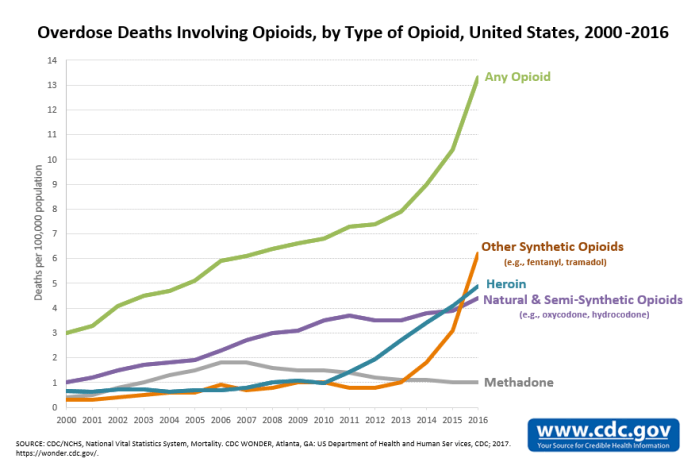
OpioidDeathsByTypeUS

In 2016, the CDC issued guidelines for treating chronic pain that warned physicians against prescribing high dose opioids and suggested talking about health risks. It also advised to “start low and go slow” — a slogan later mocked by John Oliver in a segment on opioids. And, according to a CDC analysis, prescriptions for the most dangerous opioids have dropped 41% from 2010 to 2015, and so have opioid prescriptions in general dropped. This has resulted in patients with physical dependency suffering withdrawal, often without programs to ease the transition to nonopioid pain relievers. Opioid dependants with withdrawal, or average citizens in need of pain relief, often turn to stronger street narcotics, since heroin is the cheaper and stronger alternative to oxycodone. For example, with the drop in first-time OxyContin abuse since 2010, heroin use has spiked. In Maine, a 15% decrease in opioid analgesic overdoses came with a 41% increase in heroin overdoses in 2012. The use of prescribed opioids, then, looks like it might be strongly connected to the use of street narcotics. The Commission, for its credit, notes that “the removal of one substance conceivably will be replaced with another.”

One fact lost in the discussion is that the use of nonmedical opioids has decreased but the amount of overdose deaths has increased. And “opioid epidemic” when discussing overdoses highly obscures that heroin is the major contributor alongside fentanyl — not merely prescription analgesics. We hear a lot about OxyContin and Vicodin, which are actually leveling out (or were until 2015), and less about the drugs which are already policed more, have been policed longer, and cause more physical problems.

What the Commission proposes

In its report, the Commission concludes the goals of its recommendations are “to promote prevention of all drug use with effective education campaigns and restrictions in the supply of illicit and misused drugs.” The President’s Commission doesn’t want to interfere too strongly, despite all of Trump’s suggestions of a revamped drug war. The report notes that coming down hard on opioids will hurt patients with real needs, as has already happened, and, in a way, has happened since 1924. Much of the Commission’s recommendations come from a market approach, e.g. the suggestion (Rec. 19) to reimburse nonopioid pain treatments. The current Centers for Medicare and Medicaid Services (CMS) policy for reimbursement for healthcare providers treats nonopioid, postsurgical pain relief treatments the same as opioid prescriptions, issuing one inclusive payment for all “supplies” at a fixed fee. Nonopioid medications and treatments cost more, and so hospitals opt for dispensing opioids instead. The Commission recommends “adequate reimbursement [for] a broader range of pain management” services, changing the bundle payment policy to accommodate behavioral health treatment, educational programs, “tapering off opioids” and other nonopioid options.

Trump himself suggested an educational approach in a public announcement, which triggered critical comparisons to the failed D.A.R.E. program and “your brain on drugs” commercials. Educational programs are a less coercive option than direct regulation of opioids, but their effectiveness seems to be hit and miss. The Commission cites the Idaho Meth Project from 2007 (ongoing), conducted by a private nonprofit to inform young adults on the health problems associated with methamphetamine use, as a success story: “The Meth Project reports that 94% of teens that are aware of the anti-meth campaign ads say they make them less likely to try or use meth, and that Idaho has experienced a 56% decline in teen meth use since the campaign began.” This meth project is one success story out of many failures. For instance, the Montana Meth Project from 2005, on which the Idaho project was modelled, “accounting for a preexisting downward trend in meth use,” was determined to have “effects on meth use [that] are statistically indistinguishable from zero,” according to an analysis by the National Library of Medicine. Then again, one large scale anti-drug educational campaign, truth, which encourages youth to avoid tobacco, might be having success. Their modern guerrilla tactics are a major improvement on the old model of Partnership for a Drug-Free America. 

In another market approach to help recovering addicts reenter society, the Commission recommends decoupling felony convictions and eligibility for certain occupations (Rec. 50). The report cites Section 1128 of the Social Security Act, which prohibits employers that receive funding from federal health programs from hiring past convicts charged with unlawfully manufacturing, distributing or dispensing controlled substances. Any confrontation with law enforcement is a barrier to landing a job — a protected area of discrimination — and government laws that specifically ban their hiring make it worse on ex-users and -dealers trying to get clean. Recommendations like these lessen the role that the state has in keeping ex-convicts out of work. 

Much of the funding requested by the President’s Commission is authorized by the Obama administration’s major contribution to combating opioid usage, the Comprehensive Addiction and Recovery Act (CARA), signed into law July 2016 and credited as the “first major federal addiction legislation in 40 years.” CARA helped implement naloxone (an opioid overdose-reversal nail spray) in firefighting departments and strengthen drug monitoring programs. 


I’ll post the second half soon, and then a bonus post on my personal favorite solution.

The Abraham Lincoln Brigade

My latest over at RealClearHistory went up on Tuesday. The schedule for my work over there goes as follows: I’ve got a regular Friday column and a Tuesday blog post, so be on the lookout! Here’s an excerpt:

The volunteers were to be used as cannon fodder for the Republicans, which explains the high casualty rate, but it was the disorganized front put on by the democratically-elected Republican government that is to blame for the high casualty rates, rather than some sort of prejudice or malice on the part of the Spanish Left. The volunteers almost all came from non-military backgrounds, too, as most were starry-eyed urban idealists who believed they were fighting injustice. After a meager 30 days of training, the Lincoln Battalion was marched to the front lines to fight a bunch of battle-hardened troops that mostly hailed from Spain’s colonies, where military governance was practiced and honed to near perfection.

Read the rest. This was a fun one to write. I initially wanted to do something about the Spanish Civil War and international meddling (Madrid fell to Franco on March 29), before tying it in to the events in Syria.

My editor gently reminded me that the blog posts should be about American history, so I threw in the Abraham Lincoln Brigade. And check out my RCH colleague’s post on the birth and rise of the Republican Party.

Nightcap

  1. When Antarctica ran out of whales Lyndsie Bourgon, Aeon
  2. Even Boston was ankle deep in LSD Dominic Green, Spectator
  3. The Kind Cruelty libertarians must heed Wayland Hunter, Liberty Unbound
  4. The violent bear it away Richard Reinsch II, Law and Liberty

Midweek Reader: The Drug War, the Opioid Crisis, and the Moral Hazard of Overdose Treatment

Today, I’m reviving an old series I attempted to start last year that never came to fruition: The midweek reader. A micro-blogging series in which I try to link to stories that are related to each other to provide deeper insight into an issue. This week, we’re looking at the relationship between the Opioid Crisis and the drug war, and the academic debate around a controversial paper finding moral hazard in policies that try to increase access to Naloxone.

  • At Harpers Magazine, Brian Gladstone has a fantastic long-form piece looking into how attempts to crack down on opioid addiction by targeting the prescription pain meds have left many patients behind and questioning the mainstream narrative that the rise of opioids was driven primarily by pain prescriptions. A slice:

    Yet even the most basic elements of this disaster remain unclear. For while it’s true that the past three decades saw a staggering upsurge in the prescribing of opioid medication, this trend peaked in 2010 and has been declining since: high-dose prescriptions fell by 41 percent between 2010 and 2015. The question, then, is why overdose deaths continue to skyrocket, rising 37 percent over the same period — and whether restricting access to regulated drugs is actually pushing people toward more lethal, unregulated ones, such as fentanyl, heroin, and carfentanil, a synthetic opioid 10,000 times stronger than morphine.

  • Similarly, at the Cato Institute, Jeffery A. Singer has a good piece exploring the relationship between America’s War on Drugs and the rise of opioid addictions. He concludes:

    Meanwhile, President Trump and most state and local policymakers remain stuck on the misguided notion that the way to stem the overdose rate is to clamp down on the number and dose of opioids that doctors can prescribe to their patients in pain, and to curtail opioid production by the nation’s pharmaceutical manufacturers. And while patients are made to suffer needlessly as doctors, fearing a visit from a DEA agent, are cutting them off from relief, the overdose rate continues to climb.

  • At Voxphilosopher Brendan de Kenessey of Harvard has a piece exploring the philosophy of the self and of rational choice to argue that it’s wrong to treat drug addiction as a moral failure. A slice:

    We tend to view addiction as a moral failure because we are in the grip of a simple but misleading answer to one of the oldest questions of philosophy: Do people always do what they think is best? In other words, do our actions always reflect our beliefs and values? When someone with addiction chooses to take drugs, does this show us what she truly cares about — or might something more complicated be going on?

  • An econometrics working paper by Jennifer L. Doleac of University of Virginia and Anita Mukherjee of the University of Wisconsin released earlier this month, which sparked spirited discussion, investigated the link between opioids and laws increasing access to Naloxone. They found the laws increased measurements of opioid use but did reduce mortality, which they theorize is because Naloxone increases moral hazard for addicts by reducing potential costs of an overdose. However, they conclude:

    Our findings do not necessarily imply that we should stop making Naloxone available to individuals suffering from opioid addiction, or those who are at risk of overdose. They do imply that the public health community should acknowledge and prepare for the behavioral effects we find here. Our results show that broad Naloxone access may be limited in its ability to reduce the epidemic’s death toll because not only does it not address the root causes of addiction, but it may exacerbate them. Looking forward, our results suggest that Naloxone’s effects may depend on the availability of local drug treatment: when treatment is available to people who need help overcoming their addiction, broad Naloxone access results in more beneficial effects. Increasing access to drug treatment, then, might be a necessary complement to Naloxone access in curbing the opioid overdose epidemic.

  •  Alex Gertner, a PhD candidate at UNC-Chaple Hill, published a criticism of Doleac Murkhejee at Vox pointing out that their data linking Naloxone and opioid-related hospital visits are not necessarily due to a casual story involving moral hazard:

    The authors find that naloxone access laws lead to more opioid-related emergency department visits, the premise being that naloxone access laws increase opioid overdoses. But there’s a far more likely explanation: People are generally instructed to seek medical care for overdose after receiving naloxone.

    Overdose is a general term to describe experiencing the toxic effects of drugs. People can overdose, and often do, without either dying or seeking medical attention. If people who would otherwise overdose without medical attention are instead using naloxone and going to emergency rooms, that’s a good thing.

  • The widest-ranging and most thorough critique of Doleac-Murkhejee comes from Frank, Pollack, and Humphries at the Journal of Health Affairs. They argue that the original authors (1) assume too much immediacy in effect of changes in Naloxone laws than is probably warranted (2) ignore a variety of exogenous variables like Medicare expansion. They conclude:

    We believe the best interpretation of Doleac and Mukherjee’s findings is that their main treatment variable—naloxone laws—thus far have had little impact on naloxone use or nonmedical opioid use during the period studied. This disappointing pattern commands attention and follow-up from both public health practitioners and public health researchers.

Nightcap

  1. The working class, immigration, and the Left Kenan Malik, Guardian
  2. What if Trump wins the China IP dispute? Scott Sumner, EconLog
  3. The free speech dilemma Chris Dillow, Stumbling and Mumbling
  4. A short history of the Mongols Peter Gordon, Asian Review of Books

Nightcap

  1. India at the time of the globalization Raj Branko Milanovic, globalinequality
  2. What do earnings tell us? Chris Dillow, Stumbling and Mumbling
  3. Haitian Voodoo art Marcus Rediker, Storyboard
  4. Why are there 2 distinct ways of writing Norwegian? Jessica Furseth, Literary Hub

John Bolton: the view from India

On March 23, 2018, US President Donald Trump tweeted that he was removing H.R. Mcmaster as his National Security Advisor, and that John Bolton would take over on April 9, 2018.

Bolton, the US Ambassador to the UN during George W Bush’s Presidency, has evoked strong domestic reactions in the US, with both Democrats and certain Republicans being skeptical of him because of his mercurial nature and outlandish views on complex foreign policy issues. Bob Menendez, a top Democrat on the Senate Foreign Relations Committee, publicly commented on his appointment:

While the President may see in Mr Bolton a sympathetic sycophant, I would remind him that Mr Bolton has a reckless approach to advancing the safety and security of Americans – far outside any political party.

One significant point, which is being made by a number of analysts who have watched Bolton closely, is that while Trump is a pure isolationist, Bolton, according to conservatives, believes in ‘preventive war.’ While the US President was a critic of the Iraq war, Bolton has defended it. In a tweet in 2013, Trump had stated:

All former Bush administration officials should have zero standing on Syria. Iraq was a waste of blood & treasure.

How is Bolton’s appointment viewed in South Asia Continue reading

Nightcap

  1. Black African Tudors of England Jonathan Carey, Atlas Obscura
  2. What can Marx and Smith teach us? Felix Martin, New Statesman
  3. The history of Leonardo’s Salvator Mundi Morgan Meis, the Easel
  4. Goddess of Anarchy Elaine Elinson, Los Angeles Review of Books

Eye Candy: the Russian Civil War

Click here to zoom

(h/t Adrián)

Nightcap

  1. Piracy in Antarctica Philip Hoare, Spectator
  2. Federalism, good (Canada) and bad (E.U.) Nick Rowe, Worthwhile Canadian Initiative
  3. Why Macedonia’s name is such a problem Nikola Zečević, National Interest
  4. How international hegemony changes hands Kori Schake, Cato Unbound

Who are the protectionists in Africa?

Rwanda, a country that thankfully avoided “humanitarian” military intervention by Western powers during a nasty killing spree in the 90s, is leading the charge on free trade in Africa. Of the 54 countries on the African continent, 44 have signed the agreement, but the traditional economic giants of the continent – Nigeria and South Africa – have not. Surprisingly, Botswana, an example often cited by economists as an African success story, has not signed it either.

CNBC reports on why Nigeria has so far refused to join the agreement, citing a consultant who specializes in global trade:

There is a general sentiment among (labor unions and industry bodies) that Nigeria’s export capacity in non-oil sectors isn’t sufficiently robust yet to expose itself to external competition.

Unions and “buy local” capitalists: The scourge of prosperity and progress worldwide, but also not much of a surprise.

What will be interesting to see is where this bold experiment leads. How can 44 countries with poor institutions come together to form a free trade pact? I am hoping this will lead to more states in Africa. My logic goes something like this: stronger economic ties will hasten the demise of current African states’ superficial institutions, while allowing informal institutions to flourish. Because these informal institutions are better at solving coordination problems, they’ll eventually be recognized as states. Here’s how I put it back in 2012:

A better way of looking at it, and one that I have pointed out before, is to look at Europe realize that it shares roughly the same amount  of polities as does Africa (50-ish) despite being four times smaller. I bring up the comparison with Europe because in the Old World things like ethnicity still have a strong hold on how individuals identify themselves with their various social spheres. Rather than the 50-ish number of  polities in Africa that we have today, a better way of solving Africa’s problems would be to let the polities currently in place dissolve into 400 polities. Or 500. Then, I think, Africans would know peace and prosperity.

I’d add, today, that this would only be possible if the links built by this free trade pact endure. Economic integration is vital to the dissolution of Africa’s despotic states. (h/t Barry)

Nightcap

  1. Singapore, capitalism, and market socialism Scott Sumner, EconLog
  2. China’s Creditor Imperialism Brahma Chellaney, Project Syndicate
  3. Chairman Xi, Chinese Idol Ian Johnson, New York Review of Books
  4. Trump may be rude, but that doesn’t make him a tyrant Ted Galen Carpenter, the Skeptics

Brazil top court delays decision on blocking prison for ex-president Lula

Brazil’s Supreme Court decided that leftist former president Luiz Inacio Lula da Silva cannot be sent to prison for a corruption conviction until he exhausts all possible appeals. About that:

“It will be of little avail to the people, that the laws are made by men of their own choice, if the laws be so voluminous that they cannot be read, or so incoherent that they cannot be understood: if they be repealed or revised before they are promulg[at]ed, or undergo such incessant changes, that no man who knows what the law is to-day, can guess what it will be tomorrow.” – James Madison (16 March 1751 – 28 June 1836), fourth President of the United States (1809–1817), co-author, with John Jay and Alexander Hamilton, of the Federalist Papers, and traditionally regarded as the Father of the United States Constitution.

“Brazil is not for beginners.” – Antônio Carlos Jobim (January 25, 1927 – December 8, 1994), also known as Tom Jobim, Brazilian composer, pianist, songwriter, arranger, and singer. Widely considered as one of the great exponents of Brazilian music.

What on earth was the Dervish state?

That’s the topic of my latest column at RealClearHistory. An excerpt:

2. Sovereignty and suzerainty are concepts that have little to no bearing on today’s world, but perhaps they should. Prior to the end of World War II, when the U.S. and U.S.S.R. became the globe’s alpha powers, suzerainty was often used by imperial powers to manage their colonies. Suzerainty is a formal recognition, by a power, of a minor polity’s independence and autonomy, and a formal recognition by the minor polity of the power’s control over its diplomatic and economic affairs. Suzerainty was used especially often by the British and Dutch (and less so by France and other Latin states, which preferred more direct control over their territorial claims), as well as the Ottoman Empire. The U.S.-led order has focused on sovereign states rather than unofficial spaces, and this has led to many misunderstandings. Somalia, which has long been a region of suzerains, is a basketcase today largely because it is approached by powers as a sovereign state.

Please, read the rest. The Dervish state was an ally of the Ottoman and German empires during World War I.

Nightcap

  1. Canada’s Jews: Maple Leaves and Mezuzahs Bruce Clark, Erasmus
  2. We’re still no closer to the end of Pi Oliver Roeder, FiveThirtyEight
  3. Why is Trump turning his back on Iran’s Christians? Doug Bandow, the Skeptics
  4. What’s divine about divine law? Jacob P. Ellens, Law and Liberty