A Real Town Meeting in the People’s Green Republic of Santa Cruz

Tuesday night, I took in, in person, two and a half hours of town hall meeting with the same congressman, Sam Farr, in my own town of Santa Cruz, this time. Now, it’s important to understand that Santa Cruz is, overall, a seventies throwback, left-liberal to communist anti-American. To give you an idea, on my long street, downtown, there are only three American flags, two of which belong to me. When I make conservative noises in public, in spite of my considerable expressive talents, people think I am kidding.

I went to the meeting with my wife, under my own power. The only prompt I got is that one local radio station gave the time and place of the meeting on the air. It did so several times. It’s seen as a conservative station. (Full disclosure: I [used to] have a talk-show program on that station, KSCO 1080 AM, every Sunday 11AM-1PM.) Rush Limbaugh did not send me. The local Republican Party was pathetically absent in every respect. If there was any conservative or right-wing organization present, it escaped my attention and I was looking for one. There were no right-wing thugs in sight, with the possible exception of myself, and especially, my wife, Krishna. My wife is in very good shape indeed but, she is slight of built. She has never really divulged her age too me but her hair is all white. The only humans she has ever physically threatened were our children, when they were teenagers, and me, of course. I can’t tell you why she threatened me because I don’t like to brag.

I insist on the unorganized nature of the event in a spirit of helpfulness. The main problem most Democrats, including Congressman Farr and including the President face, is that they cannot conceive of a genuine grass-root movement of revulsion. George Beck, the Fox News-appointed liberal, of all things, said on television that he does not believe that the opposition to Obamacare is “spontaneous.” He is not a dumb man. He is associated in some fashion with George Washington University. I have heard him before and never caught him even in a white lie. Those people can’t conceive of spontaneous political action because it seldom happens on their side. Instead, they rely on tax-subsidized ACORN, and on a variety of radical front organizations.  Continue reading

ObamaCare

The SCOTUS should be handing down its decision sometime this week. Any thoughts?

Personally, I hope the whole damn thing gets struck down, and Obama’s lawyers got beaten so badly in court that this may be exactly what happens. Yet what I think we’ll probably see is large parts of it struck down and then the Congress will have to deal with whatever SCOTUS left intact.

August 15, 1971

People who were alive in 1941 can tell you right where they were on Pearl Harbor day.  I can tell you exactly where I was when I heard that President Kennedy had been shot.  We all remember 9/11.   Another day that I sticks in my memory just as clearly is one that is now remembered by few: Sunday, August 15, 1971.

There was no internet in those days and no cable news channels, so I was mercifully spared the news until the following morning at 8:15 when I opened my motel room door in Huntington Beach and saw the L.A. Times on the doorstep with a headline that said something like “Nixon Imposes Price Controls.”

I was shocked and disgusted for two reasons: though I was employed as an aerospace engineer, I was beginning to learn about free markets, having attended a FEE seminar the year before at which Mises and Hazlitt  – now saints of Austrian economics – lectured.  And I had voted for Nixon in 1968, naively believing the Republicans were the party of free markets.  The following year I signed up with the new Libertarian Party and never looked back on the Republicans until 2008 when Ron Paul ran.

Here is a video recording of Nixon announcing a 90-day “freeze” on prices and wages. Note the Orwellian references to the evils of price controls even as he imposes them.Image
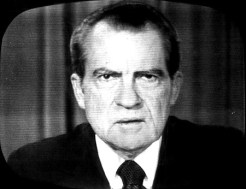
So what was the big emergency that prompted such a drastic response?  Unemployment was running about 6%; price inflation at about 5%.  Nixon’s problem was that an election was coming up in the following year.  He remembered bitterly his narrow loss to Kennedy in the 1960 election which he attributed to a mild recession of that year. Now he was determined to goose the economy and get himself re-elected. Like FDR, Nixon loved dramatic strokes and never mind the consequences. Earlier that year the man who had made his reputation as an implacable anti-communist had made a sudden and dramatic overture to communist China.  So on that sleepy Sunday Nixon delivered another bold stroke, in an end run around the Democratic opposition.  Perhaps it worked: he won 49 states in the 1972 election with considerable help from his bumbling opponent, George McGovern.

His action was quite popular.  The stock market surged that Monday morning and polls showed a 75% approval rate.  But Milton Friedman was right when he predicted “utter failure and the emergence into the open of suppressed inflation.”  Another freeze was imposed in 1973 but this time the damage to the economy became evident.  As explained in the excellent video series “The Commanding Heights,” “ranchers stopped shipping their cattle to the market, farmers drowned their chickens, and consumers emptied the shelves of supermarkets.”  Inflation reached a peak of about 14% before the decade was out and before the powers that be accepted the fact that excessive money creation is the main cause of price inflation. George Schulz, Nixon’s economic advisor and a vigorous opponent of price controls consoled himself with the thought that Nixon had demonstrated dramatically how not to fight inflation.

Nixon wasn’t finished.  During that same Sunday broadcast he slapped a 10% tariff on imported goods, accompanied by some blather about fairness.  More significantly, he ended the Bretton Woods international monetary system.  That arrangement, conceived in 1944, had the U.S. dollar convertible into gold at $35 per ounce, but only for foreign central banks.  Not only could private banks and private citizens not convert their dollars, it was even illegal to own gold (with exceptions for dentists, jewelers, etc.).  I made a point of violating that particular law on principle before the prohibition was lifted in 1974.

In all fairness, the Bretton Woods system was doomed long before that August.  The gold exchange standard had persisted only because of a gentlemen’s agreement that European central bankers would refrain from exercising their redemption rights to any significant degree.  So many new dollars had been created to finance Lyndon Johnson’s war in Vietnam and his “Great Society” at home, and so many of those dollars were parked overseas as a result of trade imbalances, that the U.S. government could not come close to honoring its Bretton Woods obligation in full.  The French under de Gaulle and his gold-bug advisor Jacques Rueff had become increasingly strident about the situation, but in early August the British ambassador showed up with $3 billion to be redeemed, and that may have been the straw that broke the camels back.

So on that same Sunday Nixon slammed the gold window shut (video here)  pushing us out of the frying pan of Bretton Woods, under which numerous wrenching devaluations had wracked international trade, into the fire of floating exchange rates, the system we have now.  The devaluations are gone but the wild swings in currency values, something that was not foreseen by Milton Friedman who was an early advocate of currency markets, are almost as bad.  Now, wonder of wonders, there is resurgent talk of some sort of gold standard.

Reagan tempted me with with some pretty inspiring rhetoric in his 1980 campaign about getting the government off our backs.  Not enough to vote for him, but I was glad he got elected and with the help of Fed chairman Paul Volcker he did break the back of inflation, but he never got spending under control and he didn’t deserve as much credit as he got for the fall of communism, which had been rotten at its core for decades.  But Bush I was terrible and in hindsight Clinton wasn’t all bad, yet I confess I was relieved when Bush II beat Gore in 2000.  I needn’t remind anyone what a disaster GWB was with his wars, his unfunded medicare expansion and his bailouts (OK, thanks for the tax cut).

I’m voting for Gary Johnson who won’t win, and I really don’t care who wins.  Gridlock is the least bad outcome, even if that means the despicable Obama stays in office facing a Republican congress.
“European Project Trips China Builder”

That is the headline of this piece in the Wall Street Journal. An excerpt:

Chinese companies have wowed the world with superhighways, high-speed trains and snazzy airports, all built seemingly overnight. Yet a modest highway through Polish potato fields proved to be too much for one of China’s biggest builders […]

It remains unfinished nearly three years after contracts were awarded to Chinese builders. The Polish government is warning there will be detours around the highway’s “Chinese sections” when the soccer championships begin […]

The project raises questions about Beijing’s strategy of pitching state-directed construction firms as the low-cost solution to the world’s infrastructure needs […]

Covec [the state-run construction company responsible for the failures] was thin on management expertise, lacked financial skills and didn’t understand the importance of regulations and record-keeping in public works projects in the West, according to numerous people involved in the project […]

Organizing actual construction proved harder. To manage the project, Covec brought in Fu Tengxuan, a 49-year-old railway engineer, who spoke only Chinese and appeared to have little authority, telling colleagues that headquarters in Beijing needed to approve even the purchase of an office copier […]

Although the funding of Chinese projects in other areas such as Africa and Asia is often murky, analysts say that Beijing regularly foots the bill […] Continue reading

Tectonic History and Gondwanan Geopolitics in the Larsemann Hills, Antarctica

That’s the title of this article (pdf) in the Political and Legal Anthropology Review. From the abstract:

At the Antarctic Treaty Consultative Meetings, an Indian delegate proposed a new research base located within an environmental protection area, because it is where India and Antarctica were connected on the 125-million-year-old continent of Gondwana. How did this claim come to be successful for the Indian Antarctic Program? In the production of documents within international governing bodies, policy makers enroll allies, emphasizing particular aspects of their plans to members of diverse epistemic communities. Instead of trying to make nationally oriented ideas work through uniform procedural rules, international policy makers reshape the contours of acceptable policy-making procedure and the political possibilities of international governance.

The whole thing is interesting, especially if you have a weird obsession with Antarctica like I do! Possibly gated.

Around the Web

  1. Conor Friedersdorf has a great piece in the Atlantic about defending the stay-at-home mom.
  2. In the New York Times there is a great read about how Mexican drug cartels earn their billions of dollars (via @MarketUrbanism)
  3. F.A. Hayek on why he was not a conservative. Good stuff on the confusion in the US about the term ‘liberal’, too. I recommend reading the book from which this article was excerpted, too also (the word ‘too’ has been used too many times).
  4. The Economics of Outsourcing.

Left-Liberal Hypocrisy and Bad Taste

Leftists always let their real soul slip through, somehow.

I know a young woman who lives in a country other than the US. She is not American. What she has in common with Santa Cruz, California liberals is, well, everything she says. (I can’t really know what she actually believes.) She says the world is fast coming to an end because of fossil fuels. She says, in so many words, that governments should take their money from the rich to give it to the poor (as defined by herself, of course). She says socialism is more fair than capitalism. (She has no idea what capitalism means.) Of, course, she talks as if the US government were a far worse terrorist than say, Osama Bin Laden. By the way, she does not want to talk about who was responsible for 9/11. I think she likes to feed ambiguity without paying the price deniers of terrorism pay in intelligent society.

This young woman also holds a responsible position in the service of a NATO government. She received an education from one of the very best schools in her country. Personally, I think that one-on-one, she is quite likable. At least, I like her in most respects.

Recently, I had a chance to look at her wedding pictures. They showed the bride in her bridal splendor, laughing guests, parts of a dinner party. Nothing more natural there. However, included in the set of published pictures was one of an expensive Mercedes convertible.

Why was the car treated as prominent member of a wedding party?

Weddings are about two individuals joining their lives together, in part, to rear children. It’s about their friends celebrating. It’s about people, isn’t it? Should be, especially among liberals who always act holier-than-thou in matters of material consumption, liberals who see themselves as are more spiritual than selfish, narrow-minded, gross conservatives like me.

What’s the flashy, environmentally unsound, insulting-to-the-poor, imported car doing in the middle of the wedding party? Do I detect such mind-boggling hypocrisy that the hypocrites don’t even recognize what they are?

By the way, no sour grapes here. I don’t care much about cars, never did. I only ask of a car that it protect me against highway drunks and that I don’t have to think about it. Conservatives are simplistic, for sure! I think expensive cars are the poor man’s art (and, I don’t mean financially poor! Wow, what a bitch I am!) The Mercedes in the picture did look good, not $100,000-good though. Think about how much you could do with that kind of money, for others, and even to cultivate your own self.

How utterly vulgar; how infantile; how astonishingly self-centered, how amazingly incoherent; how so very left-liberal!

The Corporate State and High Liberalism: A Love Story

I have been following the symposium on “free markets and fairness” over at Bleeding Heart Libertarians with some interest. One of the things that has always bothered me about the Left’s despicable tactics concerning liberty is its demagoguery concerning markets. As a former Marxist who has hung out with the right people in the right places, I can assure you that the Left is not so much concerned with the plight of the poor as it is with the plight of the rich.

Once I began to grasp the basic insights of economists (thanks to Ron Paul’s 2008 Presidential campaign) it became increasingly apparent that less regulations and less restrictions are needed in this world in order to help the poor. What I have not understood about my friends on the Left is why they obstinately refuse to acknowledge the facts concerning how markets and the State work. As Deirdre McCloskey has recently pointed out, the narrative of high liberalism is factually mistaken, but this in itself is not enough to convince the True Believers that control over others needs to be abolished.

Two things stand out to me whenever I argue with Leftists: 1) the thin veneer of helping the poor is often used to cover up the base desire for control over others; the high liberal is an authoritarian through-and-through and 2) the Leftist is often unaware of this authoritarianism until you either scratch or cleave him.

Consider the following example. Continue reading

Normal Poverty

Here is a short excerpt from my memoirs: “I Used to Be French….”:

Young and youngish Americans of the early 21st century have personally only known prosperity. That is, historically unheard off prosperity. They are also fairly familiar with extreme poverty, with misery, because of the good job television often does documenting it in other parts of the world. More rarely, foreign travel gives them glimpses of appalling living conditions. And, of course, the many who have served in the Peace Corps are well informed on this topic. It seems to me that our contemporaries know little, by contrast, about the kind of poverty that prevailed in developed countries until recently. I call it “normal poverty.” I grew up in normal poverty, in Paris, in the forties and fifties. Here is what it was like.

My family of seven lived entirely off my father’s small public servant’s salary and off what he scrounged from after-hours bookkeeping for small merchants. We lived on the edge of Paris, in a charmless but well-maintained area of apartment blocks built by the city twenty years earlier. Municipal rents were probably kept artificially low. The seven of us shared an apartment that was smaller than the house I now occupy with my wife in California, a state where living spaces tend to be smaller than in most other parts of the country. Yet, we had central heating and hot water in the single bathroom. Other blocks nearby had indoor plumbing but no hot water, incredibly. Telephone service was the pay-phone at the café downstairs. When my family got its own phone, after the expected ten year wait, my mother immediately clamped a padlock on it. Continue reading

Around the Web

  1. Secessionist Movements in Europe. I have always thought that the EU would be great for more decentralization, but once the central bank became established and Brussels agitated for more political power I knew that the experiment in confederation would become the failure that it is today.
  2. Economist Bryan Caplan on Left-wing historical bias and Benito Mussolini. You’d be surprised what the history books keep out of Italy’s socialist movement…
  3. Has Africa Always Been the World’s Poorest Continent? Be sure to read through the ‘comments’ section too.
  4. Mini-DREAM and the Rule of Law: Executive Discretion. A number of libertarians have come out in support of Obama’s executive order prohibiting immigrants from being deported just for moving here as children, but I am not so sure that this is a good move. Politically, it’s great, especially when one considers the fact that the Obama administration has deported more immigrants in 4 years than GW Bush did in 8. I am more worried about the Rule of Law. It’s the legislative branch’s job to implement immigration policy, not the executive branch’s. As somebody who supports open borders, this is a tough call.

The Cold in California, in Europe, and in Liberal Hearts (Updated)

Note: This is a replay.

It’s been an unusually cold and rainy month of May in northern California. Thousands of miles to the east and north, in Paris, France, a May cold record held for sixteen years was beaten recently according to Le Figaro of 5/11/10. I don’t know if any of this means anything in terms of so-called “ global warming” ( a few points don’t make a trend). I am certain however that the climate duffuses would be clamoring if the month of May had been especially warm in either part of the world. Al Gore is speaking in Santa Cruz this week. He is a rich man with no sense of ridicule. He became rich by selling imaginary protection against an imaginary ill, global warming, while living in a giant house and flying in executive jets with his entourage, Hollywood-style. Meanwhile, my wife and I dry our laundry on the line, in the backyard, like both of our grand mothers used to do. I wonder how many climate activists forgo an electric or gas dryer, to help save the planet. I have not found one yet though I keep asking.

Here is a micro story about how liberals think, a slice of life. Last Saturday, I go by a young friend’s of mine who is holding a garage sale. I may find something to buy from her in spite of my wife’s warning that she will divorce me if I bring anything else into the house (except the beautiful quilts I get for her at the flea market, of course). At least, I will bring my friend cheerful moral support. I know I am in enemy territory there, ideologically. It matters not because likability does not follow strict ideological lines and because those who are meritorious by conservative standards are not all conservatives. (A reason for hope, by the way.) Continue reading

Organic Food and Red Herrings

I use my editor’s privilege to respond here to Ryan MH’s argument in the piece entitled: “The Cost of Organic Food: An Exchange.” I do this for the sake of clarity alone. Ryan has unfettered access to this blog.

Let me begin by stating that I congratulate myself for having elicited a serviceable and seemingly complete definition of “organic” from Ryan. This is the first time someone give me a definition, in my whole life!

Ryan MH is all over the place  to such an extent that I felt like crying in my turn as I read. So, let me specify what I am interested in.

The issue of the high cost of organic food only matters to me because I believe that it is not different from a health standpoint from non-organic food grown in this country. I think it has no merits for the consumer except in his head.

I am focusing on the portion of the organic definition that had to do with the genetic modification of organisms by methods others than the traditional methods of artificial, guided, purposeful selection and hybridization by sex methods and such. This means pretty much methods that existed before World War Two.

Ryan said in my presence that  foods modified by new methods (“genetically modified” except that these terms have no meaning.), that such food have adverse effects on human health.

If Ryan MH did not say this or something identical, for practical purposes, I have no discussion with him. I must have misunderstood him and I apologize for wasting his time and yours. Continue reading

The Case for Peace with Iran

Recently the American ambassador to Israel, Dan Shapiro, publicly let the Israelis know that the United States was ready and able to go to war against Iran. He said that a military attack was the last thing that the US wanted, yet the fact that the statement was made publicly and haughtily suggests that Washington is eager to provoke Tehran into making a mistake or two in the nuclear showdown.

Now let me be frank: a nuclear Iran, as the state stands today, would be a big problem for peace not only in the Middle East but throughout the world. If Iran were to get the bomb it would suddenly have much more leverage in international affairs. Not only would a nuclear-armed Iran have the capabilities to deter Western powers, but it would also have the capability to be much more bellicose in its foreign policy. Instead of mere tentacles in Syria, Lebanon, Gaza and Iraq, Tehran would have power (that loathsome word) to back up its interests in the region. Furthermore, a nuclear-armed Iran would start another military arms race in the Middle East, as Saudi Arabia and Israel would seek to bolster their own capabilities to deter an Iranian threat.

If you think a nuclear-armed Iran is bad, just image a nuclear-armed Saudi Arabia. Remember, Persians don’t use suicide bombing as a terrorist tactic. That’s something Arabs (and Sinhalese) do. Additionally, Iran is not really a hotbed of Islamic fundamentalism. Islamism has been stifled in Iran largely because it is already the state religion, which means that all Islamist activities have been co-opted into the official state apparatus. If you still have trouble following, just remember: state apparatuses are a handy tool used by dictatorships to water down the more radical elements of a philosophy or movement.  Continue reading

Around the Web, Kinda

No.  The master narrative of High Liberalism is mistaken factually.  Externalities do not imply that a government can do better.  Publicity does better than inspectors in restraining the alleged desire of businesspeople to poison their customers.  Efficiency is not the chief merit of a market economy: innovation is.  Rules arose in merchant courts and Quaker fixed prices long before governments started enforcing them.

I know such replies will be met with indignation.  But think it possible you may be mistaken, and that merely because an historical or economic premise is embedded in front page stories in the New York Times does not make them sound as social science.  It seems to me that a political philosophy based on fairy tales about what happened in history or what humans are like is going to be less than useless.  It is going to be mischievous.

How do I know that my narrative is better than yours?  The experiments of the 20th century told me so.

This is from Deirdre McCloskey’s blog post over at a new symposium being put on by Bleeding Heart Libertarians. It is probably the best thing I’ve read on the web in a couple of years. You can find the rest of the posts from the symposium here. I highly recommend all of them.

Co-editor Fred Foldvary recently participated in the last symposium that BHL held on Libertarianism and Land. You can find both of his entries here (be sure to read through his responses in the ‘comments’ section, too) and here.

France Does not Export Wines, nor Mexico Guacamole, nor Does the US Import Cars, etc. “National Competitiveness” for the Intelligent Ignorant

It’s national election season again. As always happens in this season, in every developed country, the old battle horse of national competitiveness gets a new coat of shiny paint and is led out by its sparkle-strewn tether to support politicians misconceptions and mis-talks. There is a very widespread misconception that nourishes unreasonable thoughts and false notions on the economy.

Sorry but at this time, in this season, I feel a compulsion to resort to teaching, so, pay attention. There might be a quiz.

The misconception: Countries, (or “nation-states”) such as the US, Canada, Mexico, Belgium, or France don’t compete with each other like soccer teams, for example, compete against each other. In soccer, when one team wins a point, the other team loses a point. When the economy of one country picks up speed however, it is not (NOT) the case that the economy of another country (or of several countries) must slow down. The reverse is true. When the Mexican economy grows, some Mexicans are better able to buy American corn, or American video games, making some Americans richer than would be the case if the Mexican economy stagnated.

The confusion has three sources. The first source is simply ignoring that the producers of one country are also potential customers for the producers of all other countries. Those who compete with American workers, are often also buyers of American-made products. If they are not at the moment, the richer they become, the more likely they are to become buyers. One of the international functions of those who compete with American producers is thus to enrich American producers, perhaps different ones. The relationship may be more indirect. Foreign worker A competes with American worker B and he uses the money he gets from beating B to buy from American worker C. If I am C, my interests are not well lined up with those of my fellow American B. That’s a fact, no matter what politicians say in the language of football. However, if I am American worker C, in the long run, I am better off if fellow American worker B becomes richer than if he does not. For one thing, he will be able to support better equipments, such as schools, from which I will profit. Continue reading