Gun control: Centralized vs. Dispersed

Hayek made the point that the debate of whether to have central planning was not over whether or not there would be planning, but over who would plan for whom. This point has an analog in the debate over gun control. The option is not between reason and chaos, but between centralized (and therefore bureaucratic) control and decentralized control.

Just because you (i.e. your ideals as embodied in the Democratic National Convention) aren’t in control, doesn’t mean that nobody is. A decentralized gun control regime is one where individual gun owners are responsible for securing their weapons and criminals are responsible for crimes they commit. Will mistakes be made? In the imperfect world we live in that’s almost a certainty. Will the results be worse than one with government gun control? That’s an empirical question. Political gun control will raise the cost of getting guns, but it will also raise the relative criminal effectiveness of guns. It will save some lives but will also cost some. There will probably be fewer accidental deaths and suicides, maybe fewer crime-of-passion murders, but likely more “kill the witness” murders. If the penalty for using a gun in a crime is high, then the relative cost of killing a witness is low (for example, adding a life sentence for murder on top of a 30 year sentence for armed robbery is like getting a 30-year off coupon on that life sentence).

With 3D printed guns on the horizon (to say nothing of the “dangerous” lack of regulation of machining tools!) an effective political gun control regime would have to expand to all manner of regulation. This regulation would cost a lot! But, one might object, mere money is not worth as much as the lives that might be saved. But it’s not embossed portraits of dead white men that’s at stake. I don’t think we should let economists play God, but I think there is something to economists’ activity of considering what we might be willing to give up for a life.

Money is a medium of exchange; it’s not the end, just a tool we use to make life easier. The cost of regulation is real human well-being, time, and effort foregone. Taking someone’s money prevents them from spending it on what they otherwise would have. It also discourages them from investing further effort into producing something valued by others. Regulation also takes people’s (irreplaceable!) time; saving someone’s (irreplaceable) life provides some moral justification for this, but the cost must be acknowledged.

If (if!) there is a benefit to political gun control (that is if we judge the lives lost under a decentralized regime as morally superior to those lost under a political regime), then we should still consider the cost. In any case, we should all stop using the term “gun control” when we mean “political gun control.” A problem defined is a problem half solved, and the blanket term “gun control” mis-defines the problem.

Unequal Poverty: Tricks (Part Two of two)

In the previous installment:

I explained how the general standard of living in America, denoted by real income, grew a great deal between 1975 and a recent date, specifically, 2007. This, in spite of a widespread rumor to the contrary. The first installment touched only a little on the following problem: It’s possible for overall growth to be accompanied by some immobility and even by some regress. Here is a made-up example:

Between the first and the second semester, grades in my class have, on the average, moved up from C to B. Yet, little Mary Steady’s grade did not change at all. It remained stuck at C. And Johnny Bad’s grade slipped from C to D.

Flummoxed by the sturdiness, the blinding obviousness of the evidence regarding general progress in the standard of living, liberal advocates like to take refuge in more or less mysterious statements about how general progress does not cover everybody. Or not everybody equally, which is a completely different statement. They are right either way and it’s trivial that they are right. Let’s look at this issue of unequally distributed economic progress in a skeptical but fair manner.

It’s awfully hard to prevent the poor, women and minorities from benefiting

I begin by repeating myself. As I noted in Part One, it’s too easy to take the issue of distribution of income growth too seriously. Some forms of improvements in living standard simply cannot practically be withheld from a any subgroup, couldn’t be if you tried. Here is another example: Since 1950, mortality from myocardial infarctus fell from 30-40% to 5-8%. (from a book review by A. Verghese in Wall Street Journal 10/26 and 10/27 2013). When you begin looking at these sort of things, unexpected facts immediately jump at you.

Fishing expeditions

The US population of 260 millions to over 300 million during the period of interest 1975-2007 can be divided in an infinity of segment, like this: Mr 1 plus Mr 2; Mr 2 plus Mrs 3; Mr 2 and Mrs 3 plus Mr 332; Mr 226 plus Mrs 1,000,0001; and so forth.

Similarly, the period of interest 1975 to 2007 can be divided in an infinity of subperiods, like this: Year 1 plus year 2; year 1 plus year 3; years 1, 2, 3 plus year 27; and so forth. You get the idea.

So, to the question: Is there a subset of the US population which did not share in the general progress in the American standard of living during some subperiod between 1975 and 2007?

The prudent response is “No.” It’s even difficult to imagine a version of reality where you would be right to affirm:

“There is no subset of the US population that was left behind by general economic progress at any time during the period 1975- 2007.”

Let me say the same thing in a different way: Given time and good access to info, what’s the chance that I will not find some Americans whose lot failed to improve during the period 1975 to 2007? The answer is zero or close to it.

This is one fishing expedition you can join and never come back empty-handed, if you have a little time.

Thus, liberal dyspeptics, people who hate improvement, are always on solid ground when they affirm, “Yes, but some people are not better off than they were in 1975 (or in _____ -Fill in the blank.)” The possibilities for cherry-picking are endless (literally).

Everyone therefore has to decide for himself what exception to the general fact of improvement is meaningful, which trivial. This simple task is made more difficult by the liberals’ tendency to play games with numbers and sometimes even to confuse themselves in this matter. I will develop both issues below.

To illustrate the idea that you have to decide for yourself, here is a fictitious but realistic example of a category of Americans who were absolutely poorer in 2007 that they were in 1975. You have to decide whether this is something worth worrying about. You might wonder why liberals never, but never lament my subjects’ fate.

Consider any number of stock exchange crises since 1975. There were people who, that year, possessed inherited wealth of $200 million each, generating a modest income of $600,000 annually. Among those people there were a number of stubborn, risk-seeking and plain bad investors who lost half of their wealth during the period of observation. By 2007, they were only receiving an annual income of $300,000. (Forget the fact that this income was in inflation shrunk dollars.) Any way you look at it, this is a category of the population that became poorer in spite of the general (average) rise in in American incomes. Right?

Or, I could refer to the thousands of women who were making a living in 1975 by typing. (My doctoral dissertation was handwritten, believe it or not. Finding money to pay to get it typed was the hardest part of the whole doctoral project.) One of the many improvements brought about by computers is that they induced ordinary people to learn to do their own typing. Nevertheless, there was one older lady who insisted all along on making her living typing and she even brought her daughter into the trade. Both ladies starved to death in 2005. OK, I made them up and no one starved to death but you get my point: The imaginary typists fell behind, did not share in the general (average) improvement and their story is trivial.

So, I repeat, given some time resources, I could always come up with a category of the US population whose economic progress was below average. I could even find some segment of the population that is poorer, in an absolute sense, than it was at the beginning of the period of observation. Note that those are two different finds. Within both categories, I could even locate segments that would make the liberal heart twitch. It would be a little tougher to find people who both were poorer than before the period observation and that would be deserving of liberal sympathy. It would be a little tough but I am confident it could be done.

So, the implication here is that when it comes to the unequal distribution or real economic growth you have to do two things:

A You have to slow down and make sure you understand what’s being said; it’s not always easy. Examples below.

B You have to decide whether the inequality being described is a moral problem for you or, otherwise a political issue. (I, for one, would not lose sleep over the increased poverty of the stock exchange players in my fictitious example above. As for the lady typists, I am sorry but I can’t be held responsible for people who live under a rock on purpose.)

Naively blatant misrepresentations

A hostile liberal commenter on this blog once said the following:

“Extreme poverty in the United States, meaning households living on less than $2 per day before government benefits, doubled from 1996 to 1.5 million households in 2011, including 2.8 million children.”

That was a rebuttal of my assertion that there had been general (average) income growth.

Two problems: first, I doubt there are any American “households” of more than one person that lives on less than $2 /day. If there were then, they must all be dead now, from starvation. I think someone stretched the truth a little by choosing a misleading word. Of maybe here is an explanation. The commenter’s alleged fact will provide it, I hope.

Second, and more importantly, as far as real income is concerned, government benefits (“welfare”) matter a great deal. Including food stamps, they can easily triple the pitiful amount of $2 a day mentioned. That would mean that a person (not a multiple person- household ) would live on $1080 a month. I doubt free medical care, available through Medicaid, is included in the $2/day. I wonder what else is included in “government benefits.”

The author of the statement above is trying to mislead us in a crude way. I would be eager to discuss the drawbacks of income received as benefits in- instead of income earned. As a conservative, I also prefer the second to the first. Yet, income is income whatever its source, including government benefits.

The $2/day mention is intended for our guts, not for our brains. Again, this is crude deception.

Pay attention to what the other guy asserts sincerely about economic growth.

Often, it implies pretty much the reverse of what he intends. In an October 2013 discussion on this blog about alleged increasing poverty in the US, asked the following rhetorical question:

“Or have Americans’ standard of living only improved as the gap [between other countries and the US] closed?“

I meant to smite the other guy because the American standard of living has only increased, in general, as we have seen (in Part One of this essay posted). A habitual liberal commenter on my blog had flung this in my face:

“….Since 1975, practically all the gains in household income have gone to the top 20% of households…” (posted 10/23/13)

(He means in the US. And that’s from a source I am not sure the commenter identified but I believe it exists.)

Now, suppose the statement is totally true. (It’s not; it ignores several things described in Part One.) The statement says that something like roughly 60 million Americans are richer than they, or their high income equivalents were in 1975. It also says that other households may have had almost stationary incomes (“practically”). The statement does not say in any way that anyone has a lower income in 1975. At best, the statement taken literally, should cause me to restate my position as follows:

“American standards of living have remained stationary or they have improved….”

You may not like the description of income gains in my translation of the liberal real statement above. It’s your choice. But the statement fails to invalidate my overall assertion: Americans’ standard of living improved between 1975 and 2007.

What the liberal commenter did is typical. Liberals always do it. They change the subject from economic improvement to something else they don’t name. I, for one, think they should be outed and forced to speak clearly about what they want to talk about.

Big fallacies in plain sight

Pay attention to seemingly straightforward, common liberal, statist assertions. They often conceal big fallacies, sometimes several fallacies at once.

Here is such an assertion that is double-wrong.

“In the past fifteen years the 20% of the population who receive the lowest income have seen their share of national income decrease by ten percentage points.” (Posted as a comment on my blog on 10/21/13)

Again, two – not merely one – strongly misleading things about this assertion. (The liberal commenter who sent it will assure us that he had no intention to mislead; that it’s the readers’ fault because, if…. Freaking reader!)

A The lowest 20% of the population of today are not the same as those of fifteen years ago, nor should you assume that they are their children. They may be but there is a great deal of vertical mobility in this country, up and down. (Just look at me!) The statement does not logically imply that any single, one recognizable group of social category became poorer in the interval. The statement in no way says that there are people in America who are poor and that those same people became poorer either relatively or in an absolute sense. Here is a example to think about: The month that I was finishing my doctoral program, I was easily among the 20% poorest in America. Hell, I probably qualified for the 5% poorest! Two months later, I had decisively left both groups behind; I probably immediately qualified for the top half of income earners. Yet, my progress would not have falsified the above statement. It’s misleading if you don’t think about it slowly, the way I just did.

I once tried to make the left-liberal vice-president of a Jesuit university understand this simple logical matter and I failed. He had a doctorate from a good university in other than theology. Bad mental habits are sticky.

B Percentages are routinely abused

There is yet another mislead in the single sentence above. Bear with me and ignore the first fallacy described above. The statement is intended to imply that the poorer became poorer. In reality, it implies nothing of the sort. Suppose that there are only two people: JD and my neighbor. I earn $40, neighbor earns $60. In total, we earn $100. Thus my share of our joint income is 40%, neighbor’s is 60%. Then neighbor goes into business for himself and his income shoots up to $140. Meanwhile, I get a raise and my income is now $60.

In the new situation, my share of our joint income has gone down to 30% (60/60+140), from 40%. (Is this correct? Yes, or No; decide now.) Yet, I have enjoyed a fifty percent raise in income. That’s a raise most unions would kill for. I am not poorer, I am much richer than I was before. Yet the statement we started with stands; it’s true. And it’s misleading unless you pay attention to percentages. Many people don’t. I think that perhaps few people do.

My liberal critic was perhaps under the impression that his statement could convince readers that some Americans had become poorer in spite of a general (average rise) in real American income. I just showed you that his statement logically implies no such thing at all. If he want to demonstrate that Americans, some Americans, have become poorer, he has to try something else. The question unavoidably arises: Why didn’t he do it?

Was he using his inadequate statement to change the subject without letting you know? If you find yourself fixating on the fact that my neighbor has become even richer than I did because he more than doubled his income, the critic succeeded in changing the subject. It means you are not concerned with income growth anymore but with something else, a separate issue. That other issue is income distribution. Keep in mind when you think of this new issue that, in my illustration of percentages above, I did become considerably richer.

Liberals love the topic of unequal progress for the following reason:

They fail to show that, contrary to their best wish, Americans have become poorer. They fail almost completely to show that some people have become absolutely poorer. They are left with their last-best. It’s not very risky because, as I have already stated, it’s almost always true: Some people have become not as richer as some other people who became richer!

Policy implications of mis-direction about income growth

The topic matter because, in the hands of modern liberals any level of income inequality can be used to call for government interventions in the economy that decrease individual liberty.

Here are a very few practical, policy consequences:

A Income re-distribution nearly always involves government action that is, force. (That’s what government does: It forces one to do what one wouldn’t do out of own inclination.) That’s true for democratic constitutional governments as well as it is for pure tyrannies. In most countries, to enact a program to distribute the fruits of economic growth more equally it to organize intimidation and, in the end, violence against a part of the population. (For a few exceptions, see my old but still current journal article: “The Distributive State in the World System.“ Google it.) This is a mild description pertaining to a world familiar to Americans. In the 1920s, in Russia, many people (“kulaks”) were murdered because they had two cows instead of one.

Conservatives tend to take seriously even moderate-seeming violations of individual liberty, including slow-moving ones.

B Conservatives generally believe that redistribution of income undermines future economic growth. With this belief, you have to decide between more equality or more income for all, or nearly all (see above) tomorrow?

It’s possible to favor one thing at the cost of bearing the travails the other brings. It’s possible to favor the first over the second. This choice is actually at the heart of the liberal/conservative split. It deserves to be discussed in its own right; “Do your prefer more prosperity or more equality?” The topic should not be swept under the rug or be made to masquerade as something else.

If you are going to die for a hill, make sure it’s the right hill.

PS: There is no “income gap.”
Growing Poverty, a Declining Standard of Living: Watch Out for…. Part 1.

It’s vital to the liberal narrative that pretty much everything has to go generally downhill (except global warming, of course, which is always going up even when it’s not, like right now). Life has to deteriorate, they think. That things are getting worse is an article of faith among liberals; it’s even a tenet of their faith. (If things are swimming along fine, what excuse is there for government intrusion?) You might even say that most liberals hate most good news. Prominent among the liberals’ permanent myths is the belief that Americans have become poorer except for a tiny minority of the very rich __________% (Fill in the blank.) In its most common version the idea is that Americans’ real standard of living has done nothing but decline since sometimes in the seventies. This, whatever the numbers say.

I, for one, know it’s not true. I was there, after all, from the beginning, even from before the beginning! I remember well how bad the good old days were in many respects. I am distressed that some people with apparently conservative or libertarian ideas have now also espoused this false belief. In this essay in two parts, I try to help readers find their way in the midst of often misleading or downright false statements that seem to support this erroneous belief. As usual, I do not address myself to specialists but rather to the intelligent but ignorant. Specialists are welcome to comment if they agree to do it in English or in some other official language.

Two forewords

1 I don’t contend that I understand what happened to American real incomes during the current crisis, say, between 2009 and 2013. I will say nothing about this recent period. (If I told you what I suspect happened, you might be astounded, though.) I refer in this essay only to the period 1975-2007.

2 I believe poverty and prosperity have to be measured in terms of real income, income as experienced by real human beings: It’s not how many dollar bills you have in your wallet, it’s what your paycheck actually buys that matters. This brings up several tough technical problems we will get into presently or in the next episode. If you think of poverty in different terms, I am not sure I have anything useful to say to you.

The superficial facts

General federal statistics, all OECD figures, all World Bank numbers show that on the average Americans have become considerably richer since 1975. Nevertheless, these statistics, contrary to a now common belief – significantly understate the economic progress of Americans. We, in general, have become vastly richer than were were then.

I will deal later explicitly with the issue of possible differences between what the average shows and the economic progress of sub-categories of the US population. In the meantime, I must point out that some common forms of enrichment cannot be confined to a particular group. Cleaner drinking water, for example, is usually cleaner for everyone. It would be impractical to reserve wells of dirty, polluted water for the poor or for racial minorities. (However, if you search a little you might actually find liberal allegations of such segregation or, at least, the intimations of such. National Public Radio is a good bet.)

Here is what I don’t intended to do, don’t do: I do not accuse government statistics of lying. I help others read them and complement them where they need to be complemented. There is not government conspiracy designed to mislead us about the living standards of Americans, I think.

Major (unintended) sources of bias.

There are three major sources of bias in expressing standard of living that understate, underestimate, understate economic betterment. I explain them below.

Ballooning health expenditures

Since the seventies, most employed Americans have taken most of their pay raises in the form of health benefits. This results from a historically accidental peculiarity of the American wage and benefit system going back to WWII. (It may be getting removed by the implementation of Obamacare as I write in 2013). The large increase in health expenditures provided by employers do not appear in wage statistics. Yet, they constitute consumption in a way similar to straight wages. In fact, wherever people are given a choice between more steak and more health care, they seem to chose more steak and more health care. Health care possesses an interesting characteristic all of its own: While there is a limit to how much steak an individual can ingest, there is no limit at all to how much health care -broadly defined – the same individual can absorb. It’s close to infinite. Why, I am considering right now some surgery to correct a nose I have not really liked for more than sixty years!

Whether it is a wise societal choice to spend apparently limitless resources on health care, much of it for the old and economically unproductive is an interesting issue in its own right. However, it’s not my issue here. Health services have been produced in vast quantities since 1975. They were eagerly consumed by Americans. Health expenditures constitute a part of the standard of living. If you don’t believe this, just ask yourself if the withdrawal of all health care would not be a lowering of the standard of living.

Better quality of common goods

Common objects on which comparisons of living standard across time are based have improved tremendously in quality. This is difficult, sometimes impossible to measure. Indices of comparison across time (1975 to 2007) don’t do a good job of it.

Nominal wages, the numbers printed on your paychecks, have to be corrected for inflation. We all know that a dollar does not buy as much as it did in 1975. (Around that time, my salary of $20,000/year was quite comfortable.) Federal international and private organizations in charge of these things do their very best to correct raw numbers in meaningful ways. However, they meet with several limitations because things of 1975 are often radically different from what bears the same name in 2007.

(Note: The agencies in charge do their best and mostly intelligently. Again, I am not faulting their efforts. Also, I think there is little intellectual fraud involved in this work because their results are among the most and best scrutinized in the history of the world.)

Here is an example: I suspect that the average television set of 1975 was like mine was then: It was small, offered only black and white images, often had scratchy sound, and gave access to little more than three national networks. Watching television then was like eating in a mediocre restaurant that offered only three dishes ( and there was maybe a hot dog stand outside).

When economists correct for inflation, they have little choice but to compare that television set with a modern ultra-flat etc… Hence, when they report that the cost of a television set has increased in face dollars by, say, 100%, they are not able to take into account that the actual service (the enjoyment) attached to a contemporary set with precise colors, faithful sound that is a gateway to 300 sources is ten times, or one hundred times, greater than what I derived from my 1975 B&W set.

This example can pretty much be turned into a general rule: Everything is better, works better, tastes better, gives more service than its equivalent back then. When you find a seeming exception, you soon discover that it’s not real. Two examples of exceptions that don’t resist examination:

A     Cars are more expensive now than then by several measures. This means that it takes more days of mean (average) American wages to buy the cheapest car in American than it did then. But the cheapest car on American roads today are vastly better in every way than their supposed equivalent back then. They break down less often; they are safer (weight for weight); they require much less maintenance. (Older people will remember the days when every car required an oil change every 5,000 miles and when prudent car owners changed oil every 3,500 miles.)

In addition, much of the rise in real car prices is due to mandated safety and environmental buffers now built into them that did note exist in 1975. (It’s startling to see in not-so-old movies parents getting into the family car with their children and driving off with no one buckling safety belts because there aren’t any.) No matter how one feels about the current health and environmental restrictions pushing upward car prices, they are undeniably form of consumption. It’s useless to cry,” I don’t want it” when you imposed it on yourself through the political process you deem legitimate in every way.

B     Many older people, and I am often tempted to join them, believe that any number of produce just tasted better back then, produce such as tomatoes and strawberries, for example. This is pure delusion. Here is how I know: Several times, I have steeled my resolve, put cash in my pocket and directed my steps to the local farmers’ market. There, against all my instincts, I purchase a pound of organic tomatoes or a tiny basket of grossly priced strawberries. Now organic produce is not better for you (See “organic food” on this blog.) but it’s often fresher, and often handpicked. Each time, I recovered in my mouth the taste of produce of my youth. Each time, I did the calculations only to rediscover anew that the outrageous cost of the farmer’s market produce was actually less, as a percentage of any income, or in inflation-corrected dollars, than the equivalents did when I was young.

We have become used to paying little for mediocre produce, the better produce of yesteryear are still available. They are not even especially expensive. They appear expensive because we are spoiled by general low food prices.

An then, of course, there is the coffee. It was so vile then, coast-to-coast, in 1975 that if anyone but a drunks’ bar served it today he would probably be indicted. And then, there is bread that would have qualified as light construction material. The list is endless: In the good old days, most things were mediocre to very bad and they were, in fact expensive. Current measures are seldom able to take improvement in quality into account. For this reason, they understate average economic progress in America between 1975 and 2007.

I repeat that this average economic progress is also mostly widespread, available to all parts of the population. There are, in fact, few corner bakeries operating especially in the ghetto and specializing in nutritionally unsound, bad-tasting bread for African-Americans.

There may be an exception to the general rule that things have become cheaper in thirty years with constant quality I am not able to deal with here. It may be a major exception: Housing in all its forms may be more expensive in real terms now than it was in 1975. Much housing is the same now as it was then, so prices matters a great deal. Thus, better quality would not explain superior cost. I am eager to see sources on this issue and to publish them here.

New goods, new services

When comparing the prices of things and services then and now, economists are not able, of course, to take into account objects and services that simply did not exist then. This inescapable fact also understates the real progress in living standards. I repeat: Some good things are not counted at all in comparisons of the standard of living then and now because they did not exist at all then. This fact in itself constitutes an overstatement of the standard of living of then. The Internet and its many manifestations, its many subordinate services, such as Google, are a case in point.

I hasten to add that this judgment does not depend on how much you, personally value the Internet and its multiple offerings. To demonstrate that it’s a form of consumption, it’s enough to observe that few of those who can have access to the Internet actually turn it down. I, for example, like most residents of developed societies probably know more than one thousand people. Of the people I know, only three refuse to gain Internet access (and they periodically cheat by catching a ride on a relative’s network tool!)

I can hear some older readers grumble ( as one did recently on this blog) that newfangled technical innovations, such as the Internet and hugely better television, actually made life worse. I smile sarcastically inside for the following reason: Very few Americans seem to be following the primitivist dream implicit in such judgment and make for the wilderness. This, although it would be easy because there is probably more and more undeveloped, empty space in America as the population become more concentrated in a few mega cities. This is too has improved since 1975: There is more and wilder wilderness.

Summary

Large health expenditures, better products, more products have increased the general standard of living of Americans considerably beyond what wage and income statistics show. This statement is implicitly based on averages. The demonstration above does not exclude the logical possibility that some sectors of American society were worse off in 2007 than they, or their equivalents were in 1975. This issue is dear to liberal sensitivity. I deal with it in Part 2, soon forthcoming.

Around the Web

  1. Are you a liberal imperialist? Stephen Walt asks the question and lists ten signs that you may be one.
  2. Will Obama attack Syria in the face of so many domestic scandals?
  3. Libertarians care about more than just themselves. Bryan Caplan explains why.
  4. Big Country Blues.
  5. Great post on civil society and its work exposing police corruption. Don’t forget that police departments are now heavily unionized…
  6. Human Rights and Democracy Statistics. A short, informative video by a Swedish epidemiologist and statistician.
  7. Ha. Ha.

Lies and Untruths

Big lies are pretty much the same on all ends of the political starfish. I am more interested in persistent white lies and in the mechanisms of collective self-delusion. I think they are more common on the Left. In fact, I believe they underlie liberal thinking to a large extent.

Although I have been living most of my adult life with these kinds of untruths, in academia, I am only now trying to gain a precise understanding of the relevant psychology. It takes leisure time and some perspective, I suppose. I have spotted two big sources of half-involuntary mendacity, so far .

I have frequent conversations with a young liberal I chose deliberately because he is thoughtful, curious and he seems intellectually honest. (I don’t waste time on older people and I don’t waste time with liars; they are almost always boring.) We have had several exchanges on the reality of global warming. He sent me a long email explaining why he believed it was real while admitting he did not understand the science behind the claim and did not try to. I don’t try either; I don’t understand it either; I don’t have to. I know a liar and a fabricator when I see one. If your cause or your theory is good, you never have to lie about it. The last sentence of his last email stated that he had to go, on this issue, with the “majority” of scientists. I heard a click go off in my brain. This sounds oddly familiar though I have not heard it said so clearly. Continue reading

Am I Smarter Than Everyone? Experts and Advocates (Revised)

“Do you think you are smarter than everyone, Jacques?” asked the young intelligent liberal man with whom I have occasional conversations. He was referring to my deep skepticism regarding global warming, its consequences, its remedies, its very existence, when it comes down to it. He was also implicitly referring to an alleged “consensus” about global warming, of course.

Good question. Let me answer in two steps. First, I don’t think I am smarter than everyone and I don’t have to. Fortunately, the question does not arise. (See Part Two below.) Rather, I think I am smarter than most. It’s not much of a claim. It does not involves much conceit. “Most” means the same as “a majority.” That’s half, or 50%, plus one person. If you divided the human race in two equal halves based on intelligence, I think I would be standing somewhere to the right of the divide. So?

Part One

Here is my second answer to the question (That’s Part One – 2): I am much smarter than most in two important respects. I don’t have a religious fiber in my body and I don’t care if I belong to the club or not. In fact, I would rather not join. Many intelligent people, many much smarter than I, have a religious streak and they crave belonging. (The whole history of Communism in the West tells us that this is true.) Religiosity and wanting to belong have a great deal to do with belief in the global warming syndrome, I am sure.

The global warming syndrome is first and foremost a successful contemporary cult: It has its dogma (the world is ending because of our sins) and its priesthood (climate scientists with no scientific conscience, and other scientists who have no training regarding climate issues, a large majority of signatories of climate change manifestos, by the way.) It has its promised Armageddon, the Death of Life on Earth through global warming. But it’s a religion of redemption, like Christianity. We can still avoid the End, collectively, if we repent, give half of our money to the poor and accept future poverty for ourselves and for the poor themselves in the form of much diminished economic activity. The originality of this cult is that its Holy Places are nomadic. Its Rome used to be Kyoto, then it was Rio; today it’s Copenhagen. It will be somewhere else tomorrow (unless the End catches up with us first, of course. )

The cult also allows for individual salvation but only through rigorous methods: Sinners must reduce their individual carbon footprint, whatever it takes. As in some other religious groups, high-ranking members are exempted, however. The manager of the biggest limousine service in Copenhagen says she had to bring (gasoline and diesel) cars from Sweden and Germany because there aren’t enough in all of Denmark to satisfy the demand from delegates to the climate conference. It has now exceeded 1,200 vehicles of which five (5) are electric. (Confirmed by the Wall Street Journal on 12/14/09.)  I am not that smart actually so, I wonder why militant environmentalists seeking to reduce everyone’s carbon footprint can’t use the city’s vaunted public transportation.

Last but absolutely not least (see below), the global warming cult has its Grand Poopah. Like the Pope in Rome the Grand Poopah is infallible when speaking on matters of faith. No amount of evidence, and certainly, no misdeeds by his clergy, can persuade him to alter the intrinsically truthful dogma.

So, finally to answer the question: Yes, I think I am smarter than most because I am an atheist, Thanks God! None of the trappings of the global warming cult makes any impression on me. Zero! And, no, I have no desire to follow to the cult. As I have said, I have no wish to belong in general. In fact, I take a small and discreet but nevertheless real perverse pleasure in not going to church.

Part Two

The global warming cult uses the idea of science the way the Catholic Church used the arts, graphic, statuary and musical, for centuries, as an attractive wrapping for ideas that are basically unsound and unpalatable. The cult betrays itself when its spokesmen claim that there is a “scientific consensus” about climate change. There isn’t and if there were, it would not matter. The way a scientific theory comes to dominate any part of reality is through elimination of competing theories. That’s what happened with evolutionary theory for example. It was never “proven.” Rather other ways of explaining the same observations fell by the wayside and lost almost all their advocates. The global warming cult tries to pass for “scientific” precisely as it combats as forcefully as it can the consideration, and even the production, of competing explanations.

The public allows this to happen because of an excess of generosity, paradoxically. There is widespread confusion about what the holder of any intellectual position owes the public. The confusion is about the important distinction between “expert” and “advocate.” The American public generously allows the latter to operate with the rules intended for the former.

Experts are your doctor, your dentist, your car mechanic, your “chef de cuisine.” It’s generally accepted that experts’ performance should be assessed as a ratio of good decisions to bad decisions. People don’t withdraw their confidence from an expert because of the occasional misdiagnostic, because of a slip of the drill, or because of the rare extra nut on the car floor. It hurts me to say this but even a boring dish coming from a great chef allows him to remain a great chef. In this country, the courts even admit this kind of assessment. “Negligence” won’t get you much; it takes “gross negligence” to cash out.

An advocate is someone who is trying to make you change your ways and therefore, trying to make you change who you are. Because of the seriousness of their endeavor, and,often, its irreversibility, advocates must be held to a higher standard of truthfulness than are experts. Like this:

“If you don’t know what you are talking about, why should I change my life to make it conform to what you preach?”

And,

“If you have to lie for your cause, it’s a bad cause and I am not for it.”

The global warming cult had some of its clergymen in good standing caught telling untruths recently. The so-called “scientists” at the University of East Anglia both showed that they didn’t know what they were talking about and they lied. To make matters worse, the cult did not immediately spew them out but it tried to defend them and to minimize their crimes against truth. End of story. It’s absolutely fair and intellectually appropriate to stop believing any of the cult’s pronouncements.

And I haven’t even touched on he cult’s heartlessness. The best example is turning food crops into unnecessary and expensive fuel, which was sure to raise the price of food for the poorest of the poor in the world.

By the way, I could have saved you all this tedious reasoning. You just have to look at the cult’s Grand Poopah: Al Gore is an ignoramus who believes the inside of the earth is “millions of degrees” hot (I heard this with my own ears); he is a liar on multiple counts; he is a hypocrite who uses private jets and lives in a house 25 times larger than mine, with a corresponding carbon footprint. He is a moron who could not even carry his own state when he was running for President. That’s the same state of Tennessee where is daddy was a beloved Congressman for nearly thirty years. Of course, he, little Al, invented the Internet, but still!

Reminder: My fellow rationalists, there is not much reason to despair. Whatever, if anything, comes out of Copenhagen, will be an international agreement. Contrary to rumors in some right-wing circles, the President does not have the constitutional authority to enter into such agreements. They must be ratified by the Senate. And whatever has been ratified can be un-ratified after the next election.

Equal Pay for Equal Work: The New/Old Trojan Horse; Unfairness

I am a sore loser. Thoughts of re-emigration dance around in my head. However, I am too old. And the very mechanism that I fear is trapping this whole society has entrapped me: I am dependent on Medicare which is not transportable. I am a ward of the federal government which took loads of my money for forty years and turned it against me, like a two-bit dope-dealer. Like other conservatives I know, I am tempted by the option of personal, psychological secession from the new Obama Peronista United States. But, finally, there is nothing to do right now but to continue to sound a voice of reason and of conscience in the hope that it will reach some of the inner children Pres. Obama has been singing to.

(Personally, I make it a practice to take my inner-child out every so often and to beat his ass.)

President Obama won re-election handily not by winning arguments but by side-stepping deftly vital issues of the solvency of this society, present and future, and of the role of government in restricting our freedoms. (There was also quite a bit of slime he threw at hapless Romney but that was secondary in his victory, I think.) After his inauguration speech I wonder if he is going to succeed in side-stepping central matters again by raising silly issues such as that of homosexual marriage. (I don’t use the word “gay” because it carries a political agenda. I am not against homosexuals, however. I don’t even think they have a greater chance of burning in Hell than I do, for example.) Continue reading

“Happyism”

If a man tormented by starvation and civil war in South Sudan declares that he is “happy, no, very happy, a regular three, mind you,” we have learned something about the human spirit and its sometimes stirring, sometimes discouraging, oddity. But we inch toward madness if we go beyond people’s lips and claim to read objectively, or subjectively, their hearts in a 1-2-3 way that is comparable with their neighbors or comparable with the very same South Sudanese man when he wins an immigration lottery and gets to Albany.

From Deirdre McCloskey in the New Republic. It’s about the mismeasurement of happiness. Read the whole thing, but don’t you dare smile!

From the Comments: the Unemployment Rate

Dr. Gibson has won the much-cherished gold star I had offered in a previous comment. My question had to do with the green dot in this graph, and Dr. Gibson explained it to perfection. He writes:

The widely followed U3 unemployment rate, as shown in the figure, is the number of unemployed divided by the labor force. The labor force excludes discouraged workers. The labor force participation rate is the labor force size (employed & unemployed) divided by the population. The green dot shows what the U3 rate would be if that ratio had stayed the same since Jan. 2009.

The U6 statistic counts discouraged workers as unemployed. That rate is currently around 15%.

See also: Unemployment: What It Is

From the article Dr. Gibson directs us towards comes some other important information:

Government policies contribute to unemployment above and beyond natural unemployment. The most notorious of these policies are minimum wage laws. These laws make it illegal, effectively, for low-skilled workers to accept employment. Anyone who cannot generate $8 worth of production per hour cannot expect to be paid more than $8. Such unfortunate people might be productive at $6 per hour but are forbidden to accept employment at this rate and are instead condemned to joblessness and all its attendant miseries. This burden falls most heavily on black teenagers, whose unemployment rate (based on those seeking work and excluding those who are in school) is well over 40 percent. The benefits accrue mainly to slightly higher-skilled workers, who have climbed onto the metaphorical ladder leading to better jobs and who are shielded from competition from those excluded by minimum-wage laws […]

Labor unions, as voluntary associations bargaining freely with employers, are unobjectionable. They did a lot of good in the past when working conditions in many places were pretty bad. But now they are granted special privileges by law—basically the privilege to engage in violent or coercive activities. The result is often wage agreements that are above market-clearing levels. Those left out are of course unemployed.

While labor unions can boost their members’ compensation at the expense of non-union workers, higher wages generally and higher living standards are due mainly to increased productivity, which in turn depends on high levels of capital investment. People are more willing to save and invest when they have confidence in the future, and that confidence comes from respect for property rights.

For more on minimum wage laws, see Bad Idea of the Year.

Economic Growth in Europe: the Longer View

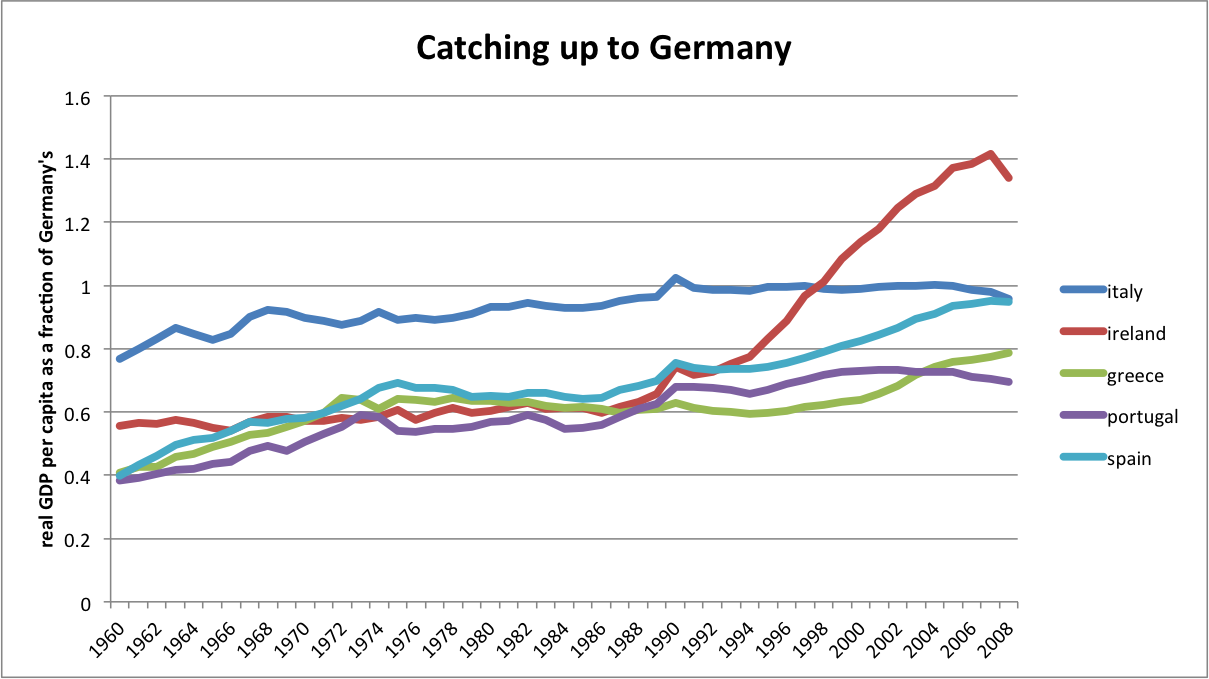
Economist Tyler Cowen has a post up on who has gained most from the Euro (as measured by state), but the economist Angus puts things into perspective:

Ireland, Spain, Portugal and Greece were all growing fast relative to Germany (and France which is not on the graph) well before the introduction of the Euro. Ireland and Spain take off somewhere around 1990 and the intro of the Euro in 2000 does not speed up their trajectory. Portugal actually falls further behind Germany in the Euro era. Greece is the only country of these 5 whose catch-up to Germany accelerates with the intro of the Euro.

Two quick thoughts:

  1. Woah! Look at Ireland!
  2. I’ll bet the acceleration of growth in the 1960’s had to do with the end of World War 2 and its rebuilding efforts.

Taking a broader historical view really puts things into perspective. If the Euro was not the catalyst for the economic growth of the 1990’s, what was? My guess is that the elimination of tariffs and labor restrictions between European states led to the growth. If the Eurozone had not implemented a central bank I think we wouldn’t be looking at all of the political problems now associated with the region.

Angus (who works at Oklahoma University) got his statistics from here. I highly recommend using it in your own studies as well.

Guns and Truth

I have stayed away from this blog too long. I wasn’t cruising the South Pacific on my McGregor 26, as you might expect. I was just editing my memoirs; I was trying to be thorough. (It’s called: “I Used to Be French: An Immature Autobiography.” There are excerpts of it on this blog.)

On my last radio show, I made the subject of gun control come up. I did it because I had heard one of my colleagues, a liberal talk-show host on the same station make a statement that sounded bogus to me. (The station is KSCO A.M. In Santa Cruz; it’s available on-line. My show is called “Facts Matter.” It’s every Sunday 11a.m. – 1p.m.)

The statement that caught my attention was this:

For every time a gun is used in legitimate self-defense, a gun is used nineteen times for illegitimate or illegal purposes.

The figure was just too pat. It was calculated to be remembered by regular folks who are assumed by the Left to have no head for numbers. It sounded like pure propaganda. I thought it might also be trivially true, correct but without any meaning.

I called the liberal host during his show and challenged him to produce a source. He could not. We had eleven email exchanges. The other guy says he gave me the references. I say he did not.

If you insist on you shoring up your argument with figures – a good thing- you had better be prepared to explain where they come from. I think the Left is forever quoting imaginary numbers and numbers they misinterpret. Some just cheat and make up facts. Others are just conveniently loose with numbers, making mistakes always in the same direction.  Continue reading

Around the Web

Lots of great stuff I’ve been meaning to link to lately.

A historian from Hillsdale College, Paul Moreno, has a piece in the WSJ about Congress’s power to tax.

Some sexy chick (also from the WSJ) writes about Obama’s Imperial Presidency. Again, this is in the Wall Street Journal.

A quick heads up on pieces in the Wall Street Journal. Usually, when you click on the link it says access is restricted, but if you copy and paste the title of the piece into a Google search bar then you will be able to access the entire article. Cool, huh?

Obama’s Scramble for Africa. From AntiWar.com.

An economist at Cal State Northridge has a great piece on damn lies and statistics. It’s also about the Obama administration. (h/t Steve Horwitz).

Bernard K. Gordon writes in Foreign Affairs about the necessity of the Trans-Pacific Partnership.

And in a prophetic piece (ie it was written in 1991-92) by former Secretary of State James Baker, this very good lawyer sizes up the situation in Asia. Also from Foreign Affairs.

Exploring Irrationality: Clusters

With great trepidation, I want to use this blog to do something that may be verging on the obscene. Don’t worry though, it does not involve my disrobing on-line, at least, not yet.

Let me explain: I style myself a strict rationalist. I have spend much of my life fighting and trying to destroy superstitions. Since I have lived in Santa Cruz, California, for more than ten years, I have been busy. Tech. note: Santa Cruz is where half digested vulgar Marxism meets endlessly with New Age beliefs, diet and exotic health practices. It’s also a major center for the cult of Gaiia. (“Gaiia” is the poetic name for that contrary bitch, Mother Nature.) I think facts matter and the people whose influence I fight every hour of the day when I am not sleeping think only beliefs and intentions matter. They are further sure that beautiful beliefs are more real than facts and that they trump facts (if any).

So, here I go: I have to speak about something I cannot quite explain and that has been puzzling me all my adult life and perhaps before. And it’s a little bit shameful:

Events that have little importance in my life and that I encounter rarely tend strongly to happen in clusters. Two interrelated examples below. Let me tell you right away: what’s below is both perplexing and fairly unimportant.

Example 1: I go to the beach with my grand-daughter who is three. It’s the same beach where we have gone fifty times this past summer. There is small concrete space there in front of a coffee shop and in front of a restaurant. That nice day, the space is jammed. I need to go to the restroom inside quickly. I scan the small crowd for a likely person or persons to whom to entrust my grand-daughter for a very few minutes. My eyes rest on a nice, hearty older couple. I ask them. They say yes with an accent I recognize as German. They confirm they are German tourists. Continue reading