“We’re all nothing but bags of stories”: Carlos Castaneda as a Countercultural Icon and Budding Post-Modernist

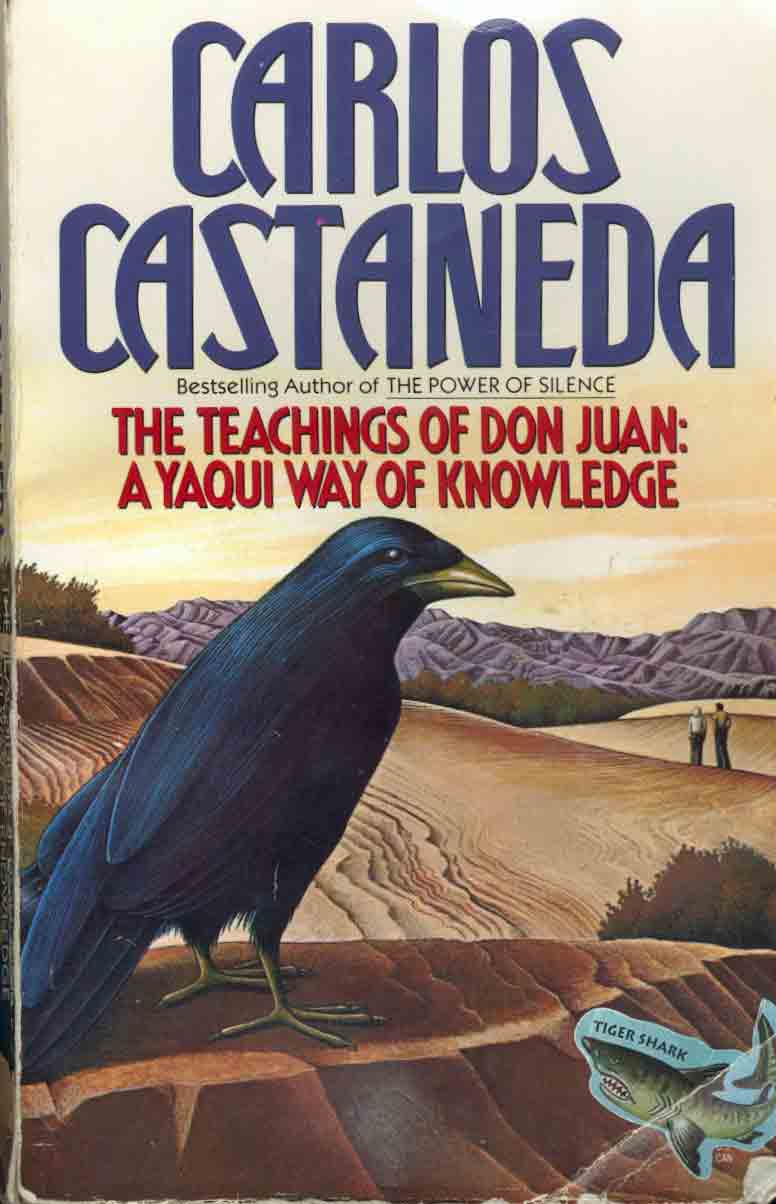
Exploring the countercultural 1960s and the origin of Western New Age, one cannot bypass Carlos Castaneda. He became a celebrity writer because of his bestselling book The Teachings of Don Juan: A Yaqui Way of Knowledge that was published by the University of California Press in 1968. The book was written in a genre of free-style dialogues between a Native American shaman named Don Juan Matus and Castaneda himself, who claimed that he worked with Don Juan for many years. The Teachings describes how Castaneda learned to use three hallucinogenic plants: peyote, jimson weed, and psychedelic mushrooms. After ingesting these substances, Castaneda went through mind transformations and learned that there were other realities besides the ordinary one. Later, it was revealed that he made up the whole experience, but this never affected his popularity.
Carlos-Castaneda-The-Teachings-of-Don-Juan

Of course, a book like this was well-tuned to the then-popular hallucinogenic subculture, and the link between Castaneda’s text and the psychedelic ‘60s is the most common explanation of his popularity. Yet I want to argue that this is a very narrow view, which does not explain why Castaneda’s follow up books, which had nothing to do with psychedelics, continued to enjoy popularity well into the 1990s. In fact, by the early 1980s, Castaneda became so paranoid about hallucinogens that he forced his girlfriend to undergo drug tests before allowing her to sleep with him. I also argue that viewing Castaneda exclusively as one of the spearheads of the New Age does not explain much either. The appeal of his texts went far beyond the New Age. In the 1970s and the 1980s, for example, his books were frequently assigned as conventional course readings in anthropology, philosophy, sociology, religious studies, and humanities classes.

Let me start with some biographical details. Castaneda was born Carlos Arana in Peru to a middle class family and moved to the United States in 1951. He tried to enter the world of art but failed. Then, for a while, he worked as a salesman while simultaneously taking classes in creative writing before eventually enrolling in the anthropology graduate program at UCLA.

Originally Castaneda did not care about hallucinogens and the emerging hippie culture, but eventually UCLA (and the broader California environment), which was saturated at that time with various counterculture and unchurched spirituality projects, made him choose a sexy topic: the use of psychedelics in a tribal setting. The book which made him famous, The Teachings of Don Juan, originated from a course paper on “power plants” and from his follow-up Master’s thesis. I want to stress that both papers were essentially attempts to find a short-cut to satisfy the requirements of his professors. His first professor, an anthropologist, invited those students who wanted to get an automatic “A” to find and interview an authentic Indian. Despite a few random contacts, Castaneda could not produce any consistent narrative, and had to invent his interview. This was the origin of his Don Juan character. Then he followed requirements of his advisor, Harold Garfinkel, a big name in sociology at that time and one of the forerunners of postmodernism. Garfinkel made it explicitly clear to Castaneda that he did not want him to classify and analyze his experiences with Don Juan scientifically.

What Garfinkel wanted was a free-style and detailed description of his work with the indigenous shaman as it was and without any interpretation. Thus it was through collective efforts that Castaneda produced a text that by chance caught the attention of the university press as a potential bestseller. Essentially, Castaneda took to the extreme incentives provided to him by his professors and by the surrounding subculture. He internalized these incentives by composing a fictional text, which he peddled as authentic anthropological research. It is interesting to note that in 1998, just before he died, Castaneda made the following mischievous remark in his introduction to the last anniversary edition of The Teachings of Don Juan: “I dove into my field work so deeply that I am sure that in the end, I disappointed the very people who were sponsoring me.”

The popularity of the first book gave rise to the whole Don Juan sequel, which made Castaneda an anthropology and counterculture star. The combined print run of his books translated in 17 languages reached 28 million copies. And, as I mentioned above, despite the revelations that his Don Juan was a completely fabricated character, the popularity of his books was increasing throughout the 1970s. In fact, to this present day, libraries frequently catalogue his books as non-fiction.

It seems that Castaneda’s appeal had something to do with overall trends in Western culture, which made his text resonate so well with millions of his readers. For this reason, I want to highlight the general ideological relevance of Castaneda’s books for the Western zeitgeist (spirit of the time) at its critical juncture in the 1960s and the 1970s. Various authors who wrote about Castaneda never mentioned this obvious fact, including his most complete biography by French writer Christophe Bourseiller, Carlos Castaneda: La vérité du mensonge (2005). So exploring the ideological relevance of the Don Juan books will be my small contribution to Castanediana.

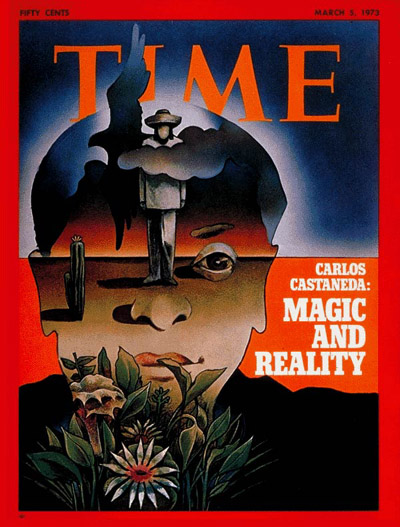
To be specific, I want to point to two themes that go through all his books. First, he hammered in the minds of his readers the message of radical subjectivism, which in our day it is considered by some a conventional wisdom: What we call truth is always socially constructed. Don Juan, who in later books began speaking as a philosophy professor, repeatedly instructed Carlos that so-called reality was a fiction and a projection of our own cultural and individual experiences, and instead of so-called objective reality, we need to talk about multiple realities. In an interview for Time magazine, Castaneda stressed that the key lesson Don Juan taught him was “to understand that the world of common-sense reality is a product of social consensus.” Castaneda also stressed the role of an observer in shaping his or her reality and the significance of text in Western culture. In other words, he was promoting what later became the hallmark of so-called postmodern mindset.

Second, fictional dialogues between the “indigenous man” Don Juan, whom Castaneda portrayed as the vessel of wisdom, and Castaneda, a “stupid Western man,” contained another message: remove your Western blinders and learn from the non-Western ones. Such privileging of non-Western “wisdom” resonated very well with Western intellectuals who felt justified frustration about the hegemony of positivism and Western knowledge in general and who looked for an intellectual antidote to that dominance. By the 1990s, this attitude mutated into what Slavoj Zizek neatly labelled the “multiculturalist’s basic ideological operation,” which now represents one of the ideological pillars of Western welfare-warfare capitalism.

At the end of the 1970s, several critics tried to debunk Castaneda. They were able to prove that his books were the product of creative imagination and intensive readings of anthropological and travel literature. These critics correctly pointed out that Castaneda misrepresented particular indigenous cultures and landscapes. Besides, they stressed that his books were not written in a scientific manner. Ironically, this latter criticism did not find any responsive audiences precisely because social scholarship was moving away from positivism. Moreover, one of these critics, anthropologist Jay Fikes, who wrote a special book exposing Castaneda’s hoax, became a persona non grata in the anthropology field within the United States. Nobody wanted to write a reference for him, and he had to move to Turkey to find an academic position.

What critics like Fikes could not grasp was the fact that the Castaneda texts perfectly fit the emerging post-modernist thinking that was winning over the minds of many Western intellectuals who sought to break away from dominant positivism, rationalism, and grand all-explaining paradigms. To them, an antidote to this was a shift toward the subjective, individual, and spontaneous. The idealization and celebration of non-Western knowledge and non-Western cultures in general, which currently represents a powerful ideological trend in Western Europe and North America, became an important part of this intellectual revolt against the modern world. I am sure all of you know that anthropology authorities such as Clifford Geertz (until recently one of the major gurus of Western humanities), Victor Turner, and Claude Lévi-Strauss were inviting others to view any cultural knowledge as valid and eventually erased the border between literature and science. They also showed that scholarship can be constructed as art. Castaneda critics could not see that his texts only reflected what was already in the air.
Castaneda_Time magazine

The person who heavily affected the “production” of the first Don Juan book, which was Castaneda’s revised Master’s thesis, was the above-mentioned sociologist Garfinkel. As early as the 1950s, Garfinkel came up with ideas that contributed to the formation of the post-modern mind. I am talking here about his ethnomethodology. This school of thought did not see the social world as an objective reality but as something that individuals build and rebuild in their thoughts and actions. Garfinkel argued that what we call truth was individually constructed. Sometimes, he also called this approach “people’s sociology.” He stressed that a scholar should set aside traditional scientific tools and should simply narrate human experiences as they were in all details and spontaneity. Again, today, for many, this line of thinking is conventional wisdom, but in the 1950s and the 1960s it was revolutionary. Incidentally, for Castaneda it took time to figure out what Garfinkel needed from him before he rid his text of the vestiges of “positive science.” To be exact, Castaneda could not completely get rid of this “science” in his first bestselling book. In addition to the free-flowing and easy-to-read spontaneous dialogues with Don Juan, Castaneda attached to the text an appendix; a boring meaningless read that he titled “Structural Analysis.” In his later books, such rudiments of positivism totally disappeared.

When Castaneda was writing his Master’s thesis, Garfinkel made him revise the text three times. The advisor wanted to make sure that Castaneda would relate his spiritual experiences instead of explaining them. Originally, when Castaneda presented to Garfinkel his paper about a peyote session with Don Juan, the text was formatted as a scientific analysis of his own visions. The professor, as Castaneda remembered, rebuked him, “Don’t explain to me. You are nobody. Just give it to me straight and in detail, the way it happened. The richness of detail is the whole story of membership.” Castaneda spent several years revising his thesis and then had to revise it again because Garfinkel did not like that the student slipped into explaining Don Juan psychologically. Trying to be a good student, Castaneda embraced the advice of his senior colleague. So the final product was a beautiful text that was full of dialogues, rich in detail, and, most importantly, came straight from the “field.”

I interviewed some of Castaneda’s classmates and other scholars who became fascinated with his books at the turn of the 1970s. Many of them had no illusions about the authenticity of Don Juan. Still, they argued that the whole message was very much needed at that time. A quote from Douglas Sharon, one of Castaneda’s acquaintance, is illustrative in this regard. In his conversation with me, Sharon stressed:

“In spite of the fact that his work might be a fiction, the approach he was taking—validating the native point of view—was badly needed in anthropology, and, as a matter of fact, I felt it was a helping corrective for the so-called scientific objectivity that we were taking into the field with us.”

I want to mention in conclusion that Castaneda not only promoted the postmodern approach in his novels but also tried to live it. Before the age of Facebook and online forums, Castaneda, with a group of his followers, became involved in an exciting game of identity change. They came to enjoy confusing those around them by blurring and constantly changing their names and life stories. For example, people in his circle shredded their birth certificates and made new ones. They also performed mock wedding ceremonies to make fun of conventional reality. To those who might have had questions about this “post-modernist” game, Castaneda reminded: “We’re all nothing but bags of stories.”

Buddha, A Lonely Human Rebel

Although I do not consider myself a Buddhist, I have always had much respect for Gautama Buddha and I have always regarded him as an exemplary person.

What I find most sympathetic about Buddha are his humanness, his epistemological modesty, and his insistence to use reason and scientific inquiry to understand the world and to free oneself from social dogmas and religious oppression. It is for these reasons that Gautama Buddha could be considered contumacious or rebellious; he argued tenaciously against the superstitious practices and beliefs of Hinduism. He encouraged his followers to cultivate the mind and develop reason, because he considered it to be an essential element of ‘magga’ or the eightfold path to enlightenment (right understanding, right intention, right speech, right action, right livelihood, right effort, right mindfulness, and right concentration).

Smith & Novak write in Buddhism (2003) that there are six aspects of religion that “surface so regularly as to suggest that their seeds are in the human makeup” (Smith & Novak, 2003, p. 22), and that Gautama Buddha rebelled against all these aspects. The six aspects are:

  1. Authority – which was hereditary and exploitative as brahmins were charging exorbitantly for their services;
  2. Rituals – which became the people’s mechanical means to achieve quick miraculous results in life;
  3. Speculation – which entirely lost its experiential base;
  4. Tradition – which inhibited people from progress. One example is the tradition to instruct religious discourse in Sanskrit, making the brahmins’ knowledge effectively unavailable for the common people;
  5. Divine grace – which became confused with fatalism as to undercut human responsibility. Think for instance about the misinterpretation of ‘karma’ that was abused in order to maintain and rationalize the caste system;
  6. Mystery – which became confused with mystification and led to a perverse obsession with miracles and the occult. (Smith & Novak, 2003, p. 23)

According to Gautama Buddha, they were all too prevalent in the Hinduism of his days and he regarded them to be oppressive of human flourishing. As a revolt against the superstitious Hindu culture, Gautama Buddha preached a philosophy that is:

A. Devoid of authority – he tried to break the brahmins’ monopoly on religious teachings. In addition, he challenged everyone to utilize their own rationality and stop passively relying on the brahmins to tell them what to do.

B. Devoid of rituals – he believed that rites and ceremonies bind the human spirit.

C. Devoid of speculation – the monk Malunkyaputta, troubled by Gautama Buddha’s silence on metaphysical speculations, said:

whether the world is eternal or not eternal, whether the world is finite or not, whether the soul is the same as the body, or whether the soul is one thing and the body another, whether a Buddha exists after death or does not exist after death, whether a Buddha both exists and does not exist after death, and whether a Buddha is non-existent and not non-existent after death, these things the Lord does not explain to me, and that he does not explain them to me does not please me, it does not suit me (Kyimo, 2007, p. 206).

D. Devoid of tradition – he wanted a break from the archaic and he wanted to teach the peoples in their vernacular. On the question why his teachings should be followed, Gautama Buddha answers:

Do not go upon what has been acquired by repeated hearing; nor upon tradition; nor upon rumor; nor upon what is in a scripture; nor upon surmise; nor upon an axiom; nor upon specious reasoning; nor upon a bias toward a notion that has been pondered over; nor upon another’s seeming ability; nor upon the consideration, ‘The monk is our teacher.’ Kalamas, when you yourselves know: ‘These things are bad; these things are blamable; these things are censured by the wise; undertaken and observed, these things lead to harm and ill,’ abandon them.[1]

What Gautama Buddha is effectively saying here is that everything should be questioned; every tradition, every holy book, and even teachers including himself. He taught everyone to use reason and the scientific methodology of inquiry, and he emphasized on doing good and abandoning evil.

E. Emphasizes intense self-effort and opposes fatalism – everyone can become enlightened. He taught everyone that actions are meaningful and that everyone contains the power to change their lives immediately for the better. Everyone was considered responsible for their own actions and happiness. This puts heavy responsibilities on all individuals to make the best of their lives.

F. Devoid of the supernatural – he condemned divination and reliance on Brahma (God). (Smith & Novak, 2003, pp. 24-28) He could not conceive of Brahma who considered himself “the Supreme one, the Mighty, the All-seeing, the Ruler, the Lord of all, the Maker, the Creator, the Chief of all appointing to each his place, the Ancient of days, the Father of all that is and will be”[2] to inflict so much suffering on the peoples:

If the creator of the world entire
They call God, of every being be the Lord
Why does he order such misfortune
And not create concord?
If the creator of the world entire
They call God, of every being be the Lord
Why prevail deceit, lies and ignorance
And he such inequity and injustice create?
If the creator of the world entire
They call God, of every being be the Lord
Then an evil master is he, (O Aritta)
Knowing what’s right did let wrong prevail![3]

At the same time, Gautama Buddha appeared to be one of us: fallible, sensitive, and insecure about life. Despite his immense influence, he remained humble enough as to never claim to be a son or a prophet of God – nor did he ever claim to understand the beginnings of the universe. His teachings were entirely devoted to alleviate man from his misery.

Talking about the Three Greatest Men In History (1935), H.G. Wells said of Gautama Buddha that:

[Y]ou see clearly a man, simple, devout, lonely, battling for light – a vivid human personality, not a myth. Beneath a mass of miraculous fable I feel that there also was a man. He, too, gave a message to mankind universal in its character. Many of our best modern ideas are in closest harmony with it. All the miseries and discontents of life are due, he taught, to selfishness… Before a man can become serene he must cease to live for his senses or himself. Then he merges into a greater being. Buddha in different language called men to self-forgetfulness 500 years before Christ. In some ways he was nearer to us and our needs. He was more lucid upon our individual importance in service than Christ and less ambiguous upon the question of personal immortality. (Wells, 1935, July 13)

Footnotes
[1] From Kalama Sutta: The Instruction to the Kalamas.

[2] From Digha Nikaya 1: Brahmajala Sutta.

[3] From Bhuridatta Jakata.

Bibliography
Examiner. (1935, July 13). Greatest In History. Retrieved from www.trove.nla.gov.au/ndp/del/article/51945346?searchTerm=GLOBE%20READER%20DIGEST%20&searchLimits=

Gunasekara, V.A. (1997). The Buddhist Attitude To God. Retrieved from http://www.budsas.org/ebud/ebdha068.htm

Kalama Sutta: The Instruction to the Kalamas. (1994), Transl. Soma Thera. Retrieved from www.accesstoinsight.org/tipitaka/an/an03/an03.065.soma.html

Kyimo. (2007). The Easy Buddha. London: Prospect House Publishing.

Smith, H., & Novak, P. (2003). Buddhism: A Concise Introduction. New York: HarperOne.

Cave Paintings and Elementary Science

This is a travel story of sorts, of travel through time, to an extent. Be patient.

Directly to the west of Marseille, the second largest city in France are a series of beautiful, narrow coves, like fjords, situated in a sort of desert. They are called “calanques” in French. They are accessible only by sea or through a long walk on hot rocky ground. Although they constitute a separate world, the calanques are close to Marseille, as the crow flies. They used to be a major fishing resource for the city. You can be sure they were never forgotten during the 2600 years of the city’s existence. Also, the city was founded by Greeks and thus, it always had a literate population, one that kept records.

Marseille and its environs are where SCUBA was invented, the first practical solution to the problem of men breathing underwater. Accordingly, the calanques were always and thoroughly explored after 1950. In 1985, one of the co-inventors of SCUBA discovered a deep cave in one of the calanques. He couldn’t resist temptation and swam into it until he reached a large emerging room. I mean a cave where he could stand and breathe regular air. His name was Cosquer.

Cosquer visited there several times without saying a word about his discovery. Soon, he observed dozens of beautiful paintings belonging to two distinct periods on the upper walls of his cave. The art of the first period was mostly hand imprints or stencils. The art of the second, distinct period, comprised 170-plus beautiful animals including many horses, ibex and others mammals, also fish, seals and other sea creatures. Archaeologists think the painting of the first period were done about in about 25 000 BC, those of the latter period date back to about 18 000 BC, they believe.

Today, the entrance to the cave is about 125 feet below sea level. We know that paleolithic men did not have SCUBA. They simply walked into the cave for their own reasons, with their own purposes in mind. Thus, the sea level was at least 125 feet lower then than it is today. The people of Marseille never saw the cave. They would have written about it. There would be records. They would not have forgotten it. They simply did not know of its existence during the past 2600 years.

Sometimes in the past 20 000 years, the sea rose 125 feet or more. That’s an amplitude several times greater than any of the direst predictions of the official United Nations Intergovernmental Panel on Climate Change for the next century. The IPCC squarely blames a future ocean rise (one that has not been observed at all, yet) on abnormal emission of several gases, especially CO2 . These abnormal emissions in turn, the IPCC affirms are traceable to human activities such as driving cars and producing many useful things by burning fossil fuels.

It seems to me that basic good science requires that causal analysis begin with a baseline. In this case, it would mean something like this: In the absence of any burning of fossil fuels, the ocean rose 125 feet sometimes during the past 20,000 years. Let’s see if we can find evidence of the ocean rising above and beyond this order of magnitude since humanity began burning fossil fuels in large quantities, about 150 years ago.

The conclusion will likely be that nothing out of the ordinary happened. Hence, fossil fuel emissions are probably irrelevant to this particular issue. (This leaves open the possibility that such emissions are odious for some other reason. I mean that CO2 is plant food. Too much CO2 may promote weed growth in our fields and gardens. )

The ocean is not currently rising and if it is, the existence of the Cosquer cave suggests that it’s rising to a tiny degree. Let’s keep things in perspective. Let’s discard openly and loudly every part of the building of a complex hypothesis that does not work. Those who don’t take these obvious cleansing measures simply have a lot of explaining to do. They should not be allowed to wrap themselves in the mantle of science while violating Science 101 principles.

One of the conceits of the Warmist movement is that you don’t have a right to an opinion unless you possess a doctorate in Atmospheric science. By this dictate, anybody who has to keep a job, raise children, or pay a mortgage is out of the discussion. This is the typical posturing of intellectual totalitarianism. Note what’s missing in the story above: It says nothing about what did cause the ocean to rise between 18 000 B. C. and today. It’s enough to know that whatever it was, it was not the massive burning of fossil fuels. The story is complete as is. Don’t quit your job and apply to graduate school!

The selfish meme

There are two senses in which to consider the phrase.

  1. The sense in which memes enter or exit our minds.
  2. The sorts of behavior encouraged by our memes.

For those who don’t know what I’m talking about:

A meme (/ˈmm/ meem)[1] is “an idea, behavior, or style that spreads from person to person within a culture”.

Richard Dawkins introduced the idea in his famous book: The Selfish Gene. The bulk of his book discusses examining the gene as the basic unit of analysis in evolutionary studies. He introduces the idea of the meme as a different form of replicator. Both genes and memes will only be reflected in the outcome of biological and cultural evolution if they exhibit fitness–if they are able to survive.

So the cultural traditions that helped hunter-gatherer societies survive droughts or harsh winters tended to survive and spread. Over time a culture accumulates this sort of practical, tacit knowledge. (Side note: this week’s Econtalk has Cesar Hidalgo who does really interesting work trying to indirectly measure the presence of such tacit knowledge in market economies.) And if culture is made up of memes, the same way organisms are made up of genes.

Looking at genes as the unit of analysis (as opposed to the organism) explains some otherwise mysterious behavior. It provides a plausible explanation of altruism: we care for our children more than anyone because 50% of their genes are our genes. A nephew is still precious, but not as important to us because the expected ratio of shared genes between the two of you is 25%. A gene that prompts you to protect your children is likely to survive longer than a gene that doesn’t prompt you. (And genes that hang around with such kin-protects genes are also more fit than their competition.) A gene that prompted you to be kind to neighbors makes sense when you live in small groups. But a gene that prompted you to be kind to total strangers might be a liability in a world where strangers were dangerous.

Cultural evolution certainly makes sense as a gradual mutation of different cultural practices merging together to make what is called (and perceived) as a unique body of culture. It’s a complex of knowledge, ideas and basic assumptions, social interface protocols, and it’s deeply embedded in how we engage in the world. (Perhaps we can’t remember our infancy because we didn’t have a cultural lens through which to reference anything to anything else…) One thing that I’m sure we’ve all noticed is that it can be almost painful to have to reject a cherished belief. It’s even difficult to see one of these memes challenged.

Now genes don’t have to be small bits of genetic code. They can be something simple like “make this enzyme when you get a chance.” But as a unit of replication, you should consider the smallest discrete chunk of genetic coding that replicates itself. If a particular pattern isn’t fit, it will leave the gene pool, while the fit collections of genetic instruction spread. So you might end up with long complex strings of genetic material akin to a computer program. Initially simple scripts might gather as successful collections of genes that work well together. The “produce stomach acid” gene works well with the “produce a stomach” gene and soon the two are virtually inseparable. They’ve become a simple script: “Do this, then that, then maybe this other thing.” Scripts gather into multi-cellular organisms with different functions that can respond differently to different stimuli. Soon you’ve got a complex set of code as your replicating unit.

More complex genes are necessary to prompt more complex behavior. It’s worth noting that Dawkin’s theoretical framework sometimes looks like a hyper-rational economics model. Evolutionary Stable Strategies are a Nash Equilibria that are robust to invaders. They occupy a niche and survive. But this evolution is happening in the context of increasing complexity. The system is learning*. This isn’t an instantaneous process**, but it is gradually becoming more sophisticated.

A complex gene will get bugs due to random mutation, but as long as it’s still generally fit, it will survive. And over time, more subtle and sophisticated programs identify new niches. And we get plant genes surviving by filling the “eat sunlight” niche and animals in the “eat plants” niche, and bacteria co-evolving with animals’ digestive systems.

Slowly working through this long, blind, random process genes surviving this hostile environment develop behaviors that help them flourish (the “four F’s of evolution: Fighting, fleeing, feeding, and reproduction”). Gradually they stumble into opportunities, and an important one was social behavior.

More and more complexity, round and round, until we start to get our first little bits of sentience. I’ve been watching a chinchilla hop around my apartment for a couple weeks now and I’m astonished by how much effort she puts into genuinely exploring her world. She tests objects for structural integrity and learns what she can and can’t jump on. She tests boxes with her teeth, I don’t know what for. She’s distinctly learning and not merely existing or surviving. She’s comfortable and does not know fear (I’ve seen her scare one particularly wussy cat). That sort of behavior requires a great deal of complexity which requires a great deal of genetic material.

I’m noticing as I write this that the biggest gene (i.e. discrete, replicated set of genetic code) must be that very large collection of genetic patterns that must come together in order for a one’s offspring to simply be the same species.*** I’ve heard that humans and chimps share 94 percent of our genetic material. That overlap tells me that some larger percentage than that is what makes us actually a human. The difference between any two individuals, then, must be among a very small portion of their total genetic makeup. This small portion is where genetic competition occurs in the arena of sexual reproduction.

In any case, our first memes (behaviors) seem to be transmitted biologically. Later, with more complex genes, we are able to replicate more complex behaviors. Eventually, we get complex enough to build up a sense of consciousness****.

A complex enough gene might have a subroutine that sets off an error; something like the pain our consciousness experiences when things are going poorly*. And likewise for a meme. Though more likely is that the error is being returned by our psychology. (If our genes are assembly language, our psychology is the operating system, and culture is the mess of basic programs that makeup our desktop environment.)

When we think of memes as self-replicating units, interesting questions arise: what sort of patterns will be robust to competition? Which will occupy what niches? What happens when incompatible memes come together in one mind? What sort of eusocial behaviors are possible? How much do our memes govern our behavior? (This is where nature and nurture overlap.)

Obviously one possibility is a “selfishness meme,” or a culture that hits an equilibrium of distrust. But there are many others, and how they combine matters. At this level we’re essentially asking questions about psychology, culture, and institutions. The fodder of all the social sciences comes together here. Different memes will be transmitted in different ways (which is perhaps what defines the disciplines), but any of these memes may be complex enough to have a defense mechanism that involves activating various processes (including other memes, perhaps) and perhaps making people feel anger and related emotions when someone questions our beliefs and may even push people to fight with their life for their memes.


*We’re computers, markets are computers, societies are computers, the ecosystem is a computer, Earth is just a big giant computer. It processes data and creates new data.

** The next Hayek rap should include the phrase “it’s spontaneous order, not instantaneous…”

*** I could imagine it as made up of some set of smaller genes in some complex, rather than one monolithic gene but I don’t have the language to communicate that idea concisely.

**** And it must be noted that this consciousness is built out of parts designed for the poop-and-panic machines that were our evolutionary ancestors. It’s like building a super computer* out of a truck load of Pez dispensers and a warehouse full of chainsaws. And yet, how else could it be done.

What makes it science?

When I hear the phrase “I experimented with drugs/diet/habit/whatever [on myself],” I tend to call bullshit. (A good exception is the author at Gwern.net who does blind, randomized trials on himself sometimes.) Without a control group you aren’t doing an experiment.

But I heard some interesting phrasing that is making me reconsider. Scott Adams was talking about experimenting with changes to his diet by isolating one thing and seeing if he can observe a change after a week. It’s clear that he understands the limitations of this approach. And that clarity makes me think that he’s really properly experimenting. He’s not going so far as running a double-blind study, he’s just taking a serious look at imperfect evidence and being epistemically honest.

Like any good scientific thinker of our time, Adams knows that the outcomes he observes can be affected by any number of variables he’s failed to account for. He knows that his estimates need an error term. He almost certainly knows that time isn’t on his side and ever so slightly affects his results. He almost certainly also knows that path-dependency plays a role. But he corrects for all that in his interpretation. It’s this considered approach to the evidence that makes me view him as operating on a scientific basis. So even if his trials do not provide powerful evidence, his interpretation and application of the evidence is what makes it science.

I suppose this would mean that an experiment can’t be considered scientific until the data is interpreted.

And of course all of this is to say that he’s definitely right about Donald Trump.

Should there be a Nobel in Sociology?

A friend of mine recently shared a piece making the case for creating a Nobel prize for the social sciences that I found interesting: see here. Or, for those who wish to be technical, this hypothetical new Nobel would be ‘A Prize in Social Science in Memorial to Alfred Nobel‘.

The general argument is that economics is not a real science, in the same manner that physics and other natural sciences are ‘real’ sciences capable of prediction and measurement. The other social sciences, such as anthropology, sociology, psychology, on the other hand are undervalued and should have greater say in the policy realm.

If economics were a social science like sociology or anthropology, practitioners would set about interviewing those committee members, scrutinising the meetings’ minutes and trying to observe as many meetings as possible. That is how the kind of fieldwork-based, “qualitative” social sciences, which economists like to discard as “soft” and unscientific, operate. It is true that this approach, too, comes with serious methodological caveats, such as verifiability, selection bias or observer bias. The difference is that other social sciences are open about these limitations, arguing that, while human knowledge about humans is fundamentally different from human knowledge about the natural world, those imperfect observations are extremely important to make.

To make his case the author points out that modern economics shies away from doing qualitative research by going out and doing case studies of the economic actors they study. Instead economists sit in their offices and theorize how economic actors behave.

The author is correct to point out that ‘blackboard economics’ is a problem in the field but he goes a bit too far. The economics field has several practitioners who go out and get their hands dirty, granted they are a minority. Ronald Coase’s infamous lighthouse paper* was written after Coase went and did research on how lighthouses actually functioned. Hernando de Soto (the economist, not the Spanish explorer!) similarly has made a name for himself by looking at how developing economies work first hand.

The article is strongest when, instead of attacking economics, it praises the other social sciences.

Karen Ho did years of fieldwork at a Wall Street bank. Her book Liquidated emphasises the pivotal role of zero job security at Wall Street (the same system governs the City of London). The financial sociologist Vincent Lépinay’s Codes of Finance, a book about the division in a French bank for complex financial products, describes in convincing detail how institutional memory suffers when people switch jobs frequently and at short notice.

Should there be nobel prizes for the other social sciences? I am certainly in favor of such a proposal if it aids promote public appreciation for the other social sciences. There is no need however to attack one another. There is room enough in the world for economists, sociologist, psychologists, and the other social sciences.

____________________

*For context, the lighthouse is an example widely used by economists as a public good that would not be produced in the market without state intervention. The benefit of a lighthouse is enjoyed by all, but is not excludable and therefore difficult to make revenue out of. The solution, as Coase points out, is that lighthouses are bundled with other goods such as port fees.

BC’s weekend reads

  1. Hongcouver
  2. Making a Case for Bishops’ Authority in the Second and Seventeenth Centuries
  3. Global Warming is not a Crisis
  4. Dondante
  5. From masterpieces to selfies (top link)

Global Warming, Soot Pollution, Mayor Bloomberg, the Paris Conference (forthcoming): So Confusing, So Confused!

So many inane things have been said about climate change by silly unqualified sources and so many others by dishonest qualified sources that it’s hard to keep separating the wheat from the shaft (Ah, ah!)

On the Monday June 29th of the Wall Street Journal, former Mayor Bloomberg of New York City delivered himself of advice about the forthcoming 2015 fall United Nations conference on climate change. It will take place in Paris. Right there, you know they are not serious. At any one time, half the delegates will be seeing the sights, or tasting the flavors.

Below is the excerpt that flummoxed me. I am retired, I have the time to be flummoxed. Other readers may not have had the time or the peace of mind to notice. This is for them.

“…The Paris conference has already proven successful in one respect: It has pushed heads of state to prioritize climate action” (Bolding mine.)

And further down:

“Whether they live in a capitalist or communist society [sic], people want to breathe clean air. They know that air fouled with carbon pollution causes death and disease,….” (Bolding mine, again.)

Wait a minute, I have been told a thousand times if I have been told once that CO2 is the primary cause of “climate change”! I flunked high school physics (not bragging, just admitting the facts) but I am sure that CO2 does not cause disease. And, I remember from a diving class long ago that it does not even cause death except insofar as it physically replaces oxygen. That’s hard to do in your lungs, by the way. It takes practice. Accordingly, suicide by CO2 is extremely rare!

So, is Mr Bloomberg referring to another kind of carbon pollution? Is there a faction of the Warmist Movement that’s on the edge of admitting that mere CO2 is just plant food, as we believed before the Apocalypse began? I ask because if the real enemy is either carbon monoxide or any of the visible sooty components that result from burning coal, I am not sure which side I am on anymore. Speak of agonizing re-appraisal!

I don’t know which side to take because I am squarely against both carbon monoxide and particulate (soot) pollution. The only people who are in favor of carbon monoxide are people who failed physics even worse than I did and confuse this deadly gas with the innocuous plant food CO2. As for particle pollution, the only ones who would say a single good thing about it, don’t. They are power industry spokesmen and other users of coal. They are not even arguing that they are good; they asked for more time to clean up their dirty act. The US Supreme Court declared last week that they were actually entitled to more time.

I remember well breathing the heavy smog in Paris in the fifties; I remember seeing pictures of the even worse smog in London. I remember the largely automobile-based smog in LA in the sixties. All these cities cleaned up their act. They did it to a large extent under demanding legislation. That legislation was not very controversial because it did not rest on mysterious, esoteric, contorted, and ever-changing science largely propagated by the incompetent, the irrepressibly stupid, and those who leave political judgment to experts. Besides, the application of the legislation walked in lockstep with perceptible progress. The air in Paris cleaned up in a few years during my childhood even while the population grew. The air in LA improved quickly after unleaded gasoline was introduced, etc. I hope someone will correct me if I am wrong but I don’t think the research involved or its presentation comprised crude fraud as in the “hockey stick” scandal about global warming.

If they were concerned with CO1 (mono) or with particle pollution, there would be no struggle, or little resistance. They invoke CO2 threat because cleaning up carbon is not going to give them the de-industrialization and the government control they crave. Think it through.

Incidentally, we wouldn’t even have this discussion if the US had continued building nuclear power plants twenty years ago. I mean, like France, where absolutely nothing dangerous happened. Like Japan where the worst happened in Fukushima and nothing happened. Nuclear energy releases no carbon particles, no carbon monoxide, and negligible amounts of CO2. Want to save the planet or not?

So, is mayor Bloomberg calling for UN conference in Paris re-dedicated to better breathing rather than to the never-ending struggle against “climate change’? Is he honestly confused? (Wouldn’t be the first time.*) Is he a dupe or a fiendish accomplice? Is he aiming for a typical “liberal Republican” middle course between truth and falsehood? Or, he is pushing forward a genuine Trojan Horse to finally reduce the already tottering, rickety citadel of misrepresentations, exaggerations, conflicting truths, bad measurements, worse logic, unscientific reasoning, an outright lies of Warmism?

* I am not casting the first stone, in this case. I demonstrated that the UN “Summary” for officials and political decision-makers was incomprehensible.

Around the Web

  1. Olivier Roy on Laicite as Ideology, the Myth of ‘National Identity’ and Racism in the French Republic
  2. Prague ’68 and the End of Time
  3. How To Spot And Critique Censorship Tropes In The Media’s Coverage Of Free Speech Controversies
  4. The Swamping that Wasn’t: The Diaspora Dynamics of the Puerto Rican Open Borders Experiment
  5. A Voice Still Heard: Irving Howe
  6. Borders and Bobbing Heads: Postcoloniality and Algeria’s Fiftieth Anniversary of Independence (so close, and yet so far…)
  7. The New Yorker on the recent scientific fraud, with its epicenter at my alma mater. (Delacroix remains startlingly relevant because of it.)

Measles Vaccine? Not Me!

That’s because the vaccine didn’t exist when I was a kid. I got the disease instead, leaving me with natural immunity. I think my chums all got it too and it amounted to a few days of discomfort, no big deal. But there must have been some who got it and suffered serious consequences, even death. News just didn’t get around in those days (ca. 1950) like it does today.

It’s terrific that a vaccine now exists, but like all vaccines it entails perverse incentives. When nearly everyone is vaccinated, there is little incentive for an individual parent to get it for his child because the disease can’t spread through a vaccinated population, and at least some incentive not to get it: cost, bother, and a remote chance of ill effects. And if enough parents skip the vaccine, the percentage of vaccinated children may fall low enough to permit the disease to propagate as, in fact, it has begun to do lately in some areas.

The solution for public schools is simple: require vaccination for all entering school children. As long as we have public schools, there have to be rules and this would be a quite sensible rule. For private schools the situation is trickier. Should the government require private schools to require vaccination? I think not. Most parents would have sense enough to keep their kids away from such schools. A no-measles policy would be a selling point for private schools.

Federalizing the Social Sciences

A few days ago I asked whether the social sciences could benefit from being unified. The post was not meant to make an argument in favor or against unification, although I myself favor a form of unification. The post was merely me thinking out loud and asking for feedback from others. In this follow up post I argue that the social sciences are already in the process of unification and a better question is what type of unification type this will be.


What is a social science?

First though allow me to define my terms as commentator Irfan Khawaja suggested. By social sciences I mean those fields whose subjects are acting individuals. For the time being the social sciences deal with human beings, but I see no particular reason why artificial intelligence (e.g. robots in the mold of Isaac Asimov’s fiction) or other sentient beings (e.g. extraterrestrials) could not be studied under the social sciences.

The chief social sciences are:

Economics: The study of acting individuals in the marketplace.

Sociology: The study of acting individuals and the wider society they make up.

Anthropology: The study of the human race in particular.

Political Science: The study of acting individuals in political organizations.

There are of course other social sciences (e.g. Demography, Geography, Criminology) but I believe the above four are those with the strongest traditions and distinctive methodologies. Commentators are more than encouraged to propose their own listings.

In review the social sciences study acting individuals.  A social science (in the singular) is an intellectual tradition that has a differentiating methodology. Arguably the different social sciences are not sciences as much as they are different intellectual schools.


Why do I believe the social sciences will be unified? 

On paper the social sciences have boundaries among themselves.

In practice though the boundaries between the social sciences blurs quickly. Economists in particular are infamous for crossing the line that the term ‘economics imperialism‘ has been coined to refer to the application of economic theory to non-market subjects. This imperialism has arguably been successful with Economists winning the Nobel prize for applying their theory to sociology (Gary Becker), history (Douglass North, Robert Fogel), law (Ronald_Coase) and political science (James M. Buchanan). The social sciences are in the process of being unified via economic imperialism.

Imperialism is a surprisingly proper term to describe the phenomenon taking place. Economists are applying their tools to subjects outside the marketplace, but little exchange is occurring on the other end. As the “Superiority of Economists” discusses, the other social sciences are reading and citing economics journals but the economics profession itself is very insular. The other social sciences are being treated as imperial subjects who must be taught by Economists how to conduct research in their own domains.

To an extent this reflects the fact that the economics profession managed to build a rigorous methodology that can be exported abroad and, with minimal changes, be used in new applications. I think the world is richer in so far that public choice theory has been exported to political science or price theory introduced to sociology. The problem lays in that this exchange has been so unequal that the other social sciences are not taken seriously by Economists.

Sociologists, Political Scientists, and Anthropologists might have good ideas that economics could benefit from, but it is only through great difficulty that these ideas are even heard. It is harder still for these ideas to be adopted.


Towards Federalizing the Social Sciences

My answer to economic imperialism is to propose ‘federalizing’ the social sciences, that is to say to give the social sciences a common set of methodologies so that they can better communicate with one another as equals but still specialize in their respective domains.

In practice this would mean reforming undergraduate education so that social science students take at minimum principle courses in each other’s fields before taking upper division courses in their specializations. These classes would serve the dual purpose of providing a common language for communication and encouraging social interaction between the students. Hopefully social interaction with one another will cause students to respect the work of their peers and discourage any one field from creating a barrier around itself. A common language (in the sense of methodology) meanwhile should better allow students to read each other’s work without the barriers that jargon terminology and other technical tools create. It is awful when a debate devolves into a semantics fight.

Supplementary methodologies will no doubt be introduced in upper division and graduate study, reflecting the different needs that occur from specialization, but the common methodology learned early on should still form the basis.

The unification of the social science need not mean the elimination of specialization. I do however fear that unless some attempt is made in ‘federalizing’ the social sciences we will see economics swallow up its sister sciences through imperialism.

As always I more than encourage thoughts from others and am all too happy to defer to better constructed opinions.

Global Warming and Scholarly Conspiracies, etc. Part Two

In Part One of Scholarly Conspiracies, Scholarly Corruption and Global Warming, I drew on my own experience as a scholar to describe how the scientific enterprise can easily become corrupted for anodyne, innocent reasons, for reasons that are not especially cynical. I argued, of course, that this can especially happen in connection with such big, societal issues as climate change. I concluded that the findings of scientists do not, as a matter of principle, merit the quasi-religious status they are often granted. It follows from this that the Left’s attempt to stop any debate on the ground that science has spoken is grotesque.

I should have added in Part One that at different times in my career, I may have benefited by the kind of corruption I describe as well as having been hurt by it. Of course, one thing does not compensate for the other. Corruption is corruption; it constitutes more or less wide steps away from the truth whether I profit by it or whether it harms me. These things just add up, they don’t balance each other out.

Once you open your eyes, it’s not difficult to find gross derailments of the scientific enterprise. To be more precise, the transformation of limited scientific results into policy often gives rise to abuses. Sometimes, they are gross abuses verging on the criminal.

A recent book describes in detail how the slim results of 1950s studies that were obviously flawed both in their design and with respect to data collection were adopted by the American scientific establishment as policy. They resulted in a couple of generations of Americans being intellectually terrorized into adopting a restrictive, sad, un-enjoyable diet that may even have undermined their health. The book is The Big Fat Surprise by Nina Teicholz .

For most of my adult life, I limited my own intake of meats because saturated fats were supposed to give me cardiac illness and, ultimately heart attacks. I often thought something was fishy about the American Heart Association severity concerning saturated fats because of my frequent stays in France. There, I contemplated men of all ages feasting on pork chops fried in butter followed by five different kinds of cheese also eaten with butter. Then, they would have a post-prendial cigarette or two, of course. None of the men I knew exercised beyond walking to shop for pâtés, sausages, and croissants sweating butter (of course). Every time, I checked – often – Frenchmen had a longer life expectancy than American men (right now, it’s two and half years longer.)

Yet, such was the strength of my confidence (of our confidence) in the official medical-scientific establishment that I bravely followed my stern semi-macrobiotic diet even while in France. In my fifties, I developed Type Two diabetes. None of my four siblings who lived and ate in France did. I understand well the weakness of a such anecdotal evidence. And I know I could have been the one of five who hit the wrong number in the genetic lottery. (That would have been the inheritance from my grandfather who died at 26 of a worse illness than diabetes, a German bullet, in his case.) Yet, if there are quite a few cases like mine where siblings constitute a natural control for genetic factors, it would seem worth investigating the possibility that a diet high in carbohydrates is an actual cause of what is often described as an “epidemic” of Type II diabetes. If there are many more cases than there were before the anti-fat campaign, controlling for age, something must have changed in American society. The diet low on saturated fats pretty much forced on us since the fifties could be that societal change.

I am not saying that it is. I am saying it’s worth investigating, with proper design and normal rules of data selection. I am not holding my breath. I think the scientific establishment will not turn itself around until its biggest honchos of the relevant period pass away. Teicholz’s book may turn out to have many defects because she is more a journalist than a scientist. I am awaiting with great attention the rebuttals from the scientific establishment, or – you never know – their apologies.

And then, there is the old story of how it took twenty years for the American Medical Association to change its recommendation on how to treat the common duodenum ulcer after an obscure Australian researcher showed that it was almost always caused by a bacterium. (The story was told about twenty years ago, in Atlantic Monthly, I think I remember. You look it up.)

The de facto scientific establishment is not infallible but it usually wants to pretend that it is. It’s aided in its stubbornness by the religiously inspired passivity of ordinary people who were raised with misplaced all-around reverence for science and anything that appears, rightly or wrongly, “scientific.”

The climate change lobby, wrapped in a pseudo-scientific mantle still thrives in several policy areas in spite of most Americans’ relative indifference to the issue. Two of its main assets are these: First it is well served by irresponsible repetition of a simplified form of its message that amounts to constant, uncritical amplification; second, even well-educated people usually don’t pay a lot of attention to detail, don’t read critically because they are busy.

Now, I am not going to spend any time denouncing the myriad airheads with short skirts who add their own climate change sage commentary to their presentation of ordinary weather reports. (I am a man of vast culture, I listen to the same tripe in three different languages!) As I keep saying, I don’t beat on kindergartners. Let’s take National Geographic, instead, that justifiably respected monument to good information since 1888.

The October 2013 issue presents another striking photographic documentary intended to illustrate fast climate change. One of the photographic essays in the issue concerns, predictably, the alleged abnormal melting of glaciers. The talented photographer, James Balog, contributes his own completely superfluous, judgmental written commentary:

We know the climate is changing…. I never expected to see such huge changes in such a short period of time.

The guy is a photographer, for God’s sake! He has an undergraduate degree in communications. His credentials to pronounce on long-term climate change are…? Even the National Geographic, generally so careful about its assertions, couldn’t resist, couldn’t bring itself to tell him, “This is outside your area of competence, STFU!” Why not let the janitor also give his judgment in the pages of National Geographic? This is a free country after all. Most people simply don’t have the energy to notice thousands of such violations of good scientific practice.

Now to inattention, still with the venerated National Geographic. The September 2013 issue, entitled “Rising Seas” presents a truly apocalyptic future in case global warming is not controlled. As is usually the case with N.G. the article is chock-full with facts from studies. The article is also tightly argued. N.G. is normally careful about what it asserts. To make things even clearer, it offers a graph on pp. 40 -41 purporting to demonstrate a disastrous future for the earth starting very soon.

Being a leisurely retired man endowed with an unusually contrary personality, being furthermore well schooled in elementary data handling, I did the obvious with the graph, the obvious not one educated person in 10,000 would think of doing, or care to do. I took my desk ruler to the graph itself. Here is what I discovered:

Between 1880 and 2013, there was less than a one foot rise in the oceans level according to National Geographic. Of course, those 123 years cover the period of most rapid rise in the emission of alleged greenhouse gases. Imagine if National Geographic had an article entitled:

“Less Than Foot-Rise in Ocean in Spite of More than 120 Years of Greenhouse Emissions”

Many citizens would respond by thinking that maybe, possibly there is global warming but it’s not an urgent problem. Let’s take our time looking into the phenomenon more carefully, they would say. Let’s try and eliminate alternative explanations to greenhouse gases if we find that there is indeed abnormal warming. After all, how much of a rush would I be in even if I were convinced that water rises in my basement by almost one tenth of an inch each year on the average?

This is not an absurd mental exercise. The business of science is to try to falsify and falsify again. When you get interesting results, the scientific establishment (if not the individual scientist author of the findings) is supposed to jump on them with both feet to see if they stand up. Instead in connection with global warming, scientists have allowed the policy establishment and those in their midst that influence it to do exactly the reverse: If you see anything you like in a scientific study, try hard for more of the same. If you find something that contradicts your cause, bury it if you can, ignore it otherwise. You will get plenty of help in doing either.

Scientists have become collectively a complicit in massive anti-scientific endeavor with many religious features.

I am finally proofing the print copy of my book:

I Used to Be French: an Immature Autobiography.

Scholarly Conspiracies, Scholarly Corruption and Global Warming: Part One

97 % of scientists, blah, blah…. Ridiculous, pathetic.

Thus challenged, some people I actually like throw reading assignments at me. Some are assignments in scholarly journals; some, sort of. Apparently, I have to keep my mouth shut until I reach a high degree of technical competence in climate science (or something). I don’t need to do these absurd assignments. I am not blind and I am not deaf. I see what I see; I hear what I hear; it all sounds familiar. Been there, done it!

A long time ago, I accepted a good job in France in urban planning after receiving my little BA in sociology from Stanford. I was a slightly older graduate and I had no illusions that I knew much of anything then. I had some clear concepts in my mind and I had learned the basic of the logic of scientific inquiry from old Prof. Joseph Berger and from Prof. Bernard Cohen. I had also done some reading in the “excerpts” department including the trilogy of Max Weber, Emile Durkheim and Karl Marx. Only a couple of weeks after I took my job, my boss sent me to a conference of urban sociologists in Paris. Having been intellectually spoiled by several years in the US and conscious of my limited knowledge of urban planning, I asked many questions, of course.

In the weeks following the meeting, I became aware of a rumor circulating that presented me as an impostor. This guy coming out of nowhere – the USA – cannot possibly have studied sociology because he does not know anything, French sociologists thought. I had to ask how the rumor started. I was aware that I knew little but, but, I did not think it was exactly “nothing.” Besides, most of my questions at the conference had not been answered in an intelligible manner so, I was not convinced that my comparison set – French sociologists working in city planning – knew much more than I did.

Soon afterward, I wrote a “white paper.” It was about the eastern region where I had been tasked to plan for the future until 2005 (the year was 1967) as part of a multidisciplinary team. The white paper gave a list of social issues city planners had to face at this point, the starting point of the planning endeavor. As young men will do, I had allowed myself short flights of speculation in the white paper, flights I would not have indulged in a few years later. My direct supervisor, an older French woman who was supposed to be sociologist, read the whole ambitious product, or said she had, and made no comments except one. She took exception to one of my speculative flights in which I made reference to the idea that much societal culture rises up from the street. It was almost an off-hand remark. Had that part been left out, the white paper would have been pretty much the same. The supervisor insisted I had to remove that comment because, she said exactly, ”Marx asserts clearly that culture comes from the ruling class.” She told me she would not allow the white paper to be presented until I extirpated the offending statement.

In summary: The woman had nothing to say about the many parts of the report that were instrumental to the endeavor that our team was supposed to complete, about that for which she and I were explicitly being paid. She had nothing to say about the likely mistakes I exhibited in the report because of my short experience. Her self-defined role was strictly to protect what she took to be Marxist orthodoxy even if it was irrelevant. There was a double irony there. First, the government that employed us was explicitly not in sympathy with any form of Marxism. The woman was engaging in petty sedition. Second, Karl Marx himself was no lover of orthodoxies. He would have abhorred here role. (Marx is said to have declared before his death, “I am not a Marxist”!)

In any event, I was soon rid of the ideological harridan and I was able to do my job after a fashion. For those who like closure: I went back to the US to attend graduate school, at Stanford again. Two years later, my old boss called me back. He had come up in the world. He was in charge of a big Paris metropolitan area urban research institute. He begged me, begged on the phone to go back to France, and take charge of the institute’s sociology cell. He said that he understood not a word of what the “sociologists” there said to him. He added that I was the only sociologist he had ever understood. I yielded to his entreaties and I promised him a single year of my life. I interrupted my graduate studies and flew to Paris. In the event, I gave the sociologists at the institute one month warning. Then, I summoned each one of them to explain to me orally how his work contributed to Paris city and regional planning. (“What will it change to the way this is currently being done?” I asked.) They did not respond to my satisfaction and I fired all six of them. I replaced them with people who could keep their Marxism under control. My boss was grateful. I could have had a great career in France. I chose to return to my studies instead.

Three years later, having completed my doctorate, I found my self at critical juncture common to all those who go that course. You have to turn your doctoral thesis into papers published in double-blind refereed journals. (Here is what this means: “What’s Peer Review and Why It Matters“)

That’s a lot like leaving kindergarten: no more cozy relationships, no more friends assuring you that your work is just wonderful; the real world hits you in the face. The review process in good journals is often downright brutal. Anyone who does not feel a little vulnerable at that point is probably also a little silly. To make matters worse, the more respected the journal, the harder it is to get in and the better your academic career. As a rule, if you have not achieved publication in a first-rate journal in the first three or four years after completing your doctorate, you will be consigned forever to second-tier universities or worse.

Be patient, I am just setting the stage for what’s coming.

Much of my early scholarly work happened to take place within a school of research dominated by “neo-Marxists.” It was not my choice. I was interested in problems of economic development that happened to be largely in the hands of those people. My choice was between abandoning my interests or buckling up and taking my chances. I buckled up, of course. My first article to be published was innovative but a little esoteric. (Delacroix, Jacques. “The permeability of information boundaries and economic growth: a cross-national study.Studies in Comparative International Development. 12-1:3-28. 1977.) I presented to a specialized journal and therefore not one that could be called “first tier.” It happened to contain nothing that would offend the neo-Marxists. It took less than six months to have it accepted for publication.

The second published paper out of my dissertation struck at the heart of neo-Marxists convictions. It demonstrated – using their methods – that the parlous condition of the Third World – allegedly caused by capitalist exploitation – could be remedied through one aspect of ordinary good governance. I submitted it to one of the two most respected journals (the American Sociological Review). All the reviewers who had the technical skills to review my submission were also neo-Marxists or sympathetic to their doctrine. The paper reported on a study conducted according to methods that were by now common. Having the paper accepted for publication took more than three years. It also took a rare personal intervention by the journal’s editor whom I somehow managed to convince that the reviewers he had chosen were acting unreasonably. (The paper: Delacroix, Jacques. “The export of raw materials and economic growth: a cross-national study.American Sociological Review 42:795-808. 1977.) No need to read either paper.

Am I telling you here a story of conspiracy or a story of academic corruption? Yes, I faced a conspiracy but it was not a conspiracy against me personally and it was mostly not conscious. The only people – but me- who had the skills to pass judgment on my paper were not numerous. They were a small group that shared a common understanding of the reality of the world. It was not a cold, cerebral understanding. Those people formed a community of sentiment. They believed their work would contribute to the righting of a worldwide injustice, a “global” injustice committed against the defenseless people of underdeveloped countries. Is it possible that their ethical faith influenced their judgment? To ask the question is to answer it, I think. Did their faith induce them to close their eyes when others from their own camp cut some research corners here and there? On the contrary, were their eyes wide open when they were reviewing for a journal a submission whose conclusion impaired their representation of the world? In that situation, did they overreact to an uncrossed “t” or a dotted “i,” in a paper that undermined their beliefs? Might be. Could be. Probably was. Other things being equal, they may have just thought, it would be better if these annoying Delacroix findings were not publicized in a prime journal. Delacroix could always try elsewhere anyway.

So, yes, I faced corruption. It was not conscious, above-board corruption. It was not cynical. It was a corruption of blindness, much of it deliberate blindness. The blindness was all the more sturdy because it was seldom called into question. Those who would have cared did not understand the relevant techniques. Those who knew them shared in the blindness. This is a long way from cynical, deliberate lying. It’s just as destructive though. And it’s not only destructive for the lives of the likes of me who don’t belong to the relevant tribe. It’s destructive of what ordinary people think of as the truth. That is so because – however unlikely that sounds – the productions of elite and abstruse journals usually find their way into textbooks, even if it take twenty years.

Are the all-powerful editors of important journals part of the conspiracy? Mine were not but they tended to adhere to imperfect rules of behavior that made them objective accomplices of conspiracies. Here is the proof that the editor of the particular journal tried to be impartial. Only a month after he accepted my dissenting paper, the editor assigned me to review a submission from the same neo-Marxist school of thought that trumpeted another empirical finding proving that, blah, blah…. After one reading of the paper, my intuition smelled a rat. I spent days in the basement of the university library, literally days, taking apart the empirical foundation of the paper. I found the rat deep in its bowel. To put it briefly, if you switched a little thing from one category to another, all the conclusions were reversed. There was no imperative argument to put that one thing in one category rather than in the other. The author had chosen that which put his labor of love in line with the love of his neo-Marxist cozy-buddies. If he had not done it, his pluses would have become minuses, his professional success anathema. In the event, the editor agreed with my critique and dinged the paper for good. Nothing worse happened to the author. No one could tell whether he was a cheat. Or, no one would. No one was eager to. The editor was not in appetite for a fight. He let the whole matter go.

Myself, I came out of this experience convinced that it was likely that no one else in the whole wide world had both the skills and the motivation to dive into the depth of the paper to find that rat. It’s likely that no one else would have smelled a rat. It’s possible that if I had not still been smarting from three years of rejection of my own work, I would not have smelled the rat myself. The editor had the smarts, the intuition fed by experience, I would say, that he could put to work my unique positioning, my combination of competence and contrariness. He put it to work in defense of the truth. That fact is enough to exonerate him from complicity in the conspiracy I described. To answer my own question: Do I think that powerful scientific journal editors are often part of a conspiracy of the right thinking, of an orthodox cabala? I think not. Do they sometimes or often fall for one? Yes.

For those who like closure: My interests switched later to other topics. (See vita, linked to this blog’s “About me.”) I think the neo-Marxist school of thought to which I refer above gradually sank into irrelevance.

After that experience, and several others of the same kind, do I have something better to propose? I don’t but I think the current system of scholarship publication does not deserve anything close to religious reverence. Even if there were anything close to a “consensus” of scientists on anything, that should not mean that the book is closed. Individual rationalism also matters. It matters more, in my book.

What does this story of reminiscences this have to do with global warming, climate change, climate disruption , you might ask? Everything, I would say. More on the connection in part Two. [Update: Here is part 2, as promised! – BC]

Climate Change and Flat Earthers

“There has been no universal trend in the overall extent of drought across the Unites States since 1900.”

“Trends in severe storms, including the intensity and frequency….are uncertain and being studied intensively.”

Both quotes are from the fine lines in the 829-page quadrennial National Climate Assessment. That’s the report Pres. Obama flogged on national television recently for nearly an hour. The president insisted something had to be done right now.

I have not read the report, of course, why should I ? (See below.)

(The first quote is in the report according to a Wall Street Journal editorial on 5/9/14. The second is in the report according to my frequent reader and commenter McHenry. He is a young man who does, or used to, believe in the threat of man-made climate change. He has good scientific training.)

A few months ago, when the Great Lakes were 90% frozen, that great scientist, Secretary of State Kerry relegated me to the ranks of “Flat Earthers.” He did this because I am very skeptical (and growing) of the climate change thesis. (See definition below.)

Of course, anyone who has been observing him from his political beginnings knows that John Kerry has no scientific competences, no competences about anything at all, except windsurfing and marrying rich widows. (I don’t knock either, no sir!) It’s also possible that he knows some French. That would tend to contribute to his misinformation, I think.

I suspect, in fact, I am almost sure, that Mr Kerry’s self-assurance is based on the belief that 97% of scientists, blah, blah, blah…

The climate change thesis deconstructs as follows:

1 There is a global rise in temperature.

That’s from some undetermined date. Hasn’t been any for the last fifteen years according to federal government’s own reports.

2 It’s caused by human activity.

This includes the burning of fossil fuels, of course but yet, there is no call for an increase in nuclear energy production which is a reliable and lasting way to relieve worldwide reliance on fossil fuels. No reason is ever given for this absence. Sometimes, perfectly serious climate change partisans also include among the causes of man-made global warming belching and flatulence by the large worldwide cattle population. The latter “cause,” of course, calls for a quick conversion to vegetarianism. (That is where secret evangelists show their hand.)

3 The world, or parts of it, or us, or some of us, are in imminent danger of a variety of catastrophes that will be caused by climate change.

Note that the three propositions are logically linked: If there is no global rise in temperature, we don’t care about human activity. If human activity does nothing to the globe ( to what, exactly?) there is no emergency. If there is a global rise in temperature and it’s not man-made, there is not much we can do. If there is global warming and it is the result of human activities and it does no harm, there is nothing we should do. If it does both harm and good (longer growing seasons in the north, access to minerals near the North Pole) then, there is something important to discuss internationally.

As the evidence in support of the thesis becomes more complicated and contradictory, the alarmist cries are becoming shriller. This makes a sort of macabre sense. Simple rationality is getting lost along the way. What we are told about urgent policy requirements does not fit with the evidence that is presented by the same people who demand urgently a new policy of de-industrialization. The climate change book is like a novel whose cover would proclaim “Joe Is the Killer” while the inside pages would sow doubt on the idea that Joe has ever killed, or even harmed anyone, has ever so much as spat on the sidewalk.

Sometimes, downright fraud is also prominently involved. That’s the case for the “97% of scientists” that I think certified incompetents like Sec. Kerry rely on. Personally, I have always known and said that there was nothing to the number. There is no 97% of anything anywhere, except in some banana republics and in North Korea. Now, we have good evidence of fraud on this matter.

In past postings on the climate change or global warming, I have been at great pains to declare, even to prove my ignorance in matters of climate science. I did this because I wanted to step resolutely away from jargon-filled experts’ and pseudo-experts’ discussions that can only befuddle people who have to make a living, rear children, prepare their taxes, pay a mortgage, go to the gym.

In fact, I have fair general scientific training: I easily recognize a good study design. (They don’t grow on trees!) I can spot bad measurements from a mile away, like a jealous wife a single long hair of the wrong color on her husband’s lapel. I also possess a skill that is rare in the general literate population but common among those who have acted as referees for scholarly journals: a keen sense of studies’ formal conclusions that shout when the findings would only merit whispering.

Note that I don’t claim I have ever committed this last little sin myself when I was a scholar. It’s damned tempting though. How can you admit, “Yes, I and two colleagues worked hard on this study for three years and, frankly, what we found does not amount to a hill of beans.”

And then, there is the vertiginous, nightmarish situation where you would have to report, “The consensus is that X causes Y. Our study, carefully conceived in every way – go ahead and check everything – suggests that X does not cause Y.” This is like yelling, “Go ahead, don’t publish my study!” (I actually published two such studies in my time, one at the beginning of my career, one at the end. The last one took twenty years! See on my vita linked to this blog: Delacroix, Jacques. “The export of raw materials and economic growth: a cross-national study.” American Sociological Review. 42:795-808. 1977. Delacroix, Jacques and François Nielsen. “The beloved myth: Protestantism and the rise of industrial capitalism in 19th century Europe.” Social Forces 80-2:509-553. 2001.)

There is also a general, well known anti “negative findings” bias in all scientific disciplines. Few journals have the intestinal fortitude to publish articles that proclaim: “We did not find anything.” I doubt that the climate sciences constitute an exception. Do you?

Here is a fictitious but realistic example of such a conclusion:

“Humans have been pumping ‘greenhouse gases’ into the atmosphere with increasing intensity* for one hundred and ten years and yet, there is no rise in the frequency of droughts.”

How does this work for your career, do you think?

Here is an example of bad design, specifically.

Several years ago in one of the respected American scientific magazines there appeared an article authored by three Australian professors with impeccable scientific credentials. (I am very sorry I don’t have the reference. However, my memory forgets but it does not make up stuff.) The article purported to tackle the issue of long term global warming. It was an attempt to recoup after the disaster of the “hockey stick scandal”** which involved downright cheating.

The issue is this: If it was warmer in 1000 that it is today, it’s hard to argue that gases specific to industrial societies are an exclusive or even a primary cause of global warming. (It’s difficult but not impossible; it would involve heavy scientific lifting.)

Anyway, that article relied on one form of measurement of temperature, tree rings, I think, for the longest period, extending from about year 1000, to about year 1800. Then the authors switched to other, probably better, more sensitive measurements, based on other than tree rings, for the period extending from about 1800 to the present.

That’s impossibly bad scientific design, of course. Here are the reasons. If the first measurement somehow underestimates temperature then, it’s necessarily true that temperatures in the other period from 1800, will appear higher. If the second type of measures somehow overstates or simply detects more accurately high temperatures, the years 1800 to present will necessarily seem warmer. Both false effects would tend to be seem true irrespective of the real temperatures in both periods .

It tuns out that 1800 to present is the period of interest. If you are going to prove a sharp rise of temperature coinciding with industrialization, you have to demonstrate a big uptick for that period . The design is thus not neutral with respect to results. It favors some rather than others.

It’s such breathtakingly bad design that I had to read the article twice to believe it. (That’s what caused me to check the authors’ academic credentials. As I said, they were excellent.)

The alert reader will have noticed that the potential bias I describe above can work either way: If the measurements to 1800 overestimate temperatures while the measurements from 1800 to present happen to underestimate temperatures, you may find that you have demonstrated that there is no warming that corresponds to the industrializing period although one exists. You might even show that temperature has declined on the whole although it has actually risen.

Now, suppose that the study of reference showed precisely either no change or change in the “wrong” direction. That would be no change in global temperatures, 1000 to 2000, or a slight decline of temperatures beginning, say, in 1810.

My educated first guess is that, in the intellectual climate of the past fifteen years, the authors would not then have presented their research for publication. My second, also well informed guess, is that if they had presented it, the journal editor would have turned them down. He would have turned them down irrespective of his religion toward climate change. That’s because, journals don’t like negative results of the form: “Nothing happened.” See above.

That’s in addition to the fact that many editors are members of the same intellectual class that has lost its way on climate as it lost its way previously on communism and on Third World revolutions (another story I plan to tell soon on this blog).

In conclusion: Our current system of scholarly publication almost guarantees that there is little chance that scientific findings of high quality that contradict the belief in the thesis described above will see the light of day. It does not take a real conspiracy to arrive at such a situation, just the perpetuation of well-established bad habits.

How about the three credentialed Australian professors who committed the dramatically faulty research design? Are they scum? That’s were religion comes in. It’s helpful in pretending that the bad actions you commit are not really sinful. Did you know that the crusaders who captured Jerusalem in 1099 put all its inhabitants to the sword while shouting “God wants it”?

So, OK, I am a Flat Earther. It’s not so bad, really. One of these days, I will figure out the truth by noticing that no one ever falls off the earth, no matter how far he travels. I might even figure out why some get back home simply by moving in a straight line. Paying attention to negative evidence like this pays off. On the other hand, those who live inside a square box will never learn anything. Their blindness is dangerous for everyone.

* I don’t know the actual numbers but I would be surprised if we did not, collectively, burn one hundred times more than we did in 1800. One thousand times would not surprise me, not even 10,000 times.

**Look it up. Great story!

Are GMOs Bad For Me?

I am vaguely perceiving that there is a battle brewing someplace about labeling food containing genetically modified organisms (GMOs). It happened in California before. The initiative lost by referendum.

Of course, I am almost always in favor of more information for the public (even when it’s likely to be used for mischief). However, I can’t avoid wondering why sellers of food products don’t just do it on their own to gain a marketing advantage over their competitors. Not getting an answer to this question, I am wondering whether this is not just another case of a minority using the power of the state to impose its views (by force) on the indifferent majority. Keep in mind that this is what the word “law” means: If you break it, you expose yourself to official violence.

I honestly don’t know what’s wrong with GMOs. I only know that they (one?) allowed for a reduced use of pesticides. This has to be a good thing because exposure to large amounts of pesticides is bad for the health of producers and handlers. (I doubt today’s pesticides cause much harm to consumers but I always wash fruits and salad components.) I invited a local libertarian who addressed the topic on Facebook to write an essay for this blog explaining the answer. That was only a couple of days ago. He has not responded. I repeat the invite, to anyone.

What am I supposed to do, I, simple citizen and consumer not especially well equipped to ascertain if GMOs are a threat or not to my beloved? As I keep telling you, fortunately, I don’t necessarily have to go to graduate school yet three or four more years to get an idea. Instead, I look at the proponents I know.

In my area, the people who fight GMOs are mostly (but not only) foofoo heads who overlap a great deal, I think, with those who cancel erotically promising dates on the basis of astrology. They are largely the same people who advocate policy which, taken together, would take us back to what Karl Marx called, “the idiocy of village life,” with a life expectancy hovering around thirty five and a 30% infant mortality They, themselves, wouldn’t survive there more five weeks or less, by the way, because they are too coddled, too self-indulgent, and not alert enough. The wolves about which they keep crying now and here really lived then on the outskirts of such villages. They would gobble up anti-GMOist for a snack.

All the same, I keep an open mind. Anyone who wants to post a comment on GMOs can be sure it will not be censored or modified in any way. I will also consider with great interest any essay on this topic for this blog. Anyone can also send me reading assignments. I will post them but I will not read them unless the sender explains clearly why I should, beginning with the source. (See the standards I apply here)