Three Lessons on Institutions and Incentives (Part 1): Introduction

There are books that are aimed at a spectrum of readers that are counted within the “well-informed public.” They are not books confined to academic circles, they are not for mass consumption, but they do concern problems that involve entire countries and are written in a register that involves certain intellectual training. In this genre, there are three works that have much to say about the relationship between institutions and incentives. The first of them dates from 1990 and was published by a Nobel Prize winner in Economics, Douglass C. North: Institutions, Institutional Change and Economic Performance, which elaborates the distinction between formal and informal institutions and incremental and disruptive institutional change, ending with a historical analysis that seeks to explain the differences in economic performance between the United States and Latin America. It is an academic book that can be approached by the said well-informed public.

Eleven years later, in 2001, William Easterly published The Elusive Quest for Growth: Economists’ Adventures and Misadventures in the Tropics. It is proposed as a political essay in which an economist interprets his own professional experience as a member of international teams for the development of Third World countries. To do this, drawing on the theoretical notions of other leading economists, such as Paul Romer (who later, in 2018, received the Nobel Prize in Economics), he makes an assessment on the development plans for the Third World that were implemented since the end of World War II. The central thesis of Easterly stresses that, in order to have an empirical relevance, every theory of development -or of the absence of it- must carry the following behavioral postulate: “people respond to incentives.” If this reality is not taken into account, there is no public policy that can be successful. The main lessons that can be drawn come from the theoretical instruments deployed to explain the political dynamics of most of these countries, particularly in regard to the phenomenon of polarized societies.

The third book to consider is also the more recent publication. Why Nations Fail, by Daron Acemoglu & James A. Robinson, was published in 2012 and reached the global debate on the realm of the well-informed public. The proportions achieved by the population of academics and professionals, in addition to the extension of the internet, allowed the aforementioned book to generate varied opinions along both traditional and digital media throughout the world. Acemoglu & Robinson dedicate their pages to those countries that were successful, as well as those that were not, but also here, in the case of this book, the most juicy lessons truly comes from the conceptual structure that articulates the whole book. Among such notions, we find those of inclusive and extractive institutions, which in turn are divided into political and economic institutions. The worst of the institutions are preferable to the total lack of institutions. Thus, a country organized around a closed political and economic system will be preferable to a failed state. However, once a certain degree of centralization and institutionality has been achieved, it is preferable to move towards a pluralist democracy and a competitive economy. The challenge is how to accomplish such transitions.

Since there are still four years left until the year 2023 – following the periodicity of the selected works – we are still in time to make a brief synthesis of the ideas that can be applied to the analysis of the impact of the institutions on economic and political incentives.

[Editor’s note: this is the first part of a rich series on institutions and incentives. You can find the full, Longform Essay here.]

RE: Economists’ Statement on Carbon Dividends

I just got an email asking me to sign on to an open letter arguing for some carbon tax policies. I’m seeing some push back from (smart, economically literate) Facebook friends, but I think it’s a viable step in the right direction.

Here’s the statement paraphrased:

We think global warming is an important and urgent issue and we recommend these five things:

1. A carbon tax is the best, most cost-efficient way to do as much about carbon as needs to be done. [For a given level of carbon reduction, I agree. How much carbon reduction should happen (and how much at government behest) I am deeply agnostic about.]

2. We think this should be phased in over time and should be revenue neutral. [Yes on both points, but the rest of the statement makes it seem like they’re talking about a pretty short time horizon. I’m not sure how fast is too fast, but I’m sure there’s such thing.]

3. A carbon tax is more efficient than a set of specific regulations. [Certainly!] It’s also less likely to be subject to changing political winds. [Is it though?]

4. We should also apply a carbon tax to imported goods. This would reward energy-efficient American firms and prod other countries to follow suit. [Hmmmm… I can’t really disagree with the general principle, but this sounds like it will require bureaucratic oversight that will be subject to regulatory capture. On the other hand, we’ve already got that.]

5. We should give the revenue collected back to U.S. citizens, to offset increases in energy prices. [Okay, but if it’s going to be revenue neutral and come with a transfer scheme, that’s going to take some detangling!]

I buy into the notion that carbon emissions create large scale externalities that will probably be more bad than good on balance. Not universally bad, mind you. And not something that humanity won’t ultimately adapt to. But I think the people who will face the brunt of the bad outcomes will be the world’s poor (who we should help migrate to better climates!).

I don’t think we can just impose “the right” carbon tax and have everything come out just right. Even though I routinely draw out the case with a supply and demand graph in class, the truth is that nobody has access to those curves in real life. But a small tax can serve to reduce the inefficiency of pollution even if we don’t get it exactly right.

The revenue neutral part is important–we’re currently taxing lots of things we actually want more of (like investment). So if we can cut those taxes by taxing things we want less of (pollution), we’re reducing two sources of inefficiency in the current setup. Of course you and I have bolder views about what policy should look like in 100 years, but restricted to a 10 year window, a revenue neutral carbon tax looks pretty good to me.

The letter dramatically over-simplifies things. Climate change is probably a problem, but probably not as big a problem as proffered by proponents of proposals to prepare for apocalypse. It’s not clear to me that we have a good idea of a) all of the effects (good and bad), b) how people will adapt, and c) how people will adapt to a changing policy regimen.

Figuring out how to handle the tax on imports will be difficult and rife with rent seeking. Unmentioned is the impact on exports. If all our trading partners follow a similar policy, there’s no problem, but in the mean time there’s a tension that will probably be resolved with some unfortunate bit of rent seeking.

I’m sure most reasonable people would agree that instantaneous change would probably be unduly costly, but it’s not clear what the right speed of implementation is.

There are some miscellaneous rhetorical points I have issue with, but I suspect those are in there to throw a bone to people who aren’t me.

I hope that 10 years from now this open letter looks a bit silly. But I also hope that 10 years from now pollution taxes start to replace more inefficient taxes. On balance, I’m happy to see the letter prodding us in that direction.

Selective Moral Argumentation

There are two competing approaches to moral theory. Consequentialism posits that actions and policies should be judged by their consequences: an action (or policy) is good if its predictable consequences are good. Deontologist perspectives, on the other hand, claim that actions should be judged according to their own worth, irrespective of consequences.

Note that the differences between these approaches lies not in the specific policies advocated but in their modes of arguing. Consider the death penalty. Consequentialists are generally against killing people because it’s not a good idea, but will support the death penalty if it can be shown that it is a cost-effective way of reducing crime. The deontologist opposition against the death penalty is absolute, but a deontologist may also support the death penalty because criminals deserve it, even if that’s not an efficient way to reduce crime.

I used to believe that specific individuals are either consequentialists or deontologists, i.e. some people are very sensitive to consequentialist reasoning while others were immune to it, and vice versa. At the very least, I expected individuals to combine both approaches in a consistent way (for example, by being consequentialists only two-thirds of the time). But now I think this is putting the cart before the horses: what happens in practice is that an individual first decides which policy she wants to defend, and then employs the mode of argument that is more favorable to the policy in question.

Throughout the 1960s and 1970s, right-wing military dictatorships were pretty common in Latin America. These governments often committed heinous crimes. When, years or even decades after the fact, the issue of punishing those responsible came to the fore, right-wingers opposed the move from a consequentialist perspective –social peace is worth preserving, isn’t it?–, while left-wingers took the deontologist stance –surely those who committed crimes against humanity should be harshly punished. But when the discussion turned about pardoning left-wing guerrillas, as in the 2016 peace referendum in Colombia, the tables turned: now the right found intolerable that criminals would be pardoned for the sake of social peace. (It is worth noting that in Argentina, where several former military commanders, including some with atrocious human rights records, contested and won elections after the return to democracy, the right never raised deontologist objections against them.)

I see the same pattern in Mexico today. During the electoral campaign last year, then candidate Andrés Manuel López Obrador was harshly criticized for raising the possibility of an amnesty for members of drug cartels in order to pacify the country. To be sure, there are many ways in which such a strategy could go wrong; but the criticism focused on the moral horror of pardoning drug dealers. Predictably, now that the government of López Obrador cut fuel supplies in order to prevent gasoline theft –something against which his predecessors had done nothing–, his opponents have found the virtues of consequentialism: the policy is creating (serious) fuel shortages. As you may guess, the government highlights the importance of combating criminals, without paying much attention to the consequences.

All of this reinforces the point repeatedly made by Cowen and Hanson: politics is not about policy, but about the relative status of different social groups. That said, the fact that we (unconsciously?) pick our preferred policies/stances first and decide how to defend them afterwards only begs the question: what determines whether we end up positioning ourselves in one side of the political spectrum or another? And given that we sometimes (but rarely) switch sides, what are the motivations behind these changes?

Legal Immigration Into the United States (Part 18): Reforms I Would Favor

Now, here is what I, personally, a US citizen and an appreciative immigrant, as well as a small government conservative, would like to see happen: As I pointed out before, most liberals and quite a few conservatives perceive allowing all immigration as a sort of altruistic gesture. That includes those who do not overtly call for open borders but whose concrete proposals (“Abolish ICE.”) would result in a soft state that would provide the equivalent of open borders. As far as I can tell – with the major exception of Tabarrok, discussed above – many pure libertarians whisper that they are all for open borders, but they only whisper it. I speculate that they are forced to take this principled but unreasonable position to avoid having to defend the nation-state as a necessary institutional arrangement to control immigration.  Frankly, I wish they would come out of the closet and I hope this essay will shame some into doing so.

The most urgent thing to my mind is to separate conceptually and bureaucratically with the utmost vigor, immigration intended to benefit us, American citizens and lawfully admitted immigrants, and beyond us, to promote a version of the American polity close to the Founders’ vision, on the one hand, from immigration intended to help someone else, or something else, on the other. The US can afford both but the amalgam of the two leads to bad policies. (See, for example the story “The Refugee Detectives: Inside Germany’s High-Stake Operation to Sort People Fleeing Death…” by Graeme Wood in The Atlantic, April 2018.)

Next, I think conservatives should favor, for now, an upper numerical limit to immigration, one pegged perhaps to the growth of our domestic population. Though my heart is not in it, it seems to me that this is a prudent recommendation in view of the threatening prospect of a Democratic one-party governance.

The first category of immigrants would be admitted on some sort of merit basis, as I said, perhaps a version of the system I discuss above. The second category would include all refugees and asylum seekers, and, to a limited extent, their relatives. Given a strictly altruistic intent in accepting such people, Congress and the President jointly would be in a better position than they are today to apply any strictures at all, including philosophical and even religious tests of compatibility with central features of American legal and philosophical tradition – if any. (Of course, in spite of the courts’ interventions in the matter, I have not found the part of the Constitution that forbids the Federal Government from barring anyone it wants, including on religious grounds. Rational arguments can be made against such decisions but they are not anchored in the Constitution, I believe. (See constitutional lawyers David B. Rivkin and Lee A. Casey’s analysis: “The Judicial ‘Resistance’ is Futile” in the Wall Street Journal of 2/7/18.)

I think thus both that we could admit many more people seeking shelter from war and other catastrophes than we do, and that we should vet them extensively and deeply. We could also rehabilitate the notion of provisional admission. Many of the large number of current Syrian refugees would not doubt like to go home if it were possible. Such refugees could be given, say, a five-year renewable visa. As I pointed out above, some beliefs system are but little compatible with peaceful assimilation into American society. This can be said aloud without proffering superfluous insults toward any group.  National hypocrisy does not make sense because it rarely fools anyone. In general, I think all American society has been too shy in this connection, too submissive to political correctness. So, think of this example: French constitutions, most of the fifteen of them anyway, proclaim the primacy of something called “the general interest,” a wide open door to authoritarian collectivism if there ever was one. There is no reason to not query French would-be immigrants on this account. I would gladly take points off for answers expressing a submissiveness to this viewpoint. (Yes, I am one of those who suspect that the French Revolution is one of the mothers of democracy but also, of Communism and of Fascism.)

Similarly Muslim religious authorities as well as would-be Muslim immigrants could be challenged like this: Just tell us publicly if Islamic dogma welcomes separation of religion and government. State, also in public, loudly and clearly that apostasy does not deserve death, that it deserves no punishment at all. Admission decisions would be a function of the answers given. Sure, people would be coached and many would cheat but, they would be on record. The most sincere would not accept going on record against their doctrine. Sorry to be so cynical but I don’t fear the least sincere!

The underlying reasoning for such policies of exclusion is this: First, I repeat that there is no ethical system that obligates American society to commit suicide, fast or slowly; second, probabilistic calculations of danger and of usefulness both are the only practicable ones in the matter of admitting different groups and categories. (I don’t avoid jumping from planes with a parachute because those who do die every time they try but because they die more often than those who don’t.) Based on recent experience (twenty years+), Muslims are more likely to commit terrorist acts than Lutherans. (It’s also true that there is a very low probability for both groups.) Based on common sense and the news, most Mexicans must have acquired a high tolerance for political corruption. Based on longer experience, many Western Europeans have extensive and expensive expectations regarding the availability of tax supported welfare benefits. Based – perhaps- on one thousand years of observation, the Chinese tend to favor collective discipline over individual rights more than Americans do. (See my: “Muslim Refugees in perspective.”)

Pronouncing aloud these probabilistic statements does not shut off the possibility of ignoring them because immigrants from the same groups bring with them many improvements to American society, of course. I could easily allow a handful of well chosen French chefs to come in despite of their deep belief in the existence of a common public interest. I even have a list ready. Admitting facts is not the same as making decisions. I can also imagine a permanent invitation to anyone to challenge publicly such generalizations. It would have at least the merit of clearing the air.

Last and very importantly: Invalidating the generalizations I make above, to an unknown extent, is the likelihood that immigrants are not a true sample of their population of origin: Chinese immigrants may tend to have an anarchist streak; that may be the very reason they want to live in the US. Mexicans may seek to move to the US precisely to flee corruption for which they have a low tolerance, etc. The French individuals wishing to come to the US may be trying to escape the shadow of authoritarianism they perceive in French political thought, etc.

[Editor’s note: in case you missed it, here is Part 17]

Legal Immigration Into the United States (Part 17): Merit-Based Immigration and Other Solutions

The long-established numerical prominence of immigration into the US via family relations makes it difficult to distinguish conceptually between legal immigration responding to matters of the heart and immigration that corresponds to hard economic, and possibly, demographic facts. The one motive has tainted the other and vice-versa. The current public discussions (2016-2018) suggest that many native-born Americans think of immigration as a matter of charity, or of solidarity with the poor of this world, as in the inscription at the foot of the Statue of Liberty: “Give me your tired, your poor, your huddled masses yearning to breathe free,….”  Many Americans accordingly perceive as hard-hearted those who wish to limit or reduce immigration. Inevitably, as whenever the subject of hard-heartedness emerges as a topic in politics, a Right/Left divide appears, always to the detriment of the former.

It seems to me that conservatives are not speaking clearly from the side of the divide where they are stuck. They have tacitly agreed to appear as a less generous version of liberals instead of  carriers of an altogether different social project. Whatever the case may be, the politically most urgent thing to do from a rational standpoint is to try and divide for good in public opinion, immigration for the heart and immigration for the head, immigration for the sake of generosity and immigration for the benefit of American society. Incidentally, and for the record, here is a digression: I repeat that I believe that American society has a big capacity to admit immigrants under the first guise without endangering itself. That can only happen once the vagueness about controlling our national boundaries has dissipated. Such a strategy requires that the Federal Government have the unambiguous power to select and vet refugees and to pace their admission to the country.

“Merit” Defined

In reaction to the reality and also, of to abuses associated with the current policy, a deliberate, and more realistic doctrine of immigration has emerged on the right of the political spectrum. It asks for admission based on merit, partly in imitation of Australia’s and Canada’s. Canada’s so-called “Express Entry System” is set to admit more than 300,000 immigrants on the basis of  formally scored merit in 2118. That’s for a population of only about 37 million. The central idea is to replace the current de facto policy favoring family relations as a ground for admission, resulting in seemingly endless “chain migration,” with something like a point system. The system would attempt scoring an immigrant’s potential usefulness to American society. In its simplest form, it would look something like this: high school graduate, 1 point; able to speak English, 1 point; literate in English, 1 more point; college graduate, 2 points (not cumulative with the single point for being a high school graduate); STEM major, 2 points; certified welder, 2 points; balalaika instructor, 2 points. Rocket scientist with positive record, 5 points.  Certified welder, 10 points.

The sum of points would determine the order of admission of candidates to immigration into the US for a set period, preferable a short period because America’s needs may change fast. With the instances I give, this would be a fair but harsh system: Most current immigrants would probably obtain a score near zero, relegating them to eternal wait for admission.

There are two major problems with this kind of policy. First, it would place the Federal Government perilously close to articulating a national industrial policy. Deciding to give several point to software designers and none to those with experience running neighborhood grocery stores, for example, is to make predictions about the American economy of tomorrow. From a conservative standpoint, it’s a slippery slope, from a libertarian standpoint, it’s a free fall. Of course, we know how well national industrial policies work in other countries, France for example. (For 25 years, as a French-speaking professor on the spot, visiting French delegations to my business school would take me aside; they would buy me an expensive lunch and demand that I give away the secret of Silicon Valley. First, create a first rate university, I would answer meanly…)

Second, the conceit that a merit-based system of admission, any merit-based system, is an automatic substitute for the family reunion-dominated current policy is on a loose footing. Suppose, a Chinese woman receives top points in the new system as a world-class nuclear scientist whose poetry was nominated for a Nobel in literature. She walks right to the head of the line, of course. But she is married and she and her husband have three children. Can we really expect her to move to the US and leave her family behind? Do we even want her to, if we expect her to remain? Does anyone? Then, the woman and her husband both turn out to be busy as bees and hard workers, major contributors to the US economy, and to American society in general. (They are both also engaged in lively volunteering.) So, they need help with child care. The husband’s old but still healthy mother is eager and willing to come to live with the couple. She is the best possible baby-sitter for the family. The problem is that the old lady will not leave her even older husband behind. (And, again, would we want her here if she were the kind to leave him?)

Here you go, making ordinary, humane, rational decisions, the merit-based admission of one turns into admission of seven! And, I forgot to tell you: Two of the kids become little hoodlums, as happens in the best families in the second generation. They require multiple interventions from social services. They will both cost society a great deal in the end. In this moderate scenario, the attempt to rationalize immigration into a more selfish policy benefiting Americans has resulted in a (limited) reconstitution of the despised chain immigration, with some of the usual pitfalls.

The arguments can nevertheless be made that in the scenario above, the new merit-based policy has resulted in the admission of upper-middle class individuals rather than in that of the rural, poorly educated immigrants that the old policy tended to select for. This can easily be counted as a benefit but the whole story is probably more complicated. In the exact case described above, the US did replace lower-class individuals with upper-middle class people but also with people possibly of more alien political culture, with consequences for their eventual assimilation. I mean that all Mexicans tend to be experts in Americana and that our political institutions are familiar to them because theirs are copy-cat copies of ours. I surmise further that Mexicans are unlikely from their experience to expect the government to be mostly benevolent. Moreover, it seems to me the children of semi-literate Mexicans whose native language is fairly well related to English and uses the same alphabet, are more likely to master English well than even accomplished Chinese. This is a guess but a well-educated teacher’s guess. (I don’t think this  holds true for the grand-children, incidentally.) Of course, if my argument is persuasive, there would be a temptation to down-score candidates just for being Chinese, pretty much the stuff for which Harvard University is on trial as I write (October 2018).

I described elsewhere how the fact of having relatives established in the country facilitates installation and economic integration, even as it may retard assimilation. Note that a point system does not have to forego the advantages associated with family relationships. Such a system can easily accommodate family and other relationships, like this: adult, self-sufficient offspring legally in the US: 3 points; any other relation in the US: 1 point; married to a US resident with a welder certification: 15 points, etc.

[Editor’s note: in case you missed it, here is Part 16]
Should you vote today? Only if you want to.

Today is election day in the United States and everywhere I turn I see “get out the vote” ads. Even on Facebook my feed is filled with people urging others to vote. I am fine with these nudges insofar that they are just that – nudges.

I am concerned when I see claims that voting is one’s duty. I am especially concerned when I see claims that, if you don’t vote, you are allowing the evil [socialists/white men/etc] to govern. These claims concern me because they respectively promote worship of the state and tribalism.

There is more to life than being a politico. If Americans at large sacrificed their other activities in order to become fully informed voter-activists, we would be a boring lot. If you enjoy politics, go vote, but you needn’t feel superior over someone who thinks their time would be better spent playing music or grabbing a beer with friends after work. Life is short and should be spent doing what one enjoys.

Likewise, it is perfectly okay to have an opinion on how government should be run. I, and I imagine most NoL readers, have strong policy preferences. It is however beyond arrogance to believe that an educated person can only believe X and only a mustached villain would believe Y. To be clear, I am not saying that truth is relative.

NIMBYist policies lead to housing shortages, that is a fact. I am in favor of revising zoning regulations and ending parking subsidies to mitigate the problem. I don’t think that the family that owns a detached unit in Santa Monica and opposes denser development is evil though. I understand their hesitance to see their neighborhood changed.

If you wish to vote today, please do so but please don’t act like a snob towards those who do not. Express your policy preferences, but leave your holier than thou attitude at home.

Tldr; play nice.

Evidence-based policy needs theory

This imaginary scenario is based on an example from my paper with Baljinder Virk, Stella Mascarenhas-Keyes and Nancy Cartwright: ‘Randomized Controlled Trials: How Can We Know “What Works”?’ 

A research group of practically-minded military engineers are trying to work out how to effectively destroy enemy fortifications with a cannon. They are going to be operating in the field in varied circumstances so they want an approach that has as much general validity as possible. They understand the basic premise of pointing and firing the cannon in the direction of the fortifications. But they find that the cannon ball often fails to hit their targets. They have some idea that varying the vertical angle of the cannon seems to make a difference. So they decide to test fire the cannon in many different cases.

As rigorous empiricists, the research group runs many trial shots with the cannon raised, and also many control shots with the cannon in its ‘treatment as usual’ lower position. They find that raising the cannon often matters. In several of these trials, they find that raising the cannon produces a statistically significant increase in the number of balls that destroy the fortifications. Occasionally, they find the opposite: the control balls perform better than the treatment balls. Sometimes they find that both groups work, or don’t work, about the same. The results are inconsistent, but on average they find that raised cannons hit fortifications a little more often.

A physicist approaches the research group and explains that rather than just trying to vary the height the cannon is pointed in various contexts, she can estimate much more precisely where the cannon should be aimed using the principle of compound motion with some adjustment for wind and air resistance. All the research group need to do is specify the distance to the target and she can produce a trajectory that will hit it. The problem with the physicist’s explanation is that it includes reference to abstract concepts like parabolas, and trigonometric functions like sine and cosine. The research group want to know what works. Her theory does not say whether you should raise or lower the angle of the cannon as a matter of policy. The actual decision depends on the context. They want an answer about what to do, and they would prefer not to get caught up testing physics theories about ultimately unobservable entities while discovering the answer.

Eventually the research group write up their findings, concluding that firing the cannon pointed with a higher angle can be an effective ‘intervention’ but that whether it does or not depends a great deal on particular contexts. So they suggest that artillery officers will have to bear that in mind when trying to knock down fortifications in the field; but that they should definitely consider raising the cannon if they aren’t hitting the target. In the appendix, they mention the controversial theory of compound motion as a possible explanation for the wide variation in the effectiveness of the treatment effect that should, perhaps, be explored in future studies.

This is an uncharitable caricature of contemporary evidence-based policy (for a more aggressive one see ‘Parachute use to prevent death and major trauma related to gravitational challenge: systematic review of randomised controlled trials’). Metallurgy has well-understood, repeatedly confirmed theories that command consensus among scientists and engineers. The military have no problem learning and applying this theory. Social policy, by contrast, has no theories that come close to that level of consistency. Given the lack of theoretical consensus, it might seem more reasonable to test out practical interventions instead and try to generalize from empirical discoveries. The point of this example is that without theory empirical researchers struggle to make any serious progress even with comparatively simple problems. The fact that theorizing is difficult or controversial in a particular domain does not make it any less essential a part of the research enterprise.

***

Also relevant: Dylan Wiliam’s quip from this video (around 9:25): ‘a statistician knows that someone with one foot in a bucket of freezing water and the other foot in a bucket of boiling water is not, on average, comfortable.’

Pete Boettke’s discussion of economic theory as an essential lens through which one looks to make the world clearer.

Lunchtime Links

  1. David Reich’s essay in the New York Times on genetics, race, and IQ
  2. Henry Farrell’s essay at Crooked Timber on genetics, race, and IQ
  3. Ezra Klein’s essay at Vox on genetics, race, and IQ
  4. Chris Dillow’s essay at Stumbling and Mumbling on genetics, race, and IQ
  5. Andrew Sullivan’s essay at Daily Intelligencer on genetics, race, and IQ

Andrew’s essay is a must read. It’s careful, well thought out, and bolder than the other ones. All are well-worth reading, though.

Reich’s essay has sparked an important dialogue in the Anglo-American world (props to the NY Times). Globally, I think conceptions of race, genetics, and IQ in the non-Anglo world are based on pseudoscience (at best), so it’s nice to see this debate unfold the way it has (so far).

I don’t think any of them have done a good job grappling with Charles Murray’s argument. (More on that later.)

Thanks to Uncle Terry for bringing this to light in the first place.

A short note on Rand Paul’s shaming of the GOP

For those who don’t know what I’m talking about, Rand Paul delayed a new, 700-page congressional budget that purportedly adds $300 billion to the deficit. CNN has the money shot:

“When the Democrats are in power, Republicans appear to be the conservative party,” Paul said at one point. “But when Republicans are in power, it seems there is no conservative party. The hypocrisy hangs in the air and chokes anyone with a sense of decency or intellectual honesty.”

Read the rest. The delay lasted a couple of hours. What I found most interesting was the complaining, by Senators and House Representatives alike, about having to stay up until 4 or 5 in the morning to pass the budget.

Good. At first I was incensed that politicians could think of nothing other than getting a good night’s sleep after adding hundreds of billions of dollars to the deficit (these are the same people who have voted to give themselves six-figure salaries for their “public service”), but then I remembered, thanks in part to Rick’s constant reminders, to give my enemies all my faith. Washington’s politicians probably believe they are doing honest work, and that adding to the already massive deficit is okay as long as it achieves a bipartisan consensus.

One other thought: Rand Paul is playing politics when he uses the term “conservative” to describe budget discipline. He knows, like Jacques, that conservatives are unprincipled, middle-of-the-road opportunists, but in today’s public discourse, fiscal discipline is somehow associated with conservatism, so he uses the term “conservative” to describe his libertarian politics.

Does anybody know where the deficit actually stands?

The US Immigration Lottery

As I write, Democrats and Republicans are gearing up for a battle to transform an American immigration system that has changed little in fifty years. President Trump seems eager to alter both the number of immigrants and the nature of qualifications for immigration. His Democratic opponents call him “racist.” (Democratic extremists call anyone they don’t like “racist,” perhaps because they have exhausted all normal political insults.) The so-called “lottery” door to immigration is attracting special scorn from the president and from other high-ranking Republicans. Many in the general public, not well versed in matters of immigration, listen to the president’s attacks with perplexity or disbelief: a “lottery”? This short essay aims to throw light on the topic with a small number of figures.

In 2016 there were 1,200,000 admissions to permanent residency in the US. That’s the granting of the famous “green card” which gives one full rights to work, to go in and out of the country, but no political rights, no right to vote, and no right to be elected – until now. Permanent residency is not citizenship. This must be obtained later, separately after five or three years (the latter, for spouses of US citizens) in almost all cases. Nearly all legal residents who wish to eventually become American citizens.

“Admission” is a legal-bureaucratic term. Many of those so admitted have already been in the US, some for years, while their case was being processed. The number physically arriving in the US on that year is much larger because it includes tourists, students, and others who are supposed to be visitors staying only for a stated length of time. Immigrants are admitted on the basis of one of five broad categories:

Occupational/business qualification, family relationship to someone already legally in the US. (The latter actually includes two legal-bureaucratic categories. The distinction between the two need not concern us here.) This family-based category accounts for the bulk of legal immigration, 67% of the total in 2016. Refugees (and “asylees”) account for another large number that is variable from year to year. There is also a category “Others” which gathers a small number of odds and ends admissions otherwise not fitting into another category.

The most interesting basis for admission is the quaintly called “Diversity.” It’s an actual lottery. It’s a lottery without admission fee where one can play as often as one cares to. It contributed 50,000 admissions in 2016, or 4% of the total admitted. The number is so small that it hardly would seem to be worth the attention of policy makers, except perhaps when a lottery winner engages in spectacular criminal acts as happened in New York in the fall of 2017.

Once, in the late 80s, Senator Ted Kennedy discovered that immigration to the US included practically no Irish people. He got angry and, on the spot, devised a remedy that became – through his influence in Congress – the diversity lottery. I can’t guarantee this story is true but it’s plausible and its spirit explains well the existence of this strange anomaly.

The main reason some parts of the globe send few immigrants to the US is that most opportunities to do so are sucked up by the prevalence of immigration based on family status in other areas. It’s the result of a quasi-random starting point combined with chain immigration. Suppose a single young Mexican male manages to move to the US legally (worry not how). Within a couple of years he goes back to Mexico to get married. He brings his wife to the US. It turns out he already had a son in Mexico, from another woman. He brings the son over too. The couple has several children, all US born. Soon, they would like to have built-in babysitters. They bring in both of the wife’s parents and the husband’s surviving mother. So, in this unremarkable story, we go – in the space of less than ten years – from one immigrant from Mexico, to six. After a few more years, any of the foreign born adults may bring one or two more immigrants, including brothers and sisters. The US-born children can also bring in their Mexican uncles, aunts, and cousins, though it would take a long time. There is a natural snowball effect built into the system.

To the extent that Congress wishes to cap the total number of immigrants brought in (excluding refugees), national contingents that happened to be numerous early may monopolize a very large number of available immigration opportunities. This leaves the door almost closed to other nationalities that were not present in large numbers early. The purpose of the lottery is to improve the US immigration chances to people living in areas of the world that have been under-served for a little while. Accordingly, lottery slots are allocated among regions observed to be contributing a small number of immigrants by other means. The drawing occurs individual under-served region to under-served region. Each region corresponds more or less to a continent (distinguishing between South America and North America).

The lottery products are interesting. First, the lottery results in a frequency distribution of admissions by country of origin that would be difficult to predict in general. Second, it would be hard to forecast which countries would end up still undeserved. In 2016, lottery admissions included people from 152 countries. Only six countries passed the (arbitrary) bar of “diversity” lottery of 2,000 immigrants into the US. They were, by order of the magnitude of their immigrant contingent:

  • Egypt, Nepal, Iran, Congo (formerly Zaire), Uzbekistan, and Ethiopia.
  • Ukraine, with 1,915, almost made the cut.
  • In 2016 also, four Uruguayans qualified under the lottery (that’s 4, four units.)

Together, the core western European countries of Belgium, Denmark, France, Germany, Italy, Ireland, the Netherlands, Portugal, Spain, the United Kingdom, Sweden, and Norway, sent a grand total of 1,390 to the US under this qualification. That’s between 2 and 3% of the total diversity lottery winners. Although European countries do send immigrants to the US under other programs, Europe is classified as one of the under-served regions. It also turns out to be under-served by the lottery. In 2016, about one per thousand of the immigrants admitted to the US came from the conventionally defined core western European areas under an admission program intended to correct for under-representation. The Republic of Ireland produced 51 winners. Sen. Kennedy hardly got his way.

Anybody who calls the current American immigration system racist is out of his mind, probably dishonest as well as ignorant and, more likely, dishonestly ignorant. Inevitably, any forthcoming reform of American immigration laws is going to give results that will seem racist in comparison. Brace yourselves with facts!

All data from Homeland Security: Immigration Statistics and Data


I am an American sociologist by training, with a doctorate from a good university. I am also an immigrant and married to another immigrant, from another country. Together, we have two adopted children, both born abroad. I have lived in the US for fifty years. During that time, I have rarely been out of touch with immigration issues although they are not one of my subjects of systematic scholarly inquiry. Many other essays are here in Notes On Liberty and also on my blog: factsmatter.wordpress.com.

In the Search for an Optimal Level of Inequality

Recently, the blog ThinkMarkets published a post by Gunther Schnabl about how Friedrich Hayek’s works helped to understand the link between Quantitative Easing and political unrest. The piece of writing summarized with praiseworthy precision three different stages of Friedrich Hayek’s economic and political ideas and, among the many topics it addressed, it was mentioned the increasing level of income and wealth inequality that a policy of low rates of interest might bring about.

It is well-known that Friedrich Hayek owes the Swedish School as much as he does the Austrian School on his ideas about money and capital. In fact, he borrows the distinction between natural and market interest rates from Knut Wicksell. The early writings of F.A. Hayek state that disequilibrium and crisis are caused by a market interest rate that is below the natural interest rate. There is no necessity of a Central Bank to arrive at such a situation: the credit creation of the banking system or a sudden change of the expectancies of the public could set the market interest rate well below the natural interest rate and, thus, lead to what Hayek and Nicholas Kaldor called “the Concertina Effect.”

At this point we must formulate a disclaimer: Friedrich Hayek’s theory of money and capital was so controversial and subject to so many regrets by his early supporters – like said Kaldor, Ronald Coase, or Lionel Robbins – that we can hardly carry on without reaching a previous theoretical settlement over the apportations of his works. Until then, the readings on Hayek’s economics will have mostly a heuristic and inspirational value. They will be an starting point from where to spring new insights, but hardly a single conclusive statement. Hayekian economics is a whole realm to be conquered, but precisely, the most of this quest still remains undone.

For example, if we assume – as it does the said post – that ultra-loose monetary policy enlarges inequality and engenders political instability, then we are bound to find a monetary policy that delivers, or at least does not avoid, an optimal level of inequality. As it is explained in the linked lecture, the definition of such a concept might differ whether it depends on an economic or a political or a moral perspective.

Here is where I think the works of F.A. Hayek have still so much to give to our inquiries: the matter is not where to place an optimal level of inequality, but to discover the conditions under which a certain level of inequality appears to us as legitimate, or at least tolerable. This is not a subject about quantities, but about qualities. Our mission is to discover the mechanism by which the notions of fairness, justice, or even order are formed in our beliefs.

Perhaps that is the deep meaning of the order or equilibrium that it is reach when, to use the terminology of Wicksell and Hayek’s early writings, both natural and market interest rates are the same: a state of affairs in which the most of the expectancies of the agents could prove correct. The solution does not depend upon a particular public policy, but on providing an abstract institutional structure in which each individual decision could profit the most from the spontaneous order of human interaction.

What is going on in Brazil

I’ve been thinking about writing a short essay about some of the things going on in Brazil right now, especially concerning politics and economics, for my English speaking friends. I guess one can get really lost in the middle of so much news, and to the best of my knowledge, some left-leaning journalists are saying quite some nonsense already. So here we go!

President Dilma Rousseff was impeached over a year ago. Her party, the Workers Party (Partido dos Trabalhadores, or PT in Portuguese) is officially a social democrat party, close to the European social democracy tradition, i.e., socialists who want to attain power through a non violent, non revolutionary path. In the end, as it happens with so many big parties, PT has many internal tendencies and in-fighting, but I believe the party can be summarized especially in two tendencies.

On one hand you have cultural Marxists, in the Frankfurt School but even more in the Antonio Gramsci tradition. Many people in PT and other Brazilian socialist parties understood long ago that they had to win a cultural war before they won the political war. And so, these factions are much more interested in feminism, gay rights, and minority rights in general than in anything else. To the best of my knowledge, this is a strategy that backfires somewhat: cultural Leftism is a self defeating philosophy, and so, cultural Marxists are more and more into a witch hunt that damages even themselves. They make a lot of noise, to be sure, but they can’t run a country.

On the other hand, many Brazilian socialists are almost entirely pragmatic. It seems that they forgot about Marxism long ago, and are somehow even convinced of the Washington Consensus. They know basic economics, such as money doesn’t grow on trees and there’s no such thing as free lunch. But they also don’t want to lose face, and most importantly, don’t want to lose position. So, they surely won’t take measures that really shrink the size of the state to a healthy degree.

Dilma’s supporters still say she was the victim of a coup. Of course, she wasn’t. She was impeached with overwhelming evidence of her wrongdoings according to Brazilian law. Other than that, it is hard to believe in a coup where all branches of government agree and the military are not involved in any way. Eventually her supporters sophisticated the argument by saying she was the victim of a “parliamentary coup.” It is nonsense, but if we take it with a grain of salt we can be reminded of something important in Brazilian politics – or politics in general. Dilma was not impeached because of her wrongdoings. Many politicians in Brazil have done similar or worse things than her. She was impeached because she lost support, mostly in the legislative branch. For the wrong reasons (opposition to Dilma), the representatives did the right thing.

One of the problems that Brazil faces today is that the same congress that impeached Dilma for the wrong reasons expects from her successor, Michel Temer, the political favors they used to get from Dilma’s predecessor, Luis Inacio Lula da Silva. But these favors are not cheap. Other than that, even if he is a crook, Temer seems to realize that Brazil can’t suffer any more socialism. In the end Brazil is facing some (sort of) free market reforms, but without really shaking the basis of a state too big to function properly.

Minimum Wages: Where to Look for Evidence

A recent study on the effect of minimum wages in the city of Seattle has produced some conflicted reactions. As most economists expected, the significant increase in the minimum wage resulted in job losses and bankruptcies. Others, however, doubt the validity of the results given that the sample may be incomplete.

In this post I want to focus just one empirical problem. An incomplete sample in itself may not be a problem. The issue is whether or not the observations missing from the sample are relevant. This problem has been pointed out before as the Russian Roulette Effect, which consists in asking survivors of the increase in minimum wages if the increase in minimum wages have put them out of business. Of course, the answer is no. In regards to Seattle, a concern might be that fast food chains such as McDonald’s are not properly included in the study.

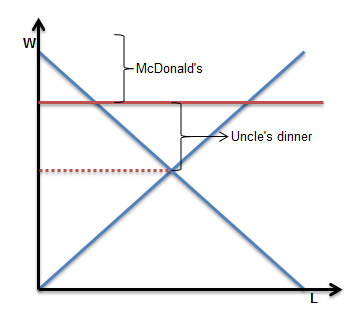
The first reaction is, so what? Why is that a problem? If the issue is to show that an increase of wages above their equilibrium level is going to produce unemployment, all that has to be shown is that this actually happens, not to show where it does not happen. This concern about the Seattle study is missing a key point of the economic analysis of minimum wages. The prediction is that jobs will be lost first among less efficient workers and less efficient employers, not equally across all workers and employers. More efficient employers may be able to absorb a larger share of the wage increase, to cut compensations, delay the lay-offs, etc. This is seen by the fact that demand is downward sloping and that a minimum wage above its equilibrium level “cuts” demand in two. Some employers are below the minimum wage (the less efficient ones) and others are above the minimum wage (the more efficient ones.) Let’s call the former “Uncle’s diner” and the latter “McDonald’s.” This how it is seen in a demand and supply graph:

minimum wage

Surely, there is some overlapping. But the point that this graph is making is that looking at the effects minimum wage above the red line is looking at the wrong place. A study that is looking for the effect on employment needs to be looking at what happens with below the red line. This sample, of course, has less information available than fast food chains such as McDonald’s; this is a reason why some studies focus on what can be seen even if the effect happens in what cannot be seen (and this is a value added of the Seattle study.)

This is why it is important to ask: “what do minimum wage advocates expect to find by increasing the sample size?” To question that minimum wages increase unemployment, then the critics also needs to focus on the “Uncle’s diner” part of the demand curve. If the objective is to inquire about something else, than that has no bearing on the fact that minimum wage increases do produce unemployment in the minimum wage market and at the less efficient (and harder to gather data) portion of it first.

PS: I have a previous post on minimum wages that can be found here.

The importance of understanding causal pathways: the case of affirmative action.

Let us put aside the question of whether affirmative action is a desirable goal. Instead I wish to ponder how to implement affirmative action, given that it will be implemented in some form regardless.

The logic of most affirmative action programs is that X vulnerable community’s outcomes (Y) are significantly below the average. For the sake of example let us say that X is Cherokees and Y is the number of professional baseball players from that ethno-racial group.

Y = f(X) 

A public policy analyst who simply noted the under representation of Cherokees in the MLB, without digging deeper into the causal pathway, may propose that quotas be implemented requiring teams to have a certain share of Cherokee players. Such a proposal would be a bad one. It would be bad because it could lead to privileged Cherokees gaining spots in the MLB at the expense of less privileged individuals from other ethno-racial groups.

A better public policy analysis would note that Cherokees are less likely to enter professional baseball because they are malnourished (Z). This analyst, recognizing the causal pathway, may instead propose a program be implemented to deal with malnourished individuals regardless of their ethno-racial identity.

Y = f(X); X = f(Z) 

Most affirmative action programs that I have come across are of the former type. They recognize that X ethno-racial group is performing poorly in Y outcome, and propose action without acknowledging Z. We need more programs that are designed with Z in mind.

I do not say any of this because I am an upper class white male who resents others receiving affirmative action. To the contrary. I have benefited from this type of affirmative action several times in my life. On paper I am a gold mine for a human resources worker looking to fulfill diversity quotas: I am a undocumented Hispanic of Black-Jewish descent who was raised in a low income household. I am not however vulnerable. I come from a low income household, but my Z is not low. Not really.

Despite my demographic group, I am not malnourished. I could stand to lose weight, but I am not unhealthy. I attended a state university, but my undergraduate education is comparable to that of someone who attended a public ivy. My intelligence is on the right side of the bell curve. Absent affirmative action I am confident I would achieve entry into the middle class.

Nor am I a rarity among beneficiaries. My observation is that many beneficiaries of affirmative action programs are not low on Z and left alone would achieve success on their own. Affirmative action programs are often constructed in such a way that someone low on Z could not navigate their application process. It may seem egalitarian to require applicants to submit course transcripts, to write essays, or present letters of recommendations. However these seemingly simple tasks require a level of Z that the truly under privileged do not have.

Good public policy analysis requires us to understand causal pathway of why X groups do not achieve success at similar rates as other groups. We must design programs that target undernourishment instead of simply targeting Cherokees. If we fail to do so we may have more Cherokees playing for the Dodgers, but will have failed to solve the deeper program.

Note that I say vulnerable as opposed to ‘minority’ in the above passage. This is to acknowledge that many so-called minority groups are nothing of the sort. Hispanics, Blacks, and Asians form majorities in various parts of southwest, south, and the pacific (e.g. Hawaii). Women likewise are not a minority, but are often covered by affirmative action programs. Jews are in many instances minorities, but in contemporary life are far from under represented in society’s top professions. This distinction may seem too obvious to be worth making, but it is not. Both sides of the political spectrum forget that the ultimate goal of affirmative action is to aid vulnerable individuals.  Double emphasize on individuals.

A Tax is Not a Price

Auto_stoped_highwayAccording to The Economist, the latest US federal budget includes incentives for “congestion pricing” of roads.

Ostensibly, this is about reducing congestion. But some municipalities like the idea of charging for roads because it represents a new revenue stream. This creates an incentive to charge a price above cost. When a firm does this, we call it a “monopoly price.”

But when a government monopoly forces you to pay a fee to use a good or service, do not call it a price. It is a fee that a government collects by fiat. In other words, it is a tax.

A price is a voluntary exchange of money for a good or service. The emphasis on voluntary is important, because it is this aspect of the price that enables economic calculation for what people really want.  Even a free market “monopolist” (however unlikely or conceptually vague it may be) engages in voluntary exchange.

On the other hand, a bureaucrat “playing market” by imposing fees on government-controlled goods and services will not have the same results as a market process. For starters, unlike a person making decisions on their own behalf, a government bureaucrat has to guess at costs. Under a voluntary system, a cost is the highest valued good or service you voluntarily give up in order to attain a goal. But the bureaucrat is dealing with other people’s money.

To “objectively” determine costs, in order to set “fair” prices, is a chimera. In the words of Ludwig von Mises, “[a] government can no more determine prices than a goose can lay hen’s eggs.”