Theory versus Common Sense? The case of the Dutch

Since the fifteenth century, [the Netherlands] has had several features which later liberal thinkers, such as David Hume and Adam Smith, enviously referred to. Compared to other countries, economic freedom was an important issue, just as the larger degree of religious freedom. Trade, tolerance, and cultural developments turned the Dutch into an early manifestation of liberalism. However, with the possible exception of Erasmus, Spinoza, and perhaps the Rotterdam-born but London-based Bernard Mandeville, the Dutch lacked great thinkers who could provide this liberal practice with a theoretical base.

This is from the introduction (page 2) to Dr van de Haar‘s excellent new book, Degrees of Freedom: Liberal Political Philosophy and Ideology, and I think it makes a good argument in favor of the “common sense” approach to the political. This common sense approach, for those of you wondering, is often contrasted in American libertarian circles with the theoretical approach espoused by academics. Common sense libertarians tend to be more socially conservative and more parochial than theoretical libertarians who, in turn, are less socially conservative and more cosmopolitan in outlook. This difference in outlook between the two factions leads to the former camp appealing to “the people” in arguments, whereas the latter often appeal to the authority of a scholar or school of thought. Dudes like Ron Paul and Lew Rockwell are in the former camp; dudes like Steve Horwitz and Eugene Volokh are in the latter. This is not a tension limited to American libertarians, of course. You can find it just about anywhere, but libertarians have made it interesting, mostly because – once they have acquired facts like the one Edwin reports on above – they ask questions like this:

How is it possible for a society like the Netherlands to exist when it had no great thinkers to claim as its own?

The common sense faction will reply with something like this: “That’s easy: because the Dutch people were left alone they were able to prosper. With no busybody do-gooder class of intellectuals around to make rules for the peons, folks were able to thrive thanks largely to personal freedoms and self-interest.” This line of reasoning has a lot of merit to it. In fact I buy it, even though it’s not complete.

I think the Dutch had plenty of good theorists whose work contributed to the peculiar nature of the 15th century Dutch republic, but it is also true that the high theory of guys like Smith and Hume is largely absent from Dutch political thought (I don’t remember reading any Dutch philosophers in my introductory philosophy courses in college, for example). I can clarify this in my own mind by drawing parallels with American political theorists up until the end of World War 2, when the US suddenly became a superpower and has received a great influx of the Really Smart People from around the world. Like the good Dutch political thinkers, nobody outside of the US knows who James Madison or Alexander Hamilton are (specialists excepted, of course). A few quirky weirdos out there might know who Ben Franklin is, but they won’t know him for his political theory.

Maybe this also had to do with the fact that the Dutch (and American) theorists were more concerned with keeping Spain (or other scheming Great Powers) at bay, and this could only be accomplished with a heavy does of pragmatism to supplement ideals; pragmatism is, of course, something that high theory avoids.

The great thinkers, who we all know (even if we have not all read), in contrast, don’t seem to have a lot of experience in policy and diplomacy. Furthermore, these guys all seemed to be in well-integrated outposts of cosmopolitan empires that were largely populated by minorities. Scotland, for example, was part of the British Empire, or Kant’s Prussia, which was technically independent of the Austro-Hungarian Empire but still very much a cultural and economic junior partner to Vienna at the time.

Here is my big question, though: If the Dutch had no Great Thinkers, how were they able to create the richest, most extensive overseas empire the world had ever seen?

Common sense libertarians, 1

Theoretical libertarians, 0

By the way, my answer to that last question goes something like this: the Dutch, as former subjects of the Spanish Empire, had intimate access to Madrid’s trading networks (cultural access as well as economic and political) and this, coupled with the federal republic that Dutch statesmen were able to cobble together, gave lowlanders just enough breathing room to raise the bar of humanity. Again, you can find Dr van de Haar’s new book here.

Philosophical Research on Seasteading

The Seasteading Institute has recently published my philosophical dissertation on ‘Seasteading’. You can find it in the key research section of their Law and Policy page: http://www.seasteading.org/law-and-policy/.

Wayne Gramlich and Patri Friedman[1] founded the Seasteading Institute in 2008 in order to promote the seasteading movement, which has intellectually attracted mostly libertarian-minded individuals. The institute has also attracted funding from Paypal cofounder and early facebook investor Peter Thiel.[2]

A seastead is a permanent habitable dwelling on the ocean that preferably lies outside governmental waters. The Seasteading Institute believes that the creation of permanent societies on the seas can provide an experimentation space for innovative forms of socio-political organizations. The ultimate aim of seasteading is that newly emerging societies will inspire social changes around the world and contribute to human flourishing. First seasteads will be small-scale projects and they may even be constructed within existing governmental territories. However, seasteads could expand organically as technologies improve and innovative ideas of the functions of seasteads would emerge. One of the core ideas of seasteading is that an open experimentation space for social organizations will lead to progress in social rules and legislations, just as an experimentation space for new technologies leads to technological progress.

It is undeniable that social rules and legislations heavily influence all aspects of life, including technological progress and social well-being. One could for example compare North and South Korea, two countries that separated from each other in 1945. Both countries have had more or less the same culture and similar natural resources. However, what differs is their form of social organization; the North came under communist rule, whereas the South embraced western-style capitalism and democracy. Almost 70 years later, the differences in wealth, technological advancement, and social well-being are striking. South-Korea’s GDP per capita is for example 18 times larger, its internet penetration is more than 815 times greater, its life expectancy rate is 10 years longer, and the heights of South Korean pre-school boys are on average 4 centimeters longer. (Taylor, 2013, April 8).

The Seasteading Institute believes that, given that social progress and well-being heavily depend on how society is structured, mankind could make a huge step forward by letting social entrepreneurs start up seasteads to compete with governments in the industry of law-making and by letting millions engage in the experimentation with new forms of social organization.

In the paper, I provide a philosophical investigation of the concept of seasteading from a libertarian anarchist perspective. My investigation revolves around the following research question: “given that governments are resistant to structural changes of governance, how can mankind discover better forms of social organization?”

I argue that seasteading can fulfill that important role of moving mankind forward by experimenting with and finding new forms of social organizations that are best for human flourishing.

In the first chapter, I maintain that one core focus of political philosophy is to deal with the realities of value pluralism and political disagreements. I also contend that the most common form of social organization, representative democracy, does not satisfactorily deal with these realities. Hence, we should look for political possibilities beyond representative democracies. In order to discover these possibilities, we should experiment with new forms of social organization.

Chapter two discusses why there is currently little experimentation with social orders. I approach the issue from a meta-system level perspective and contend that all land on earth is more or less already claimed by states, which leaves little opportunity for people to start new societies on land. By applying the theory of monopoly economics, I maintain that the state’s monopoly on jurisdiction and coercion does not encourage them to provide good rules of law. It rather makes states extremely resistant to large-scale social changes. The obvious solution for finding better forms of governance then would be the introduction of competition into the industry of governments.

Chapter three deals with the epistemological attitude required for the experimentation space. I maintain that this attitude consists of having a sociological imagination, being epistemologically modest, realizing that social order can emerge spontaneously, and that the utopian dream of a single perfect society is impossible.

Chapter four discusses seasteading as the means by which the experimentation space could be realized. By homesteading the seas, a community can build and test new forms of social organization outside the scope of current governments’ control. It could generate new knowledge on social orders, thereby contributing to political philosophy and the social sciences. It could moreover also ease political tensions between citizens with different comprehensive doctrines.

Finally, I raise two objections to seasteading and address them accordingly.

If you would like to see an awesome seastead design, you should watch this video here:

Footnotes
[1] It may be interesting to know that Patri Friedman is the grandson of Milton Friedman and the son of libertarian anarchist David Friedman.

[2] Peter Thiel, previously a student of Political Philosophy at Stanford University, is also founder of the libertarian-minded newspaper The Stanford Review. He is a venture capitalist who is very much influenced by the Austrian School of Economics. With this in mind, it may not be surprising that the early mission of PayPal was to give its users more control over their money by enabling them to switch currencies. The goal of PayPal was to make it, in Thiel’s words (1999), “nearly impossible for corrupt governments to steal wealth from their people through their old means [inflation and wholesale currency devaluations] because if they try the people will switch to dollars or Pounds or Yen, in effect dumping the worthless local currency for something more secure” (Jackson, 2004).

References
Jackson, E.M. (2004). The PayPal Wars: battles with eBay, the media, the mafia, and the rest of planet earth. Los Angeles: World Ahead Publishing, Inc.
Taylor, A. (2013, April 8). A Crazy Comparison of Life in North Korea and South Korea. Retrieved from http://businessinsider.com
Thiel, P. (2009). The Education of a Libertarian. Retrieved from http://cato-unbound.org

Chuang Tzu: The natural disposition of man is Political Anarchism

Chuang Tzu

I just read this great article on ‘Anarchism and Taoism’. I find the Taoist case for anarchism extremely compelling. They sought after the harmonious nature of spontaneous order, the Tao, and internalized it into a tremendously rich personal philosophy of life. It makes me wonder: can a person ‘live’ a Libertarian life? Libertarianism is mostly regarded as a political philosophy in the west, but can it, like the Taoists believe, be regarded as a way of life that is most fulfilling on a personal level as well? These are questions that I still have to find out for myself.

After reading the article on Anarcho-Taoism, I’d like to share a small part of Chuang Tzu’s thoughts on the natural disposition of man here:

Horses live on dry land, eat grass and drink water. When pleased, they rub their necks together. When angry, they turn round and kick up their heels at each other. Thus far only do their natural dispositions carry them. But bridled and bitted, with a plate of metal on their foreheads, they learn to cast vicious looks, to turn the head to bite, to resist, to get the bit out of the mouth or the bridle into it. And thus their natures become depraved.

As with horses, so it is with human beings. Left to themselves they live in natural harmony and spontaneous order. But when they are coerced and ruled, their natures become vicious. It follows that princes and rulers should not coerce their people into obeying artificial laws, but should leave them to follow their natural dispositions. To attempt to govern people with manmade laws and regulations is absurd and impossible: ‘as well try to wade through the sea, to hew a passage through a river, or make a mosquito fly away with a mountain!’. In reality, the natural conditions of our existence require no artificial aids. People left to themselves will follow peaceful and productive activities and live in harmony with each other and nature.

In an essay ‘On Letting Alone’, Chuang Tzu asserted three hundred years BC the fundamental proposition of anarchist thought:

There has been such a thing as letting mankind alone; there has never been such a thing as governing mankind. Letting alone springs from fear lest men’s natural dispositions be perverted and their virtue left aside. But if their natural dispositions be not perverted nor their virtue laid aside, what room is there left for government?

Lao Tze, The First Libertarian

Lao TzeFrom the very first moment I read into Taoist philosophy, 5 years ago, I had grown extremely fond of Taoism. It also bears many similarities with the political philosophy of libertarianism. In this post I would like to trace the libertarian concept of Spontaneous Order to the Tao.

Lao Tze (~6th century BC) is regarded as the founder of Taoism. He is also the writer of the Tao Te Ching, one of the most translated books in history, which consists of 81 short chapters about leadership, modesty, and how to live in accordance with your own nature.

From the perspective of a personal philosophy of life, the Tao Te Ching teaches you to flow with life and to be in touch with your inner self so that your actions never contradict your personal being, and so that you can live a truly authentic and enriched life. This may sound too lofty to some, but reading the book one will realize how practical the philosophy actually is. To illustrate the practicality of Taoism, I have written about an interesting application of Taoism in Bruce Lee’s Jeet Kune Do – the martial arts that Bruce Lee had developed – in this post of mine.

One can also read the Tao Te Ching from the perspective of political philosophy. Taoism proposes a society in which there is little or even no central authority (government), since the government is counterproductive and the grand source of social misery. Taoism is therefore libertarian, and stands very much in contrast with Confucianism with its multifarious laws and regulations. Mr. Libertarian, Murray Rothbard, had recognized that Lao Tze was the first libertarian intellectual who saw the government as “a vicious oppressor of the individual, and ‘more to be feared than fierce tigers’” (Rothbard, 1995, p. 23). Taoists and Libertarians believe that society functions most efficient and most just when the government does not meddle and regulate the people.

The skeptics may ask: how can there be order without a central authority? Some modern philosophers, like for example Hobbes, have referred to this anarchistic state as the ‘state of nature’; a state of “a mere war of all against all; and in that war all men have equal right unto all things” (Hobbes, 1651, p. 34). Taoists and Libertarians however, believe that this view is wrong. They believe that it is in the nature or instinct of individuals to be collectivist, because the person who lives in solitude is hardly able to survive in nature. In order to survive, human beings will naturally develop collective customs and laws to work out their disputes. The collective coordination of human beings has therefore always “depended decisively on instincts of solidarity and altruism” (Hayek, 1988, p. 12).

What, according to the Taoist and the Libertarian encourages society to become well-functioning? The Taoist calls it the ‘Tao’, and the libertarian calls it ‘Spontaneous Order’.

Tao and Spontaneous Order

The two concepts, Tao and Spontaneous Order, are similar to one another. Spontaneous Order is a spontaneous emergence of self-organized order out of seeming chaos. One can find such examples in language, the internet, the free market etc. Without any central authority we have realized language, internet, and productive orders that are so complex that not a single person would have been able to create by himself. No one can predict how the order will look like, because it is forever in flux. It can therefore only be experienced and observed. From our observation we can find that the Spontaneous Order is better than any artificial human construct.

Likewise, the Tao is an underlying natural order of the universe whose essence cannot be described in words, but which can only be experienced and observed in nature. In the first verse of the Tao Te Ching, Lao Tze writes:

The Tao that can be told is not the eternal Tao.
The name that can be named is not the eternal name. (Tao Te Ching, Chapter 1).

The Tao is neither a thing nor a substance. It is a universal trend that flows in the natural world. According to the Taoist, one can be in touch with the Tao and achieve most when one does not act against the nature of things (‘wu wei’). Lao Tze therefore writes:

Whenever you advise a ruler in the way of Tao,
Counsil him not to use force to conquer the universe.
For this would only cause resistance.
Thorn bushes spring up wherever the army has passed.
Lean years follow in the wake of a great war. (Tao Te Ching, Chapter 30)

Tao abides in non-action,
Yet nothing is left undone.
If kings and lords observed this,
The ten thousand things [world] would develop naturally. (Tao Te Ching, Chapter 37)

The more laws and restrictions there are,
The poorer people become.
The sharper men’s weapons,
The more trouble in the land.
The more ingenious and clever men are,
The more strange things happen.
The more rules and regulations,
The more thieves and robbers.

Therefore the sage says:
I take no action and people are reformed.
I enjoy peace and people become honest.
I do nothing and people become rich.
I have no desires and people return to the good and simple life. (Tao Te Ching, Chapter 57)

Why are the people starving?
Because the rulers eat up the money in taxes.
Therefore the people are starving.
Why are the people rebellious?
Because the rulers interfere too much.
Therefore they are rebellious.
Why do the people think so little of death?
Because the rulers demand too much of life.
Therefore the people take death lightly.
Having little to live on, one knows better than to value life too much. (Tao Te Ching, Chapter 75)

The Taoists have this concept called ‘mutual arising’, which means that order comes into being through a harmonious interplay of different forces. This is expressed as follows by Lao Tze:

The Tao begot one. One begot two. Two begot three.
And three begot the ten thousand things.
The ten thousand things carry yin and embrace yang.
They achieve harmony by combining these forces. (Tao Te Ching, Chapter 42)

We, human beings, are incapable of understanding how these forces play out against each other. Every time we interfere with the Tao, unintended consequences will happen. Since we cannot apprehend what forces have led to the unintended consequences, we will create more unintended consequences by trying to offset the previous unintended consequences. Man can therefore fall into a state of perpetual interference with nature and become evermore unnatural. Is that not the state we are in right now; the state of unnaturalness due to our thousandfold petty laws that attempt to regulate our conduct, relationships, and ethics?

Is it realistic to have no central government and expect spontaneous orders to emerge?

It certainly is realistic. Bruce Benson has written an insightful book called The Enterprise Of Law: Justice Without The State (2011) in which he discusses historic examples of how law and order emerged spontaneously. Many scholars are currently acknowledging that during the time of the expansion of the American frontier, those areas where people moved faster westward than the central government was not wild or lawless. It was actually more peaceful than modern day America. For an interesting read into this issue, see Anderson & Hill’s ‘An American Experiment in Anarcho-Capitalism: The Not So Wild, Wild West’ (1979).

See also this talk of Thomas Woods on the ‘not so wild, wild west’:

Bibliography

Anderson, T.L. & Hill, P.J. (1979). An American Experiment in Anarcho-Capitalism: The Not So Wild, Wild West. Journal of Libertarian Studies, 3, 1, 9-29.

Benson, B. (2011). The Enterprise Of Law: Justice Without The State. San Francisco: Independent Institute.

Hayek, F.A. (1988). The Fatal Conceit: the errors of socialism. London: Routledge.

Hobbes, T. (1651). De Cive. (H. Warrender, Ed.) New York: Oxford University Press.

Lao Tze. Tao Te Ching. Retrieved from http://www.schrades.com/tao/taotext.cfm?TaoID=1

Rothbard, M.N. (1995). Economic Thought Before Adam Smith: An Austrian Perspective on the History of Economic Thought Volume I. Retrieved from http://mises.org

BC’s weekend reads

  1. Introducing… Jesus and Mo
  2. On private property and the commons
  3. Why Merkel’s Kindness to Asylum Seekers Could Reflect a German Soft Spot for Islam
  4. Why I find the Mthwakazi monarchy restoration unjustified
  5. September (a song about me)
  6. From the Far Right to the Far Left
  7. Beyond Neoliberalism (book review)

A Matter of Legitimacy

Dictionaries give us two definitions of “legitimacy”: “the quality of being legal” and “the quality of being reasonable and acceptable”. The two meanings are intertwined: we expect reasonability from the laws and we infer the content of a law we do not properly know from what we regard as reasonable. Unreasonable laws are not acceptable to the people and Cesare Beccaria warned us about how unreasonable prohibitions engender more and new crimes.

Political Realism and Legal Positivism cross their paths when it is time to discuss what is the ultimate foundation of obligation, both political and legal: facts and force. An overwhelming force deployed upon individuals and peoples will always be able to impose what is reasonable and acceptable. For Thomas Hobbes, as fear is not a sufficient reason for annulment of covenants, the feeling of terror from the subject to the sovereign does not challenge the legitimacy of his power.

Libertarianism is, in principle, a political stance on the state that denies its legitimacy or, at least, denies unlimited sovereignty. And we stress “in principle” because we want to point out that not all versions of Libertarianism accomplish the said aims. In this regard, we want to single out one crucial trait of every Libertarian political theory: is it possible a stateless order of cooperative coordination between individual plans? Does its existence depend upon our own volition and agreement? We want to make a distinction between two strains of Libertarianism: the one which affirms the possibility of a stateless society and the one which does not.

Paradoxically, the affirmation of the possibility of a stateless order of cooperation legitimates the Hobbesian stance on unlimited sovereignty: having at their disposal the alternative of a stateless political order, individuals opt freely for a Leviathan. What we have to decide now is the extension of the power of the government, but at this point there is no restriction left to the power of the Leviathan to determine its own limits.

On the other hand, for the strain of Libertarianism that regards the absence of a state as impossible or not desirable ­because, for example, the justice is an artificial virtue that demands a government to enforce it­, the state is a fact that has no reasonable alternatives. As the theft that compels us to choose between our bag or our life, there are no reasonable options left to us but accepting the power of the state. As David Hume pointed out, tacit conventions as the stability of the possessions require a political order to enforce it. Therefore, the factual power of the state will be legit only as long as it enforces the tacit order of human cooperation that allows individuals to fulfil their plans. Notwithstanding this last strain of Libertarianism does not deny the legitimacy of the state, it does consistently deny the legitimacy of any type of unlimited sovereignty.

How Can Crypto-currencies Democratize Society?

Yesterday, September 26th of 2015, I attended the Reinvent Money event in Rotterdam, the Netherlands, that was organized by Paul Buitink. The goal of the event was to bring people together for a grand discussion on the future of our monetary system. This discussion on monetary reforms is totally necessary if one considers the current problems with the euro and Greece, banking scandals, the rise of bitcoin and the blockchain technology, and peer-to-peer lending.

The speakers list consisted of many prominent thinkers and activists who could share with a crowd that was mostly in favor of crypto-currencies their thoughts about the current monetary system and whether money should be reinvented.

Willem Middelkoop was the first speaker and talked about the Big Reset of the monetary system that is currently orchestrated by high level officials. Jakob de Haan, head of the research department at the Dutch Central Bank, was the second speaker and stated that he does not believe in an upcoming Big Reset. While defending central banks, he argued that central banks are necessary in order to stabilize the currency and he sees five aspects that central banks should fulfill:

  1. central bank independence;
  2. central bank transparency;
  3. using monetary policy instruments to stabilize the economy;
  4. banking supervision of not only independent commercial banks, but of the whole economy. In his opinion, the central bank should supervise the entire economic system instead of primarily addressing individual institutions;
  5. macro-prudential policies to avoid crises.

Other speakers included Max Keiser, Stacy Herbert, Vit Jedlicka (president of Liberland), Stephan Antonopoulos, Simon Dixon, Joris Luyendijk, Prof. Antal Lekety and some others. Some wanted to go back to a gold-based monetary system, others truly wanted to reinvent money through crypto-currencies, and a few wanted the system to stay as it is structurally. As a voluntaryist, I was quite disappointed that the pro-crypto-currency speakers saw it as a means to democratize society. I don’t fully understand what they mean with the word ‘democratize’ and how crypto-currencies could do that, but I’ve noticed that those speakers saw it as a means to make our political system more democratic. Maybe, they mean ‘anti-authoritarian’ as crypto-currencies would indeed limit the monetary powers of the government and the central bank. However, I’ve always understood it as a de-political money system that is disruptive enough to do away with the myth that government is needed at all to stabilize our currency, and hence that it would bring us closer toward a voluntaryist society – not toward a more democratic system. A democratic system, in my opinion, means a system in which the majority rules. Crypto-currencies give every individual the full ownership of their money. Thus taking personal financial affairs entirely outside the scope of government meddling, also if that government is democratically chosen.

BC’s weekend reads

  1. Hongcouver
  2. Making a Case for Bishops’ Authority in the Second and Seventeenth Centuries
  3. Global Warming is not a Crisis
  4. Dondante
  5. From masterpieces to selfies (top link)

The Poverty Of Democracy

I have been a strong proponent of democracy until the Spring of 2012 when I picked up Hans-Hermann Hoppe’s Democracy: The God That Failed. Since then, I have never looked at democracy with the same warm feelings again. Now, in this post, I would like to explore why democratic political representation is an impossibility and why it deals poorly with value pluralism – the fact that society holds various fundamental values that are in conflict with each other. In addition, I would like to urge that we should look for other political possibilities and stop maintaining that democracy is the end of all forms of social organization.

What most people find attractive about democracy is its underlying idea that the electorate is an embodiment of the general will of the public as if the public has reached some kind of general agreement on public policies and legislation. It is believed that with regular elections, the rulers are in power for a limited time and they “will be compelled by the threat of dismissal to do what public opinion wants them to do” (Popper, 1963, p. 345). Gerard Casey writes in Libertarian Anarchy (2012) that “[T]he central characteristic of representation by agency is that the agent is responsible to his principal and is bound to act in the principal’s interest” (Casey, 2012, p. 125). It is however questionable to what extent the electorate can truly represent the constituency and to what extent the public voice can be considered univocal. We must also beware of attributing “to the voice of the people a kind of final authority and unlimited wisdom” (Popper, 1963, p. 347). When society holds a vox populi vox dei attitude, it can easily slip into a tyranny of the majority. A society ruled by public opinion by no means guarantees social justice.

It is important to realize that the notion of representation is highly questionable. According to public choice theory, political agents cannot possibly truly represent their constituencies when members of a society have different comprehensive doctrines, hold different values, and have different interests. Public choice theory applies economic methods in the field of political theory and provides some interesting insights that are relevant for political philosophy. It maintains that politics is ruled by clashing opinions among policy makers and clashing opinions among members of the constituency. One may for example desire to build new roads with public funds, another may want to use public funds for the modernization of the military and defense, a third may desire to spend more on social welfare, a fourth on education etc.

Given that we live in a world of value pluralism, it is difficult for policy makers to pursue and represent the ‘public interest’. Furthermore, special minority interest groups may have incentives to organize themselves in order to influence public policies through lobbying. When the expected gain of lobbying of such minority interest groups is greater than the cost of lobbying efforts, they have greater incentive to influence legislators. Large interest groups, such as taxpayers in general, have fewer incentives to campaign for particular legislations, because the benefits of their actions, if they are successful, are spread much more widely among each individual taxpayer.

When the principal believes that the cost of being politically active – keeping oneself up-to-date with political actualities and being involved with political campaigns – is not worth the benefits, the principal may become ‘rationally ignorant’ of politics. This gives representatives more incentives not to pay attention to the public interests. Rationally ignorant principals do not know who their representatives are or what they do. This consequently discourages the politicians’ feeling of accountability for their actions and it encourages the politicians to sell themselves to donors and to pursue personal agendas. Different interests, incentives, and ideologies among principals and political agents therefore result in unequal representation.

I believe that Casey is right when he asserts that there is

“no interest common to the constituency as a whole, or, if there is, it is so rare as to be practically non-existent. That being the case, there is nothing that can be represented” (Casey, 2012, p. 125).

Imagine that there is a piece of legislation that our representatives can either pass or not with 35 per cent of the public in favour of the legislation and 65 per cent who oppose it. If our representatives pass the legislation, they will represent the 35 per cent and ignore the interests of the 65 per cent. If they do not pass the legislation, they will represent the 65 per cent and cease to represent the interests of the 35 per cent.

“In this very normal political scenario, it is not that it is difficult to represent a constituency – it is rather that it is impossible” (Casey, 2012, p. 125).

A representative democracy is therefore actually quite inadequate in dealing with a pluralistic society as it cannot fulfill its promise: representing the will of the peoples. Democracy is moreover a system that is inherently violent, because it divides people along the lines of their comprehensive doctrines. People with similar political thoughts organize themselves into groups to campaign against people who hold conflicting ideas. In a democracy, these people then vote for their preferred ruler to rule over people who may have contrasting views or who may be indifferent to political issues at all. It has never happened that the turnout at elections is 100 per cent. According to Eurostat.com, the average turnout rate in Europe is around 43 per cent. Nonetheless, the 43 per cent are choosing political agents who are expected to represent the 57 per cent of the non-voting constituency. The violent nature of democracy is that with every vote the voter attempts to enforce their preferred rulers or legislation unto others. This basically makes it a system in which people lose their political autonomy to other voters.

I believe that in order to deal more adequately with value pluralism we have to look for political possibilities that lie beyond a representative democracy. Instead of considering democracy as the end of all forms of social organization, we should ask ourselves how we could discover better forms of social organization.

References
Popper, K. (1963). Conjectures and Refutations. London: Routledge.

Casey, G. (2012). Libertarian Anarchy: against the state. London: Continuum International Publishing Group.

Larry Siedentop’s Straw Dog

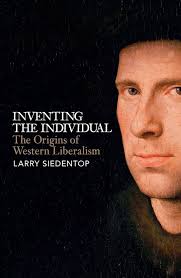
I finally had the chance to finish reading Larry Siedentop’s Inventing the Individual: The Origins of Western Liberalism.

download

It is a great book, and especially informative for those not well-versed in the intellectual history of political ideas within (mainly) Christian thought. The arguments starts with the Ancient traditions, to the early years of Christianity, all the way to the fifteenth century. According to Siedentop (p. 332) the main goal of the book is:

‘to show that in its basic assumptions, liberal thought is the offspring of Christianity. It emerged as the moral intuitions generated by the Christianity were turned against an authoritarian model of the church. The roots of liberalism were firmly established in the arguments of the philosophers and canon lawyers by the 14th and 15th centuries: belief in the fundamental equality of status as the proper basis for a legal system; belief in that enforcing moral conduct is a contradiction in terms; a defense of individual liberty, through the assertion of fundamental or ‘natural rights’ and, finally, the conclusion that only a representative form of government is appropriate for  a society resting on the assumption of moral equality’.

Siedentop clearly succeeds in making this point. As said, the book can be warmly recommended. The question is, however, why does he care about this issue? Siedentop (pp. 334-338) clarifies that he wants to fight the dominant idea that liberalism sprang from the Renaissance, and that liberalism almost equates secularism, or is even anti-religion, at least in the public sphere.

You do not need to be a scholar of the liberal history of ideas to raise more than a few eyebrows here. What liberalism is Siedentop taking up for argument? He is unclear about this, as he does not care to define this liberalism, nor does he provide references to liberal thinkers. That is where the trouble starts.

Undoubtedly there are some modern social-liberals who claim that liberalism is secular and that the state and lawmaking should be strictly neutral in religious terms. Arblaster in The Rise and Decline of Western Liberalism even explicitly refutes any liberal traces before the Renaissance. Unclear is how dominant these voices are, especially outside academia. One thing is certain, these do not comprise classical liberals.

In the Scottish Enlightenment, in many ways the birth grounds of classical liberalism, the place of religion in life, and religion as a source of morality, was discussed. In contrast to most other thinkers, -Smith included- Hume even criticized religion, albeit most openly  after his death in Dialogues concerning Natural Religion. Yet to my knowledge, no thinker actually denied the role of Christianity as a source of  important ideas, certainly not the  role of individuality.

Modern writers, who are more aware of classical liberalism as a tradition do not deny this either. Let me give a few examples.

Hayek in an essay on liberalism (in New Studies in Politics, Philosophy Economics and the History of Ideas) writes that it traces back to classical antiquity and certain medieval traditions. He actually attacks ‘some nineteenth century writers’ who denied ‘that the ancient knew individual liberty in the modern sense’. In his general overview entitled Liberalism, John Gray (then still in his liberal days), also neatly points to the pre-modern and early modern times for the development of liberal ideas as we now know them. David Schmidtz and Jason Brennan pay their due respect to these older sources in A Brief History Of Liberty and the same goes for George H. Smith in The System of Liberty, and David Boaz in The Libertarian Mind.

Of course, none of them made detailed studies of these influences because their books had different purposes than Siedentop’s. Yet all deal with it in a few paragraphs or even a separate chapter, making clear to their readers that (classical) liberalism has older roots then the Renaissance, that there are important Medieval and Ancient thinkers who all left their mark on the development of (classical) liberal thought.

Siedentop wrote a great book, that unfortunately is a straw dog as well: his portrayal of ‘liberalism’ is erroneous, either deliberately or not. It denies the views of the founding and one of the main liberal variants. That is sloppy, to say the least, for such a learned and experienced scholar. With the use of these general terms Siendentop’s attack is simply off target. He should have taken far more time to define the ‘liberalism’ and the liberal scholars subjected by his attack.

Myths of Sovereignty and British Isolation XIV, Revolution and the Dutch Model in the Late 17th Century

The last post in this series looked at the impact of Dutch republicanism on constitutional innovation and revolution in mid-seventeenth century Britain. Now on to Dutch influence on the Glorious Revolution of 1688.

Britain, or what was still three kingdoms (England, Scotland and Ireland) only unified in the person of the monarch did not have just one revolution connected with the Dutch model in the seventeenth century, but two. Furthermore the second of those revolutions required invasion by a Dutch prince to happen. The Glorious Revolution, as that second revolution is known, established something like the modern British political system in 1688 in establishing that the monarch could not legislate or even nullify legislation without parliament, could not govern without parliamentary consent and that parliament had the right to decide who could inherit the monarchy.

That this fundamental reorientation of the state system took place through violence and foreign intervention is not the sort of thing that sovereigntist believers in a British special path separate from mainland Europe, since Edmund Burke like to emphasise. Edmund Burke, a remarkable parliamentarian and writer on various topics including philosophical aesthetics, of the latter half of the eighteenth century, is introduced here, because his way of presenting British history is very connected with his assertions of British superiority in Reflections on the French Revolution, his most widely read book.

Of course there were things to condemn in the French Revolution, and Burke was a very acute observer of the violent polarising tendencies within it before they reached their extreme points, but his assumptions about British history are absurd. Given the importance of the Glorious Revolution for the British polity within which he played a distinguished role (though never in government), and his wish to condemn revolution, he reacts by denying a real revolution in 1688, presenting it as essentially restorative rather than innovative and as an essentially peaceful consensual event. It was of course presented in that way at the time, but then the French Revolution was influenced by ideas of restoration.

Evaluating Burke’s attitude will require going back to those events. Inevitably there are debates about the real causes of the Glorious Revolution, but it is anyway undeniable that it was a reaction against the rule of James II, who had only come to the throne three years previously suggesting remarkably poor powers of persuasion and conciliation.

The collapse of his reign was in some important part the result of religious issues going back to the simple fact that he was a Catholic monarch in a Protestant country. This would have been tolerable for Parliament and everyone else participating in political life if James had left the state religious settlement alone and if he was to die without a Catholic heir.

James was, however, very busy with changing the state religious settlement letting Catholics into powerful positions, and more seriously institutionalising the Catholic church in ways that suggested that at the very least he intended to give it equal status with the Protestant Church of England. This could be defended on grounds of religious tolerance at the time and still is.

Unfortunately for him James was not successful at persuading many Protestants, even those subject to discrimination themselves, that he had good intentions, and his methods of enforcing changes in the state religious settlement did not suggest someone willing to limit his general powers as Parliament expected. These methods included the assertion of a Dispensing Power, in which laws were suspended at will, and measures to manipulate parliamentary elections.

At the beginning of the reign he benefited from an extravagantly royalist Tory Parliament, but in a short period became mistrusted and feared. The birth of a son in June 1688 brought opposition to a new peak as it suggested that what James II had done would last beyond his own lifetime and it was not enough for those who disliked his policies to simply wait for his death, which would bring his Protestant daughter Mary to the throne, if he had no male heirs and she lived long enough. The outcome was that the Immortal Seven, seven prominent parliamentarians invited Princess Mary’s husband, Prince William of Orange to invade England.

The title ‘Orange’ refers to territory in France, but the Orange family was Dutch. They had a rather complicated and changing status as the first family of a country with no monarchy, tending to lead the army and to some degree provide a focus for central executive power in a  very decentralised system. The invitation to William enabled him to become King by will of parliament, but as he was the husband of the next in line to James, apart from his son, the hand over to William could be concealed as Mary taking her inheritance.

The next post will look at the steps from Dutch model to German kings linking Britain with Hanover.

Myths of Sovereignty and British Isolation, V: Britain and European Models

The last post looked at how Montesquieu’s The Spirit of the Laws, the biggest classic of Enlightenment political thought, certainly in size and probably in importance, does not offer Britain as the model of liberty for Europe. Rounding off that argument, Germany produced its own important liberty oriented thought at the end of the eighteenth century in the work of Immanuel Kant and Wilhelm von Humboldt, in which they do not offer Britain as a model. Of course at this time Britain stood as an example of liberty, particularly in the exact period from 1792 when the French Revolution had turned highly violent and dictatorial, and European monarchies were tending to become more conservative-authoritarian in reaction.

Nevertheless, the opening phase of the French Revolution developed a much more complete vision of a equal citizens under laws they had made themselves through representative citizens than Britain itself. France was the home of great liberal thinkers such as Benjamin Constant (like Rousseau and Voltaire, Swiss in origin) and Germaine de Stael, who were  horrified by the descent of the French Revolution into state terror and then Bonapartist dictatorship. Switzerland and the variety of German states within the loose structure of an empire (the Holy Roman Empire of the German Nation) gave them ideas for liberty.

Going back to Germany itself, there was a strong element of aesthetic liberalism, focused on the cultivation of individuality and individuality sensibility, which drew on the growth of German culture at that time and the history of many different states and state forms, that includes Johann Wolfgang von Goethe, Friedrich Schiller, and Friedrich Schlegel that had a European wide influence, including in Britain.

On the level of what was going in European nations during the eighteenth century is should be noted that the death penalty was abolished in the state of Tuscany in northern Italy in the late eighteenth century at a time when Britain was famous for widespread use of the death penalty, not just for murder and treason but for small crimes in property. The French Revolution inspired severe attacks on civil liberties in Britain and one of many rounds of state force to keep the Irish down, when the United Irishmen revolted in 1798 for Irish self-government.

Britain was largely ahead of the rest of Europe at the end of the wars with Revolutionary and Bonapartist France, but that was in large part because Britain had worked very hard to finance and encourage autocratic monarchies to take back control of Europe. Napoleon was no friend of liberty, though some British sovereigntist-Eurosceptics nevertheless celebrate him, as in Andrew Robert’s recent biography Napoleon the Great. Not for the first time a British sovereigntist shows signs of wishing to imitate European nations at times when they seem most aggressively sovereign, while holding to British separateness and superiority.

As the nineteenth century unfolded, Britain started as a nation where the existence of an elected parliament, a limited form of monarchy in the process of becoming a purely symbolic monarchy, and strong legal institutions allows a case for saying that Britain was leading the way in liberty, at least for those belonging to the most marginal and dominated parts of the state territory. However, that picture applies less and less after 1830, when the July Revolution put in place a system in France, under the Orléanist monarchy, comparable to that in Britain for promoting law, liberty, and commerce. It must be said that the preceding system introduced after the defeat of Napoleon under the restored Bourbon monarchy was directly modeled on Britain’s, but could not work like the British system, given the different national context. A lesson in the dangers of thinking that liberty can be exported and designed from abroad.

The 1848 cross-European ‘Springtime of the Peoples’ undermined the relative advantages of the British system further as republics and monarchies limited by constitutions were proclaimed in various parts of Europe. There was a big autocratic reaction reversing most but not all of this. Denmark made the most progress, with peaceful demonstrations leading to a constitutional monarchy and an elected national assembly. France reverted to autocracy under the Second Empire of Napoleon III (nephew of the famous Napoleon). However, the Second Empire did have elected bodies and however objectionable Louis-Napoleon’s seizure of sovereign power was, he was a moderate autocrat presiding over a continuing growth of civil and commercial society. If we look at models for liberty in Europe, Britain was certainly important, but so was France. Even under Napoleon III, France was a long way ahead of most of Europe in the liberties of its people and the vibrancy of the economy.

If we look at one of the most important events in nineteenth century Europe, the Risorgimento which turned Italy from multiplicity of more or less autocratic states, including the Austrian armies more of less resting on church domination of society and Austrian armies, into a unified nation; France was important in providing a model of a relatively secular liberal catholic society and in pushing for a more modernist liberal form of government in Italy. Napoleon III’s behaviour was opportunistic and designed to revive French power in Europe, but nevertheless he seems to have had a genuine sentimental attraction  to the idea of a free and unified Italy. Camillo Benso, Count of Cavour, as chief minister of Sardinia-Piedmont was the major political architect of a unified Italy was impressed by both the French and British models. The ideological architect of the Risorgimento, Giuseppe Mazzini, largely lived in London and was impressed by the British type of constitutionalism and political culture, but nevertheless was also a republican and European federalist more influenced at the level of political thought by the French revolutionary and republican heritage. The military architect of the Risorgimento, Giuseppe Garibaldi, was popular in Britain, but belonged to the French republican revolutionary heritage, which he worked to spread in South America before returning to Italy.

Next post, Britain and Europe after the Springtime of the Peoples

Look at what just arrived in my hands

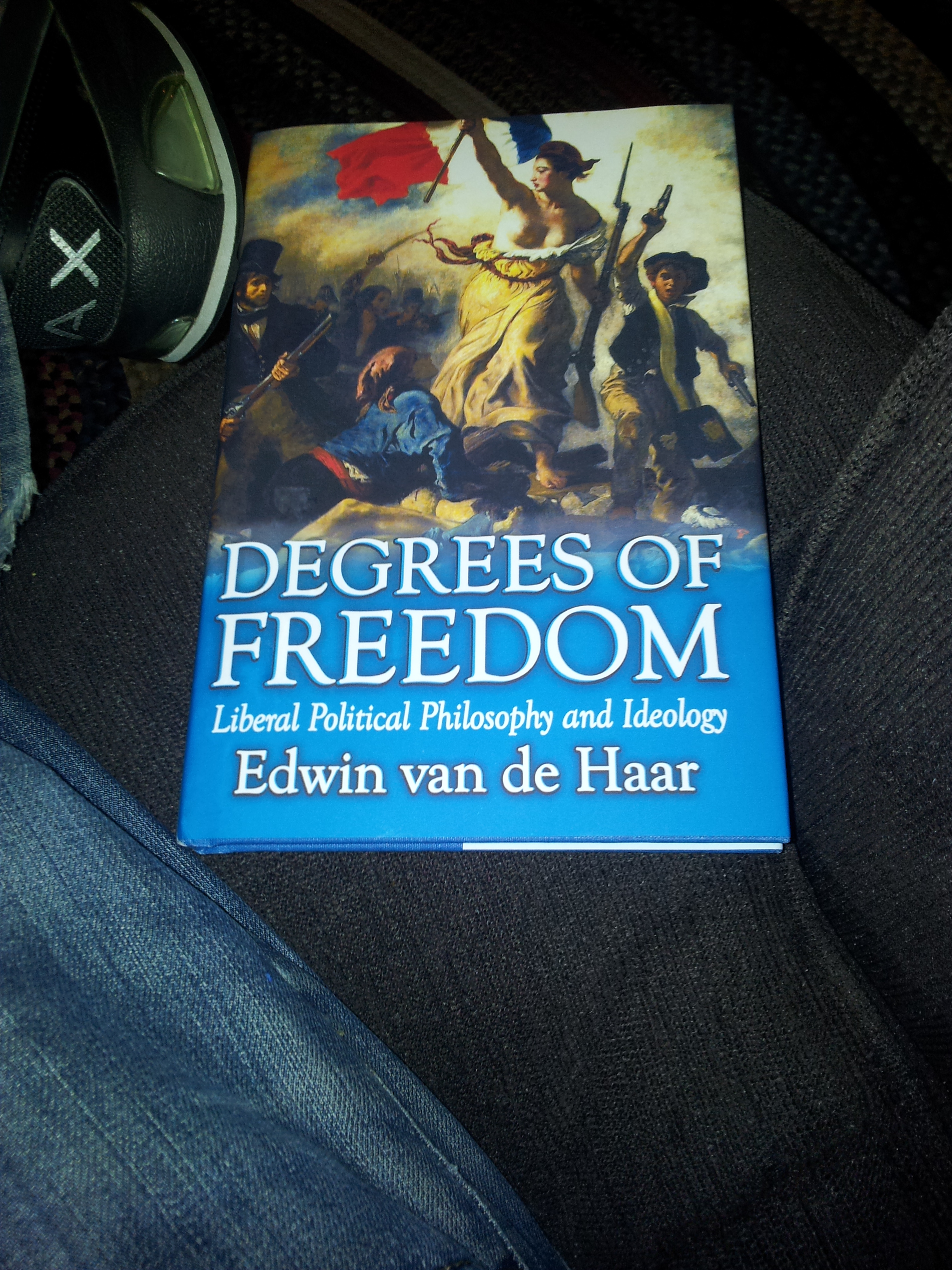
Van de Haar's "Degrees of Freedom: Liberal Political Philosophy and Ideology"
Van de Haar’s “Degrees of Freedom: Liberal Political Philosophy and Ideology”

It’s Dr van de Haar’s newest book, straight from the Netherlands. You can pick up your own copy here (mine was a gift from Dr V, one of the many perks of being an annoying blog editor!). He’s got more books that you can find either on his ‘About…’ page here at NOL or on the sidebar. Thanks Dr van de Haar!

I know Dr Khawaja (of Policy of Truth infamy) was thinking of getting this book reviewed for Reason Papers, too. I don’t have the training in political philosophy to do the job, but I can say, just by reading through the first couple of pages in his introduction, that I could have benefited immensely from this book if I had been introduced to it in Political Science 101.

Aside from the introduction, I also briefly read through Edwin’s section near the back of the book (pgs. 120-126) titled ‘The Neoliberal Phantom’, and believe that it would be very useful for liberals of all stripes when confronted with poorly constructed anti-liberal arguments (the geographer – NOT anthropologist – David Harvey, for example, gets the full Dutch treatment from Dr van de Haar). It should be noted that this section is probably (again, I don’t have any training in this area) a little less useful for academics confronting more sophisticated attacks against liberalism, but it’s a very good primer for intense undergraduates and graduate students who have to deal with the relentless, poorly reasoned attacks on liberalism in their studies and at seminars.

When I read the whole thing I’ll be sure to post a review here at the blog. If I get word of somebody who wants to review Dr van de Haar’s book for Reason Papers (check out what’s on tap right now, by the way), I’ll try to post the good news here, too.

How about war, Professor Wall?

The Cambridge Companion to Liberalism

There is a lot of truth, insight and wisdom in this Cambridge Companion to Liberalism. But how on earth is it possible that there is no substantial mentioning, let alone analysis, of the political philosophy of liberalism and international relations? At least a weird omission by the editor, Professor Steven Wall, I must say….

Milton on Freedom of Printing: Areopagitica

Areopagitica 

A Speech of Mr John Milton for the Liberty of Unlicensed Printing to the Parliament of England (1644).

(For my general introduction to Milton, click here)

‘We turn for a short time from the topics of the day, to commemorate, in all love and reverence, the genius and virtues of John Milton, the poet, the statesman, the philosopher, the glory of English literature, the champion and martyr of English liberty’, Thomas Babington Macaulay (Whig-Liberal historian, writer and government minister), 1825.

The digitised text of Areopagitica can be found at the Online Library of Liberty here.

The strange sounding title is a reference to one of the key institutions of ancient republican and democratic Athens, the court of Areopagus. Appropriately, as we are looking at an essay on politics by a great poet, the Areopagus and its mythical foundation was celebrated as the core of Athenian justice in Aeschylus’ tragic trilogy, the Oresteia. The Areopagus was itself an aristocratic institution preceding democracy in Athens and as such can be seen as what balanced the changeable majorities of the citizens’ assembly with enduring standards of justice, which have meaning in all ways of constituting political institutions.

What Milton looks for in this great institution of early experiments in constituting liberty is a standard for freedom of publication and finds that it offered a very tolerant standard, at least in the context of the seventeenth century. Milton suggests that the only restrictions the Areopagus placed on books of the time (all handwritten manuscripts of course) was with regard to atheism and libel. We are not going to look back at Milton or the Areopagus now as the most advanced instances of liberty when they prohibit expressions of atheism, but these are times when the idea that a good and rational person could not be an atheist were all pervasive and the assumption can still be found later in the seventeenth century in John Locke, one of the general heroes of modern thinking about liberty.

The restraint on libel applies in all societies and all political thinking I am aware of, but one should never discount the possibility of an interesting exception. Leaving aside possible interesting radical alternatives, there is nothing repressive by the standards of general thinking about liberty in restraining libel. Milton’s interest in the standards of pagan Greece is itself a tribute to a spirit of pluralism and open mindedness in someone generally inclined to take moral and political guidance from the religious traditions of Hebrew Scripture and the Gospels, along with the writings of early Christians, and the Protestant thinkers of the sixteenth century Reformation.

The Reformation, as Milton himself emphasises, relied on the printed word, and it is no coincidence that Protestantism emerged soon after Europe discovered printing (after the Chinese of course), as a weapon against the institutional authority of the Catholic Church and its hierarchy. The structure of the Catholic Church was not just a matter of church offering a choice to people seeking a faith-based life, it was connected with state power and pushed onto societies as the only allowable life philosophy. The politics of religion comes up in Milton’s essay, including the issue of the relation of the state to the church hierarchy.

While England had a Protestant Reformation in the sixteenth century (England including Wales, but excluding Scotland which had its own distinct Reformation before union with England), it had retained a state church, the Church of England, with Bishops. Milton, like many on the side of Parliament in the Civil War, was against Bishops, referred to as prelates, as part of the old Catholic hierarchy in which the ‘truth’ was given from above to the mass of believers.

Inspired by the pamphlets of and books of Protestant reformers, Milton argues that truth can have many forms and that while Christianity may require acceptance of central truths, they can be expressed in more ways than the Catholic hierarchical state-backed tradition allows. State backing, of course, included the imprisonment, torture, and burning to death of ‘heretics’ by the Inquisition.

Milton refers to the last pagan Roman Emperor, Julian ‘the Apostate’ (reigned 361-363) with regard to his policy of banning Christians from pagan education. Milton argues that this was the biggest possible blow to Christianity, because it deprived believers of the intellectual capacity and credibility to influence pagan inhabitants of the Empire. Christian truth could only be convincingly understood, communicated, and taught if it drew on all areas of learning including what had been produced by pagans.

Truth benefits from being tested in argument and contestation, something undermined by state-enforced church power as well as by the monarchical institution of courts full of sycophants and yes-sayers. Political liberty requires republican representative institutions and truth, including the truths of religion, require testing in conditions of liberty.

Unfortunately, Milton supported legal discrimination against Catholics, but as with prohibitions on expressions of atheism, this was part of the general understanding of a just state at the time, and Milton was more tolerant than many on the Protestant as well as Catholic sides. His arguments make up a part of the general movement to tolerance and freedom of speech, making very powerful points on behalf of liberty, enabling us to take them beyond the limits within which he constrained them.

Next post, Milton on political institutions