Libertarians and Pragmatists on Democracy Part 4: Why Market Anarchism is more Democratic than Democracy

Note: This is the final part of a series on democracy. It is assumed the reader is familiar with part one, defining democracy, part two, summarizing classical liberal perspectives on democracy, and part three, which analyzes how pragmatists conceive of democracy as a broader philosophy. Here, I will argue that a synthesis of libertarian and pragmatist perspectives on democracy will yield an argument in favor of market anarchy.

The insights of classical liberalism, and particularly modern libertarianism, have shown that democracy is likely to lead to a tyranny of an irrational and ignorant majority and public choice theory has shown how it results in awful policies thanks to a number of collective action issues. However, as pragmatists have argued, democracy’s philosophical aspirations to scientific public deliberation, seeking the consent of the governed, valuing the dignity of every individual, and decentralizing political authority to take advantage of dispersed intelligence are still admirable. However admirable these philosophical aspirations are, real-world democracies completely fail to fulfill them.

The natural question is, if not democracy, what political arrangements can live up to the philosophical goals of Dewey and Hook? I think the answer lies in market anarchism. In what follows, I will show how market anarchism could succeed in realizing the aspirations of philosophical democracy where political democracy has failed.

Before we get started, let’s take into account a few minor housekeeping notes. It is assumed that the reader has at least a cursory knowledge of how market anarchism and polycentric law works. If you are not familiar with these concepts I highly recommend watching this video by David Friedman before continuing. Also, I am in no way arguing that any of the thinkers discussed in this series are “really” anarchists unless they’re obviously so such as Huemer. I will not even claim that any of them “should have been” anarchists (with the exception of Hayek). I am simply arguing that if we take into account the insights of their various perspectives, one could plausibly defend market anarchism.

Market Anarchism, Unlike Democracy, Does Rest on the Voluntary Consent of the Governed

As Michael Huemer convincingly has shown, democracy does not actually “rest upon the freely given consent of the governed” as Sidney Hook claims. The bar tab example illustrates that we would not consider majority rule “consent” in any everyday interaction and there is little reason to think it should be any different in the context of political institutions. By contrast, market anarchism is almost by definition based off of consent. This is the primary reason why many deontological market anarchists, such as Murray Rothbard, are market anarchists in the first place and why they oppose the coercive, non-consensual nature of the state. While democracy’s claim to legitimacy is that the governed vote but they are still forced to follow the (unjustified) authority of a state that has the monopoly on force whether they agree or not to, market anarchism is based off of voluntarily consented to contracts between individuals and defense agencies and contracts between those defense agencies and private, voluntary court systems and arbitrators. Further, the content of the laws is agreed to and law becomes a product one buys in voluntarily agreeing to sign up with a defense company, just as one buys a car, a piece of furniture, or any other good.

It is curious that many pragmatist defenses of democracy sound very similar to what many market anarchists and libertarians write. Not just in Sidney Hook’s definition of a democracy as a government that “rests upon the freely given consent of the governed,” but perhaps most strikingly in John Dewey’s 1939 essay “I Believe.” In this essay, Dewey walked back some of his early Hegelian collectivist lines of his early years:

My contribution to the first series of essays in Living Philosophies put forward the idea of faith in the possibilities of experience at the heart of my own philosophy. In the course of that contribution, I said, “Individuals will always be the center and the consummation of experience, but what the individual actually is in his life-experience depends upon the nature and movement of associated life.” I have not changed my faith in experience nor my belief that individuality is its center and consummation. But there has been a change in emphasis. I should now wish to emphasize more than I formerly did that individuals are the final decisive factors of the nature and movement of associated life.

Indeed, throughout the whole essay he emphasizes “the idea that only the voluntary initiative and voluntary cooperation of individuals can produce social institutions that will protect the liberties necessary for achieving development of genuine individuality.” Throughout the essay, he decries (like many left-anarchists do) “state socialism” just as much as he does “state capitalism.” Dewey’s opposition to capitalism is well-known, but what is less known is his opposition to so-called “public collectivism.” His criticisms here could just as easily have been written by someone like Hayek:

Recent events have shown that state socialism or public collectivism leads to suppression of everything that individuality stands for. It is not too late for us in this country to learn the lesson taught by these two great historic movements [ie., the rise of state capitalism and state socialism]. The way is open for a movement which will provide the fullest opportunity for cooperative voluntary endeavor. In this movement, political activity will have a part, but a subordinate one. It will be confined to providing the conditions, both negative and positive, that favor the voluntary activity of individuals.

It is interesting that, like anarchists who favor direct action, he emphasizes that political activity is subordinate to the political movement he sees as necessary.

Of course, there are still notable differences between Dewey and libertarians, he still defends what he calls “functional socialism” in the socialization of medicine and still berates more than many libertarians would be comfortable with (except, of course, for left-anarchists) inequality caused by state capitalism. His vision of a truly individualist society, even in his later years, was one with localized, experimental democratic institutions and economics controlled by those localized governments in a “functional socialist” fashion (as I mentioned earlier, that economic vision is at odds with Dewey’s epistemological commitments).

However, I would argue that it is more than a mere superficial coincidence that Dewey’s criticisms of state capitalism are almost identical to those of market anarchists who decry “crony capitalism,” that his criticisms of state socialism are very similar to some individualist libertarian criticisms, and his overall rhetoric defending democracy on the grounds of “voluntary cooperation of individuals” sounds remarkably similar to many libertarians. This is because, largely, the philosophical ends Dewey seeks in politics are the same as those sought by libertarians, market anarchists, and classical liberals. However, the institutional means he advocates are very different and fail to meet those ends.

There is, conversely, one potential criticism that Sidney Hook would raise at this point: that market anarchism does not really rest upon the freely-given consent of the governed due to its allowance for economic inequality. Hook argued that income inequality undermines consent in democracy and, as a result, economic organization should be controlled by a democratically elected government. There are two points to be made. First of all, when economic organization is controlled by government in democracies it exacerbates the problem of income inequality. Rent-seeking culture arises in which concentrated interests use, through lobbying power, government force to accumulate and protect their wealth. Indeed, as I mentioned earlier,  there have been empirical studies showing how over-regulation lobbied for by those concentrated benefits have regressive effects. Even fairly anti-free market economists such as Joseph Stiglitz have argued that income inequality is not an inevitable result of market institutions, but a result of bad government policies such as corporate welfare.

Second, it is questionable to what degree income inequality would exist in pure market anarchy. Of course, much of the bad inequality experienced under state capitalism is the result of bad policies, but some if it is also just a result of market’s tendencies to disrupt economic distributions (which, as Mises argued in Liberalism: The Classical Tradition is not a bad thing because it allows for luxury markets which can serve as an experimental market for expensive, new goods that one day become popular consumer goods). Some market anarchists, such as Anna Morgenstern, have argued that the type of mass accumulation of capital under capitalism would be impossible under market anarchism. I am unsure to what extent I agree, and a systemic analysis of the economic roots of inequality is outside of the scope of this post. However, suffice it to say that it is an open, empirical question whether purely free markets would result in problematic levels of inequality, as Hook seems to think, and we have some good reasons to think it would not. At the very least, it is clear that the democratic institutions favored by Hook are not a serious solution to the problem.

Market Anarchism, Unlike Democracy, Relies on a Decentralized Process of Political Decision Making

Dewey argued in “Democracy and Educational Administration” that “it is the democratic faith that [the distribution of knowledge and intelligence] is sufficiently general so that each individual has something to contribute and value of each contribution can be assessed only as it enters into the final pooled intelligence constituted by the contributions of all.” He seems to echo Hayek’s knowledge problem critique of socialism when he argues that the democratic faith is based on the wisdom that “no man or limited set of men is [sic] wise enough or good enough to rule others without their consent[.]” As we have seen, democracies tend towards heavily centralized governments that undermine this faith and fail to take advantage of the dispersed knowledge (in Hayekian terms) among individuals in society.

Market anarchy, on the other hand, by definition takes advantage of this feature of dispersed intelligence. Rather than having law be designed by a centralized legislature, law arises out of voluntary market exchanges between individuals and, like common law, the precedent of judges in private courts. Of course, both Dewey and Hayek embraced democratic institutions (in Hayek’s case, as well as free market economic coordination) to take advantage of decentralized knowledge. However, both Dewey and Hayek, particularly the ladder (Dewey never wrote about market anarchism as it did not exist as a unique perspective until almost a decade after his death), failed to appreciate the extent to which a polycentric legal system does this much better. Peter Stringham and Todd Zywicki have noted this tension in Hayek’s thought in particular, as they put it in an abstract for their excellent paper on the issue:

Should law be provided centrally by the state or by some other means? Even relatively staunch advocates of competition such as Friedrich Hayek believe that the state must provide law centrally. This article asks whether Hayek’s theories about competition and the use of knowledge in society should lead one to support centrally provided law enforcement or competition in law. In writing about economics, Hayek famously described the competitive process of the market as a “discovery process.” In writing about law, Hayek coincidentally referred to the role of the judge under the common law as “discovering” the law in the expectations and conventions of people in a given society. We argue that this consistent usage was more than a mere semantic coincidence — that the two concepts of discovery are remarkably similar in Hayek’s thought and that his idea of economic discovery influenced his later ideas about legal discovery. Moreover, once this conceptual similarity is recognized, certain conclusions logically follow: namely, that just as economic discovery requires the competitive process of the market to provide information and feedback to correct errors, competition in the provision of legal services is essential to the judicial discovery in law. In fact, the English common law, from which Hayek drew his model of legal discovery, was itself a model of polycentric and competing sources of law throughout much of its history. We conclude that for the same reasons that made Hayek a champion of market competition over central planning of the economy, he should have also supported competition in legal services over monopolistic provision by the state — in short, Hayek should have been an anarchist.

There is one possibly fatal objection to this line of reasoning, that is also the most substantial objection to market anarchism as a whole: the possibility that market anarchy, like democracy, will eventually lead to a centralized state that undermines its attempt to take advantage of dispersed knowledge. This argument was initially hinted at by Robert Nozick in Anarchy, State, and Utopia in his argument about the “immaculate conception of the state” but was expanded on most convincingly by Tyler Cowen. Ultimately it is an empirical question whether market anarchy would eventually lead to more centralization, and it is outside the scope of this post to analyze that fascinating question in any satisfactory amount of detail. I will say, however, that Bryan Caplan has given more or less convincing reasons why this may not be the case.

Market Anarchism, Unlike Democracy, Values the Dignity of the Individual

One of the features central to the pragmatist “democratic faith” is the belief that “belief that every individual should be regarded as possessing intrinsic worth or dignity[.]” As I argued, the conflation of democratic governments with the “collective will” of the people undermines this faith as political dissenters and individual thinkers become viewed as opponents to “the people.” Indeed, it seems that the type of “public” and “private” collectivisms that Dewey ridiculed in “I Believe” are a result of democratic institutions run amuck.

Market anarchism, meanwhile, suffers from no such issues. Instead, the intrinsic worth of the individual is respected as their free choices and associations is the main driving mechanism for political organization. There is no violation of free speech and free thought by a deliberative government as such a government does not exist in the first place under anarchy, and thus the intrinsic worth and dignity are not found in the “will of the people” as in democracies, but in the sovereign individual’s choice of which defense provider to contract with.

Market Anarchism, Unlike Anarchy, is Scientific and Deliberative

Contrary to Dewey and Hook’s characterization of democracy as a deliberative, intelligent application of the scientific method to social issues, democracy is instead characterized by polarizing populist pandering and rationally ignorant and irrational voters casting meaningless ballots based cultural associations rather than reasoned consideration of policy issues. Market anarchism, meanwhile, does have the deliberative, scientific nature the pragmatists vainly hope democratic institutions could aspire to. While under democracy the cost of casting an informed vote is very high and the benefits very low resulting in massive amounts of rational ignorance, under market anarchism individuals have every incentive to ensure they are informed about the legal rules they are purchasing, so to speak, by contracting with rights defense agencies. Unlike in democracy where the benefits of casting an informed vote are extremely low because your vote has an infinitely small probability of making a difference, under market anarchy the rights defense agency you chose to contract with has immediate and certain impacts upon your life, thus creating a much larger incentive to cast an informed (metaphorical) vote by choosing to purchase the services of a preferred rights defense agency.

Deliberation about legal policy is far more likely to be more reasoned in market anarchy than in democracy. First, because market anarchism is more radically experimental than political democracy. Freedom of speech and of thought in democracy is often likened to a metaphorical “marketplace of ideas,” but in market anarchy it is a literal marketplace in which the ideas are not chosen just by speculation and public deliberation, but actually experimented with and acted upon in practice. Democracy is only “experimental” in a priori public deliberation about policies, but market anarchy is “experimental” in actually applying those policies and assessing their results a posteriori. Under democracy, once a policy is chosen it becomes difficult to assess counterfactually if another potential policy could have yielded better results, thus it is difficult to ascertain which was the superior policy. It is as if scientists in a lab simply talked about the hypothetical results of various hypothetical experiments and chose theories based on their discussions rather than actually testing the theories by actually running the experiments. Because of the polycentric nature of law under market anarchy, multiple policies are taken on at the same time, making it easier to tell which is more desirable in practice rather than simple theoretical deliberation.

Another reason why political deliberation is more likely to be reasoned in market anarchy than democracy is because of the institutional mechanisms for choosing policy. The main way law is “made” in democracy is through legislation voted on by representatives, who are ultimately accountable to the public through general elections. Often, debate on the floor of legislative bodies is anything but reasoned and deliberative, and clearly discussion about elections quickly devolves into mindless partisan bickering, sensationalist “scandals,” and populist rhetorical flair rather than reasoned discussion about policies. In market anarchy, however, law is “discovered” by private arbitrators and judges who are ultimately accountable to the defense firm’s consumers in the marketplace. It is pretty clear that real-world courtrooms tend to have a more elevated level of dialogue than legislative bodies, to say less of public elections, and I fail to see why this would not be the case under market anarchism.

Further, there wouldn’t be a need for partisan bickering and debates that bring down the level of public discourse in market anarchy, for similar reasons why there isn’t nearly as nasty debates about preferences for consumer goods as there are about politics. To use an analogy, in democracy, if we’re voting on what soda to consume, whoever wins the vote gets a monopoly on their preferred soda; so my preference for Coke could possibly eliminate your ability to enjoy Pepsi; but in a market, if I prefer Coke you still can drink Pepsi, meaning we don’t need to bicker about our consumer preferences. It is similar (though clearly not identical because when we’re talking about law it’s quite a bit more consequential) with legal policies: in democracy, if I prefer one set of legal rules to another which you prefer, we must fight over how to vote because the two are mutually exclusive; but in market anarchy, because law is polycentric and not monolithic, they are not mutually exclusive so we don’t need to fight nearly as hard for it. There’s a good reason why debates among consumers for products they prefer (Coke v. Pepsi, Apple v. Windows, Android v. iPhone) rarely get as nasty as debates in democratic politics, because there is room for disagreement at the end of the day in a market that there is not in politics.

Conclusion

Clearly, democracy is far from the ideal method of political organization. As classical liberals throughout history have shown, despite the fact that it may be possible to other political forms such as oligarchy and monarchy, it has a tendency towards the tyranny of the majority and massive collective action problems. However, the philosophical aspirations of the most ardent defenders of democracy are still extremely valuable, even if their preferred institutions fail to deliver. Market anarchism is a reasonable synthesis of these two insights; it has the potential to live up to the aspirations of pragmatist democrats without the major, systemic problems of real working democracies that undermine those aspirations.

John Dewey once said “democratic institutions are no guarantee for the existence no guarantee for the existence of democratic individuals,” what is needed is a better set of institutions that have a higher probability to cultivate Dewey’s idea of “democratic individuals.” Market anarchism appears to be a viable candidate for such a set of institutions.
From the Comments: Why care about Syrians?

Dr Gibson notes:

I’d say the “big question” makes no sense. Surely some Syrians would be better off under ISIS and some under Assad.

And there’s a bigger question: who the hell cares? Few if any of us Americans have enough information to judge this issue nor should we. We have our own fish to fry. The Washington politicians have done incalculable damage with their ceaseless meddling in the affairs of the Middle East and elsewhere. Let the Syrians and their immediate neighbors sort this out.

I wanted to draw this excellent comment out for two reasons. Reason number one has to do with Dr Gibson’s first paragraph. Questions rarely make sense (which is why you ask people for help), but suppose you asked whether Syrians would be better off under capitalism or socialism. Some Syrians would be better off under socialism than capitalism, but that doesn’t mean it’s just as good as capitalism. Right? One of those systems is better for far more people than the other, and as an individual don’t you have a moral duty to support the more just system in some form or other? These are questions that libertarians, especially libertarians in the United States, should be asking themselves more often than not. There is a disturbing tendency among this faction of libertarians to lean in the direction of nationalist parochialism when it comes to matters outside of our borders. This brings me to reason number two for highlighting Dr Gibson’s (quite excellent) comment: Reminding libertarians and classical liberals that our creed is an international (and a humble) one.

War refugees represent the humblest of our species. The UN estimates that the war has affected nearly 12 million Syrians so far and, of course, that doesn’t include all of the people outside of Syria’s borders who have been affected. Russians, Europeans, North Americans, Syria’s immediate neighbors, and East Africans have all been affected by the ongoing war. How could you not be interested, especially from an individualist point of view?

I think the problem of the American libertarian’s parochialist nationalism stems from Murray Rothbard’s Cold War-era writings. Unlike F.A. Hayek and Ludwig von Mises, who were both big supporters of more international cooperation (but who both saw the glaring flaws in organizations like the UN and what is now the EU), Rothbard’s writings on foreign affairs were heavily influenced by the fact that the world was dominated by two superpowers and that the government he lived under used lies and deceit to counter Moscow’s power plays. Rothbard’s world of bi-polar geopolitics is long gone. It doesn’t exist. It will not exist again in my lifetime. Ours is a world of multipolarity. Yet somehow Rothbard’s writings on foreign affairs (which descended into outright incoherence near the end of his life) still have a profound impact on the American libertarian movement.

Much of my work here at NOL is dedicated to eviscerating this long-expired mindset from the American libertarian movement. Isolationism is nationalist, plain and simple (just pay attention to the rhetoric of libertarians like Justin Raimondo or Doug Bandow if you need more convincing), but Warren’s point about Washington’s meddling in the affairs of other states remains pertinent. So perhaps a different question to ask (even if it doesn’t make sense) is what a more internationalist-minded, in the vein of Hayek and Mises and Adam Smith, US foreign policy would look like. (I’ve been asking this question for a while now.)

Declining to Wed Gay Couples: Right or Wrong?

News item: the Georgia governor has just vetoed a bill that would, among other things, have allowed ministers to decline to wed gay couples.

What a tangle. Let’s see if we can sort things out.

First of all, many decent people, your humble servant included, find the concept of “gay marriage” troubling. I believe any two adults (or three or more) should be free to make any contract they like regarding sharing assets, pledging fidelity, and so forth. I just wish they wouldn’t call it “marriage.” That term is taken.

Second, hate is not a crime. Some people express repugnance or hatred for homosexuality. Ayn Rand called the practice immoral, an attitude that is hard to fathom in this day and age but perhaps understandable given the tenor of her times. Some go farther and express hatred for homosexuals per se. But as long as these people refrain from initiating force or fraud, they should not be molested. Boycotts, shunning, and criticism are legitimate responses to such people, but forcible restraint is not.

Third, rights are not granted by governments. Rights derive from our basic nature as humans, as thinkers such as Ayn Rand and Murray Rothbard have so eloquently demonstrated. Contractual “rights” should have a different name, perhaps “privileges.” These are actions that have been legitimized by a voluntary agreement. Thus for example, no one has free speech “rights” on a campus. Students may have free speech “privileges” on a campus if the owners of the campus have granted that privilege in a written or implied contract.

Fourth, freedom of association is a basic human right, and includes freedom of dissociation, whether in personal or business relations. Some years ago I posted a defense of the late Lester Maddox who famously attempted to exclude blacks from his chicken restaurant. My post generated considerable blowback, but I stand by it and note that in this day and age, anyone who tried to exclude blacks would not be elected governor of Georgia as Maddox was, but instead lose most of his customers and close his doors.

In summary, no minister needs permission from the state to deny wedding services to a gay couple. And religion has nothing to do with it. Anyone should free to decline business or personal relationships with anyone, for any reason whatever, or for no reason at all.

NOL Foreign Policy Quiz, Part One

The goal of this post is to discuss the purpose of a NOL Foreign Policy Quiz. It is the first in a series of posts discussing the details of how to actually devise and distribute this quiz. Reader input is encouraged.


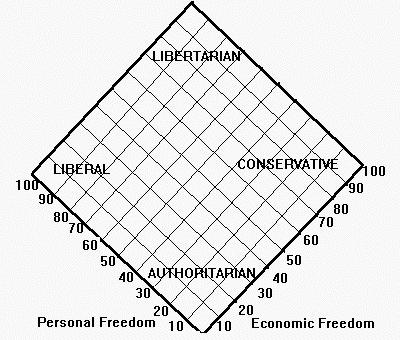
The Nolan Chart is a short political quiz developed by David Nolan, the Libertarian Party founder. The Nolan quiz plots individuals along two axes, asking them their preferences towards issues of personal and economic freedom (both Rick and Warren have blogged about the Nolan Chart here at NOL, too). Libertarians are those individuals who favor both personal and economic freedom.

nolanchart

The benefit of the Nolan Chart is that it moves us away from the left–right spectrum and towards a two-dimensional understanding of politics. The limitation of the Nolan Chart is that it only views politics through these two limitations. The Nolan Chart at best tells us what end policies we favor, but it fails to address how to achieve these goals.

This is problematic, as even political groups that agree on end goals differ substantially on how to best achieve them. Among libertarians, the largest debate is probably between those who believe a minimal state is needed (minarchists), and those who believe no state can be tolerated (market anarchists) to achieve maximum liberty. There is also, to a lesser extent, a debate on the form of government* and foreign policy.

It is possible to be a libertarian and believe that monarchy is superior to republicanism or democracy in upholding the law and maximizing liberty. Likewise, it is possible to be a libertarian and desire an active foreign policy beyond promoting free trade agreements. I know that I stir controversy with my latter comment, but give me a moment to defend it.

The standard libertarian foreign policy is one of non-intervention. It is a policy of wishing to sever military ties with foreign nations and instead promoting free trade with all. It is a policy consistent with the non-aggression principle.

However, this standard policy is not the only policy consistent with libertarianism. It is possible to believe that, although the loss of any human life is horrible and that the state is illegitimate, the best option to minimize human life and protect liberty is to attack, embargo, or annex another state.

I do believe that there are several tests that must be met before one adopts a foreign policy beyond the standard libertarian creed. Specifically:

  1. Loss of human life and liberty must be weighed for both sides.
    1. Discounting should not occur on national basis.
  2. All reasonable peaceful solutions must be acted on beforehand.
  3. The long-term consequences of the action must be considered and weighed for both sides.

Additionally, if actions are taken, then all precautions must be taken to minimize loss of human life and liberty on both sides.

Minarchist libertarians may see the state as a tool to maximize freedom, but I do not believe this grants them the authority to kill others. There may be a scenario where the murder of one man is outweighed by it leading to the protection of ten men, but the one man has still been murdered and his death must be felt as a regrettable action. The value of a man is not dependent on whether he was born in New York City or Tehran. A libertarian cannot be a jingoist.

At no point may a foreign policy action be taken if a reasonable peaceful action is still available. If a man enters your home with a gun and clearly intends to harm you, by all means it is justified to attack him, even if he has not yet shot or aimed at you.

And finally, the long-term consequence of a foreign policy action must be considered. Even if the first two rules are met, if there is not a long-term plan that is likely to succeed, no action should be taken.

For a long time, I wrestled with my stance on the Iraq war. I believed in the past that the first two requirements had been met and that the US invasion of Iraq was justified despite the loss of life and liberty on both sides. The Iraq war did not, however, meet the third hurdle. There was no viable long-term plan, and the latest consequence of this is the rise of ISIS and other militant groups in the MENA region.

Meeting these three conditions is difficult, but possible.

For example, I believe that expanding the US to include South Korea and Japan would be a proactive foreign policy stance consistent with my the rules I outlined above. Such an expansion would harm Okinawan residents, whose land is currently used for US bases. Such an expansion would also lead to retaliation from the PRC and North Korea. It would, however, lead to a net win for liberty. South Koreans and Japanese residents would have a stronger defense against a rising PRC seeking to dominate the region militarily. US residents would benefit from having defense costs, both in monetary and human life terms, more equitably shared. Although I am hopeful the PRC will liberalize in the future, its actions towards Hong Kong makes me doubtful that that will occur in the foreseeable future.

It is possible that I am wrong of course, and that adding South Korea and Japan would lead to a great loss of life and/or liberty. I am still a libertarian, however. I am not discounting the lives or liberty of non-US residents. I am not ignoring another peaceful solution – the current foreign policy scenario in East Asia is not sustainable for much longer, the PRC has clear intent to assert itself in the region, and it’s extremely doubtful that it will liberalize in the foreseeable future. I am considering the future: the PRC and North Korea are sure to retaliate, but I do not see either of them going to war over it. I do see the PRC being more likely to go to war over annexing Taiwan, even if not immediately, or otherwise I would promote Taiwanese annexation as well.

Hopefully I have successfully shown that it is possible to be a libertarian and favor a policy beyond the standard libertarian foreign policy. In which case, there is merit in discussing foreign policy beyond this standard.

There have been proposals to incorporate a foreign policy dimension to the extant Nolan Chart, but these proposals take it for granted that a non-interventionist policy is the only libertarian prescription. Over at FEE, Richard Fulmer proposes the following five questions:

  1. The United States should cease serving as the world’s policeman.
  2. The United States should not engage in nation building.
  3. The United States should not pledge to defend other countries.
  4. The United States should withdraw its troops currently stationed around the world.
  5. U.S. foreign policy should not be tied to that of the United Nations.

Unless one believes only a non-interventionist foreign policy is compatible with libertarianism, it is clear that these questions are insufficient. They also highlight that a NOL foreign policy quiz should seek to complement, but be independent of, the Nolan Chart. Otherwise, any attempt to add a foreign policy dimension will end with in fighting over who is a libertarian and who is a statist.

Again, the standard non-interventionist libertarian foreign policy view is a consistent and legitimate view point. It is however possible to favor foreign policy interventions under certain conditions and still be a consistent libertarian.

In the next post I will be proposing the foundation for a NOL foreign policy quiz.


Foot Notes:

*Even market anarchists who reject the need for a state debate on what type of organizations would exist and how the law would operate. For example, Murray Rothbard’s early vision for market anarchism presumed that a unitary law would exist, and that private defense associations (PDAs) would compete to best to carry out this unitary law. This unitary law would be based on ‘natural law.’ David Friedman’s vision for market anarchism does not presume a unitary law, and instead imagines competition for the law, as opposed to competition for the application of the law itself. My understanding is that there are also Rothbardians who have moved away from PDAs and towards dispute resolution organizations (DROs). It has been quite some time since I actively followed this debate among market anarchists, so I will defer to anyone who has more up-to-date information.

Further Reading:

Ian Bremmer’s American Foreign Policy Quiz [NOL Post] – The post that initiated the idea of a NOL Foreign Policy

A Three Dimensional Nolan Chart Extension Focusing on Form of Government (e.g. Anarchy v. Monarchy)

Liberalism and Sovereignty

More than a year ago I promised Jacques a post on sovereignty and while I am not always able to follow up very quickly, I tend to do what I promise. So here it is! Jacques’ main cri de coeur was why (classical) liberals should care about sovereignty at all.

When it comes to the theoretical discussion about sovereignty (the literature is huge), I think there is no better start than the work of international relations theorist Robert Jackson. Or better and broader: any thinking about international relations benefits from this Canadian, former Boston University professor, especially his magnum opus The Global Covenant: Human Conduct in a World of States (Oxford University Press, 2000). But this is a side step.

In his 2008 book Sovereignty: Evolution of an Idea (Polity Press) he argues that:

sovereignty is an idea of authority embodied in those bordered territorial organizations we refer to as states, and is expressed in their various relations and activities, both domestic and foreign. It originates from the controversies and wars, religious and political of sixteenth and seventeenth century Europe. It has become the fundamental idea of authority of the modern era, arguably the most fundamental.

Also in regions where other kinds of arrangements existed before Western imperialism.

It is at the same time both an idea of supreme authority in the state, and an idea of political and legal independence of geographically separate states. Hence, sovereignty is a constitutional idea of the rights and duties of the governments and citizens or subjects of particular states. It is also an international idea of multiple states in relation to each other, each one occupying its own territories and having foreign relations and dealing with others, including peaceful and cooperative relations as well as discordant relations and periodical wars.

Of course a lot of popular and academic discussion follows from this, for example about the particular form of sovereignty (popular, or not), the relation between power and sovereignty, sovereignty and globalization, or if and when sovereignty may be breached to protect others through intervention. Yet here I solely  focus on the relation between sovereignty and liberal political theory.

Concerning the domestic supremacy side of sovereignty a lot has been written by liberals. Most liberals (classical, social, and even libertarian minarchists, such as Ayn Rand or Robert Nozick; see my Degrees of Freedom for the precise definitions) realize some form of state is needed to protect individual rights. A state embodied with sovereignty. At the same time most liberals (social liberals less so, because they favor a relatively large state) recognize the state is also the largest danger to individual freedom. How to balance the two is the perpetual question of liberal political thought, one also without a definitive answer or solution, so far.

Less attention has been given to the international side of sovereignty. There are a number of libertarians, such as the anarcho-capitalist Murray Rothbard, or his intellectual successor Hans-Hermann Hoppe, who think there should not be states, hence no issues of sovereignty exist once their stateless world has materialized (they remain largely silent about how to reach that situation). Yet it seems to me the thinking should not stop there. These same thinkers romanticize the idea of secession, yet seem to overlook that those seceded groups or communities also need to deal with other seceded groups and communities. They are a bit lazy when stating everybody should look after themselves, and only defend themselves in case of attack by others. If everything would be nice and neat among people this might be ok. Yet of course history shows (also in those areas where sovereignty never played a big role before Western imperialism) that people interfere all the time in each others affairs, some rulers may have malign intentions, others belief some parts of the seceded lands belong to their community, let alone issues about religion, et cetera. In short, chances on a peaceful world with the occasional conflict that can be solved by self defense are zero.

Funnily enough, social liberals share the idea of the possibility of a world peace and cosmopolitan harmony. They also favor the abolition of sovereign states, not through secession but through the pooling of sovereignty at the transnational level, with the European Union as an example and a world federation as the ultimate end goal. This seems just as unrealistic, as even the EU is still mainly governed from the member states, as the current refugee crisis and the possible dissolution of the Schengen agreement illustrates. More generally, the pooling of sovereignty proves rather difficult, also in other parts of the world. ASEAN in South East Asia is an example.

More realistic are classical liberals, such as Hume, Smith, and Hayek, who acknowledged an emotional tie between the individual and his country, as well as the constant need to defend individual property rights against invasion by others, through standing armies, diplomacy, some international treaties, the balance of power, et cetera.  Human nature does not allow for starry eyed fantasies about international harmony, let alone international peace. Hence, it is rather normal to care about external sovereignty, as it is foremost a means of protection.  Not the sole means, but an important and fundamental institution of international relations.

Giving Up On The Masses

In 2012, during Ron Paul’s second presidential candidacy as a Republican, I felt deflated with the masses again. Again, the masses were not going to vote a libertarian into office. It was the same year in which I read Murray Rothbard’s Ethics of Liberty and Hans-Hermann Hoppe’s Democracy: The God That Failed. What struck me at that time was the realization that democracy is actually an extremely poor political system to make society become more libertarian. Democracy is not even a guarantee whatsoever for political and economic freedoms. Its success is dependent on the uprightness of the masses, but where are the masses to stand up against war, bank bailouts, taxation, police aggression etc? If the government is truly a gang of thieves and murderers, as I believe it is, then the voting masses are advocates of theft, harassment, assault, and murder.

I do not believe that the masses are ready for freedom, because freedom means taking responsibility for one’s life and actions – a frightening prospect for the masses who lack the strength to face insecurities in life. Ingrained with fear of their own and their neighbours’ incapability to live a ‘responsible’ life, they are attracted to masters who can arrange their lives for them. The masses have also never thirsted for truth. Whoever can supply them with illusions is easily their master, and whoever attempts to destroy their illusions is always their victim. They want to be comfortable and cuddled to death. Thinking is too much hassle for the mass-man. The masses have moreover a love for egalitarianism and a disdain for those who are different, who are more successful and more beautiful. They hate freedom, because in freedom man naturally maintains his distance from his fellow human beings.

Being discontent with the masses and deflated in my philosophical views on politics and economics, I took Peter Thiel’s following dictum to heart: “The masses have given up on unregulated capitalism, so those who still support unregulated capitalism should give up on the masses.” Instead, I have put my hope on such technological advances of decentralization as cryptocurrencies, seasteading, 3D-printing, and localized energy conservation and production.

Book Review: Hans-Hermann Hoppe – Economic Science and the Austrian Method

I decided to read Hans-Hermann Hoppe’s Economic Science And The Austrian Method (1995) in order to grasp a deeper philosophical understanding of the Austrian School’s methodology of economic inquiry. I was especially interested in Immanuel Kant’s influence on Ludwig von Mises and how Mises had used Kant’s epistemological insights to construct praxeology, the study of human action (economics included) that is purely deductive in nature.

Those who are acquainted with scientific methodologies in the field of economics may have heard of the controversies surrounding praxeology. Living in an empirical age, many people may be inclined to question the validity of a science that claims to arrive at economic laws from pure deduction whose validity can be established independently from observations. Praxeological propositions are indeed much more “like those of logic and mathematics, a priori” (Mises, 1966, p. 32). Such a science may strike the skeptics as being disquietly dogmatic.

In this book review, I will firstly give a brief discussion why it is important at all to discuss the epistemological foundations of economic science. Thereafter, I will discuss Hoppe’s thesis. I will describe the philosophical aspects of praxeology that can be traced back to Kantian epistemology. I will moreover summarize Hoppe’s critique of empiricism and historicism, and why Mises believed that economics is essentially praxeology. Lastly, I will give my personal thoughts on the book.

Why should we discuss the epistemological foundations of economic science?
The most immediate answer to this question is that different epistemological foundations lead to different methodologies and different theories, which can lead to different interpretations of real-life phenomena. Take for example the interpretation of an historical economic event, the Great Depression. Murray Rothbard, because he is working within the context of praxeology makes use of the praxeological Austrian Business Cycle Theory. This theory focuses on the expansion of the money supply as an explanation of the onset of the ‘boom’ in the 1920’s which eventually resulted in the ‘bust’ in 1929. Milton Friedman and Anna Schwartz in A Monetary History Of The United States (1963), while not applying the ABCT, have focused only on the contraction of the money supply and the resulting higher interest rates in 1928 as the main cause of the Great Depression. Their application of different economic methods has led them to look for different possible historical causes of the Great Depression which has effectively resulted in different accounts of the same historical event. It therefore matters what economic methods are employed in economic research.

Now that we have established the importance of inquiring epistemological foundations and methodologies of economic science, I will turn to Hoppe’s thesis.

Kant and synthetic a priori propositions
Working within the rationalist tradition of Leibniz and Kant, Mises attempts to present the proper way through which economic science – a science that according to Mises falls within the broader science of human action, praxeology – should be conducted. He resorts to the Kantian conception of the nature of knowledge and explains praxeology in terms of Kantian terminology. Hence, Hoppe firstly directs the reader to Kantian epistemology.

Kant had developed the idea that all propositions are either analytic or synthetic and either a priori or a posteriori. The difference between analytic and synthetic propositions is that the former is true by virtue of their meaning or as Kant would have phrased it himself, “the predicate B belongs to the subject A as something that is (covertly) contained in this concept A” (Kant, 1781, A:6-7). Take for instance the following proposition: “Bachelors are unmarried.” This proposition is analytic, because the predicate, ‘unmarried’, is part of the concept of a bachelor. Analytic propositions are regarded as tautological propositions; they simply restate the definition or a concept incorporated within a word and therefore they do not tell us anything meaningful about the world. A synthetic proposition on the other hand is a proposition whose predicate concept is not contained in the subject’s concept. It could therefore express something meaningful about the world. An example of a synthetic proposition is: “All bachelors are unhappy.” The concept ‘unhappy’ is not contained within the definition of ‘bachelor’, and expresses something meaningful about ‘bachelors’.

The distinction between a priori and a posteriori is as follows: a priori propositions are propositions whose justification does not rely upon experience, but solely on logical reasoning. The justifications of a posteriori propositions on the other hand, do rely upon experience. Examples of a posteriori propositions are “Some bachelors I have met are unhappy” or “Siddharta Gautama left the palace.”

The big question is: do synthetic a priori propositions exist? Kant certainly believed that they do exist, “and it is because Mises subscribes to this claim that he can be called a Kantian” (Hoppe, 1995, p. 18). In Critique of Pure Reason (1781), Kant contended that synthetic a priori propositions do exist and as an example he took mathematics (Kant, 1781, p. 55). The statement “7 + 5 = 12” is not dependent on experimentation and the concept 12 is not contained in either the definitions of 7 or 5. According to Kant, a priori propositions are derived from self-evident axioms. We can find such axioms by reflecting upon ourselves and understanding ourselves as knowing subjects. However, how can truth claims derived from reflection in our mind have any basis in reality? Is Kant here running into the problem of idealism – a notion that it is the mind that constructs reality and superimposes itself upon reality in such a way that it fits within the mind’s necessary laws?

According to Hoppe, Kant had not given a satisfactory response to this issue and future thinkers would have to take on the challenge of solving this problem. Hoppe believes that Mises had done so successfully when he had averred that action provides the link between mind – body and between mind – external world: “[W]e must recognize that such necessary truths are not simply categories of our mind, but that our mind is one of acting persons. Our mental categories have to be understood as ultimately grounded in categories of action” (Hoppe, 1995, p. 20). It is through action that the mind and reality are related: “[A]cting is a cognitively guided adjustment of a physical body in physical reality” (Hoppe, 1995, p. 70).

Another issue that arises with regards to the possibility of synthetic a priori propositions, and which I have found quite confusing myself is the following: does Hoppe suggest that we can arrive at knowledge without any experience of ourselves or the external world at all? No, according to Hoppe “the truth of a priori synthetic propositions derives ultimately from inner, reflectively produced experience” (Hoppe, 1995, p. 19). This experience is phrased by Stolyarov II as “the mind’s identification of facts about actually existing entities, including the identifier himself” (Stolyarov II, 2007, p. 53). In this sense, the action axiom is experientially-derived, but it is not subjected to the empiricists’ narrow view that all knowledge must be testable, verifiable, or falsifiable.

Empiricism, Historicism, and Praxeology
When Mises systematically constructed the foundations of praxeology, he faced a double-challenge; (A) empiricism which was quickly becoming the main influence in the economics discipline, and (B) historicism which was then a prevailing ideology at German-speaking universities.

(A) Empiricism
Empiricism is the “philosophy which thinks of economics and the social sciences in general as following the same logic of research of that, for instance, of physics” (Hoppe, 1995, p. 28). Hoppe writes that empiricism is governed by the following two related basic propositions:

(1) that empirical knowledge, knowledge about reality, must be subjected to falsifiability and verifiability by observational experience;
(2) and that empiricist research formulates their explanations in terms of causality, i.e. “if A, then B”. (Hoppe, 1995, pp. 28-29)

Hoppe continues to write that the validity of empirical statements

can never be established with certainty… The statement will always be and always remain hypothetical… Should experience confirm a hypothetical causal explanation, this would not prove that the hypothesis was true. Should one observe an instance where B indeed followed A as predicted, it verifies nothing… Later experiences could still possibly falsify it. (Hoppe, 1995, p. 29)

Empirical knowledge is hence contingent on historical facts. Neither confirmation nor falsification by observational experience can prove that a relationship between phenomena does not or does exist. By emphasizing that our knowledge of reality must stem from observational experience, they directly deny a science that avers that a priori knowledge can give us any meaningful explanation of real phenomena. However, as Hoppe and Mises point out, the statement that meaningful synthetic a priori propositions cannot exist is itself a synthetic a priori proposition. Mises has put this empiricist contradiction the following way in The Ultimate Foundation of Economic Science (1962):

The essence of logical positivism [logical empiricism] is to deny the cognitive value of a priori knowledge by pointing out that all a priori propositions are merely analytic. They do not provide new information, but are merely verbal or tautological, asserting what has already been implied in the definitions and premises. Only experience can lead to synthetic propositions. There is an obvious objection against this doctrine, viz., that this proposition that there are no synthetic a priori propositions is in itself a … synthetic a priori proposition, for it can manifestly not be established by experience. (Mises, 1962, p. 5)

Hoppe mentions a second contradiction of empiricism which regards historical events. Empiricists believe that particular events may cause any particular human action. They attempt to find such causal relationships in order to explain historical events. However, in order to do so, empiricists must assume that causality within historical sequences exists through all times. This assumption itself is not based on experiential observations, and must presuppose a priori knowledge that “time-invariantly operating causes with respect to actions exist” (Hoppe, 1995, p. 36). In addition, Hoppe identifies a third contradiction with respect to social phenomena. The empiricists believe that in order to confirm and falsify hypotheses, one must be able to learn from historical and social experience. If one would deny this, then why should one engage in empirical research at all? This however presupposes that “one admittedly cannot know at any given time what one will know at a later time and, accordingly, how one will act on the basis of this knowledge” (Hoppe, 1995, p. 37). Admitting that humans learn from historical and social experience, one cannot deny that empirical causal constants in human action do not exist. “The empiricist-minded social scientists who formulate prediction equations regarding social phenomena are simply doing nonsense” (Hoppe, 1995, p. 38). Predicting human action is not a science according to Hoppe.[1]

The empiricists are mistaken in applying the methodology of the natural sciences into the fields of social science in order to predict human actions. Unlike natural elements, human beings can and do act differently under equal conditions. Thus, social history cannot yield any knowledge that can be employed for predictive purposes. Relating this to the quantity theory of money; if the money supply for instance increases, one can still not predict whether the demand of money will change as this is entirely dependent on human action. Nonetheless, one could assert that if the demand for money stays constant and the money supply increases, then the purchasing power of money will fall (Hoppe, 1995, pp. 44-45).

(B) Historicism
Historicism, the second challenge that Mises had to face, does not take nature as its model but literary texts. Historicists believe that there are no objective laws in economics, and that “historical and economic events are whatever someone expresses or interprets them to be” (Hoppe, 1995, p. 54). Historicism is therefore extremely relativist. However, according to Hoppe also historicism is fundamentally self-contradictory. If there are only interpretations and hence no constant time-invariant relations, then there is also no historicist constant truth about history and economics. If historicism does not give us any reason to believe in its doctrine, why should we adhere to its epistemological philosophy if its proposition implies that they themselves may not be true?

Next to his refutations of empiricism and historicism, Mises had hoped that he could demonstrate the existence of true synthetic a priori propositions. Such propositions would (1) not be derived from experience, and (2) they must yield self-evident axioms so that when one tries to deny it one is involved in self-contradiction. Mises believes that these two requirements are met by the axiom of action – the proposition that human beings act and display intentional behaviour (Hoppe, 1995, pp. 60-61). According to Mises, purposeful human behaviour exhibits a person’s pursuit of an end which he attempts to reach through the employment of particular means (at least time and body). The fact that a person pursues a particular goal with his action reveals that he places a relatively higher value (preference) on the goal than any other goals of action that he could have thought of at the beginning of his action. Human action also happens sequentially, implying that the actor can only pursue one goal at a time in which he has to forego other valuable goals temporally. Action therefore also implies choices and costs. An action furthermore implies loss (and profit), because every action accompanies a certain degree of uncertainty, whether the goal achieved has resulted in the value one has expected can only be known in retrospect. All these categories of action – values, ends, means, choices, preferences, costs, profit, loss, and time – are at the heart of economics (Hoppe, 1995, pp. 61-63). This insight establishes economics as a science of human action. Or as Hoppe asserts more precisely,

all true economic theorems consist of (a) an understanding of the meaning of action, (b) a situation or situational change – assumed to be given or identified as being given – and described in terms of action-categories, and (c) a logical deduction of the consequences – again in terms of such categories – which are to result for an actor from this situation or situational change (Hoppe, 1995, pp. 63-64).

The existence of the categories of action is derived a priori from the axiom of action, and not through observation. Any attempt to disprove it is futile, since “a situation in which the categories of action would cease to have a real existence could itself never be observed or spoken of, since to make an observation and to speak are themselves actions” (Hoppe, 1995, p. 63).

My thoughts on Hoppe’s book
The book serves as an excellent summary of praxeological philosophy and is a must-read for anyone who wants to start learning more about the subject. Reading the book, one feels that it is extremely concise (around 80 pages), but also dense. Hoppe directly discusses the essential philosophical aspects that one must know in order to understand praxeology as developed by Mises, and fortunately he leaves many footnotes for further reading.

I believe that Hoppe has skillfully shown that economics is part of praxeology, and that it indisputably deals with such categories of human action as values, ends, means, choices, preferences, profit, loss, time, and causality. He has furthermore provided a well-reasoned critique of the empiricist and historicist-hermeneutical interpretations of economics by showing that they are necessarily self-contradictory.

Understanding that economics should not be conducted within the methodological framework of the natural sciences has severe implications to the ways we should deal with data of real world phenomena. If, like praxeologists claim, we cannot predict human action then there is also little reason to believe that effective social engineering is possible. The fundamentals of the praxeological methodology are therefore also immediately relevant within discussions on the roles of the state in planning the economy.

Footnotes
[1] Hoppe calls it entrepreneurship.

Bibliography
Friedman, M. & Schwartz, A.J. (1963). A Monetary History of the United States 1867-1960. Princeton: Princeton University Press.
Hoppe, H.H. (1995). Economic Science and the Austrian Method. Auburn: Ludwig von Mises Institute.
Kant, I. (1781). Critique of Pure Reason. (W.S. Pluhar, Trans.) Indianapolis: Hackett Publishing Company, Inc.
Mises von, L. (1942). Social Science and Natural Science. In R.M. Ebeling (Ed.) Money, Methods, and the Market Process (pp. 3-15). Retrieved from http://mises.org
Mises von, L. (1966). The Ultimate Foundation of Economic Science. Retrieved fromhttp://mises.org
Stolyarov II, G. (2007). The Compatibility of Hoppe’s and Rothbard’s Views of the Action Axiom. The Quarterly Journal of Austrian Economics, 10, 2, pp. 45-62.

Dumbing Down the World

Public education has been a slowly degenerating disaster throughout the West, and now it seems we’re exporting it to the rest.

At a United Nations meeting 15 years ago, the world’s governments agreed on the goal of enrolling every child on the planet in primary schooling by this year.

Indeed, they have nearly succeeded, with 2014’s reports indicating that 90 percent of children in developing regions now attend primary school. Presumably, the numbers for developed countries are above 95 percent.

But strangely, this lofty plan did not say anything about the quality of the schooling into which we have now driven more than 9 out of every 10 human children; the whole idea is to get children into government-approved classrooms, apparently regardless of what happens there.

The reports of UN agencies like Education for All (EFA) are full of ideas on how to get kids to go to school in developing countries: making education entirely taxpayer funded (commonly by taxpayers from richer countries), providing free medication or food to students who show up, or even just paying cash to the parents in return for kids’ attendance.

But are the pupils who spend more time at these schools actually learning more as a result? Has the goal of putting more kids into classrooms actually led to more kids getting a proper education? MIT’s Abdul Latif Jameel reports, “Several programs which have raised participation, from providing worm medicine to free meals, show no evidence that children are learning more as a result.”

And EFA’s Fast Track Initiative admits, “In nearly all developing countries the levels of learning achievement are shockingly low.… In many low-income countries students learn virtually nothing and end up functionally illiterate.”

In fact, the situation is so bad that Jameel says one area to be improved is “more regular attendance of teachers.”

A crucial fallacy

The international education agencies seem to have been duped by what Austro-libertarian Murray Rothbard calls “a crucial fallacy … confusion between formal schooling and education in general.”

Promising to educate every child in every culture through primary schooling is a bit like promising to clothe every child in every climate by giving them a parka.

In fact, until recently, nearly all children learned the important skills of life largely outside of schools, through observing and joining in with the activities of adults. Rothbard writes with respect to American education, “Education is a lifelong process of learning, and learning takes place not only in school, but in all areas of life. When the child plays, or listens to parents or friends, or reads a newspaper, or works at a job, he or she is becoming educated.”

All the medicine handouts and free school lunches EFA proposes are attempts to offset the direct economic opportunity cost of the child spending a day at school instead of working on the farm or in a factory. While these handouts do take into account the child’s economic contribution to the family’s labor, what about that labor’s educational contribution to the child? What about the educational opportunity cost?

If students in many schools are learning very little and graduating “functionally illiterate,” if attendance doesn’t actually produce real education, and if teachers sometimes don’t even bother to show up, perhaps the parents and children feel that they would learn more outside the schools than in.

The presence of this educational opportunity cost may help explain why, despite all the subsidies and bonuses meant to drive kids into classrooms, the 2014 report on this goal laments, “high dropout rates [of children] remain an impediment to universal primary education.”

The kids are going into school, they and their families are seeing the results, and they and their families are deciding they are better off elsewhere.

But sadly, this important educational opportunity cost doesn’t seem to be on the global pedagogical philanthropists’ radar. Jameel says only that “there is no consensus on why so many poor children don’t attend school, or the best way to increase participation. If children’s labor is crucial to their family’s welfare … it may prove very difficult to attract more children to school.”

There is no mention of any learning that might happen while the child is outside the classroom.

For the moment, let us grant this assumption: Only schooling is education. No learning happens outside of schools.

Under this assumption, not only do children’s minds profit nothing from a day spent at home or in the bush, but most of the parents of children in the developing world are themselves totally un-“educated” — benighted savages whose heads are filled with cobwebs.

Thus, for our benevolent pedagogical overlords, it could make sense to get those kids away from their parents and into schools as soon as possible, even if, as EFA acknowledges, “in some countries nearly every aspect of the schooling system is seriously deficient — infrastructure, teaching materials, teacher availability and qualifications, lack of student assessments and lack of incentives for improving learning outcomes.”

Furthermore, in many poorer countries, the office jobs (the only ones for which schooling is actually required) are nearly all government and international NGO jobs. That’s because these countries have not (or at least not yet) developed a strong market demand for literate and numerate workers. So those kids who do succeed in school end up moving to the capital and writing reports on the importance of international funding for schools.

The kids who do not do well in school go back home to the farms or the factories, having spent years of their lives learning, in some cases, “virtually nothing.” But since the bureaucrats seem to believe that the traditional cultures the children might have spent those years immersed in held no knowledge anyway, this result might not be seen as much of a loss.

Setting young minds free

No doubt, some kids who would profit from schooling are being kept out of it by very bad things: wars, forced prostitution, and outright poverty. EFA’s programs to make schooling more accessible could have a huge positive impact on these children’s lives.

But instead of focusing on gimmicks to get kids into the classes governments want to teach, educators should focus on materials that kids want to learn — or that their parents are willing to invest in.

James Tooley has reported on the existence of an entire underground economy of black- and gray-market private schools in the slums of India and Kenya. Since these schools either hide themselves from the local authorities (to avoid being shut down) or are hidden by the local authorities from the national and international authorities (to avoid embarrassing the public schools), it’s difficult to know how prevalent they are.

What is clear is that these dirt-cheap private schools are operating with a profit motive under serious competition. Students’ parents often have to choose whether to pay for a loaf of bread or a day in school. How good would your kid’s school have to be for you to pay for it under those circumstances?

Meanwhile, these schools’ profits are being siphoned off in bribes to the local inspectors.

We could unleash these not-quite-legal schools from their government shackles by breaking the chain between government and education. Ending the drive for compulsory, state-run, subsidized schooling would, in Rothbard’s words, “give children their head” and let them seek out “a genuine and truly free education, both in and out of formal schools.”


This article was originally published in the Freeman online, and is based on an older article written for Mises Daily. Many thanks to Max Borders and BK Marcus for the opportunity to publish in the Freeman, and to Dan Sanchez for the opportunity to publish in the Mises Daily during his tenure.

Around the Web

  1. The first Gulf War in 1991 was the US’s opening Iraqi mistake
  2. The art history of an unknown Korea
  3. Damon Root sums up Obama’s disappointing year with the Supreme Court
  4. Brazil: Cinema’s most radical battleground
  5. How to have law without legislation
  6. If Scotland Goes: First the empire disappeared. Now Britain itself could crumble. Scottish independence would have global implications

A Liberal: To Be or Not To Be (Happy #LiberalismDay!)

What’s in a name?

Dan Klein and Kevin Frei recently decided to launch a campaign dedicated to spreading awareness about the original meaning of the word ‘liberal’. At first I was a bit ambivalent about the project because a) I don’t mind using the term ‘libertarian’ to describe myself or the policies I favor, and b) I am normally very careful about classifying Leftists as such, rather than referring to them as ‘liberals’. In my mind, I’m doing everything right so why on earth should I spend time on really driving home a semantic point?

As I was thinking about this issue, Dr Gibson sent me an email of an interview Dan Klein gave with the London-based Adam Smith Institute. Here is how Dr Klein debunked my thoughts on semantics:

The word liberal is powerful. It relates to liberty and toleration, reflected in to liberalize. Words have histories that a generation or two cannot undo. A word has cognates and connotations that make our language cohere, more than we know, more than dictionary definitions can tell.

We need a wider understanding of the semantic changes of the 1880-1940 period. In a way, semantic issues are the momentous issues of our times; semantics tell who and what we are, our selfhood; they condition how we justify our everyday activities.

I can’t argue with this, so instead I have been asking myself how I can go about identifying myself as a liberal rather than a libertarian, and what exactly is the difference between a liberal and a libertarian if the semantics fight is one that should occur between individualists and collectivists (Jesper answers this second question quite well, by the way).

In a way, #LiberalismDay makes Will Wilkinson’s old essay on “bleeding-heart libertarianism” much more pertinent than ever before. Maybe I’m just a plain ole’ liberal, especially if the definition of libertarian being put forth by some individuals in our quadrant continues to gain traction. Maybe most of us are just plain ole’ liberals.

At the end of the day, and after thinking about this for quite some time, I think I’ll try to refer to myself as a liberal for the next little while. After all, as Klein and Frei point out, the term ‘liberal’ has increasingly come to mean the continued “governmentalization”of society so referring to myself as a ‘liberal’ while advocating policies that don’t conform to American conceptions of the term is basically an affront to the theft of the word in the first place.

Calling myself a ‘liberal’ while advocating for more restriction upon the state sounds better and better as I talk myself into it.

I know, I know, I didn’t explain how or why the term ‘liberal’ morphed into what it has here in the States. I outsource to F.A. Hayek on this matter (pdf).

Here are some more thoughts on #LiberalismDay (many of them do a great job of explaining the ‘how’ and the ‘why’ as well):

Karl Marx versus Thomas Piketty

Both [Marx and Piketty] protest economic disparities, but move in opposite directions. Piketty advances into the domain of salaries, income and wealth; he wants to temper these extremes and give usto alter the slogan of the ill-fated Prague Spring of 1968capitalism with a human face. Marx advances into the domain of commodities, work, and alienation; he wants to undo these relations and give us a transformed society.

This is from UCLA historian Russell Jacoby in the New Republic. The rest of the article is not that great, to be honest (I’ll bet you ten bucks that Jacoby – whom I never took during my time in Westwood – is an old man; I can safely assume this because of the praise he lavishes upon Karl Marx at the expense of Piketty and other economists), but I thought this excerpt was a good opportunity to enhance my argument that Murray Rothbard was a great Cold War scholar and a terrible role model for the world we live in today.

Rothbard’s argument – exemplified by this excerpt that Adam provided in the ‘comments’ threads a while back – devastated the Marxist notions of the world held in the 1960s and 1970s, but Rothbard’s argument simply does not grapple with Piketty’s. It’s a whole new ball game, and one that newer scholars who have built upon Rothbard’s foundations are now grappling with. It does us no good to continue parroting a line of reasoning that has long since outlived its usefulness.

Short blurb on Murray Rothbard

Murray Rothbard (1926-1995) was an economist at UNLV and is considered to be one of the most important figures of the post-war libertarian movement. Rothbard earned his BA and PhD from Columbia (his dissertation on the banking panic of 1819 is still cited by economic historians), so it’s not like he was some hack with an unwarranted vendetta against the government. His contributions to a more libertarian world can be felt in numerous ways, from think tanks to economics graduate programs to the presidential campaigns of Ron Paul in 2008 and 2012. His daring foray into anarchy is, of course, his most important contribution to the scholarly world. However, I don’t see why this man has such a cult classic following within the libertarian movement. Could somebody explain this to me?

My best guess is that Rothbard’s strategy of appealing to the intelligent layman with well-disguised fallacies instead of discussing his research with the scholarly community has something to do with it, but this is only a guess.

His work just has “Cold War” written all over it. For instance, the first book of Rothbard’s that I cracked open, Conceived in Liberty Volume 1, read like a 1970s Marxist diatribe on economic development (by the way: see Dr Delacroix’s “The Export of Raw Materials and Economic Growth: A Cross-National Study” in the American Sociological Review for an excellent rebuttal of Marxist development theory). Again, I think part of this can be blamed on the time period he was writing in (mid-1970s), but even though it must have really sucked to be a scholar during the Cold War era there is really no good excuse for Rothbard’s present-day status as a saint within libertarian circles.

Not only has his scholarship become a stepping stone rather than a shrine (as all scholarship inevitably becomes), but the cult-like attitudes of some of his fans makes me cringe as a libertarian. At any rate, I’d really like to know why he has such a devoted following, and why his followers seem to think that their devotion to him is a good thing for the movement.

3,278 Americans Are Serving Life Sentences for Nonviolent Crimes, Report Says

Around 79 percent of the nonviolent life sentences without parole are drug-related, according to the ACLU, and around 20 percent are for property crimes. The remaining 1 percent are for traffic and other infractions in Alabama and Florida”

This seems like as good an opportunity as any to talk about libertarian law.  First of all, to the libertarian, there is no such thing as non-violent or “victimless” crime.  There can be no “crime against the state” or “crime against society” since there would be no state and “society” is an abstract concept that cannot be a victim.  Crime can only occur when there is a clear perpetrator and a clear victim.

This is the logic used to deduce that there can be no punishment for consuming or selling drugs for example.

Second, libertarian punishment is confined to the concept of “proportionality”.  Proportionality is described by Murray Rothbard as:

“…the criminal, or invader, loses his own right to the extent that he has deprived another man of his. If a man deprives another man of some of his self-ownership or its extension in physical property, to that extent does he lose his own rights.  From this principle immediately derives the proportionality theory of punishment-best summed up in the old adage: “let the punishment fit the crime.””

Walter Block famously expanded on this concept with his “Two Teeth for a Tooth” rule saying:

“In encapsulated form, it calls for two teeth for a tooth, plus costs of capture and a
premium for scaring. How does this work?

Suppose I steal a TV set from you. Surely, the first thing that should occur when I am captured is that I be forced to return to you my ill-gotten gains.

So, based on the first of two “teeth,” I must return this appliance to you.

But this is hardly enough. Merely returning the TV to you its rightful owner is certainly no punishment to me the criminal.

All I have been forced to do is not give up my
own TV to you, but to return yours to you.

Thus enters the second tooth: what I did (tried to do) to you should instead be done to me. I took your TV set;
therefore, as punishment, you should be able to get mine (or some monetary equivalent). This is the second tooth.2″

The claim is often made that a libertarian society would be less just for the poor and disadvantaged but take this list of crimes that caused human beings to be sent to prison for the rest of their lives and compare it to the logical corresponding punishment called for by the proportionality rule and tell me which is more just.

“Among the most obscure offenses – mostly from Louisiana and Mississippi – documented in the report as the impetus for life sentences:

  • Possessing stolen wrenches
  • Siphoning gasoline from a truck
  • Shoplifting a computer from WalMart
  • Shoplifting three belts from a department store
  • Shoplifting digital cameras from WalMart
  • Shoplifting two jerseys from an athletics store
  • Breaking into a parked car and stealing a bag containing a woman’s lunch
  • Stealing a 16-year-old car’s radio
  • Drunkenly threatening a police officer while handcuffed in a patrol car”

More regions contemplating independence?

The historically great city-state of Venice is contemplating independence from Italy. “Over two million residents,” nearly half of the total population, “of the Veneto region took part in the week-long survey, with 89 percent voting in favour of independence from Italy.” The  Indipendenza Veneta party believes that the centralized Italian government is unable “to stamp out corruption, protect its citizens from a damaging recession and plug waste in the poorer south.” Venice joins Catalonia and, for better or worse, Crimea this year in considering breaking away from it’s central government. Catalonia’s request for an independence referendum denied by the Spanish prime minister while we all know how long Crimean independence lasted.  All is not lost however.

These types of referendum must be celebrated by libertarians throughout the world. The further decentralization of governments is a goal that can directly lead to a freer, more libertarian society and will serve as a siphon weakening governments worldwide. To quote, as I do so often, the great Murray Rothbard:

“Once one concedes that a single world government is not necessary, then where does one logically stop at the permissibility of separate states? If Canada and the United States can be separate nations without being denounced as in a state of impermissible ‘anarchy’, why may not the South secede from the United States? New York State from the Union? New York City from the state? Why may not Manhattan secede? Each neighbourhood? Each block? Each house? Each person?”

Why not indeed.

Is China running out of cash?

Is China running out of cash?

China Halts Bank Cash Transfers

“The People’s Bank of China, the central bank, has just ordered commercial banks to halt cash transfers.”

Could we be seeing the start of total economic collapse? The answer, ceteris paribus, is yes and the Austrian Business Cycle Theory (ABCT) explains why.

To quote Ludwig Von Mises’ explanation of the final act of the ABCT:

Ludwig von Mises stated that the “crisis” (or “credit crunch“) arrives when the consumers come to reestablish their desired allocation of saving and consumption at prevailing interest rates.[12][

This means that when consumers finally realize that the money they have invested has actually been malinvested in the economy they then seek to acquire as much of their money as possibly from said investments. Most of which take the form of bank deposits.

The linked article reminds us that this is the numerous such time that China has adopted this policy saying:

“So what’s really going on?  This crunch follows similar incidents in June and December of last year.  In June, for instance, the central bank used the excuseof a “system upgrade” to allow banks to shut down their ATMs and online banking platforms.  As a result, they conserved cash and thereby avoided a nationwide meltdown.”

Other instances, such as this one in England where “[s]ome HSBC customers have been prevented from withdrawing large amounts of cash because they could not provide evidence of why they wanted it,” show that this problem may not be contained to China and may be spreading to the international market.

What does Murray Rothbard say will happen when this “credit crunch” inevitably occurs?

Wasteful projects, as we have said, must either be abandoned or used as best they can be. Inefficient firms, buoyed up by the artificial boom, must be liquidated or have their debts scaled down or be turned over to their creditors. Prices of producers’ goods must fall, particularly in the higher orders of production—this includes capital goods, lands, and wage rates […]

this means a fall in the prices of the higher-order goods relative to prices in the consumer goods industries. Not only prices of particular machines must fall, but also the prices of whole aggregates of capital, e.g., stock market and real estate values. In fact, these values must fall more than the earnings from the assets, through reflecting the general rise in the rate of interest return […]

“Since factors must shift from the higher to the lower orders of production, there is inevitable “frictional” unemployment in a depression, but it need not be greater than unemployment attending any other large shift in production. In practice, unemployment will be aggravated by the numerous bankruptcies, and the large errors revealed, but it still need only be temporary […]

Another common secondary feature of depressions is an increase in the demand for money. This “scramble for liquidity” is the result of several factors: (1) people expect falling prices, due to the depression and deflation, and will therefore hold more money and spend less on goods, awaiting the price fall; (2) borrowers will try to pay off their debts, now being called by banks and by business creditors, by liquidating other assets in exchange for money; (3) the rash of business losses and bankruptcies makes businessmen cautious about investing until the liquidation process is over.

With the supply of money falling, and the demand for money increasing, generally falling prices are a consequent feature of most depressions. A general price fall, however, is caused by the secondary, rather than by the inherent, features of depressions.

So is the massive failure of all economies imminent? Well not necessarily because the government can take some steps to prevent the immediate failure.

According to Mises:  

“Continually expanding bank credit can keep the borrowers one step ahead of consumer retribution (with the help of successively lower interest rates from the central bank). In the theory, this postpones the “day of reckoning” and defers the collapse of unsustainably inflated asset prices.[12][14] It can also be temporarily put off by price deflation or exogenous events such as the “cheap” or free acquisition of marketable resources by market participants and the banks funding the borrowing (such as the acquisition of land from local governments, or in extreme cases, the acquisition of foreign land through the waging of war).[15]

The “false” monetary boom ends when bank credit expansion finally stops – when no further investments can be found which provide adequate returns for speculative borrowers at prevailing interest rates”

These steps only “kick the can down the road” and delay the inevitable since “the longer the “false” monetary boom goes on, the bigger and more speculative the borrowing, the more wasteful the errors committed and the longer and more severe will be the necessary bankruptcies, foreclosures and depression readjustment.”

We may be seeing the beginning of the next great depression here but only time will tell.  One thing is certain though, a massive economic readjustment is coming and the central banks of the world have only been aggravating the problem.  When it will hit is anyone’s guess but in this author’s opinion we are either looking at a repeat of the early 30’s or a repeat of the early 40’s and I can only hope we can avoid going through both.