Porque privatizar (ou desestatizar) o ensino é uma das melhores reformas que se pode fazer

Talvez seja somente uma percepção subjetiva sem maior relevância objetiva, mas a impressão que tenho é que a privatização do ensino é um dos maiores tabus da sociedade brasileira. Até onde eu sei nenhum partido, figura política ou figura pública de destaque está defendendo a privatização total do ensino no Brasil. Segundo as notícias que chegam até mim, o recente anúncio de corte de gastos na educação causa uma de duas reações: indignação ou pesar. Alguns reagem com indignação, e não aceitam que qualquer corte seja feito; outros reagem com pesar, mas consideram que os cortes são necessários. Ditas estas coisas, penso que cabe a mim agir como Walter Block e “defender o indefensável”: o governo (ou o estado – use o vocabulário que lhe convir) não deveria ter qualquer papel na educação. Para isso irei expor brevemente o que é economia, como ela funciona, e o que isso tem a ver com governo, indivíduos e educação. É uma exposição breve, e pode deixar alguns pontos pouco desenvolvidos. Para uma exposição mais profunda deste tema, recomendo o livro Educação: Livre e Obrigatória, de Murray Rothbard.

Economia é a gestão de recursos necessariamente escassos que possuímos. Os recursos são necessariamente escassos porque somos seres humanos finitos, e não deuses. Alguns paradigmas econômicos (notoriamente o marxismo) partem de um pressuposto de abundancia de recursos, mas isto é falso e até mesmo perigoso: até mesmo o homem mais rico do mundo tem somente 24 horas no seu dia. Tem somente um corpo, e não pode estar em dois lugares ao mesmo tempo. Tem energia limitada, e fica cansado. Todos nós possuímos recursos limitados (ainda que alguns possuam mais recursos à sua disposição do que outros). A economia é a arte de melhor gerir estes recursos.

A gestão dos recursos limitados que possuímos é feita através de escolhas. O nome que os economistas dão a isso é “custo de oportunidade”: a não ser que você detenha infinitos recursos, gastar em uma coisa significa não gastar na segunda melhor alternativa. Exemplos: comprar o carro A significa não comprar o carro B; morar na cidade X significa não morar na cidade Y; casar com Z significa não casar com W; e escolher a carreira α significa não escolher a carreira λ. Como disse um antigo professor meu, “a vida é feita de escolhas”.

Considerando que possuímos recursos finitos e precisamos fazer escolhas, qual é mecanismo mais eficiente para tomar decisões? Certamente muitas pessoas gostariam de tomar decisões com base nos seus gostos pessoais. Gostariam de escolher aquilo de que mais gostam. Porém, aquilo de que mais gosto nem sempre está ao meu alcance. Exemplos: ainda que eu goste mais de uma Ferrari do que de um fusquinha, talvez eu precise me contentar com a segunda opção. Ou ainda que eu queira viajar, talvez eu tenha que me contentar em pagar o tratamento para um problema de saúde que acabei de descobrir que tenho. É por coisas assim que a economia ficou conhecida como “ciência triste”. Muitas vezes ela está aí para lembrar que nem sempre podemos ter o que queremos. Dito isto, a melhor forma de tomar decisões é pelos preços: os preços nos dizem se aquilo que desejamos é compatível com os recursos disponíveis.

Os preços são geralmente definidos em termos de dinheiro. Dinheiro é melhor definido por aquilo que faz do que por aquilo que é. Muitas coisas podem ser dinheiro: papel, metais preciosos, cigarros, balas ou dígitos num computador. Mas o que dinheiro faz é servir como uma linguagem: o dinheiro transmite de uma pessoa para outra o valor dos recursos envolvidos numa mercadoria ou num serviço. E valor é algo subjetivo. Contrariando a teoria do valor trabalho, é impossível saber de forma objetiva qual é o preço de uma determinada mercadoria ou serviço: é necessário que este valor seja definido por relações de oferta e procura. E é de incontáveis relações de oferta e procura que os preços são feitos. Em outras palavras, os preços nos transmitem de forma simples algo que jamais poderia ser calculado por uma pessoa: uma infinidade de relações de oferta e procura, escolhas e preferências, dentro da economia. Como disse Friedrich Hayek, “a economia somos nós”.

E assim chegamos à educação. Como eu disse acima, escolher a carreira α significa não escolher a carreira λ. Como essa decisão é feita? Certamente que muitas pessoas escolhem sua carreira com base em aptidões que percebem em si mesmas, ou em considerações sobre o que poderá ser uma atividade profissional mais prazerosa. Porém, este é um luxo que não está disponível para todos: muitas pessoas precisam escolher uma carreira com base no que pode dar mais retorno financeiro com menor investimento e menor risco. Posso escolher uma carreira que promete um grande retorno financeiro, mas com grande risco de não conseguir emprego num mercado de trabalho altamente competitivo, ou com um investimento de recursos (em tempo em dinheiro) que não posso arcar. A vida é feita de escolhas, e essas escolhas muitas vezes envolvem riscos. Escolher uma carreira é dizer não (ao menos temporariamente) para todas as outras. Algumas pessoas tem a chance de arriscar mais. Outras não têm o mesmo luxo. Considerações como relação candidato/vaga, salário médio, nível de empregabilidade e outras são semelhantes aos preços, e podem ser bons parâmetros ao se decidir por uma carreira. Mas com o governo criando vagas em universidades, determinando regras de acesso ao mercado de trabalho e adotando outras medidas, os preços não refletem a real relação de oferta e procura. Em outras palavras, a linguagem é distorcida, e as decisões não são as melhores, nem para os indivíduos, e nem para a sociedade.

Compreendo que pensar assim possa soar extremamente cínico, e pode ser um banho de água fria, especialmente para os mais jovens ou mais sonhadores. Muitas pessoas preferem tomar decisões considerando seus gostos pessoais, sua vocação, seu desejo de ajudar o próximo ou outras considerações. Não estou desmerecendo nenhuma destas considerações. Estou apenas dizendo que somos seres humanos limitados que vivem num mundo de recursos limitados. Precisamos fazer o melhor uso possível destes recursos. Embora os recursos sejam limitados, nossa criatividade para aproveitá-los não demonstra um limite óbvio. O uso criativo e sustentável dos recursos necessita de uma bússola, um guia. O sistema de preços é o melhor guia que possuímos. Sem propriedade privada não há formação de preços, e sem formação de preços o cálculo econômico é impossível. Por esta razão os gastos com educação não param de aumentar e a qualidade dos resultados não para de cair: o melhor juiz para determinar como os recursos serão empregados é o individuo fazendo uso de seus próprios recursos. A interferência do governo prejudica ou até desfaz este julgamento.

Em tempo: estou defendendo que o governo precisa sair da educação e deixá-la para a iniciativa individual (até mesmo porque somente indivíduos podem ter iniciativa). Não estou defendendo que educação precisa ser necessariamente paga pelos alunos. Como disse Milton Friedman, “não existe almoço grátis” (mais uma dessas frases que tornam os economistas – especialmente os liberais clássicos e libertários – pessoas pouco populares). Mas quando uma pessoa tem fome e não pode pagar pelo almoço, outra pode fazer isso. O nome disso é caridade, e quero incentivá-la o máximo possível. Caso você se preocupe com os pobres, sugiro que pare de mandar dinheiro para Brasília na forma de impostos, que serão necessariamente mal empregados (segundo tudo que discuti aqui), e procure pessoas que precisam. Com certeza você não terá dificuldade de encontrá-las.

O que é capitalismo?

O Brasil é capitalista? O capitalismo é culpado por vários problemas que observamos no Brasil? E outros países? A China é hoje um país de economia capitalista, ainda que com política socialista (ou comunista)? O capitalismo prejudica os mais pobres enquanto beneficia os mais ricos? Estas são algumas questões com as quais me esbarro regularmente. Algumas pessoas mais sofisticadas observam que não há apenas um capitalismo, mas vários: o capitalismo brasileiro é diferente do sueco, que é diferente do japonês, que é diferente do norte-americano, e assim por diante. Vejo alguma pertinência nesta observação, mas penso que ela ainda deixa de lado a questão mais básica e fundamental: o que é capitalismo?

Suponho que sem recorrer a qualquer fonte podemos concluir que capitalismo é algo relacionado a capital. Segundo o Palgrave Macmillan Dictionary of Political Thought, de Roger Scruton, “o capitalismo é um arranjo econômico, definido pela existência predominante de capital e trabalho assalariado”. De acordo com esta definição, no capitalismo alguns ganham salários e outros ganham lucros. Capital por sua vez é definido como “os meios de produção produzidos, ou seja, commodities que foram produzidas e que por sua vez podem ser empregadas na produção de outras commodities”. Em outras palavras: capital são recursos que são empregados na produção de mais recursos. Capitalismo é um sistema econômico (e não predominantemente político ou social ou cultural) que gira em torna da alocação destes recursos.

Partindo de uma forma de pensar semelhante, Milton Friedman observou que todos os países são capitalistas. Os EUA são capitalistas. A China é capitalista. A URSS é capitalista (Friedman estava fazendo esta observação ainda no período da Guerra Fria). Não há país (ou sociedade) onde não haja capital e onde não ocorram decisões sobre como alocar o capital. Há bastante tempo Max Weber fez uma observação semelhante, afirmando que alguma forma de capitalismo esteve presente em todas as civilizações, com a diferença que mais recentemente o Ocidente produziu um capitalismo moderno, com características peculiares. Mas voltando para Friedman: todos os países são capitalistas. A questão é: quem controla o capital?

A pergunta de Friedman lembra uma observação de Friedrich Hayek: durante o período da Guerra Fria era comum afirmar que a economia da URSS era planejada, enquanto que a economia dos EUA não era. Mas esta afirmação está errada: ambas economias eram planejadas. A da URSS por um pequeno grupo de pessoas em Moscou; a dos EUA por milhões de indivíduos espalhados pelo país. O ponto de Hayek é que uma economia necessariamente envolverá decisões sobre como alocar capital (ou recursos). A questão é: quem tomará estas decisões? Um grupo de governantes num comitê centralizado, em nome de toda a população? Ou a própria população, numa esfera mais modesta, dentro de suas próprias vidas?

Adam Smith é popularmente considerado o pai do capitalismo (e também da Economia como disciplina acadêmica, além do liberalismo econômico. Adam Smith teve muitos filhos). Curiosamente, Smith não usou o nome capitalismo em seus escritos (este nome seria cunhado mais tarde por marxistas – o próprio Marx também não usou este nome, ao menos não regularmente), mas falava sobre sociedade de mercado. A observação de Smith era que em tempos recentes mais pessoas estavam se tornando mercadores. Em tempos antigos (sobretudo na Antiguidade Clássica de Grécia e Roma) as relações econômicas eram dominadas por donos de terras e escravos. Havia mercadores (ou comerciantes), mas estes ocupavam um espaço menor na sociedade (e também eram vistos com desconfiança por não produzirem nada – apenas trocarem o que outros produziram). Na Inglaterra do final do século 18 mais pessoas eram comerciantes, isto é, trocavam alguma coisa, ainda que “alguma coisa” fosse sua força de trabalho em troca de salários. Neste sentido, Smith não inventou o capitalismo moderno: apenas observou e descreveu seu nascimento – além de suas vantagens diante de outros arranjos econômicos.

Partindo de Adam Smith e chegando a Friedman e Hayek, podemos observar quatro elementos fundamentais do capitalismo moderno (ou do liberalismo econômico, ou as sociedade de mercado, ou do livre mercado): escolha pessoal; trocas voluntárias; liberdade para competir em mercados; direito de propriedade privada. A escolha pessoal se refere às decisões individuais que se toma a respeito dos recursos individuais (devo sair para trabalhar hoje? Ou devo ficar em casa?). Trocas voluntárias se refere ao fato de que posso livremente trocar meus recursos com outra pessoa que queira fazer o mesmo (havendo uma coincidência de vontades). Liberdade para competir significa que posso oferecer meus serviços (ou produtos, ou talentos) e aguardar que haja interessados. Propriedade privada se opõe a propriedade coletiva ou comunal, geralmente sob controle do estado.

Uma forma mais direta de sistematizar a teoria de Smith (e neste ponto de Friedman e Hayek) é dizer que no livre mercado a propriedade é privada (e não coletiva ou comunal) e o trabalho e assalariado (e não escravo). Mais simples ainda, o livre mercado opera pela máxima de “não faça aos outros o que você não gostaria que fizessem com você”, ou “não mexa com quem está quieto”. No livre mercado os indivíduos são livres para fazer trocas voluntariamente com outros indivíduos – que queiram voluntariamente fazer estas trocas, havendo coincidência de vontades.

Há muitos economistas que consideram que a sociedade de mercado é mais um tipo ideal do que uma realidade. Alguns países estão mais próximos desta ideal do que outros, e neste sentido é válida a observação de que há variedades de capitalismo. O capitalismo praticado no Brasil (ou na China) não é (nunca foi e nunca chegou perto de ser) o capitalismo liberal descrito ou almejado por Smith, Friedman e Hayek. O capitalismo praticado nos EUA está mais próximo disso, embora esteja num franco afastamento deste ideal há várias décadas.

Saber o que é capitalismo é um primeiro passo para sabermos se este é um modelo que desejamos ou não. Pretendo nos próximos posts continuar este assunto. Por ora, digo apenas que quando falo a respeito de capitalismo estou pensando na sociedade de mercado descrita ou almejada pela tradição liberal. Caso o que temos no Brasil seja capitalismo, certamente não é este capitalismo que defendo.

Would a Universal Basic Income Increase Poverty?

Switzerland has recently overwhelming voted against a proposal that would establish a universal income guarantee (sometimes called a “basic income guarantee” or the similar Friedman-influenced “negative income tax”[1]). Though I myself am a supporter of BIG as a nth best policy alternative for pragmatic reasons,[2] I’m unsure if I myself would have voted for this specific policy proposal due to the lack of specifics. A basic income is only as good as the welfare regime surrounding it (which preferably would be very limited) and the tax system that funds it.[3] However, the surprising degree of unpopularity of the proposal—with 76.9% voting against—was quite surprising.

The Swiss vote has renewed debate in the more wonkish press and blogosphere, as well as in think tanks, about the merits and defects of a Basic Income Guarantee here in the States. For example, Robert Goldstein of the Center on Budget Policy and Priorities[4] has a piece arguing that a BIG would increase poverty if implemented as a replacement for the current welfare state. His argument covers three points:

  1. A BIG would be extremely costly to the point of being impossible to fund.
  2. A BIG would increase the poverty rate by replacing current welfare programs like Medicaid and SNAP.
  3. A universal welfare program like a BIG—as opposed to means-tested programs—is politically impossible right now due to its unpopularity.

For this post, I’ll analyze Goldstein’s arguments in detail. Overall, I do not find his arguments against a BIG convincing at all.

The Political Impossibility of a BIG

Goldstein writes:

Some UBI supporters stress that it would be universal.  One often hears that means-tested programs eventually get crushed politically while universal programs do well.  But the evidence doesn’t support that belief.  While cash aid for poor people who aren’t working has fared poorly politically, means-tested programs as a whole have done well.  Recent decades have witnessed large expansions of SNAP, Medicaid, the EITC, and other programs.

If anything, means-tested programs have fared somewhat better than universal programs in the last several decades.  Since 1980, policymakers in Washington and in a number of states have cut unemployment insurance, contributing to a substantial decline in the share of jobless Americans — now below 30 percent — who receive unemployment benefits.  In addition, the 1983 Social Security deal raised the program’s retirement age from 65 to 67, ultimately generating a 14 percent benefit cut for all beneficiaries, regardless of the age at which someone begins drawing benefits.  Meanwhile, means-tested benefits overall have substantially expanded despite periodic attacks from the right.  The most recent expansion occurred in December when policymakers made permanent significant expansions of the EITC and the low-income part of the Child Tax Credit that were due to expire after 2017.

In recent decades, conservatives generally have been more willing to accept expansions of means-tested programs than universal ones, largely due to the substantially lower costs they carry (which means they exert less pressure on total government spending and taxes).

I agree that Goldstein is right on this point: universal welfare programs are extremely unpopular right now, like the Swiss vote shows. I imagine that if a proposal were on the ballot in the States the outcome would be similar.[5] However, this is no argument against a Basic Income. Advocating politically unpopular though morally and economically superior policies is precisely the role academics and think tank wonks like Goldstein should take.

If something is outside the Overton Window of Political Possibilities, it won’t necessarily be so in the future if policymakers can make the case for it effectively to voters and the “second-hand dealer of ideas” in think tanks and academia get their ideas “in the air,” so to speak.[6] It wasn’t that long ago that immigration reform or healthcare reform seemed politically impossible due to its unpopularity, yet the ladder has popular support and the former was actually accomplished.[7]

If anything, the unpopularity of a BIG is precisely why people like Goldstein should advocate for the policy.

The Fiscal Costs of Funding a Basic Income Guarantee

Goldstein points out, rightly, that a Basic Income Guarantee would be extremely expensive:

There are over 300 million Americans today.  Suppose UBI provided everyone with $10,000 a year.  That would cost more than $3 trillion a year — and $30 trillion to $40 trillion over ten years.

This single-year figure equals more than three-fourths of the entire yearly federal budget — and double the entire budget outside Social Security, Medicare, defense, and interest payments.  It’s also equal to close to 100 percent of all tax revenue the federal government collects.

Or, consider UBI that gives everyone $5,000 a year.  That would provide income equal to about two-fifths of the poverty line for an individual (which is a projected $12,700 in 2016) and less than the poverty line for a family of four ($24,800).  But it would cost as much as the entire federal budget outside Social Security, Medicare, defense, and interest payments.

Where would the money to finance such a large expenditure come from?  That it would come mainly or entirely from new taxes isn’t plausible.  We’ll already need substantial new revenues in the coming decades to help keep Social Security and Medicare solvent and avoid large benefit cuts in them.  We’ll need further tax increases to help repair a crumbling infrastructure that will otherwise impede economic growth.  And if we want to create more opportunity and reduce racial and other barriers and inequities, we’ll also need to raise new revenues to invest more in areas like pre-school education, child care, college affordability, and revitalizing segregated inner-city communities.

Of course, Goldstein is right that a BIG would be fairly expensive and we are already having serious issues funding our existing welfare state. However, he grossly oversells the difficulty in funding it. In particular, it is not necessary to raise taxes to pay for it or for current welfare expenditures.

Goldstein likely gets the $10,000 figure from Charles Murray’s proposal for a BIG. Personally, I’m no fan of Murray’s proposal as it goes too far and he proposes financing it by increasing payroll taxes, which are economically inefficient. However, let’s assume that the relevant proposal is around $7,000 dollars.[8] Multiplying that by the US population of 320 million makes for a total cost $2.24 trillion per year.[9] This could be paid for by using the BIG to replace the following current welfare programs and cutting discretionary spending:[10]

  1. $65.32 billion annually in discretionary spending on Veteran’s benefits
  2. $66.03 billion in discretionary spending on Medicare and other healthcare benefits
  3. $69.98 billion in discretionary spending for education.[11]
  4. $13.13 billion in discretionary spending for food and agriculture (eg., SNAP).[12]
  5. $1.25 trillion in mandatory spending for Social Security.[13]
  6. $985.74 billion in mandatory spending for Medicare and Healthcare.
  7. $95.3 billion in mandatory spending for veteran’s benefits.[14]
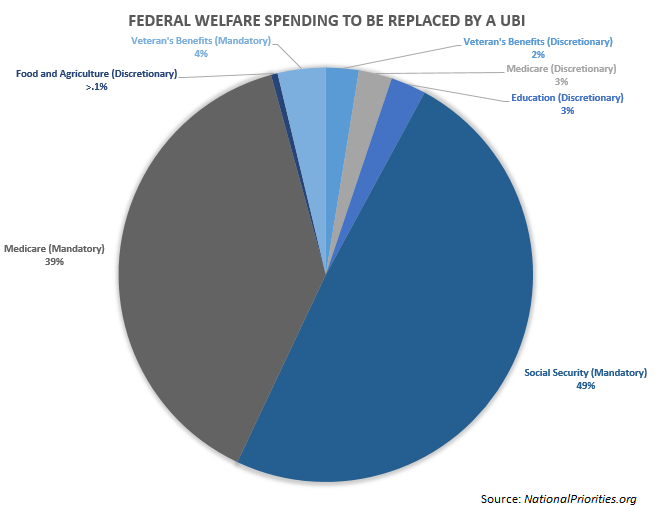
Spending a UBI Could Replace

That’s a total of $2.542 trillion in savings annually, more than enough to fund the proposed BIG with another $300.3 billion to spare that could be used for tax credits for low-income households to use on healthcare,[15] education,[16] retirement,[17] and/or basic necessities like food.[18] Funding the program would be a huge challenge, but it is possible to do it without tax increases.

Additionally, Goldstein ignores the fact that similar proposals, such as Friedman’s negative income tax, would have a much lower cost while having a similar effect. The Niskanen Center’s Samuel Hammond has estimated that a NIT could cost only $182 billion annually.[19] From Hammond’s analysis:

Just how much of a cost difference is there between a UBI and NIT? To get a rough idea, I used the Census population survey’s Annual Social and Economic Supplement, which has the distribution of individuals over the age of 15 by income level in $2,500 intervals (I subtracted retirees). I then calculated the transfer each quantile would receive based on a hypothetical NIT which starts at $5,000 for individuals with zero income and is phased out at a rate of 30%. Multiplying the average transfer by the number of actual individuals in each grouping and summing, I arrived at total cost of $182 billion—roughly the combined budget for SSI, SNAP and EITC.

The Effect of Replacing Welfare with a BIG on Poverty

Goldstein would object to my line of reasoning by saying cutting all that spending would harm the poor and increase the poverty rate. He says as much in his piece:

UBI’s daunting financing challenges raise fundamental questions about its political feasibility, both now and in coming decades.  Proponents often speak of an emerging left-right coalition to support it.  But consider what UBI’s supporters on the right advocate.  They generally propose UBI as a replacement for the current “welfare state.”  That is, they would finance UBI by eliminating all or most programs for people with low or modest incomes.

….Yet that’s the platform on which the (limited) support for UBI on the right largely rests.  It entails abolishing programs from SNAP (food stamps), which largely eliminated the severe child malnutrition found in parts of the Southern “black belt” and Appalachia in the late 1960s, the Earned Income Tax Credit (EITC), Section 8 rental vouchers, Medicaid, Head Start, child care assistance, and many others.  These programs lift tens of millions of people, including millions of children, out of poverty each year and make tens of millions more less poor.

Some UBI proponents may argue that by ending current programs, we’d reap large administrative savings that we could convert into UBI payments.  But that’s mistaken.  For the major means-tested programs — SNAP, Medicaid, the EITC, housing vouchers, Supplemental Security Income (SSI), and school meals — administrative costs consume only 1 to 9 percent of program resources, as a CBPP analysis explains.  Their funding goes overwhelmingly to boost the incomes and purchasing power of low-income families.[20]

Moreover, as the Roosevelt Institute’s Mike Konczal has noted, eliminating Medicaid, SNAP, the EITC, housing vouchers, and the like would still leave you far short of what’s needed to finance a meaningful UBI.  Would we also end Pell Grants that help low-income students afford college?  Would we terminate support for children in foster care, for mental health, and for job training services?

This is by far and away the weakest part of Goldstein’s argument.

First of all, as my analysis above showed, Konczal’s and Goldstein’s idea that eliminating the current welfare state “would still leave you far short of what’s needed to finance a meaningful UBI” is just false. Even a relatively robust UBI of $7,000 a year is doable by significantly cutting current welfare programs.

But more importantly, Goldstein’s assertion that replacing the welfare state with a UBI would increase poverty is fully unwarranted. He seems to take a ridiculously unsophisticated idea that “more means-tested programs immediately reduce welfare.” His assertion that the programs in question “lift tens of millions of people, including millions of children, out of poverty each year and make tens of millions more less poor” is, at best, completely erroneous. For three reasons: first, individuals know better what they need to lift themselves out of the than the government, and these programs assume the opposite. Second, the structure of status quo means-tested programs often creates a “poverty trap” which incentivizes households to remain below the poverty line. Finally, thanks to these first two theoretical reasons, the empirical evidence on the success of the status-quo programs in terms of reducing the poverty rate is, at best, mixed.

The way our current welfare state is structured is it allocates how much money can go to what basic necessities for welfare recipients. So if a household gets $10,000 in welfare a year, the government mandates that, say, $3,000 goes to food, $3,000 goes to healthcare, $3,000 goes to education, and $1,000 goes to retirement.[21] This essentially assumes that all individuals and households have the same needs; but this is simply not the case, elderly people may need more money for healthcare and less for education, younger people may need the exact opposite, and poorer families with children may need more for food and education than other needs. It’s almost as if our current welfare system assumes interpersonal utility function comparisons are possible, or utility functions of poorer people are fairly homogenous but they’re not. It also ignores the opportunity cost of the funding for helping individuals and households out of funding; a dollar spent on healthcare may be more effectively spent on food for a particular individual or household.

In sum, there’s a knowledge problem involved in our current welfare policy to combat poverty: the government cannot know the needs of impoverished individuals, and such knowledge is largely dispersed, tacit, and possessed by the individuals themselves. The chief merit of a UBI is, rather than telling poor people what they can spend their welfare on, it just gives them the money and lets them spend it as they need.

Second, universal programs are superior to means tested programs precisely because the amount of transfer payments received does not decrease as income increases. Our current welfare programs too often make the marginal cost of earning an additional dollar, above a certain threshold, higher than the benefits because transfer payments are cut-off at that threshold. This actually perversely incentivizes households to remain in poverty.[22] For example, the Illinois Policy Institute while analyzing welfare in Illinois found the following:

A single mom has the most resources available to her family when she works full time at a wage of $8.25 to $12 an hour. Disturbingly, taking a pay increase to $18 an hour can leave her with about one-third fewer total resources (net income and government benefits). In order to make work “pay” again, she would need an hourly wage of $38 to mitigate the impact of lost benefits and higher taxes.
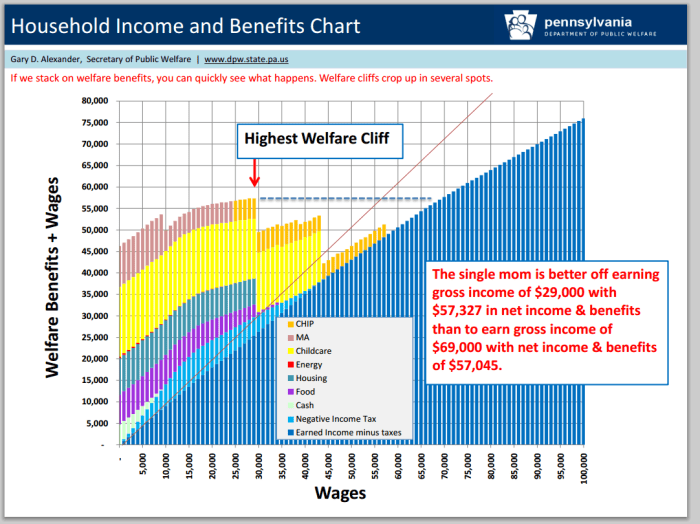
SingleMomWelfareCliffChart

Or consider this chart (shown above) from the Pennsylvania Department of Public Welfare showing the same effect in Pennsylvania

UBI does not suffer from this effect. If your income goes up, you do not lose benefits and so there are no perverse incentives at work here. Ed Dolan has analyzed how the current welfare state with its means-tested benefits is worse in terms of incentivizing work and alleviating poverty extensively. Here’s a slice of his analysis:
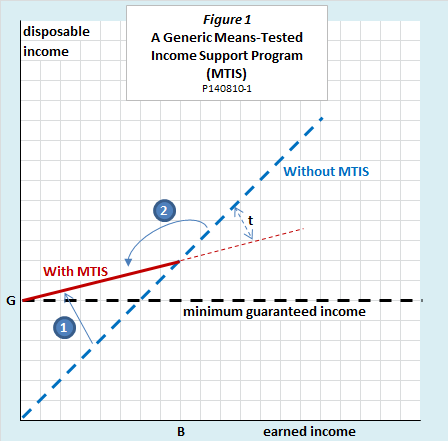
P140810-11

The horizontal axis in Figure 1 represents earned income while the vertical axis shows disposable income, that is, earned income plus benefits. To keep things simple, we will assume no income or payroll taxes on earned income—an assumption that I will briefly return to near the end of the post. The dashed 45o line shows that earned and disposable income are the same when there are no taxes or income support. The solid red line shows the relationship between disposable and earned income with the MTIS policy.

This generic MTIS policy has three features:

A minimum guaranteed income, G, that households receive if they have no earned income at all.

A benefit reduction rate (or effective marginal tax rate), t, indicted by the angle between the 45o line and the red MTIS schedule. The fact that t is greater than zero is what we mean when we say that the program is means tested. As the figure is drawn, t = .75, that is, benefits are reduced by 75 cents for each dollar earned.

A break-even income level, beyond which benefits stop. Past that point, earned income equals disposable income.

When these two factors are taken into account (that individuals know better than the government what they need to get out of poverty and there are significant poverty traps in our welfare state), it is no surprised that the empirical evidence on the effectiveness of these anti-poverty programs is far less rosy than Goldstein seem to think.

After reviewing the empirical literature on the relationship between income and welfare improvements for impoverished households, Columbia University’s Jane Waldfogel concluded “we cannot be certain whether and how much child outcomes could be improved by transferring income to low income families.” The Cato Institute’s Michael Tanner wrote in 2006:

Yet, last year, the federal government spent more than $477 billion on some 50 different programs to fight poverty. That amounts to $12,892 for every poor man, woman, and child in this country. And it does not even begin to count welfare spending by state and local governments. For all the talk about Republican budget cuts, spending on these social programs has increased an inflation-adjusted 22 percent since President Bush took office.

Despite this government largesse, 37 million Americans continue to live in poverty. In fact, despite nearly $9 trillion in total welfare spending since Lyndon Johnson declared War on Poverty in 1964, the poverty rate is perilously close to where it was when we began, more than 40 years ago.

Tanner’s point remains true today. The chart below shows that, despite a massive increase in anti-poverty spending since the war on poverty was declared under Johnson’s “Great Society,” Poverty rates have remained woefully stagnant. In fact, the reduction in poverty that was occurring prior to Johnson’s interventions stopped soon thereafter.
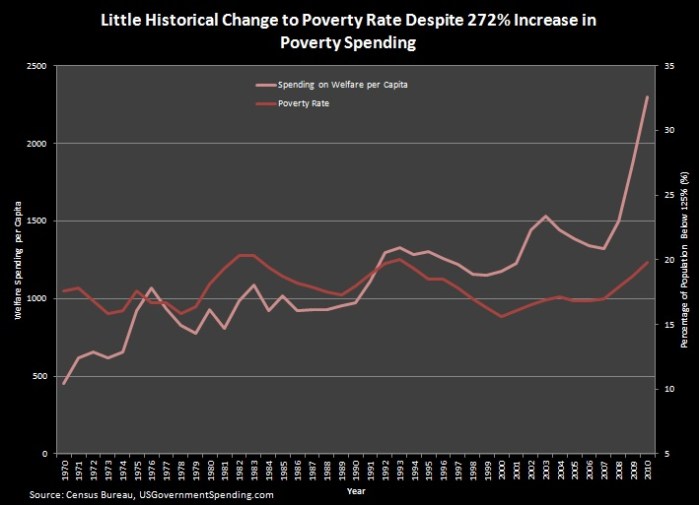
US Poverty Spending

Also, the point is that UBI is a replacement for current welfare benefits. Most households probably would not see a decrease in amount of benefits under a UBI, depending on the specifics of the proposal, and some might even see an increase, contrary to Goldstein’s analysis. Further, they’d be able to actually spend this on what they know they need rather than what government bureaucrats thin they need.

UBI lacks the flaws of the current welfare state, and would likely decrease poverty far more effectively than Goldstein thinks, especially when compared to his favored status-quo.

[1] Though there are some technical differences between Milton Friedman’s proposal for a “negative income tax” and most Basic Income Guarantee proposals, they essentially have the same effect on income. See the Adam Smith Institute’s Sam Bowmen on this point.

[2] See Matt Zwolinski for the “Pragmatic Libertarian Case for a Basic Income,” it should be noted that “pragmatic reasons” here does not refer to my pragmatist philosophical views. Zwolinski has also made a moral case for the basic income on Hayekian grounds that a BIG could reduce coercion in labor negations. I am unsure to what extent I am convinced by this line of reasoning, but it is a valid argument nonetheless.

[3] The Niskanen Center’s Samuel Hammond has made the case that universal transfer programs like a Basic Income cannot be analyzed outside of the tax system that pays for it.”

[4] Or, as my think tank buddies jokingly call it, the “Center for Bigger Budgets.”

[5] Having said that, polls have shown that it is popular across the pond in the Eurozone. The Swiss proposal would call into question this point but it could be argued that the vagueness of the Swiss proposal is why it was turned down not necessarily the spirit of it.

[6] My colleague Ty Hicks of Students for Liberty has made this point well. See also Hayek’s “Intellectuals and Socialism.”

[7] Granted, the Affordable Care Act was not really what most on the left or the right wanted in the first place and has been a disaster.

[8] This number is selected because, according to the CBO, $9,000 is the average amount in means-tested welfare benefits per household for 2006. But that’s for households and a BIG discussed here is for individuals, so it is understandable to make a BIG slightly less than the current average. Goldstein would object that this is far below the poverty line, but BIG is not meant to be a replacement for total income on the labor market at all, so it is unclear why this is an objection in the first place.

[9] This is admittedly a crude and naïve calculation but it is virtually identical to the method Goldstein himself uses to estimate the cost.

[10] All figures for this section are for the 2015 budget and are taken from here.

[11] Goldstein is sure not to be happy with cutting education, and I myself would like to replace this spending with few-strings-attached funding for local education or private school tax vouchers. I’ll address this point more later in this piece.

[12] Much of this is food stamps, which would be rendered obsolete by a BIG anyways. Goldstein would object, more on that in the next section.

[13] Not all of this could be cut, and there would be legal and detailed nuances on how to treat financial obligations for Social Security, veteran’s benefits, and Medicare. The specific legal complexities of mandatory welfare spending are not my areas of expertise, admittedly, and is outside the scope of this paper. I’m just illustrating that it is possible to cut at least some of this spending, perhaps even the majority of it, to fund it.

[14] Many people would object to cutting veterans benefits. First of all, BIG could act in place of these benefits

[15] I have in mind expanding tax-exempt Health Savings Accounts here. I also think funding this by eliminating the employer-based deduction would be a step in the right direction and reduce cost fragmentation in the healthcare market, as Milton Freidman argued.

[16] I have in mind a private school taxpayer voucher system like what is in Sweden.

[17] I have in mind something similar to this proposal to reform social security from the Cato Institute.

[18] I have in mind something like the pre-bates proposed in the Fair Tax.

[19] For this reason, I prefer an NIT to a BIG, but I prefer both to our current welfare state.

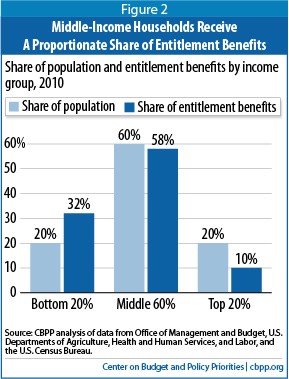
[20] This point is Ironic considering the fact that CBPP’s own research shows that government benefits in America overwhelmingly goes to households above the poverty line, in the middle and upper classes. See this chart (source):
1-SOlzSwsxa08Cno7PiQ9R7A

[21] The real-world numbers are probably different and vary a little bit from household to household, but this is just a hypothetical to illustrate a more general point.

[22] It should be noted, however, that the EITC, and some other programs, is largely free of this defect. This is because the EITC itself is modeled after Friedman’s NIT.

Note: The first chart has been edited since this was initially posted for readability.
Book Review: Hans-Hermann Hoppe – Economic Science and the Austrian Method

I decided to read Hans-Hermann Hoppe’s Economic Science And The Austrian Method (1995) in order to grasp a deeper philosophical understanding of the Austrian School’s methodology of economic inquiry. I was especially interested in Immanuel Kant’s influence on Ludwig von Mises and how Mises had used Kant’s epistemological insights to construct praxeology, the study of human action (economics included) that is purely deductive in nature.

Those who are acquainted with scientific methodologies in the field of economics may have heard of the controversies surrounding praxeology. Living in an empirical age, many people may be inclined to question the validity of a science that claims to arrive at economic laws from pure deduction whose validity can be established independently from observations. Praxeological propositions are indeed much more “like those of logic and mathematics, a priori” (Mises, 1966, p. 32). Such a science may strike the skeptics as being disquietly dogmatic.

In this book review, I will firstly give a brief discussion why it is important at all to discuss the epistemological foundations of economic science. Thereafter, I will discuss Hoppe’s thesis. I will describe the philosophical aspects of praxeology that can be traced back to Kantian epistemology. I will moreover summarize Hoppe’s critique of empiricism and historicism, and why Mises believed that economics is essentially praxeology. Lastly, I will give my personal thoughts on the book.

Why should we discuss the epistemological foundations of economic science?
The most immediate answer to this question is that different epistemological foundations lead to different methodologies and different theories, which can lead to different interpretations of real-life phenomena. Take for example the interpretation of an historical economic event, the Great Depression. Murray Rothbard, because he is working within the context of praxeology makes use of the praxeological Austrian Business Cycle Theory. This theory focuses on the expansion of the money supply as an explanation of the onset of the ‘boom’ in the 1920’s which eventually resulted in the ‘bust’ in 1929. Milton Friedman and Anna Schwartz in A Monetary History Of The United States (1963), while not applying the ABCT, have focused only on the contraction of the money supply and the resulting higher interest rates in 1928 as the main cause of the Great Depression. Their application of different economic methods has led them to look for different possible historical causes of the Great Depression which has effectively resulted in different accounts of the same historical event. It therefore matters what economic methods are employed in economic research.

Now that we have established the importance of inquiring epistemological foundations and methodologies of economic science, I will turn to Hoppe’s thesis.

Kant and synthetic a priori propositions
Working within the rationalist tradition of Leibniz and Kant, Mises attempts to present the proper way through which economic science – a science that according to Mises falls within the broader science of human action, praxeology – should be conducted. He resorts to the Kantian conception of the nature of knowledge and explains praxeology in terms of Kantian terminology. Hence, Hoppe firstly directs the reader to Kantian epistemology.

Kant had developed the idea that all propositions are either analytic or synthetic and either a priori or a posteriori. The difference between analytic and synthetic propositions is that the former is true by virtue of their meaning or as Kant would have phrased it himself, “the predicate B belongs to the subject A as something that is (covertly) contained in this concept A” (Kant, 1781, A:6-7). Take for instance the following proposition: “Bachelors are unmarried.” This proposition is analytic, because the predicate, ‘unmarried’, is part of the concept of a bachelor. Analytic propositions are regarded as tautological propositions; they simply restate the definition or a concept incorporated within a word and therefore they do not tell us anything meaningful about the world. A synthetic proposition on the other hand is a proposition whose predicate concept is not contained in the subject’s concept. It could therefore express something meaningful about the world. An example of a synthetic proposition is: “All bachelors are unhappy.” The concept ‘unhappy’ is not contained within the definition of ‘bachelor’, and expresses something meaningful about ‘bachelors’.

The distinction between a priori and a posteriori is as follows: a priori propositions are propositions whose justification does not rely upon experience, but solely on logical reasoning. The justifications of a posteriori propositions on the other hand, do rely upon experience. Examples of a posteriori propositions are “Some bachelors I have met are unhappy” or “Siddharta Gautama left the palace.”

The big question is: do synthetic a priori propositions exist? Kant certainly believed that they do exist, “and it is because Mises subscribes to this claim that he can be called a Kantian” (Hoppe, 1995, p. 18). In Critique of Pure Reason (1781), Kant contended that synthetic a priori propositions do exist and as an example he took mathematics (Kant, 1781, p. 55). The statement “7 + 5 = 12” is not dependent on experimentation and the concept 12 is not contained in either the definitions of 7 or 5. According to Kant, a priori propositions are derived from self-evident axioms. We can find such axioms by reflecting upon ourselves and understanding ourselves as knowing subjects. However, how can truth claims derived from reflection in our mind have any basis in reality? Is Kant here running into the problem of idealism – a notion that it is the mind that constructs reality and superimposes itself upon reality in such a way that it fits within the mind’s necessary laws?

According to Hoppe, Kant had not given a satisfactory response to this issue and future thinkers would have to take on the challenge of solving this problem. Hoppe believes that Mises had done so successfully when he had averred that action provides the link between mind – body and between mind – external world: “[W]e must recognize that such necessary truths are not simply categories of our mind, but that our mind is one of acting persons. Our mental categories have to be understood as ultimately grounded in categories of action” (Hoppe, 1995, p. 20). It is through action that the mind and reality are related: “[A]cting is a cognitively guided adjustment of a physical body in physical reality” (Hoppe, 1995, p. 70).

Another issue that arises with regards to the possibility of synthetic a priori propositions, and which I have found quite confusing myself is the following: does Hoppe suggest that we can arrive at knowledge without any experience of ourselves or the external world at all? No, according to Hoppe “the truth of a priori synthetic propositions derives ultimately from inner, reflectively produced experience” (Hoppe, 1995, p. 19). This experience is phrased by Stolyarov II as “the mind’s identification of facts about actually existing entities, including the identifier himself” (Stolyarov II, 2007, p. 53). In this sense, the action axiom is experientially-derived, but it is not subjected to the empiricists’ narrow view that all knowledge must be testable, verifiable, or falsifiable.

Empiricism, Historicism, and Praxeology
When Mises systematically constructed the foundations of praxeology, he faced a double-challenge; (A) empiricism which was quickly becoming the main influence in the economics discipline, and (B) historicism which was then a prevailing ideology at German-speaking universities.

(A) Empiricism
Empiricism is the “philosophy which thinks of economics and the social sciences in general as following the same logic of research of that, for instance, of physics” (Hoppe, 1995, p. 28). Hoppe writes that empiricism is governed by the following two related basic propositions:

(1) that empirical knowledge, knowledge about reality, must be subjected to falsifiability and verifiability by observational experience;
(2) and that empiricist research formulates their explanations in terms of causality, i.e. “if A, then B”. (Hoppe, 1995, pp. 28-29)

Hoppe continues to write that the validity of empirical statements

can never be established with certainty… The statement will always be and always remain hypothetical… Should experience confirm a hypothetical causal explanation, this would not prove that the hypothesis was true. Should one observe an instance where B indeed followed A as predicted, it verifies nothing… Later experiences could still possibly falsify it. (Hoppe, 1995, p. 29)

Empirical knowledge is hence contingent on historical facts. Neither confirmation nor falsification by observational experience can prove that a relationship between phenomena does not or does exist. By emphasizing that our knowledge of reality must stem from observational experience, they directly deny a science that avers that a priori knowledge can give us any meaningful explanation of real phenomena. However, as Hoppe and Mises point out, the statement that meaningful synthetic a priori propositions cannot exist is itself a synthetic a priori proposition. Mises has put this empiricist contradiction the following way in The Ultimate Foundation of Economic Science (1962):

The essence of logical positivism [logical empiricism] is to deny the cognitive value of a priori knowledge by pointing out that all a priori propositions are merely analytic. They do not provide new information, but are merely verbal or tautological, asserting what has already been implied in the definitions and premises. Only experience can lead to synthetic propositions. There is an obvious objection against this doctrine, viz., that this proposition that there are no synthetic a priori propositions is in itself a … synthetic a priori proposition, for it can manifestly not be established by experience. (Mises, 1962, p. 5)

Hoppe mentions a second contradiction of empiricism which regards historical events. Empiricists believe that particular events may cause any particular human action. They attempt to find such causal relationships in order to explain historical events. However, in order to do so, empiricists must assume that causality within historical sequences exists through all times. This assumption itself is not based on experiential observations, and must presuppose a priori knowledge that “time-invariantly operating causes with respect to actions exist” (Hoppe, 1995, p. 36). In addition, Hoppe identifies a third contradiction with respect to social phenomena. The empiricists believe that in order to confirm and falsify hypotheses, one must be able to learn from historical and social experience. If one would deny this, then why should one engage in empirical research at all? This however presupposes that “one admittedly cannot know at any given time what one will know at a later time and, accordingly, how one will act on the basis of this knowledge” (Hoppe, 1995, p. 37). Admitting that humans learn from historical and social experience, one cannot deny that empirical causal constants in human action do not exist. “The empiricist-minded social scientists who formulate prediction equations regarding social phenomena are simply doing nonsense” (Hoppe, 1995, p. 38). Predicting human action is not a science according to Hoppe.[1]

The empiricists are mistaken in applying the methodology of the natural sciences into the fields of social science in order to predict human actions. Unlike natural elements, human beings can and do act differently under equal conditions. Thus, social history cannot yield any knowledge that can be employed for predictive purposes. Relating this to the quantity theory of money; if the money supply for instance increases, one can still not predict whether the demand of money will change as this is entirely dependent on human action. Nonetheless, one could assert that if the demand for money stays constant and the money supply increases, then the purchasing power of money will fall (Hoppe, 1995, pp. 44-45).

(B) Historicism
Historicism, the second challenge that Mises had to face, does not take nature as its model but literary texts. Historicists believe that there are no objective laws in economics, and that “historical and economic events are whatever someone expresses or interprets them to be” (Hoppe, 1995, p. 54). Historicism is therefore extremely relativist. However, according to Hoppe also historicism is fundamentally self-contradictory. If there are only interpretations and hence no constant time-invariant relations, then there is also no historicist constant truth about history and economics. If historicism does not give us any reason to believe in its doctrine, why should we adhere to its epistemological philosophy if its proposition implies that they themselves may not be true?

Next to his refutations of empiricism and historicism, Mises had hoped that he could demonstrate the existence of true synthetic a priori propositions. Such propositions would (1) not be derived from experience, and (2) they must yield self-evident axioms so that when one tries to deny it one is involved in self-contradiction. Mises believes that these two requirements are met by the axiom of action – the proposition that human beings act and display intentional behaviour (Hoppe, 1995, pp. 60-61). According to Mises, purposeful human behaviour exhibits a person’s pursuit of an end which he attempts to reach through the employment of particular means (at least time and body). The fact that a person pursues a particular goal with his action reveals that he places a relatively higher value (preference) on the goal than any other goals of action that he could have thought of at the beginning of his action. Human action also happens sequentially, implying that the actor can only pursue one goal at a time in which he has to forego other valuable goals temporally. Action therefore also implies choices and costs. An action furthermore implies loss (and profit), because every action accompanies a certain degree of uncertainty, whether the goal achieved has resulted in the value one has expected can only be known in retrospect. All these categories of action – values, ends, means, choices, preferences, costs, profit, loss, and time – are at the heart of economics (Hoppe, 1995, pp. 61-63). This insight establishes economics as a science of human action. Or as Hoppe asserts more precisely,

all true economic theorems consist of (a) an understanding of the meaning of action, (b) a situation or situational change – assumed to be given or identified as being given – and described in terms of action-categories, and (c) a logical deduction of the consequences – again in terms of such categories – which are to result for an actor from this situation or situational change (Hoppe, 1995, pp. 63-64).

The existence of the categories of action is derived a priori from the axiom of action, and not through observation. Any attempt to disprove it is futile, since “a situation in which the categories of action would cease to have a real existence could itself never be observed or spoken of, since to make an observation and to speak are themselves actions” (Hoppe, 1995, p. 63).

My thoughts on Hoppe’s book
The book serves as an excellent summary of praxeological philosophy and is a must-read for anyone who wants to start learning more about the subject. Reading the book, one feels that it is extremely concise (around 80 pages), but also dense. Hoppe directly discusses the essential philosophical aspects that one must know in order to understand praxeology as developed by Mises, and fortunately he leaves many footnotes for further reading.

I believe that Hoppe has skillfully shown that economics is part of praxeology, and that it indisputably deals with such categories of human action as values, ends, means, choices, preferences, profit, loss, time, and causality. He has furthermore provided a well-reasoned critique of the empiricist and historicist-hermeneutical interpretations of economics by showing that they are necessarily self-contradictory.

Understanding that economics should not be conducted within the methodological framework of the natural sciences has severe implications to the ways we should deal with data of real world phenomena. If, like praxeologists claim, we cannot predict human action then there is also little reason to believe that effective social engineering is possible. The fundamentals of the praxeological methodology are therefore also immediately relevant within discussions on the roles of the state in planning the economy.

Footnotes
[1] Hoppe calls it entrepreneurship.

Bibliography
Friedman, M. & Schwartz, A.J. (1963). A Monetary History of the United States 1867-1960. Princeton: Princeton University Press.
Hoppe, H.H. (1995). Economic Science and the Austrian Method. Auburn: Ludwig von Mises Institute.
Kant, I. (1781). Critique of Pure Reason. (W.S. Pluhar, Trans.) Indianapolis: Hackett Publishing Company, Inc.
Mises von, L. (1942). Social Science and Natural Science. In R.M. Ebeling (Ed.) Money, Methods, and the Market Process (pp. 3-15). Retrieved from http://mises.org
Mises von, L. (1966). The Ultimate Foundation of Economic Science. Retrieved fromhttp://mises.org
Stolyarov II, G. (2007). The Compatibility of Hoppe’s and Rothbard’s Views of the Action Axiom. The Quarterly Journal of Austrian Economics, 10, 2, pp. 45-62.

Tabarrok on “Bernanke vs. Friedman”

Alex Tabarrok has a very flattering post at Marginal Revolution about my 2011 article,  “Ben Bernanke versus Milton Friedman: The Federal Reserve’s Emergence as the U.S. Economy’s Central Planner.” It seems that the President of the Richmond Fed has independently just made a similar argument.

Around the Web

This is the 69th installment of ‘Around the Web’. Giggity!

  1. guaranteed income vs. open borders; Economist Kevin Grier weighs the options
  2. How poverty taxes the brain; A sexy-sounding female gives us the low-down
  3. The origins of Northwest European ‘guilt culture’; Evolutionary anthropologists are so, soooo cute
  4. The ‘thoughtful libertarian’ subreddit; Finally!
  5. Is Christmas efficient? Only an economist (Tyler Cowen) could ask such a thing
  6. God, Hayek and the Conceit of Reason; Concise essay by Jonathan Neumann in Standpoint
  7. Milton Friedman’s 1997 musings on a common currency in the European Union: The Euro: From monetary policy to political disunity

FDR, Uncle Fred, and the NRPB

In Ayn Rand’s epic novel Atlas Shrugged, government officials regulate the economy through something called the Bureau of Economic Planning and Natural Resources. She clearly chose that name to reflect their belief that productive people were bound to produce just because of their “conditioning” and could therefore be treated pretty much like coal in the ground—as resources ripe for exploitation.

One wonders whether she had ever heard of the National Resources Planning Board (NRPB). The NRPB was a real agency, part of the kaleidoscope of bureaus that formed the New Deal. Its history is in some ways as dry as dust, but a closer look reveals some interesting and timeless insights into the planning mentality and the role of personalities in shaping history.

The philosophy underlying Roosevelt’s New Deal, if one can call it that, was to try something and if it didn’t work, try something else. In that same spirit the NRPB mission changed frequently; even its name changed four times before it was killed in 1943. It had been authorized as part of the National Industrial Recovery Act, but that program was ruled unconstitutional in 1935, leaving the National Planning Board, as it was called then, in danger of extinction. It was quickly rescued by FDR, however, and established as an independent agency. Casting about for a new name, one planner suggested “natural resources,” whereupon another commented that human beings were America’s most important resource. “National Resources” was suggested. The President chewed the phrase over a few times, then, pleased with its sound, grinned and announced, “That’s it. Get that down, boys, because that’s settled.” Continue reading

Unemployment: What Is It?

Unemployment has regained center stage now that the debt crisis has receded from that position, at least for a time. Unless things change dramatically over the next year unemployment will be the number one issue in the forthcoming presidential election. Hardly any proposal will escape being labeled “job-killing” or “job-creating” or both.

To begin with some basics, what is work and what is a job? For economists, work is any activity that we would not perform without tangible compensation, usually money. In our work lives almost all of us are also motivated by nonmonetary considerations, and to the extent we diverge from the most remunerative activity available to us, we are blending work and leisure. A retired person who takes up college lecturing may do the work primarily for the satisfaction it brings. If his salary were withdrawn and he continued to teach, he would be enjoying leisure.

The goal of all economic activity is consumption, which to economists means not just mundane goods like faster cars but also “noble” ends like cathedrals. Jobs are therefore not ends in themselves, as much as public discussion would suggest otherwise. They are means to acquire income to be used for consumption and saving, in addition to personal satisfaction, learning opportunities, or socializing.

A person who lacks a job is unemployed if he or she wants work, has suitable skills, and has realistic expectations about compensation. These are vague terms; they make unemployment a murky concept. That goes double for underemployment, though both remain very real phenomena. Continue reading

The Curious Case of the Bourgeois Bubble Boy

Since Ron Paul’s fantastic, spontaneous, incredible 2008 presidential campaign libertarianism has become a hot topic among the brightest people throughout the world. This is not a coincidence or an act of God, I think. The recent peak in interest of libertarian alternatives has to do with the sometimes sorry state that our world always seems to be in.  As somebody who came from the hard, anarchist, collectivist Left, I can assess that the libertarian alternative has been given a fair shake by a broad swathe of the American public.  However, on the hard Left, there has been bitter hostility towards anything remotely libertarian in American political discourse.  Most of this is envy, I think; a primitive form of envy that always forms when competition arises to challenge the orthodox opinions and mores of a society.

More on this is just a minute, but first: although there are indeed many problems facing the world today, we are living in a time of great abundance and peace. Furthermore, the periodic mass starvations in East Africa and the short, intense outbursts of small wars are both relatively simple to fix and uncommon (which is why they make the news). These are facts that we would do well to remember. Back to the hard, bitter Left.
Continue reading

August 15, 1971

People who were alive in 1941 can tell you right where they were on Pearl Harbor day.  I can tell you exactly where I was when I heard that President Kennedy had been shot.  We all remember 9/11.   Another day that I sticks in my memory just as clearly is one that is now remembered by few: Sunday, August 15, 1971.

There was no internet in those days and no cable news channels, so I was mercifully spared the news until the following morning at 8:15 when I opened my motel room door in Huntington Beach and saw the L.A. Times on the doorstep with a headline that said something like “Nixon Imposes Price Controls.”

I was shocked and disgusted for two reasons: though I was employed as an aerospace engineer, I was beginning to learn about free markets, having attended a FEE seminar the year before at which Mises and Hazlitt  – now saints of Austrian economics – lectured.  And I had voted for Nixon in 1968, naively believing the Republicans were the party of free markets.  The following year I signed up with the new Libertarian Party and never looked back on the Republicans until 2008 when Ron Paul ran.

Here is a video recording of Nixon announcing a 90-day “freeze” on prices and wages. Note the Orwellian references to the evils of price controls even as he imposes them.Image

So what was the big emergency that prompted such a drastic response?  Unemployment was running about 6%; price inflation at about 5%.  Nixon’s problem was that an election was coming up in the following year.  He remembered bitterly his narrow loss to Kennedy in the 1960 election which he attributed to a mild recession of that year. Now he was determined to goose the economy and get himself re-elected. Like FDR, Nixon loved dramatic strokes and never mind the consequences. Earlier that year the man who had made his reputation as an implacable anti-communist had made a sudden and dramatic overture to communist China.  So on that sleepy Sunday Nixon delivered another bold stroke, in an end run around the Democratic opposition.  Perhaps it worked: he won 49 states in the 1972 election with considerable help from his bumbling opponent, George McGovern.

His action was quite popular.  The stock market surged that Monday morning and polls showed a 75% approval rate.  But Milton Friedman was right when he predicted “utter failure and the emergence into the open of suppressed inflation.”  Another freeze was imposed in 1973 but this time the damage to the economy became evident.  As explained in the excellent video series “The Commanding Heights,” “ranchers stopped shipping their cattle to the market, farmers drowned their chickens, and consumers emptied the shelves of supermarkets.”  Inflation reached a peak of about 14% before the decade was out and before the powers that be accepted the fact that excessive money creation is the main cause of price inflation. George Schulz, Nixon’s economic advisor and a vigorous opponent of price controls consoled himself with the thought that Nixon had demonstrated dramatically how not to fight inflation.

Nixon wasn’t finished.  During that same Sunday broadcast he slapped a 10% tariff on imported goods, accompanied by some blather about fairness.  More significantly, he ended the Bretton Woods international monetary system.  That arrangement, conceived in 1944, had the U.S. dollar convertible into gold at $35 per ounce, but only for foreign central banks.  Not only could private banks and private citizens not convert their dollars, it was even illegal to own gold (with exceptions for dentists, jewelers, etc.).  I made a point of violating that particular law on principle before the prohibition was lifted in 1974.

In all fairness, the Bretton Woods system was doomed long before that August.  The gold exchange standard had persisted only because of a gentlemen’s agreement that European central bankers would refrain from exercising their redemption rights to any significant degree.  So many new dollars had been created to finance Lyndon Johnson’s war in Vietnam and his “Great Society” at home, and so many of those dollars were parked overseas as a result of trade imbalances, that the U.S. government could not come close to honoring its Bretton Woods obligation in full.  The French under de Gaulle and his gold-bug advisor Jacques Rueff had become increasingly strident about the situation, but in early August the British ambassador showed up with $3 billion to be redeemed, and that may have been the straw that broke the camels back.

So on that same Sunday Nixon slammed the gold window shut (video here)  pushing us out of the frying pan of Bretton Woods, under which numerous wrenching devaluations had wracked international trade, into the fire of floating exchange rates, the system we have now.  The devaluations are gone but the wild swings in currency values, something that was not foreseen by Milton Friedman who was an early advocate of currency markets, are almost as bad.  Now, wonder of wonders, there is resurgent talk of some sort of gold standard.

Reagan tempted me with with some pretty inspiring rhetoric in his 1980 campaign about getting the government off our backs.  Not enough to vote for him, but I was glad he got elected and with the help of Fed chairman Paul Volcker he did break the back of inflation, but he never got spending under control and he didn’t deserve as much credit as he got for the fall of communism, which had been rotten at its core for decades.  But Bush I was terrible and in hindsight Clinton wasn’t all bad, yet I confess I was relieved when Bush II beat Gore in 2000.  I needn’t remind anyone what a disaster GWB was with his wars, his unfunded medicare expansion and his bailouts (OK, thanks for the tax cut).

I’m voting for Gary Johnson who won’t win, and I really don’t care who wins.  Gridlock is the least bad outcome, even if that means the despicable Obama stays in office facing a Republican congress.