- Globalization and Political Structure [pdf] | what’s a monopolis?
- Protestantism and the Rise of Industrial Capitalism in Nineteenth Century Europe [pdf] | who was James Cooley Fletcher?
- Primed against primacy: the restraint constituency and US foreign policy | polystate, book 2
- Nation-building, nationalism, and wars [pdf] | against libertarian populism
international relations
BC’s weekend reads
- Who’s who in Hamburg’s G20 protests
- “But, if Marxism is not inevitable, it is nothing. Ronald Reagan, with his abiding fear that the Evil Empire would spread without intervention, was, in this sense, a much better Marxist than David Roediger could ever hope to be.“
- It’s business as usual between Turkey and the EU
- “So far there is not much sign of the fresh dawn that IS’s downfall should bring.“
- Hell Makes the News
Dutch politics, after the elections
Now that the Dutch elections for the Lower House are over, as well as the unprecedented international hype surrounding it, it is time for a few pointers and reminders.
Turkey
Prime Minister Mark Rutte used the crisis with Turkey to his greatest advantage. When the crisis just loomed he escalated, helped of course by the increasingly hysterical reactions of the Turkish authorities, particularly the President.
I have not been able to get figures, but it is rather normal for foreign ministers, including from Turkey, to visit the Netherlands and address their nationals, also for political purposes. This is just the consequence of allowing Turkish people to have dual nationality and -in the Turkish case- also double voting rights. With the referendum in Turkey coming up, it is only logical to allow proponents and opponents to campaign as well.
This said, any thinking person would strongly object to the plan to give even more power to the already way too powerful Turkish executive. Dictatorship looms (please read Barry’s much better informed blogs on this).
Politicians almost always choose the short term over the long term. Certainly four days before elections. Still, the downside of Rutte’s actions are immense, as they also serve the interest of Erdogan, enabling him to play the victim of the ‘racist Dutch’. It might even pull the deciding number of voters into his camp. That would be bad for Turkey, and for Europe.
Chances for Turkey joining the European Union were already small, but have now disappeared completely. (Which I personally do not mind much, but others differ, including many in Rutte’s own party).
Populism
Another topic of international concern surrounding the election was the rising populism and its alleged ending by the electorate at the ballot box. Indeed, Geert Wilders’ Party for Freedom did not become the biggest party, yet he did win votes again. An increase of a third actually, from 15 to 20 in the 150-seat Lower House. His party thus became the second largest party in parliament.
He was never going to be Prime Minister anyway, as all parties had said before the elections they would not collaborate with him. This was important as the Dutch electoral system has a low threshold, which means many parties can enter parliament and no party has ever won a majority of 76. It demands parties to negotiate a governing coalition. After Wednesday at least four parties are needed for such a majority, which will take months.
There is a less-noted, other ‘bad populism’, which includes the largest winner, the Green Left party. This party represents are the radical environmental left, led by a young good looking leader who has been able to attract a lot of young people, in particular women, according to electoral research. There are also other populist parties elected, most notably the party for pensioners, the Islamic party DENK, and the Forum for Democracy, the intellectual version of Geert Wilders’ party.
Coalition building
It remains to be seen whether Green Left will get a seat in government, given the large differences with the other parties who will be negotiating the new government: the centre right VVD of Rutte, the social liberals of D66, and the Christian democrats.
This process is slow and boring for most people, except for political junkies like myself. So chances are you will not hear about Dutch politics until a new government has finally been installed. Do not be surprised if this does not happen before Christmas.
Rules of Warfare in Pre-Modern Societies
As my first foray into NOL blogging, I figured I would bring up a recent debate I had liberty, war, and peace that lingered in my mind: how have rules of war been maintained throughout history without a central enforcing agency? This question is fundamental to the understanding of the nation-state in IR theory, and is also an astonishing example of spontaneous order in an anarchic and chaotic scenario.
The quandary exists because even the laudable negative rights of life, liberty, and property ownership, as Eric Mack discusses in his essay on Just War Theory, require a positive enforcement by others. Similarly, “rules of war”–such as refraining from attacking non-regulars, not attacking neutral parties, abiding by the terms of treaties, treating prisoners of war with respect, etc.–are, theoretically, difficult to establish and dependent on positive enforcement. This is because if Party A respects these rules, they provide a perverse incentive to Party B to take advantage of Party A’s restraint, and if doing so gives Party B the upper hand, they can enjoy the benefits of betraying the rules of war with impunity. This is a classic Prisoner’s Dilemma, and if it generalized across many nations, the theory of rational choice would lead us to expect a coordination problem, in which those using the strategy of Party B would dominate the Party A’s.
I am certainly not the first to identify this, and the literature on overcoming coordination problems through iteration of the Prisoner’s Dilemma, regime collaboration, and international organizations and treaties is incredibly thorough (just for a taste, you can see James Morrow’s book, F.V. Kratochwil’s book, and articles by Duncan Snidal, Arthur A. Stein, and even James Buchanan and Victor Vanberg). However, I thought it would be interesting to examine the historical evidence of effective rules of war, particularly from the premodern period. Because global communication technology and networks, international courts, treaties, and organizations, and deterrence based on the terrifying weapons of modern war were lacking in antiquity and on through roughly the 18th century (open to argument on that one), premodern societies seem to be the best test of the effectiveness of rules of war and their mechanisms. I won’t discuss any in detail, and I am skipping many rules of war for which their effectiveness is not discernable (such as the Mahabarata, Deuteronomy, and the Quran), but here is a list of interesting examples for discussion:
- The archaic Greek poleis:
- As Victor Davis Hanson argues in his influential book, the Western Way of War, the incentive to focus on agricultural production and the fact that citizen-warriors were personally responsible for military service made the costs of long-term campaigns, especially given the lack of siege technologies and the difficulty in laying waste to wheat fields and olive trees, higher than the potential benefits. However, there were still disputes to be resolved, and raiding was still harmful to the agriculture of polis that was raided. In order to limit costs to both invader and defender, the poleis developed the hoplite warfare strategy, in which citizen-soldiers met for decisive conflicts in traditional, if not previously agreed, locations, in which limited territorial gains were afforded to the victor. While this does not describe every aspect of 7th-5th century warfare in Greece, this strategy pervaded the Greek mainland and allowed disputes to be resolved with minimal collateral damage and investment.
- Thucydides’ Athens:
- Though Thucydides’ History of the Peloponnesian War is seen as the invention of realism based on its “the strong did what they could, and the weak suffered what they must” representation of self-interest in foreign policy, his narrative as a whole shows an important constraint in war: if a military power makes war with the expressed intent of empire-building without casus belli, they will entrench their enemies, alienate neutral states, and cause divisiveness on the home front because they have lost the moral high ground. Thucydides notes that the majority of Greeks opposed Athens on the grounds of their selfish empire-building, and because of their inability to convince Sparta of their just motives, brutality to neutral states, internal dissension during the Sicilian expedition, and many other misfortunes of war (plague, death of Pericles, Persian intervention), Athenian power was broken. The lesson: Party B (from above) must consider the international reaction to abusing Party A, and at least make a public showing that the war is just. Also, if Hitler had only read his Thucydides, he might have known that marching through Belgium may be tactically sound, but he was risking the same reaction that the Athenians risked in the Melian massacre.
- POW’s and ransoming in antiquity
- Several rules of warfare were maintained through the mutual benefits to combatants, the most notable being the conventions concerning ransoming. From at least 5th century Greece (in the Sphacteria incident) to Caesar, citizens could be ransomed following a battle—and there were even conventional levels of payment for these POW’s. This was a benefit specifically afforded to “civilized” foes, and Roman practice increasingly became enslavement rather than ransom, but this convention was widespread for centuries, possibly showing that ransoming enemies is an Iterated Prisoner’s Dilemma.
- Ancus Marcius and Just War Theory:
- Along the same lines as the Thucydides example, the Romans engaged in the ritual of the fetiales, including the enumeration of the just cases for war, before invading an enemy. This limited war to official disagreements with neighboring states, and other religious conventions were maintained that limited certain tactics in war (a noteworthy passage of the Aeneid shows that putting on the armor of your enemies for stealth purposes would be doubly punished by the gods). These conventions included looking down on poison as woman’s weapon and on taking some religious statuary as booty, and though Roman generals still poisoned wells or robbed cities of their gods, they received negative reactions by their contemporaries.
- Hostage policies throughout antiquity:
- Another problem with the rules of war is the enforcement of treaties, which have credible commitment problems. Both Greeks and Romans made imperial gains by breaking treaties, but it was common practice to overcome the credible commitment problems of both alliances and treaties to end wars that hostages, usually the children of influential citizens or nobles, were exchanged. Whether they were exchanged both ways (more common in alliances) or passed only one way (usually from the defeated to the victorious), hostages were used at least 250 times by Rome and countless times by other ancient civilizations to ensure the enforcement of treaties.
- Carthage’s “Truceless War”:
- While we often think of ancient war as anarchic and based on the whims of generals, wars that completely lacked conventions or limitations were rare. In fact, following truces that allowed for collection of the dead, ransoming of both the living and the dead, and supplication for one’s own life go back at least as far as the Iliad, and wars that lacked such conventions were shocking to ancient historians. Such wars occurred when one side broke a general convention, usually the convention of allowing enemies to surrender alive and be ransomed. Because of this betrayal, their opponents would also stop following any rules of war, and such wars became not about achieving strategic goals but annihilating the opponent entirely. Carthage, following their loss in the First Punic War, fought a truceless war with their former mercenaries due to lack of payment that featured escalations in mutilation and crucifixion until the mercenaries were wiped out, at great cost in men and money to Carthage.
- Roman 3rd party arbitration or intervention:
- The Romans, after they gained international prominence but before they ruled the whole Mediterranean, took an interest in wars between their neighbors. While this sometimes included imperialism, in several instances they served as a 3rd party arbitrator of peace, and even as an enforcer of peace in Antiochus IV’s invasion of Egypt.
- Blood feuds:
- While mentioning blood feuds brings up images of Hatfields, McCoys, and senseless brutality over generations, blood feuds were actually a mechanism for limiting violence through threat of reprisal. While the effectiveness of this mechanism may be debatable, its intention as a limitation of violence is notable in several pre-modern societies, especially the Scots and Slavs.
- Chivalric codes:
- We should be careful of romanticizing this example, but from the 12th to 14th centuries, chivalry established rules of conduct for how knights should treat knights on and off the battlefield. Much of the conception of chivalry comes from poetic fictions about historical figures that were vicious or corrupt in many ways. However, it was actually the battlefield codes, such as ransoming rather than killing noble foes, that were actually practiced the most often, a trend that saw a brutal reversal in the War of the Roses. One might point out that neither the chivalric codes nor the earlier Roman codes of war included avoidance of harming civilians. This shows that, while rules of war were effective in practice at many points in history, they did not always have the same conceptions of what these rules were made to protect.
- The Roman Catholic Church:
- Catholicism influenced the rules of war in two ways: like the fetiales of the Romans, it established the grounds on which war was justifiable (and was influential on the ideals of chivalry), and the pope himself, through the power of excommunication, could limit the warring impulses of kings and lords. While many popes used their power to cause conflict, the church still had both moral influence and bargaining power, and was a powerful international institution for centuries that forced treaties on Christian rulers, provided a court of arbitration, and, several times, that tried to unite these leaders in war against non-Christians. The influence of Catholic peacekeeping measures waxed and waned from Charlemagne onward, but the Peace and Truce of God was one of the earliest attempts to protect non-combatants in wartime
This very incomplete list represents a lot of the more conventional examples of this phenomenon (sorry, but I am very conventionally educated). I would love if those who have other examples, especially from outside of Greece, Rome, and the Western World, would bring them up in the comments so I can expand my knowledge of the history of the rules of war!
The many iterations of rules of war in pre-modern societies shows the effectiveness of spontaneous order in creating systems that promote liberty and peace. These rules did not eliminate violence, cruelty, or imperialism, but they forced self-interested parties to check their selfish impulses. This is not an argument that international organizations with the goal of limiting war are unnecessary (and the Geneva Conventions are a laudable example of voluntary self-enforcement), but rather a demonstration of the wide reach of both Smith’s invisible hand and Hayek’s spontaneous order: even in the most anarchic of trades, long-term individual self-interest can support general interest, and a certain level of order is imposed on the chaos of war through the unplanned conventions of societies.
ἐν μὲν γὰρ τῇ οἱ παῖδες τοὺς πατέρας θάπτουσι, ἐν δὲ τῷ οἱ πατέρες τοὺς παῖδας
In [peace], sons bury their fathers, but in [war], fathers bury their sons.
–Herodotus, The Histories, 1.87.4.
Some thoughts on “Thinking About Libertarian Foreign Policy”
Brandon asked me to leave some thoughts on “Thinking About Libertarian Foreign Policy”, By Matthew Fay, here. Edwin van de Haar already did that in his “Foreign Policy in the Liberal Tradition: The Real Story”, but as I tend to follow a different path from van de Haar, I believe I may have something original to say here. So lets go.
First, unlike Edwin, I’m not going to go in the direction of discussing who is a libertarian, who is a conservative, who is a classical liberal, and so on. For one thing, I think that this kind of discussion is really boring (sorry Edwin, no offense intended, believe me). Other than that, it seems to me that discussing vocabulary is tremendously counterproductive. During the Cold War the US defined itself as a democracy. The USSR defined itself as a democracy as well. Both could meet and discuss who was really democratic, without any real gain. The same can be said about discussions within the socialist bloc: Chinese and Russians could discuss forever who was more Marxist, almost going to war because of that, without any real profit. Personally, I think I lost a lot of time some years ago discussing if Venezuela was democratic or not. And then they ran out of toilet paper. So I care not if communists want to call Venezuela a democratic state or not, the fact is that I don’t think any of them are willing to live without the simple but precious item of capitalist modern life.
With that said, if Matthew Fay wants to call his international relations perspective “libertarian,” so be it. But here are some commentaries from someone who usually calls himself libertarian:
“Libertarians have an uneasy relationship with foreign policy. The state, after all, is the primary actor in international relations.”
I wouldn’t say that. First, I’m a libertarian who studies foreign policy more than anything else. Second, I don’t think that we should say that “The state, after all, is the primary actor in international relations.” That’s simply not a good phrase to use when talking about International Relations. Better to say that the state is very often regarded as the primary actor in International Relations theory, especially by theorists who identify themselves as Realists. Other theorists would say that individuals, or international institutions, or international organizations are as or more important than the states.
“For libertarians, who want the state to do less, not more, this fact can be hard to stomach.”
I identify as a libertarian and I don’t exactly “want the state to do less.” I want the state to do some things and not others. I know that many libertarians (specially people at the Mises Institute, following Murray Rothbard) understand that anarcho-capitalism is the natural and logical conclusion for libertarians. I’m still not convinced. For example, I would like the state to do a lot about prosecuting murders and nothing about what I put in my own body.
“identifying an aggressor is difficult enough in interpersonal relations—let alone in international affairs.”
That’s something that goes at least to Robert Jervis’ 1978 article “Cooperation Under the Security Dilemma,” but I openly disagree. If they are not invading your territory, then they’re not aggressors. They may be potential aggressors, or they may be aggressive, but they’re not aggressors. As an individual, I choose to carry a gun, or even better, to avoid certain neighborhoods. The states should, if possible, avoid certain neighborhoods. If that’s not possible, carry a gun. And definitely keep a gun at home and learn how to use it.
“even when the action of the U.S. government may be superior to that of another government, many libertarians have a difficult time acknowledging that government action is justified. For those reasons, many strict non-interventionist libertarians find themselves openly embracing illiberal governments that they claim are resisting American imperialism and condemning any American criticism of autocrats as a prelude to ‘regime change.’”
First, I don’t think that one can prove that US intervention is superior to anything, ever. It’s basically a broken window fallacy. And I don’t embrace any illiberal government. I just don’t think that it’s the US government’s job to overthrown them. Also, I don’t think any autocratic governments are primarily resisting imperialism.
“Realism is attractive for libertarians because the United States faces no major threats, and therefore does not need to balance either externally or internally.”
Realism in International Relations theory is in general attractive for me because it seems to reflect the reality. Among International Relations theorists, my personal favorites are John Mearsheimer and Stephen Walt. I believe they are very liberal (in the classical sense) at heart but, like me, they are very suspicious of states. By the way, I’m Brazilian and I don’t live in the States, so the second part makes no sense either. There are many libertarians outside the US, by the way, and I think it would be very interesting to check what they think about all this.
“Libertarians, for example, believe that regime change and nation building through the use of military force is unjust and more often than not doomed to failure.”
I don’t think that. The American Revolution and the Puritan Revolution were great examples of regime change and nation building through the use of military force. They worked just fine. I just don’t believe that we can force this on other people.
“But libertarians have also rejected other aspects of America’s post-World War II grand strategy—namely, America’s military alliances and the web of international political and economic institutions they underpin—that have served the causes of peace, free trade, and a more interdependent world. The result of this web of institutions has been a liberal international order that encourages peaceful, commercial relations between states that had previously been rivals. It helps ameliorate security competition and establishes expected patterns of behavior that encourage cooperation instead. This order has not been without its flaws and, as Nexon highlights in another post, serious reforms should be explored. But it has also helped underpin previously unseen levels of peace and prosperity. As Nexon writes, ‘we should not confuse two different questions: ‘which liberal order?’ and ‘whether liberal order?’’”
I’m not sure if “America’s post-World War II grand strategy have served the causes of peace, free trade, and a more interdependent world.” Again, it’s a matter of opportunity cost, or another broken window fallacy. I’m also unsure if “the result of this web of institutions has been a liberal international order that encourages peaceful, commercial relations between states that had previously been rivals.” I have a really strong tendency to say it didn’t. The problem with theorizing in social sciences is that, unlike in natural sciences, you can’t take things to the laboratory and run consecutive tests. That is, by the way, one of the reasons why I reject positivism as a research methodology. I’m not sure if Matthew Fay embraces it, but the fact is that for me we are better with praxeology, or at least some version of methodological individualism. And with that in mind, we can’t be so bold to say that American foreign policy in the post-WWII Era was the main cause of peace and everything else. It just seems to me that without US intervention in WWI there would be no WWII (and no Russian Revolution, at least not a successful one, by the way). The Founding Fathers were right: Europe is a mess. The farthest you get from it, the best.
Foreign Policy in the Liberal Tradition: The Real Story
Over at the Niskanen Center, Matthew Fay wrote a blog entitled “Thinking about Libertarian Foreign Policy.” Brandon was so nice to point this out to me.
Fay’s main point is that, apparently contrary to what some libertarians think (Fay leaves them unnamed, no references either), there is big divide between the foreign policy pronouncements of Donald Trump and libertarian views on foreign policy. So far, so good. I have no dispute with that.
Yet Fay’s blog post is seriously lacking at other points. The main one, and the focus of this post, is that he mixes up different views on international relations within the liberal tradition at large, which is in some way not so surprising because he appears to be ignorant of those differences to begin with (at least in this piece). That is not very comforting for those concerned with this issue, as the Niskanen Center is about to start a larger project on foreign policy. Should it indeed be born in neglect and oversight, it won’t add much to our knowledge, I am afraid.
Conceptual mess
Fay’s essay gets off to a false start as he fails to properly introduce “libertarian.” He then continues to use this label for all kinds of theoretical ideas, originating from both liberal political thought, and international relations theory. To make things worse, Fay routinely claims that there is one unified libertarian position on foreign policy.
This is erroneous, as classical liberalism, libertarianism, and social liberalism all have partly different views on the matter. The various thinkers associated with those different liberalisms have different views on domestic and international politics. Any meaningful analysis on foreign policy from a libertarian or other liberal position should acknowledge that, and use it to the reader’s advantage. It is impossible and perhaps even deceiving to enter into a topical debate when your own position is a conceptual mess. This applies to all debates, academic and otherwise.
Proper conceptual approach
So what should Fay have done instead? Simply acknowledge there is more to liberal thought on international relations, and work from there.
To keep this blog to a readable length, I will just present these differences very briefly. My presentation is based on the writings of the British political theorist Michael Freeden. He argues that every political ideology (and liberalism is one of them) should be seen as a framework (which he calls morphology) composed of a number of political concepts. These concepts vary in importance while their meaning is contested within the ideology. It is possible to distinguish core, adjacent, and peripheral concepts, which together make a unique set of political ideas. While some of the individual concepts overlap, there is significant variation between the frameworks. This enables the distinction between different liberal variants, which are still part of the larger liberal family.
For example, the concept of liberty is key to all liberal variants, but liberty has different meanings. Isaiah Berlin’s famous divide between positive and negative liberty is relevant here. The latter can be defined as ‘the freedom from interference by others’, the first ‘the freedom to fully enjoy one’s rights and liberties’, which often demands some support of the state. Classical liberalism is associated with the negative conception and social liberalism with the positive meaning. Yet the meaning of negative liberty may be further contested. The protection from interference by others may be taken as absolute, which is far more stringent than the classical liberal interpretation, which does allow for compulsory taxation of individuals to pay for public services. Now we are entering the libertarian domain, which is in itself divided into those who hold an absolute idea of negative liberty (the anarcho-capitalists), and those who permit a minimal infringement of property rights to pay for police, external defense, and the judiciary (the minarchists). This is also why conservatism is not as closely related to the liberal family as is sometimes thought. For conservatives, individual liberty is not a core concept at all.
Applied to liberalism and conservatism is comes to this:
Table 1: The Morphology of Liberalism and Conservatism
| Classical Liberalism | Social Liberalism | Libertarianism | Conservatism | |
| Core concepts | Negative freedom, realistic view of human nature, spontaneous order, limited state | Positive freedom, positive view of human nature, social justice as self-development, extended state | Negative freedom, realistic view of human nature, spontaneous order, natural law including strict defense of property rights | Realistic view of human nature, organic change, human order with ‘extra-human’ origins, counter movement |
| Adjacent concepts | Natural law, rule of law/constitutionalism | Modern human rights, rule of law and neutral state, social contract (Mill: utilitarianism) | Minarchism: minimal state, rule of law | Groups/family, hierarchy, active state, sometimes: spontaneous order |
| Peripheral concepts | Social justice, strict defense of property rights, democracy, utilitarianism | Property rights, spontaneous order | Social justice | Individual (property) rights, freedom |
Source: Edwin van de Haar, Degrees of Freedom. Liberal Political Philosophy and Ideology (Transaction Publishers, 2015).
Liberalism and international relations
Interestingly, yet of course completely logical, these differences also translate to views on foreign policy and international relations:
Table 2: Liberalism, Conservatism, and International Relations
| Classical liberalism | Social liberalism | Libertarianism | Conservatism | |
| Nation as limit of individual sympathy | Yes | No | No | Yes |
| State as prime actor in world politics | Yes | No | No | Yes |
| International governmental
institutions/regimes |
No | Yes | No | No |
| Can war be eliminated | No | Yes | Yes | No |
| Does trade foster peace? | No | Yes | Yes | No |
Source: Edwin van de Haar, Degrees of Freedom. Liberal Political Philosophy and Ideology (Transaction Publishers, 2015).
So, in contrast to Fay’s approach, it is not so simple to claim all kinds of concepts and ideas for just one liberal label. There is far more to it. I shall leave it at this for the moment, but for those wanting to read more about this, see my longer essay at libertarianism.org, or my books Degrees of Freedom and Classical Liberalism and International Relations Theory.
Joaquim Nabuco, a Brazilian visionary in Washington
During most of the 19th century Brazil and the United States showed little mutual interest. Brazilian foreign policy was initially directed to Europe (mainly England) and then to border problems in South America (particularly with Argentina and Paraguay). Meanwhile, the US was concerned about its expansion to the west and its internal tensions between north and south. With little convergence in these priorities, the two countries basically ignored each other.
However, this picture began to change at the end of the century, especially because Brazilian coffee found in the USA an excellent consumer market. The definitive change occurred in the first decade of the 20th century, when Barão do Rio Branco, Brazil’s foreign minister for 10 years (1902-1912) decided that the country should privilege relations with the US in its foreign policy. The Baron understood that after Africa and Asia, South America (especially the unprotected Amazon) would be the target of European imperialism. Without an army and a navy that could deal with Europeans, Brazil needed US protection.
Fortuitously, this was also the period in which Theodore Roosevelt gave his corollary to the Monroe Doctrine. Roosevelt had already made clear his intention to keep Europeans away from the American continent, particularly in his intervention to build the Panama Canal. An unwritten alliance was formed between the two countries: the convergence of interests caused Brazil and the United States to experience an unprecedented approach in history. To consolidate the new paradigm of foreign policy the Baron elevated the Brazilian diplomatic representation in Washington to the level of embassy. In the diplomatic gesture of the time this was a clear indication of the preference that the country gave to the USA. The Baron chose Joaquim Nabuco to be Brazil’s first ambassador to Washington.
Nabuco is a well-known personage to the scholars of Brazilian history. When he became ambassador to Washington he was already famous for his struggle against slavery in Brazil and for his work as a historian. Like the Baron, Nabuco believed that Brazil would be the target of European imperialism, and that it needed US help to protect itself. Unlike the Baron, however, Nabuco saw an opportunity at the time to do something more: to turn America into a zone of peace, a continent with international relations essentially different from those of Europe.
The Baron saw international relations only as a zero-sum game. He also did diplomacy thinking in terms of a balance of power. Nabuco was not unaware of these aspects, but he believed that through regular international conferences and open trade, America could avoid the wars that were so characteristic of Europe. But for that the US leadership was essential, and should be supported by all. The Baron sought the US punctually: he wanted the protection of a stronger country while Brazil was not able to protect itself. Nabuco wanted a permanent alliance. In his foreign policy the Baron was a kind of conservative: changes do not occur easily. The story simply repeats itself. The 20th century would simply repeat the 19th. Nabuco believed that change is possible. He believed in universal principles linked to classical liberalism.
Nabuco passed away in 1910, only five years after assuming the position of ambassador. Perhaps if he had been more successful in his foreign policy we would have had a very different twentieth century. The United States would not have become involved in Europe, as it did in World War I. America would be a continent of peace, contrasting with the Old World. America would lead by example, not intervention. And many problems we face today, the fruits of American interventionism, would be avoided.
My favorite posts at NOL this year
Last week I promised y’all a post on my favorite reads at NOL this year. I almost always keep my promises, so below is a long-ish list of essays I really enjoyed reading and learning from this year.
My absolute favorite essay of 2016 at NOL was Barry Stocker’s analysis of the attempted coup in Turkey. Dr Stocker has spent a quarter of a century in the Turkish-speaking world and all of his acquired wisdom of the region is on display in the piece. Barry didn’t post much here this year, but I am hoping that, given the geopolitical situation in his neck of the woods (Dr Stocker teaches political philosophy at Istanbul Tech), he’ll be able to provide much more insight into the challenges the region will face in 2017.
Jacques, who has become sidetracked ever since Donald Trump became the GOP nominee, had an excellent post titled “A Muslim Woman and the Sea” that everyone should read. I don’t agree with it, but the quality of his writing almost demands that you read through the entire piece. In it is the peaceful nostalgia for both youth and French Algeria, the almost careless way he describes his surroundings, and the slow, deliberate manner in how he attacks his enemies. It is all on display for you, his audience, to devour at your leisure. Dr Delacroix is a world-class storyteller.
Mark Koyama’s piece on Jewish communities in premodern Europe garnered a lot of praise, but I found his post on medieval China to be much more fascinating. In the post, Dr Koyama summed up his recent paper (co-authored with UCLA Anderson’s Melanie Meng Xue) on literary inquisitions during the Qing era (1644-1912). What they did was tally up the number of times the state dragged scholars and artists to court in order to accuse them of delegitimizing the Qing government. This had the unfortunate (but predictable) effect of discouraging discussion and debate about society in the public sphere, which stifled dissent and emboldened autocratic impulses.
Chhay Lin had a number of great posts here, some of which were picked up by major outlets like RealClearWorld and 3 Quarks Daily, and Notes On Liberty is lucky to have such a cool cat blogging here. My favorite post of his was the one he did on his childhood in a Cambodian refugee camp along the Khmer-Thai border. What an inspiring story! I hope there are more to come in 2017. (Chhay Lin, by the way, splits his time at NOL with SteemIt, so be sure to check him out there).
Zak Woodman had lots of good posts in his debut year (including NOL‘s most-read article), but the two I enjoyed most were his thoughts on empathy in cultural discourse and his Hayekian take on safe spaces. Both pieces took a libertarian line on the freedom of speech, but Mr Woodman’s careful articles, which are as much about being true to the original meaning of some of the 20th century’s best thinkers as they are about libertarianism, suggests that he has a bright future ahead of him as one of the movement’s deeper thinkers (he’s an undergraduate at UM-Ann Arbor). I look forward to his thoughts in 2017.
Bruno Gonçalves Rosi burst on to NOL‘s scene this year with a number of posts (in both English and Brazilian Portuguese). His blistering critiques of socialism were fundamental and – to me, at least – reminiscent of the debates between libertarians and statists here in the United States in the 1970s and 1980s. My favorite of Dr Rosi’s 2016 posts, however, was his reflection of the 2016 Rio Paralympics that took place in the late summer (at least it was late summer here in Texas). Bruno brilliantly applied the Games to the famous argument about inequality between 20th century American philosophers Robert Nozick and John Rawls. I hope the piece was but a glimpse of what’s to come from Dr Rosi, who also has a keen interest in history and international relations.
Lode Cossaer is probably busy with his very intriguing dissertation (“the institutional implications of the tension between universal individual rights and group self governance”), but he did manage to find some time to dip his feet into the blogging pool with a few insightful posts. My favorite was his explanation of Donald Trump’s Carrier move, which was blasted from all sides of the political spectrum (including libertarians) for being a prime example of “crony capitalism.” Cossaer, in his own delightfully contrarian manner, pointed out that there is a trade-off between the rule of law and lower taxes. This trade-off might not be pretty, but it exists regardless of how you feel about it. Lode, in my opinion, is one of very few thinkers out there who can walk the tight-rope between Rothbardian libertarianism and plain ole’ classical liberalism, and he does so ruthlessly and efficiently. I hope we can get more contrarianism, and more insight into Cossaer’s dissertation, in 2017.
Vincent has been on a roll this month, and I simply cannot choose any single one of his 2016 posts for recognition. His pêle-mêle comments on the debate between historians and economists over slavery is well-worth reading, especially his insights into how French Canadians are portrayed by economic historians in graduate school, as are his thoughts on the exclusion of Native Americans from data concerning living standards in the past. These posts highlight – better than his more famous posts – the fact that economists, along with political philosophers and anthropologists, are doing way better historical work than are traditional historians. Dr Geloso’s post on fake news as political entrepreneurship did a wonderful job, in my eyes, of highlighting his sheer passion for history and his remarkable ability to turn seemingly boring topics (like “political entrepreneurship”) into hard talking points for today’s relevant policy debates.
Federico is still practicing corporate law in Argentina, so every article he writes at NOL is done so in his free time. For that I am deeply grateful. His early August question, “What sort of meritocracy would a libertarian endorse, if he had to?” was intricately stitched together and exemplifies Federico’s prowess as one of the world’s most novel scholars of Hayekian thought. I also enjoyed, immensely, a careful, probing account of human psychology and our ability to act in this short but rewarding post on homo economicus. I look forward to a 2017 filled with Hayekian insights and critical accounts of social, political, and economic life in Buenos Aires.
Rick spent the year at NOL blogging about whatever the hell he wanted, and we were all rewarded for it. Dr Weber is obviously emerging as important conduit for explaining how “politics” works in democratic societies, and perhaps more importantly how to be a better, happier person within the American system. I hope Rick continues to explore federalism though a public choice lens, but I also suspect, given Dr Weber’s topics of choice this year, that Elinor Ostrom would have been interested in what he has to say as well. 2017 awaits! Here is Rick breaking down Trump’s victory over Clinton. You won’t get a finer explanation for why it happened anywhere else. Oh, and how about a libertarian argument for an FDA?
Michelangelo, who is now a PhD candidate in political science at UC Riverside, won my admiration for his brave post on safe spaces and the election of Donald Trump. While 2017 may be composed of uncertainties, one thing that is known is that Trump will be president of the United States. We need to be wary and vocal (just as we were with Bush II and Obama). Michelangelo was in top form in his piece “…Why I Don’t Trust the Police,” so much so that it stuck with me throughout the year. It is libertarianism at its finest.
William Rein, a sophomore (“second-year”) at Chico State, has been impressive throughout the year. His thoughts do very well traffic-wise (literally thousands of people read his posts), and it’s all well-deserved, but I thought one of his better pieces was one that was relatively slept on: “Gogol Bordello & Multiculturalism.” Mr Rein points out that Political Correctness is destroying fun, and the election of Donald Trump is merely the latest cultural challenge to PC’s subtle tyranny. William weighed in on the safe spaces concept as well and, together with Zak’s and Michelangelo’s thoughts, a coherent libertarian rationale has formed in response to this cultural phenomenon. If you want to know which clouds young libertarian heads are in, NOL is a great place to be.
Edwin initiated the best debate of the year here at NOL with his post on classical liberalism, cosmopolitanism, and nationalism. Barry replied (in my second-favorite post of his for 2016), and Dr van de Haar responded with a third volley: “Classical Liberalism and the Nation-State.” At the heart of their disagreement was (is?) the concept of sovereignty, and just how much the European Union should have relative to the countries comprising the confederation. Dr Stocker concluded the debate (for 2016, anyway) with a final post once again asserting that Brexit is bad for liberty. For Edwin and Barry, sovereignty and international cooperation are fundamental issues in Europe that are not going away anytime soon. NOL is lucky to have their voices and, like Dr Stocker, I hope Dr van de Haar will be able to provide us with many more fascinating and sometimes contrarian insights in 2017.
Lucas Freire wasn’t able to post much here this year (he is doing postdoc work in South Africa), but his post on economics in the ancient world is well worth reading if you are at all interested in methodology and the social sciences. Dr Freire has continually expressed interest in blogging at NOL, and I am almost certain that 2017 will be his breakout year.
Those are my picks and I’m sticking to ’em (with apologies to Rick). Notewriters are free to publish their own lists, of course, and if readers would like to add their own in the ‘comments’ I’d be honored (you can always email me, too). The post I most enjoyed writing this year, by the way (thanks for asking…), was a snarky one questioning the difference between Saudi Arabia and Islamic State. Thanks for everything.
Trump and Tillerson Could Save Our Bacon
If Trump is anything like the deal-maker he claims to be, and if Tillerson can translate the expertise and connections he gained as CEO of a gigantic international corporation into diplomatic skills, we could be spared from a nasty confrontation with a nuclear-armed Russia.
Putin is not a nice man. His incursions into Crimea and Ukraine are inexcusable. But he does have a rationale for his claim of aggressive threats from NATO, and this has served hun well in diverting attention away from the drastic declines in liberty and prosperity in Russia. As this article indicates, the West promised not to expand NATO into Eastern Europe but did so anyway, even threatening to include Ukraine and Georgia, which are geographically Russia’s underbelly. How would we like it if the Soviet Union had proposed including Cuba in the Warsaw Pact?
Trump and Tillerson should make a deal with Putin. It must give Putin incentives to pull out of Ukraine and perhaps Crimea, although the latter was historically Russian and Tatar. It must give him something to brag about to his people. This in contrast to Obama, who declared Russia to be merely a regional player. Who could blame all Russians for taking this as an insult? He should have praised Russia as a major international player, capable of great contributions to world peace, while taking quiet steps to keep them from making trouble.
The Baltic states are indefensible. Neutralization has worked well for Finland and it ought to work well for the Baltics and Ukraine. Putin could be given a green light to take over Belarus, a socialist basket case that is ethnically very similar to Russia. He could even be invited to join NATO. This may not be so crazy given that Russia and the West share Christian roots and a common threat from Islamo-fascists.
Some would bring up Chamberlain’s capitulation to Hitler. Skillful negotiations should be able to avoid that trap. The stakes are high, and right now Trump and Tillerson are our best hope of avoiding a possible catastrophe.
Regional jealousies and transboundary rivers in South Asia
In the final reckoning, Pakistan got about 80 per cent of the Indus and India 20 per cent. India has limited rights on the western rivers and cannot undertake projects on those rivers without providing all the details to Pakistan and dealing with Pakistan’s objections. Why did India put itself in that position? The answer is that if Pakistan got the near-exclusive allocation of the three western rivers, India for its part got the eastern rivers. This was important from the point of view of the Indian negotiators because the water needs of Punjab and Rajasthan weighed heavily with them in seeking an adequate allocation of Indus water for India. Yet, Punjab had a serious grievance over the signing of the IWT [Indus Waters Treaty] by the union government. Citing provisions of the IWT which caused transfer of three river waters to Pakistan, Punjab had terminated all its water-sharing agreements with its neighbouring states in 2004.
The demand of Kutch (in Indian Gujarat), which used to fall into a catchment area of River Indus, decades back, was not taken into consideration despite many petitions, arguing about their historical claim on its water, sent by the prominent Kutchi leaders, in 1950s, to India’s Ministry of Irrigation and Power. Also people from the Indian side of Kashmir always show their ire against the IWT. On 3 April 2002, the Jammu & Kashmir Legislative Assembly, cutting across party affiliations, called for a review of the treaty. The state government has been contending that in spite of untapped hydroelectric potential, the state has been suffering from acute power deficiency due to restrictions put on the use of its rivers by the Indus Treaty. They claim that their interests were not taken into consideration and their views were not taken while signing the treaty. (6-7)
This is from my latest paper, “Disputed Waters: India, Pakistan and the Transboundary Rivers,” published by Studies in Indian Politics, and which you can find here.
Here is a map of all the Indian states mentioned in the excerpt above:

The ugliness of international politics
What has been widely feared is about the happen, it seems. President Assad’s troops, supported by the Russians, are winning the battle over Aleppo. That is not great from a lot of perspectives. To name just a few: first of all for the civilians, who are killed and bombed continuously. Secondly, the crushing of the rebel forces there means the further weakening of what are ‘natural’ allies of the West, as they are against Assad and against ISIS. Thirdly, this victory (if it all continues this way, of course) strengthens Assad’s position, making it even more unlikely that he will disappear from the scene anytime soon. The only good thing seems to be the further weakening of ISIS.
Like many others, I do not like this development at all. I think Assad is a ruthless murderer of his own people and should therefore be taken to justice, preferably in its most definitive form. I wish the Syrian people all the best and would like them to decide over their own fate in liberty. I also deeply hate ISIS and all that it stands for. And the interference of foreign powers (either Russian, Turkish, Iranian, Western) certainly does not do much good either, although I also think it has been inevitable. Public opinion, perceived and real interests, and the defence of allies all foster these kind of interventions. These are of course just a few of the important variables in an enormously complex war.
So what to do, or aim for, as Western countries? Obviously, most Syrians are better off in a stable situation without war, than with any currently viable alternative. This means that negotiations about cease fires should commence, or at least be fostered, which will then hopefully lead to a permanent settlement. I do not dare to predict how long it will take for this approach to be successful. Yet any alternative is worse. These negotiations, whenever feasible, should have all parties at the table, Assad included. No vetoes against him being part of future talks, as has previously been the case. The man will stay around for a while, and we better get used to the idea. This is surely deplorable, yet inevitable. The situation in Syria shows once again the ugliness of international politics, with very limited roles for international law and justice.
Let it be a lesson for those within the liberal tradition who still think differently.
Taxes, Free-riding, and Federation
Check out Adam Smith complaining about the rent-seeking that the UK’s North American colonies were practicing back in 1776:
The expence of the ordinary peace establishment of the colonies amounted, before the commencement of the present disturbances, to the pay of twenty regiments of foot; to the expence of the artillery, stores, and extraordinary provisions with which it was necessary to supply them; and to the expence of a very considerable naval force which was constantly kept up, in order to guard, from the smuggling vessels of other nations, the immense coast of North America, and that of our West Indian islands. The whole expence of this peace establishment was a charge upon the revenue of Great Britain, and was, at the same time, the smallest part of what the dominion of the colonies has cost the mother country. If we would know the amount of the whole, we must add to the annual expence of this peace establishment the interest of the sums which, in consequence of her considering her colonies as provinces subject to her dominion, Great Britain has upon different occasions laid out upon their defence. We must add to it, in particular, the whole expence of the late war, and a great part of that of the war which preceded it. The late war was altogether a colony quarrel, and the whole expence of it, in whatever part of the world it may have been laid out, whether in Germany or the East Indies, ought justly to be stated to the account of the colonies. It amounted to more than ninety millions sterling, including not only the new debt which was contracted, but the two shillings in the pound additional land tax, and the sums which were every year borrowed from the sinking fund.
This comes from Book 4, the third (and last) part (“Part Third”) of Chapter 7 in Smith’s famous book The Wealth of Nations (TWON). (Here is a great link to the whole chapter, courtesy of the Library of Economics and Liberty. I read the Bantam Classics version for my Honors seminar on Liberty in Western Political Thought, led by Andrew Sabl, who is currently a Visiting Professor at Yale, though I don’t have it with me so I can’t cite, let alone remember, the page numbers.)
Let me throw a little bit of historical context for this excerpt at you. Smith wrote TWON before the onset of the first Anglo-American war (TWON was published in 1776, which means it did not influence the American colonists in any way, shape, or form; think about the way information spread back in those days), and the war was largely the result of a quarrel between the UK and its North American colonies over taxation. The taxation, though, was needed in order to pay for a war (the Seven Years’ War) that the colonies had initially lobbied the British government to fight for them. The British colonies in North America had much more leeway than their French, Spanish, Portuguese, and Dutch counterparts, and a number of these colonies wanted to expand westward, into the Ohio Valley, where the French state had made claims that were recognized under international treaties.
To make a long story short: Several colonial factions picked a fight with the French and their Native American allies, and this little schoolyard brawl turned into a global war (with fighting in North America, India, Africa, South America, and East Asia) that saw the United Kingdom become the world’s preeminent imperial power and France lose almost all of its North American colonial possessions.* When the war was over, the British parliament wanted to tax the colonies to pay for their fair share of the war, and the colonists said “No taxation without representation!” Smith summed up the situation as thus:
In order to put Great Britain upon a footing of equality with her own colonies […] it seems necessary, upon the scheme of taxing them by parliamentary requisition, that parliament should have some means of rendering its requisitions immediately effectual, in case the colony assemblies should attempt to evade or reject them […] The parliament of Great Britain insists upon taxing the colonies; and they refuse to be taxed by a Parliament in which they are not represented.
This is quite the conundrum, and Smith put forth a proposal that I found quite novel when I first read it as an undergraduate. But before I get to his proposal, I want to make sure that everyone understands the situation here. The UK fought an expensive war at the behest of its colonies, and the colonies, once the war was over, refused to pay for it. Sound familiar? It should. Today the United States finds itself in this situation often (just replace the word “colonies” with “allies”).
Smith proposed the following deal instead of war or civil oppression (such as economic sanctions):
If to each colony […] Great Britain should allow such a number of representatives as suited the proportion of what is contributed to the public revenue of the empire, in consequence of its being subjected to the same taxes, and in compensation admitted to the same freedom of trade with its fellow-subjects at home. [Were British America] to send fifty or sixty new representatives to parliament, […] there is not the least probability that the British constitution would be hurt by the union of Great Britain with her colonies. That constitution, on the contrary, would be completed by it, and seems to be imperfect without it. The assembly which deliberates and decides concerning the affairs of every part of the empire, in order to be properly informed, ought certainly to have representatives from every part of it. That this union, however, could be easily effectuated, or that difficulties and great difficulties might not occur in the execution, I do not pretend. I have yet heard of none, however, which appear insurmountable. The principal perhaps arise, not from the nature of things, but from the prejudices and opinions of the people both on this and on the other side of the Atlantic. […]
Why didn’t the UK just federate with its North American colonies? Smith cited British fears of an unbalanced political constitution that the North American colonies might bring to such a union, and North American fears of being completely dominated by a faraway parliament were they to join such a federation. He countered both fears well, but check out what he predicted would happen if such a federation were to actually take place:
The distance of America from the seat of government […] would not be of very long continuance. Such has hitherto been the rapid progress of that country in wealth, population, and improvement, that in the course of little more than a century, perhaps, the produce of American [taxation] might exceed that of British taxation. The seat of the empire would then naturally remove itself to that part of the empire which contributed most to the general defence and support of the whole.
Interesting, right? Smith argued that the American colonies would become so rich and so populous that the capital of his proposed British federation would “naturally” move from London to somewhere in North America.
Smith was wrong in a general way, but correct in an even more general way. Let me explain.
Smith was wrong because the United States – once separated from the United Kingdom – evolved into the wealthiest, most innovative society the world has ever known. The reason for this is the aristocratic upper house of a legislative institution (“Senate”) that the 13 states had to create in order for all of them to join a federation. If Smith had had his way, the world would have never known the American Senate, and I doubt very much that the 13 colonies would have grown to become as innovative and wealthy as they are today without this vital institution of governance.
Smith was also wrong to make his argument for such a federation to be based on tax revenue rather than principled representation (though see Warren’s infamous post arguing for just such a proposal). The tax revenue argument might be more economically efficient, but it would not give polities seeking federal bonds the guarantee of some sort of equality (two representatives in the aristocratic chamber of the legislative assembly) that they would need to join such a federation. On these two points Smith’s argument was wrong, but what did he and other republicans and federalists get right?
To answer that I think it’s best to ask another question: What would happen if the UK and the US were to federate today?
The UK would be the poorest state in the union (as measured by GDP PPP per capita), if it were admitted as one state.
The stark difference in living standards doesn’t stop there, though. Suppose the SNP finally gets its way and Scotland leaves the UK. Even if England (intl$ 32,669), Wales (intl$ 25,947), and Northern Ireland (intl$ 27,573) were admitted into the US as three separate states, they would all be at the bottom of the living standards barrel. Were Scotland to go along with the other polities in the UK and federate with the US as a separate state, she would rank second-to-last (intl$ 33,791), just in front of Mississippi but behind Idaho. The rankings would look like this:
49. Idaho
50. Scotland
51. Mississippi
52. England
53. Northern Ireland
54. Wales
Smith’s argument suddenly looks a whole lot better, right? At least if you think living standards as they are measured by economists are a good way to gauge the overall health and wealth of a given society.
A federation is basically a huge, actual free trade zone (both capital and labor can move freely) coupled with a binding military pact and some institutions that allow factions to openly argue and contest for spoils that end up in a state’s treasury, but that’s not what the US has with any of its military allies or trading partners. What I find interesting is that the objections to federation between the UK and its North American colonies that Smith listed are essentially the same ones that crop up when such a federation is proposed between the US and its various allies and partners. The difference between now and then, though, is the Senate. Sending representatives based purely on population or tax revenue would most likely contribute to an unbalanced political constitution, but having two guaranteed representatives in a political body that’s heavily aristocratic and lightly democratic would surely guarantee an equality that all sides could eventually agree upon.
There is also an interesting cultural development to think about as well. The states in Western Europe and East Asia sans China have helped to develop a political culture that is more closely aligned with the one found in the US, Canada, and Australia/New Zealand, one where citizenship trumps ethnic identity. Identity based on citizenship is not as strong as the one found in the Anglo-Saxon world, and ethnic differences do pop up from time to time (largely due to linguistic differences), but the states of Western Europe and East Asia have taken many steps in the right direction to help eradicate the parochial tribalism that has long plagued European and Asian societies and replace it with citizenship. Take a look at the political constituencies of the following three countries:


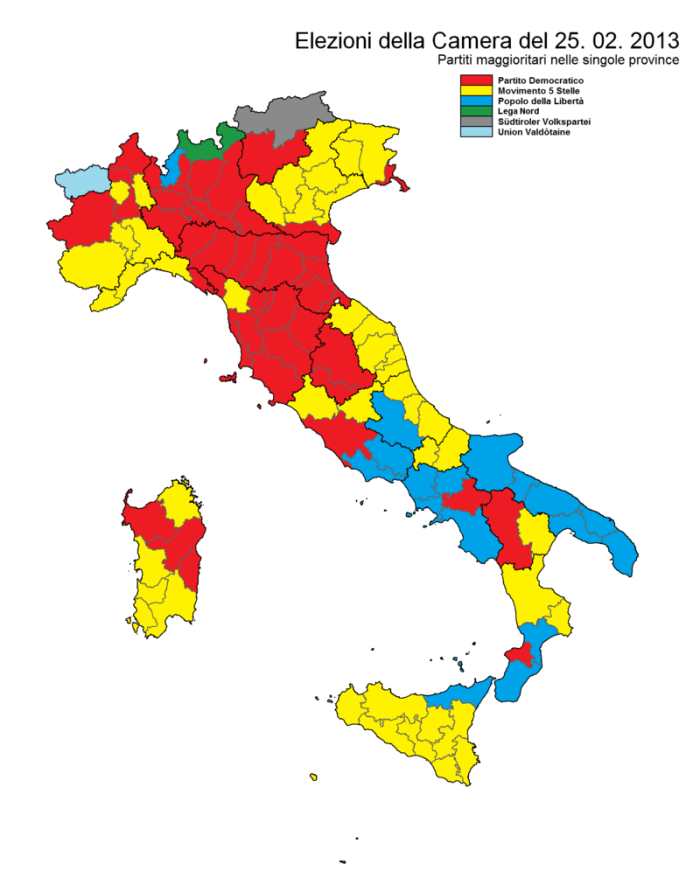
They are largely based on a Left-Right divide rather than the ethnic ones we find in less economically-developed, less politically-integrated, post-colonial states. This Left-Right divide would fit in perfectly with the Madisonian constitution, as administrative units (i.e. Northern Ireland, Gangwon, Bavaria, or Trentino instead of the UK, South Korea, Germany, or Italy) could be added in a manner so as not to upset the balance between Left and Right currently found in the US. Political coalitions would wax and wane with time, of course, but if we want a world where the East Asians and Western Europeans pay their fair share, and where they are protected from Moscow and Beijing, then federation is as moderately radical as you can get.
Just ask Adam Smith.
Some thoughts on the Olympic Games and cosmopolitanism
Right now my city, Rio de Janeiro, is hosting the Summer Olympic Games. It is in many ways a great moment, and it is especially good to see people from so many parts of the world together in relative harmony. In other words, a good example of cosmopolitanism. The cosmopolitanism in the city today reminds me of the attempts of multilateralism that marked Brazilian (and world) foreign policy in previous governments, but that now seem to fade away. The two terms, cosmopolitanism and multilateralism, are not exactly synonyms, but are closely related: multilateral policies should work in bringing peoples together in a more cosmopolitan world. Concerning that, I think of a multilateralism that does not work in bringing people together through cosmopolitanism, and one that can work in that way.
When the Cold War was over, multiple theories were presented to explain what would happen to a world without the tension between two superpowers. Some suggested that the US would reign as a lone superpower; others that it would embrace some form of benign hegemony, in a New World Order. Others still believed that US power was in decline, and that the World would see more multilateralism in the 21st century. This last view was especially dear in Brazil, but as the 21st century progresses, it does not seem to hold as much water anymore.
One great example of multilateralism substituting American hegemony was the integration of Western Europe, but that does not seem to be the case anymore. It is true that beginning shortly after WWII European countries experienced growing levels of regional integration, culminating with the European Union and the Euro in the 1990s. But even then, economists warned politicians and the general public that such a level of integration was not possible, at least not without a central government in Europe. Successive economic crises, Brexit, and the harsh questioning of immigration policies show today that economists were right back then.
Another example of multilateralism celebrated in the 1990s was the growing importance of the UN. Successive humanitarian missions and interventions in several countries suggested that that UN could now surpass the dawn that marked the relationship between USA and USSR in the previous period. Optimism went so far as to discuss themes such as the ‘obligation to intervene’, substituting previous understandings of state sovereignty. But as the years go by, cases like Haiti, Rwanda, Sudan, and many others show that the optimism was at best too high.
Finally and more recently, Brazil and other underdeveloped and developing countries focused greatly on South-South Cooperation, trying to substitute the more standard paradigm of North-South Foreign Aid. This materialized in initiatives such as UNASUR and BRICS. Although presented as a new development, that was actually very reminiscent of The Non-Aligned Movement, The Group of 77, and other initiatives from the 1960s and 1970s. Now, as Brazil, Venezuela, Ecuador, Bolivia, Turkey, China, Russia, and several other countries face growing levels of economic and political hardship, attempts to “overcome American hegemony” seem but preposterous.
New forms in multilateralism in Europe, the Global South, and even the World (in the UN) did not work because they are not really democratic, as they claim to be. Behind a rhetoric of democracy, empowerment of the poor, and so on, they are just new forms of mercantilism: political elites trying to control the economy, not just at the national level, but the international one as well. The point was never to actually bring people together, but to maintain the status quo by avoiding real competition.
The multilateralism that can bring about cosmopolitanism, and that somewhat shows in the Summer Olympic Games in Rio, is one characterized by spontaneous order. People do come together: that is the natural ways of things. The desire to trade spontaneously brings different peoples closer to one another, and as they are closer they realize how much they have in common, and also what can be learnt from the differences. It is not always a peaceful dealing, but the more people are educated to tolerate the differences and to benefit from them, the more cosmopolitan they become.
A top down approach to cosmopolitanism is just a deformed clone of the real thing. Even if some results appear, they always seem to fall somewhere in the uncanny valley, and anyway, the results do not last very long. A bottom up cosmopolitanism is the real thing, and if only elites let it be, it can grow stronger, bring more wealth, and even a little more peace to the world.
Classical Liberalism and the Nation State
Barry’s response to my earlier post is another interesting read, yet it is also rather broad brush historical. I think he is erroneous if he claims that ‘it did not occur to classical liberals, on the whole, to question the state system as they knew it’. In fact the founding fathers of classical liberalism, David Hume and Adam Smith, were very much aware of other, often cosmopolitan ideals of world order. Yet they argued that the nation was attached to individual emotion, which could not be the case for entities beyond the nation state. This was also the position of later classical liberals such as Von Mises and Hayek, as I show in Classical Liberalism and International Relations Theory (Palgrave, 2009). Let me elaborate a little, also in the wider context of international political theory.
Liberalism is the political expression of individualism, yet cooperation of individuals in groups is valued positively. For classical liberals the nation, or the country, is the largest group in society which is the object of human passion, both positive in the sense of national pride and negative in the sense of shame and humiliation. Hume noted that there are few men entirely indifferent to their country, and both he and Adam Smith underlined that humans sympathise more with people to whom they are close than with strangers or foreigners. Feelings for the nation are strong, natural motivational forces for individuals.[i]
This also applies in the age of modern states and nationalism. Despite the atrocities committed in the name of national glory throughout the twentieth century, Mises and Hayek never predicted nor called for the end of the nation state. Mises thought that language was the essence of nationality, and with the fragmentation of the polyglot Austro-Hungarian Empire in mind he argued that multi-language countries were doomed to failure. His solution was an increase in possibilities for individual self-determination and group secession, but not in the expectation that this would lead to a world without sovereign states.[ii] Hayek saw the nation as a prime source of human bonding and individual loyalty, but recognised the negative aspects of nationalism. He valued the nation, but nationalism was a poison,[iii] not least because he saw a strong relation between nationalism and imperialism. After all, it is a small step from thinking good about one’s country to trying to rule and civilise allegedly inferior others. Often, although certainly not in all cases, the nation as a group is politically organised as a sovereign state. In the classical liberal view, states are the most important actors in international relations.
To maximise individual freedom the state should only have a limited number of tasks. The state is an important protector of natural rights, but history has shown that it is also the biggest abuser of these rights. The principle of the rule of law intends to protect the negative liberty of individuals. Classical liberals think the state can best be bound by a combination of constitutions; separation of the legislative, executive and judicial powers; and the limitation of positive law.
In international affairs this means that states should be cautious about concluding and ratifying treaties and other forms of positive law. These are often binding commitments that are very hard to change or to get rid of, with a large possible negative impact on individual freedom. Some international agreements may be useful to smooth the working of the international society of states, or to settle practical matters. But the dangers of overregulation are just as real in world politics as they are in national politics. Besides some specific cross-border issues, the classical liberal rule of thumb is that there is no need for international state action if there is no domestic state task.
Consequently, attempts to build a better world by establishing international organisations and regimes are rejected. Mises and Hayek were strong critics of the League of Nations and its successor the United Nations, and Hayek was a fierce critic of the International Labour Organization. Their main concern was that these and other organisations were taking up tasks they should not perform, just like overactive states in national circumstances. Social constructivism is bad, no matter at what level it is performed.[iv]
In Degrees of Freedom (Transaction, 2015) I have tried to illuiminate the differences between the different forms of liberalism (and conservatism, also see my earlier post on the differences between them entitled “Let’s clear up the liberal mess”), including their views in international relations. In summary it looks like this:
Liberalism, Conservatism and International Relations
| Classical liberalism | Social liberalism | Libertarianism | Conserva
tism. |
|
| Nation as limit of individual sympathy | Yes | No | No | Yes |
| State as prime actor in world politics | Yes | No | No | Yes |
| International governmental
institutions/regimes |
No | Yes | No | No |
| Can war be eliminated | No | Yes | Yes | No |
| Does trade foster peace? | No | Yes | Yes | No |
Source: Edwin van de Haar, Degrees of Freedom. Liberal Political Philosophy and Ideology (Transaction Publishers, 2015).
That also explain partly why Barrry can rightly argue that the ideas of Kant, Mill and to a lesser extent Montesquieu differ from those of Hume, Smith, Mises and Hayek: they are not classical liberals but social liberals.
Notes:
[i] Hume, Treatise,79, 317; Adam Smith, The Theory of Moral Sentiments (Indianapolis: Liberty Fund, 1982), 299; also Edwin van de Haar, ‘David Hume and International Political Theory: A Reappraisal,’ Review of International Studies, 34:2 (April 2008), 225–242.
[ii] Ludwig von Mises, Nation, State, and Economy. Contributions to the Politics and History of Our Time (New York and London: Institute for Humane Studies & New York University Press, 1983), 39–40, 82.
[iii] Friedrich Hayek, Studies in Philosophy, Politics and Economics (New York: Simon and Schuster, 1967), 143.
[iv] Mises, Nation, State and Economy, 90–91; Ludwig von Mises, Omnipotent Government. The Rise of the Total State and Total War (Grove City: Libertarian Pres, 1985), 292–294; Friedrich Hayek, The Road to Serfdom (London: Routledge, 1997), 176.
Classical Liberalism, Cosmopolitanism and Nationalism
In another thought-provoking post on Facebook (does the guy ever write mediocre stuff, I wonder?) Barry raised the question of the relation between classical liberalism, nationalism and cosmopolitanism. He wrote the following:
“On the capture of classical liberal/libertarianism by anti-cosmopolitans. This is very influential at the heart of the ‘leave’ ‘elite’ in the UK, and can only be destructive of classical liberalism/libertarianism. The immediate political consequence of Leave is the elevation of Theresa May to Tory leadership/Prime Minister’s office on a much more ‘Red Tory’, communitarian, corporatist foundation than existed under Cameron. ’To the extent to which the current wave of populism maps into a conflict over national versus transnational identity (Dan Drezner is unconvinced), the problem is not an excess of cosmopolitanism but rather its absence, especially on the conservative, free-market right.”
He seems to take a positive relation between classical liberalism and cosmopolitanism as the default position. Of course Barry did not provide definitions in a FB post, but here I take cosmopolitanism to mean “the idea that all human beings, regardless of their political affiliations, belong to a common moral community. Cosmopolitans often believe that all individuals have the same basic moral status, and tend to downplay the importance or desirability of national political institutions. [They are] opposed to nationalism” (source: Matt Zwolinski (editor), Arguing About Political Philosophy, Routledge, 2009).
I argue that Barry overlooks that classical liberalism combines a cosmopolitan side, with a strong defense of national political institutions (e.g. the state). The cosmopolitan side is perhaps easiest to see, if one takes the idea of free trade as the guiding principle. Free trade is by nature morally neutral for the individuals involved, and has numerous positive economic effects; it fosters cultural exchange as well as innovation and knowledge sharing. In that sense classical liberalism is indeed related to cosmopolitanism.
Yet this stops where the national state comes into play. Classical liberals never predicted any positive political effects of trade (see my earlier notes on this topic) and, just as importantly, they actually favor a strong state, with a limited number of tasks. At the same time, from Hume and Smith onwards to Mises and Hayek, they strongly dislike the idea of transnational political institutions, because these lack any substantial emotional basis which nations do posses. Also, these large political institutions easily become a threat to individual liberty, even more so than national states with too many tasks. So, there is no really no relations between political cosmopolitanism and classical liberalism at all.
There is also no relation between nationalism and classical liberalism. A preference for the national state does not lead to nationalism, which is the vicious and poisonous belief in the superiority of one’s country, often accompanied with a dislike of allegedly inferior neighboring countries or peoples or groups. This is collectivism turned even worse, which is a double ‘no’ from a classical liberal perspective. This said, if patriotism is defined as national pride, then classical liberalism and patriotism can and will go together. There is a fine line between the two sometimes, but patriotism is not violent and dividing, but a binding force between individuals sharing a national state.
The last point is on the European Union. Hayek and Mises have been on record with strong support for a European Federation, primarily as a remedy to war-torn and nationalism-infected Europe. In these circumstances the default position of an international order as a society of states no longer functioned, so there was a need to seek an alternative. Needless to say their federation had little resemblance with the current super state we know as the European Union, which has become a classical liberal nightmare in terms of liberty and property rights violations it commits on a daily basis.
The current EU has some classical liberal traits (the imperfect common market is the single most important one), which is of tremendous use to all European individuals. It is, however, way too cosmopolitan in the bad political way. A likely consequence of Brexit is that this will become even worse, now that the French and their allies will get more room for their collectivist fallacies.
 Notes On Liberty