- Is there an actual China-Japan thaw happening? Wijaya & Osaki, Diplomat
- The occupation of France after Napoleon Christine Haynes, Age of Revolutions
- Ilhan Omar and the power of clarity Michael Koplow, Ottomans & Zionists
- Blackmail! (Libertarian red meat!) Tyler Cowen, Marginal Revolution
international relations
Nightcap
- Anthony de Jasay, RIP Alberto Mingardi, EconLog
- A grim portrait of human nature Lou Marinoff, Footnotes to Plato
- The last Englishman Soni Wadhwa, Asian Review of Books
- What can history tell us about the future of international relations? Sørensen & Møller, OUPblog
Freire’s book (in Portuguese) is up and it’s open access; Van de Haar’s glowing profile
Lucas had a busy, productive 2018 elsewhere, but he assures me that 2019 will be the year he gets back on track for blogging. I’ve uploaded his 2013 book on the rise of the state in the early modern period (“Do Império ao Estado: Morfologias do sistema internacional”) to the side bar, or you can access the whole thing here (pdf).
I don’t know about you, but I am really looking forward to Dr Freire’s thoughts!
Elsewhere, Garreth Bloor has paid a glowing tribute to Edwin’s lifelong work on international relations over at Law & Liberty. The context is in a review of Yoram Hazony’s recent book on nationalism, and I don’t actually agree with much of what Bloor says, but it’s really cool to see Edwin’s important work getting the attention it deserves.
The Capitalist Peace: What Happened to the Golden Arches Theory?
Many are familiar with the Democratic Peace Theory, the idea that two democracies have never waged war against one another. The point is widely recognized as one of the major benefits of democracy, and the hand-in-hand development of more democracies and fewer/less-devastating wars than virtually any other period of human history, is a tempting and enticing explanation.
Now, it is not overly difficult to come up with counter-examples to the Democratic Peace Theory, and indeed there’s an entire Wikipedia page dedicated to it. Here are some notable and obvious counters:
- Yugoslavian wars of the 1990s
- First Kashmir War between India and Pakistan War (1947-49)
- Various wars between Israel and its neighbors (1967, 1973, 2006 etc)
- The Football war (1969)
- Paquisha and Cenepa wars (1981, 1995)
Some people even include the First World War and various 18th and 19th century armed conflicts between major powers (American War of Independence comes to mind), but the question of when a country becomes a democracy naturally arises.
There’s another, equally enticing explanation, the main rationale underlying European Integration: The Capitalist Peace, or in a more entertaining and relatable version: The Golden Arches Theory – as advanced by New York Times columnist Thomas Friedman in the mid-1990s:
No two countries that both have a McDonald’s have ever fought a war against one another.
Countries, frankly, “have too much to lose to ever go to war with one another.” As a proposition it seems reasonable, an extension of the phrase apocryphally attributed to Bastiat: “When goods don’t cross borders, soldiers will”. And not because your Big Mac meal comes with a side of peace-and-love or enhanced conflict-resolution skills, but because the introduction of McDonald’s stores represents close economic interdependence and global supply chains. After all, if your suppliers, your customers or your collegues consists of people on the other side of a potential military conflict, a war seems even less useful. Besides – paraphrasing Terry Anderson and Peter Hill in their superb The Not So Wild Wild West – trading is cheaper than raiding. Even as adamant a critic as George Monbiot admits that a fair number of McDonald’s outlets “symbolised the transition” from poor and potentially trouble-making countries, to richer and peace-loving ones.
Not unlike poor Thomas Malthus, whose convicing theory had been correct up until that point, reality rapidly decided to invalidate Friedman’s tongue-in-cheek explanation. Not long after it was published, the McDonald’s-ised nations of Pakistan and India decided to up their antics in the Kargil war, quickly undermining its near-flawless explanatory power of Friedman’s. Not one to leave all the fun to others, Russia engaged in no more than two wars in the 2000s to undermine the Golden Arches theory: the 2008 war with Georgia, and more recently the Crimean crisis. Adherring to their namesake creation, McDonald’s pull-out from Crimea was just a tad too late to vindicate Friedman.
The Capitalist Peace, the academic extension of the general truism that trading is cheaper than raiding, came undone pretty quickly thanks in part to our Russian friends. The updated version, the Dell Theory of Conflict Prevention, may unfortunately fall into the same trap as the Democratic Peace Theory: invoking ambiguous definitions that may ultimately collapse to mere than tautologies.
Nightcap
- Marx and the morality of capitalism Virgil Storr, Liberty Matters
- Adam Smith’s two economies Chris Dillow, Stumbling & Mumbling
- 2002 essay on Columbus and the New World Charles Mann, the Atlantic
- Polish plans for an American military base, pros and cons Michael Kofman, War on the Rocks
The EU’s laudable Asia Connectivity Strategy
The European Union (EU) has put forward a plan for enhancing connectivity within Asia, and has been dubbed as the Asia Connectivity Strategy.
The EU does not want to give an impression that the Asia Connectivity Strategy (ACS) is a counter to the Belt and Road Initiative (BRI). Yet, senior officials of the EU, while commenting on the broad aims and objectives of the project, have categorically stated that the primary goal of the Asia Connectivity Strategy is enhancing connectivity (physical and digital) while also ensuring that local communities benefit from such a project, and that environmental and social norms are not flouted (this is a clear allusion to the shortcomings of the BRI). There are no clear details with regard to the budget, and other modalities of the project (EU member countries are likely to give a go ahead for this project, before the Asia-Europe Meeting in October 2018). The EU has categorically stated that it would like to ensure that the ACS is economically sustainable.
Other alternatives to BRI: the US
It is not just the EU, but also the US, along with Japan and Australia, which are trying to create an alternative vision to the BRI.
A short note from New Delhi on the 2018 Eastern Economic Forum
Chinese President Xi Jinping recently attended the Eastern Economic Forum (EEF), hosted by the Russian city of Vladivostok, which was held on September 11th and 12th of 2018. President Xi (who became the first Chinese President to attend the EEF) met with Russian President Vladimir Putin for the third time in as many months. Significantly, Japanese Prime Minister Shinzo Abe also attended the Forum, which was titled “The Russian Far East: Expanding the Range of Possibilities.”
Both Xi and Putin repeatedly referred to not just their close personal rapport (Chinese President Xi Jinping, while referring to their individual ties, stated that his and Putin’s ‘friendship was getting stronger all the time’), but also the deepening of economic and strategic ties between Russia and China, as well as the convergence on key global issues (neither side missed the opportunity to target the US for it’s inward looking economic policies).
China was also participating in military exercises, held in Siberia, which have been dubbed ‘Vostok 2018’ (Beijing clarified that these military exercises were not targeted at any third party). The military exercise (September 11-17, 2018) involves 300,000 troops, 1,000 planes, and a number of warships. China sent over 3,000 People’s Liberation Army personnel for the military exercises.
China-Russia Economic Times
A number of issues were discussed during the course of the Forum. Both sides agreed that there was a need to accelerate bilateral economic ties. Trade has witnessed a significant rise in recent years, while in 2017 it was estimated at over $80 billion. In 2018, bilateral trade could surpass $100 billion. Chinese investments in Russia have also been increasing. According to the Russia-China Investment Fund (RCIF; set up in 2012), 150 representatives from China and Russia have already identified 73 projects estimated at $100 billion. Also according to the RCIF, 7 projects estimated at well over $4 billion have already been undertaken.
Both sides also agreed to promote stronger synergies between the Belt and Road Initiative (BRI) and the Eurasian Economic Union (EEU).
Given the fact that the Forum was held in Russia’s Far Eastern Region (RFE), the need to increase Chinese investment in the RFE was high on the agenda. President Xi stated that China has always been a key participant in development projects in the Eastern parts of Russia. China’s Shandong Hi-Speed Group is also likely to invest in highway projects in the RFE.
Recent years have witnessed an increasing Chinese economic presence in Khabarovsk, which is the second largest city in the Eastern Region and 800 kilometres from Vladivostok. It may also be pertinent to point out that a large number of Russians have been uncomfortable with the growing Chinese economic clout, as well as immigrants. In 2010, the Chinese population in the Russian Far East was estimated at less than 30,000, though according to some estimates the population is much higher.
Protectionism
Both Russia and China warned against growing economic protectionism. Xi stated that he was all for greater international cooperation, and even lashed out at the growing tendency towards protectionism. Xi’s views were echoed by Putin, who stated that ‘the world and global economy are coming up against new forms of protectionism today with different kinds of barriers which are increasing.’
Putin made the point that protectionism was a threat, especially to Asia-Pacific (significantly, the current Trump administration has been using the term ‘Indo-Pacific,’ much to the chagrin of the Chinese).
What was also significant was that Xi came down heavily on ‘unilateralism’ at a time when China itself is being accused of ‘expansionist tendencies’ and promoting ‘Debt Trap Diplomacy.’ What was even more interesting was a reference to ‘UN Charter.’
The message emanating from the forum was clear: that the economic as well as strategic partnership between Moscow and Beijing is likely to strengthen, and both will try to develop an alternative narrative to that currently emerging from Washington.
Significance of meeting: Why India would be watching
New Delhi would be observing the Forum and meetings between Putin and Xi, since it’s own relations between Russia and China are of vital importance. While Russia is important in the security context, economic ties with Beijing are important for New Delhi.
New Delhi attaches immense significance to ties with Moscow
There are many in analysts in New Delhi who argue that India should be cautious in strengthening strategic ties with the US, given that this could cause friction in New Delhi’s relations with Moscow (Russia’s improved defense ties with Pakistan are often cited as a consequence of New Delhi moving too close to Washington DC). There are others who argue that New Delhi’s ties with Moscow are robust and time-tested, and will not be impacted by close ties with Washington DC. Russian President Vladimir Putin will be visiting India in October 2018 (for the 19th annual India-Russia Summit), while Indian External Affairs Minister Sushma Swaraj, during her Moscow visit, met with Deputy Prime Minister Yuri Borisov. Both of them jointly chaired the 23rd India-Russia Inter-Governmental Commission on Trade, Economic, Scientific, Technical, and Cultural Cooperation (IRIGC-TEC) meeting. A number of issues, including the need to boost bilateral trade and enhance people-to-people contact, were discussed. Significantly, this was Swaraj’s third visit to Russia in 11 months and she stated that India accorded ‘high priority’ to ties with Russia.
The fact that Swaraj’s visit to Russia took place after a successful 2+2 dialogue with the US, where a number of important defense agreements including COMCASA were signed, shows that New Delhi realizes the importance of ties with Russia. India is likely to sign a deal with Russia for the procurement of the S-400 air defence system, even though the USA has not given India any assurances with regard to a waiver from CAATSA (Countering America’s Adversaries through Sanctions Act) if India purchases defence equipment from Russia. During the visit, India is also likely to go ahead with an agreement with Russia for four frigates for the Indian Navy. While two of these will be manufactured in Kaliningrad, two will be manufactured in Goa.
New Delhi-Beijing ties
The issue of trade tariffs, which was highlighted by Putin and Xi, has also not gone unnoticed by New Delhi. One of the reasons (apart from the desire for peace and tranquility on borders) why India has been pro-actively reaching out to China is a convergence on economic issues. In fact, days after the 2+2 Summit, US President Trump, while referring to India and China, stated that the US has been providing subsidies to India and China for far too long and can not afford to do so any longer.
In terms of investments, there has not been much progress so far due to political disputes, but there is scope for greater economic cooperation between both countries through enhanced connectivity. New Delhi, on its part, should be open to projects like BCIM Corridor (Bangladesh, China, India, Myanmar). The recent proposal out of Beijing to start a railway line from Kunming to Kolkata may not seem possible in the short run, but in the long run it is definitely worth examining, and would give a boost to economies of India’s Eastern and North Eastern states. Interestingly, on September 9th, 2018, Myanmar signed a memorandum of understanding (MoU) with China for agreeing to establish the China-Myanmar Economic Corridor (CMEC). New Delhi should see this connectivity project as an opportunity rather than an obstacle.
Conclusion
New Delhi, while enhancing strategic cooperation with Washington, needs to keep in mind that there is a plethora of economic as well as other issues of global importance where New Delhi can find common ground with Beijing and Moscow. India bilaterally shares robust economic ties with China, and a strategic relationship with Russia. All three countries are also working closely in BRICS as well as SCO. New Delhi also needs to keep in mind that while strategic ties with Washington are important, Trump’s unpredictability will compel New Delhi to keep all its options open and think in a nuanced manner. While historically New Delhi shares close ties with Moscow, the logic of geography can not be ignored in the context of India-China ties.
Nightcap
- Artificial Intelligence: How the Enlightenment ends Henry Kissinger, the Atlantic
- What if we have already been ruled by an Intelligent Machine – and we are better off being so? Federico Sosa Valle, NOL
- We are in a very, very grave period for the world Henry Kissinger (interview), Financial Times
- What should universities do? Rick Weber, NOL
Ottomanism, Nationalism, Republicanism VI
The end of World War Two placed Turkey between the Soviet Communist world and the western democracies. It’s Middle Eastern neighbours consisted of one outright colony (thinly disguised as a League of Nations mandate), French Syria; one de facto colony of Britain, Iraq (formally independent after a mandate period); one country whose sovereignty was highly compromised by United States and British ‘interests’, that is Iran. After decades of rule by the secularist-nationalist Republican People’s Party (CHP is the Turkish acronym), the idea of a Middle Eastern orientation was not a major one at any kind of obvious level, and had limited practical applicability even for those oriented towards the kind of traditionalist Islam which inevitably looks for some kind of connection with the original Muslim heartland.
The Muslim Brotherhood was formed in (British dominated) Egypt in 1928 and that becomes more important in Turkey over time. A Turkish version, National View, was founded by Necmettin Erbakan in 1969, and forms the core of the AKP today, led by Recep Tayyıp Erdoğan. Turkish history from the 1940s to the AKP coming to power in 2002 can look like an inevitable process, and with some qualifications that is probably a reasonable one-sentence way of thinking. Qualifications include the dangers of seeing history as the inevitable unfolding of a single unified process, and the constant possibility that better decisions by secular leaders at various time could have prevented this outcome. The decisions of the small numbers of self-defined liberals in Turkey were not really any better, sad to say.
İnönü’s response to the post-war world was to adopt multi-partyism. The Democrat Party was allowed to form under Adnan Menderes, who had been a member of the short-lived Free Republican Party and then a CHP deputy, and former prime minister Celâl Bayar. The DP contested the 1946 election, which was not all fully free and fair, but came to power in a more properly conducted election in 1950. Bayâr became President and Menderes became Prime Minister. This worked more as the Turkish constitution suggested than when the CHP was the only party in the national assembly. The result was that Menderes was the decision making person.
This political opening up helped Turkey into the Council of Europe (the grouping of European democracies) in 1949 and made it eligible for Marshall Aid under İnönü. Under Menderes, Turkey joined NATO in 1952. Acceptance into NATO was helped by substantial Turkish participation in the Korean War. The participation of conscript peasant soliders from Anatolia is still remembered in folk songs.
All these ways in which Turkey was acknowledged as part of the community of European democracies took place simultaneously for Greece, so the countries were taken as a pair during this period. The peaceful transfer of power through election from İnönü and the CHP to Menderes and the DP was the first such occasion in Turkish and Ottoman history. Some have seen İnönü as ‘only’ responding to US pressure and therefore denied him credit. This has, in the past, been the default position of most Turkish liberals though I believe that the latest historical work shows that İnönü was much more of an active enthusiast for the transition to genuine elections. On this matter, and others, it looks like time for the default ‘liberal’ position to change.
In any case, the whole idea that İnönü only responded to pressure is unsatisfactory. Of course he made his decision in a context of international balances of power of the time. Others made different decisions. In Spain, for instance, Francisco Franco stuck to ultra-conservative, Fascist-influenced dictatorship, accepting US military bases and continuing previous valuable trading relations. In Portugal, the corporatist dictatorship of António de Oliveira Salazar joined NATO after the adoption of an absurd imitation of party pluralism, with a purely token licensed opposition. Spain and Portugal were not aid recipients, but were able to get considerable trade advantages from the differing deals they made to associate with North Atlantic democracies. İnönü could have found ways to stay in power for ever, but did not.
There were limits to İnönü’s moves towards political pluralism and it was certainly not the ideal process. To some degree, it was one part of the CHP agreeing to the demands of the other part (which left to form DP) to have its turn in power after the current, most favourable to state-led joint secularism and modernity had been in power for so long. More on the DP in the next post.
Returning to İnönü’s rule after the war, the left became victims after a period relative tolerance in the latter years of World War Two, when it looked like the western allies would win in alliance with the US, so the Turkish state showed more tolerance of leftists and less of pan-Turkish nationalists who had the most tolerance of Fascism and Nazism (there has never been a self-identified fascist or national socialist political movement in Turkey).
Not only did İnönü oppress leftist groups outside the CHP as he moved towards genuinely contested elections, he identified left-Kemalist loyalists to the regime as communists who needed to be purged. This was at least in part to gain favour in the US by presenting himself as the main enemy of a real communist threat. Left-Kemalist academics who lost their university jobs at the time included Neyazi Berkes, the most notable Kemalist intellectual of any kind, who went onto an academic career in the west. Measures against left groups outside the CHP included using a religious conservative gang to smash the printing presses of a left newspaper. The willingness of the state to tolerate, and even promote, illegal violence by far right groups supposed threats to the regime and has been a frequent occurrence ever since.
To be continued
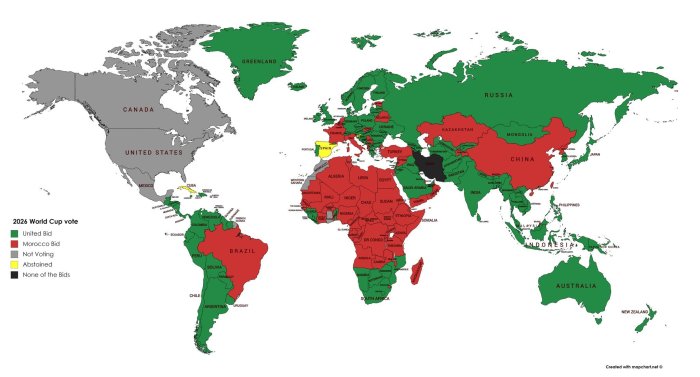
Eye Candy: 2026 World Cup votes, by country

My only question is why did 3 countries that could easily (and have, in the past) host the World Cup on their own gang together? Mexico, Canada, and the United States are wealthy countries. Why gang up?
My guess is that wealthier countries are going to have to do a lot more cooperating if they want to host world-level events from now on, due to the fact that the selection process for these types of events has become democratized. Economist Branko Milanovic has a thoughtful piece on FIFA (the governing body for world-level soccer events) and corruption that ties in to all of this.
Halliday’s ‘The World’s Twelve Worst Ideas’
I came across a collection of essays and blogs by the late Fred Halliday, entitled Political Journeys (2007), published in the last few years of his life. Halliday, who died in 2010 at only 64 years of age, was one of my professors in the International Relations Department at the London School of Economics in the mid-nineties. By some standards he was the big departmental star, not only as a researcher, but also as a public intellectual.
Like most professors he was firmly left wing, a former communist who moved somewhat to the centre. To his credit, his teaching was immaculate: you could not tell his political ideas from his lecturing or the extensive international political theory reading list he gave. He was known for his expertise of the Middle East, revolutions, and his feminism. But he was also a good theorist, and his book Rethinking International Relations (1994) is especially a real treat.
While going through Political Journeys my eyes fell on a piece about ‘the world’s twelve worst ideas in 2007’. Most of them still stand, also from a classical liberal and libertarian viewpoint, and warrant a full discussion by themselves. Yet for now I just list them here, in descending order, with short explanations between parentheses when not self-explanatory:
12. human behaviour can be predicted (against the scientific fallacy in the social sciences)
11. the world is speeding up (large areas I human life still consume the same amount of time as ever before, despite acceleration in other areas)
10. we have no need for history
9. we live in a ‘post-feminist epoch’ (still a need for feminism, given the position of women in most parts of the world)
8. markets are a natural phenomenon, which allow for the efficient allocation of resources and preferences (clearly I strongly disagree with Halliday here, although he seems to mix up real free markets and those characterised by government interference)
7. religion should again be allowed, when not encouraged, to play a role in political and social life (points to the fight against the influence of religion on public life)
6. in the modern world we do not need utopias (aspiration to a better world as necessary part of the human condition)
5. we should welcome the spread of English as a world language (while practical it comes with cultural arrogance by the Anglo-Saxons)
4. the world is divided into comparable moral blocs or civilisations (there is indeed a set of common values shared across the world)
3. diasporas have a legitimate role to play in national and international politics (refutes the idea that diaspora have a special insight into their homeland, and Halliday then points to the negative and backward role in the resolution of the conflicts in their countries of origin)
2. the only thing ‘they’ understand is force (plain colonial and hegemonic thinking)
1. the world’s population problems and the spread of AIDS can be solved by ‘natural’ means (against those who oppose condoms use and other contraceptives)
A short note on the India-Pakistan thaw
Over the past couple of months, both India and Pakistan have been trying to lower the temperatures through some good gestures and reconciliatory statements, while both sides have reiterated their commitment to amicably resolve the issue of harassment of diplomats. India and Pakistan have also agreed to some humanitarian gestures with regard to prisoners languishing, on both sides, in jails.
There have also been indicators that the two neighbors are keen to revive economic ties and give a boost to bilateral trade, which is way below potential.
In the month of March, Indian High Commissioner to Pakistan, Ajay Bisaria, while addressing the Lahore Chamber of Commerce and Industry, spoke about the need for greater bilateral trade:
We should not talk about negative and positive lists rather we should work on the windows of opportunities. At present, over $5 billion trade is being done through third country but after removal of non-tariff barriers, liberalisation of visa and normalisation of mutual relations, the two-way trade could touch a high $30 billion.
Bisaria, while addressing the Employers Federation of Pakistan and the South Asian Forum of Employers, reiterated the need to increase the level of trade, and also said that if South Korea and North Korea could work towards resolving their serious differences, there is no reason why India and Pakistan could not.
Interestingly, in the month of April, Pakistan High Commissioner to India, Sohail Mahmood, met with the Chief Minister of Punjab (India), Captain Amarinder Singh, and discussed possible areas where both countries can cooperate. Not only was there an emphasis on reviving people-to-people contact between the two Punjab’s, but also to give a boost to trade through the Wagah-Attari land route. In the two phases (2004-2007 and then 2011-2014), when India and Pakistan made headway in terms of connectivity and economic linkages, the two Punjab’s played a pivotal role. The area of Punjab, of course, was split by the British Partition of 1947.
Change in mindset of Pakistan Army and RUSI report
What is interesting is a commentary, authored by Kamal Alam, published by premier British think-tank RUSI (Royal United Services Institution), which emphatically argues that there is a paradigm shift in the mindset of the Pakistani military, under the leadership of current Chief of Army Staff, Qamar Ahmed Bajwa, and a genuine realization for the need to move away from a zero-sum approach.
Alam’s commentary refers to an address by Bajwa last year, where he made a case for India being part of the $60 billion China Pakistan Economic Corridor (CPEC). The Pakistan army chief stated:
The Pakistan army is now no more insecure and feels confident of its future and that he welcomes Indian participation in Pakistan’s flagship infrastructure project, the China Pakistan Economic Corridor (CPEC).
Alam, to strengthen his argument, also points to some other instances, such as Bajwa’s speech at the passing-out parade of cadets at the Pakistan Military Academy in Kakul, where the Pakistan Army Chief referred to the necessity of dialogue between both countries, and an invite to the Indian Military attache, Sanjay Vishwasrao, and other senior diplomats posted at the Indian High Commission, for the military parade to mark Pakistan’s National Day. The diplomats attended the parade alongside Vishwasrao.
Another interesting development flagged by Alam is the military drill (conducted under the umbrella of Shanghai Cooperation Organisation) in September 2018, where both India and Pakistan along with other member nations will participate.
Alam’s commentary has quoted a number of other high level members of the Pakistan army who have spoken in favor of mending ties, and also argues that a change in the Pakistan army’s mindset has been visible since 2013.
In December 2016, Pakistan’s Southern Command Lt General, Amir Riaz, while speaking at an awards distribution ceremony at Balochistan FC Headquarters, invited India to join CPEC and ‘share the fruits of future development by shelving the anti-Pakistan activities and subversion.’ Riaz, as Director General of Military Operations in 2013, had met his counterpart at Wagah to reduce tensions across the Line of Control.
According to Alam, Major General Ahmed Hayat, the Director-General-Analysis of the Inter-Services-Intelligence for Pakistan, had authored, in 2013, what was dubbed as the India Plan. While agreeing that engagement and not conflict was the answer, the report sought to identify the appropriate time to reach out to India from a position of strength.
Points of contention moving forward
While Alam’s report has generated a lot of interest, a few facts need to be borne.
First, the recent meeting between Modi and Xi, where China, without making a mention of Pakistan, committed to flag terrorism as a key concern. In recent months, China has given some indicators that it may be willing to re-think its approach towards terrorism emanating from Pakistan. Pakistan is now likely to be put on the watchlist of an international financial watchdog, Financial Action Task Force (FATF). Beijing was initially opposed to this move, but relented after India lent its support to Beijing for the Vice Presidency of FATF.
China has of course been pitching for a better relationship between New Delhi and Islamabad for some time, keeping in mind its own economic interests, and has even asked New Delhi to be part of CPEC. New Delhi has been steadfast in its opposition to China’s One Belt One Road (OBOR) Initiative, given the fact that CPEC passes through disputed territory, but with the changing dynamics in the New Delhi-Beijing relationship, it is likely that Bajwa and the upper echelons of India’s diplomatic corps are making the right noises to look good to the international community, especially China.
Second, the incumbent PML-N civilian government in Pakistan, which has been completely overwhelmed in the past two years with the weakening of former Prime Minister Nawaz Sharif. The fall of Sharif began with the joint Tahir Ul Qadri-Imran Khan protests (backed by the Pakistan army) in 2014, and ever since the Panama Case leaks in April 2016, things have spiraled downhill for Sharif. In July 2017, Nawaz Sharif was disqualified by the Supreme Court from holding any public office, and had to resign as Prime Minister of Pakistan. In April 2018, he was disqualified from holding any position for life.
Sharif, who has on more than one occasion dubbed political rival and former cricket star Imran Khan, Chairman of Pakistan-Tehreek-E-Insaaf (PTI) as ‘laadla’ (favorite) of the army, has also argued that the judiciary and military are jointly conspiring against him. One of the points of divergence between Sharif and the army were relations with India, as Sharif has always batted for better relations with New Delhi.
There is absolutely no doubt that Imran’s relations with the army have improved considerably according to some. Imran has also publicly praised the army chief, recently calling Bajwa “probably the most pro-democratic man [Pakistan] has ever seen.” There is a good chance that PTI, backed by the military establishment, may win in the upcoming elections of 2018. The commentary, and Bajwa’s statements, could be a message to India that New Delhi will have to engage with the military in case PTI were to come to power.
In this context, Bajwa has been trying to cultivate the image of a pragmatist not opposed to peace. A few months ago in an article written for The News, the prominent left-leaning Pakistani journalist Sohail Warraich wrote:
The Bajwa doctrine stands for regional peace and, like China, wants to make peace with India while keeping our differences on core issues. The doctrine is ready for peaceful negotiations but without compromising on the Kashmir issue. The doctrine is fully aware of the Chinese advice to Pakistan that instead of war, other peaceful measure be negotiated for Kashmir issue.
Conclusion
It is important for New Delhi to wait and watch, while engaging with the business community and Pakistan’s vibrant civil society is absolutely essential. Not much should be read into Bajwa’s remarks. They should be taken note of, and not dismissed, but it is a bit premature to be optimistic. After all, the army has been backing the Milli Muslim League (MML), a civil front of the JuD, headed by the Mumbai terror attack mastermind, Hafiz Saeed.
It will also be interesting to see the ultimate outcome of the upcoming election in July.
New Delhi needs to deal with whoever is in power in Pakistan, and the army is an important power center there. A civilian government (possibly PTI) beholden to the establishment will not address India’s concerns the way a firm civilian government which has the fervent backing of the people (this may not happen in the imminent future, but is a reality) would. The Pakistan Army Chief’s words would have had more meaning if he had backed Nawaz Sharif’s attempts towards improving ties with India, and not joined hands with the judiciary to plot his downfall.
The Indo-Pacific narrative, US insularity, and China’s increasing influence
Over the past year, there has been a growing interest with regard to the vision of a Free and Fair ‘Indo-Pacific’. While this term has been used in recent years by policy makers from the US and Australia and has been pushed forward by a number of strategic analysts, a number of developments since last year have resulted in this narrative gaining some sort of traction.
US President Donald Trump, during his visit to South East Asia and East Asia in November 2017, used this term on more than one occasion, much to the discomfort of China (which prefers ‘Asia-Pacific’). On the eve of his visit to India last year, Former Secretary of State Richard Tillerson, while speaking at the Centre for Strategic and International Studies (CSIS, Washington DC), explicitly mentioned a larger role for India in the Indo-Pacific, and the need for India and US to work jointly. Said Tillerson:
The world’s center of gravity is shifting to the heart of the Indo-Pacific. The U.S. and India, with our shared goals of peace, security, freedom of navigation, and a free and open architecture, must serve as the Eastern and Western beacons of the Indo-Pacific, as the port and starboard lights between which the region can reach its greatest and best potential.
In November 2017, the Quad grouping (Australia, US, India, and Japan) met on the sidelines of the ASEAN Summit pitching not just for a rules based order, but also in favour of enhancing connectivity. Commenting on the meeting, an official statement from the US Department of State had said that the discussions were important and members of the Quad were “committed to deepening cooperation, which rests on a foundation of shared democratic values and principles.”
Earlier, too, the four countries had coalesced together, but as a consequence of Chinese pressure, the grouping could not last.
There have also been discussions of coming up with connectivity projects. This was discussed during Australian Prime Minister Malcolm Turnbull’s meeting with Donald Trump in February 2018, and between representatives of Japan, the US, and India in April 2018 when the three sides met in New Delhi, committing themselves to furthering connectivity between the countries.
China Factor
While members of the Quad have continuously denied that the Indo-Pacific concept is specifically targeted at China, it would be naïve to believe this assertion. In fact, during a visit to Australia, French President Emmanuel Macron, who is trying to position himself as one of the frontline protagonists of liberalism in the Western world, spoke about the need for India, Australia, and France to work together in order to ensure a rules-based order. Commenting on the need for India, France and Australia to jointly work for a rules based order, and checking hegemony (alluding to China), the French President stated:
What’s important is to preserve rules-based development in the region… and to preserve necessary balances in the region….It’s important with this new context not to have any hegemony.
Evolving relationship between China-India and China-Japan
While it is good to talk about a rules-based order, and a Free and Fair Indo-Pacific, it is important for members to do a rational appraisal of ensuring that the Indo-Pacific narrative remains relevant, especially in the context of two important events. First, the reset taking place between India-China, and second, the thaw between Japan-China.
This has already resulted in some very interesting developments.
First, Australia was kept out of the Malabar exercises last June (Japan, US, and India participated). Australia is a member of the Quad alliance and has been one of the vocal protagonists of the Free and Fair Indo-Pacific narrative. Canberra has also expressed vocally the need for a greater role for India in the Indo-Pacific. Australia has on more than one occasion expressed its desire to participate in the Malabar Exercises.
Many argue that the decision to exclude Australia from the exercises is a consequence of the significant shift taking place in India-China relations, though India has been dismissive of this argument.
Second, Japan has expressed its openness to participate in China’s Belt and Road Initiative (BRI) as long as international norms are met. During meetings between the Chinese and Japanese Foreign Ministers in April 2018, the Chinese Foreign Minister, Wang Yi, said such a possibility was discussed. Japanese Prime Minister Shinzo Abe, who is seeking to improve ties with China, recently reiterated the potential of the Belt and Road Initiative in giving a boost to the regional economy.
It would be pertinent to point out that a number of Japanese companies are already participating in countries which are part of the Belt and Road Initiative.
Interestingly, the Japanese-led Asian Development Bank (ADB), which has been funding many projects (spearheaded by Japan) projected to be components of the Indo-Pacific strategy, has even gone to the extent of stating that it does not perceive the Chinese-led Asian Infrastructure Investment Bank (AIIB) as a threat. Commenting on the possibility of cooperation between ADB and AIIB, the President of ADB, Takehiko Nakao, stated that “AIIB, it’s not the kind of threat to us. We can cooperate with AIIB because we need larger investment in Asia and we can collaborate.”
Where does the Indo-Pacific move from here?
In terms of strategic issues, especially ensuring that China is not an unfettered influence in the region, the narrative is relevant. The Chinese approach towards Indo-Pacific and Quad as being mere froth is an exaggeration. Addressing a press conference on the sidelines of the National People’s Congress, China’s Foreign Minister, Mr. Wang, had stated that there was “no shortage of headline grabbing ideas” but they were “like the foam on the sea” that “gets attention but will soon dissipate.”
Similarly, in terms of promoting democratic values it certainly makes sense. The real problem is in terms of connectivity projects (beyond India-Japan, none of the members of the Quad have elaborated a coherent vision for connectivity). The US has spoken about an Indo-Pacific Economic Corridor, but given the Trump Administration’s approach, it remains to be seen to what extent this can be taken further. While Australia has been steadfast in its opposition to China’s growing economic clout, it has its limitations, especially in terms of funding any concrete connectivity projects. Possible regions where Australia could play a key role should be identified.
Conclusion
It is fine to speak in terms of certain common values, but to assume that China can be the only glue is a bit of a stretch, especially given the fact that it has strong economic ties with key countries pushing ahead the Indo-Pacific vision. It is also important for the Indo-Pacific to come up with a cohesive connectivity plan. Currently, the narrative seems to be driven excessively by strong bilateral relationships, and the individual vision of leaders.
Nightcap
- One of the 19th century’s most mysterious and eccentric figures Rhys Griffiths, Public Domain Review
- Internationalists are more libertarian than non-interventionists Isabel Hull, London Review of Books
- Why is the US military all over Africa? Eric Schewe, JSTOR Daily
- California is a model for divorce, not domination David French, National Review
Recent developments in the context of Indo-Pacific
At a time when a massive churn is taking place in the Donald Trump Administration (HR Mcmaster was replaced as head of the NSA by John Bolton, while Secretary of State Rex Tillerson was replaced with the more hawkish Mike Pompeo), Alex Wong, Deputy Assistant Secretary of State for East Asian and Pacific Affairs, gave a briefing with regard to the US vision for ‘Indo-Pacific’ strategy, on April 3, 2018 (a day before a trilateral dialogue took place between senior officials from India, Japan and US). Wong outlined the contours of the strategy, and spoke not just about the strategic vision, but also the economic vision of the US, with regard to the Indo-Pacific.
A backgrounder to the Indo-Pacific, Quad, and the China Factor
For a long time, the US referred to the region as ‘Asia-Pacific’ (which China prefers), but the current Trump Administration has been using the term ‘Indo-Pacific’. During his visit to East Asia and South East Asia, in November 2017, the US President had used the term more than once (much to the discomfort of China) giving a brief overview of what he meant by a ‘Free and Fair Indo-Pacific’. While speaking to a business delegation at Asia-Pacific Economic Cooperation, Trump spoke about ‘rule of law’ and playing by the rules. Former Secretary of State Rex Tillerson had referred to the Indo-Pacific and the Quad Alliance (consisting of US, India, Japan, and Australia) in an address at the Center for Strategic and International Studies (a Washington think tank) in October 2017, a week before his India visit.
In order to give a further thrust to the Quad, representatives of all four countries met on the eve of East Asia Summit in Manila. A statement of the Indian Foreign Ministry said: Continue reading