Sons outearning Fathers in Chetty et al. : working hours should be considered

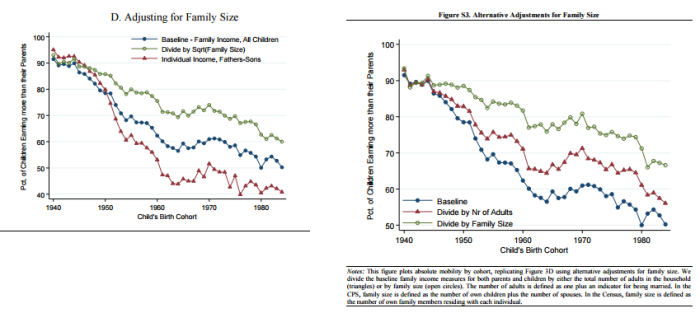
In response to my post yesterday, my friend and economist/nuclear engineer (great mix) Laurent Béland pointed out that the Father-Sons mobility figures in Chetty et al. are depressing. Yes, at first glance, they are (see below – the red line). fathersons

But, at second glance, it is not as terrible. Think about family structures with the 1940 birth cohorts. The father works and, in most likelihood, the mother is a stay-at-home father. Most of the earnings come from the father who probably works 45 to 60 hours a week.  If my father earns 40,000$ at 60 hours a week or earn 40,000$ at 40 hours a week, the line remains at the same height, but we are not talking about the same living standard in reality. Chetty et al. do not account for hours worked to achieve income.  The steep decline – faster than the baseline of household-size adjusted decline – matches the steep increase in female labor force participation and the decline labor force participation of males (see graph here and Nicolas Eberstadt’s work here) as well as the decline in hours worked by males.

If the question had been “what are your chances of out-earning your father per hour worked”, then the red line would not have fallen like that. Income divided by labor supplied would probably bring the red-line back with the blue-line.

Note: Again, please note that I am not trying to rip apart Chetty et al. (as some have claimed elsewhere). Their work is great and as a guy who does all his research on providing data series regarding economic history, I am never going to rip on someone who does hard data work like Chetty et al. did ! My point is that I am not convinced that the decline is so big. And, in good faith, it seems that Chetty et al. do try to put the “caution” labels where its needed – and its important to discuss those caution labels before some politician or two-cents-pundit goes all Trump on us by saying stuff that this doesn’t say!

A flaw regarding the chance of “out-earning” your parents

When Raj Chetty publishes a paper, it generally comes with a splash. The last one is no exception. His paper (co-authored), picked up by David Leonhardt at the New York Times and Justin Wolfers on Twitter, basically measures the American dream : what are your chances to do better than your parents. The stunning conclusion is that someone born in 1940 had a 90%+ chance of “out-earning” his parents compared with a few points above 50% for those born in the 1980s. I am not convinced. Well, when I am not convinced, I am saying I am not convincing about how big the drop is! I think the drop is smoother (the slope of decline is gentler) and the starting point for the 1940 cohort is too high.  As a big fan of Chetty, I must press this point.

More precisely, I am saying that the bar (income threshold) over which someone had to jump in 1940 is underestimated and overestimated in 1980. Setting the bar too low (high) means very high (low) chances of “out-earning” your parents. To set the bar too low, you must underestimate (overestimate) the income of the parents.  This could occur if household economies of scale are not accounted for.

An income of 30,000$ for 3 persons is not the same as an income of 60,000$ for 6 peoples. On a per capita basis, the income is the same. But, if you adjust for economies of scale in housing and furnitures, there are differences (the simplest is square root).  This gives you income per adult equivalent. Chetty et al. are aware of that and they provided a sensitivity analysis which is not mentioned by those who are relaying the article. Since household size has tended to fall over time, the growth in per capita income is faster than the growth in income per adult equivalent (a better measure). Any correction for this long-term demographic trend would attenuate the slope of the decline of the chance to out-earn your parents. And indeed, once Chetty et al. make the correction, the decline is much more modest (but still present – see below).

size

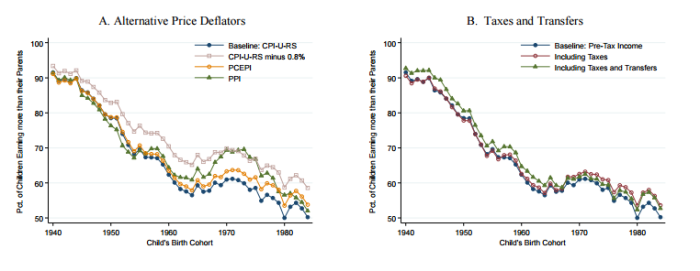
Simultaneously, Chetty et al. also present other important sensitivity checks. All of them relevant. But, in a strange decision, Chetty et al. decided to isolate each of the sensitivity checks rather than compile them. Taken individual, they all seem minor – except adjusting for family size. But compound this with the other sensitivity check proposed by Chetty et al.: price deflators. Using the well-known bias in the the CPI that overestimates inflation by 0.8%, Chetty et al. find that, by the end of their perod, there is roughly a ten percentage point difference between the baseline uncorrected CPI and the corrected CPI (see below). Compound this with the corrections for family and you still get a decline – but again the slope of the decline is much more modest. If you add panel B from figure 3 in Chetty et al – which includes taxes and transfers – you probably get a few extra points up. There will still probably be a decline, but a moderate one.

pricetaxes

Finally, at footnote 19, Chetty et al. also point out that they do not account for in-kind transfers prior to 1967 (there were some).  And, on page 13, they point out that “one may be concerned that levels of absolute mobility for recent cohorts may still be understated because of increases in fringe benefits, nonmarket goods, or under-reporting of income in the CPS”. Add in all these little extra problems to the family size, the transfers and the inflation correction and I am not sure how big the drop from 1940 to the end of the studied period is. Finally, I would also add that an understudied point in economic history is what the distribution of in-kind payments according to income was. From studying the British industrial revolution, I have generally to see that it is the poorest workers who receive in-kind payments (which are not measured) and the richest receive much fewer of those in proportion of their incomes. One of the few to note that distributional was the hardcore left-leaning scholar Gabriel Kolko who mentioned this issue in Dissent back in the 1950s.  If Kolko is correct, then the income of “poor parents” in 1940 is underestimated. As a result, the bar over which the children of said parents must jump is set mildly too low. If that is the case, the odds for the 1940 birth cohort are overestimated.

Combine all of these things together and I am not sure that the drop is as dramatic as many are making it out to be. I would be very satisfied if Chetty et al. would publish all the corrections they did and do a sensitivity check with hypothetical regarding a sliding-scale of in-kind payments in 1940 according to income (10% of income for poorest to 0% for the richest). I would just like to see how much it matters.

Inherited wealth and size of government

In the debate over inequality, I have long argued that governments are much better at creating inequality than at reducing them (see my paper here with Steve Horwitz). Through rent-seeking and regulatory capture, interest groups manage to redistribute wealth in the “wrong” direction. There are a great many cases of large fortunes amassed thanks to government favors (think of the Bombardier family in Canada or Carlos Slim in Mexico).

Yet, as many scholars have pointed out, large fortunes can be rapidly consumed by squabbling heirs and poor investments (see this paper here notably). Thus, the fortunes gathered by parents who earned government favors can melt away over time. Nonetheless, governments do protect the fortunes of the heirs if they continue in business. For example, the heirs of the Bombardier family in Canada continued their ancestor’s work and remained relatively well-off. This is in part because governments continue to rescue that firm from its misfortunes. In a way, government may act to limit the erosion of fortunes. We can phrase this differently by asking whether or not the size of government is correlated with the share of wealth from the “ultra-rich” that is gained through inheritance.

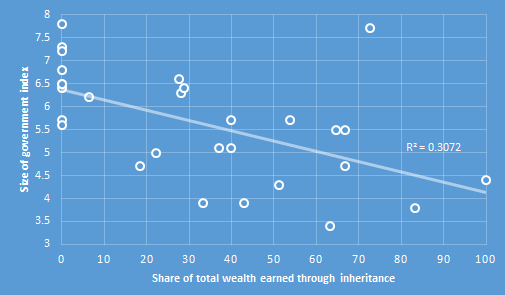
Using a working paper from the Peterson Institute for International Economics titled The Origins of the Superrich: The Billionaire Characteristics Database authored by Caroline Freund and Sarah Oliver and the Economic Freedom Index of the World produced by the Fraser Institute (released this week), we can check for the existence of this correlation. The paper by Freund and Oliver documents the share of the total wealth of billionaires that was earned through inheritance.

Unsurprisingly (for me), the lower the index for the size of government, the greater the share of wealth earned through inheritance. Using all OECD and European countries, we can very well see that the size of government is negatively correlated with the share of wealth from inheritance. untitled

Maybe, just maybe, those who believe that the solution to rising inequality is more government redistribution should be willing to reconsider their proposed cure. This is, I believe, an additional cause for skepticism regarding remedies.

Some afterthoughts on Rio Paralympics

Paralympics are over, and with them the cycle of Olympic Games in Rio de Janeiro. Once again the city was able to put up a good show, and thankfully all went well in the Cidade Maravilhosa. But not everything is alright in Rio: even more than the Olympics, the Paralympics were able to show the contradictions between the city where we live everyday and the city of the event: Rio is not welcoming for people with disabilities.

At least in Brazilian Portuguese, political correctness has done a mess with vocabulary concerning the kind of people who compete in Paralympics. We are not supposed to say they are disabled (don’t even think about saying they are crippled!). I think the correct vocabulary today is, as I used, “people with disabilities.” But even that is under political correct scrutiny, so it seems. All this discussion about words springs from cultural Marxism, postmodernism, relativism and the belief that there’s nothing objective beyond our vocabulary. But words can’t hide the reality: Rio is unequal. The way it treats the blind, the lame, and even the elderly or the young, is completely different from the way it treats people in middle-age and more able to walk. And all that despite strong legislation in this area.

One of the greatest debates in political philosophy in the 20th century happened between American philosophers John Rawls and Robert Nozick. Trying to build on classical liberal foundations (but moving to egalitarian liberalism), Rawls pointed out that “equality was supposed to be the moral benchmark for social and political institutions, and that any deviation from equality had to be specially justified.” Nozick answer was that liberty upsets patterns. Even if we have a starting point in society where we have a perfectly equal distribution of goods or assets, the moment that we allow people to be free to make their own choices (as liberalism prescribes) they are going to make choices we cannot possibly predict, and these choices are going to upset any kind of pattern we established in the first place. That happens because each one of us is unique in its own right: each one of us have a specific set of values, preferences and circumstances that upsets any would-be planner. So, if you want to respect human liberty to make choices, you have to give up on any plan for material equality.

Nozick’s answer to Rawls has a lot of Adam Smith in it. In The Theory of Moral Sentiments (1759) (preceding the more famous Wealth of Nations both in time and argument) Smith presented a character called “man of system.” This person sees society as an architect sees a blueprint for a construction. Smith says such person is “apt to be very wise in his own conceit; and is often so enamored with the supposed beauty of his ideal plan of government that he cannot suffer the smallest deviation from any part of it.” The problem is that humans have free will, the ability to make choices. And as such, they will upset any blueprint prepared for them. In other words, “individual people are not chess pieces you can move on a board with their dreams and desires ignored.” To the eyes of the would-be planner, “society must be at all times in the highest degree of disorder.”

So, material equality of outcomes (or at least of opportunities) is totally out of reach? Should we disregard it completely? Should the “invisible hand” prevail in spite of the weakest in our society? I don’t think so. Just the opposite! One of the very reasons I find classical liberalism morally appealing is the fact that no economic or political system ever conceived helps the weakest as it does. In other words, contrary to (what seems to me is) the popular belief, classical liberalism defends social justice more than any of its intellectuals alternatives. Answering John Rawls’s famous claim that “a just society will be one whose rules tend to work to the maximum advantage of the least well-off classes,” Friedrich Hayek pointed out exactly this. In The Constitution of Liberty, Hayek agreed with Rawls about the end at which social institutions should aim: the welfare of the least advantaged. He simply disagreed about the means Rawls thought would get us there.

Instead of thinking of us as chess pieces on a board, when can use the analogy of a soccer game (or football, or basketball – suit yourself). The outcome of the game is the result of the player’s individual abilities, but it is also the outcome of the rules. In other words, in a free society, where people are free to choose, the outcomes are not just the result of the innumerable decisions of countless individuals. They are also the result of the rules enforcing property rights, contracts, taxation, and so on. So, it’s important to think about the justice of these rules, as well as the outcomes they might have. The point is that we can embrace a theory of social justice, but that just tells us the end we are heading to, not the means to get there.

Contrary to egalitarians, progressivists and socialists claims, no theory “tends to work to the maximum advantage of the least well-off classes” as classical liberalism does. And that’s a great reason I support it. As I said in the beginning, Rio is very unequal, despite decades of egalitarian policies in the city and in Brazil as a whole. On the other hand, there’s plenty of evidence that classical liberal policies tend to help the very people others accuse it of ignoring. When it comes to doing social justice, it’s important to have not just the heart, but also the mind in the right place. And I believe classical liberal policies are this place.

References:
What’s Right about Social Justice?
Rawls and Nozick on Liberty & Equality
Adam Smith and the Follies of Central Planning
Fight of the Century

Libertarians and Pragmatists on Democracy Part 4: Why Market Anarchism is more Democratic than Democracy

Note: This is the final part of a series on democracy. It is assumed the reader is familiar with part one, defining democracy, part two, summarizing classical liberal perspectives on democracy, and part three, which analyzes how pragmatists conceive of democracy as a broader philosophy. Here, I will argue that a synthesis of libertarian and pragmatist perspectives on democracy will yield an argument in favor of market anarchy.

The insights of classical liberalism, and particularly modern libertarianism, have shown that democracy is likely to lead to a tyranny of an irrational and ignorant majority and public choice theory has shown how it results in awful policies thanks to a number of collective action issues. However, as pragmatists have argued, democracy’s philosophical aspirations to scientific public deliberation, seeking the consent of the governed, valuing the dignity of every individual, and decentralizing political authority to take advantage of dispersed intelligence are still admirable. However admirable these philosophical aspirations are, real-world democracies completely fail to fulfill them.

The natural question is, if not democracy, what political arrangements can live up to the philosophical goals of Dewey and Hook? I think the answer lies in market anarchism. In what follows, I will show how market anarchism could succeed in realizing the aspirations of philosophical democracy where political democracy has failed.

Before we get started, let’s take into account a few minor housekeeping notes. It is assumed that the reader has at least a cursory knowledge of how market anarchism and polycentric law works. If you are not familiar with these concepts I highly recommend watching this video by David Friedman before continuing. Also, I am in no way arguing that any of the thinkers discussed in this series are “really” anarchists unless they’re obviously so such as Huemer. I will not even claim that any of them “should have been” anarchists (with the exception of Hayek). I am simply arguing that if we take into account the insights of their various perspectives, one could plausibly defend market anarchism.

Market Anarchism, Unlike Democracy, Does Rest on the Voluntary Consent of the Governed

As Michael Huemer convincingly has shown, democracy does not actually “rest upon the freely given consent of the governed” as Sidney Hook claims. The bar tab example illustrates that we would not consider majority rule “consent” in any everyday interaction and there is little reason to think it should be any different in the context of political institutions. By contrast, market anarchism is almost by definition based off of consent. This is the primary reason why many deontological market anarchists, such as Murray Rothbard, are market anarchists in the first place and why they oppose the coercive, non-consensual nature of the state. While democracy’s claim to legitimacy is that the governed vote but they are still forced to follow the (unjustified) authority of a state that has the monopoly on force whether they agree or not to, market anarchism is based off of voluntarily consented to contracts between individuals and defense agencies and contracts between those defense agencies and private, voluntary court systems and arbitrators. Further, the content of the laws is agreed to and law becomes a product one buys in voluntarily agreeing to sign up with a defense company, just as one buys a car, a piece of furniture, or any other good.

It is curious that many pragmatist defenses of democracy sound very similar to what many market anarchists and libertarians write. Not just in Sidney Hook’s definition of a democracy as a government that “rests upon the freely given consent of the governed,” but perhaps most strikingly in John Dewey’s 1939 essay “I Believe.” In this essay, Dewey walked back some of his early Hegelian collectivist lines of his early years:

My contribution to the first series of essays in Living Philosophies put forward the idea of faith in the possibilities of experience at the heart of my own philosophy. In the course of that contribution, I said, “Individuals will always be the center and the consummation of experience, but what the individual actually is in his life-experience depends upon the nature and movement of associated life.” I have not changed my faith in experience nor my belief that individuality is its center and consummation. But there has been a change in emphasis. I should now wish to emphasize more than I formerly did that individuals are the final decisive factors of the nature and movement of associated life.

Indeed, throughout the whole essay he emphasizes “the idea that only the voluntary initiative and voluntary cooperation of individuals can produce social institutions that will protect the liberties necessary for achieving development of genuine individuality.” Throughout the essay, he decries (like many left-anarchists do) “state socialism” just as much as he does “state capitalism.” Dewey’s opposition to capitalism is well-known, but what is less known is his opposition to so-called “public collectivism.” His criticisms here could just as easily have been written by someone like Hayek:

Recent events have shown that state socialism or public collectivism leads to suppression of everything that individuality stands for. It is not too late for us in this country to learn the lesson taught by these two great historic movements [ie., the rise of state capitalism and state socialism]. The way is open for a movement which will provide the fullest opportunity for cooperative voluntary endeavor. In this movement, political activity will have a part, but a subordinate one. It will be confined to providing the conditions, both negative and positive, that favor the voluntary activity of individuals.

It is interesting that, like anarchists who favor direct action, he emphasizes that political activity is subordinate to the political movement he sees as necessary.

Of course, there are still notable differences between Dewey and libertarians, he still defends what he calls “functional socialism” in the socialization of medicine and still berates more than many libertarians would be comfortable with (except, of course, for left-anarchists) inequality caused by state capitalism. His vision of a truly individualist society, even in his later years, was one with localized, experimental democratic institutions and economics controlled by those localized governments in a “functional socialist” fashion (as I mentioned earlier, that economic vision is at odds with Dewey’s epistemological commitments).

However, I would argue that it is more than a mere superficial coincidence that Dewey’s criticisms of state capitalism are almost identical to those of market anarchists who decry “crony capitalism,” that his criticisms of state socialism are very similar to some individualist libertarian criticisms, and his overall rhetoric defending democracy on the grounds of “voluntary cooperation of individuals” sounds remarkably similar to many libertarians. This is because, largely, the philosophical ends Dewey seeks in politics are the same as those sought by libertarians, market anarchists, and classical liberals. However, the institutional means he advocates are very different and fail to meet those ends.

There is, conversely, one potential criticism that Sidney Hook would raise at this point: that market anarchism does not really rest upon the freely-given consent of the governed due to its allowance for economic inequality. Hook argued that income inequality undermines consent in democracy and, as a result, economic organization should be controlled by a democratically elected government. There are two points to be made. First of all, when economic organization is controlled by government in democracies it exacerbates the problem of income inequality. Rent-seeking culture arises in which concentrated interests use, through lobbying power, government force to accumulate and protect their wealth. Indeed, as I mentioned earlier,  there have been empirical studies showing how over-regulation lobbied for by those concentrated benefits have regressive effects. Even fairly anti-free market economists such as Joseph Stiglitz have argued that income inequality is not an inevitable result of market institutions, but a result of bad government policies such as corporate welfare.

Second, it is questionable to what degree income inequality would exist in pure market anarchy. Of course, much of the bad inequality experienced under state capitalism is the result of bad policies, but some if it is also just a result of market’s tendencies to disrupt economic distributions (which, as Mises argued in Liberalism: The Classical Tradition is not a bad thing because it allows for luxury markets which can serve as an experimental market for expensive, new goods that one day become popular consumer goods). Some market anarchists, such as Anna Morgenstern, have argued that the type of mass accumulation of capital under capitalism would be impossible under market anarchism. I am unsure to what extent I agree, and a systemic analysis of the economic roots of inequality is outside of the scope of this post. However, suffice it to say that it is an open, empirical question whether purely free markets would result in problematic levels of inequality, as Hook seems to think, and we have some good reasons to think it would not. At the very least, it is clear that the democratic institutions favored by Hook are not a serious solution to the problem.

Market Anarchism, Unlike Democracy, Relies on a Decentralized Process of Political Decision Making

Dewey argued in “Democracy and Educational Administration” that “it is the democratic faith that [the distribution of knowledge and intelligence] is sufficiently general so that each individual has something to contribute and value of each contribution can be assessed only as it enters into the final pooled intelligence constituted by the contributions of all.” He seems to echo Hayek’s knowledge problem critique of socialism when he argues that the democratic faith is based on the wisdom that “no man or limited set of men is [sic] wise enough or good enough to rule others without their consent[.]” As we have seen, democracies tend towards heavily centralized governments that undermine this faith and fail to take advantage of the dispersed knowledge (in Hayekian terms) among individuals in society.

Market anarchy, on the other hand, by definition takes advantage of this feature of dispersed intelligence. Rather than having law be designed by a centralized legislature, law arises out of voluntary market exchanges between individuals and, like common law, the precedent of judges in private courts. Of course, both Dewey and Hayek embraced democratic institutions (in Hayek’s case, as well as free market economic coordination) to take advantage of decentralized knowledge. However, both Dewey and Hayek, particularly the ladder (Dewey never wrote about market anarchism as it did not exist as a unique perspective until almost a decade after his death), failed to appreciate the extent to which a polycentric legal system does this much better. Peter Stringham and Todd Zywicki have noted this tension in Hayek’s thought in particular, as they put it in an abstract for their excellent paper on the issue:

Should law be provided centrally by the state or by some other means? Even relatively staunch advocates of competition such as Friedrich Hayek believe that the state must provide law centrally. This article asks whether Hayek’s theories about competition and the use of knowledge in society should lead one to support centrally provided law enforcement or competition in law. In writing about economics, Hayek famously described the competitive process of the market as a “discovery process.” In writing about law, Hayek coincidentally referred to the role of the judge under the common law as “discovering” the law in the expectations and conventions of people in a given society. We argue that this consistent usage was more than a mere semantic coincidence — that the two concepts of discovery are remarkably similar in Hayek’s thought and that his idea of economic discovery influenced his later ideas about legal discovery. Moreover, once this conceptual similarity is recognized, certain conclusions logically follow: namely, that just as economic discovery requires the competitive process of the market to provide information and feedback to correct errors, competition in the provision of legal services is essential to the judicial discovery in law. In fact, the English common law, from which Hayek drew his model of legal discovery, was itself a model of polycentric and competing sources of law throughout much of its history. We conclude that for the same reasons that made Hayek a champion of market competition over central planning of the economy, he should have also supported competition in legal services over monopolistic provision by the state — in short, Hayek should have been an anarchist.

There is one possibly fatal objection to this line of reasoning, that is also the most substantial objection to market anarchism as a whole: the possibility that market anarchy, like democracy, will eventually lead to a centralized state that undermines its attempt to take advantage of dispersed knowledge. This argument was initially hinted at by Robert Nozick in Anarchy, State, and Utopia in his argument about the “immaculate conception of the state” but was expanded on most convincingly by Tyler Cowen. Ultimately it is an empirical question whether market anarchy would eventually lead to more centralization, and it is outside the scope of this post to analyze that fascinating question in any satisfactory amount of detail. I will say, however, that Bryan Caplan has given more or less convincing reasons why this may not be the case.

Market Anarchism, Unlike Democracy, Values the Dignity of the Individual

One of the features central to the pragmatist “democratic faith” is the belief that “belief that every individual should be regarded as possessing intrinsic worth or dignity[.]” As I argued, the conflation of democratic governments with the “collective will” of the people undermines this faith as political dissenters and individual thinkers become viewed as opponents to “the people.” Indeed, it seems that the type of “public” and “private” collectivisms that Dewey ridiculed in “I Believe” are a result of democratic institutions run amuck.

Market anarchism, meanwhile, suffers from no such issues. Instead, the intrinsic worth of the individual is respected as their free choices and associations is the main driving mechanism for political organization. There is no violation of free speech and free thought by a deliberative government as such a government does not exist in the first place under anarchy, and thus the intrinsic worth and dignity are not found in the “will of the people” as in democracies, but in the sovereign individual’s choice of which defense provider to contract with.

Market Anarchism, Unlike Anarchy, is Scientific and Deliberative

Contrary to Dewey and Hook’s characterization of democracy as a deliberative, intelligent application of the scientific method to social issues, democracy is instead characterized by polarizing populist pandering and rationally ignorant and irrational voters casting meaningless ballots based cultural associations rather than reasoned consideration of policy issues. Market anarchism, meanwhile, does have the deliberative, scientific nature the pragmatists vainly hope democratic institutions could aspire to. While under democracy the cost of casting an informed vote is very high and the benefits very low resulting in massive amounts of rational ignorance, under market anarchism individuals have every incentive to ensure they are informed about the legal rules they are purchasing, so to speak, by contracting with rights defense agencies. Unlike in democracy where the benefits of casting an informed vote are extremely low because your vote has an infinitely small probability of making a difference, under market anarchy the rights defense agency you chose to contract with has immediate and certain impacts upon your life, thus creating a much larger incentive to cast an informed (metaphorical) vote by choosing to purchase the services of a preferred rights defense agency.

Deliberation about legal policy is far more likely to be more reasoned in market anarchy than in democracy. First, because market anarchism is more radically experimental than political democracy. Freedom of speech and of thought in democracy is often likened to a metaphorical “marketplace of ideas,” but in market anarchy it is a literal marketplace in which the ideas are not chosen just by speculation and public deliberation, but actually experimented with and acted upon in practice. Democracy is only “experimental” in a priori public deliberation about policies, but market anarchy is “experimental” in actually applying those policies and assessing their results a posteriori. Under democracy, once a policy is chosen it becomes difficult to assess counterfactually if another potential policy could have yielded better results, thus it is difficult to ascertain which was the superior policy. It is as if scientists in a lab simply talked about the hypothetical results of various hypothetical experiments and chose theories based on their discussions rather than actually testing the theories by actually running the experiments. Because of the polycentric nature of law under market anarchy, multiple policies are taken on at the same time, making it easier to tell which is more desirable in practice rather than simple theoretical deliberation.

Another reason why political deliberation is more likely to be reasoned in market anarchy than democracy is because of the institutional mechanisms for choosing policy. The main way law is “made” in democracy is through legislation voted on by representatives, who are ultimately accountable to the public through general elections. Often, debate on the floor of legislative bodies is anything but reasoned and deliberative, and clearly discussion about elections quickly devolves into mindless partisan bickering, sensationalist “scandals,” and populist rhetorical flair rather than reasoned discussion about policies. In market anarchy, however, law is “discovered” by private arbitrators and judges who are ultimately accountable to the defense firm’s consumers in the marketplace. It is pretty clear that real-world courtrooms tend to have a more elevated level of dialogue than legislative bodies, to say less of public elections, and I fail to see why this would not be the case under market anarchism.

Further, there wouldn’t be a need for partisan bickering and debates that bring down the level of public discourse in market anarchy, for similar reasons why there isn’t nearly as nasty debates about preferences for consumer goods as there are about politics. To use an analogy, in democracy, if we’re voting on what soda to consume, whoever wins the vote gets a monopoly on their preferred soda; so my preference for Coke could possibly eliminate your ability to enjoy Pepsi; but in a market, if I prefer Coke you still can drink Pepsi, meaning we don’t need to bicker about our consumer preferences. It is similar (though clearly not identical because when we’re talking about law it’s quite a bit more consequential) with legal policies: in democracy, if I prefer one set of legal rules to another which you prefer, we must fight over how to vote because the two are mutually exclusive; but in market anarchy, because law is polycentric and not monolithic, they are not mutually exclusive so we don’t need to fight nearly as hard for it. There’s a good reason why debates among consumers for products they prefer (Coke v. Pepsi, Apple v. Windows, Android v. iPhone) rarely get as nasty as debates in democratic politics, because there is room for disagreement at the end of the day in a market that there is not in politics.

Conclusion

Clearly, democracy is far from the ideal method of political organization. As classical liberals throughout history have shown, despite the fact that it may be possible to other political forms such as oligarchy and monarchy, it has a tendency towards the tyranny of the majority and massive collective action problems. However, the philosophical aspirations of the most ardent defenders of democracy are still extremely valuable, even if their preferred institutions fail to deliver. Market anarchism is a reasonable synthesis of these two insights; it has the potential to live up to the aspirations of pragmatist democrats without the major, systemic problems of real working democracies that undermine those aspirations.

John Dewey once said “democratic institutions are no guarantee for the existence no guarantee for the existence of democratic individuals,” what is needed is a better set of institutions that have a higher probability to cultivate Dewey’s idea of “democratic individuals.” Market anarchism appears to be a viable candidate for such a set of institutions.

Socialism(s) – Part Two

Sweden’s Imaginary Socialism as a Non-Model

Part One of this essay was posted a couple of days ago. In it, I reviewed some of the avatars and zombies of the vague words “socialist” and “socialism.” I arrived at the inescapable conclusion that Sen. Sanders “democratic socialism” means only Scandinavian and, specifically, Swedish “socialism.” I look at that social and fiscal arrangement below.

First, let me say that Sweden is a good place to live; it’s a very civilized country. I just don’t know in what sense it’s “socialist.” Center-left parties took part in governing the country for most of the 20th century, true. Yet, little of Swedish commerce or industry is nationalized, or in any way public property. The Swedish government tends not to be invasive with regulations or direct intervention. Sweden even ranks a little higher than the US in “business freedom” on the 2016 (international) Index of Economic Freedom. Swedish companies are thriving, at home and abroad. Swedish capitalism is obviously alive and well.

I suspect that what confused Sen. Sanders and those of his supporters who have even thought about it is that the Swedish government offers extensive and high quality services to its citizens, many of which services that would belong to the private sector in other advanced societies. Let me say it again because this is an important point: The Swedish government is a quality service provider. But Swedes pay for these services with very high taxes. Swedish workers, on the average receive less than 50 of the income they earn. Careful: micro aggression coming. This is to me an unbearable negation of personal freedom, no matter how high the quality of services Swedish citizens receive “in return.”

Thus, even in moderate, impeccably democratic Sweden, “socialism” proves to be liberticide, it blocks on a massive scale and routinely the realization of individual wishes, the pursuit of happiness, in other words. To take an example: Those Swedes who would rather earn less money and spend more time reading philosophy, for example, practically are prevented by high taxes from even trying lest they starve. Incidentally, the share of GDP taken by Swedish taxes has been declining since the 90s. It would make sense for socialist Sen. Sanders to ask why. Hint: This decline was accompanied by a strong rise in GDP growth.

Sweden is a well managed capitalist welfare state. It would have been more ingenuous for Sen. Sanders to say this clearly rather than drag out the soiled word “socialism.” This assumes that he knows the difference, of course. His followers evidently do not.

I want to make a detour here about Swedish income inequality because inequality is a topic dear to Sen. Sanders’ supporters. As you would expect, and as is intended, Sweden has one of the lowest income inequality on Earth (Gini Index: 0.25 vs the US about 0.44). However, its wealth inequality is very high (Gini Index: 0.85). This curious divergence is compatible with several scenarios including this alluring possibility: Socialist-inspired schemes designed to procure income equality had the effect – probably unintended – of freezing wealth disparities to where they were before “socialism.” It’s almost impossible to get ahead from near the bottom of the economic ladder when your income is seized before you even see it. For one thing, high taxes make it difficult or impossible to accumulate capital to create a new small business and therefore, new jobs. In other words, in many years of Swedish socialism, the restaurant waiter remained a restaurant waiter, the local Rockefeller remained Rockefeller, while the former was earning $12/hour and the latter only $24 (figures made up). As I said, other scenarios can account for divergence between income inequality and wealth inequality. Play at imagining them. Good luck.

Whether or not one considers the objectives of Swedish-style “democratic socialism” desirable, there are considerable obstacles in the path of realizing it in America. Sen. Sanders and his followers semi-consciously assume that given the right legislation – not to forget far-reaching executive orders since the path has been open by President Obama – the United States could be turned into a kind of Sweden. There are three-plus things about American society that make this dream unrealistic.

First, until right now, Sweden was a thoroughly middle-class society. I mean by this that nearly everyone, except for a few skinheads, shared an understanding of the good life, and the same ethical system. We, in the USA, by contrast have a whole Third World inside our boundaries. I refer, of course, to all of Louisiana, to Chicago and its suburbs, to some parts of Texas and New Mexico, and to nearly all black inner-city ghettos. (Read carefully: I did not say “predominantly black areas.”) Third World conditions breed predatory behavior. That makes the job of civil servants difficult. It also sucks up public resources for policing.

Second, and at the risk of breaching the etiquette of political correctness, Swedish society if fairly restrained as compared to most others, certainly as compared to American society. It’s a collective trait. It does not mean that most Swedes are restrained but that many Swedes are. I mean by this, for example, that on the average Swedish drunks are more polite, less noisy and less dangerous than American drunks. Collective restraint makes all government functions easier to perform obviously.

Third, Sen. Sanders assumes implicitly that given a victory, his administration would easily generate the first-class federal civil service that makes the Swedish welfare state function effectively and smoothly. That is an unrealistic assumption. Think the IRS, of course, and TSA (that’s never caught a terrorist ever, or ever stopped a terrorist action). Think of the Bureau of Alcohol, Tobacco, Firearms, and Explosives that generously donated hundred of firearms to Mexican drug cartels. Think of the Environmental Protection Agency that declared CO2 – the main plant food – a noxious gas subject to its regulation. I could go on.

Good civil services are rooted in a broad social  tradition whereas smart, well-educated people chose careers in government in preference to a business career. There is no such American tradition. It would take many years of bad private employment before preferences of such individuals would shift away from business. Here is the question: can so-called “socialist” policies be implemented so quickly in America that private employment will worsen soon enough to serve the requirements of a quality civil service necessary to the implementation of the same-self “socialism”?

I must add a fourth obstacle to the success of Swedish style welfare state in the US, one that I don’t necessarily believe in myself. Swedes and also Danes keep telling me the following: Their form of welfare “socialism” involves a high degree of forced sharing. The acceptance of such taking from Peter to give to Paul is well served by the fact that Paul is a lot like Peter and even looks a lot like him. According to this view, the high population homogeneity of Sweden until now is a necessary condition to the confiscatory taxes imposed on ordinary wage earners that is at the heart of its “socialism.” Needless to say, the US population is low on homogeneity (a fact I celebrate myself).

So, a gifted, honest, competent civil service is central to the welfare capitalist supposedly “socialist” Swedish model (which the Swedes themselves explicitly do not propose as a model). My unavoidably subjective judgment is that a United States Sanderista civil service would, with some effort, with much reform, place somewhere between the French and the Brazilian. To think otherwise is the height of ignorant wishful thinking bordering on hubris.

I am not hugely alarmed at the prospect of a new American capitalist welfarism though, for the simple reason that we are already half-way there. Sen. Sanders’ more-of-the-same would not be Armageddon. It only promises an accelerated decline of this vibrant, inventive, culturally brilliant society accompanied by more short-term equality, less equity, and more poverty- and therefore less freedom – for all.

PS Incidentally, I am not much opposed to Sen. Sanders’ proposal to make state universities and college tuition-free. I think the proposal has the same justification as publicly supported elementary and secondary schooling. I would be willing to bet such a measure would have the same overall beneficial economic results as the GI Bill did right after WWII. Finally, there is just a chance that government management would put a brake on the unconscionable rise in the cost of tertiary schooling, of what universities charge without restraints. It’s not as if the current system that largely separates the decision makers from the payers, from the beneficiaries, has worked really well!

A depressing take on inequality

Recently, I reviewed Unequal Gains (Princeton University Press) which is basically the magnum opus of economic historians Peter Lindert and Jeffrey Williamson. In the pages of Essays in Economic and Business HistoryI survey the history of growth and inequality in the United States since 1700 that they portrayed in their book.

Coming out of their book, I could not help feel depressed and simultaneously vindicated in my classical liberal outlook of the world. While they avoid the Pikettyesque tendency to create “general laws” of inequality, their results suggest that inequality has risen in spite of massive government intervention since the 1920s.

To be clear, Unequal Gains is probably the best book you can get on understanding the dynamic of inequality. Although I am biased in their favor since both authors have given me great help in my academic career, the book should overthrow Capital in the 21st century as the reference work on inequality. Throughout the book, they use normal economic theory to explain why inequality increased or decreased (discrimination, capital flows, immigration, changes in labor force participation, urbanization, relative factor scarcities, uneven supply shocks, changes in returns to human capital, regional income differences). They constantly eschew general laws. From the book, we should understand that inequality is context-specific. Like a recipe, difference mixes of the ingredients of inequality will yield different courses. This is the main strength of the book (plus the tons of data).

And this is also why it is depressing. The vast majority of inequality before 1910 in the United States would have been the result of market forces (immigration, urbanization, capital flows, relative factor scarcities, regional income differences) and not of governmental decisions. I believe that the pre-1910 level of inequality is sensibly overestimated and that, while not gigantic, government policies did have a non-negligible role in raising inequality. Nonetheless, most of these inequalities are hard to judge negatively. More immigrants from poor Italy may depress (I do not agree with that claim, but people like G.Borjas of Harvard could make this claim) wages in the United States in 1900 and increase inequality, but the migration of the Italian to America leaves no one worse off while improving the living standard of the Italian migrant. Urbanization, as part of the industrialization, is a hard process to fault and criticize. So, inequalities before 1910 are simply an issue of explaining their levels and trends.

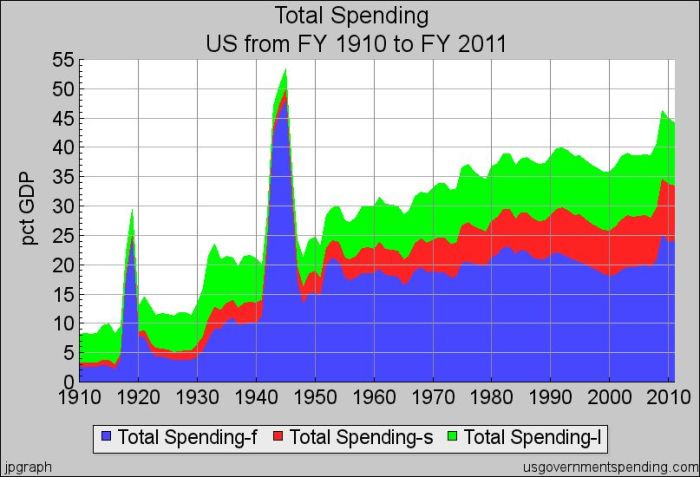
After 1910 however, there is what Lindert and Williamson call the “great leveling” where there is an important decrease in inequality which ends in 1970. This is where I become depressed. In my paper, I highlighted that most of the fall in inequality between 1910 and 1970 occurs because or regional convergence, gender wage convergence and racial wage convergence. Between the 1910s and 1970s, differences in per capita state-level incomes narrowed dramatically (and they have since slightly widened). Between 1910 and 1970, thanks to the migration of blacks to the north, wages between whites and blacks grew closer together. Between 1910 and 1970, thanks to the arrival of household amenities like running water, appliances and electricity, women joined the labor force and the gender wage gap narrowed. None of these factors have anything to do with redistributive policy. Now, I am not claiming that redistributive policy had no impact on inequality measures (that would be empirically false). What I am claiming is that numerous forces were at play – some of which were related to non-governmental factors. Between 1910 and 1970, if one looks at ratios of government spending to GDP, there is a massive increase in the size of government. And yet, many factors of convergence had little to do with government.

08-government-debt.jpg

Since the 1970s, inequality has surged again – and this is in spite of the fact that governments are growing larger in many respects. While spending is at all levels seems to be either stable or growing, regulatory barriers like licensing regulations and rent-seeking arrangements in the form of corporate bailouts have multiplied. Thus, the rise of inequality occurs in spite of a very active state. Not only that, but I am working on papers with John Moore of Northwood University to study inequality from 1890 to 1940 because we believe that the level is overestimated and misunderstood and (by definition) that this affects the trendline of inequality in the 20th century. If inequality in the 1920s falls slightly, the U-shaped curve of inequality (very high before 1910 falling to 1970 and increasing thereafter) described by Piketty and others becomes a flatter upward slopping curve (maybe more like a J-shaped curve). If me and John are correct (we are still crunching numbers and collecting data) inequality increased with state intervention.

And that is highly depressing. Now, I am a classical liberal who believes that state intervention should be limited. But it is not beyond to recognize that when the state throws tons of money of something, it might get a few things the way it wants (a broken clock is still right twice a day). Thus, I expected some social programs to have an impact (and I still believe that on a case-by-case basis, some social programs do reduce inequality) but I did not expect such a disappointing performance. One could even say “depressing” performance.

Nonetheless, I would suggest to everyone to read Unequal Gains and throw out Capital in the 21st century. 

Note: To be clear, Lindert and Williamson are not making the claim I am making here. While their book is predominantly a “positive economics” work, they do propose some policy courses to reduce inequality and argue favorably for redistributive policy. This is merely my “positive take” on their book.

Can we use tax data to measure living standards (part 2)?

Yesterday, my post on the differences in per capita income and total income per tax unit caused some friends to be puzzled by my results. To their credit, the point can be defended that tax units are not the same as households and the number of tax units may have increased faster than population (example: a father in 1920 filled one tax unit even though his household had six members, but with more single households in the 1960s onwards the number of tax units could rise faster than population for a time).

The problems regarding the use of tax units instead of households is not new. In fact, it is one of the sticking point advanced by skeptics like Alan Reynolds (see his 2006 book) and, more recently, by Richard Burkhauser of Cornell University (see his National Tax Journal article here).

Could it be that all the differences between GDP per person and income per tax unit are caused by this problem? Not really.

There is an easy to see if the problem is real. Both measures are ratios (income over a population). Either the numerator is wrong or the denominator is wrong. Those who view tax units as the problem argue that the problem is the denominator. I do not agree since I believe that the numerator is at fault. The way to see this is simply to plot total income reported by all tax units and compare this with real GDP. What’s the result?

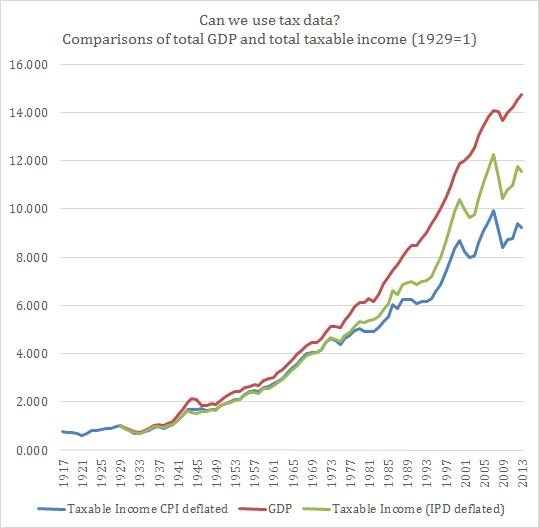
Even with tax-reported income being deflated with the Implicit Price Deflator (IPD) instead of the consumer price index, we end up with a difference (in 2013) of roughly 3 orders of magnitude between GDP and tax-reported income relative to the 1929 base point. Basically, GDP has increased by a factor of 14.749 since 1929 while IPD-deflated tax-reported income has only increased by a factor of 11.546.

TaxData

As a result, I do not believe that the problem is the tax unit issue. The problem seems to be that tax data is not capturing the same thing as GDP is!

Can we use tax units to measure living standards?

In the debate on inequality, I am a skeptic of how large a problem the issue is. Personally, I tend to believe that worries of inequality only increase when growth is stagnant. In fact, I also believe that there are numerous statistical biases causing us to misidentify stagnation as rising inequality. Most of the debate on inequality is plagued with statistical problems of daunting magnitudes (regional convergence in income, regional price levels, demographic changes, increasing heterogeneity of preferences, increasing heterogeneity of personal characteristics, income not being purely monetary, the role of taxes and transfers etc.)

One of them centers around the use of tax data. This has been the domain of Thomas Piketty and Emmanuel Saez. I can understand the appeal of using tax data since it is easily available and usable. Yet, is it perfect?

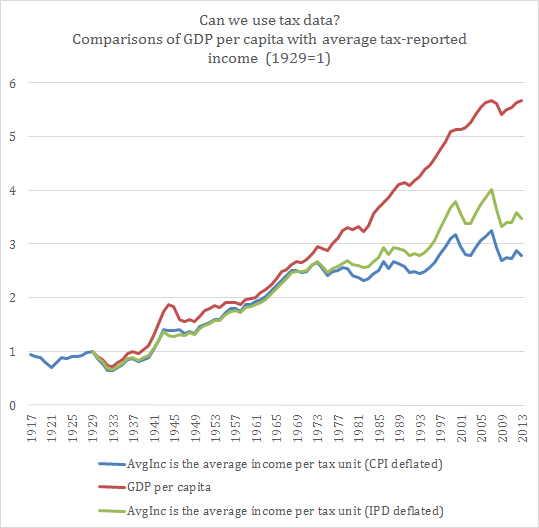
A year or two ago, I would have been inclined to simply say “yes” and not bother with the details. Theoretically, taxes should be an “okay” proxy for the income distribution and should follow average income even if at different levels. Yet, after reading the article of Phil Magness and Robert Murphy in the Journal of Private Enterprise I confess that I am no longer accepting anything as “granted” in the inequality debate. So, I simply decided to chart GDP per capita with the average taxable income per tax unit. Just to see what happens. Both are basically averages of the overall population, they should look pretty much the same (theoretically).  The data for the tax units is made available in the Mark W. Frank dataset based on the Piketty-Saez data (see here) and I deflated with both the CPI and the implicit price deflator available at FRED/St-Louis.

The result is the following and it shows two very different stories! Either the GDP statistics are wrong and we have average stagnation (which does not mean that there is no increase in inequality) or the taxable income data is wrong in estimating the trend of living standards and the GDP are closer to reality (which does not that there is no increase in inequality).  In the end, there is a problem to be assessed with the quality of the data used to measure inequality.

Tax Data

Basic income: a debate where demand magically disappears!

For a few months now, the case for the basic income has resurged (I thought it died with Milton Friedman in 2006, if not earlier). In the wake of this debate, I have been stunned by the level of disconnect between the pundits and what the outcome of the few experiments of basic income have been. The most egregious illustration of this disconnect is the case of the work disincentive.

To be clear, most of the studies find a minor effect on labor supply overall which in itself does not seem dramatic (see Robert Moffitt’s work here). Yet, this is a incomplete way to reflect on the equilibrium effect of a massive reform that would be a basic income.

Personally, I think that there is a good reason to believe that the labor supply reaction would be limited. At present, many tax systems have”bubbles” of increasing marginal tax rates. In some countries like Canada, the phasing out of tax credits for children actually mean that the effective marginal tax rate increases as income increases from the low 20,000$ to the mid 40,000$. As a result, a basic income would flatten the marginal tax rate for those whose labor supply curve is not likely to bend backward. In such a situation, labor supply could actually increase!

Yet, even if that point was wrong, labor supply could shift but without any changes in total labor provided. Under most basic income proposals, tax rates are dropped significantly as a result of a reduced bureaucracy and of a unified tax base (i.e. the elimination of tax credits). In such a situation, marginal tax rates are also lowered. This means greater incentives to invest (save) and acquire human capital. This will affect the demand for labor!

A paper in the Journal of Socio-Economics by  Karl Widerquist makes this crucial point. None of the experiments actually could estimate the demand-side reaction of the market. Obviously, a very inelastic labor demand would mean very little change in hours worked and the reverse if it was very elastic. But what happens if the demand curve shifts? Widerquist does not elaborate on shifts of the demand curve, but they could easily occur if a basic income consolidates all transfers (in kind and conditional monetary) allows a reduction in overall spending and thus the tax take needed to fund activities. In that case, demand for labor would shift to the right. A paper on the health effects of MINCOME in Manitoba (Canada) shows that improvement in health outcomes are cheaply attained through basic income which would entail substantial health care expenditures reduction.

I have surveyed the articles compiled by Widerquist and added those who have emerged since. None consider the possibility of a shift of the demand curve. Even libertarian scholars like Matt Zwolinski (who has been making the case forcibly for a basic income for sometime now) have not made this rebuttal point!

Yet, the case is relatively straightforward: current transfers are inefficient, basic income is more efficient at obtaining each unit of poverty reduction, basic income requires lower taxes, basic income means lower marginal tax rates, lower marginal tax rates mean more demand for investment and labor and thus more long-term growth and a counter-balance to any supply-side effect.

I hope that the Bleeding Heart Libertarians will take notice of this crucial point in favor of their argument!

The Dangerous Inequality Meme

The inequality of wealth and income has become a meme loaded with danger. A “meme” is an idea that gets propagated like genes in biology. Economic inequality has long been a topic of interest, but during the past few years, and especially during the 2015-2016 American elections, the inequality meme has erupted into a major political issue among those who identify as progressive, liberal, and socialist.

The facts about inequality in the USA are clear. Since 1970, income inequality has increased. As national income has grown, most of the gains have gone to the rich. Average incomes have even dropped since the recession of 2007-2009.

During the 1800s, the first economist to analyze equality and inequality was Henry George. Karl Marx had touched on economic inequality by saying that the surplus from production was due to labor but was captured by the capitalist, the owner of the firm and its tools. Thus, the proletariat, the workers, stay poor and the capitalists get rich, creating inequality. But Marx and his followers focused on the conflict between labor and capital rather than the inequality.

Henry George pointed out that the surplus from production is not in wages, nor in business profits, but in land rent, which is a pure surplus, since land has no cost of production. George showed how land rent captures the gains from economic progress, creating the inequality in wealth and income between workers and the landowners. Competitive firms make normal profits, which has no surplus. Of course monopolies can capture surplus also, but the profits from entrepreneurship are a bonus to society, rather than a social problem, as entrepreneurs drive innovation and economic progress.

Unfortunately, when the classical economics of the 1800s turned into the neoclassical doctrines of the 1900s, both by design (in opposition to the Georgist remedy of taxing land value) and for mathematical convenience, land was dropped as an input factor, and mainstream economics became the two-factor production function Q=f(K,L). It is illogical that land rent gets included in the distribution of income in the return on K, but excluded on the production side, as the models are based only on the two inputs, labor L and capital goods K. This contradiction is not questioned by graduate students in economics, who are too busy learning the calculus of “math econ” to bother asking if the whole system makes sense.

Therefore the inequality meme is now blended with the labor-capital meme, ignoring the real source of economic inequality, unequal land tenure. Politicians exploit the all-too-real economic inequality with a superficial, simplistic, and dangerous remedy: tax the rich and transfer the funds to the poor. Of course governments are doing that already, and that has not reduced inequality, but the welfare-statists insist that government should do more of it.

Conservative opponents of greater redistribution point out, correctly, that higher taxes and takings from the rich will stifle entrepreneurship and savings, reducing the economic growth. But other than eliminating some of the tax deductions and generating more growth by reducing the top tax rates, the conservatives have no effective remedy. Their call to flatten the tax rates play into the political agenda of the redistributionists who call for higher, not lower, tax rates on the rich.

The danger in the inequality meme is the confiscation of the wealth not just of the rich but also of the middle class. A family that spent all its income and now has no wealth would be given welfare aid, while the family with the same income but frugally saved its income for retirement or to provide for their children would have their wealth taken away, not just by ordinary and predictable taxation, but by a sudden taking, as happened in Cyprus in 2013. Government chiefs facing a debt crisis can kill two birds with one stone: confiscate savings and use some of it to pay off debt and the rest to transfer to the poor. Such confiscation has been suggested by the International Monetary Fund, which lends funds to countries bogged down in debt. In its publication Fiscal Monitor Report, the IMF stated (pdf):

The sharp deterioration of the public finances in many countries has revived interest in a “capital levy”— a one-off tax on private wealth—as an exceptional measure to restore debt sustainability. The appeal is that such a tax, if it is implemented before avoidance is possible and there is a belief that it will never be repeated, does not distort behavior (and may be seen by some as fair).” There we have the proposition that such confiscation of wealth can be “fair” (49).

This IMF capital-levy proposition was presented in Forbes with the title, “The International Monetary Fund Lays The Groundwork For Global Wealth Confiscation.” The Wikipedia article on “capital levy” shows that this meme is getting some traction, such as by Germany’s Bundesbank. The concept of a capital levy, confiscation of savings and investment, comes from the meme of economic inequality that looks only at the superficial existence of unequal wealth and not to the source.

It has been well pointed out by British journalist and economist Fred Harrison in his Youtube video “Ricardo’s Law: the Great Tax Clawback Scam” that while the rich pay much in taxes, many of them get the tax back, as a clawback, from government’s public goods, which generate higher rent and land value.

The effective and equitable remedy for economic inequality is not redistribution but the proper initial distribution of income. Wages and capital yields should be kept by the workers and investors, while land rent should be equally distributed either as cash or in public services. Public revenue from land rent would equalize income while promoting growth and raising wages. We need to bring land back into economic discourse, but that requires penetrating the appeal of superficial thinking. That’s what Henry George tried to do, and the Georgist meme had reached up to the heads of state in China, Great Britain, and Russia (after the first revolution with Kerensky), but World War I blasted the impending tax reforms to bits.

The candidates who now rant against inequality, the corporations, and the billionaires, even if they don’t win the election, will influence policy and generate calls for more redistribution and, perhaps in the next financial crisis, a capital levy. While alarmists often exploit impending doom for their own gains, sometimes they are right.

—————————–

This article is also in progress.org under the title “Tyrants Exploit Income Inequality”

[Ed. note: I added tags, categories, and links, and patched up some grammar – BC]

Tricks of Unequal Poverty: A Repost (In Honor of Bernie Sanders)

Note: This is an old post, reproduced today in honor of American Senator and presidential candidate Bernie Sanders

In the previous installment:

I explained how the general standard of living in America, denoted by real income, grew a great deal between 1975 and a recent date, specifically, 2007. This, in spite of a widespread rumor to the contrary. The first installment touched only a little on the following problem: It’s possible for overall growth to be accompanied by some immobility and even by some regress. Here is a made-up example:

Between the first and the second semester, grades in my class have, on the average, moved up from C to B. Yet, little Mary Steady’s grade did not change at all. It remained stuck at C. And Johnny Bad’s grade slipped from C to D.

Flummoxed by the sturdiness, the blinding obviousness of the evidence regarding general progress in the standard of living, liberal advocates like to take refuge in more or less mysterious statements about how general progress does not cover everybody. Or not everybody equally, which is a completely different statement. They are right either way and it’s trivial that they are right. Let’s look at this issue of unequally distributed economic progress in a skeptical but fair manner.

It’s awfully hard to prevent the poor, women and minorities from benefiting

I begin by repeating myself. As I noted in Part One, it’s too easy to take the issue of distribution of income growth too seriously. Some forms of improvements in living standard simply cannot practically be withheld from a any subgroup, couldn’t be if you tried. Here is another example: Since 1950, mortality from myocardial infarctus fell from 30-40% to 5-8%. (from a book review by A. Verghese in Wall Street Journal 10/26 and 10/27 2013). When you begin looking at these sort of things, unexpected facts immediately jump at you.

Fishing expeditions

The US population of 260 millions to over 300 million during the period of interest 1975-2007 can be divided in an infinity of segment, like this: Mr 1 plus Mr 2; Mr 2 plus Mrs 3; Mr 2 and Mrs3 plus Mr 332; Mr 226 plus Mrs 1,000,0001; and so forth.

Similarly, the period of interest 1975 to 2007 can be divided in an infinity of subperiods, like this: Year 1 plus year 2; year 1 plus year 3; years 1, 2, 3 plus year 27; and so forth. You get the idea.

So, to the question: Is there a subset of the US population which did not share in the general progress in the American standard of living during some subperiod between 1975 and 2007?

The prudent response is “No.” It’s even difficult to imagine a version of reality where you would be right to affirm:

“There is no subset of the US population that was left behind by general economic progress at any time during the period 1975- 2007.”

Let me say the same thing in a different way: Given time and good access to info, what’s the chance that I will not find some Americans whose lot failed to improve during the period 1975 to 2007? The answer is zero or close to it.

This is one fishing expedition you can join and never come back empty-handed, if you have a little time.

Thus, liberal dyspeptics, people who hate improvement, are always on solid ground when they affirm, “Yes, but some people are not better off than they were in 1975 (or in ______ -Fill in the blank.)” The possibilities for cherry-picking are endless (literally).

Everyone therefore has to decide for himself what exception to the general fact of improvement is meaningful, which trivial. This simple task is made more difficult by the liberals’ tendency to play games with numbers and sometimes even to confuse themselves in this matter. I will develop both issues below.

To illustrate the idea that you have to decide for yourself, here is a fictitious but realistic example of a category of Americans who were absolutely poorer in 2007 that they were in 1975. You have to decide whether this is something worth worrying about. You might wonder why liberals never, but never lament my subjects’ fate.

Consider any number of stock exchange crises since 1975. There were people who, that year, possessed inherited wealth of $200 million each, generating a modest income of $600,000 annually. Among those people there were a number of stubborn, risk-seeking and plain bad investors who lost half of their wealth during the period of observation. By 2007, they were only receiving an annual income of $300,000. (Forget the fact that this income was in inflation shrunk dollars.) Any way you look at it, this is a category of the population that became poorer in spite of the general (average) rise in in American incomes. Right?

Or, I could refer to the thousands of women who were making a living in 1975 by typing. (My doctoral dissertation was handwritten, believe it or not. Finding money to pay to get it typed was the hardest part of the whole doctoral project.) One of the many improvements brought about by computers is that they induced ordinary people to learn to do their own typing. Nevertheless, there was one older lady who insisted all along on making her living typing and she even brought her daughter into the trade. Both ladies starved to death in 2005. OK, I made them up and no one starved to death but you get my point: The imaginary typists fell behind, did not share in the general (average) improvement and their story is trivial.

So, I repeat, given a some time resources, I could always come up with a category of the US population whose economic progress was below average. I could even find some segment of the population that is poorer, in an absolute sense, than it was at the beginning of the period of observation. Note that those are two different finds. Within both categories, I could even locate segments that would make the liberal heart twitch. I would be a little tougher to find people who both were poorer than before the period observation and that would be deserving of liberal sympathy. It would be a little tough but I am confident it could be done.

So, the implication here is that when it comes to the unequal distribution or real economic growth you have to do two things:

A You have to slow down and make sure you understand what’s being said; it’s not always easy. Examples below.

B You have to decide whether the inequality being described is a moral problem for you or, otherwise a political issue. (I, for one, would not lose sleep over the increased poverty of the stock exchange players in my fictitious example above. As for the lady typists, I am sorry but I can’t be held responsible for people who live under a rock on purpose.)

Naively blatant misrepresentations

A hostile liberal commenter on this blog once said the following:

“Extreme poverty in the United States, meaning households living on less than $2 per day before government benefits, doubled from 1996 to 1.5 million households in 2011, including 2.8 million children.”

That was a rebuttal of my assertion that there had been general (average) income growth.

Two problems: first, I doubt there are any American “households” of more than one person that lives on less than $2 /day. If there were then, they must all be dead now, from starvation. I think someone stretched the truth a little by choosing a misleading word. Of maybe here is an explanation. The commenter alleged fact will provide it, I hope.

Second, and more importantly, as far as real income is concerned, government benefits (“welfare”) matter a great deal. Including food stamps, they can easily triple the pitiful amount of $2 a day mentioned. That would mean that a person (not a multiple person- household ) would live on $1080 a month. I doubt free medical care, available through Medicaid, is included in the $2/day. I wonder what else is included in “government benefits.”

The author of the statement above is trying to mislead us in a crude way. I would be eager to discuss the drawbacks of income received as benefits in- instead of income earned. As a conservative, I also prefer the second to the first. Yet, income is income whatever its source, including government benefits.

The $2/day mention is intended for our guts, not for our brains. Again, this is crude deception.

Pay attention to what the other guy asserts sincerely about economic growth.

Often, it implies pretty much the reverse of what he intends. In an October 2013 discussion on this blog about alleged increasing poverty in the US, asked the following rhetorical question:

“Or have Americans’ standard of living only improved as the gap [between other countries and the US] closed?“

I meant to smite the other guy because the American standard of living has only increased, in general, as we have seen (in Part One of this essay posted). A habitual liberal commenter on my blog had flung this in my face:

“….Since 1975, practically all the gains in household income have gone to the top 20% of households…” (posted 10/23/13)

(He means in the US. And that’s from a source I am not sure the commenter identified but I believe it exists.)

Now, suppose the statement is totally true. (It’s not; it ignores several things described in Part One.) The statement says that something like roughly 60 million Americans are richer than they, or their high income equivalents were in 1975. It also says that other households may have had almost stationary incomes (“practically”). The statement does not say in any way that anyone has a lower income in 1975. At best, the statement taken literally, should cause me to restate my position as follows:

“American standards of living have remained stationary or they have improved….”

You may not like the description of income gains in my translation of the liberal real statement above. It’s your choice. But the statement fails to invalidate my overall assertion: Americans’ standard of living improved between 1975 and 2007.

What the liberal commenter did is typical. Liberals always do it. They change the subject from economic improvement to something else they don’t name. I, for one, think they should be outed and forced to speak clearly about what they want to talk about.

Big fallacies in plain sight

Pay attention to seemingly straightforward, common liberal, statist assertions. They often conceal big fallacies, sometimes several fallacies at once.

Here is such an assertion that is double-wrong.

“In the past fifteen years the 20% of the population who receive the lowest income have seen their share of national income decrease by ten percentage points.” (Posted as a comment on my blog on 10/21/13)

Again, two – not merely one – strongly misleading things about this assertion. (The liberal commenter who sent it will assure us that he had no intention to mislead; that it’s the readers’ fault because, if…. Freaking reader!)

A The lowest 20% of the population of today are not the same as those of fifteen years ago, nor should you assume that they are their children. They may be but there is a great deal of vertical mobility in this country, up and own. (Just look at me!)The statement does not logically imply that any single, one recognizable group of social category became poorer in the interval. The statement in no way says that there are people in America who are poor and that those same people became poorer either relatively or in an absolute sense. Here is a example to think about: The month that I was finishing my doctoral program, I was easily among the 20% poorest in America. Hell, I probably qualified for the 5% poorest! Two months later, I had decisively left both groups behind; I probably immediately qualified for the top half of income earners. Yet, my progress would not have falsified the above statement. It’s misleading if you don’t think about it slowly, the way I just did.

I once tried to make the left-liberal vice-president of a Jesuit university understand this simple logical matter and I failed. He had a doctorate from a good university in other than theology. Bad mental habits are sticky.

B Percentages are routinely abused

There is yet another mislead in the single sentence above. Bear with me and ignore the first fallacy described above. The statement is intended to imply that the poorer became poorer. In reality, it implies nothing of the sort. Suppose that there are only two people: JD and my neighbor. I earn $40, neighbor earns $60. In total, we earn. $100 Thus my share of our joint income is 40%, neighbor’s is 60%. Then neighbor goes into business for himself and his income shoots up to $140. Meanwhile, I get a raise and my income is now $60.

In the new situation, my share of our joint income has gone down to 30% (60/60+140), from 40%. (Is this correct? Yes, or No; decide now.) Yet, I have enjoyed a fifty percent raise in income. That’s a raise most unions would kill for. I am not poorer, I am much richer than I was before. Yet the statement we started with stands; it’s true. And it’s misleading unless you pay attention to percentages. Many people don’t. I think that perhaps few people do.

My liberal critic was perhaps under the impression that his statement could convince readers that some Americans had become poorer in spite of a general (average rise) in real American income. I just showed you that his statement logically implies no such thing at all. If he want to demonstrate that Americans, some Americans, have become poorer, he has to try something else. The question unavoidably arises: Why didn’t he do it?

Was he using his inadequate statement to change the subject without letting you know? If you find yourself fixating on the fact that my neighbor has become even richer than I did because he more than doubled his income, the critic succeeded in changing the subject. It means you are not concerned with income growth anymore but with something else, a separate issue. That other issue is income distribution. Keep in mind when you think of this new issue that, in my illustration of percentages above, I did become considerably richer.

Liberals love the topic of unequal progress for the following reason:

They fail to show that, contrary to their best wish, Americans have become poorer. They fail almost completely to show that some people have become absolutely poorer. They are left with their last-best. It’s not very risky because, as I have already stated, it’s almost always true: Some people have become not as richer as some other people who became richer!

Policy implications of mis-direction about income growth

The topic matters because, in the hands of modern liberals any level of income inequality can be used to call for government interventions in the economy that decrease individual liberty.

Here are a very few practical, policy consequences:

A Income re-distribution nearly always involves government action, that is, force. (That’s what government does: It forces one to do what one wouldn’t do out of own inclination.) That’s true for democratic constitutional governments as well as it is for pure tyrannies. In most countries, to enact a program to distribute the fruits of economic growth more equally it to organize intimidation and, in the end, violence against a part of the population. (For a few exceptions, see my old but still current journal article: “The Distributive State in the World System.“ Google it.) This is a mild description pertaining to a world familiar to Americans. In the 1920s, in Russia, many people (“kulaks”) were murdered because they had two cows instead of one.

Conservatives tend to take seriously even moderate-seeming violations of individual liberty, including slow-moving ones.

B Conservatives generally believe that redistribution of income undermines future economic growth. With this belief, you have to decide between more equality or more income for all, or nearly all (see above) tomorrow?

It’s possible to favor one thing at the cost of bearing the travails the other brings. It’s possible to favor the first over the second. This choice is actually at the heart of the liberal/conservative split. It deserves to be discussed in its own right; “Do your prefer more prosperity or more equality?” The topic should not be swept under the rug or be made to masquerade as something else.

If you are going to die for a hill, make sure it’s the right hill.

PS: There is no “income gap.”
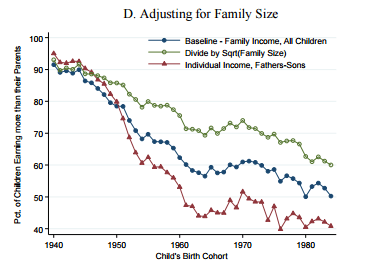
Growing Poverty in the US: A Repost (In Honor of Bernie Sanders)

This is an old post, reproduced today in honor of American Senator and presidential candidate Bernie Sanders

It’s vital to the liberal narrative that pretty much everything has to go generally downhill (except global warming, of course, which is always going up even when it’s not, like right now). Life has to deteriorate, they think. That things are getting worse is an article of faith among liberals; it’s even a tenet of their faith. (If things are swimming along fine, what excuse is there for government intrusion?) You might even say that most liberals hate most good news. Prominent among the liberals’ permanent myths is the belief that Americans have become poorer except for a tiny minority of the very rich __________% (Fill in the blank.) In its most common version the idea is that Americans’ real standard of living has done nothing but decline since sometimes in the seventies. This, whatever the numbers say.

I, for one, know it’s not true. I was there, after all, from the beginning, even from before the beginning! I remember well how bad the good old days were in many respects. I am distressed that some people with apparently conservative or libertarian ideas have now also espoused this false belief. In this essay in two parts, I try to help readers find their way in the midst of often misleading or downright false statements that seem to support this erroneous belief. As usual, I do not address myself to specialists but rather to the intelligent but ignorant. Specialists are welcome to comment if they agree to do it in English or in some other official language.

Two forewords

1 I don’t contend that I understand what happened to American real incomes during the current crisis, say, between 2009 and 2013. I will say nothing about this recent period. (If I told you what I suspect happened, you might be astounded, though.) I refer in this essay only to the period 1975-2007.

2 I believe poverty and prosperity have to be measured in terms of real income, income as experienced by real human beings: It’s not how many dollar bills you have in your wallet, it’s what your paycheck actually buys that matters. This brings up several tough technical problems we will get into presently or in the next episode. If you think of poverty in different terms, I am not sure I have anything useful to say to you.

The superficial facts

General federal statistics, all OECD figures, all World Bank numbers show that on the average Americans have become considerably richer since 1975. Nevertheless, these statistics, contrary to a now common belief – significantly understate the economic progress of Americans. We, in general, have become vastly richer than were were then.

I will deal later explicitly with the issue of possible differences between what the average shows and the economic progress of sub-categories of the US population. In the meantime, I must point out that some common forms of enrichment cannot be confined to a particular group. Cleaner drinking water, for example, is usually cleaner for everyone. It would be impractical to reserve wells of dirty, polluted water for the poor or for racial minorities. (However, if you search a little you might actually find liberal allegations of such segregation or, at least, the intimations of such. National Public Radio is a good bet.)

Here is what I don’t intended to do, don’t do: I do not accuse government statistics of lying. I help others read them and complement them where they need to be complemented. There is not government conspiracy designed to mislead us about the living standards of Americans, I think.

Major (unintended) sources of bias.

There are three major sources of bias in expressing standard of living that understate, underestimate, understate economic betterment. I explain them below.

Ballooning health expenditures

Since the seventies, most employed Americans have taken most of their pay raises in the form of health benefits. This results from a historically accidental peculiarity of the American wage and benefit system going back to WWII. (It may be getting removed by the implementation of Obamacare as I write in 2013). The large increase in health expenditures provided by employers do not appear in wage statistics. Yet, they constitute consumption in a way similar to straight wages. In fact, wherever people are given a choice between more steak and more health care, they seem to chose more steak and more health care. Health care possesses an interesting characteristic all of its own: While there is a limit to how much steak an individual can ingest, there is no limit at all to how much health care -broadly defined – the same individual can absorb. It’s close to infinite. Why, I am considering right now some surgery to correct a nose I have not really liked for more than sixty years!

Whether it is a wise societal choice to spend apparently limitless resources on health care, much of it for the old and economically unproductive is an interesting issue in its own right. However, it’s not my issue here. Health services have been produced in vast quantities since 1975. They were eagerly consumed by Americans. Health expenditures constitute a part of the standard of living. If you don’t believe this, just ask yourself if the withdrawal of all health care would not be a lowering of the standard of living.

Better quality of common goods

Common objects on which comparisons of living standard across time are based have improved tremendously in quality. This is difficult, sometimes impossible to measure. Indices of comparison across time (1975 to 2007) don’t do a good job of it.

Nominal wages, the numbers printed on your paychecks, have to be corrected for inflation. We all know that a dollar does not buy as much as it did in 1975. (Around that time, my salary of $20,000/year was quite comfortable.) Federal international and private organizations in charge of these things do their very best to correct raw numbers in meaningful ways. However, they meet with several limitations because things of 1975 are often radically different from what bears the same name in 2007.

(Note: The agencies in charge do their best and mostly intelligently. Again, I am not faulting their efforts. Also, I think there is little intellectual fraud involved in this work because their results are among the most and best scrutinized in the history of the world.)

Here is an example: I suspect that the average television set of 1975 was like mine was then: It was small, offered only black and white images, often had scratchy sound, and gave access to little more than three national networks. Watching television then was like eating in a mediocre restaurant that offered only three dishes (and there was maybe a hot dog stand outside).

When economists correct for inflation, they have little choice but to compare that television set with a modern ultra-flat etc… Hence, when they report that the cost of a television set has increased in face dollars by, say, 100%, they are not able to take into account that the actual service (the enjoyment) attached to a contemporary set with precise colors, faithful sound that is a gateway to 300 sources is ten times, or one hundred times, greater than what I derived from my 1975 B&W set.

This example can pretty much be turned into a general rule: Everything is better, works better, tastes better, gives more service than its equivalent back then. When you find a seeming exception, you soon discover that it’s not real. Two examples of exceptions that don’t resist examination:

A     Cars are more expensive now than then by several measures. This means that it takes more days of mean (average) American wages to buy the cheapest car in American than it did then. But the cheapest car on American roads today are vastly better in every way than their supposed equivalent back then. They break down less often; they are safer (weight for weight); they require much less maintenance. (Older people will remember the days when every car required an oil change every 5,000 miles and when prudent car owners changed oil every 3,500 miles.)

In addition, much of the rise in real car prices is due to mandated safety and environmental buffers now built into them that did note exist in 1975. (It’s startling to see in not-so-old movies parents getting into the family car with their children and driving off with no one buckling safety belts because there aren’t any.) No matter how one feels about the current health and environmental restrictions pushing upward car prices, they are undeniably form of consumption. It’s useless to cry,” I don’t want it” when you imposed it on yourself through the political process you deem legitimate in every way.

B     Many older people, and I am often tempted to join them, believe that any number of produce just tasted better back then, produce such as tomatoes and strawberries, for example. This is pure delusion. Here is how I know: Several times, I have steeled my resolve, put cash in my pocket and directed my steps to the local farmers’ market. There, against all my instincts, I purchase a pound of organic tomatoes or a tiny basket of grossly priced strawberries. Now organic produce is not better for you (See “organic food” on this blog.) but it’s often fresher, and often handpicked. Each time, I recovered in my mouth the taste of produce of my youth. Each time, I did the calculations only to rediscover anew that the outrageous cost of the farmer’s market produce was actually less, as a percentage of any income, or in inflation-corrected dollars, than the equivalents did when I was young.

We have become used to paying little for mediocre produce, the better produce of yesteryear are still available. They are not even especially expensive. They appear expensive because we are spoiled by general low food prices.

An then, of course, there is the coffee. It was so vile then, coast-to-coast, in 1975 that if anyone but a drunks’ bar served it today he would probably be indicted. And then, there is bread that would have qualified as light construction material. The list is endless: In the good old days, most things were mediocre to very bad and they were, in fact expensive. Current measures are seldom able to take improvement in quality into account. For this reason, they understate average economic progress in America between 1975 and 2007.

I repeat that this average economic progress is also mostly widespread, available to all parts of the population. There are, in fact, few corner bakeries operating especially in the ghetto and specializing in nutritionally unsound, bad-tasting bread for African-Americans.

There may be an exception to the general rule that things have become cheaper in thirty years with constant quality I am not able to deal with here. It may be a major exception: Housing in all its forms may be more expensive in real terms now than it was in 1975. Much housing is the same now as it was then, so prices matters a great deal. Thus, better quality would not explain superior cost. I am eager to see sources on this issue and to publish them here.

New goods, new services

When comparing the prices of things and services then and now, economists are not able, of course, to take into account objects and services that simply did not exist then. This inescapable fact also understates the real progress in living standards. I repeat: Some good things are not counted at all in comparisons of the standard of living then and now because they did not exist at all then. This fact in itself constitutes an overstatement of the standard of living of then. The Internet and its many manifestations, its many subordinate services, such as Google, are a case in point.

I hasten to add that this judgment does not depend on how much you, personally value the Internet and its multiple offerings. To demonstrate that it’s a form of consumption, it’s enough to observe that few of those who can have access to the Internet actually turn it down. I, for example, like most residents of developed societies probably know more than one thousand people. Of the people I know, only three refuse to gain Internet access (and they periodically cheat by catching a ride on a relative’s network tool!)

I can hear some older readers grumble ( as one did recently on this blog) that newfangled technical innovations, such as the Internet and hugely better television, actually made life worse. I smile sarcastically inside for the following reason: Very few Americans seem to be following the primitivist dream implicit in such judgment and make for the wilderness. This, although it would be easy because there is probably more and more undeveloped, empty space in America as the population become more concentrated in a few mega cities. This is too has improved since 1975: There is more and wilder wilderness.

Summary

Large health expenditures, better products, more products have increased the general standard of living of Americans considerably beyond what wage and income statistics show. This statement is implicitly based on averages. The demonstration above does not exclude the logical possibility that some sectors of American society were worse off in 2007 than they, or their equivalents were in 1975. This issue is dear to liberal sensitivity. I deal with it in Part 2, soon forthcoming.

The Two Ultimate Religions

Religions provide ultimate visions of reality and values. They have different views about the reality of the divine, and about what is sacred, but for life on earth, what counts most is religious ideas about the reality of human beings and the value of human life.

The two basic concepts about human life are equality and supremacy. Either one believes that all human life is equally worthy, sacred, and important, or else one believes that the members and followers of one’s religion have supremacy over other human beings. Either one values all human beings as equally human, with equal rights to life and property, or else one values the members of one’s religion as superior, with superior rights to life and property.

Almost everyone believes that one’s own religion is the correct one. Some people may have doubts, but few believe that other religions are more true, otherwise they would convert, unless forbidden to do so. Religious egalitarians believe that even though their faith is the true one and the best of all religions, nevertheless the people of other faiths have an equal moral worth, and so their lives, property, and freedom are to be respected.

Religious supremacists believe that not only are their beliefs true, and their values correct, but also that holding their beliefs, or being descended from believers, entitles them to superiority in human worth, so that they are authorized, and even required, to forcibly convert others and, at the most extreme, take their property and lives.

The divide between egalitarians and supremacists cuts across all the major religions. People of all faiths have attacked, enslaved, killed, looted, and conquered those of other religions. Even when supremacy is not an explicit religious belief, when one group conquers and enslaves another, their members at least implicitly believe that they are superior, even if only because of their power.

There are also members of all faiths who believe that, however superior, true, and sacred are their own beliefs and values, those of other faiths are equally entitled to live according to their creeds. Whatever else their religion may say about others, they believe that all people are equally human and of equal human value.

This, then, is the great religious divide, which affects every person. Atheists too are part of this divide. The atheists chiefs of Communist parties believed in the superiority of their creed, and they conquered lands, killed opponents, and imposed their control over others. Extreme nationalists have had a supremacist nationalist belief in addition to other ideas, which formed their overall religion. Supremacism may be personal, ideological, and otherwise not associated with a theistic belief, but as a view of ultimate reality and values, it is a religion that is mixed in  with other ideas.

Human beings live in a mental as well as physical universe. In our mental universe, either we believe in human equality, or not. Egalitarianism and supremacism are, however, matters of degree. Some may be more mildly supremacist, letting those of other beliefs live, but subjecting them to higher taxes, tighter restrictions, and lacking the privileges of those of superior beliefs. In the relatively tolerant societies, people are allowed to practice their religions to some extent, but there are beliefs and values, even if not in a theistic creed, that are imposed on everyone. This is why throughout the world, governments have victimless crimes. They prohibit activities such as drug use and gambling, and they censor some words, ideas, and depictions.

One supremacist idea shared by most people is the moral worth of majorities relative to minorities. Most people in today’s world believe in the superiority of majorities. If a majority of voters believe that everyone should be taxed, restricted, and forced, this is, in their view, proper, because the majority has moral supremacy. Majoritarianism is a religion, as a belief and value.

Another supremacist view is that persons who have conquered land, and their heirs, when there are no other documented claimants or survivors, have a superior status. The egalitarian position is that all human beings have an equal right to the benefits of the land that nature provided. Equality does not require equality in possession, which is not possible, but an equal share of the economic benefit, as measured by what people are willing to pay to use land.

If we take human equality to its ultimate logical conclusion, each person has an equal natural right to live, work, own property, and completely direct his life, with no restriction or imposed cost on his peaceful and honest actions. Liberty and equality are complementary.

Very few people believe in complete human equality. But we should at least strive to achieve  equal rights for life and equal rules for property. Whatever else our creeds may say, we should have a minimal egalitarianism in law and policy, so that innocent people may live, own property, and be able to live, to a great extent, in accordance to their beliefs and values. If we can achieve minimal global egalitarianism, that would be a great achievement.

Note: this article also appears in http://www.progress.org

The Dalai Lama on Inequality

There are many people who blame “capitalism” for the world’s economic problems, such as poverty, unemployment, inequality, and environmental destruction. This common belief is based on a confusion of meaning, and a lack of analysis. It is neither surprising nor noteworthy that many people fail to apply consecutive thought to economic issues, but it is sad that the Dalai Lama, as an influential religious leader, has not fully applied his compassionate thought to examine the causes and effective remedies of social problems.

The Dalai Lama, leader of Tibetan Buddhists, has identified himself as a Marxist socialist. He blames “capitalism” for economic inequality, and sees the Marxist alternative as the alternative that would increase equality. He advocates a more “human approach,” which implies less “capitalism” and more socialism. The Dalai Lama adds that he is not a Leninist, meaning that his Marxist views do not imply a desire for a totalitarian state.

The Dalai Lama believes that Marxism is founded on moral principles, such as economic equality, while “capitalism” is founded only on the pursuit of profit. His social and economic views were published in the 1996 book Beyond Dogma: Dialogues and Discourses. He said there that Marxism is concerned with the poor and with exploited minorities. Therefore, he said, “I think of myself as half-Marxist, half-Buddhist.” The Dalai Lama had studied Marxist ideology in China during the 1950s, and became attracted to it.

The essential problem with the word “capitalism” is that it is used both as a label for current economies, which are a mixture of markets and governmental interventions, and for the concept of private enterprise and free markets. Its use as a label for mixed economies makes it meaningless to blame “capitalism” for economic problems.

This confusion is similar to blaming diets for ill health. The diet of most people is a mixture of healthy foods such as vegetables and unhealthy stuff such as excessive sugar. The proposition that “diets” cause illness may be true, but it tells us nothing about which elements of our diets are causing the problem.

Likewise, to blame “capitalism,” meaning the mixed economy, for economic inequality, is meaningless, as this does not tell us which elements of the economy are causing the problem, whether it is markets or interventions. Blaming “capitalism” is worse than useless; it fogs the mind, because the label for mixed economies gets confused with the other meaning, private enterprise, so that, in a sly tacit shift of meanings, markets get blamed for economic woes.

It is meaningless to accuse “capitalism,” as a label, as only caring about profit and ignoring the poor, because the actual “mixed economy” cannot have any thoughts or feelings. Moreover, the concept of a pure market economy does have an ethical basis. The pure market is an economy in which all activity is voluntary. The concept of voluntary human action implies the existence of a universal ethic, or natural moral law, that designates acts as good, evil, or neutral, with voluntary action being good or neutral, and involuntary action consisting in coercive harm, which is evil.

One of the premises from which natural moral law is derived is the concept of human equality, that human beings have an equal moral worth, and should therefore be equal in the application of law. Human equality does not imply that all persons should have an equal income or wealth, because moral equality implies an equal self-ownership (or ownership of one’s body) of all persons. Therefore, each person properly owns his wage and the goods and investments bought from his wage. Income, however unequal, that comes from labor, including entrepreneurship, is not an evil outcome.

The mixed economy does create poverty, but not from private entrepreneurship. The poverty comes from government’s taxing the poor and subsidizing the rich. A study by the Institute on Taxation and Economic Policy and the Pew Research Center recently concluded that the poorest fifth of households pay more than twice the state and local tax rate (11 percent) as the richest one percent. Also, although the rich pay a much higher tax rate on their income, many of the rich get their money back implicitly in the form of the higher rent and land value generated by government spending, paid for by taxes on wages, goods, and enterprise profits. The taxes on the poor are even higher than that found in the study, as there are federal excise taxes included in goods, and also, federal taxes and restrictions on labor and self-employment add to the interventionist burden of the poor.

The economist Henry George wrote that “There is in nature no reason for poverty.” Poverty and excessive inequality are caused by human institutions. If Marxism implies income redistribution or government ownership of industry, this treats, and mistreats, the symptoms, not the causes. The main causes are the stifling of labor and enterprise from taxation and imposed barriers. The ultimate remedy is a completely free market, with voluntary, contractual, decentralized governance. Given today’s states and taxes, government interventions can be minimized with a constitutional prohibition of restrictions and imposed costs on peaceful and honest enterprise, thus with taxes only on bad effects – pollution – and on the ground rent generated by government’s public goods.

If he understood the ethics and economics of liberty, then the Dalai Lama would become a much greater global leader in promoting effective reforms that would not only promote liberty but also greater prosperity and social peace.