The Cruel, Conceited Follies of Trump’s Foreign Policy: 2026 Edition

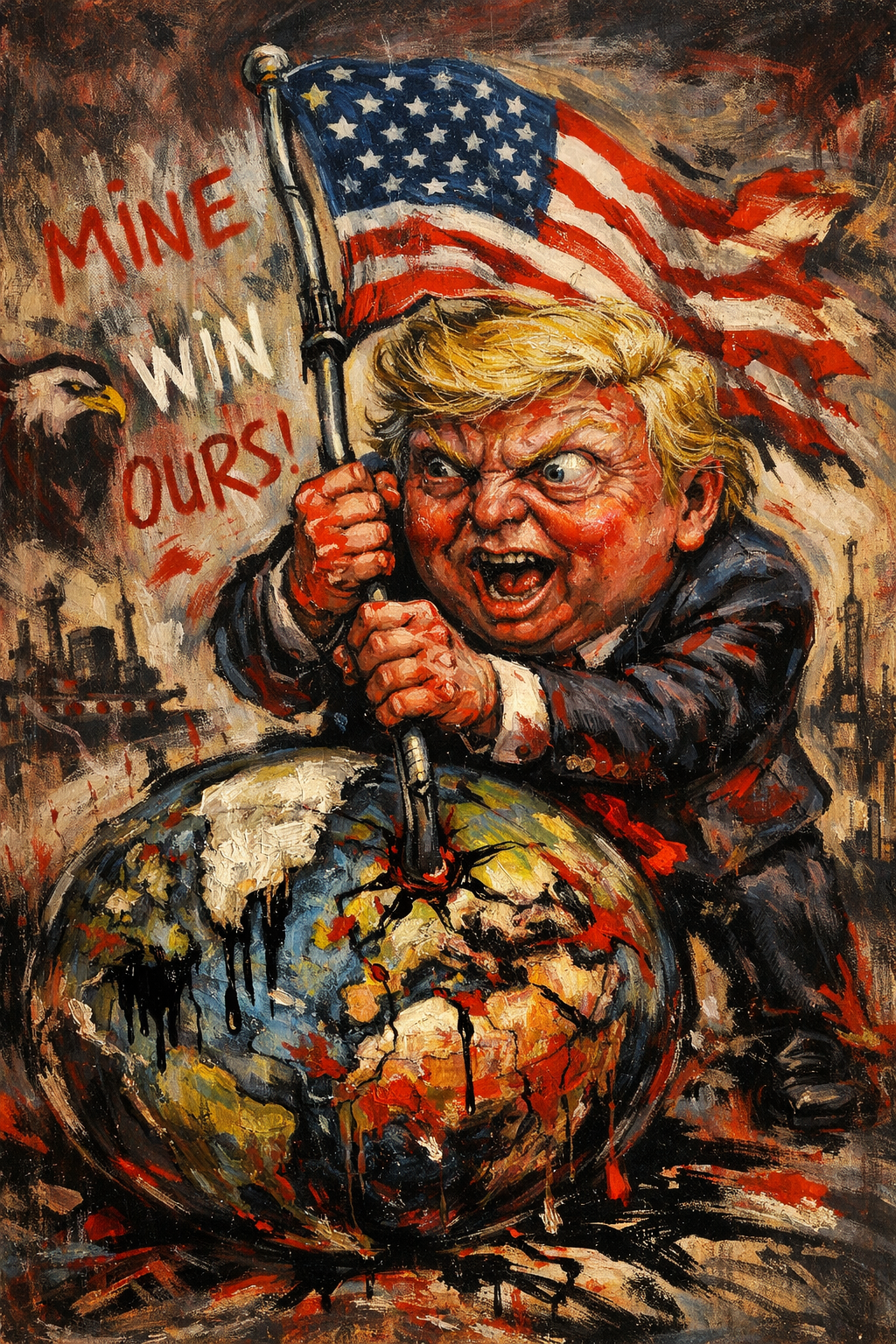
A neo-expressionist painting of Trump jamming an American Flag into the Globe with "Yours Win Ours" written in blood in the background, a bald eagle, and pastiches of factories and oil refineries.

Trump has now taken extralegal military action in Venezuela. Trump is strongly considering such action in Iran. And Trump keeps flirting with aggressive globally destabilizing military annexation of Greenland, a NATO ally. Many people are acting perplexed. After all, didn’t libertarian “genius” and totally-not-delusional-reactionary Walter Block tell us back in 2016 that libertarians should vote for Trump because he is anti-war? After this proved to be false the first term, didn’t totally-not-delusional-reactionary Walter Block then tell us again case for libertarianism was that he was anti-war and anti-foreign intervention, and that he was super cereal this time?

Sarcasm aside, I think it is worth revisiting why Trump’s foreign policy turn towards a radical sort of imperialist interventionism is so evil and unsurprising. I was confident back in 2016 that he was always going to be an old-school imperialist who uses US military conquest purely for resource extraction in a way that would be far worse than neocon warmongering. I wrote at the time, following Zach Beauchamp (who continues to emphasize this point), that Trump’s foreign policy was neither the neo-conservative interventionism of the Clintons and Bushes of the world, nor the principled anti-interventionism of libertarian scholars like Christopher Coyne and Abigail Hall, nor even the nationalist isolationism of paleoconservatives like James Buchanan. Instead, Trump’s foreign policy has always (quite consistently, since he was still a pro-choice democrat in the 90s) been about advancing inchoate national economic and political interestswhich really just means the interests of the politically connected.

This connection between Trump’s completely crankish economic nationalism and his imperialist foreign policy is even tighter now than it was then. It seems Trump is likely facing a rejection of his unconstitutional overreach of unilaterally applying economically suicidal tariffs from SCOTUS. The tariffs, which originally, might I add, were based on perhaps the single dumbest attempt to do economics I have ever seen, appeared to be lifted straight from ChatGPT, given that his main economic advisor on these matters, Peter Navarro, is literally a fraudster. As a result, he now seems to be manufacturing a national security crisis so he can impose tariffs without congress’ blessing.

But I do not want to revisit Trump’s imperialist foreign policy just to gloat. I also want to revisit and restate why this foreign policy is unbelievably unjust and self-destructive. What I wrote back in 2016 is still worth reposting at length:

First, Trump’s style of Jacksonian foreign policy is largely responsible for most of the humanitarian atrocities committed by the American government. Second, Trump’s economic foreign policy is antithetical to the entire spirit of the liberal tradition; it undermines the dignity and freedom of the individual and instead treats the highest good as for the all-powerful nation-state (meaning mostly the politicians and their special interests) as the end of foreign policy, rather than peace and liberty. Finally, Trump’s foreign policy fails for the same reasons that socialism fails. If the goals of foreign policy are to represent “national interest,” then the policymaker must know what that “national interest” even is and we have little reason to think that is the case, akin to the knowledge problem in economic coordination.

… This is because the Jacksonian view dictates that we should use full force in war to advance our interests and the reasons for waging war are for selfish rather than humanitarian purposes. We have good reason to think human rights under Trump will be abused to an alarming degree, as his comments that we should “bomb the hell out of” Syria, kill the noncombatant families of suspected terrorists, and torture detainees indicate. Trump is literally calling for the US to commit inhumane war crimes in the campaign, it is daunting to think just how dark his foreign policy could get in practice.

To reiterate: Trump’s foreign policy views are just a particularly nasty version of imperialism and colonialism. Mises dedicated two entire sections of his chapter on foreign policy in Liberalism: The Classical Tradition to critiquing colonialism and revealing just how contrary these views are to liberalism’s commitment to peace and liberty. In direct opposition to Trump’s assertions that we should go to war to gain another country’s wealth and resources and that we should expand military spending greatly, Mises argues:

“Wealth cannot be won by the annexation of new provinces since the “revenue” deprived from a territory must be used to defray the necessary costs of its administration. For a liberal state, which entertains no aggressive plans, a strengthening of its military power is unimportant.”

Mises’ comments on the colonial policy in his time are extremely pertinent considering Trump’s calls to wage ruthlessly violent wars and commit humanitarian crises. “No chapter of history is steeped further in blood than the history of colonialism,” Mises argued. “Blood was shed uselessly and senselessly. Flourishing lands were laid waste; whole peoples destroyed and exterminated. All this can in no way be extenuated or justified.”

Trump says the ends of foreign policy are to aggressively promote “our” national interests, Mises says “[t]he goal of the domestic policy of liberalism is the same as that of its foreign policy: peace.” Trump views the world as nations competing in a zero-sum game and there must be one winner that can only be brought about through military conquest and economic protectionism, Mises says liberalism “aims at the peaceful cooperation between nations as within each nation” and specifically attacks “chauvinistic nationalists” who “maintain that irreconcilable conflicts of interest exist among the various nations[.]” Trump is rabidly opposed to free trade and is horrifically xenophobic on immigration, the cornerstone of Mises’ foreign policy is free movement of capital and labor over borders. There is no “congruence” between Trump and any classically liberal view on foreign policy matters in any sense; to argue otherwise is to argue from a position of ignorance, delusion, or to abandon the very spirit of classical liberalism in the first place.

…Additionally, even if we take Trump’s nationalist ends as given, the policy means Trump prefers of violent military intervention likely will not be successful for similar reasons to why socialism fails. Christopher Coyne has argued convincingly that many foreign interventions in general fail for very similar reasons to why attempts at economic intervention fail, complications pertaining to the Hayekian knowledge problem. How can a government ill-equipped to solve the economic problems of domestic policy design and control the political institutions and culture of nations abroad?  Coyne mainly has the interventionism of neoconservatives and liberals in mind, but many of his insights apply just as well to Trump’s Jacksonian vision for foreign policy.

The knowledge problem also applies on another level to Trump’s brand of interventionism. Trump assumes that he, in all his wisdom as president, can know what the “national interest” of the American people actually is, just like socialist central planners assume they know the underlying value scales or utility functions of consumers in society. We have little reason to assume this is the case.

Let’s take a more concrete example: Trump seems to think one example of intervention in the name of national interest is to take the resource of another country that our country needs, most commonly oil. However, how is he supposed to know which resources need to be pillaged for the national interest? There’s a fundamental calculation problem here. A government acting without a profit signal cannot know the answer to such a problem and lacks the incentive to properly answer it in the first place as the consequences failure falls upon the taxpayers, not the policy makers. Even if Trump and his advisors could figure out that the US needs a resource, like oil, and successfully loots it from another country, like Libya, there is always the possibility that this artificial influx of resources, this crony capitalist welfare for one resource at the expense of others, is crowding out potentially more efficient substitutes.

For an example, if the government through foreign policy expands the supply of oil, this may stifle entrepreneurial innovations for potentially more efficient resources in certain applications, such as natural gas, solar, wind, or nuclear in energy, for the same reasons artificially subsidizing these industries domestically stifle innovation. They artificially reduce the relative scarcity of the favored resource, reducing the incentive for entrepreneurs to find innovative means of using other resources or more efficient production methods. At the very least, Trump and his advisors would have little clue how to judge the opportunity cost of pillaging various resources and so would not know how much oil to steal from Libya. Even ignoring all those problems, it’s very probable that it would be cheaper and morally superior to simply peaceably trade with another country for oil (or any other resource) rather than waging a costly, violent, inhumane war in the first place.

Having said all that, there is plenty I got wrong in picturing Trump as an old-school imperialist. During Trump’s first term, I underestimated the extent to which institutional constraints would stop him from acting on his worst nationalist and imperialist impulses. But this term, those constraints are gone. The Mattises, Tillersons, Boltons, and Pences of the world have been replaced with the Vances, Noems, Rubios, and Hegseths. As a result, thinking of Trump as an old-school imperialist and nationalist is becoming more accurate since he is allowed to act on his irrational, deranged impulses.

Second, I failed to distinguish sufficiently between resource extraction through indirect means of violent regime change, tariffs, weapons supply, and 19th-century colonialist-style direct annexation versions of it. I do still think that if Trump really did what he most consistently wants he would do quite a bit of annexation and old school colonialism (see his comments on Greenland and Canada), but he seems a bit more content than I projected back then to use military force to install stooges and puppet regimes for resource extraction (as he has sought to do in both Gaza and now Venezuela). Which, to your point, is not as different from the Nixon/Bush/Clinton/Reagan type intervention as reactionary centrists would have you believe, but the nakedness of the extractive nationalist motivation does mark a difference that encourages even more brazenly cruel, more illegal, and more strategically incoherent and unpredictable interventionist warmongering.

Thirdly, and most obviously, I greatly overestimated his coherence on foreign policy. Whether it is him handicapping US influence in the Pacific by withdrawing from the TPP while implementing tariffs on Chinese goods to seem tough in the first term, which just gave China more leverage in the region. Or whether it’s his delusional flip-flopping on Russia and Ukraine based on who he talked to last, constantly this term. Or whether it’shis random provocation against Iran in 2019 by killing one of their generals. Or whether it’s his insane flip-flopping between Nuclear War talk and sychophancy with North Korea. Or the total randomness of his attacking Venezuela for more domestic than foreign policy reasons now. He is simply far more impulsive and deranged than I would have predicted in 2016. This part of that old article seems especially stale now:

After all, it doesn’t matter so much the character of public officials as the institutional incentives they face. But in matters of foreign policy problems of temperament and character do matter because the social situation between foreign leaders in diplomacy can often make a huge difference.

I did hedge that by allowing that Trump may be a uniquely unfit person so as to constitute a sui-generis case. But I should have been more emphatic about that: Trump really is a uniquely world-historically dangerous monster, and he has gotten more and more incoherent and impulsive over the years with his cognitive decline.

Finally, the biggest miss in my analysis of Trump’s foreign policy back then is that I put far too much emphasis on Trump’s focus on material goods, thinking he really just thought of geopolitics like a 12-year-old approaches a turn-based strategy game like Risk in just accruing more stuff. But in reality, his approach is far more disturbing and vile than even that. It is not simply about getting oil for US oil companies. In the case of Venezuela, oil execs do not seem so gun-ho. As one private equity investor told the Financial Times last week, “No one wants to go in there when a random fucking tweet can change the entire foreign policy of the country.” Indeed, the political risk is so big there Exonn’s CEO has called Venezuela “uninvestable” and Trump is trying to force oil companies to misallocate capital to Venezuela.

Narrow left-wing materialists’ critiques like mine misfire because they treat material resources as the main thing. It is not the oil per se that Trump wants, but what the oil represents. He is instead approaching international geo-politics like an 8-year-old driven by malignant narcissism: he wants symbols of nationalist masculine domination. Indeed, when asked why he wanted Greenland, Trump was quoted as saying:

Because that’s what I feel is psychologically needed for success. I think that ownership gives you a thing that you can’t do, whether you’re talking about a lease or a treaty. Ownership gives you things and elements that you can’t get from just signing a document.

Indeed, the fact that Greenland looks big on a Mercator projection of the earth has as much to do with why Trump wants it as the oil. As Trump continues his authoritarian assaults on individual liberty domestically and pursues semiotic nationalist domination internationally, one can only vainly pray that something keeps his dark, demonic, twisted sadist fantasies in check without devolving into a true civilization-level threat.

“Towards a Complete Libertarianism”

from Kevin Vallier, in the latest issue of Isonomia Quarterly.

Don’t forget to check out the rest, which includes essays on Hayek, the geopolitics of Greenland, the nuclear bombing of Nagasaki, and a poem by Robert Frost.

Fighting for Every Inch of Ukrainian Soil

I ask myself: How much would I be willing to sacrifice to protect the Ukrainians from Russian slavery. The answer is clear: I would take 50% cut in my living standard. That would be maybe not forever but for a long time.

Then, I ask, how much of a cut would I take to protect Ukraine’s territorial integrity and my level of support drops like a stone. Let me explain. Defending a territory is often the best way to defend the life and liberty of its inhabitants so that the one and the other are almost identical. I believe this is not the case in Ukraine. As I explained in detail more than a month ago it’s likely that the territories Russia seized by proxy in 2014, including Crimea, today shelter few people who want to be protected from Russia. In fact, militias of Russian-speaking Ukrainians from those territories appear to constitute a large part of Russia’s front troops in its attacks against the rest of Ukraine.

President Zelenskyy insists that he wants to recover every inch of Ukrainian territory lost to Russia and to pseudo-independentists. While I find Kerensky’ courage and firmness of purpose admirable, this particular goal leaves me cool. Perhaps, both his resolve and his political thinking belong in the 20 th century. Perhaps, that’s why he reminds many of us of Churchill.

When I ask myself, what I would sacrifice to help Ukraine regain its whole territory my mind turns resolutely to forgoing a few beers. I don’t like the thought of helping brave Ukrainians lose their lives for land. In general, some Ukrainians’ – and their president’s – apparently quasi religious attachment to their land rings the wrong historical bells in my head. Let me explain.

I think that very few well educated people today could explain why the vast carnage of the First World War took place at all. After all, there was no obviously evil side (as there was in WWII, for example). The same Great Powers that massacred one another’s men for four years had been conducted brisk and abundant trade among one another, practically until the minute before the war exploded. In my reading* one specific cause stands out in the initiation of the conflict. Let me say quickly that I don’t know that it’s a very important cause of the war, but I think it was a cause, for sure.

There was a willingness and a capacity effectively to mobilize in France, one of the main military powers at the time (first or second). It’s difficult to assume causation but there are abundant proofs in the daily French press that many in the French political class never accepted the loss to Germany of rich Alsace and of the northern half of Lorraine in 1870 (a consequence of the “Franco-Prussian War”). Schoolbooks, incredibly, kept the sense of loss alive for forty- four years. In 1914, millions of ordinary French men joyfully marched to war against Germans who had not done anything to them for the same forty-four years. World War One killed about 10 million soldiers and sailors in Europe alone. The figure includes my grandfather, First Lieutenant Maurice Adolph, pulverized somewhere near Verdun.

Germany lost. Communism arose in Russia and elsewhere and France recovered Alsace and the half of Lorraine that it had lost. Sure, there were celebrations in Strasbourg, the beautiful capital of Alsace. Frankly, I don’t know who organized them. I do know that there was enough reluctance in the Alsatian populace that the French Republic had to make special rules for that province. (They are fairly mild and mostly about the place of organized religion.)

Today, the language of instruction is, of course, French in all Alsatian and Lorraine schools. It corresponds only moderately well to linguistic reality because for many of the inhabitants the language spoken at home is a German dialect. Of course, there has been an influx of others from outside the region who are French speakers (some of them, by default, instead of Arabic, Tamazight, or Wolof). The European Union has made the French-German border largely irrelevant. It’s odd and pleasant little facts that remind you of it. Thus, on Sunday morning, there is heavy traffic on the main bridge from Germany to Alsace because of the many Germans who are coming to enjoy the superior Strasbourg sauerkraut. So why did so many Europeans have to grow up without a grandfather, one wonders?

In total contradiction to what I just wrote, yes, if I could be convinced that taking every square inch of Ukraine back from Russian aggression would be instrumental to keeping the Russian monster at bay for a long time, I would change my position. Different topic.


* Disclosure: My maternal grandfather’s own grandparents had left prosperous Alsace for raggedy central France in order to avoid living under German rule, according to family tradition. My mother’s maiden name was “Adolph.”

Nightcap

  1. The International Dimension of the US Constitution (pdf) Tom Cutterham, JAS
  2. How China avoided Soviet-style collapse Adam Tooze, Noema
  3. Really good essay on sovereignty (pdf) David Strang, SSSC
  4. Foreign Relations between Indigenous Polities 1800-1920 (pdf) Brian DeLay, CHAW

I Don’t Want to Fight to the Last Ukrainian

I hope the brave Ukrainians will soon decide to stop dying. I seems to me they have to. The Russians have demonstrated that their armed forces are too incompetent to conquer Ukraine and to reduce it to a satellite. Their capacity to bomb and pound whole cites into a fields of rubble, however, is not in doubt. Even if the Ukrainians managed to expel all Russian troops from all of their country, the Russians could still destroy most Ukrainian cities from their own territory. It does not take much talent if you don’t mind the expense of throwing the same missiles over and over against the same large targets. And the expense may not matter so much while several NATO countries are still paying their fossil fuel bills to the Kremlin. And, if the Ukrainians succeeded in bringing the war to Russia itself to make the attacks cease, they would immediately face a measure of abandonment by world public opinion, including by NATO countries. In addition, even a slight invasion of Russia would probably trigger a wave of self-righteous Russian patriotism. The reluctant Russian soldiers and sailors we have seen in largely pathetic action thus far might soon be replaced by enthusiasts eager to sacrifice themselves for the motherland.

It seems to me the Ukrainians have established they are able to preserve their independence and their recently earned democracy. Yet, it appears that Pres. Zelenskyy has announced his government’s determination to boot every armed Russian from every square inch of Ukrainian soil. Such a project involves going on the offensive against an entrenched enemy because the Russians have been present in the Dombas eastern region, in some guise or other, since 2014. Attacking an entrenched enemy is always very costly in lives as the Russian military’s own failed attempt to take the Ukrainian capital showed anew. I hear in the mass media military experts of diverse nationalities assert that it takes many tanks, among other equipment, and mastery of the skies. The Ukrainians have few of the first and little hold over the other. So, the Ukrainian president’s inflexibility is a signal that many more Ukrainians will die. I can’t help but wonder why it should be so, or what for, except that Zelenskyy may be making the bet that the Russian invaders will soon fold and retreat from every area that was Ukrainian in 2013. Zelenskyy may know things I don’t know, of course but from where I sit, in the calm, his attitude seems unnecessarily dangerous. Let me explain.

After eight years of war – even if most was low intensity war – a good half of the Donbas region, most of its cities, including the puppet “people’s republics” of Donetsk and Luhansk, is probably inhabited almost entirely by Russian speakers who are pro-Russians. The others must have left long ago or been driven out. Making the existing pro-Russia population of Donbas submit would place the current elected Ukrainian government in the same situation as the Russians now are in some other parts of Ukraine: occupiers, hated, unable to reduce the local population’s resistance, liable to commit atrocities out of sheer frustration. The currently virtuous Ukraine Republic could quickly be transformed into the kind of vicious monster it is now facing on the rest of its territory.

The prized Crimean peninsula was annexed outright by Russia in 2014, soon after it was seized, and following a questionable referendum. However, since its annexation there have been few protests there against Russia. I don’t think there is a pro-Ukrainian popular movement in the Crimea. (I believe that if there were, I would have heard of it. Correct me if I have been inattentive.) It’s also good to remember that the ties between Crimea and Ukraine may well be historically shallow. Khrushchev gave it to the Ukraine Soviet Republic in 1954 (yes, 1954) pretty much as a gift. In the 2001 count, the last conducted under Ukrainian rule, only 24% of Crimeans were identified as Ukrainians. It’s notable that in the several years between the Russian annexation and the current invasion of Ukraine, it seems there have been few serious statements by any country, including Ukraine, to the effect that the latter had to be reversed. (Correct me if I am wrong.)

As I write (4/26/22) Ukraine’s military position appears strong but it’s facing an offensive where Russia’s military inferiority may not compensate for Ukraine’s smaller numbers and lack of heavy materiel and airplanes. This is the right time to make peace proposals. It appears that Putin is not the kind of person who will admit defeat or even that his project was ill-thought out and ill-planned. Even if he is not actually insane – which have has been suggested by several credible sources – an oblique approach seems well advised here This might be done, perhaps by asking various Russian oligarchs – who stand to lose even more by continued hostilities – to contact Russian general officers who are probably not eager to be dragged further in a reputational mud hole, or who might want to save what’s left of their army.

I think a peace agreement would grant Russia control of all of the Donbas which again – it had already mostly under its control – and an extension south through devastated Mariupol to form a land bridge between Russia proper and Crimea. Some of the arguments against such a resolution smack of the 19th century. First, President Zelenskyy speaks of the territorial integrity of his country as if it were a sacred concept. Yet, we know of a number of countries that lost territory and subsequently did well in every way. At the end of WWII, for example, Germany was amputated of about ¼ of its territory. Yet, it emerged in insolent health ten years later.

A main objection to Ukraine relinquishing the Donbas is that it’s its most industrialized section. This sounds like more 19th century thinking. The Donbas has a considerable steel industry and a heavy metallurgical industry because it also possesses coal mines (with coal difficult and expensive to mine). This raise the question of whether the country should exchange the lives of many of its young men again an energy source that seems to be on its way out anyway and the kind of associated heavy manufacturing favored by Stalin. The examples of Singapore and of geographically nearer Switzerland come to mind. Both countries maintain a superior standard of living without the benefit of either rich energy sources or of conventional metal-based manufacturing. These examples make it easy to argue that the real riches of a country may be its people rather than so many million tons of coals. One more reason to be stingy with Ukrainians’ lives.

If the Ukrainian government made what it probably now thinks of as the sacrifice to sue for peace immediately or soon, it would gain a big prize. I mean that it would be able to keep the big port city of Odesa which is now almost intact. With Odesa, the Ukraine would retain a single access to the sea which is probably more important economically than any coal mines. Odesa was about 2/3 Ukrainian in the last count with Russians making up less than one third. It does not pose the same kind of retention problems as Donbas.

One last but major consideration. The Ukrainian government is fond of affirming that its country is fighting for all of us, not just for itself, against Russian totalitarianism and aggression. This is an almost necessary argument to prime the military and economic pump from the West. It may even be partially true. Yet, right now, – and paradoxically not a little thanks to Putin’s wake-up call- it’s pretty clear NATO can take care of its own. I mean this, even given the lightly brandished nuclear threat. I am pretty sure the Russian General Staff has in its possession a list of its military installations that would be wiped out in the first round of riposte to a nuclear event, a second list of fossil fuel extraction and transformation sites that would be gone on the second round, and a list of Russian cities that would suffer the fate of Mariupol on the third.

I think NATO has the means to return Russia to the Third World status it ever only barely escaped. I also think the Russian military knows this. So, I am very much against the possibility of the West fighting for its freedom and for its prosperity to the last Ukrainian. That’s so, even if the Ukrainians insist they would like too. I am filled with horror at the thought of being even a smidgen responsible for making even more Ukrainian orphans and widows.

And yes, the peace I envision would be another form of rewarding aggression. However, in this case, there is a good trade-off. Russia would acquire some industrial territory in the old mold at the cost of having demonstrated to the world a surprising degree of military incompetence. We, in the US, should keep supporting the Ukrainian war effort just to say “Thanks” for this demonstration.

A couple of Monday Links

Climate Collaborations in the Arctic Are Frozen Amid War (Undark)

A War of World-Building (City Journal)

Why Pakistan can not afford further deterioration of ties with the West

Introduction

While in recent days a lot of attention has been focused upon the political events in Pakistan (the vote of no confidence on April 3, 2022, will decide Pakistan PM Imran Khan’s fate), what was interesting to see was an address by the Pakistan Army Chief, General Qamar Javed Bajwa, at a two-day Islamabad Security Dialogue on April 2, 2022.

Imran Khan has accused the US for plotting his downfall, pointing to a ‘threat letter’ and citing his independent foreign policy (especially support for Russia) as the main reason for the same. During his address to the nation on Thursday, March 31, 2022, Khan said that the US was keen to dislodge him (though later on he said that mentioning the US specifically was a slip of tongue), and also said that the opposition was working against the national interest at the behest of certain forces abroad.

While Pakistan had summoned a US envoy to lodge a complaint against interference by Washington in its domestic affairs, the US State Department has vehemently denied this accusation. 

It would be pertinent to point out that while Khan’s anti-West tirade has drawn criticism from the opposition parties, the military, too, has not been particularly happy with his remarks. Significantly, Khan’s Pakistan Tehreek E Insaaf led coalition had lost the support of the Muttahida Qaumi Movement-Pakistan (MQM-P) on March 30, 2022, and was left with the support of 164 legislators in the national assembly, while the magic number is 172.

Last month, Khan had lashed out at Islamabad-based Western envoys (including those of EU member countries) after 22 of them had written to the Pakistan Prime Minister seeking Pakistan’s support on the Ukraine issue (Pakistan had abstained from voting in favor of a UNGA resolution criticizing the Russian invasion of Ukraine). Khan had said that Pakistan is nobody’s slave.

During his address at the Islamabad Security Dialogue — which was held a day before the vote of confidence in Pakistan — Bajwa said:

We share a long history of excellent and strategic relationship with the US, which remains our largest export market. We seek to continue our ties with both countries [China and the US].

While it is true that ties between the US and Pakistan have deteriorated significantly (US President Joe Biden has not called Imran Khan after taking over), it would be pertinent to point out that there are lobbies in both Washington and Islamabad which are in favour of mending ties and at least having a working relationship. Both the US and Pakistan worked closely on the issue of Afghanistan, and given Islamabad’s economic challenges it needs to have a working relationship with the US (especially with regard to assistance from international organisations like the IMF) and the European Union (EU), and cannot look only to Beijing. In recent months, senior officials within the PTI government have repeatedly batted for improving Pakistan-US economic ties.

Interestingly with regard to the Ukraine crisis, Bajwa criticised Russia’s invasion, while batting for immediate cessation of hostilities. Said Bajwa:

despite legitimate security concerns of Russia, its aggression against a smaller country cannot be condoned.

Bajwa’s address and the criticism of Imran Khan’s anti-West/US pitch by opposition parties in Pakistan clearly points to the fact that, while in recent years due to the changing world order and the geopolitical architecture of South Asia, Islamabad may have moved closer to China and to an extent Russia, there is a realisation that Pakistan cannot further damage its relations with the West, and needs to strike a genuine balance between China/Russia and the West.

Oil Prices and the Ukrainian War

On March 8, 2022 US President Joe Biden imposed a ban on imports of Russian oil, gas, and energy . Said the US President: “This is a step we’re taking to inflict further pain on Putin.” Biden also said that Americans may have to deal with the economic repercussions of this tough decision for sometime. Gas prices in the US had touched well over $4/gallon, which was higher than the previous record set in 2008, before the announcement. 


Over the past few days, the US has been looking for alternatives to Russian oil. Last week, a delegation of US officials visited Venezuela, and apart from the release of detained US citizens in Venezuela, the removal of sanctions was also discussed (as a goodwill gesture, two prisoners were released on Tuesday, March 8, 2022). The US delegation also met with President Nicolas Maduro.

In the Middle East, the US and other countries are looking to Saudi Arabia, the UAE, and Iran for making up for the shortfall caused by the sanctions on Russia. Iran, which currently pumps over 2 million barrels per day (bpd), could raise this number significantly to 3.8 million. This would reduce global oil prices and the pressure on countries dependent on oil imports. During his address, last month, to the Gas Exporting Countries Forum (GECF) held at Doha (Qatar), Iranian President Raisi had said that Iran was willing to fulfil the energy needs of countries, including European nations.

The Biden Administration’s decision to look at alternatives for oil supplies has drawn stinging criticism. A Republican policy maker, while commenting on this decision, said:

The decision to explore alternative sources of oil and gas has fit would be outrageous to even consider buying oil from Iran or Venezuela. It’s preposterous that the Biden administration is even considering reviving the Iran Nuclear Deal.

It would be important to point out that while Iran may be an important option for the US and other countries, this would only be possible if the Iran Nuclear deal 2015 is revived, and sanctions are removed. Russia has created a major hurdle by asking for a written guarantee from the US that sanctions imposed by it will not apply to Russia’s economic linkages with Iran. The US has dismissed Russian demands and said that the sanctions imposed are not linked to the Iran deal. Apart from this, there are sections of US policy makers vehemently opposed to the deal. 

If one were to look at the case of the UAE and Saudi Arabia, both countries have refused to take the calls of President Biden – the two Gulf countries have turned down US demands to pump more oil. Both countries also took time to vote for the UNGA resolution against Russia’s invasion of Ukraine (in recent years there economic and defense ties with Russia have improved). It is important to understand that ties between Washington and both the Gulf nations have soured for a number of reasons.

Reasons for deterioration in Saudi-US ties 

If one were to look at the instance of Saudi Arabia, Washington’s ties with Riyadh have gone down hill due to a number of issues including two big ones: Washington’s withdrawal of support to the Saudi Arabian war offensive in Yemen, and strained ties between Biden and Crown Prince Muhammad Bin Salman (MBS). Biden, unlike Trump, has refused to deal with MBS and has been speaking to MBS’ father (King Salman) instead. One of the major bones of contention has been the release of an unclassified report in 2021, which clearly points to the role of MBS in the brutal murder of Saudi journalist Jamal Khashoggi (Trump had refused to release this report). Visa restrictions were imposed on 76 Saudi citizens involved in harassing journalists and activists by the Biden Administration, but no such measures were announced against MBS.

During his presidential campaign, Biden had been stinging in his criticism of Saudi Arabia’s human rights record and vowed to treat Saudi Arabia as a “pariah,” and the decision of the Biden Administration not to sanction MBS directly drew strong criticism from certain quarters within the Democrats. Saudi Arabia’s growing proximity towards China has also been a bone of contention in US-Saudi relations. In December 2021, US intelligence agencies suspected that China was assisting Saudi Arabia with the development of its ballistic missiles program. In a recent magazine interview, MBS said that he did not care if the US President had misunderstandings with regard to the former. 

Riyadh moving closer to Beijing?

Earlier this year, in January 2022, during a meeting between Chinese Defense Minister Wei Fenghe and Saudi Deputy Defense Minister Khalid Bin Salman, there was a focus on strengthening defense ties. Saudi Aramco and China’s North Industries Group (Norinco) have recently decided to take forward an agreement for the development of a crude oil refinery and petrochemical complex in Panjin, China. What is significant is that Norinco is also a defense contractor, and was amongst the eight Chinese companies that joined the recently held World Defense Show exhibition in Riyadh. Significantly, Saudi Advanced Communications and Electronics Systems Company (ACES) signed a strategic agreement with China Electronics Technology Group Corporation (CETC), one of the world’s largest defence companies, to manufacture drone payload systems in Saudi Arabia. 

Abu Dhabi-Washington relations 

The UAE’s ties with the US have also witnessed a downturn. One reason is the UAE’s blossoming relationship with China. US has been uncomfortable with Huawei being part of UAE’s 5G program and had suspected that China was developing a military facility inside the Khalifa Port close to Abu Dhabi. The UAE subsequently cancelled a $23 billion deal to buy F35 jets from the US. 

The UAE has also been unhappy with the US decision not to designate Yemen’s Houthis as terrorists. A missile and drone attack by the rebel group, in January 2022, resulted in the death of 3 people and injured 6. While commenting on the current state of the UAE-US relationship, UAE’s envoy to the US, Yousef al-Otaiba, said:

Today, we’re going through a stress test, but I’m confident that we will get out of it and we will get to a better place.

In conclusion, while the US is looking for ways of minimising the problems caused by the ban on Russian oil and gas, it is absolutely imperative for the US to convince the Saudis and the UAE to start pumping more oil, and for the revival of the Iran nuclear deal at the earliest.

The US-France-Germany triangle and the Ukraine crisis

Introduction

After French President Emmanuel Macron’s visits to Ukraine and Russia, German Chancellor Olaf Scholz embarked on visits to Ukraine and Russia as well. Scholz had visited the US last week and discussed the Ukraine issue with Biden.

The timing of Scholz’s visits to Ukraine and Russia were important, given that the Biden administration has said that Russia could attack Ukraine at any point in time (significantly, only last week, Putin had assured Macron that Russia had no plans of escalating conflict, and would not like to escalate tensions). In a media interaction on Monday, Pentagon Spokesperson John Kirby had said:

This is a military that, that continues to grow stronger, continues to grow more ready. They’re exercising, so we believe that he has a lot of capabilities and options available to him should he want to use military force.

The US has pulled out its diplomatic staff from Ukraine, while EU and NATO member states, including Germany, have urged their citizens to leave Ukraine. 

Economic repercussions

The US and other members of the G7 have issued a stern warning to Russia, saying that it would face strong economic repercussions if Moscow invades Ukraine. During his conversation with Vladimir Putin, on February 12, 2022, Biden had conveyed that any aggression by Russia would result in strong measures, and G7 Finance Ministers also reiterated the same in a statement on Monday, February 14, 2022.

It would be important to point out that apprehensions with regard to a Russian invasion of Ukraine have also impacted global markets and oil prices. European indexes, including the UK’s FTSE 100, Germany’s Dax, and France’s CAC 40, dropped significantly on Monday, February 14, 2022, along with US and Indian markets. Apart from this, crude prices went up to a seven-year high, crossing $95 a barrel.

Differences between the US and France and Germany

One of the reasons cited for Russia’s aggressive stance is US support for Ukraine’s membership in NATO. France and Germany have, however, differed with the US on this issue. In 2019, then Ukrainian President Petro Poroshenko signed a constitutional amendment which made a commitment towards making Ukraine a member of both the EU and NATO.

During his visit to Ukraine, Chancellor Scholz said that membership is not such an important issue, and that it was “strange that Russia makes this the subject of major political problems.”

The Ukrainian President, Volodymyr Zelenskiy, also said that for Ukraine, “NATO membership is not the absolute goal.”

It would be pertinent to point out that Ukraine’s Ambassador, Vadym Prystaiko, in a media interview, had made remarks indicating that Ukraine may consider giving up its stand of joining NATO, in order to avoid war, but later denied the same.

Before embarking upon his visits to Ukraine and Russia, Scholz had warned that Germany would be compelled to impose sanctions, and that the Nord Stream 2 Project, which runs from Western Siberia to Germany, would be shelved (Russia accounts for 40% of Germany’s energy supplies). During Scholz’s US visit, Biden had also said that if tensions rise then the $11 billion project owned by Gazprom would not go ahead. Said Biden:

The notion that Nord Stream 2 is going to go forward with an invasion by the Russians — that’s not going to happen.

The role of both France and Germany has been important; while on the one hand they have kept the channels of communication with Putin open, and conveyed the reservations of the US and its allies, on the other their stand vis-à-vis Ukraine membership in NATO is different. 

Biden’s focus on working with allies has been beneficial, but at the same time the reality is that there are differences between the approach of the EU and the US vis-à-vis the Ukraine issue. EU countries, especially Germany, can not overlook their economic interests and the logic of geography. It is not just France and Germany, but many other allies which would be concerned over escalation of conflict and the likely economic consequences – specifically the rise in oil prices.

The Russian-American-Chinese Triangle: A Changing Global Landscape

Introduction

Chinese President Xi Jinping and Russian President Vladimir Putin met on February 4, 2022 (this was the 38th meeting between both of them after 2013). Putin and Xi met hours before the opening ceremony of the Beijing Winter Olympics. Putin was in China to attend the Olympics and his presence was important in symbolism given that a number of countries – including the US, the UK, Australia, and India announced a diplomatic boycott of the games.

Both sides forcefully pitched for further enhancing their bilateral relationship and referred to the need for a ‘no limits partnership.’ Putin and Xi are also supposed to have agreed on the need for finding common ground in areas like artificial intelligence, technology, and climate change. A statement issued by the Kremlin after the meeting between Xi and Putin said that Beijing was opposed to the US aim of expansion of NATO in Eastern Europe (both Xi and Putin argued that NATO was promoting a ‘cold war’ ideology). During the meeting, Putin also made it clear that Russia endorsed China’s stand on Taiwan and opposed Taiwanese independence in any form. The Russian President was critical of the US for creating blocs in the Indo Pacific. Both sides expressed concern with regard to the Australia-UK-US (AUKUS) security partnership.

The joint statement made two interesting points; first, that the China-Russia relationship is ‘superior to political and military alliances of the cold war era’ and second, that both Moscow and Beijing were firmly committed to multilateralism. 

US-Russia-China triangle 

The steady deterioration between the US and both Russia and China have resulted in Moscow-Beijing relations further strengthening in recent years.

A number of US strategic analysts have argued that Washington needs to work with Moscow and find common ground on certain global issues, and to ensure that Moscow is not compelled to move closer to Beijing. 

There has been high level engagement between both sides in recent months, and they have found some common ground on the Iran nuclear issue/JCPOA (Joint Comprehensive Plan of Action). After his meeting with Russian Foreign Minister Sergey Lavrov in Geneva last month, US Secretary of State Antony Blinken had said that Iran nuclear deal was an example of how Washington and Moscow could work together. The threat of a Russian invasion of Ukraine have ensured that ties between US and Russia remain strained in spite of high level interactions between both sides.

Russia-China ties and the impact of US sanctions

A day before the meeting between Xi and Putin, Russian Foreign Minister Sergey Lavrov and his Chinese counterpart had met and are supposed to have discussed a number of issues, including Ukraine and Afghanistan. In response to the meeting, officials in the Biden administration had stated that a close economic relationship with China would not be enough for Russia to face the impact of US sanctions. Ned Price, Spokesperson of the US State Department, also warned Chinese companies in case attempts were made to circumvent US sanctions:

We have an array of tools that we can deploy If we see foreign companies, including those in China, doing their best to backfill U.S. export control actions, to evade them, to get around them.

Russia-China economic relations 

There has been a growing thrust in both Moscow and Beijing on strengthening economic relations. After the meeting between Xi and Putin a number of trade and energy related deals were signed. Russia’s Rosneft also signed a 10-year deal with China’s state-owned CNPC to continue supplying 200,000 b/d of crude to China via Kazakhstan (shipments will flow from Kazakhstan’s Atasu-Alashankou pipeline to refineries in northwest China).

Will China support Ukraine at the cost of economic ties with the EU?

While it is true that in the current global world order, Russia-China relations are likely to further strengthen, there is also a belief that China may extend support to Russia on the Ukraine issue – only to a certain point — because Beijing shares close economic links with Europe and the US. While trade between China and the EU and US account for a significant percentage of China’s total trade, trade with Russia accounts for only 2% of China’s total trade. At a time when China’s growth rate is slowing down considerably due to a number of reasons – such as some of Xi Jinping’s economic policies seeking to prevent ‘disorderly expansion of capital,’ a serious real estate crisis, and a drop in consumer spending – China would not like its economic links with the EU to be adversely affected. Apart from this, as mentioned earlier, the US has warned China that it will be affected by the economic and security challenges arising out of any further Russian aggression vis-à-vis Ukraine.

In conclusion, while there is no doubt that Russia-China bilateral ties, which are already robust, are likely to expand in a number of areas. And in a changing global world order there is likely to be growing convergence on important geopolitical issues.  It is important, however, to bear in mind that interests are not always identical and China’s economic interests – especially its economic links with the EU – are important in this context. 

The Federation of Free States: Growing pains

We’re continuing our thought experiment on adding more states to the American republic.

Our initial experiment added 29 states to the union in 2025. After a few decades of relative success (the entire world grew economically from 2025 to 2045), the bicameral Congress of free states was willing to accept several new members, who in turn were willing to trade their sovereignty for two seats in the Senate. The polities that joined the federation of free states in the second peaceful geographic expansion of the Philadelphian federal order were varied, but only somewhat predictable. The Madisionian compound republic rearranged the map once again. Here is what it looks like in 2045:

The red places were “states” in 2025, the orange places are new “states” in 2045.

As you can see, most of the expansion came in North America, East Asia, and West Africa. The experience of Canaan, England, and Wales hasn’t been bad, but enough nationalist-secessionist sentiments remain in these three “states” that none of their neighbors thought that giving up their sovereignty for Senate seats was worth it. All three economies grew, and peace finally came to Canaan, but if peace, wealth, and security from predation were the only things that people wanted then we wouldn’t be people. We’d be something else entirely. People want freedom, and the compound republic – the federation of free states – did not yet show in 2045 it was capable of extirpating the menace of nationalism from human existence.

The success of the ranching states of Mexico – Coahuila, Tamaulipas, and Nuevo León – within the United States prompted several more Mexican states to apply for statehood, but the pushback against too many states joining the union was stern. Yucatán and Chihuahua were added as is, giving the Senate four more seats, but the states of Zacatecas, Durango, and San Luis Potosí had to combine into one state (they called it San Luis Potosí, and it’s about the size of Nevada) in order to join the Philadelphian world order.

The prairie provinces of Canada also did well for themselves since 2025. So well, in fact, that five more provinces applied to join. However, Congress did not want to add five more states with such sparse populations, so the Atlantic provinces of Nova Scotia, Prince Edward Island, New Brunswick, Newfoundland, and Labrador merged to become a state that they called Nova Scotia, a massive landmass with enough people for only one or maybe two representatives. By the way, from 2025 to 2045, several old American states — Washington, Oregon, and Vermont – all held referendums on whether to leave the Madisonian republic and join Canada (or go it alone), but the referendums have proved to be unsuccessful.

Liberia’s success in the American federation is perhaps the most encouraging progress of all. Crime rates skyrocketed once Liberia joined the union, but this only shows how the American legal system does such a wonderful job of protecting property rights. Violent crime dropped, but crimes involving property rights reached an all-time high, which means that property rights in Liberia are finally being protected by a state strong enough to do so. The GDP (PPP) per capita of Liberia quadrupled from 2025 to 2045. Several neighboring states took notice, but only one, Sierra Leone, joined the federation outright.

Several Nigerian and Ghanaian polities joined the republic. All of the polities started out as administrative units within Ghana and Nigeria, and there were too many that wanted to join. So, they borrowed from San Luis Potosí’s playbook and merged with each other before applying for statehood as larger polities. From Nigeria, the states of Oyo (made up of five Nigerian states), Biafra (made up of eight states), Benin (made up of four states), and Bayelsa (three states) all joined. The states are all from the south of Nigeria.

Ghana sent three states to the republic: Ashanti (made up of five Ghanaian provinces), Volta (made up of three provinces), and Cape Coast (three provinces). The 11 provinces that made up the three new states were all from Ghana’s south. It should be noted the the Ashanti region had a relatively strong sense of nationalism when it applied for membership to the federation, and that the extirpation of this nationalism in exchange for self-government in a compound republic was not a problem for its inhabitants.

Colombia and Panama. The Caribbean experience has had less of a “wow factor” than Liberia or Mexico. Economic growth in Antilles was a little bit better than the regional average, but not by much. The big change was demographics, as many seniors from the original 50 states moved to Antilles, and many young people from Antilles moved to the original 50 states. The crime rate was similar to that of Liberia, too, with violent crimes dropping but property crimes increasing a little bit. Most of the countries in Central America (sans Costa Rica) and all of the Pacific countries in South America applied for membership in one form or another. However, only four states were added in 2045: three from Colombia and the whole of Panama. The four states got together and pulled out a map of 19th century Gran Colombia to put together a plan for federation. Isthmo (Panama), Cundinamarca (made up of eight Colombian states), Magdalena (made up of six states), and Cauca (five states) all joined the federation of free states.

Things went so well in East Asia and the Pacific that the entire country of Vietnam applied lock, stock, and barrel. Like Japan, South Korea, and the Philippines in 2025, Vietnam had too many states for the federation so six regions joined instead: Bắc Trung Bộ, Bắc Bộ, Tây Nguyên, Đông Nam Bộ, Tây Nam Bộ, and Đồng Bằng Sông Hồng. The Vietnamese now enjoy the military and economic benefits that come with being federated with the compound republic of the United States.

Further thoughts

The Canadian and West African states are the only ones with English-language speakers. Nevertheless, English continues to be employed as the lingua franca of the federated polity. This has produced a class division between those who can speak English and those who cannot, and eventually English will be spoken by nearly everybody in the polity (now numbering just over one billion souls), but the native languages are unlikely to disappear. They’ll continue to evolve on their own lines, and most people in the federation will simply be able to speak more than one language. The English of the Constitution and Bill of Rights will no doubt become antiquated as English evolves, but it’s already pretty antiquated today (2022) and there’s been no real challenge in 250 years to English’s status as the lingua franca of the republic.

Reactions to the compound republic from other states

Perhaps the most interesting aspect of the United States’ decision to apply federation to its foreign policy is the reaction of other states. The Russians, who it could be argued had an alternative to the Westphalian order in the 19th century (and this is why it pursued its own foreign policy agenda throughout the Cold War, rather than for the exportation of the Revolution), are still doing what they’ve been doing since 2000: recognizing small states along their vast border and slowly chipping away at the losses of their empire. States such as Donetsk, South Ossetia, and Crimea are recognized as states by Russia, Belarus, and, say Kazakhstan, but in 2045 the compound republic decided to build upon its foreign policy of federation by recognizing these claims to independence. This means that post-Soviet states like Ukraine and Georgia lose territory, but it doesn’t necessarily make Russia stronger and it doesn’t mean freedom is in decline. Out of two states (in this example), five now exist, and there’s nothing to suggest that they won’t lean on the compound republic rather than the Russian Federation.

The CCP turned inward, especially once the compound republic called its bluff on Taiwan. Like Russia, it has been argued that an alternative state system to Westphalia existed prior to 19th century European imperialism. The Belt and Road Initiative was supposedly part of the Tianxia state system, but regardless of whether or not you buy this argument (I don’t), China’s expansion ceased once Japan, South Korea, and Taiwan joined the Philadelphian union. The CCP became even more repressive and paranoid. The non-Han grew more despondent, and the non-Mandarin speaking Chinese, especially those living along the wealthy seaboard of the South China Sea, grew angry.

The Europeans and their interstate system continued to try to keep the Westphalian European Union alive, but without the abrogation of state sovereignty, the EU continued to be ineffectual. The French, taking a page from the American playbook, revived an old effort to federate with its former colonies. The French continued to adhere to a Westphalian logic in this effort, and the French Union floundered as badly as the European Union. The key to Madisonian compound republic’s success has been its abrogation of state sovereignty (which is “traded” for seats in the Senate). Portugal reached out to Brazil and Angola to discuss a Lusophone federation, and ties became closer, but Westphalian sovereignty trumped all discussions of cooperation and the Portuguese found themselves in the same situation as the French: members of two ineffectual confederations that are built upon Westphalian nation-state sovereignty.

The remnants of the British and Spanish Empires (Peru, Argentina, Australia, India, Pakistan, Sri Lanka, New Zealand, Iraq, Egypt, Saudi Arabia, the British Caribbean, etc.) continued along the same path as the Europeans. Economic growth continued at its slow pace, but compared to the societies living within the compound republic, it was becoming clear that the Westphalian remnants were losing ground, especially in regards to liberty, equality under the law, and democratic governance.

In 2045, the American republic added 22 more states, making the federation a conglomerate of 101 “states” and the District of Columbia. Liberty is on the rise, and despotism is getting cornered.

China’s new footprint in the Middle East starts with Iran

Introduction

Iranian Foreign Minister Hossein Amir Abdollahian met with Chinese Foreign Minister Wang Yi on Friday, January 14, 2022, in the city of Wuxi, in China’s Jiangsu province. Both of them discussed a gamut of issues pertaining to the Iran-China relationship, as well as the security situation in the Middle East.

A summary of the meeting, published by the Chinese Foreign Ministry, underscored the point that the Foreign Ministers of Iran and China agreed on the need for strengthening bilateral cooperation in a number of areas under the umbrella of a 25-year agreement known as “Comprehensive Cooperation between the Islamic Republic of Iran and the People’s Republic of China.” This agreement had been signed between both countries in March 2021 during the Presidency of Hassan Rouhani, but the Iranian Foreign Minister of the new Raisi government announced the launch of the agreement on January 14, 2022.

During the meeting there was a realization of the fact that cooperation between both countries needed to be enhanced not only in areas like energy and infrastructure (the focus of the 25-year “comprehensive cooperation agreement” was on infrastructure and energy), but also in other spheres like education, people-to-people contacts, medicine, and agriculture. Iran also praised the Belt and Road Initiative (BRI) and said that it firmly supported the One China policy.

China-US and the Iran nuclear deal

The timing of this visit is interesting, as Iran is in talks with other signatories to the JCPOA/Iran nuclear deal 2015 (which includes China) for the revival of the 2015 agreement. While Iran has asked for removal of economic sanctions which were imposed by the US after it withdrew from the JCPOA in 2018, the US has said that time is running out, and it is important for Iran to return to full compliance to the 2015 agreement. US Secretary of State Antony Blinken said in an interview: “Iran is getting closer and closer to the point where they could produce on very, very short order enough fissile material for a nuclear weapon.” The US Secretary of State also indicated that if the negotiations were not successful the US would explore other options along with other allies.

During the course of the January 14 meeting Wang Yi is supposed to have told his Iranian counterpart that while China supported negotiations for the revival of the Iran nuclear deal 2015, the onus for revival was on the US since it had withdrawn in 2018.

The visit of the Iranian Foreign Minister to China was also significant because Foreign Ministers of four Gulf Cooperation Council (GCC) countries – Saudi Arabia, Kuwait, Oman, and Bahrain — and the Secretary General of the GCC (Nayef Falah Mubarak Al-Hajraf) were in China from January 10-14, 2022, with the aim of expanding bilateral ties – especially with regard to energy cooperation and trade. According to many analysts, the visit of GCC officials to China was driven not just by economic factors, but also the growing proximity between Iran and Beijing.

In conclusion, China is important for Iran from an economic perspective. Iran has repeatedly stated that if the United States does not remove the economic sanctions it has imposed, it will focus on strengthening economic links with China (significantly, China has been purchasing oil from Iran over the past three years in spite of the sanctions imposed by the US). The Raisi administration has repeatedly referred to an ‘Asia-centric’ policy which prioritises ties with China.

Beijing is seeking to enhance its clout in the Middle East as US ties with certain members of the GCC, especially the UAE and Saudi Arabia, have witnessed a clear downward spiral in recent months (the US has been uncomfortable with the use of China’s 5G technology by the UAE and the growing security linkages between Beijing and Saudi Arabia). One of the major economic reasons for the GCC gravitating towards China is Washington’s thrust on reducing its dependence upon GCC for fulfilling its oil needs. Beijing can utilize its good ties with Iran and the GCC and play a role in improving links between both.

The geopolitical landscape of the Middle East is likely to become more complex, and while there is not an iota of doubt that American influence in the Middle East is likely to remain intact, China is fast catching up.

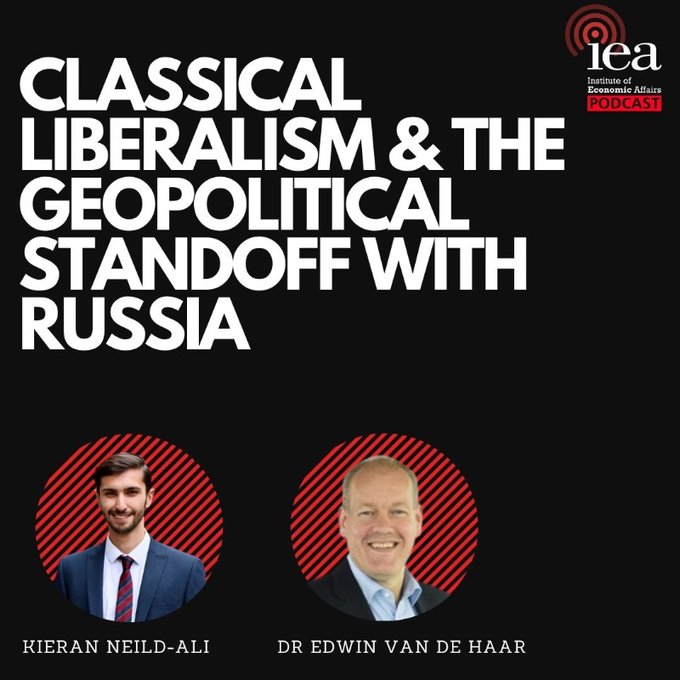
Podcast Institute of Economic Affairs

I had a chat on classical liberalism, liberal international relations theory the standoff with Russia. It is about 25 minutes or so.

China’s new footprint in the post-American Middle East

Days after the UAE’s decision to cancel the agreement regarding purchase of F35 jets from the US, a CNN report (December 23, 2021) stated that assessments of senior US officials suggested that transfers of sensitive ballistic missiles had taken place between China and Saudi Arabia.

UAE’s reasons for cancelling the agreement for purchase of F35s

One of the reasons for the UAE to cancel the deal with the US was that it did not want to be caught in any sort of ‘cold war’ between both the US and China. Anwar Gargash, Diplomatic Adviser to the UAE’s leadership, said, while speaking at a think tank in Washington DC earlier this month:

I think we, as a small state, will be affected negatively by this, but will not have the ability in any way to affect this competition even positively really.

While the US has been uncomfortable with the UAE’s use of Chinese 5G technology, with Washington warning the Emirates that the latter’s use of technology will impact security ties between both countries, the findings of US surveillance that China was trying to build a military installation in Khalifa port, close to Abu Dhabi, led to serious differences. Although construction work on the site in Khalifa port was cancelled (though both the UAE and China insisted that the facility was purely commercial in nature), and both the Emirates and the Americans have publicly stated that their relationship is still strong, there is no doubt that recent events have cast a shadow on the bilateral relationship.

If one were to look at the case of Saudi Arabia developing ballistic missiles, it is important for a number of reasons. First, it shows the increasing security imprint of China on the Middle East, specifically two Gulf Cooperation Council (GCC) countries: Saudi Arabia and the United Arab Emirates (UAE). Both are considered to be close to the US, and the fact is that ties with China could emerge as a bone of contention in relations between Washington and Abu Dhabi and Riyadh.

A senior Chinese official did not deny cooperation in the sphere of ballistic technology between Saudi Arabia and China, stating that both countries are comprehensive strategic partners. Said the official:

Such cooperation does not violate any international law and does not involve the proliferation of weapons of mass destruction.

Interestingly, China also shares robust economic ties with Iran and has been pitching for revival of the 2015 Joint Comprehensive Plan of Action JCPOA/Iran nuclear deal, while the UAE and Saudi Arabia, like the US, Israel, and other countries, have expressed worries with regard to Iran’s nuclear ambitions. China and Iran have also signed a 25-year cooperation agreement, referred to as “strategic cooperation pact,” in March 2021, which sought to bolster economic and security linkages between both countries. Iran has also hinted that if the JCPOA does not revive it would go ahead and trade with China and other countries.

Second, the development of ballistic missiles by Saudi Arabia will have a significant impact on the Middle East, and make it tougher for the US and other countries to prevent Iran from developing a ballistic program.

US ties with Saudi Arabia

While information pertaining to Chinese assistance for Saudi development of ballistic missiles was available to the US even earlier, the Trump administration did not put much pressure on the Saudis over this issue. The Biden Administration’s ties with Riyadh have been strained (as a result Saudi Arabia has been attempting to reorient its foreign policy significantly), though in recent months the US has been working on remolding ties. One of the reasons why Washington did not impose sanctions on Saudi Crown Prince Mohammed Bin Salman (MBS) even though declassified reports of CIA pointed to the fact that MBS was clearly involved in the Jamal Khashoggi murder (a number of Saudi officials were put on a no travel list, while financial sanctions were imposed on some officials), was that the US did not want to allow ties with Saudi Arabia to further deteriorate.

GCC countries like Saudi Arabia and the UAE, which have shared strong economic and strategic ties with the US, have been altering their foreign policy within the Middle East (one important example of this has been attempts by both countries to improve ties with Iran) as well as outside of it. One of the propelling factors for the reorientation in foreign policy of Riyadh and Abu Dhabi is the belief that the US will be less involved in the region in the future. In the past the China factor has never been a major issue in US ties with Saudi Arabia and the Emirates, but greater security and technological cooperation between the GCC states and Beijing could prove to be a thorny issue. Apart from its increasing economic clout, the biggest advantage that China possesses in the Middle East is that, apart from strong ties with Gulf countries, it also has good relations with Iran.

The Aussie-UK Free Trade Agreement

Introduction

Australia and the UK signed a Free Trade Agreement (FTA) on December 17, 2021 (an in principle agreement had been announced in June 2021). This FTA will drastically reduce tariffs on a number of Australian exports to the UK and reduce duties on a number of British commodities to Australia. Significantly, it will also make it easier for both Australian and British workers to work in each other’s countries under the working holiday scheme (WHS).

According to estimates of the British government, the FTA could increase trade between the United Kingdom and Australia by approximately $19 billion “in the long run” while the UK’s GDP may increase by about $4.2 billion by 2035.

There are some important provisions which could benefit workers from both countries. Firstly, in an important step, both countries have increased the working holiday visa’s eligible age to 35. What is especially significant is that there is no pre-requisite for applicants under this category to be employed in any “specific work.” Second, Australia will permit up to 1,000 workers to come from the UK in the first year of a new “skills exchange” trial.

Symbolic importance of the FTA

In a post-pandemic world, society is becoming even more insular and borders are becoming more stringent, so encouraging professionals and workers is important. In June 2021, UK Prime Minister Boris Johnson had said:

We’re opening up to each other and this is the prelude to a general campaign of opening up around the world.

The UK’s Secretary of State for International Trade, Anne Marie Trevelyan, described the deal as “a landmark moment in the historic and vital relationship between our two Commonwealth nations.”

The geopolitical significance of the FTA

From the UK’s point of view the FTA is important because the UK has been seeking to become more pro-active in the Indo-Pacific. Australia has been one of the most vocal proponents of the Free and Open Indo Pacific, and is also one of the members of the Quad (the other three members are the US, Japan, and India). From an economic standpoint the FTA is agreeable because the UK is seeking to get on board the Comprehensive and Progressive Agreement for Trans-Pacific Partnership (CPTPP) (members of this group have a combined GDP of $13.5 trillion), and this deal will only bolster its chances. The UK has already signed trade agreements with two members of the CPTPP — Japan and Vietnam – in 2020. Interestingly the TPP (Trans Pacific Partnership), the precursor to the CPTPP, was conceived by former US President Barack Obama, but the US withdrew from the agreement during the Trump Administration (pulling the US out of the TPP was one of the first decisions taken by Donald Trump after he took over as President). The trade agreement had also been opposed by a number of Democrat leaders including Hillary Clinton and Bernie Sanders.

For Australia, this agreement is especially significant because ever since the souring of relations with China, the bilateral economic relationship has been adversely impacted. China has imposed tariffs on a number of commodities, such as wine and barley, and also restricted imports of Australian beef, coal, and grapes. Under the Australia-UK FTA, tariffs on Australian wines will be terminated immediately, and the FTA will give a boost to the sales of not just wine but a number of other commodities boycotted by China. The FTA with the UK may not be able to compensate for the economic ramifications of strained ties with China, but it could pave the way for Australia exploring similar arrangements with a number of other countries.

In conclusion, the agreement between Australia and the UK is an important development and a clear reiteration of the point that the UK has an important role to play as a stakeholder in the vision of the “Free and Open Indo Pacific.” Second, the Indo Pacific needs to have a strong economic component and FTAs between countries are important in this context. Third, countries like Australia willing to bear the economic ramifications of a deterioration in ties with China need to look at alternative markets for their commodities. Finally, while there are certain areas where only the US can provide global leadership, US allies need to chart their own course, as is evident not only from FTAs signed between many of them, but also by the success of the CPTPP without the US being on board.