Why is India so poor? A macro approach

India’s total area, in square kilometers, is 1,222,559 3,166,414.

The total area of France, Germany, the UK, Ireland, the Netherlands, Belgium, Luxembourg, Denmark, Sweden, Iceland, Norway, Finland, Switzerland, Austria, Italy, the Czech Republic and Slovakia (or “the West”), in square kilometers, is 1,223,543 3,106,585.

Think of this comparison in terms of regions: one region is India, the other is the West. Both regions are densely populated. Both regions have a number of languages and an even greater number of regional dialects. Yet one region is wealthy, and the other is poor.

One way to look at this phenomenon would be to glance at the macro institutional structures in place in these two regions. India is one country. The West is composed of 6 17 countries. That’s six seventeen centers of power, as opposed to one, within territorial spaces that are roughly equivalent in size.

If we think about these macro institutions and incorporate them into other institutional arguments that focus on the micro institutions, then India actually has a lot of hope. The West saw numerous wars before it finally came to the arrangements it now has (six seventeen independent centers of power and a free trade zone binding them together), so India has a great blueprint for improving its macro institutions.

On the downside, of course, is the fact that many factions won’t really care if India becomes freer and more prosperous, so long as they get theirs. Along with the standard public choice explanation, the path dependency argument also suggests that India has a tough road ahead.

Sometimes being a libertarian sucks.

Update: Dr Gibson was kind enough to point out that I had initially calculated India’s size in square miles rather than square kilometers. I have taken that into account and updated it accordingly. Conceptually, my argument actually grows in strength with the corrected size. 
Is the United States on “Strike”?

The Economist thinks so:

To state baldly the main parallel with 1940, lots of Americans sound sick of calls to fix Muslim countries, just as their grandparents were tired of trying to fix Europe. Yet there are instructive differences, too.

A revealing contrast with the past involves broader attitudes to war. Modern Americans, especially Republicans, insist that Congress should control any decision to strike Syria—by which they mostly mean that they want a veto over Mr Obama. In 1938 the House of Representatives only narrowly rejected a much more radical idea: that future wars would have to be approved by the public, via national referendums. In those febrile days generals would wear mufti rather than uniforms to congressional committees to avoid antagonising anti-war members, records Ms Olson, while shops near army bases routinely barred soldiers.

Modern Americans are wary of war but reverential towards warriors. Troops in uniform are invited to throw out first pitches at baseball games and hailed as they board airliners. At the most bruising congressional hearings, members are careful to thank uniformed, beribboned generals for their service.

The rest is here. I think the parallels between now and 1940 drawn in this admirably well-balanced piece, and by others around the web, are disingenuous. There is nothing in the Middle East today that is comparable to mid-20th century Europe. Europe was industrialized, imperial and the various tribes of the region had all been nationalized to a large extent. It was a multipolar world, and Europe was dealing with the collapse of two large, cosmopolitan empires and a bloody revolution in a third empire. There were still imperial jealousies and the humiliating issue of reparations forced on the German state continued to dominate diplomatic (and, in some cases, domestic) discourse.

The scenario in the Middle East today looks nothing like the historical example found in mid-century Europe. We need to tread with much caution, if we tread at all.

Around the Web

  1. The Reality of Feel-Good Government. James Bovard on “federal service” programs
  2. Will Wilkinson says “I smoke pot and I like it” (there’s more to the piece than just a confession)
  3. Map of police officers per 100,000 people in Europe
  4. Filming North Korea’s Film Industry
  5. Stephen Walt weighs in on the Snowden affair: What, me worry?
  6. Sex in the Arab World. An interview with Shereen El Feki

“Europe’s Job Seekers Flock to Germany”

That’s the title of a recent piece on immigration in Europe, as told through a Greek family settling down in Germany, by the Wall Street Journal. Among the gems:

Despite the enmity often directed at Berlin for its insistence on painful austerity as the cure for Europe’s sovereign-debt crisis, Germany has become a new land of opportunity for tens of thousands of people fleeing their recession-racked homelands.

Data released Tuesday by the German statistics agency showed immigration hit a 17-year high last year, with the increase from Europe’s crisis-riddled nations “particularly evident.”

And this:

Germany has long had an uneasy relationship with migrants. Previous generations have often integrated poorly, facing high hurdles to gain citizenship—if they even try. Many Germans also believe that migrants come to live off welfare benefits or criminal activity [but] experts say today’s renewed influx of migrants is good for Germany. As its population declines and ages, the nation badly needs qualified workers to fuel economic growth and support its pension and health-care systems […]

The youngest, Nikos, at 15 years old, told his parents he missed his friends. Don’t worry, Mr. Karoustas replied. He’d see them again.

“I don’t hope for it,” the father told his son, “but all of them will come to Germany too.”

Read the whole thing. You can get around the WSJ‘s subscriber firewall by copying-and-pasting the title of piece and Googling it. Once you do that, just click on the article.

See our past notes on the EU here.

Russian and US Relations: Definitely Cooler and a Further Inquiry Into Why This Is

I appreciate Evgeniy’s recent remarks on the deterioration of Russian and American relations. This is an issue that has not received as much attention as it should.

From my own point of view, I can think of a few items that have caused deterioration on the American side of the relationship. Here is a small and by no means comprehensive list:

  1. The missile shield being built in Eastern Europe, ostensibly for the prevention of missile attacks from Iran. This is pure garbage. Iran has zero interest in attacking Europe with missiles. The Europeans have proven themselves to be very even-handed when it comes to affairs in the Middle East over the past few decades, and especially in regards to all things Israel. The missile shield in states previously under Moscow’s thumb is a direct provocation towards Russia, and there is absolutely no need for it. Russia, for its part, has no need of attacking Europe either. Moscow currently has a symbiotic relationship with Europe and its energy needs and its own problems in the Caucasus and the Far East.
  2. The contempt that establishment foreign policy figures in Washington have shown, and continue to show, towards Russia. The remnants of the Cold War have simply refused to go away in Washington. I think this is largely because if the establishment consensus were to acknowledge that Cold War policies are irrelevant, then they would all be out of their lucrative jobs. This contempt spills over into the political arena as well. Remember Mitt Romney’s comments about Russia being the “number one enemy” of the United States? Pure nonsense and both the American people and the Russian people deserve better.
  3. The continued occupation of the Balkans by Western coalition troops. NATO should have either dissolved or become an all-European alliance once the Warsaw Pact came apart and the Soviet Union split up. Taking sides in the Balkan conflict was designed to do two things at once: 1) stick the West’s thumb in Russia’s eye and 2) convince the Muslim world that the West was paying attention to its needs. A few years after attacking Serbia and initiating the process of splitting it up into smaller states, two skyscrapers full of innocent people were bombed by two jet planes filled with innocent people in New York City. The attacks were done in the name of Islam. In addition to the failure of the Balkan invasion to court the Muslim world, the exercise of power in Russia’s traditional backyard did indeed infuriate the Russians. Instead of an ally or a friend, the policies of NATO have led to cool receptions and deep levels of mistrust in Moscow.

These three policies are a good starting point for understanding why Russian-US relations have cooled considerably since the collapse of the USSR and the presidency of George HW Bush. I think more reaching out is needed on both sides, and I again thank Evgeniy for initiating this discussion. I am hoping for a long and prosperous friendship between free thinkers from two magnificent societies. A friendship that is dedicated to peace and understanding between two peoples who should have never been enemies in the first place.

The Rationality of Anti-Antisemitism; The Currency Issue Made Simple

The most interesting thing I have read in years about anti-Semitism is in the Wall Street Journal today. A poll in Europe indicates that 50% of Spaniards have a somewhat unfavorable, or a very unfavorable impression of Jews. The percentage in Germany is 25, in France it’s 20, in the UK, it’s 10. There are large number so Jews in France and in the UK.

What makes Spanish anti-Antisemitism interesting is that there are no Jews to speak off in Spain. All Spanish Jews were expelled from the country in 1492. The bulk of those who did not die in the expulsion went to the Ottoman (Turkish) Empire were they were welcomed by the Sultan. Others scattered around Muslim North Africa and Italy. Until WWII, many Turkish and Balkans Jews spoke 15th century Spanish. I knew a Spanish-speaking Turkish Jew at Stanford in the sixties myself. His last name was Cardona.

Between 1939 and the 1970s, the Fascist regime of Francisco Franco promoted a brand of Catholicism that was unfriendly to Jews, as “Christ killers.” For most of the intervening period the Inquisition promised to make life miserable enough for Jews that they did not come back.

So, here you go: The ultimate judgment on the rationality of anti-Antisemitism: The less the chance that you ever met a Jew, the more likely you dislike Jews. At least, that’s true in Europe. Continue reading

Big Horrors, Small Horrors

“Militia” members guided by official Syrian “security” forces massacre civilians in their houses.They use both tanks and knives. About fifty of the civilians – all terrorist opponents of the Assad regime, of course –  are children under ten. The response of nine rich countries including the US is severe: They call in the Syrian ambassadors, Assad’s buddies all, and they tell them severely to pack up and leave. No ifs and buts; teach the child-killers a lesson; the bastards will get the message now! Every one of those countries has an air force capable of destroying all Syrian tanks within three weeks.

Not so long ago, Arabs of all provenances were infiltrating into Iraq though Syria, precisely. They were on their way to kill the American oppressors who had destroyed that great assassin, the mass murderer of Arabs, Saddam Hussein. Where are the Arab volunteers now infiltrating Syria to go and protect Arab children from Assad’s slaughterers? If I were an Arab man from any country today, I would be dying of shame. Or I would consider donning the hijab. Here is a question: If the violent jihadists could do it, enter Syria clandestinely, why can’t you?

I am repeating myself, I know: When Arabs massacre Arabs it’s not so bad, right?

And, by the way, the silence of the Israeli political class regarding the atrocities next door wins Israel no friends I would guess. Continue reading

Economic Growth in Europe: the Longer View

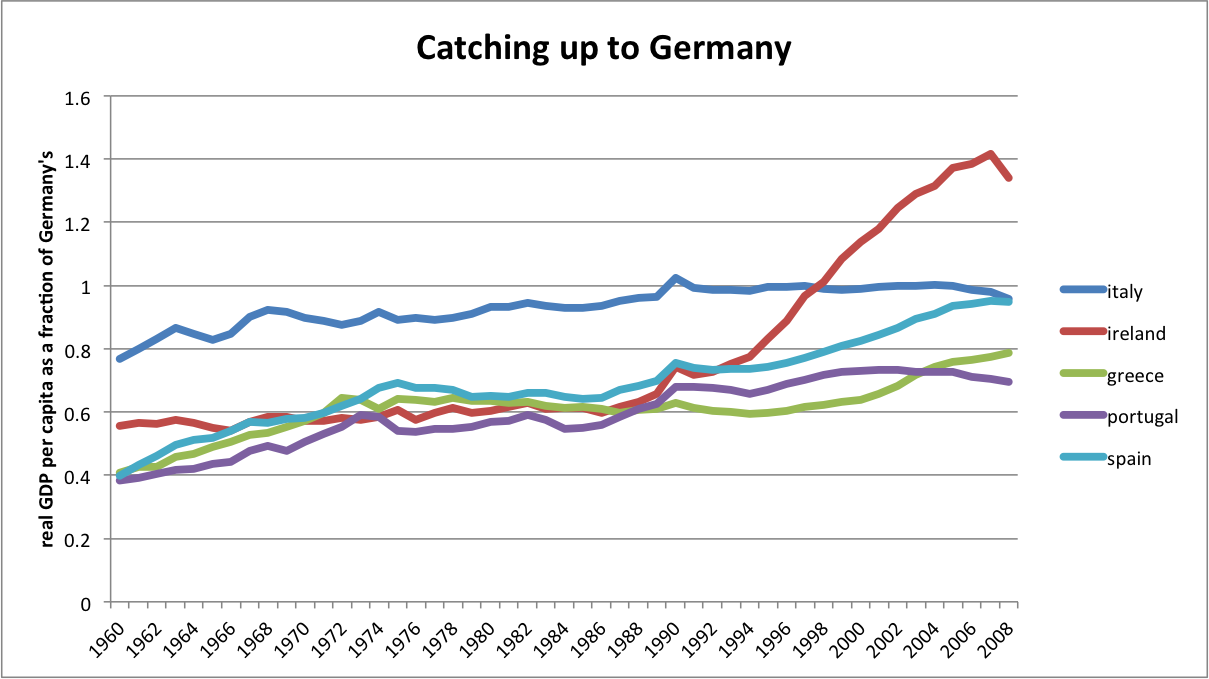
Economist Tyler Cowen has a post up on who has gained most from the Euro (as measured by state), but the economist Angus puts things into perspective:

Ireland, Spain, Portugal and Greece were all growing fast relative to Germany (and France which is not on the graph) well before the introduction of the Euro. Ireland and Spain take off somewhere around 1990 and the intro of the Euro in 2000 does not speed up their trajectory. Portugal actually falls further behind Germany in the Euro era. Greece is the only country of these 5 whose catch-up to Germany accelerates with the intro of the Euro.

Two quick thoughts:

  1. Woah! Look at Ireland!
  2. I’ll bet the acceleration of growth in the 1960’s had to do with the end of World War 2 and its rebuilding efforts.

Taking a broader historical view really puts things into perspective. If the Euro was not the catalyst for the economic growth of the 1990’s, what was? My guess is that the elimination of tariffs and labor restrictions between European states led to the growth. If the Eurozone had not implemented a central bank I think we wouldn’t be looking at all of the political problems now associated with the region.

Angus (who works at Oklahoma University) got his statistics from here. I highly recommend using it in your own studies as well.

Anti-Americanism: Lesson One, Europeans

Hostile liberal members of the American media have been repeating for years that the Bush presidency caused the prestige of the US in the world to decline sharply. In addition, they whine endlessly that the US is disliked pretty much more than it ever has been. I think tender-hearted liberal commentators are confusing several issues, some of which have nothing to do with Pres. G.W. Bush or with any of his policies.

As a person with a very good knowledge of another society and culture (France) and a pretty good understanding of several others (most of Latin America plus Spain), I may be able to help disentangle the impressions they are giving the general American public concerning their country’s popularity in the world. I also have better than average access to Germany and to Russia thanks to several long-term friendships.

I wish to begin by stating that I believe popularity is considerably overstated as a geopolitical resource. Governments do what they do largely on the basis of their calculated self-interest. Love of another country probably plays little role in the tactical alliances they form. (I must say that I could be talked into believing that there exists a sort of solidarity of kinship linking Canada, the United Kingdom, and Australia with this country. This solidarity may contribute to making the public opinion of those democratic countries more tolerant of policies they don’t especially like than they would be absent the felt kinship.)  Continue reading

Around the Web

Isn’t California broke?

Savage Continent. European women and their Nazi boyfriends.

A Family-Plus Outing. Islam at the Beach: Santa Cruz edition.

As I keep saying, this election is Romney’s to lose.

Sorry ’bout the short posts from me lately. I hope everybody is enjoying their summer!

Things You Need to Know About Germany, About French Culture

If you know this blog at all, you will not be surprised to learn that I am an expert in French culture, a merciless one. As luck would have it, I am also an expert in Europe in general and in Germany in particular. That’s because the media one uses to follow French affairs unfailingly tell you about European affairs.

Here is an example of my pan-European expertise: Do you know what German Chancellor Angela Merkel does with her old pant-suits?

She wears them!

The problem with stereotypes is not that they always carry falsehoods but that some are true but it’s hard to distinguish the correct ones from the urban legends and historical fables.

Here is a tenacious historical fable held even by lawyers: Under French law, the accused has to prove that he is not guilty.

It’s just not true, not even a little.

I read the French daily Le Figaro on-line almost daily. I see it as centrist as you can get. It’s well written (not a given with contemporary French press and the silly desire to appear with it*). It ranges far and wide.

There is a piece in it today that shows once more that the French are serious about their vacations. The title asks: “Can one copulate in the ocean?” It’ s clear  right after the third paragraph the question does not refer to fish or whales which do it all the time in the ocean, as most of us realize. The author implies the question for humans. Nevertheless, there is an allusion to dolphins who purportedly do it often and really, really enjoy it. (Damn, damn! Not only are they smarter than I am, they have a better sex life.)

Anyway, after supposedly consulting “sexologists,” author supplies a liberating positive answer to the question. Yes, she says, you can do it; it’s fun but if you do it where the water is over your head, make sure you don’t drown.

On the one hand, I exclaim: “N.S.!” On the other hand, I think: “What a way to go!”

French culture is interesting but not for the reasons you probably think. It’s a good counterpoint the better to understand American culture. Some wise man (or maybe a “wise old Latina” as a current Supreme Court Justice once said)  declared: “One who knows only one country knows no country.” You got to compare to understand.

French culture, like other contemporary European cultures, is strangely deficient in some area, in many areas, actually. Here is a link to an introduction to the topic, right on this blog:

French Movies, Sex, and the Welfare State

I don’t imply that you shouldn’t go to Europe this summer. It’s a quality museum. The food is quite good in some countries, in France, of course, and in Italy but also often, in Spain.

Of course, if you are under thirty and have no children and you vacation in Europe you are probably a wimp. When are you going to go to Burma, to Paraguay? When you are sixty-five?

* For the record: “au courant” does not mean “with it” or “edgy” as semi-lingual journalists seem to think. Those two words just mean “well informed,” and “up to date.” I don’t want to catch any of you making this mistake again.

Around the Web

  1. Secessionist Movements in Europe. I have always thought that the EU would be great for more decentralization, but once the central bank became established and Brussels agitated for more political power I knew that the experiment in confederation would become the failure that it is today.
  2. Economist Bryan Caplan on Left-wing historical bias and Benito Mussolini. You’d be surprised what the history books keep out of Italy’s socialist movement…
  3. Has Africa Always Been the World’s Poorest Continent? Be sure to read through the ‘comments’ section too.
  4. Mini-DREAM and the Rule of Law: Executive Discretion. A number of libertarians have come out in support of Obama’s executive order prohibiting immigrants from being deported just for moving here as children, but I am not so sure that this is a good move. Politically, it’s great, especially when one considers the fact that the Obama administration has deported more immigrants in 4 years than GW Bush did in 8. I am more worried about the Rule of Law. It’s the legislative branch’s job to implement immigration policy, not the executive branch’s. As somebody who supports open borders, this is a tough call.

Immigrants – A Story Pregnant with Deep Meaning

They are a pretty young couple. He is a thin, blond Dutchman in his early thirties. Yasmina, his younger wife, is a honey-skinned beauty, and all curves. The day I met them, she was wearing a short, tight silky dress over a black push-up bra that was doing its job quite well, indeed. She is Pakistani by way of Toronto. They have come to seek their fortune in California.

Peter, the Dutchman, is working for a local software company. He is a language specialist in a generic sense, if there is such a thing. He began an advanced degree in Sanskrit, at Oxford. He did not finish because he could not “raise” the 35,000 pounds ($50,000) required. He spent a couple of years in India studying Sanskrit with a guru. When I asked him why he had not sought admission to an American doctoral program that would have supported him, one way or another, as is the custom, he gave me an answer I did not quite understand. It was something about changing priorities and about the infernal American demand for scholarly publications. Peter and Yasmina met at Oxford, where she completed an undergraduate degree. Or maybe not.

A Muslim by birth, Yasmina drinks wine with gusto, a sure sign of aristocratic upbringing. She speaks English perfectly and very fast. Peter discusses wines with much competence. His parents own a winery and vineyard in the heart of Continue reading

Update on America and on the World

Newt Gingrich [recently] won the South Carolina primary by a big margin. I know that’s only South Carolina, perhaps the most conservative state. Still, that’s a major rebuke to serious candidate Romney. The speeches both gave after Gingrich won delineate clearly two major paths for the Republican Party. Romney’s speech was colorless, odorless, rich in platitudes. It was the kind of speech unfairly associated with “moderates” who deserve better.

Gingrich spoke incisively, precisely about what agitates conservatives like me who are not born-again Christians nor any of the other stereotypes the liberal press has invented. We want a smaller government that’s not wasteful and that does not get us into debt for two  generations to come. Gingrich’s speech was well received for another reason: It spoke of simple pride in America, not of imperial pride, not of a wish to dominate, not of hubris but of simple dignity.

There is a pervasive feeling that we lost our national dignity during the three-year Obama presidency. It was not all his fault. Certainly, a major contributor is our large national debt that was already too large when he took office. However, it’s fair to charge Obama for this loss of dignity because he told us repeatedly that America should become a smaller, more ordinary country, and it has. If you tell Mom in anger, ” I wish you died” and she dies, don’t be surprised if your brothers are angry at you. And, President Obama, whose middle name is  still Hussein, bowed to the King of Saudi Arabia, the grandchild of camel thieves who happens to have captured a lot of oil. Continue reading