On power-display bias and the historians

This is an excerpt from my upcoming book at Palgrave McMillan which discusses Canadian economic history. This excerpt relates to a point that I have made numerous times on this blog regarding the bias for power held by historians and how it often leads them to inaccurate conclusions (here and here):

When the great historian Lord Acton warned that, “absolute power corrupts absolutely,” he was not only referring to imbuing certain fallible humans with excessive powers, but also as a caution to historians for their assessment of politicians. Too often, politicians become known for “greatness” because of their actions, regardless of how much they impoverished society or put in place measures that would ultimately erode their citizens’ quality of life. By the same token, some eminent figures remain unknown, relegated to a footnote in the history books, even though they have contributed in a more significant way to economic enrichment, cultural development, and social cohesion. Grand gestures and large-scale social projects inspired by good intentions do not always yield great results – or desirable ones.

If we truly want to assess the Quiet Revolution and the “Great Darkness” with any clarity, we must consider politicians’ actions in a more realistic scope, and sift through the quantitative and qualitative data that show how people thought and acted in the everyday. Through the use of rigorous tools, statistical methods and economic theories, we ought to consider how things might reasonably have developed otherwise without the Quiet Revolution. This is what I have tried to do in this book. (…)

The discourse on Quebec modernity that emerged along with the Quiet Revolution coincided with the emergence of a strong interventionist State. When we compare Quebec to other Western countries, however, our analysis reveals that the State did not play a major role in modernization here. After all, it was in a period when Quebec’s State apparatus was less active compared to the rest of Canada that it was able to progress in leaps and bounds. Of course, the State must have had some effect in certain areas, but the Quiet Revolution was not responsible for the bulk of positive outcomes that came to term during this period. Analyzing trends, causes, explanations and secondary forces at play in Quebec society’s metamorphosis definitely requires a degree of patience and effort. It would be much less onerous to take the easier path of only looking at the State’s activities as worthy of attention in this regard. If we fail to make these efforts, we risk succumbing to the “Nirvana Fallacy.” In order words, we tend to put the State on a pedestal: it becomes a kind of disembodied entity in a virtual reality where it plays the VIP or starring role. Comparing reality with a utopia necessary leads us to conclude that utopia is better, but this approach is utterly fruitless.


Once, Cubans were (maybe) richer than Americans

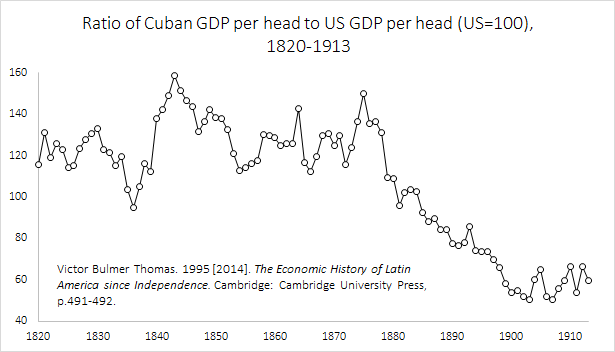
In light of what we see today, this is hard to believe. However, as a result of Castro’s death, I accidentally became interested in the history of this fascinating island and the more I discover, the more shocked I am at “the path” that Cuba has taken. One of these reasons is provided below by Victor Bulmer Thomas in his Economic History of Latin America since Independence. Now, Thomas uses a different approach than the commonly used Maddison data (he believes the assumptions are too heroic). He uses indicators correlated with GDP per capita to fill in the gaps and he finds that Cuba was generally richer than the United States for most of the 19th century (see below):

cubaus

Now, I am not convinced by the figure Thomas presents. However, I am also skeptical of the levels presented by Maddison (where Cuba is roughly 60% as rich as the US in 1820). In between are some more reasonable estimate (see this great discussion in this book as well as this discussion by Coatsworth).  Moreover, there is the  issue of slavery which distorts the value of using GDP per capita because of high levels of inequality (however, it distorts both ways since the US was also a slave economy up to the Civil War).

Nonetheless, this tells you about the “path not taken” by Cuba.

A very short response to Bruno Gonçalves Rosi’s reflection on Latin American Conservatism

With his “The Problem with Conservatism in Latin America, Bruno Gonçalves Rosi brings to NOL a very interesting debate on politics and history. In the case of Hispanic America the controversy is quite severe: during the 17th-century Spain and its colonies were undergoing an incremental process of liberalization and modernization known as “Bourbon Reforms.” These reforms implied a language unification (adopting Castilian – later named “Spanish” – as the national language), an increasing centralization of political administration, and free trade between Spain and its colonies, among other aspects.

In the case of the Spanish colonies in America, the Bourbon Reforms implied that Spanish-born subjects were preferred over American-born ones to take up public duties, and also that American products could not compete with Spanish ones. Up until then, commerce among Spain and its American colonies was restrained to gold and a narrow scope of goods. Free commerce had been allowed only in cases of extreme scarcity (for example, between Buenos Aires and South Africa) and for a very short lapse of time. The Bourbon Reforms put a severe strain on the incipient local production of the Hispanic American colonies that had flourished as consequence of closed markets. Sometimes inefficient local processes of production were outperformed by more competitive Spanish goods. But in other cases, efficient local industries were banned because they were regarded as a menace to Spanish ones.

Thus, the reactions to the Bourbon Reforms were of two opposite kinds: the Liberals rejected them because they limited the free trade only to Spain and its colonies and the modernization process was too slow. Liberals demanded free trade with all countries. On the other side, the Conservatives sought to go back to the Habsburg era: they rejected Modernity and free trade and demanded protectionism. The Emancipatory process of Spanish America was carried out by the conjunction of the Liberal and the Conservative reaction against the Bourbon Reforms. Once independence was fulfilled, the two parties became acutely antagonist to each other…perhaps up until today.

The history of Latin American Conservatism and Liberalism is worth our attention not only because of political history itself, but because it gives us a model to ponder the processes of departure from political and economic commonwealths that have been seen in the recent years -and perhaps are not closed yet.

BC’s weekend reads

  1. Path-dependence of measuring real GDP?
  2. Technological creativity and the Great Enrichment (h/t Federico)
  3. The deadly serious accusation of being a “so-called judge”
  4. Why Congress isn’t reigning in Trump
  5. How did Germany and Austria’s elite musical institutions navigate the vicissitudes of early 20th-century European history? (review)
  6. Western nationalism and Eastern nationalism

On 7 million deaths from air pollution

ATTN published a video of An-huld (the really cool guy who made my childhood by being in all my favorite action movies like Predator* and who ended up being the governor of California). In that short clip, Schwarznegger starts by saying that 7 million individuals die from pollution-related illnesses.

That number is correct. But it is misleading.

People see pollution as “all and the same”. But some forms of pollution increase with development (sulfur emissions and some would argue that too much CO2 emissions is pollution as it causes climate change). However, others drop dramatically – especially heavy particules (Pm10) which are a great cause of smog. Julian Simon (the late cornucopian economist who is one my greatest intellectual influence) pointed out this issue and noted that the deadliest forms of pollution are those that relate to underdevelopment.

Back in 2003, Jack Hollander published the Real Environmental Crisis: Why Poverty, Not Affluence is the Environment’s Number One Enemy. Hollander pointed out that simply from the combustion of organic matter (read: firewood and animal manure – literally burning fecal matter) indoors for the purposes of heating, cooking and lighting was responsible for close to 2 millions deaths.

Since then, the WHO came out with a study pointing out that around 3 billion people cook and heat their homes with open fires and stoves that rely on biomass or anthracite-coal. They put the number of premature deaths directly resulting from this at over 4 million people. This is close to 60% of the figure cited by the former President of California (yes, I know he was governor – see here). In other words, 60% of the people who die prematurely as a result of strokes, ischaemic heart diseases, chronic obstructive pulmonary diseases and lung cancers can be attributed to indoor air pollution. That means pollution resulting from the fact that you are so poor that you have to burn anything at hand at the cost of your health.

True, richer countries pollute and there are policy solutions (I have often argued that governments are better at polluting than at reducing pollution, but that is another debate) that should be adopted. But, these forms of pollution do not harm human life as much as those that come with poverty.

* By the way, when you watch Predator, do you realize that there are two future American governors in that movie? I mean, imagine that when Predator came out, some dude from the future told you that two of the main actors would end governing American states. Pretty freaky!

When (Where and Why) Women Were More Literate than Men

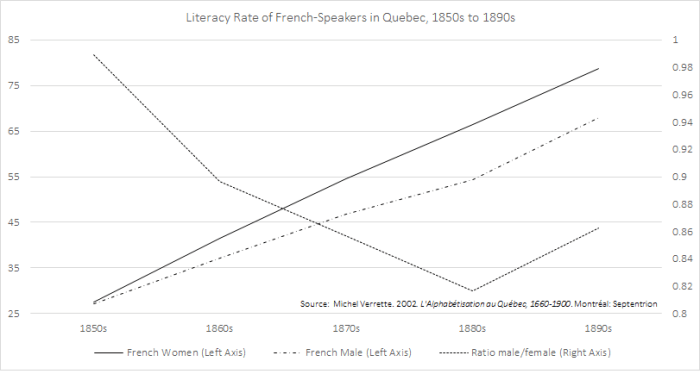
For most of history, men tended to be more literate than women. In essence, illiteracy was widespread but even more so for women. There is one exception: the French-Canadians. For most of the 19th century, literacy rates were greater for French-Canadian women than French-Canadian men.

literacy

This is a fascinating piece of economic history and somewhat of a puzzle (given that it is an oddity). It also shows how important institutions are to determining paths of development. In a 1999 article in the Journal of Economic History, Gillian Hamilton indicates that the more “liberal” institution of marriage contracts for the French-Canadians probably induced this result :

Quebec’s unique legal institutions offered the opportunity to draw up a prenuptial contract to couples who could benefit from a different property structure than the law provided. Not surprisingly, a prenuptial contract was unnecessary for most couples. Within this transaction cost-competitive marriage market framework, contracts generally were desirable only in cases of mismatch, either due to an exceptional woman or a relatively productive husband whose job did not entail a significant component of family participation. Their contracting decisions are consistent with terms that would have provided them with more appropriate incentives for work and the production of jointly produced goods, and at least the potential for greater utility and wealth than they otherwise would have accumulated. The use of contracts likely provided Quebec with higher overall wealth and a wider income distribution than it would have experienced without contracts (because the skilled disproportionately signed agreements).


The Asian Age

I love Asia. Ever since my student days I have had a keen interest in South East Asia and China, with my course on the Politics of the Asia Pacific at the London School of Economics in the run up to the handover of Hong Kong as a high point. This was followed almost a decade later with four years of living in Manila, with time spend as a freelance journalist covering Philippine politics and society, as well as teaching for three years at the European Studies Program at the elitist Ateneo de Manila University. I also had the opportunity to travel to almost all countries in the region (with the notable exceptions of Laos, Taiwan and the Koreas, but one should keep something to be desired). I admire the resilience of the Asians, their humour, great work ethics, the beauty of their countries, and of course their sumptuous food.

As a classical liberal I always have a keen interest in the economic developments of the region, which to me serve as the prime evidence for the great and positive impacts freeing up economies have. The rise of Asia in essence is the empirical proof that classical liberal ideas work, that capitalism has the capacity to improve the life of millions of people, in a very short term. This despite the imperfect implementation of capitalism throughout the region, so there is much room for further improvement. In this light it is also interesting to see how long economic freedom and political lack of freedom can co-exist. Classical liberal ideas predict, most clearly expressed by Milton Friedman in Capitalism and Freedom, that one follows the other. Economic and political freedom cannot be separated forever (nor forever suppressed together, as the experiences in the former Soviet bloc continue to make clear, even despite Putin’s increasing autocratic rule).

For an international relations observer from Europe, the developments in the Asia Pacific are of particular interest, because the rise of Asia seems to go together with the fall of Europe as a geopolitical player. Or more precisely: the fall of the middle rank European powers, as the European Union itself is a significant player in trade politics only, the only field where it represents all member states and policy is determined at the European level, with a leading role for the European Commission.

The recent book Easternisation: War and Peace in the Asian Century, by Financial Times journalist Gideon Rachman, deals precisely with this issue.

blog-easternisation

It is a great book, bringing together Rachman’s extensive experience in the US, Asia, and Brussels. Often, books written by journalists lack sound analysis for the mid to long term, and historical perspective. While Easternisation is not an academic tome either, it does provide sufficient deep analysis, especially by tackling developments in all important countries which play a role in the process. It is not just another volume of simply USA or EU bashing, as we have seen before with the huge literature on the alleged Japanese take-over of the US economy.

Rachman’s main argument is that the influence of the West, Europe in particular, has crumbled. This may lead to a major conflict in the Asia Pacific, most notably between China and the US, which also endangers the global economic order. Yet many other conflicts are also building up, in a region which heavily invests in armaments. In short, in the 21st century, ‘rivalries between the nations in the Asia Pacific will shape global politics, just as the struggles between European nations shaped world affairs for over 500 years from 1500 onwards’. I think this is an important message, which should be taken seriously by everybody. Certainly by the Europeans, who are in danger of just inhabiting the world’s largest open air museum within a few decades.  One thing is certain: the Asians will not wait for them to come to terms with the current shift of power.

On 19th Century Tariffs & Growth

A few days ago, Pseudoerasmus published a blog piece on Bairoch’s argument that in the 19th century, the countries that had high tariffs also had fast growth.  It is a good piece that summarizes the litterature very well. However, there are some points that Pseudoerasmus eschews that are crucial to assessing the proper role of tariffs on growth. Most of these issues are related to data quality, but one may be the result of poor specification bias. For most of my comments, I will concentrate on Canada. This is because I know Canada best and that it features prominently in the literature for the 19th century as a case where protection did lead to growth. I am unconvinced for many reasons which will be seen below.

Data Quality

Here I will refrain my comments to the Canadian data which I know best. Of all the countries with available income data for the late 19th century, Canada is one of those with the richest data (alongside the UK, US and Australia). This is largely thanks to the work of M.C. Urquhart who recreated the Canadian GNP series fom 1870 to 1926 in collaborative effort with scholars like Marvin McInnis, Frank Lewis, Marion Steele and others.

However, even that data has flaws. For example, me and Michael Hinton have recomputed the GDP deflator to account for the fact that its consumption prices component did not include clothing. Since clothing prices behaved differently than the other prices from 1870 to 1885, this changes the level and trend of Canadian incomes per capita (this paper will be completed this winter, Michael is putting the finishing touch and its his baby).  However, like Morris Altman, our corrections indicate a faster rate of growth for Canada from 1870 to 1913, but in a different manner. For example, there is more growth than believed in the 1870-1879 period (before the introduction of the National Policy which increased protection) and more growth in the 1890-1913 period (the period of the wheat boom and of easing of trade restrictions).

Moreover, the work of Marrilyn Gerriets, Alex Chernoff, Kris Inwood and Jim Irwin (here, here, here, here) that we have a poor image of output in the Atlantic region – the region that would have been adversely affected by protectionism. Basically, the belief is a proper accounting of incomes in the Atlantic provinces would show lower levels and trends that would – at the national aggregated level – alter the pattern of growth.

I also believe that, for Quebec, there are metrological issues in the reporting of agricultural output. The French-Canadians tended to report volume units in manners poorly understood by enumerators but that these units were larger than the Non-French units. However, as time passed, census enumerators caught on and got the measures and corrections right. However, that means that agricultural output from French-Canadians was higher than reported in the earlier census but that it was more accurate in the later censuses. This error will lead to estimating more growth than what actually took place. (I have a paper on this issue that was given a revise and resubmit from Agricultural History). 

Take all of these measurements issue and you have enough doubt in the data underlying the methods that one should feel the need to be careful. In fact, if the sum of these (overall) minor flaws is sufficient to warrant caution, what does it say about Italian, Spanish, Portugese, French, Belgian, Irish or German GDP ( I am not saying they are bad, I am saying that I find Canada’s series to be better in relative terms).

How to measure protection?

The second issue is how to measure protection. Clemens and Williamson offered a measure of import duties revenue over imports volume. That is a shortcut that can be used when it is hard to measure effective protection. But, it may be a dangerous shortcut depending on the structure of protection.

Imagine that I set an import duty so high as to eliminate all entry of the good taxed (like Canada’s 300% import tax on butter today). At that level, there is zero revenue from butter import and zero imports of butter. Thus, the ratio of protection is … zero. But in reality, its a very restrictive regime that is not being measured.

More recent estimates for Canada produced by Ian Keay and Eugene Beaulieu (in separate papers, but Keay’s paper was a conference paper) attempted to measure more accurate indicators of protection and the burden imposed on Canadians. Beaulieu and his co-author found that using a better measure, Canada’s trade policy was 11% more restrictive than believed. Moreover, they found that the welfare loss kept increasing from 1870 to 1890 – reaching a figure equal to roughly 1.5% of GDP (a non-negligible social cost).

It ought to be noted though that alongside Lewis and Harris, Keay has found that the infant industry argument seems to apply to Canada (I am not convinced, notably for the reasons above regarding GDP measurements). However, that was in the case of Canada only and it could have been a simple outlier. Would the argument hold if better trade restriction measures were gathered for all other countries, thus making Canada into a weird exception?

James Buchanan to the rescue

My last argument is about political economy. Was the institutional arrangement of protection a way to curtail government growth? Protection is both a method for helping national industries and for raising revenues. However, the government cannot overprotect at the risk of loosing revenues. It must protect just enough to allow goods to continue entering to earn revenues from imports.  This tension is crucial especially since most 19th century countries did not have uniform general tariffs (like a flat 5% import duty) which would have very wide bases. The duties tended to concern a few goods very heavily relative to other goods. This means very narrow tax bases.

Standard public finance theory mandates wide tax bases with a focus on inelastic sources. However, someone with a public choice perspective (like James Buchanan) will argue that this offers the possibility for the government to grow. Basically, a public choice theorist will argue that the standard public finance viewpoint is that the sheep is tame. Self-interested politicians will exploit this tameness to be elected and this might imply growing government. However, with a narrow and elastic tax base, politicians are heavily constrained. In such a case, governments cannot grow as much.

The protection of the 19th century – identified by many as a source of growth – may thus simply be the symptom of an institutionnal arrangement that was meant to keep governments small. This may have stimulated growth by keeping other sectors of the economy more or less free of government meddling. So, maybe protection was the offspring of the least flawed institutional arrangement that could be adopted given the political economy of the time.

This last argument is the one that I find the most convincing in rebuttal to the Bairoch argument. It means that we are suffering from a poor specification bias: we have identified a symptom of something else as the cause of growth.

Spanish GDP since 1850

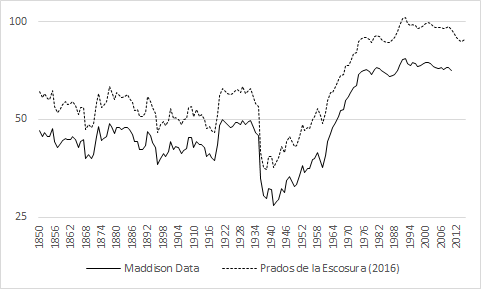
Among the great economic historians is Leandro Prados de la Escosura. Why? Because, before venturing in massively complex explanations to explain academic puzzles, he tries to make sure the data is actually geared towards actually testing the theory. That attracts my respect (probably because it’s what I do as well which implies a confirmation bias on my part). Its also why I feel that I must share his most recent work which is basically a recalculation of the GDP of Spain.

The most important I see from his work is that the recomputation portrays Spain as a less poor place than we have been led to believe – throughout the era. To show how much, I recomputed the Maddison data for Spain and compared it with incomes for the United Kingdom and compared it Leandro’s estimates for Spain relative to those for Britain (the two methods are very similar thus they seem like mirrors at different levels). The figure below emerges (on a log scale for the ratio in percentage points). As one can see, Spain is much closer to Britain than we are led to believe throughout the 19th century and the early 20th century. Moreover, with Leandro’s corrections, Spain convergence towards Britain from the end of the Civil War to today is very impressive.

spanishgdp

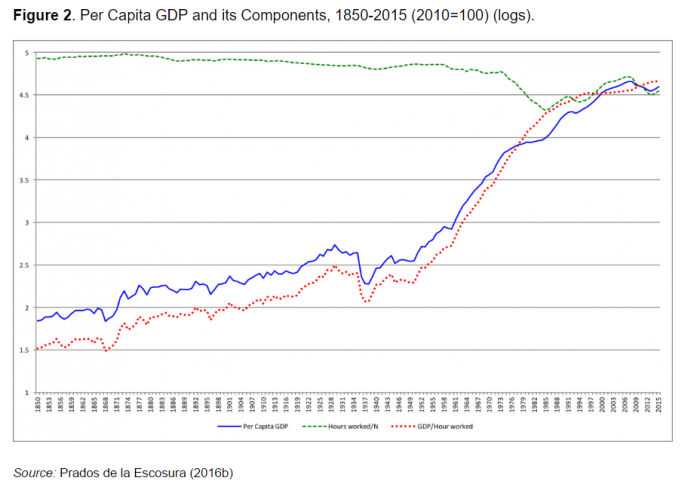
The only depressing thing I see from Leandro’s work is that Spain’s productivity (GDP / hours worked) seems to have stagnated since the mid-1980s.

spanishproductivity

On quasi-rents and the minimum wage

Ryan Murphy of Southern Methodist University has a new article published in Economics Bulletin regarding the minimum wage and “quasi-rents”.  The argument made by Ryan has the advantage of theoretically fleshing out a point made by many skeptics of the new literature. Generally, the argument has been that in the short-term, the minimum wage may have minimal effects, but in the long-term, firms will adjust.

I tended, until Ryan’s article, to be more or less skeptic of the value of this counter-argument. My point has always been that the new literature (like the Dube-Lester-Reich paper) tends to act as a partial equilibrium story (focusing only on one sector only or one indicator). My view has always been very “Coasian” in the sense that there are transaction costs to adapting to any new minimum wage rate.

The height of the hike and what industries are primarily affected will determine the method of adjustments. Firms can cut on benefits, substitute between forms of labor (the minimum wage increases the supply of older workers which remplace younger inexperienced workers), hours or training. They can also, depending on the elasticity of demand for their products, increase prices or cut quality. They can also cut employment. All of these are channels of adjustment and they will be used differently depending on the context. They are all different expressions of the fact that the demand curve slopes downward. But each expression has costs to be used that are to be weighted against their benefits – which are highly circumstantial. For example, if I have a firm of two employees, I will not sacrifice half my workforce by firing a worker (thus sacrificing 50% of my output) for a 5% hike in the minimum wage. Not only would this be an over-reaction, but there are transaction costs for me to fire that worker : separation fees, emotional pain, learning what the employee was doing etc. Reducing his hours would be a safer adjustment.

Until there is a study that measures all of these adjustments channels at once, I am skeptical.

So where does Ryan’s story come in? Well, none of my arguments had a long-term component. They were largely void of any time dimension. While I am aware of research like those of Meer and WestClemens and Wither and Clemens regarding job growth patterns following minimum wage hikes, I always discounted that argument. I was always reluctant to engage in long-term reasoning because I felt it was conceding a point that ought not to be conceded even if that counter-point is valid.  I only used it to top up the rest of my argument. But Ryan introduced to me the concept of quasi-rents, of which I had vaguely heard during my undergraduate microeconomics class.

Basically, here is the argument about quasi-rents: in the short-term, there are rents to be extracted from fixed factors of productions. Firms need these quasi-rents to remain in business, but only in the long-run.  However, if labor can find a way to capture the rents in the short-run, they will get higher earnings and employers will not fire people as much. As a result, there is basically a reshuffling of the consumer surplus. However, in the long-run, nothing is fixed and firm owners can adjust by shifting to different production methods. Thus, they will reduce their future hirings. In Ryan’s words:

But the on-impact negative effects of minimum wages may be hidden. In the longer run, after the quasi-rent is dissipated, the owner would have the incentive to eventually switch from more labor-intensive methods to ones that are less globally efficient (this being the conventional “demand slopes down” result). More perniciously, the threat of future increases in the minimum wage may create regime uncertainty undermining a willingness to invest in the types of technology and capital complementary to low skilled labor, thereby reducing employment for low skilled workers. That is to say, the risk of the appropriation of quasi-rents can shift investment towards capital unlikely to be appropriated via the minimum wage. Repeated and arbitrary increases in the minimum wage worsen this risk. This is consistent with the recent shift towards long run effects of increases in the minimum wage, for instance Meer and West (2016).

This is exactly what Andrew Seltzer found for the introduction of the minimum wage during the Great Depression in certain American industries. In the short-term, the capital was more or less fixed and production methods could not be abandonned easily. In the long run, firms adapted and shifted production methods. This is why Ryan’s argument is convincing. It offers a theoretical explanation for the empirical results observed by Dube, Lester and Reich or Card and Krueger. It fits well with theories of imperfect markets (damn I hate that word that is basically saying that all markets have frictions) like those of Alan Manning (see his Monopsony in Motion here).

This is the kind of work on the minimum wage that, if measured, should force considerable requestionning on the part of minimum wage hike advocates.

Sensitive and Crucial: on Measuring Living Standards in the 18th Century

In the course of the twitterminar on the High-Wage Economy argument (HWE) which generated responses from John Styles on his blog (who has convinced me that the key solution to HWE rests in Normandy, not the Alsace) and many other on Twitter. In the course of that discussion, I skirted a point I have been meaning to make for a long time. However, I decided to avoid it because it is tangentially related to the HWE story. Its about how we measure living standards over space in the past.

Basically, the HWE story is a productivity story and all that matters in such a story is wage rates relative to other input prices. Because we’re talking about relatives, the importance of proper deflators is not that crucial. However, when you move beyond HWE and try to ask the question regarding absolute differences over space in living standards, the wage rates are not sufficient and proper deflators are needed.

They are many key issues to estimating living standards across space. The largest is that given that very few goods crossed borders in the past, converting American incomes into British sterling units using reported exchange rates would be rife with errors and calculating purchasing power parities would be complicated. The solution, very simple and elegant by its simplicity, is to rely on the logic of the poverty measures. Regardless of where you are, there is a poverty threshold. Then, all that is needed is to express incomes as the ratio of income to the poverty line. If the figure is three, then the average income buys three times the poverty line. Expressed as such, comparisons are easy to do. This is what Robert Allen did and it was basically a deeper and more complete approach than Fernand Braudel’s “Grain-Wages” (wage rates divided by grain prices).

Where should the line be?

While this represents a substantial improvement for economic historians like me who are deeply interested in “getting the data right”, there are flaws. In the course of my dissertation on living standards in Canada (see also my working papers here and here), I saw one such flaw in the form of how long the length of the work year was. In fact, a lot of my comments in this post were learned on the basis of Canada as an extreme outlier in terms of sensitivity. In Canada, winter is basically a huge preindustrial limitation on the ability to work year-round (thus, the expression mon pays ce n’est pas un pays, c’est l’hiver). But this flaw is only the tip of the iceberg. First of all, the winter means that the daily energy intake must substantially greater than 2,500 calories in order to maintain body mass. The mechanism through which the temperature increases the energy requirements of the human metabolism is in part the greater weight carried by the heavier clothing in addition to the energy needed by the body to maintain body temperature. At higher altitudes, these are compounded by the difference in air pressure.In their attempt to construct estimates of the living standards of Natives in the Canadian north during the fur trade era, Ann Carlos and Frank  Lewis assert that it is necessary to adjust the basket of comparison to include more calories for the natives given the climate – they assert that 3500 calories were needed rather 2500 calories for English workers.In Russia, Boris Mironov estimated that the average calories ingested stood at 2952 per day between 1865 and 1915 while the adult male had to consume 3204 calories per day. In Canada in the 18th century, it was estimated that patients at the Augustines hospital in Quebec City required somewhere 2628 calories and 3504 calories per day while soldiers consumed on average 2958 calories per day and the average population consumed 2845 calories per day (see my papers linked up above).  The range of calorie requirements for soldiers (which I took from a reference inside my little sister’s military stuff) is quite large: from 3,100 in the desert at 33 degrees Celsius to 4,900 in artic conditions (minus 34 degrees Celsius) – a 58% difference. So basically, when we create welfare ratios for someone in, say, Mexico, the calories needed in the basket should be lower than in the Canadian basket.

Another issue, of greater importance, is the role of fuel. In the welfare ratios commonly used, fuel is alloted at 2MBTU for the basic level of sustenance which. This is woefully insufficient even in moderately warm countries, let alone Canada. My estimates of fuel consumption in Canada is that the worst case hovers around 20MBTU (ten times above the assumption) if the most inefficient form of combustion (important losses) and the worst kind of wood possible (red pine). Similar levels are observed for the American colonies.

Combined together, these corrections suggest that the Canadian poverty threshold should be higher than the one observed in France, England, South Carolina or Argentina. These adjustments can more or less be easily made by using military manuals. The army measures the basic calories requirements for all types of military theaters.

How to factor in family size and use equivalence scales. 

Equivalence scales refer to the role of family size. Given the same income, families of different size will have different levels of welfare. Thanks to economies of scale in housing, cooking, lighting and heating, larger households can get more utility out of one dollar of income. That adjustments are required to render different households comparable is well accepted amongst economists. However, given the sensitivity of any analysis to the assumptions underlying any adjustments, there is an important debate to be had.

The convention among economic historians has been to assume that households have three adult equivalents. This assumption has gone largely undiscussed. The problem is “which scale to use”. The conversion into adult equivalents is subject to debates. Broadly speaking, three approaches exist. The first uses the square root of the number of individuals. The second attributes the full weight of the first adult, half the weight of the second adult and 30% for each child. This approach is commonly used by the OECD, Statistics Canada and numerous government agencies in Canada The third approach is the one used by the National Academy of Sciences in the United States which proposed to use an exponent ranging between 0.65 and 0.75 to household size but only after having multiplied the number of children by 0.7. As a result, a family of four (two parents, two infants) can have either 2 adult equivalents (square root), 2.1 adult equivalents (OECD and Statistics Canada approach) or 2.36 adult equivalent (NAS approach). The differences relative to the square roots approach are 5% and 18%. If we move to a family of 6 persons, the differences increase to 10.22% and 34.72%.  If we are comparing regions with identical family structures, this would not be a problem. If not, then it is an issue. The selection of one method over another would have important effect on the cost of the living basket, with the NAS approach showing the costliest basket. Using a method relatively close to that of the OECD (although not exactly that measure), Eric Schneider found that the relatively small size of families in England led Allen to underestimate living standards. In a more recent paper, Allen alongside Schneider and Murphy pointed out that extending Schneider’s analysis to Latin America where “family sizes were likely larger (…) than in England and British North America” would amplify the wage gap between the two regions.
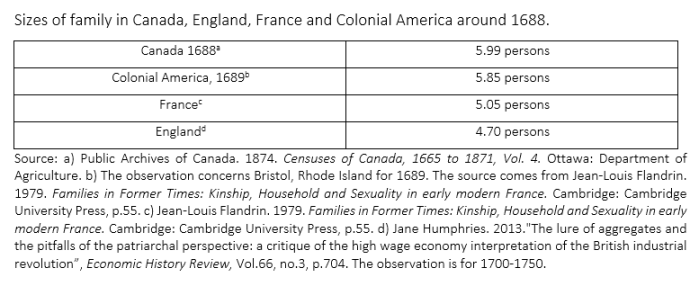
familysize

The table above shows how much family size varied around the late 17th century across region. Clearly, this is a non-negligible issue.

Sensitivity of estimates

Just to see how much these points matter, let’s modify for two easily modifiable factors: household size (given the numbers above) and fuel requirements (calories from food are harder to adjust for and I am still in the process of doing that). Let’s recompute the welfare ratios (those classified as bare bones) of Canada (the outlier) relative to the other according to different changes circa the end of the 17th century. How much does it matter?

Comparing New World places like Canada and Boston does not change much – they are more or less similar (family size and relative price-wise). However, just adjusting for family size eliminates a quarter of the gap between Canada and Paris (from 61% to somewhere 43.9% and 49.5%). Then, the adjustment for the fact that it is freezing cold in Canada eliminates a little more than half the advantage Canada enjoyed. So roughly two third of the Canadian advantage over Paris (the richest place in France) is eliminated by adjusting for family size and fuel consumption without adjusting for food requirements. However, family size does not affect dramatically the comparison between Paris and London (regardless of whether we use the Allen figures or the Stephenson-Adjusted figures).  Thus, most of the sensitivity issues are related to comparing the New World with the Old World. effectofcorrections
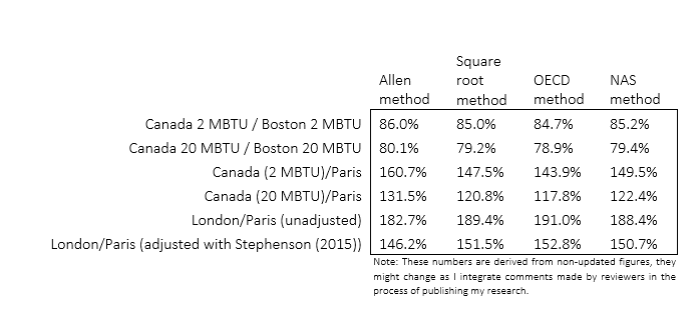
Still, there are some appreciable differences from family structures within Europe (i.e. the Old World) that may alter the relative positions.  For example, Ireland had much larger families than England in the 18th century (see here – the authors shared their dataset with me and a co-author): in 1700, England & Wales had an average household size of 4.7 compared with 5.32 in Ireland. That would moderately disrupt the comparison. Not as much as comparison between the New World and Old World, but enough to make cautious about European differences.

Conclusion

I have seen many discussions regarding the sensitivity of welfare ratios in numerous papers. I am not attempting to make my present point into some form of revolutionary issue. However, all the sensitivity estimates were concentrated on a case or another and they all concern a specific problem. No one has gathered all the problems in one place and provided a “range of estimates”. Maybe its time to go in that direction so that we know which place was poor and which was not (relative to one another, since anything preindustrial was basically dirt-poor by our modern standards).
On Capitalism and Slavery : Pêle-Mêle Comments

Last week, a debate was initiated via an article in the Chronicle of Higher Education that relates to the clash between historians and economists over the topic of slavery. The debate seems acrimonious given the article and at the reading of a special issue of the Journal of Economic History regarding the Half has never been told by Edward Baptist, its hard to conclude otherwise. Pseudoerasmus published comments on the issue in a series of posts and a Trumpian twitterstorm (although the quality is far from being Trumpian). I find myself largely in agreement with him in response to the historians, but there are some pêle-mêle points that I felt I needed to add.

On Historians Versus Economists

To be honest, when I took my first classes in economic history, it seemed clear that there were important points that were agreed upon in the literature on slavery. The first was that the accounting profitability of slavery was not the same as the economic profitability (think opportunity cost here) of slavery. Thus, it was possible that (concentrating on the US here) the peculiar institution could more or less thrive regardless of the social costs it imposed (i.e. slavery is a tax on leisure which also increases the expropriation rate from slaves, and non-slaveowners often had to shoulder the cost of enforcing the institution). This argument is not at all new; in fact it is basically a public choice argument that Gordon Tullock and Anne Krueger could have signed on to without skipping a heartbeat (see Sheilagh Ogilvie – one of my favorite economist who does history in equality with Jane Humphries). The second point of agreement is that no one agreed on how to measure the productivity of slavery in the United States and the distribution of its costs and gains. The second point has been a very deep methodological debate which related to the method of measuring productivity (CES vs Translog TFP – stuff that would make your head blow and which also lead to the self-invitation of the Cambridge Capital Controversy to the debate). The quality of the data has been at the centre-stage as well, and datasets on slave prices, attributes, tasks and many other variables are still being collected (see notably the breathtaking work of Rhode and Olmsted here and here).

Thus, I will admit to being unimpressed by the use of oral histories to contest that literature. In addition, the absence of theory in Baptist’s work yields an underwhelming argument. Oral histories are super-duper important. The work of Jane Humphries on child labor is a case in point of the need to use oral histories. She very carefully used the tales told by children who worked during the industrial revolution to document how labor markets for children worked. The story she told was nuanced, carefully argued and supported by other primary evidence. This is economic history at its best – a merger of cliometrician and historian. In fact, while this is an evaluation that is subjective, the best economists are also historians and vice-versa. The reason for that is the mix of theory with multiple forms of evidence. But they key is to have a theory to guide the analysis.

Unexpectedly for some, the best exposition of this argument comes from Ludwig von Mises in his unknown book Theory and HistoryI was made aware of that book in a discussion with Chris Coyne of George Mason University and I proceeded to reading it. I was surprised how many similarities there were between the Mises who wrote that book and the Douglass Norths and the Robert Fogels of this world. The core argument of Theory and History is that axiomatic statements can be applied to historical events. The goal of historians and economic historians is to sort which theory applies. For example, the theory of signaling and the theory of asymmetric information are both axiomatically true. Without the need for evidence, we know that they must exist. The question of an economic historian becomes to ask “did it matter”? Both theories can compete to offset each other: if signaling is cheap, then asymmetric information can be solved; if it is not, asymmetric information is a problem. Or both may be irrelevant to a given historical development. To explain which two axiomatic statements apply to the event (and in what dosage), you need data (quantitative and qualitative). Thus, Theory and History actually proposes the use of econometrics and statistical methods because it does not try to predict as much as it tries to a) sort which axiomatic statements applied; b) the relative strengths of competing forces; c) the counterfactual scenario.

Without theory, all you have is Baptist’s descriptions which tell us very little and can, incidentally, be distorted by he who recounts the tales he read.

On the Culture of Peasants/Slaves/Slaveowners

When I started my PhD dissertation Canadian economic history, the most annoying thing I saw was the claim that the French-Canadians had “different mentalities” or “more conservative outlooks”. This was basically the way of calling them stupid. This has recently evolved to say that they “maximized goals other than wealth”. Regardless, this was basically: the French-Canadian was not culturally suited for economic development.

But culture is not a fixed variable, it is not an exogenous variable. Culture is basically the coherent framework built by individuals who share certain features to “cut out” the noise. Everyday, we are bombarded with tons of pieces of information and there is no way that the human brain can process them all. Thus, we have a framework – culture (ideology does the same thing) – which tells us what is relevant and what is irrelevant and what interpretation to give to relevant information.

People can cling to old beliefs for a long time, but only if there is no cost to them. I can persist in terrible farming practices if I am not made aware of the proper valuation of the opportunity I am foregoing. For example, British farmers who arrived in Quebec in the 19th century tended to use oxen as they did in England for tilling the soil. They had probably been taught to do that by their parents who learnt it from their grandparents because it was part of the farming culture of England. The behavior was culturally inherited. However, when they saw that the French-Canadians were using horses and that horses – in the Canadian hinterland – got the job done better, they shifted. The culture changed at the sight of how important was the foregone opportunity by continuing to use oxen. Where the British and the French co-existed, both were equally good farmers. Where they could not observe each other, they were all sub-optimal farmers. Seeing the other methods forced changes in culture.

The same applies to slaveowners and slaves! Slaveowners were a more or less tightly knit group that frequented similar circles and were constantly on the lookout to increase productivity. If some master had noticed that he could increase production by whipping more slaves, why would he not adopt this method? Why would he leave 100$ bill on the street? Why did the masters growing cotton in South Carolina not adopt the method of whipping adopted by growers in Louisiana? Without a theory of how culture changes (and what purposes it serves beyond the simplistic Marxist power structure argument), there is no answer to this question. With the work of Rhode and Olmstead, there is an answer: the type of cotton that had higher yields was not suited for growing everywhere! In this case, we are applying my comment from the section above on Historians versus Economists. There are competing theories of explaining increasing output: either some slave masters were unable to observe the other slave masters and adopt the torture methods they had (which would need to be the case for Baptist to be right) or there were biological limitations to growing the better crops in some areas (Rhode and Olmstead).

Two competing theories (they are not mutually exclusive though) that can be tested with data and they set a counterfactual. That is why you need theory to make good history.

One last thing: slave owners were not capitalists

This is probably the most childish thing to come out of works like those of Baptist: to assert that because slaves were capital assets, that the owners were capitalists. That is true if you want to adhere to the inconsistent (and self-contradicting) Marxist approach to capital. In fact, as Phil Magness pointed out to me, slave owners were not free market types. They were very much anti-capitalists. Slavery apologists like Fitzhugh and Carlyle were even more anti-capitalists than that. It’s not because you own capital that you are a capitalist unless you adhere to Marxist theory.

But, capital is just a production input. Its value depends on what it can produce. As Jeffrey Hummel pointed out, there is a deadweight loss from slavery: enforcement costs, the overproduction of cotton because slavery is basically a tax on leisure and the implicit taxation of the output produced by slaves. All three of these factors would have slowed down economic growth in the south. Thus, as capital assets, slaves were relatively inefficient.

How Well Has Cuba Managed To Improve Health Outcomes? (part 1)

Since the passing of Fidel Castro, I have devoted myself to researching a proper assessment of his regime’s achievements in matters of health care. The more I dig, the more I am convinced that his regime has basically been incredibly brilliant at presenting a favorable portrait. The tweaking of the statistics is not blatant or gigantic, it is sufficiently small to avoid alerting demographers (unlike when Davis and Feshbach, Eberstadt and Miller and Velkoff found considerable evidence of data tweaking in the USSR which raised a massive debate). Indeed, a re-computation of life expectancy based on life tables (which I will present in the new few weeks) to adjust for the false reclassification of early neonatal deaths as late fetal deaths (raising the low infant mortality rate by somewhere 28% and 96%) suggests that somewhere between 0.1 and 0.3 years must be knocked off the life expectancy figures. Given that the variations between different measurements available (WHO, World Bank, MINISAP, CIA, FAO) are roughly of that magnitude, it falls within a very reasonable range of errors. This statistical tweaking is combined with an over-dramatization of how terrible the situation was in 1959 (the life expectancy figures vary from 63.9 years to 65.4 years at the beggining of the Castrist regime). But that tweaking is not sufficient to invalidate the massive downward trend.  As a result, the majority of public health scholars seem confident in the overall level and trend (and I tend to concur with that statement even if I think things are worse than presented and the slope of the downward trend is too steep).

Those little tweaks have been combined with the use of massive coercive measures on the local population (beautifully described  by Katherine Hirschfeld in what should be an example of ethnographic work that economists and policy-makers should rely on because it goes behind the data – see her book Health, Politics, and Revolution in Cuba: 1898-2005) that go from using doctors as tools for political monitoring to the use of abortion against a mother’s will if it may hinder a physician’s chance of reaching the centrally-decided target without forgetting forced isolations for some infectious patients. Such methods are efficient at fighting some types of diseases, but they are associated with institutions that are unable to provide much economic growth which may act as a palliative counter-effects to how choices may make us less healthy (me having the freedom to eat too much salt means I can die earlier, but the type of institutions that let me eat that much salt also avoid infringing on my property rights thus allowing me to improve living standards which is the palliative counter-effect).  With such a trade-off, the issue becomes one of the ability of poor countries to improve in the absence of extreme violence as that applied by the Castrist regime.

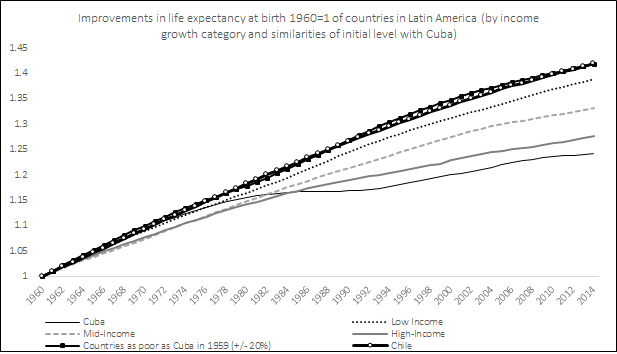
Over the next few weeks, I will publish many re-computations of health statistics to sustain this argument as I write my article.  The first one I am doing is the evolution of life expectancy from 1960 to 2014. What I did is that I created comparatives for Cuba based on how much living standards (income per capita). Cuban living less than doubled over that 49 years period (82% increase) from 1959 to 2008 (the latest available data from the high-quality Maddison data).  Latin American and Carribean countries that saw their living standards less than double (or even decline) are Argentina (+90%), Bolivia (+87%), El Salvador (+68%), Haïti (-33%), Honduras (+71%), Jamaica (+51%), Nicaragua (-17%) and Venezuela (+7%). This forms the low income group. The remaining countries available are separated in two groups: those whose income increased between 100% and 200% (the mid-income group composed of Brazil, Colombia, Mexico, Peru, Uruguay, Ecuador, Guatemala, Panama and Paraguay) and those whose incomes increased more than 300% (the high-income group composed Chile, Costa Rica, Dominican Republic, Puerto Rico and Trinidad & Tobago).  I also compared Cuba with a group of countries that had incomes per capita within 20% of the income per capita of Cuba.  So, how did Cuba’s life expectancy increase?

Well, using only the official statistics (which I do not fully trust although they are from the World Bank Development Indicators Database), Cuba life expectancy (which was already pretty high by Latin American standards in 1959) increased 24%. However, all other countries – which were well below Cuba – saw faster increases. The countries that had the least growth in Latin America saw life expectancy increase 38% and the countries that were equally poor as Cuba saw life expectancy increase an impressive 42%. Chile, whose life expectancy was only 57.5 years against Cuba’s 63.9 in 1960, also increased more rapidly (also 42%) and it has now surpassed Cuba (81.5 years against 79.4 years) and what is more impressive is that this rate has increased in a monotonic fashion regardless of changes in political regimes (democracy, socialism, Pinochet, liberal democracy) while Cuba’s rate seems to accelerate and decelerate frequently. Now, this is assuming that the figures for 1960 are correct. I have surveyed the literature and it is hard to find a way to say which of the estimates is the best, but that of the World Bank for 1960 is the lowest. There are other rates, contained in McGuire and Frankel’s work – the highest stands at 65.4 years for 1960. That means that the range of increase of life expectancy in Cuba is between 21.4% and 24.2%. Its not earth-shattering, but it makes Cuba’s achievements less impressive (although it is impressive to keep increase life expectancy from an already-high level). But as you can see, more important improvements could have been generated without recourse to such violent means. In fact, as a post that I will publish this week shows, the decline in car ownership from 1959 to 1988 probably played moderately in favor of the increase in life expectancy while the massive increase in car ownership in all other countries played (all else being equal) in favor of slowing down the increases in life expectancy (but being too poor or making it illegal to import a foreign car is not health care and I deem it improper to consider that this accident from misfortune should be praised).

improvementslifeexpectancy

In a way, what I am saying is that the benefit is not as impressive as claimed. Given the costs that Cubans have to assume for such a policy, anything that makes the benefits look more modest should make more inclined to cast a damning judgment on Castro’s regime.

Coming up (I will add the links as they are published) :

  1. Life Expectancy Changes, 1960 to 2014
  2. Car ownership trends playing in favor of Cuba, but not a praiseworthy outcome
  3. Of Refugeees and Life Expectancy
  4. Changes in infant mortality
  5. Life expectancy at age 60-64
  6. Effect of recomputations of life expectancy
  7. Changes in net nutrition
  8. The evolution of stature
  9. Qualitative evidence on water access, sanitation, electricity and underground healthcare
  10. Human development as positive liberty (or why HDI is not a basic needs measure)

Sons outearning Fathers in Chetty et al. : working hours should be considered

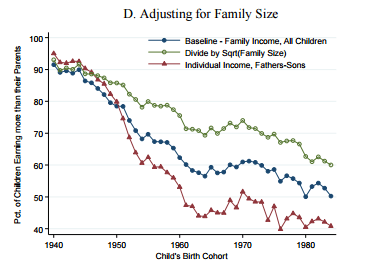
In response to my post yesterday, my friend and economist/nuclear engineer (great mix) Laurent Béland pointed out that the Father-Sons mobility figures in Chetty et al. are depressing. Yes, at first glance, they are (see below – the red line). fathersons

But, at second glance, it is not as terrible. Think about family structures with the 1940 birth cohorts. The father works and, in most likelihood, the mother is a stay-at-home father. Most of the earnings come from the father who probably works 45 to 60 hours a week.  If my father earns 40,000$ at 60 hours a week or earn 40,000$ at 40 hours a week, the line remains at the same height, but we are not talking about the same living standard in reality. Chetty et al. do not account for hours worked to achieve income.  The steep decline – faster than the baseline of household-size adjusted decline – matches the steep increase in female labor force participation and the decline labor force participation of males (see graph here and Nicolas Eberstadt’s work here) as well as the decline in hours worked by males.

If the question had been “what are your chances of out-earning your father per hour worked”, then the red line would not have fallen like that. Income divided by labor supplied would probably bring the red-line back with the blue-line.

Note: Again, please note that I am not trying to rip apart Chetty et al. (as some have claimed elsewhere). Their work is great and as a guy who does all his research on providing data series regarding economic history, I am never going to rip on someone who does hard data work like Chetty et al. did ! My point is that I am not convinced that the decline is so big. And, in good faith, it seems that Chetty et al. do try to put the “caution” labels where its needed – and its important to discuss those caution labels before some politician or two-cents-pundit goes all Trump on us by saying stuff that this doesn’t say!

The Uniqueness of Italian Internal Divergence

A few weeks ago, I got engaged in a twitter debate with Garett Jones, Pseudoerasmus and Anna Missiaia (see her great work here) about institutions in Italy. During the course of that discussion, I was made aware that I held a false belief. Namely, the belief that since the late 19th century, there had only been a minor divergence within Italy. In reality, there has been considerable divergence within the country since the late 19th century.

In the wake of the Italian referendum, it is worth examining how big is this divergence. Below is a map of regional GDP per capita taken from Europa.ec.  The southern regions of Italy have GDP per capita below 75% of the European average while some of the northern regions have GDP per capita above 125% of the European average. The IStat database suggest similar levels of divergence across regions in Italy.

Gross_domestic_product_(GDP)_per_inhabitant_in_purchasing_power_standard_(PPS)_in_relation_to_the_EU-28_average,_by_NUTS_2_regions,_2014_(¹)_(%_of_the_EU-28_average,_EU-28_=_100)_RYB2016.png

So, how much divergence was there – say a little a more than one hundred years ago? Well, according to the great work of Felice (see here in the Economic History Review and here), there were more similarities back in the 19th century than there are today. Take the Liguria which – in 1891 – had per capita value added of 44% above national average. Take also Campania which was 3% below the national average. Today, the IStat data places Liguria 9% above national average but the region of Campania is 37% below the national average. Overall, regardless of how you present the data , divergence has increase. Just expressed at coefficient of variations, there has been an increase. In 1891, the coefficient of variation stood at 22.95% while it stood at 28.95% in 2013.

italiangdp

This makes Italy into an oddity. My own work shows that in Canada, since the 19th century, there has been considerable convergence (see article in Economics Bulletin). The same happened in the United States (see this paper by Michener and McLean), in England (here and here) and in Sweden (here). Among western countries, increased internal divergence is rare and Italy is the prime case example. And this is a strong indictment. Either Italy as a whole shares the same steady-state status and something is preventing upwards convergence from the South or Italy has two different economies with two different steady-states. In both cases, the implications are depressing.