The Impossible Trinity of Liberal Democracy

In the first part of my series on democracy published a few years ago, I made a distinction between four senses in which the term “democracy” is used. To briefly recap, I made they were: a) a term of empty political praise for policies which partisans like b) an institutional decision-making process emphasizing the primacy of majoritarian opinion c) a generic term for the type of procedures which have been prevalent in the west, and d) an overarching term for the ethical commitments of liberals. In that series, I focused on the tension b) and d), mostly ignoring a) and c). (For Present purposes, my highly speculative musings on anarchism are irrelevant.

In a recent podcast of the Ezra Klein show  (which I highly recommend) discussing his book The People vs. Democracy: Why Our Freedom Is in Danger and How To Save It, Harvard political theorist Yascha Mounk and Ezra Klein were debating how pessimistic we should be about the prospects for the future of American Democracy. I don’t really wish to comment on whether we should be pessimistic or not, but I want to make a further distinction that clarifies some of the disagreements and points towards a deeper issue in the workings of democratic institutions. I will argue that democracy consists of a liberal, majoritarian, and procedural dimension and these dimensions are not reconcilable for very long.

Mounk makes a similar distinction to the one I made between democratic majoritarianism and liberalism as a reason to be pessimistic. Klein tended to push back, focusing on the ways in which modern American political culture is far more ethically liberal than it has ever been, as seen through the decline in racism since the middle of the twentieth century and decline in homophobia since the 1990s. Mounk, however, emphasized how respect for procedure in the American political process has declined during the Trump Era, as evidenced by Trump’s disrespect for the political independence of courts and agencies like the Department of Justice.

However, throughout Klein’s and Mounk’s debate, it became clear that there was another distinction which needed to be made explicitly, and one which I have tended to heavily under-emphasize in my own thinking on the feasibility of democracy. It seems to me there are at least three dimensions by which to judge the functioning of democracies which are important to distinguish:

  1. Majoritarianism—the extent to which a democracy is sensitive to majority public opinion. Democracy, in this dimension, is simply the tendency to translate majority opinion to public policy, as Mounk puts it.
  2. Liberalism—this refers to the ethical content towards which democracies in the west try to strive. This is the extent to which citizens are justly treated as moral equals in society; whether minority religious freedoms are respected, racial and ethnic minorities are allowed equal participation in society (economically and politically), and the extent to which general principles of liberal justice (however they may be interpreted) are enacted.
  3. Legal proceduralism—the extent to which political leaders and citizens respect the political independence of certain procedures. This dimension heavily emphasizes the liberal belief in the rule of law and the primacy of process. This can include law enforcement agencies such as the Department of Justice or the FBI, courts, and respect for the outcomes of elections even when partisan opponents are victorious.

It seems that there are reasons why one would want a democracy to retain all three features. Majoritarianism could be desirable to ensure stability, avoiding populist revolutions and uprising, and perhaps because one thinks it is just for government to be accountable to citizens. Liberalism, clearly, is desirable to ensure the society is just. Proceduralism is desirable to maintain the stability of the society given that people have deep political and philosophical disagreements.

Klein and Mounk’s debate, considering this explicit triadic distinction, can be (crudely) seen as Mounk initially emphasizing the tension between majoritarianism and liberalism in modern democracies. Klein pushes back saying that we are more liberal today than we’ve ever been, and perhaps the current majoritarian populist turn towards Trump should be put in context of other far more illiberal majoritarian populist impulses in the past. Mounk’s response seems to be that there’s also been a decline in respect for legal procedure in modern American politics, opening a danger for the instability of American democracy and a possible rise of authoritarianism.

First, it seems to me that both Mounk and Klein overemphasize respect for procedure in the past. As Robert Hasnas has argued, it has never been the case that anyone treats the law as independent simply because “the law is not a body of determinate rules that can be objectively and impersonally applied by judges” and therefore “what the law prescribes is necessarily determined by the normative predispositions of the one who is interpreting it.” There is always an ethical, and even a partisan political dimension, to how one applies procedure. In American history, this can be seen in ways that courts have very clearly interpreted law in motivated ways to justify a partisan, often illiberal, political view, such as Bowers v. Hardwick. There has always been a tendency for procedures to be applied in partisan ways, from the McCarthyite House Unamerican Committee, to the FBI’s persecution of civil rights leaders. Indeed, has Hasnas argues, the idea that procedures and laws can be entirely normatively and politically independent is a myth.

It is true, however, that Mounk does present reason to believe that populism makes disrespect for these procedures explicit. Perhaps one can say that while procedural independence is, in a pure sense, a myth, it is a constructive myth to maintain stability. People believing that elections are not independent, Trump’s disrespect for the independence of courts and justice, allows for a disintegration of those institutions into nothing but a Carl Schmitt-style, zero-sum war for power that can undermine stability of political institutions.

On the other hand, it seems worth emphasizing that there is often a tension between respect for procedure and the ethics of liberalism. Klein points out how there was large respect for legal procedure throughout American history that heavily undermined ethical liberalism, such as southerners who filibustered anti-lynching laws. Indeed, the justification for things such as the fugitive slave law was respect for the political independence of the legal right to property in slaves. All the examples of procedure being applied in politically biased and illiberal ways given moments ago support this point There is nothing in the notion that legal and electoral procedures are respected that guarantees those procedures in place will respect liberal principles of justice.

I remain agnostic as to whether we should be more pessimistic about the prospects for democracy in America today than at any other point in American history. However, at the very least, this debate reveals an impossible trinity, akin to the impossible trinity in monetary policy, between these three dimensions of democracy. If you hold majority opinion as primary, that includes populist urges to undermine the rule of law. Further, enough ink has been spilled on the tensions between majoritarianism and liberalism or effective policy. If you hold respect for procedure as primary, that includes the continuation procedures which are discriminatory and unjust, as well as procedures which restrict and undermine majority opinion. If you hold the justice of liberalism as primary, that will generate a tendency for morally virtuous liberals to want to undermine inequitable, unjust procedures and electoral outcomes and to want to restrict the ability of majorities to undermine minority rights.

The best a conventional democrat can do, it seems to me, is to pick two. A heavily majoritarian democracy where procedures are respected, which seems to be the dominant practice in American political history, is unlikely to be very ethically liberal. An ethically liberal and highly procedural government, something like a theoretically possible but practically unfeasible liberal dictator or perhaps a technocratic epistocracy (for which Jason Brennan argues), is a possible option but might be unstable if majorities see it as illegitimate or ethically unpalatable to procedural democrats. An ethically liberal but majoritarian democracy seems unworkable, given the dangers of populism to undermine minority rights and the rational ignorance and irrationality of voters. This option also seems to be what most western democracies are currently trending towards, which rightly worries Mounk since it is also likely to be extremely unstable. But if there’s a lesson to be learned from the injustice of American history and the rise of populism in the west it’s that choosing all three is not likely to be feasible over the long term.

Why the left loves democracy

The left loves to talk about democracy. Brazil’s former president Lula da Silva is in jail. Finally. Leftists inside and outside Brazil call this a crime against democracy because the polls were showing that in the upcoming October elections Lula would be elected president. The people wanted Lula president, and a judge, Sergio Moro, against the will of the majority, jailed Lula.

I will consent to this argument. Maybe Lula was going to be elected in October (although I have serious doubts about it). Would this be democratic? Maybe. In its most pure form, democracy is the rule of the majority. A good picture of this is three wolves and a sheep voting on what they are going to have for dinner. Leftists in power (or hoping to be in power) love this.

A pure Democracy, by which I mean a Society consisting of a small number of citizens, who assemble and administer the Government in person, can admit of no cure for the mischiefs of faction. A common passion or interest will, in almost every case, be felt by a majority of the whole; a communication and concert result from the form of Government itself; and there is nothing to check the inducements to sacrifice the weaker party, or an obnoxious individual. Hence it is, that such Democracies have ever been spectacles of turbulence and contention; have ever been found incompatible with personal security, or the rights of property; and have in general been as short in their lives, as they have been violent in their deaths. Theoretic politicians, who have patronized this species of Government, have erroneously supposed, that by reducing mankind to a perfect equality in their political rights, they would, at the same time, be perfectly equalized and assimilated in their possessions, their opinions, and their passions. — James Madison, Federalist No. 10

Are voting ages still democratic?

Rather par for the course, our current gun debate, initiated after the school shooting in Parkland, has been dominated by children — only this time, literally.

I’m using “children” only in the sense that they are not legally adults, hovering just under the age of eighteen. They are not children in a sense of being necessarily mentally underdeveloped, or necessarily inexperienced, or even very young. They are, from a semantics standpoint, still teenagers, but they are not necessarily short-sighted or reckless or uneducated.

Our category “children” is somewhat fuzzy. And so are our judgments about their political participation. For instance, we consider ourselves, roughly, a democracy, but we do not let children vote. Is restricting children from voting still democratic?

With this new group of Marjory Stoneman Douglas high school students organizing for political change (rapidly accelerated to the upper echelons of media coverage and interviews), there has been widespread discussion about letting children vote. A lot of this is so much motivated reasoning: extending suffrage to the younger demographic would counter the current proliferation of older folks, who often vote on the opposite side of the aisle for different values. Young people tend to be more progressive; change the demographics, change the regime. Yet the conversation clearly need not be partisan, since there exist Republican- and Democrat-minded children, and suffrage doesn’t discriminate. (Moreover, conservative religious groups that favor large families, like Mormons, could simply start pumping out more kids to compete.)

A plethora of arguments exist that do propose pushing the voting age lower — 13, and quite a bit for 16 (ex. Jason Brennan) — and avoid partisanship. My gripe about these arguments is that, in acknowledging the logic or utility of a lowered voting age, they fail to validate a voting age at all. Which is not to say that there should not be a voting age in place (I am unconvinced in either direction); it’s just to say that we might want to start thinking of ourselves as rather undemocratic so long as we have one.

An interesting thing to observe when looking at suffrage for children is that Americans do not consider a voting age incompatible with democracy. If Americans do not think of America as a democracy, it is because our office of the President is not directly elected by majority vote (or they think of it as an oligarchy or something); it is not undemocratic just because children cannot vote. The fact that we deny under-eighteen year olds the vote does not even cross their minds when criticizing what many see as an unequal political playing field. For instance, in eminent political scientist Robert Dahl’s work How Democratic is the American Constitution? the loci of criticism are primarily on the electoral college and bicameral legislature. In popular parlance these are considered undemocratic, conflicting with the equal representation of voters.

Dahl notes that systems with unequal representation contrast to the principle of “one person, one vote.” Those with suffrage have one or more votes (as in nineteenth-century Prussia where voters were classified by their property taxes) while those without have less than one. Beginning his attack on the Senate, he states “As the American democratic credo continued episodically to exert its effects on political life, the most blatant forms of unequal representation were in due time rejected. Yet, one monumental though largely unnoticed form of unequal representation continues today and may well continue indefinitely. This results from the famous Connecticut Compromise that guarantees two senators from each state” (p. 48).

I quote Dahl because his book is zealously committed to majoritarian rule, rejecting Toqueville’s qualms about the tyranny of the majority. Indeed, Dahl says he believes “that the legitimacy of the Constitution ought to derive solely from its utility as an instrument of democratic government” (39). And yet, in the middle of criticizing undemocratic American federal law, the voting age and status of children are not once brought up. These factors appear to be invisible. In our ordinary life, when the voting age is brought up, it is nearly always in juxtaposition to other laws, e.g., “We let eighteen year olds vote and smoke, but they have to be 21 to buy a beer,” or, on the topic of gun control, “If you can serve in the military at 18, and you can vote at 18, then what is the problem, exactly, with buying a gun?”

What is the explanation for this? We include the march for democracy as one progressive aspect of modernity. We see ourselves as more democratic than our origin story, having extended suffrage to non-whites, women and people without property. We see America under the Constitution as a more developed rule-of-the-people than Athens under Cleisthenes. So, we admit to degrees of political democracy — have we really reached the end of the road? Isn’t it more accurate that we are but one law away from its full realization? And of course, even if we are more of a representative republic, this is still under the banner of democracy — we still think of ourselves as abiding by “one person, one vote” (Dahl, 179-183).

In response, it is said that children are not properly citizens. This allows us to consider ourselves democratic, even while restricting direct political power from a huge subset of the population while inflicting our laws on them.

This line of thought doesn’t cut it. The arguments for children as non- or only partial-citizens are riddled with imprecisely-targeted elitism. “Children can be brainwashed. Children do not understand their own best interests. Children are uninterested in politics. Children are not informed enough. Children are not rational. Children are not smart enough to make decisions that affect the entire planet.”

Although these all might apply, on the average, to some age group — one which is much younger than seventeen, I would think — they also apply to all sorts of individuals distributed throughout every age. A man gets into a car wreck and severely damages his frontal lobe. In most states there is no law prohibiting him from dropping a name in the ballot, even though his judgment is dramatically impaired, perhaps analogous to an infant. A nomad, who eschews modern industrial living for the happy life of travel and pleasure, is allowed to vote in his country of citizenship — even though his knowledge of political life may be no greater than someone from the 16th century. Similarly, adults can be brainwashed, adults can be stupid, adults can be totally clueless about which means will lead to the satisfaction of their preferred ends.

I venture that all Americans do not want uninformed, short-sighted, dumb, or brainwashable people voting, but they will not admit to it on their own. Children are a proxy group to try to limit the amount of these people that are allowed in on our political process. And is banning people based on any of these criteria compatible with democracy and equality?

Preventing “stupid” people from voting is subjective and elitist; preventing “brainwashable” people from voting is arbitrary; preventing “short-sighted” people from voting is subjective and elitist, and the same for “uninformed” people. We come to the category of persons with severe mental handicaps, be their brain underdeveloped from the normal process of youth, or injury, or various congenital neurodiversities. Regrettably, at first glance it seems reasonable to prevent people with severe mental defects from voting. Because, it is thought, they really can’t know their interests, and if they are to have a voting right, it should be placed in a benefactor who is familiar with their genuine interests. But now, this still feels like elitism, and it doesn’t even touch on the problem of how to gauge this mental defect — it seems all too easy for tests to impose a sort of subjective bias.

Indeed, there is evidence that this is what happens. Laws which assign voting rights to guardians are too crude to discriminate between mental disabilities which prevent voting and other miscellaneous mental problems, and make it overly burdensome to exercise voting rights even if one is competent. It is hard to see how disenfranchising populations can be done on objective grounds. If we extended suffrage from its initial minority group to all other human beings above the age of eighteen, the fact that we prolong extending it to children is only a function of elitism, and consequently it is undemocratic.

To clarify, I don’t think it is “ageist” to oppose extending the vote to children, in the way that it is sexist to restrict the vote for women. Just because the categories are blurry doesn’t mean there aren’t substantial differences, on average, between children and adults. But our reasoning is crude. We are not anti-children’s suffrage because of the category “children,” but because of the collective disjunction of characteristics we associate underneath this umbrella. It seems like Americans would just as easily disenfranchise even larger portions of the population, were we able to pass it off as democratic in the way that it has been normalized for children.

Further, it is not impossible to extend absolute suffrage. Children so young that they literally cannot vote — infants — could have their new voting rights bestowed upon their caretakers, since insofar as infants have interests, they almost certainly align with their daily providers. This results in parents having an additional vote per child which transfers to their children whenever they request them in court. (Again, I’m not endorsing this policy, just pointing out that it is possible.) The undemocratic and elitist nature of a voting age cannot be dismissed on the grounds that universal suffrage is “impossible.”

It is still perfectly fine to say “Well, I don’t want the boobgeoisie voting about what I can do anyway, so a fortiori I oppose children’s suffrage,” because this argument asserts some autocracy anyway (so long as we assume voting as an institutional background). The point is that the reason Americans oppose enfranchising children is because of elitism, and that the disenfranchising of children is undemocratic.

In How Democratic is the American Constitution? the closest Robert Dahl gets to discussing children is adding the Twenty-Six Amendment to the march for democratic progress, stating that lowering the voting age to eighteen made our electorate more inclusive (p. 28). I fail to see why lowering it even further would not also qualify as making us more inclusive.

In conclusion, our system is not democratic at all,
Because a person’s a person no matter how small.


Nightcap

  1. One-party systems loved by the Left, ignored by Trump Oliver Kamm, CapX
  2. George W Bush’s Forgotten Crimes Against Democracy James Bovard, the Hill
  3. Peshawar, Sicily, and the Fatal Conceit of Intervention Peter Miller, Views
  4. How to Seize the Moral High Ground Wayland Hunter, Liberty Unbound

The Gradual, Eventual Triumph of Liberty

Today I’d like to write a few words of hope and encouragement to those who already understand liberty’s value. I read a speech from 1853 that stood out to me. It’s easy to be caught up in the daily news cycle and feel that liberty is constantly under attack and threatened at every hand, that every gain is clawed back as liberties are eroded one at a time. At times like that, it is good to step back and took a better look at the broader history of the world.

The speech I read was by a gentleman named Parley P. Pratt, an apostle of the Church of Jesus Christ of Latter-day Saints in the Utah territory. This was just a few years after the Mormons, including Pratt and his family, had been driven from their homes by mobs and by indifferent and sometimes hostile state and federal governments in the United States proper to find freedom and refuge in the Rocky Mountains. There they still held 4th of July celebrations, honoring the sacrifices for liberty their fathers had made. Pratt, by this point in his life, had traveled through England and parts of Europe, much of the US, Canada, and along the Pacific into Mexico, and met with many people from Asia as well – a remarkably well-traveled man.

Despite the very real failures of the government to protect their individual rights or redress their grievances, he spoke in praise of the Constitution. The main thrust of his address was that the cause of liberty would expand and someday fill the world:

The longer I live, and the more acquainted I am with men and things, the more I realize that … the Constitution of American Liberty was certainly dictated by the spirit of wisdom, by a spirit of unparalleled liberality, and by a spirit of political utility. And if that Constitution be carried out by a just and wise administration, it is calculated to benefit not only all the people that are born under its particular jurisdiction, but all the people of the earth … . It seems broad enough, and large enough, to receive and protect all that may be in any way deprived of the common rights of man. …. [The principles of the Constitution] embrace eternal truths, principles of eternal liberty, not the principles of one peculiar country, or the sectional interest of any particular people, but the great, fundamental, eternal principles of liberty to rational beings – liberty of conscience, liberty to do business, liberty to increase in intelligence and in improvement […]

There is a day coming when all mankind upon this earth will be free. When they will no longer be shackled, either by ignorance, by religious or political bondage, by tyranny, [or] by oppression (Journal of Discourses, Vol. 1, p. 137-143)

Pratt claimed this would not happen predominantly by revolution and violence, but by America being a beacon light to the world. He spoke of throngs of people who would sit in his day enjoying to hear of our freedoms, our institutions, and our scientific and cultural progress. He spoke of the immigrants coming to this country from all parts of the world specifically to find that freedom, and that once enlightened by being allowed to think and reason and act for themselves without the bondage of kings, state religions, or other powers they would blossom and rise up in greatness. Whether they eventually returned to their native lands or not, this would act as an “indirect influence … on those despotic nations” of Europe and Asia.

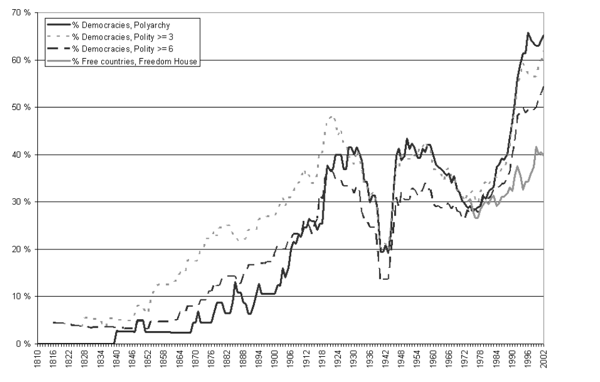
Recognizing that our liberty is remarkably multi-faceted, I will focus on the same categories Pratt mentioned. At the time he spoke, there were exactly 3 nations that were in some measure democracies, where at least some large percentage of the populace had the liberty of choosing their leaders. You can see for yourself how this has grown in the intervening 160+ years:

NOL Watson 1
source: Our World in Data

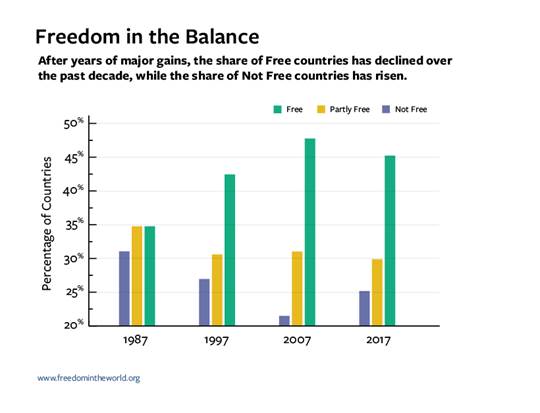
Billias’ 2009 work on how the principles of American constitutionalism were “heard round the world” shows that waves of influence gradually spread the principles of self-determination, liberty, separation of powers, and checks and balances into the freedom movements and constitutions of most of the world. Even while warning that the last ten years have seen declines in liberty overall worldwide, Heritage shows us that the last thirty years still show remarkable improvement:

NOL Watson 2

From a time when the US was one of very few countries to legally protect religious liberty, today nearly three-fourths of all the countries in the world have a constitution that specifically protects freedom of belief, and two-thirds permit some religious proselytism – which preserves freedom of expression (Pew Global Restrictions on Religion). There is still much to do to improve and preserve religious liberty around the world, both in legally acknowledged protections and in fostering an actual peaceful society where religious groups are not subject to violence and persecution.

Despite the distance left to go, the cause of liberty has clearly moved forward in great ways in the last 160 years. Much as Pratt predicted, much of this was accomplished without great revolutions and civil wars, but through the power of example as free nations and free people proved themselves a beacon to the world. There is still good cause to believe in that fundamental converting power from setting the right example and allowing free people to govern themselves.

A quick update, then liberals and democracy, followed by racism and rectification

I have been busy. I picked up a gig at RealClearHistory as a ghost editor, and I also write a weekly column there. I have a baby daughter (she’s 8 months old). My musings here at NOL have been sporadic, but I have been learning a lot. Bill (morality) and Federico (law and liberty) continue to make me smarter.

Tridivesh’s thoughts here so far have a heavy element of “democracy-is-best” in them. I find this to be the case for most South Asian liberals. I wonder if this community has had the time to ponder Fareed Zakaria’s The Future of Freedom…, which laments the fact that most liberals worldwide have eschewed the “liberty” in the phrase “liberty and democracy.” One is surely sexier than the other, and there are probably many pragmatic reasons for this phenomenon, but it’s worth repeating here that you can’t have liberal democracy without liberty. China holds elections all the time, but this doesn’t mean the Chinese are free.

Michelangelo’s most recent note on race is interesting, as always. If it’s just the US Census then I agree with Thomas: eliminate the race question. Matt’s idea, to leave it blank and let people fill it in themselves, is a good idea, too, provided the Census continues to pry too much into the lives of people living in the US. As far as race goes in general, the American system of classification is ridiculous (to be fair to us, I’ve never come across a good one). However, the US government has committed some heinous crimes based on racist classifications and as such I do think there is a need to continue asking race-based questions. My approach would be much simpler, though. I’d ask:

  • Do you identify as African-American?
  • Do you identify as Native American?
  • Do you identify as Japanese-American?

That’s it. Those are the only 3 questions I would ask about race. These three groups are groups because the US government, at some point in time, classified them as such and then proceeded to implement plans that robbed them of their labor, or their land, or their freedoms, and justice has yet to be delivered.

Libertarianism, Classical Liberalism, Right Wing Populism, and Democracy

An interesting exchange has occurred between Will Wilkinson of the Niskanen Center and Ilya Somin writing for the Washington Post on the issue of the influence of libertarianism over the modern Republican Party’s erosion of liberal democratic norms. In his initial piece, Wilkinson seemed to argue that the Libertarian view of absolutism in regards to property rights which was a way to offer an emotionally gratifying alternative to socialist redistribution was responsible for the Right’s adoption of a populist outlook which eroded democratic norms, for example, policies like Voter ID and Gerrymandering. Ilya Somin responded by pointing out that the libertarian “absolutist” conception of property rights had next to nothing to do with why many libertarians Wilkinson cites are skeptical of democracy. Wilkinson responded by saying his initial argument was confusingly stated, not that absolutist property rights is driving democratic erosion on the part of the right, by trying to clarify his distinction between “libertarian” and “classical liberal.” Somin pointed out that this response undermines the force of Wilkinson’s initial argument and took issue with some of his other points.

I wish to contribute to this debate because, even though Somin is largely right that Wilkinson’s argument is weakened by his clarification, I think both have missed that Wilkinson has fundamentally misunderstood what right-wing populism is and why it is a threat to democracy. Modern right-wing populism does not try to erode majoritarian democracy, even if it erodes some of the institutional norms which make it possible for modern liberal democracy to function. Rather, populism, in its many forms, weaponizes democratic rhetoric which is premised on the very notions which libertarians and classical liberals critical of democracy seek to challenge. Attempts to tie such criticisms to the modern right is absurd and distracts us from confronting those aspects which are actually threatening about the right’s pathologies. Afterwards, I will comment on some of the other minor confusions into which I believe Wilkinson falls.

Populism and Folk Democratic Intuitions

In Wilkinson’s genealogy, the root of modern libertarianism is an attempt to weaponize classical liberalism’s defense of property against the desire for socialist redistribution. As he tells it, classical liberals like Hayek and Buchanan sought to put trigger locks on democracy in the form of constitutional constraints on majority rule whereas radical libertarians like Rand, Nozick, and Rothbard sought to disarm democracy altogether from violating property rights. This conception leaves no room for any analysis of or support for democratic decision-making. Since the end of the Cold War, the right has continued to believe this absolutist property rights argument was extremely important even after the Red Menace had been slain and so is willing to do anything, including throwing democracy under the bus, to defend property rights. As Wilkinson puts it:

And that’s why ideological free-market conservatives tend to be so accommodating to, if not exactly comfortable with, populist white identity politics. In their minds, mundane left-right differences about tax rates and the generosity of the welfare state are recast as a Manichean clash between the light of free enterprise and the darkness of socialist expropriation. This, in turn, has made it seem morally okay, maybe even urgently necessary, to do whatever it takes—bunking down with racists, aggressively redistricting, inventing paper-thin pretexts for voting rules that disproportionately hurt Democrats, whatever—to prevent majorities from voting themselves a bigger slice of the pie.

In his follow up, after Somin pointed out that irrational factors like partisanship are more likely to influence a voter’s decision than complicated moral theories such as property rights, Wilkinson attempted to make this argument more plausible by giving the hypothetical example of a white working-class republican voter who, while not fully libertarian, uses his thin knowledge of libertarian property rights absolutism as a form of motivated reasoning justifying his erosion of democratic norms:

Burt is a moderately politically engaged mechanical engineer with ordinary civics-class ideas about democracy, as well as a strong distaste for paying his taxes. (He wants to buy a boat.) One day Burt picks up Atlas Shrugged on the recommendation of a friend, likes it a lot, and spends a few weeks poking around libertarian precincts of the Internet, where he encounters a number of libertarian arguments, like Rand’s, that say that taxation violates a basic, morally inviolable right. Burt happens to find these arguments extremely convincing, especially if he’s been idly shopping for boats online. Moreover, these arguments strongly suggest to Burt that democracy is a dangerous institution by which parasitic slackers steal things from hyper-competent hard workers, like Burt.

Now, none of this leads Burt to think of himself as a “libertarian.” He thinks of himself as a Lutheran, a moderate Republican, and a very serious Whovian. He’s suspicious of “free trade.” He’s “tough on crime.” Burt would never disrespect “our troops” by opposing a war, and he thinks legalizing drugs is bananas. Make no mistake: Burt is not a libertarian. But selective, motivated exposure to a small handful of libertarian arguments has left Burt even more indignant about taxes, and a bit sour on democracy—an altogether new attitude that makes him feel naughtily iconoclastic and a wee bit brave. Over time, the details of these arguments have faded for Burt, but the sentiments around taxation, redistribution, and democracy have stuck.

Ayn Rand and the other libertarian thinkers Burt encountered in his brief flush of post-Atlas Shrugged enthusiasm wanted him to be indignant about redistribution and wanted him to be sour on democracy. He drew the inferences their arguments were designed to elicit. The fact that he’s positively hostile to other elements of the libertarian package can’t mean he hasn’t been influenced by libertarian ideas.

Let’s suppose that, a few years later, a voter-ID ballot initiative comes up in Burt’s state. The local news tells Burt that this will likely make it harder for Democrats to win by keeping poorer people without IDs away from the polls. Burt rightly surmises that these folks are likely to vote, if they can, to take even more of his money in taxes. A policy that would make it less likely for those people to cast a ballot sounds great to Burt. Then it occurs to him, with a mild pang of Christian guilt, that this is a pretty selfish attitude. But then Burt remembers those very convincing arguments about the wickedness of democratic redistribution, and it makes him feel better about supporting the voter-ID requirement. Besides, he gives at church. So he votes for the initiative come election day.

That’s influence. And it’s not trifling, if there are a lot of Burts. I think there are a lot of Burts. Even if the partisan desire to stick it to Democrats is doing most of the work in driving Burt’s policy preference, the bit of lightly-held libertarian property rights absolutism that got into Burt’s system can still be decisive. If it gives him moral permission to act on partisan or racial or pecuniary motives that he might otherwise suppress, the influence might not be so small.

The problem here is not just, as Somin says, that this dances around the issue that people like Burt have become less libertarian over time and so it seems silly to blame libertarianism for his actions. It sounds as if Wilkinson has never actually talked to a populist-leaning voter like Burt. If you do, you will not find that Burt is skeptical of democracy or sees himself as defending some important ideal of laissez-faire capitalism against irrational socialist voters who are using democracy to destroy it. It is more likely that you will find that Burt sees himself as defending the “silent majority” who democracy should rightly represent from evil liberal, socialist and “cultural Marxist” elites who are undermining democracy, and how Trump will stop all the elitist liberals in the courts and media from alienating the common man with common sense by “draining the swamp.”

Read, for example, Rothbard’s original call for libertarians to ally with nationalist right-wing populists. In it, you’ll find no mention of how small “d” democracy attacks property rights because voters are rationally ignorant, and you won’t find, to quote Wilkinson, skepticism towards “a perspective that bestows dignity upon democracy and the common citizen’s democratic role.” Instead, you’ll find that the “grassroots” of the right-wing common man like the secessionists and neo-confederates who are defending property rights against the “socialist tyranny” of the “beltway elites,” Clintons, and the Federal Reserve. Modern adherents to this Rothbardian populist strategy define populism as “a political strategy that aims to mobilize a largely alienated base of the populace against out-of-control elites.” It sounds more like a radically majoritarian, Jacksonian screed about how the voice of the people needs to be truly represented.

Importantly, what the libertarian populists are trying to do is take the folk democratic intuitions which populist right-wingers have, intuitions upon which most peoples’ beliefs in the legitimacy of democracy rely, and channel those intuitions in a more thinly “libertarian” direction. Unfortunately, this is why many modern right-libertarians in the style of Ron Paul are impotent against white supremacists and often try to cozy up to them: because an important part of their strategy is to regurgitate the vulgar democratic rhetoric in which populists believe.

By contrast, modern skeptics of democracy in libertarian circles (or “classical liberal” or “cultural libertarian,” whichever semantic game Wilkinson wants to play to make his argument coherent), such as Ilya Somin, Bryan Caplan, and Jason Brennan, fundamentally undermine those folk democratic intuitions. While right-wing populists believe that the “common man” with his “common sense” knows better how the world works than the evil conniving academic elite does, the libertarian skeptic of democracy points out that the majority of voters know next to nothing and fail to be competent voters due to their rational ignorance. While populist voters believe that the voice of the majority should rule our governing structure, public choice tells us that “majority will” is mostly an illusionary concept. While populist voters believe that the “trigger locks” like courts are evil impediments to the people’s will and regularly attack them, libertarian skeptics of democracy view such institutions as the last line of defense against the irrational and ignorant mob of hooligan voters.

In fact, if people listened to folks like Somin and Brennan, populism of the sort that we’ve seen on the right would be an impossible position to maintain. This is partially why Rothbard largely rejected the public-choice analysis on which scholarship like Somin’s depends.

To try to link modern public choice-inspired skepticism of democracy with populism of any form, even in its most pseudo-libertarian form of the late Rothbard, is to grossly misunderstand populism, classical liberalism, and libertarianism. It seems rather odd to blame Somin and company for the rise of a political ideology which their arguments render incoherent. A Nancy MacLean-like conspiracy to undermine majority rule doesn’t have much of anything to do with the modern right when they think they are the majority who’s being oppressed by elites.

Neither is this some trivial matter of simply assigning blame incorrectly. The problem with populism on the right which has eroded American democracy is not that it thinks democracy is wrong, most populists naively have a lot of folk intuitions which imply some sort of vague proceduralist justification of strongly majority rule. Rather, they’ve taken the majoritarian, quasi-Jacksonian rhetoric (rhetoric to which libertarians other than Rothbard and classical liberals alike have mostly been opposed) which democrats often use and weaponized it in a manner that undermines the non-majoritarian norms on which liberal democracy is dependent for functioning. For someone like Wilkinson, who defends liberal democracy vigorously, misunderstanding the very nature of the threat seems like a particularly grave error as it renders his arguments impotent against it.

Democratic Majoritarianism versus Democratic Norms

In part, I think Wilkinson falls for this trap because he makes a conceptual confusion between the non-majoritarian liberal ideals on which democracy depends—towards which most libertarians are sympathetic—and democracy’s institutional form as majority rule. I’ve described this as a distinction between “institutional democracy” and “philosophical democracy” in the past, and have argued that one can uphold philosophical democratic norms while being skeptical of the current institutions in which they are embedded. Wilkinson argues, citing an article by Samuel Freeman, that libertarian absolutist conception of property is inherently illiberal as it implies a sort of propertarian, feudalist order. Of course, Wilkinson neglects to mention a response to Freeman by Peter Boettke and Rosolino Candela claiming that Freeman misunderstands the role property rights play in libertarian theory.

I am not an absolutist natural property rights-oriented libertarian at all, however in their defense, it is wrong for Wilkinson to think that belief in absolutist property rights—even to the point that one becomes an anarchist like Rothbard—means one is necessarily willing to do anything to undermine democracy to defend property rights. As Somin mentions, not all libertarian absolutists in property completely disbelieved in government like Nozick, but more importantly one can be an anarchist who is strongly skeptical of democracy for largely propertarian reasons but still believes, given that we have democracy, certain norms need to be upheld.

Norms such as equality before the law, equal footing in public elections (which Gerrymandering violates), and equal access to political power (which Voter ID laws violate). Just because one believes neo-Lockean arguments about property rights are valid does not mean one cannot coherently also endorse broadly Hayekian accounts of non-majoritarian liberal norms which make it possible for democracies to function (what Wilkinson calls “trigger locks”), even if in particular instances it might result in some property rights violations.

In other words, one can be skeptical that institutional democracy is moral for libertarian reasons while still embracing a broadly philosophically democratic outlook, or simply believe it is preferable to keep some democratic norms intact given that we have a democracy as an nth best possible solution.

What Wilkinson takes issue with is how the modern right attacks the sort of norms which make democracy work, norms with which no libertarian ought to take issue with given that we have a democracy as they are precisely the “trigger locks” which Hayek called for (even if libertarians want much stronger trigger locks to the point of effectively disarming governments). To think these norms are identical with how many libertarians think the specific voting mechanisms which democracy features are flawed is a conceptual confusion.

An Alternative Account of the Relationship between Libertarianism and the Right’s Pathologies

To me, it seems that Wilkinson’s attempt to shoehorn the somewhat nuanced (by the standards of electoral politics, if not by the standards of academic philosophical argumentation) philosophical arguments of Nozick and Rothbard into an account of the rise of Trumpian politics seems fundamentally inconsistent with the way we know voters act. Even if voters sometimes use indirect intellectual influences as a way to reason about their voting preferences in a motivated manner likes Wilkinson imagines, it’s not really explaining why they need to use such motivated reasoning in the first place. Here’s an alternative account:

During the Cold War, as Wilkinson notes, libertarians and conservatives had a common enemy in communism and socialism. As a result, fusionism happened and libertarians and conservatives started cheering for the same political team. After the end of the cold war, fusionism continued and libertarians found it hard to stop cheering for the “red” team for the same tribalist reasons we know non-libertarian irrational voters remain fiercely loyal to their political parties. Today, even though the GOP is becoming extremely less libertarian, some libertarians find it hard to stop cheering for the GOP for the same reasons New England Patriots fans still cheer for Tom Brady after the deflation scandal: old tribalist affiliations are hard to break.

The only real link between libertarians and modern right-wing pathologies are that some voters who have vaguely libertarian ideas still cheer for populist right-wingers in the GOP because they’re irrational hooligans who hate the left for tribalist reasons. This accords better with the fact voters aren’t all that ideological, that they (unlike Burt who’s interested in just lowering his own taxes selfishly) vote based off of perceived national interest more than self-interest, and how we know generally voters behave in partisan tribalist patterns. But this doesn’t make libertarianism any more culpable for the rise of the modern right’s erosion of democratic norms any more than (and probably less than given its limited influence) any other ideological current which has swayed the right to any degree.

How does this make sense of Wilkinson’s only real, non-hypothetical evidence of libertarian influence on the modern GOP, that some right wing politicians like Paul Ryan and Rand Paul sometimes cite Ayn Rand and Rothbard? Politicians sometimes use intellectual influences haphazardly to engage in certain sorts of motivated-reasoning to cater to subsets of voters, even though they overwhelmingly disagree with those thinkers. This why Paul Ryan first praised Ayn Rand, to get some voters who like Rand, and then later emphasized how much he rejected Rand. This is why Rand Paul cites libertarians simply to virtue-signal to some subset of libertarianish voters while constantly supporting extremely un-libertarian policies. Ted Cruz has said that conservatives “should talk about policy with a Rawlsian lens,” but nobody thinks that Rawls has been particularly influential over Cruz’s policy decisions. All politicians do when they cite an intellectual influence is try to play to cater to the tribalist, pseudo-intellectual inklings of some nerdy voters (“I read the same guys as you do, therefore I’m on your team”), it usually doesn’t mean they really were deeply influenced by or even understand the thinker they cite.

Libertarians and Classical Liberals

Let me conclude this article by addressing a side-issue of how to parse out the distinction between classical liberals and libertarians. One of Wilkinson’s ways of clarifying his disagreement with Somin was by claiming that there is something fundamentally different between “libertarianism” and “classical liberalism.” As Wilkinson puts it:

Absolutist rights-based libertarianism isn’t really part of this conversation at all. It’s effectively an argument against liberalism and the legitimacy of liberal political institutions, which is why it’s so confusing that the folk taxonomy lumps libertarianism and classical liberalism together, and sets them against standard left-liberalism. The dispute between liberalism and hardcore libertarianism concerns whether it’s possible to justify democratic political authority at all. The dispute within liberalism, about the status of economic rights and the legitimate scope of democratic decision-making, is much smaller than that.

Thus, Wilkinson seems to think that libertarians think political authority can’t be justified given that property rights are absolute and that classical liberals just think economic liberties should be included as liberal liberties. However, in my view this taxonomy of ideologies is still confused. Many who typically count as “libertarians” do not fit neatly into such a schema and need to be ignored.

You need to ignore significant portions of libertarians who still endorse property rights but think they are insufficient to a full conception of liberty and endorse other liberal freedoms, like the aforementioned Peter Boettke paper. You need to ignore intuitionist libertarians who do not endorse an absolutist conception of property rights but still dispute that political authority is justified at all, like Mike Huemer. You need to ignore consequentialists who do not embrace absolutist property rights as a philosophical position but think some sort of absolutist property-based anarchist society is desirable against liberal democracy, like David Friedman and Don Lavoie’s students. You need to ignore “thick” left libertarians like Charles Johnson and Gary Chartier who endorse libertarian views of rights yet think they imply far more egalitarian leftist positions. Further, you’d need to claim that most people the public readily identifies as some of the most influential libertarians of all time, like Hayek and Milton Friedman, are not actually libertarian which obscures rather than clarifies communication. Basically, the distinction is only useful if you’re trying to narrowly clarify disagreements between someone like JS Mill and someone like Rothbard.

I agree that there are distinctions between “libertarians” and “classical liberals” that can be drawn and the folk taxonomy that treats them creates a lot of confusion. However, it seems obvious if one talks to most libertarians, there is more going on in their ideology than just “property rights are absolute” and that there is a strong intermingled influence between even the most radical of anarchist libertarians and classical liberals. It is also true that there are a small minority of libertarians who are thoroughly illiberal (like Hoppe), but it seems better to just call such odd illiberal aberrations “propertarian” and still treat most libertarians as a particularly radical subset of classical liberals.

Ultimately, however, I think this taxonomical dispute, while interesting, isn’t particularly closely related to the problem at hand: the relationship between right-wing populism and libertarianism.

A short note on the Holy Roman Empire, “democracy,” and institutions

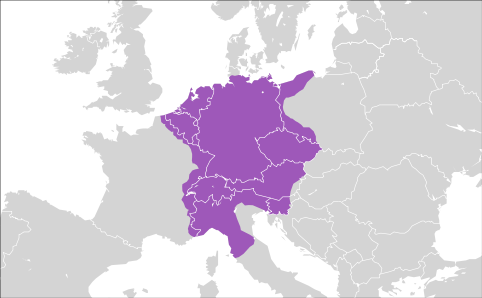
At the heart of Europe […] lay a hugely complex and fragmented political entity which resisted the ‘modernizing’ trend of national state formation, and preserved medieval arrangements conceived as rooted in antiquity: the Holy Roman Empire. After three decades of bloodshed retrospectively known as the Thirty Year War (1618-1648), the Empire had achieved a somewhat precarious equilibrium in which hundreds of semi-autonomous imperial estates co-existed under the loose authority of an emperor and a college of princes. Disparaged as a multi-headed monster by many […,] for Leibniz the Holy Roman Empire remained a preferable alternative to national and absolutist states. In his mind, the Empire offered an ideal of shared sovereignty in which limited territorial autonomy could be combined with a central imperial authority, and the main Christian confessions could cohabit peacefully in a balanced, representative Reichstag. Alongside his more famous works on logic, metaphysics, and mathematics, Leibniz wrote innumerable memos and proposals advising rulers on how to strengthen and re-order the Empire into a stable, supra-national political structure which could protect and promote common interests while maintaining local self-determination in territories and imperial free cities. In short, Leibniz regarded political unity in diversity under a supra-national authority as a better path to peace, prosperity, and stability in Europe than the ascendancy of competing national states.

This is from Maria Rosa Antognazza, a philosopher at King’s College London, writing for Oxford University Press’s blog.  (h/t Barry) Check out this map of the outline of the Holy Roman Empire in 1600 AD (it is superimposed onto the outlines of today’s European states):

blog-holy-roman-empire-1600
(source)

It reminded me of this map I produced a couple of years ago showing the GDP (PPP) per capita of administrative units in Europe. What the map illustrates, generally, is a Europe where present-day Austria, western Germany, northern Italy, Switzerland, and Benelux are much wealthier than the rest of Europe (sans Scandinavia).

And here is a map, thanks to Vincent, of GDP per capita in European regions. What his map illustrates, generally, is a Europe where present-day Austria, western Germany, northern Italy, Switzerland, and Benelux are much wealthier than the rest of Europe (sans Scandinavia).

Wow, right? Eastern Germany, Poland, and Czech Republic are poor today, but the rest of what was once the Holy Roman Empire is very prosperous. So, two lines of thought here. One, socialism is really bad for people. It not only destroys economies and political and civil liberties, it also destroys institutions.

The second line of thought is to wonder aloud a bit more about institutions and their long-term viability. The first question that needs to addressed is “what are institutions?” Today, many scholars use “democracy” and “property rights” as generic answers when explaining to the general public what good institutions are, and they are not wrong, but they don’t do justice to the concept of democracy (or property rights, for that matter). I think a better term might be “representativeness,” or “constitutionalism,” or “republicanism.” Anything but “democracy.” Democracy implies rule of the people, but this doesn’t describe what has happened in the West, in regards to political equality and economic growth (both are uneven, but undeniably real).

“Democracy” sounds better than “political institutions favoring separation of powers and coalition-building in parliamentary settings, as well as the inclusion of people who don’t pull the levers of statecraft (through the voting mechanism),” but this shorthand has obvious negative unintended consequences: many a demagogue will use the term democracy to mean something quite different from what actual self-governance requires institutionally.

There is more to the Holy Roman Empire than just path dependency (albeit stretched to its limits). For instance, you’d have to explore why representative institutions in the HRE eventually failed. My quick guess would be that HRE’s neighbors (Russian Empire, French Empire, Ottoman Empire, Scandinavian kingdoms) were pretty ruthless and thus made it impossible for more formal constitutional institutions to take deep root and flourish in the heart of Europe. Instead, because of HRE’s unruly neighbors, the Empire was forever in flux between a loose alliance of petty states and a confederation.

“Fuck Your Vote!”

That’s what I have been hearing ever since the morning after the presidential election. That what I keep hearing on most cable television and on National Public Radio. That’s what I see in most of what I read, and that’s what I am told is being published in the liberal print media I stopped reading long ago. That’s also what I find when I go slumming in left-wing sectors of Facebook.

No one has actually told me directly, in those exact words, “Fuck your vote,” not yet, but that’s what the ceaseless hounding of Pres. Trump means: My vote for him ought to be ignored; it can’t possibly count. If you had not had any news for six months, you would think that there had been a coup in the United States; that a horrid, caricature capitalist had taken over the country by stealth and by force, both. You would guess that the intellectually and morally live segments of American society were resisting a brutal takeover as best as they could. You would not guess there had been a hotly disputed election, fielding 16 viable candidates on one side.

A grass-root movement with a strategy

The verbal lynching to which Pres. Trump is subjected on a 24-hr cycle is not a conspiracy. There is no secrecy to it. It’s all overboard. It’s a regrouping of the political establishment, of the 90% leftist media, of the 90% leftist academia, of the vast tribe of government bureaucrats, of the many others who live off tax revenue, of the labor unions leaders, of the teachers’ unions, especially. So, after a fashion, it’s a genuine grass root movement. It’s a grass root movement of the well-bred and of the semi-educated who spend all their time – always did – feeling “appalled.”

It’s not a conspiracy but it’s a deliberate plot. It has a strategy: Hound him until he loses his cool completely. Harass him to the point where he cannot govern at all. At worst, we can keep him so busy his intended policies kind of vanish. The Santa Cruz AM station where I had a political show for three years has its own well-known, semi-official leftist caller, “Billy.” Billy thinks he is well informed and a genuine, deep-thinking intellectual because he is leisurely. In fact, he does not work for a living; he lives off his rich wife instead. (I would not make this up.) He called the station about two weeks before this writing to sound off on one thing or another that the president had done or said. Then, he declared straightforwardly, “We are hounding him out of office,” and also, with commendable clarity, “It’s a slow coup.” I would not have dared used these words in my conservative (“libéral” en Français) polemical writing, too provocative, possibly exaggerated.

Or take this short, childishly coded message I picked out from from an ordinary left-liberal’s Facebook page:

“47 could end up being Pelosi if we drag it out til 18.”

Translation: the current minority leader in the House could become the next president (the 47th). If we drag what out? For overseas readers and for American readers who went to the beach when the US Constitution was taught in high school: What has to happen before the minority leader of the House of Representatives becomes president outside of a presidential election? The constitutional order of succession if the president dies, in any way of manner, or becomes incapacitated, or is remove from office for any reason is this: Vice-President, Speaker of the House. In the partial elections of 2018, Nancy Pelosi may become Speaker of the House again. She would automatically become president if and only if both President Trump and Vice-President Pence were eliminated. Hence the FB message: Keep up the harassment. Note: Some readers might think I am making this up. I will give the name and FB address of the person from whom this is taken to anyone asking me privately.

What does not revolt me: Donald Trump is a bad person

What is it that makes me angry? Let me begin by telling you what does not make me deeply angry.

First, everyone here and abroad has every right to dislike Mr Trump personally, Trump the man. There is a lot I don’t like about the man myself. He talks too much; he is ignorant of many things; his ignorance does not stand in the way of his having strong opinions about the very same things; he often talks before he thinks; he brags too much; he is too frequently crude. (Actually, I am of two minds about the latter. Official crudeness may be the form that starting to roll back political correctness must take.)

I did not vote for Donald Trump because I loved him but mostly because of the character of the only, single alternative to him at the time of the presidential election. (Keep in mind that Sen. Sanders was not on the ballot. Remember what happened to him?) I had no illusions from day one. I knew that Mr Trump is not at all like suave President Obama, for example, who was awarded a Nobel Peace Prize within barely ten months of taking office.* I voted for Trump also for policy reasons. I thought there was a good chance he would appoint a conservative Supreme Court Justice, as promised. He did, within days. I thought he would deregulate to some extent. He is doing just that. I thought we stood a better chance of having serious tax cuts with him than with the Democratic candidate. I still think so. Tax cuts are the most direct path to vigorous economic growth, I believe. (Shoot me!)

A short digression: As I was writing this cri du coeur, the liberal media were exulting about President Trump’s loss of a few points of general approval. (Actually, it’s about the same as Bill Clinton’s at the same period in their presidencies.) They don’t mention that there is zero evidence that he has lost any ground among those who voted for him, that they feel any voter remorse. Myself, I like him better than I did when I voted for him. He has begun to make America stand up again. He has been a bulwark against several forms of hysteria – including Endofworldism – to a greater extent than I counted on.

What does not revolt me: Opponents trying to stop and sink his program

The second thing to which I do not object in the treatment of President Trump is legislative maneuvering. Democrats and dissident Republicans have every right to block and undermine Mr Trump’s legislative programs, be they tax cuts or “the wall.” (Personally, I want the first ones and think of the second as a silly idea.) The media have every right and sometimes an obligation to support this exercise in checks and balances between executive and legislative that is at the heart of the US constitution. No problem there either. I understand that when you win the presidency, in the American system, that’s all you have got, the presidency. After that, you have to convince Congress to pay for what you want, for what you (conditionally) promised.

What annoys me without revolting me: the courts’ usurpation

The Founding Fathers decided that courts had to be able to curtail or block just about any executive or legislative action. This, to make extra sure that neither branch of government could ever create unconstitutional law. This, to avoid the tyranny of the majority. It often rankles but that’s how our constitutional democracy works. Accordingly, the third going on that annoys me but that I accept is the several courts’ endeavors to stop the president from taking the measures he thinks necessary to keep the country safe. (I try to distinguish between dislike and a negative judgment of illegitimacy. This distinction is a the heart of the problem about which I am writing.) I accept, for example the decisions of the two or three courts who stopped the presidential executive order banning the admission of peoples from a handful of countries. I accept them, although:

Public opinion and – I think – one court, call it a ban “on Muslims,” even if only 9% of all Muslims worldwide would be affected; although half of those are citizens of a country – Iran – that is the declared enemy of the US and officially a sponsor of terrorism as far as we (Americans) are concerned.** and ***.

I accept it although there is nothing in the Constitution that prevents the executive branch from stopping people entering the US based on their religion.

I accept it although there is no part of the US Constitution that recognizes any rights to foreigners who are neither under American jurisdiction nor at war with the US.

I accept it although there is a statute, a law, that explicitly gives the president the right to ban the entry of anyone for any reason.

I accept these court orders but my acceptance is a testimony to my strong commitment to constitutional democracy.

Now, on to what I object to deeply and irreversibly in the attacks on the president.

Extirpating electoral legitimacy

What really, really disturbs me are the nearly daily attempts at removing, at extirpating the legitimacy of the 2016 presidential election results, the desperate and brutal, unscrupulous attempts to make people believe that Mr Trump is not really president. They make me livid because they are not attacks on Mr Trump but rather, they are attacks on me. They are assaults on my right to exercise my constitutional right to cast my vote and to have it counted. And also the rights of sixty-three million Americans**** who voted as I did. The slow coup against Mr Trump defies reason and it resembles nothing I have seen in fifty years in this country. It does remind me of several historical precedents though. (Look up “March on Rome,” you will be amazed.)

More than the mechanics of democracy is at stake. The principle of government by the consent of the governed itself is under assault, the attack is systematic and unrelenting. When I cast one of approximately sixty-three million votes for Donald Trump, I thought I was choosing the lesser of two evils. That’s nothing new; I don’t remember ever voting in a national election for someone who inspired enthusiasm in me. And perhaps, that’s the way it should be. Enthusiasm about a person may not be even compatible with democracy. Free men and women don’t need saviors and they are leery of leaders, even of leadership itself. Be it as it may, I cast my vote as I did and no one (that’s “no”) has the right to try and nullify it, to cancel it. As I write this self-evident truth, I fear that many of the people still having hysteria about the 2016 Democrats’ failure are not sophisticated enough to understand the difference between opposing the consequences of my vote through accepted, traditional parliamentary and judicial maneuvers on the one hand, and nullifying my vote, on the other hand.

Fascism is neither of the left or of the right. It thrives on moral confusion and on bad logic. Hysteria is its main sustenance.

“The Russians” made them lose everything

The daily assault on the Trump legitimacy changes form almost every day. Right now, it has been focusing for several weeks on alleged Russian intervention in the presidential election.

It matters not to the Trump haters that in 2016 Democrats lost everything they could lose besides the presidential election: governor races, state legislatures, Congress. This swath of defeats seems to me to indicate that the Democratic Party in general was not popular, forget Trump. If “the Russians” had actually handed out the presidency to Mr Trump, there would still be a need to explain the Democrat routs at all other levels. Did “the Russians” also organize the rout, including of county boards of supervisors, and at all other minute local levels?

It does not matter that Mrs Clinton was never made to explain how and why she caused to erase or ditch 30,000 emails belonging to the government, a cynical suppression of evidence if there was ever one.

A considerable work of imagination

Thus far, the mud has been thrown at Mr Trump and at his whole team, at any one who has ever met him perhaps in connection with “Russian” interference in the presidential election. Mud has no shape; it’s amorphous. I don’t know about him but when I suspect someone of something, the something has a shape, at least a rough description. You never say, “I suspect you,” but, “I suspect you of X or of Y.” The Trump accusers have never been able to reach even that primitive level of concreteness. None of them has (yet) been stupid enough to suggest that the Russian secret services hacked or tricked up the voting machines in the hundreds of jurisdictions that would be needed to make a difference. So, what have “the Russians” done, really?

The most tangible thing they have against the Trump campaign to-date is a supposition, a product of the collective imagination, and it need not even involve Trump or his agents at all. What we know is that someone hacked the Democratic National Committee emails. Some contents were leaked by Wikileaks which did not say where it got it from. Wikileaks has friendly links with Russia. It’s possible Russians hackers gave it the info. If this is what happened, here is what we still don’t know:

We don’t know that those imagined Russian hackers worked for Pres. Putin. Entrepreneurial Russian hackers have been dazzling us for twenty years. The DNC email seems to have been poorly protected, anyway. A Putin intervention is superfluous in this story.

Furthermore: Do you remember what Wikileaks disclosed (thanks to “the Russians.”)? It showed that the Democratic establishment engineered, by cheating, the defeat of candidate Sanders in the Democratic primary elections. In my book, the anonymous, perhaps Russian, hackers deserve a medal, an American medal for casting light on dysfunction and plain dishonesty within an American political party. The Congressional Medal of Honor is not out of the question, in my book.

Moreover: The leftist media keep referring to “collusion” between members of the Trump campaign and some unnamed Russians. Sounds sinister, alright. But as the Harvard Law Professor Alan Dershowitz, – a Democrat – pointed out recently, “collusion” is not illegal. It’s what you collude to do (rob a bank) that makes it criminal. Colluding to eat a pizza is not criminal. Mr Trump and his entourage are daily accused -without proof – of having committed acts that are not illegal.

The first Comey testimony

The 06/08/17 open, public Senate Judiciary hearing of dismissed FBI Director Comey was awaited by the left and media, and also by some genteel Republicans, like the Roman plebe awaited the lions’ feasting on the Christians. That hearing was a disappointment too. I am writing here as if I thought every word uttered by Mr Comey were exactly true (100% true) although there is no reason to do so. The hearing showed ex-FBI Director to be a leaky wimp, of shaky integrity caught in corrupt and difficult circumstances, first under Obama with the Clinton Follies, then with the unpredictable Trump presidency. It did showcase a great deal of inappropriate behavior by President Trump. But the hearing did not even begin to point to any illegal behavior on the part of the president, not to a single whiff of illegality. If you don’t trust my legal judgment (although I watch many crime shows on TV), refer again to Democrat and Harvard Law School professor Dershowitz who thinks as I do on this issue. The fact is that hardly anyone, possibly no one, voted for Mr Trump because of the appropriateness of his behavior or of his statements. If anyone was about to do so during the election, the airing by the Clinton campaign of a tape describing Mr Trump’s manual approach to seduction would have cured that illusion.

Next?

Personally, I think there is nothing to investigate. Nevertheless, I hope the Special Counsel (a friend of Comey’s, it turns out) will do his job of investigating the possibility that President Trump did whatever he is supposed to have done with I know not what Russians. There is a chance that merely having a single person in charge – what the left demanded – will reduce the daily din of anti-Trump insults. There is even a possibility that it will allow Pres. Trump to get to work on some more of the projects***** for which I gave him my vote. If the investigation reveals real illegal behavior by Mr Trump, felony-level crimes, I think he should be peaceably removed from office, with Vice-President Pence taking over as required by the US Constitution. Anything else, any other succession would be a form of fascism. Any other scenario of Trump removal turns my attention to the Second Amendment (me and hundreds of thousands of gun-crazy, church going “deplorables.”)

How it will end

I don’t see a reasonable finish to all this unless the president is found guilty of something. When the smoke finally clears, when the investigation of President Trump’s collusion to do whatever with whatever Russians ends, I think there is no chance that the matter will be finally put to rest. If the Special Counsel that liberals clamored for concludes that Mr Trump and his whole entourage never committed any illegal act in connection with the 2016 election, there will still be voices pointing out that an intern on Trump’s campaign once ate Russian caviar on a date, which raises serious questions! Or something.

The undisputed fact, that Mr Trump’s improprieties revolt many who voted for the only real alternative, is not an argument for overthrowing an elected government. They are the same people who tried to elect – directly or indirectly – an old woman apparently in failing health, a lackluster former Secretary of State, at best, a person who campaigned incompetently, a candidate for the highest office who never managed to articulate her vision of government, a person who cheated during the primary election, one who ended up losing against a rank political amateur who spent less than half the money she spent on campaigning. With a large majority of voters guilty of such a poor choice, this country has bigger fish to fry, I would think, than presidential rudeness and/or insensitivity.

Conclusion

Dear Trump–hating fellow citizens: One thing that did not cross my mind when I voted was that should my candidate win – a long shot at the time – there would be a massive, multi-pronged endeavor to make believe that I had not voted, or that I had voted other than the way I voted, or that my vote somehow did not count. I thought I was living in a democracy. I assumed the democracy was lodged not only in the rules we follow to form governments but in the hearts of my fellow-citizens. I assumed that the rules were internalized, that they were part of the moral baggage of everyone including those whose vote countered mine.

If you will not accede to the modest wish that my vote should be honored, why bother with elections at all? They are costly and disruptive, they often disappoint, sometimes more than half of the population, and they provide many opportunities for the expression of deplorable taste. Why not, for example, convene a governing directory selected by an assembly of university professors, of well-bred employees’ union leaders, of Democratic politicians, and of media personalities (excluding Fox, and also Rush Limbaugh, of course), all chaired by the Editor-in-Chief of the New York Times?


* Just because you ask, I will tell you that I am guessing that the silly old men of the Norwegian Nobel Committee actually thought they were giving the Prize to the American left electorate for electing a Negro (“neger,” in Norwegian). It’s also a fact that Mr Obama always looks good in a suit.

** To my overseas readers: It was not Pres. Trump who designated officially Iran as a sponsor of terrorism. It happened several presidential administrations back, many years ago.

*** I wonder if the said executive order would have been acceptable to the courts if President Trump had thrown in say, a Buddhist country or two, and a pair of Catholic countries from South America, for example, like this: ban on admission to the US for citizens of Somalia, Yemen, Laos, Syria, Paraguay, Iran, etc.

**** Note to my overseas readers: That’s 2.8 million fewer than won by candidate Clinton. In the US system the candidate who obtains the largest number of votes cast by citizens (the “popular vote”) does not necessarily win the presidency. We have indirect elections instead. This may seem strange but the fact is that neither big party has ever really tried to change the constitution in this respect. So, after the two Obama victories, no one in the Democratic party said, “We have to change this system to make sure the popular vote prevails.” And if we had a popular vote system, all candidates would have campaigned differently. Mr Trump might have won the popular vote handily, or Mrs Clinton may have won with a margin of ten million votes or more; or the Libertarian Party may have received enough votes to deny either candidate a majority. There are many other possibilities in the world of “what if….”

***** Some of his campaign promises are being fulfilled at a fast clip in spite of the ceaseless persecution to which the president is subjected. The loosening of the regulatory hands of the Federal Government on the economy’s neck, for example, is going well.
Could the DUP push UK Conservatives towards a ‘Norway Option’?

Last year, Britain voted to leave the European Union under a banner of anti-immigration and protectionism. Since then, both social democrats and classical liberals have been waiting to catch a break. Ever the optimist, I hope they may have just got one, from an unlikely source, the Democratic Unionist Party. They are a Northern Ireland-based Protestant party that is usually at the margins of national British politics. Thanks to the outcome of the latest general election, they may be in a position to force the British Conservatives towards a more trade and immigration friendly Brexit.

In April, Prime Minister (for now) Theresa May called a snap election. She didn’t need to face the electorate until 2020, but decided to gamble, thinking that she would increase her working majority of Conservative MPs. Instead, as we discovered yesterday after the polls closed, she did the opposite, reducing the slim majority that David Cameron won in 2015 to a mere plurality. This was against one of the most radically left-wing opponents in decades, Jeremy Corbyn.

This was a dismal failure for the Conservatives but the result is a relatively good sign for liberals. I feared that Theresa May’s conservative-tinged anti-market, anti-human rights, authoritarian corporatism was exactly what centrist voters would prefer. It turns that Cameron’s more liberal conservativism actually won more seats. Not only is an outward-looking liberalism correct, de-emphasizing it turns out not be a popular move after all.

Without a majority, the Conservatives need to form a coalition or come to an informal agreement with another party. This seems likely impossible with Labour, the Scottish Nationalists or the Liberal Democrats who have all campaigned heavily against the Conservatives and disagree on key issues, such as whether Britain should leave the European Union at all. This leaves the DUP.

In terms of ideology, the DUP is far to the right of most British Conservatives. Their opposition to gay marriage, abortion, and occasional support for teaching creationism, means that they have more in common with some Republican Christian groups in the United States than the secular mainstream in the rest of the United Kingdom. Historically, at least, they have links with pro-unionist paramilitaries that have terrorized Irish Catholic separatists.

There is, however, one way in which the DUP are comparatively moderate. While content with the UK leaving the European Union, they want to keep the land border between Northern Ireland and the Republic of Ireland (an EU member) open. Closing it would reduce critical cross-border trade with an economically dynamic neighbor and re-ignite violent tensions between the Protestant and Catholic communities in Northern Ireland.

How could this be achieved? Leaving the EU while keeping a relatively open trading and immigration relationship is similar to the so-called Norway Option. Norway is within the single market but can exempt itself from many parts of EU law. In return, it has no direct representation in EU institutions. If the EU could accept such an arrangement, then the DUP may be able to make Conservatives commit to it.

Of course, the DUP will extract other perks from their major partners as part of any deal. But their social policy preferences are so far to the right of people in England, Wales and Scotland that this will hopefully have to take the form of fiscal subsidies to their home region (economically damaging but could at least avoid infringing civil liberties).

It might seem paradoxical that an extreme party may have a moderating influence on overall policy. However, social choice theory suggests that democratic processes do not aggregate voter, or legislator, preferences in a straightforward way. Because preferences exist along multiple dimensions, they are neither additive nor linear. This can produce perverse and chaotic outcomes, but it can also generate valuable bargains between otherwise opposed parties. In this case, one right-wing party produces an authoritarian Brexit. But two right-wing parties could equal a more liberal outcome.

That’s the theory. Has something like this ever happened in practice? Arguably, Canada is an outstanding example of how a minority party with many internally illiberal policy preferences produces liberal outcomes (see the fascinating Vaubel, 2009, p.25 for the argument). There, the need to placate the separatist movement in Quebec involved leaving more powers to the provinces in general, thus keeping Canada as a whole much more decentralized than Anglo-Canadian preferences alone could have assured. Will the DUP do the same for Britain? We can but hope.

Summing up: the year of irrationality

Brandon says I’ve got one last chance to write his favorite post of the year. But it’s the end of a long semester and I’m brain dead, so I’m just going to free ride on his idea: a year end review. If I were to sum up the theme of this year in a word, that word would be irrational.

After 21 months of god awful presidential campaigning, we were finally left with a classic Kodos vs Kang election. The Democrats were certain that they could put forward any turd sandwich and beat Trump, but they ultimately lost out to populist outrage. Similar themes played out with Brexit, but I don’t know enough to comment.

https://www.youtube.com/watch?v=4v7XXSt9XRM

Irrationality explains the Democrats, the Republicans, and the country as a whole. The world is complex, but big decisions have been made by simple people.

We aren’t equipped to manage the world’s complexity.

We aren’t made to have direct access to The Truth; we’re built to survive, so we get a filtered version of the truth that has tended to keep our ancestors out of trouble long enough to get laid. In other words, what seems sensible to each of us, may or may not be the truth. What we see with our own eyes may not be worth believing. We need more than simple observation to actually ferret out The Truth.

Our imperfect perceptions build on imperfect reasoning faculties to make imperfect folk economics. But what sounds sensible often overlooks important moving parts.

For every complex problem there is an answer that is clear, simple, and wrong.

Only a small minority of the population will ever have a strong grasp on any particularly complex thing. As surely as my mechanic will never become an expert in economics, I will never be able to do any real work on my car. The trouble arises when we expect me or my mechanic to try to run the country. The same logic applies to politicians, whose job (contrary to what your civics teacher thinks) is to get re-elected, not to be a master applied social scientist. (And as awful as democracy is, the alternative is just some other form of political competition… there is no philosopher king.)

But, of course, our imperfect perception and reasoning have gotten us this far. They’ve pulled us out of caves and onto the 100th floor of a skyscraper*. Because in many cases we get good enough feedback to learn a lot about how to accomplish things in our mysterious universe.

We’re limited in what we can do, but sometimes it’s worth trying something. The trouble is, I can do things that benefit me at your expense. And this is especially true in politics (also pollution–what they have in common is hot air!). But it’s not just the politicians who create externalities, it’s the electorate. The costs of my voting to outlaw gravity (the simplest way for me to lose a few pounds) are nil. But when too many of us share the same hare-brained idea, we can do some real harm. And many people share bad ideas that have real consequences.

Voting isn’t the only way to be politically engaged, and we face a similar problem in political discourse in general. A lot of Democrats are being sore losers about this election rather than learning and adapting. Trump promised he would have done the same had he lost. We’re basically doomed to have low-quality political discourse. It’s easy and feels (relatively) good to bemoan that the whole world is going to hell.

We’re facing rational irrationality. Everyone is simply counting on someone else to get their shit together, because each of us individually is more comfortable with our heads firmly up our asses.

It’s a classic tragedy of the commons and it should prompt us to find some way to minimize the harm of our lousy politics. We’ve been getting better at this over the centuries. Democracy means the levers of power can change hands peacefully. Liberalization has entailed extending civil and economic rights to a wider range of people. We need to continue in this vein. More freedom has allowed more peace and prosperity.


So what do we do? I’d argue that we should focus on general rules rather than trying to have flawed voters pick flawed politicians and hope for the best. I don’t mean “make all X following specifications a, b, and c.” I mean, if you’re mad, try and sue someone. We don’t need dense and exploitable regulations. We don’t need new commissions. We just need a way for people to deal with problems as they arise. Mind you, our court system (like the rest of our government) isn’t quite ready for a more sensible world. But we can’t be afraid to be a little Utopian when we’re planning for the long run. But let’s get back to my main point…

We live in an irrational world. And it makes sense that it’s that way; rationality is hard. We can see irrationality all around us, but we see it most where it’s cheapest: politics and Facebook. The trouble is, sometimes little harmless irrational acts add up to cause real harm. Let’s admit we’ve got a problem with irrationality in politics so we can get better.


*Although that’s only literally true in 17 cases.

BC’s weekend reads

  1. Madonna offers oral sex for those who vote Hillary Clinton
  2. Trump-inspired ‘pussy’ ad banned in San Francisco subway
  3. The poverty of democracy
  4. The battle for the Arctic
  5. Countries rush for upper hand in Antarctica
  6. Why not world government? (Part 2)
  7. Meet China’s state-approved Muslims
  8. The good, the bad, and the ugly of Somaliland secession

The legacy of autocratic rule in China

What is the long-term legacy of political persecutions? Here I want to present the main findings of my recent research with Melanie Meng Xue (UCLA Anderson). Our research is an attempt to undercover how a legacy of political persecution can shape social capital and civil society by studying imperial China. The full version of the paper is available here.

We know from other research that particular institutions, policies, and events can have a detrimental and long-lasting impact on economic and political outcomes (e.g. Nunn 2011, Voigtländer and Voth, 2012). But it is hard to find a setting where we can study the long-run impact of autocratic institutions. A key feature of autocracy is the use of persecutions to intimidate potential opponents. In our paper, Melanie and I argue that the intensification of imperial autocracy that took place in the High Qing period (1680-1794) provides an ideal setting to study the impact of such persecutions.

Qing China

The High Qing period was one of great political stability, imperial expansion, and internal peace. Economic historians like Bin Wong and Ken Pomeranz have shown that China possessed a flourishing market economy during this period; it experienced Smithian economic growth and a massive demographic expansion. Rulers such as the Kangxi (1661-1722) and Qianlong Emperors (1735-1794) are seen as among the most successful in Chinese history. Nevertheless, as ethnic Manchus, these rulers were extremely sensitive to possible opposition from the Han Chinese. And during this period Qing tightened control over the gentry and implemented a policy of the systematic persecution of dissent. (Figure 1 depicts the Manchu conquest of China.)

chinamingqing
The Qing conquest of China

The Literary Inquisitions

The focus of our paper is on the impact of persecutions conducted by Qing China against individuals suspected of expressing disloyalty. We study the impact of these state-orchestrated persecutions on the social fabric of society. This allows us to speak to the kinds of concerns that authors like Hannah Arendt and George Orwell expressed about the long-run impact of totalitarianism in the 20th century.

These persecutions are referred to by historians as ‘literary inquisitions’. Existing scholarship suggests that the resulting fear of persecution elevated the risks facing writers and scholars, and created an atmosphere of oppression and a culture of distrust which deterred intellectuals from playing an active role in society. But these claims have never been systematically investigated. Putting together several unique datasets for historical and modern China, we explore the impact of literary inquisitions on social capital in Qing China and trace its long-run impact on modern China through its effect on cultural values.

spence
Jonathan Spence provides an excellent account of one of the most famous and unusual inquisition cases in his book Treason by the Book

To conduct our analysis, we use data on 88 inquisition cases. We match the victims of each case (there are often multiple victims per case) to their home prefecture. This data is depicted in Figure 1. Since prefectures varied greatly in their economic, social, and political characteristics we conduct our analysis on a matched sample. This ensures that the prefectures “treated” by a literary inquisition are similar in terms of their observables to those we code as “untreated”. As our data is a panel, we are able to exploit variation across time as well as variation in space.

While individuals could be persecuted for a host of reasons, these were all but impossible to anticipate ex ante. Cases were referred to the emperor himself. Frederic Wakeman called this “the institutionalization of Imperial subjectivity.” The standard punishment in such cases was death by Lingchi or (slow slicing) and the enslavement of all one’s immediate relatives. In some cases, however, the guilty party would be executed by beheading. These persecutions aimed to deter opposition to Qing rule by signaling the ability of the Emperor to hunt down all potential critics or opponents of the regime.

Map.jpg

The Impact of Literary Inquisitions on Social Capital

We initially focus on the impact of persecution on the short and medium-run using our historical panel. We first examine the effects on the number of notable scholars.  In our preferred specification we find that a literary inquisition reduced the number of notable scholars in a prefecture by 33 percent relative to the sample mean.

We go on to show the effect of persecutions on collective participation among the gentry in China. Our measure of collective participation in civil society is the number of charitable organizations. Charitable organizations played an important role in premodern China providing disaster relief and local public goods such as repairing local roads. They were non-governmental organizations and played an important role alongside the government provision of disaster relief. In our preferred empirical specification, we find that a persecution number of charitable organizations by 38 percent relative to the sample mean.

These results are in keeping with the argument that literary inquisition had a major psychological impact on Chinese society. They are consistent with the rise of “inoffensive” literary subjects during the Qing period that have documented by historians. To reduce the risk of persecution, intellectuals scrupulously avoided activities that could be interpreted as constituting an undermining of Qing rule. Instead they “immersed themselves in the non-subversive “sound learning” and engaged in textual criticism, bibliography, epigraphy, and other innocuous, purely scholarly pursuits” (Wiens, 1969, 16).

The Impact of Literary Inquisitions on 20th Century Outcomes

We go on to examine how the effects of these persecutions can be traced into the 20th century. In particular, we focus on the provision of basic education at the end of Qing dynasty. In late 19th and early 20th century China, there was no centralized governmental provision of primary schools.  Basic education remained the responsibility of the local gentry who ran local schools.

Thus the provision of education at a local level was dependent on the ability of educated individuals to coordinate in the mobilization of resources; this required both cooperation and trust. We therefore hypothesize that if the persecution of intellectuals had a detrimental impact on social capital, it should also have negatively affected the provision of basic education.

We find that among individuals aged over 70 in the 1982 census – hence individuals who were born in the late Qing period – a legacy of a literary inquisition is associated with lower levels of literacy. This reflects the impact of literary inquisition on the voluntary schools provided by the gentry and is not associated with lower enrollment at middle school or high school. We show that result is robust to controlling for selective migration and for the number of death caused by the Cultural Revolution.

Finally, we show that literary inquisitions generated a cultural of political non-participation. Drawing on two datasets of political attitudes – the Chinese General Social Survey (CGSS) and the Chinese Political Compass (CPoC) – we show that individuals in areas in which individuals were targeted during literary inquisitions are both less trusting of government and less interested in political participation.

Finally, we find that individuals in prefectures with a legacy of literary inquisitions are less likely to agree that: “Western-style multi-party systems are not suitable for China” (Q 43.). This suggests that in areas affected by literary inquisitions individuals are also more skeptical of the claims of the Chinese government and more open to considering alternative political systems. Similarly, individuals in affected prefectures are more likely to disagree with the statement that: “Modern China needs to be guided by wisdom of Confucius/Confucian thinking.”

In summary, our analysis suggests that autocratic rule reduced social capital and helped to produce a culture of political quietism in pre-modern China. This has left a legacy that persisted into the 20th century. These findings have implications for China’s current political trajectory. Some scholars anticipate China undergoing a democratic transition as it’s economy develops (Acemoglu and Robinson, 2012). Others point to China as an example of “authoritarian resilience.” By showing that a long-history of autocratic rule and political persecutions can produce a culture of political apathy, our results shed light on a further and previously under-explored source of authoritarian resilience.

The right to lose

After a year of being shocked by Trump’s behavior, people are now finally out of meaningful things to be upset about. We’re down to “Trump isn’t going to accept the results if he loses?!” The tone on the FiveThirtyEight elections podcast (mostly from Clare Malone) was “How dare he?! He must accept the outcome of the election!”

He’s not going to storm the White House, he’s just going to be a sore loser. Why, at this point, should we expect him to lose gracefully? What benefit would that give anyone? He’s not weakening institutions, just being a big baby. We shouldn’t be surprised!

I’m not saying that Trump gets an out because he’s exceptional. I’ve got two related points: 1) Good deeds lose their meaning if they weren’t done by choice. We don’t have to celebrate him being a sore loser, but we shouldn’t try to stop him (whatever that might mean) either. 2) If you aren’t free to be wrong, you aren’t free. Yes, democracy isn’t actually about freedom, but we are still trying to be a free country.

Liberals and Conservatives should stop talking about guns

I’ve come across some great journalism on guns and gun control recently. Here’s the key points:

  • Most gun deaths are suicides. Many of these suicides would have happened were a gun not available, but many of them wouldn’t have.
  • Most gun homicides mostly affect young black men.
  • More guns does not equal less crime.
  • Gun accidents affect very few people.
  • Cost-benefit analysis would likely suggest improving safety other places would save more lives, given limited budgets. (e.g. changing attitudes on vaccinations)

A basic theme seems to be that government can do little on the margin to reduce gun deaths. Crime rates are uncorrelated with number of guns, or regulations in place. Upright citizens do not turn into Rambo when they see dastardly criminals mug little old ladies. Guns are actually sort of boring in practice.

It’s possible that the government could affect gun deaths with a comprehensive gun control policy backed by public opinion (the Australian option). But it would likely cost so much that you’d lose the budget and/or political capital to enact other reforms that would be less controversial and save more lives.

MrPB-prince-Cordova-one-of-amendments.png
We don’t torture people in America, Todd. That’s called one of the amendments.

What about the second amendment? The real argument for the second amendment is that having armed Americans around is pretty practical in general, but also important to prevent tyranny. In practice, guns aren’t half as practical, in terms of personal or national defense as back then. The capability of America’s military is so extraordinary that American’s don’t stand a chance of fighting a corrupt American government.

Let’s acknowledge that the Bill of Rights, though surely important, is ultimately a piece of paper that is neither sacrosanct nor a practical guarantee of anything in particular. The founders were brilliant, but fallible. The constitution is frequently ignored by governments, and citizens often do little to discipline such governments. Second amendment advocacy is mostly a symbolic gesture that probably comes at the expense of using political capital to protect the fourth amendment (the one that should protect you when the government decides to take your guns, cold dead fingers or no).

Conclusion

There are weak arguments to made in favor of gun control and weak arguments to be made in favor of protecting the second amendment. But mostly this whole debate seems like a distraction from more important issues. Symbolically valuable? Sure, but at what cost? The cost is the political will to make a bigger difference somewhere else. There are more valuable freedoms to protect, better interventions to pursue, and more lives to be saved.