- Czeslaw Milosz: A Worker in the Vineyard Andrew Motion, Hudson Review
- When Americans Despised the Irish Christopher Klein, History
- How Brexit Has Reopened Old Irish Wounds Tony Connelly, New Statesman
- Quantum Mechanics? Try Entangled Time Instead! Elise Crull, Aeon
Brexit
2017: Year in Review
Well folks, another year has come and gone. 2017 was Notes On Liberty‘s busiest year yet. Traffic came from all over the place, with the most visits coming from the US, the UK, Canada, Australia, and India. (In the past, India and Germany have vied for that coveted 5th place spot, but this year India blew Germany out of the water.)
NOL is a voluntary cooperative, and as such this year saw the introduction of 6 new Notewriters: Kevin Kallmes, Nicolás Cachanosky, Ash Navabi, Tridivesh Maini, Matthew Bonick and Trent MacDonald.
Michelangelo invited Kevin to join, Nicolás is an old grad school buddy of Rick‘s, I reached out to Tridivesh, and Ash and Matthew were invited on Vincent‘s initiative.
Speaking of Vincent, 2017 was his year. He had Tyler Cowen (MarginalRevolution), Mark Thoma (Economist’s View), Anthony Mills (RealClearPolicy), Barry Ritholtz (Bloomberg), Don Boudreaux (Cafe Hayek), John Tamny (RealClearMarkets) and Pseudoerasmus (a well-regarded economic historian) all link to his thoughts multiple times over the course of the year. His Top 10 list for best papers/books in recent economic history (Part 1 and Part 2) were legitimate viral sensations, dominating the top 2 spots on NOL‘s most-read list. Other huge posts included “Did the 30 Glorious Years Actually Exist? (#5),” “The Pox of Liberty – dixit the Political Economy of Public Health (#9),” “James Buchanan on racism,” “The GDP, real wages and working hours of France since the 13th century,” “Did 89% of American Millionaires Disappear During the Great Depression?,” and “A hidden cost of the war on drugs.” My personal favorite was his “Star Trek Did More For the Cultural Advancement of Women Than Government Policies.” Dr Geloso’s thoughts made up 40% of NOL‘s 10 most-read 2017 posts.
My favorite posts from Edwin this year were his analyses of Dutch politics – “Dutch politics, after the elections” and “North Korea at the North Sea?” – but the reading public seemed to enjoy his posts on Ayn Rand, especially her thought on international relations, and his summary of Mont Pelerin Europe more than anything else. Van de Haar’s day job is in the private sector, so his blogging is understandably light (especially given his incredible publishing output in academic journals). I look forward to what looms ahead in 2018.
Federico’s most recent post on artificial intelligence and the law got love from some major outlets, including FT‘s Alphaville blog and 3 Quarks Daily. His question “Does business success make a good statesmen?” and his report on a Latin American Liberty summit are worth reading again, but my personal favorites were his comments on other Notewriters’ thoughts: first jumping in to add some historical clarity to Bruno’s post on Latin American conservatism and then to add layers onto the debate between Mark and Bruno on the Protestant Reformation. Federico has been invaluable to NOL‘s welcoming, skeptical culture and I cannot wait to see what he comes up with in 2018.
Barry was generous enough recount the situation in Turkey after the coup earlier in the year, and fruits of this endeavor – Coup and Counter Coup in Turkey – can be found in six parts:
- “First of a series of posts on Turkey since 15th July 2016 and background topics“
- “Immediately after the coup and party politics“
- “Gülenists and Kemalists“
- “The Kurdish issue in Turkey“
- “Jacobins and Grey Wolves in Turkey“
- “Presidential Authoritarianism in Turkey“
Dr Stocker also began writing an appendix to his six-part series, which resulted in a first post on authoritarianism and electoral fixes. Barry is hard at work on a new book, and of course the situation in Turkey is less than ideal, so I can only hope he has a bit more time in 2018 for NOL.
Michelangelo had a banner year at NOL. His #microblogging has been fun, as were his post analyzing relevant data from his surveys: What libertarians think of climate change, for example, or urban planning in Oregon. Michelangelo also utilized NOL to play around with concepts like race, marriage markets, data, Spanish language services, affirmative action, and freeware, to name a few. My absolute favorite Michelangelo post this year was his excellent “Should we tax churches? A Georgist proposal.” Michelangelo is a PhD candidate right now, too, so if he ever gets some time to himself, watch out world!
Rick also had a banner year at NOL. His post arguing against Net Neutrality was one of the most-read articles of the year here (#4), and many of his wonkier thoughts have been picked up by the sharp eye of Anthony Mills (RealClearPolicy) and the excellent Chris Dillow (Stumbling and Mumbling). Rick is my favorite blogger. Posts on cycling in Amsterdam, subsidies, management and measurement, linguistics, more subsidies, and my personal favorite of his for the year, “Why do we teach girls that it’s cute to be scared,” always make me think and, more importantly, smile.
Bruno’s blogging was also amply rewarded this year. His thoughts on some of the problems with postmodernism brought in the most eyeballs, but thankfully he didn’t stop there: Articles introducing postmodernism and highlighting the origins of postmodernism also generated much interest. RealClearWorld picked up his post analyzing Brazil post-Rousseff (he had more analysis of Brazilian politics here and here), and his post delving into whether Nazism is of the left or the right provoked quite the dialogue. Dr Rosi was at his best, though, when prompted by Mark to further advance his argument that the Protestant Revolution played an integral role in the rise of the freedom of conscience. Times are tough in Brazil right now, so I can only hope that Bruno continues to play a vital role as a Notewriter in 2018.
Chhay Lin, now in the private sector, had his post about Bruce Lee’s application of Taoist philosophy head to the top of reddit’s philosophy sub, and his post on Catalonia and secession got love from RealClearWorld and Lew Rockwell (Political Theater). I hate to be *that* guy distracting a man from making his money, but I hope to see Chhay Lin pop in at NOL much more often in 2018!
Zak has been busy with a number of different projects, as well as attending Michigan-Ann Arbor full-time. He still managed to have one of his posts, on “libertarian” activist hypocrisy (#10), highlighted in the Guardian, the UK’s premier left-wing mouthpiece. His post on The Nancy MacLean Disgrace earned him plaudits from the online libertarian community and Don Boudreaux (Cafe Hayek), and his posts on open borders and income inequality show just how much of a bad ass he has become. I had a tough time trying to pick out my favorite Zak article of 2017, so I’m just gonna highlight all three of them:
- “Immigration, Cultural Change, and Diversity as a Cultural Discovery Process“
- “Why I’m No Longer A Christian…“
- “Against Libertarian Populism“
They’ve all got great self-explanatory titles, so do yourself a favor and read ’em again! Hopefully Zak can continue to work NOL in to his many successful ventures in 2018.
Jacques continues to amaze me. He’s been retired from academia for – as far as I can tell – at least a decade and he’s still producing great material that’s able to reach all sorts of people and places. His post on the Ottoman Empire and libertarianism (#6), which was featured at RealClearWorld and much-shared in Ottomanist corners of Twitter – took aim at popular American libertarian understandings of decentralization and seems to have landed pretty squarely on target. My favorite post of Dr Delacroix’ this year was about French Africa (also featured at RealClearWorld), but his late-year book review on Christopher De Bellaigue’s 2017 book about Islam might end up being a classic.
Bill’s 2017 here at NOL was productive and he continues to impress. His “Speech in academic philosophy: Rebecca Tuvel on Rachel Dolezal” brought in thousands of readers, but it was not his ability to draw crowds that I found impressive. His ability to tackle tough concepts and tough issues came to the forefront this year: drug use, “vulvæ,” more drug use, party culture (my personal fave), schooling (another personal fave), more schooling, and music (personal fave). Bill’s ability to weave these trends together through the lens of individual freedom is so much fun to read and important for fostering a culture of tolerance and respect in today’s world. I can’t wait to see what 2018 has in store for him!
Nicolás came out firing on all cylinders this year. With excellent dialogues between himself and Vincent, as well as between himself and guest blogger Derrill Watson (who I hope will be back for more in 2018), Dr Cachanosky’s passion for teaching has shown through clearly and brightly. I hope 2018 – his first full year with NOL – is filled with much more hard-hitting but insightful blogging from Nicolás.
Ash brought the heat, too. Check out the subject matter of his first few posts here at NOL: “A Right is Not an Obligation,” “Physical Goods, Immaterial Goods, and Public Goods,” “The Economics of Hard Choices,” “Markets for Secrets?,” “A Tax is Not a Price,” and “A Radical Take on Science and Religion.” Like Nicolás, Ash’s first full year at NOL is coming up, and if 2017 is any indication, readers can look forward to an interesting and engaging 2018.
Mark’s first full year here at NOL was a definite barnburner. His debate with Bruno on the Protestant Reformation (#8) brought in a bunch of eyeballs, including from RealClearHistory, while his “The Return of Cyclical Theories of History” also brought in thousands of readers, thanks in large part to Robert Cottrell’s excellent website, the Browser. Dr Koyama’s review of Aldo Schiavone’s The End of the Past also caught Mr Cottrell’s eye and the attention of his readers. Mark’s post on geopolitics and Asia’s “little divergence” is well worth reading again, too. Like Zak and Bill’s posts, I couldn’t choose just one favorite, so I give you two:
- “Political Decentralization and Innovation in early modern Europe“
- “Some Thoughts on State Capacity” (an especially good criticism of American libertarian understandings of the “state capacity” literature)
We’re lucky to have Mark here at NOL.
Kevin, like Ash and Nicolás, brought the ruckus for his first few posts here at NOL. Kevin’s very first post at Notes On Liberty – “Rules of Warfare in Pre-Modern Societies” (#3) – ended up on the front page of RealClearHistory while his “Paradoxical geniuses…” earned a spot on the Browser‘s prestigious reading list. Not a bad start. Kevin will be finishing up the second half of his first year of law school (at Duke), so I doubt we’ll see much of him until June or July of 2018. My personal favorite, by the way, was Kevin’s “Auftragstaktik: Decentralization in military command.” His posts on taking over Syria – Roman style, the median voter theorem, and inventions that didn’t change the world also got lots of love from around the web.
Nick’s post on public choice and Nancy MacLean (#7) earned a nod from Arnold Kling (askblog), Don Boudreaux (Cafe Hayek), Chris Dillow (Stumbling and Mumbling), Mark Thoma (Economist’s View), and pretty much the entire online libertarian community, while his post analyzing the UK’s snap election earned a spot at RealClearWorld. Dr Cowen’s thoughts on school choice and robust political economy, as well as a sociological analysis of Trump/Brexit prompted by Vincent, all garnered love from libertarians and scholars around the world. My favorite Cowen post was his question “Is persecution the purpose?”
Overall, it was a hell of a year here at Notes On Liberty. I’m really looking forward to 2018. Here’s to a happy, healthy you. Oh, and my proudest piece this year was “North Korea, the status quo, and a more liberal world.” HAPPY NEW YEAR!
Worth a gander
- good piece of American sociology by Jeffrey Friedman (h/t Alberto Mingardi)
- Daniel Larison on the devastation in Puerto Rico
- Don Boudreaux has the best take I’ve read or heard on the Trump-pro athlete fiasco, and remember when conservatives blasted Obama for sticking his nose where it didn’t belong when cops killed a black kid in Baltimore?
- Chris Dillow explains Leftist confusion about Brexit
- smart Leftists talking about smart things (penguins, of course!)
Could the DUP push UK Conservatives towards a ‘Norway Option’?
Last year, Britain voted to leave the European Union under a banner of anti-immigration and protectionism. Since then, both social democrats and classical liberals have been waiting to catch a break. Ever the optimist, I hope they may have just got one, from an unlikely source, the Democratic Unionist Party. They are a Northern Ireland-based Protestant party that is usually at the margins of national British politics. Thanks to the outcome of the latest general election, they may be in a position to force the British Conservatives towards a more trade and immigration friendly Brexit.
In April, Prime Minister (for now) Theresa May called a snap election. She didn’t need to face the electorate until 2020, but decided to gamble, thinking that she would increase her working majority of Conservative MPs. Instead, as we discovered yesterday after the polls closed, she did the opposite, reducing the slim majority that David Cameron won in 2015 to a mere plurality. This was against one of the most radically left-wing opponents in decades, Jeremy Corbyn.
This was a dismal failure for the Conservatives but the result is a relatively good sign for liberals. I feared that Theresa May’s conservative-tinged anti-market, anti-human rights, authoritarian corporatism was exactly what centrist voters would prefer. It turns that Cameron’s more liberal conservativism actually won more seats. Not only is an outward-looking liberalism correct, de-emphasizing it turns out not be a popular move after all.
Without a majority, the Conservatives need to form a coalition or come to an informal agreement with another party. This seems likely impossible with Labour, the Scottish Nationalists or the Liberal Democrats who have all campaigned heavily against the Conservatives and disagree on key issues, such as whether Britain should leave the European Union at all. This leaves the DUP.
In terms of ideology, the DUP is far to the right of most British Conservatives. Their opposition to gay marriage, abortion, and occasional support for teaching creationism, means that they have more in common with some Republican Christian groups in the United States than the secular mainstream in the rest of the United Kingdom. Historically, at least, they have links with pro-unionist paramilitaries that have terrorized Irish Catholic separatists.
There is, however, one way in which the DUP are comparatively moderate. While content with the UK leaving the European Union, they want to keep the land border between Northern Ireland and the Republic of Ireland (an EU member) open. Closing it would reduce critical cross-border trade with an economically dynamic neighbor and re-ignite violent tensions between the Protestant and Catholic communities in Northern Ireland.
How could this be achieved? Leaving the EU while keeping a relatively open trading and immigration relationship is similar to the so-called Norway Option. Norway is within the single market but can exempt itself from many parts of EU law. In return, it has no direct representation in EU institutions. If the EU could accept such an arrangement, then the DUP may be able to make Conservatives commit to it.
Of course, the DUP will extract other perks from their major partners as part of any deal. But their social policy preferences are so far to the right of people in England, Wales and Scotland that this will hopefully have to take the form of fiscal subsidies to their home region (economically damaging but could at least avoid infringing civil liberties).
It might seem paradoxical that an extreme party may have a moderating influence on overall policy. However, social choice theory suggests that democratic processes do not aggregate voter, or legislator, preferences in a straightforward way. Because preferences exist along multiple dimensions, they are neither additive nor linear. This can produce perverse and chaotic outcomes, but it can also generate valuable bargains between otherwise opposed parties. In this case, one right-wing party produces an authoritarian Brexit. But two right-wing parties could equal a more liberal outcome.
That’s the theory. Has something like this ever happened in practice? Arguably, Canada is an outstanding example of how a minority party with many internally illiberal policy preferences produces liberal outcomes (see the fascinating Vaubel, 2009, p.25 for the argument). There, the need to placate the separatist movement in Quebec involved leaving more powers to the provinces in general, thus keeping Canada as a whole much more decentralized than Anglo-Canadian preferences alone could have assured. Will the DUP do the same for Britain? We can but hope.
Ricardo and Ringo for a free-trade Brexit

My colleague, Shruti Rajagopalan, points out that today is the 200th Anniversary of the publication of David Ricardo’s On the Principles of Political Economy and Taxation. It was here that the notion of comparative advantage began confounding protectionists and nativists. Shruti offers this famous example of it in practice:
Apparently, when asked if Ringo Starr is the best drummer in the world, John Lennon quipped, “Ringo isn’t the best drummer in the world. He isn’t even the best drummer in the Beatles.” And while Lennon may have fancied himself a better singer, guitarist, songwriter, and drummer, than Ringo, the Beatles are still better off with Ringo at the drums.
The essence of comparative advantage is that you don’t need to possess a great talent to benefit from trade within a group, whether we are talking about individual people or nations. So long as there exists some variation in relative talents, people will be able to benefit from specialization and trade.
This message is as relevant as ever. The British Parliament has just voted to hold fresh elections. This is supposedly to strengthen the Prime Minister’s hand when negotiating new terms of trade when Britain leaves the European Union. Politicians act as if trade is dangerous, always a threat to the national interest unless carefully constrained. They negotiate complex deals and regulation on market access, essentially holding their own consumers hostage, preventing them from buying foreign goods unless other countries agree to open their own markets. They fear that their domestic producers will be out-competed by superior, or cut-priced, businesses from abroad.
What comparative advantage shows is that even if that happened to be true for every single industry, domestic businesses could still specialize so as to be competitive on the world market, and improve domestic living standards at the same time. Britain could open its ports and wallets to foreign goods and services with no tariffs, even without any reciprocal deal from the EU, and yet still benefit from trade.
Why? Because it doesn’t matter if you have to be the drummer, just so long as you are in the band.
Trump’s Inauguration: Ageing Pains
Vincent has discussed the relative age of US presidents. There is something to be said about the age of electorates.
I was living in the United Kingdom when we voted for Brexit (I was a soft remainer). I was living in the United States when Trump won the election. So I can’t help but feel that Trump’s inauguration is part of a generalised nationalist turn that, ironically, transcends national borders. Why is this nationalist turn happening? And why has it wrong-footed pollsters and political scientists more than once now?
We are repeatedly, and correctly, warned not to over-interpret individual events as somehow determined by given factors. Both the Brexit vote and the presidential election were close, with Trump taking the electoral college without the popular vote. One domino that didn’t fall last year was the Austrian presidency that, after a close call, went to a Green rather than a Nationalist. So whatever explanation we are looking for has to be a tendency that’s slightly shifted the odds in favour of nationalist politicians without the experts being able to anticipate it in advance.
Some suggest that this resurgent economic nationalism is an inevitable outcome of the overreach of trade liberalisation that has undermined national self-determination and humiliated local cultures. Others argue that the real cause is growing income and wealth inequality. I think a potentially more straightforward factor is demography. The electorate is simply older than it used to be.
There are a few reasons why this explanation may work better than the more popular ones. The ageing electorate is almost unprecedented in history. This could make it harder for political scientists to predict its impact on elections. Surveys might be able to tell us how older people vote as individuals without being able to work out how older people surrounded, in addition, by lots of older peers will behave.
Countries like Italy and Japan were somewhat ahead of us on this demographic transition. And perhaps not entirely coincidentally, Italy repeatedly elected a mini-Trump, Silvio Berlusconi as Prime Minister, while continuing to support the elderly at the expense of opportunities for the young. Meanwhile, Japan has always been more ethno-nationalist than other developed economies and in some ways has grown more politically reactionary in recent decades.
This explanation chimes with the fact that Trump voters were not typically economically disadvantaged. They were older and less educated but typically economically secure. Age was also a big factor explaining support for Brexit. At the same time, an ageing population presents real economic challenges that translate into politically salient problems. Demography is probably responsible for a great deal of the sustained drop in real interest rates, precisely the sort of thing that worries ageing savers with slowly growing pension pots.
Trump wants to boost infrastructure, construction and manufacturing. But these sectors do best with young and growing populations, where families want new and bigger houses and offices, roads to connect them and cars to drive to and from them. What happens when everyone already has a great deal of material goods and a country hasn’t got as many young adults to demand new stuff? Inevitably, an economy’s trend growth declines and may even contract, leaving investors with fewer places to get a good return.
What could this mean about the future? On the one hand, this could be quite a pessimistic explanation. There is very little that can be done in the short or medium term about the demographics of an electorate. So we might just be in for a more reactionary period. The vote is not about strength of belief, just the sheer numbers nudged in that direction, and that is what age can do.
On the other, this could be an optimistic hypothesis. The situation we find ourselves in is a side-effect of two generally attractive outcomes: people living much longer, and lower fertility thanks to women becoming more educated. The balance between the young and the elderly might eventually improve once the demographic bulge of the baby boomers has passed into history (this depends critically on whether institutions permit new family formation). In addition, tomorrow’s elderly are not the same as today’s elderly. They will probably be more educated, less nationalist and possibly less subject to cognitive decline than the current generation. They are less likely to be impressed by a bad sales pitch.
Why Brexit is bad for Liberty
I have been debating classical liberalism and the European Union with Edwin van de Haar. For the moment at least, I think the debate should end or we will risk repetition of previously made points. I would like to thank Edwin for a constructive debate and to invited readers to read through it themselves. Now is the time to move onto a more concrete discussions of the UK referendum vote to leave the European Union.
The UK referendum vote to leave the European Union is not producing the consequences its most eloquent supporters and ideologues had predicted. It is of course very early to have a complete view of the consequences of Brexit, but a large part of Brexit journalistic, campaigning and intellectual elite have argued for leaving the EU on the grounds it would enable a mıore free market UK, one less burdened by regulations ‘imposed’ from Brussels.
A disproportionate part of this elite claims to be libertarian or conservative libertarian, operating in party politics via the Conservative Party and the UK Independence Party and operating in libertarian to conservative campaigning groups. Employees of the most important classical liberal and libertarian policy institutions, the Institute of Economic Affairs and the Adam Smith Institute were divided on this issue. However, some part of the Brexit elites were High Tory, that is traditionalist conservative.
The insistence on sovereignty and national institutions outweighs a commitment to free markets and individual rights. Immigration in particular comes off badly here. The High Tory narrative dominates the Brexit narrative in practice. Some Brexit enthusiasts welcome the supposed opportunity to boost defence spending (though this has nothing do with the European Union which places no limits whatsoever on national defence spending) and believe Brexit will allow restoring the UK’s Great Power status. This is already very high by general European standards and given the inherent limits of the UK’s resources compared with the USA, Russia and China, it’s hard to see how great power status could be attained and why the UK should try. It is clearly not compatible with retrenchment of the state.
David Cameron announced his resignation as Conservative Party leader and Prime Minister straight after the referendum result. His replacement Theresa May began her term of office with a speech suggesting greater state involvement in the economy and society. As Home Secretary she has a particularly illiberal record in civil liberties, immigration and drugs. She has announced support for changes in company law to force firms to accept employee representatives onto boards and restriction on takeover laws.
These measures have led the ‘Red Tory’, Philip Blond, to announce compatibility with his views and enthusiasm for her leadership. Blond runs the policy institute, ResPublica (http://www.respublica.org.uk). He was a colleague of mine in graduate programs at the University of Warwick in the late eighties, though I have not been in touch with him since. He moved from a period of research and university teaching in theology (he was studying European philosophy since the early nineteenth century when I knew him) into the policy world.
The contemporary theologian who influenced him most is John Milbank, an adherent of a version of the Christian tradition which tends to advocate community above individual, or at least would seem to do so if its social philosophy is turned into state enforced actions. There is a strong element of Medieval nostalgia for an organic society in Blond’s social and political thought. He is arguing for less not more free markets and individualism. Now there is no reason to think that Blond’s ideas will have a major influence on May, but if he feels so comfortable with her then that is reason to think there will be strong streak of communalist conservatism in the post-referendum government and even a hint of Christian socialism.
May’s approach has also been compared to that of Joseph Chamberlain, a nineteenth century advocate of interventionist local government and then of a protectionist, state-welfare orientated British Empire; he was as well considered by some to be the strongest advocate of Empire ideology in his time.
Even the Brexit supporters who have the strongest free market small government history have come out in favour of interventionist and corporatist polices. Allister Heath, a senior member of the Daily Telegraph staff, who has a reputation as a free market advocate published advice to Theresa May which is anything but free market, full of corporatism and buying off people who might be relative losers in the post-Brexit UK.
Previous free market advocates, who found it easy to be advocates when the EU served as a scapegoat for any and every overextension of state activity in the UK (whether or not in reality it originated with the EU), have become less clear in their commitment given that some EU support for open markets, such as bans on subsidies to keep bankrupt companies afloat, are no longer available. With some institutional supports for free markets removed, the Brexit liberty advocates find themselves in a world of paying off voters who voted for ‘leave’ because they don’t like ‘neoliberalism’ and blame any difficult consequences of technological invention and market innovation on Brussels Bureaucrats along with immigration from EU countries.
One key theme of the more ostensibly libertarian parts of the ‘leave’ campaign was to argue that they did not want to reduce immigration, but globalise it by replacing automatic rights of EU citizens to live in the UK with an Australian points system, which allows people to enter from anywhere in the world who has sufficient points with regard to educational level, scarce skills, money to invest and so on. However, it is clear that many ‘leave’ voters just want a reduction in immigration and May has distanced herself from a ‘points’ system in favour of absolute reduction.
The ‘leave’ vote won based on the anti-immigration, anti-globalist and anti-‘neoliberal’ instincts of a significant section of the ‘leave’ vote. It is not the whole of the ‘leave’ vote, but ‘leave’ could not have won without it. The evidence so far is that whatever the intentions of the libertarian to conservative element of ‘leave’ thinking that the government is now driven by the wish to follow that aspect of public opinion. The UK is headed towards communalist corporatism, or even protectionist/mercantilist, security-state Great Power nationalist versions of conservatism. Clearly there is much work for liberty advocates to do in the UK counteracting this disaster.
Why a Nexit would be good for the Netherlands
Past Friday, 51.9% of the British have voted to leave the European Union against 48.1% of those who have voted to remain. The details of the EU referendum can be found on BBC’s EU referendum page. Although it is still unclear what shape the relationship between Britain and the EU will take, I expect that the Brexit will offer good economic opportunities for Britain provided that they can reach free trade agreements with all nations within the EU and provided that they will continue to open up their markets for free trade with other countries outside of the EU.
An Exit of the Netherlands, or a Nexit, will have more consequences than a Brexit as the Netherlands are also participants in the European Monetary Union. A Nexit could therefore lead to an end of the Euro. An analysis of the EU is a political analysis and as politics is always complemented by power, this analysis should hence incorporate insights on power struggles and competing visions. Each country has its own interests within the EU, just like any politician within the EU has his own special interests that he is serving. Participation in the EU is often represented as an exercise of solidarity and political appeasement, however it is still politics with politicians’ usual desire for self-enrichment.
There have always been two competing visions of the EU. The first one is a classical liberal vision, led by German speaking Christian democrats Schuman (France), Adenauer (Germany) and Alcide de Gasperi (Italy) with the Treaty of Rome (1957) as the greatest achievement of this classical liberal vision for Europe. The Treaty sought to deliver the following four freedoms: free movement of goods, freedom of movement for workers, the right of establishment and freedom to provide services, and free movement of capital. The other vision was a socialist vision led by mainly French politicians, such as Jacques Delors and François Mitterrand whose goal was to create a supranational state.
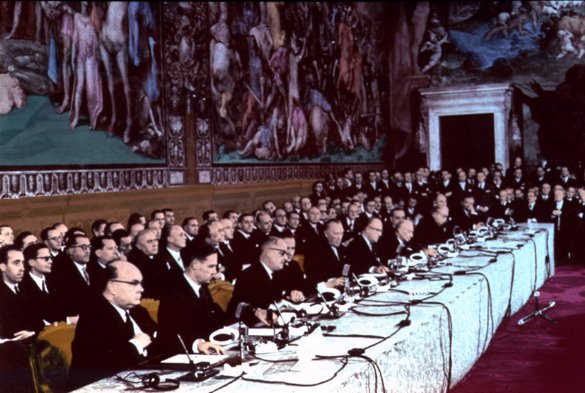
Classical liberal vision
The first vision promotes political competition between the EU’s member states by opening up borders. When a person is discontent with the excessive taxes in his country, he could leave his country for another. Competition between member states would lead to smaller governments, lower taxes, and political respect for people who would want to pursue their individual freedoms in another member state. It would represent a return to the political model that was prevalent in Europe from the Middle Ages to the 19th century when different political systems coexisted independently. There were independent cities or city states in Flanders, Germany and Northern Italy. There was the kingdom of Bavaria, the republic of Venice, and small city states like Ghent and Bruges embraced their autonomy. The German writer and poet Johann Wolfgang von Goethe (1749-1832) had expressed the beauty of such a political system as follows when he discussed a Germany that was still splintered in 39 independent states:
“I do not fear that Germany will not be united; … she is united, because the German Taler and Groschen have the same value throughout the entire Empire, and because my suitcase can pass through all thirty-six states without being opened. … Germany is united in the areas of weights and measures, trade and migration, and a hundred similar things. … One is mistaken, however, if one thinks that Germany’s unity should be expressed in the form of one large capital city, and that this great city might benefit the masses in the same way that it might benefit the development of a few outstanding individuals. … What makes Germany great is her admirable popular culture, which has penetrated all parts of the Empire evenly. And is it not the many different princely residences from whence this culture springs and which are its bearers and curators? … Germany has twenty universities strewn out across the entire Empire, more than one hundred public libraries, and a similar number of art collections and natural museums; for every prince wanted to attract such beauty and good. Gymnasia, and technical and industrial schools exist in abundance; indeed, there is hardly a German village without its own school. … Furthermore, look at the number of German theaters, which exceeds seventy. … The appreciation of music and song and their performance is nowhere as prevalent as in Germany, … Then think about cities such as Dresden, Munich, Stuttgart, Kassel, Braunschweig, Hannover, and similar ones; think about the energy that these cities represent; think about the effects they have on neighboring provinces, and ask yourself, if all of this would exist, if such cities had not been the residences of princes for a long time. … Frankfurt, Bremen, Hamburg, Lübeck are large and brilliant, and their impact on the prosperity of Germany is incalculable. Yet, would they remain what they are if they were to lose their independence and be incorporated as provincial cities into one great German Empire? I have reason to doubt this.”[1]
In addition to the advancement of political competition, the vision also promotes economic competition. A German employee would not be obstructed from working in France anymore, a Dutchman would not be taxed by the government if he transfers money from a Dutch to a Spanish bank or when he decides to buy stocks on the Italian equity market. Nobody would withhold a Belgian brewery from selling beer in other countries within the European free trade area.
Socialist vision
The second vision promotes a European central state that holds the power to enact more regulations, redistribution of wealth, and harmonization of legal systems within the whole Union. A strong central political body is to coordinate such efforts. The consequence is that its member states would increasingly have to give up their sovereignty. This is clearly visible from the political events in Greece and Ireland during the financial crisis of 2008 when Brussels demanded from Greece and Ireland how they should deal with their deficits and what austerity measures they should take. The socialist vision of Europe is an ideal for the political class, bureaucrats, interest groups and the subsidized sectors that want a powerful central state for their self-enrichment. Political competition among its member states, something that the classical liberals supported, should be eliminated. Doing so, Europe becomes less democratic and political power is increasingly shifted into the hands of bureaucrats and technocrats in Brussels. Historically, such plans for concentrated political power had been realized by such figures as Charlemagne, Napoleon and Hitler. The difference with our times is that the creation of a modern European superstate does not directly require military means. The introduction of new institutes like the European Central Bank, a common currency like the Euro, and extended power of the European Commission would suffice. Similar socialist intentions were already visible from the start of the European integration in the European vision of Jean Monnet, the intellectual father of the European community. Fearing an independent and emerging Germany after the second World War, an integration of Germany into Europe was considered to be a good thing. Next to that, the French wanted to have control over the Rühr area and they wanted to keep other vital German resources out of solely German hands. After losing her colonial powers in Indochina and Africa, the French ruling elite were also looking for new influence and pride which they eventually found in the European community.[2] The French premier in 1950 had for example proposed a plan to install a European army under the leadership of the French.
Why it is good for the Netherlands to leave the European Union
I believe that the EU should never have had more ambitions than the free trade zone that requires no supranational institutes, except for a European Court of Justice that is restricted to supervising conflicts between the member states and guaranteeing the four freedoms. The EU has become so far removed from the classical liberal vision of political and economic competition that it is not worthwhile anymore for the Netherlands to participate. It has declined into a malignant cartel of states that can tell its members with whom and how they should conduct their trade. A good example were the quotas and import levies on Chinese solar panels in 2013 under the disguise of ‘anti-dumping’ measures. Several countries like the Netherlands and Germany had first opposed to these measures as they would like to maintain good relationships with China. Nonetheless, the European Committee, apparently under influence of solar panel lobbyists like those of the German producer Solarworld AG, introduced ‘anti-dumping’ measures. The eventual winners of such measures are European solar panel producers and its victims are the European people that simply want to buy cheap solar panels. Another example are the sanctions that the EU had imposed on Russia since the Ukrainian conflict – a conflict that was provoked by American imperialists and NATO.[3] The deteriorating trade relationships between the EU and Russia is also detrimental to the wealth of ordinary European citizens. Another recent example is the prohibition of high-powered vacuum cleaners and possible future bans on other energy appliances such as kettles and hairdryers in order to reach environmental targets.[4] Those who profit from such measures are mainly large legacy organizations such as Bosch and Siemens that have enough capital to meet the strict EU regulations.
Another reason why a Nexit would be good for the Netherlands is that it offers an opportunity to extricate oneself from the Euro and the implicitly pledged financial aid when a future financial crisis will tear through Europe.
The tragedy of the Euro
The introduction of the Euro has proven to be a huge mistake, because it has enabled fiscally irresponsible governments of such countries like Portugal, Italy, Greece, Spain etc. to conduct unsustainable economic policies. In the past, when these states had their own currency, their governments had to finance their budget deficits through the sales of government bonds which resulted in higher government debts. The higher government debts manifested itself in higher interest rates on their government bonds, and a greater money supply would lead to devaluations of their currencies.
To illustrate how the process of government bonds financing works in the European Monetary Union, we could look at the development of 10-year government bonds. The graph below shows the interest rates that governments have to pay to the financiers of their 10-year government bonds from 1995 to 2011:

The y-axis represents the rates of interest that an investor receives from 10-year government bonds. Countries that are economically stronger and fiscally more conservative are rewarded with lower interest rates due to the smaller risk that these governments will not pay back their loans. In the case of Germany, a country with traditionally a stronger economy, a more conservative Bundesbank, and a fiscally more responsible government than many other European nations, investors received 7.5% interest on their 10-year government bonds in 1995. Greek government bonds had a yield of 18% in 1995. 1995 was the year in which the European Committee had announced that the Euro would arrive in 2002. Interest rates on government bonds consequently converged in the following years. At the end of 1997 all rates of interest on Portuguese, Irish, Spanish, Italian, French and German 10-year government bonds were more or less equal despite the fact that many of the governments of these countries still spent more than they received in tax incomes. The consequence of sharing a common currency with fiscally more responsible countries like Germany and the Netherlands is that fewer price signals in the form of higher interest rates on government bonds of fiscally irresponsible governments emerge. Irresponsible governments can issue government bonds to the banking sector that transfer these bonds as collateral to the ECB in return for loans. The interest rate that banks pay for the loans of the ECB are issued as profits to their governments. This is in short how ‘seigniorage’, the profits derived from money creation when the costs of money production and the distribution of money are lower than the value of money itself, is created.
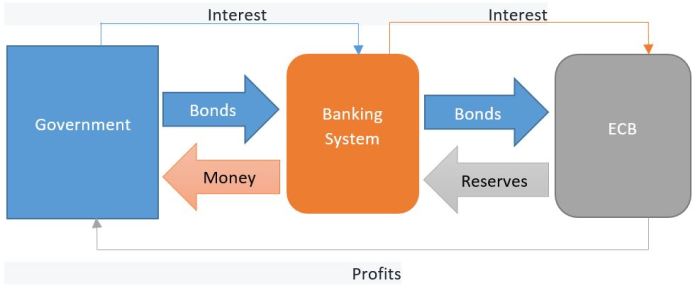
This process leads to inflation, but the costs of inflation in the EMU are not solely borne by the respective country that issues the government bonds, but by all countries that participate in the EMU. A country like Spain can for example issue government bonds that traditionally would correspond with 10% inflation. However, when other countries like the Netherlands and Germany issue an amount of bonds that corresponds with 5% inflation, Spain benefits from seigniorage as the inflation created by Spain is higher and borne partly by the Netherlands and Germany. A Euro in this regard is beneficial for fiscally irresponsible governments. It is actually a “Tragedy of the commons”. Abusing the Euro in this way is exactly what countries like Portugal, Italy, Ireland, Greece, Spain and France have done. This works until a financial crisis shows how insolvent the governments of these countries actually are. That has happened in 2008, the moment when interest rates on European government bonds started diverging. The ECB had even decided to buy up Greek government debts in May 2010 in order to lower the interest rates on Greek government bonds. In June 2010, a temporary European Financial Stability Facility (EFSF) was founded with guarantees of up to €440 billion to combat the European sovereign debt crisis. It has provided financial assistance to Ireland, Portugal and Greece. The EFSF was later replaced by the European Stability Mechanism (ESM) in October 2012 with a total described capital of around €700 billion of which the Netherlands has pledged €40 billion in capital participation. The Dutch prime minister, Mark Rutte, had promised the Dutch in 2011 that the Netherlands would receive back the money it has loaned out to Greece in May 2010.[5] The total sum that was loaned to Greece by the Dutch was €3.2 billion. However, in 2012 when the Netherlands loaned out €14.5 billion of the second financial aid package of €130 billion that was pledged by Europe and the IMF to Greece, the Dutch minister of Finance, Jeroen Dijsselbloem, admitted that the Netherlands were losing money. Rutte also admitted that he could not guarantee that the Dutch loans to the Greeks would not be forgiven.[6] Three years later, on July 13 2015, the Netherlands loaned out another €22.6 billion to Greece.[7] It has become clear that such financial pledges of the Netherlands to fiscally irresponsible governments like that of Greece are not beneficial for the Dutch. Even in the long run it is not beneficial for the EU as it supports and prolongs a socialist European system that is deeply rotten to its core and destined to fail. What the EU needs is a radical return to decentralization and political competition.
The EU has become a sinking ship. It appears to me that the Netherlands should leave the Union as soon as possible. I do not see how Europe can maneuver itself safely through the next financial crisis that is at the point of breaking out as more banks are on the brink of collapse.[8] I also expect greater centralization of political power within the EU and a greater loss of individual member countries’ sovereignty. On June 27, 2016, the Polish media had reported that France and Germany were taking matters into their own hands and are using the Brexit to unveil their plan to morph the continent’s countries into one giant superstate. Under their radical proposals,
“EU countries will lose the right to have their own army, criminal law, taxation system or central bank, with all those powers being transferred to Brussels.”[9]
Conclusion
A sensible Netherlands would leave the European Union and the European Monetary Union in order to preserve political and economic sovereignty. They would have free trade agreements with all countries within and outside of the EU. EenVandaag, a popular Dutch TV programme, had published the results of their 27,000 large online poll on Sunday June 26, 2016 in which 54% of the Dutch would like to hold a referendum about the Netherlands’ participation in the EU. 48% of the poll wanted the Netherlands to leave the EU against 45% who would like to remain in the EU.[10] In the meantime, the Remain camp will continue their nauseating snobbery accusing the Leave camp of being racist, nationalistic, isolationist or simply ignorant.
References
Bagus, P. (2010). The Tragedy of the Euro.
BBC. (2016). EU referendum: The result in maps and charts.
China Courant. (2014). Mogelijk nieuwe straffen voor producenten Chinese zonnepanelen.
Dijkstra, M. (2015). Griekse crisis: wat heeft het allemaal gekost?
DutchNews.nl. (2016). Dutch PM rejects referendum calls: not in the Netherlands’ interest.
Fullfact.org. (2016). First they came for the vacuum cleaners: will it be kettles next?
Gutteridge, N. (2016). European SUPERSTATE to be unveiled: EU nations ‘to be morphed into one’ post-Brexit.
Hoppe, H.H. (2001). Democracy the god that failed.
Judt, T. (2006). Postwar: A History of Europe Since 1945.
McMurtry, J. (2016). Ukraine, America’s “Lebensraum”. Is Washington prepared to wage war on Russia?
NOS. (2011). Rutte verwacht Grieks geld terug.
NU.nl. (2012). Rutte geeft verbreken verkiezingsbelofte toe.
Zerohedge.com. (2016). Deutsche Bank tumbles near record lows as yield curve crashes.
Footnotes
[1] From Johann Peter Eckermann’s Conversations with Goethe (1836-1848).
[2] Tony Judt writes in Postwar: A History of Europe Since 1945 (2006) that “[U]nhappy and frustrated at being reduced to the least of the great powers, France had embarked upon a novel vocation as the initiator of a new Europe” (p. 153). He also writes that “[F]or Charles de Gaulle, the lesson of the twentieth century was that France could only hope to recover its lost glories by investing in the European project and shaping it into the service of French goals (p. 292).”
[3] See for example Prof. John McMurtry’s “Ukraine, America’s ‘Lebensraum’. Is Washington prepared to wage war on Russia?” for an analysis how Washington had provoked the Ukrainian conflict with Russia.
[4] See “First they came for the vacuum cleaners: will it be kettles next?”
[5] See “Rutte verwacht Grieks geld terug” (2011). http://nos.nl/artikel/275035-rutte-verwacht-grieks-geld-terug.html
[6] See “Rutte geeft verbreken verkiezingsbelofte toe” (2012). http://www.nu.nl/algemeen/2968363/rutte-geeft-verbreken-verkiezingsbelofte-toe.html
[7] See “Griekse crisis: wat heeft het ons allemaal gekost?” http://www.elsevier.nl/economie/article/2015/07/griekse-crisis-wat-heeft-het-ons-allemaal-gekost-2657386W/
[8] See for example “Deutsche Bank tumbles near record lows as yield curve crashes.” http://www.zerohedge.com/news/2016-06-13/deutsche-bank-tumbles-near-record-lows-yield-curve-crashes
[9] See “European SUPERSTAT to be unveiled: EU nations ‘to be morphed into one’ post-Brexit.” http://www.express.co.uk/news/politics/683739/EU-referendum-German-French-European-superstate-Brexit
[10] See “Dutch PM rejects referendum calls: not in the Netherlands’ interest.” http://www.dutchnews.nl/news/archives/2016/06/92520-2/
From the Comments: Pushback in favor of Brexit
Dr Stocker‘s recent post arguing against Brexit elicited the following response from Chhay Lin in the ‘comments’ threads, and I think it’s worth highlighting in a post of its own:
Very well explained, Barry Stocker. Although it can be good for Britain to leave the EU, it entirely depends on how they go on from there. I am worried that Britain will move unto the path of less free trade which would be an erosion of the 4 freedoms – free movement of goods, capital, services, and people. On the other hand, it seems to me that the EU was steadily moving toward greater centralization and harmonization of regulations that would decrease the competition between its member states and thereby becoming quite harmful. I think that the EU should have never had greater ambitions than the 4 freedoms with a European Court of Justice that would protect these freedoms. Now they can impose EU-wide tariffs and quotas against products from countries outside of the EU or they can impose EU-wide sanctions. Some harmful examples of the EU: the quotas on cheap Chinese solar panels and EU-wide sanctions against Russia. A wise independent Britain would have free trade agreements with countries within and outside the EU, but I’m afraid that too large a portion of the Leave supporters are hostile to immigration and open markets.
Chhay Lin has written more about Brexit, in Dutch, on his homepage and I do recommend you check it out.
Brexit, free trade, and the EU
I posted this on Facebook twenty hours before the results were known:
The United Kingdom will not leave the EU. If it does, there will be concrete talks of a trade agreement between the UK and the Union within a week. Free trade is the best part of the EU anyway. It may be the only worthwhile part. At least, it undeniably works. The EU has a free trade agreement with Norway and with Switzerland already. I don’t see it denying the UK, not even out of collective pique.
My guess (guess) is that the UK will have done the EU a favor by pointing out that much of the European Union’s bureaucratic, abstract, nebulous project is simply overambitious. The UK taught the world democracy and soccer (football). It can teach its European neighbors pragmatism.
Obviously, I called the referendum wrong. The mistake I made was to guess that people who were going to vote for staying were more likely to lie to pollsters than partisans of Leave. That would have given an underestimate for the “stays.” I should not have called it. I am not inside British culture enough to make this kind of guess. I shouldn’t have. I won’t again.
I am perplexed by some of the comments I heard all day in the US media. Perhaps as a result of a bit of psychological projection, American commentators state that anti-immigration sentiment played the main part in the victory of the “leave.” This may be the case; I don’t know enough to pronounce but I need to make a technical point that the pundits don’t seem to be completely aware of. Leaving the European Union can only lessen the flow of European immigrants into the UK: Polish (plumbers), Romanian carpenters, and tens of thousands of French citizens, at least. Since about one million Brits leave abroad and almost all in the EU, I see an exchange agreement in the making. Don’t you?
Leaving the EU will do nothing or nearly nothing to reduce the intake of immigrants of color and of Muslims. Those landed in the UK and continue to land there as a consequence of past colonial relationships. I say this because I suspect (I suspect; I don’t know) that Brits are more exercised about large numbers of dark-skinned Muslims than they are about fewer dishwater-white Catholic Poles. Call me a cynic!
Second technical point. Many of the American commentators I heard today, including those predicting Armageddon as a result of the British referendum, seem to have vague ideas about what the European Union actually is. It’s actually fairly complicated but I don’t excuse them. If they want to comment, they should do their homework. Anyway, the EU is first and foremost a free trade area and and free investment area. In this capacity, it works very well. I mean by this that any step backward would impoverish all Europeans to some extent.
I don’t see how British industry and British commerce can really face the possibility of meeting with tariff walls and other discriminatory treatments in a market of 27 countries until now wide open to them.
The Brits have two years to finalize their exit. I think (but I have been wrong before; see above) that they will say to the EU: We are leaving except that… we want to be included in your free trade and free investment area, like Iceland and like Norway. As I mentioned above, I also think they will want some mutual arrangement about citizens of the EU living in the UK and citizens of the UK living in the EU. I think there are going to be many rounds of negotiations around the theme: “We are leaving but…” It’s also possible that the most fervent Leave-ers will ultimately be satisfied with having made a rude gesture toward Brussels, the capital of the European Union. I am repeating (in fear this time) my prediction that the British referendum will cause the EU to reform itself. In fact, think it already has.
See also “Protectionism; Free Trade….” It was written for the intelligent uninformed.
A quick note on the Brexit debacle
I think Barry (here and here) and Edwin (here and here) have made the best contributions to the debate on the EU and sovereignty here at NOL to date, so I’m just going to add a couple of open-ended thoughts to the recent vote (which I think was a huge mistake).
One of the big theoretical debates over the years concerning the EU is the concept of European-ness and how it can never replace the nationalisms that already exist in each state across the pond. This makes no sense to me, though, especially if you buy the argument (as I do) that nations come and go largely in reaction to current events. German-ness or French-ness or British-ness could easily be subsumed by a European-ness.
I don’t want to be one of those doomsayers who claims that, because things did not go my way, all will be lost. The UK is going to be in for a little bit of hurt, financially, as is the European Union; losing the UK is a big deal, and so is leaving the EU. However, the UK is not exactly Sweden or Germany. The United Kingdom is poorer than Mississippi, the poorest administrative unit in the United States. It’s possible, if a bit unlikely, that the UK will be better placed to negotiate itself back to economic prominence if it doesn’t have to work through the EU to attain some of its goals. The UK has deep connections with a number of states and regions around the world thanks to its now-dead worldwide empire, and I don’t why a more Euroskeptic UK would decide to shun the rest of the world too, especially if the “rest of the world” was once a part of the UK’s empire (the glorious past of the UK seems to be an important talking point for Euroskeptics).
Immigration may not cease either. An irony here is that the Euroskeptics who won rode hard a wave of anti-immigration sentiment sweeping across the UK (and the rest of Europe, too). But it seems to me that, because of the UK’s deep connections to its former imperial provinces, most of the immigrants in the UK are going to be South Asian or Gulf Arab rather than Polish or Greek. Given that much of the anti-immigrant rhetoric in Europe stems from a deep distrust of Islam, I find it odd that British voters could be so gullible on this matter.
Does anybody know if this vote is the final say on whether or not the UK will leave the EU? [UPDATE: see Dr van de Haar’s comment for an answer to my question] It seems to me that there has got to be some legal mechanisms, via courts, that have been put into place in order to slow down things like mob rule mass voting.
The Case for the UK staying in the EU
Leaving the European Union would not be a gain for liberty in the United Kingdom. This is true as a matter of general principles and is reinforced by the nature of the Leave campaign which has targeted sections of the population hostile to immigration, open markets, and free trade. Much of the Leave campaigning which has not appealed to such base arguments has at the very least appealed to a version of populist democratic sovereignty at odds with the restraints on government and the state at the heart of classical liberal and libertarian thought.
Even if we try to separate some pure classical liberal version of the Leave campaign from the crudity of the campaign, as some natural supporters of leave wish had happened to the extent they ate voting for Remain rather than go along with such an obnoxious campaign, we are still left with the question of why it liberty advocates should support Leave.
I have sometimes seen references to national sovereignty as a classical liberal doctrine. If this means never sharing sovereignty at a transnational level, then it is simply a false claim. Immanuel Kant advocated a world federation to prevent war. Kant is not often put at the centre of the history of classical liberal thought. His ideas about political institutions, individual rights, and the limits of government certainly belong in the classical liberal sphere. We should distinguish between what Kant said and what later German Idealists said, a rather big issue, and appreciate how close he is to the way of thinking of Montesquieu and Smith and even advances upon them in showing a clearer understanding of the role of representative assemblies in modern politics.
More recently F.A. Hayek advocated federation between liberal democracies. The creation and evolution of the European Union has been and continues to be supported by European political parties of a classical liberal persuasion, those liberal parties which remained most true to the principles of their nineteenth century founders and precursors. Thinkers on the left, like Albert Camus and George Orwell, known for their particular commitment to liberty and their opposition to an authoritarian state were enthusiasts for European integration. Many conservatives of the more free market and limited government sort like Ludwig Erhard (founder of Germany’s post-war, post-Nazi market economy) and John Major (UK Prime Minister from 1990 to 1997, who went further than Margaret Thatcher in privatisation and deregulation) have been and are advocates of the European Union.
The unrestrained sovereignty of the nation-state is not only not an inherently liberal idea, it is dangerous to liberalism. There is nothing illiberal in transnational rules and institutions that restrain states from violence against their own citizens, attacks on individual rights, economic protectionism, and market rigging. The European Union is particularly successful with regard to the economic and market issues at the national level. It adds huge institutional weight to the work of the Council of Europe which promotes human rights through its court in Strasbourg. The existence of the European Court of Justice is of profound importance in ensuring that national governments and peoples are accustomed to regarding the decisions of nation states as subordinate to and accountable to a judicial process enforcing transnational laws.
The EU is open to a great deal of criticism with regard to its tendencies towards over-regulation, but this represents the median attitude of the member governments, not an imposition on the nation-states of Europe. Since the UK economy is at the more free market deregulated end of the European Union, there is some plausibility in saying the UK might go further down that road if it left the EU. However, before it joined the EU it was looking less market oriented than the EU states of the time. The period during which the UK has moved from the more statist to the more limited state end of the European nations has been during the period of EU membership. The precedents do not favour the UK becoming more classically liberal because it leaves the EU and the Leave campaign has appealed to the most insular, nationalist, anti-immigrant, anti-foreigner, and anti-free trade sections of the UK population.
It is possible to imagine the UK as a more libertarian kind of place in the EU, but a much more plausible use of the liberal imagination is to think of ways in which the UK can work with allies in the EU for a a less regulatory and centralised EU. This has already worked as in the adoption of the European Single Market and the diminishing role of the European Commission, the ‘bureaucratic’ part of the EU. The Commission employs as many bureaucrats as the larger local government units in the UK and is tiny compared with any national bureaucracy. Its members are nominated by national governments subject to confirmation of the European Parliament. Power has shifted from the Commission to the bodies in which national government representatives meet, the European Council and the Council of the European Union.
The Leave campaign in the UK, including self-styled free marketers in the Conservative Party, is committed to leave the Single Market as well as the European Union itself, in large part to terminate free movement of EU citizens across its borders. The reasoning offered to prevent this movement of human capital is in terms of anti-foreigner sentiment. This is not something than can be recognised as a pro-liberty program. The pro-liberty choice is to keep free movement of goods, investment, and labour within the EU while working to reform the more interventionist tendencies of the European Union, to stymie the regulatory drift which started hitting industrial market economies decades before the EU was created and which cannot be solved by smashing up the EU.
The European Union is Pathetic
So here we are. Prime Minister Cameron got his ‘special deal’ from the rest of the EU leaders. It is pathetic, from both sides. I like the Brits, and admire their great tradition in political thought. Because of their constant doubts about the EU, they are (potentially) the most informed about it, if the enormous flow of publications pro and con is a sign, which have seen the light since the eighties. Therefore, one questions the sincerity of Cameron, who has repeatedly said he will campaign against Brexit. His pathetic result seems a sure vote winner for the No side though. I find it hard to belief that anyone can be seriously convinced to stay in, if his four main results should do the trick.
These four are: a minor semantic thingy (Britain is exempt from striving to a closer union); a complicated procedure for a majority of national parliaments to reject or change intended European regulation (a comparable procedure has been a failure); the possibility to decrease the amount of children allowance for children who do not live in Britain to the purchase power parity level of the country concerned (especially aimed at Eastern Europeans); and finally an emergency break on social security benefits. Great results to build a campaign on…
These results are mostly symbolic, and while symbols are important in politics, it still amounts to little. So the other European leaders were not willing to change much in the way the EU is now run and its enormous amount of laws, rules and legislation. This is by far the saddest of it all. The leaders let the moment pass to really change the EU, to not only address the British fear and frustration, but also those of the people of many other member states.
This is especially relevant for The Netherlands. On April 6 there is national referendum on the association treaty with Ukraine. The No-camp is leading the polls. If rejected (and the government acts accordingly, which it is not obliged legally), the whole treaty has to be discarded by the EU. We have been in this situation before. In 2005 the French and Dutch populations rejected the EU constitution by large margins. Only to have force fed on their throats a marginally different constitutional treaty a year later. So strange support for the EU had been decreasing for years.
The EU cannot make a fist in foreign politics, not in defense and security affairs, not in the current refugee crisis. It fails to ensure free competition in services, it still wastes billion of euros in subsidies on agriculture, regional support, industrial policies, et cetera. In short: it is a mess, the EU fosters the development of turning itself into an open air museum: admired for its culture, laughed at for its dismal politics and economics. Thanks a lot for the leadership, European Council.
 Notes On Liberty