Nick’s article is part of an elite mini-symposium on Rawls and his Theory of Justice, while mine slipped in near the end of the journal as a piece on libertarian foreign policy. Both pieces are paywalled, but here is an earlier draft of Nick’s piece (titled “Rescuing Rawls from Rawls”) that you can read, and here is an earlier, readable draft of my piece.
You can buy the entire issue here, and I recommend that you do!
China’s economy faces a number of challenges — three in particular:
the spread of the covid19 pandemic
the country’s ambitious zero-covid approach (which has resulted in severe lockdowns)
and a grave real estate crisis arising out of the crackdown on the property market
The slow down of China’s economy was acknowledged by Chinese Premier Li Keqiang. In a meeting he is reported to have said: “It is necessary … to further cut taxes and [administrative] fees to ensure a stable economic start in the first quarter and stabilize the macro economy.”
During a meeting in December 2021, Chinese leadership flagged ‘stability’ as its key aim for 2022. This was in stark contrast to targets for 2021, which was focused on ‘the disorderly expansion of capital’ driven by President Xi Jinping’s objective of reducing inequalities in Chinese society.
China’s zero-covid strategy is impacting its economic links with the rest of the world as international air travel is restricted, and even the stringent lockdowns applied in the country are likely to take their toll on global supply chains. A lockdown in Xian, for instance, has already prompted Samsung Electronics and Micron Technology, two of the world’s largest memory chip makers, to red flag the possibility of their chip manufacturing bases in the area being hit.
As a result of its zero-covid strategy, and its aim of controlling the spread of the pandemic in Xian, and also before the Beijing winter Olympics next month, China has further tightened regulations for the import of products from neighbouring countries in Southeast Asia. Trucks with agricultural products from Vietnam and Myanmar have been stranded for weeks (some for well over a month), and as a result products have been rotting (especially fruits like mangoes and jackfruit) and exporters in both countries have had to face losses (exports of non-agricultural products, such as rubber and minerals, from Laos to China, have also suffered). Apart from stringent checks, exporters of commodities are supposed to carry Chinese trucks across the border – the unloading of goods and transfer is a time consuming process and this leads to further delays.
It is not just mainland China but also the important financial hub of Hong Kong that has been following a zero-covid policy, which has impacted its economy – especially the tourist sector. The fact that Hong Kong will be opening to China before it opens to the rest of the world has also not sent out a positive message to international businesses.
China faces the onerous responsibility of not just keeping covid19 under check, but also preventing a further slow down in its economy. Economic challenges and the zero-covid approach will lead not only to domestic problems, but also impact its economic linkages with the rest of the world, especially neighbouring countries in Southeast Asia (China is an important market for agricultural products of Vietnam and Myanmar). The slow down in China’s economy and the remarks by Li Keqiang with regard to the same also highlight the limitations of Xi Jinping’s economic vision and the fact that there is a growing concern with regard to the country’s possible economic challenges over the next few months.
A novella fucked me up. Not now. That would be some 20 years ago, at the nationally held university admission exams. So, last week I went for a complete re-read of the thing, “Η Τιμή και το Χρήμα” (translates in either Price or Honor, and Money, a witty ambiguity in Greek) by Konstantinos Theotokis. It follows a family drama in Corfu island, circa 1910. It’s prose is something for its own sake, but more importantly, it is a relatively rare depiction of lower class people, not as proud, hard-working laborers, but as quite cold calculating individuals.
Rigid constraints are in place, from tradition and custom: Social hierarchy is alive and kicking, with old noble families and new-moneyed ones on top and the poorer, working ones beneath. Women are generally subordinate. There is a clear distinction in occupations, so that men of higher heritage are unavoidably expected to be masters, not employees, securing that their women do not (need to) work. The drama arises as the son (Andreas) of such a family, plighted by ill economic tidings, and the daughter (Rini) of a lower family, fall in love. It gets more complicated as the girl’s mother (Epistimi), the acting head of their house and a business partner of sorts to the prospective groom, refuses to offer the requested dowry.
It is a sad story, with just a bit of silver lining so no to come as downright depressing. Some take-aways:
Smuggling was thriving. Andreas smuggles commodities and cattle.
Epistimi, a factory seamstress, buys smuggled products from Andreas to resell them, and also lends him money for his endeavors. A homebrew little merchant – money lender she is.
The interest rate is around 20%-25% for a term of weeks or so. In written pact.
Smuggling operations have a nearly explicit political coverage. Andreas uses his family’s connections to remove the local constable at some point.
This patronage is flimsy, as governments change. Smuggling shifts to the new minister’s electoral district. Hardly a good fit for trade theorizing.
Per Andreas’ uncle, who is also his accomplice, smuggling is as decent as any dealing, and those “fat cats” at the capital could do with less taxes.
Women’s’ social position plainly sucked. But at least they could take some initiatives.
Hard labor is in fact praised throughout the novella.
Juveniles lack context to understand and appreciate the novella, I think. I agree it should be taught, but not in the hammer-it-in-your-head way it was presented back then.
If a person were to receive a letter with the salutation “Hey girl!” and the closing “Kindly,” one would naturally start to make conclusions about the author. One might conjecture from the salutation that the letter is between intimates, though it could equally signify that the author is unaware of appropriate salutations for written communications. The closing “Kindly” would probably trigger a second of cognitive dissonance. “Kindly” has passive aggressive undertones, which is one reason etiquette guides discourage using it. This type of analysis — what sort of person wrote this letter? — relates to social class.
In October 2021, The New York Times’s literary arm, New York Times Magazine, published a story on a multi-year tussle between writers Dawn Dorland and Sonya Larson. In the process of lawsuits, Dorland’s side subpoenaed Larson’s group chats with other writers in which those who also knew Dorland discussed in frank terms how irritating they found her. As part of a court order to indicate types of research Larson did for her work, her lawyers submitted a list of resources which included a handful of academic research on the subject of “White Savior” complexes. To be fair to Larson, it is important to her short story that one character is Asian-American and the other is Caucasian, so it is logical that Larson would read some sources on the subject, as well as the others submitted which were on topics such as alcoholism or psychological conditions. However, as Larson herself is a mixed-race Asian-American and Dorland is Caucasian, followers of the case latched on to the detail as representative of the underlying problem between the two writers. In my opinion, dragging race into the Dorland-Larson debacle represents a problem of vocabulary: modern society has taken to using political race-based terms to describe issues of social class.
The salutation and closing described in the first paragraph come from an email Dorland wrote to Larson. The author of the New York Times Magazine story on Dawn Dorland and Sonya Larson chose to interpret Dorland’s sign off, “kindly,” as a sign of her altruistic mindset.
To summarize a situation that occurred over several years, Dorland donated a kidney and created a Facebook group as a platform where she talked about her experiences in real time; Larson wrote a short story in which she used elements of some of Dorland’s story; the story won literary accolades; Dorland accused Larson of plagiarism and contacted the Boston Book Festival for promoting the story along with some of Larson’s other work; Larson sued Dorland for tortious interference and the courts found in Larson’s favor; Dorland countersued Larson for copyright violation; the courts ruled for Larson, citing that Larson hadn’t used enough of Dorland’s writings on the topic to qualify remotely as copyright violation; Dorland maintained that Larson had violated her rights and mounted a campaign to discredit Larson within professional literary circles.
Larson is the daughter of educated professionals. Her Caucasian-American father and her Asian-American mother are university professors. That said, her maternal grandparents were working-class immigrants who worked hard for their children’s futures. Dorland had an unstable childhood as the child of itinerant agricultural workers; eventually she ended up in Los Angeles. She obtained two graduate degrees, one from Harvard Divinity School and an MFA from University of Maryland. Given that she took a degree at a top university, one can argue that she had a ticket into the American bourgeois, if not the grands bourgeois. In this way, the American system worked: she was not denied opportunity based on parental background; she was welcomed as an equal within a professional network. In a broad sense, the two women were on a level of some parity: Larson was an established writer, but Dorland was a Harvard graduate.
The decision to project a racial narrative onto the debate was not Larson’s as is evident in the legal documents her lawyers submitted and the story itself. Those who latched onto a racial interpretation of the debacle missed to a great extent that while the story contained a traditional dichotomy, working-class minority woman opposed to a wealthy, though uncultured Caucasian for narrative purposes, the dynamic between the real people was, if anything, reversed. Based on cultural norms from around the world, who would start life higher, the child of a university professor, or the child of an itinerant laborer? In real life, a dynamic that works for fiction can be, and often is, inverted.
In one of the ping pong lawsuits, Dorland sued Larson for Intentional Infliction of Emotional Distress, citing that “Larson abruptly ceased speaking with Ms. Dorland” and had moved to “ostracize Ms. Dorland from their mutual acquaintances in the writing community.” The judge dismissed the IIED suit out of hand. Dorland’s charges were based on an earlier claim that she and Larson had been close personal friends. And this is where class differences start to show up. As a citizen journalist has found, Dorland met Larson around 2007 by dint of attending writing workshops at the arts center where Larson worked, but they were not the close friends Dorland portrayed in her lawsuits. Larson categorically stated via her lawyers that they “were never alone in the same room,” which implies all of the social activities close friends do, e.g. going to restaurants, cafés, or movies together, never occurred. This does not ipso facto mean Dorland lied; rather, the difference can indicate that there was a misunderstanding of proximity. Dorland rubbed shoulders with Larson for around seven years before moving away from Boston; Dorland attended Larson’s partner’s mother’s funeral; according to Dorland’s testimony, Larson attended Dorland’s going away party and presented a “meaningful gift.” Finally, and of more immediate interest to the judiciary, Dorland told Larson about her familial history. Depending on who is asked, this last is interpreted as either a sign of a friendship or as a sign that Dorland was an over-sharer. Both women could be correct in terms of their assessment of their friendship. What could be glancing and low-commitment contact in Larson’s social strata — in the American upper-middle class, one does not attend a goodbye party without a gift and one makes an effort to put some thought into it (after seven years, one should know enough about the recipient to choose an item that won’t trigger allergies and is in a pleasing color; this is simply common courtesy) — might be signs of deep friendship in Dorland’s. The lack of clarity in this is one reason the court ruled that there was no Intentional Infliction of Emotional Distress.
At this point, any racial issues remained part of the fictional short story. However, once the case went public, the racial dynamic took over the narrative in certain quarters. The polemic therefore bore little resemblance to the original problems between Dorland, Larson, and Larson’s friends. The latter two had problems with behaviors which were low-class, though neither Larson nor her friends are people who are likely to use that term. Use of racial language obscures the class issue, which undeniably matches contemporary sensibilities. After all, discussing the case in terms of class — on one side, a woman reveals medical procedures and conducts herself in a manner others might perceive as overly familiar, overly ebullient, while on the other side, a group of more established professionals decry her lack of gravitas, dignitas, or sense of privacy, while possibly sending out a snobbish aura — opens up an uncomfortable recognition of the existence of class divides, something which American society would prefer to ignore.
Throughout all of human history, societies have had acceptable and unacceptable behaviors. These are often cast in terms of upper- or lower-class. This is normal for humans. Attempting to deflect the matter is to ignore a fundamental part of how humans negotiate with each other. Creating a red herring of race issues serves no one. To the contrary, doing so increases problems as questions of conduct take on a political tone. Which is even less helpful as politics are polarizing enough without conflating class differences with political differences. Anecdotally, I know many people from the right and the left who are upper-class in their manners, tastes, activities, and professions, but equally I also know many people from both sides of the aisle who are decidedly lower-class in their behaviors, dress, entertainments, and lifestyle. Confusing political leanings with social class, as some people I know have, is truly not helpful. Having good table manners, dressing correctly, or behaving appropriately with others is not a matter of conservative or liberal, Republican or Democrat, but if a person has tangled “Conservative” with “polished,” or “slovenly” with “Liberal,” then one will see political boogeymen in every corner of life.
I’m buried in a special issue for Cosmos + Taxis. It’s gonna be awesome. It’s on libertarian foreign policy. The list of authors contributing is astounding, but the list of peer reviewers might be the crowning achievement of the issue. I’m dealing with academic rock stars.
I generally like Noah Smith’s economics made simple explanations and have read him since his old blog days (I still check his substack, and Bloomberg, pieces)
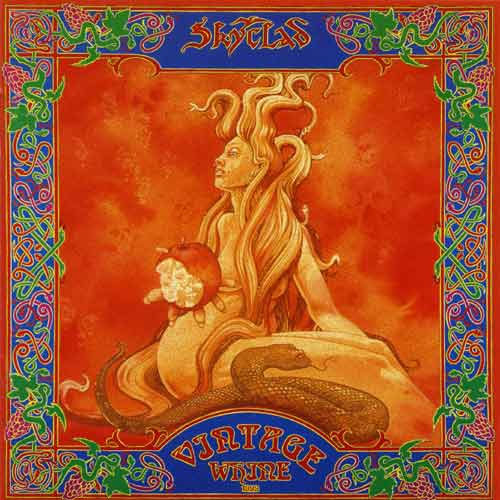
Skyclad rocked (never got interested in their pagan tendencies and gibberish fonts, though) – Source
So, NS reposted The liberty of local bullies, a decade-old critique of libertarianism (using, in perfect economist style, a completely libertarian world as the basic assumption). I am sure almost everything is already said and done (late to the party!), but here goes anyway (from “theoretical” to “real-world” order):
Those cartels that will push anyone not to their liking aside would not necessarily be invincible. Cartels/ trusts/ consortia/ whatever (probably) use government regulations to dig-in even more solidly. Take away the government’s heavy hand, and they get more exposed to competition.
The high transaction costs of moving/ working elsewhere also go the same way.
Liberal thought is not blind to misuses of private power (the usual quote here being *the* Adam Smith). Αt least one European liberal strand requires active trust-busting policies as a prerequisite for protection against such consolidations (ordoliberalism of 1930s-50s). Also, the mother of legislative trust-busting, the US Sherman Act of 1890, was signed by a Republican President. Since NS hedges as he gears his offensive to American expressions of the liberty creed, I am at a loss if this law could claim a liberal (libertarian?) root.
Days after the UAE’s decision to cancel the agreement regarding purchase of F35 jets from the US, a CNN report (December 23, 2021) stated that assessments of senior US officials suggested that transfers of sensitive ballistic missiles had taken place between China and Saudi Arabia.
UAE’s reasons for cancelling the agreement for purchase of F35s
One of the reasons for the UAE to cancel the deal with the US was that it did not want to be caught in any sort of ‘cold war’ between both the US and China. Anwar Gargash, Diplomatic Adviser to the UAE’s leadership, said, while speaking at a think tank in Washington DC earlier this month:
I think we, as a small state, will be affected negatively by this, but will not have the ability in any way to affect this competition even positively really.
While the US has been uncomfortable with the UAE’s use of Chinese 5G technology, with Washington warning the Emirates that the latter’s use of technology will impact security ties between both countries, the findings of US surveillance that China was trying to build a military installation in Khalifa port, close to Abu Dhabi, led to serious differences. Although construction work on the site in Khalifa port was cancelled (though both the UAE and China insisted that the facility was purely commercial in nature), and both the Emirates and the Americans have publicly stated that their relationship is still strong, there is no doubt that recent events have cast a shadow on the bilateral relationship.
If one were to look at the case of Saudi Arabia developing ballistic missiles, it is important for a number of reasons. First, it shows the increasing security imprint of China on the Middle East, specifically two Gulf Cooperation Council (GCC) countries: Saudi Arabia and the United Arab Emirates (UAE). Both are considered to be close to the US, and the fact is that ties with China could emerge as a bone of contention in relations between Washington and Abu Dhabi and Riyadh.
A senior Chinese official did not deny cooperation in the sphere of ballistic technology between Saudi Arabia and China, stating that both countries are comprehensive strategic partners. Said the official:
Such cooperation does not violate any international law and does not involve the proliferation of weapons of mass destruction.
Interestingly, China also shares robust economic ties with Iran and has been pitching for revival of the 2015 Joint Comprehensive Plan of Action JCPOA/Iran nuclear deal, while the UAE and Saudi Arabia, like the US, Israel, and other countries, have expressed worries with regard to Iran’s nuclear ambitions. China and Iran have also signed a 25-year cooperation agreement, referred to as “strategic cooperation pact,” in March 2021, which sought to bolster economic and security linkages between both countries. Iran has also hinted that if the JCPOA does not revive it would go ahead and trade with China and other countries.
Second, the development of ballistic missiles by Saudi Arabia will have a significant impact on the Middle East, and make it tougher for the US and other countries to prevent Iran from developing a ballistic program.
US ties with Saudi Arabia
While information pertaining to Chinese assistance for Saudi development of ballistic missiles was available to the US even earlier, the Trump administration did not put much pressure on the Saudis over this issue. The Biden Administration’s ties with Riyadh have been strained (as a result Saudi Arabia has been attempting to reorient its foreign policy significantly), though in recent months the US has been working on remolding ties. One of the reasons why Washington did not impose sanctions on Saudi Crown Prince Mohammed Bin Salman (MBS) even though declassified reports of CIA pointed to the fact that MBS was clearly involved in the Jamal Khashoggi murder (a number of Saudi officials were put on a no travel list, while financial sanctions were imposed on some officials), was that the US did not want to allow ties with Saudi Arabia to further deteriorate.
GCC countries like Saudi Arabia and the UAE, which have shared strong economic and strategic ties with the US, have been altering their foreign policy within the Middle East (one important example of this has been attempts by both countries to improve ties with Iran) as well as outside of it. One of the propelling factors for the reorientation in foreign policy of Riyadh and Abu Dhabi is the belief that the US will be less involved in the region in the future. In the past the China factor has never been a major issue in US ties with Saudi Arabia and the Emirates, but greater security and technological cooperation between the GCC states and Beijing could prove to be a thorny issue. Apart from its increasing economic clout, the biggest advantage that China possesses in the Middle East is that, apart from strong ties with Gulf countries, it also has good relations with Iran.
In 1969, Colonel Luke Quinn, a U.S. Army Air Force officer in World War II, was diagnosed with inoperable gallbladder cancer. Surprisingly, he was referred to Dr. DeVita, the lymphoma specialist at National Cancer Institute, by the great Harvard pathologist Sidney Farber — famous for developing one of the most successful chemotherapies ever discovered. Nobody imagined back then that Colonel Luke Quinn, a wiry man with grey hair and a fierce frown with his unusual and likely incurable cancer, would significantly impact how we look at cancer as a disease.
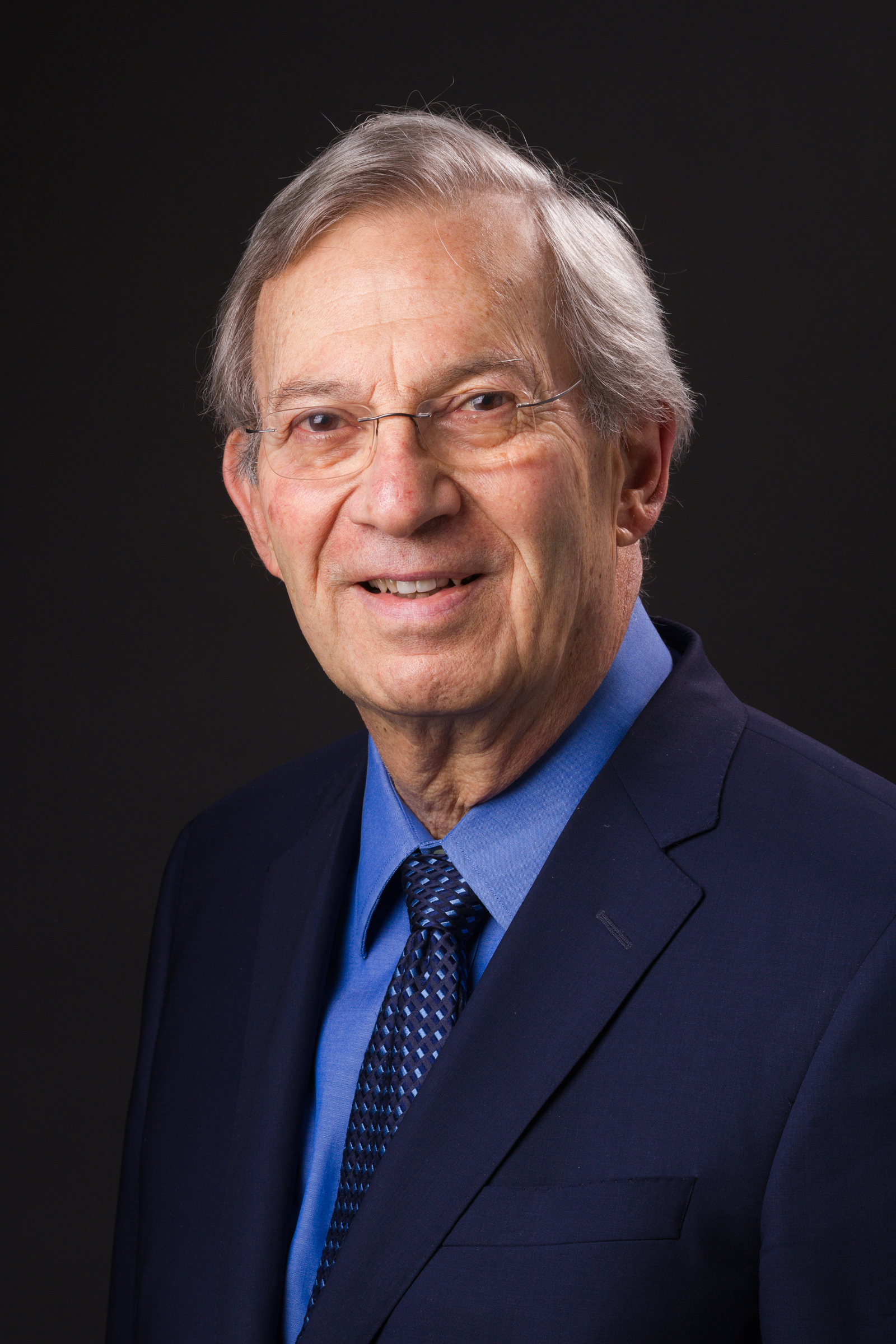
Vincent DeVita Jr, MD; Author: The Death of Cancer
Having been coerced to take up the case of Colonel Luke Quinn, despite gallbladder cancers not being his specialty, Dr.DeVita began to take a routine history, much to the annoyance of Luke Quinn who was used to being in command. Though Quinn glared at Dr.DeVita for reinitiating another agonizing round of (im)patient history, he said he had gone to his primary care physician in D.C. when his skin and the whites of his eyes had turned a deep shade of yellow — jaundice. Suspecting obstructive jaundice—a blockage somewhere in the gallbladder, Quinn was referred to Claude Welch, a famous abdominal surgeon at Mass general who had treated Pope John Paull II when he was shot in 1981. Instead of gallstones, the renowned surgeon found a tangled mass of tissue squeezing Quinn’s gallbladder—gallbladder cancer was pretty much a death sentence. On the pathologist’s confirmation, Quinn, being declared inoperable, was sent to Dr.DeVita at NCI as he wanted to be treated near his home.
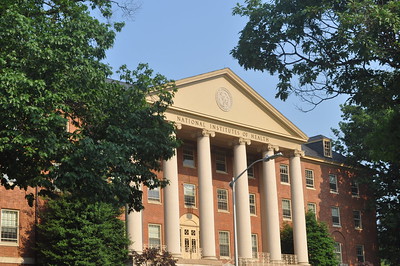
James H. Shannon Building (Building One), NIH campus, Bethesda, MD
Dr.DeVita, however, noticed something quite odd when he felt Quinn’s armpits during a routine examination. Quinn’s axillary lymph nodes—the cluster of glands working as a sentinel for what’s going on in the body—under his arms were enlarged and rubbery. These glands tend to become tender when the body has an infection and hard if it has solid tumors—like gallbladder cancer; they become rubbery if there is lymphoma. Being a lymphoma specialist, the startled Dr. DeVita questioned the possibility of a misdiagnosis—what if Quinn had lymphoma, not a solid tumor wrapping around his gallbladder leading to jaundice?
On being asked for his biopsy slides to be reevaluated, the always-in-command Colonel Luke Quinn angrily handed them over to the pathologist at NCI and sat impatiently in the waiting room. Costan Berard, the pathologist reviewing Quinn’s biopsy slides, detected an artifact in the image that had made it difficult to differentiate one kind of cancer cell from the other. Gallbladder cancers are elliptical, whereas Lymphoma cells are round. The roundish lymphoma cells can look like the elliptical gallbladder cancer cells when squeezed during the biopsy. This unusual finding by Berard explained why Quinn’s lymph nodes were not hard but rubbery. The new biopsy showed without a doubt that Quinn had non-Hodgkin’s lymphoma —the clumsy non-name we still go by to classify all lymphomas that are not Hodgkin’s disease.
COSTAN W. BERARD, MD (1932-2013)
The NCI was working on C-MOPP, a new cocktail of drugs to treat non-Hodgkin’s lymphoma that had shown a two-year remission in forty percent of aggressive versions of this disease. The always-in-command WW II veteran had somehow landed in the right place by accident! It was a long three months for the nurses though, as they hated him for leaning on the call button all-day, for complaining bitterly about the food, for chastising anyone who forgot to address him, Colonel Quinn, and for never thanking anyone. But incredibly, he was discharged without any sign of his tumor; he had gone from certain death to a fighting chance.
The fierce and unpleasant Colonel Quinn is crucial because his initial misdiagnosis unknowingly spurred the creation of a close network of influential people during his remarkable escape from certain death. He could do this because he was a friend and employee of the socialite and philanthropist Mary Lasker—the most consequential person in the politics of medical research. Read my earlier piece on her.
Mary Lasker on her living room sofa; Mid 1950s. Courtesy of the Albert and Mary Lasker Foundation.
Mary Lasker, the timid, beehived socialite circumvented all conventions of medical research management and got the U.S. Congress to do things her way. Mary’s mantra was: Congress never funds a concept like “cancer research,” but propose funding an institute named after a feared disease, and Congress leaps on it. Her incessant lobbying with the backing of her husband, Albert Lasker and her confidante, Florence Mahoney, wife of the publisher of The Miami News, helped create the National Cancer Institute, the National Heart Institute, the National Eye Institute, the National Institute of Mental Health, the National Institute of Dental and Craniofacial Research, the National Institute of Arthritis and Metabolic Diseases, the National Institute of Aging, and the National Institute of Child Health and Human Development.
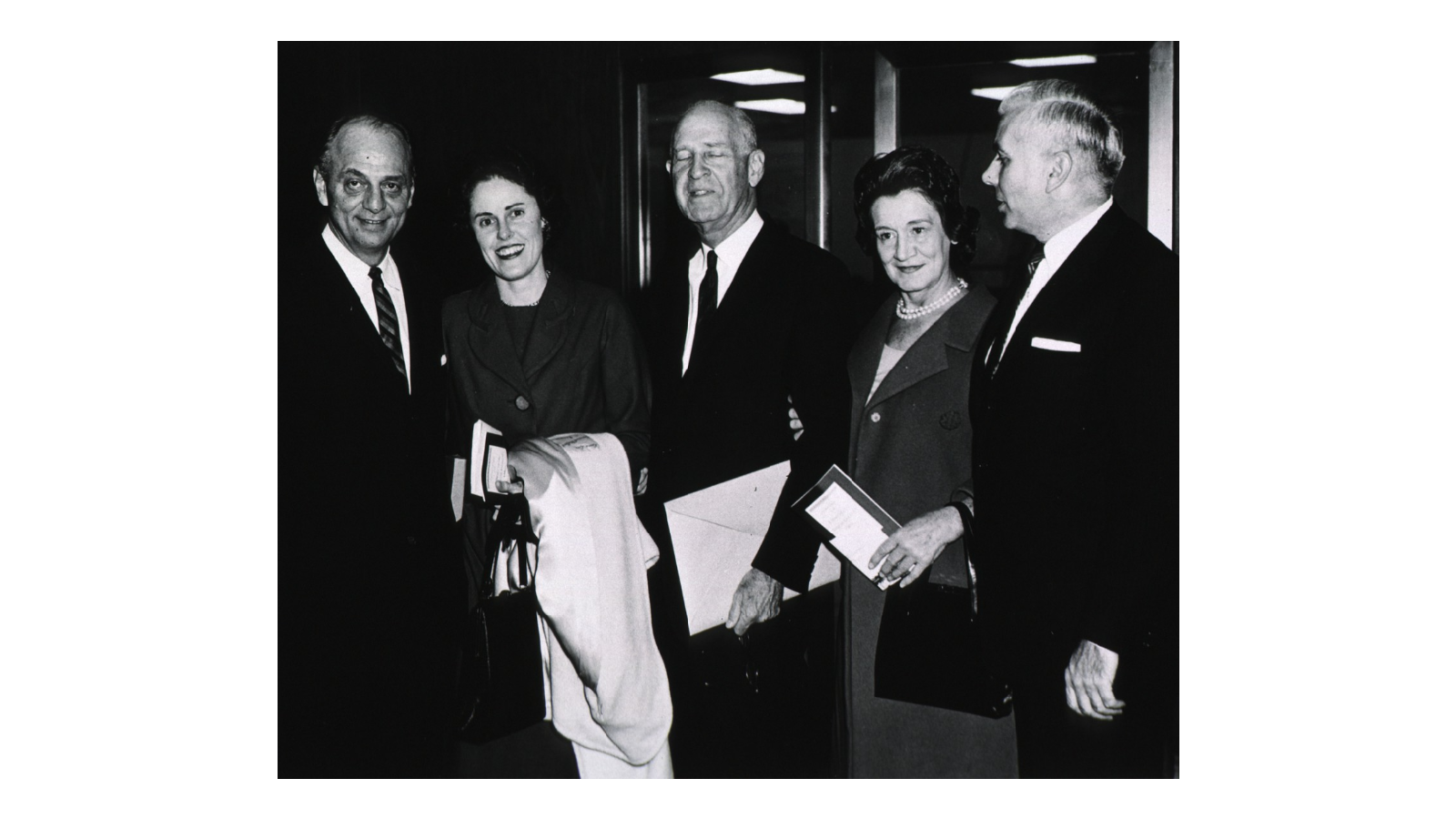
From Left to Right: Luther Terry, Mary Lasker, Lister Hill, Florence Mahoney, and Boisfeuillet Jones [Credit: The National Library of Medicine]
Though Mary Lasker knew the value of independent investigators pursuing their unique research interests, she supported projects only when a clinical goal was perceptible, like curing tuberculosis. In 1946, Mary, having noticed microbiologist Selman Waksman’s work on streptomycin—a new class of antibiotics effective against microbes resistant to penicillin—persuaded him and Merck pharmaceutical company to test the new drug against TB. By 1952 Mary’s instinct had won over Waksman’s initial skepticism as the widespread use of streptomycin halved the mortality from TB! Mary Lasker’s catalytic influence on basic research leading to a Nobel Prize-winning discovery is a case in point.
Her clout over Congress was in its prime through the 1950s and 60s when the National Cancer Institute (NCI) was developing the first cancer cures. It was also the period when Colonel Luke Quinn became her influential lieutenant. The Congress believed Luke Quinn represented the American Cancer Society, but he was Mary’s lobbyist in reality. When Quinn got sick, Mary used her contacts to get Welch and Sidney Farber, but it got her special attention when Quinn’s incurable torment was overcome. The ongoing public concern for cancer and Albert Lasker’s death due to pancreatic cancer made it an ideal disease for Mary to draw the battle lines. Quinn’s recovery convinced her that the necessary advance in basic research had occurred to justify taking the disease head-on. In April 1970, she began building bipartisan support by having the Senate create the National Panel of Consultants on the Conquest of Cancer. She prevailed over the Texas Democrat senator Ralph Yarborough to appoint her friend, a wealthy Republican businessman Benno C. Schmidt —the chairman of Memorial Sloan Kettering board of managers—to be the chairman on the conquest of cancer panel. She backed him up by arranging Sidney Farber as the co-chairman. The panel also included Colonel Luke Quinn and Mary herself.
In just six months, the panel issued “The Yarborough Report.” The report, mainly written by Colonel Luke Quinn and Mary Lasker, made far-reaching recommendations, including an independent national cancer authority. It recommended a substantial increase in funding for cancer research from $180 million in 1971 to $400 million in 1972 and reaching $1 billion by 1976. Finally, it recommended that the approval of anticancer drugs be moved from the FDA to the new cancer authority. Senator Edward Kennedy presented the recommendations as new legislation for the Ninety-Second Congress. Though not a Senate staff member, Colonel Quinn, trained by Mary in the art of testifying before the Congress, orchestrated the hearings, set the agenda, and selected the people who would testify.
Washington Post: 9 December 1969; Citizens Committee for the Conquest of Cancer.
The Nixon administration did not immediately embrace the bill as he wasn’t thrilled by Edward Kennedy’s involvement. Being Ted Kennedy’s close friend, Mary asked him to withdraw as a sponsor. Under Senator Pete Domenici, the bill renamed the National Cancer Act had to pass in the House. Paul Rogers, who headed the House Health subcommittee—Colonel Quinn and Mary Lasker had no influence over him—objected to removing the NCI from the NIH umbrella. He cautioned the NIH would face similar threats of separation in other disease areas. A revised bill agreed to this demand and kept the NCI under the NIH but gave it a separate budget and a director appointed by the President.
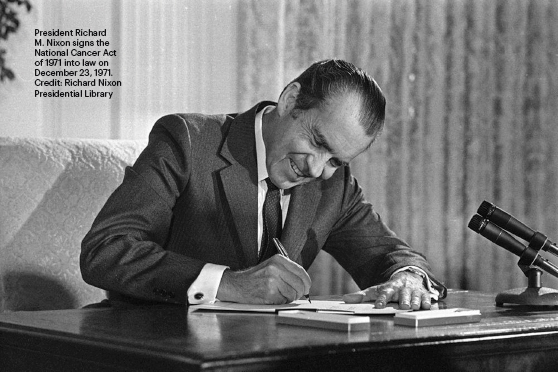
On December 23, 1971— fifty years to this day—the National Cancer Act was signed as a Christmas gift to the nation by President Richard Nixon, two years after Colonel Luke Quinn walked into the NCI with a wrong diagnosis. Though Quinn ultimately died of his relapsed cancer, a few months after the signing of the Cancer Act, the war on cancer had commenced with cancer research on the fast track. It was a victory for Mary Lasker, perhaps the most effective advocate for biomedical research that Washington had ever seen.
WASHINGTON: March 12 —Luke C. Quinn:au, a Capitol Hill spokesman, for the American Cancer Society, died of the disease yesterday in the National Institutes of Health
In hindsight, Mary Lasker’s triumph came with two significant disappointments. First, her crusade had failed in transferring the authority for approval of anticancer drugs from the FDA to the NCI—a failure that would plague the National Cancer Program well into the future. Second, the premise of the National Cancer Act that the “basic science was already there” and a quantitative boost in resources was all that was needed to bring victory was flawed. In combination, the two disappointments—the subjects of a future blog post—have spotlighted a perceived progress gap in cancer research by the tax-paying general public rather than underlining the tremendous conceptual progress made due to the War on Cancer.
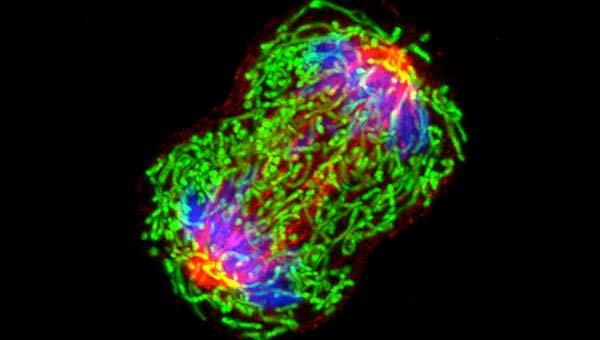
A dividing breast cancer cell. Credit: National Cancer Institute / Univ. of Pittsburgh Cancer Institute
Ultimately, this blog is for you to appreciate the 50th anniversary of the lucky accidents and the incredible effort in creating the National Cancer Act. At the same time, personally, cancer researchers—the boots on the ground—like me who experience the non-triviality of progress in cancer will dwell on the insistence of simplistic linear views of progress in cancer research for public consumption.




 Notes On Liberty