Nightcap

  1. James Buchanan calling the kettle black David Glasner, Uneasy Money
  2. The war that never ended Patrick Hagopian, History Today
  3. ‘The Mind of Pope Francis’ J Matthew Ashley, Commonweal
  4. Mueller’s done. What now? Samuelsohn & Gerstein, Politico

Three Lessons on Institutions and Incentives (Part 1): Introduction

There are books that are aimed at a spectrum of readers that are counted within the “well-informed public.” They are not books confined to academic circles, they are not for mass consumption, but they do concern problems that involve entire countries and are written in a register that involves certain intellectual training. In this genre, there are three works that have much to say about the relationship between institutions and incentives. The first of them dates from 1990 and was published by a Nobel Prize winner in Economics, Douglass C. North: Institutions, Institutional Change and Economic Performance, which elaborates the distinction between formal and informal institutions and incremental and disruptive institutional change, ending with a historical analysis that seeks to explain the differences in economic performance between the United States and Latin America. It is an academic book that can be approached by the said well-informed public.

Eleven years later, in 2001, William Easterly published The Elusive Quest for Growth: Economists’ Adventures and Misadventures in the Tropics. It is proposed as a political essay in which an economist interprets his own professional experience as a member of international teams for the development of Third World countries. To do this, drawing on the theoretical notions of other leading economists, such as Paul Romer (who later, in 2018, received the Nobel Prize in Economics), he makes an assessment on the development plans for the Third World that were implemented since the end of World War II. The central thesis of Easterly stresses that, in order to have an empirical relevance, every theory of development -or of the absence of it- must carry the following behavioral postulate: “people respond to incentives.” If this reality is not taken into account, there is no public policy that can be successful. The main lessons that can be drawn come from the theoretical instruments deployed to explain the political dynamics of most of these countries, particularly in regard to the phenomenon of polarized societies.

The third book to consider is also the more recent publication. Why Nations Fail, by Daron Acemoglu & James A. Robinson, was published in 2012 and reached the global debate on the realm of the well-informed public. The proportions achieved by the population of academics and professionals, in addition to the extension of the internet, allowed the aforementioned book to generate varied opinions along both traditional and digital media throughout the world. Acemoglu & Robinson dedicate their pages to those countries that were successful, as well as those that were not, but also here, in the case of this book, the most juicy lessons truly comes from the conceptual structure that articulates the whole book. Among such notions, we find those of inclusive and extractive institutions, which in turn are divided into political and economic institutions. The worst of the institutions are preferable to the total lack of institutions. Thus, a country organized around a closed political and economic system will be preferable to a failed state. However, once a certain degree of centralization and institutionality has been achieved, it is preferable to move towards a pluralist democracy and a competitive economy. The challenge is how to accomplish such transitions.

Since there are still four years left until the year 2023 – following the periodicity of the selected works – we are still in time to make a brief synthesis of the ideas that can be applied to the analysis of the impact of the institutions on economic and political incentives.

[Editor’s note: this is the first part of a rich series on institutions and incentives. You can find the full, Longform Essay here.]

Nightcap

  1. The strange relationship between virtue and violence Barbara King, Times Literary Supplement
  2. Nixon’s path to peace included bombing Cambodia Rick Brownell, Medium
  3. The suboptimality of the nation-state Branko Milanovic, globalinequality
  4. The threshold of land invasion Nick Nielsen, Grand Strategy Annex

Michel Temer, Brazil’s former president, sent to jail

Maybe Brazil is trying to set a record. With Luis Inacio Lula da Silva already sentenced, Michel Temer was sent to jail this Thursday. Temer was Dilma Rousseff’s vice-president and came to power with her impeachment in 2016. Temer is now also one of the prisoners made by Operation Car-Wash, formerly lead by judge Sergio Moro, currently president Jair Bolsonaro’s minister of justice.

Temer’s party, the MDB (until recently PMDB), is known for being a centrist party with little to none ideological leanings. In many ways, it is similar to Mexico’s Institutional Revolutionary Party. In his time in power, however, Temer made a fairly good job. Although not an enthusiast of free markets, he made some reforms that Brazil desperately needs, showing that only really radical people on the left deny that free markets are the way to prosperity. The problem is that Temer’s party is too deeply entangled in private interests (as his prison shows) to go deeper into the reforms the country needs.

The left’s standard narrative is that Temer made a coup in Dilma’s impeachment. Of course, nothing could be further from the truth. Brazil leftists are more and more like members of  Flat Earth Society. Temer was Dilma’s vice-president, and this alone shows that he could not be too far from corruption.

Overall, Operation Car Wash is already one of the greatest blows against corruption in Brazilian history. To have two former presidents in jail might be bad for other countries. But in Brazil, it is a reason to celebrate. The law finally applies to everyone and anyone.

Nightcap

  1. What are the real fault lines diving Americans? George Hawley, Law & Liberty
  2. Beliefs and interests Chris Dillow, Stumbling & Mumbling
  3. Can we trust deliberation priests? Robin Hanson, Overcoming Bias
  4. R. Kelly and mob justice Irfan Khawaja, Policy of Truth

The Institutional Foundations of Antisemitism

Antisemitism has returned to mainstream politics in Europe and America. One fundamental misconception about antisemitism is that it is simply another form of racism. Thus Jeremy Corbyn responds to charges of antisemitism with “ ‘I’ve spent my whole life exposing racism in any form”. But of course, Corbyn is, at the very least, an enabler of antisemitism (and there is evidence he holds antisemitic prejudices himself — see here).

Why is antisemitism different from other forms of racism? And what makes antisemitism unique. When Noel Johnson and I began writing Persecution & Toleration, we didn’t envision antisemitism returning to prominence, but I believe our analysis sheds important insight on the institutional foundations of antisemitism.

Continue reading

Nightcap

  1. How the poor became blessed Pieter van der Horst, Aeon
  2. Learn to love trade with China Deirdre McCloskey, Reason
  3. “Degrowth” in a poor and unequal world Branko Milanovic, globalinequality
  4. Answers from the Sahel Quentin Lopinot, War on the Rocks

Nightcap

  1. Søren Kierkegaard: The blessing of despair Clare Carlisle, Footnotes to Plato
  2. Another Liberty Canon: Kierkegaard Barry Stocker, NOL
  3. The existentialist origins of postmodernism Bruno Gonçalves Rosi, NOL
  4. Another Liberty Canon: Nietzsche Barry Stocker, NOL

The Nonsensical Meaning of Sustainability

Along with ‘Inequality’ and ‘Democratic socialism’, ‘Sustainability‘ is one of the words that captures the essence of my generation. A sustainable project, event or business is met with “wow”s and “oooh!”s, an indicator of its owner’s moral righteousness and altogether praiseworthy character.

But its meaning is far from clear from all but its most fervent supporters. Dealing with the extraction of resources, the use of ecological reserves or harvesting of crops, a process is allegedly ‘sustainable’ if the naturally occurring regeneration exceeds the current levels of extraction. Simply put, don’t use more than what is (annually?) renewed. Moreover, a process branded as sustainable usually involve a mix of some other virtue signalling activities of our time: carbon emission neutrality or offsetting; at least a superficial concern for one’s environmental impact; energy produced in ‘renewable’ ways (read: nothing but solar, wind or hydro); or the use of recycled materials.

If this sounds unobjectionable and self-evident to you, this piece is for you. Despite the fancy branding, the SDGs, the fervor of self-proclaimed do-gooders, is the ‘sustainability’ of an activity really what we care about?

There are at least two major confusions with the assessment of activities as sustainable or its despised opposite: unsustainable. First, and most frequently occurring, is the belief that we aim to pursue our current endeavor in the same way for all eternity. If you think about it, the indignant objection of unsustainability is often quite meaningless, worthy of nothing but a ‘so what?’ response; everything we do at any given moment is in a sense “unsustainable”:

  • if I keep typing on my computer I will eventually starve;
  • if I keep lifting weights or endlessly running on that treadmill, I will collapse;
  • if I keep eating this chocolate cake of mine, I will be sick.

So? Everyone who has ever engaged in those activities understand that there are ends to them, that we’re only doing them for a particular purpose for a certain period of time, and that extrapolating snapshots of reality is quite silly; I do not intend to continue this activity until the brink of whatever physical boundary there might – or might not – be. Until I approach some “safe” distance to that brink, I’ll happily indulge in my chocolate cake, lift my weights or type away at my keyboard. In economic speak we are trading off one resource for another, until saturation or the fulfillment of some other aim becomes more important (prime example is Environmental Kuznets Curves).

The other confusion is to believe that economic systems cannot change and that humans cannot adapt. It is emphatically irrelevant that there is a physically limited amount of oil in the ground, since price systems and their incentives effectively ration oil use according to urgently-induced needs and encourage substitutes when those are needed. More importantly, the price system for raw materials incorporate and incentivize technological improvements that 1) through discovering new deposits literally expands “the” amount of resources,  2) shape cost-effective processes to hard-to-access deposits we couldn’t profitably exploit before, 3) improve the bang for our buck, i.e. how much output we can squeeze out of a given quantity of material. Thus, there might ultimately be a physical limit, but not an economic limit.

Let me give an iconic example: chopping down trees quicker than the forest grows. Such an activity seem pretty ‘unsustainable’ since the declining size of the forest implies that one day there will no longer be a forest. So what? There might be urgent present reasons for doing that (say, for instance, no other source of heat/fuel for cooking or no other source of income) that are very likely to change in a fairly short time frame (ie, before complete deforestation has occurred); the current prices of pulp or firewood may be meaningfully higher than their anticipated future prices (‘selling’ off some capital assets would therefore be fairly prudent); there might be future technological innovations that a) (re-)grows forests quicker, b) offers a better substitute to the current use of wood, c) allows us to cheaply make use of more from what we chop down.

Almost any practice taken as a snap-shot in time is literally ‘unsustainable’. Naively believing that they will mindlessly continue linearly into the future is quite silly; hailing processes that don’t as righteous and ‘sustainable’ is similarly silly. Human societies and their economic process are dynamic systems capable of (read: constantly) change.

By saying that something is unsustainable, my generation wants to convey the idea that these activities are immoral and that they shouldn’t continue. It’s a naive and erroneously nonsensical conviction.

Nightcap

  1. That time Russians explored the world via flotilla Yelena Furman, Los Angeles Review of Books
  2. The origins of globalisation can be found in the deep past Daniel Lord Smail, History Today
  3. What it’s like to be a lawyer for the New York Times Preet Bharara, New York Times
  4. Capitalists, not socialists, pose the greatest threat to capitalism Randall Holcombe, the Hill

The Admissions Scandal Will Improve Universities

I would have been annoyed, I would have felt frustrated if my alma matter, Stanford, had been left out of the university admissions scandal. After all, what does it say about your school if it’s not worth bribing anyone to get your child admitted to it? Fortunately, it’s right in the mix.

I spent ten years in American universities as a student, and thirty as a professor. You might say that they are my milieu, that I am close to being an expert on them, or perhaps, just a native informant. Accordingly, reactions to the March 2019 admissions scandal seem a bit overwrought to me. That’s except for the delight of encountering the names among the line cutters of famous and successful people one usually associates with a good deal of sanctimoniousness. The main concern seems to be that the cheating is a violation of the meritocratic character of universities.

In fact, American universities have never been frankly or unambiguously meritocratic. They have always fulfilled simultaneously several social functions and served different and only partially overlapping constituencies. Sure enough, there is some transmission of knowledge taking place in almost all of them. I don’t mean to belittle this. I am even persuaded that there is a palpable difference between intelligent people who have attended college and those who have not. In addition, it should be obvious that some of the knowledge transmitted in higher education organizations is directly instrumental to obtaining a job (most engineering courses of study, accounting). That, although, in general, it was never expressly the primary role of undergraduate education in the US to procure employment.

The best of universities also contribute to the production of new knowledge to a considerable extent. University research is probably the bulk of the considerable body of American research in all fields. (Incidentally, I believe that the dual function of American faculty members as both researchers and teachers largely accounts for the superior international reputation of American higher education. More on this on demand.) The remainder of schools of higher education imitate the big guys and pretend to be engaged in research or in other scholarly pursuits. Many succeed some of the time. Some fail completely in that area. In fact most university professors are well aware of the degree to which each individual college or university offers conditions propitious to the conduct of research and such, and demands them. But teaching and research are not the whole story of American academia by a long shot. Those in the general public who think otherwise are deluded or, largely misinformed.

Most American universities are obviously superb sports venues; a few are world-grade in that area. In some schools, football financially supports learning rather than being an adjunct activity. Some, such as Indiana University where I taught, make do with basketball which can also be quite lucrative. It’s obvious too that residential universities- which include almost all the top names – are reasonably good adolescent-sitting services: Yes, they get drunk there but there is a fair chance they will do it on campus and not drive afterwards. If they do too much of anything else that’s objectionable – at least this was true until quite recently – there is a fair chance the story will get squashed on campus and remain there forever.

And, of course, of course, the big universities, especially the residential version but not only it, are incomparable devices to channel lust. They take young people at approximately mating age and maximize the chance that they will come out four, or more likely, five years later, either suitably matched, or appropriately unmatched. It’s a big relief for the parents that their darling daughter may become pregnant out of wedlock but it will be through the deeds of a young person from their own social class. For some parents, universities would be well worth the cost, if they limited themselves to staving off what the French call: “mésalliances.” (Go ahead, don’t be shy; you know more French than you think.)

Naturally, universities could not have been better designed to promote networking, offering at once numerous opportunities to meet new people (but not too new), and plenty of leisure time to take advantage of them, all in a conveniently limited space. As is well known the results of this networking often last a lifetime. For some, campus networking constitutes an investment that keeps paying dividends forever.

And, I kept the most important university function for last. I think that from the earliest times in America, universities served the purpose of certifying upper-class, then, middle-class status. This credentialing function is usually in two parts. The young person gets social points for being accepted in whatever college or university the parents consider prestigious enough, nationally, internationally, or even locally. The student gets more points for actually graduating from the same school or one equivalent to it.

This idea that higher education organizations publicly certify social status is so attractive that it has spread downward in my lifetime, from the best known schools, Ivy League and better (such as Stanford), down to all state universities, and then, to all lower admission-standards state colleges, and even down to two-year community colleges. In my neighborhood of California, possessors of a community college Associate of Arts degree are considered sort of upper lower-class. This small degree influences marriage choices, for example. I used to know a man of a sort of hillbilly extraction who was very intelligent and extremely eager to learn and who attended community college pretty much for twenty years. He kept faithful to his origins by never even earning an AA degree. (True story. Some other time, of course.)

Merit recruitment of faculty and students

I, and the academics I know are not very troubled by the cheating news, only by the crudeness involved, especially in the raw exchange of cash for illicit help. I suppose most of us realized, even if in a sort of subliminal way, that admission was never thoroughly or even mainly based on merit as measured, for example by high school achievement and by test results. My own undergraduate experience is limited but varied. I spent two years in a good community college where pretty much everyone who could read was accepted. Then, I transferred to Stanford with a full tuition scholarship. Academic merit did not loom very large in either school, and perhaps a bit more in the community college than it did at Stanford.

In order to preserve a reputation for intellectual excellence that contributes to their ability to credentialize without subsuming it at all, universities and colleges must actively recruit. They have first to attract faculty with a sufficient supply of their own (academic) credentials in relation to the status the universities seek to achieve, or to keep. Often, regularly for many, they also reach down to recruit as students promising young people outside of their regular socioeconomic catchment area. Their own motives are not always clear to those who make the corresponding decisions. One is do-gooding, of course completely in line with the great charitable American tradition (that this immigrant personally admires).

At the same time, colleges and universities don’t select scholarship recipients for their moral merit but for their grades, and for other desirable features. The latter include, of course, high athletic performance. Additionally, in my observation, many, or at least, some, also recruit poor undergraduates the way a good hostess composes a menu. When Stanford plucked me out of my young single immigrant poverty, it was not only for my good community college GPA, I was also an interesting case, an interesting story. (There were no French undergrads at all on campus at the time. Being French does not have cachet only for foolish young women.) Another transfer student they recruited at the same time, was a Turkish Jew whose mother tongue was 16th century Spanish (Ladino). How is this for being interesting? I am speaking about diversity, before this excellent word was kidnapped by an unlovable crowd.

Attendance, grades and merit

At Stanford, I realized after a couple of quarters that many undergraduates did not care to go to class and did not care much about grades either. I discovered a little later (I never claimed to be the sharpest knife in the drawer!) that few were preoccupied with receiving good grades. That was because it was quite difficult to get a really bad grade so long as you went through the motions.

I was puzzled that several professors took an instant liking to me. I realized later, when I was teaching myself, that it was largely because I was afraid of bad grades, greedy for good grades, and I displayed corresponding diligence. I thought later that many of the relaxed students were legacy admissions (I did not know the term then) who had good things coming to them pretty much irrespective of their GPA. Soon, I perceived my own poor boy conventional academic striving as possibly a tad vulgar in context. I did not resent my relaxed fellow students however. I kind of knew they paid the freight, including mine. Incidentally, I am reporting here, not complaining. I received a great education at Stanford, which changed my life. I was taught by professors – including a Nobel Prize winner – that I richly did not deserve. The experience transformed and improved my brain architecture.

About ten years after graduating, I became a university teacher myself, in several interesting places. One was a denominational university that was also pricey. I remember that there were always there well dressed young women around, smiley, with good manners, and vacant eyes. (I don’t recall any males of the same breed; I don’t know why.) They would do little of the modest work required. Come pop-quiz time, they would just write their name neatly on a piece of blank paper. I gave them the lowest grade locally possible, a C, of course. Same grade I gave without comment to a bright-faced, likable black athlete who turned in the best written essay I had ever seen in my life. There were no protests, from any party. We had a tacit understanding. I speculate the young women and the star athletes had the same understanding with all other faculty members. I don’t know this for fact but I don’t see how else they could have remained enrolled.

And then, there always were always cohorts of students bearing a big sticker on their forehead that said, “I am not here because of my grades but in spite of my grades.” OK, it was not on their forehead but on their skin. That was damned unfair to those minority students who had gained admission under their own power if you ask me. Nobody asked me. And then, especially in California, there has been for a long time the tiny issue of many students whose parents come from countries where they eat rice with chopsticks. Many of those couldn’t gain admission to the school of their choice if they had invented a universal cure for cancer before age eighteen. As I write, this issue is still being litigated. I doubt there is anyone in academia who believes the plaintiffs don’t have a case.

Meritocracy!

Virtue out of evil

The mid-March 2019 admissions scandal might paradoxically make universities better, from a meritocratic standpoint. By throwing a crude light on their admission process and turning part of the public cynical about it, the scandal may undermines seriously their credentialing function. It will be transformed, or at least, it may well be watered down. I mean that if you can’t trust anymore that the fact that Johnny was admitted to UnivX is proof of Johnny’s worth, then, you might develop a greater interest in what Johnny actually accomplished while he was attending UnivX. You might become curious about John’s course of study, his choice of classes, even his grades, for example. That wouldn’t be all bad.

Some schools, possibly many schools because universities are like sheep, may well respond by strengthening their transmission of knowledge function, advertising the fact loudly and, with luck, becoming trapped in their own virtuous snare. Some universities, possibly those that are now second-tiers rather than the famous ones (those could well prove immune to any scandal, indestructible) may actually become more of the learning centers they have long pretended to be.

I can envision a scenario where the US has a first kind of good universities, good for intellectual reasons, to an extent, but mostly good for continued social credentialing. And next to the first kind, would be higher education establishments mainly dedicated to studying and learning. The latter, if they were successful, would unavoidably and eventually grow a credentialing function of sorts. That would be fine. The two categories might compete for students. That would be fine too. It would be good for recruiters to have a clear choice of qualities. I think that university professors, or some of them, many of them, would easily move between the two categories of schools. There would be a single labor market but different vocations, perhaps serialized in time. Above all, students would have more choice and more sharply defined choices. Everyone could stop pretending. Actual intellectual merit and grit would find a bigger place in the higher education enterprise.

This is all wool-gathering of course. It depends on one of my big predictions being false. I mean none of the above matters if American universities are committing suicide before our eyes. I refer to unjustified and unjustifiable tuition raises over thirty years, to their collaborating in the moral horror that student loans have become; I am thinking of their capture by a monolithic tribe of ideologues clinging to an old, defeated utopianism. I refer even more to their current inability or unwillingness to protect free speech and the spirit of inquiry.
Nightcap

  1. The need for class politics Chris Dillow, Stumbling & Mumbling
  2. “Do not dig a grave for someone else!”
  3. Has the Tervuren Central African museum been decolonized? Tyler Cowen, MR
  4. The nativists have won in Europe Krishnadev Calamur, the Atlantic

RCH: 10 most brutal massacres in history

That’s the subject of my latest at RealClearHistory (I submitted it before the vicious, anti-Muslim shooting in New Zealand occurred). An excerpt:

7. Chios massacre (March – July 1822). The Ottomans were bad people for a few centuries during the Middle Ages (RealClearHistory has more on the Ottomans here). In 1822, Istanbul massacred 52,000 Greeks on the island of Chios during the Greek War of Independence. The massacre was used deftly by imperial proponents in London, Paris, and Moscow, and further isolated the Ottomans from European diplomacy. As for the inhabitants of Chios, most were apathetic toward the rebellion until the massacre.

Here’s another one:

5. Massacre of the Latins (1182). In the 12th century, Roman Catholics in Constantinople, the capital city of the Roman Empire, were known as Latins and in 1182 they were slaughtered, driven out of the city, or sold into slavery. Tens of thousands of people are estimated to have died. The massacre occurred because the vast majority of non-Roman Catholic inhabitants were much poorer than the Latins of the city, due to the latter’s connections to the wealthy city-states on the Italian peninsula (Venice, Genoa, Pisa, etc.). The massacre also made it harder for the Pope to unify the Christian world, as the split between Catholic and Orthodox sects only became more hardened.

Lots of bad things have happened in Turkey and Greece and over the years. Please, read the rest. There’s more massacres, but also thoughts on the genocide-versus-massacre debate, and the sheer lack of knowledge that humanity possesses in regards to its own history.

Nightcap

  1. The last (effortless) rulers of the world Branko Milanovic, globalinequality
  2. How TikTok is rewriting the world John Herrman, New York Times
  3. Empires of the weak: European imperialism reconsidered Peter Gordon, Asian Review of Books
  4. The place that launched a thousand ships Sean McMeekin, Literary Review

Why Persecute?

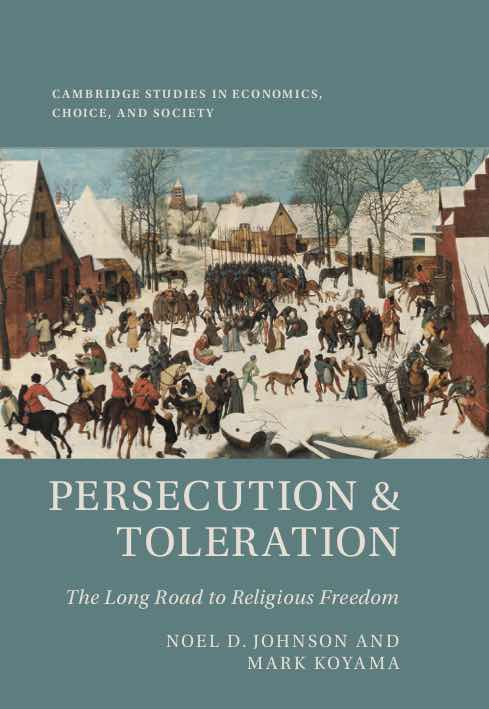
Why was religious persecution common in the premodern world? This is the question Noel Johnson and I address in Persecution and Toleration.

Answers that rely on the alleged barbarism of the times or the brutality or narrowed-mindedness of individual churchmen or rulers are unsatisfying. We need to understand why religious dissent was so alarming that political and religious authorities resorted to violent repression.

In Persecution and Toleration, we outline why states often had an incentive to enforce religious conformity.

Suppose the ruler wants to pass a law. The religious authority can choose to legitimate this law or to oppose it. If the religious authority opposes it, the law will be seen as illegitimate, and the ruler will face unrest or opposition in attempting to enforce it. If the religious authority legitimates the law, then compliance with the law will be greater and the law will be enforced at a much lower cost for the ruler. Rulers therefore have a good reason to want legitimacy. Because religious authorities were the most powerful source of legitimacy in the premodern period, it was natural for rulers to rely on religious legitimacy.

Rulers can bargain with religious authorities to obtain legitimacy. One way to do this is to enforce religious conformity. This provides a natural framework for studying religious persecutions.

One insight is that persecutions are necessarily political. The justification for persecution can vary. Secular authorities will persecution in terms of secular arguments. Religious authorities may persecute on religious or doctrinal grounds. But structurally these persecutions will resemble one another.

A second key argument is that some form of religious repression was the default in the premodern world but outright persecution was, in fact, quite rare. The default level of religious repression we characterize as a state of conditional toleration. Religious differences were usually tolerated, but only conditionally. Outright persecution was quite rare. But the threat of persecution played an important role in enforcing religious conformity, restricting dissent and providing states with legitimacy.

How general is our account? Is this story only applicable to Western Europe? Or to monotheistic societies? Can it explain the persecution of Christians in pagan Rome or the persecution of Christians in 17th century Japan? And what distinguishes religious persecutions from other persecutions?


To address these concerns, consider the persecution of Christians in the Roman Empire. Historians such as Candida Moss downplay these persecutions (here). Catherine Nixey’s The Darkening Age — reviewed positively in the New York Times —for example, writes:

“The idea, therefore, of a line of satanically inspired emperors, panting for the blood of the faithful is another Christian myth. As the modern historian Keith Hopkins wrote, ‘the traditional question: “Why were the Christians persecuted?” with all its implications of unjust repression and eventual triumph, should be re-phrased: “Why were the Christians persecuted so little and so late?”

Nixey correctly cautions the reader not to view Christian accounts of the death of martyrs as historical accounts. But her argument is a larger one. To her mind, the persecution of Christians was not a religious persecution. Commenting on the Roman governor Pliny’s decision to persecute some Christians, she writes:

“Pliny’s problem with all of this is not religious. He is not upset because Jupiter has been neglected, or Hera has been slighted: he is upset because the citizens of his province are becoming disgruntled by the Christians’ behaviour . . .”

“. . . Even the locals who were forcing Pliny’s hand might not have been complaining about Christians for religious reasons either: it has been speculated that what was really upsetting them was not theology but butchery. Local tradesmen were angry because this surge of Christian sentiment had led to a drop in the sales of sacrificial meat and their profits were suffering: anti-Christian sentiment caused less by Satan than by a slow trade in sausage-meat.”

Because Christians were punished as pests and social deviants, rather than for reasons conventionally identified as religious, Dixey suggests this was a simple matter of“law and order”. If anything her sympathies appear to be with the Roman governor responsible for prosecuting Christians:

“What should Pliny do with these odd people? Trajan’s reply is brief and to the point. He doesn’t get into theological or legal debates about the legal status of Christianity (to the disappointment of later scholars); nor does he (thus confounding the martyrdom tropes) fulminate against the Christians. He does agree with Pliny that those who are proved to be Christian ‘must be punished’ — though for precisely what charge is unclear. He also adds that ‘in the case of anyone who denies that he is a Christian, and makes it clear that he is not by offering prayers to our gods, he is to be pardoned as a result of his repentance however suspect his past conduct may be’. Roman emperors wanted obedience, not martyrs. They had absolutely no wish to open windows into men’s souls or to control what went on there. That would be a Christian innovation.”

This hardly not exculpates the Romans or implies the persecution of Christians was a myth. Nixey is correct that the Roman authorities were unconcerned with what Christians believed. But she is wrong to suppose that this is the defining characteristic of religious persecution. And the urge to downplay the persecution of Christians suggests other anachronistic instincts are at work. After all, no-one denies that Christians were killed, often horrifically, in the Roman persecutions (for a critical review of Moss’s book, on which Nixey relies, see here).

Theologians were, of course, concerned with wrong beliefs. But the reason why religious dissent became a major concern to both secular and religious authorities in medieval Europe was precisely due to the threat heresy posed to the established social and political order.


Consider another example from medieval Europe. Norman Cohn’s Pursuit of the Millennium explains the threat heretical movements posed to political order. Focusing on the most revolutionary millennium sects — movements that envisioned the last days as at hand, and took action to herald their coming — Cohn’s text vividly captures both the appeal as well as the radicalism and violence of these movements. Describing the manifesto of the “Revolutionary of the Upper Rhine”, Cohn writes:

“the route to the Millennium leads through massacre and terror. God’s aim is a world free from sin. If sin continues to flourish, divine punishment will surely be visited upon the world; whereas if sin is once abolished, then the world will be ready for the Kingdom of the Saints. The most urgent task of the Brethren of the Yellow Cross is therefore to eliminate sin, which in effect means to eliminate sinners . . . To achieve that end assassination is wholly legitimate: ‘Whoever strikes a wicked man for his evildoing, for instance for blasphemy — if he beats him to death he shall be called a servant of God; for everyone is in duty bound to punish wickedness.’ In particular the Revolutionary calls for the assassination of the reigning Emperor, Maximilian, for whom he had an overwhelming hatred.”

Such beliefs were a threat to all established authority. Church authorities were naturally concerned with monitoring belief and practice. But heresy also posed a potent threat to secular authority.

Of course, many people in medieval society had incorrect and unorthodox religious beliefs. What principally concerned the Church was not ignorance but heresy: obstinately holding beliefs that directly contradicted Church teachings.

Heresy was feared because it was a source of disorder. Religious dissent had the potential to unleash revolutionary violence and social chaos. This was one reason why Martin Luther recanted his earlier support for religious liberty during the Peasant Revolt.

Arguments for enforcing religious conformity went deeper than the fear of revolutionary violence. Such was the importance of the Church to the social and political order that all challenges to Church authority were perceived as threats to society.


Consider the doctrine of apostolic poverty — which emerged in the 11th and 12th centuries as the Commercial Revolution was transforming the European economy increasing urbanization, trade, wealth, inequality and also poverty. Shocked by the growing gap between the rich and the poor, adherents to this doctrine aspired to the simple poverty of Christ’s followers. They lived without property or money and they were critical of the wealth accumulated by the Church.

The fact that the Church was wealthy did not, of course, imply that Churchmen were not devout or dedicated. The problem was, however, that the Church was also a political institution. Many bishoprics were the preserve of the nobility who would jostle to ensure that their younger sons became influential churchmen. These prelates were expected to be the equal of the secular nobles, to entertain lavishly, and to dress splendidly. Taken too far, therefore, apostolic poverty threatened the legitimacy of the Church and its relationship with secular authority.

Through mendicant orders such as the Franciscans, the Church could accommodate these demands and concerns. But groups who directly attacked the legitimacy of the Papacy itself, such as the Waldensians and the Spiritual Franciscans could not be tolerated. The leader of the Spiritual Franciscans, Angelo da Clareno denied that Pope John XXII was pope, a direct challenge to the legitimacy of the Church. Precisely because of the threat they posed to the church and state alliance — and not because of their theological beliefs, which were unremarkable — the Spiritual Franciscans had to be repressed.

Were the concerns of the Roman Emperors so different from those of medieval rulers and churchmen? Religion was not a private affair in antiquity. It had political consequences; it mattered for the fate of the Empire. The first Empire-wide persecution of Christians occurred under Decius (r. 249–251). Decius’s response to the political crisis facing the Empire — invasions from both Persia and the Goths — was a revival of the state religion and the imperial cult.

Claiming that Roman persecutions of Christianity were not religious but political, as Moss and Nixey do, is misleading; all persecutions are political. Because it began as a persecuted cult, Christianity as a religion contained many potent arguments against religious persecution. For these reasons, it was probably less predisposed to persecution than many other religions. Nevertheless, the fact that the medieval Church eventually came to persecute dissent points to deep, structural, political economy factors that made religious freedom impossible. It this these factors that are the subject matter of Persecution & Toleration.