A Muslim Woman and the Sea

Here is another short story. (I don’t have the talent to compose characters so, most of my stories are autobiographical by default.)

I am on the same free-diving and spear fishing expedition I mentioned in another story. We are driving and living in a VW bus I equipped myself for the purpose. This time, my then future ex-wife (“TFEW”) and I are stopped in a small town in coastal western Algeria. We just arrived and it’s a sunny quiet morning. We are enjoying a rare cup of real coffee at the also rare terrace of a small café. I will never forget that insignificant non-event, because, suddenly, out of nowhere, a baby camel came ambling down the street. The charming animal walked straight up to me and began browsing my hair. (Go ahead, don’t believe me; I have a picture!)

So, we are just lingering when a handsome teenage boy stops by to make conversation (in French, of course): Where are you from? What are you doing here? What kind of fishing, again? How do you like Algeria?

We invite him to sit down and have coffee with us but he insists he is in a hurry. He wishes us a good vacation and walks away. Then, suddenly, he wheels around to tell us he would like to invite us to his house for couscous. He is too young to be married and to have his own house. I ask him how his mother would respond to sudden unannounced guests. He replies that she would love it, that she misses her old French bosses; that she likes to speak French with real French people. I am beginning to feel peckish. Against my better judgment, we follow him around the corner.

We drive through a metal gate he closes behind us. The young man stops at the door to the house and calls out with several sentences in Arabic. A woman’s voice responds and the door opens immediately. A woman in her early forties stands smiling at us. Her dark shiny hair is partially covered. She has beautiful apricot skin and dancing black eyes. Under other circumstances, in spite of a fifteen-year age difference, I might have fallen in love with her on the spot. I must have been fairly obvious because the TFEW secretly yanked hard on the back of my shirt.

We sit down on cushions in the living room. There is an opening into the kitchen so we can communicate with the mother while she works. Actually, I am pretty much the only one doing the communicating because the TFEW is not a native French speaker and she is a little hesitant on that account. The thought crosses my mind that the mother is flirting with me verbally a little from the kitchen where I cannot see her face. The charming son soon serves us tea and two quiet teenage girls dart in and out on what I think is a mission to keep us company although they do not say anything. I am not sure whether they were shy or if they did not know French. There is no man in sight and no mention of any adult male.

After quite a long time bantering back and forth without the help of an adult beverage precisely, the steaming couscous garni appears on the rug in front of our knees. (Tech note: “couscous” is the grits-like grain; it’s “garni” when it is accompanied by a vegetable stew including chickpeas, and meat, usually boiled mutton, sometimes chicken.) Everyone is starving by that time and the family sits around and next to us each holding a bowl into which the mother dishes out couscous topped with veggies and mutton. One of the girls has thoughtfully placed a spoon in front of us, the visitors, which we make a point of honor to ignore, of course because we want to appear cool.

The mother tells us gaily how she had worked for fifteen years for a French family, as a servant with broad responsibilities, including the care of small children and the kitchen. She says she loved the lady of the house and the lady of the house loved her “like a niece.” I guess that’s how she has learned her grammatically perfect and lively French. After the French left, suddenly, feeling threatened (and probably with good reason) there was no work for a woman with her skills. Nothing is said, again in this story, about a husband. There is no explanation about how the family sustains itself.

It’s often difficult to say how poor people are following a revolution. Those don’t look poor. They are all well though simply dressed. The house in which they live is consequential and Western-style. (I mean that I would have moved into it in a minute.) As far as I know, it is her beloved lady boss’s house they are all occupying. Perhaps, the lady boss has slipped her the title before fleeing. I am told there was a lot of that that went on. I am also told the new Algerian government, its hands full of pressing matters, was happy to let sleeping dogs lie on this issue. I can’t judge what the family’s everyday food is like but none of them look skinny and the couscous was well garnished and ample. (But then again, the latter is not a good indicator of anything in North Africa where a feast is a feast however meagre the fare on ordinary days.)

If you eat enough food and it’s tasty enough, at the end of the meal, you will feel a little like drunk. Those who talk after dinner, including the Mom, talk louder. The pleasant son tells me of his wish to go work in France and of his modest ambitions in general. Even the young girls smile more broadly. Perhaps seeing their mother happy makes them feel happy. I am asked to explain for the tenth time in Algeria what I am doing there. I explain my quest for big fish and spiny lobster (and also for slipper lobster, a grotesque looking but delicious creature). I describe how I go under water holding my breath to shoot them in the face with a rubber spear gun. The family seems a little incredulous but they are visibly charmed by the concept. They have already made themselves believe that the TFEW and I really sleep in the VW bus as we travel from place to place. (The bus was parked out of view in their courtyard while we ate.)

Then, out of nowhere, the mother says something astounding: I envy you – she says to spend so much time looking at the sea. I love the sea and I haven’t seen it for so long. Say this again, I request. Isn’t this house, your house, about four or five blocks from the sea cliff? It is, she said but I can’t go there (“Je ne peux pas y aller.”) French does not not distinguish between physical impossibility and moral interdiction. So, I am a little confused but not for long. I guess quickly what’s on her mind.

I have an idea, I say. I tell you what: Tomorrow morning at five when the sun is up but everyone is still asleep, you will put on your hijab and wear a shawl around your shoulders that you can raise to hide your face if necessary. Your son will open the gate to let my bus out and then, he will sit next to me in front where everyone can see him. You will be in the back next to my wife with the curtains drawn. Your son will direct me to a suitable point on the cliff where I will park. There, you will raise the curtain as much as you want to and look at the sea as long as you wish. She agrees and her face is filled with anticipation.

Early the next morning, the son wake us up with cups of hot coffee. There is a defeated look on his face. He tells us that his mother has changed her mind and that she will not take up my proposal after all; that she says thank you and good-bye. He adds she is too embarrassed to get up and wish us a good trip face-to-face. We shake hands and leave with much sadness in our hearts.

Is this a story about religion? All Algerians were Muslims, if nothing else, by default; so was our pleasant hostess, no doubt Yet Muslim intellectuals will point out that there is no part of the Islamic sacred scriptures that enjoins women to hide at home. There is certainly nothing in the same scriptures that says they can’t enjoy contemplating the sea, one of God’s first creations, in Islamic as well as in Jewish and Christian tradition.

Personally, I disagree. I think this is a story about religion although indirectly. If the woman had been a Lutheran, a Catholic, a Buddhist, a Zoroastrian, or a Mormon, she would have had her fill of the sea before I met her. I can even imagine a Hindu woman being somewhat self-cloistered but not one fluent in a foreign language, not one with a long history of happy interaction with Westerners.

Two main points. First, every follower of a religion is not a scriptural expert. What people think is their religion often differs a great deal from what theologians say is true religion. I addressed this issue in an article in Liberty Unbound. (“Religious Bric-a-Brac and Tolerance of Violent Jihad.”) Second, religions are vehicles for all kinds of cultural practices that are not religious or only in a distorted manner. Thus, Catholicism, besides its rich history of burning people alive for their opinions, is largely responsible for the consumption of fish among inland Catholics. It probably even had a lot to do with the establishment of the long lasting Newfoundland cod fishery. (Ask me.) It’s fair to judge religions for the cultural baggage they carry and that they could put down if they really wanted to. Passive assent is a form of complicity.
Art, Photography, and Homophobia

Sometimes the theater of the absurd, current events that is, just gets to be too much and I have to comment. This time the issue is whether photography is an art form, a case arising from a professional photographer’s refusal to cover a lesbian wedding. If photography is art, goes the argument, it’s a form of speech protected by the Constitution and that protection overrides any laws prohibiting discrimination on account of sexual orientation.

This nonsense arises from the notion that some forms of voluntary transactions should enjoy legal protection and others shouldn’t. Transactions that are deemed to be exercises of religion or freedom of speech are protected while it’s OK to suppress others even when they are mutually voluntary. The courts view artistic works forms of speech, and are protected. This protection covers not just engaging in protected activities but also refraining from engaging in them. Thus if photography is art, then refraining from photographing a lesbian wedding is an exercise of free speech, protected by the first amendment.

That’s all well and good as far as it goes, but it leaves courts with the job of drawing lines delimiting religious activity or free speech activity. Example: during Prohibition, Catholics were allowed to use wine as part of their Communion sacrament. But Native Americans who want to use peyote as part of their religious ceremonies have consistently run afoul of the law. What’s the difference? Obviously, Catholics are more numerous and politically powerful than Native Americans. Since there is no objective way of delimiting either religion or art (as presently understood), court decisions about these matters are necessarily political.

Delimiting artistic expression may be even more problematic than with religion. Given that any and all kinds of garbage can be found in “Modern Art” museums, it would seem that almost any activity, spraying graffiti for example, could be construed as artistic expression.

The solution is to recognize the right of free association and its concomitant freedom of dissociation, whether in personal or business affairs. (Though not a part of the First Amendment, these rights might be found in the Ninth Amendment.) There are two qualifications. First, any transaction that infringes on the rights of third parties is illegitimate. As Ayn Rand put it, “any alleged ‘right’ of one man, which necessitates the violation of the rights of another, is not and cannot be a right.” Second, politicians and bureaucrats must not be allowed to discriminate since they are supposed to represent the entire population. Those qualifications aside, any business person must be free to turn away gays, blacks, Jews, or anybody else, with or without explanation. But woe unto anyone who tries such exclusions in today’s world. They would pay a stiff price in lost business and boycotts. Unless they found a niche market among KKK bigots, such business people would very likely lose most of their customers, including, I hasten to add, this writer.

Some time ago I posted a piece on these pages defending the right of Lester Maddox, a truly obnoxious character, to exclude blacks from his chicken restaurant, which he did in the 1960s in defiance of the Civil Rights Act. Those were different times, and he garnered enough support to get elected Governor of Georgia. That would not happen these days.

Though I got a lot of pushback, I stand by the argument that obnoxious characters like Lester Maddox constitute a vanguard that helps defend the rights of us “normal” folks. If their outrageous but non-aggressive actions are protected, our moderate actions are safe. Nobody has made this case better than Walter Block in his book “Defending the Undefendable.” He trots out and defends one seedy character after another—pimps, prostitutes, you name it—whose actions, while distasteful to almost everyone, violate no one’s rights.

Returning to the photographer in question, it should make no difference whether her refusal is informed by religion or by hatred of gays.  She should be free to turn away customers for good reasons, bad reasons, or no reason.

Incidentally, my friend Michelle Kamhi recently convinced me that photography is not art. I highly recommend her book Who Says That’s Art?, devoted primarily to demolishing modern and post-modern “art” which she calls “anti-art.” I think she’s spot on, but whether you agree or not, you will have to admire the courage and tight reasoning in her book.

“We’re all nothing but bags of stories”: Carlos Castaneda as a Countercultural Icon and Budding Post-Modernist

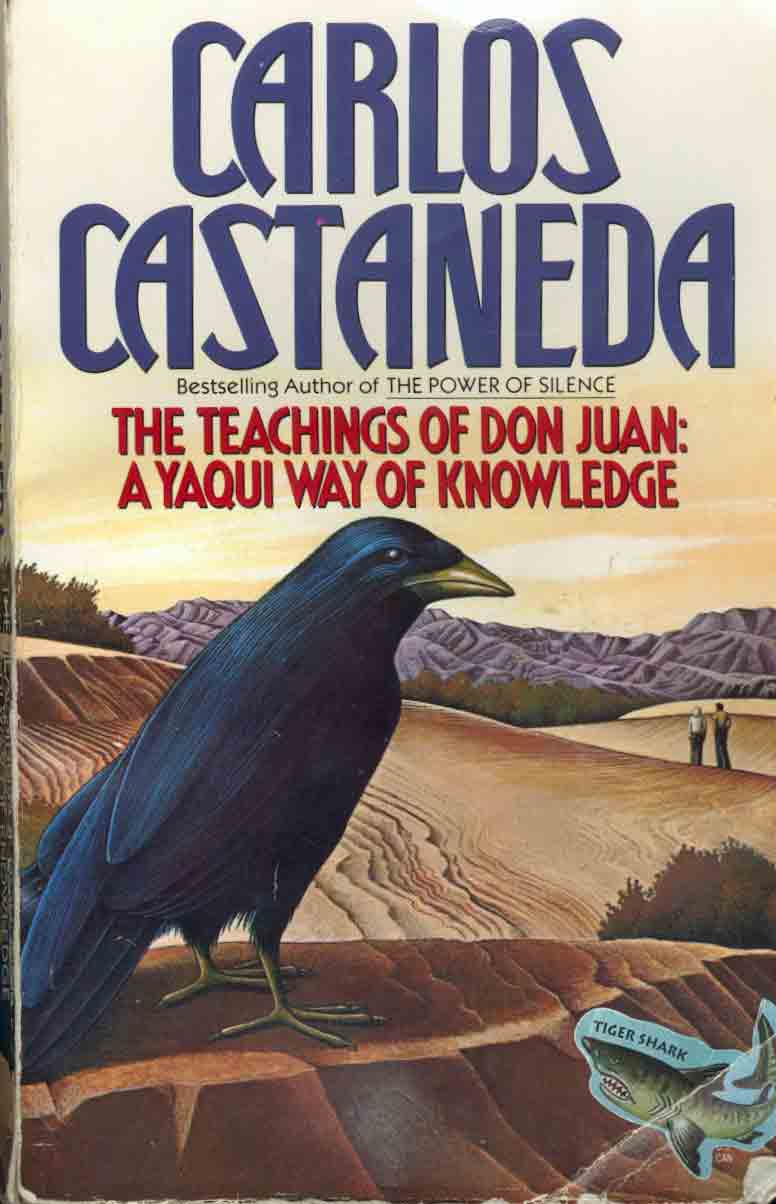
Exploring the countercultural 1960s and the origin of Western New Age, one cannot bypass Carlos Castaneda. He became a celebrity writer because of his bestselling book The Teachings of Don Juan: A Yaqui Way of Knowledge that was published by the University of California Press in 1968. The book was written in a genre of free-style dialogues between a Native American shaman named Don Juan Matus and Castaneda himself, who claimed that he worked with Don Juan for many years. The Teachings describes how Castaneda learned to use three hallucinogenic plants: peyote, jimson weed, and psychedelic mushrooms. After ingesting these substances, Castaneda went through mind transformations and learned that there were other realities besides the ordinary one. Later, it was revealed that he made up the whole experience, but this never affected his popularity.

Carlos-Castaneda-The-Teachings-of-Don-Juan

Of course, a book like this was well-tuned to the then-popular hallucinogenic subculture, and the link between Castaneda’s text and the psychedelic ‘60s is the most common explanation of his popularity. Yet I want to argue that this is a very narrow view, which does not explain why Castaneda’s follow up books, which had nothing to do with psychedelics, continued to enjoy popularity well into the 1990s. In fact, by the early 1980s, Castaneda became so paranoid about hallucinogens that he forced his girlfriend to undergo drug tests before allowing her to sleep with him. I also argue that viewing Castaneda exclusively as one of the spearheads of the New Age does not explain much either. The appeal of his texts went far beyond the New Age. In the 1970s and the 1980s, for example, his books were frequently assigned as conventional course readings in anthropology, philosophy, sociology, religious studies, and humanities classes.

Let me start with some biographical details. Castaneda was born Carlos Arana in Peru to a middle class family and moved to the United States in 1951. He tried to enter the world of art but failed. Then, for a while, he worked as a salesman while simultaneously taking classes in creative writing before eventually enrolling in the anthropology graduate program at UCLA.

Originally Castaneda did not care about hallucinogens and the emerging hippie culture, but eventually UCLA (and the broader California environment), which was saturated at that time with various counterculture and unchurched spirituality projects, made him choose a sexy topic: the use of psychedelics in a tribal setting. The book which made him famous, The Teachings of Don Juan, originated from a course paper on “power plants” and from his follow-up Master’s thesis. I want to stress that both papers were essentially attempts to find a short-cut to satisfy the requirements of his professors. His first professor, an anthropologist, invited those students who wanted to get an automatic “A” to find and interview an authentic Indian. Despite a few random contacts, Castaneda could not produce any consistent narrative, and had to invent his interview. This was the origin of his Don Juan character. Then he followed requirements of his advisor, Harold Garfinkel, a big name in sociology at that time and one of the forerunners of postmodernism. Garfinkel made it explicitly clear to Castaneda that he did not want him to classify and analyze his experiences with Don Juan scientifically.

What Garfinkel wanted was a free-style and detailed description of his work with the indigenous shaman as it was and without any interpretation. Thus it was through collective efforts that Castaneda produced a text that by chance caught the attention of the university press as a potential bestseller. Essentially, Castaneda took to the extreme incentives provided to him by his professors and by the surrounding subculture. He internalized these incentives by composing a fictional text, which he peddled as authentic anthropological research. It is interesting to note that in 1998, just before he died, Castaneda made the following mischievous remark in his introduction to the last anniversary edition of The Teachings of Don Juan: “I dove into my field work so deeply that I am sure that in the end, I disappointed the very people who were sponsoring me.”

The popularity of the first book gave rise to the whole Don Juan sequel, which made Castaneda an anthropology and counterculture star. The combined print run of his books translated in 17 languages reached 28 million copies. And, as I mentioned above, despite the revelations that his Don Juan was a completely fabricated character, the popularity of his books was increasing throughout the 1970s. In fact, to this present day, libraries frequently catalogue his books as non-fiction.

It seems that Castaneda’s appeal had something to do with overall trends in Western culture, which made his text resonate so well with millions of his readers. For this reason, I want to highlight the general ideological relevance of Castaneda’s books for the Western zeitgeist (spirit of the time) at its critical juncture in the 1960s and the 1970s. Various authors who wrote about Castaneda never mentioned this obvious fact, including his most complete biography by French writer Christophe Bourseiller, Carlos Castaneda: La vérité du mensonge (2005). So exploring the ideological relevance of the Don Juan books will be my small contribution to Castanediana.

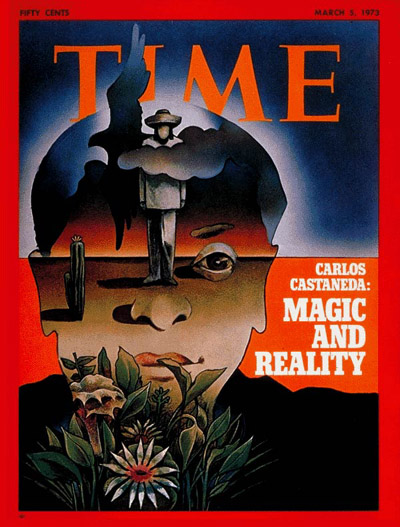
To be specific, I want to point to two themes that go through all his books. First, he hammered in the minds of his readers the message of radical subjectivism, which in our day it is considered by some a conventional wisdom: What we call truth is always socially constructed. Don Juan, who in later books began speaking as a philosophy professor, repeatedly instructed Carlos that so-called reality was a fiction and a projection of our own cultural and individual experiences, and instead of so-called objective reality, we need to talk about multiple realities. In an interview for Time magazine, Castaneda stressed that the key lesson Don Juan taught him was “to understand that the world of common-sense reality is a product of social consensus.” Castaneda also stressed the role of an observer in shaping his or her reality and the significance of text in Western culture. In other words, he was promoting what later became the hallmark of so-called postmodern mindset.

Second, fictional dialogues between the “indigenous man” Don Juan, whom Castaneda portrayed as the vessel of wisdom, and Castaneda, a “stupid Western man,” contained another message: remove your Western blinders and learn from the non-Western ones. Such privileging of non-Western “wisdom” resonated very well with Western intellectuals who felt justified frustration about the hegemony of positivism and Western knowledge in general and who looked for an intellectual antidote to that dominance. By the 1990s, this attitude mutated into what Slavoj Zizek neatly labelled the “multiculturalist’s basic ideological operation,” which now represents one of the ideological pillars of Western welfare-warfare capitalism.

At the end of the 1970s, several critics tried to debunk Castaneda. They were able to prove that his books were the product of creative imagination and intensive readings of anthropological and travel literature. These critics correctly pointed out that Castaneda misrepresented particular indigenous cultures and landscapes. Besides, they stressed that his books were not written in a scientific manner. Ironically, this latter criticism did not find any responsive audiences precisely because social scholarship was moving away from positivism. Moreover, one of these critics, anthropologist Jay Fikes, who wrote a special book exposing Castaneda’s hoax, became a persona non grata in the anthropology field within the United States. Nobody wanted to write a reference for him, and he had to move to Turkey to find an academic position.

What critics like Fikes could not grasp was the fact that the Castaneda texts perfectly fit the emerging post-modernist thinking that was winning over the minds of many Western intellectuals who sought to break away from dominant positivism, rationalism, and grand all-explaining paradigms. To them, an antidote to this was a shift toward the subjective, individual, and spontaneous. The idealization and celebration of non-Western knowledge and non-Western cultures in general, which currently represents a powerful ideological trend in Western Europe and North America, became an important part of this intellectual revolt against the modern world. I am sure all of you know that anthropology authorities such as Clifford Geertz (until recently one of the major gurus of Western humanities), Victor Turner, and Claude Lévi-Strauss were inviting others to view any cultural knowledge as valid and eventually erased the border between literature and science. They also showed that scholarship can be constructed as art. Castaneda critics could not see that his texts only reflected what was already in the air.

Castaneda_Time magazine

The person who heavily affected the “production” of the first Don Juan book, which was Castaneda’s revised Master’s thesis, was the above-mentioned sociologist Garfinkel. As early as the 1950s, Garfinkel came up with ideas that contributed to the formation of the post-modern mind. I am talking here about his ethnomethodology. This school of thought did not see the social world as an objective reality but as something that individuals build and rebuild in their thoughts and actions. Garfinkel argued that what we call truth was individually constructed. Sometimes, he also called this approach “people’s sociology.” He stressed that a scholar should set aside traditional scientific tools and should simply narrate human experiences as they were in all details and spontaneity. Again, today, for many, this line of thinking is conventional wisdom, but in the 1950s and the 1960s it was revolutionary. Incidentally, for Castaneda it took time to figure out what Garfinkel needed from him before he rid his text of the vestiges of “positive science.” To be exact, Castaneda could not completely get rid of this “science” in his first bestselling book. In addition to the free-flowing and easy-to-read spontaneous dialogues with Don Juan, Castaneda attached to the text an appendix; a boring meaningless read that he titled “Structural Analysis.” In his later books, such rudiments of positivism totally disappeared.

When Castaneda was writing his Master’s thesis, Garfinkel made him revise the text three times. The advisor wanted to make sure that Castaneda would relate his spiritual experiences instead of explaining them. Originally, when Castaneda presented to Garfinkel his paper about a peyote session with Don Juan, the text was formatted as a scientific analysis of his own visions. The professor, as Castaneda remembered, rebuked him, “Don’t explain to me. You are nobody. Just give it to me straight and in detail, the way it happened. The richness of detail is the whole story of membership.” Castaneda spent several years revising his thesis and then had to revise it again because Garfinkel did not like that the student slipped into explaining Don Juan psychologically. Trying to be a good student, Castaneda embraced the advice of his senior colleague. So the final product was a beautiful text that was full of dialogues, rich in detail, and, most importantly, came straight from the “field.”

I interviewed some of Castaneda’s classmates and other scholars who became fascinated with his books at the turn of the 1970s. Many of them had no illusions about the authenticity of Don Juan. Still, they argued that the whole message was very much needed at that time. A quote from Douglas Sharon, one of Castaneda’s acquaintance, is illustrative in this regard. In his conversation with me, Sharon stressed:

“In spite of the fact that his work might be a fiction, the approach he was taking—validating the native point of view—was badly needed in anthropology, and, as a matter of fact, I felt it was a helping corrective for the so-called scientific objectivity that we were taking into the field with us.”

I want to mention in conclusion that Castaneda not only promoted the postmodern approach in his novels but also tried to live it. Before the age of Facebook and online forums, Castaneda, with a group of his followers, became involved in an exciting game of identity change. They came to enjoy confusing those around them by blurring and constantly changing their names and life stories. For example, people in his circle shredded their birth certificates and made new ones. They also performed mock wedding ceremonies to make fun of conventional reality. To those who might have had questions about this “post-modernist” game, Castaneda reminded: “We’re all nothing but bags of stories.”

Malthusian pressures (as outcome of rent-seeking)

Nearly a week ago, I intervened in a debate between Anton Howes of King’s College London whose work I have been secretly following  (I say “secretly” because as an alumnus of the London School of Economics, I am not allowed to show respect for someone of King’s College) and Pseudoerasmus (whose identity is unknown but whose posts are always very erudite and of high quality – let’s hope I did not just write that about an alumnus of King’s College). Both bloggers are heavily involved in my first field of interest – economic history.

The debate concerned the “Smithian” counter-effect to “Malthusian pressures”. The latter concept refers to the idea that, absent technological innovation,  population growth will lead to declining per capita as a result of marginally declining returns. The former refers to the advantages of larger populations: economies of scale, more scope for specialization and market integration thanks to density. Now, let me state outright that I think people misunderstand Malthusian pressures and the Smithian counter-effect.

My point of is that both the “Smithian counter-effect” and “Malthusian pressures” are merely symptoms of rent-seeking or coordination failures. In the presence of strong rent-seeking by actors seeking to reduce competition, the Smithian counter-effect wavers and Malthus has the upper hand. Either through de-specialization, thinner of markets, shifting to labor-intensive technologies, market disintegration and lower economies of scale, rent-seeking diminishes the A in a classical Cobb-Douglas function of Total Factor Productivity (Y=AKL). This insight is derived from my reading of the article by Lewis Davis in the Journal of Economic Behavior and Organization which contends that “scale effects” (another name for a slight variant of the “Smithian counter-effect) are determined by transaction costs which are in turn determined by institutions. If institutions tend to favor rent-seeking, they will increase the likelihood of coordination failure. It is only then that coordination failures will lead to “Malthusian pressures” with little “Smithian counter-effect”. Institutions whose rules discourage rent-seeking will allow markets to better coordinate resource use so as to maximize the strength of the “Smithian counter-effect” while minimizing the dismal Malthusian pressures.

In essence, I don’t see the issue as one of demography, but as one of institutions, public choice and governance. I am not alone in seeing it this way (Julian Simon, Jane Jacobs and Ester Boserup have documented this well before I did). Why the divergence?

This is because many individuals misunderstand what “Malthusian pressures” are. In an article I published in the Journal of Population Research, me and Vadim Kufenko summarize the Malthusian model as a “general equilibrium model”. In the long run, there is an equilibrium level of population with a given technological setting. In short-run, however, population responds to variation in real wages. Higher real wages from a “temporary” positive real shock will lead to more babies. However, once the shock fades, population will adapt through two checks: the preventive check and the positive check. The preventive check refers to households delaying family formation. This may be expressed through later marriage ages, planned sexual activities, contraception, longer stays in the parental household and greater spacing between births. The positive check refers to the impact of mortality increasing to force the population back to equilibrium level. These checks return to the long-term equilibrium. Hence, when people think of “Malthusian pressures”, they think of population growth continuing unchecked with scarce ressources. But the “Malthusian model” is basically a general equilibrium model of population under fixed technology. In that model, there are no pressures since the equilibrium rates of births and deaths are constant (at equilibrium).

However, with my viewpoint, the equilibrium levels move frequently as a result of institutional regimes. They determine the level of deaths and births. “Poor” institutions will lead to more frequent coordination failures which may cause, for a time, population to be above equilibrium – forcing an adjustment. “Poor” institutions would also lead to an inability to respond to a change in constraints (i.e. the immediate environment) by being rigid or stuck with path-depedency problems which would also imply the need for an adjustment.  “Good” institutions will allow “the Smithian counter-effect” to intervene through arbitrage across markets to smooth the effect of local shocks, a greater scope for specialization etc.

My best case for illustration is a working paper I have with Vadim Kufenko (University of Hohenheim) and Alex Arsenault Morin (HEC Montréal) where we argue that population pressures as exhibited by the very high levels of infant mortality rates in mid-19th century Quebec were the result of institutional regimes. The system of land tenure for the vast majority of the population of Quebec was “seigneurial” and implied numerous regressive transfers and monopoly rights for landlords. This system was also associated with numerous restrictions on mobility which limited the ability of peasants to defect and move. However, a minority of the population (but a growing one) lived under a different institution which did not impose such restrictions, duties and monopolies. In these areas, infant mortality was considerably lower. We find that, adjusting for land quality and other factors, infant mortality was lower in these areas for most age groups. Hence, we argued that what was long considered as “Malthusian pressures” were in fact “institutional pressures”.

Hence, when I hear people saying that there are problems linked to “growing population”, I hear “because institutions make this a problem” (i.e. rent seeking).

Buddha, A Lonely Human Rebel

Although I do not consider myself a Buddhist, I have always had much respect for Gautama Buddha and I have always regarded him as an exemplary person.

What I find most sympathetic about Buddha are his humanness, his epistemological modesty, and his insistence to use reason and scientific inquiry to understand the world and to free oneself from social dogmas and religious oppression. It is for these reasons that Gautama Buddha could be considered contumacious or rebellious; he argued tenaciously against the superstitious practices and beliefs of Hinduism. He encouraged his followers to cultivate the mind and develop reason, because he considered it to be an essential element of ‘magga’ or the eightfold path to enlightenment (right understanding, right intention, right speech, right action, right livelihood, right effort, right mindfulness, and right concentration).

Smith & Novak write in Buddhism (2003) that there are six aspects of religion that “surface so regularly as to suggest that their seeds are in the human makeup” (Smith & Novak, 2003, p. 22), and that Gautama Buddha rebelled against all these aspects. The six aspects are:

  1. Authority – which was hereditary and exploitative as brahmins were charging exorbitantly for their services;
  2. Rituals – which became the people’s mechanical means to achieve quick miraculous results in life;
  3. Speculation – which entirely lost its experiential base;
  4. Tradition – which inhibited people from progress. One example is the tradition to instruct religious discourse in Sanskrit, making the brahmins’ knowledge effectively unavailable for the common people;
  5. Divine grace – which became confused with fatalism as to undercut human responsibility. Think for instance about the misinterpretation of ‘karma’ that was abused in order to maintain and rationalize the caste system;
  6. Mystery – which became confused with mystification and led to a perverse obsession with miracles and the occult. (Smith & Novak, 2003, p. 23)

According to Gautama Buddha, they were all too prevalent in the Hinduism of his days and he regarded them to be oppressive of human flourishing. As a revolt against the superstitious Hindu culture, Gautama Buddha preached a philosophy that is:

A. Devoid of authority – he tried to break the brahmins’ monopoly on religious teachings. In addition, he challenged everyone to utilize their own rationality and stop passively relying on the brahmins to tell them what to do.

B. Devoid of rituals – he believed that rites and ceremonies bind the human spirit.

C. Devoid of speculation – the monk Malunkyaputta, troubled by Gautama Buddha’s silence on metaphysical speculations, said:

whether the world is eternal or not eternal, whether the world is finite or not, whether the soul is the same as the body, or whether the soul is one thing and the body another, whether a Buddha exists after death or does not exist after death, whether a Buddha both exists and does not exist after death, and whether a Buddha is non-existent and not non-existent after death, these things the Lord does not explain to me, and that he does not explain them to me does not please me, it does not suit me (Kyimo, 2007, p. 206).

D. Devoid of tradition – he wanted a break from the archaic and he wanted to teach the peoples in their vernacular. On the question why his teachings should be followed, Gautama Buddha answers:

Do not go upon what has been acquired by repeated hearing; nor upon tradition; nor upon rumor; nor upon what is in a scripture; nor upon surmise; nor upon an axiom; nor upon specious reasoning; nor upon a bias toward a notion that has been pondered over; nor upon another’s seeming ability; nor upon the consideration, ‘The monk is our teacher.’ Kalamas, when you yourselves know: ‘These things are bad; these things are blamable; these things are censured by the wise; undertaken and observed, these things lead to harm and ill,’ abandon them.[1]

What Gautama Buddha is effectively saying here is that everything should be questioned; every tradition, every holy book, and even teachers including himself. He taught everyone to use reason and the scientific methodology of inquiry, and he emphasized on doing good and abandoning evil.

E. Emphasizes intense self-effort and opposes fatalism – everyone can become enlightened. He taught everyone that actions are meaningful and that everyone contains the power to change their lives immediately for the better. Everyone was considered responsible for their own actions and happiness. This puts heavy responsibilities on all individuals to make the best of their lives.

F. Devoid of the supernatural – he condemned divination and reliance on Brahma (God). (Smith & Novak, 2003, pp. 24-28) He could not conceive of Brahma who considered himself “the Supreme one, the Mighty, the All-seeing, the Ruler, the Lord of all, the Maker, the Creator, the Chief of all appointing to each his place, the Ancient of days, the Father of all that is and will be”[2] to inflict so much suffering on the peoples:

If the creator of the world entire
They call God, of every being be the Lord
Why does he order such misfortune
And not create concord?
If the creator of the world entire
They call God, of every being be the Lord
Why prevail deceit, lies and ignorance
And he such inequity and injustice create?
If the creator of the world entire
They call God, of every being be the Lord
Then an evil master is he, (O Aritta)
Knowing what’s right did let wrong prevail![3]

At the same time, Gautama Buddha appeared to be one of us: fallible, sensitive, and insecure about life. Despite his immense influence, he remained humble enough as to never claim to be a son or a prophet of God – nor did he ever claim to understand the beginnings of the universe. His teachings were entirely devoted to alleviate man from his misery.

Talking about the Three Greatest Men In History (1935), H.G. Wells said of Gautama Buddha that:

[Y]ou see clearly a man, simple, devout, lonely, battling for light – a vivid human personality, not a myth. Beneath a mass of miraculous fable I feel that there also was a man. He, too, gave a message to mankind universal in its character. Many of our best modern ideas are in closest harmony with it. All the miseries and discontents of life are due, he taught, to selfishness… Before a man can become serene he must cease to live for his senses or himself. Then he merges into a greater being. Buddha in different language called men to self-forgetfulness 500 years before Christ. In some ways he was nearer to us and our needs. He was more lucid upon our individual importance in service than Christ and less ambiguous upon the question of personal immortality. (Wells, 1935, July 13)

Footnotes
[1] From Kalama Sutta: The Instruction to the Kalamas.

[2] From Digha Nikaya 1: Brahmajala Sutta.

[3] From Bhuridatta Jakata.

Bibliography
Examiner. (1935, July 13). Greatest In History. Retrieved from www.trove.nla.gov.au/ndp/del/article/51945346?searchTerm=GLOBE%20READER%20DIGEST%20&searchLimits=

Gunasekara, V.A. (1997). The Buddhist Attitude To God. Retrieved from http://www.budsas.org/ebud/ebdha068.htm

Kalama Sutta: The Instruction to the Kalamas. (1994), Transl. Soma Thera. Retrieved from www.accesstoinsight.org/tipitaka/an/an03/an03.065.soma.html

Kyimo. (2007). The Easy Buddha. London: Prospect House Publishing.

Smith, H., & Novak, P. (2003). Buddhism: A Concise Introduction. New York: HarperOne.

From the Comments: Debunking Myths About Islam and Violence

Jacques, a retired sociologist and university professor, has been repeating himself over and over again for the past fifteen years or so. His gripe? The imminent danger of Islam. Or Islamism. It depends on when you began reading him. Until recently, until the time that Delacroix decided to try and pick on me, Jacques’ venom was directed at Islam. Nowadays, it seems his poisonous arguments are directed at Islamism, the political movement. This is a step in the right direction. And yet, though his target his changed, his argument has not. The argument runs something like this:

  • Most, or much, of the violence in the world today is associated with Muslim groups of some kind or other.
  • Therefore, Islam, or Islamism, has an inherently violent penchant that needs to be removed using any method at the West’s disposal (including torture, a separate judicial system for Muslims suspected of being terrorists, and outright war).
  • In addition, Muslims who are not inherently violent (notice: Islam has an inherently violent penchant, except when it does not) are still responsible for terrorism because they do not snitch to government authorities when their fellow Muslims begin growing beards, and they do not speak out against Muslim extremists.

I have already gone the rounds with Delacroix on this narrative. He has been nothing but obstinately ignorant about his own argument, including the pseudo-facts that they rest upon. Maybe I shouldn’t be taken seriously. I’m just a lowly blog editor, after all, and a self-admitted libertarian to boot. The ‘comments’ of the two guys I’m about to highlight should be taken seriously, though. They are both college professors, and both do not self-identify as libertarians (though I think they are). Here is Dr Khawaja attempting to talk some sense into Jacques:

The first point is predictability versus explanation-in-retrospect, and I think you’re proving my point. I agree with your general account of the traits and biographical trajectory of terrorists. They’re often just as you say they are. The problem is, there are lots of non-violent losers with identical traits and trajectories, and no way to sort out the violent from the non-violent before the fact. The explanatory patterns typically emerge after the fact, which is when people tend to jump from explanation-after-the-fact to predictability-ex-ante. I guess I’m just flatly denying that the trajectory of the non-Islamist crazy is–in Western countries–all that different (ex ante) from the Muslim ones. The only “distinguishing” feature is that the latter are Muslim, and alienated from traditional Islam, and born again into something radical. But an enormous number of people have those traits, and simply waste their lives on being born-again Muslims of that sort without ever doing anything violent. My point is, when people–typically young men–start to move in that direction, it usually causes some concern. But “concern” is not the same as alarm at an imminent or even pending attack, and contrary to your suggestion, there is almost no way to predict those unless you’ve been taken into confidence by the would-be perpetrator. And of course, given what he wants to perpetrate, he’d have to be very incompetent to take a would-be snitch into his confidences.

Proviso: what I’m saying above refers to Muslims in Europe and North America. Things are different elsewhere. In the West Bank, if X’s brother, father, uncle, or cousin has been killed by the IDF, X is likely to commit a terrorist act, and if X becomes very religious, you can infer that he’s a member of Hamas. Similar moves are open to someone living in Pakistan. But those are different contexts than France of the US.

I’m not dogmatic enough to insist that the French cleric you quoted must absolutely be wrong. Maybe he has some way of detecting jihadists. But I really doubt it. The problem with French clerics of that sort is precisely their proximity to the government. They tend to speak with a view to pleasing this or that constituency, and what your cleric says is what the French government and people want to hear.

On immigration, granted that you didn’t literally come out and oppose all immigration by Muslims. But that isn’t quite what I accused you of, either. My point is: here we have a humanitarian crisis involving refugees who want asylum in this country. I’m the first to admit that if we admit a large number, some of this number will be terrorists and will perpetrate attacks on us that wouldn’t otherwise have happened (if we hadn’t let them in). My point is: now that we have this crisis, Americans have suddenly decided that a mass influx of refugees has to be constrained by border controls that would ensure that the mass influx remains a trickle. Imagine facing a potential influx of Syrian refugees and applying your stricture that none of them be Muslim literalists. By the time you operationalized that policy, and hired the border control staff to operate it, the year would be 2023, and the refugee crisis would be over. Or to take your other policy: can you really imagine teaching Syrian (or any other) refugees First Amendment law at their point of entry into the US? It can’t be done. It’s just not the way refugee operations work or can work. Imposing strictures like that on refugees is just a way of ensuring that the US never becomes a sanctuary during refugee crises.

I wouldn’t mind that attitude if only it were accompanied by a little bit of candor about history and politics. The US is committed never to become a large-scale sanctuary for, say, Syrian refugees. But now listen to the way politically conscious Americans talk about refugee crises elsewhere. The Arabs of Mandate Palestine were reluctant to open the borders of Palestine to European Jews? Well, that makes them anti-Semites. Common assertion: “The Palestinians remain in UNRWA camps to this day because the surrounding Arab countries, in their greed, refuse to take them in.” This comes from Americans who would never dream of taking them in. Israel, of course, has a very generous refugee policy (for Jews); that gets praise without any recognition that the refugees then function as demographic chips in the settlement game. West Bank settlements are full of Russian “Jews” who know less about the celebration of shabbos than I do.

Do I think the US has a Muslim problem? What makes the question difficult to answer is not any reluctance on my part to tackle the issue head-on, but an ambiguity in the phrase “a Muslim problem.” In one sense, it means “any significant problem stemming from Muslims.” In another sense, it means “a high priority issue facing the country as a whole and stemming from Muslims.” My view is that it has the first, not the second. There are several million Muslims in the country, and on the whole they don’t constitute a political problem. There are pockets of fanatics among them that do constitute a political (security) problem. France may well be different, but I think things are essentially in good shape in the US, despite this or that conspicuous Muslim atrocity.

To come at your question slightly differently: there is a sense in which Islam has a problem, the problem of reconciling itself to modernity. Given that, wherever you have Muslims who haven’t reconciled themselves to modernity, you’re going to get a problem (or problems). So yes, even if we had an isolationist foreign policy, that problem would remain. But that problem is least pronounced in the US, where Muslims basically run the same gamut as Reform to Conservative to Orthodox Jews. Literalist Muslims are no more (or less) a national problem than Orthodox Jews. I don’t mean to deny that they’re both a problem. But I wouldn’t say we have an Orthodox Jew Problem any more than I’d say we have a Muslim or Literalist Muslim Problem. Some places might, but we don’t.

Sorry, I said something confusing: “I don’t mean to deny that they’re both a problem.” I meant to say, “I don’t mean to deny that they’re both problematic,” i.e., give rise to problems. What I’m denying is that the problems are the equivalent of a high-level security threat.

Dr Khawaja blogs over at Policy of Truth and teaches philosophy at Felician College. Dr Amburgey tries to talk some sense into Jacques using a different angle:

“I said “probability.” It’s the concept we use, consciously or not, to approximate rational decisions in our daily lives: Select this birth clinic, rely on this baby food, travel by car, get vaccinated or not, go for this class rather than another. etc.”

I agree with Jacques. I’ll go further, I agree wholeheartedly with Jacques. I don’t subscribe to silly notions of human rationality like some of my colleagues but doing the best we can to make rational decisions is desirable both individually and in matters of public policy. As a consequence it’s useful to consider probabilities in our consideration of Jacques proposals.

Firstly, how does terrorism stack up against other risks in a probabilistic sense?

“Indeed – as we’ve previously documented – you’re more likely to die from brain-eating parasites, alcoholism, obesity, medical errors, risky sexual behavior or just about anything other than terrorism.”
http://www.globalresearch.ca/non-muslims-carried-out-more-than-90-of-all-terrorist-attacks-in-america/5333619

Even if we set aside the consequences of our choices [lifestyle or otherwise] terrorism is dwarfed by other things that kill us. Is it rational to spend more on the military than every other form of discretionary spending combined?
https://www.nationalpriorities.org/budget-basics/federal-budget-101/spending/

Secondly, given that terrorism is a risk how do different forms stack up compared to one another.
According to Jacques…

“We have terrorists of all inspirations in America, I know. The white murderer of black church people in Charleston was a terrorist, pure and simple. He was home bred and home grown. However, we have many, many more terrorists of foreign extraction, almost all with ties to Islam.”

This is, to put it politely, a counterfactual statement. The various public datasets have different observation windows and methodologies. Right now I’m going to use the 1980-2005 FBI data simply because there is a handy pie chart that I can copy from. In decreasing order…

Latino-42%, Extreme left-wing groups-24%, Others-16%, Jewish extremists-7%, Islamic extremists-6%, Communists-5%

The USA certainly has problems. Does it have a ‘muslim problem’? I’d say the numbers speak for themselves.

Dr Amburgey teaches in the business school of the University of Toronto. He doesn’t blog.

Jacques has still not addressed my questions regarding the implications of his policy proposals, by the way, namely that they echo those implemented by the Third Reich. Political Correctness is a corrupting influence on the free and open society (I suspect, in my infinite kindness and generosity, that Political Correctness is Jacques’ real target when he writes about Islam), but so is cultural chauvinism. Two wrongs don’t make a right!

Milton on Freedom of Printing: Areopagitica

Areopagitica 

A Speech of Mr John Milton for the Liberty of Unlicensed Printing to the Parliament of England (1644).

(For my general introduction to Milton, click here)

‘We turn for a short time from the topics of the day, to commemorate, in all love and reverence, the genius and virtues of John Milton, the poet, the statesman, the philosopher, the glory of English literature, the champion and martyr of English liberty’, Thomas Babington Macaulay (Whig-Liberal historian, writer and government minister), 1825.

The digitised text of Areopagitica can be found at the Online Library of Liberty here.

The strange sounding title is a reference to one of the key institutions of ancient republican and democratic Athens, the court of Areopagus. Appropriately, as we are looking at an essay on politics by a great poet, the Areopagus and its mythical foundation was celebrated as the core of Athenian justice in Aeschylus’ tragic trilogy, the Oresteia. The Areopagus was itself an aristocratic institution preceding democracy in Athens and as such can be seen as what balanced the changeable majorities of the citizens’ assembly with enduring standards of justice, which have meaning in all ways of constituting political institutions.

What Milton looks for in this great institution of early experiments in constituting liberty is a standard for freedom of publication and finds that it offered a very tolerant standard, at least in the context of the seventeenth century. Milton suggests that the only restrictions the Areopagus placed on books of the time (all handwritten manuscripts of course) was with regard to atheism and libel. We are not going to look back at Milton or the Areopagus now as the most advanced instances of liberty when they prohibit expressions of atheism, but these are times when the idea that a good and rational person could not be an atheist were all pervasive and the assumption can still be found later in the seventeenth century in John Locke, one of the general heroes of modern thinking about liberty.

The restraint on libel applies in all societies and all political thinking I am aware of, but one should never discount the possibility of an interesting exception. Leaving aside possible interesting radical alternatives, there is nothing repressive by the standards of general thinking about liberty in restraining libel. Milton’s interest in the standards of pagan Greece is itself a tribute to a spirit of pluralism and open mindedness in someone generally inclined to take moral and political guidance from the religious traditions of Hebrew Scripture and the Gospels, along with the writings of early Christians, and the Protestant thinkers of the sixteenth century Reformation.

The Reformation, as Milton himself emphasises, relied on the printed word, and it is no coincidence that Protestantism emerged soon after Europe discovered printing (after the Chinese of course), as a weapon against the institutional authority of the Catholic Church and its hierarchy. The structure of the Catholic Church was not just a matter of church offering a choice to people seeking a faith-based life, it was connected with state power and pushed onto societies as the only allowable life philosophy. The politics of religion comes up in Milton’s essay, including the issue of the relation of the state to the church hierarchy.

While England had a Protestant Reformation in the sixteenth century (England including Wales, but excluding Scotland which had its own distinct Reformation before union with England), it had retained a state church, the Church of England, with Bishops. Milton, like many on the side of Parliament in the Civil War, was against Bishops, referred to as prelates, as part of the old Catholic hierarchy in which the ‘truth’ was given from above to the mass of believers.

Inspired by the pamphlets of and books of Protestant reformers, Milton argues that truth can have many forms and that while Christianity may require acceptance of central truths, they can be expressed in more ways than the Catholic hierarchical state-backed tradition allows. State backing, of course, included the imprisonment, torture, and burning to death of ‘heretics’ by the Inquisition.

Milton refers to the last pagan Roman Emperor, Julian ‘the Apostate’ (reigned 361-363) with regard to his policy of banning Christians from pagan education. Milton argues that this was the biggest possible blow to Christianity, because it deprived believers of the intellectual capacity and credibility to influence pagan inhabitants of the Empire. Christian truth could only be convincingly understood, communicated, and taught if it drew on all areas of learning including what had been produced by pagans.

Truth benefits from being tested in argument and contestation, something undermined by state-enforced church power as well as by the monarchical institution of courts full of sycophants and yes-sayers. Political liberty requires republican representative institutions and truth, including the truths of religion, require testing in conditions of liberty.

Unfortunately, Milton supported legal discrimination against Catholics, but as with prohibitions on expressions of atheism, this was part of the general understanding of a just state at the time, and Milton was more tolerant than many on the Protestant as well as Catholic sides. His arguments make up a part of the general movement to tolerance and freedom of speech, making very powerful points on behalf of liberty, enabling us to take them beyond the limits within which he constrained them.

Next post, Milton on political institutions

Introducing John Milton: Republican and Poet (1608-1674)

John Milton is one of the major figures in the history of English literature. His poetry, particularly but certainly not only his epic Paradise Lost, has conditioned all of English literature since his own time. He was also a major political writer and advocate of liberty.

In some ways his appeal has become a bit more limited with the decline of religion as a major part of life in Britain and other English speaking countries, but he is still read and has influence on the non-religious no less than the religious. He came from a time when political and literary activity in England (strictly speaking there was no Britain or Great Britain in terms of the legal state until 1707, before which there was a union of three kingdoms or states, England, Scotland and Ireland with no superseding state on top) and across Europe was very tied up with religion. Both of the greatest English political philosophers of the seventeenth century, Thomas Hobbes and John Locke, were centrally concerned with the relation of the state to religion. The last thinker I discussed, James Harrington, though not very religious in orientation, still discusses the Biblical ancient Jews in his political writing.

Milton was a Puritan in religion and a republican in politics. To say he was a Puritan is to say he was one of the more radical Protestants outside of the mainstream of the state church as it existed under English kings. Puritan was originally a pejorative label associating religious dissenters and radicals with joyless fanaticism. This might have been an accurate description of some Puritans, but not all and certainly not Milton. He travelled in Catholic Europe where he made friends and intellectual interlocutors. He advocated for the right to divorce, which had been no more recognised in Protestant England after the Protestant Reformation of the sixteenth century than in preceding Catholic England. His learning, including that of ancient pagan classics, was greater than normal for bigoted fanatics. Furthermore, his poetry shows great joy in the pleasure of words and imagination, traits uncharacteristic of the bigot whose greatest pleasure is to think of his enemy burning in hellfire.

Even the more joyless kind of Puritan often showed a spirit of equality in social life, democracy in church government, and the value of all honest work, along with a belief in enough education for children to at least study the Bible carefully and intelligently, which played a large role in the growth of liberty, commercial society and civil institutions in England. This was not an era where complete religious tolerance, or complete independence of the individual from the state, was at all mainstream and even the most tolerant states (the Netherlands being the best candidate) did not have complete equality between faiths or tolerance for open non-believers.  For the time, Milton was at the more tolerant end of the spectrum and so were many other Puritans, despite the forbidding associations of that term.

Milton lived through through the Civil War (1642-1651) between Crown and Parliament and was a strong supporter of Parliament as were Puritans in general, though Milton’s political views should also be seen in the light of his classical learning and respect for the republics of ancient Greece and Rome.

Parliament’s victory lead to the creation of an English republic known as the Commonwealth in 1649, and Milton’s advocacy of republicanism led to an appointment as Secretary of Foreign Tongues, an office which required him to compose correspondence with foreign governments in Latin and continue a defence of republicanism for a European audience. Milton continued in this post as the Commonwealth gave way to the Lord Protectorship of Oliver Cromwell, the most outstanding general of the parliamentary army. This was not an explicit repudiation of republicanism, but did reflect the difficulties of organising parliamentary government in a country used to monarchical governments.

Parliaments were very happy to offer Cromwell powers he was not ready to accept, and even the explicit title of king. Cromwell essentially served as an uncrowned king, making various experiments with parliamentary and military administration. Cromwell is sometimes portrayed as a religious fanatic and tyrant, but he restrained the intolerance of the most radical Puritans and was not religiously intolerant by the standards of the era. His tendency towards more militaristic and personal government reflected institutional failures rather than a plan for absolute personal power. He purged and selected parliaments, but all previous parliaments had presumed the subservience of MPs to monarchical domination and conformity to the state church.

Cromwell’s darkest reputation arose in Ireland, but tales of Cromwellian massacres of Irish Catholic civilians are now agreed by Irish historians to be highly exaggerated. What he was guilty of was completion of a long process of subordinating Ireland to England, and of removing power and landed property from the Catholic majority. Deplorable as this was, it was no more than the standard statecraft of the time. Cromwell did not establish an arbitrary violent despotism in England. He largely operated within the law and reformed the administration of the nation in an efficient and enduring way. He did not acquire spectacular wealth or establish a court of ostentatious luxury. Though Oliver Cromwell’s son Richard inherited the Lord Protectorship, Cromwell had not prepared the way for the dynastic rule of his family, and power returned to the previous royal family.

I have discussed Cromwell’s status as a figure in English history to show how a sincere republican like Milton could continue in his state position. There is no reason to think he did so for reasons of acquiring wealth or addiction to power. He remained true to his principles after the return of the monarchy, unlike many, and was in real danger of very serious legal consequences. Fortunately those who respected him in the new regime, after abandoning the old regime, intervened and Milton was able to live out his life peacefully though in rather simple style for one of the greater writers of the time.

Milton’s writings, along with the failed republican experiment and the Cromwellian administrative reforms, established the conditions for a second concealed republican revolution, the Glorious Revolution of 1688, which under the pretence of restoring a traditional relation between monarchy and nation, in practice established a successful aristocratic-commercial republic under a monarch who could only act in co-operation with Parliament.

Next I will begin the investigation of Milton’s writings.

The Two Ultimate Religions

Religions provide ultimate visions of reality and values. They have different views about the reality of the divine, and about what is sacred, but for life on earth, what counts most is religious ideas about the reality of human beings and the value of human life.

The two basic concepts about human life are equality and supremacy. Either one believes that all human life is equally worthy, sacred, and important, or else one believes that the members and followers of one’s religion have supremacy over other human beings. Either one values all human beings as equally human, with equal rights to life and property, or else one values the members of one’s religion as superior, with superior rights to life and property.

Almost everyone believes that one’s own religion is the correct one. Some people may have doubts, but few believe that other religions are more true, otherwise they would convert, unless forbidden to do so. Religious egalitarians believe that even though their faith is the true one and the best of all religions, nevertheless the people of other faiths have an equal moral worth, and so their lives, property, and freedom are to be respected.

Religious supremacists believe that not only are their beliefs true, and their values correct, but also that holding their beliefs, or being descended from believers, entitles them to superiority in human worth, so that they are authorized, and even required, to forcibly convert others and, at the most extreme, take their property and lives.

The divide between egalitarians and supremacists cuts across all the major religions. People of all faiths have attacked, enslaved, killed, looted, and conquered those of other religions. Even when supremacy is not an explicit religious belief, when one group conquers and enslaves another, their members at least implicitly believe that they are superior, even if only because of their power.

There are also members of all faiths who believe that, however superior, true, and sacred are their own beliefs and values, those of other faiths are equally entitled to live according to their creeds. Whatever else their religion may say about others, they believe that all people are equally human and of equal human value.

This, then, is the great religious divide, which affects every person. Atheists too are part of this divide. The atheists chiefs of Communist parties believed in the superiority of their creed, and they conquered lands, killed opponents, and imposed their control over others. Extreme nationalists have had a supremacist nationalist belief in addition to other ideas, which formed their overall religion. Supremacism may be personal, ideological, and otherwise not associated with a theistic belief, but as a view of ultimate reality and values, it is a religion that is mixed in  with other ideas.

Human beings live in a mental as well as physical universe. In our mental universe, either we believe in human equality, or not. Egalitarianism and supremacism are, however, matters of degree. Some may be more mildly supremacist, letting those of other beliefs live, but subjecting them to higher taxes, tighter restrictions, and lacking the privileges of those of superior beliefs. In the relatively tolerant societies, people are allowed to practice their religions to some extent, but there are beliefs and values, even if not in a theistic creed, that are imposed on everyone. This is why throughout the world, governments have victimless crimes. They prohibit activities such as drug use and gambling, and they censor some words, ideas, and depictions.

One supremacist idea shared by most people is the moral worth of majorities relative to minorities. Most people in today’s world believe in the superiority of majorities. If a majority of voters believe that everyone should be taxed, restricted, and forced, this is, in their view, proper, because the majority has moral supremacy. Majoritarianism is a religion, as a belief and value.

Another supremacist view is that persons who have conquered land, and their heirs, when there are no other documented claimants or survivors, have a superior status. The egalitarian position is that all human beings have an equal right to the benefits of the land that nature provided. Equality does not require equality in possession, which is not possible, but an equal share of the economic benefit, as measured by what people are willing to pay to use land.

If we take human equality to its ultimate logical conclusion, each person has an equal natural right to live, work, own property, and completely direct his life, with no restriction or imposed cost on his peaceful and honest actions. Liberty and equality are complementary.

Very few people believe in complete human equality. But we should at least strive to achieve  equal rights for life and equal rules for property. Whatever else our creeds may say, we should have a minimal egalitarianism in law and policy, so that innocent people may live, own property, and be able to live, to a great extent, in accordance to their beliefs and values. If we can achieve minimal global egalitarianism, that would be a great achievement.

Note: this article also appears in http://www.progress.org

What’s wrong with migrating?

This is a response to Irfan Khawaja over at the Policy of Truth blog.

I am of Jewish descent. I am not a JewI was baptized a Catholic as a baby and have no plan to convert in the foreseeable future. I am nonetheless of Jewish descent. My paternal grandfather is a rabbi and my cousins from that side of the family are Jews.

My family patriarch migrated from Germany to Mexico during the turn of the 20th century. He migrated long before the Holocaust, but I wouldn’t be surprised if he was motivated to migrate to escape prosecution in Europe.

I also have slaves in my family tree. My great grand mother (Or was it great great? I forget.) was a black Cuban and my parents thought I might be born with dark skin. Blacks, for those who are keeping score at home, are not native to Cuba. Slavery in Cuba did not end till 1886. My great grandmother migrated to Mexico to escape prosecution in Cuba.

I myself migrated to the United States at the age of two. I might have been born in Mexico, but I was a libertario at birth. I loved Mexican food but that was not sufficient reason to stay in a country with such a poor conception of personal liberty. So I kissed my mother good bye, packed my bags, and crossed the border. I ended up settling down in Los Angeles, where I could have Mexican food and liberty.

What I am getting at here is that there is nothing wrong with migrating.

Had I stayed in Mexico I would likely be dead now. If a cartel member asked me to pay protection tax I would have refused and instead given him a speech on why we should legalize drugs. My town of birth, Morelia, is one of the capitals of the drug trade so you can imagine how long I would have lasted.

Had my great grandmother stayed in Cuba she would have to live with left over discrimination against slaves and their descendants. Worse still her descendants would be living in Castro’s Cuba!

My family patriarch might have survived the Holocaust if he had stayed in Europe. Or he might have been baked.

I agree with Irfan Khawaja that one should be assured of their personal safety and liberty regardless of any incidents of birth. I also agree with him that Benjamin Netanyahu, current Israeli Prime Minister, is wrong to urge European Jews to migrate to Israel. Israel is hardly a safer country for Jews than Europe.

Where I disagree is that I see nothing with migrating or urging others to migrate in pursuit of safety or liberty. There are times when one should hold strong and defend themselves. There are also times when one should realize that your neighbors are bigots and they won’t stop being bigots during your lifetime. If you can improve your quality of life by migrating, why not do so?

For any European Jews who might be reading this: forget about Israel and come to the United States! Specifically come over to my hometown, the San Fernando Valley.  The San Fernando Valley is a lovely community within Los Angeles. The original Karate Kid series, and countless other films, take place in the Valley. The film industry is actually located in the Valley, not Los Angeles itself. Best of all, the valley is filled with Jews. My undergraduate university, Cal State Northridge, has one of the largest concentration of Jews in America. Did I mention that there is plenty of Mexican food to go around?

I’ll be honest, there are some drawbacks to the valley. We are ruled over by the incompetent authorities in Los Angeles city hall and attempts to form our own city have been thwarted over the years. Real estate prices are also high. Despite this though I love the valley and welcome others to migrate there if their current home is undesirable.

A Short Note on Islam and Violence: Russian Edition

Many notable, and many more unnotable, commentators will swear by Islam’s “violent penchant.” They don’t care for nuance. They don’t care for facts. Instead, they adhere to the old principle of repeating something often enough until it becomes true.

I think there is an issue with Sunni Arabs and cultural chauvinism (the Qur’an is supposed to be memorized in the Arabic language only, for example) masquerading as religion. I think religion itself is mentally and emotionally abusive. Yet I am confident in stating matter-of-factly that there is no penchant for violence in Islam. Each instance of violence perpetrated by an Islamist can be explained by his or her political, or better yet institutional, situation. Islamism is, after all, a relatively new political paradigm that has arisen only with the advent of the nation-state in the Middle East.

Incidentally, these same detractors – the ones who repeat themselves over and over again – are also hawks when it comes to Russia. If I am not mistaken, Russia is a Christian nation (with a few exceptions along its peripheries) and unofficially a Christian state (did anyone catch the Patriarch’s recent speech to the Duma?). The Russian state is violent and aggressive. Russian society is violent and parochial. Moscow routinely violates individual rights. Because the vast majority of Russian citizens support the aggressiveness of both the Russian state and the Russian communities in post-Soviet space, this means that all Christians are violent and aggressive, right?

From the Footnotes: Ignorance of Islam and of the Decentralization of Power

There are widespread calls for an Islamic reformation such as Christianity experienced in the sixteenth century, but the Reformation cleaved Christianity into two major traditions and many splintered sects; each grew independently of the others, eroding any hope of a Christian center that could rein in extremes. After its early division into Sunni and Shi’a, Islam has come to suffer enough from this segmentation without a modern reformation. Indeed, Islam is a democratic religion, so thoroughly decentralized that even muftis are elected. Many Muslims are interested not in further schisms but rather in reconciliation among the competing doctrines and their extremist messengers, ultimately reducing the violence carried out against each other and other civilizations. As Gilles Kepel argues, though the rise of militant Islamism has been spectacular, its hyperviolence has proved to be a liability rather than an asset. (243)

This is from Parag Khanna’s 2008 book The Second World: Empires and Influence in the New Global Order. This footnote is in most respects a microcosm of the book as a whole: it’s on the cusp of providing theoretical insight into how the world works but just can’t seem to shake a certain type of dogma associated with the technocratic Left (I think he has done a better job of shaking this dogma post-2008).

This footnote is also in most respects why I’ll never be a Leftist again, even as a sleek, trade-friendly technocrat.

This footnote says to me that Khanna is arguing for a hands-off approach to Islam on the part of the West. Khanna is saying that Islam does not need a Christianity-style reformation. So far, so good. Khanna and I are in agreement. Then he goes off his rocker, though, by arguing that Christianity (and by implication European society) became a net loser because there was no Christian center to temper extremists.

What?

Correct me if I am wrong, but doesn’t Christian Europe have higher standards of living/tolerance/pluralist values today than anywhere else in the Old World? And isn’t Christian Europe the one place in the Old World where it is awfully hard to find Christian religious extremists? Wouldn’t you have a better argument if you stated that is was the lack of a Christian center which has been responsible for the dramatic increase in standards of living/tolerance/pluralist values in the West?

Maybe Khanna is thinking of medieval Europe, with its devastating series of religiously-inspired wars, but somehow I don’t think this is the case.

The Muslim world is decentralized culturally (like Europe) and is trying to decentralize politically (again, like Europe). The political decentralization is being hastened by trade liberalization and global economic integration. This same decentralization is being resisted by the international order (including, especially, Russia and China) due to nefarious but understandable interests of state but also to the severe lack of understanding that Western intellectuals like Khanna have of social organization. A center of cultural or political or economic power does not guarantee a waning of extremes. In fact, in some cases (in most?) such a center of power actually contributes to extremes.

Khanna was so blinded (and, again, I think he’s changed his tune post-2008) by technocratic Left-wing theory that he could not see what he was arguing: that a decentralized Christianity gave rise to Europe as we know it, therefore the West should step back so that the Muslim religion can build a monolithic consensus in order to combat “extremes.” Am I mischaracterizing Khanna’s footnote? Am I knocking down a straw man?

Khanna’s latest stuff has been much better than what I found in his 2008 book. He still doesn’t go far enough, though. He needs to undertake Brandon-style libertarianism in order to really be a bad ass: let the process of decentralization happen, but (but) recognize new states where it is smart and safe to do so (Kurdistan? The Islamic State? Baluchistan?) and then integrate them into the imperfect but important international order that the West has slowly been building for the last hundred years or so.

Khanna’s incoherence on geopolitical matters is not limited to interesting footnotes. Check out what he wrote in the introduction (again, this is from 2008):

Many believe that the emerging world order is polycentric: China will remain primarily a regional power, Japan will assert itself more nationalistically, the EU will lack influence beyond its immediate region, India will rise to rival China, Russia will resurge, and an Islamic Caliphate will congeal as a geopolitical force. (xviii)

This is basically what has happened so far, and it largely falls in line of where I would bet my money (but not place my dreams) on future events (the Muslim world excepted; see above). Khanna has none of it though:

All these views ignore a much deeper reality: The United States, the European Union, and China already possess most of the total power in the world. (xviii)

I think this argument, if anything, reveals Khanna’s (and, by implication, the technocratic Left’s) authoritarian impulses and desires. The United States is the world’s sole hegemon, and it will be for a long, long time. The EU is a basketcase and China’s GDP (PPP) per capita stands at Intl$ 11,907 in 2013, just below the Dominican Republic, Serbia, the world average, and Iraq. Khanna’s inclusion of the EU – with the social democratic values that technocratic Leftists mistakenly believe Europe harbors – and China – an ode to both the condescending identity politics of the same technocratic Left and its fixation with centrally-planned but privately-run enterprises (“corporatism”) – in the troika of world powers illustrates nicely the weaknesses of the Left.

Khanna’s dogma gets him in more trouble (still on the same introductory page):

Russia, Japan, and India cannot assert themselves globally, militarily or otherwise […] In fact, they are being gradually outmaneuvered by the United States, the EU, and China in their own regions. (xviii)

Don’t cry for Khanna. Last time I checked, he was on the board of several prominent think tanks.

Khanna’s best chapter is on the Middle East (it starts with a useful map on p. 168 and ends on p. 253). His treatment of post-Soviet Europe is laughable (“Ukraine: From Border to Bridge”) and his treatment of China (“Asia”) is overly laudable. India gets just three dismissive pages.

Would I recommend reading it?

Yeah, sure. I like the concept of “second world” that Khanna tries (but fails) to convey. I like the way he thinks and his post-2008 work is especially good. There are a lot of facts that aren’t really facts in the book though, and he applies those facts to theories that I think are weak at explaining how the world works. Then again, when has reading a book ever hurt you?

The Saudis, the Holy Lands, and double standards

I know we’ve been linking to Irfan and the PoT heads a lot lately, but there’s a good reason for it. Check out Dr Khawaja’s thoughts on the recent death of King Abdullah:

The late Pakistani journalist Tashbih Sayyid, editor of Pakistan Today, put the point to me in this way: “Muslims complain so loudly about the Israeli occupation of Jerusalem and the West Bank. What about the Saudi occupation of Mecca and Medina?” It sounds like a joke, but it really isn’t one. He might well have added: What about the Saudi occupation of the Arabian peninsula?

Here’s an article on Saudi Arabia’s criticizing Norway’s human rights record. This criticism comes from a country where it’s illegal for women to drive. Of course, to be fair, Saudi Arabia is making progress. It abolished slavery in 1962.

I don’t agree with defenders of Israel who insist that the movement to divest from Israel is “anti-Semitic,” but I do think there is a double standard in the way activists think about and deal with Israel by contrast with Saudi Arabia. Saudi Arabia has all the features that members of BDS find objectionable in Israel. Like Israel, Saudi Arabia is guilty of systematic human rights abuses. Like Israel, Saudi Arabia gets massive and systematic U.S. support. Like Israel, Saudi Arabia exerts enormous influence over the U.S. government. The difference is just that Saudi Arabia is a lot worse than Israel on every relevant dimension.

Read the rest, it’s an excellent analysis as usual.

Jacques has a piece on Islam in France up over at Liberty that you might want to check out, too. He doesn’t make any new arguments that he hasn’t made before, and I don’t think he is advancing the conversation at all (see here and here, for example), but it’s still worth the read.

“Mohammed — in pictures”

That is the title of this piece by Barnaby Rogerson in the Spectator. There are three beautiful pieces of medieval art (two Persian and one Turkish), and those alone are worth the price of the click. There is, of course, a short essay explaining why there is now so much resistance to depicting Mohammed in art (of both the high and low brow variety). Check it out:

Whatever the heritage of their medieval past, Sunni Islam — in the Arab-speaking Middle East — had decisively turned its back on depictions of the Prophet well before the 18th-century emergence of Wahhabism. Once again there are no definite answers. It may have been a gut reaction to the magnificent art produced by their Iranian Shiite rivals but it also reflects a very real fear that Mohammed was slowly being turned into a demi-god and that in the process his actual prophetic message would be ignored. This was especially true in the far eastern frontiers of Islam, such as India and Indonesia (numerically the two largest Muslim nations in the world) with their ancient syncretic traditions. So the attack on imagery can also be seen to have a constructive element embedded within it, concentrating all attention on the text of the Koran and reinforcing the Arab nature of that revelation.

Take this as you will. My instinct is to suspect “the Arab nature of that revelation” as the initial reason for this change in Islamic aesthetics. That is to say, I suspect that a medieval notion of Arab chauvinism is responsible for the shift.

From the Comments: Islam and Islamism

Matthew riffs off of my recent post on imperialism:

I am far too lazy at present to read the links you embedded in this article, so I will shoulder the lazy man’s burden, and provide some simple anecdotes.

A very common reaction is to blame Islam itself for the problems Islamists cause in the West, and in their own countries. I have never opened the Koran, and I have only cursorily read the statements of Islamist groups such as Hamas. I cannot honestly speak to whether Islam is at fault in toto, because I know too little about Islam’s tenets to deduce a causal relationship between Islamist extremism and the creed they espouse. What I have been noticing, however, in my brief travels in the Islamic world (I am currently in Meknes, Morocco) is the difference in practice between what I will call “media Muslims” (the straw men the media set up as representative of all Muslims) and the real, flesh and blood Muslims you meet in your every day encounters. I have met pious Muslims, who pray five times a day, and have had theological discussions over the differences between Judaism and Islam. I have not hidden my Judaism, as many Jews do out of fear for their lives – misplaced oftentimes, I would say – and have had no problems. I have met young Muslims who eat pork and drink alcohol and don’t give a jot about Allah or Muhammad. I have tried to flirt with Muslim girls and failed, probably because my only Berber words are “yaaah” (yes) and “oho” (no).

There is a very large pressure in culture and in the media to reduce everything to social forces. We must fear “Islam,” and “Communism,” and “Terror,” without considering that all of these social forces are composed of many individuals, with different ideals, and different means of pursuing them. Islam is, like everything else, a pluralistic social movement. There is Wahhabism on one end, and cultural Islam on the other, and many people fall in between. So, I do not think Islam can be blamed for the West’s problems with Muslims. A particular strain of Islam, adhered to by a particular type of individual, is one factor. Western meddling and overt racism is another.

The rest of the ‘comments’ thread is, of course, well worth the read too. I am not much of a bragger but, as I’ve repeated on here many times, the ‘comments’ threads at NOL are some of the best on the web. I look forward to Matthew’s posts teasing out what it means to be Western.

Also, Matthew, with Moroccan girls you have to feign ignorance and let them believe that they are doing the hunting and that you are the prey. (Let us know how it goes, of course.)