Expect a new, decentralized narrative in the post-Coronavirus world

Introduction

Many analysts have argued that the US and China will continue to be the two most important global players in a post-corona world, but they will not be the sole drivers of the narrative with regard to economic and geopolitical issues. While the US has become insular under Trump and has failed to foster a spirit of international cooperation even during the midst of the coronavirus pandemic, China’s suppression of crucial information with regard to the coronavirus has been criticized by a number of countries – not just the US.

During the midst of the coronavirus pandemic itself, many countries have risen to the occasion not just in terms of dealing with the pandemic, but also providing assistance to other countries. This includes the Asian countries of South Korea, Taiwan and Vietnam, and Western countries like Germany and France, which have both risen to the occasion by speaking up for removal of sanctions against Iran, and also providing financial assistance.

Increasing importance of South Korea, Taiwan, and Vietnam

If one were to look at the instance of Asia, countries like South Korea, Taiwan, and even Vietnam, which has been successful in controlling the virus, are likely to enhance their stature globally, and will become even more relevant in the economic and strategic sense not just in Asia, but on the global stage.

All three countries have provided medical assistance to a number of countries, including the US. Taiwan and Washington have also joined hands to carry out research and to develop a vaccine for finding a cure for the virus.

The success of South Korea and Taiwan blunts the narrative about authoritarian governments being in a position to control the epidemic better, an argument which Beijing has been trying to push. The success of Vietnam has shown that resources are helpful, but not necessary, for handling situations like pandemics. Even with meagre resources, the ASEAN nation has restricted the number of cases and not recorded a single death so far. This has been attributed to the timely response by the country’s leadership. Vietnam has also been able to relax the lockdown and open certain businesses.

India too has been able to contain the spread of the virus and has provided aid and assistance to a number of countries in spite of a paucity of responses.

In a post-corona world, China is not likely to drive the Asian narrative.

Western narrative: Not driven by the US

In the West, while Trump has been criticised for his handling of the coronavirus, Germany has been relatively successful in containing the outbreak of the virus compared to other EU member states. What is interesting is that while Germany has publicly criticised China it has not taken the US stand on a number of issues.

First, along with the UK and France, Germany provided medical assistance to Iran via the Special Purpose Vehicle (SPV), which had been set up to circumvent sanctions imposed against Iran (the medical assistance reached Iran on March 31, 2020).

Second, when Trump reduced US funding to the World Health Organisation (WHO), Merkel spoke in favor of greater international cooperation, and support to WHO at this point of time, while also indirectly criticizing the step taken by Trump. Even in the past, Merkel has been at variance with Trump on numerous issues including the US approach to Iran and Trump’s approach towards globalization.

Emmanuel Macron too has been critical of China, but not necessarily echoing the US line. Both leaders have also been emphasizing the need for revival of the European Union (EU) and making it relevant.

Conclusion

In a post-corona world, a number of changes are likely to occur in the world order. First, if smaller countries have been successful in dealing with the pandemic their stature will rise, and they will benefit both in economic terms as well as geopolitical clout.

Second, the belief that a democratic system is incapable of dealing with a crisis like the coronavirus has also been challenged.

Third, the international world order will have numerous layers, and the influence of both Washington and Beijing on the narrative are likely to reduce with new players likely to speak up on crucial economic, environmental, and strategic issues. While trade and travel may be restricted, there is a possibility of greater ‘international cooperation’ and a new narrative which does not emanate merely from Washington or Beijing, but collectively from a number of countries.

Finally, cooperation will not be restricted merely to regional blocs or geography. In a number of instances, medical aid and assistance has been extended by one country to another far flung country. The new world order promises to be an interesting one, though it will be complex.

The Biden Rat

I don’t like the crucifixion of poor old Joe Biden (who denied everything today – finally). This, for two unrelated reasons.

First, during the Kavanaugh hearings, I answered firmly the question, “Do women lie?” Yes, some women lie some of the time (as absolutely anyone, male or female, over six well knows.) Do some women lie about sexual harassment? My answer, based on intuition but fed by some experience is also, “Yes.”

I am not changing my mind because it would be convenient to do so. Mr Biden’s accuser deserves to be heard; Mr Biden deserves the civilized presumption of innocence.

Second, and much more importantly, I smell a big rat. I doubt that Republicans would under their own power, resuscitate the charge against Mr Biden because those who live in glass houses…. Rather, I suspect (without proof so far) that there is a concerted effort from the higher ranks of the Dem party to disqualify Mr Biden.

I imagine they have finally understood what a miserable, pathetic candidate Mr Biden is. (For one thing, it’s unthinkable that he could debate Mr Trump on TV.) I think they are engineering a coup, a way to get rid of him, and to replace him at the last minute with someone nobody selected in a primary process. A few names come to mind beginning with Mrs Clinton who is still owed a presidency, somehow.

Or, it was the plan all along and the Dem elite never meant for Mr Biden to be President. Does this sound paranoid? For sure but, do you remember what happened to the Sander candidacy in 2016. Anyone who would have predicted this sort of machination in 2015 would have been called paranoid. I would have joined in.

I am disturbed both by the sheer evilness of what I think is going on, and by the likely noxious consequence for the election. I don’t especially wish for Mr Trump, preoccupied by persecutions with an illegal and an immoral basis (we now know) throughout his administration to be forced to pivot at the last minute and have to face a more vigorous opponent for whom he is not prepared.

Those Republicans who gleefully join in the prosecution/persecution of Mr Biden are not thinking clearly.

Brazil will not become Venezuela

Judge Sérgio Moro has left the Bolsonaro government. Chosen to be Minister of Justice, Moro achieved prominence for leading the Carwash operation that took several corrupt politicians to jail, including former President Luiz Inácio Lula da Silva. Moro’s departure exposes a very serious weakness within the Bolsonaro government, and in the medium term, it will lead to the weakening of the government and the country. According to Moro, his departure is due to attempts by President Bolsonaro to unduly interfere with the Federal Police. Bolsonaro countered the accusations, but the scenario remains shaky for the president. If Moro is speaking the truth, and if he can substantiate what he said with material evidence, this can lead to impeachment and even arrest of the president.

It is important to remember how Bolsonaro came to power. Going back a few decades in the past, Brazil emerged from a military dictatorship in 1985. The years since then have been called the New Republic by Brazilian analysts. One of the most relevant leaders of this period was Fernando Henrique Cardoso. As finance minister (1993-1994) of the Itamar Franco government (1992-1994) and later as president (1995-2002), FHC led a series of reforms that made the country’s economy, previously marked by developmentalism, freer. FHC was succeeded by Luiz Inácio Lula da Silva (2003-2010). Historically a radical socialist affiliated with the Workers’ Party, Lula came to power in 2003 promising a moderate government. To a large extent, this promise was kept, but the Lula government was soon hit by serious allegations of corruption. These complaints continued under the government of his successor, Dilma Rousseff (2011-2016), who ended up being impeached in 2016. Because of his corrupt actions as president, Lula ended up arrested by Sérgio Moro in 2018. Despite the moderate tone of Lula and Dilma as presidents, throughout their time in power, both signaled measures that resembled their party’s most radical years. This nod often sounded like a threat that both could trigger the bases of their party to take radical measures as was seen in other South American countries that had elected left-wing governments, especially Hugo Chavez’s Venezuela. Lula went so far as to declare that in Venezuela under Chavez there was an “excess of democracy”.

It was in the face of multiple corruption scandals and the threat of a radical turn to the left that Jair Bolsonaro gained prominence. For many years an inconsequential politician from Rio de Janeiro, Bolsonaro gained fame with his stripped-down and even pimp language. As early as 2014, he began to be welcomed throughout Brazil under the shouts of “myth” for the open way in which it criticized the “left”. He soon became a popular phenomenon. Although many analysts doubted his viability as a candidate, he ended up winning the presidency.

Unfortunately, Bolsonaro is far from a classic liberal or a Burkean conservative. A retired army captain, he entered politics to defend the interests of his fellow soldiers. In addition, he has always defended Rio de Janeiro’s military police officers, who are constantly accused of human rights abuses. Finally, Bolsonaro has always declared himself an uncompromising admirer of the Military Dictatorship (1964-1985). Although he showed no signs that he would like to extinguish democracy in Brazil (as many analysts on the left feared), he was also unable to see the many damages that the military did to the country during their years in power.

In his practice as president, Bolsonaro shows himself to be an impatient man, unable to respect the bureaucratic procedures of a liberal democracy. Worse than that, if Sérgio Moro’s allegations are true (and there is good reason to believe that Moro is not a frivolous man), Bolsonaro is trying to control the Federal Police to avoid investigations against his eldest son, Senator Flávio Bolsonaro, accused of corruption and involvement with militias. There are good reasons to believe that, with the departure of Sérgio Moro, the Bolsonaro government has come to an end.

Fortunately, as Dilma Rousseff’s impeachment demonstrates, Brazil is not Venezuela. Despite its many setbacks and weak record as a liberal democracy, the country still stands out in South America for its record of solid institutions that survived even during anti-liberal governments. Although imperfectly, Brazil has the institutions expected from a classic liberal democracy: division of powers, a bicameral legislature, a supreme federal court, and (at least formal) independence between the powers. Unfortunately, there are high levels of corruption in all of these spheres, largely due to the great attributions of the state provided for in the 1988 Constitution. Much is expected of the state, and the state controls an immense amount of resources. It is said that a thief was once asked why he robbed banks. “Because that’s where the money is,” was his reply. Likewise, there is a good reason why many people enter politics in Brazil.

There are crucial reforms that need to be made in Brazil if the country is to become a viable democracy. Fortunately, many of these reforms have been made in the past. Since its independence from Portugal in 1822, the country has, at least superficially, classic liberal institutions. Never has a head of government in Brazil dared to govern without a constitution, as was the case in other South American countries. Bolsonaro’s impeachment, if confirmed, will be a major blow, but it will not destroy Brazil. But it also shows that, more than populist politicians, Brazil needs leaders who will lead it to a deeper liberalism. Popular support for this type of reform exists, but it is contrasted by the desire for a “myth”.

A very short note on despotism

Democracy was once viewed as a counterweight to despotism. Democracy was also once more exclusionary, too.

However, once democratic regimes in North America and France were established in the late 18th century, despotism flourished. How to deal with democratic despotism is at the heart of the conservative-liberal split (socialists embrace democratic despotism).

Conservatives believe a stronger executive “branch” will temper democracy’s excesses, while liberals believe a stronger judicial apparatus will do a better job of keeping democratic despotism at bay. (By “liberals” I mean libertarians.)

Thus Hamilton and Trump argue for a stronger executive branch. Thus Madison and Hayek argue for a stronger judicial branch. Thus Marx and Sanders argue for more power to the people. This is at the heart of all political disagreement, and not just in the United States. Indeed, it’s at the heart of politics itself. Discuss.

Ron Paul’s Revolution: Looking back

On January 20, 2009, Barack Obama was sworn in as President of the United States. It was a historic moment. The United States of America had elected its first black President. I remember listening to the president’s inaugural speech on the radio. (I was driving from the Lake Tahoe area to Santa Cruz, officially moving to the Monterey Bay along with my girlfriend at the time, who had been accepted into UC Santa Cruz while we were in Ghana.) I got chills that ran down my spine. My nipples got hard. The hair on my arm stood up, revealing goosebumps.

I had enough respect for the republic’s history to know that I was listening to one of its greatest triumphs. A member of an ethnic minority, and a group that had been viciously oppressed at that, had been elected to the republic’s highest-ranking democratic office. American society was evolving in a way that made me proud. It was cool, but my elation was tampered due to a different evolution that was going on in my own way of thinking. My thoughts about how societies worked had been radically altered thanks to the presidential candidacy of a little-known Republican Congressman from Texas: Ron Paul.

I came across Ron Paul via YouTube videos that had been shared on MySpace. I was a product of the California public school system. The public school system has two tiers: a good one for rich people and an awful one for the rest of us. I came from a single parent household. My mother had a college degree and was part of the California public school system, but we were still in the “poor” category. In California’s public schools, a binary way of thinking about civics is introduced and hammered home from the age of 5 to the age of 18. Democrats are liberals who prefer higher taxes, listen to scientists, and believe in change, while Republicans are conservatives who prefer lower taxes, listen to Protestant ministers, and believe in maintaining the status quo. This is not a caricature. I believe this is how most Americans viewed civics up until the moment Ron Paul arrived on the national scene via his back-and-forth with Rudy Guilliani.

In short, I was uneducated but enthusiastic about reading and especially history. I had no career at that point in time (I was an informal carpenter’s apprentice from March through November, and a sandwich maker during the rainy holiday season). I became obsessed with Ron Paul videos online. I watched them over and over. I had never heard arguments like his before. I had no idea that you could be a Republican and be against wars on terrorism and drugs. I had no idea Democrats could be so “pragmatic” when it came to these wars. I watched Ron Paul over and over again. Instead of trying to soundbyte his message, he spoke of responsibility and hard money and corporations taking advantage of regulations to enrich themselves at the expense of everybody else. Never had I heard such ideas before!

I was slow to follow up on his reading suggestions, though. I went almost immediately to the websites of Lew Rockwell and the Mises Institute but what I found there was too radical for me. It was too straightforward. They were speaking of things that I considered, due to my public schooling and religious background, to be taboo. There was a hint of racism in some of the articles I saw at these sights. Perhaps because of the cruddy schooling I got in California, I was at the time of Ron Paul’s revolution a left-wing conspiracist of sorts. I marched against the invasion of Iraq in San Francisco. I marched in 2003 and 2004, when opposition was its zenith. I shared Immortal Technique’s music videos on MySpace (you know the ones). I proudly spouted socialist views online and at parties. Republicans were conservatives, and therefore racists and religious bigots. The whole of the American Right was thus unfit for my company.

Yet, slowly and surely, I kept visiting these two sites. The site I visited most often, though, was Campaign for Liberty, run by Anthony Gregory. It served as Ron Paul’s official campaign website and continued to drum up support and solidarity months after Obama had already been sworn into office. The authors on this site kept imploring me to check out this ‘n’ that from the Mises Institute or lewrockwell.com or Jacob Hornberger’s Future of Freedom Foundation. It was a long, slow process. Some of the things said on these sites never sat well with me. Yet, there were also articles on Native American reservations, anti-war movements in the American past, how property rights could save the environment, and how to bring down big corporations.

I gave in. Once the intellectual floodgates were opened, I found FEE, the Independent Institute, Cato, Reason, Cafe Hayek, EconLog, and Liberty. I read libertarian thought every day. I checked Campaign for Liberty when I woke up. During this time I decided to enroll in college. I enrolled at Cabrillo College near Santa Cruz. Cabrillo is located on the beach. It attracts PhDs. My professors there had doctorates from schools like Columbia, Cal and UCLA, UC San Diego, Washington University in Saint Louis, and a plethora of other good second-tier public universities. Ron Paul inspired me to learn, to think for myself.

Next: A libertarian’s education

Be Our Guest: “Those Astonishing Reversals on the Political Left”

Jack Curtis is back:

The Democrats stood firm for Catholics and Jews while the Protestants who ran things tended to minimize or exclude them; today their Obamacare forces the Catholic Little Sisters of the Poor to fund abortions while Barack Obama was called the most anti–Israel president in America’s history. Regardless, a substantial majority of Catholics and Jews reliably continue to vote for Democratic candidates. Perhaps that’s a clue to the historically temporary nature of democracy?

Read the rest of his “Be Our Guest” article. I’ll be waiting patiently for someone (including Jack, if he;s up for it), to give the same treatment to Republicans. By all means, Be Our Guest.

Again: Never reason from a fatality change

The future isn’t written yet

Last week Richard Epstein predicted around 500 fatalities in the United States (I originally misread his estimate to be 50,000 for the US, not the whole world). His estimate was tragically falsified within days and he has now revised his estimate to 5,000. I still think that’s optimistic but I am hopeful for less than 50,000 deaths in the United States given the social distancing measures currently in place.

Today, several US peers have become excited about a Daily Wire article on comments by a British epidemiologist, Neil Ferguson. He has lowered his UK projections from 500,000 to 20,000 Coronavirus fatalities. The article omits the context of the change. The original New Scientist article (from which the Daily Wire is derivative with little original reporting) explains that the new fatality rate is partly due to a shift in our understanding of existing infections, but also a result of the social distancing measures introduced.

The simple point is:

Policy interventions will change infection rates, alter future stresses on the health system, and (when they work) lower future projections of fatalities. When projections are lower, it is not necessarily because the Coranavirus is intrinsically less deadly than believed but because appropriate responses have made it less deadly.

Life

Screenshot 2020-03-26 at 12.15.15

No matter how old, frail or vulnerable it may be, a life isn’t something to take or risk at another’s discretion. Nor does it undermine culpability when someone dies as a result of negligence. The common law ‘eggshell skull’ rule reflects this moral principle.

During the Coronavirus pandemic, some erstwhile defenders of the famous Non-Aggression Principle (NAP) appear to have forgotten that natural rights are conceived to protect life as well as liberty and property. They seem to think that the liberties we ordinarily enjoy have priority over the right to life of others. The environment has changed and, for the time being, many activities that we previously knew to be safe for others are not. They are not part of our set of liberties until a reformed set of rules, norms and habits establishes a sufficiently hygienic public environment. To say that bans on public gatherings violate natural rights a priori is as untenable as G.A. Cohen’s claim that a prohibition on walking onto a train without a valid ticket is a violation of one’s freedom.

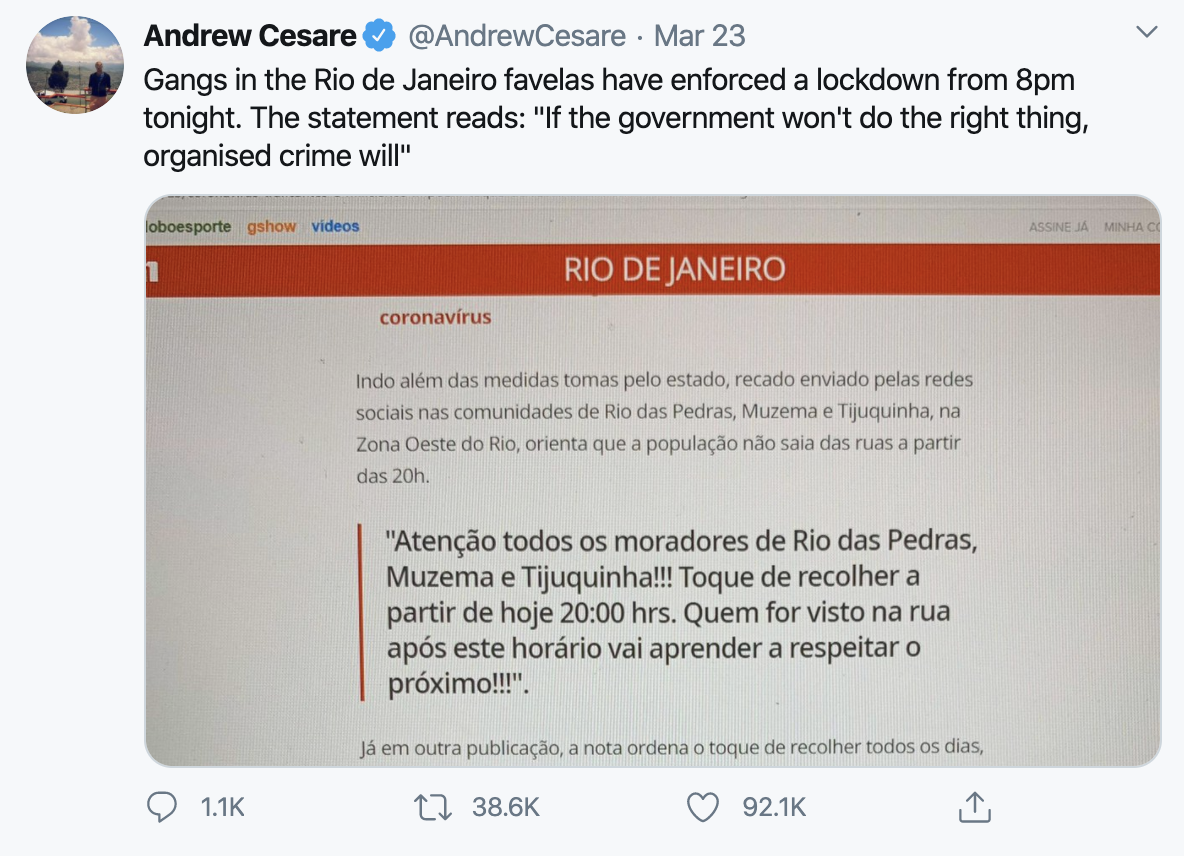
The clue for anarcho-capitalist state-sceptics that this is a genuine shift in social priorities is that even organized criminal gangs are willing to enforce social distancing. You do not have to believe that the state itself is legitimate to see that the need for social distancing is sufficiently morally compelling that it can be enforced absent free agreement, just as one does not need free agreement to exercise a right to self-defense.

Not every restriction is going to be justified, although erring on the restrictive side makes sense while uncertainty about the spread of infection persists. Ultimately, restrictions have to balance genuine costs with plausible benefits. But rejecting restrictions on a priori grounds does not cohere with libertarian principles. Right now, our absolute liberties extend to the right to be alone. Everything else must be negotiated under uncertainty. Someone else’s life, even two-weeks or so in the future, is a valid side-constraint on liberty. People can rightfully be made to stay at home if they are fortunate enough to have one. When people have to travel out of necessity, they can be temporarily exempted, compensated or offered an alternative reasonable means of satisfying their immediate needs.

A PPE pandemic reading list

I haven’t written for a while – other duties get in the way – but I’d like to suggest this reading list in Philosophy, Politics, and Economics for the present time of crisis and perplexity. The main reason is that everyone seems to be an expert in Economics, Epidemiology, and Political Philosophy these days, assuming that from “facts” we can easily derive “values” and answer the question, “what is to be done?” I think this is at best a naïve attitude and at worst the same rationalistic hubris we experience everytime a political issue is simplified and reduced to a matter of “science”. Yes, there are facts and they shouldn’t be ignored, but it’s not easy to decide what is to be done, morally and politically, in light of those facts.

The first item on the list is Leviathan by Thomas Hobbes. A classic, and a reminder that people choose all the time to sacrifice some degree of liberty in the altar of survival (or a chance to survive), but also a reminder that Leviathan may turn from friend to foe, from protector to persecutor – and there is very little we can do about it. The second item is John Locke’s Second Treatise of Government, which then explores this topic in light of the fact that civil government shouldn’t have absolute power. It makes an attempt to show us how that power can, or should, be limited within a certain sphere of responsibility. Though it’s still there to protect us.

In this time of pandemic, people feel tempted to panic. People and politicians are calling for dramatic measures, and one reason is that the use of government coercion – which, according to Locke, ought to be limited – might be necessary to force people to cooperate, for example, by staying home. This is a proposed solution to the dilemmas of collective action posed by the problem that some may “free-ride” on the rest, and, as a result, the disease will keep spreading, frustrating any attempt to slow it down. Against dramatic, desperate and, perhaps, arrogant, use of political power, and in favor of prudence and wisdom, Edmund Burke’s collection of writings from the period of the French Revolution can be a beacon of light. On the other hand, explaining the dilemmas of collective action and suggesting ways of solving them, Mancur Olson offers an insightful look at incentives and group behavior in The Logic of Collective Action.

However, the idea that government coercion is the only solution to dilemmas of collective action (such as imposing a quarantine, for example) doesn’t hold water. In fact, other economists follow Olson in saying the problem is real and challenges a strict individualist way of thinking, but, adding to Olson’s point, they also acknowledge the role of private action and sanctions in fostering cooperation. Elinor Ostrom’s Governing the Commons is a wonderful study that opens up a number of possibilities for private enforcing of collective action to preserve and promote the frugal allocation of common goods. This can be complemented by The Quest for Community, an overlooked work by sociologist Robert Nisbet, where it becomes clear that, between individuals, the state, and the market, there’s room for other associations and communities that strengthen civil society – particularly in this challenging time. Nisbet’s lesson invites liberty-loving people to reflect on whether a hyper-individualistic view of the world ends up pitting helpess individuals against Leviathan instead of offering the buffer zone of community in between. This is something Alexis de Tocqueville discussed in the 19th century.

And just for the sake of dealing with the issue that “is” doesn’t easily lead to “ought”, and that science might have facts and an explanation for them, but does not easily conduce to a proper discussion on values policy, I must finish this PPE pandemic reading list with F. A. Hayek’s The Constitution of Liberty. On Chapter 4, for example, Hayek introduces a constrast between “rationalist liberalism” and “anti-rationalist liberalism”. Rationalist liberals assume too easily that knowledge of the facts on the ground will give them what they need to re-design a society governed by reason. Hayek warns us against this technocratic assumption and offers a defence of “anti-rationalist liberalism”. Anti-rationalist liberals understand the importance of spontaneous order and of constraining power (even at a time of crisis) while prudently balancing the values of liberty and safety in light of past experience and tradition.


Three Additional readings:

Buzan, Waever and De Wilde, Security: A New Framework for Analysis (1997). In a liberal democracy, the state steps in suspending some civil liberties only if it can persuade citizens that there’s a threat that justifies it. This book offers a framework to interpret how such threats are constructed in official and non-official discourse, and to what extent this construction of a threat can be effective.

Robert Higgs, Crisis and Leviathan (2013). 25th anniversary edition. Looks at US history and how government employed crises to its advantage and the advantage of the ruling elites. In particular, security and economy related issues are dealt with.

Sanford Ikeda, Dynamics of the Mixed Economy (2002). Shows that a time of crisis might be a time for further interventionism in the economy, as Higgs (see above) suggests, but might also be a time for disintervention, as seems to be the case with part of the agenda today (FDA deregulation, etc.) This is based on Ludwig von Mises’ view that interventionist economies are not very stable and are always swinging as a pendulum between socialism and capitalism.


Pandemic responses are beyond Evidence-based Medicine

critical-appraisal-of-randomized-clinical-trials-14-638

John Ioannidis, a professor of medicine at Stanford University, fears that the draconian measures to enforce social distancing across Europe and United States could end up causing more harm than the pandemic itself. He believes that governments are acting on exaggerated claims and incomplete data and that a priority must be getting a more representative sample of populations currently suffering corona infections. I agree additional data would be enormously valuable but, following Saloni Dattani, I think we have more warrant for strong measures than Ioannidis implies.

Like Ioannidis’ Stanford colleague Richard Epstein, I agree that estimates of a relatively small overall fatality rate are plausible projections for most of the developed world and especially the United States. Unlike Epstein, I think those estimates are conditional on the radical social distancing (and self-isolation) measures that are currently being pushed rather than something that can be assumed. I am not in a position to challenge Ioannidis’ understanding of epidemiology. Others have used his piece as an opportunity to test and defend the assumptions of the worst-case scenarios.

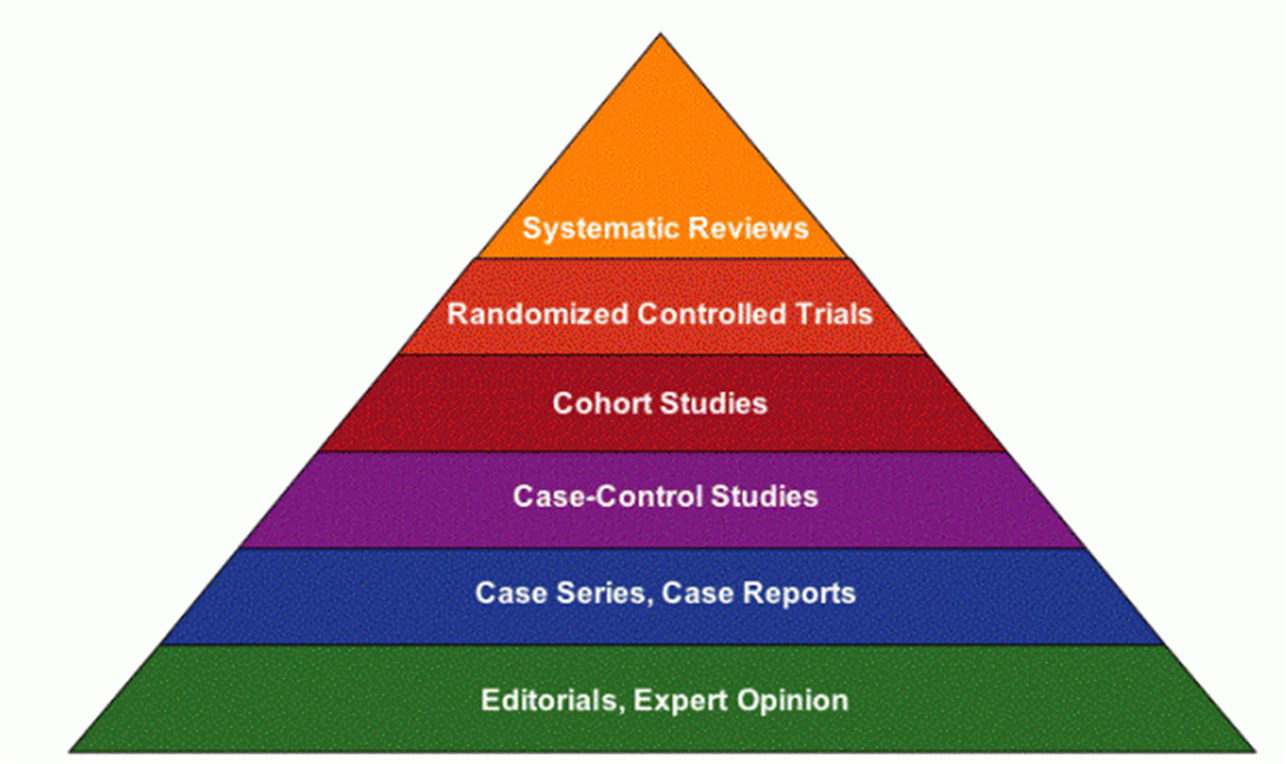
Nevertheless, I can highlight the epistemic assumptions underlying Ioannidis’ pessimism about social distancing interventions. Ioannidis is a famous proponent (occasionally critic) of Evidence-based Medicine (EBM). Although open to refinement, at its core EBM argues that strict experimental methods (especially randomized controlled trials) and systematic reviews of published experimental studies with sound protocols are required to provide firm evidence for the success of a medical intervention.

The EBM movement was born out of a deep concern of its founder, Archie Cochrane, that clinicians wasted scarce resources on treatments that were often actively harmful for patients. Cochrane was particularly concerned that doctors could be dazzled or manipulated into using a treatment based on some theorized mechanism that had not been subject to rigorous testing. Only randomized controlled trials supposedly prove that an intervention works because only they minimize the possibility of a biased result (where characteristics of a patient or treatment path other than the intervention itself have influenced the result).

Picture4

So when Ioannidis looks for evidence that social distancing interventions work, he reaches for a Cochrane Review that emphasizes experimental studies over other research designs. As is often the case for a Cochrane review, many of the results point to uncertainty or relatively small effects from the existing literature. But is this because social distancing doesn’t work, or because RCTs are bad at measuring their effectiveness under pandemic circumstances (the circumstances where they might actually count)? The classic rejoinder to EBM proponents is that we know that parachutes can save lives but we can never subject them to RCT. Effective pandemic interventions could suffer similar problems.

Nancy Cartwright and I have argued that there are flaws in the methodology underlying EBM. A positive result for treatment against control in a randomized controlled trial shows you that an intervention worked in one place, at one time for one set of patients but not why and whether to expect it to work again in a different context. EBM proponents try to solve this problem by synthesizing the results of RCTs from many different contexts, often to derive some average effect size that makes a treatment expected to work overall or typically. The problem is that, without background knowledge of what determined the effect of an intervention, there is little warrant to be confident that this average effect will apply in new circumstances. Without understanding the mechanism of action, or what we call a theory of change, such inferences rely purely on induction.

The opposite problem is also present. An intervention that works for some specific people or in some specific circumstances might look unpromising when it is tested in a variety of cases where it does not work. It might not work ‘on average’. But that does not mean it is ineffective when the mechanism is fit to solve a particular problem such as a pandemic situation. Insistence on a narrow notion of evidence will mean missing these interventions in favor of ones that work marginally in a broad range of cases where the answer is not as important or relevant.

Thus even high-quality experimental evidence needs to be combined with strong background scientific and social scientific knowledge established using a variety of research approaches. Sometimes an RCT is useful to clinch the case for a particular intervention. But sometimes, other sources of information (especially when time is of the essence), can make the case more strongly than a putative RCT can.

In the case of pandemics, there are several reasons to hold back from making RCTs (and study designs that try to imitate them) decisive or required for testing social policy:

  1. There is no clear boundary between treatment and control groups since, by definition, an infectious disease can spread between and influence groups unless they are artificially segregated (rendering the experiment less useful for making broader inferences).
  2. The outcome of interest is not for an individual patient but the communal spread of a disease that is fatal to some. The worst-case outcome is not one death, but potentially very many deaths caused by the chain of infection. A marginal intervention at the individual level might be dramatically effective in terms of community outcomes.
  3. At least some people will behave differently, and be more willing to alter their conduct, during a widely publicized pandemic compared to hygienic interventions during ordinary times. Although this principle might be testable in different circumstances, the actual intervention won’t be known until it is tried in the reality of pandemic.

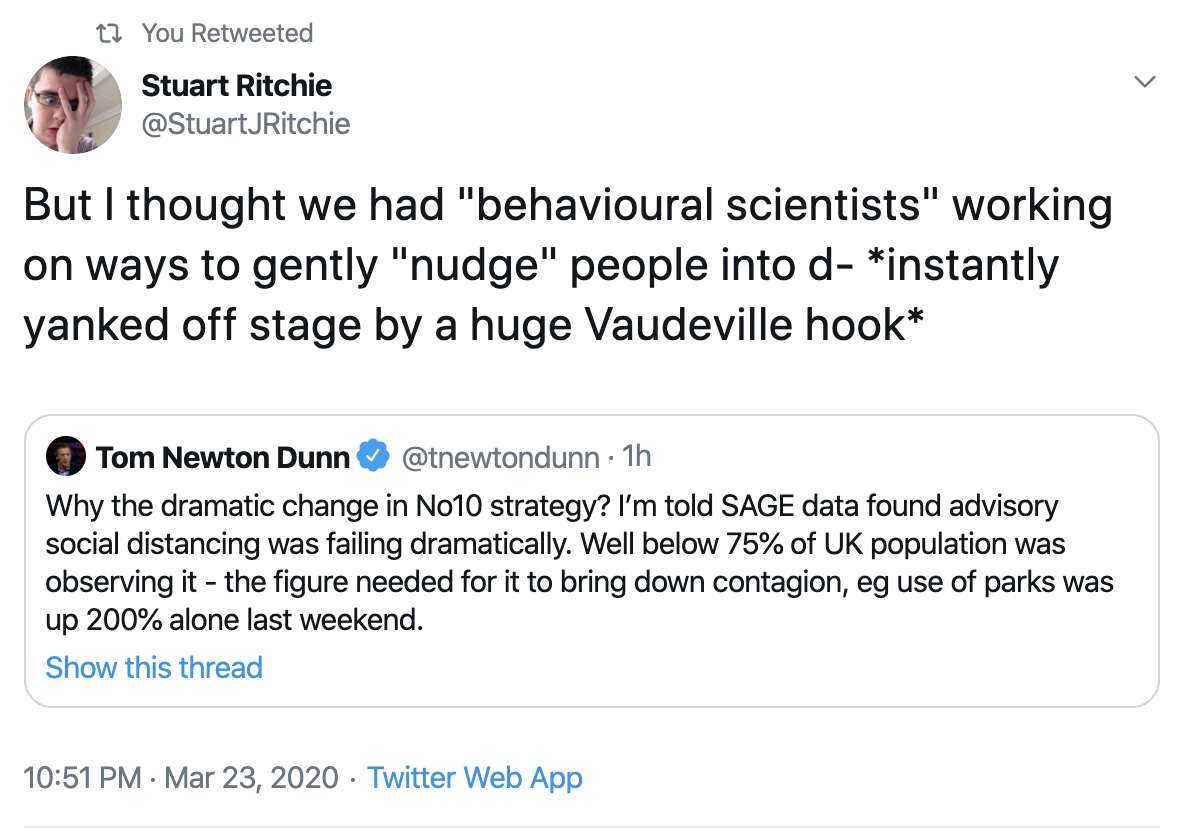
This means that rather than narrowly focusing on evidence from EBM and behavioral psychologists (or ‘nudge’), policymakers responding to pandemics must look to insights from political economy and social psychology, especially how to shift norms towards greater hygiene and social distancing. Without any bright ideas, traditional public health methods of clear guidance and occasionally enforced sanctions are having some effect.

Screenshot 2020-03-23 at 23.57.13

What evidence do we have at the moment? Right now, there is an increasing body of defeasible knowledge of the mechanisms with which the Coronavirus spreads. Our knowledge of existing viruses with comparable characteristics indicates that effectively implemented social distancing is expected to slow its spread and that things like face masks might slow the spread when physical distancing isn’t possible.

We also have some country and city-level policy studies. We saw an exponential growth of cases in China before extreme measures brought the virus under control. We saw immediate quarantine and contact tracing of cases in Singapore and South Korea that was effective without further draconian measures but required excellent public health infrastructure.

We have now also seen what looks like exponential growth in Italy, followed by a lockdown that appears to have slowed the growth of cases though not yet deaths. Some commentators do not believe that Italy is a relevant case for forecasting other countries. Was exponential growth a normal feature of the virus, or something specific to Italy and its aging population that might not be repeated in other parts of Europe? This seems like an odd claim at this stage given China’s similar experience. The nature of case studies is that we do not know with certainty what all the factors are while they are in progress. We are about to learn more as some countries have chosen a more relaxed policy.

Is there an ‘evidence-based’ approach to fighting the Coronavirus? As it is so new: no. This means policymakers must rely on epistemic practices that are more defeasible than the scientific evidence that we are used to hearing. But that does not mean a default to light-touch intervention is prudent during a pandemic response. Instead, the approaches that use models with reasonable assumptions based on evidence from unfolding case-studies are the best we can do. Right now, I think, given my moral commitments, this suggests policymakers should err on the side of caution, physical distancing, and isolation while medical treatments are tested.

[slightly edited to distinguish my personal position from my epistemic standpoint]

Coronavirus and takings

City governments are flirting with a ban on evictions during the coronavirus pandemic. I doubt, however, that doing so comports with the Constitution’s takings clause or, perhaps, the contracts clause.

San Jose has introduced legislation that will ban evictions due to un/underemployment resulting from coronavirus. Seattle’s socialist firebrand, Kshama Sawant, calls for similar action. Her letter, though, betrays the truth behind many proposed emergency measures–she’s leveraging the crisis to further her political agenda, particularly her hatred of capitalism. In the letter, she froths: “The status quo under capitalism is deeply hostile to the majority of working people, and it would be unconscionable to place the further burden of the Coronavirus crisis on those who are already the most economically stressed.” Never mind that the status quo in the absence of capitalism would be grinding poverty.

But, in any case, the proposal to ban evictions and force landlords to renew leases as the pandemic sweeps across the states raises serious constitutional concerns. Even in times of crisis, observance of constitutional norms remains essential. In part, this is because laws passed as emergency measures tend to hang about long after the emergency subsides. New York rent control began as a wartime measure, for instance, and that curse still plagues the New York rental market. The other reason, of course, is that the Constitution is built for just these moments. The pressure to invade rights, after all, comes when things are not going well. As Justice Sutherland once put it, “If the provisions of the Constitution be not upheld when they pinch, as well as when they comfort, they may as well be abandoned.”

Forcing landlords to either renew leases or forego eviction for lease violations likely raises at least two constitutional problems: takings and impairment of contractual obligations. While such laws don’t literally seize property, they effectively impose a servitude on landlords’ property, stripping them of control over the disposition and occupation of their land. When an essential attribute of property ownership is destroyed by regulation in this manner, the government must offer compensation. We already know this compensation requirement applies during national emergencies. During World War II, for instance, the Supreme Court held that the United States had to compensate property owners and leaseholders when it temporarily seized factories for wartime production.

The contract clause problem is also straightforward: barring landlords from enforcing lease terms impairs obligations under pre-existing contracts. The contracts clause, though, has been severely undermined in recent decades, such that a showing of a compelling interest like mitigating the impact of the pandemic may well satisfy the flaccid demands of the modern contracts clause.

It may seem profoundly harsh to impose constitutional constraints on governments trying to resolve a crisis. But three things ought to be kept in mind.

First, an emergency certainly means that some will face a heavy burden, but that fact tells us nothing about how that burden should be allocated. Why should landlords bear the costs? Indeed, As the Supreme Court said in Armstrong v. United States, the takings clause exists to avoid imposing societal burdens on specific individuals: “The Fifth Amendment’s guarantee that private property shall not be taken for a public use without just compensation was designed to bar Government from forcing some people alone to bear public burdens which, in all fairness and justice, should be borne by the public as a whole.”

Second, we should keep in mind that lease agreements already account for risk. That’s baked into the price and terms that give rise to a mutually agreeable arrangement between parties. To simply allow one party to slip out of the terms of the lease distorts that arrangement.

Third, the takings clause does not bar emergency measures, including the seizure of property, but only upon just compensation. No exigency should excuse cities like San Jose or Seattle from compensating for the costs they’re hoisting upon landlords. And in the case of the contracts clause, the government could still honor existing leases by acting as a guarantor for tenants who can’t pay the rent.

All of these points apply to a world in which landlords do not voluntarily exercise leniency. But I think we’ll find that most landlords are forgiving during a temporary crisis. Most landlords have an extreme aversion to evicting tenants–it’s the nightmare, last-ditch option that they try hard to avoid. That, plus the simple dose of compassion that many landlords will feel inspired to offer, may do more toward helping see us through than any emergency measures.

13 Books for 2020 – What A Year!

2020 is turning into quite the publishing year.

Perhaps every year is like this and I just haven’t been paying attention before. Now, as I actively scan publisher sites and newsletters for upcoming books, there seems to be an abundance of super-interesting new stuff: how is anybody – even someone like me who does this for a living – supposed to keep up?

#1: The year began at full (or stagnating…?) speed with University of Houston professor Dietrich Vollrath‘s Fully Grown: Why a Stagnant Economy is a Sign of Success, With praise by Tyler Cowen and reviews in The Economist and the Wall Street Journaland actually a lot of good discussions on Twitter – I’m sad that I haven’t taken time to read it. Later, perhaps, on the off-chance that nothing else on this incredible lists comes in the way.

#2: Next up was Diane Coyle‘s Markets, State, and People. Coyle, the endlessly interesting public intellectual/economist and newly(-ish) appointed Professor of Public Policy at Cambridge, is someone we all should read: she manages to be controversial and still balanced, provocative but still interesting. This book, however, seems to be in line with all the other “Third Way” books of last year: Acemoglu and Robinson’s The Narrow Corridor; Raghuram Rajan’s The Third Pillar; Branko Milanovic’s Capitalism, Alone. Crowded field. As I haven’t even gotten around to her previous book on GDP yet, I imagine I’ll read that one first whenever I carve out some time for Coyle.

The curse of modernity is quickly adding up.

#3: Changing gears somewhat at least in terms of topics I have started reading Charles Murray‘s Human Diversity: The Biology of Gender, Race, and Class and it’s exactly as provocative as you might think. Delivered, however, with the seriousness of scientific investigation and a massive chip on his shoulder. Still, exactly the kind of antidote to madness that fuels a lot of my priors. I’ll write up a comment or two whenever I finish this 528-page tome.

#4: In a similar vein is the Dutch writer and historian Rutger Bregman‘s Humankind: a Hopeful History, scheduled to be released in June. As Bregman isn’t somebody that I usually agree with, I’m very excited to read this take of his, which is hopefully a mix of Paul Bloom’s End of Empathy, Ruth DeFries’ The Big Ratchet and Paul Seabright’s The Company of StrangersSort of like Yuval Harari’s Sapiens but better (and no, I’m not on Team Harari despite this excellent long-read in The New Yorker).

#5: Going back a little bit to what I think is chronologically the next book to be released (on Tuesday March 10 in the U.S., but not until April in the U.K.) is Robert Bryce’s A Question of Power: Electricity and the Wealth of NationsHaving recently written a piece on electricity generation and being into the weeds about climate change and emissions, I’m very curious about this take on electricity as a critical source for our prosperity. I hope it reads a little like an improved version of Zubrin’s best chapters in Merchants of Despair.

#6: March is also the month for Angus Deaton and Anne Case‘s Deaths of Despair and the Future of Capitalism (Amazon says it’s already out in the U.K.) Their hugely successful and highly relevant pet project for the last few years, Deaton and Case’s case(!) for how rising morbidity rates indicate a collapse of the fabric of society is a pretty standard one by now: globalization, economic inequality, the hollowing-out of tight-knit communities and the various forces that may have fueled this.

The reviews are already popping up left and right (WSJ, Financial Times) and their session was the most exciting and most talked-about at the ASSA meeting in San Diego. As I understand it, the latest findings is that American life expectancy that pesky ever-increasing number that fell in recent years, in no small part due to overdoses and opioids has recovered and is now again on the up-tick. Maybe Deaton and Case’s book will be one for an odd historic event rather than foreshadowing “The Future of Capitalism” (also, what’s up with shoving ‘Future of Capitalism’ into your titles?!).

#7: In a similar topic, Robert Putnam yes, the Harvard professor famous for Bowling Alone and the idea of social capital is back with another sweeping analysis of what’s gone wrong with American society. The Upswing: How America Came Together a Century Ago and How We Can Do It Again, coming out in June, is bound to make a lot of waves and receive a lot of attention by social commentators.

#8: Officially published just yesterday is John Kay and former Bank of England Governor Mervyn King‘s Radical Uncertainty: Decision-Making for an Unknowable Future. Admittedly, this is the book I’m least excited about on this list. Reviewing King’s 2016 End of Alchemy where King discussed his experiences of the financial crisis and the global banking system for the Financial Times, John Kay discussed exactly that: the title? “The Enduring Certainty of Radical Uncertainty.” Somebody please press the snooze button. Paul Krugman’s 4000 word review of End of Alchemy ought to be enough; I’d be surprised if Kay and King brings something new to the table in thus poorly-titled release (though, of course the fringe already loves it).

The Really Good Stuff

While the above eight titles are surely worth at least some of your time, the next five are worth all of it.

#9: I’ll begin with my two biggest hypes: Matt Ridley‘s How Innovation Works: And Why It Flourishes in Freedom, coming out May 14th in the U.K. and May 19th in the U.S. The author of The Rational Optimist and The Evolution of Everything is back with another 400-page rundown of a deep-seated and hyper-relevant topic: how do societies innovate and progress? What conditions assist it, and which obstacles prevent it? 

I expect a lot of spontaneous order-type arguments, debunked Great Man fallacies, and some Mariana Mazzucato take-downs.

#10: The second hype, William Quinn and John Turner‘s Book and Bust: A Global History of Financial BubblesSince John first told me about this book over a year-and-a-half ago, I’ve been super excited – I’m a big fan of his work and I’m looking forward to receiving my review copy in the next couple of weeks. Publication date: August.

#11: For somebody who writes about bubbles and financial markets more than most people think healthy, I’m gonna get a warm-up in MIT professor Thomas Levenson‘s Money for Nothing: The South Sea Bubble & The Invention of Modern CapitalismWhat’s with all these books on historical financial bubbles? Yes, you’re right: 2020 marks the three-hundred year anniversary of the South Sea Bubble, that iconic period of John Law in France and the similar government funding scheme in England will surely receive a lot of attention this year.

#12: Some environmental stuff at last: Bjørn Lomborg, the outspoken author and voice of reason in the climate change space announced that his False Alarm: How Climate CHange Panic Costs Us Trillions, Hurts The Poor, and Fails To Fix the Planet will be published in June this year! While possibly the least boring book on this list, the title receives lowest possible marks. What overworked publisher decided that this page-long subtitle was a good idea?!

#13: Also, Alex Epstein of the Centre for Industrial Progress and host of Power Hour (one of my all-time favorite podcasts) has been working on an update to his hugely popular The Moral Case for Fossil Fuels. As far as I understand, we’re to receive an updated and revised version in August the Moral Case for Fossil Fuels 2.0!


So. The next six months have at least thirteen pretty interesting books coming up. I imagine there are a bunch more for the rest of the year and a few I have completely overlooked.

Also, after this burst of links, Amazon should probably offer Notes On Liberty an affiliate program.

In sum: you can see my fields of interests overlapping here: (1) financial history and financial markets; (2) environment, climate change, and its solutions; (3) Big Picture society stories, preferably by interesting or quantitatively savvy authors. Not enough on the fourth big interest of mine: (4) money and monetary economics – particularly in historical contexts. Perhaps not, as David Birch’s Before Babylon, Beyond Bitcoin is on my desk, and I’m currently re-reading William Goetzmann’s Money Changes Everything both first released in 2017.

Also: the absence or underrepresentation of women (or ethnic minorities or any other trait you care a lot about) might disturb you: 2 out of 17 authors women (4 out of 27 authors mentioned) Needless to say, it must be because I’m sexist.

Post-script: Ha! As I just heard about Stephanie Kelton‘s upcoming book The Deficit Myth: Modern Monetary Theory and the Birth of the People’s Economy, I’m gonna quickly add it to the list and satisfy both of my qualms above: not enough women (now: 3/18 authors!), and not enough monetary economics. Splendid!

Happy reading, everyone!

Or, why I don’t vote

I had been rooting for Senator Klobuchar a bit here at NOL over the past couple weeks. Nothing crazy, but I liked what I read. Now, I must eat my words. It turns out the Senator was a government prosecutor before she became a politician, something I did not know.

So, I am glad she’s out of the race. Being a government prosecutor is how most politicians in Washington start their careers. How many people can you put behind bars? How much “crime” can you prevent? If you’re answer is “LOTS” then you’re well on your way to a seat in federal Congress.

I’m not much of a political junkie anymore. I’ve just come to accept that I’m ignorant of far too many things to waste my time in a voting booth, or listening to politicians promise me stuff.

I understand that democracy is the the worst form of government, except for all the others. But I’m ignorant. When I’m old, and bored, I’ll probably get back into politics. I can think of nothing more intellectually stimulating, actually, than participating in political events as a senior citizen. The crowds, the organizational effort, the sense of belonging. I get it now.

The most heartening, encouraging thing I’ve read about the American primaries is that young people are still staying away from the polls. Liberty is alive, well, and aflame.

My Political Paranoia on Speed

I gave myself a little time to react to the Super Tuesday Democratic Party primary results (in the US). I wanted to examine my own head and my own heart first. Incidentally, I don’t feel shy about spouting off today. The professional pundits have proven again that they don’t know much of anything.

V.P. Joe Biden came up from behind in an astonishing sweep of several states. First, I don’t know how it happened. It’s credible that the heart of the Dem. Party was always sort of moderate although we were misled by the hype about socialist Sen. Sanders. Second, it’s possible that the Dem leadership, national and local, worked double time toward an unlikely Biden victory. All the same, it remains hard to believe.

I have two fears, a little one and a big one. The little one first: Should VP Biden actually get the nomination and should Pres. Trump agree to debate him, I am afraid he, Mr Trump, will not be able to restrain himself, that he will bully Mr Biden on stage, even make him cry. That would be a disaster big enough to guide tender-hearted undecided voters away from the president. In a close election it might just make the difference.

Now, about my second fear, but let me start with a reminder. Those who know me a little are aware of the fact that I don’t readily adopt conspiracy explanations (of anything). I also have a record of keeping paranoia at bay. Ordinary human folly and bad luck explain almost everything I don’t like. This time is different.

It’s almost impossible to not see what I see: Mr Biden is not capable of being president. He is too old to sustain the stress. He is too mentally fragile. The fact that he gave a decently coherent victory speech Tuesday night does not modify much my opinion. Mr Biden and I are the same age and I am well aware of the short term miracles that pharmacology can produce. (And by the way, I don’t make much of the fact that he briefly confused his wife for his sister. That may just have been a shout out to Rep. Ilhan Omar.) Moreover, Mr Biden is corrupt if not directly, for his relatives. Corruption and senility make an explosive mixture.

So, if the Dem apparat is aware, it may never have to worry about Mr Biden’s ability to govern, or not for long. If he obtains the nomination, the Dem elite will produce yet another Clinton miracle. Hillary Clinton will become the VP nominee. If they win, soon after President Biden’s inauguration, he will retire informally, or even formally. Ms. Clinton will then at last have the presidency that is owed to her.

Alternatively, the Dem elite is not cured of its identity obsession and confusion and it will choose as a V.P candidate, the low-achieving, snobbish, and anti-American Michelle Obama. Same scenario except that the occult Dems will exercise even more power.

Tell me I am crazy. Please.

One good thing has come out of this 2020 Dem. primary: The myth has been put away for a while that one can buy an election, at least as directly as Mr Bloomberg tried to do. He may yet try to buy if for Mr Biden, of course.

“Medicare For All” will never work: a Brazilian view

Even though I don’t follow the news, it’s somewhat impossible not to know that Bernie Sanders is making a lot of buzz as the possible Democrat candidate for the coming presidential elections. I know: he presents himself as a democratic socialist; he says that some European countries are good examples for the US. I believe that as a Brazilian I have something to say about that.

Bernie Sanders often compares the US with countries like Denmark or Sweeden. I believe there is a fundamental problem with that: the US is a gigantic country with a gigantic population. And a very diverse population at that! Nordic countries are tiny, with a tiny and homogenous population. How about comparing the US and Brazil? The two countries have about the same size and the population is not too different. Besides, Brazil is as culturally diverse as the US. Maybe more!

So here are some things about Brazil that I think people should know. Brazil is by definition a social democracy. That is not written anywhere, but one has only to read our constitution to be aware of that. Brazil’s constitution is very young: it was promulgated in 1988. As so, it reflects more recent political ideas. For example, it basically puts healthcare as a human right that the government has to provide for the population. So, Brazil has (in theory) a free universal healthcare system.

How is healthcare in Brazil in reality? Horrible. Inhumane. Media news are basically the same every week: long waiting lines for the most basic treatments. People dying without care. Few doctors. Overprice. Medication and equipment rooting without use. I don’t think that people in Brazil are different from people in the US. We have the same chromosomes. The difference is in how we deal with the issue. Brazil decided that healthcare is a right and that it should be provided by the government. The result is that we don’t have healthcare.

I believe I know why things are the way they are in Brazil: healthcare is a need. No doubt about that! But there is something really bad when a need is turned into a right. A right means that you have to get it, no matter what. But, really? No matter what? Second, there is something very deceiving when one talks about “free” healthcare. Really? Free?! Doctors have to get paid. Medicine costs money. One can’t possibly be serious when they say “free healthcare”. Finally, I suspect that the Austrian School of economics has something very important to say about the government running the healthcare system. More than anyone else, Friedrich Hayek pointed to how free prices are important for the economy. In a truly free economy, supply and demand interact with prices: high prices mean low supply; low prices mean high supply. This simple mechanism functions as a compass for everyone. However, when the government interferes, the result is inefficiency.  Too much medicine is bought and just rots. Or too little, and people die.

I’m not sure how many Bernie supporters read Notes on Liberty. But I really wish some of them would check what happens in Brazil. We tried to have a free universal healthcare system. We tried to have free college. We tried all these things. It didn’t work. I believe that the Austrian School can explain why. I know, it’s a bummer. There is nothing nice about people dying for lack of treatment. However, if you agree with me that this is a problem, I believe I’m in the right position to say that socialism – democratic or not – is not the solution.